L
EARNING
O
UTCOME
1
Describe factors that affect the vital signs and accurate measurement of them.
Concepts for Lecture
1. The vital signs are body temperature, pulse, respirations, and blood
2. Vital signs monitor functions of the body and reflect changes that
3. Factors affecting body temperature include:
• Age: Affects body temperature, pulse, respirations, and blood
(1.8
F) between early morning and late afternoon. The point of
highest temperature is usually reached between 1600 and 1800
hours (4
PM
and 6
PM
), and the lowest is reached during sleep be-
tween 0400 and 0600 hours (4 AM and 6 AM).
• Exercise: Hard work or strenuous exercise can increase body tem-
perature.
the person’s body temperature will be low.
• Pyrexia: This is a body temperature above the usual range. Hyper-
thermia is a fever, and a very high fever (41
C or 105.8
F) is
4. Factors affecting the pulse include:
• Gender: After puberty, the average male’s pulse rate is slightly
lower than the female’s.
C
HAPTER
29
VITAL SIGNS
S
UGGESTIONS FOR
C
LASSROOM
A
CTIVITIES
• Have the students monitor their own body tem-
peratures in the morning on arising, in the late af-
ternoon, and between 2 AM and 4 AM and report
findings.
• Have several students run up and down a flight
of stairs after obtaining baseline radial, apical,
S
UGGESTIONS FOR
C
LINICAL
A
CTIVITIES

CHAPTER 29 / Vital Signs 167
•
Exercise: The pulse rate normally increases with exercise. The rate of
increase in the professional athlete is often less than that of the average
• Stress: Affects pulse because the sympathetic nervous stimulation
increases the overall activity of the heart. In addition, the rate and
force of the heartbeat increases. Fear, anxiety, and the perception
5. Several factors influence respiratory rate:
• Factors that increase the respiratory rate include exercise (increas-
6. Two of the factors that affect depth of respirations are:
• Body position: The depth is suppressed in certain body positions
7. Factors affecting blood pressure include:
• Exercise: Increases the cardiac output and the blood pressure.
•
Stress: Affects blood pressure because stimulation of the sympathetic
nervous system increases cardiac output and vasoconstriction of the ar-
terioles, which increases the blood pressure reading. However, severe
and adults.
• Diurnal variations: Have an affect on blood pressure, which is
usually lowest early in the morning when the metabolic rate is
lowest. It rises throughout the day and peaks in the late afternoon
or early evening.
168 CHAPTER 29 / Vital Signs
L
EARNING
O
UTCOME
2
Identify the variations in normal body temperature, pulse, respirations, and
blood pressure that occur from infancy to advanced age.
Concepts for Lecture
1. The body temperature of an infant is greatly influenced by the tem-
perature of the environment. Children’s temperatures continue to be
more variable than those of adults until puberty. Many older people,
3. The respiratory rhythm of an infant may be less regular than an
4.
Newborns have a mean systolic pressure of about 75 mm Hg. The pres-
sure rises with age, reaching a peak at the onset of puberty, and then
L
EARNING
O
UTCOME
3
Verbalize the steps used in:
a. Assessing body temperature
b. Assessing a peripheral pulse
c. Assessing the apical pulse and the apical-radial pulse
d. Assessing respirations
e. Assessing blood pressure
f. Assessing blood oxygenation using pulse oximetry.
ESSENTIAL/
CRITICAL
ELEMENT?
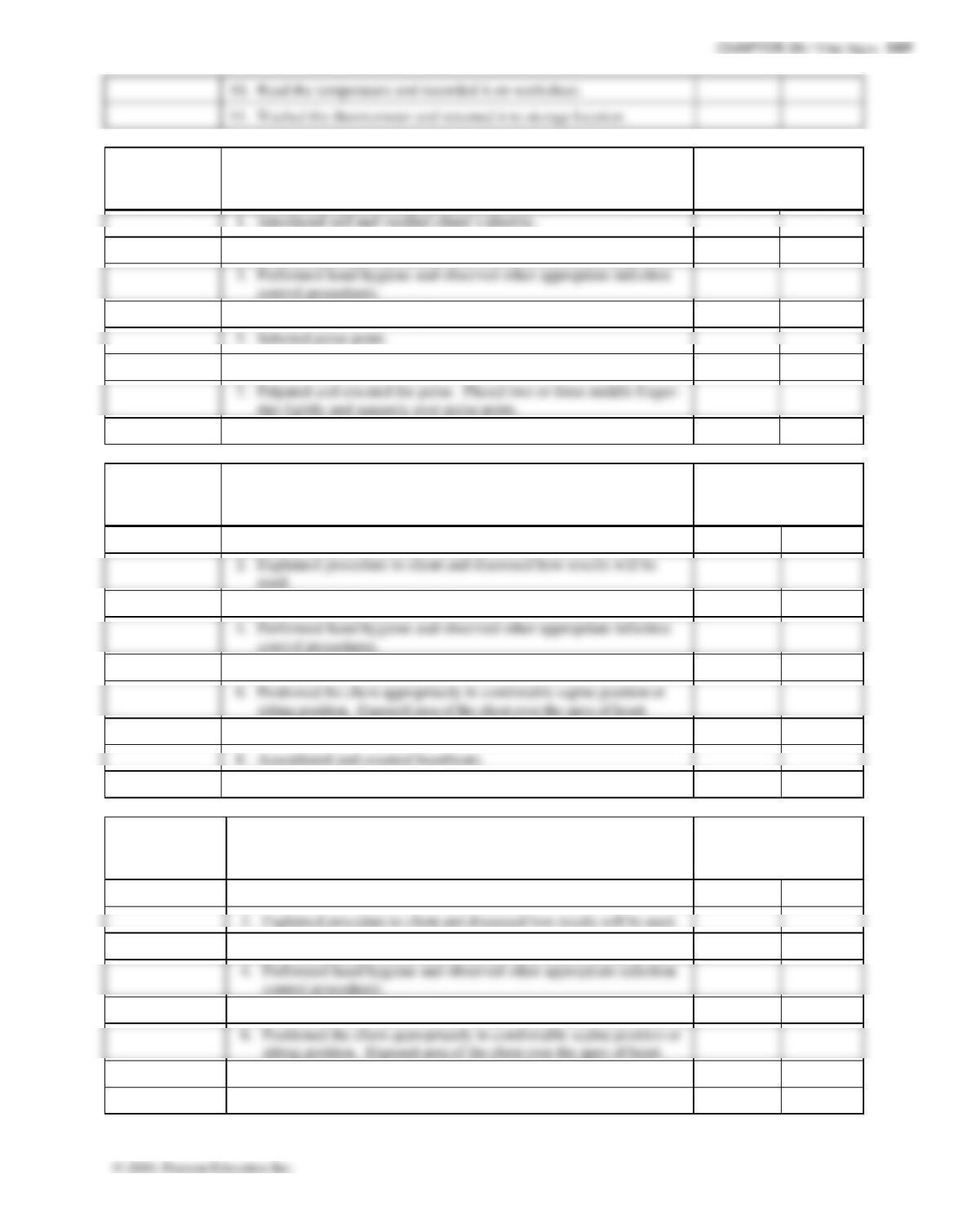
SKILL 29-1: ASSESSING BODY TEMPERATURE
COMPETENCY
DEMONSTRATED?
Yes
No
2. Explained procedure to client and discussed how results will be used.
3. Gathered appropriate equipment.
4. Performed hand hygiene and observed appropriate infection control
procedures.
5. Provided for client privacy.
6. Placed the client in the appropriate position.
7. Placed the thermometer.
8. Waited the appropriate amount of time.
9. Removed the thermometer and discarded the cover or wiped with a
tissue if necessary.
S
UGGESTIONS FOR
C
LASSROOM
A
CTIVITIES
• Discuss the standards for blood pressure in in-
fants and children.
• Provide students with clinical situations (e.g., a
crying infant) and them decide the order in which
to obtain the vital signs, providing rationales for
the order.
ESSENTIAL/
CRITICAL
ELEMENT?
SKILL 29-2: ASSESSING PERIPHERAL PULSES
COMPETENCY
DEMONSTRATED?
Yes
No
2. Explained procedure to client and discussed how results will be used.
4. Provided for client privacy.
6. Assisted client to a comfortable resting position.
8. Assessed pulse rhythm and volume.
ESSENTIAL/
CRITICAL
ELEMENT?
SKILL 29-3: ASSESSING AN APICAL PULSE
COMPETENCY
DEMONSTRATED?
Yes
No
1. Introduced self and verified client’s identity.
3. Gathered appropriate equipment.
5. Provided for client privacy.
7. Located apical pulse.
8. Auscultated and counted heartbeats.
9. Assessed the rhythm and strength of heartbeat.
ESSENTIAL/
CRITICAL
ELEMENT?
SKILL 29-4: ASSESSING AN APICAL-RADIAL PULSE
COMPETENCY
DEMONSTRATED?
Yes
No
1. Introduced self and verified client’s identity.
2. Explained procedure to client and discussed how results will be used.
3. Gathered appropriate equipment.
5. Provided for client privacy.
7. Located apical and radial pulse sites.
8. Counted the apical and radial pulse rates for 60 seconds.
170 CHAPTER 29 / Vital Signs
ESSENTIAL/
CRITICAL
ELEMENT?
SKILL 29-5: ASSESSING RESPIRATIONS
COMPETENCY
DEMONSTRATED?
Yes
No
1. Introduced self and verified client’s identity.
2. Explained procedure to client and discussed how results will be used.
3. Gathered appropriate equipment.
4. Performed hand hygiene and observed other appropriate infection
control procedures.
5. Provided for client privacy.
6. Observed or palpated and counted respiratory rate.
7. Observed depth, rhythm, and character of respirations.
ESSENTIAL/
CRITICAL
ELEMENT?
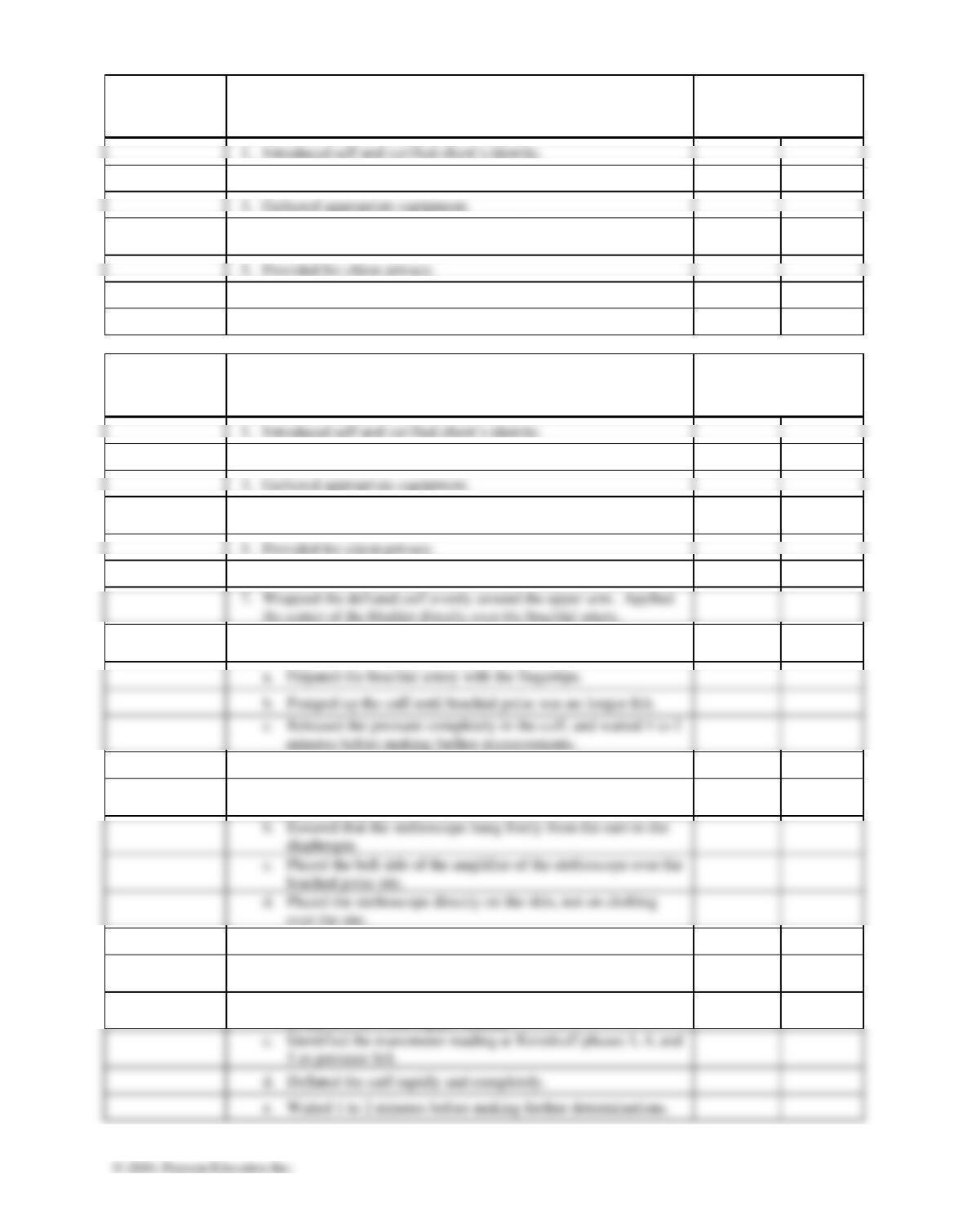
SKILL 29-6: ASSESSING BLOOD PRESSURE
COMPETENCY
DEMONSTRATED?
Yes
No
1. Introduced self and verified client’s identity.
2. Explained procedure to client and discussed how results will be used.
3. Gathered appropriate equipment.
4. Performed hand hygiene and observed other appropriate infection
control procedures.
5. Provided for client privacy.
6. Positioned the client appropriately.
7. Wrapped the deflated cuff evenly around the upper arm. Applied
8. Performed a preliminary palpation of systolic pressure with the
client’s initial examination.
c. Released the pressure completely in the cuff, and waited 1 to 2
minutes before making further measurements.
9. Positioned stethoscope appropriately.
a. Inserted the ear attachments of the stethoscope in ears so that
they tilt slightly forward.
diaphragm.
brachial pulse site.
d. Placed the stethoscope directly on the skin, not on clothing
over the site.
10. Auscultated client’s blood pressure.
a. Pumped up the cuff until the sphygmomanometer read 30 mm
Hg above the point where the brachial pulse disappeared.
b. Released the valve cuff carefully so that the pressure decreased
at rate of 2 to 3 mm Hg per second.
5 as pressure fell.
f. Repeated above steps to confirm the accuracy of the reading.
a. Helped the client assume a prone position.
b. Exposed the thigh, taking care not to expose the client unduly.
c. Located the popliteal artery.
b. Turned on the blood pressure switch.
d. Removed the cuff and checked skin condition periodically.
d. Wrapped the cuff evenly around the midthigh with the com-
pression bladder over the posterior aspect of the thigh and the
11. Removed the cuff from the client’s arm.
12. Wiped the cuff with an approved disinfectant.
ESSENTIAL/
CRITICAL
ELEMENT?
SKILL 29-7: ASSESSING OXYGEN SATURATION
COMPETENCY
DEMONSTRATED?
Yes
No
1. Introduced self and verified client’s identity.
2. Explained procedure to client and discussed how results will be used.
3. Gathered appropriate equipment.
4. Performed hand hygiene and observed other appropriate infection
control procedures.
5. Provided for client privacy.
6. Chose a sensor appropriate for client’s weight, size, and desired
location.
7. Prepared the site.
a. Cleaned the site with an alcohol wipe before applying the sensor.
8. Applied the sensor and connected it to the pulse oximeter.
9. Set and turned on the alarm when using continuous monitoring.
10. Ensured client safety.
ger sensor every 4 hours and a spring-tension sensor every 2
a. Inspected and/or moved the location of an adhesive toe or fin-
11. Ensured accuracy of measurement.
172 CHAPTER 29 / Vital Signs
L
EARNING
O
UTCOME
4
Describe appropriate nursing care for alterations in vital signs.
Concepts for Lecture
1. Nursing interventions for clients with fever include:
• Monitor vital signs.
• Assess skin color and temperature.
• Monitor white blood cell count, hematocrit value, and other perti-
2. Nursing interventions for clients with hypothermia include:
• Provide a warm environment.
• Provide dry clothing.
• Apply warm blankets.
L
EARNING
O
UTCOME
5
Identify nine sites used to assess the pulse and state the reasons for their use.
Concepts for Lecture
1. The nine sites used to assess the pulse are radial, temporal, carotid,
apical, brachial, femoral, popliteal, posterior tibial, and pedal (dorsa-
lis pedis). The radial site is readily accessible. The temporal site is
used when the radial pulse is not accessible. The carotid site is used
S
UGGESTIONS FOR
C
LASSROOM
A
CTIVITIES
• Provide the students with a drawing of the vascu-
lar system and have them identify the pulse sites.
• Have the students locate the pulse sites on a
partner.
S
UGGESTIONS FOR
C
LINICAL
A
CTIVITIES

CHAPTER 29 / Vital Signs 173
L
EARNING
O
UTCOME
6
List the characteristics that should be included when assessing pulses.
Concepts for Lecture
1. When assessing the pulse, the nurse collects the following data: rate,
2. Rate is the number of beats per minute (BPM). An excessively fast
heart rate (> 100 BPM in an adult) is referred to as tachycardia and
3. Rhythm is the pattern of beats and intervals between beats. Equal
4. Volume (also called pulse strength or amplitude) refers to the force
5. Elasticity of the arterial wall refers to its expansibility or its deformi-
ty. A healthy, normal artery feels straight, smooth, soft, and pliable.
L
EARNING
O
UTCOME
7
Describe the mechanics of breathing and the mechanisms that control respira-
tions.
Concepts for Lecture
1. During inhalation the following processes normally occur:
• Diaphragm contracts (flattens).
2. During exhalation the following processes normally occur:
• Diaphragm relaxes.
3.
Normally, breathing is carried out automatically and effortlessly. Respi-
ration is controlled by respiratory centers in the medulla oblongata, the
S
UGGESTIONS FOR
C
LASSROOM
A
CTIVITIES
• Discuss the scientific basis for the characteristics that
should be included when assessing pulses.
• Divide the students into pairs and have one student
obtain the radial pulse of his or her partner, noting the
characteristics of the pulse. Have the student go up
S
UGGESTIONS FOR
C
LASSROOM
A
CTIVITIES
• Discuss how body positioning can assist a person
with the mechanics of respiration.
174 CHAPTER 29 / Vital Signs
L
EARNING
O
UTCOME
8
Recognize when it is appropriate to delegate measurement of vital signs to
unlicensed assistive personnel.
Concepts for Lecture
1. Prior to delegating measurement of vital signs to unlicensed assistive
personnel (UAP), the nurse must have assessed the individual client
2. Routine measurement of the client’s temperature can be delegated to
the UAP or to family members/caregivers in nonhospital settings.
3. Measurement of the client’s radial or brachial pulse can be delegated
to the UAP or family members/caregivers in nonhospital settings.
Reports of abnormal pulse rates or rhythms require reassessment by
the nurse, who also determines appropriate action if the abnormality
4. Counting and observing respirations may be delegated to the UAP.
5. Blood pressure measurement may be delegated to the UAP. The in-
6.
Application of the pulse oximeter sensor and recording of the SpO2 value
L
EARNING
O
UTCOME
9
Demonstrate appropriate documentation and reporting of vital signs.
Concepts for Lecture
1. When documenting vital signs in the narrative note, the nurse in-
cludes both the reading obtained and any assessments gathered
S
UGGESTIONS FOR
C
LASSROOM
A
CTIVITIES
• Provide the students with client situations and
ask whether it would appropriate to delegate vital
sign measurement to unlicensed assistive per-
sonnel for these clients.
S
UGGESTIONS FOR
C
LINICAL
A
CTIVITIES
S
UGGESTIONS FOR
C
LASSROOM
A
CTIVITIES
• Phoning the provider can also be an intimidating
act for student nurses, so have them pair up and
practice “calling the doctor” to report abnormal
vital signs.
• Provide students with blank graphic record
sheets and several days’ worth of recorded vital
signs to allow them to practice documenting.

2.
Abnormal vital signs should be reported by the student nurse to the nurs-
ing instructor. As a graduate nurse, vital signs outside of normal limits