
Chapter 2. The Structure of Thermodynamics 1
Chapter 2. Structure of Thermodynamics
a. A solid bar of copper.
b. A glass of ice water.
rpm.
If you find it necessary to qualify your answer by defining the
system more precisely, state your assumptions.
Answer to 2.1.
In each case it is necessary to make some assumptions about
the kind of processes that may be of interest in the problem.
The simplest situation is assumed in each of the following.
c. In this material system the yttria (Y2O3) is present as second
taken to be Y2O3 and ZrO2) heterogeneous (two phases),
closed, non-reacting otherwise simple system.
d. Styrofoam is a polymer of fixed composition. It may be
is defined to include the porosity then additional (gaseous)
e. A eutectic system consists of alternating layers of two
phases, each of which is a solid solution. The problem also
———–———–——————-——–————-——-——-
–
2.2. It is not an overstatement to say that without state
functions thermodynamics would be useless. Discuss this
assertion.
Answer to 2.2.
2.3. Determine which of the following properties of a
thermodynamic system are extensive properties and which are
intensive.
a. The mass density.
b. The molar density.
c. The number of gram atoms of aluminum in a chunk
of alumina.
d. The potential energy of the system in a gravitational
field.
e. The molar concentration of NaCl in a salt solution.
f. The heat absorbed by a the gas in a cylinder when it
Answer to 2.3.
a. The mass density is the ratio of the mass of a system to its
volume; it is intensive.
characteristic that they may be defined at a point within the
system, and indeed may vary from point to point.
———–———–——————-——–————-—
2.4. Why is heat a process variable?
Answer to 2.4.
necessarily accompanied by changes in at least some of the
properties of the systems involved. Such a change is by
definition a process.
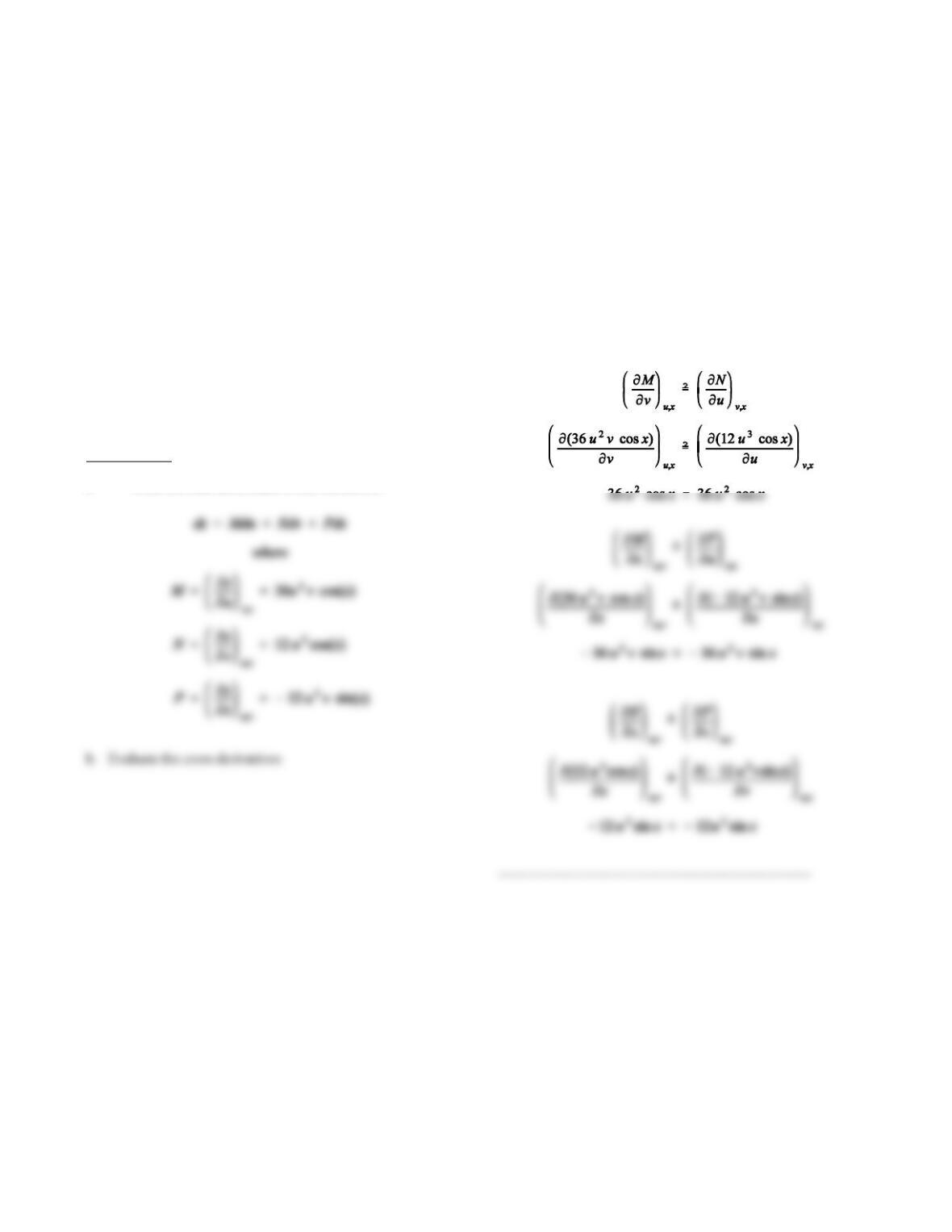
2.5. Write the total differential of the function
3
this expression as appropriate partial derivatives.
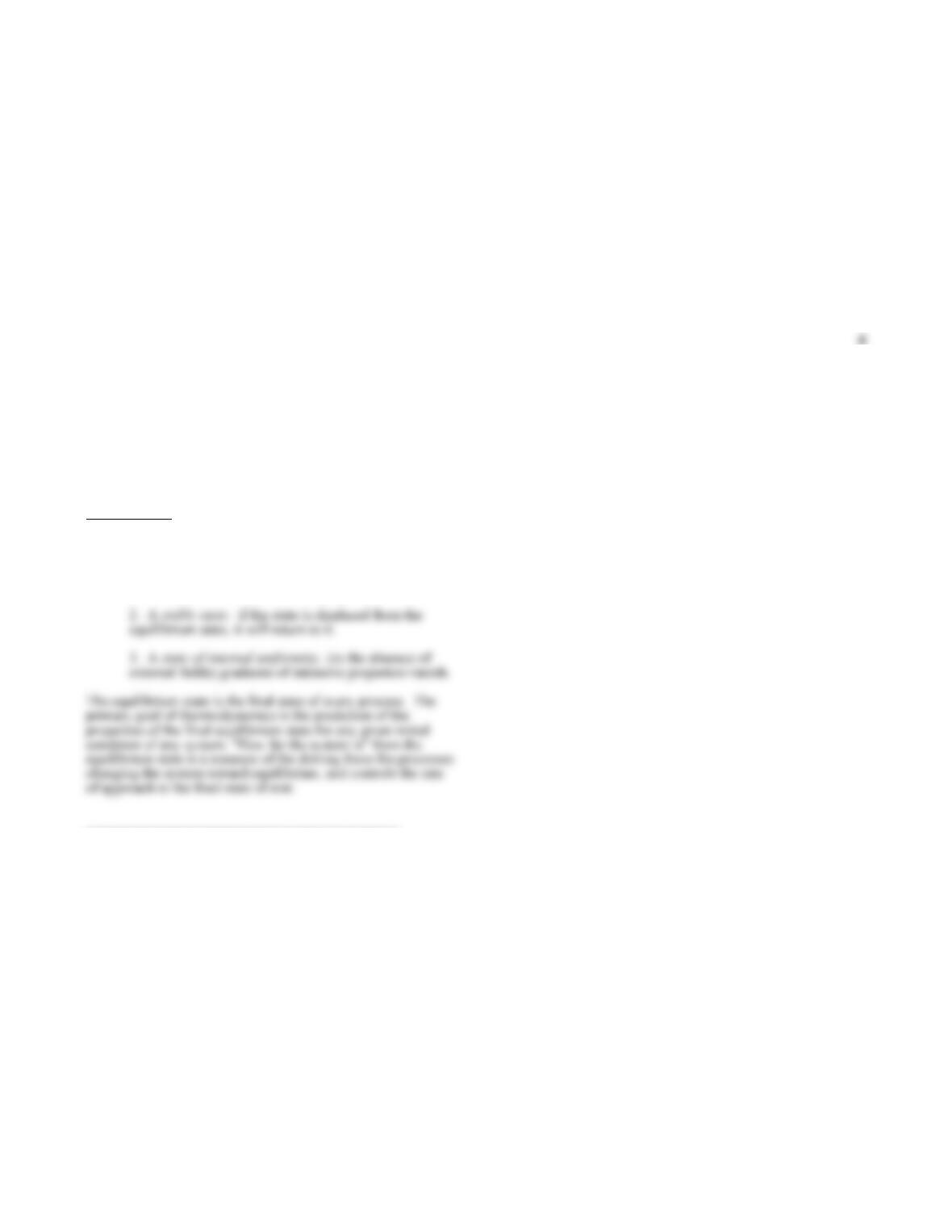
b. Show that three Maxwell relations hold among these
coefficients
Answer to 2.5.
a. Write the total differential of the function z:
2.6. Describe what the notion of equilibrium means to you.
List as many attributes as you can think of that would be
exhibited by a system that has come to equilibrium. Why do
you think these characteristics of a system in equilibrium are
important in thermodynamics?
Answer to 2.6.
Attributes of equilibrium:
1. A state of rest: state of the system does not change
with time.
———–———–——————-——–————-—