Chapter 15. Electrochemistry
Chapter 15. Electrochemistry
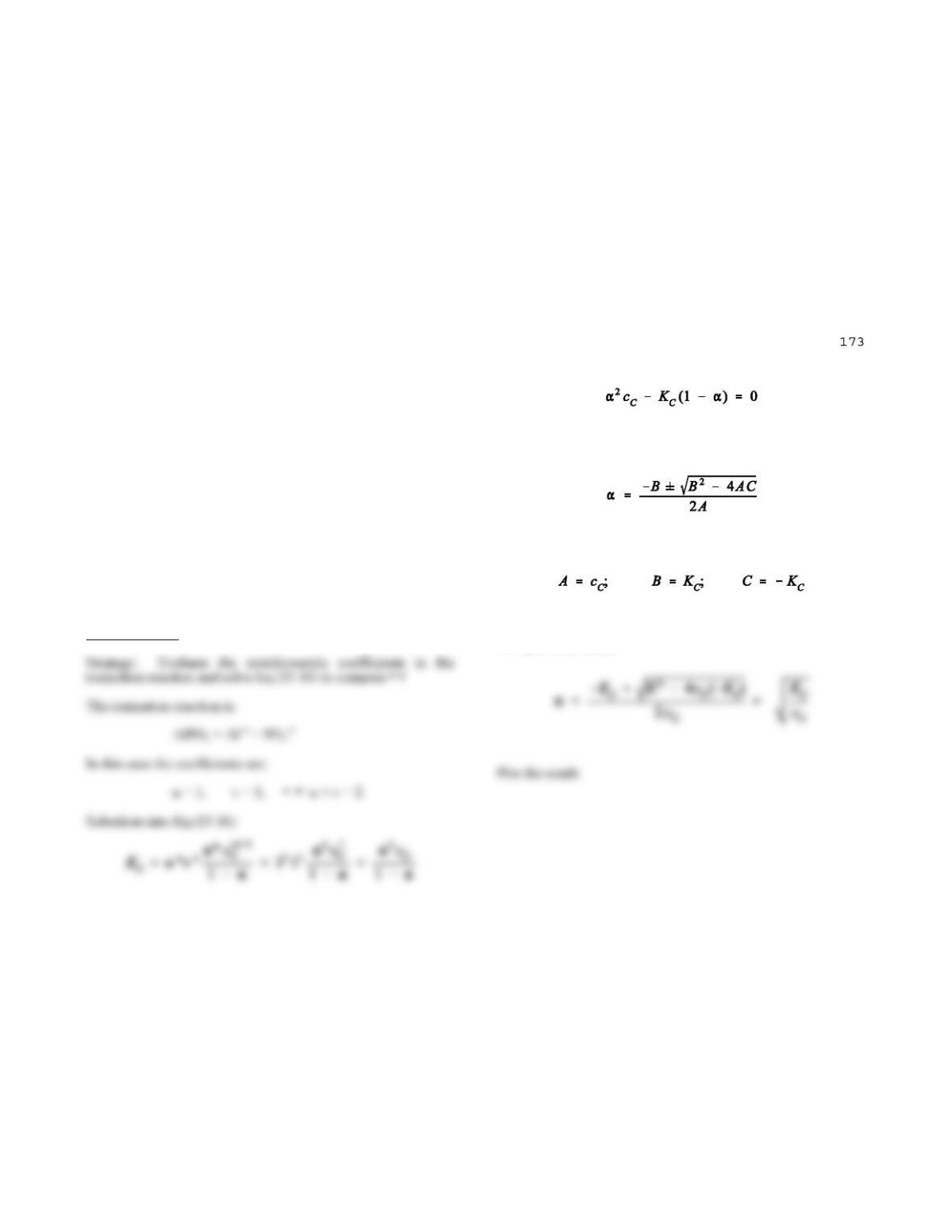
15.1. The dissociation constant for aluminum phosphate in
aqueous solution at 298 K is 9.8X10⁻²¹. Assume Kf = 1.
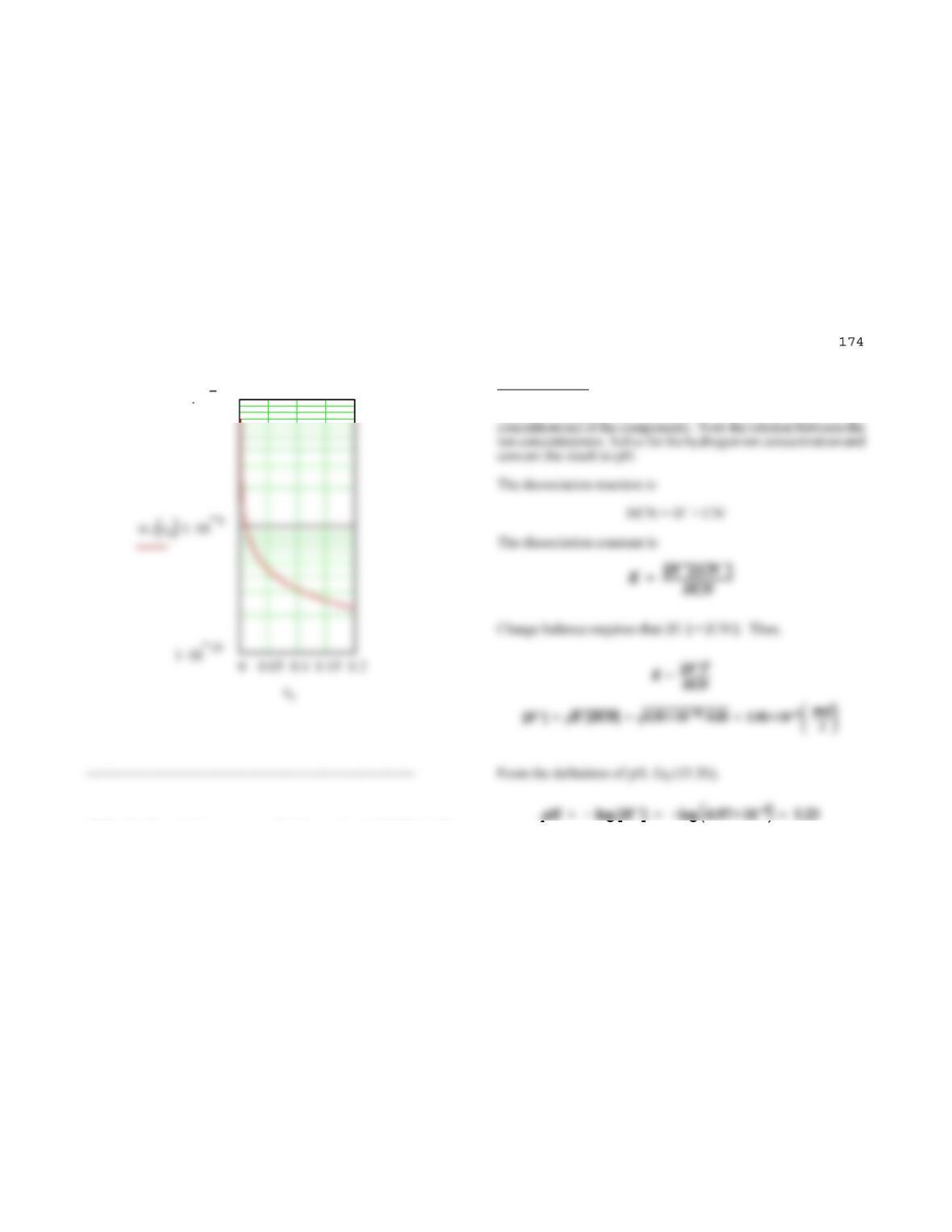
Calculate the degree of dissociation of AlPO4 as a function of
concentration. Plot the result.
Answer to 15.1.
This may be written:
This is a quadratic equation in • •. The solution has the form
where the coefficients are
This gives the result:
Chapter 15. Electrochemistry
1 10 8
15.2. The dissociation constant of hydrocyanic acid (HCN) at 25
oC is 7 x 10⁻¹⁰. Compute the pH of a solution prepared with 0.05
molar concentration of HCN.
Answer to 15.2.
Strategy: Express the dissociation constant in terms of the
———–———–——————-——–————-——-
Chapter 15. Electrochemistry
15.3. Beryllium hydroxide is a weak base with a dissociation
constant given by 5 X 10-11 at 25 C. How many grams of
Be(OH)2 must be added to a liter of water in order to obtain a pH
of 8.5?
The hydroxyl ion concentration can be expressed in terms of the
degree of dissociation:
Chapter 15. Electrochemistry
15.4. What concentration of sodium hydroxide must be added to
water to adjust the pH to 9.5?
Chapter 15. Electrochemistry
15.5. Calcium hydroxide and nitric acid are strong electrolytes.
Two stock solutions are available: one with 0.02 molar Ca(OH)2;
and the other with 0.05 molar HNO3. How much of the nitric
acid solution must be added to one liter of the calcium hydroxide
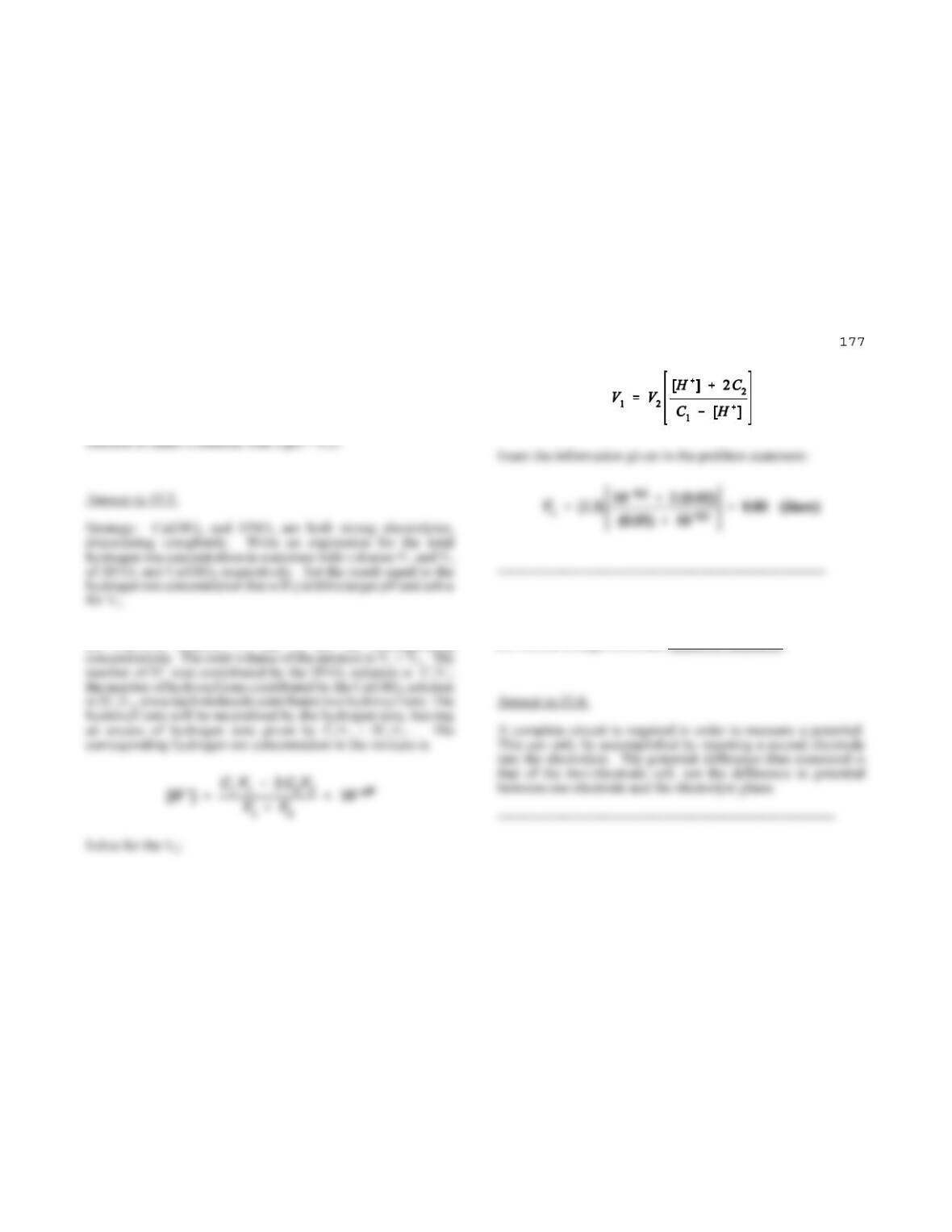
Let V1 be the volume of the HNO3 solution added and V2 that of
the Ca(OH)2 solution; C1 and C2 are the corresponding
15.6. Explain why the potential difference computed in equation
(15.39) for a single electrode cannot be measured.
Chapter 15. Electrochemistry
15.7. Describe all of the subsystems in a Galvanic cell, including
the phases and the interfaces. Describe the conditions that must
be met by each of these subsystems in order for the cell to operate
reversibly.
Answer to 15.7.
A Galvanic cell consists of a minimum of four parts: two
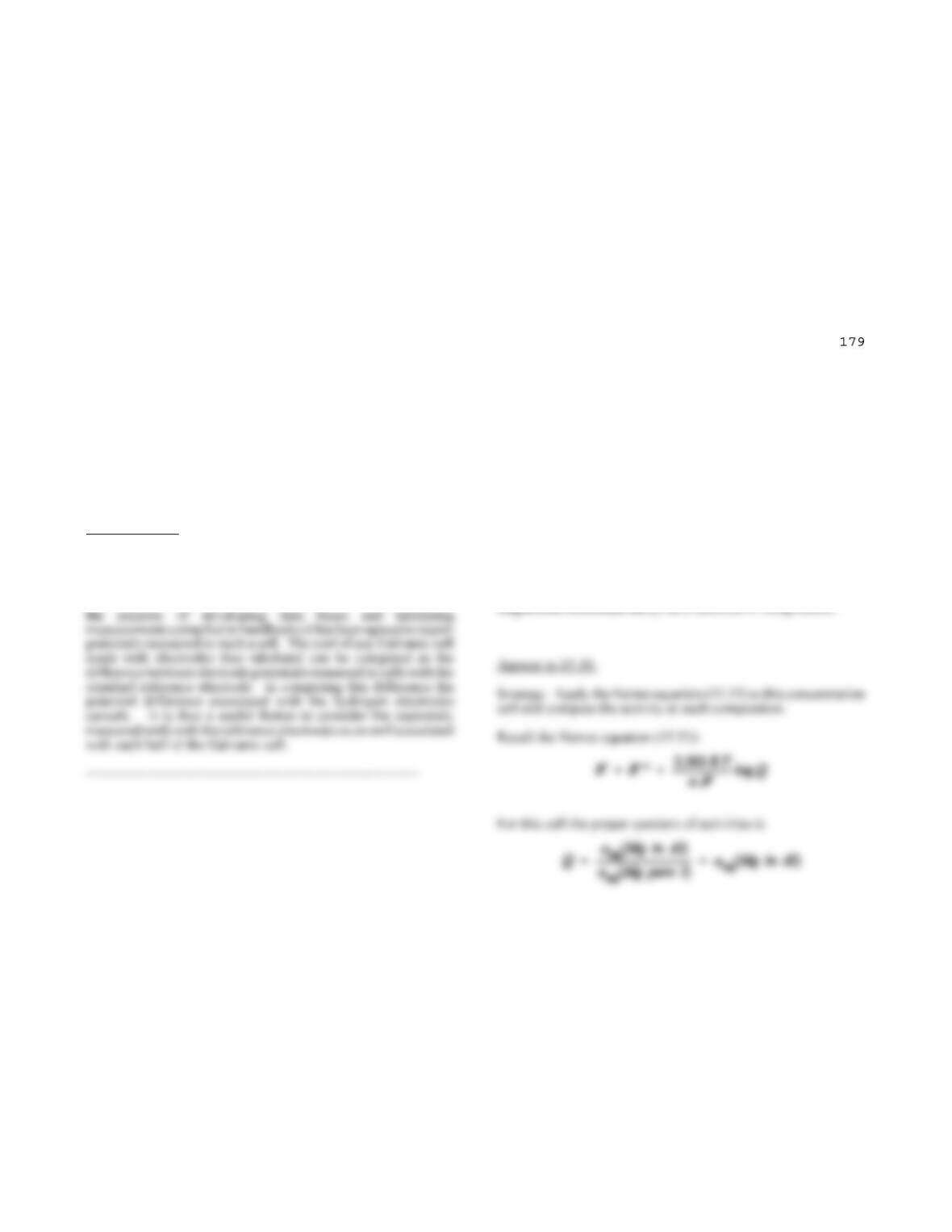
15.8. Sketch a Galvanic cell represented by the following
notation.
Label all of the parts of the cell.
Chapter 15. Electrochemistry
———–———–——————-——–————-——
15.9. Given that it is not possible to measure the potential
difference between an electrode and an electrolyte in which it is
immersed, how is it possible to evaluate “half cell potentials” for
the subsystems in an electrochemical cell?
Answer to 15.9.
A “half cell potential” is in reality a potential measured in a
Galvanic cell in which one electrode is the phase whose “half cell
potential” is to be determined and the other electrode is the
“standard hydrogen electrode” used as a reference electrode. For
15.10. Reversible emfs are measured for the following cell at
1073 K:
Mg(pure liquid)|MgCl2 – CaCl2|Mg (in Al, liquid)
for a sequence of compositions:
X 0.0447 0.1130 0.1905 0.3400 0.5825 0.7490
• •mv 152.840 109.868 82.501 54.195 30.446 20.871
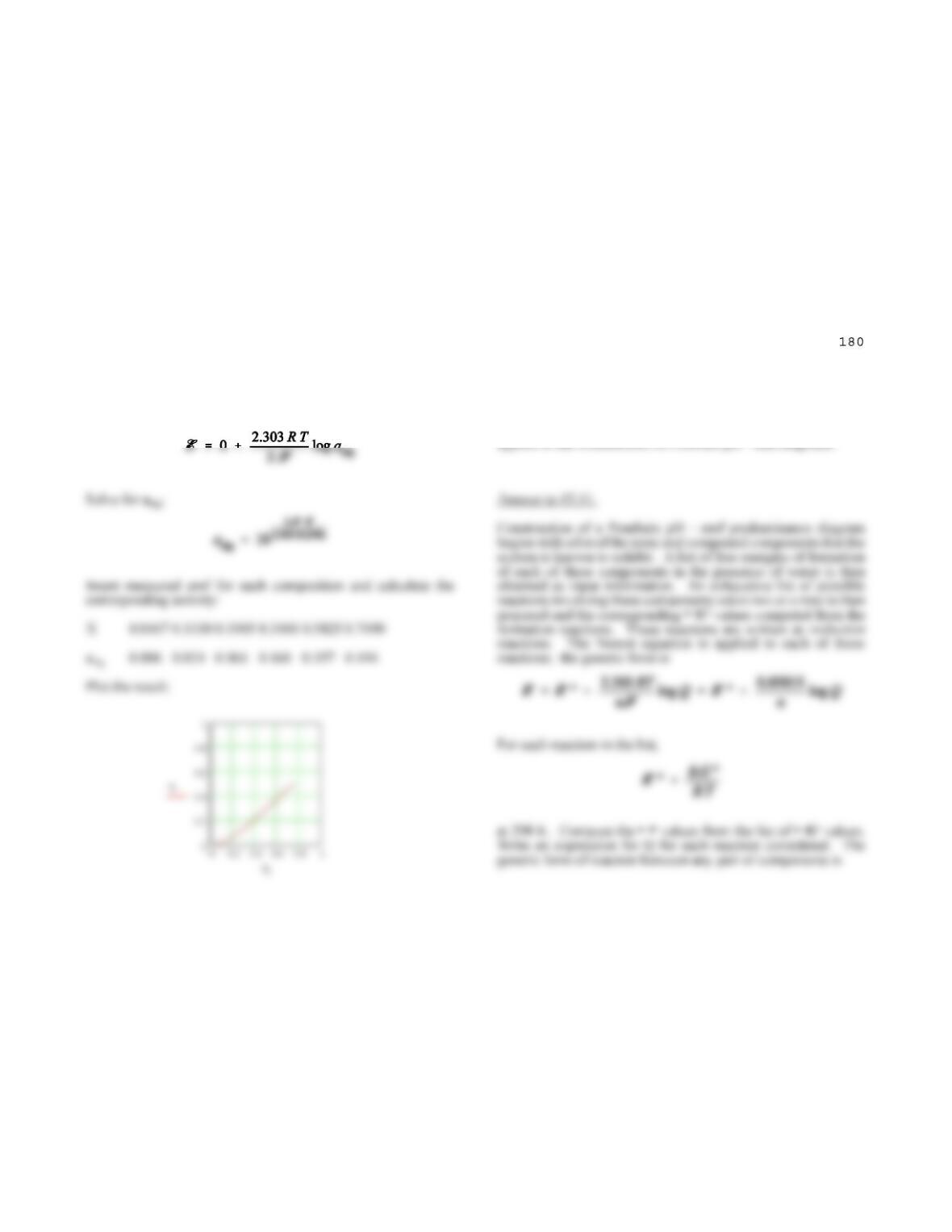
Compute and plot the activity of magnesium in liquid
magnesium-aluminum alloys as a function of composition.
Chapter 15. Electrochemistry
since the activity for pure Mg is 1. For a concentration cell the
reference states are the same for both electrodes so that
• •
o = 0. Take n = 2:
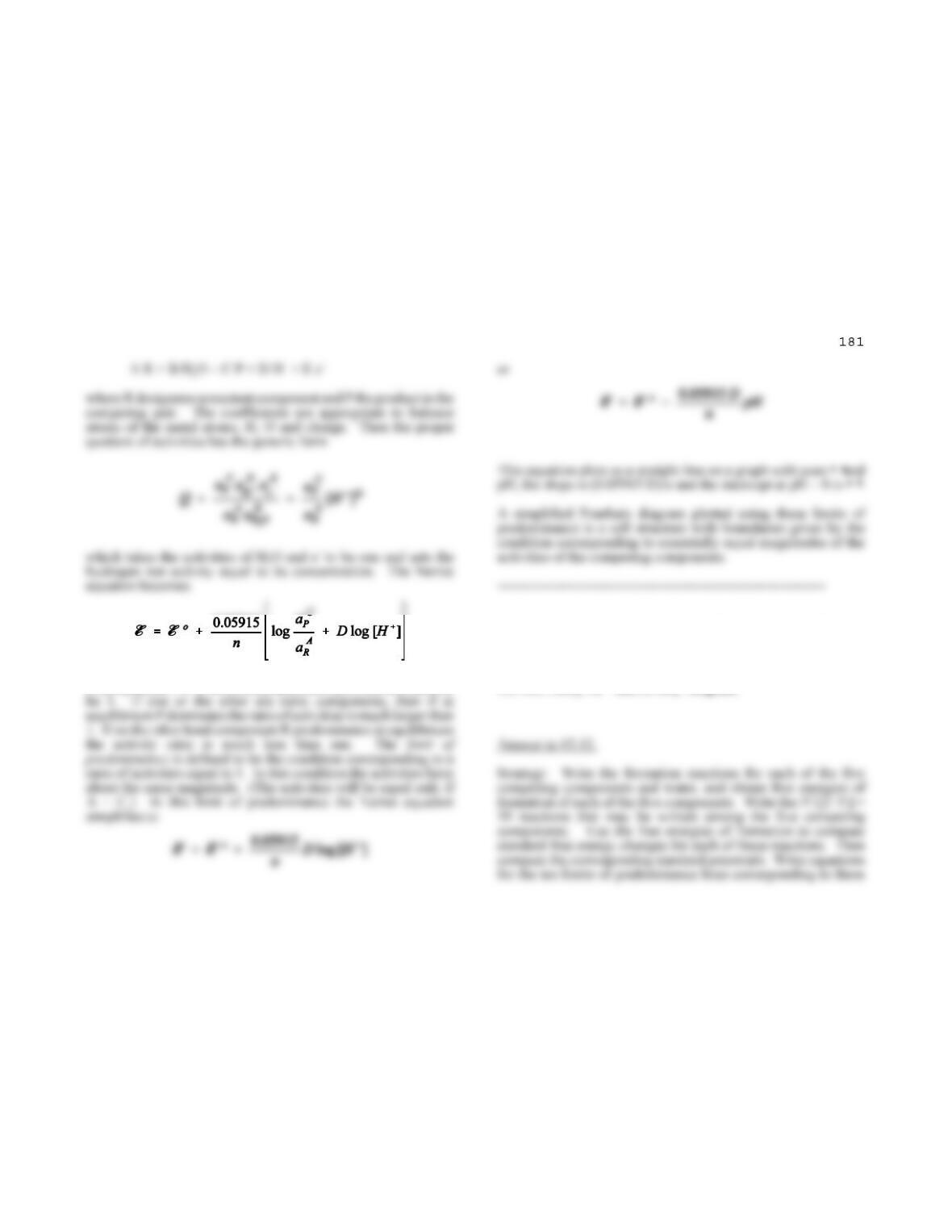
15.11. Review the concept of the limit of predominance as it
applies to the construction of Pourbaix pH – emf diagrams.
Chapter 15. Electrochemistry
If components P or R are solid phases their activities are taken to
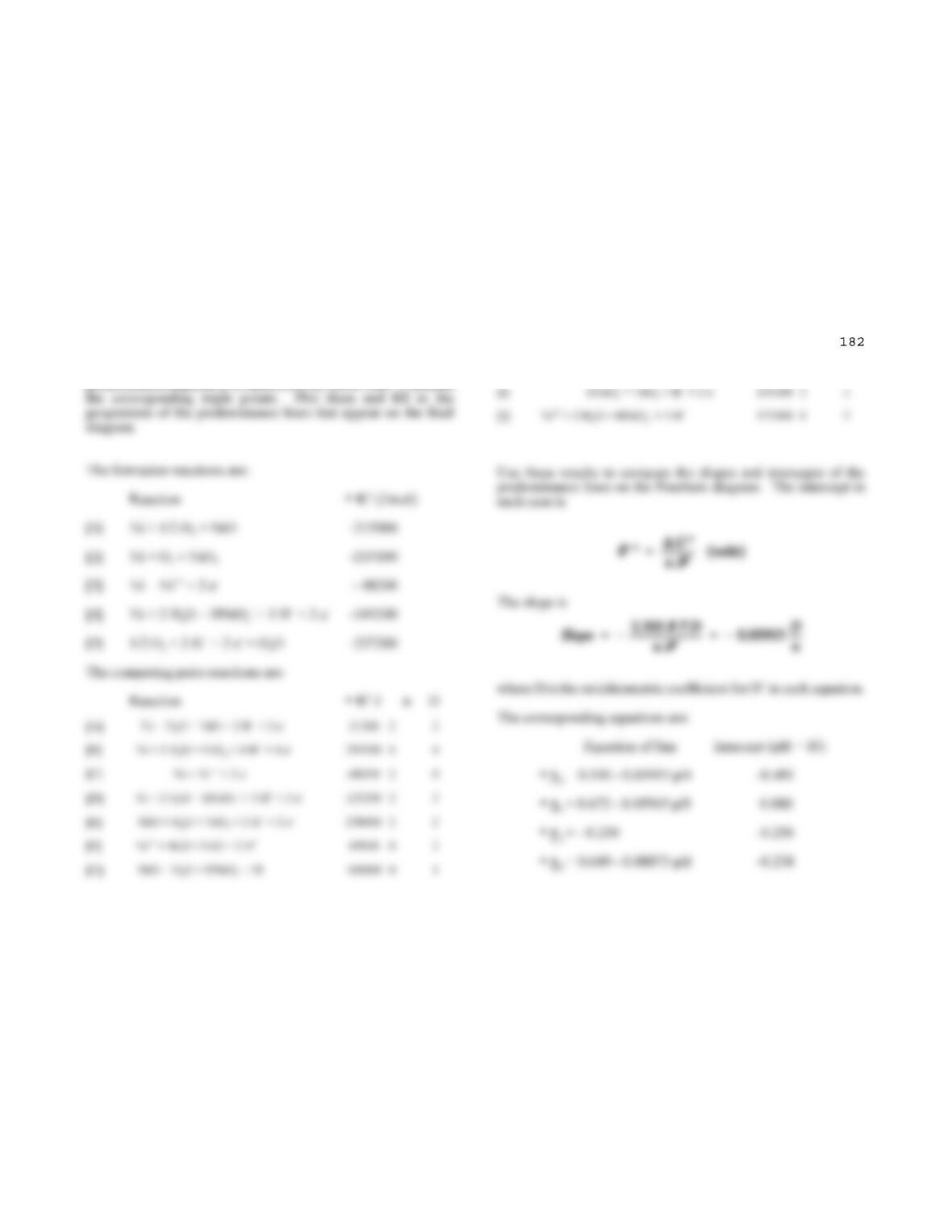
15.12. Construct a potential – pH diagram for the Ni-water
system at 25oC. Limit consideration to the following
components:
Ni, NiO, NiO2, Ni++ and HNiO2
–. diagram.
Chapter 15. Electrochemistry
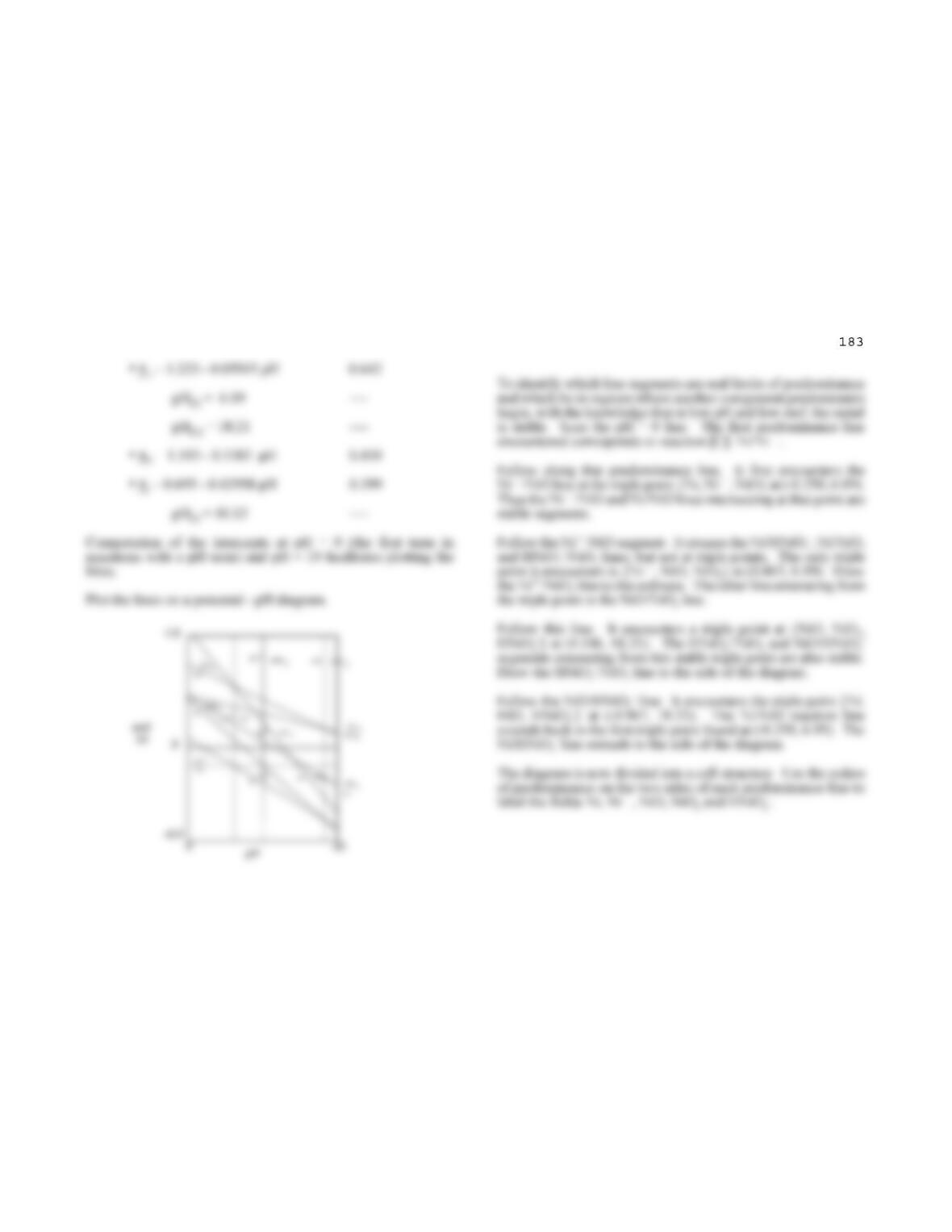
competing reactions. Draw these lines on the diagram. Use
predominance arguments to determine the stable lines. Calculate
[H] Ni++ + 2 H2O = NiO2 + 4 H+ + 2 e–307600 2 4
Chapter 15. Electrochemistry
Chapter 15. Electrochemistry
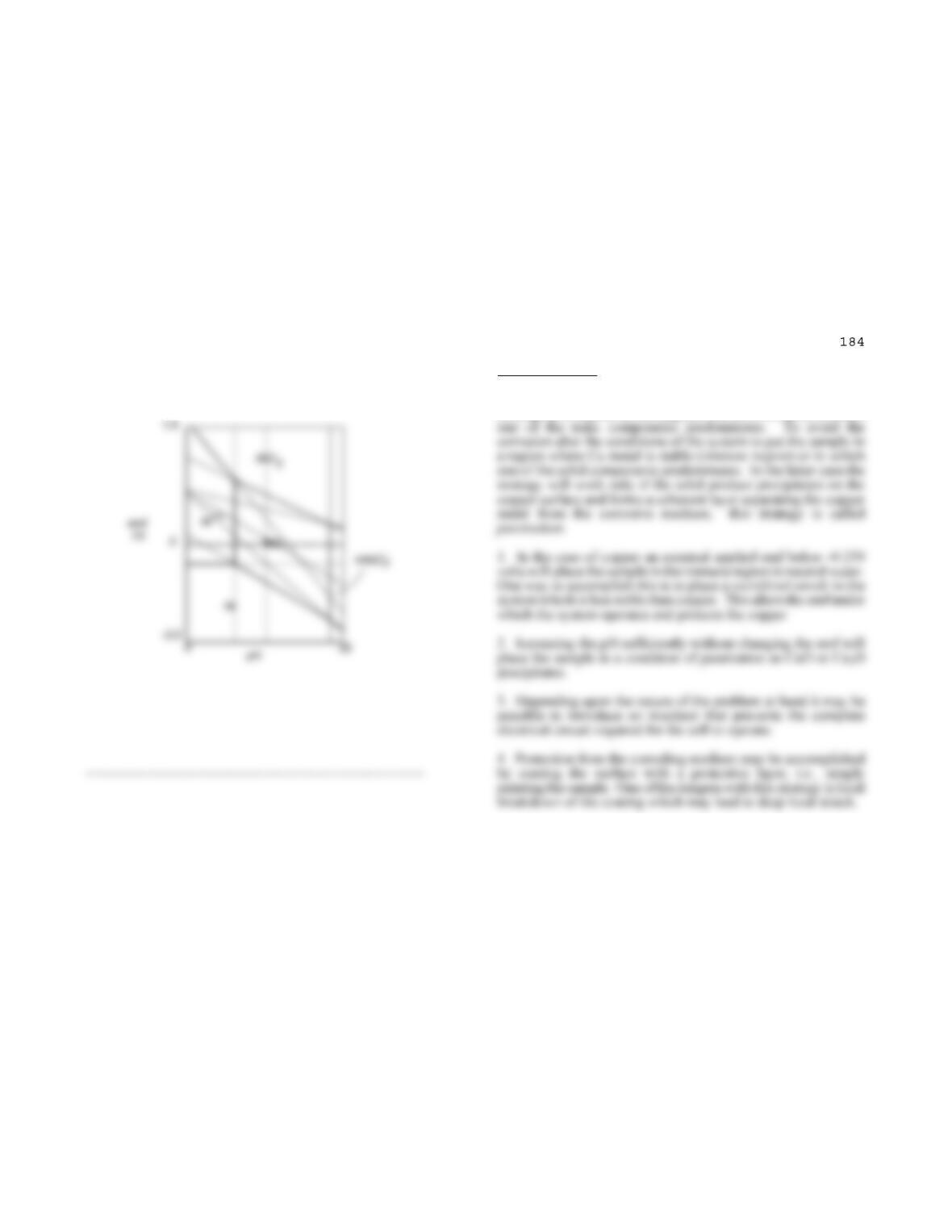
15.13. A sample of copper dissolves in water at 25oC. Use the
Pourbaix diagram in Figure 15.10 to suggest three strategies to
avoid the corrosion of copper in water.
Answer to 15.13.
The copper will dissolve if the conditions in the system
correspond to a point on the diagram that lies in a region in which