Chapter 13. Defects
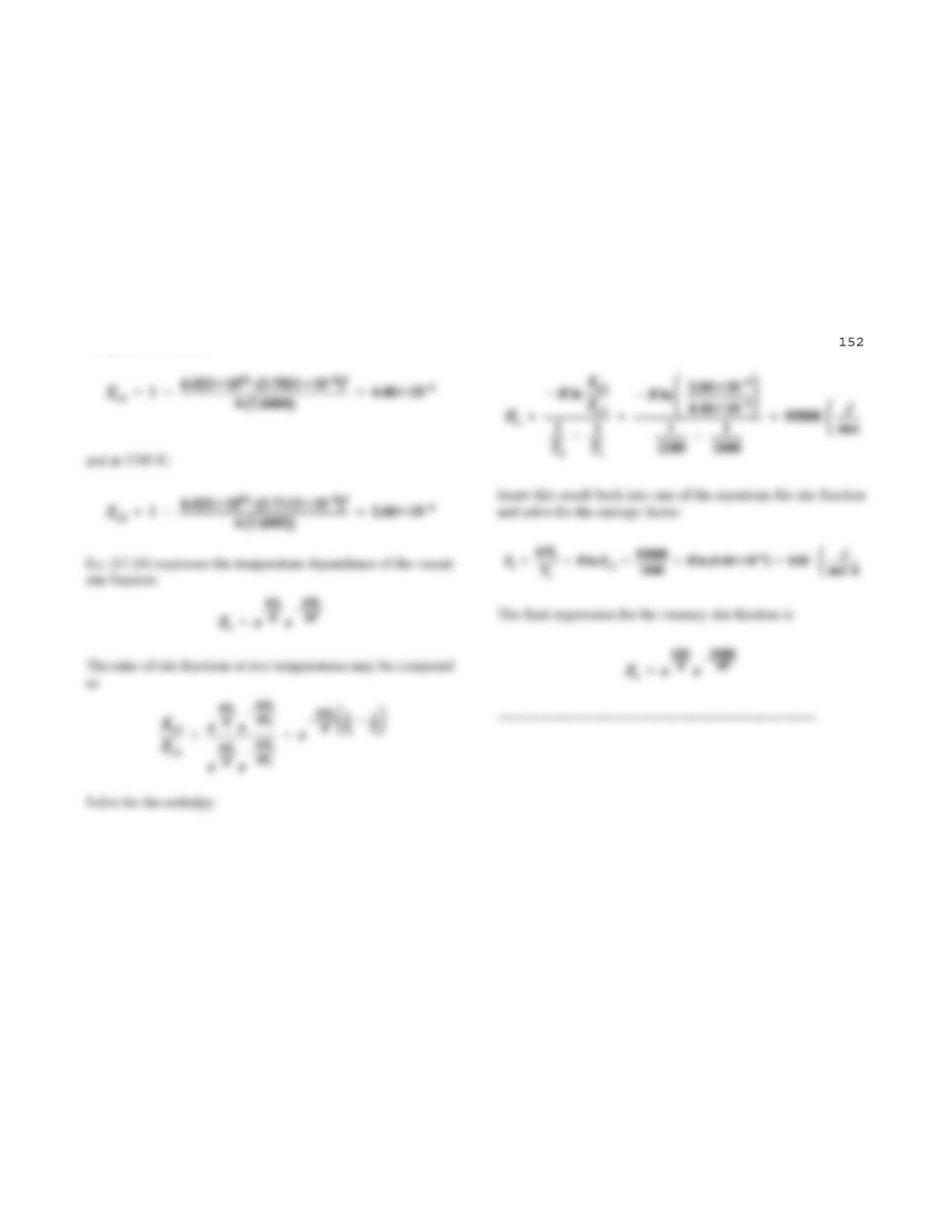
13.1. Careful dilatometric and high temperature diffraction
measurements of pure face centered cubic A give the following
At T1 = 1040 K 3.7021X10⁻⁸ 7.64041
At T2 = 1340 K 3.7113X10⁻⁸ 7.69922
Derive a relationship for the temperature dependence of the
vacancy concentration in pure A.
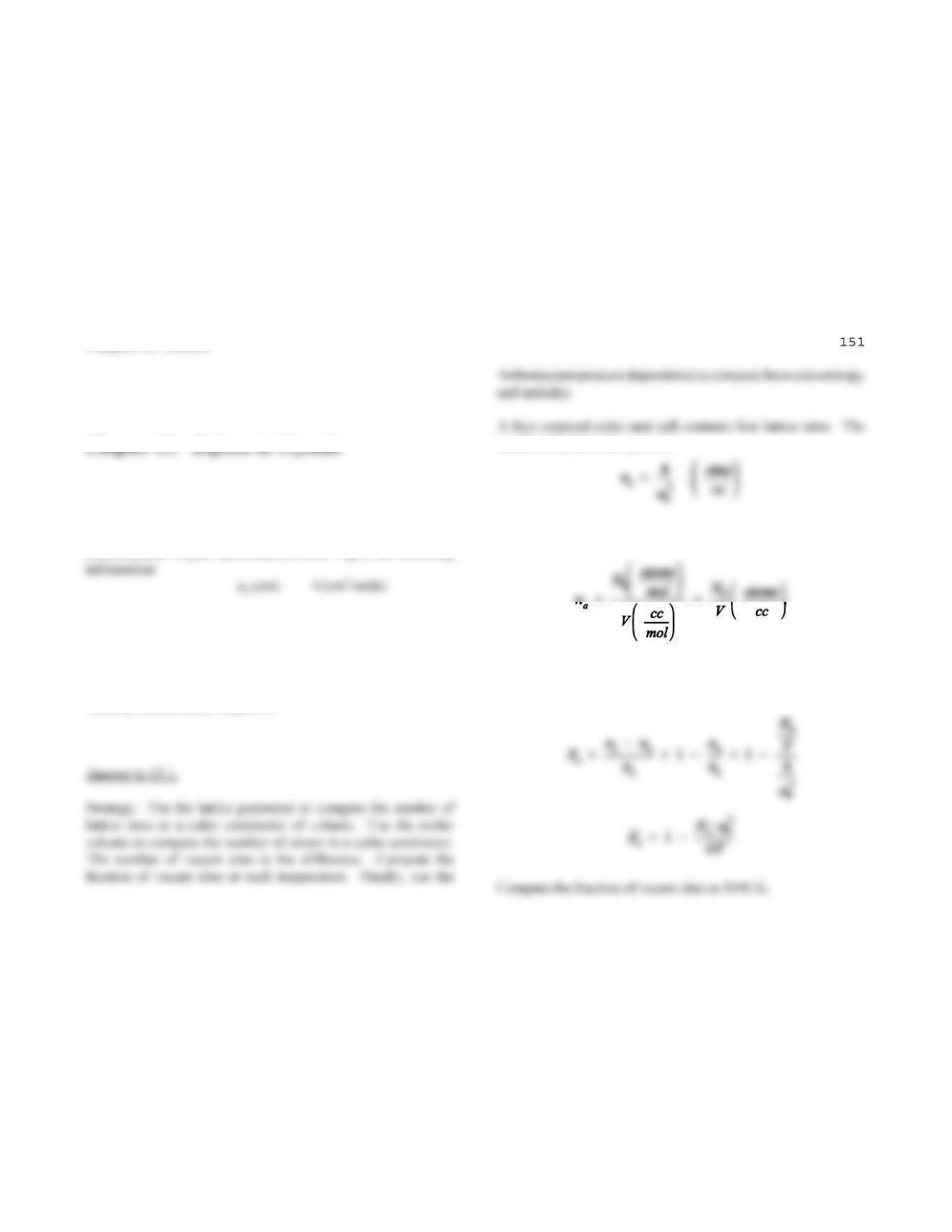
number of lattice sites per cc is
The number of atoms in a cubic centimeter is
The excess number of sites in a cubic centimeter is ns – na. The
fraction of vacant sites is
Chapter 13. Defects
Chapter 13. Defects
13.2. The enthalpy of formation of an interstitial in an FCC
a. Calculate and plot the equilibrium concentration of
interstitials as a function of temperature in the range from
600 to 1300 K
b. Compare this result to that found for vacancies in this
material in Problem 13.1.
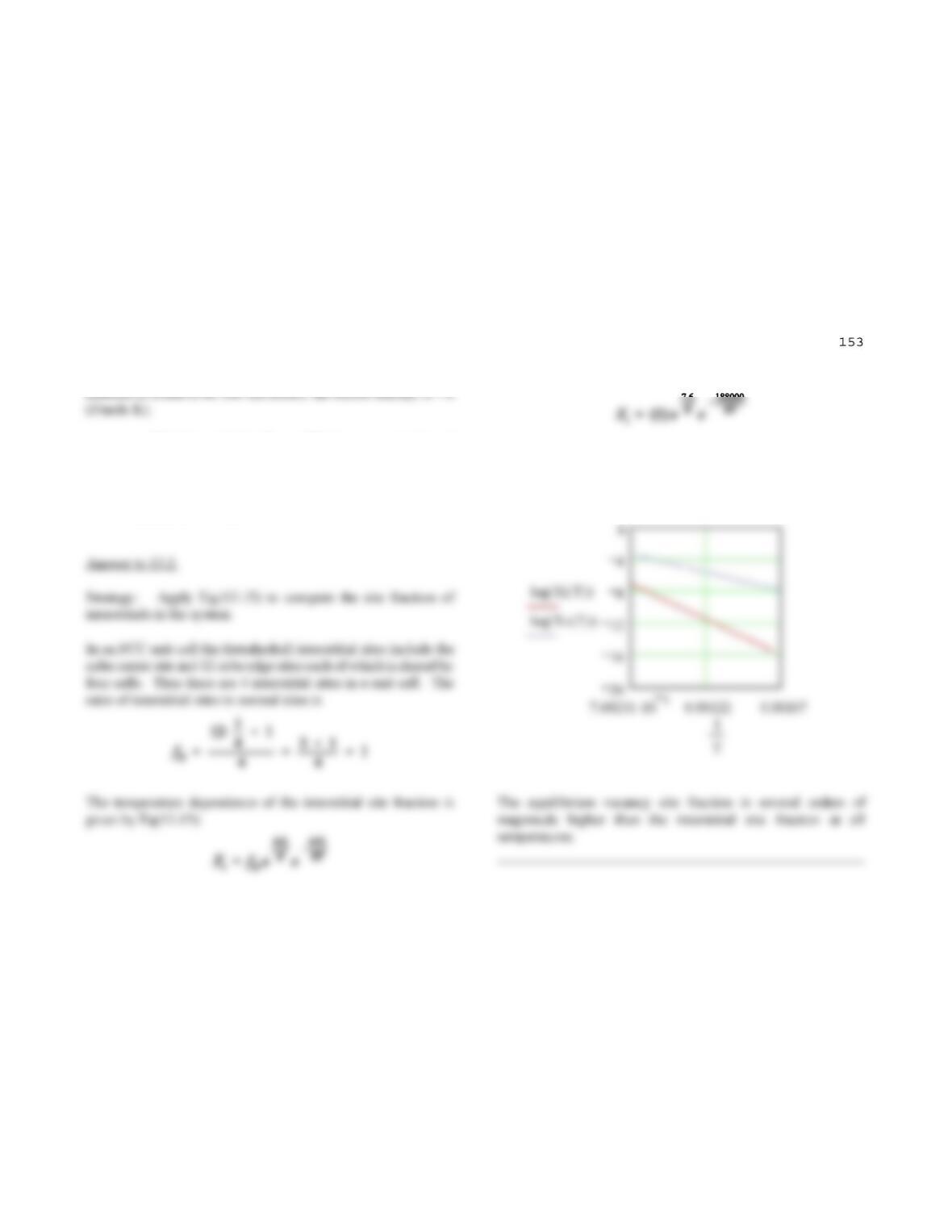
Substitute the values for • •Hi and • •Si:
Plot log Xi versus 1/T on a graph with log Xv.
Chapter 13. Defects
13.3. Suppose that the interaction parameters for divacancies are
about 10% of the values of the corresponding single defect
parameters; i.e., suppose
Using the results of problem 13.1, compute and plot the mole
fraction of divacancies as a function of temperature for pure A in
the range from 600 to 1300 K.
Insert the numbers:
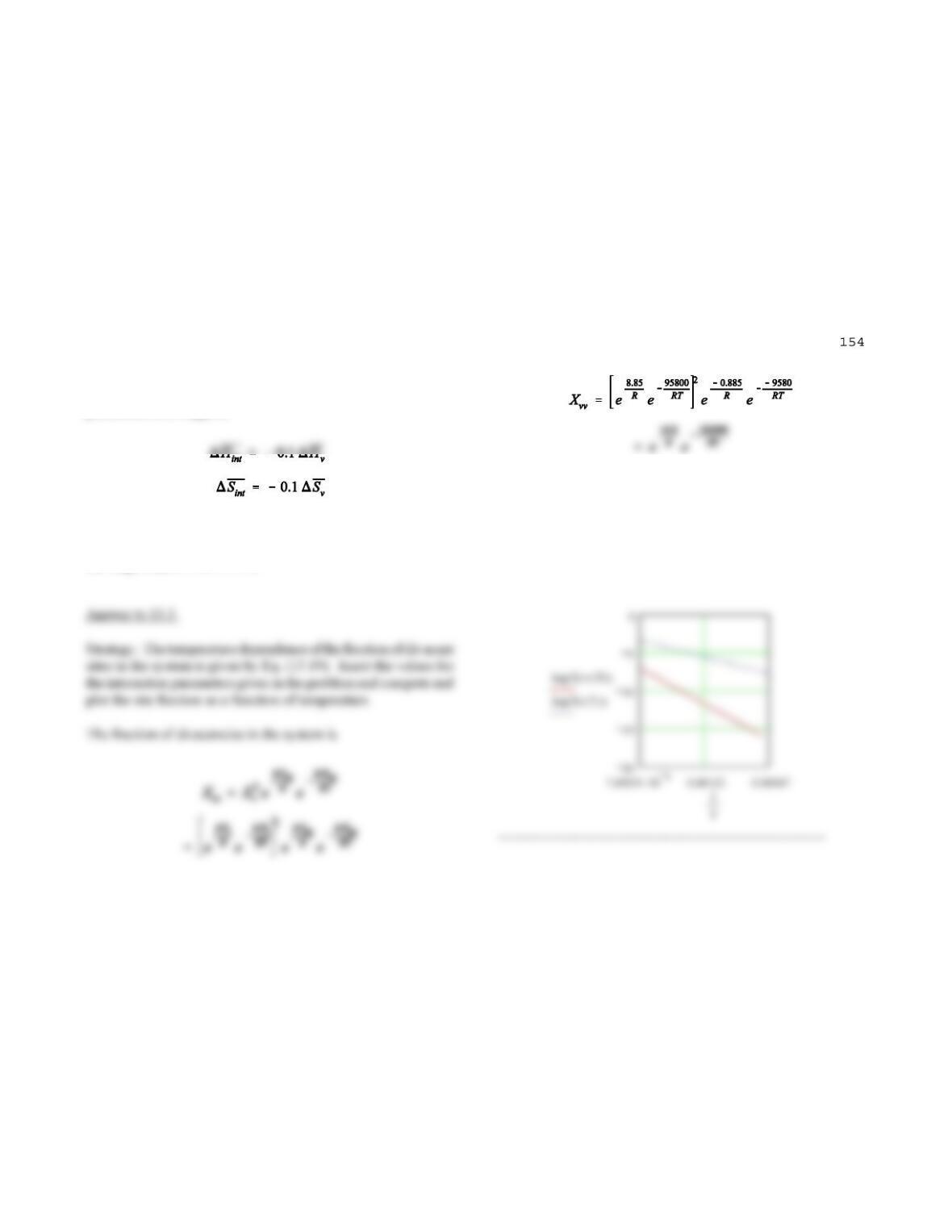
Compare Xv with Xvv by plotting their logarithms versus 1/T.
Under equilibrium conditions the fraction of divacancies in the
system is negligible in comparison with the fraction of single
vacancies.
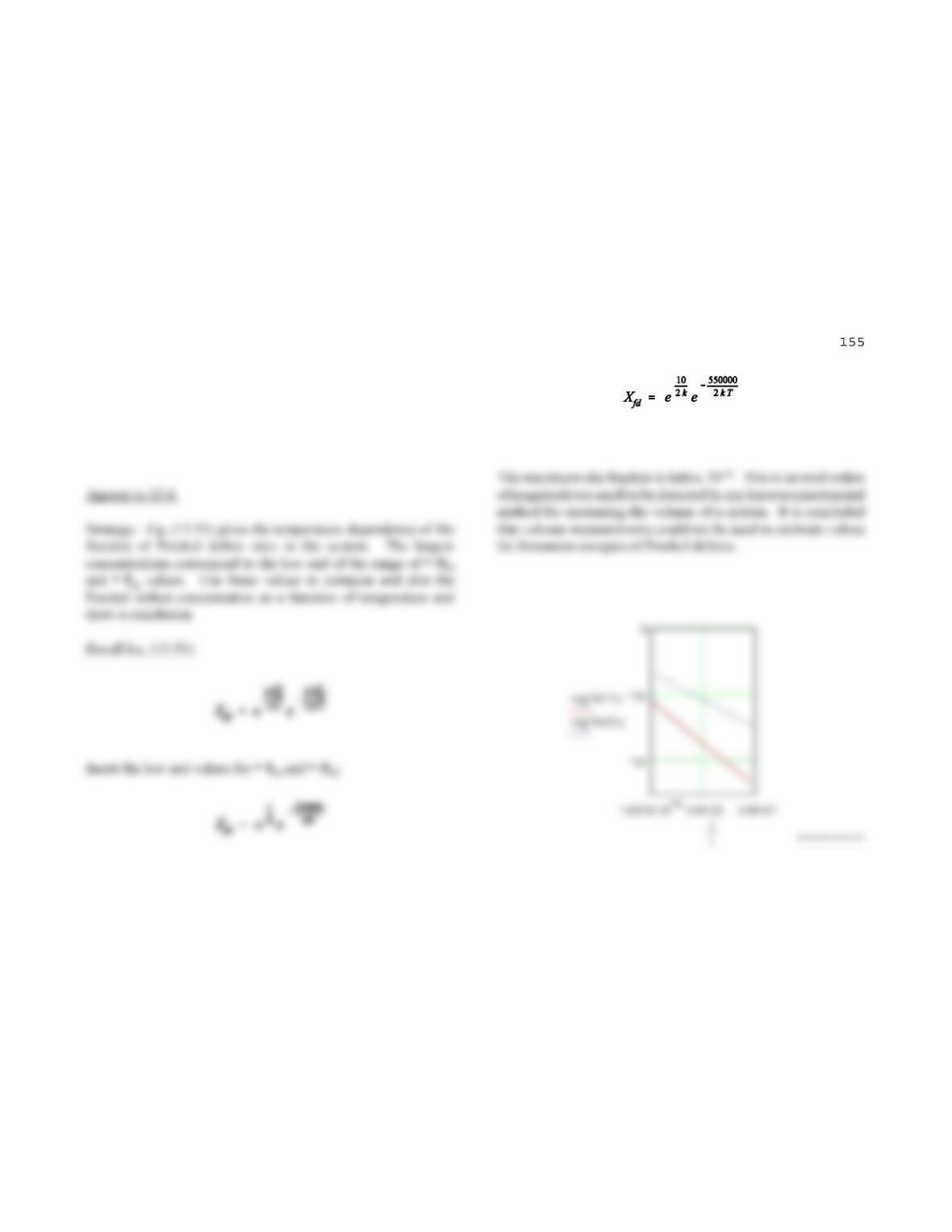
13.4. Enthalpies of formation of Frenkel defects range from 350
Chapter 13. Defects
to 550 (KJ/mole) and entropies from 1 to 10 (J/mole K). Use
these ranges to compute and plot limits of the defect
concentrations expected as a function of T. Could very careful
measurements of volume be used to estimate values of formation
energies of Frenkel defects?
Insert the high end values:
Plot this result.
————–
———–——–——–—————
13.5 Frenkel and Schottky defects are intrinsic to the crystal in
Chapter 13. Defects
which they occur. While both of these classes of defects may
form in compound crystals, only one may form in a pure
elemental crystal. Identify which of these defects may form in an
elemental crystal and explain why this is not possible for the
13.6. Consider the stoichiometric crystal, silicon nitride: Si3N4.
The following defects may form in this system: VSi; Sii; VN; Ni.
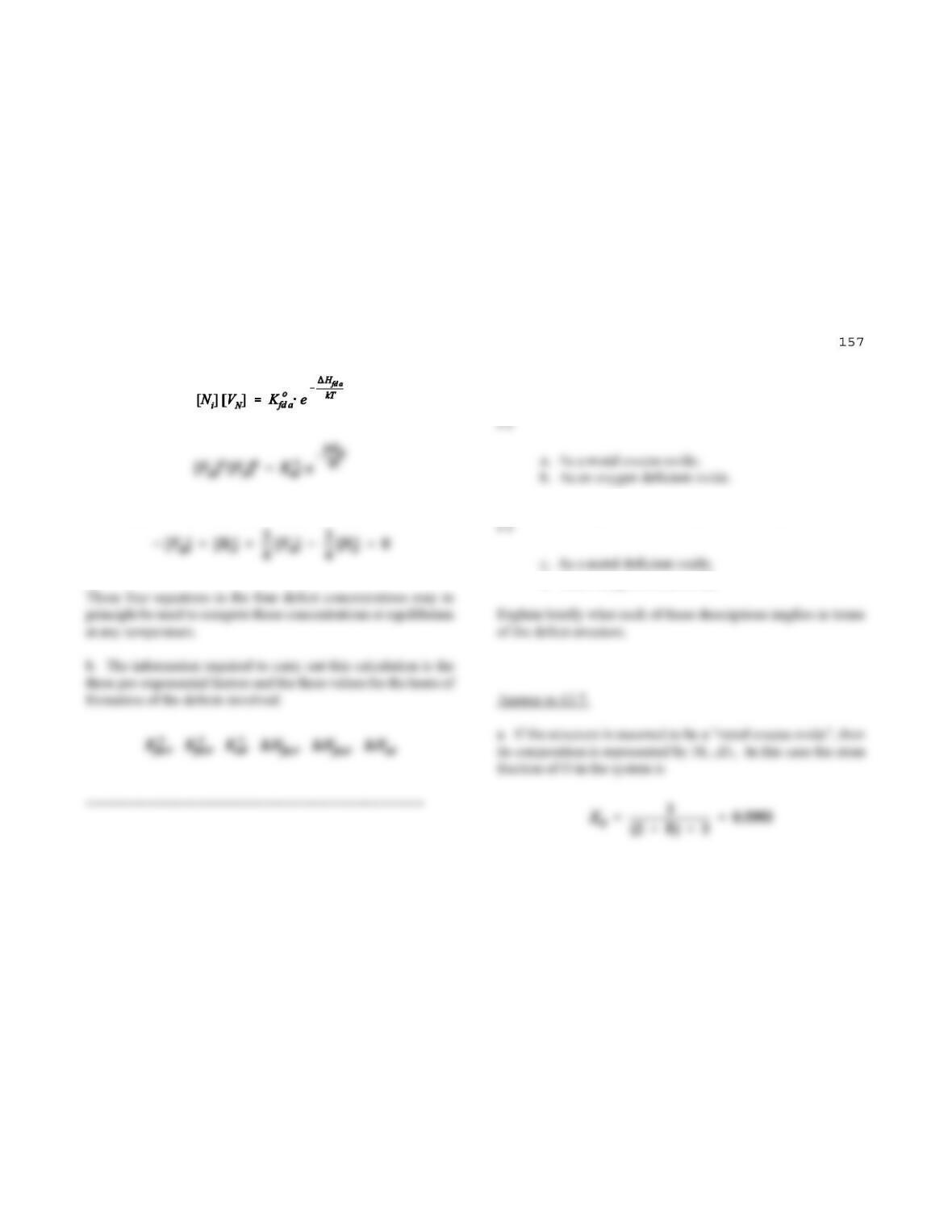
a. Write out the conditions for equilibrium that permit the
computation of these defect concentrations at any
temperature.
b. What information would be required to permit actual
equilibrium defect concentrations as a function of
temperature?
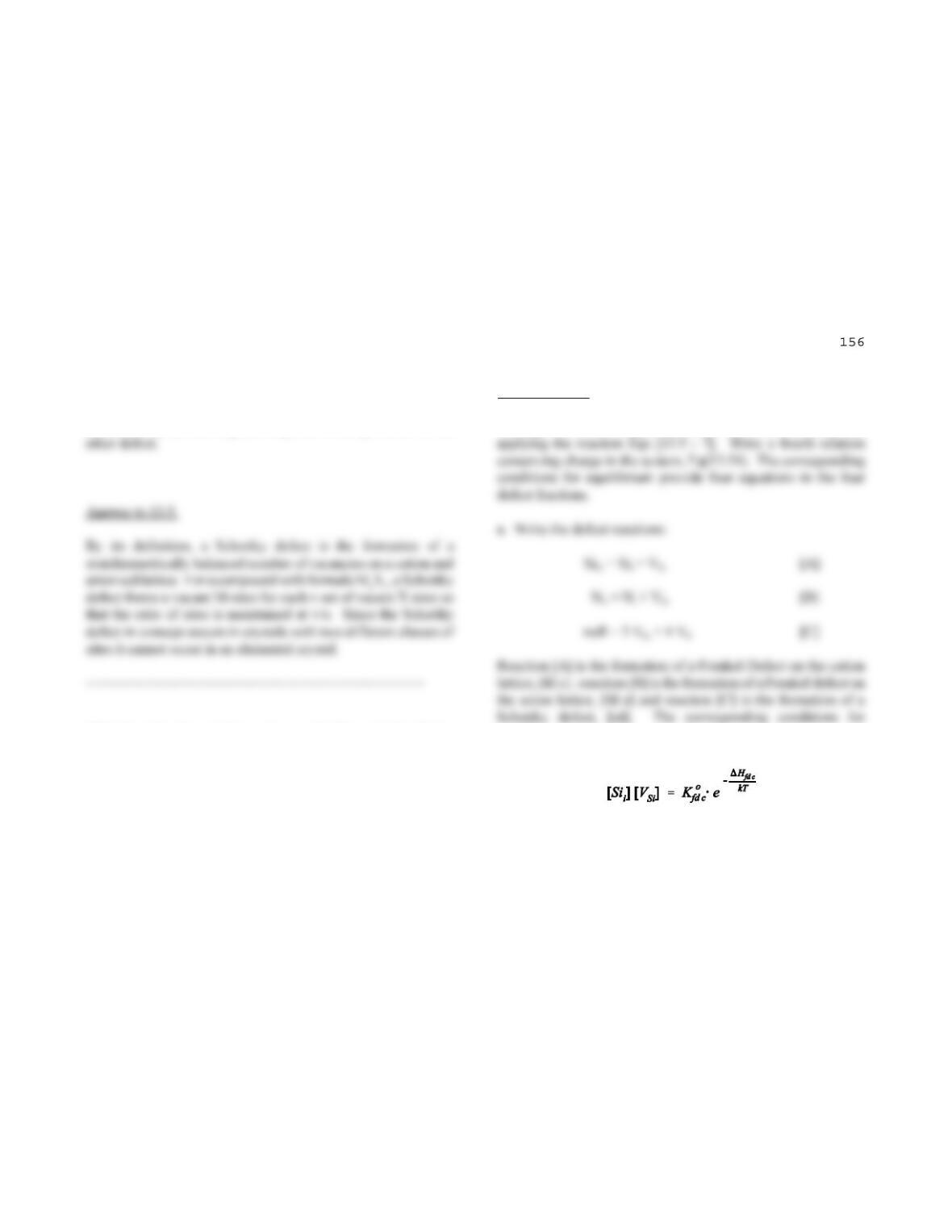
Answer to 13.6.
Strategy: Write the independent defect reactions for the system
equilibrium are
Chapter 13. Defects
The charge conservation equation may be written:
13.7. The system M-O forms the oxides M2O• •
, M2O3
• •
and MO2
• •
at 1600 K. The composition of the • • phase (M2O3) in equilibrium
with • • (M2O) is XO = 0.5994. At the other phase boundary of • •
the composition in equilibrium with • • (MO2) is XO = 0.6003.
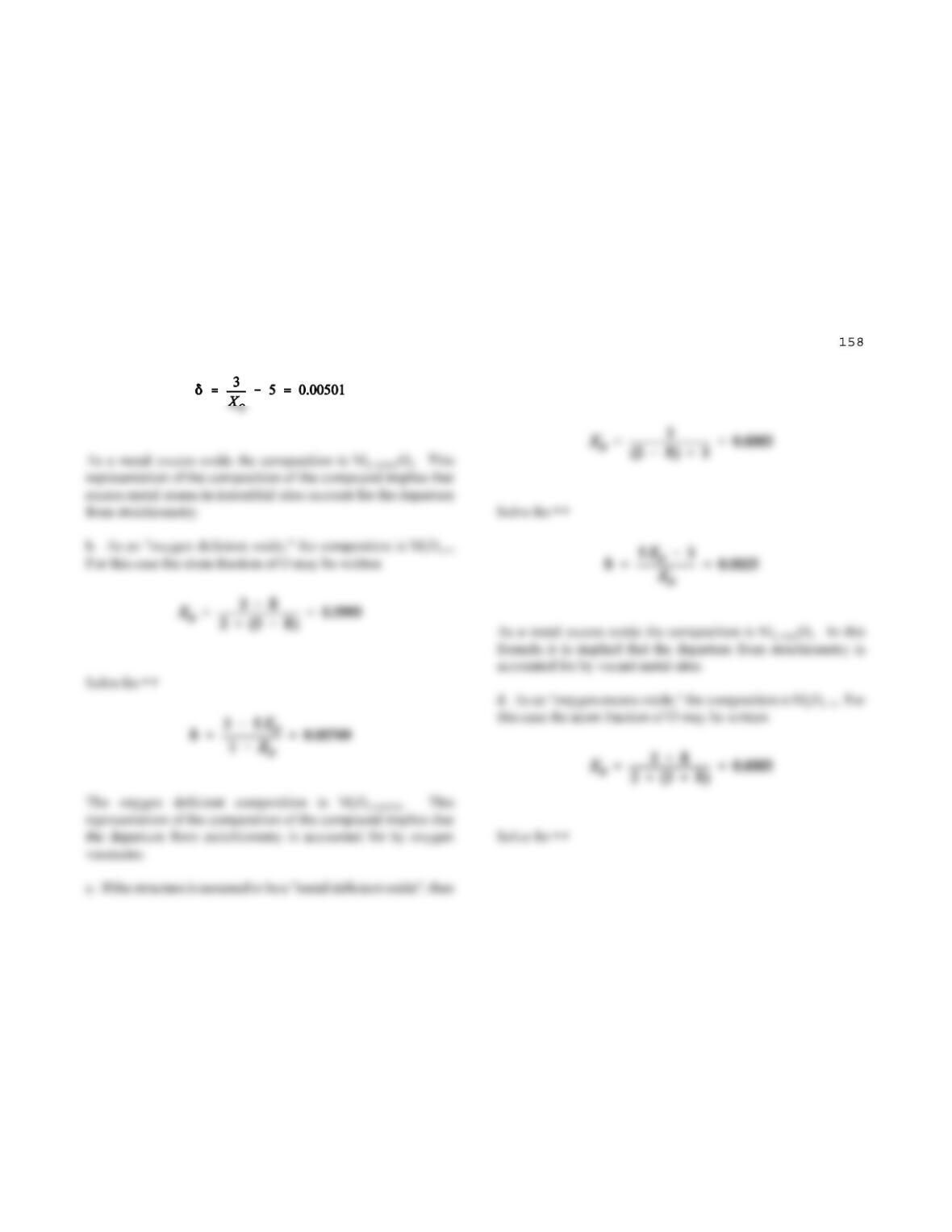
Describe the composition of the • • phase when equilibrated with
Describe the composition of the • • phase when equilibrated with
d. As an oxygen excess oxide.
Solve for • •:
Chapter 13. Defects
its composition is represented by M2-• •
O3. In this case the atom
fraction of O in the system is
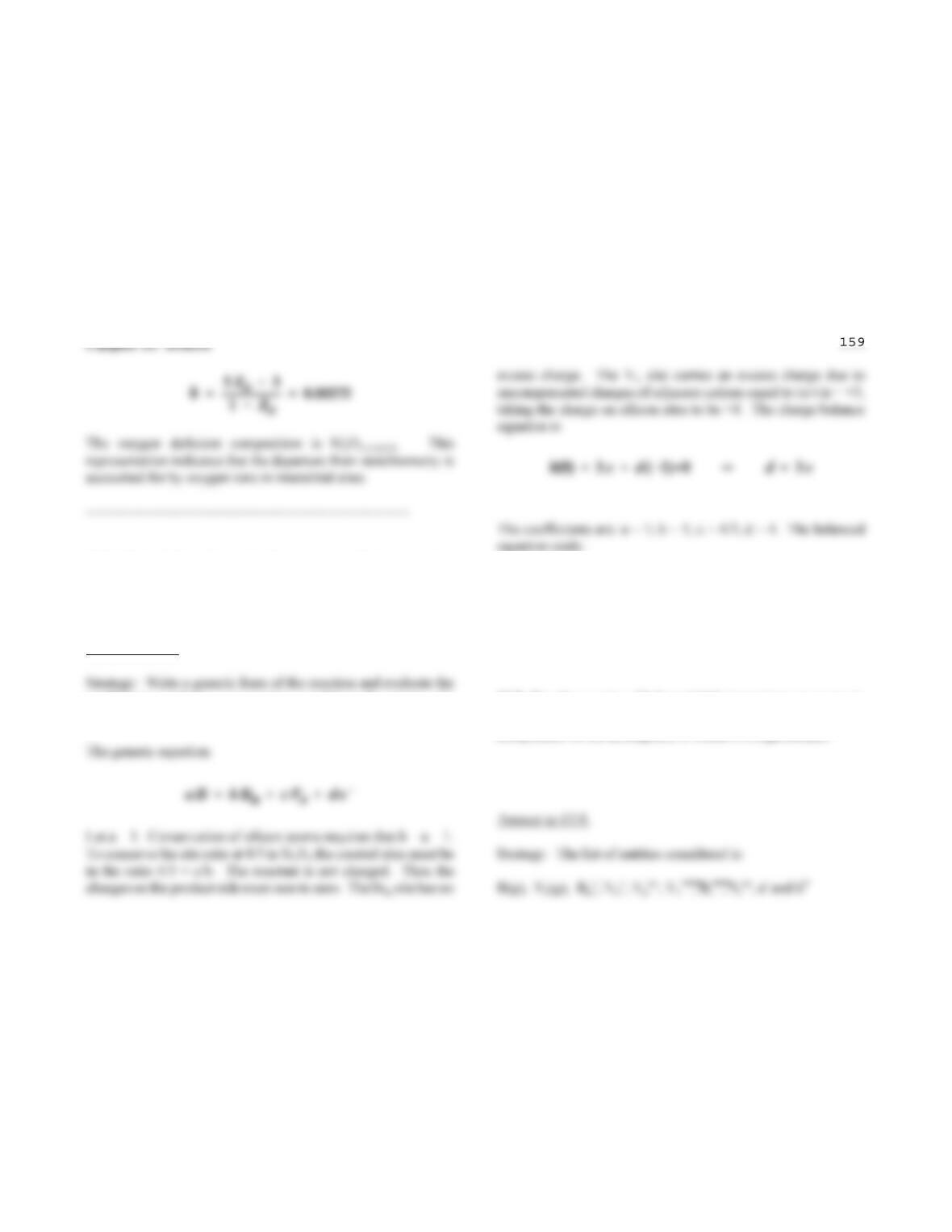
13.8. Write a balanced equation that represents the incorporation
of silicon into a silicon sublattice site in silicon nitride, Si3N4.
Answer to 13.8.
coefficients applying conservation conditions for atoms, site
ratio, and charge.
Si = SiSi
x + 4/3 VN
••••••
+ 4 e’
———–——–——–——————-——–——–———
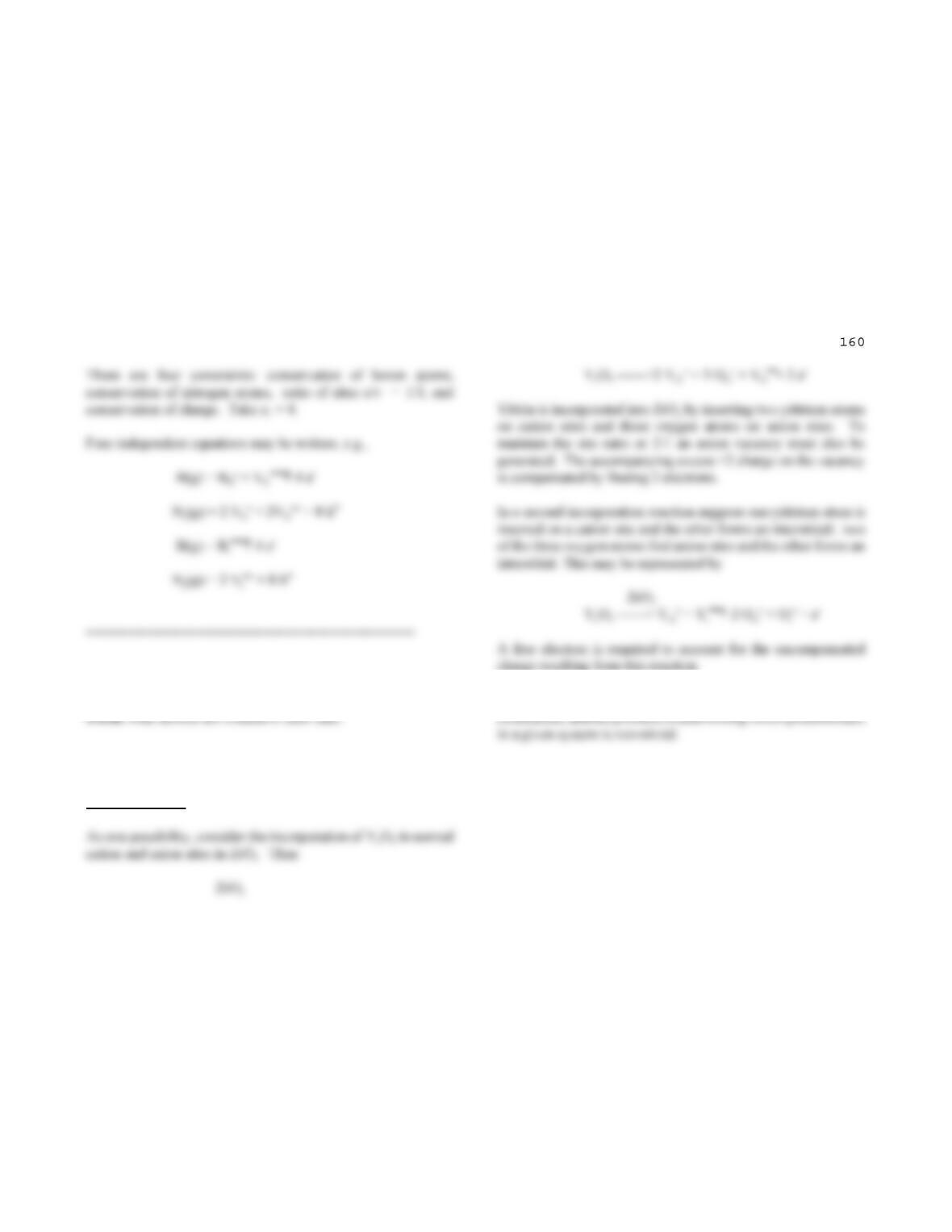
13.9. Develop a series of balanced defect equations necessary to
relate defect concentrations in boron nitride (BN) to the
composition of the atmosphere in which it is equilibrated.
Chapter 13. Defects
13.10. Construct a set of equations that describe the
incorporation of yttria (Y2O3) into zirconia (ZrO2). Describe in
Answer to 13.10.
charge resulting from this reaction.
Evidently a variety of incorporation reactions may be