Solution Manual
Chapter 12. Capillarity Effects
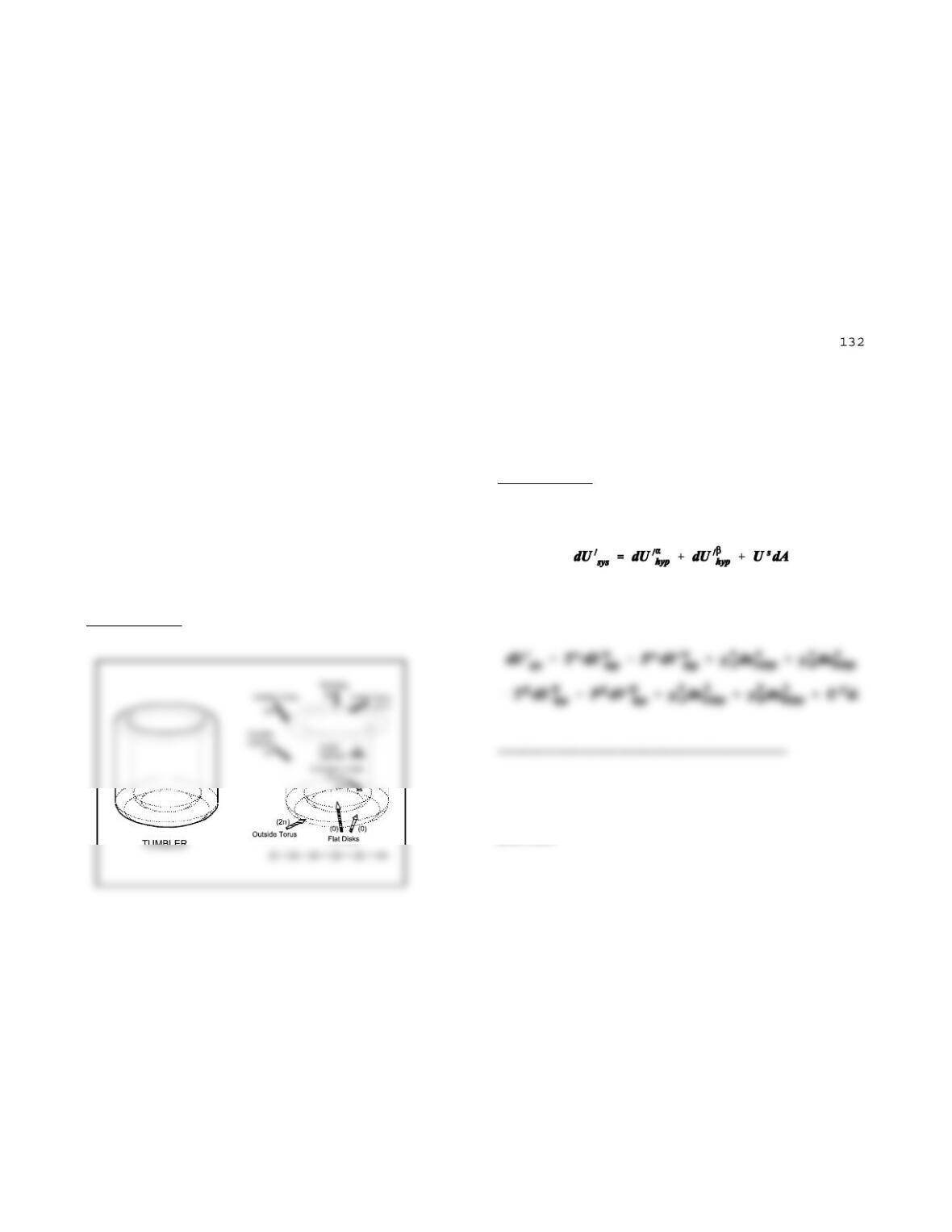
12.1. Sketch a familiar object that has convex, concave and
saddle surface elements. Draw an exploded view of the object
that illustrates each of these classes of features.
Answer to 12.1.
12.2. Write out an explicit expression for the change in
internal energy for a two phase, two component system,
including surface terms.
Answer to 12.2.
Strategy: Apply Eq.(12.14)
Substitute expressions for each phase:
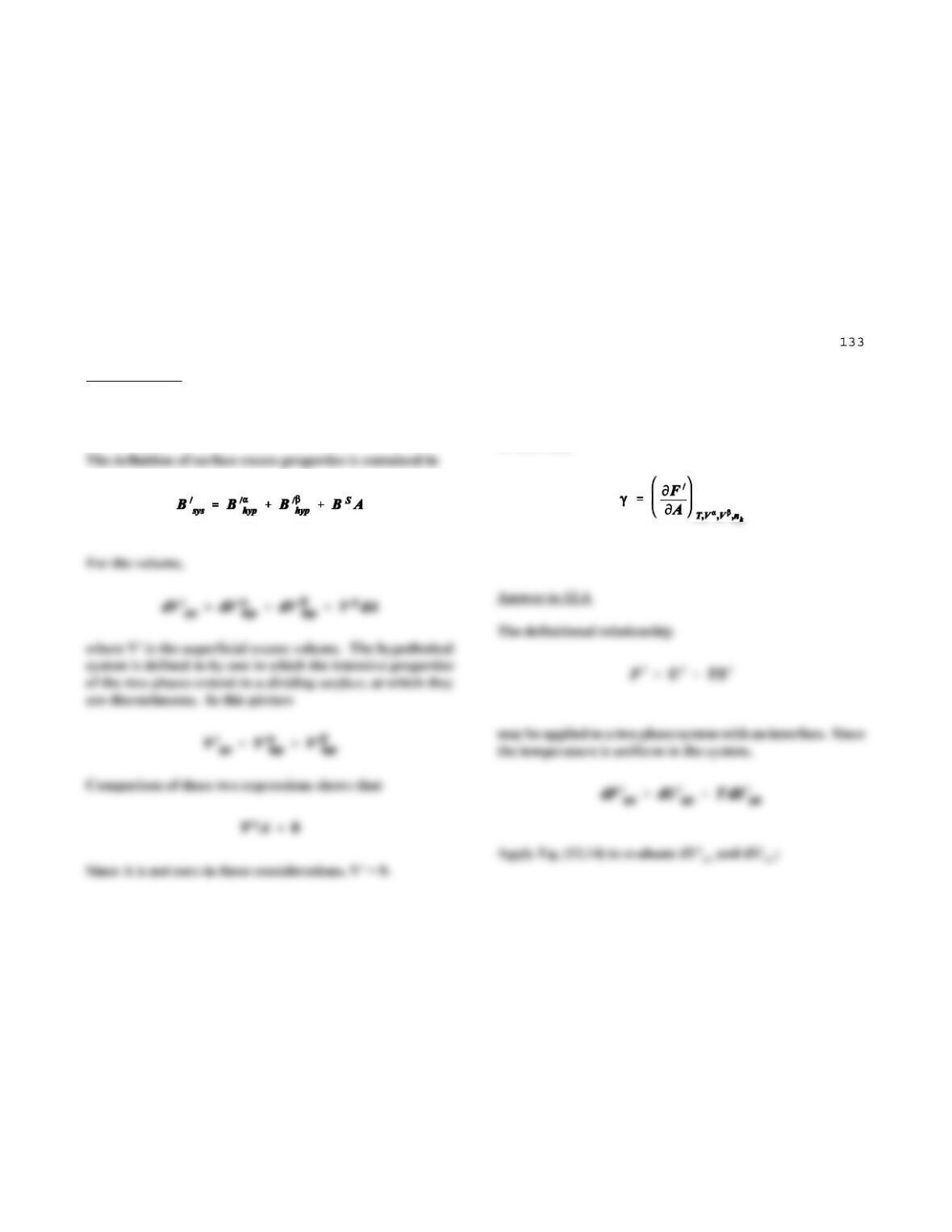
12.3. It has been asserted that Vs, the “specific superficial
excess volume”, is zero for any interface. Prove this
assertion.
Chapter 12. Capillarity
Answer to 12.3.
Strategy: Recall the generic definition, Eq.(12.14), and apply
it to the volume.
———–——–——————————————
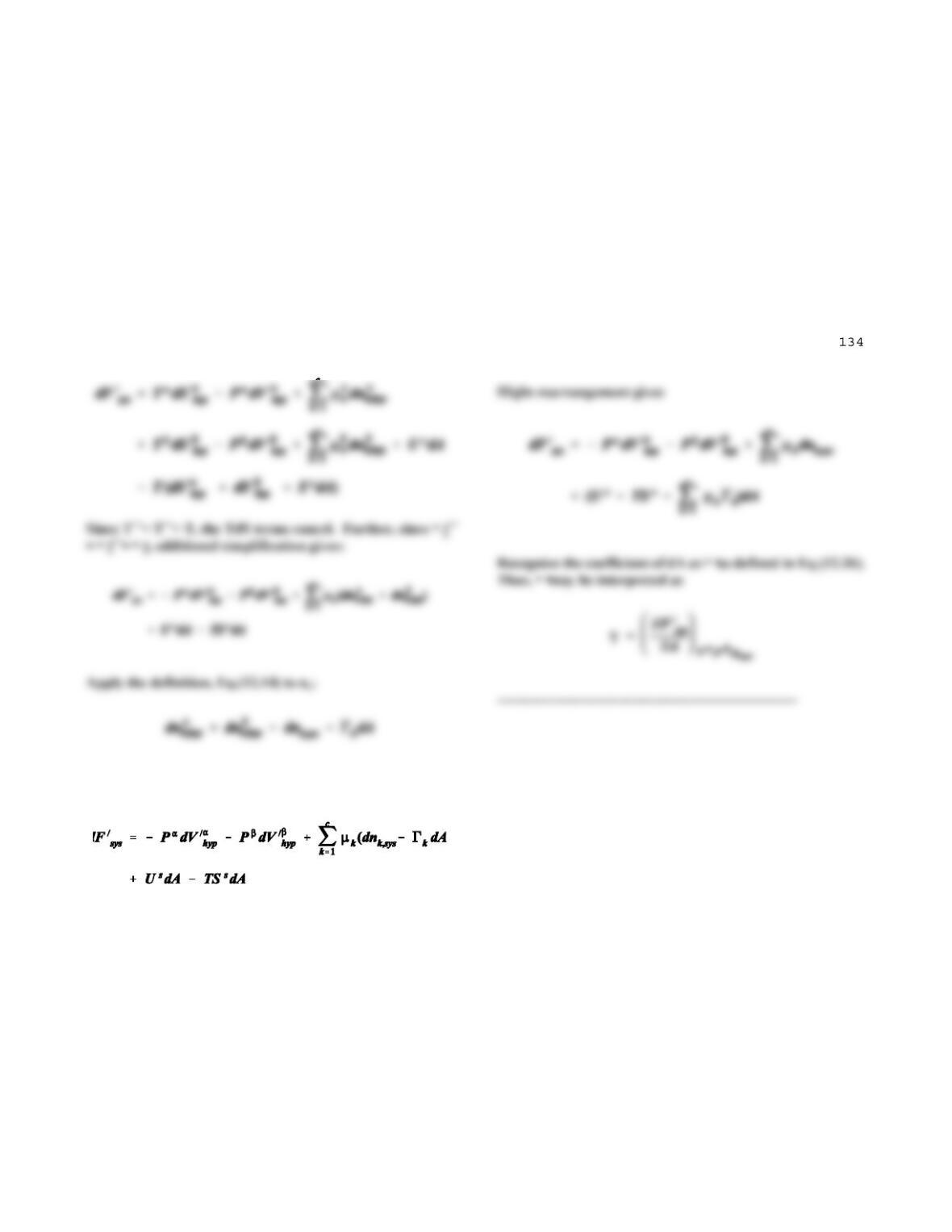
12.4. Paraphrase the development leading to equation (12.33)
to show that
Solution Manual
Substitute into the expression for dF’sys
12.5. A thin wire of radius r and length l will tend to shorten
under the action of surface tension, unless a weight F is hung
on it sufficient to balance the contracting forces.
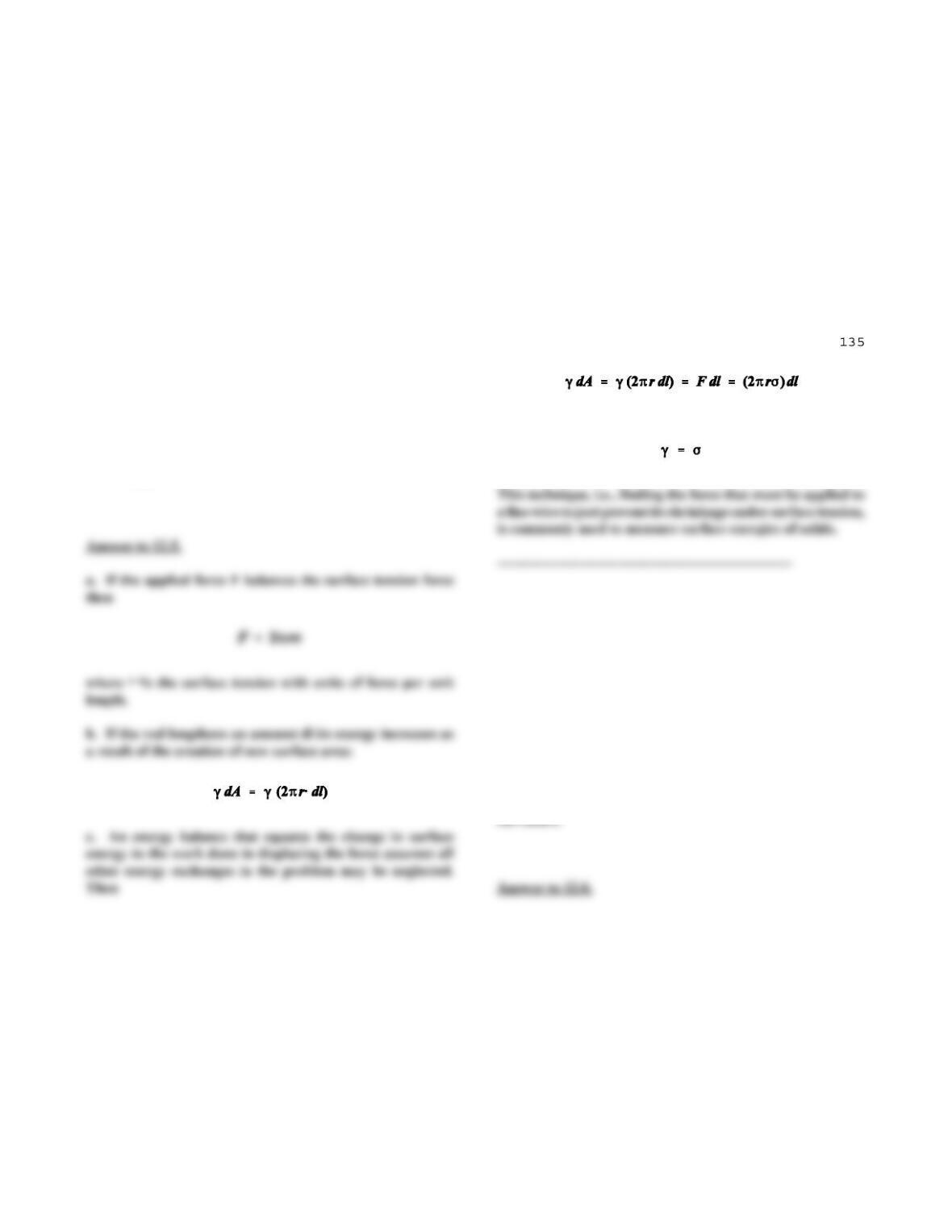
a. Write a force balance that relates the weight F to
the surface tension • • and the dimensions of the wire.
Chapter 12. Capillarity
b. Write an expression for the change in energy
associated with an incremental lengthening dl of the
rod in terms of • • and the dimensions of the rod.
c. Interpret the energy change in terms of the work of
displacing the force F through a distance dl.
d. Equate the two alternate evaluations of F to show
that • • = • •.
d. Compare these expressions;
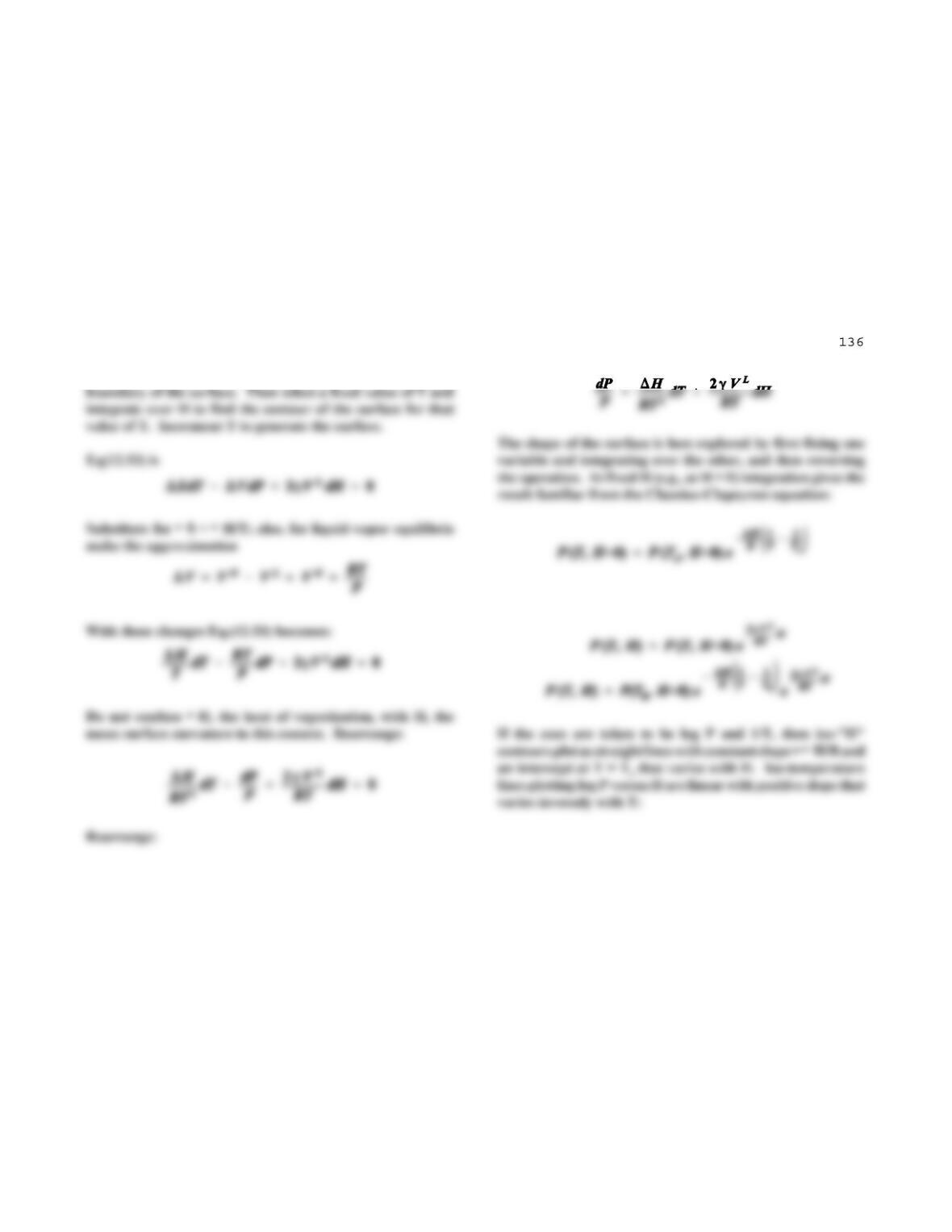
12.6. Use equation (12.53) to sketch a surface that represents
the variation of vapor pressure with temperature and
curvature.
Solution Manual
Strategy: Integrate Eq.(12.53) at H = 0 to obtain one
Chapter 12. Capillarity
P(T, H)
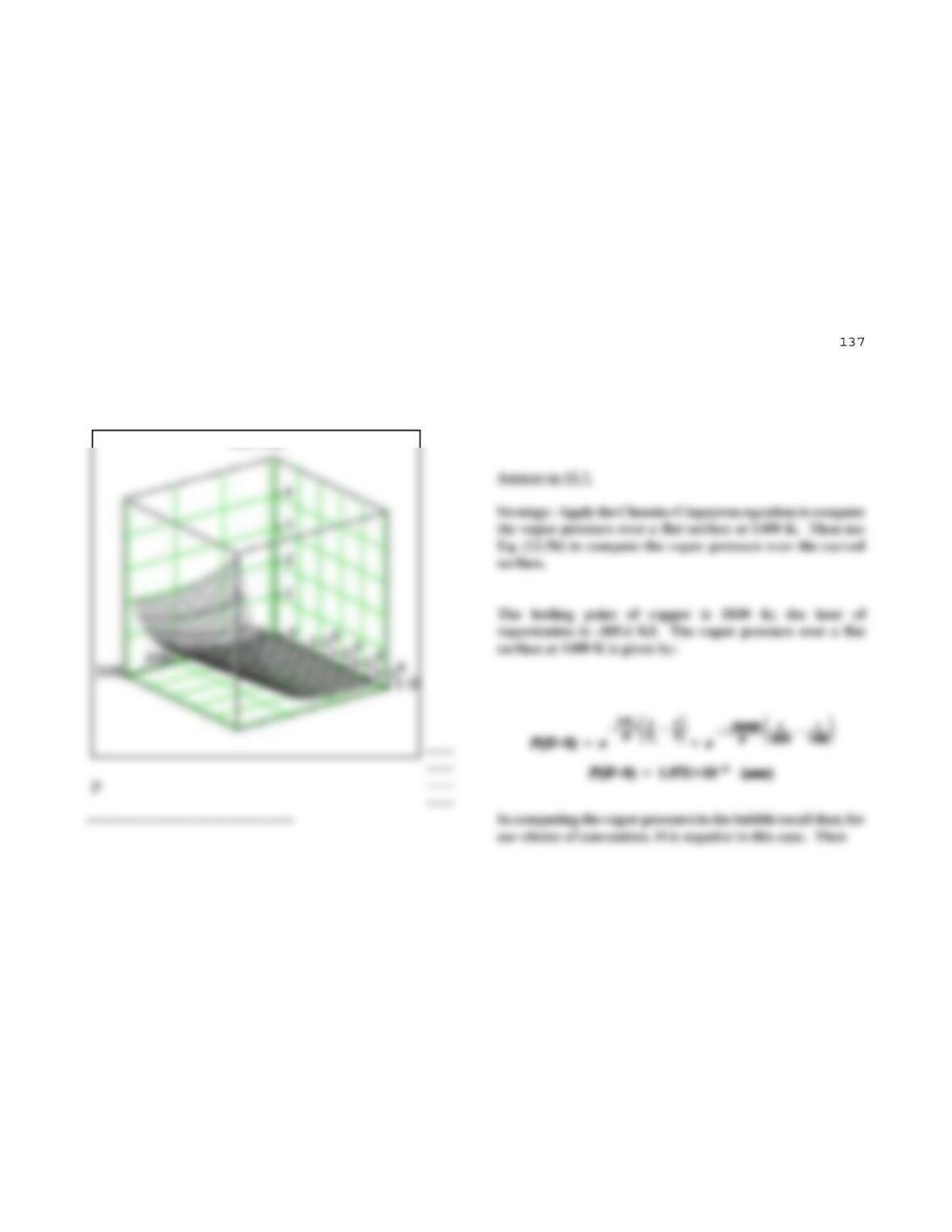
12.7. Compute the vapor pressure of liquid copper over a flat
surface at 1400 K. Compute the equilibrium vapor pressure
inside an 0.5 micron diameter bubble of copper vapor
suspended in liquid copper at 1400 K.
Answer to 12.8.
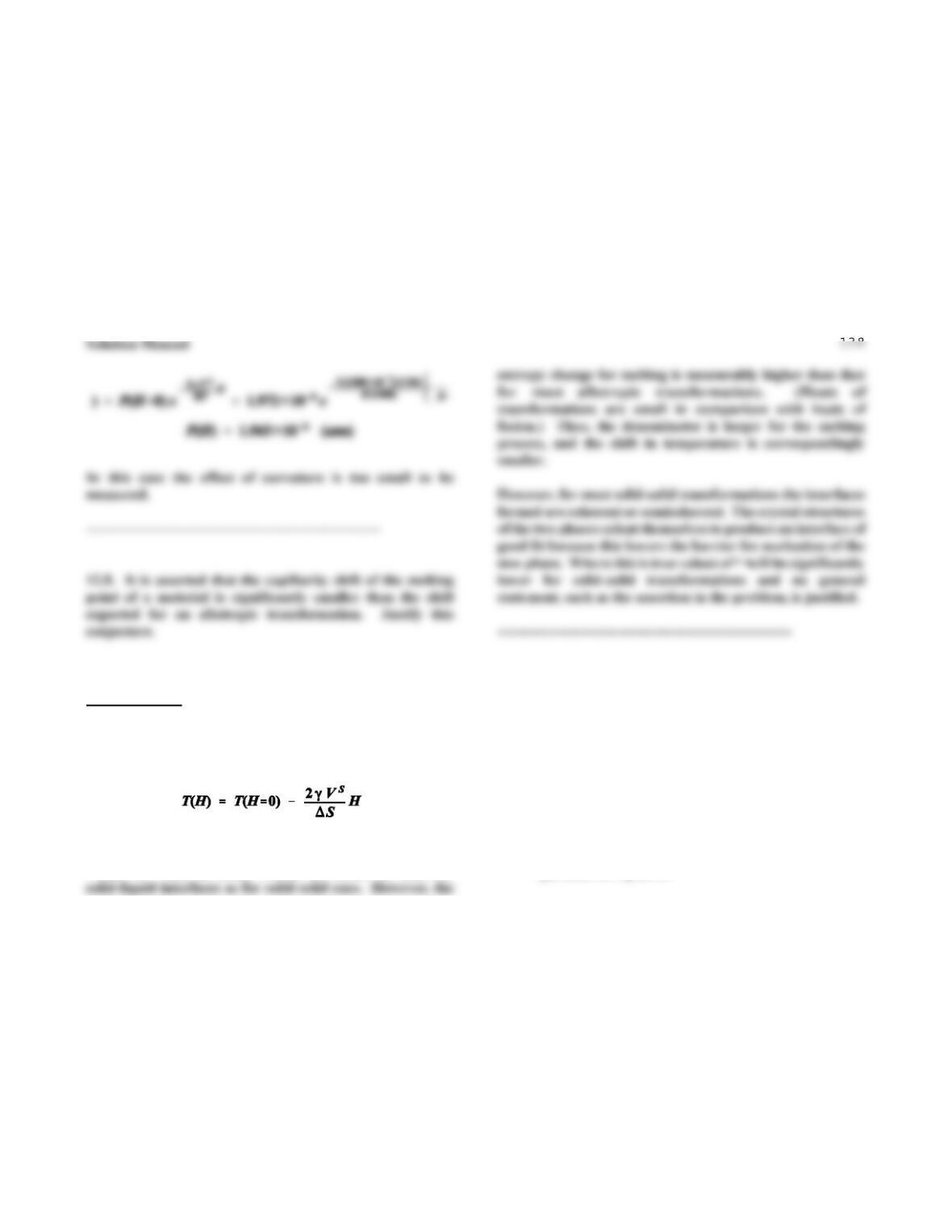
The shift in the transformation temperature is given in Eq.
(12.61):
Values of • • and the molar volume are about the same for
12.9. Below 892 K the phase diagram for the system A – B
consists of dilute terminal solid solutions • • and • • with no
intermediate phases. At 680 K the solubility limits are X2
• •
=
0.025 and X2
• •
= 0.967. The molar volume of • • is 9.5 cc/mole
and the partial molal volume of component 1 in • • is 11.2
cc/mole. The interfacial free energy is 500 ergs/cm2.
a. Compute the capillarity length scales for the • • and
• • phases.
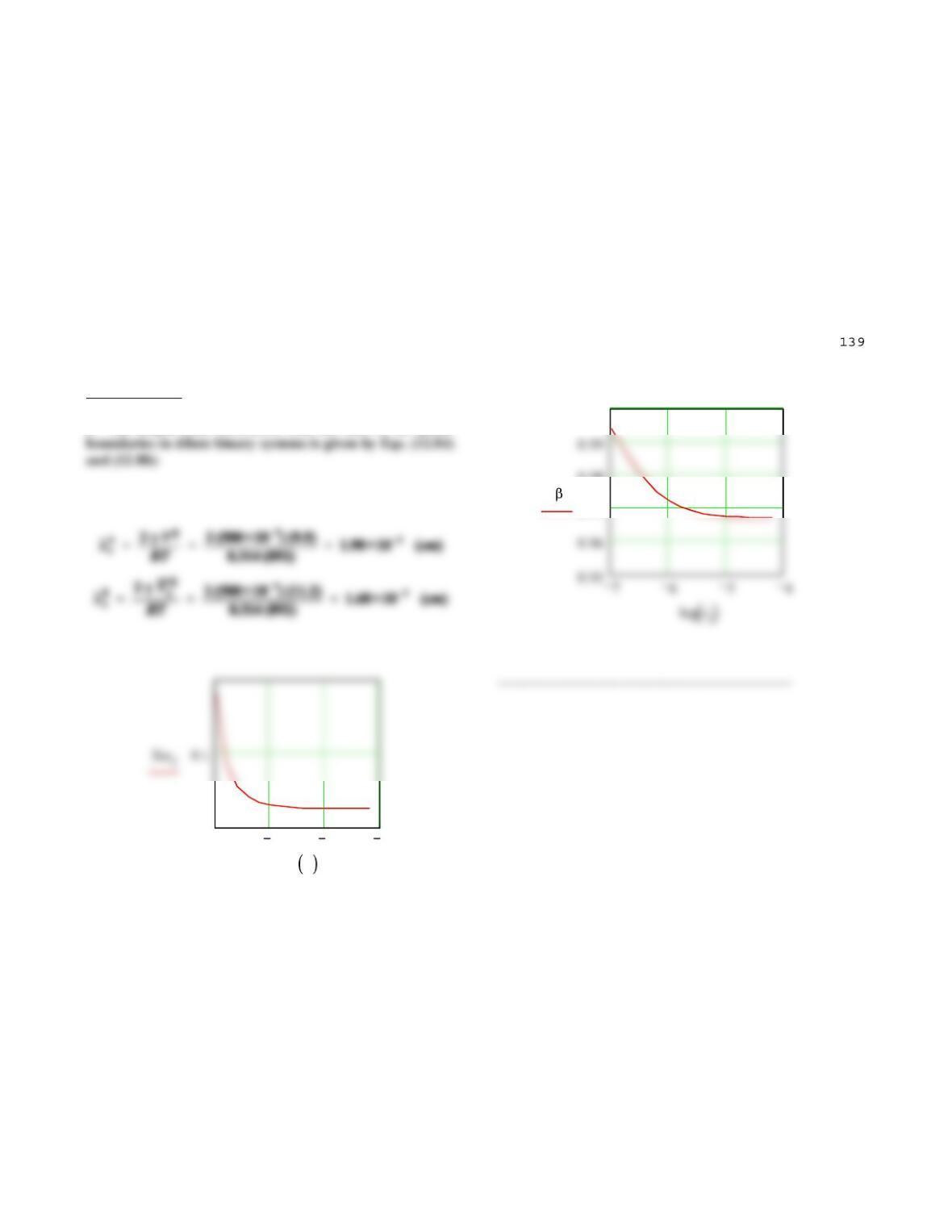
b. Compute and plot the equilibrium interface
compositions as a function of particle size. Assume the
particles are spheres.
Chapter 12. Capillarity
6 5 4
0
log rj
0.97
0.98
1
Xj
Answer to 12.9.
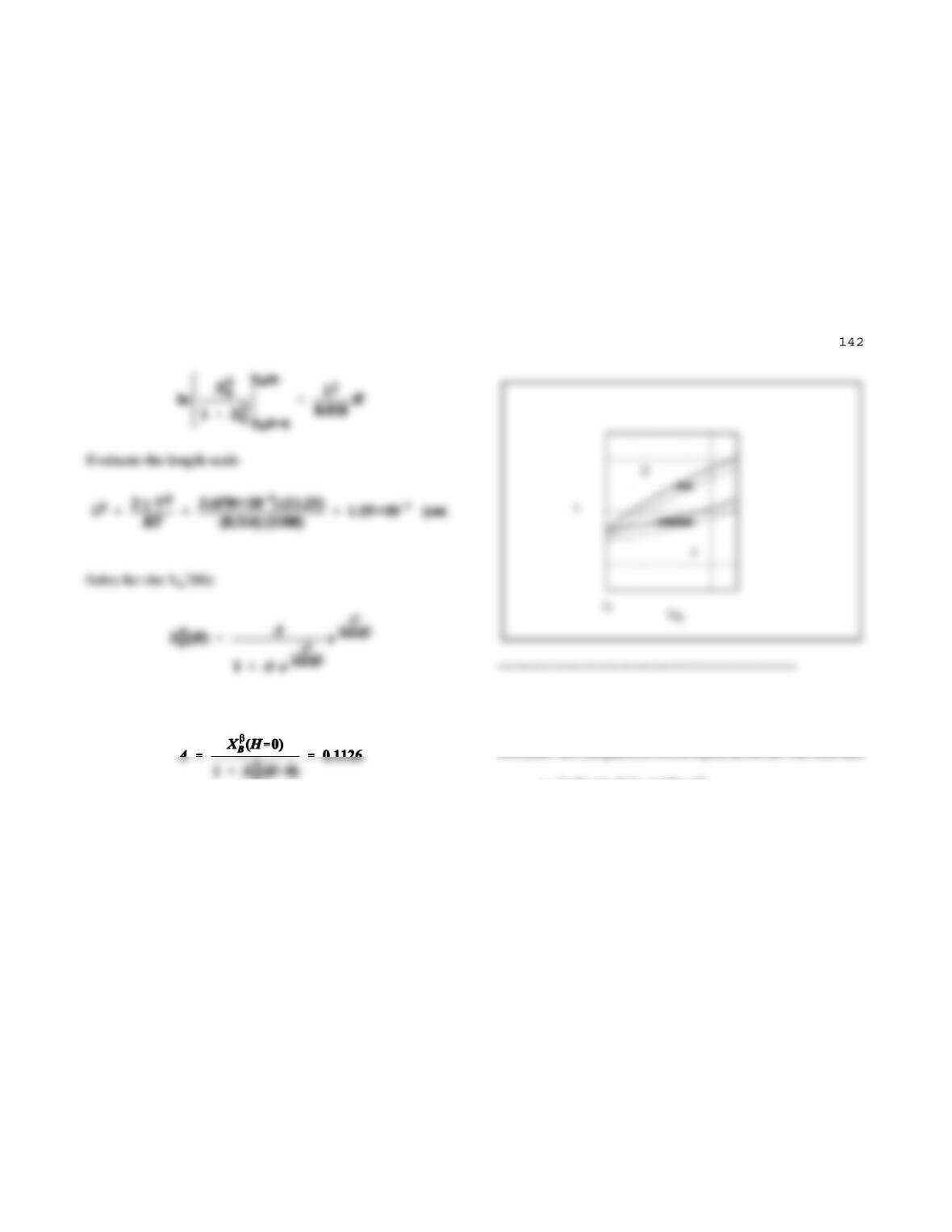
a. The length scale associated with the shift of the phase
b. Plot the capillarity shift versus particle radius:
12.10 The • • to • • transformation occurs at 1155 K in pure
titanium. The element B is a • • stabilizer when added to
titanium. Assume for this problem that the • • and • • phases
are ideal solutions. The properties of the system are:
Component Tk
• •->• •
(K) • •Sk
o• •->• •
(J/mole K) Vk
• •
(cc/mole)
Solution Manual
Titanium 1155 4.2 11.5
B 830 5.2 9.7
a. Compute the bulk compositions, XB
• •
and XB
• •
, at
1100 K.
b. An alloy with XB = 0.12 is quenched from the • •
phase to 1100 K where • • nucleates and grows.
Compute and plot the interface composition in the • •
phase as a function of particle radius.
c. Sketch the capillarity shift on the phase diagram.
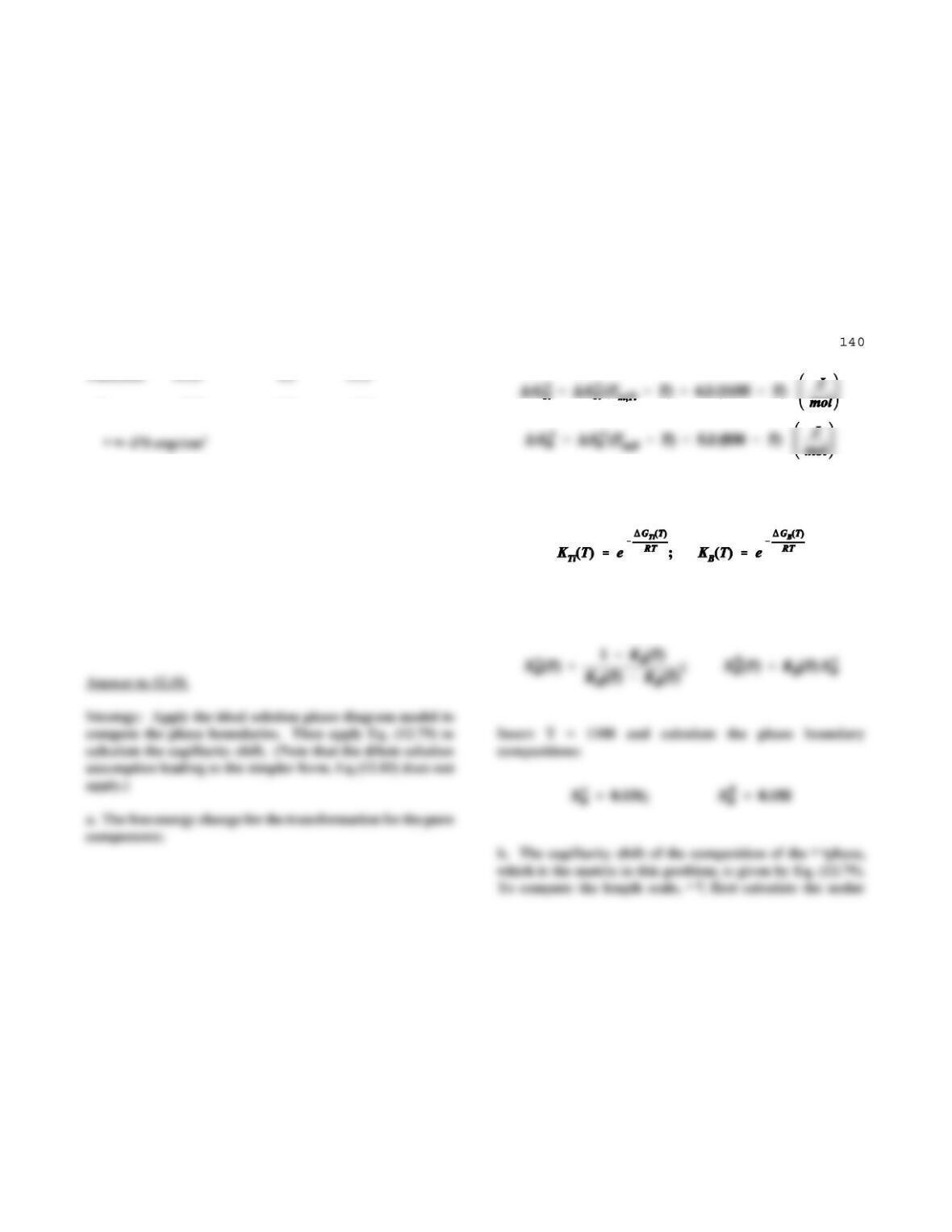
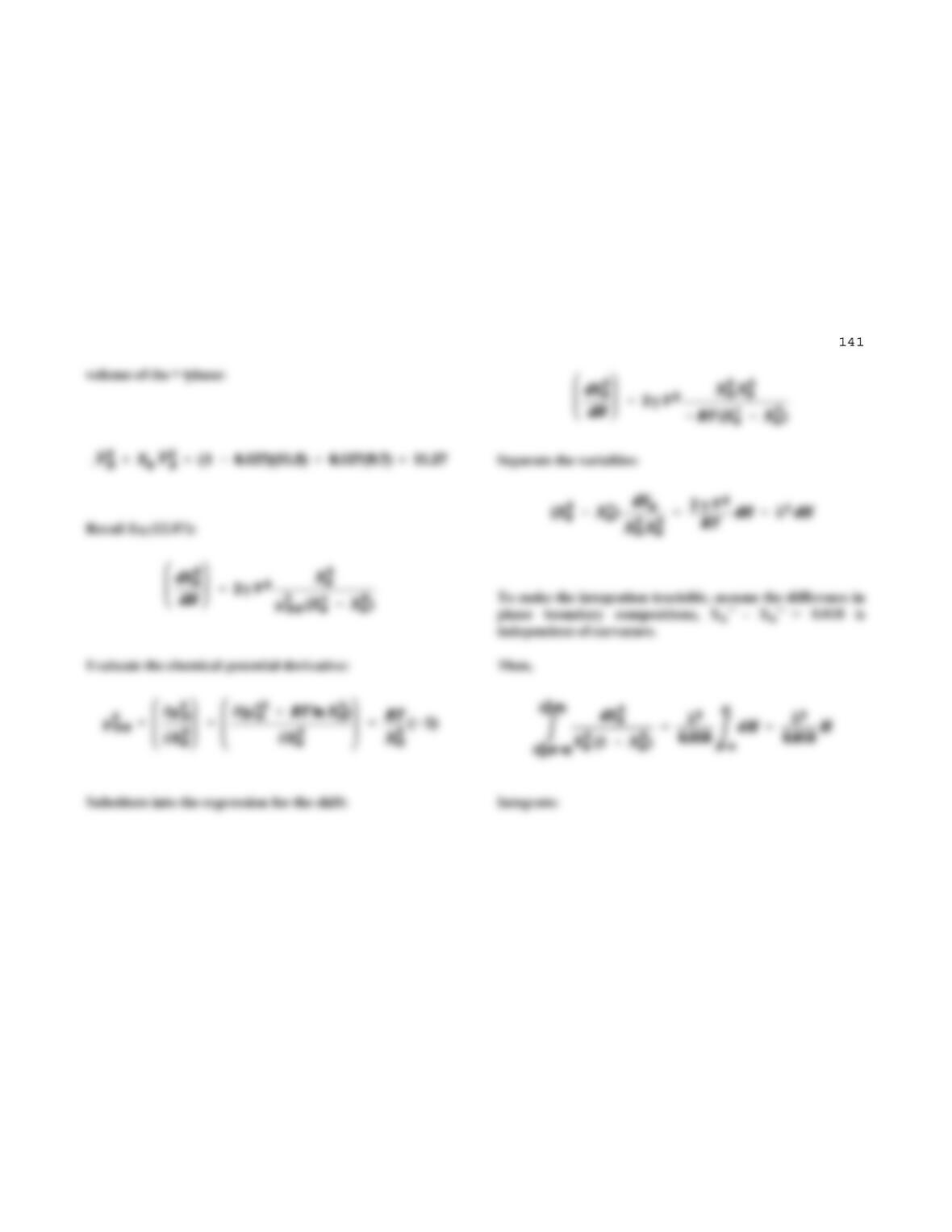
The K(T) functions:
The Phase boundary compositions are then
Chapter 12. Capillarity
Solution Manual
where
c. The capillarity shift of the phase boundaries for a constant
H is:
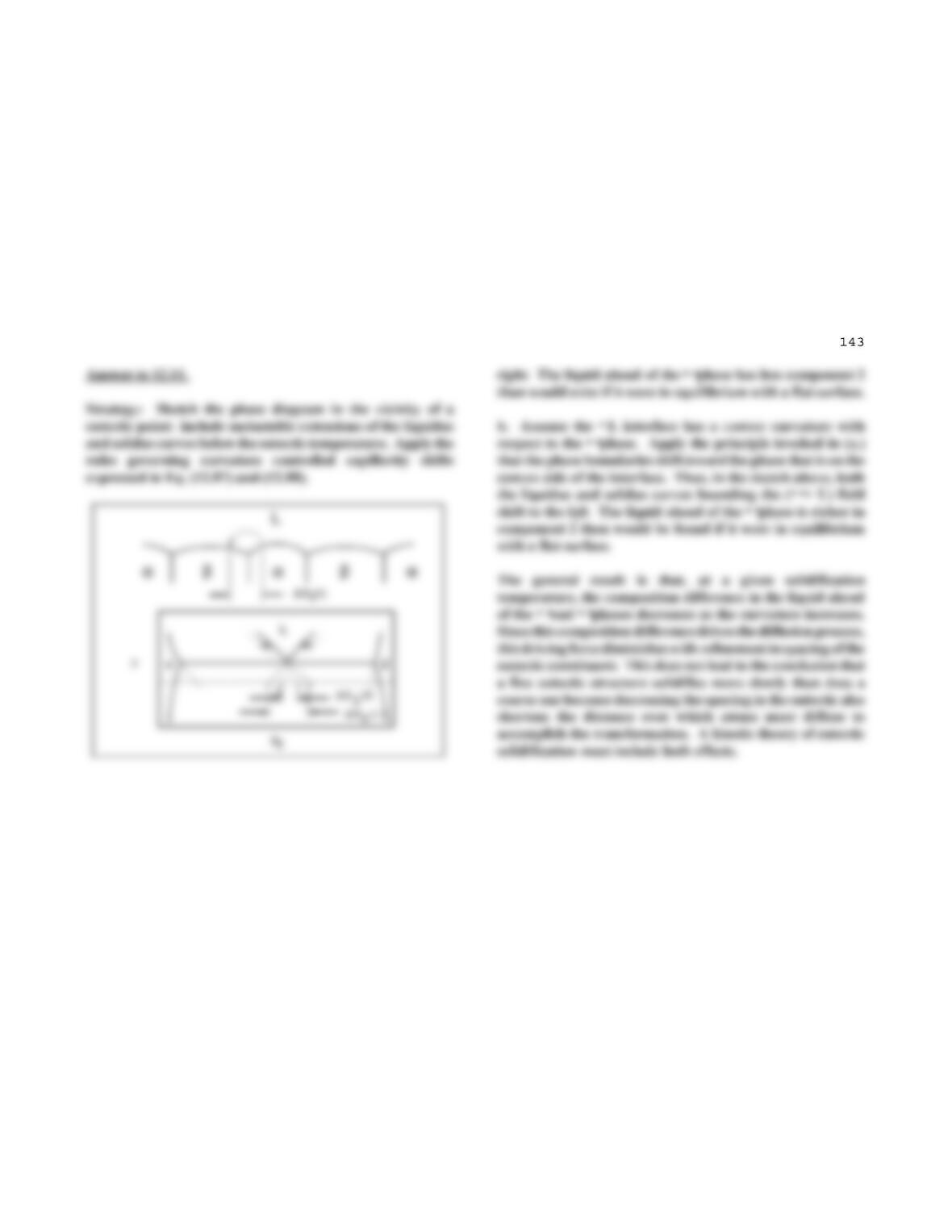
12.11. Sketch the microstructure at the advancing (• •+• •/L)
interface in a solidifying eutectic. How does the capillarity
shift alter the composition in the liquid at the curved interface
a. In front of the • • phase?
b. In front of the • • phase?
Illustrate your answer by sketching shifted liquidus curves on
the phase diagram near the eutectic point.
Chapter 12. Capillarity
a. Assume the • •L interface has a convex curvature with
respect to the • • phase. The phase boundaries in a two phase
field both shift toward the phase that is on the convex side of
the interface. Thus, in the sketch above, both the liquidus
and solidus curves bounding the (• • + L) field shift to the
———–——–——————————————-
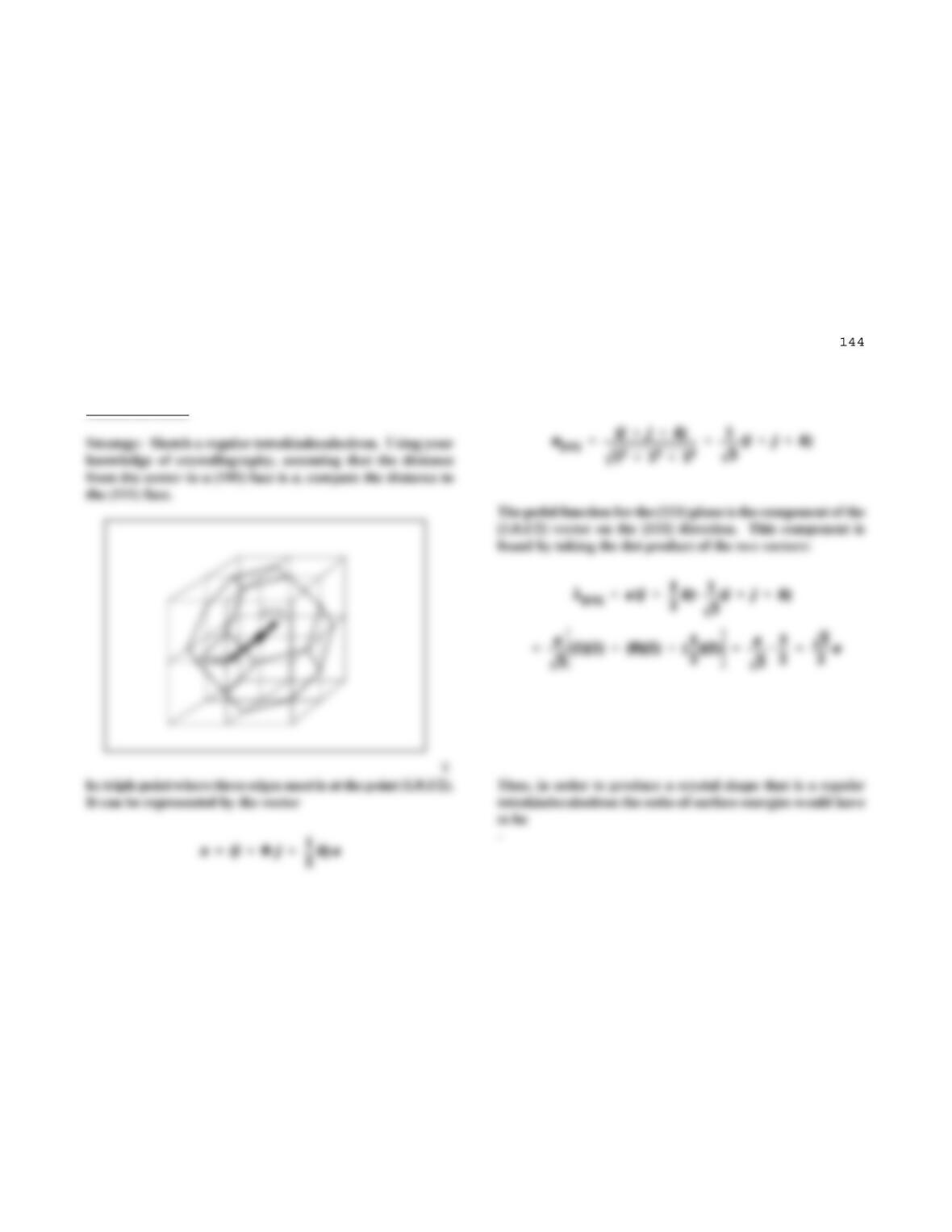
12.12. The tetrakiadecahedron is a polyhedron with six {100}
faces and eight {111} faces. (Tetrakiadeca is Greek for
fourteen.) On a regular tetrakiadecahedron all of the edges
have the same length. Calculate the ratio of • •
{111} to • •
{100} that
would be required to produce this shape.
Solution Manual
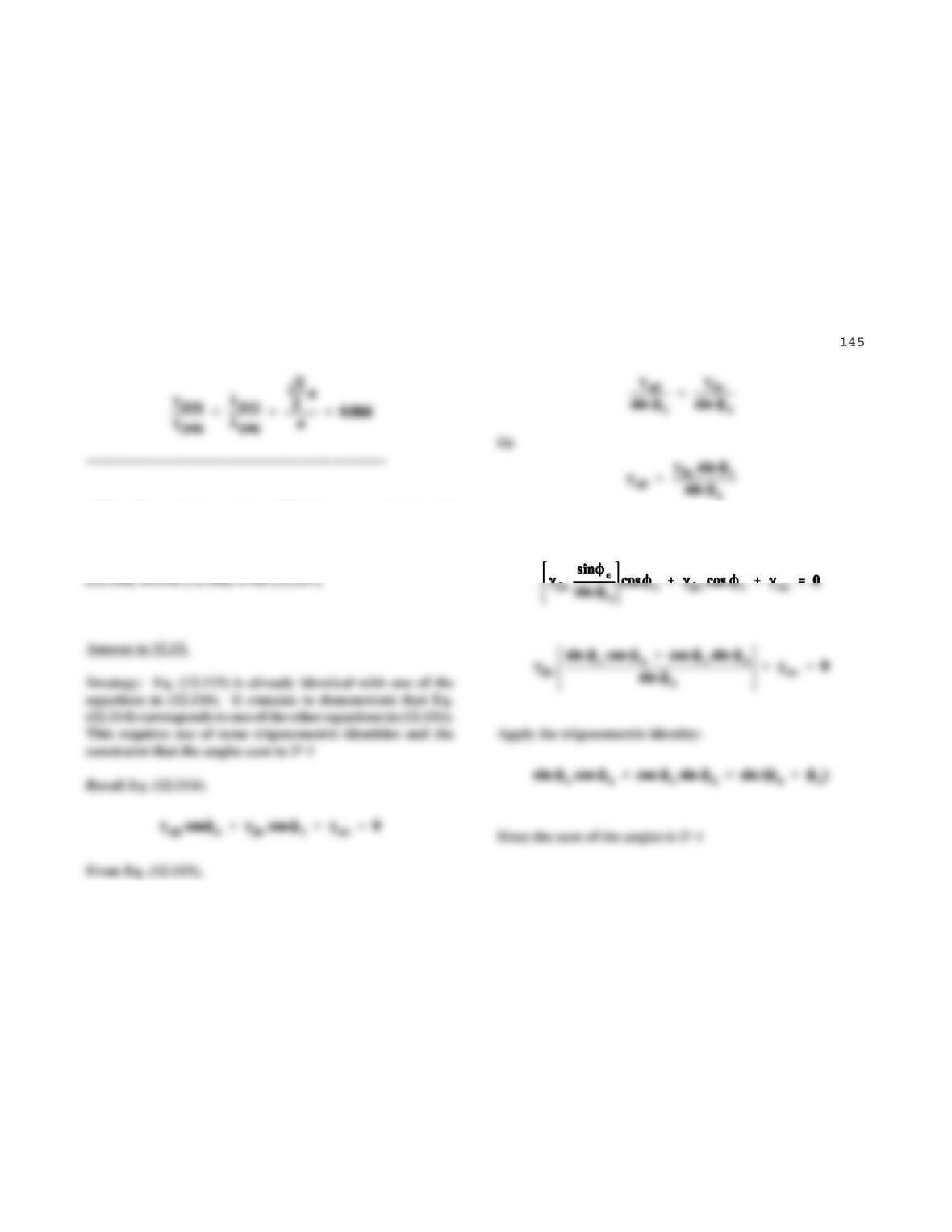
Answer to 12.12.
where i, j and k are unit vectors in the x, y and z directions.
The unit vector in the [111] direction is
Chapter 12. Capillarity
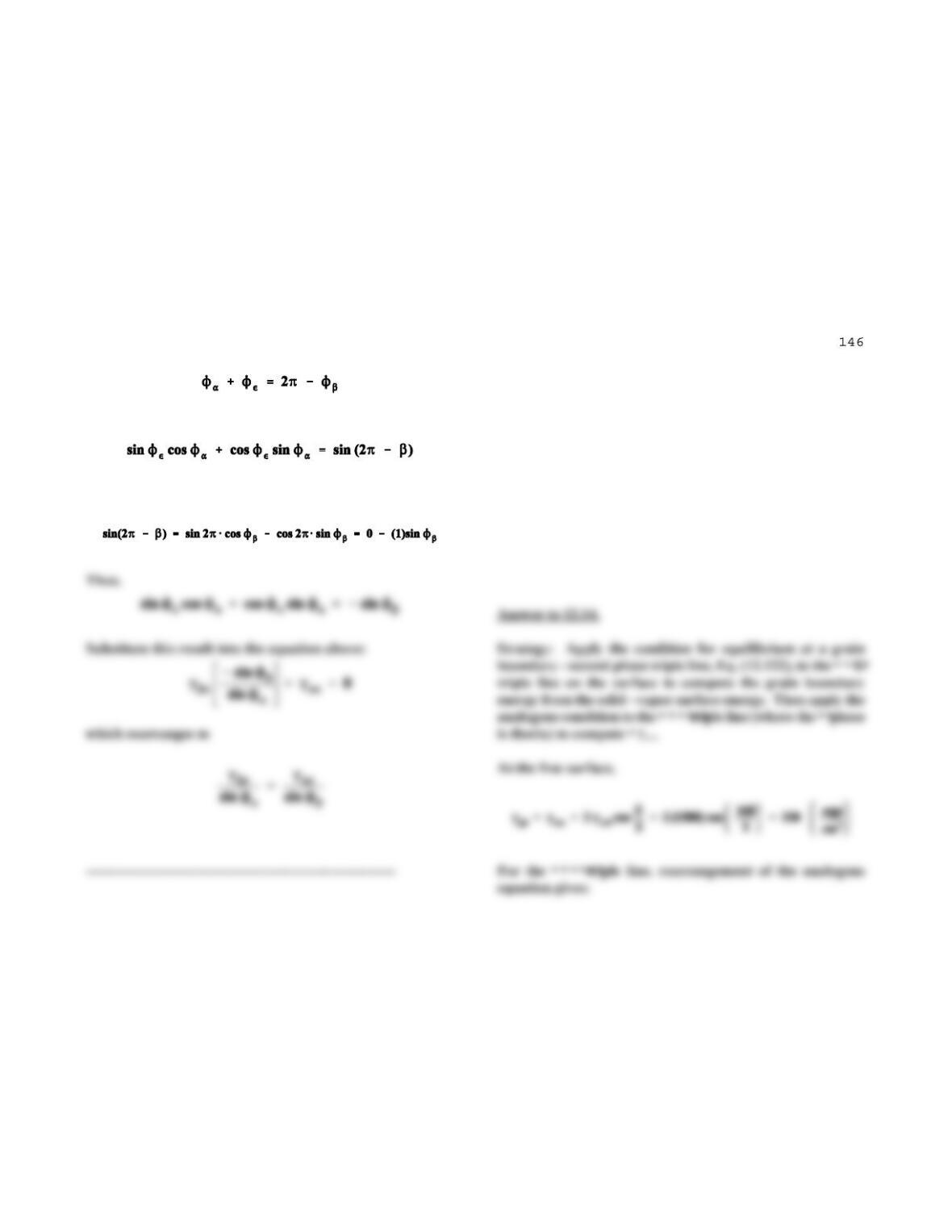
12.13. Show that equations (12.116) are consistent with
equations (12.114) and (12.115).
NOTE: ERROR IN TEXT WHICH ASKS TO COMPARE
Use this result to eliminate • •
• • • •
in Eq. (12.114):
Solution Manual
so that
Further,
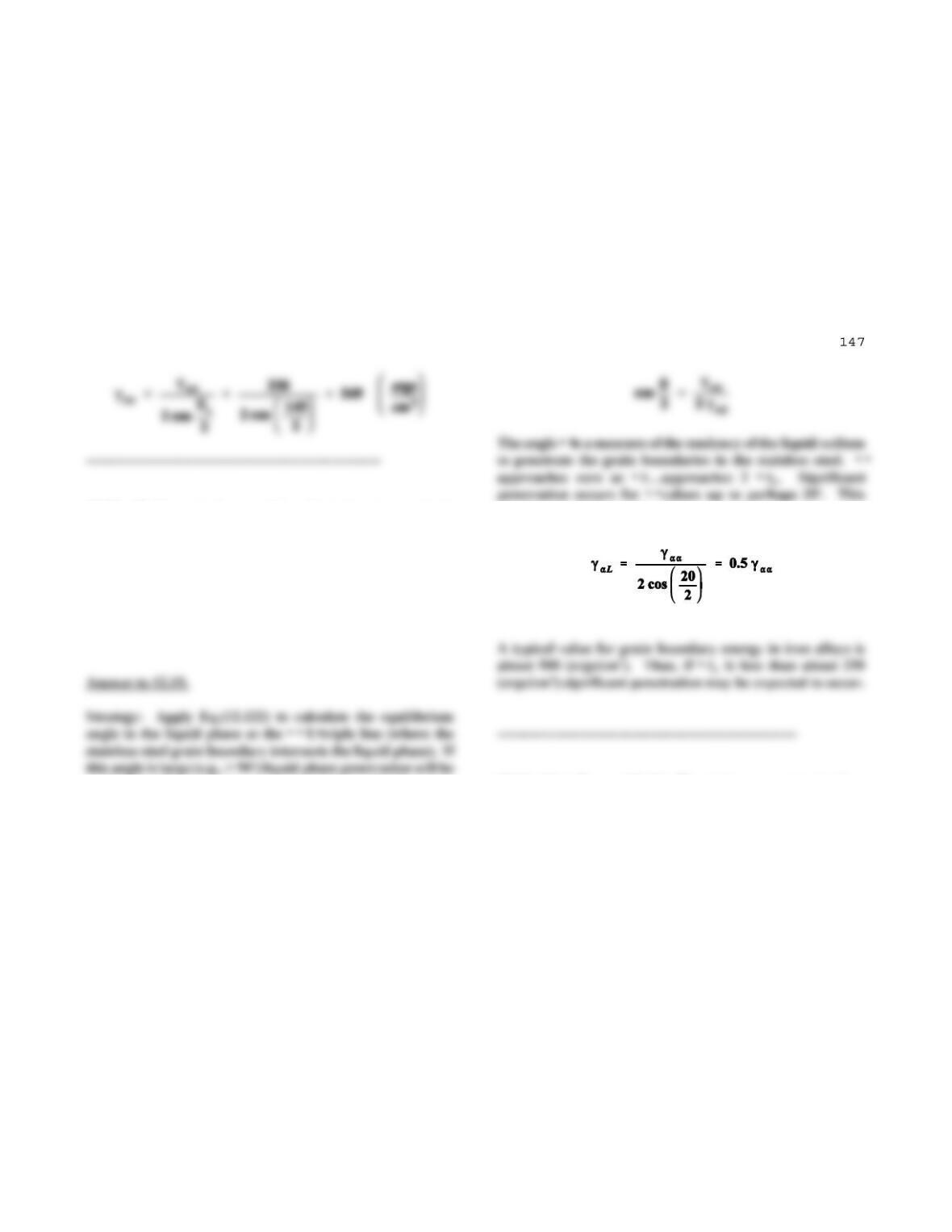
12.14. The surface energy of the interface between nickel and
its vapor is estimated to be 1580 (ergs/cm2) at 1100 K. The
average dihedral angle measured for grain boundaries
intersecting the free surface is 151o. Thoria dispersed nickel
alloys are made by dispersing fine particles of ThO2 in nickel
powder and consolidating the aggregate. The particles are
left at the grain boundaries in the nickel matrix. Prolonged
heating at elevated temperatures gives the particles their
equilibrium shape. The average dihedral angle measured
inside the particle is found to be 157o. Estimate the specific
interfacial energy of the thoria – nickel interface.
Chapter 12. Capillarity
12.15. Nuclear reactors used in submarine power plants
circulate liquid sodium as a coolant in the reactor core.
Stainless steel piping is proposed for use in the heat
exchangers. The average grain boundary energy of stainless
steel 250 (ergs/cm2)while that of the solid/liquid interface is
110 (ergs/cm 2. Will liquid sodium significantly penetrate the
grain boundaries of the stainless steel?
negligible; if it approaches zero, penetration of sodium into
stainless steel may be expected to be a significant problem
and a different alloy must be selected for tubing in the reactor
heat exchanger.
Rearrange Eq (12.122):
corresponds to the condition
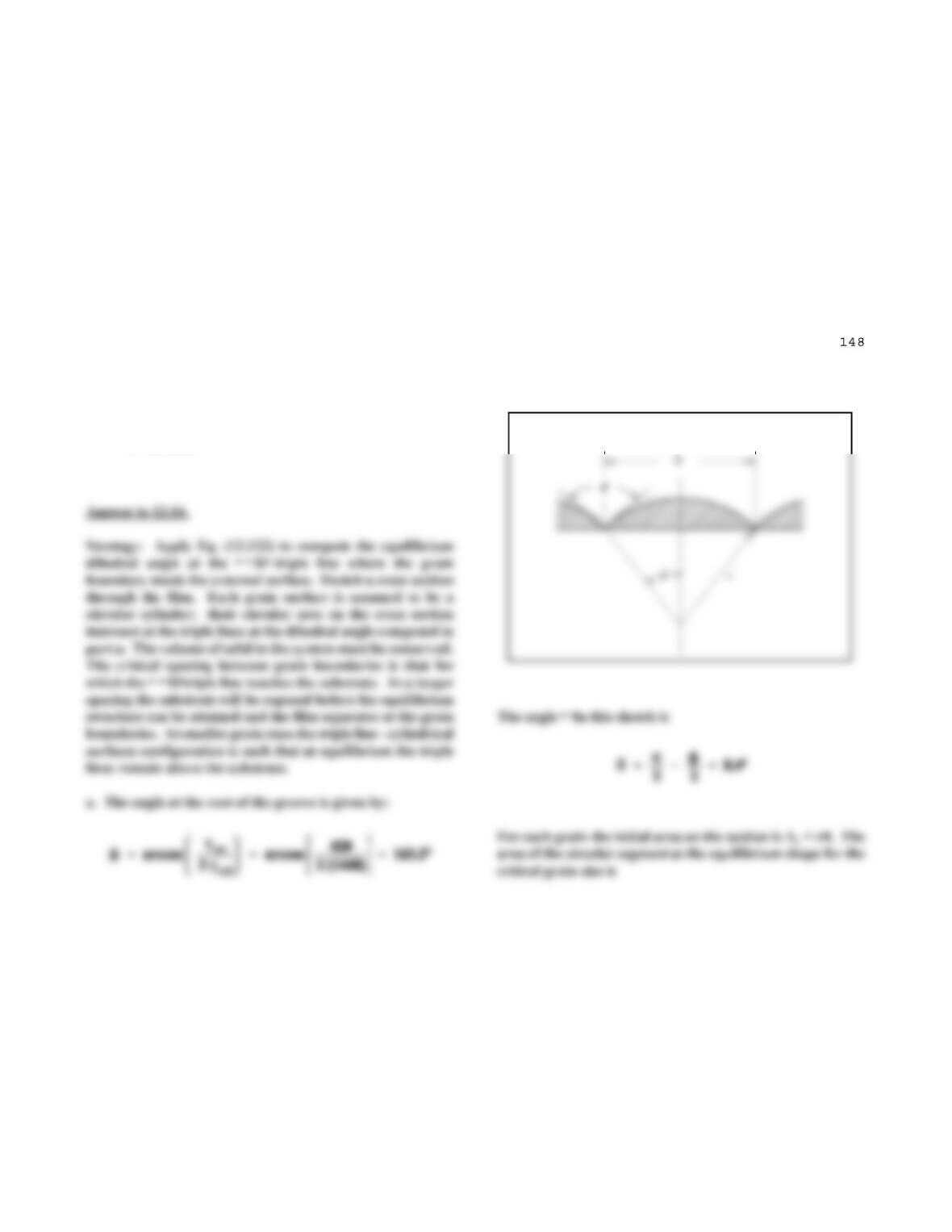
12.16. Visualize a gold thin film stripe as a connector in a
microelectronic chip. Suppose the stripe is 0.1 micron thick
and has a bamboo grain structure. (This means the grain
boundaries run laterally completely across the stripe.) Take
the grain boundary energy of gold at 600 K to be 420
(ergs/cm2); its surface energy is 1440 (ergs/cm2).
Solution Manual
a. Compute the dihedral angle where a grain
boundary meets the external surface.
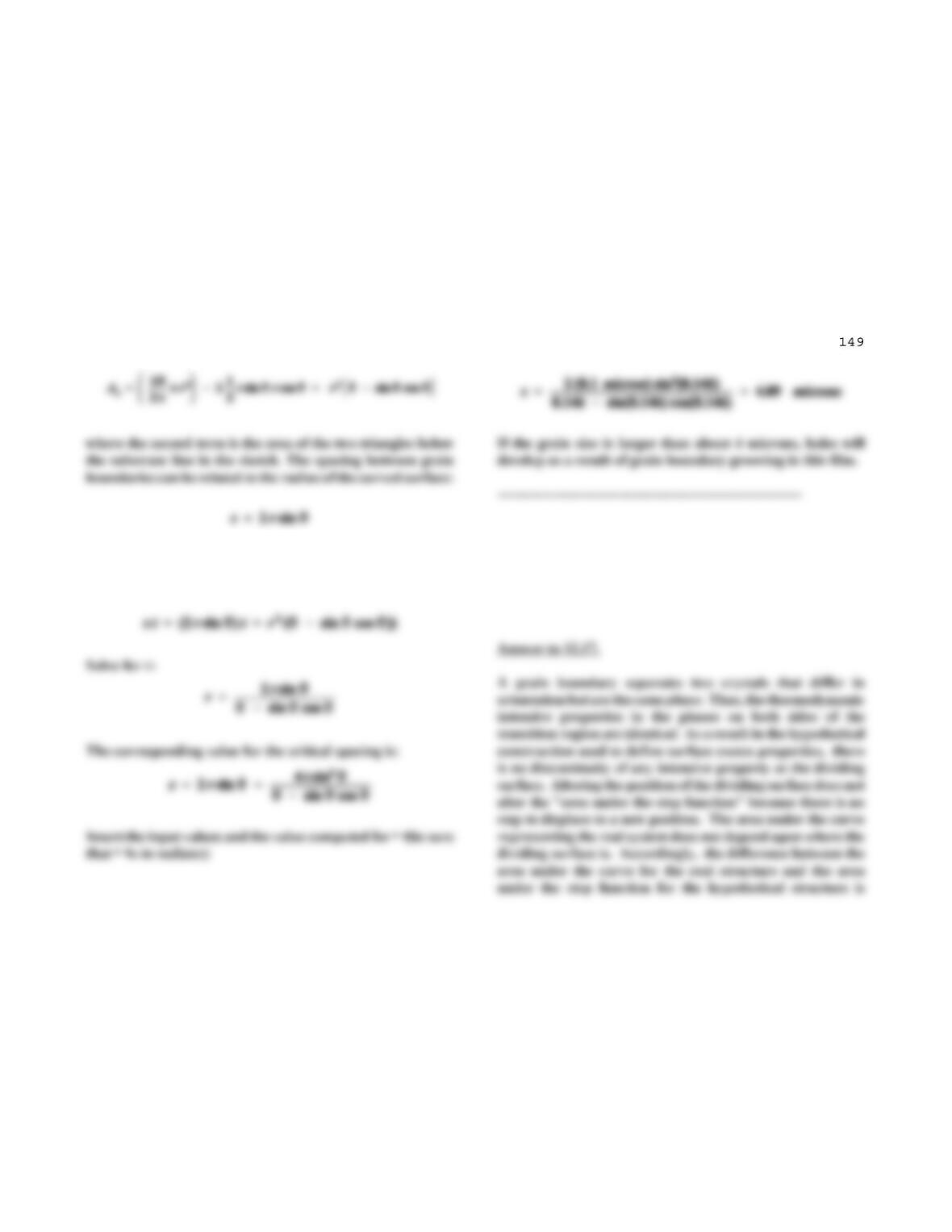
b. Find a critical grain boundary spacing, sc, for
which the equilibrium grain shape will produce a hole
in the film.
b. Sketch the critical condition:
Chapter 12. Capillarity
Conservation of atoms requires that the initial area on the
cross section be equal to the final area:
12.17. Show that the specific interfacial excess properties
associated with a grain boundary are independent of the
choice of the position of the dividing surface.
Solution Manual
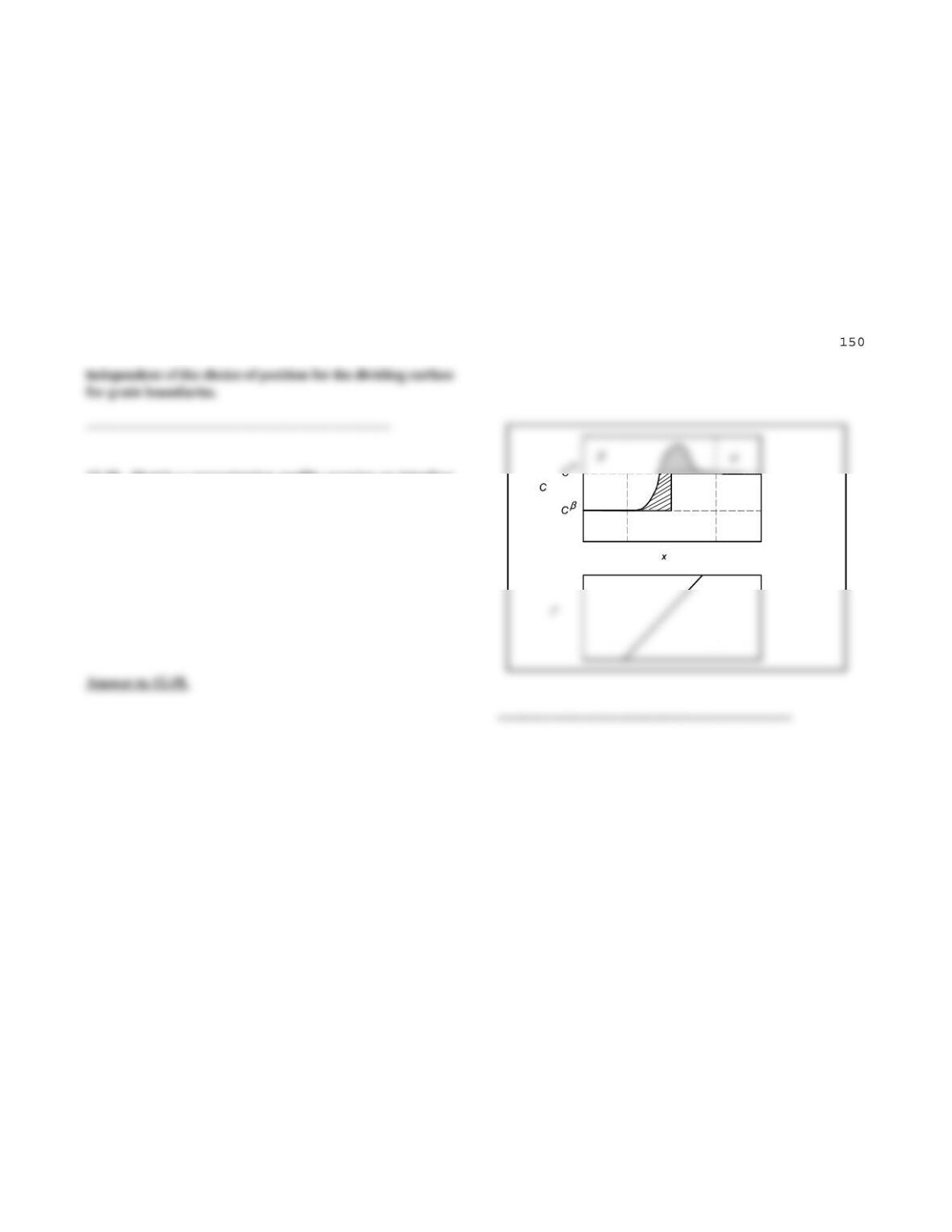
12.18. Sketch a concentration profile crossing an interface
between • • and • • phases. Sketch a plot of the variation of the
specific interfacial excess of the component as the choice of
the position of the dividing surface moves from one side of the
physical surface of discontinuity to the other. Pay particular
attention to the form of the curve.