Chapter 11. Reacting Systems
Chapter 11. Reacting Systems
11.1. Consider a gas mixture at a high temperature with the
a. List the elements in the system.
b. How many independent chemical reactions does this
system have?
c. Make a complete list of all of the possible reactions.
d. From this list choose a set of independent reactions.
e. Select one of the remaining reactions and show that it
is a linear combination of independent reactions.
SiH4 + H2O = SiO + 3H2 etc.
d. Choose the three formation reactions because that is the
information that will be found in tables and data bases:
Si + ½ O2 = SiO [2]
e. Choose SiH4 + H2O = SiO + 3H2[4]
Si + ½ O2 = SiO [2]
SiH4 = Si + 2H2– [3]
H2O = H2 + ½ O2+[1]
Combine:
Chapter 11. Reacting Systems
Component: CO CO2 O2
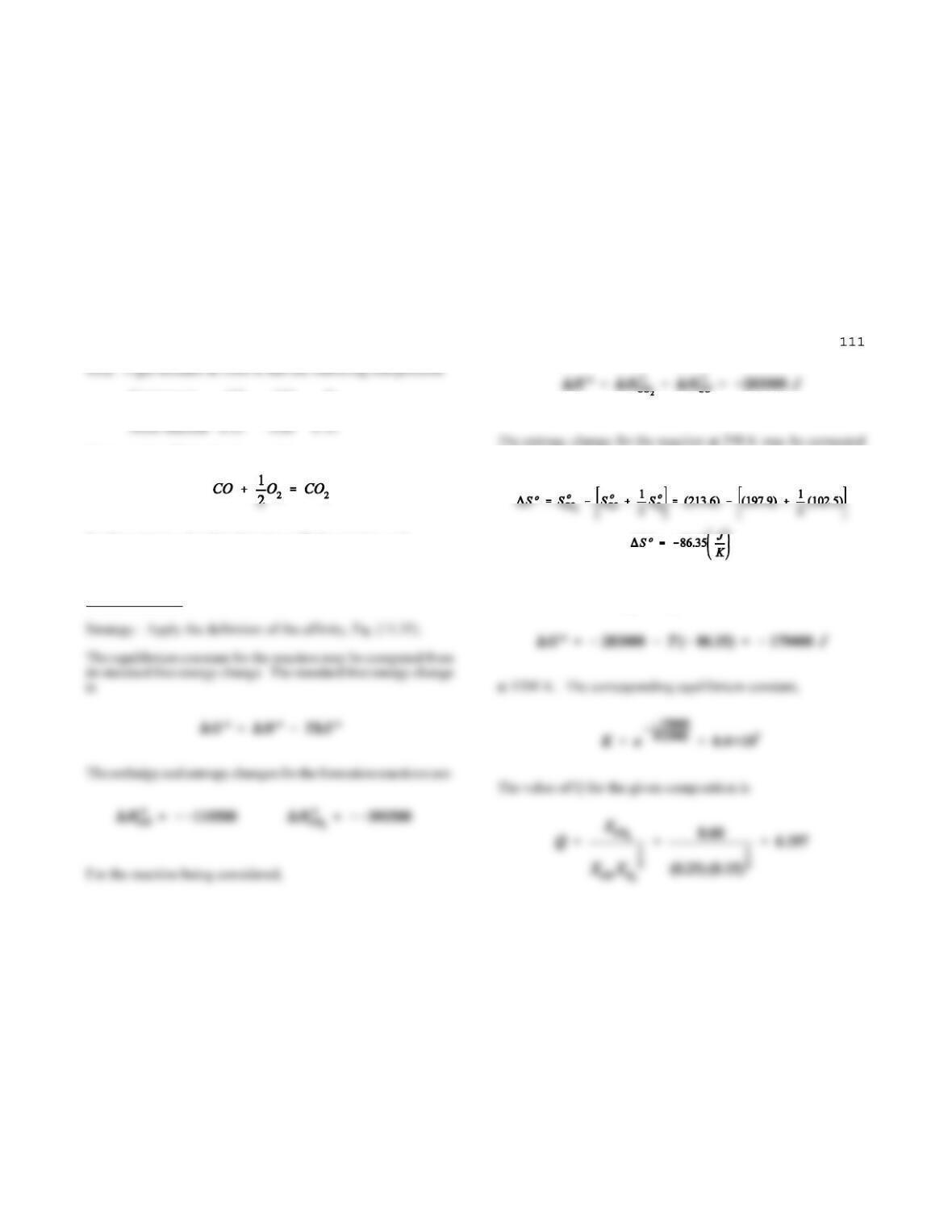
Compute the affinity for the reaction
for this mixture. In what direction will the reaction go?
Solution to 11.2.
The entropy change for the reaction at 298 K may be computed
from the absolute entropies of the components:
The standard free energy change is thus
Chapter 11. Reacting Systems
11.3. Consider the following gas mixture at 900 K.
Component: H2 H2O O2 CH4 CO CO2
Mole fraction: 0.19 0.05 1X10⁻⁵ 0.30 0.05 0.50
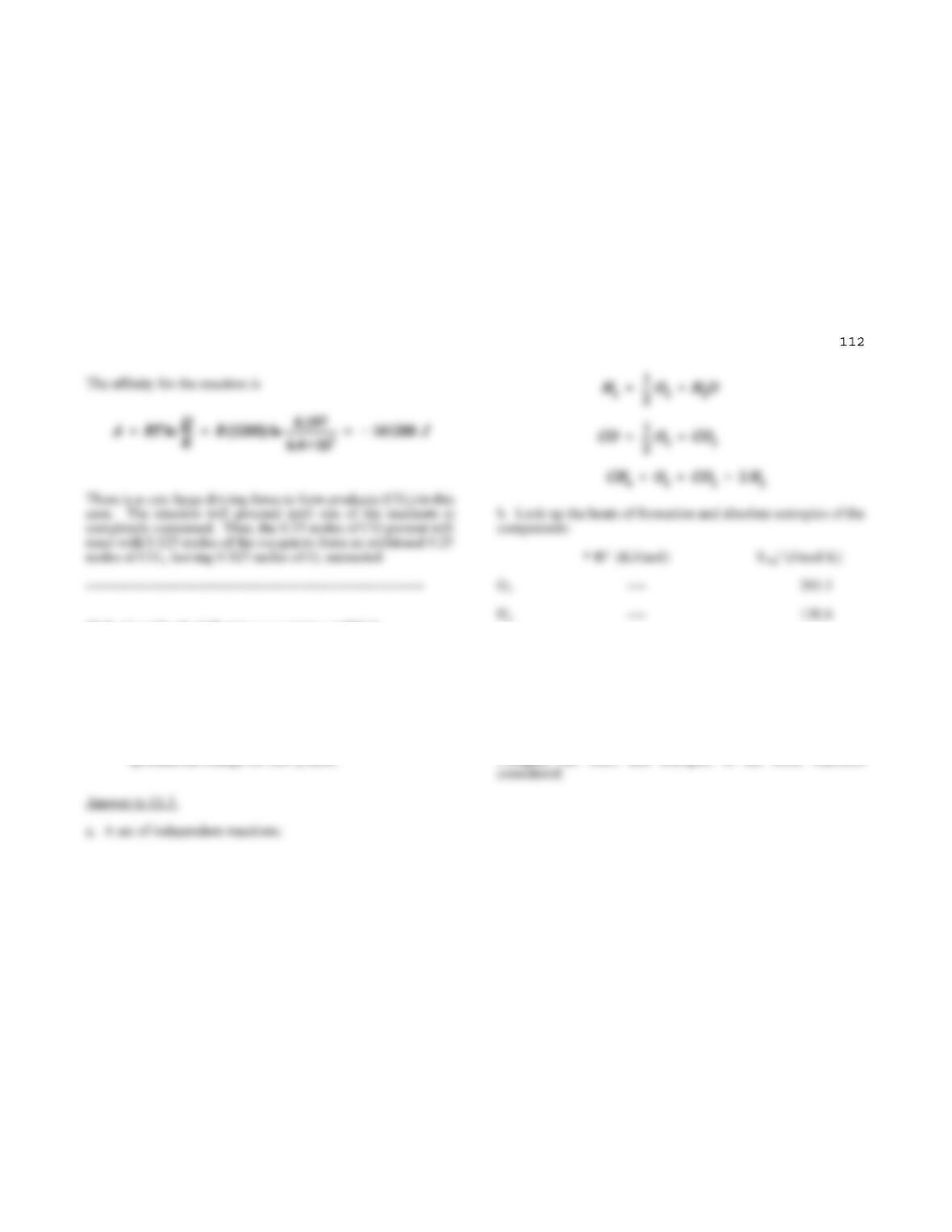
a. Write a set of independent reactions for this system.
b. Obtain equilibrium constants for these reactions.
c. Evaluate the affinity for each of these reactions.
d. What can you conclude about the direction of
spontaneous change for this system?
H2O -285.8 60.9
CO -110.5 197.5
CO2-393.5 213.7
CH4– 74.8 186.3
Compute the heats and entropies of the three reactions
Chapter 11. Reacting Systems
Chapter 11. Reacting Systems
11.4. A gas mixture initially has the composition:
Component: CO O2 CO2
a. Write out the conservation equations for atoms of
carbon and oxygen in terms of the three nk values.
b. Write an expression for the total number of moles, nT
in the system.
c. Write the expression for the equilibrium constant in
terms of the nk values and nT.
d. Solve this set of equations to find the equilibrium
constant for this reaction at 1000K.
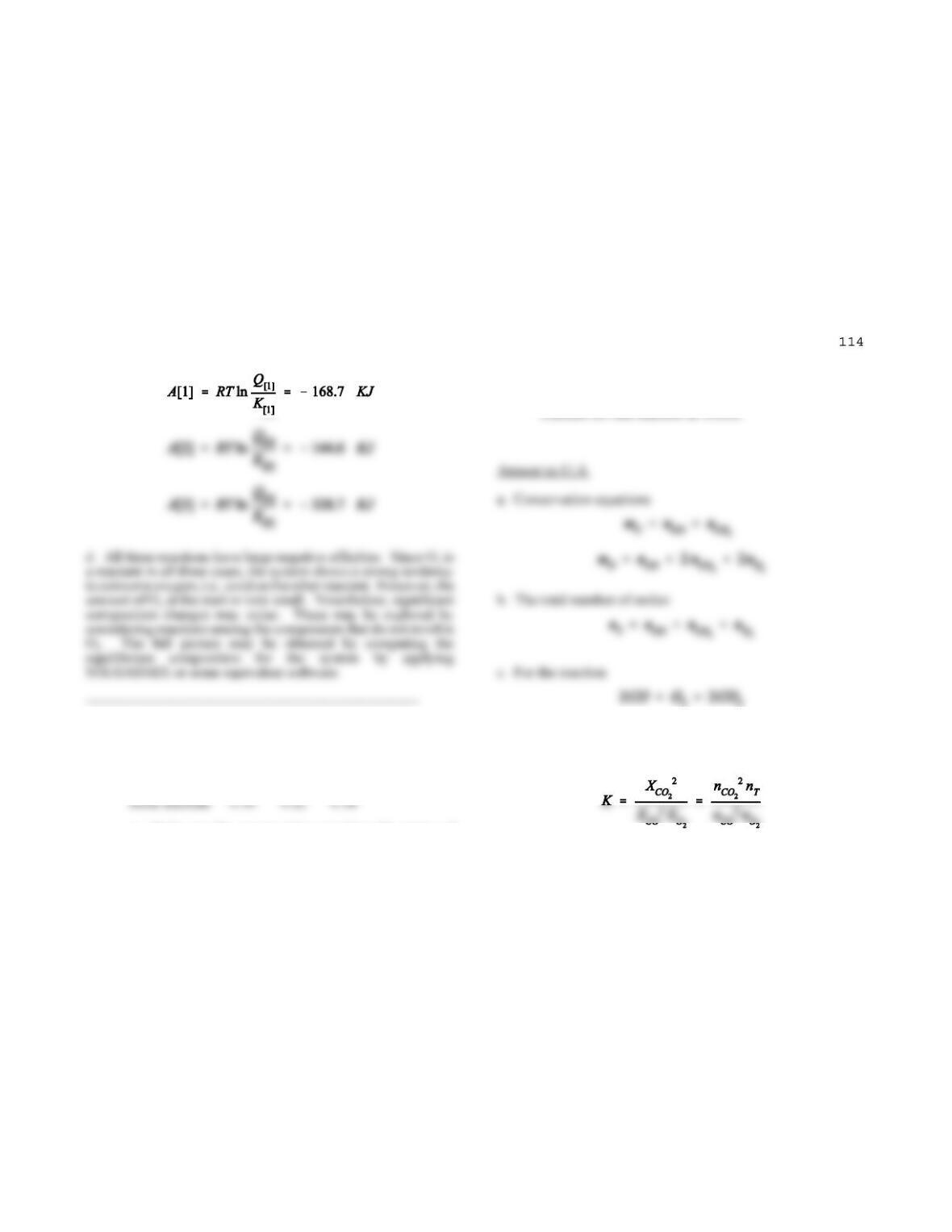
the equilibrium constant is
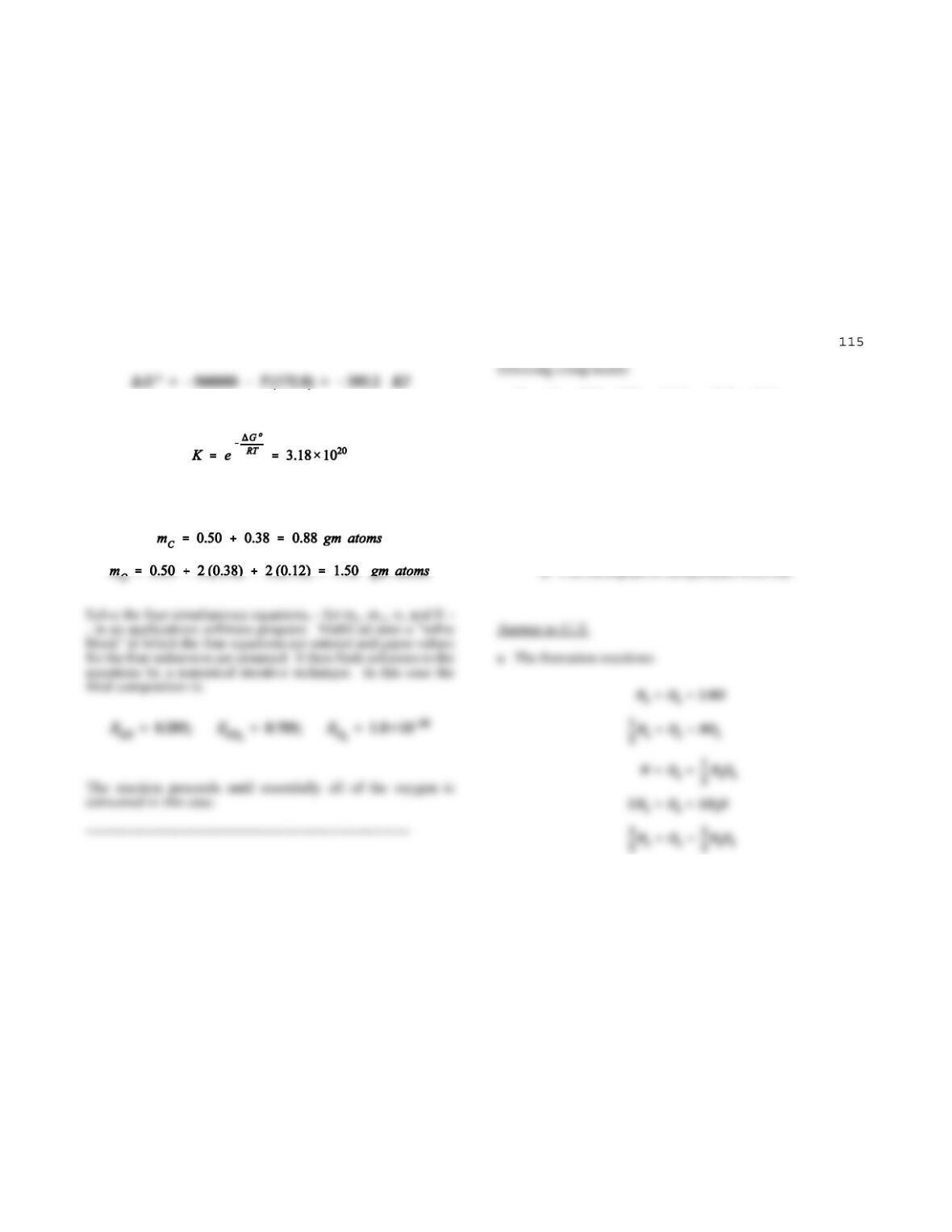
d. The standard free energy change for this reaction is:
Chapter 11. Reacting Systems
The equilibrium constant:
Evaluate mC and mO from the initial conditions:
11.5. A gas mixture of nitrogen and oxygen may contain the
N2 O2 NO NO2 N2O4 N2O N2O5
a. Write out the set of formation reactions for this
mixture.
b. Write all of the reactions of the form
nA + O2 = mB
that may be constructed for this system.
c. From this list, how many sets of three equations that
each share in three components (other than oxygen and
nitrogen) may be written?
Chapter 11. Reacting Systems
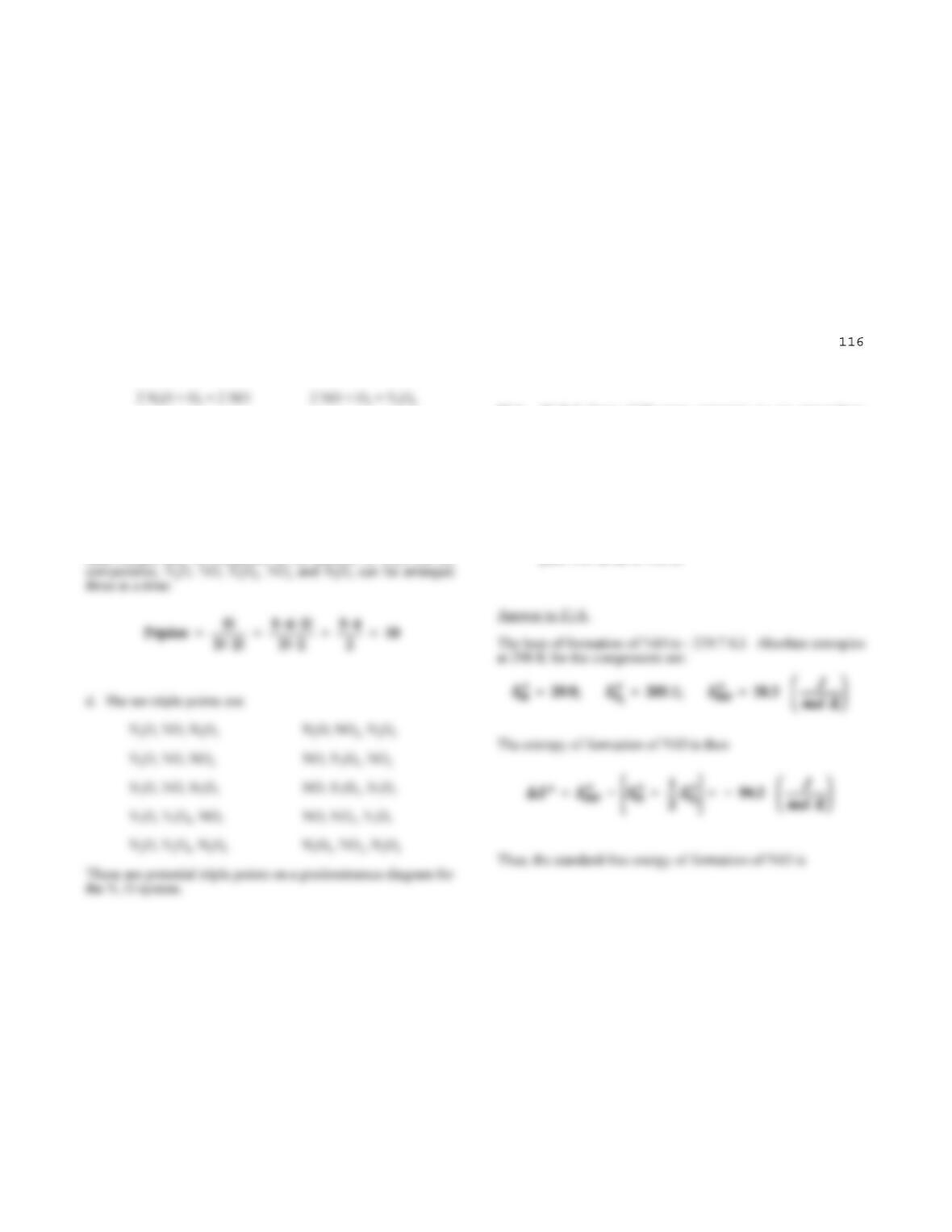
b. Additional reactions:
2/3 N2O + O2 = 4/3 NO24/3 NO + O2 = 2/3 N2O5
2/3 N2O + O2 = 2/3 N2O4 2 NO = N2O4
½ N2O + O2 = ½ N2O5 4 NO2 + O2 = 2 N2O5
2 NO + O2 = 2 NO22 N2O4 + O2 = 2 N2O5
c. The number of reactions that share three components other
than oxygen may be computed as the number of ways the six
———–———–———————————–———–
11.6. Nickel forms NiO upon exposure to an atmosphere
containing oxygen.
a. Find the standard free energy of formation of NiO as
a function of temperature.
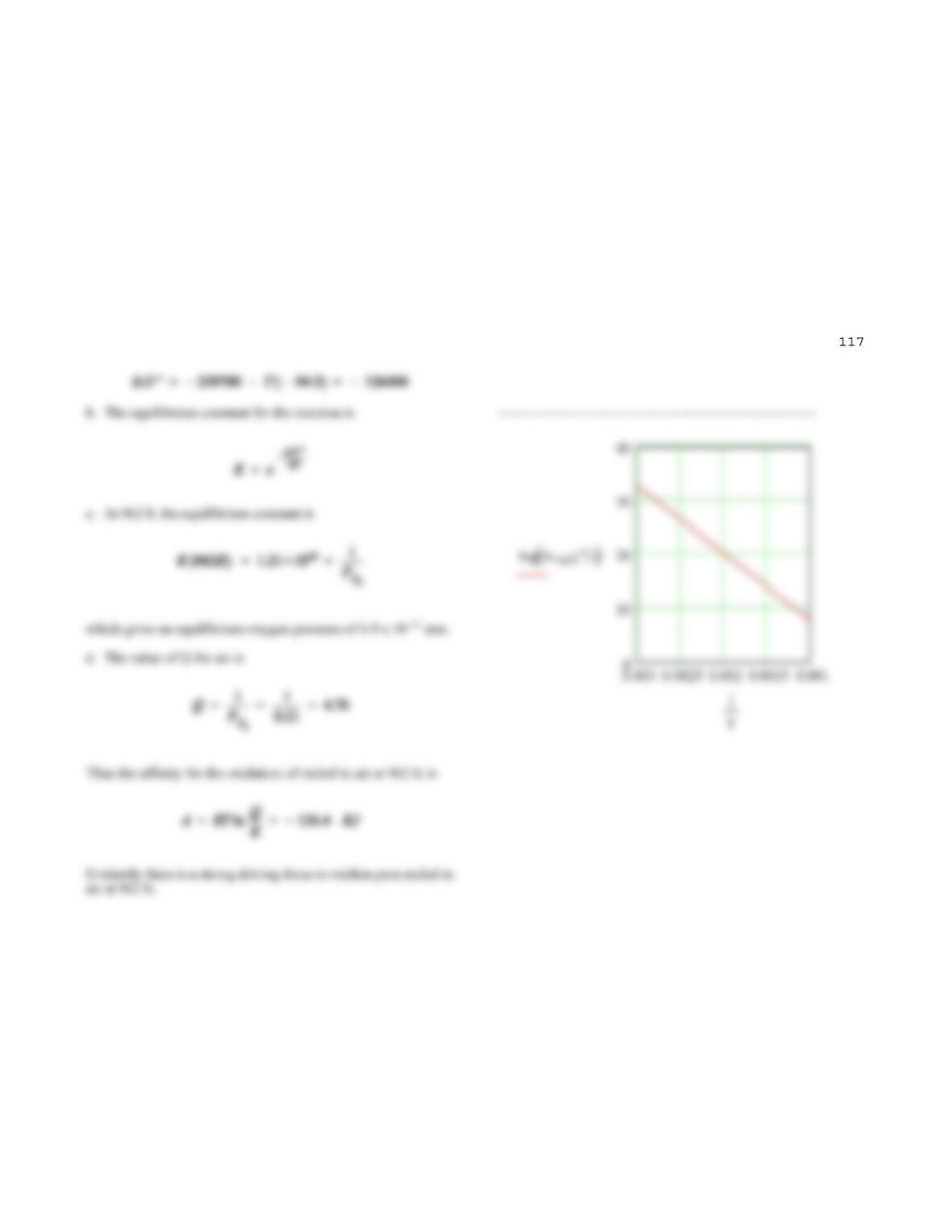
b. Evaluate and plot the equilibrium constant for this
reaction as a function of temperature.
c. Compute the equilibrium oxygen partial pressure at
962 K, assuming the nickel and NiO are pure.
d. Compute the affinity for a system with pure nickel and
pure NiO in air at 962 K.
Chapter 11. Reacting Systems
Chapter 11. Reacting Systems
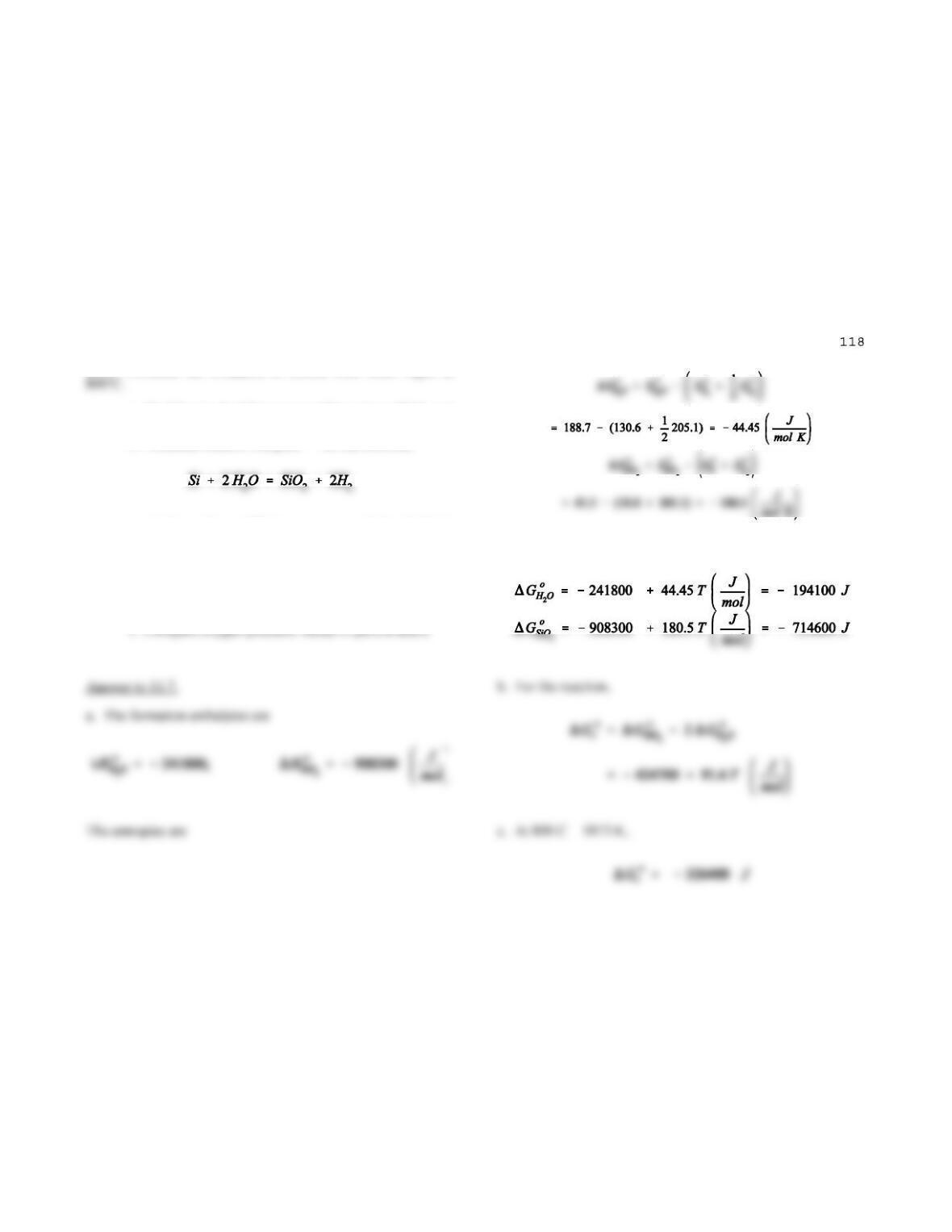
11.7. Consider the oxidation of silicon with water vapor at
a. Find the standard free energy of formation of SiO2 and
H2O.
b. Combine them to compute • •
o for the reaction
c. Evaluate the equilibrium constant and the (H2/H2O)
ratio in equilibrium with silicon and its oxide at 800oC.
d. Compute the equilibrium partial pressure of oxygen in
a silicon-silica system.
e. Compute the equilibrium partial pressure of oxygen for
a gas mixture at 800oC with an (H2/H2O) ratio computed
in part c.
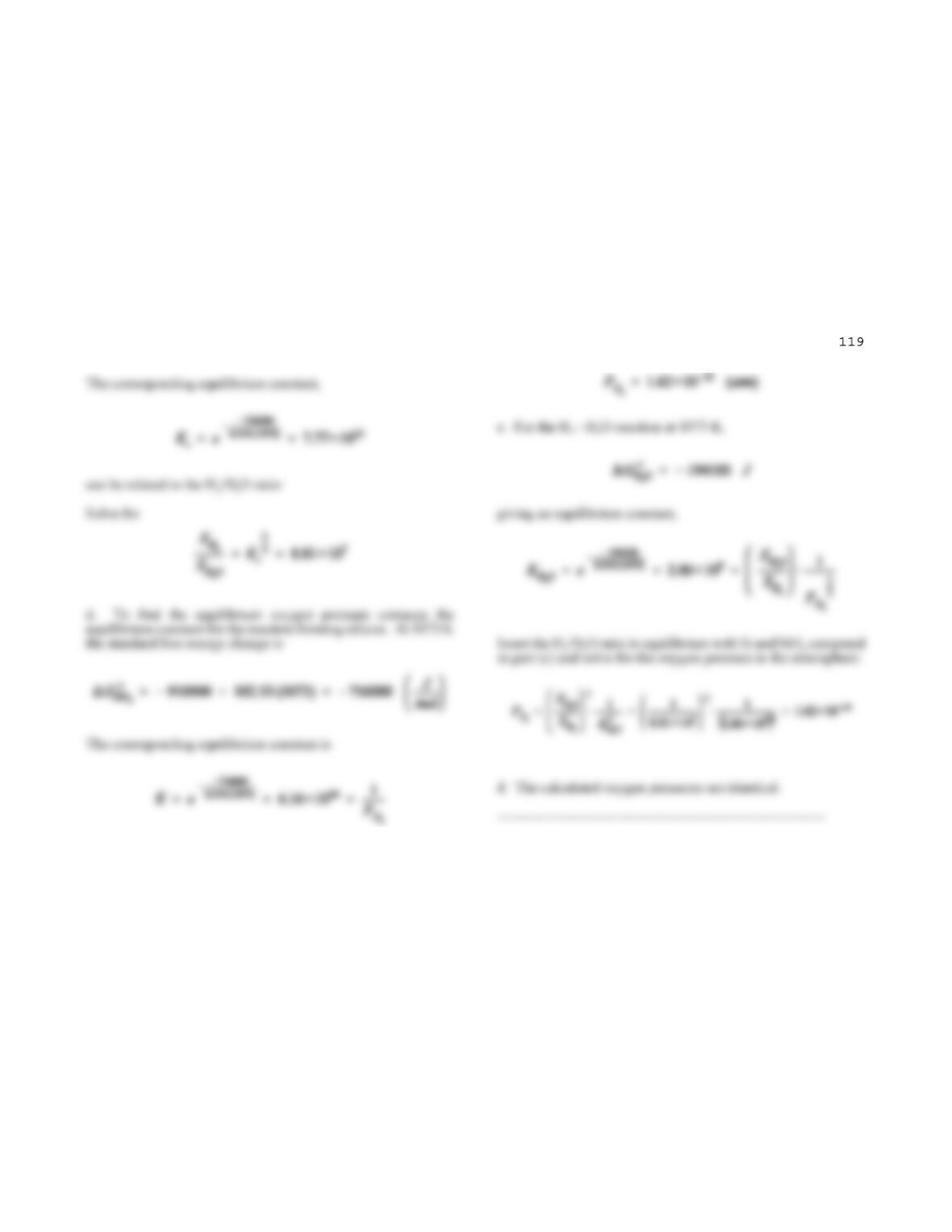
The standard free energy changes are:
Chapter 11. Reacting Systems
The dissociation pressure at 1073 K is thus
11.8. Use the Richardson-Ellingham chart to verify the results of
the calculation in Problem 11.7.
Chapter 11. Reacting Systems
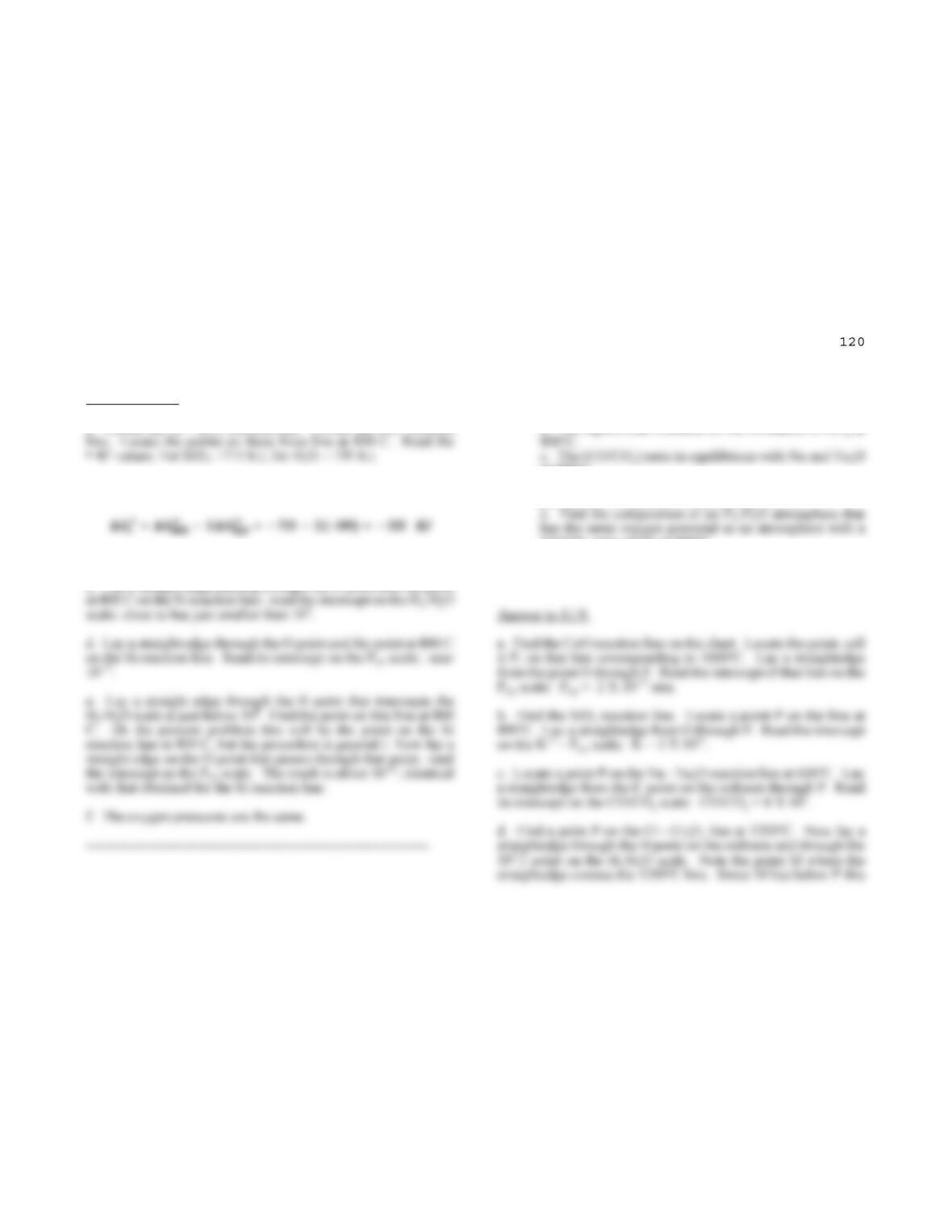
Answer to 11.8.
a. Locate the Si – SiO2 reaction line. Locate the H2O reaction
b. For the reaction,
11.9. Use the Richardson-Ellingham chart for oxides to find the
following:
a. The dissociation pressure of CoO at 1000oC.
b. The equilibrium constant for the formation of SiO2 at
at 600oC.
d. Will an atmosphere with an H2/H2O ratio of 105/1
prevent the oxidation of chromium at 1200oC?
CO/CO2 ratio of 103 at 900oC.
f. Find the oxygen potential in part (e).