Chapter 9 Review Questions
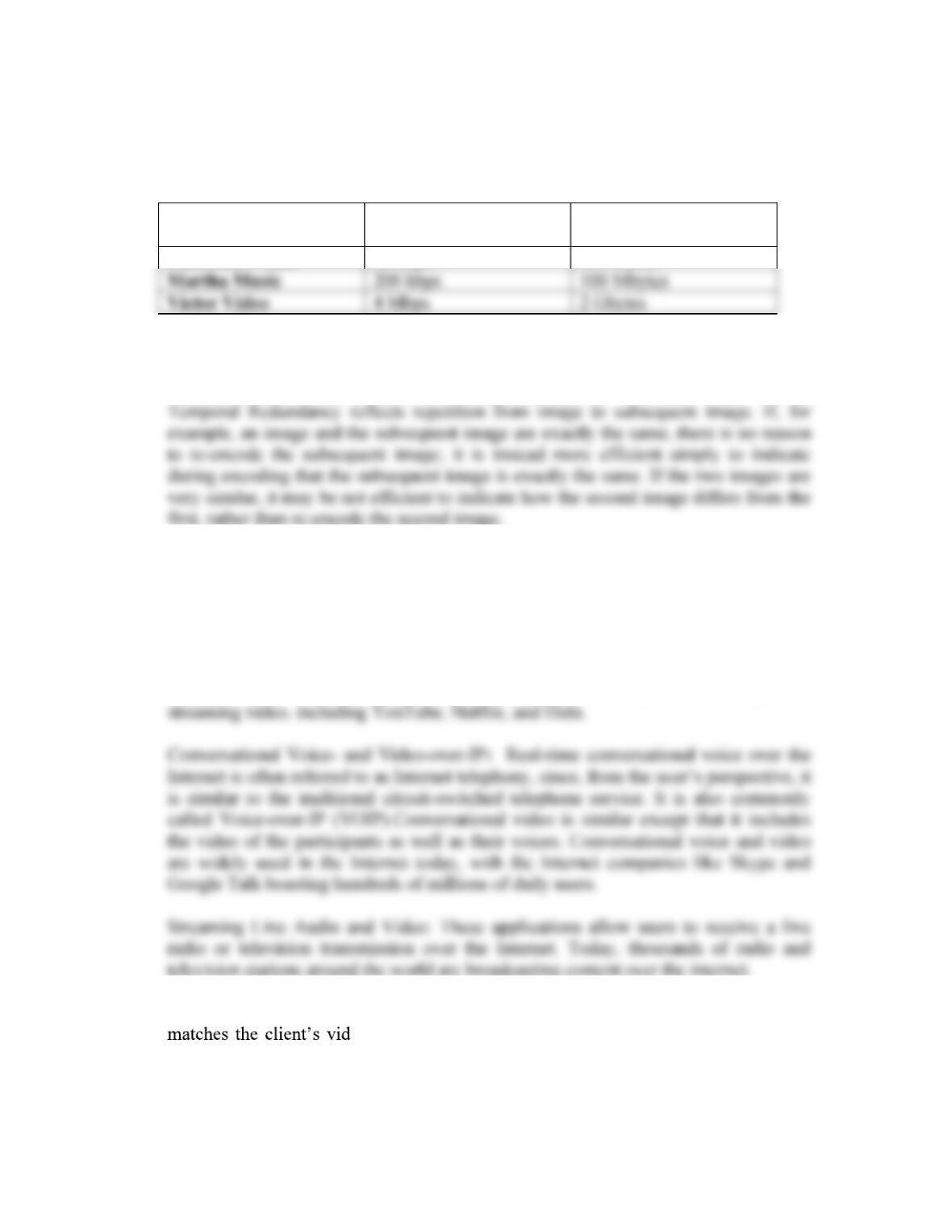
1.
Bit rate
Bytes transferred in 67
mins
Facebook Frank 40 kbps 20 Mbytes
2. Spatial Redundancy: It is the redundancy within a given image. Intuitively, an image
consists of mostly white space has a high degree of redundancy and can be efficiently
compressed without significantly sacrificing image quality.
3. Quantizing a sample into 1024 levels means 10 bits per sample. The resulting rate of
the PCM digital audio signal is 160 Kbps.
4. Streaming stored audio/video: In this class of applications, the underlying medium is
prerecorded video, such as a movie, a television show, or a prerecorded sporting
event. These prerecorded videos are played on servers, and users send requests to the
servers to view the videos on demand. Many internet companies today provide
5. UDP Streaming: With UDP streaming, the server transmits video at a rate that
eo consumption rate by clocking out the video chunks over
UDP at a steady rate.
HTTP Streaming: In HTTP streaming, the video simply stored in an HTTP server as
6. The three significant drawbacks of UDP Streaming are:
1. Due to unpredictable and varying amount of available bandwidth between server
7. No. On the client side, the client application reads bytes from the TCP receive buffer
8. The initial buffering delay is tp = Q/x = 4 seconds.
9. End-to-end delay is the time it takes a packet to travel across the network from source
10. A packet that arrives after its scheduled play out time cannot be played out.
Therefore, from the perspective of the application, the packet has been lost.
11. First scheme: send a redundant encoded chunk after every n chunks; the redundant
12. RTP streams in different sessions: different multicast addresses; RTP streams in the
13. The role of a SIP registrar is to keep track of the users and their corresponding IP
addresses which they are currently using. Each SIP registrar keeps track of the users
Chapter 9 Problems
Problem 1
a) Client begins playout as soon as first block arrives at t1 and video blocks are to be
played out over the fixed amount of time, d. So it follows that second video block
should be arrived before time t1 + d to be played at right time, third block at
Problem 2
a) During a playout period, the buffer starts with Q bits and decreases at rate r – x. Thus,
after Q/(r – x) seconds after starting playback the buffer becomes empty. Thus, the
Problem 3
a) .
scheduled playout time of the next frame. Thus playback will freeze after displaying
the first frame.
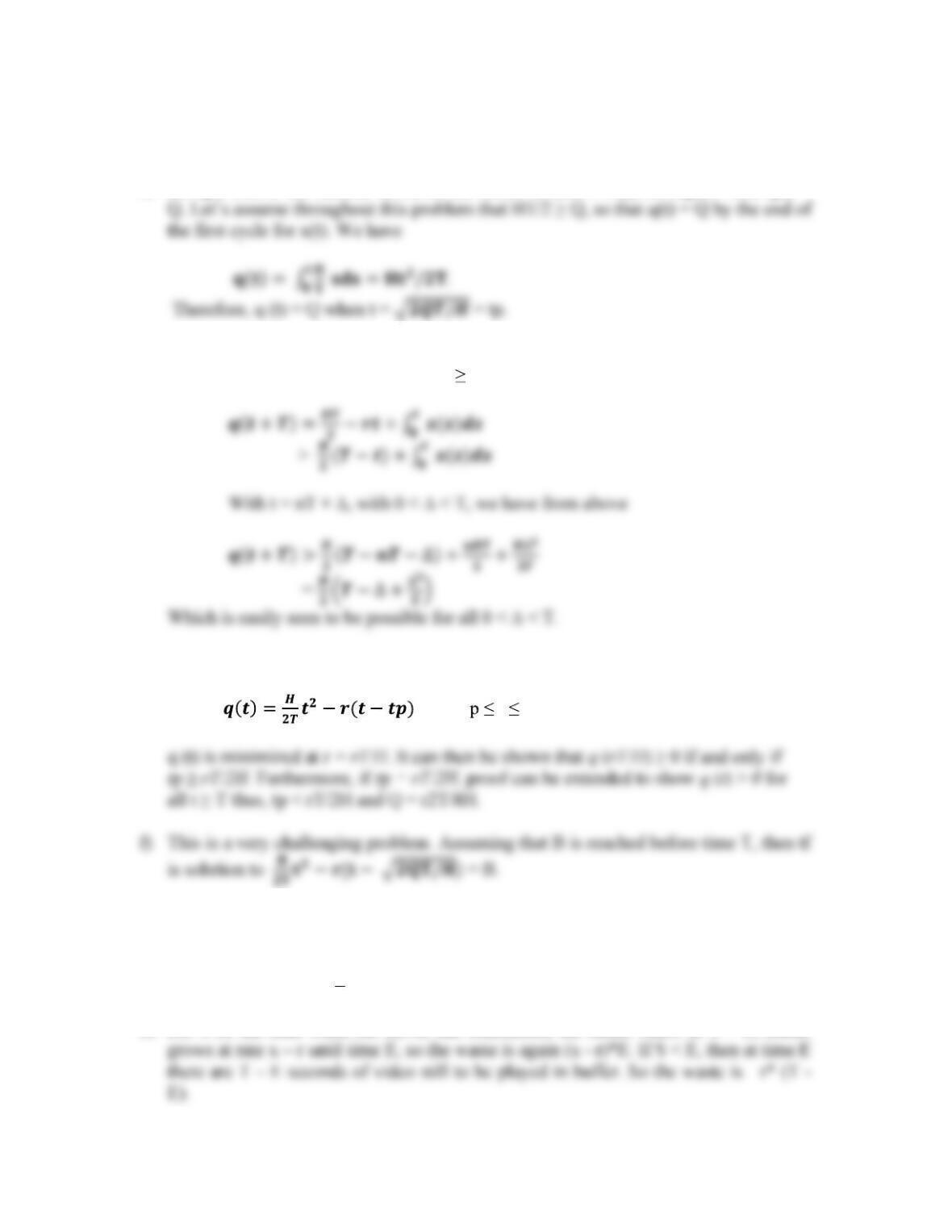
c) Let q(t) denote the number of bits in the buffer at time t. Playout begins when q(t) =
d) At time t = T, q (t) = HT/2 = Q, so that playout begins. If subsequently there is no
freezing, we need q(t + T) > 0 for all t T, we have
e) First consider the [0, T]. We have
for t t T
Problem 4
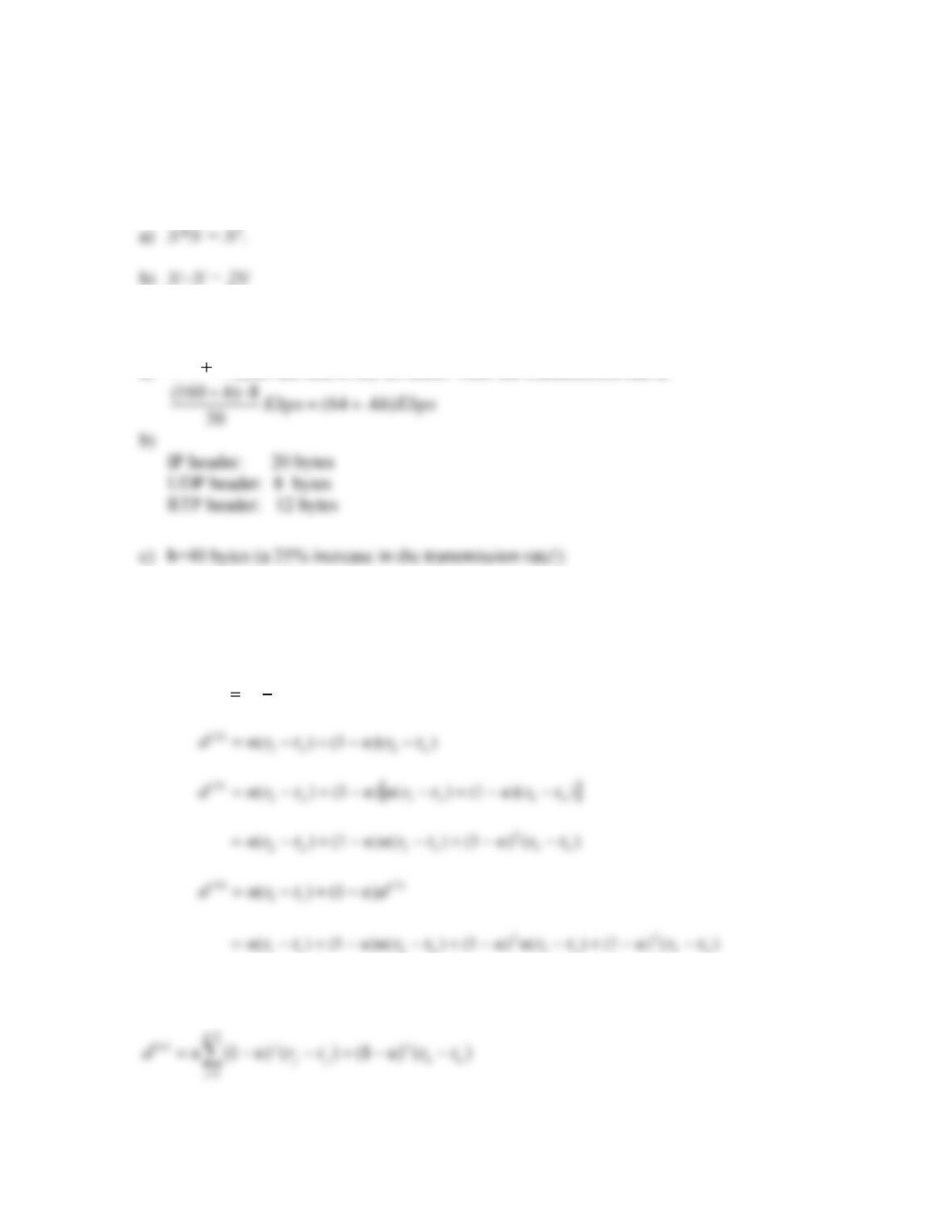
a) Buffer grows at rate x r. At time E, (x – r)*E bits are in buffer and are wasted.
b) Let S be the time when the server has transmitted the entire video. If S > E, buffer
Problem 5
Problem 6
a)
h
160
bytes are sent every 20 msec. Thus the transmission rate is
Problem 7
a) Denote
)
(
n
d
for the estimate after the nth sample.
44
)1( trd
44
33
2211
b)
c)
Problem 8
a) Denote
)
(
n
v
for the estimate after the nth sample. Let
j
jj
tr
.
)1(
4
)1(
dv
(=0)
b)
Problem 9
a) r1 t1 + r2 – t2 rn-1–tn-1 = (n-1)dn-1
Substituting this into the expression for dn gives
Problem 10
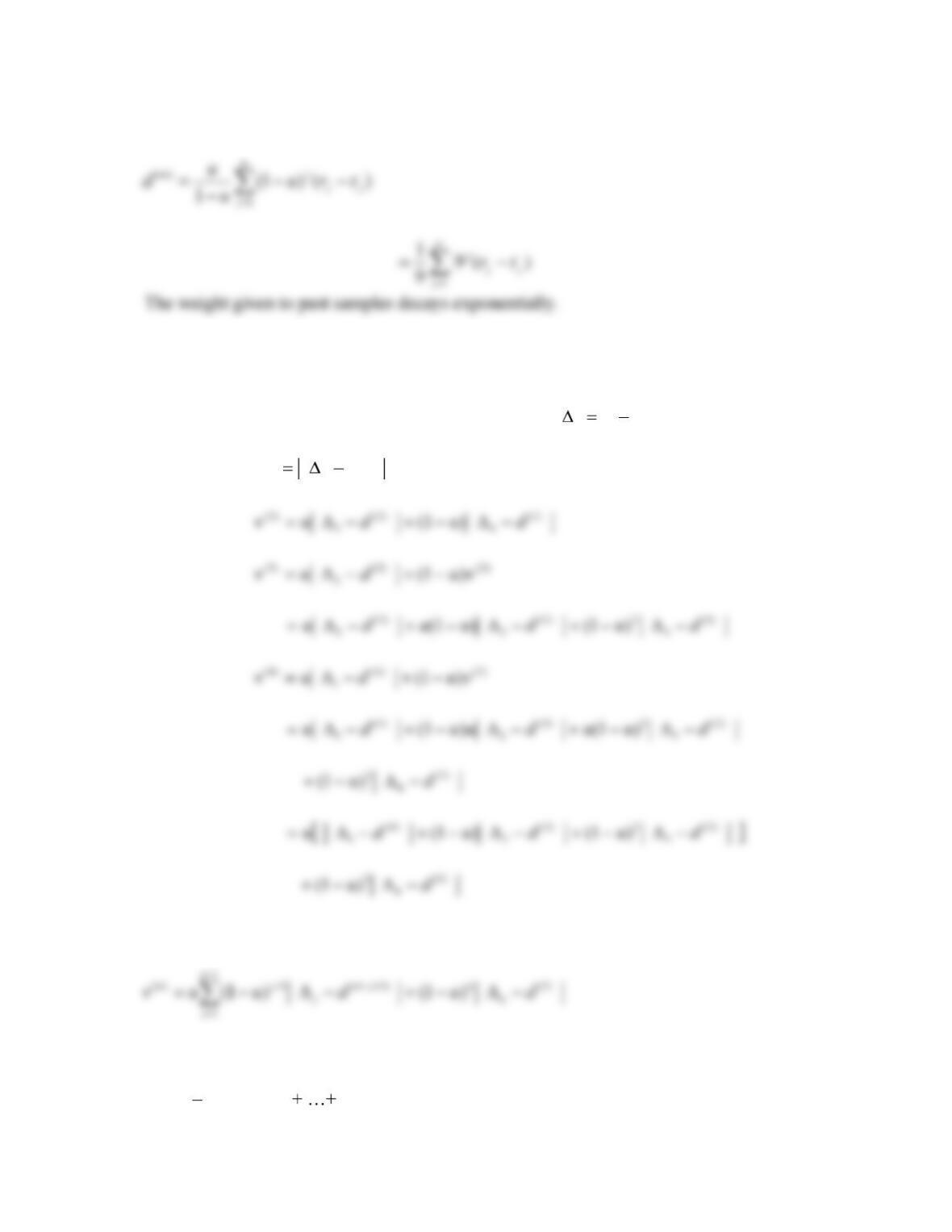
The two procedures are very similar. They both use the same formula, thereby resulting
in exponentially decreasing weights for past samples.
Problem 11
a) The delay of packet 2 is 7 slots. The delay of packet 3 is 9 slots. The delay of packet
4 is 8 slots. The delay of packet 5 is 7 slots. The delay of packet 6 is 9 slots. The
Problem 12
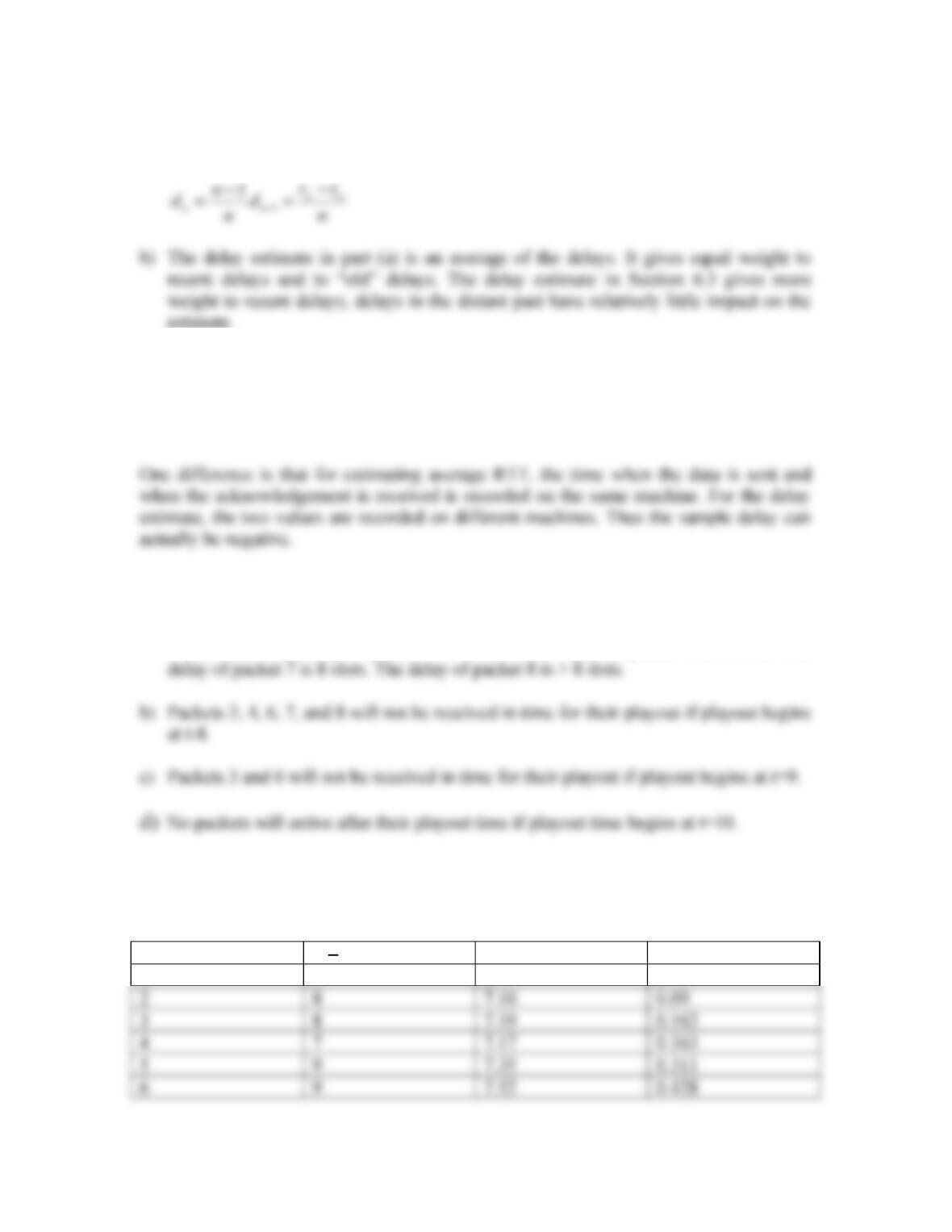
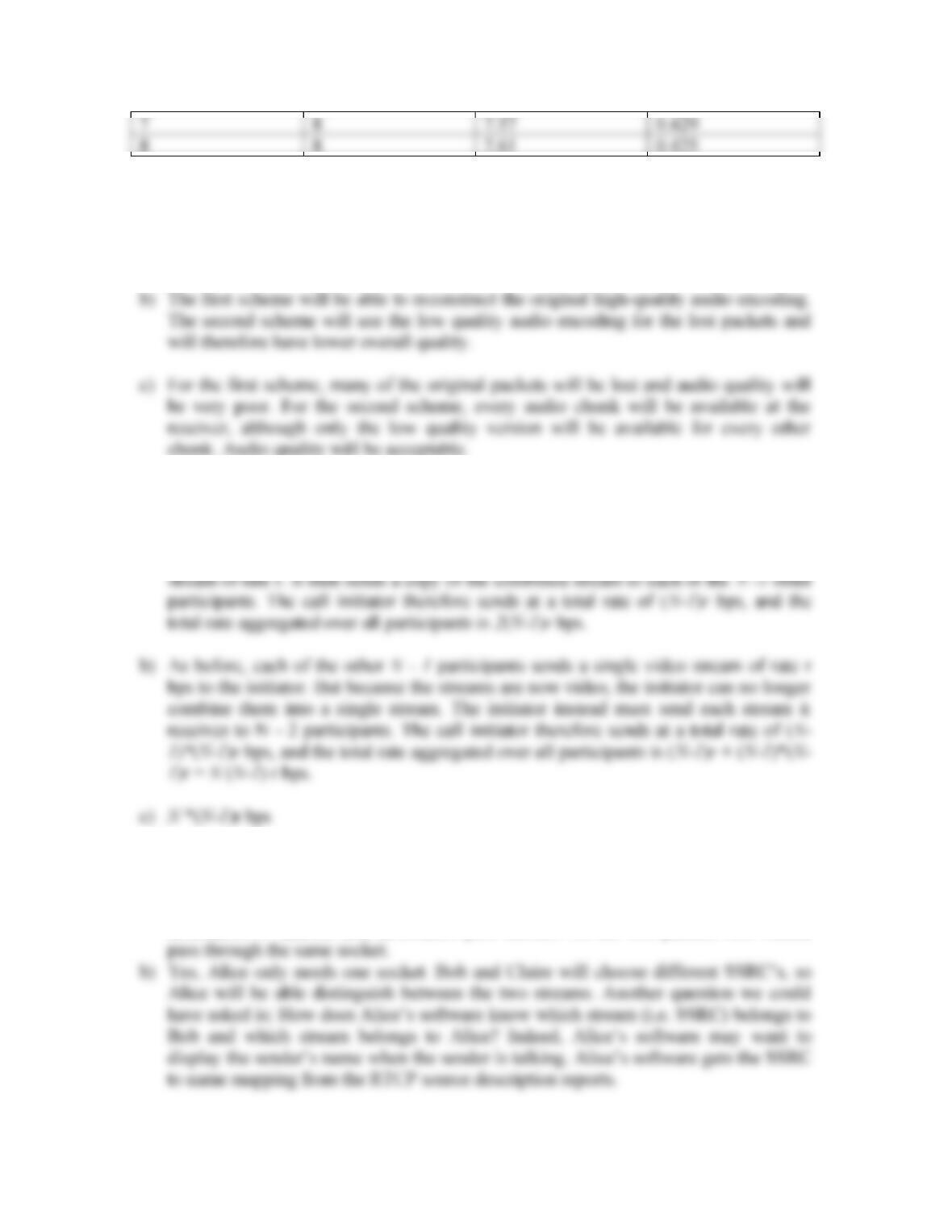
The answers to parts a and b are in the table below:
Packet Number ri ti di vi
1
7
7
0
2
8
7.10
0.09
3
8
7.19
0.162
4
7
7.17
0.163
5
9
7.35
0.311
Problem 13
a) Both schemes require 25% more bandwidth. The first scheme has a playback delay of
5 packets. The second scheme has a delay of 2 packets.
Problem 14
a) Each of the other N – 1 participants sends a single audio stream of rate r bps to the
initiator. The initiator combines this stream with its own outgoing stream to create a
Problem 15
a) As discussed in Chapter 2, UDP sockets are identified by the two-tuple consisting of
destination IP address and destination port number. So the two packets will indeed
Problem 16
a) True
b) True
c) No, RTP streams can be sent to/from any port number. See the SIP example in
Problem 17
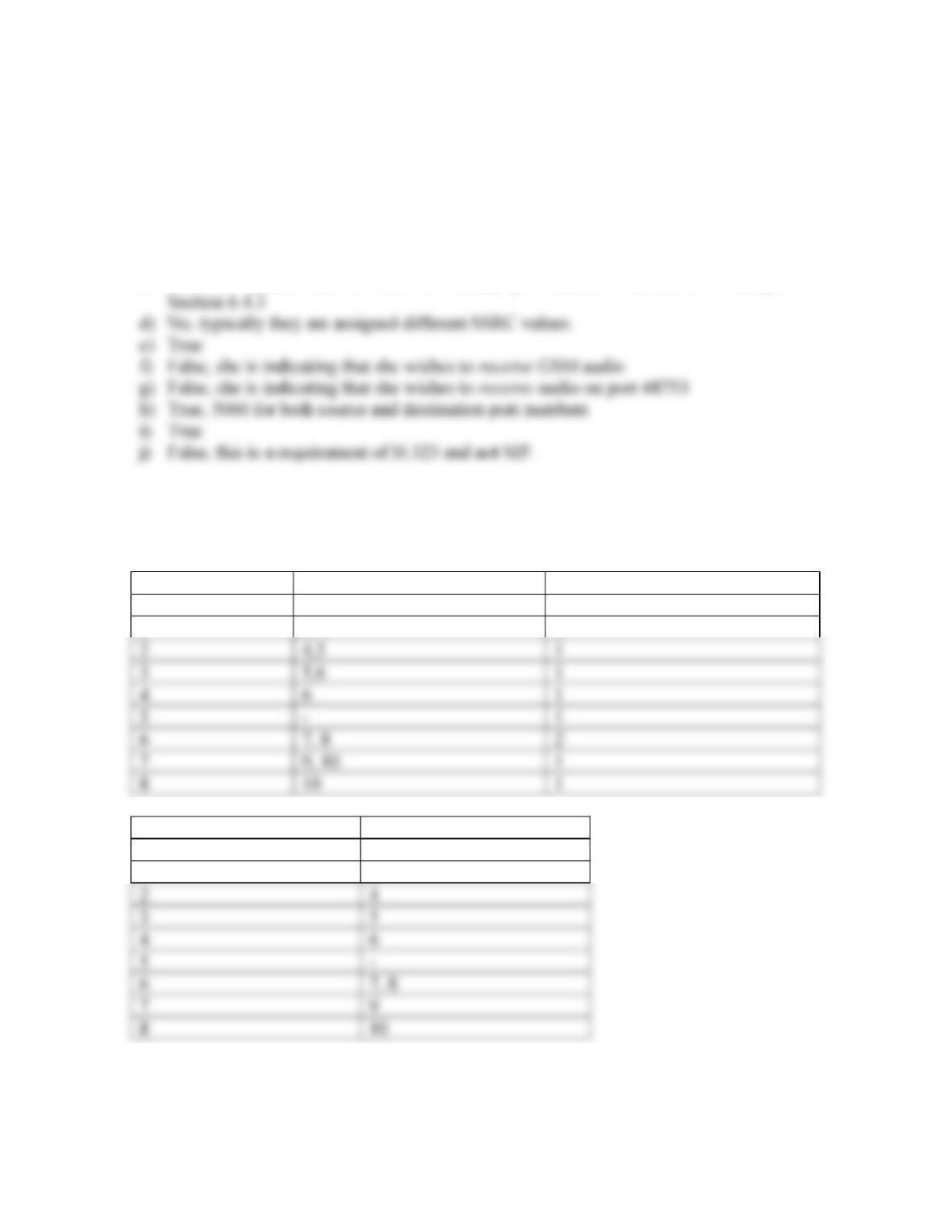
Time Slot Packets in the queue Number of tokens in bucket
0 1, 2, 3 2
1 3, 4 1
Time Slot Packets in output buffer
0
1, 2
1
3
2
4
3
5
4
6
Problem 18
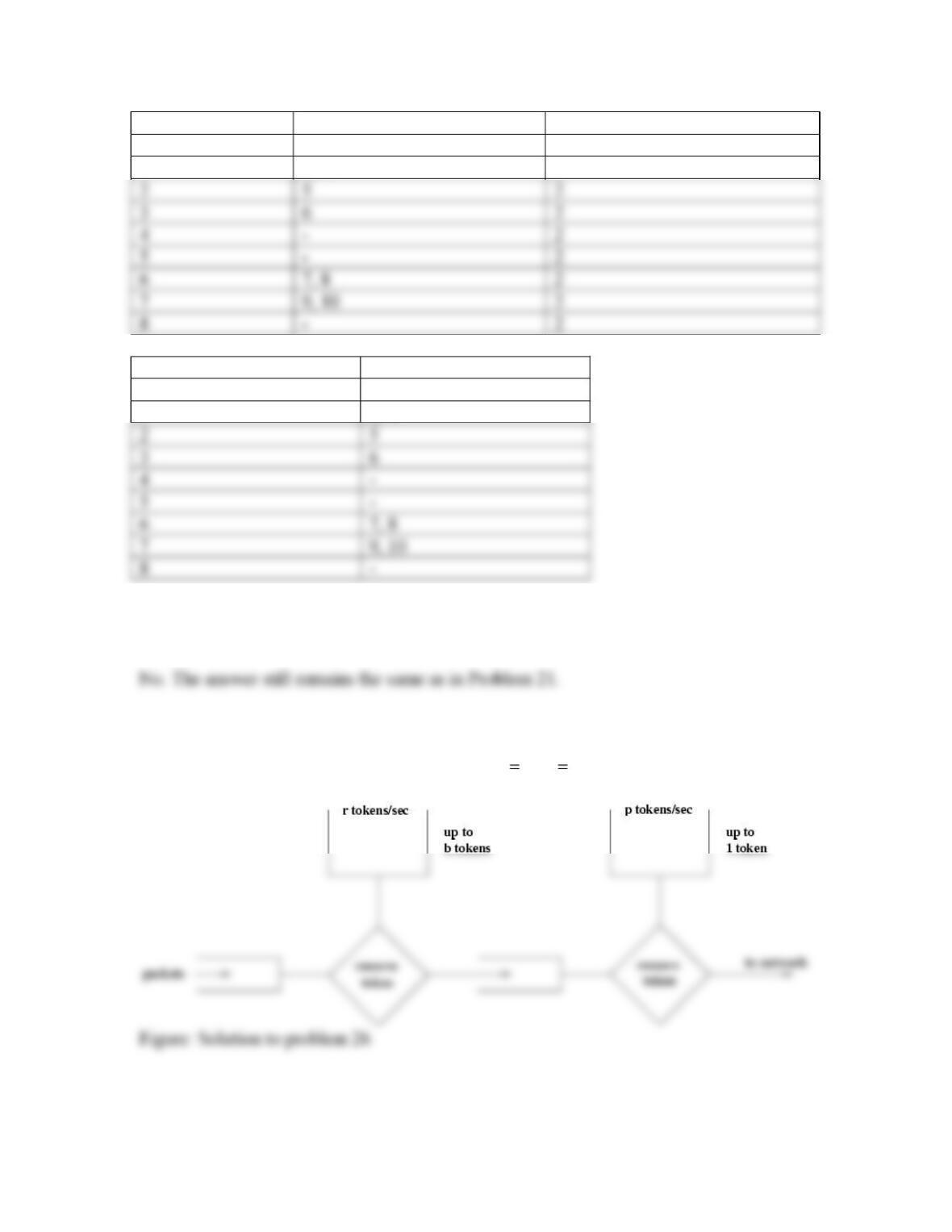
Time Slot Packets in the queue Number of tokens in bucket
0 1, 2, 3 2
1 3, 4 2
Time Slot Packets in output buffer
0 1, 2
1 3, 4
Problem 19
Problem 20
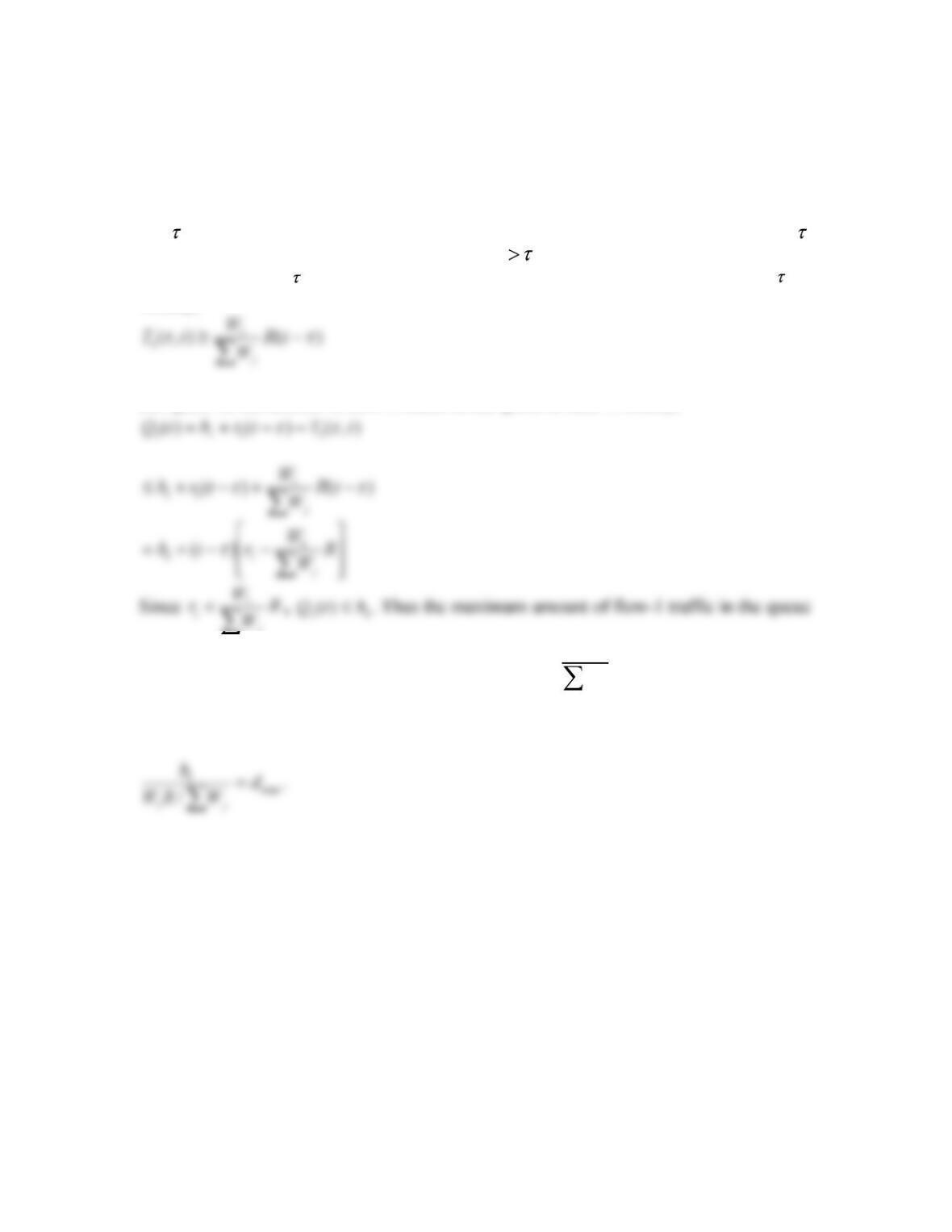
See figure below. For the second leaky bucket,
.
1, bpr
Problem 21
No.
Problem 22
Let be a time at which flow 1 traffic starts to accumulate in the queue. We refer to
as the beginning of a flow-1 busy period. Let
t
be another time in the same flow-1
busy period. Let
),(
1
tT
be the amount of flow-1 traffic transmitted in the interval
]
,[
t
.
Clearly,
Let
)(
tQ
be the amount of flow-1 traffic in the queue at time t. Clearly,
j
is
1
b
. The minimal rate at which this traffic is served is
j
W
RW1.
Thus, the maximum delay for a flow-1 bit is