Chapter 8 Review Questions
1. Confidentiality is the property that the original plaintext message can not be
determined by an attacker who intercepts the ciphertext-encryption of the original
plaintext message. Message integrity is the property that the receiver can detect
2. o routers; (iii) two DNS name servers.
3. One important difference between symmetric and public key systems is that in
symmetric key systems both the sender and receiver must know the same (secret) key.
4. In this case, a known plaintext attack is performed. If, somehow, the message
6. If each user wants to communicate with N other users, then each pair of users must
have a shared symmetric key. There are N*(N-1)/2 such pairs and thus there are
7. a mod n = 23 , b mod n = 4. So (a*b) mod n = 23*4=92
9. One requirement of a message digest is that given a message M, it is very difficult to
find another message M that has the same message digest and, as a corollary, that
10. No. This is because a hash function is a one-way function. That is, given any hash
11. This is scheme is clearly flawed. Trudy, an attacker, can first sniff the communication
12. Suppose Bob sends an encrypted document to Alice. To be verifiable, Alice must be
able to convince herself that Bob sent the encrypted document. To be non-forgeable,
Alice must be able to convince herself that only Bob could have sent the encrypted
document (e.g.,, no one else could have guessed a key and encrypted/sent the
13. A public- need only encrypt (using
14. This is false. To create the certificate, certifier.com would include a digital signature,
15. For a MAC-based scheme, Alice would have to establish a shared key with each
17. Once in a lifetimes means that the entity sending the nonce will never again use that
18. In a man-in-the-middle attack, the attacker puts himself between Alice and Bob,
20. False. SSL uses implicit sequence numbers.
22. True. The IV is always sent in the clear. In SSL, it is sent during the SSL handshake.
23. After the client will generate a pre-
public key, and then send the encrypted PMS to Trudy. Trudy will not be able to
25. False. IPsec will increment the sequence number for every packet it sends.
27. 01011100
28. True
32.
33. True
Chapter 8 Problems
Problem 1
The
Problem 2
know the ciphertext for b,o,a,l,i,c,e
Problem 3
er has both
Problem 4
a) The output is equal to 00000101 repeated eight times.
Problem 5
a) There are 8 tables. Each table has 28 entries. Each entry has 8 bits.
Problem 6
a) 100100100 ==> 011011011
b) Trudy will know the three block plaintexts are the same.
Problem 7
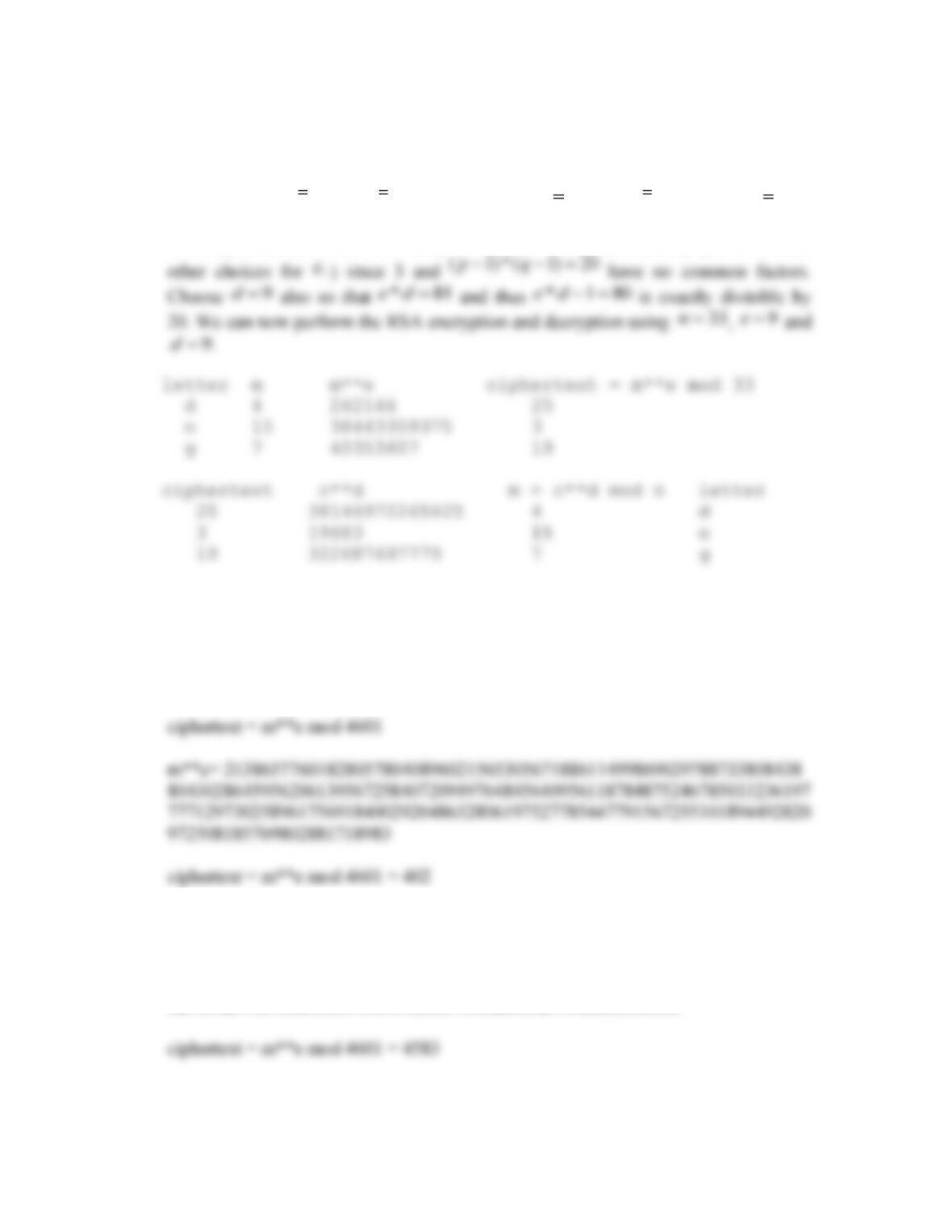
a) We are given
3
p
and
.
11
q
We thus have
33
n
and
.
11
q
Choose
9
e
(it
might be a good idea to give students a hint that 9 is a good value to choose, since the
resulting calculations are less likely to run into numerical stability problems than
We first consider each letter as a 5-bit number: 00100, 01111, 00111. Now we
concatenate each letter to get 001000111100111 and encrypt the resulting decimal
number m=4583. The concatenated decimal number m (= 4583) is larger than current
n (= 33). We need m < n. So we use p = 43, q = 107, n = p*q = 4601, z = (p-1)(q-1)
= 4452. e = 61, d = 73
c**d
= 1283813313619771634195712132539793287643533147482536209328405262793
027158861012392053287249633570967493122280221453815012934241370540204
5814598714979387232141014703227794586499817945633390592
Problem 8
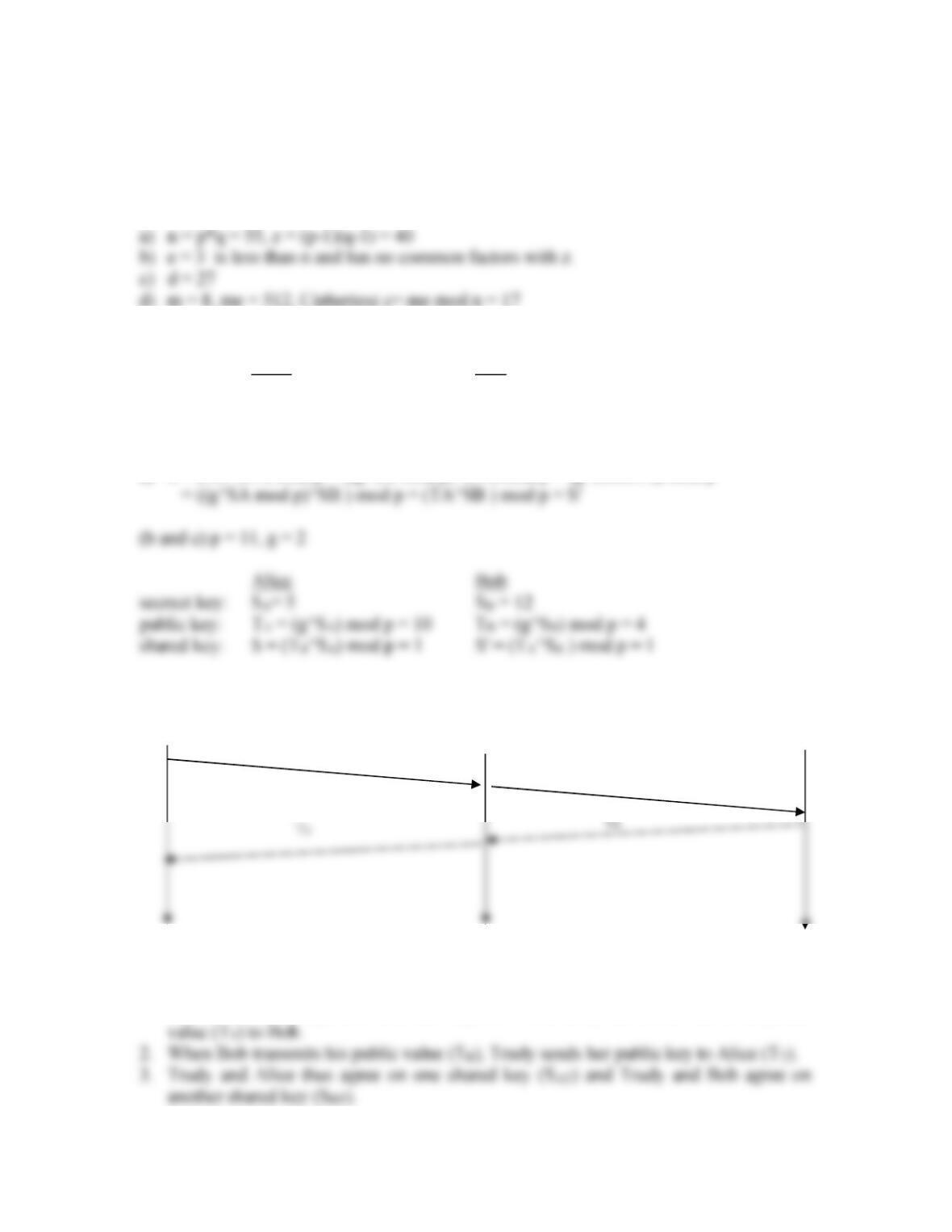
p = 5, q = 11
Problem 9
Alice Bob
secrect key: SA SB
public key: TA = (g^SA) mod p TB = (g^SB) mod p
shared key: S = (TB^SA) mod p S’ = (TA^SB ) mod p
a) S = (TB^SA ) mod p = ((g^SB mod p)^SA ) mod p = (g^(SBSA )) mod p
d)
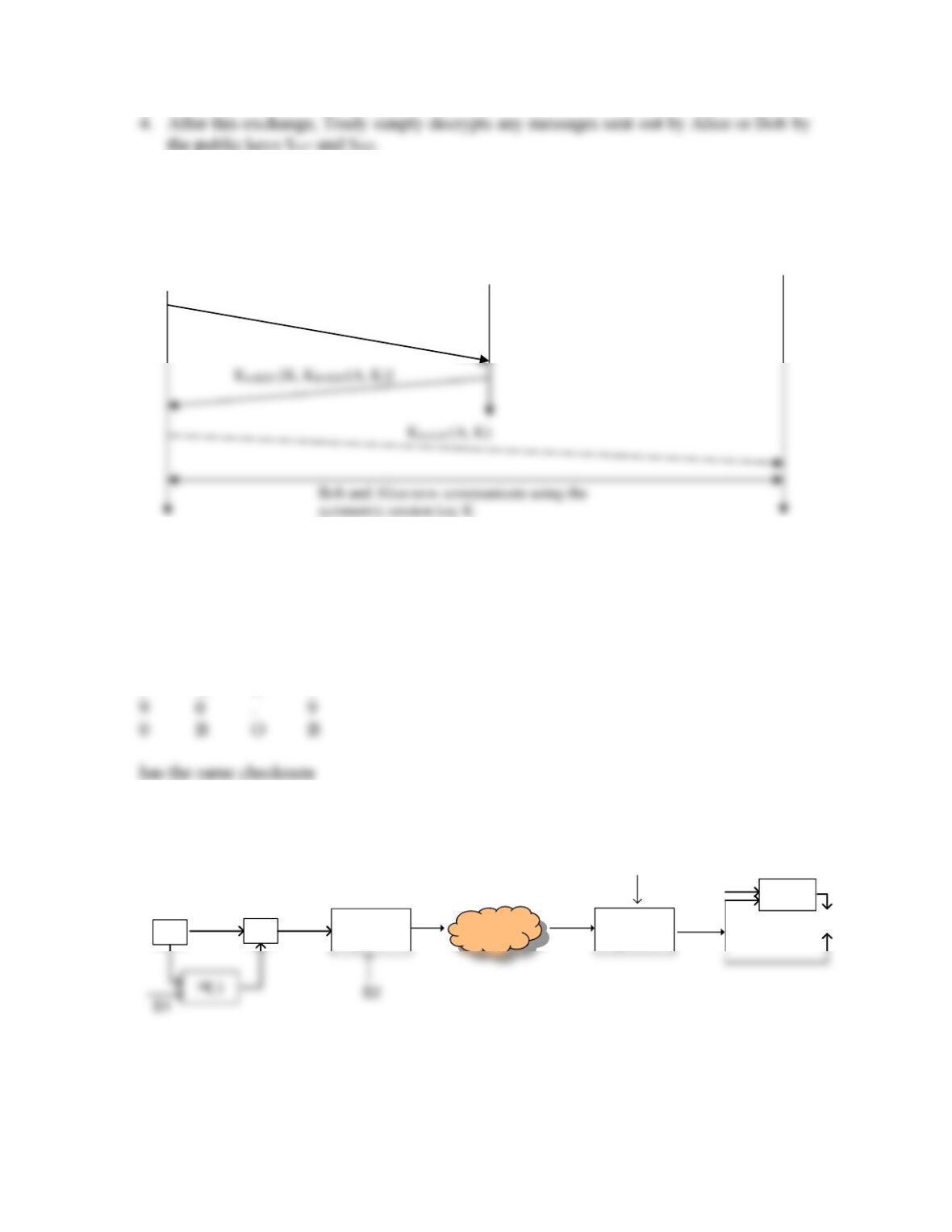
The Diffie-Hellman public key encryption algorithm is possible to be attacked by man-in-
the-middle.
1. In this attack, Trudy receives Alice’s public value (TA) and sends her own public
TA
TT
Alice
Trudy Bob
Problem 10
Problem 11
The message
I O U 1
Problem 12
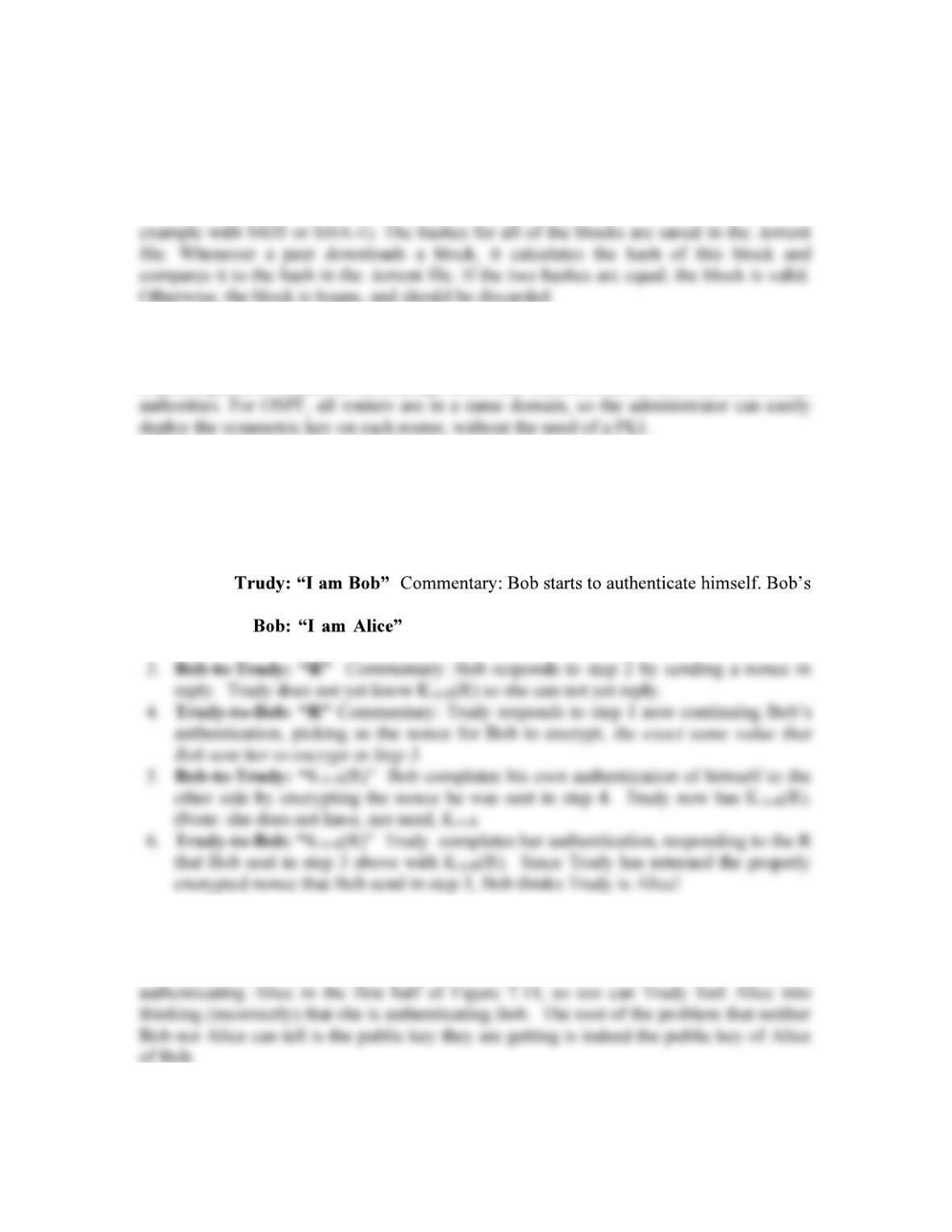
Internet
Decription
algorithm
S2
(m,h) m
S1
Compare
(m,h)
m+encription
algorithm
KS2 (m,h) KS2 (m,h)
H(.)
KA-KDC{A,B}
Alice
KDC
Bob
Problem 13
The file is broken into blocks of equal size. For each block, calculate the hash (for
Problem 14
Digital signatures require an underlying Public Key Infrastructure (PKI) with certification
Problem 15
Bob does not know if he is talking to Trudy or Alice initially. Bob and Alice share a
secret key KA-B that is unknown to Trudy. Trudy wants Bob to authenticate her (Trudy)
as Alice. Trudy is going to have Bob authenticate himself, and waits for Bob to start:
1. Bob-to-
authentication of himself to the other side then stops for a few steps.
2. Trudy-to- Commentary: Trudy starts to authenticate herself as
Alice
Problem 16
This wouldn’t really solve the problem. Just as Bob thinks (incorrectly) that he is
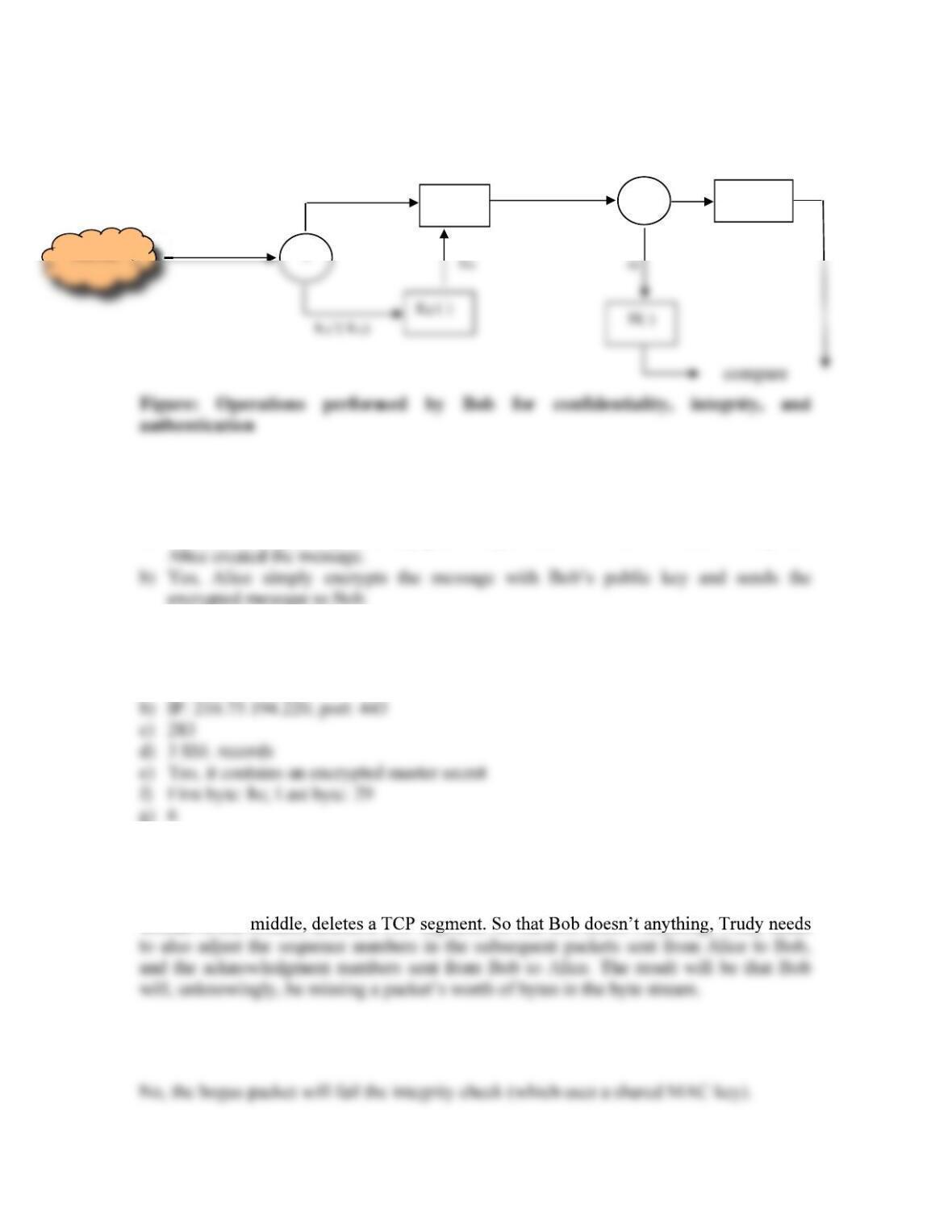
Problem 17
Problem 18
a) No, without a public-private key pair or a pre-shared secret, Bob cannot verify that
Problem 19
a) Client
Problem 20
Again we suppose that SSL does not provide sequence numbers. Suppose that Trudy, a
woman-in-the-
Problem 21
KS(m,KA–(H(m))
KB+( KS), KS(m,KA–(H(m)))
KS( )
–
KA+( )
Internet

Problem 22
a) F
Problem 23
If Trudy does not bother to change the sequence number, R2 will detect the duplicate
Problem 24
a) Since IV = 11,
b) The receiver extracts the IV (11) and generates the key stream 111110100000
c) Since the ICV is calculated as the XOR of first 4 bits of message with last 4 bits of

Problem 25
Filter Table:
Action Source
Address
Dest
address Protocol Source
port
Dest
port
Flag
bit
Check
connection
allow 222.22/16 outside of
222.22/16 TCP > 1023 23 any
Connection Table:
Source
address
Dest
address
Source
port
Dest
port
222.22.1.7 37.96.87.123 12699 23
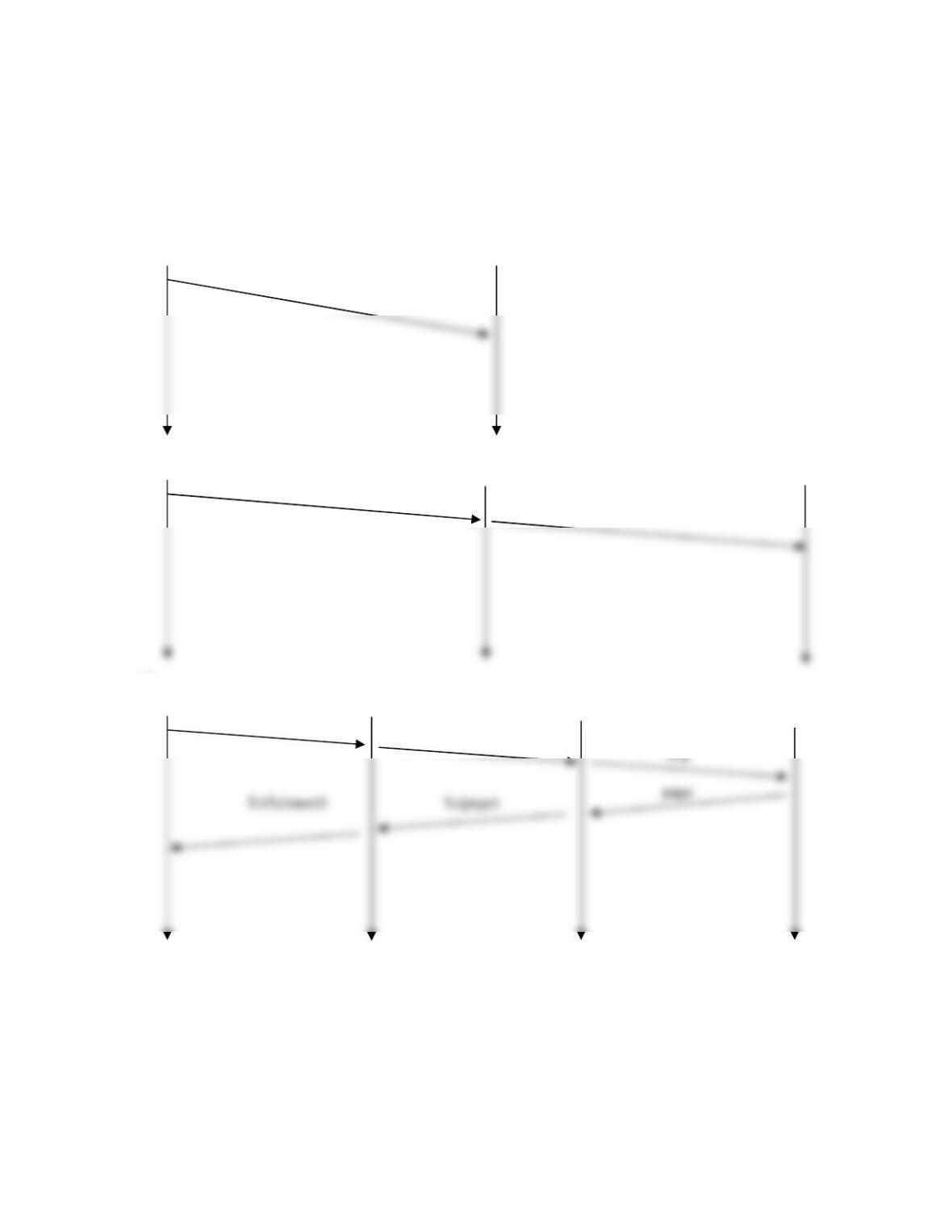
Problem 26
a)
b)
c)
K1+(S1)
Alice
Proxy1
S1( K2+(S2))
Alice
Proxy1 Proxy2
K2+(S2)
S1(S2(req))
Alice
Proxy1
Proxy2
S2(req)
Activist.com