Guide to Networking Essentials, 8th ed., ISBN 9780357118283
Chapter 7 Solutions-1
Chapter 7 Solutions
Review Questions
1. The original commercial version of Ethernet supported 10 Mbps bandwidth; the version
introduced in the early 1990s supports 100 Mbps; and in 1998, Gigabit Ethernet was
introduced. All versions use the same data frame formats, with the same maximum PDU
sizes, so they can interoperate freely. Given this information and what you know of layered
technologies, which of the following statements is true? (Choose all that apply.)
b. Ethernet spans several layers and requires a new protocol stack to upgrade to new
versions.
d. Ethernet isn’t considered a scalable technology.
2. The addition of information to a PDU as it’s passed from one layer to the next is called which
of the following?
a. PDI transforming
d. Converting
3. Layers acting as though they communicate directly with each other across the network are
called which of the following?
a. Partners
b. Synchronous
4. Place the following letters in the correct order to represent the OSI model from Layer 7 to
Layer 1:
a. Presentation
b. Data Link
e. Application
f. Transport
Guide to Networking Essentials, 8th ed., ISBN 9780357118283
Chapter 7 Solutions-2
5. Which OSI layer creates and processes frames?
6. Which OSI layer handles flow control, data segmentation, and reliability?
a. Application
b. Physical
7. Which OSI layer governs how a NIC is attached to the network medium?
8. Which OSI layer determines the route a packet takes from sender to receiver?
a. 7
d. 4
9. Which OSI layer is responsible for setting up, maintaining, and ending ongoing information
exchanges across a network?
a. 6
b. 3
10. Which of the following elements might the Data Link layer add to its PDU? (Choose all that
apply.)
b. Logical addresses
c. Data
11. When and how many times is a CRC calculated?
a. Once, before transmission
b. Once, after receipt
Guide to Networking Essentials, 8th ed., ISBN 9780357118283
Chapter 7 Solutions-3
12. Which layer of the OSI model does Project 802 divide into two sublayers?
a. Physical
d. Session
13. What are the names of the sublayers specified as part of Project 802? (Choose all that apply.)
a. Data Link Control (DLC)
c. Carrier Sense Multiple Access/Collision Detection (CSMA/CD)
14. Which term refers to stripping header information as a PDU is passed from one layer to a
b. Encapsulation
d. Packetization
15. Which IEEE 802 standard applies to Ethernet?
a. 802.2
c. 802.4
e. 802.11
16. Which IEEE 802 standard applies to wireless LANs?
a. 802.2
c. 802.4
d. 802.5

Guide to Networking Essentials, 8th ed., ISBN 9780357118283
Chapter 7 Solutions-4
17. What’s the name of the PDU at the Transport layer?
b. Packet
d. Data
18. At which OSI layer does the PDU contain sequence and acknowledgment numbers?
a. Application
c. Data Link
19. Which of the following is an example of software found at the Application layer? (Choose all
that apply.)
b. TCP
d. ICMP
20. At which Data Link sublayer does the physical address reside?
b. Logical Link Control (LLC)
d. Network Access Control (NAC)
21. Which of the following problems can occur at the Physical layer?
a. NIC driver problems
b. Incorrect IP addresses
Guide to Networking Essentials, 8th ed., ISBN 9780357118283
Chapter 7 Solutions-5
Hands-On Projects
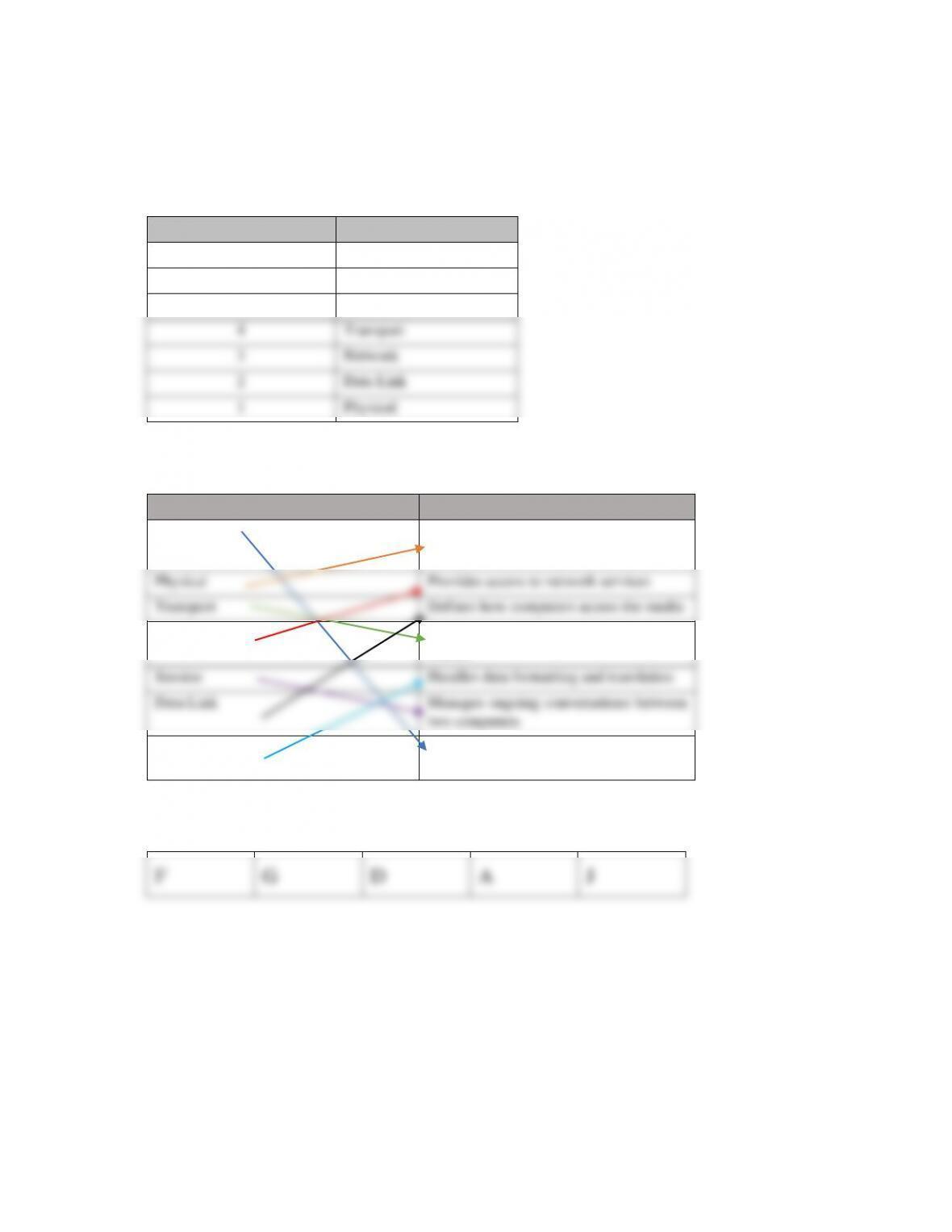
Hands-On Project 7-2
OSI model layer number
OSI model layer name
7
Application
6
Presentation
5
Session
4
Transport
3
Network
2
Data Link
1
Physical
Hands-On Project 7-3
OSI model layer name
OSI model layer description
Network
Converts bits into signals for outgoing
messages
Physical
Provides access to network services
Transport
Defines how computers access the media
Application
Breaks long data streams into smaller
chunks
Session
Handles data formatting and translation
Data Link
Manages ongoing conversations between
two computers
Presentation
Provides best path selection in an
internetwork
Hands-On Project 7-4
F
G
D
A
J
Guide to Networking Essentials, 8th ed., ISBN 9780357118283
Chapter 7 Solutions-6
Challenge Labs
Challenge Lab 7-1
Map the header names in the captured packet to the layers of the OSI model:
• Ethernet II: Data Link layer
For each header, find two fields you can identify as pertaining to that OSI layer’s function, and be prepared
to explain why.
• Ethernet II: Source and destination MAC address
Challenge Lab 7-2
List the steps you took to get all the MAC addresses:
Case Projects
Case Project 7-1
1. Physical
3. Application
5. Presentation
7. Transport
9. Application
10. Network
Case Project 7-2
Answers will vary, but students should provide a clear description of a layered process.
Case Project 7-3
This document transfer should work. There’s no problem with transferring data between an Ethernet