CCNA Guide to Cisco Networking, Fourth Edition Chapter 7 Lab Solutions
1
Chapter 7 Lab Solutions
Because the router labs in this chapter are not saved, it is best to have the students do
the chapter in one sitting.
Instructor Tips Lab 7.1
This first lab can be done in class within teams or at home if there is not enough class time.
Activity Questions Lab 7.1
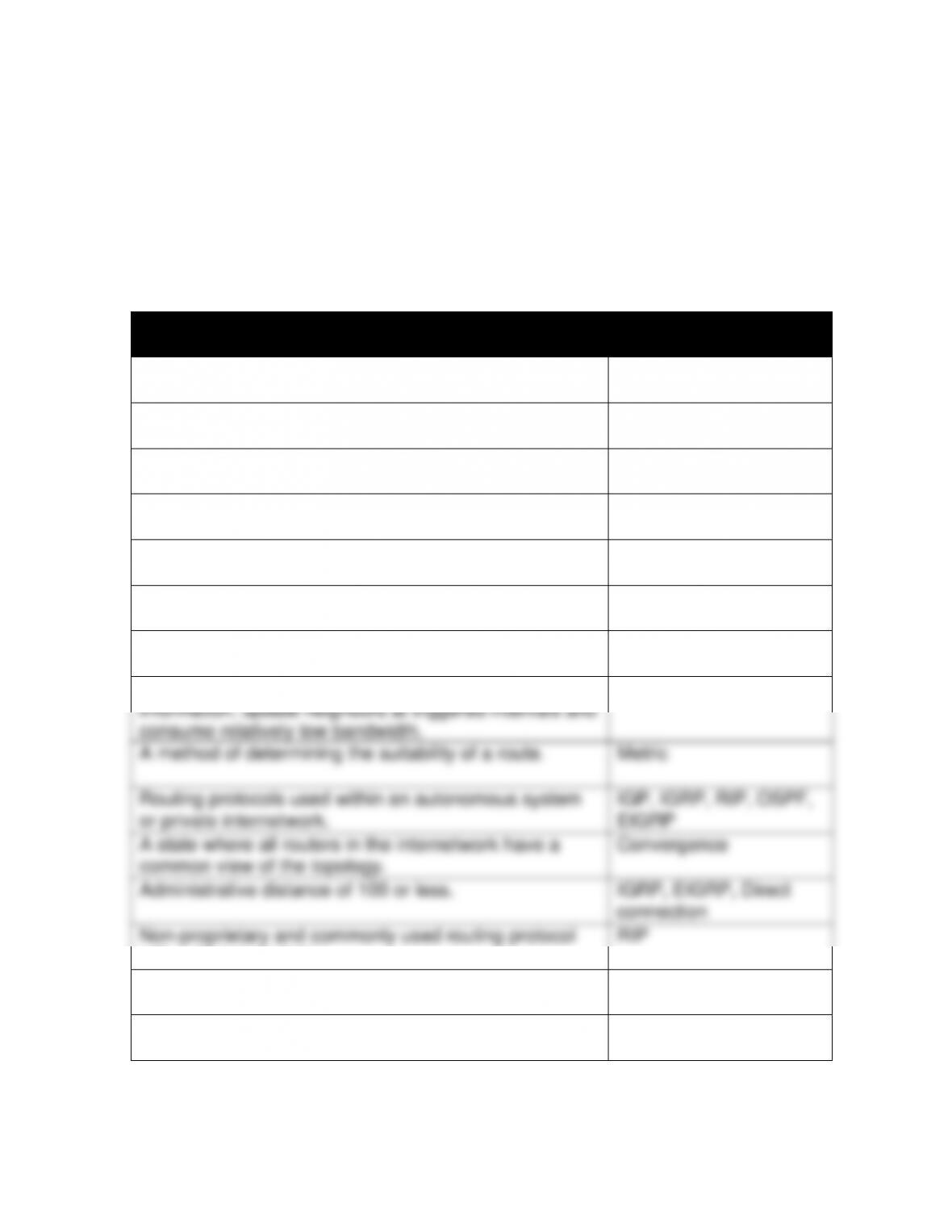
Routing Concept Description
Matching Term
Protocols that cannot be routed.
NetBEUI
Protocols that broadcast their entire routing tables
periodically.
Distance-vector, RIP,
IGRP
A type of route used in a stub situation or as a backup.
Static Route
The method a router uses to rank the reliability of
routing information.
Administrative distance
A group of routers that will share routing information
and are under the control of one administrator.
Autonomous system
Protocols that can be routed.
IP, IPX
Used to combat the count-to-infinity problem.
Hold-down timers
Split horizon
Protocols that, after the initial flooding of routing
information, update neighbors at triggered intervals and
consume relatively low bandwidth.
Link-state, OSPF
A method of determining the suitability of a route.
Metric
Routing protocols used within an autonomous system
or private internetwork.
IGP, IGRP, RIP, OSPF,
EIGRP
A state where all routers in the internetwork have a
common view of the topology.
Convergence
Administrative distance of 100 or less.
IGRP, EIGRP, Direct
connection
Non-proprietary and commonly used routing protocol
with a 15-hop limitation.
RIP
Routing protocols that can be used only between Cisco
routers.
IGRP, EIGRP
Routing protocols used between autonomous systems
or private internetworks.
EGP, BGP
Review Questions Lab 7.1
2
1. A default route is a type of static route. What is it used for?
2. Rank IGRP, EIGRP, RIP, OSPF, static route, and direct connection in terms of
3. What is the difference between split horizon and split horizon with poison reverse?
Activity Questions Lab 7.2
5. Answer varies; there is a “C”; answer varies; there is an “R”
10. Answer varies; answer varies; answer varies
13. No; they will be put in the table only if there is no dynamic routing information
16. S; because the administrative distance of a static route is “1,” which is less
Review Questions Lab 7.2
1. What is a stub router?
2. Why do you think the administrative distance of a static route is only 1?
3. What is the purpose of changing the default administrative distance of a static route?
4. What is the only type of routing table entry that would have a default administrative
distance less than the default administrative distance of a static route?
Instructor Tips Lab 7.3
Tell the students not to worry if they aren’t receiving RIP information from other routers.
Depending on how far the other students are along in the lab, the routing tables can vary
quite a bit.
CCNA Guide to Cisco Networking, Fourth Edition Chapter 7 Lab Solutions
Activity Questions Lab 7.3
13. Hopefully yes
19. Hopefully yes
20. You can tell if you are receiving and/or sending RIP updates.
Review Questions Lab 7.3
1. What is an advantage of increasing the update interval?
2. What is the purpose of the hold-down timer?
3. List three commands to turn off the debugging you configured using the debug ip rip
command.
4. What is the purpose of the flush interval?