Chapter 7 Review Questions
1. In infrastructure mode of operation, each wireless host is connected to the larger
network via a base station (access point). If not operating in infrastructure mode, a
2. a) Single hop, infrastructure-based
3. Path loss is due to the attenuation of the electromagnetic signal when it travels
through matter. Multipath propagation results in blurring of the received signal at the
4. a) Increasing the transmission power
b) Reducing the transmission rate
5.
6. False
7. es will be transmitted over one of
9. Each wireless station can set an RTS threshold such that the RTS/CTS sequence is
10.
transmit at the same time, and they both use RTS/CTS. If the RTS frame is as long as
11. Initially the switch has an entry in its forwarding table which associates the wireless
station with the earlier AP. When the wireless station associates with the new AP, the
AP.
12. Any ordinary Bluetooth node can be a master node whereas access points in 802.11
14.
15. UMTS to GSM and CDMA-2000 to IS-95.
16. The data plane role of eNodeB is to forward datagram between UE (over the LTE
radio access network) and the P-GW. Its control plane role is to handle registration
and mobility signaling traffic on behalf of the UE.
17. In 3G architecture, there are separate network components and paths for voice and
data, i.e., voice goes through public telephone network, whereas data goes through
18. No. A node can remain connected to the same access point throughout its connection
19. A permanent address for a mobile node is its IP address when it is at its home
21. The home network in GSM maintains a database called the home location register
(HLR), which contains the permanent cell phone number and subscriber profile
information about each of its subscribers. The HLR also contains information about
22. Anchor MSC is the MSC visited by the mobile when a call first begins; anchor MSC
thus remains unchanged d
23. a) Local recovery
Chapter 7 Problems
Problem 1
Problem 2
Sender 2 output = [1,-1,1,1,1,-1,1,1]; [ 1,-1,1,1,1,-1,1,1]
Problem 3
Problem 4
Problem 5
a) The two APs will typically have different SSIDs and MAC addresses. A wireless
station arriving to the café will associate with one of the SSIDs (that is, one of the
APs). After association, there is a virtual link between the new station and the AP.
Problem 6
Suppose that wireless station H1 has 1000 long frames to transmit. (H1 may be an AP
that is forwarding an MP3 to some other wireless station.) Suppose initially H1 is the
only station that wants to transmit, but that while half-way through transmitting its first
Problem 7
A frame without data is 32 bytes long. Assuming a transmission rate of 11 Mbps, the time
to transmit a control frame (such as an RTS frame, a CTS frame, or an ACK frame) is
Problem 8
a) 1 message/ 2 slots
b) 2 messages/slot
c) 1 message/slot
d) i) 1 message/slot
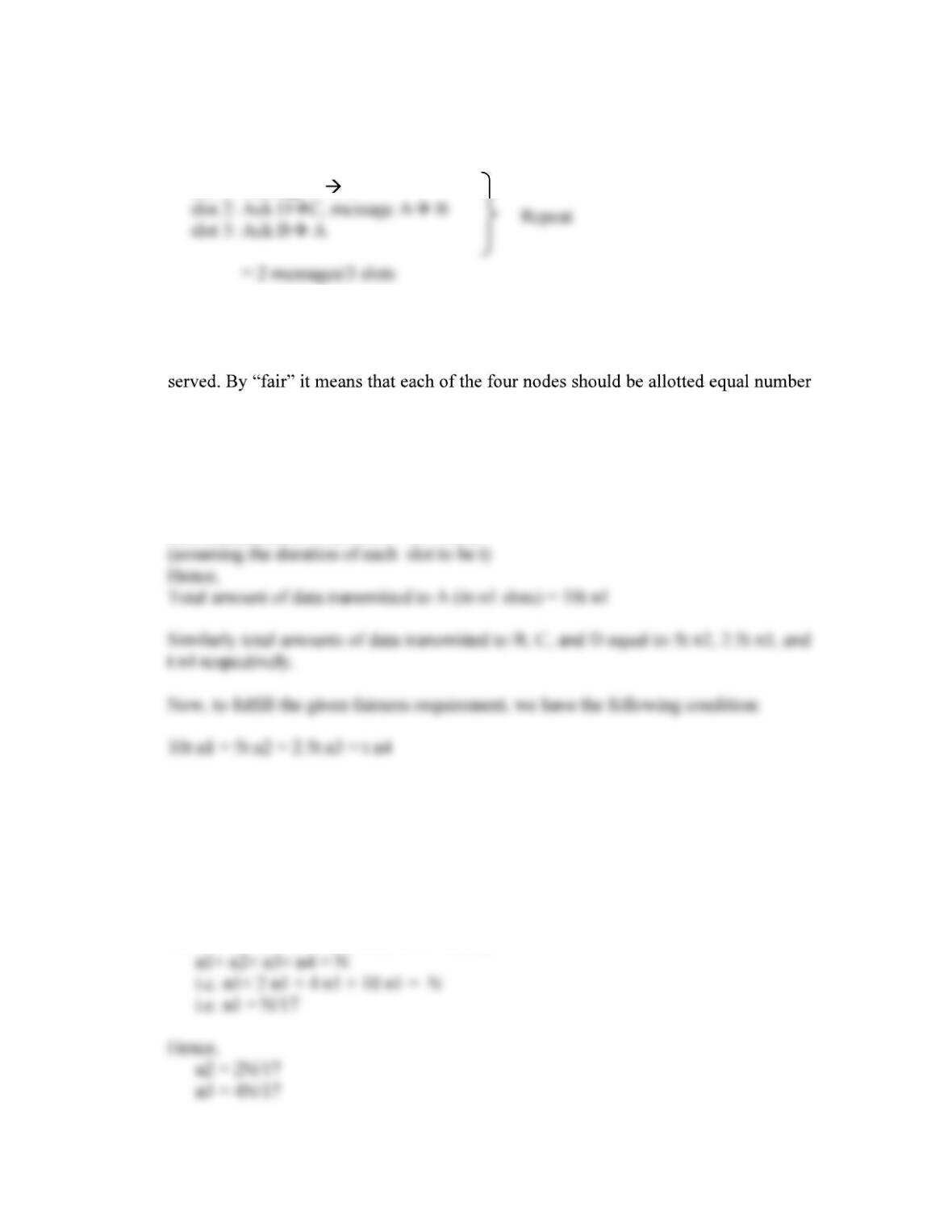
= 2 messages/ 3 slots
iii)
slot 1: Message C D
Problem 10
a) 10 Mbps if it only transmits to node A. This solution is not fair since only A is getting
of slots.
b) For the fairness requirement such that each node receives an equal amount of data
during each downstream sub-frame, let n1, n2, n3, and n4 respectively represent the
number of slots that A, B, C and D get.
Now,
data transmitted to A in 1 slot = 10t Mbits
Hence,
n2 = 2 n1
n3 = 4 n1
n4 = 10 n1
Now, the total number of slots is N. Hence,
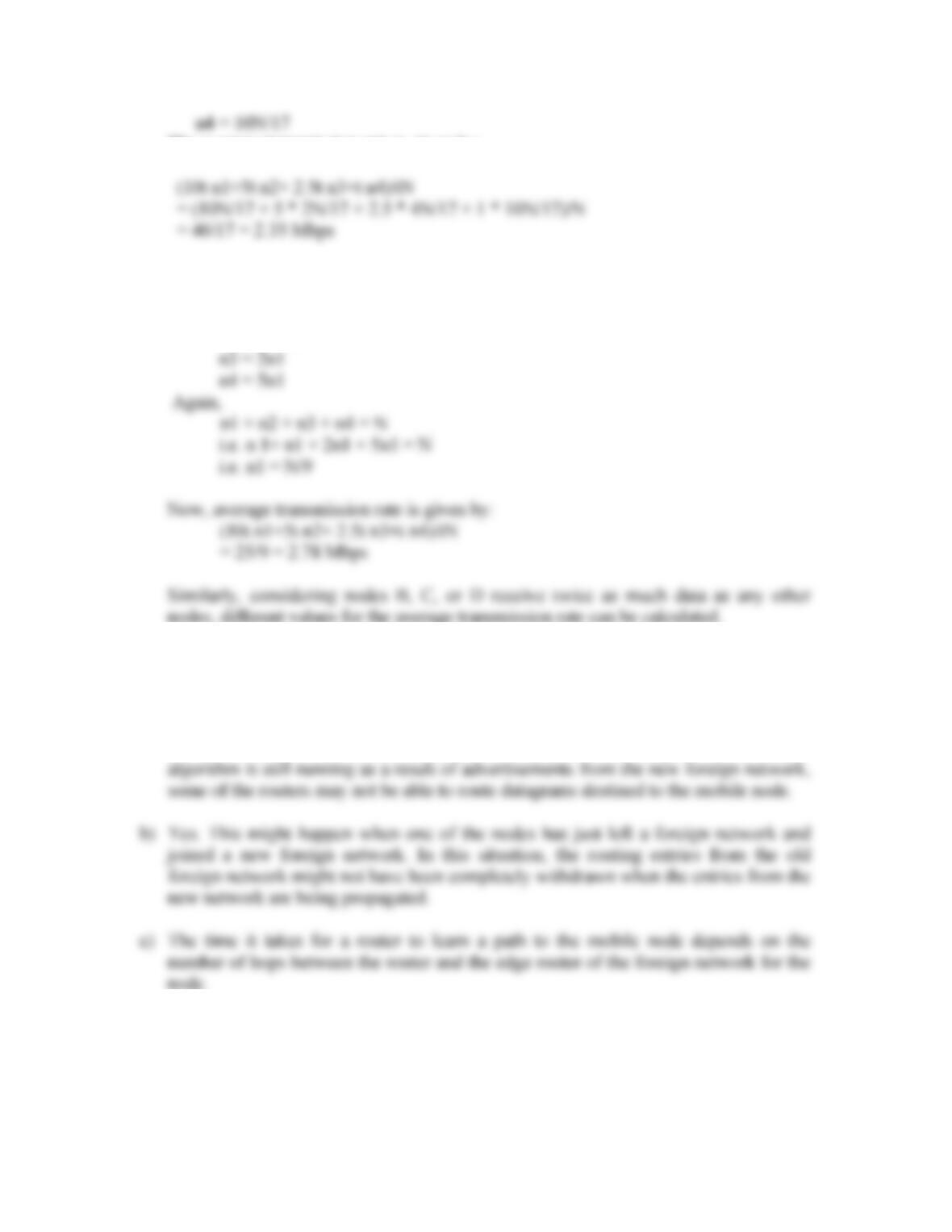
The average transmission rate is given by:
c) Let node A receives twice as much data as nodes B, C, and D during the sub-frame.
Hence,
10tn1 = 2 * 5tn2 = 2 * 2.5tn3 = 2 * tn4
i.e. n2 = n1
Problem 11
a) No. All the routers might not be able to route the datagram immediately. This is
because the Distance Vector algorithm (as well as the inter-AS routing protocols like
BGP) is decentralized and takes some time to terminate. So, during the time when the
Problem 12
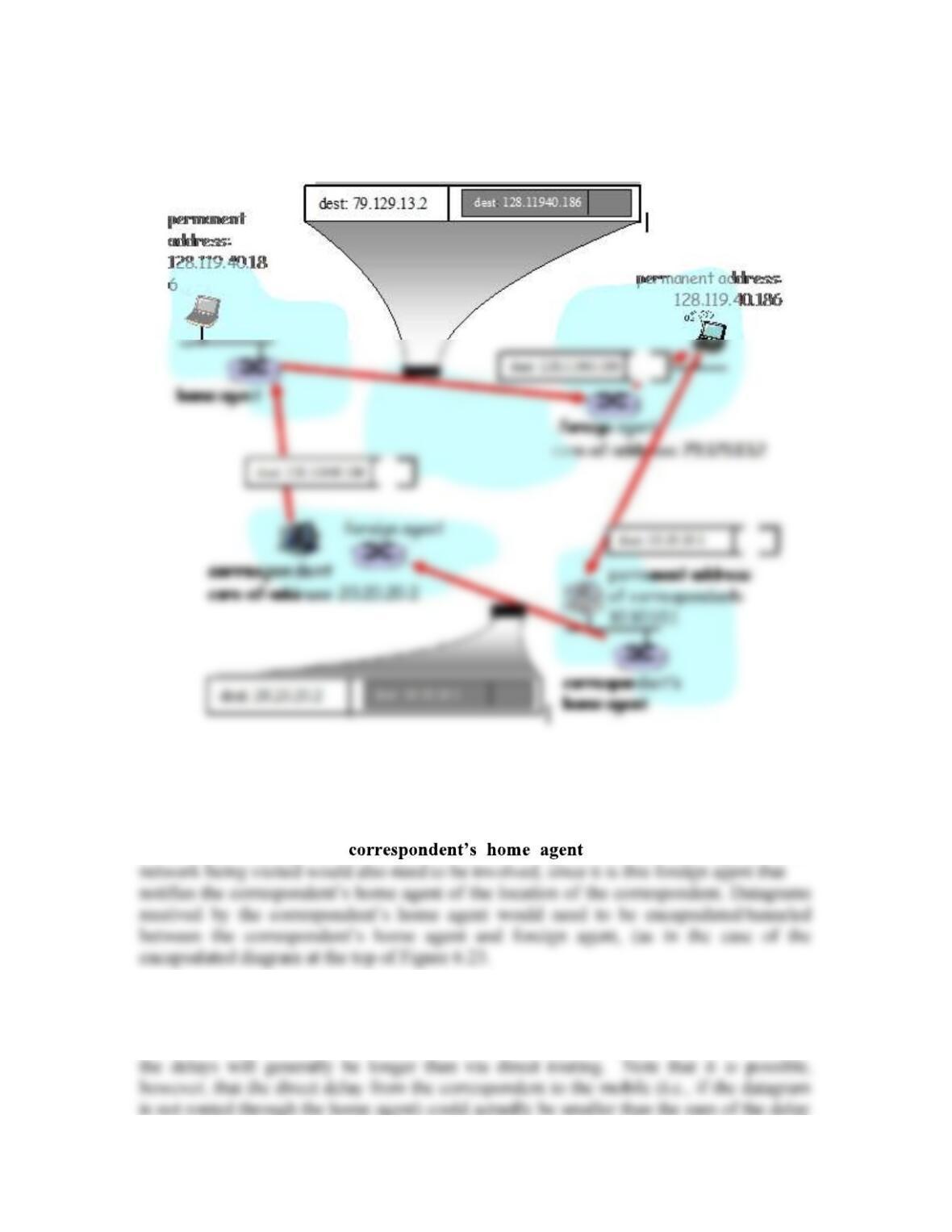
If the correspondent is mobile, then any datagrams destined to the correspondent would
have to pass through the . The foreign agent in the
Problem 13
Because datagrams must be first forward to the home agent, and from there to the mobile,
Problem 14
First, we note that chaining was discussed at the end of section 6.5. In the case of
chaining using indirect routing through a home agent, the following events would
happen:
The mobile node arrives at A, A notifies the home agent that the mobile is now
visiting A and that datagrams to the mobile should now be forwarded to the
specified care-of-address (COA) in A.
In the case that chaining is not used, the following events would happen:
The mobile node arrives at A, A notifies the home agent that the mobile is now
visiting A and that datagrams to the mobile should now be forwarded to the
specified care-of-address (COA) in A.
The mobile node moves to B. The foreign agent at B must notify the foreign
agent at A and the home agent that the mobile is no longer resident in A but in
When the mobile goes offline or returns to its home network, the datagram-forwarding
state maintained by the foreign agent in C must be removed. This teardown must also be
Problem 15
Two mobiles could certainly have the same care-of-address in the same visited network.
Problem 16
If the MSRN is provided to the HLR, then the value of the MSRN must be updated in the