Chapter 6 Review Questions
1. The transportation mode, e.g., car, bus, train, car.
2. Although each link guarantees that an IP datagram sent over the link will be received
at the other end of the link without errors, it is not guaranteed that IP datagrams will
3. Framing: there is also framing in IP and TCP; link access; reliable delivery: there is
4. There will be a collision in the sense that while a node is transmitting it will start to
receive a packet from the other node.
5. Slotted Aloha: 1, 2 and 4 (slotted ALOHA is only partially decentralized, since it
requires the clocks in all nodes to be synchronized). Token ring: 1, 2, 3, 4.
7. In polling, a discussion leader allows only one participant to talk at a time, with each
8. When a node transmits a frame, the node has to wait for the frame to propagate
9. 248 MAC addresses; 232 IPv4 addresses; 2128 IPv6 addresses.
11. An ARP query is sent in a broadcast frame because the querying host does not which
adapter address corresponds to the IP address in question. For the response, the
12. No it is not possible. Each LAN has its own distinct set of adapters attached to it, with
14. 2 (the internal subnet and the external internet)
16. We can string the N switches together. The first and last switch would use one port
Chapter 6 Problems
Problem 1
1 1 1 0 1
Problem 2
Suppose we begin with the initial two-dimensional parity matrix:
0 0 0 0
With a bit error in row 2, column 3, the parity of row 2 and column 3 is now wrong in the
matrix below:
0 0 0 0
1 1 0 1
0 0 0 0
Problem 3
01001100 01101001
+ 01101110 01101011
——————————
Problem 4
a) To compute the Internet checksum, we add up the values at 16-bit quantities:
00000001 00000010
b) To compute the Internet checksum, we add up the values at 16-bit quantities:
01000010 01000011
c) To compute the Internet checksum, we add up the values at 16-bit quantities:
01100010 01100011
01100100 01100101
Problem 5
If we divide 10011 into 1010101010 0000, we get 1011011100, with a remainder of
Problem 6
a) we get 1000110000, with a remainder of R=0000.
Problem 7
a) Without loss of generality, suppose ith bit is flipped, where 0<= i <= d+r-1 and
assume that the least significant bit is 0th bit.
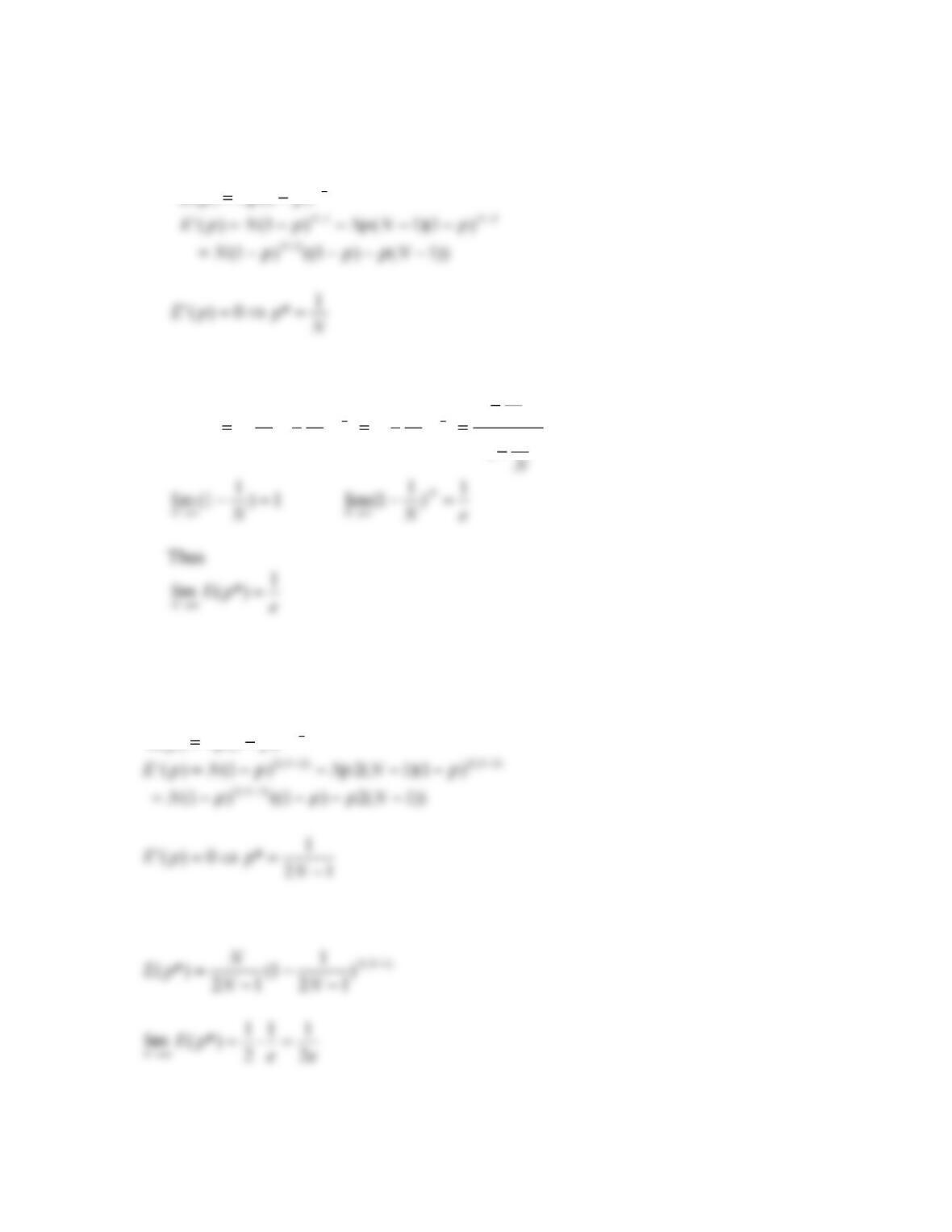
Problem 8
a)
1
)1()(
N
pNppE
b)
N
NNN
NpE
N
NN
1
1
)
1
1(
)
1
1()
1
1(
1
*)(
11
Problem 9
)
1(2
)1()(
N
pNppE
Problem 10
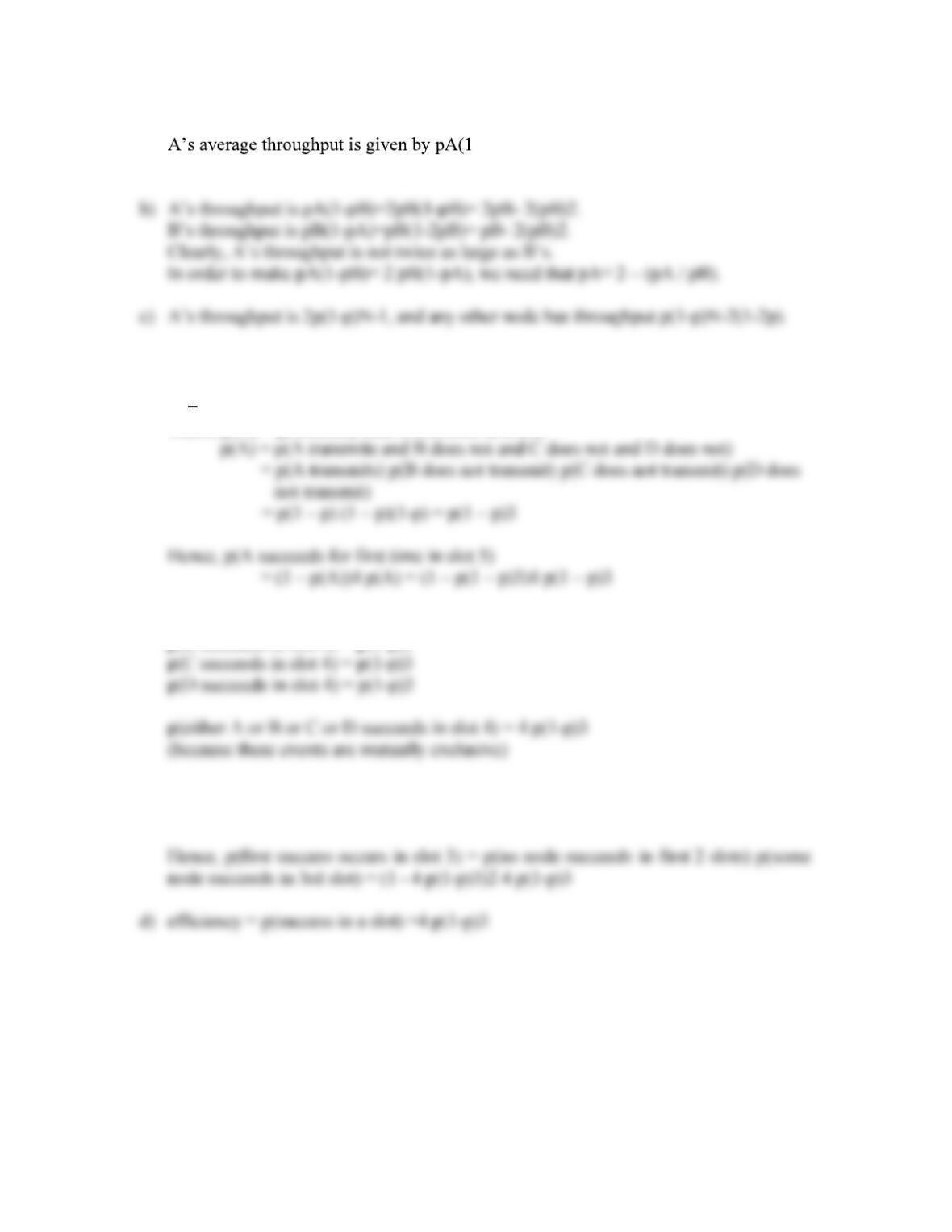
a) -pB).
Total efficiency is pA(1-pB) + pB(1-pA).
Problem 11
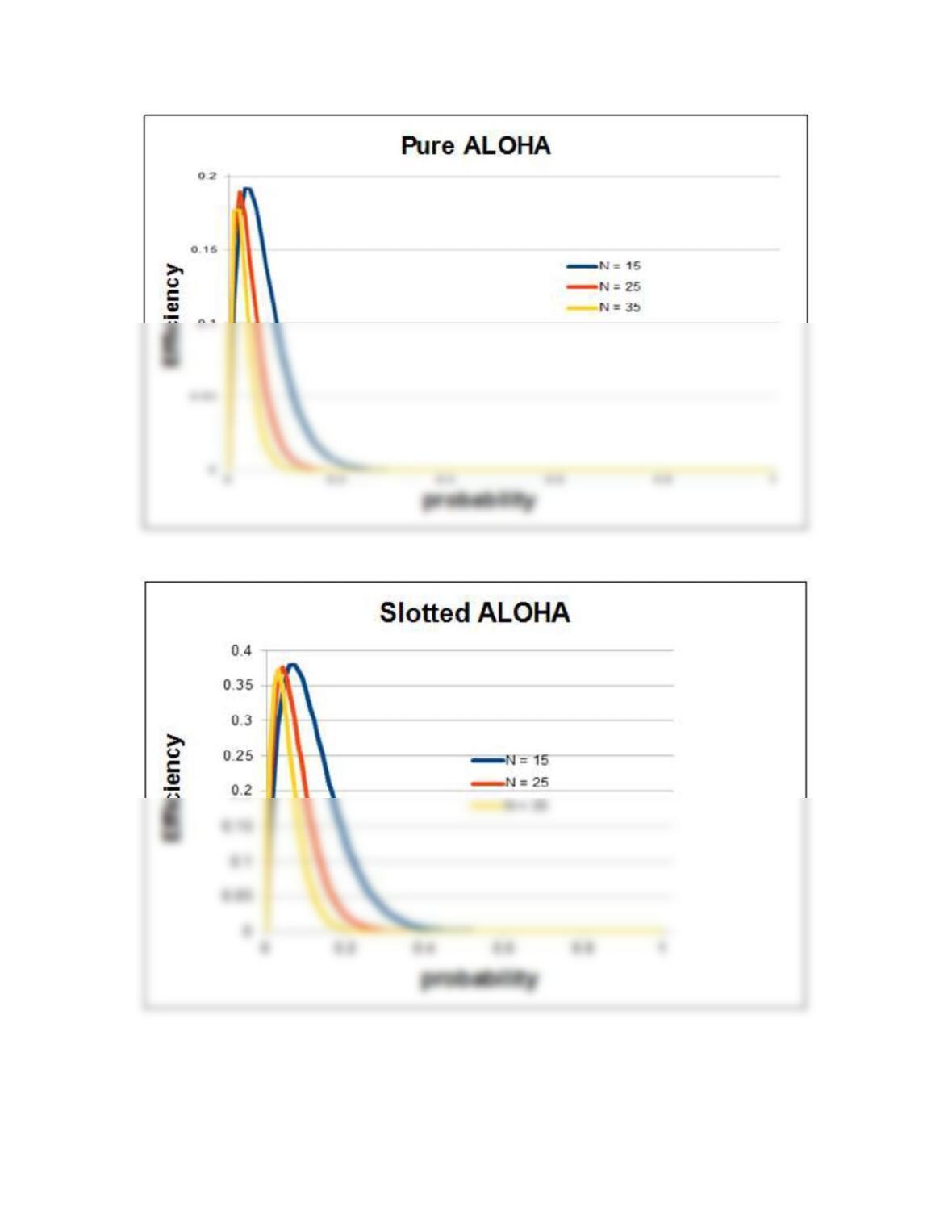
a) (1 p(A))4 p(A)
where, p(A) = probability that A succeeds in a slot
b) p(A succeeds in slot 4) = p(1-p)3
p(B succeeds in slot 4) = p(1-p)3
c) p(some node succeeds in a slot) = 4 p(1-p)3
p(no node succeeds in a slot) = 1 – 4 p(1-p)3
Problem 12
Problem 13
The length of a polling round is
)
/(
po ll
dRQN
.
Problem 14
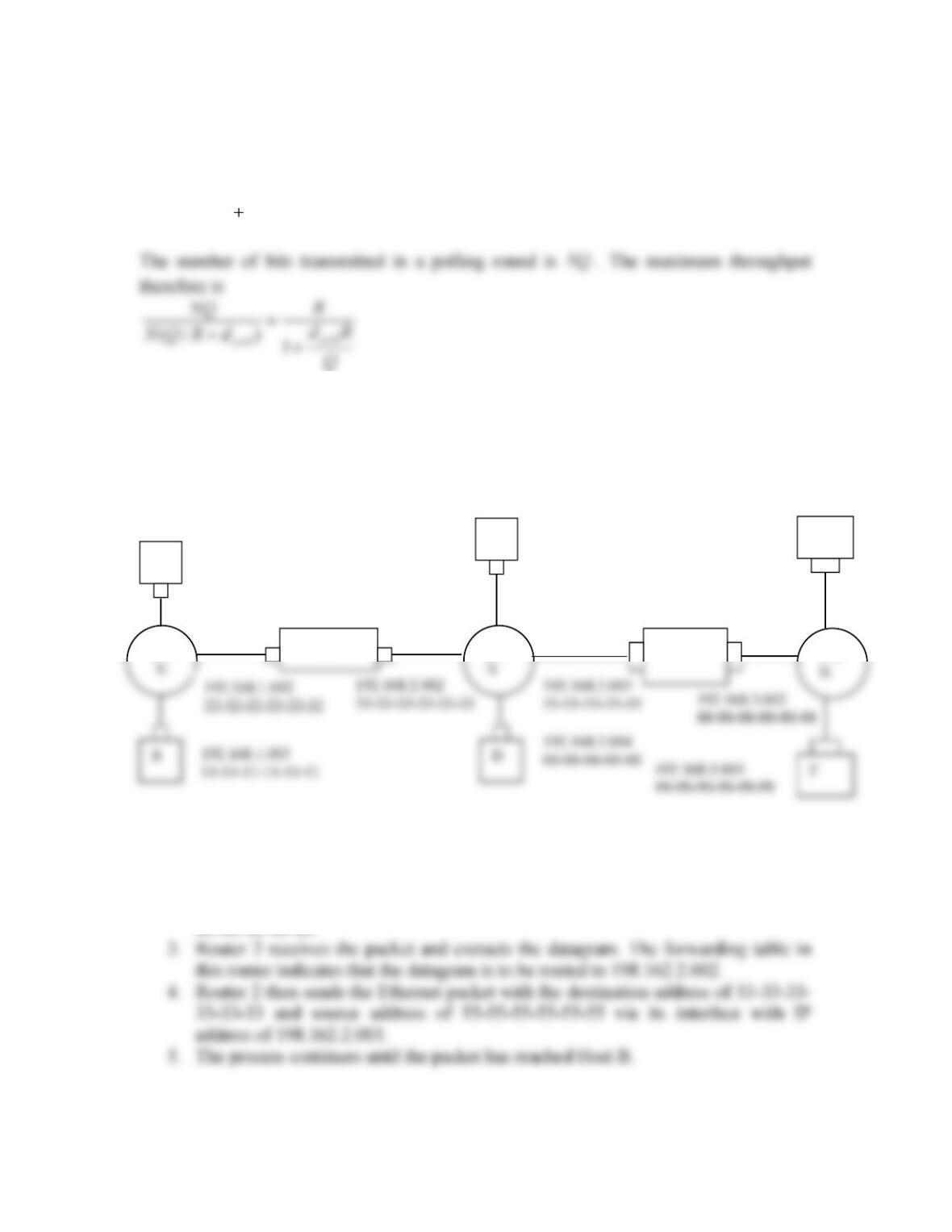
a), b) See figure below.
c)
1. Forwarding table in E determines that the datagram should be routed to interface
192.168.3.002.
2. The adapter in E creates and Ethernet packet with Ethernet destination address 88–
88-88-88-88-88.
192.168.3.001
77-77-77-77-77-77
192.168.2.001
44-44-44-44-44-44
A
LA
Router 1 LA
C
192.168.1.001
00-00-00-00-00-00
E
Router 2 LA
d) ARP in E must now determine the MAC address of 198.162.3.002. Host E sends out
Problem 15
a)
the same LAN. Thus, E will not send the packet to the default router R1.
b)
address.
Ethernet frame from E to R1:
c) Switch S1 will broadcast the Ethernet frame via both its interfaces as the received
Problem 16
Lets call the switch between subnets 2 and 3 S2. That is, router R1 between subnets 2 and
3 is now replaced with switch S2.
a)
the same LAN segment. Thus, E will not send the packet to S2.
b)
query packet with destination MAC address being the broadcast address.
This query packet will be re-broadcast by switch 1, and eventually received by Host
B.
c) Switch S1 will broadcast the Ethernet frame via both its interfaces as the received
on Subnet 1 which is connected to S1 at the interface connecting to Subnet 1. And, S1
will update its forwarding table to include an entry for Host A.
Problem 17
Wait for 51,200 bit times. For 10 Mbps, this wait is
Problem 18
At
0
t
A
transmits. At
576
t
,
A
would finish transmitting. In the worst case,
B
Problem 19
Time,
t
Event
0
A
and
B
begin transmission
245
A
and
B
detect collision
A
and
B
finish transmitting jam signal
B
B
B
Problem 20
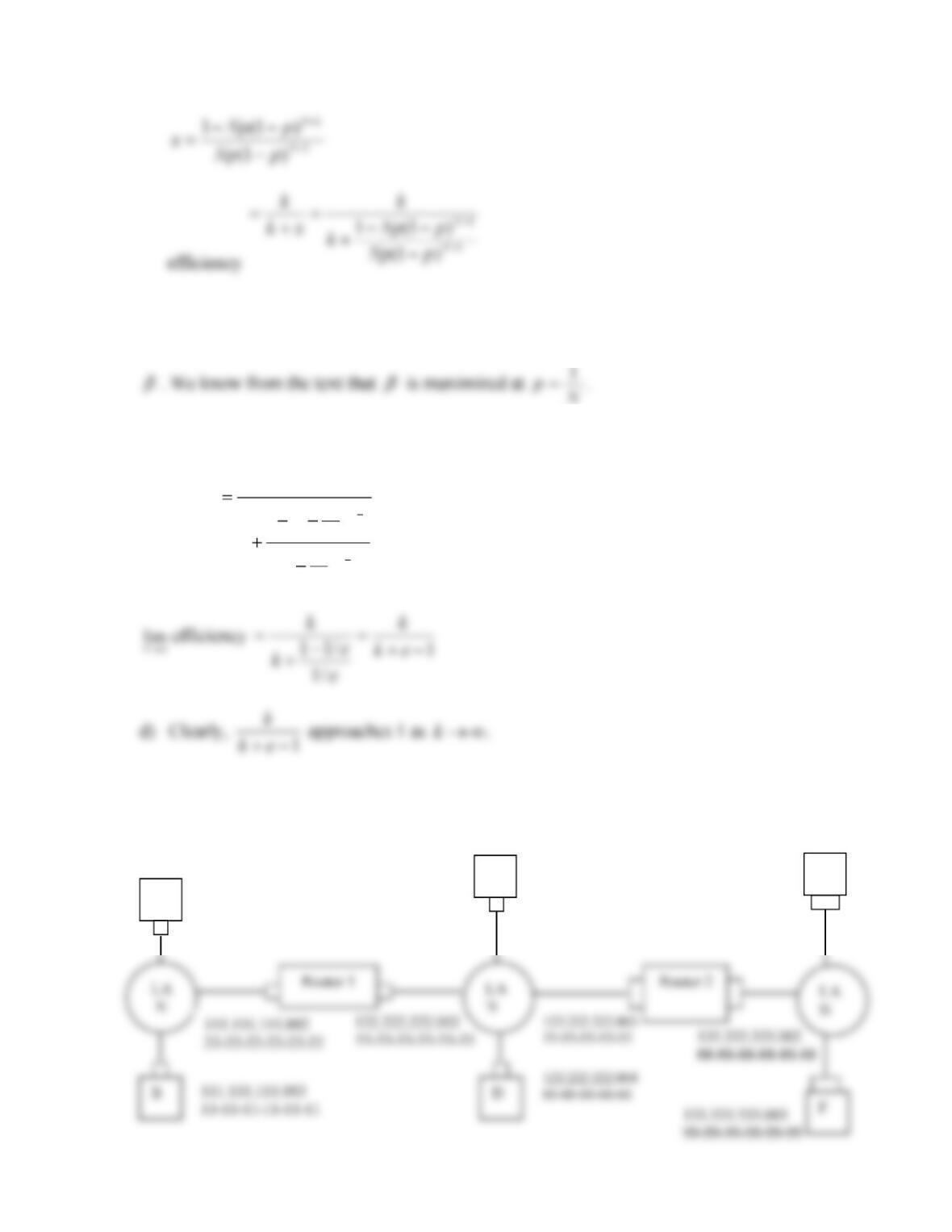
a) Let
Y
be a random variable denoting the number of slots until a success:
1
)1()(
m
mYP
,
where is the probability of a success.
B
A
A
b)
Maximizing efficiency is equivalent to minimizing
x
, which is equivalent to maximizing
c)
efficiency
1
1
)
1
1(
)
1
1(1
N
N
N
N
k
k
Problem 21
133.333.333.001
77-77-77-77-77-77
122.222.222.001
44-44-44-44-44-44
A
111.111.111.001
00-00-00-00-00-00
C E
i) from A to left router: Source MAC address: 00-00-00-00-00-00
Destination MAC address: 22-22-22-22-22-22
Source IP: 111.111.111.001
Problem 22
i) from A to switch: Source MAC address: 00-00-00-00-00-00
Destination MAC address: 55-55-55-55-55-55
Source IP: 111.111.111.001
Problem 23
If all the 11=9+2 nodes send out data at the maximum possible rate of 100 Mbps, a total
aggregate throughput of 11*100 = 1100 Mbps is possible.
Problem 24
Each departmental hub is a single collision domain that can have a maximum throughput
Problem 25
All of the 11 end systems will lie in the same collision domain. In this case, the
maximum total aggregate throughput of 100 Mbps is possible among the 11 end sytems.
Problem 26
Action Switch Table State
Link(s) packet is
forwarded to
Explanation
B sends
a
frame to E
Switch learns interface
corresponding to MAC
address of B
A, C, D, E, and F
Since switch table is
empty, so switch
does not know the
interface
corresponding to
MAC address of E
corresponding to MAC
knows interface
corresponding to
interface corresponding
knows the interface
remains the same as
knows the interface
corresponding to
Problem 27
a) The time required to fill
8
L
bits is
b) For
,
500,1
L
the packetization delay is
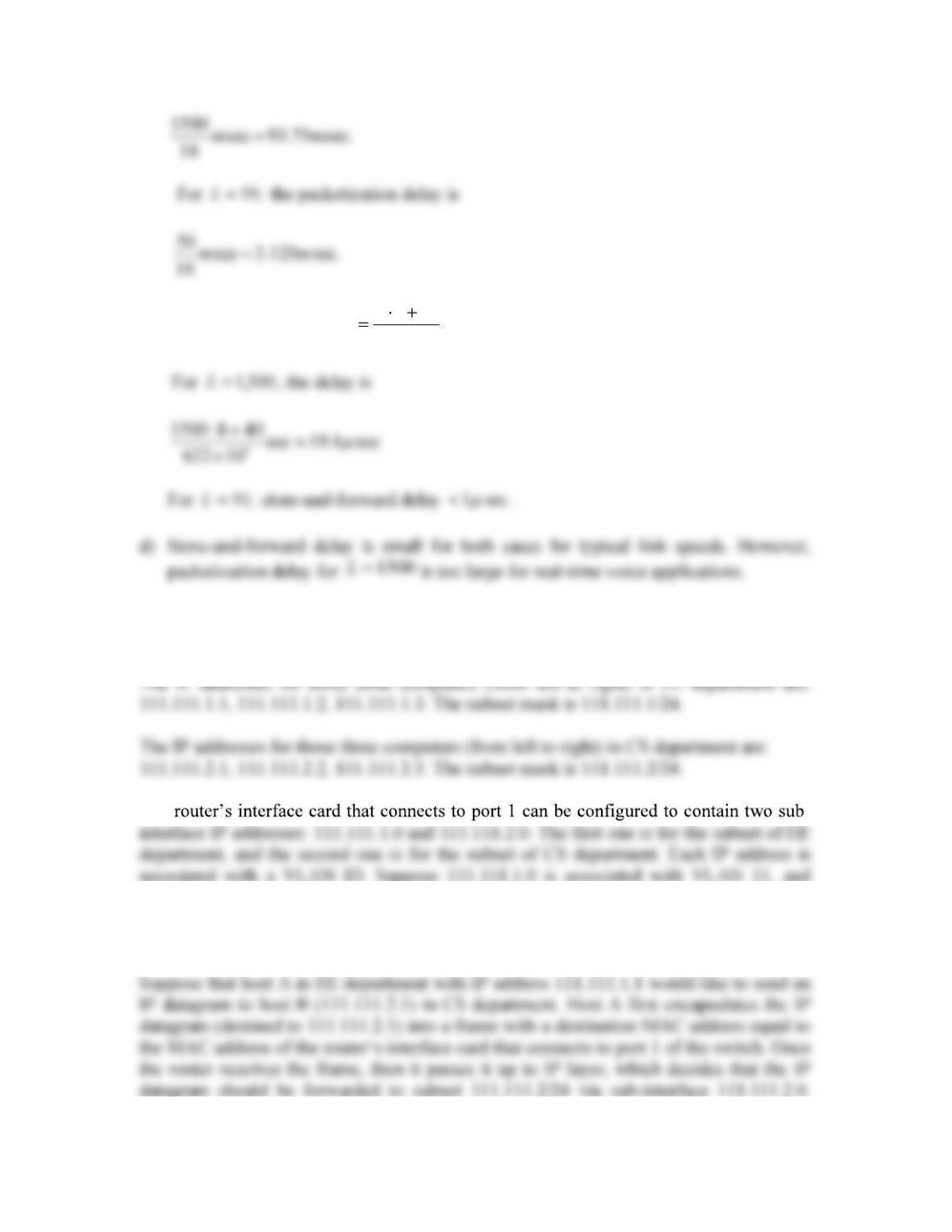
c) Store-and-forward delay
R
L
408
Problem 28
The –
111.111.2.0 is associated with VLAN 12. This means that each frame that comes from
subnet 111.111.1/24 will be added an 802.1q tag with VLAN ID 11, and each frame that
comes from 111.111.2/24 will be added an 802.1q tag with VLAN ID 12.
802.1q tag.
Problem 29
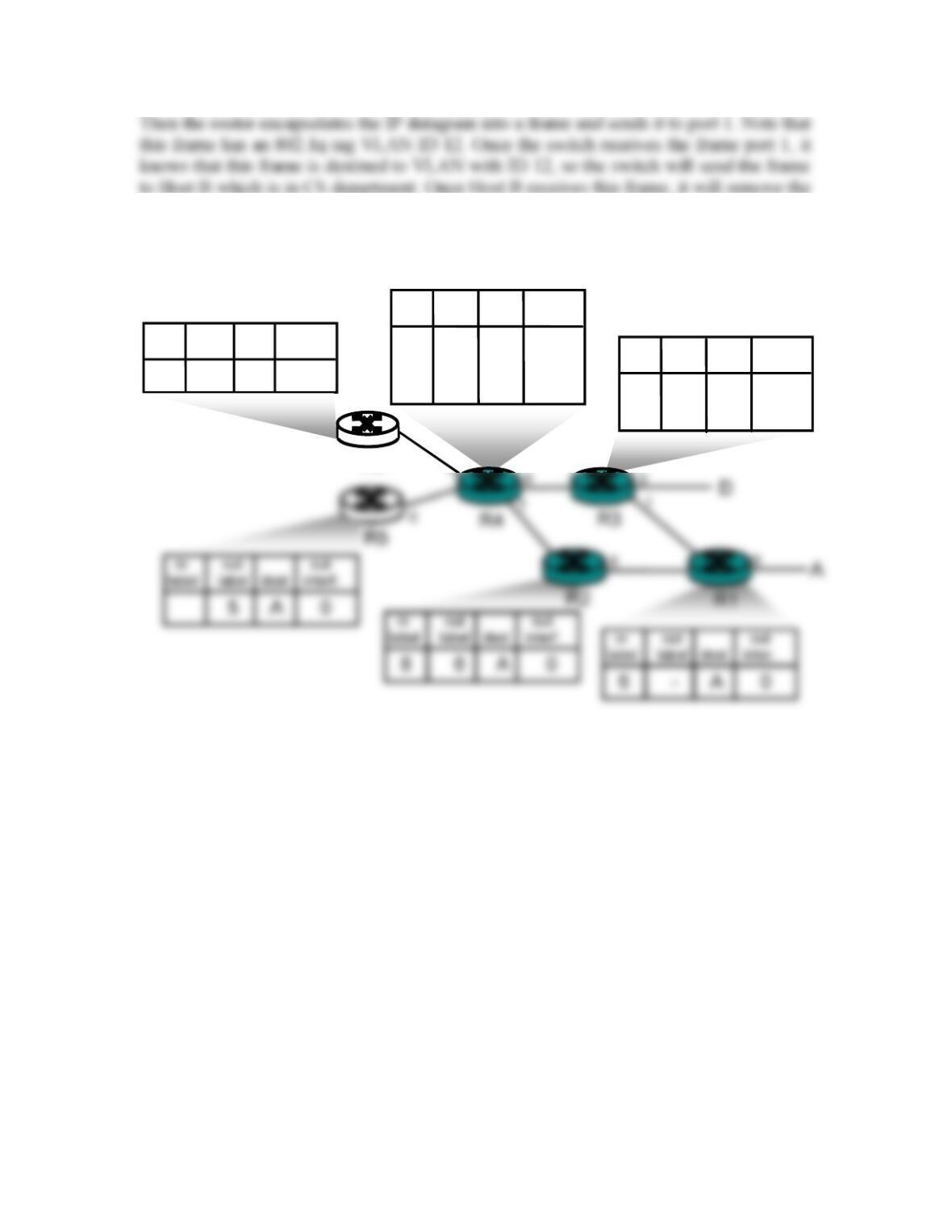
8 6 A 0
R6
in out out
label label dest interf.
10 6 A 1
12 9 D
0
in out out
label label dest interf.
7 10 A 0
12 D 0
5 8 A 1
in out out
label label dest interf.
7 A 0
0
Problem 30
R6
in out
out
label label dest interf.
12
–
D 0
in out out
label label dest interf.
3
12 D 0
2 4 D
1
in out out
label label dest interf.
3 D
0
0
Problem 31
(The following description is short, but contains all major key steps and key protocols
involved.)
Your computer first uses DHCP to obtain an IP address. You computer first creates a
special IP datagram destined to 255.255.255.255 in the DHCP server discovery step, and
puts it in a Ethernet frame and broadcast it in the Ethernet. Then following the steps in
the DHCP protocol, you computer is able to get an IP address with a given lease time.
D
R5
1
0
0
in out out
1
in out out
0
in out out
2 D
0
0
Problem 32
traversing that link, then the
80 flows crossing the B to access-router 10 Gbps links (as well as the access router to
border router links) will each only receive 10 Gbps / 80 = 125 Mbps
b) In Topology of Figure 5.31, there are four distinct paths between the first and third
Problem 33
a) Both email and video application uses the fourth rack for 0.1 percent of the time.
b) Probability that both applications need fourth rack is 0.001*0.001 = 10-6.