Chapter 4 Review Questions
1. A network-layer packet is a datagram. A router forwards a packet based on the
-layer switch forwards a packet based on the
2. The main function of the data plane is packet forwarding, which is to forward
datagrams from their input links to their output links.
input ports perform physical layer function of terminating an incoming physical link
3. The key differences between routing and forwarding is that f
local action of transferring packets from its input interfaces to its output interfaces,
4. The role of the forwarding table within a router is to hold entries to determine the
5. -effort service. With this
6. Input port, switching fabric, and output ports are implemented in hardware, because
their datagram-processing functionality is far too fast for software implementation. A
routing processor inside a traditional router uses software for executing routing
7. With the shadow copy, the forwarding lookup is made locally, at each input port,
8. Destination-based forwarding means that a datagram arriving at a router will be
forwarded to an output interface based on only the final destination of the datagram.
9. A router uses longest prefix matching to determine which link interface a packet will
10. Switching via memory; switching via a bus; switching via an interconnection
11. If the rate at which packets arrive to the fabric exceeds switching fabric rate, then
packets will need to queue at the input ports. If this rate mismatch persists, the queues
12. Assuming input and output line speeds are the same, packet loss can still occur if the
rate at which packets arrive to a single output port exceeds the line speed. If this rate
13. HOL blocking: Sometimes a packet that is first in line at an input port queue must
wait because there is no available buffer space at the output port to which it wants to
14. (A typo in this question: the first question mark should be replaced by a period).
Only FIFO can ensure that all packets depart in the order in which they arrived.
15. For example, a packet carrying network management information should receive
16. (A typo in the question: different difference)
With RR, all service classes are treated equally, i.e., no service class has priority over
RR.
17. The 8-bit protocol field in the IP datagram contains information about which transport
layer protocol the destination host should pass the segment to.
18. Time-to-live.
19.
20. The reassembly of the fragments of an
destination host.
25. 50% overhead.
26. Typically the wireless router includes a DHCP server. DHCP is used to assign IP
27. Route aggregation means that an ISP uses a single prefix to advertise multiple
28. A plug-and-play or zeroconf protocol means that the protocol is able to automatically
-related aspects in order to connect the host into a network.
29. A private network address of a device in a network refers to a network address that is
only meaningful to those devices within that network. A datagram with a private
30. IPv6 has a fixed length header, which does not include most of the options an IPv4
header can include. Even though the IPv6 header contains two 128 bit addresses
32. Forwarding has two main operations: match and action. With destination-based
forwarding, the match operation of a router looks up only the destination IP address
of the to-be-forwarded datagram, and the action operation of the router involves
33. Each entry in the forwarding table of a destination-based forwarding contains only an
IP header field value and the outgoing link interface to which a packet (that matches
34. a switch tries to find a match between
some of the header values of a packet with some entry in a flow table, and then based
on that match, the router decides to which interface(s) the packet will be forwarded

35. Three example header fields in an IP datagram that can be matched in OpenFlow 1.0
generalized forwarding are IP source address, TCP source port, and source MAC
Chapter 4 Problems
Problem 1
a) Data destined to host H3 is forwarded through interface 3
Problem 2
a) No, you can only transmit one packet at a time over a shared bus.
Problem 3
Problem 4
The minimal number of time slots needed is 3. The scheduling is as follows.
Slot 1: send X in top input queue, send Y in middle input queue.
Problem 5
a)
Prefix Match Link Interface
Problem 6
Destination Address Range Link Interface
00000000
through 0
00111111
Problem 7
Destination Address Range Link Interface
11000000
through (32 addresses) 0
Problem 8
223.1.17.0/26
Problem 9
Destination Address Link Interface
200.23.16/21 0
Problem 10
Destination Address Link Interface
Problem 11
Any IP address in range 128.119.40.128 to 128.119.40.191
Problem 12
From 214.97.254/23, possible assignments are
a) Subnet A: 214.97.255/24 (256 addresses)
b) To simplify the solution, assume that no datagrams have router interfaces as
ultimate destinations. Also, label D, E, F for the upper-right, bottom, and upper-
left interior subnets, respectively.
Router 1
Longest Prefix Match Outgoing Interface
Router 2
Longest Prefix Match Outgoing Interface
Router 3
Longest Prefix Match Outgoing Interface
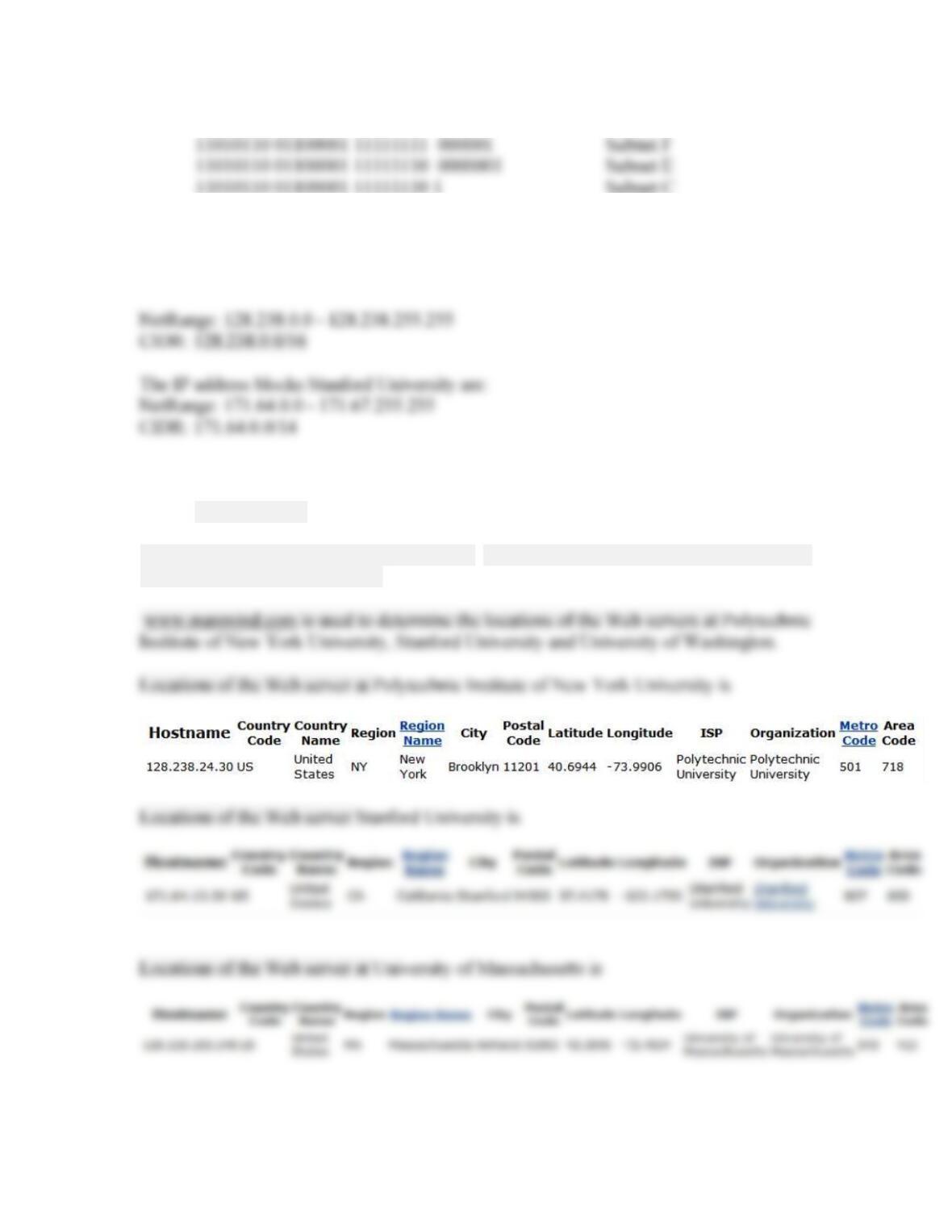
Problem 13
The IP address blocks of Polytechnic Institute of New York University are:
The IP address blocks University of Washington are:
NetRange: 140.142.0.0 – 140.142.255.255
CIDR: 140.142.0.0/16
No, the whois services cannot be used to determine with certainty the geographical
location of a specific IP address.
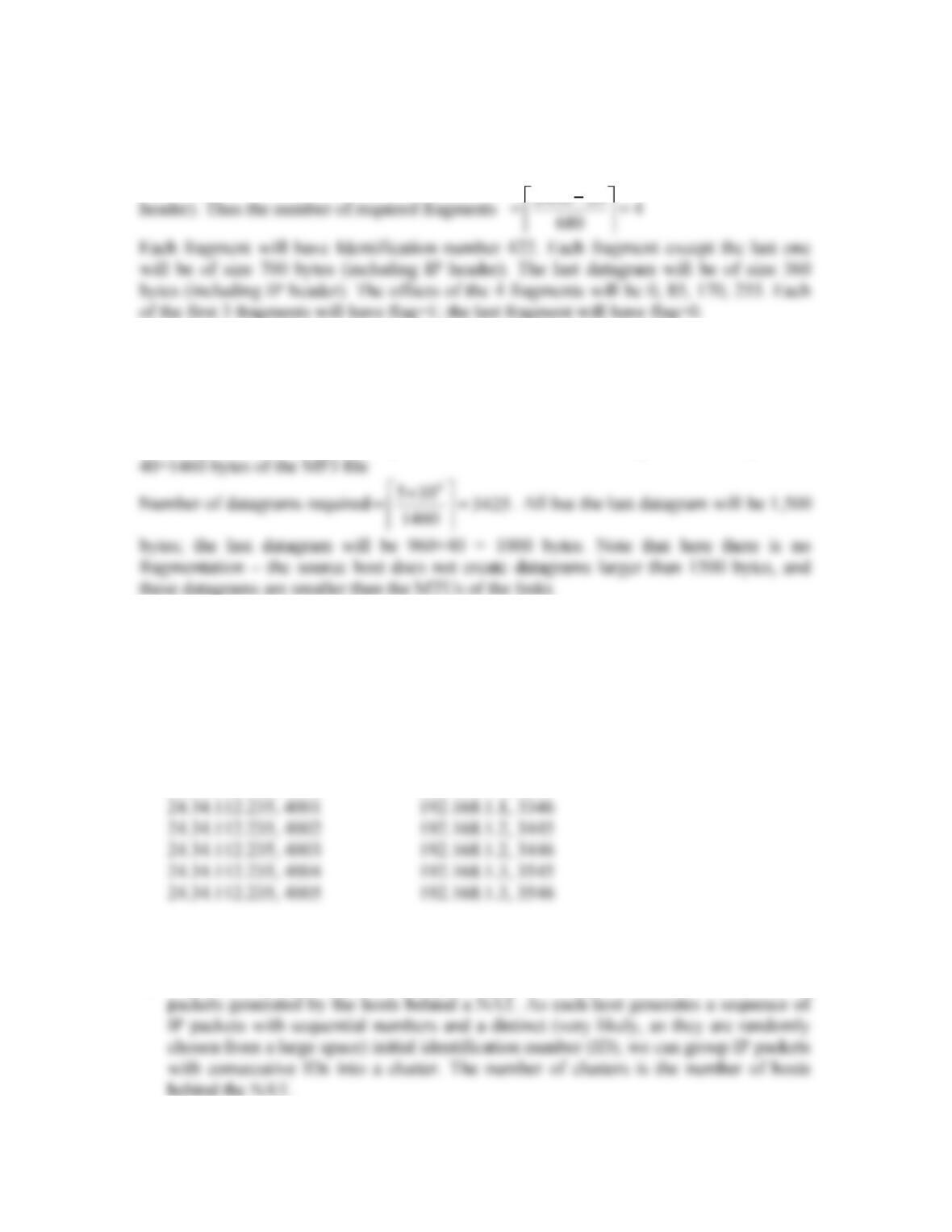
Problem 14
The maximum size of data field in each fragment = 680 (because there are 20 bytes IP
Problem 15
MP3 file size = 5 million bytes. Assume the data is carried in TCP segments, with each
TCP segment also having 20 bytes of header. Then each datagram can carry 1500–
Problem 16
a) Home addresses: 192.168.1.1, 192.168.1.2, 192.168.1.3 with the router interface
being 192.168.1.4
b)
NAT Translation Table
WAN Side LAN Side
24.34.112.235, 4000 192.168.1.1, 3345
Problem 17
a) Since all IP packets are sent outside, so we can use a packet sniffer to record all IP
-8, 2002, Marseille, France.
–
Weifeng Chen, Yong Huang, Bruno F. Ribeiro, Kyoungwon Suh, Honggang Zhang,
Problem 18
It is not possible to devise such a technique. In order to establish a direct TCP connection
Problem 19
S2 Flow Table
Match Action
Ingress Port = 1; IP Src = 10.3.*.*; IP Dst = 10.1.*.*
Forward (2)
Ingress Port = 2; IP Src = 10.1.*.*; IP Dst = 10.3.*.*
Forward (1)
Ingress Port = 2; IP Dst = 10.2.0.4
Forward (4)
Ingress Port = 3
Forward (4)
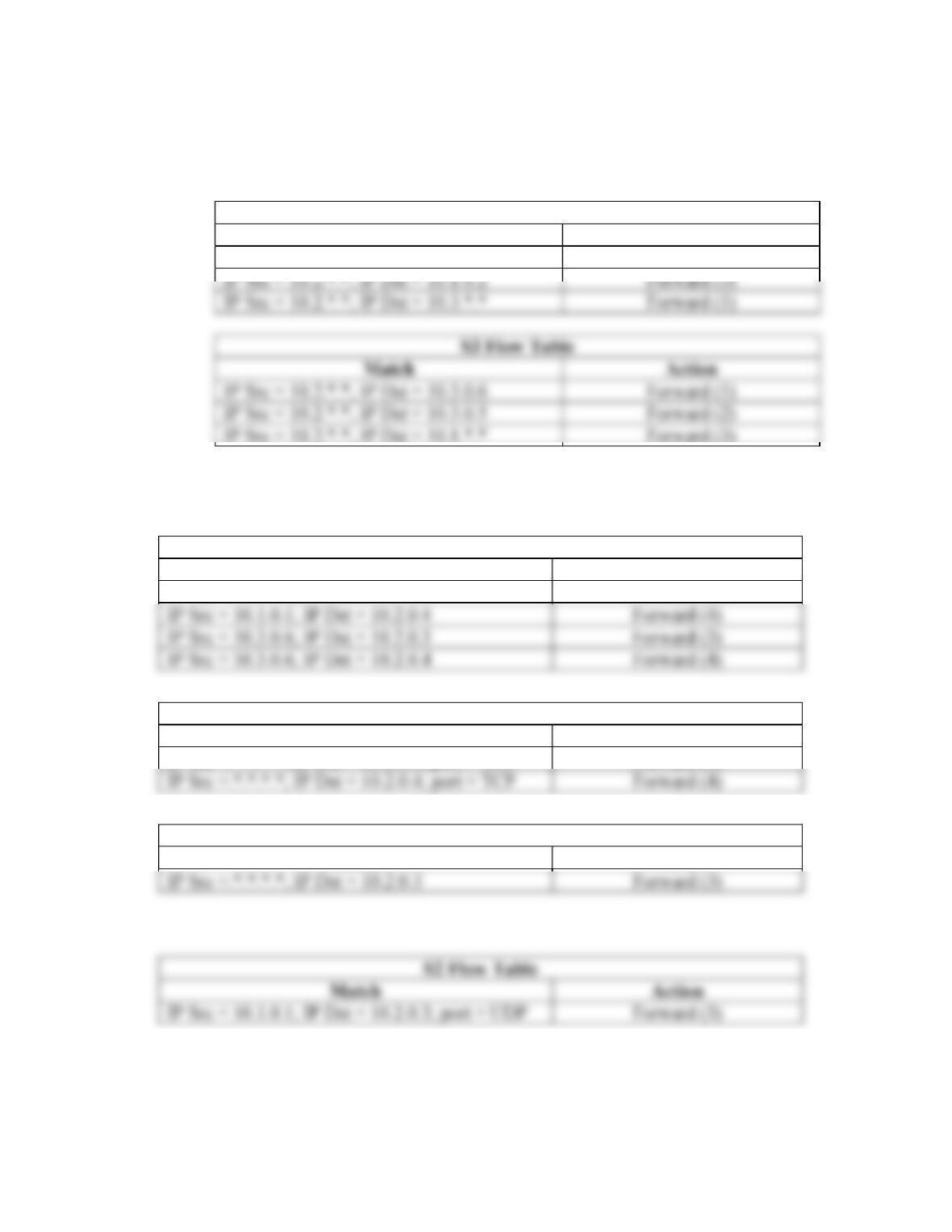
Problem 20
S2 Flow Table
Match Action
Ingress Port = 3; IP Dst = 10.1.*.*
Ingress Port = 3; IP Dst = 10.3.*.*
Forward (2)
Forward (2)
Problem 21
S1 Flow Table
Match Action
IP Src = 10.2.*.*; IP Dst = 10.1.0.1 Forward (2)
Problem 22
S2 Flow Table
Match Action
IP Src = 10.1.0.1; IP Dst = 10.2.0.3 Forward (3)
IP Src
= 10.3.0.6; IP Dst = 10.2.0.4
Forward (4)
S2 Flow Table
Match Action
IP Src =.*.*.*.*; IP Dst = 10.2.0.3; port = TCP
Forward (3)
IP Src =.*.*.*.*; IP Dst = 10.2.0.4; port = TCP
Forward (4)
S2 Flow Table
Match Action
IP Src = 10.1.0.1; IP Dst = 10.2.0.3; port = UDP
Forward (3)