Chapter 1 Review Questions
1.
2. From Wikipedia: Diplomatic protocol is commonly described as a set of international
courtesy rules. These well-established and time-honored rules have made it easier for
3. Standards are important for protocols so that people can create networking systems
and products that interoperate.
4. 1. Dial-up modem over telephone line: home; 2. DSL over telephone line: home or
5. HFC bandwidth is shared among the users. On the downstream channel, all packets
7. Ethernet LANs have transmission rates of 10 Mbps, 100 Mbps, 1 Gbps and 10 Gbps.
9. Dial up modems: up to 56 Kbps, bandwidth is dedicated; ADSL: up to 24 Mbps
10. There are two popular wireless Internet access technologies today:
a) Wifi (802.11) In a wireless LAN, wireless users transmit/receive packets to/from an
base station (i.e., wireless access point) within a radius of few tens of meters. The
11. At time t0 the sending host begins to transmit. At time t1 = L/R1, the sending host
completes transmission and the entire packet is received at the router (no propagation
12. A circuit-switched network can guarantee a certain amount of end-to-end bandwidth
13. a) 2 users can be supported because each user requires half of the link bandwidth.
b) Since each user requires 1Mbps when transmitting, if two or fewer users transmit
simultaneously, a maximum of 2Mbps will be required. Since the available
bandwidth of the shared link is 2Mbps, there will be no queuing delay before the
14. If the two ISPs do not peer with each other, then when they send traffic to each other
they have to send the traffic through a provider ISP (intermediary), to which they
15. Google’s private network connects together all its data centers, big and small. Traffic
between the Google data centers passes over its private network rather than over the
public Internet. Many of these data centers are located in, or close to, lower tier ISPs.
Therefore, when Google delivers content to a user, it often can bypass higher tier
ISPs. What motivates content providers to create these networks? First, the content
16. The delay components are processing delays, transmission delays, propagation
17. a) 1000 km, 1 Mbps, 100 bytes
b) 100 km, 1 Mbps, 100 bytes
19. a) 500 kbps
20. End system A breaks the large file into chunks. It adds header to each chunk, thereby
generating multiple packets from the file. The header in each packet includes the IP
21. The maximum emission rate is 500 packets/sec and the maximum transmission rate is
350 packets/sec. The corresponding traffic intensity is 500/350 =1.43 > 1. Loss will
22. Five generic tasks are error control, flow control, segmentation and reassembly,
23. The five layers in the Internet protocol stack are from top to bottom the
24. Application-layer message: data which an application wants to send and passed onto
the transport layer; transport-layer segment: generated by the transport layer and
25. Routers process network, link and physical layers (layers 1 through 3). (This is a little
26. a) Virus
Requires some form of human interaction to spread. Classic example: E-mail
27. Creation of a botnet requires an attacker to find vulnerability in some application or
system (e.g. exploiting the buffer overflow vulnerability that might exist in an
application). After finding the vulnerability, the attacker needs to scan for hosts that
28. Trudy can pretend to be Bob to Alice (and vice-versa) and partially or completely
modify the message(s) being sent from Bob to Alice. For example, she can easily
Chapter 1 Problems
Problem 1
There is no single right answer to this question. Many protocols would do the trick.
Here’s a simple answer below:
Messages from ATM machine to Server
Msg name purpose
——– ——-
PASSWD Ask user for PIN (password)
OK last requested operation (PASSWD, WITHDRAWL)
OK
ERR last requested operation (PASSWD, WITHDRAWL)
in ERROR
BYE ————-->
<————- BYE
In situation when there’s not enough money:
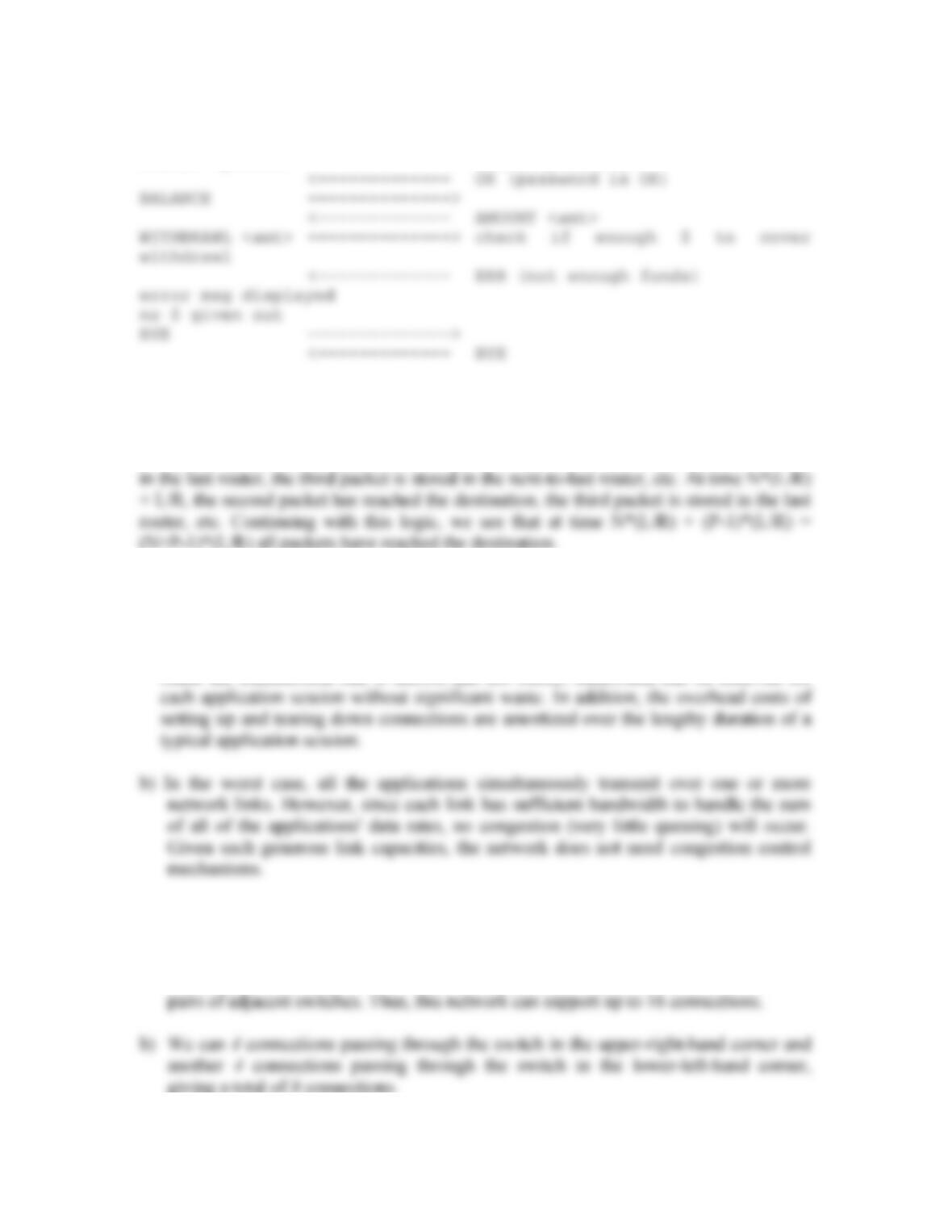
HELO (userid) ————--> (check if valid userid)
<————- PASSWD
PASSWD <passwd> ————–> (check password)
Problem 2
At time N*(L/R) the first packet has reached the destination, the second packet is stored
Problem 3
a) A circuit-switched network would be well suited to the application, because the
application involves long sessions with predictable smooth bandwidth requirements.
Since the transmission rate is known and not bursty, bandwidth can be reserved for
Problem 4
a) Between the switch in the upper left and the switch in the upper right we can have 4
connections. Similarly we can have four connections between each of the 3 other
Problem 5
Tollbooths are 75 km apart, and the cars propagate at 100km/hr. A tollbooth services a
car at a rate of one car every 12 seconds.
a) There are ten cars. It takes 120 seconds, or 2 minutes, for the first tollbooth to service
the 10 cars. Each of these cars has a propagation delay of 45 minutes (travel 75 km)
Problem 6
a)
smd
prop
/
seconds.
b) RLdtrans / seconds.
Problem 7
Consider the first bit in a packet. Before this bit can be transmitted, all of the bits in the
packet must be generated. This requires
856 sec=7msec.
Problem 8
a) 20 users can be supported.
b)
1.0
p
.
c) n
npp
n
120
1
120 .
Problem 9
a) 10,000
Problem 10
The first end system requires L/R1 to transmit the packet onto the first link; the packet
propagates over the first link in d1/s1; the packet switch adds a processing delay of dproc;
Problem 11
Because bits are immediately transmitted, the packet switch does not introduce any delay;
Problem 12
The arriving packet must first wait for the link to transmit 4.5 *1,500 bytes = 6,750 bytes
Problem 13
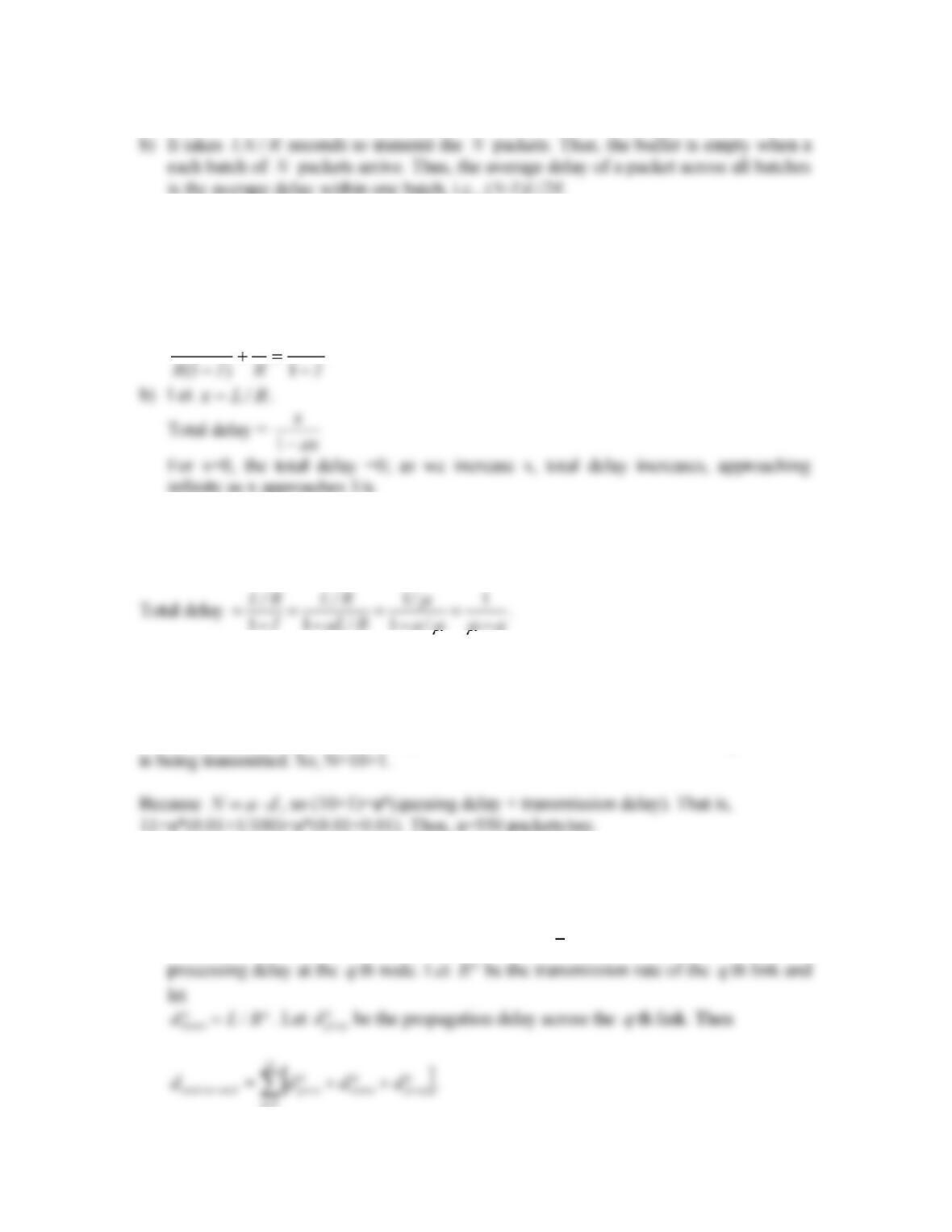
a) The queuing delay is 0 for the first transmitted packet, L/R for the second transmitted
packet, and generally, (n-1)L/R for the nth transmitted packet. Thus, the average delay
for the N packets is:
Problem 14
a) The transmission delay is
R
L
/
. The total delay is
RL
L
IL
/
Problem 15
Problem 16
The total number of packets in the system includes those in the buffer and the packet that
Problem 17
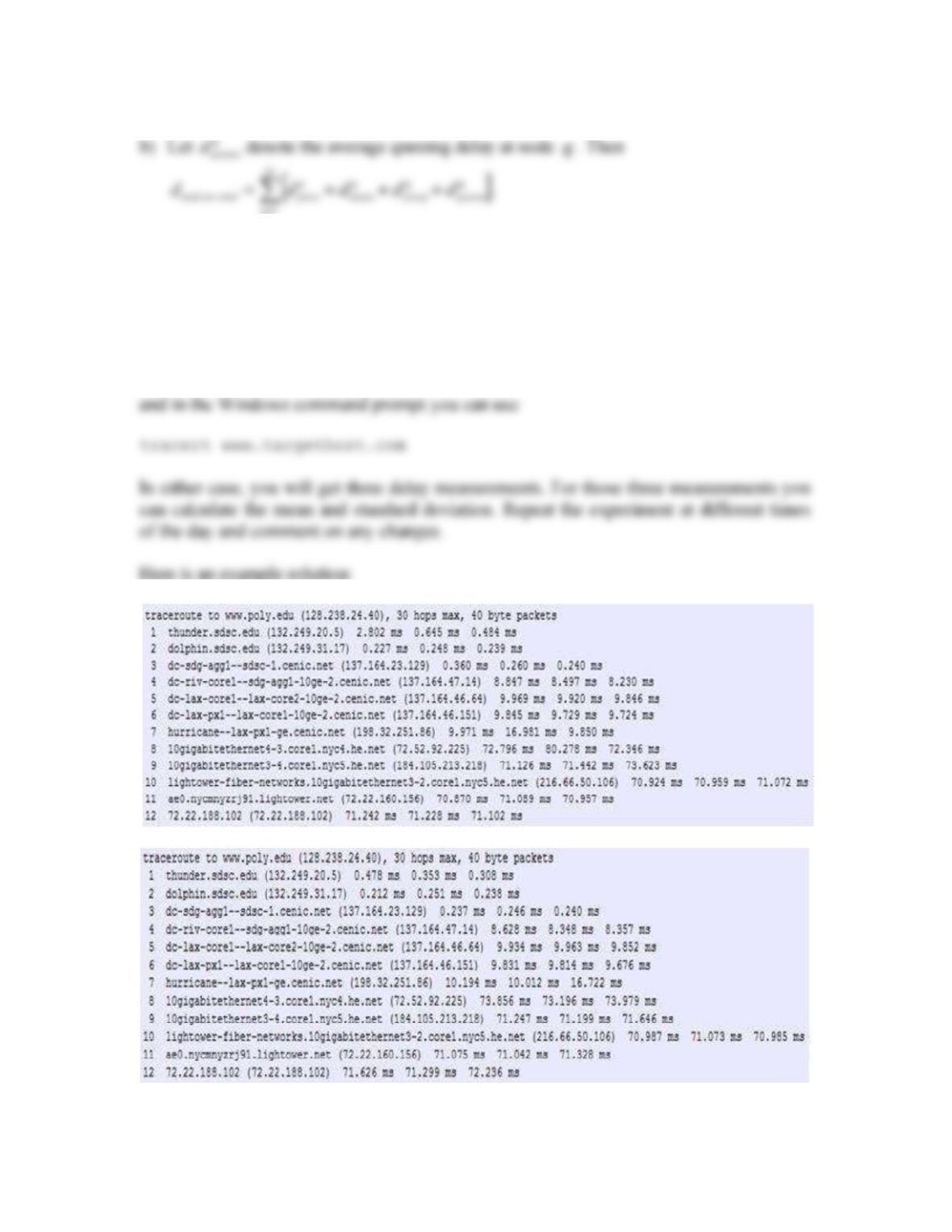
a) There are
Q
nodes (the source host and the
1
Q
routers). Let q
proc
d
denote the
prop
Problem 18
On linux you can use the command
traceroute www.targethost.com
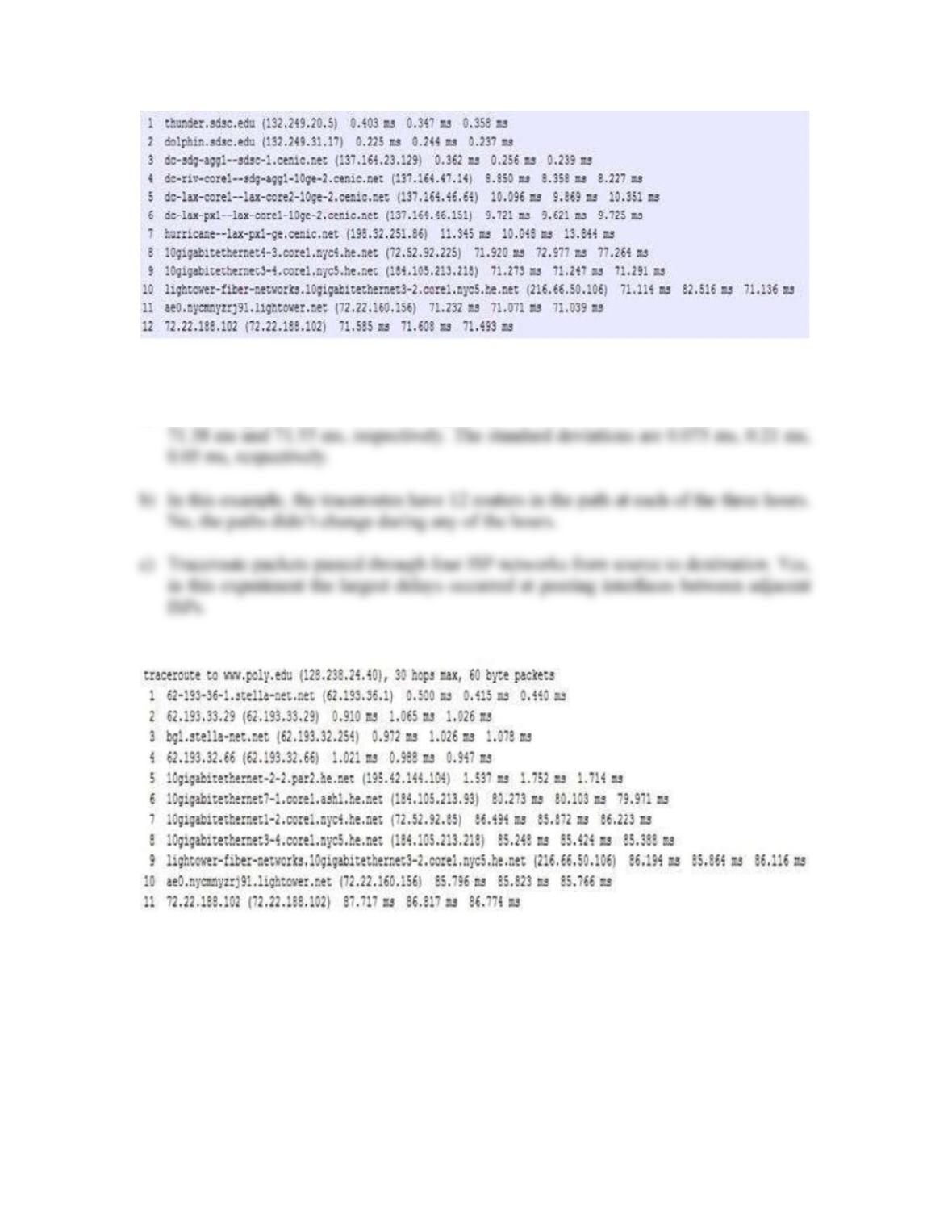
Traceroutes between San Diego Super Computer Center and www.poly.edu
a) The average (mean) of the round-trip delays at each of the three hours is 71.18 ms,
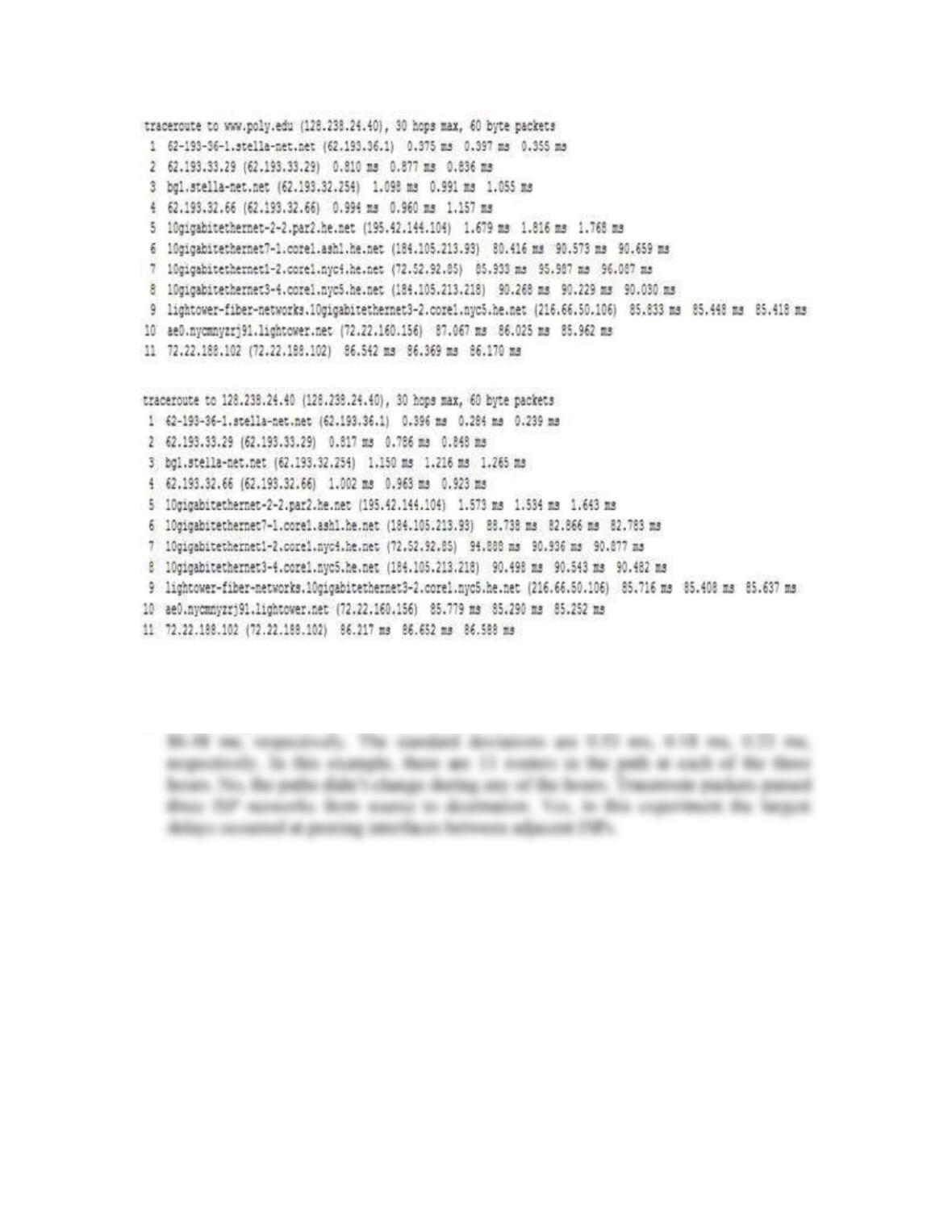
Traceroutes from www.stella-net.net (France) to www.poly.edu (USA).
d) The average round-trip delays at each of the three hours are 87.09 ms, 86.35 ms and
Problem 19
An example solution:
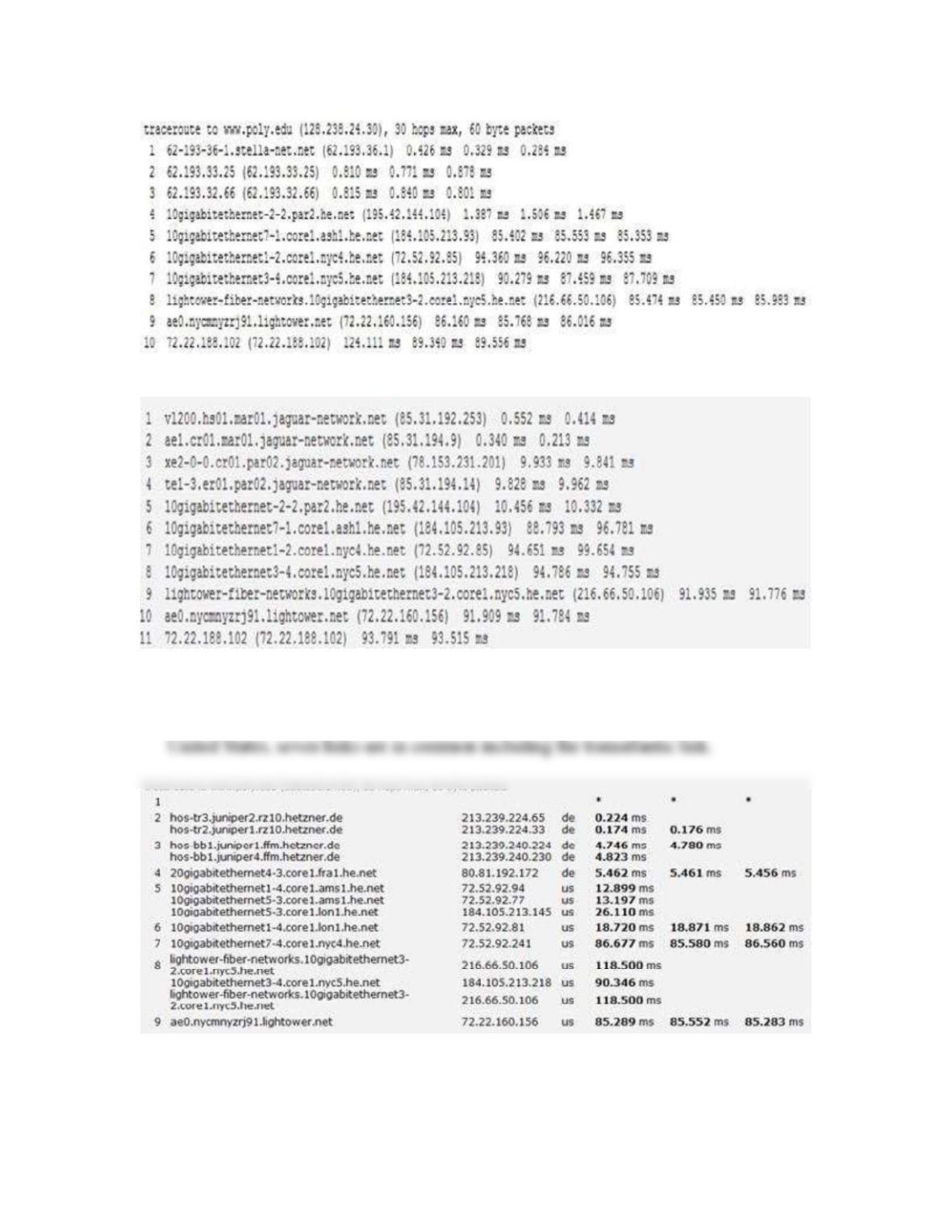
Traceroutes from two different cities in France to New York City in United States
a) In these traceroutes from two different cities in France to the same destination host in
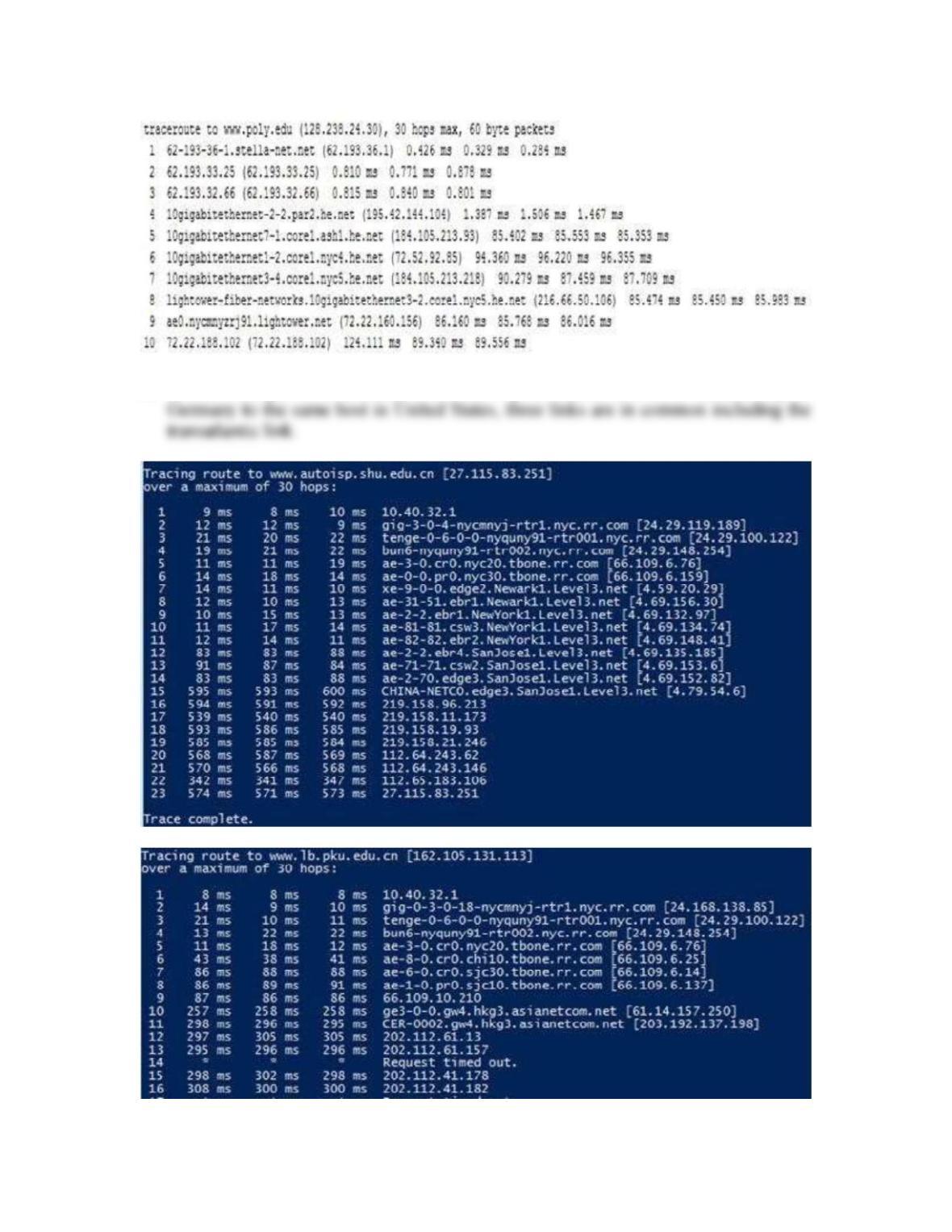
b) In this example of traceroutes from one city in France and from another city in
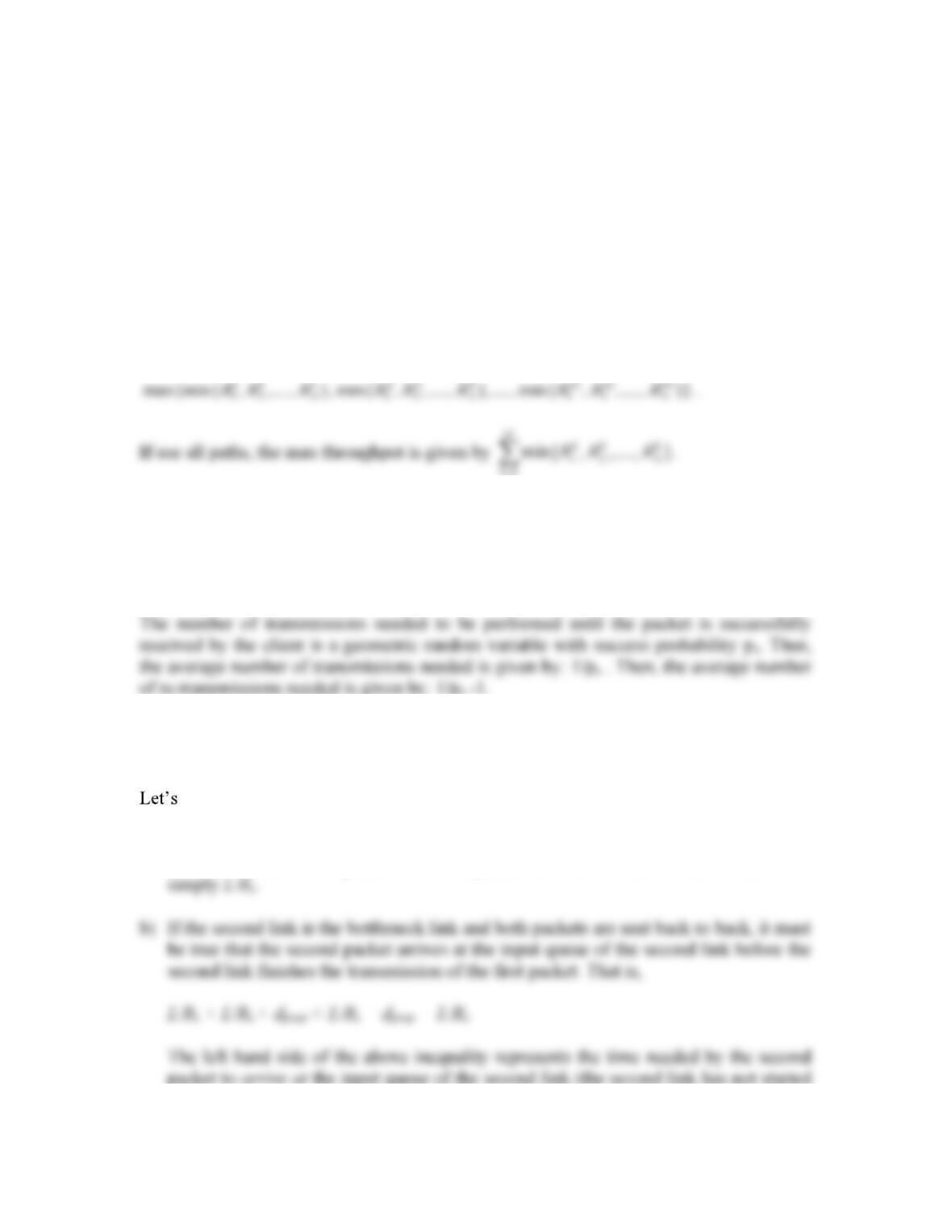
Traceroutes to two different cities in China from same host in United States
c) Five links are common in the two traceroutes. The two traceroutes diverge before
reaching China
Problem 20
Throughput = min{Rs, Rc, R/M}
Problem 21
If only use one path, the max throughput is given by:
Problem 22
Probability of successfully receiving a packet is: ps= (1-p)N.
Problem 23
call the first packet A and call the second packet B.
a) If the bottleneck link is the first link, then packet B is queued at the first link waiting
for the transmission of packet A. So the packet inter-arrival time at the destination is
Problem 24
Problem 25
a) 160,000 bits
Problem 26
Problem 27
a) 80,000,000 bits
Problem 28
a) ttrans + tprop = 400 msec + 80 msec = 480 msec.
Problem 29
Recall geostationary satellite is 36,000 kilometers away from earth surface.
a) 150 msec
Problem 30
top of the protocol stack. When the passenger checks in, his/her bags are checked, and a
tag is attached to the bags and ticket. This is additional information added in the
Problem 31
a) Time to send message from source host to first packet switch =
sec4sec
10
2
108
6
6
With store-and-forward switching, the total time to move message from source host
to destination host = sec123sec4 hops
Problem 32
Yes, the delays in the applet correspond to the delays in the Problem 31.The propagation
Problem 33
There are F/S packets. Each packet is S=80 bits. Time at which the last packet is received
dS
Problem 34
The circuit-switched telephone networks and the Internet are connected together at