Travis S. Taylor 49
Chapter 7
7.1 What is INCOSE?
7.2 In your own words give a definition for the requirements defining process.
INCOSE Systems Engineering Handbook v. 3.2 the requirements definition process main
purpose is to:
7.3 What is a Design Reference Mission?
7.4 What is a derived requirement?
7.5 The U.S. Army has a call for proposals to deliver a 400 kg payload to an altitude of
Travis S. Taylor 50
40 km with a downrange distance impact point of at least 70 km. You are
evaluating the proposals for the Army. One proposed solution “requires” solid
rocket motors only. Would this be a derived requirement, a mission requirement,
or a design choice?
7.6 Give the three Rocket Design Rules and discuss what they mean.
7.7 Use OpenRocket to design a hobby rocket using an F class motor. The mission
Travis S. Taylor 51
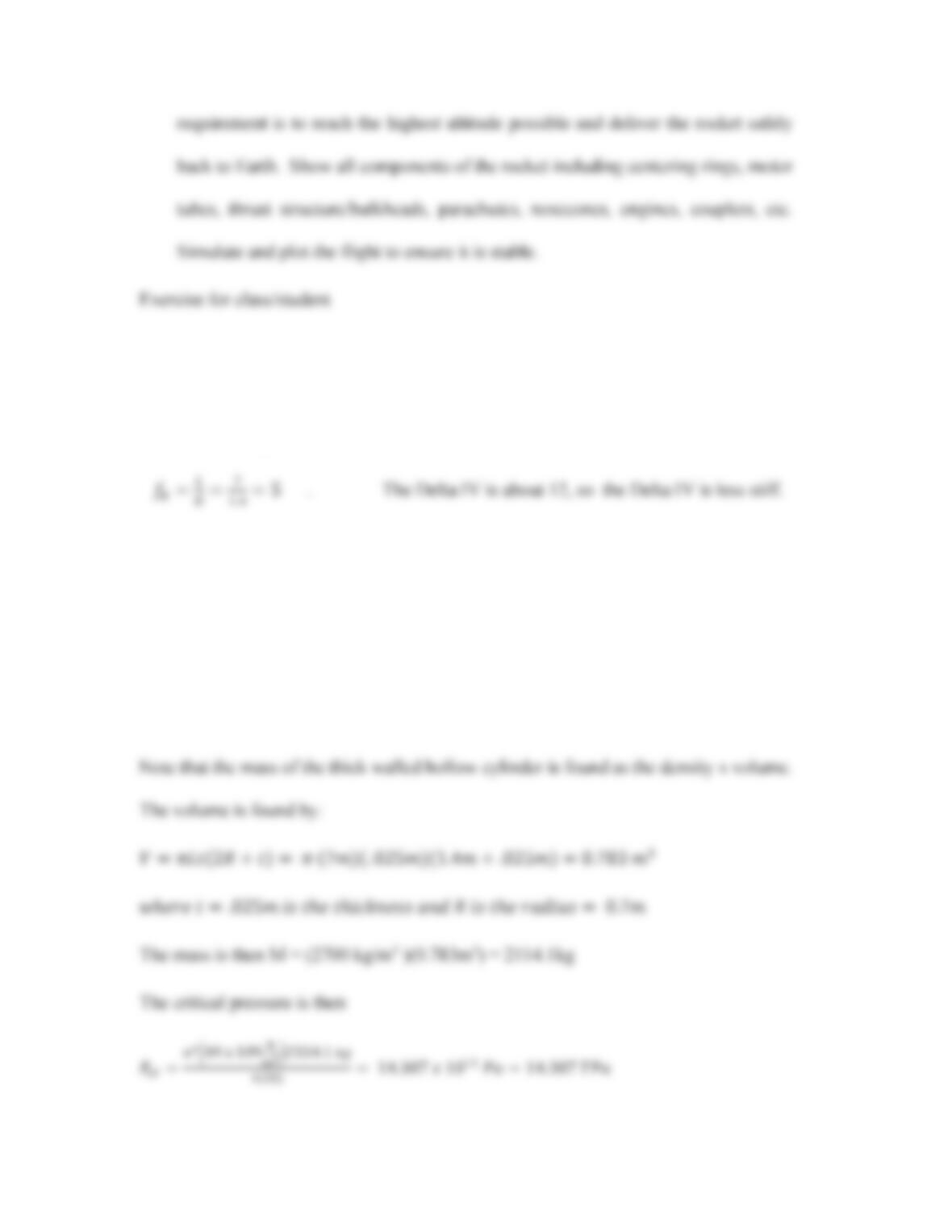
7.8 A rocket is 7 meters tall and 1.4 meters in diameter. Calculate the fineness. How
does it compare to a Delta IV?
7.9 If the rocket in Exercise 7.8 is made of 6061 aluminum that has a Young’s modulus,
E, of 69 GPa (69 x 109 N/m
2), a density of 2700 kg/m3, and we assume after
structure and tanks it has an effective wall thickness of 25mm, calculate the critical
pressure for buckling of the rocket.
Travis S. Taylor 52
7.10 Use a computer program (such as Mathcad) to graph the critical pressure of the
rocket in Exercises 7.8 and 7.9 versus a wall thickness ranging from 1 to 50 mm.
Also, plot the mass of the rocket versus the wall thickness.
7.11 Use the Mathcad algorithm/code given in Section 7.2 to reanalyze Design
Reference Mission #2 but this time with a 300 kg payload. Note: feel free to
convert the Mathcad code to Matlab or any other software you prefer.
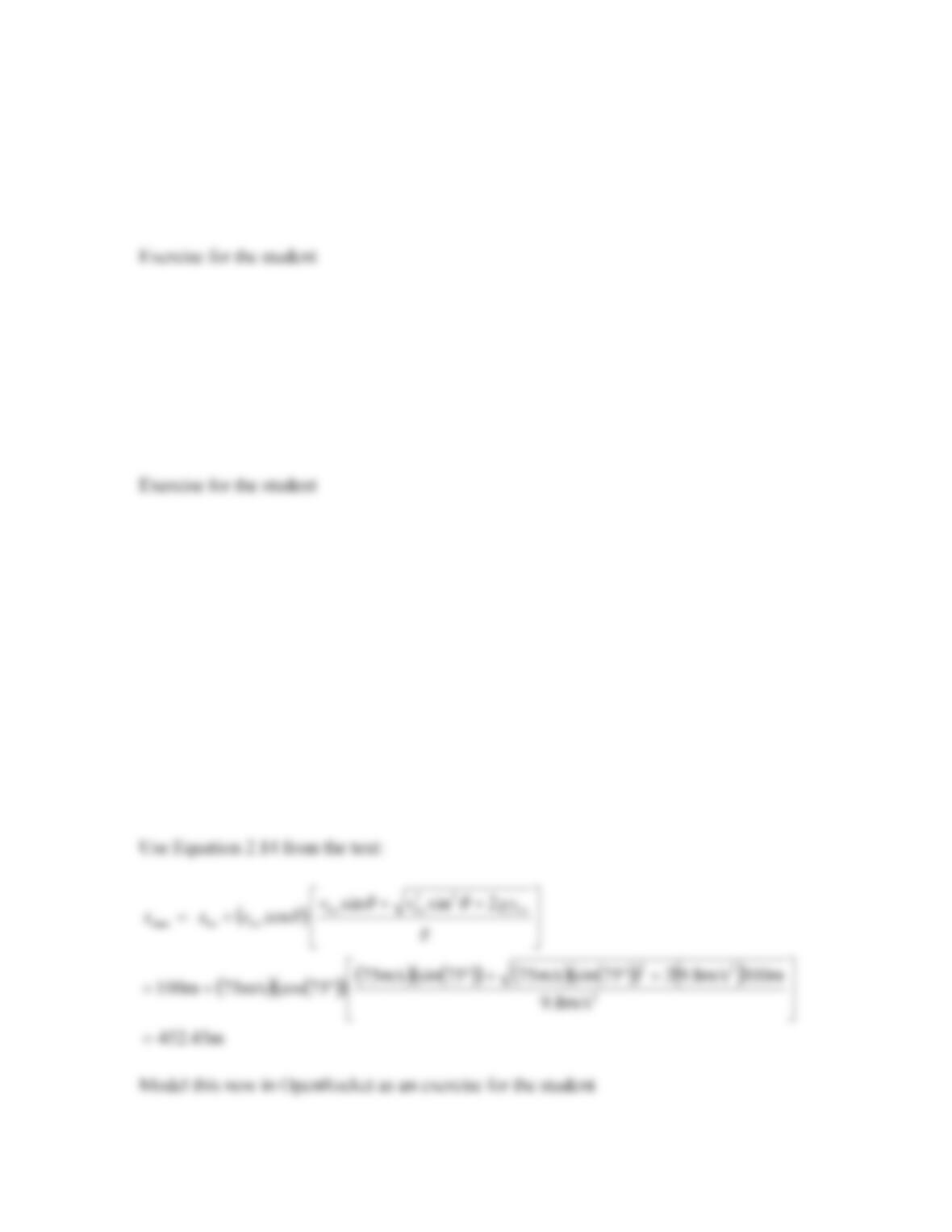
7.12 In Exercise 2.8 we studied the following rocket:
A rocket is launched with a burnout velocity of 75 m/sec, burnout altitude of 300
m, and a burnout range of 100 m. Assuming a flight path angle of 75°, calculate the
final range of the rocket when it impacts the ground.
Use OpenRocket to simulate as best you can the rocket in this Exercise. Simulate
and Plot your results.
Travis S. Taylor 53
7.13 What does OpenRocket calculate for the maximum altitude reached by the rocket
in Exercise 2.8?
7.14 Design, build, and fly a rocket using any motor and materials of choice.