Travis S. Taylor 15
Chapter 3
3.1 What is the opening at the bottom of the combustion chamber called?
3.2 Highly accelerated exhaust gasses leaving the rocket engine nozzle propel the
spacecraft through which of Newton’s laws of motion?
3.3 Why is m-dot important to the astronaut phrase “throttle–up”?
3.4 What does “throttle–up” mean?
3.5 What is the impulse-momentum theorem and what does it tell us?
Travis S. Taylor 16
3.6 What is the difference between the effective exhaust velocity and the equivalent
velocity?
3.7 Define equivalent velocity.
3.8 Define specific impulse?
3.9 What is the importance of the weight flow rate?
3.10 What are three key parameters for rocket engine design?
3.11 What is the propellant mass ratio? What else is it sometimes called?
3.12 What is hybrid staging?
3.13 What are three types of staging?
3.14 Describe the four major subsystems of a rocket.
Travis S. Taylor 18
3.15 What is max-Q?
3.16 Why do most launch vehicles wait until after max-Q to “go at throttle–up”?
3.17 What are three rocket flight conditions?
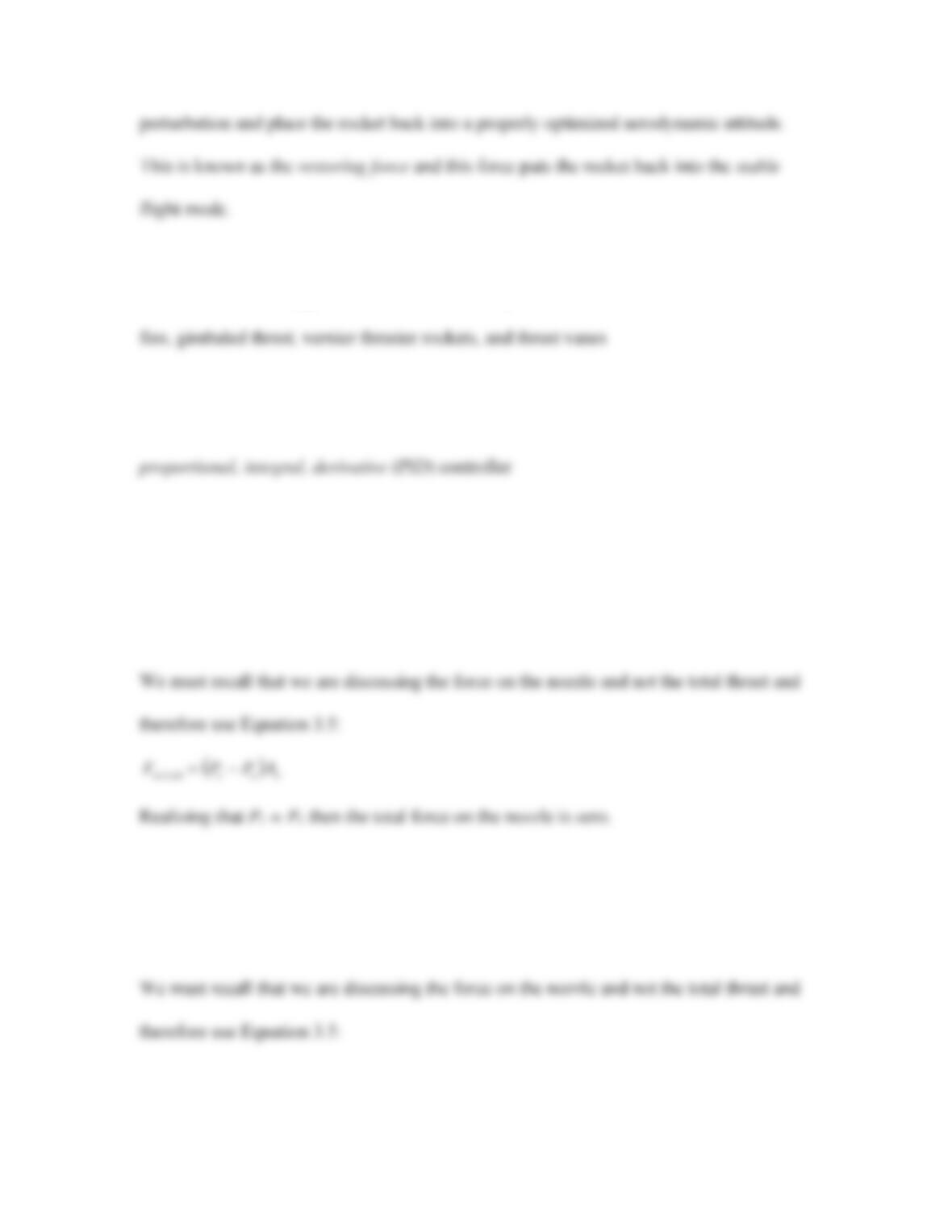
3.18 What is the restoring force?
Travis S. Taylor 19
3.19 Discuss four types of attitude correction systems.
3.20 What is a PID controller?
3.21 Given a rocket nozzle with an exit area of 1 m2 and an exit pressure of 101,325
Pa. What is the force on the nozzle due to the pressure difference inside and
outside the rocket if the rocket is at sea level?
3.22 In Exercise 3.21 calculate the force on the nozzle if the rocket is in space and the
pressure outside the rocket is zero.
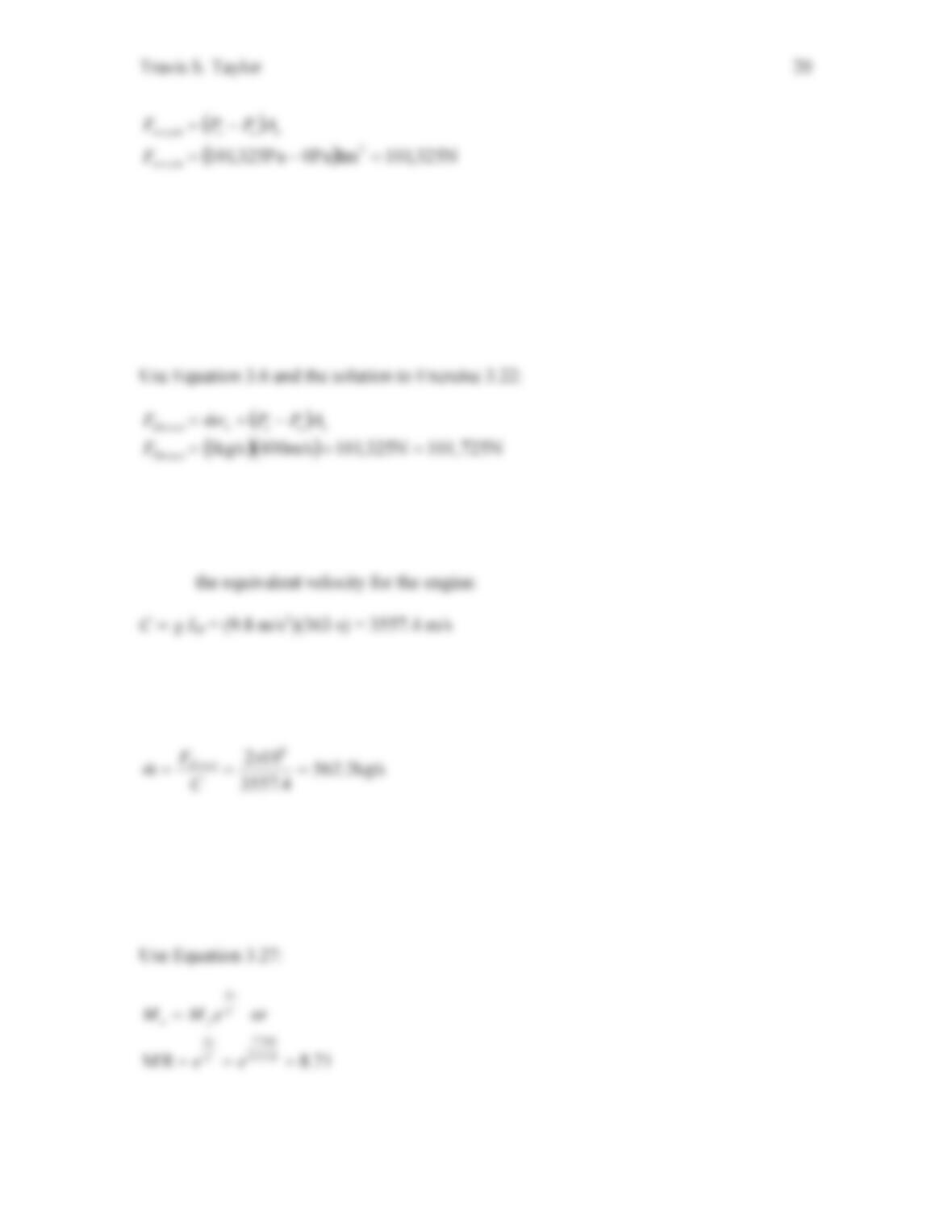
3.23 In Exercises 3.21 and 3.22 determine the force on the rocket if the m-dot of the
engine is 1 kg/s and the exhaust velocity is 400 m/s.
3.24 A rocket engine has an Isp of 363 s and can produce a thrust of 2 MN. Calculate
3.25 In Exercise 3.24 determine the m-dot of the engine.
3.26 In Exercises 3.24 and 3.25 determine the mass ratio required to reach a delta-v of
7700 m/s.
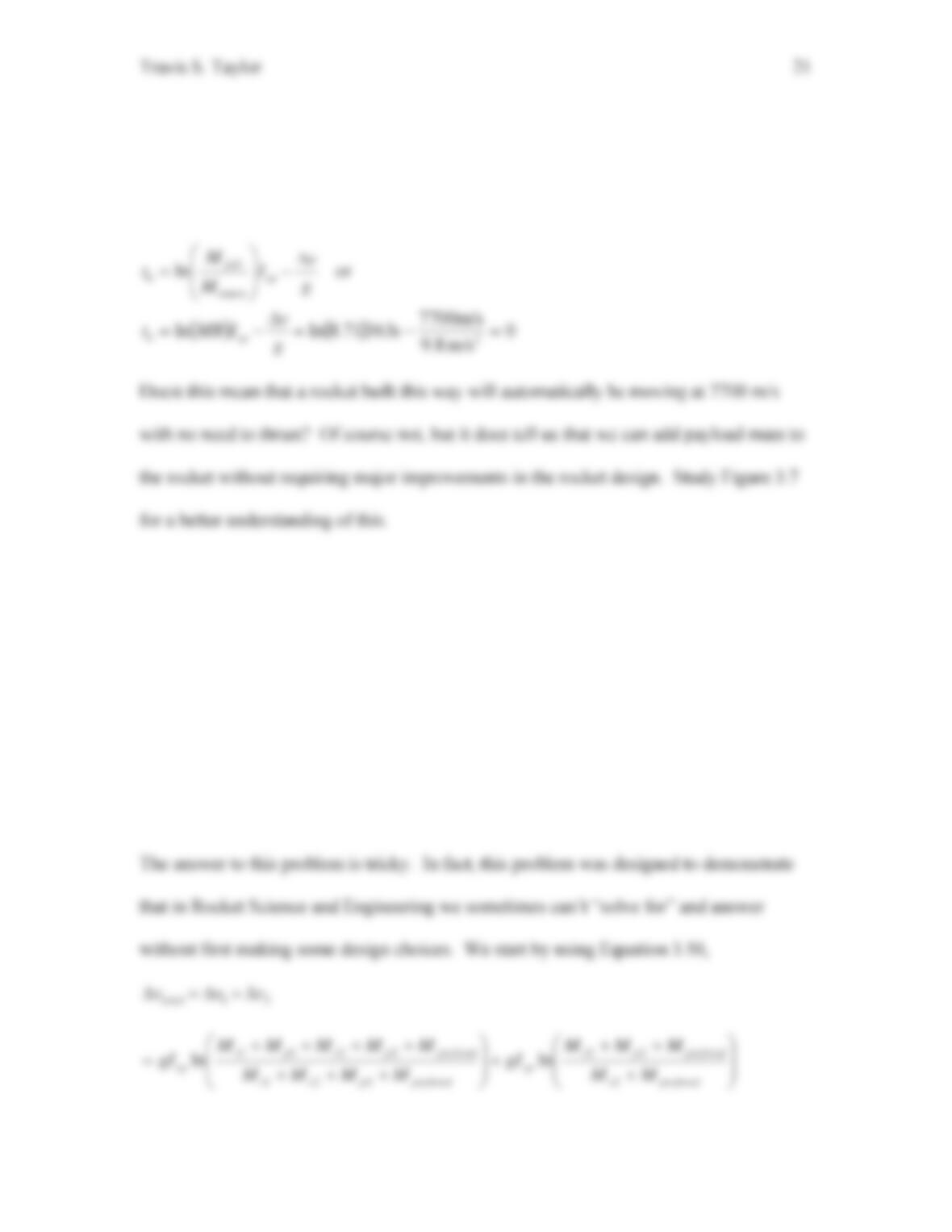
3.27 In Exercises 3.24-3.26 determine the burn time required to achieve the delta-v of
7700 m/s assuming the mass ratio calculated in 3.26.
Use Equation 3.37:
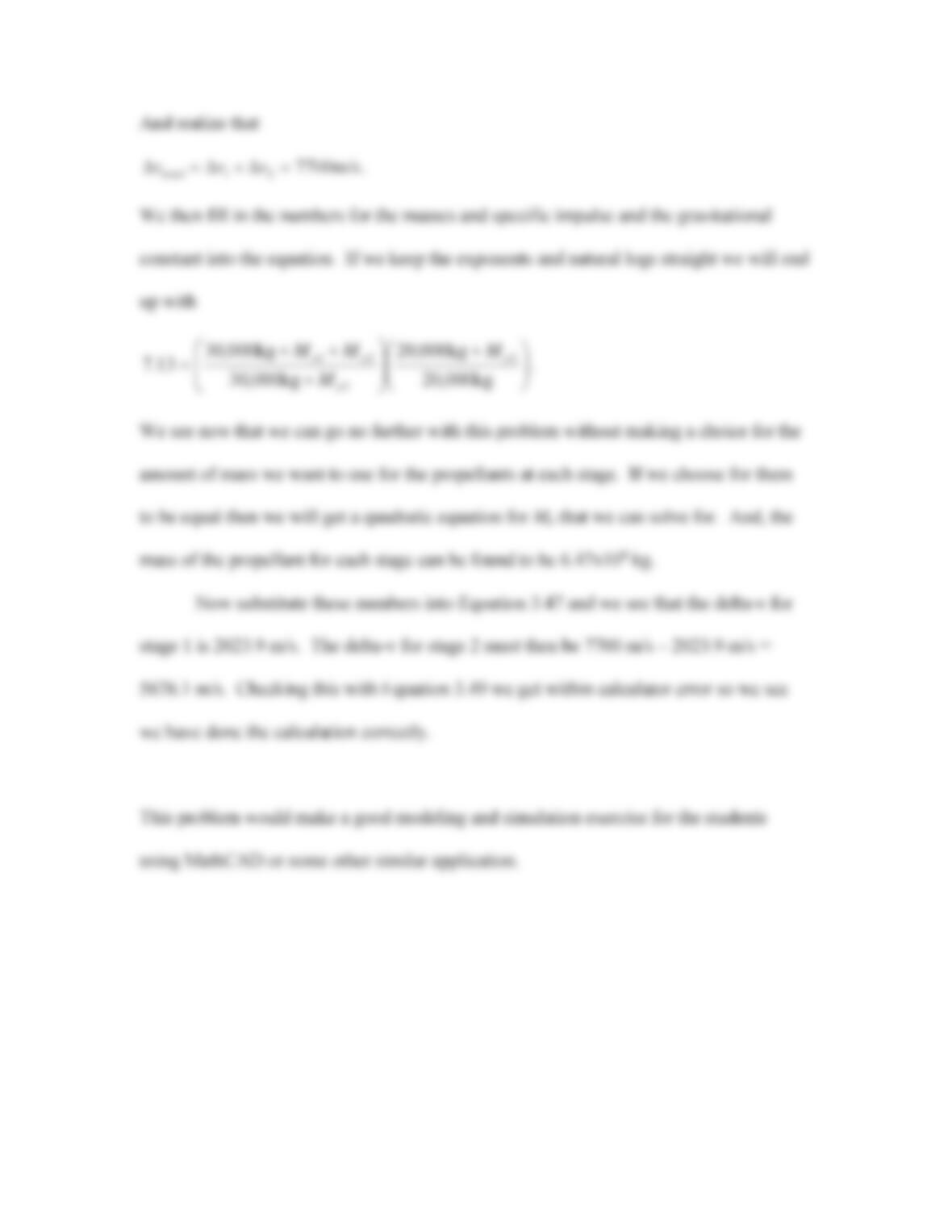
3.28 Given a two stage launch vehicle with an engine that produces an Isp = 400 s, a
payload mass of 10,000 kg, stage 1 structure mass of 10,000 kg, stage 2 structure
mass of 10,000 kg determine the mass ratio and the total mass of propellant
required to reach LEO. Assume the total delta-v required is 7700 m/s. Determine
the delta-v after each stage and the propellant mass for each stage.
Travis S. Taylor 22
Travis S. Taylor 23
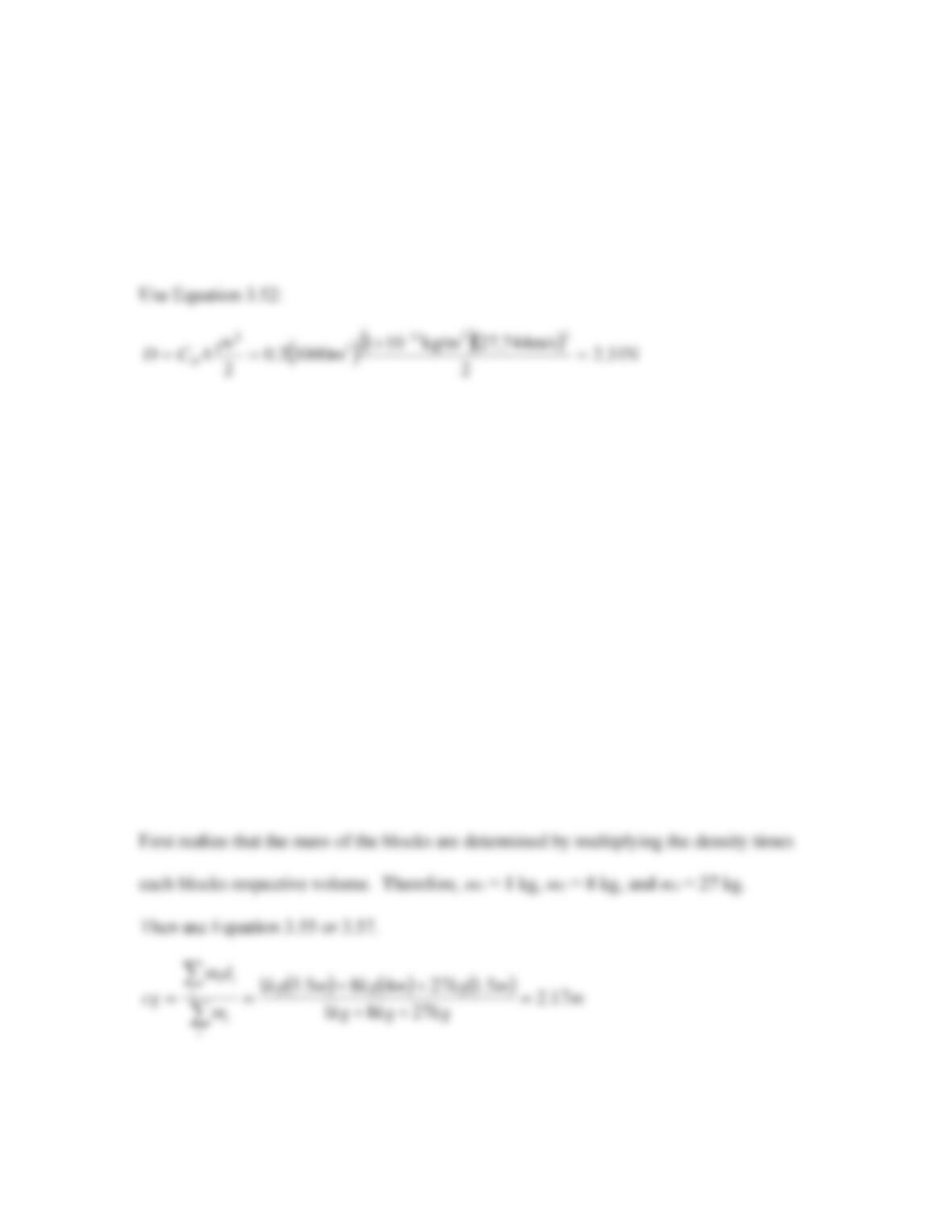
3.29 Assume that the drag coefficient for the ISS is 0.2 and its velocity is 27,744
km/hr. The density of the atmosphere at the ISS’s orbit is about 1×10-11 kg/m3. If
the surface area of the ISS is about 3000 m2 what is the drag force?
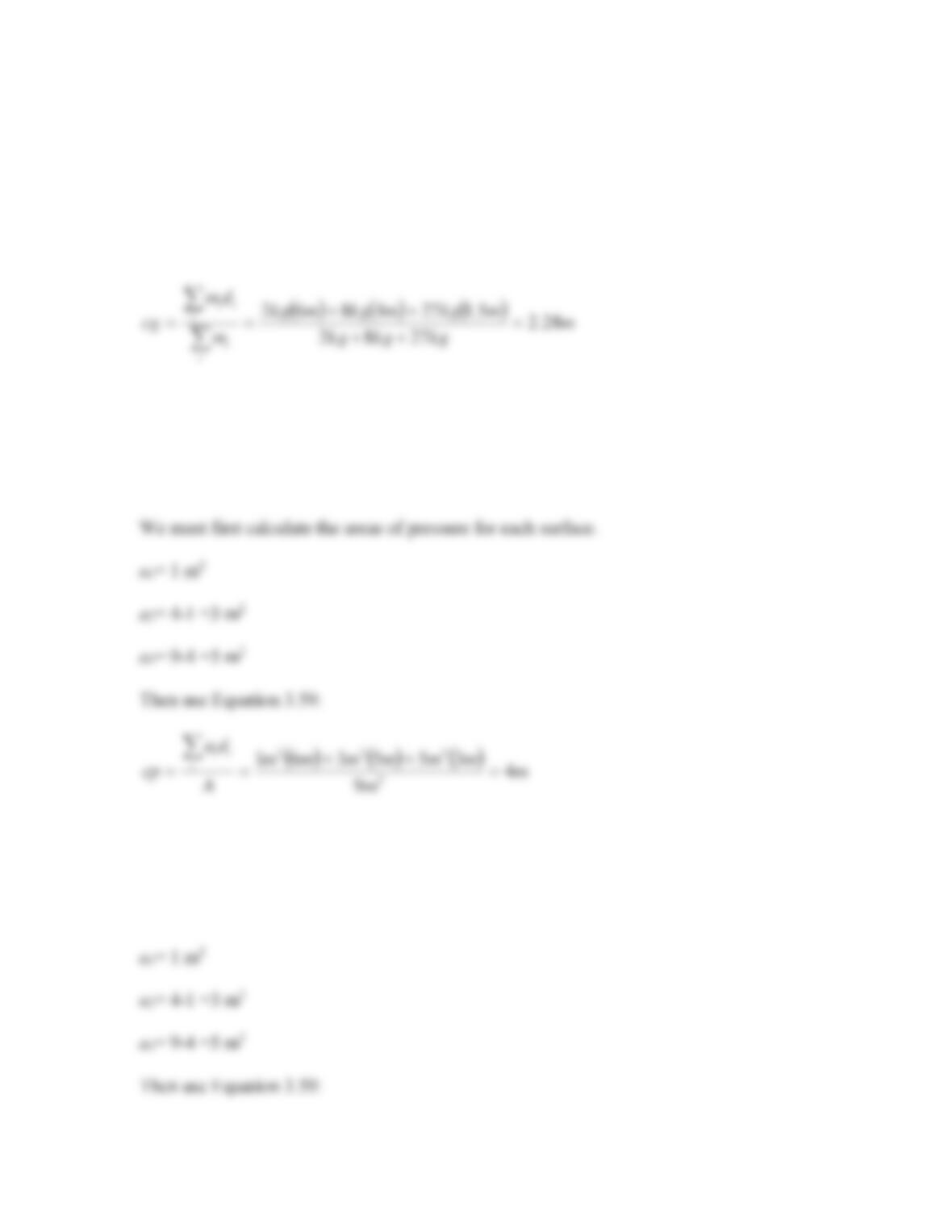
3.30 Consider 3 blocks of density 1 kg/m3. Block 1 is 1 m per side in dimension.
Block 2 is 2 m per side in dimension. Block 3 is 3 m per side in dimension. The
blocks are oriented in such that the largest block, Block 3, is on the bottom.
Block 2 is then stacked on Block 3 and then Block 1 is stacked on Block 2. The
faces of the blocks are aligned and the center of each the blocks make a straight
line upward through them. Figure 3.20 shows the blocks and how they are
stacked. With the bottom of the stack as the reference line, calculate the center-
of-gravity of the stack of blocks.
Travis S. Taylor 24
3.31 In Exercise 3.29 if Block 1 were twice as tall and the three blocks remain in the
same stacked configuration calculate the center-of-gravity.
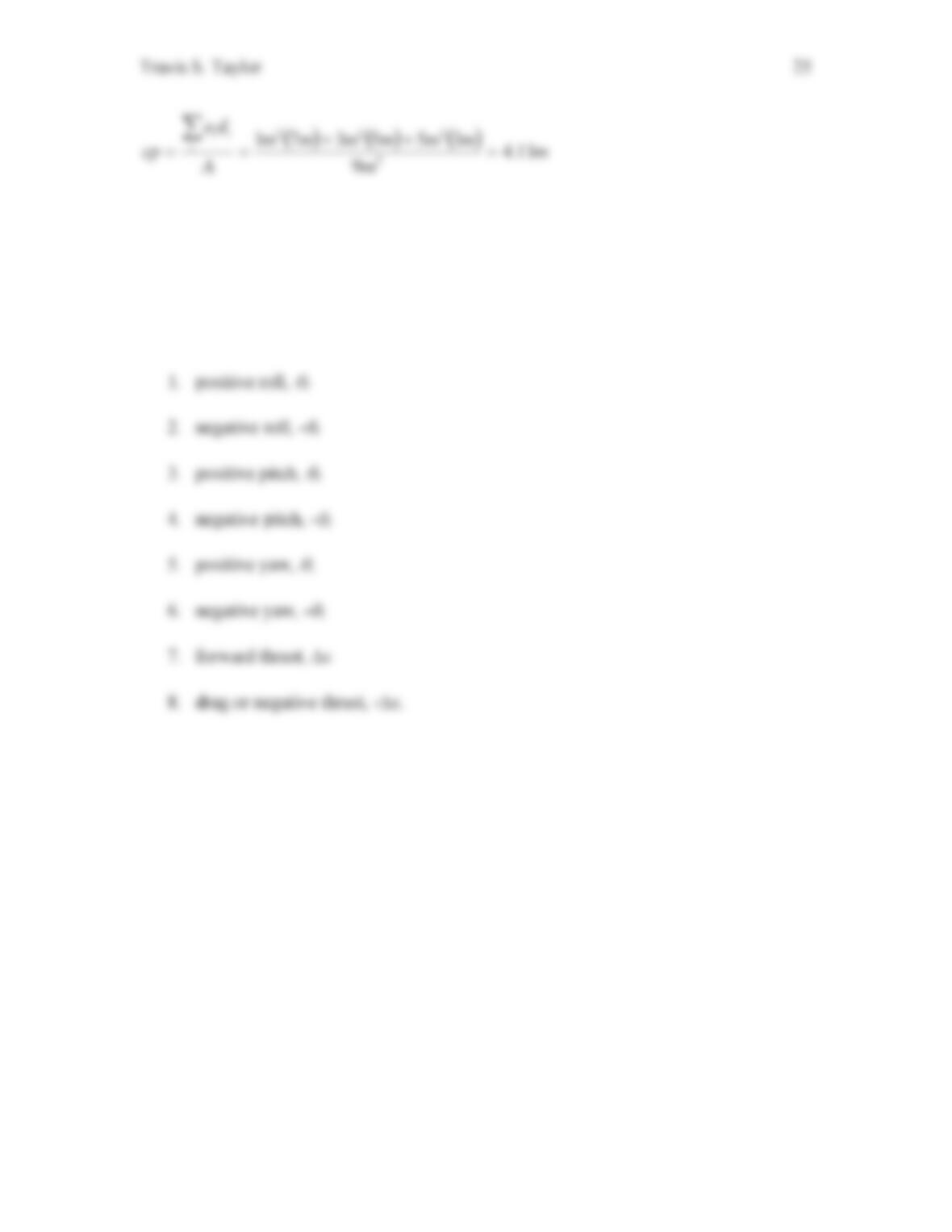
3.32 In Exercise 3.29 calculate the center-of-pressure for the stacked blocks.
3.33 In Exercise 3.30 calculate the center-of-pressure for the stacked blocks.
We must first calculate the areas of pressure for each surface.
3.34 Define 8-DOF and explain each component in detail.