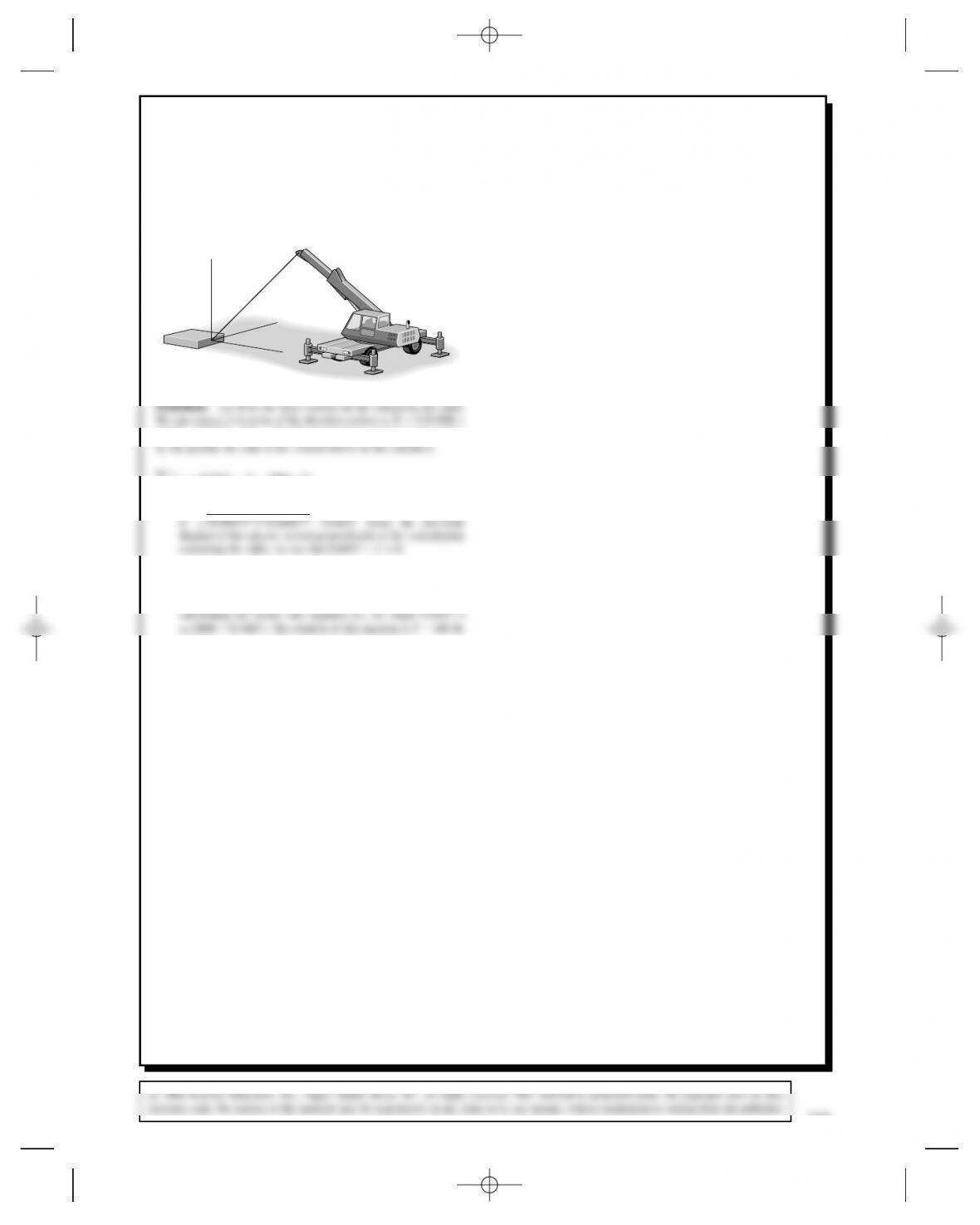
Problem 9.61 The direction cosines of the crane’s
cable are cos xD0.558,cos yD0.766,cos zD
0.260. The yaxis is vertical. The stationary caisson to
which the cable is attached weights 2000 lb and rests
on horizontal ground. If the coefficient of static friction
between the caisson and the ground is sD0.4, what
tension in the cable necessary to cause the caisson to
slip?
y
x
z
0.766jC0.260k⊳.IfNDNjis the normal force exerted on the caisson
(1) The magnitude of the horizontal force exerted by the cable
(2) slip impends when fDsN.
(3) Solving equation (1) for Nand solving equation (2) for fand
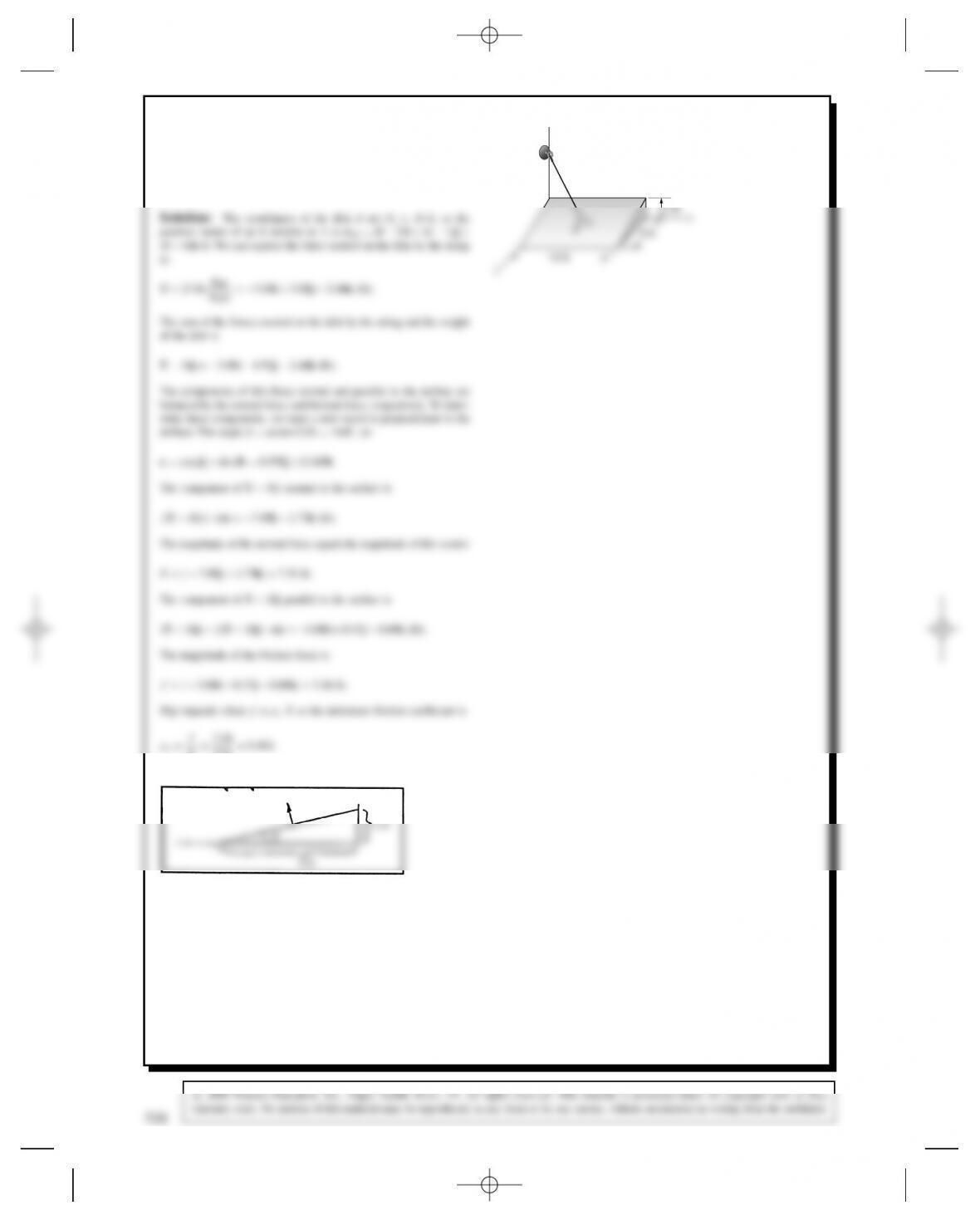
Problem 9.62* The 10-lb metal disk Ais at the center
of the inclined surface. The tension in the string AB is
5 lb. What minimum coefficient of static friction between
the disk and the surface is necessary to keep the disk
from slipping?
y
B(0, 6, 0) ft
ND3.16
7.31 D0.432.
8 ft
2 ft
y
z
β
e
726
c
2008 Pearson Education, Inc., Upper Saddle River, NJ. All rights reserved. This material is protected under all copyright laws as they
currently exist. No portion of this material may be reproduced, in any form or by any means, without permission in writing from the publisher.
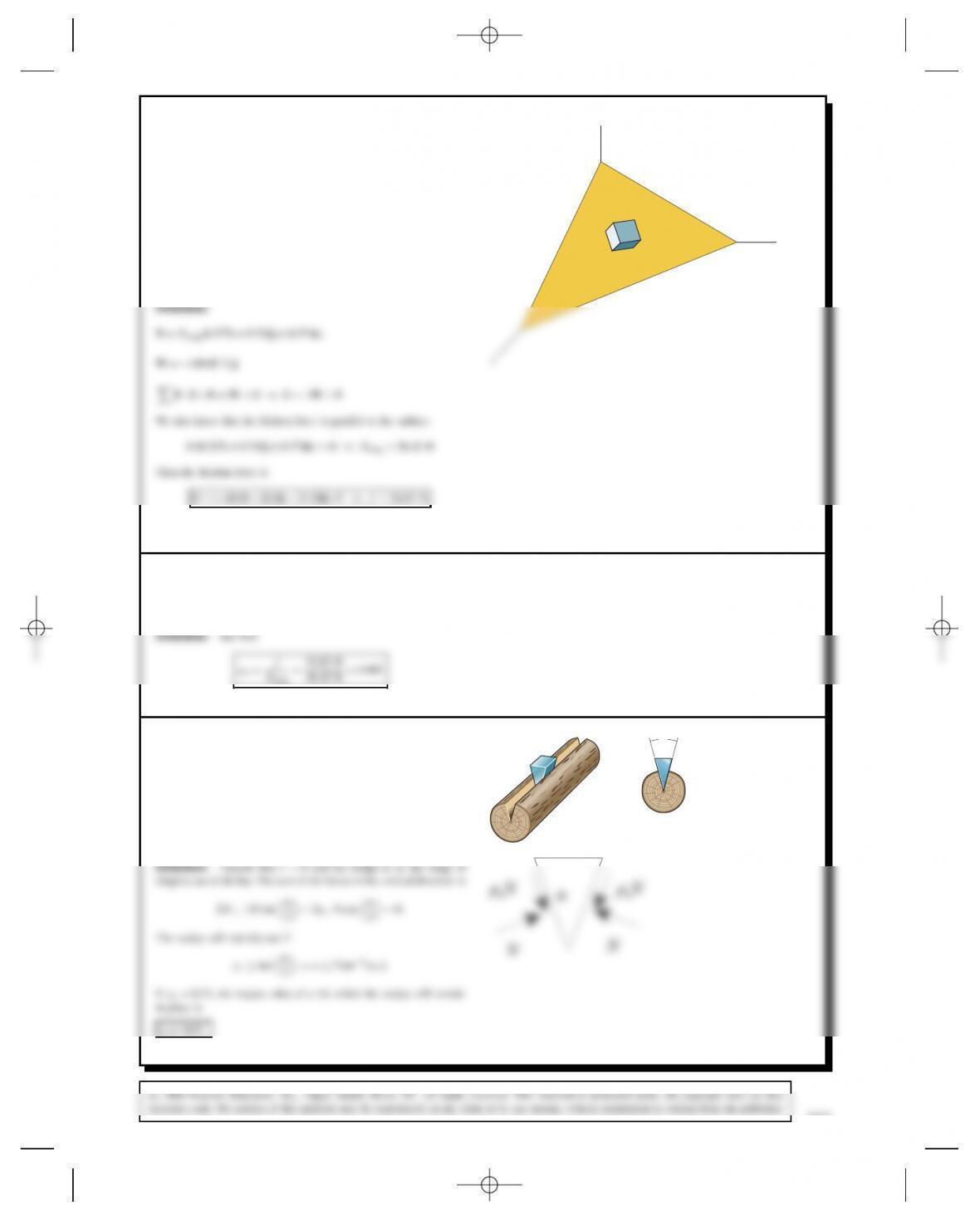
Problem 9.63* The 5-kg box is at rest on the sloping
surface. The yaxis points upward. The unit vector
0.557iC0.743jC0.371kis perpendicular to the sloping
surface. What is the magnitude of the friction force
exerted on the box by the surface?
x
y
Problem 9.64* In Problem 9.63, what is the minimum
coefficient of static friction necessary for the box to
remain at rest on the sloping surface?
Problem 9.65 In Active Example 9.4, the coefficients
of friction between the wedge and the log are sD0.22
and kD0.20. What is the largest value of the wedge
angle ˛for which the wedge would remain in place in
the log when the force Fis removed?
a
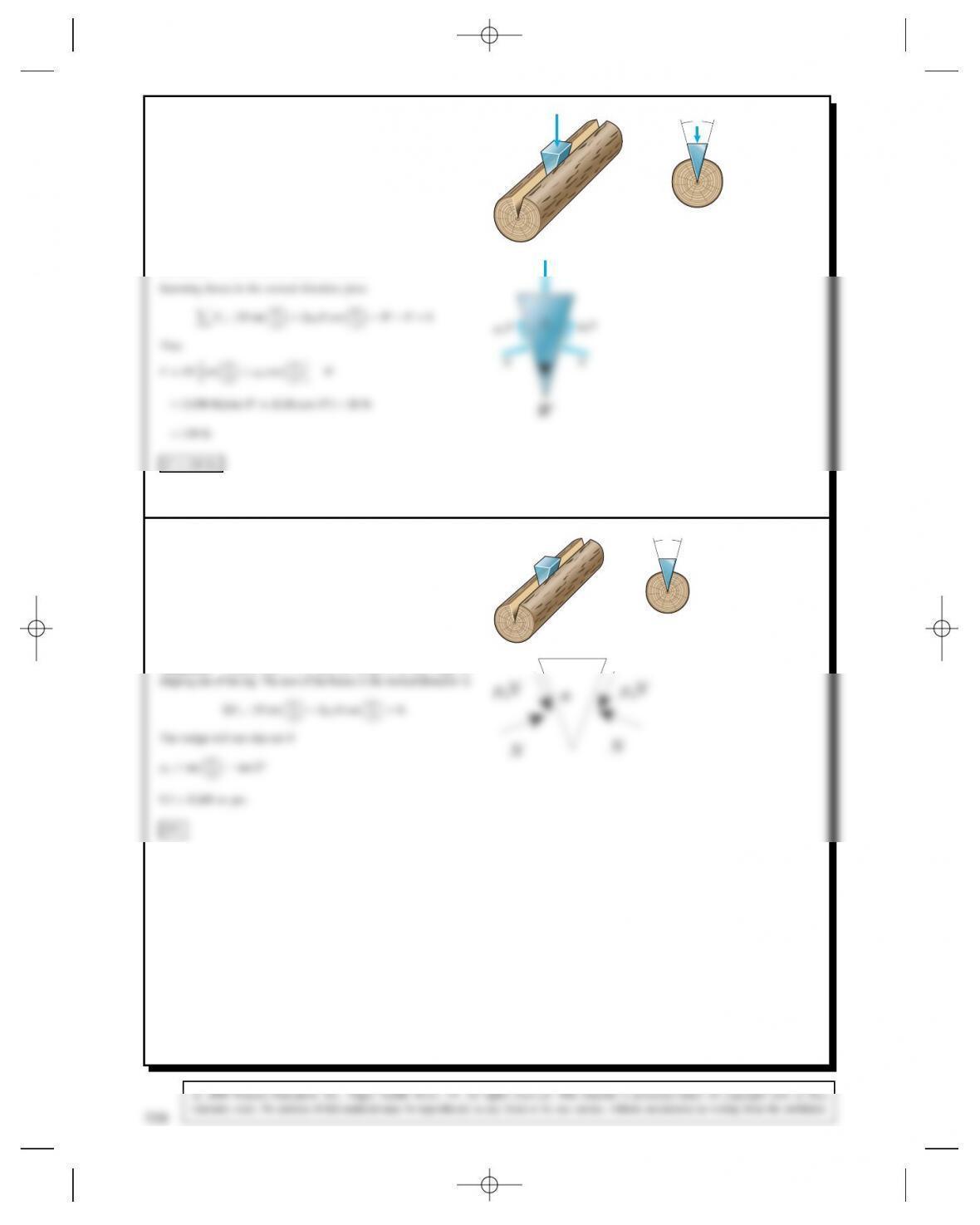
Problem 9.66 The wedge shown is being used to split
the log. The wedge weighs 20 lb and the angle ˛equals
30°. The coefficient of kinetic friction between the faces
of the wedge and the log is 0.28. If the normal force
exerted by each face of the wedge must equal 150 lb to
split the log, what vertical force Fis necessary to drive
the wedge into the log at a constant rate? (See Active
Example 9.4.)
F
Fa
Solution: The free-body diagram is shown.
F
Problem 9.67 The coefficient of static friction
between the faces of the wedge and the log in Problem
9.66 is 0.30. Will the wedge remain in place in the
log when the vertical force Fis removed? (See Active
Example 9.4.)
a
Solution: Assume that FD0 and the wedge is on the verge of
728
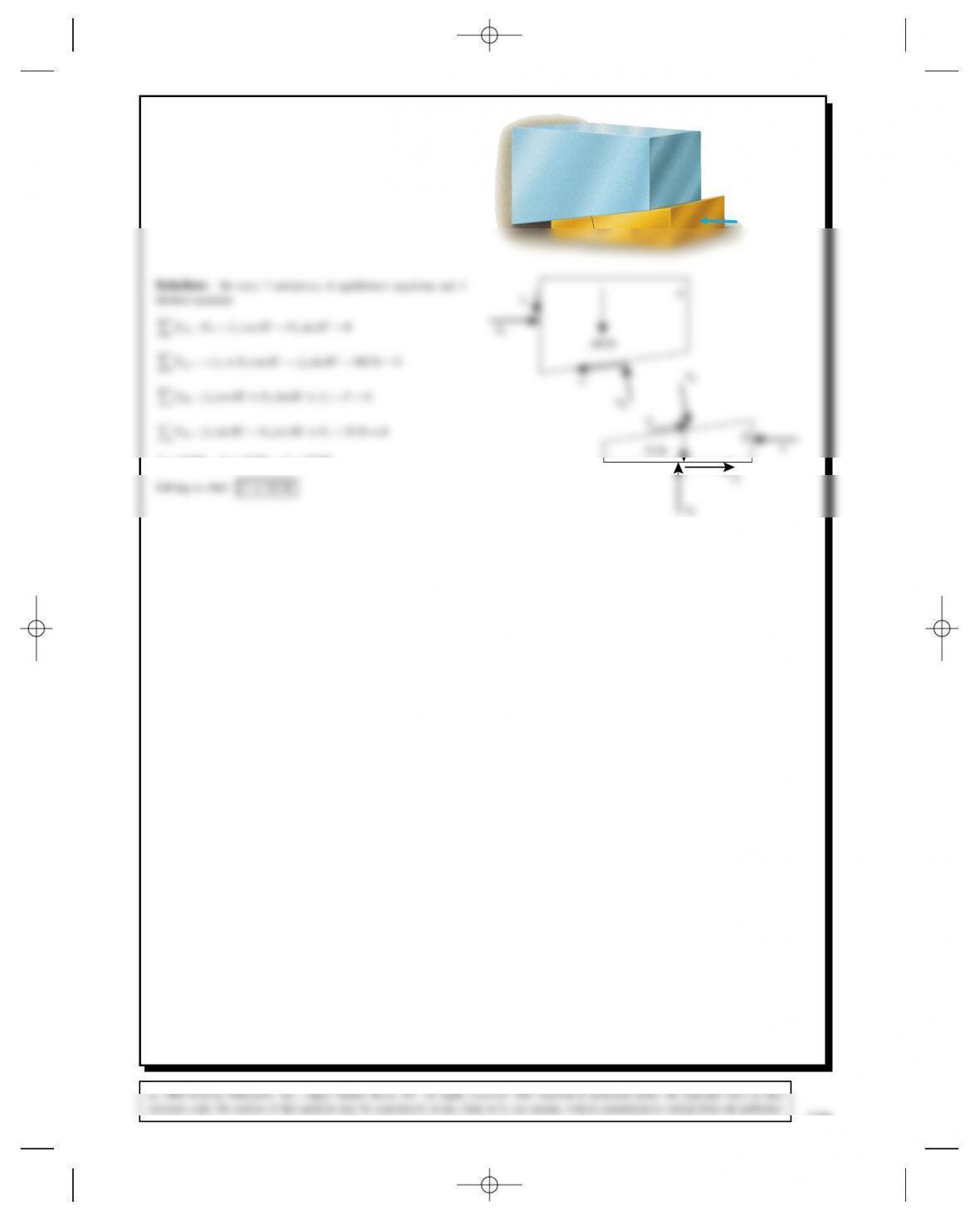
Problem 9.68 The weights of the blocks are WAD
100 lb and WBD25 lb. Between all of the contacting
surfaces, sD0.32 and kD0.30. What force Fis
necessary to move Bto the left at a constant rate?
F
A
f1D0.3N1,f
2D0.3N2,f
3D0.3N3
25 lb
B
F
f3
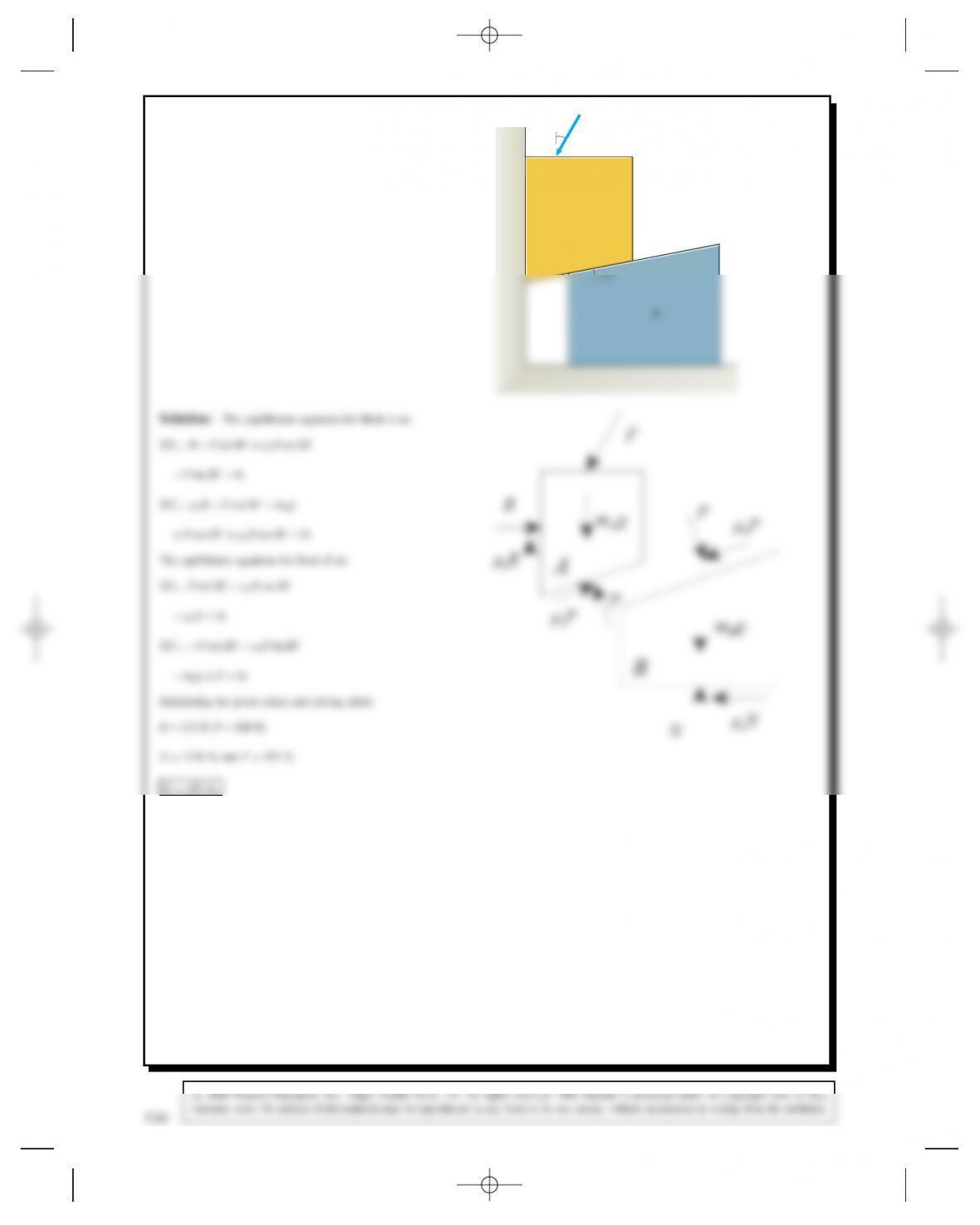
Problem 9.69 The masses of the blocks are mAD
30 kg and mBD70 kg. Between all of the contacting
surfaces, sD0.1. What is the largest force Fthat can
be applied without causing the blocks to slip?
A
F
30⬚
730
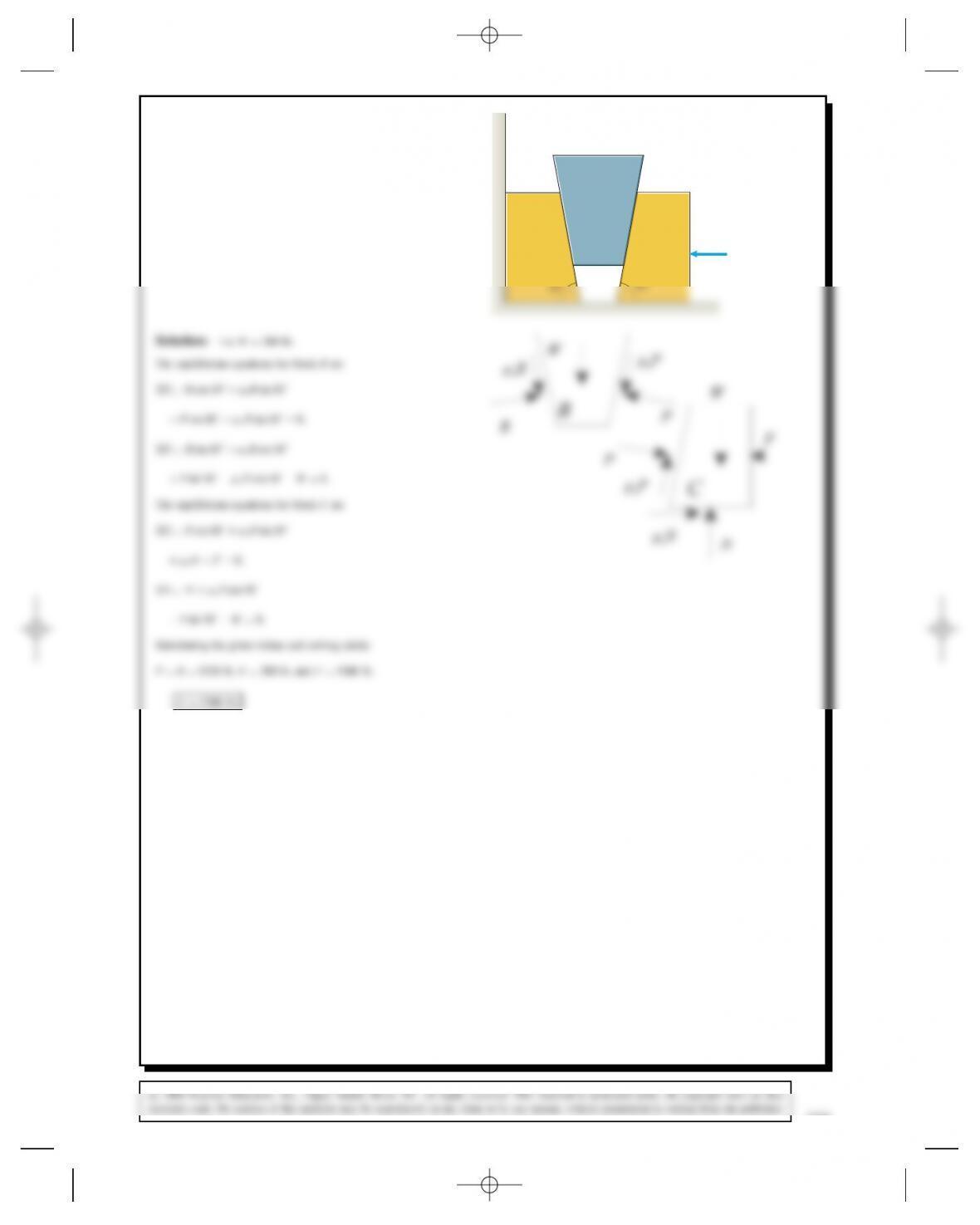
Problem 9.70 Each block weighs 200 lb. Between all
of the contacting surfaces, sD0.1. What is the largest
force Fthat can be applied without causing block Bto
slip upward?
F
AC
B
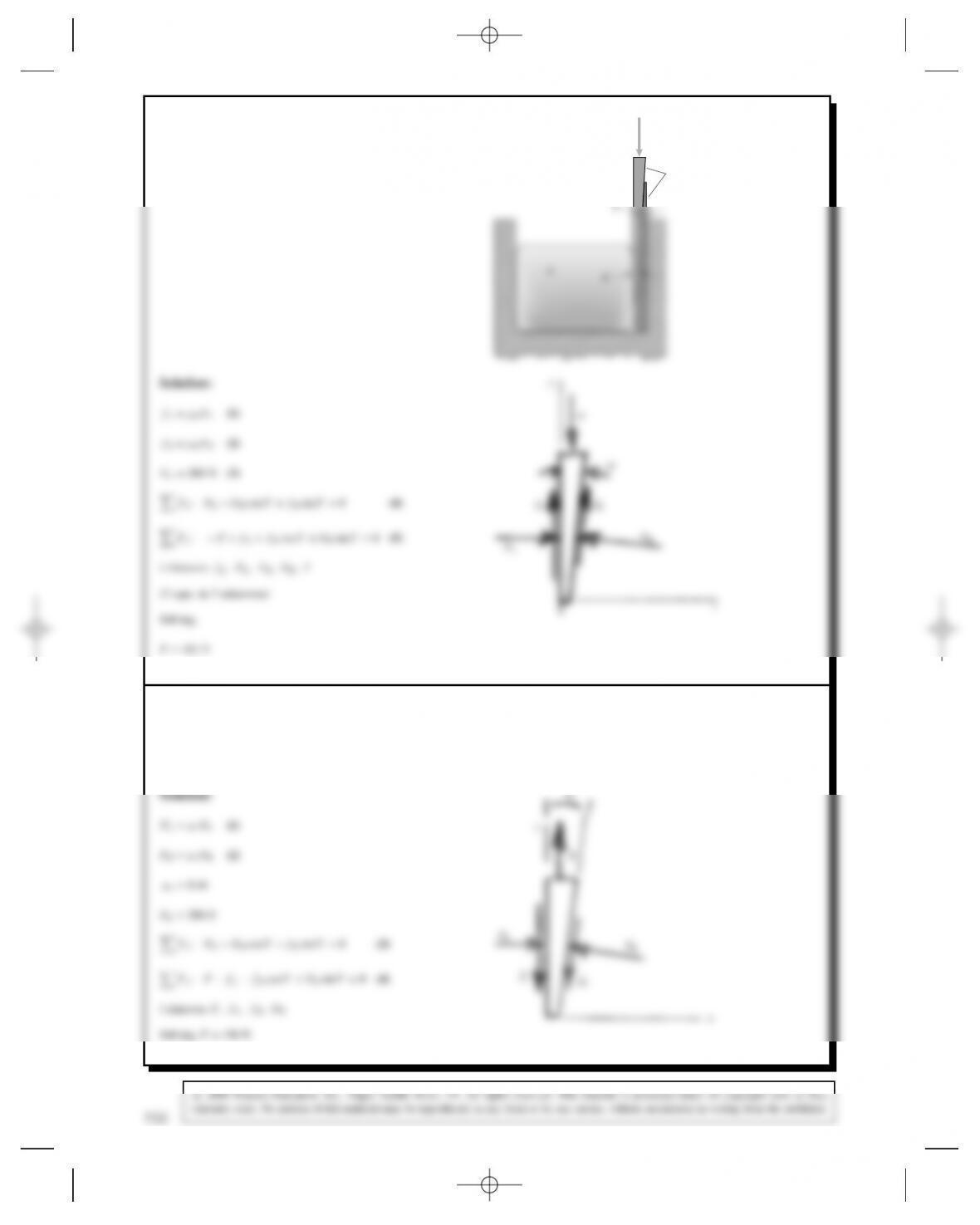
Problem 9.71 Small wedges called shims can be used
to hold an object in place. The coefficient of kinetic fric-
tion between the contacting surfaces is 0.4. What force F
is needed to push the shim downward until the horizontal
force exerted on the object Ais 200 N?
A5°
5°
Shims
F
NLD200 N (3)
Fx:NLNRcos 5°CfRsin 5°D0(4)
Fy:FCfLCfRcos 5°CNRsin 5°D0(5)
Unknowns: fL,N
L,F
R,N
R,F
(5 eqns. in 5 unknowns)
Solving,
FD181 N
fLfR
NL
NR
x
Problem 9.72 The coefficient of static friction
between the contacting surfaces in Problem 9.71 is 0.44.
If the shims are in place and exert a 200-N horizontal
force on the object A, what upward force must be exerted
on the left shim to loosen it?
732
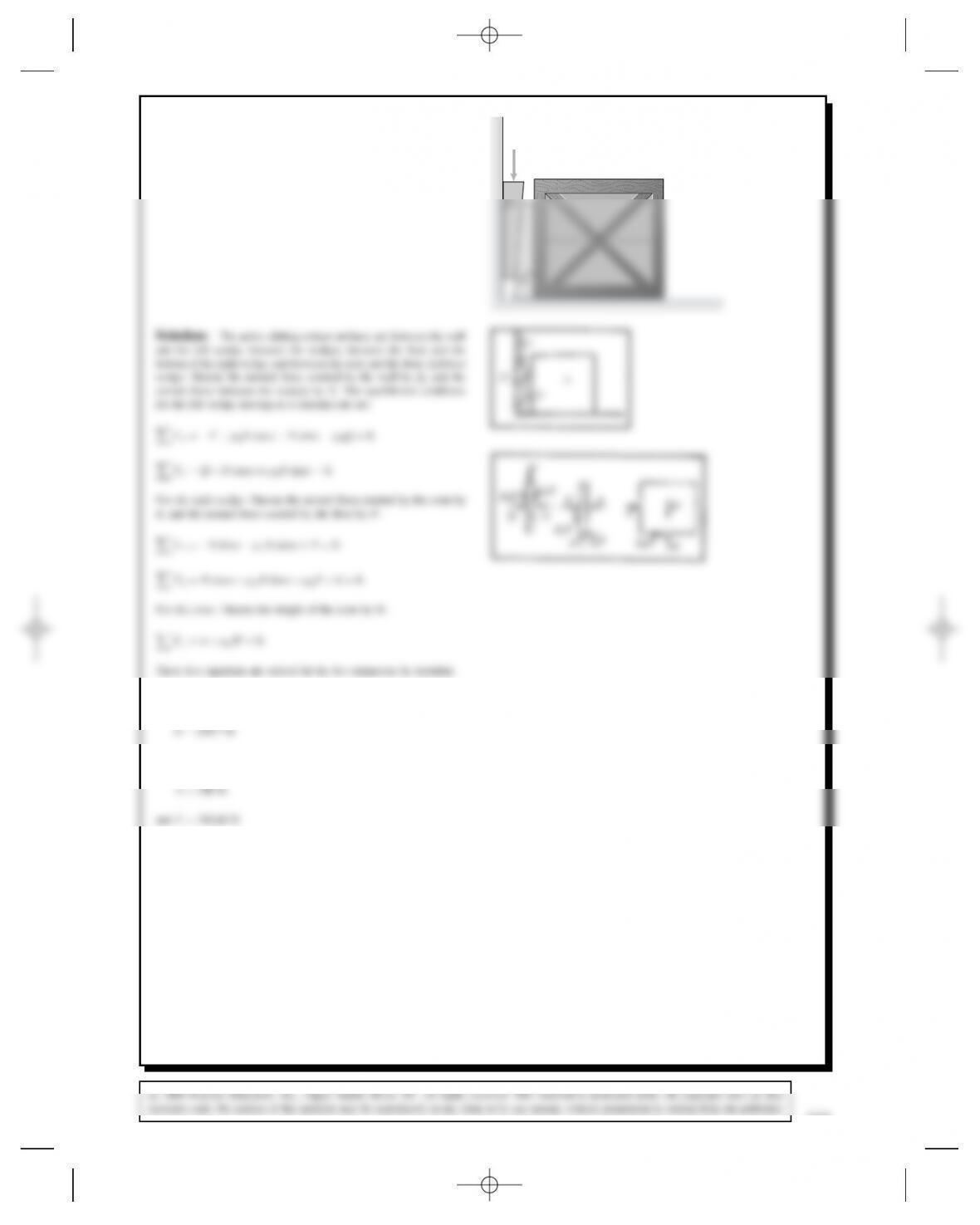
Problem 9.73 The crate Aweighs 600 lb. Between all
contacting surfaces, sD0.32 and kD0.30. Neglect
the weights of the wedges. What force Fis required to
move Ato the right at a constant rate? F
QD204.4lb,
PD81.34 lb,
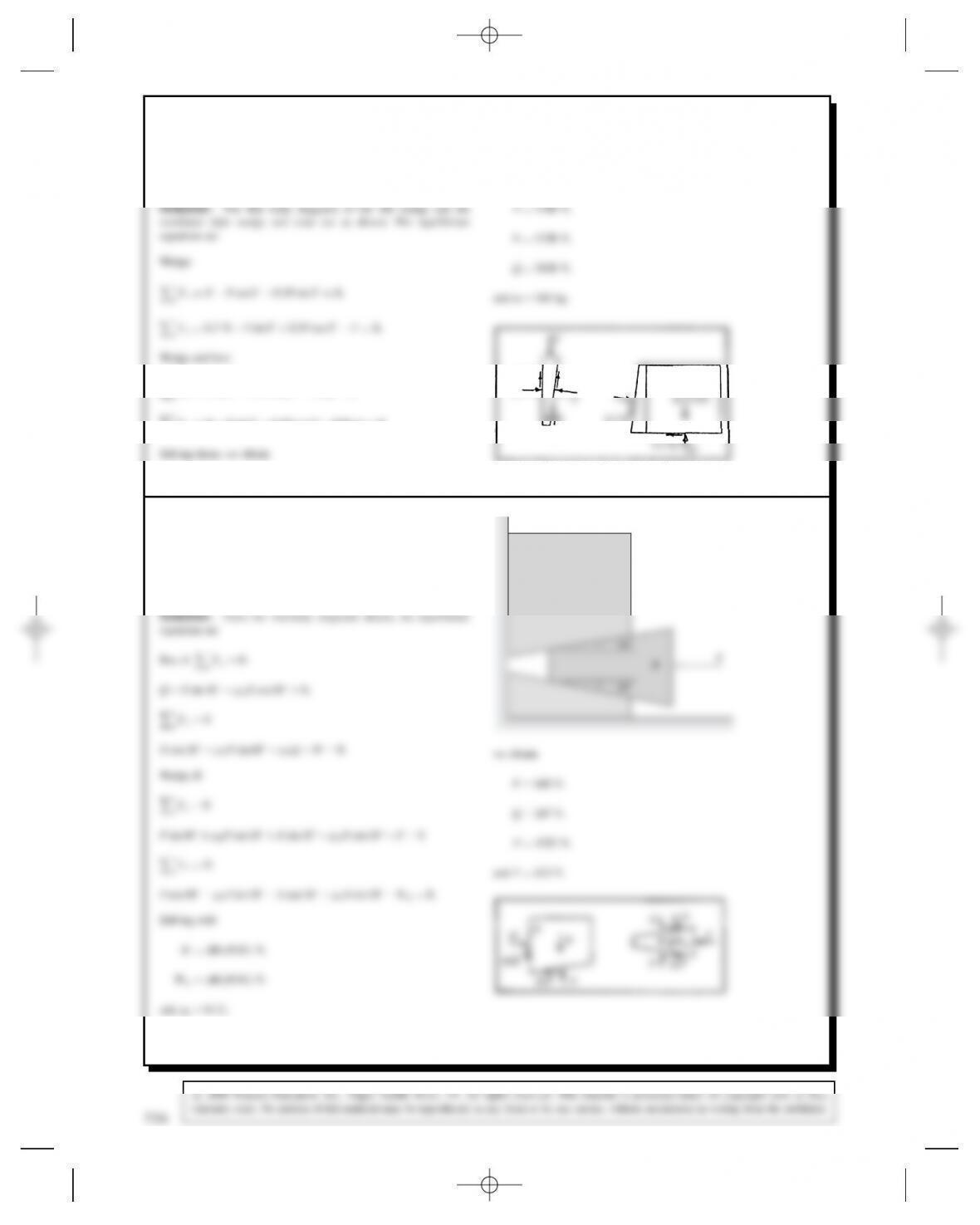
Problem 9.74 Suppose that between all contacting
surfaces in Problem 9.73, sD0.32 and kD0.30.
Neglect the weights of the 5°wedges. If a force FD
800 N is required to move Ato the right at a constant
rate, what is the mass of A?
FxDPcos 5°0.3Psin 5°0.3QD0,
FyDQPsin 5°0.3Pcos 5°9.81 m D0.
Solving them, we obtain
0.3 N
5°
0.3 P
0.3 P
NP
P
Problem 9.75 The box Ahas a mass of 80 kg, and the
wedge Bhas a mass of 40 kg. Between all contacting
surfaces, sD0.15 and kD0.12. What force Fis
required to raise Aat a constant rate?
A
734
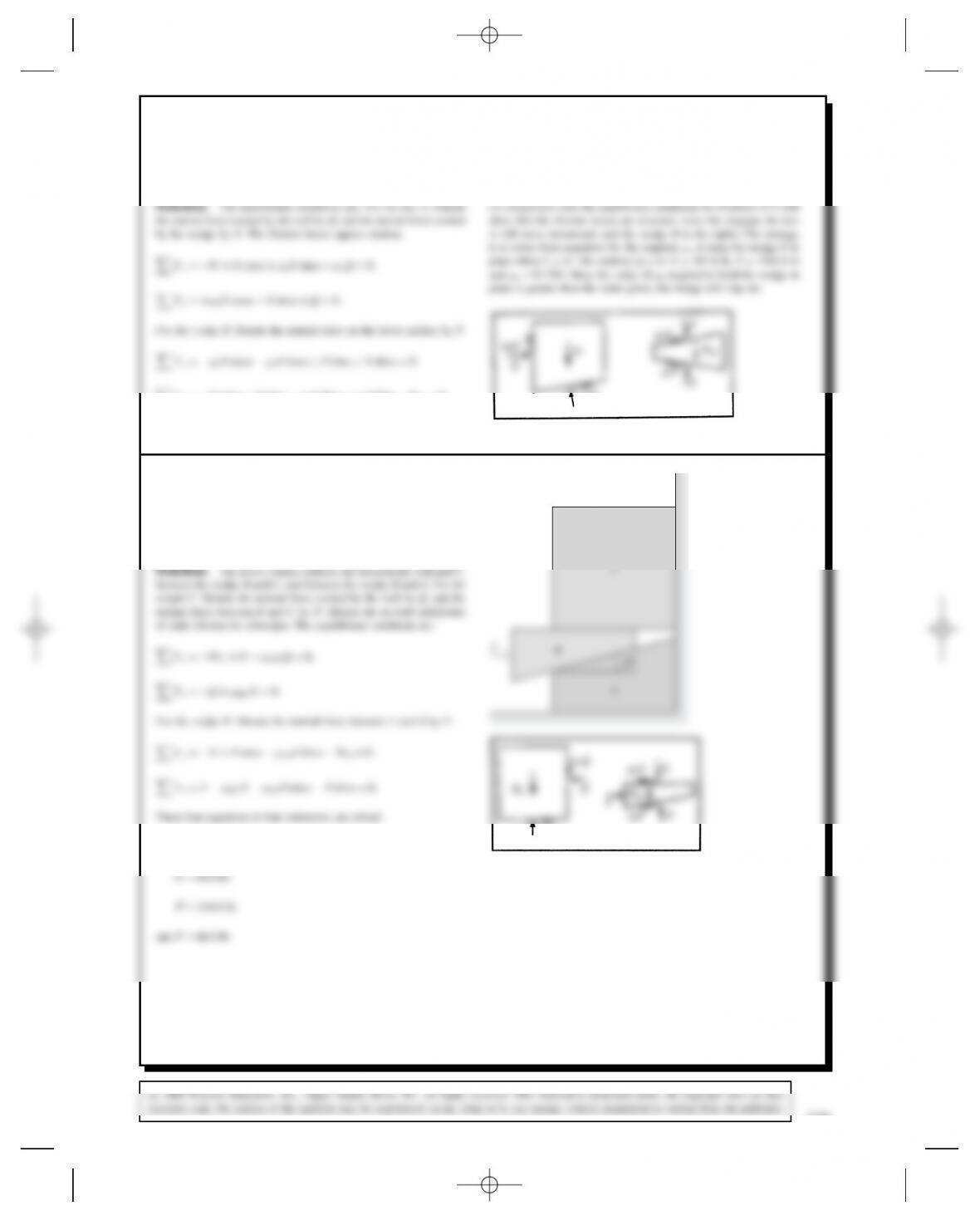
Problem 9.76 Suppose that in Problem 9.75, Aweighs
800 lb and Bweighs 400 lb. The coefficients of fric-
tion between all of the contacting surfaces are sD0.15
and kD0.12. Will Bremain in place if the force Fis
removed?
Q
µ
SN
µ
SP
N
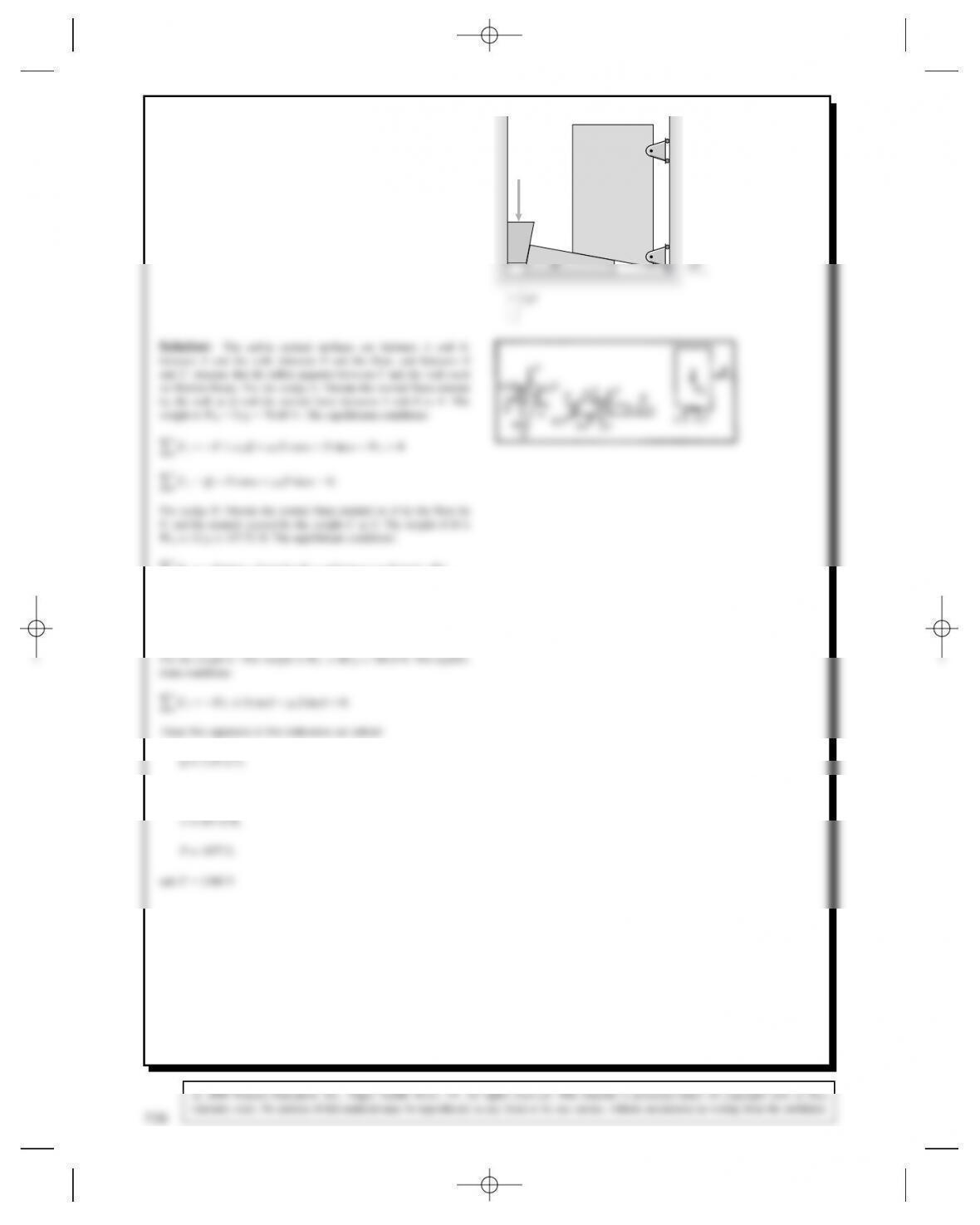
Problem 9.77 Between Aand B,sD0.20, and
between Band C,sD0.18. Between Cand the wall,
sD0.30. The weights WBD20 lb and WCD80 lb.
What force Fis required to start Cmoving upward?
C
Solution: The active contact surfaces are between the wall and C,
between the wedge Band C, and between the wedge Band A.For the
weight C : Denote the normal force exerted by the wall by Q, and the
normal force between Band Cby N. Denote the several coefficients
of static friction by subscripts. The equilibrium conditions are:
Problem 9.78 The masses of A,B, and Care 8 kg,
12 kg, and 80 kg, respectively. Between all contacting
surfaces, sD0.4. What force Fis required to start C
moving upward?
F
A
C
D0.
FxDNcos ˛sNsin ˛sPsScos ˇSsin ˇD0.
ND1293.5N,
736
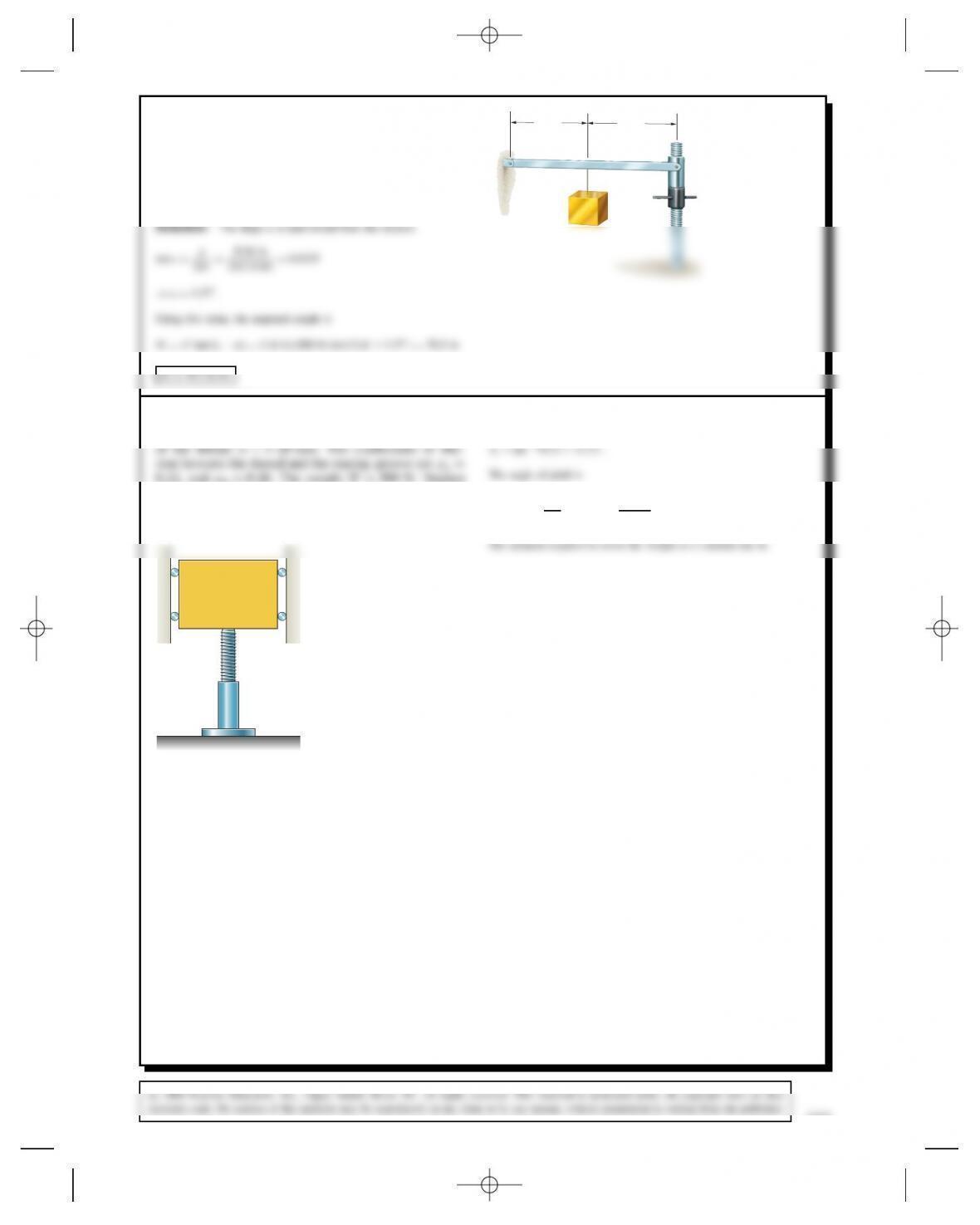
Problem 9.79 In Active Example 9.5, suppose that the
pitch of the thread is changed from pD0.2intopD
0.24 in. What is the slope of the thread? What is the
magnitude of the couple that must be applied to the collar
Cto cause it to turn at a constant rate and move the
suspended object upward?
20 in
20 in
B
C
A
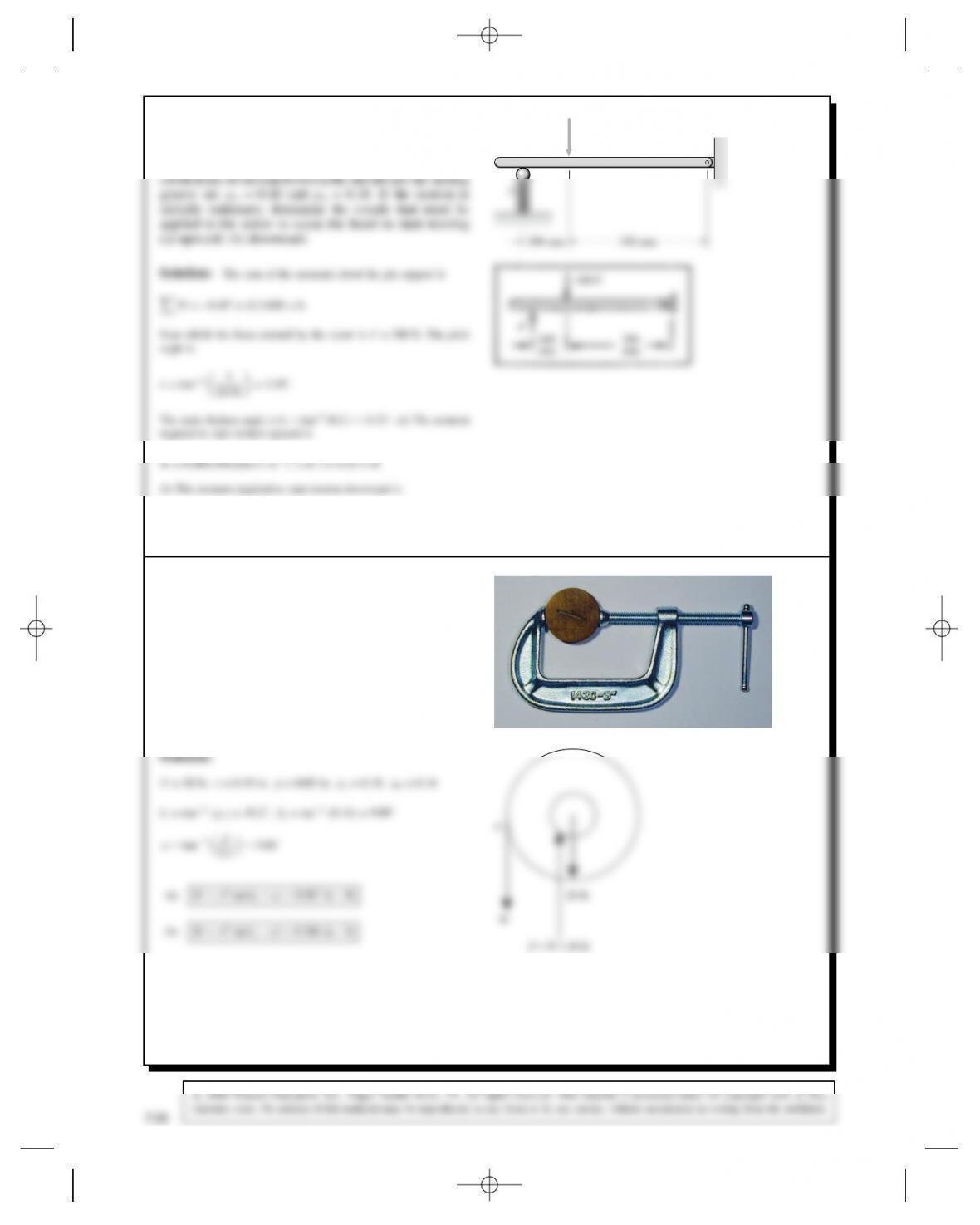
Problem 9.80 Suppose that in Problem 9.79, the pitch
of the threaded shaft is pD2 mm and the mean radius
0.22, and kD0.20. The weight WD500 N. Neglect
the weight of the threaded shaft. What couple must be
applied to the threaded shaft to lower the weight at a
constant rate?
W
C
Solution: The angle of kinetic friction is
˛Dtan1p
2r Dtan12
2⊲20⊳D0.9118°.
MD0.02⊲500⊳tan⊲11.31 0.9118⊳D1.835 N-m.
Problem 9.81 The position of the horizontal beam can
be adjusted by turning the machine screw A. Neglect the
weight of the beam. The pitch of the screw is pD1 mm,
and the mean radius of the thread is rD4 mm. The
400 N
MD0.004⊲300⊳tan⊲11.31°2.28°⊳D0.19 N-m
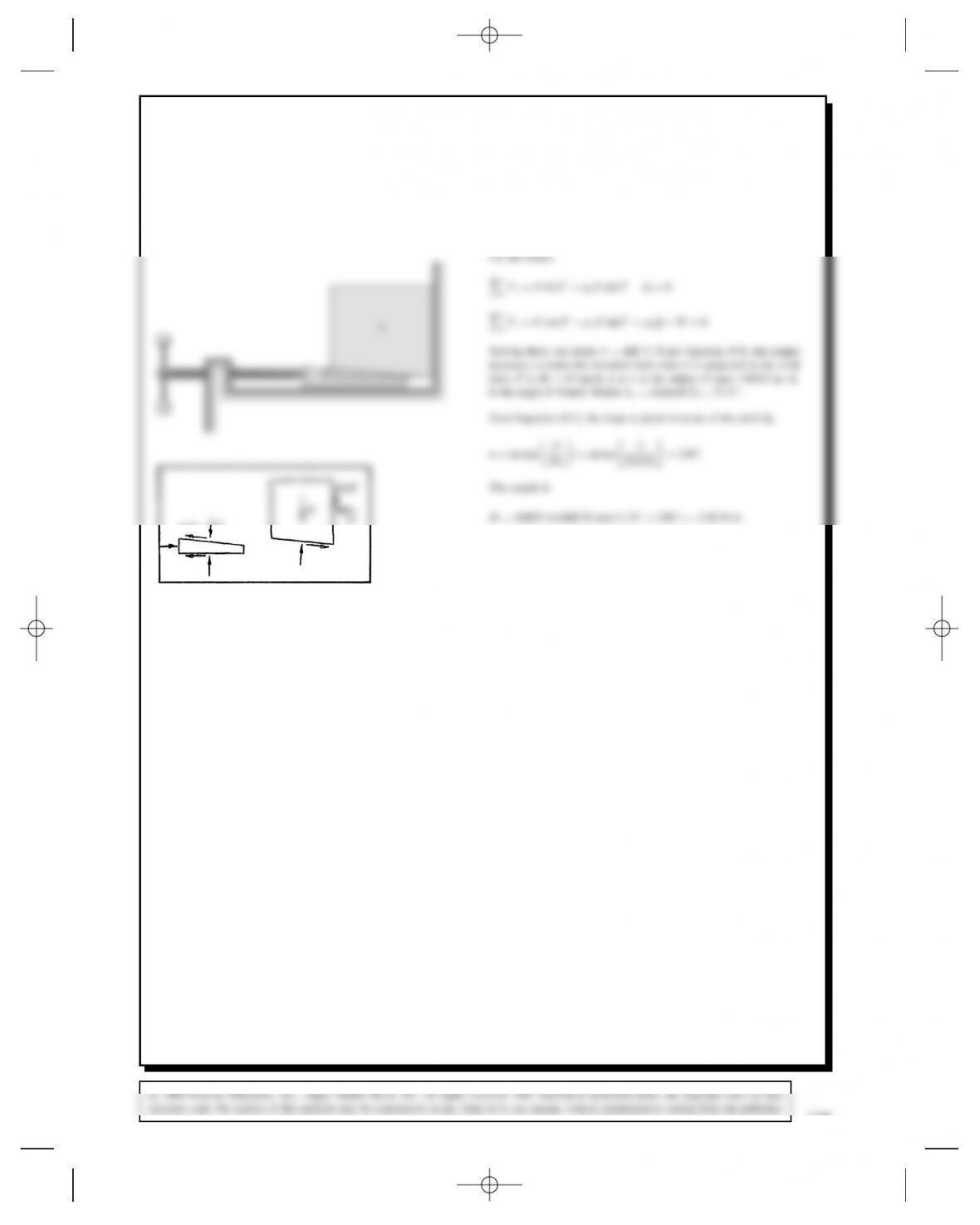
Problem 9.82 The pitch of the threaded shaft of the C
clamp is pD0.05 in and the mean radius of the thread
is rD0.15 in. The coefficients of friction between the
threaded shaft and the mating collar are sD0.18 and
kD0.16.
(a) What maximum couple must be applied to the shaft
to exert a 30-lb force on the clamped object?
(b) If a 30-lb force is exerted on the clamped object,
what couple must be applied to the shaft to begin
loosening the clamp?
738
Problem 9.83 The mass of block Ais 60 kg. Neglect
the weight of the 5°wedge. The coefficient of kinetic
friction between the contacting surfaces of the block A,
the wedge, the table, and the wall is kD0.4. The pitch
of the threaded shaft is 5 mm, the mean radius of the
thread is 15 mm, and the coefficient of kinetic friction
between the thread and the mating groove is 0.2. What
couple must be exerted on the threaded shaft to raise the
block Aat a constant rate?
Solution: Denote the wedge angle by ˇD5°and the normal force
on the top by Nand on the lower surface by P. The free body diagrams
of the wedge and block are as shown. The equilibrium equations for
wedge:
FxDFkPNsin 5°kNcos 5°D0,
FyDPNcos 5°CkNsin 5°D0.
µ
kN
µ
kN
µ
kP
N
N
P
F
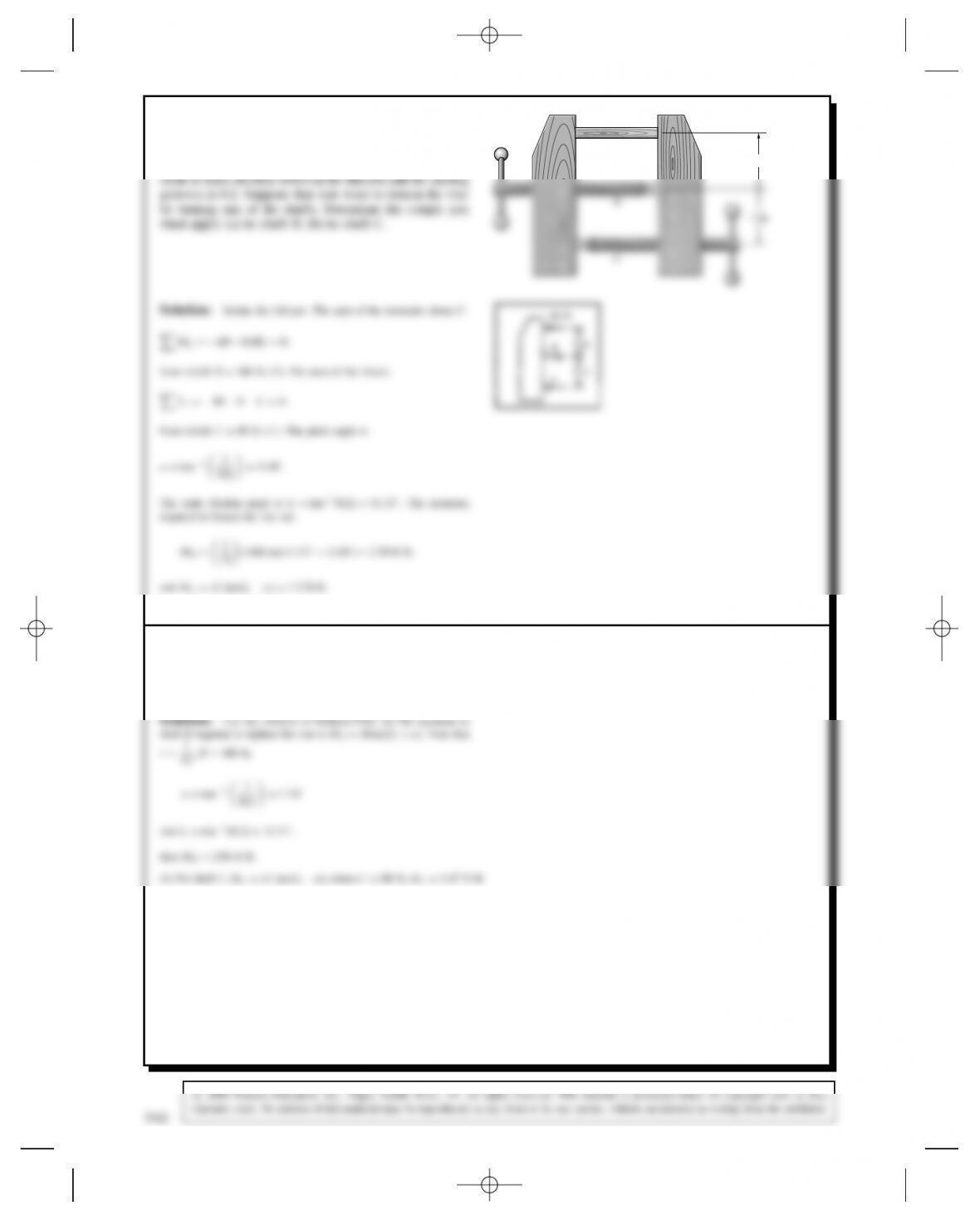
Problem 9.84 The vise exerts 80-lb forces on A. The
threaded shafts are subjected only to axial loads by the
jaws of the vise. The pitch of their threads is pD1/8 in,
the mean radius of the threads is rD1 in, and the coeffi–
4 in
A
FxD80 CBCD0,
from which CD80 lb ⊲C⊳. The pitch angle is
˛Dtan11
16D1.14°.
The static friction angle is sDtan1⊲0.2⊳D11.31°. The moments
required to loosen the vise are
MBD1
12 ⊲160⊳tan⊲11.31°1.14°⊳D2.39 ft lb,
and MCDrC tan⊲s˛⊳ D1.2 ft-lb.
Problem 9.85 Suppose that you want to tighten the
vise in Problem 9.84 by turning one of the shafts. Deter-
mine the couple you must apply (a) to shaft B; (b) to
shaft C.
740
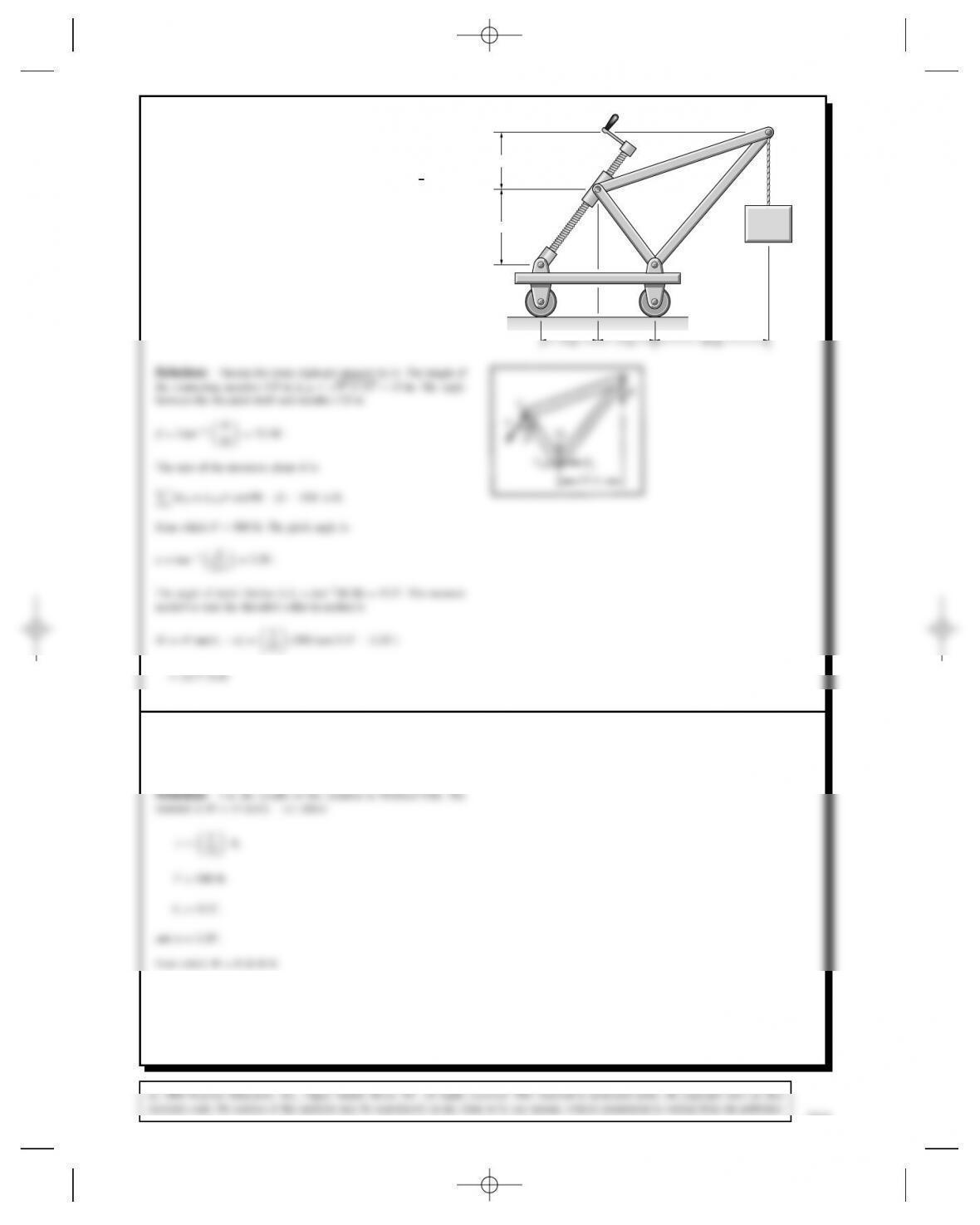
Problem 9.86 The threaded shaft has a ball and socket
support at B. The 400-lb load Acan be raised or lowered
by rotating the threaded shaft, causing the threaded collar
at Cto move relative to the shaft. Neglect the weights
of the members. The pitch of the shaft is pD1
4in, the
mean radius of the thread is rD1 in, and the coeffi–
cient of static friction between the thread and the mating
groove is 0.24. If the system is stationary in the posi-
tion shown, what couple is necessary to start the shaft
rotating to raise the load?
C
A
B
9 in
12 in
The sum of the moments about Dis
MDDLCDFcos⊲90 ˇ⊳ 18WD0,
from which FD500 lb. The pitch angle is
˛Dtan1p
2r D2.28°.
The angle of static friction is sDtan1⊲0.24⊳D13.5°. The moment
needed to start the threaded collar in motion is
MDrF tan⊲sC˛⊳ D1
12 ⊲500⊳tan⊲13.5°C2.28°⊳
D11.77 ft-lb
Dx
LCD
18 in
Problem 9.87 In Problem 9.86, if the system is
stationary in the position shown, what couple is
necessary to start the shaft rotating to lower the load?
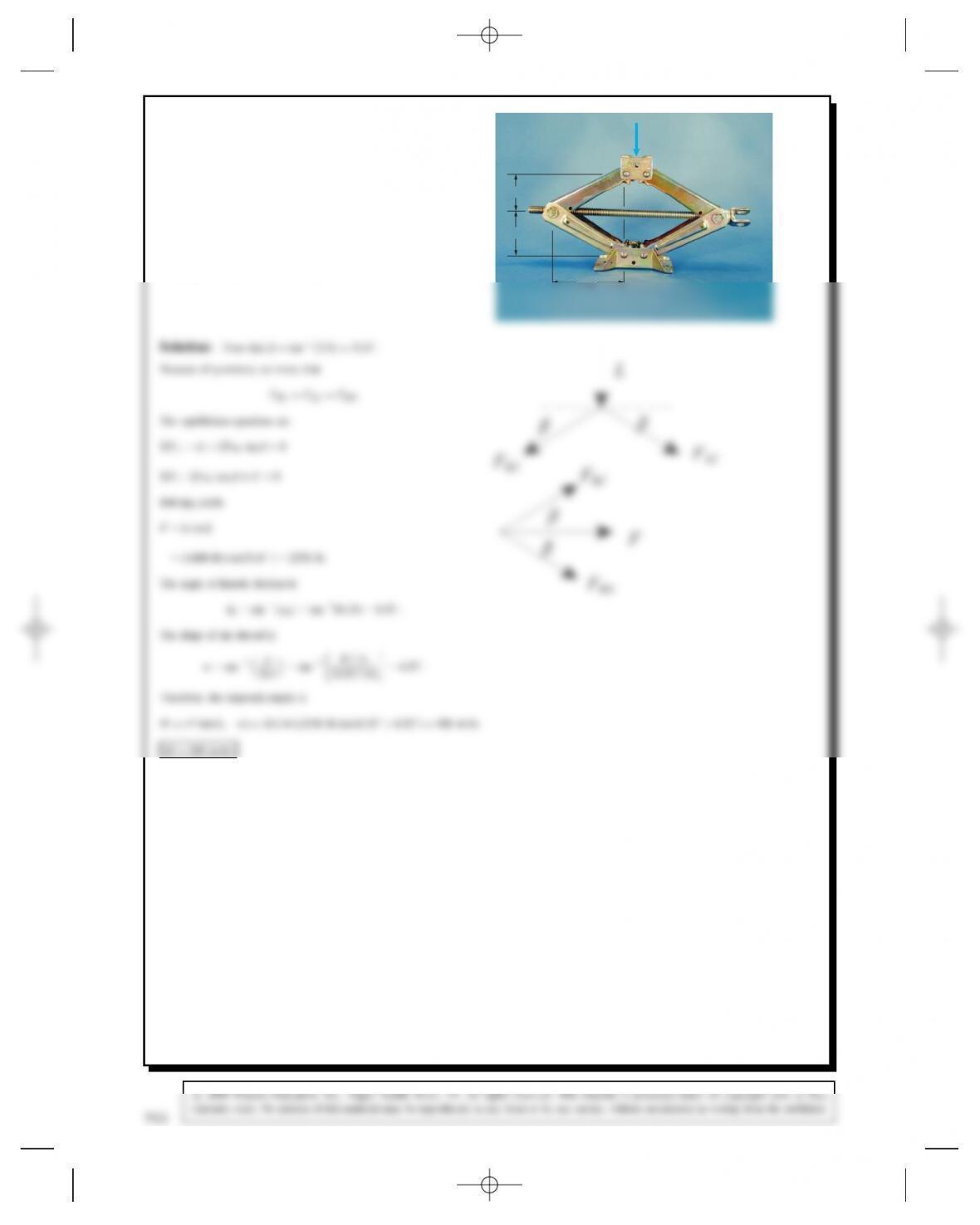
Problem 9.88 The car jack is operated by turning the
horizontal threaded shaft at A. The threaded shaft fits
into a mating threading collar at B. As the shaft turns,
points Aand Bmove closer together or farther apart,
thereby raising or lowering the jack. The pitch of the
threaded shaft is pD0.1 in, the mean radius of the
thread is rD0.2 in, and the coefficient of kinetic friction
between the threaded shaft and the mating collar at Bis
0.15. What couple must be applied at Ato rotate the
shaft at a constant rate and raise the jack when it is in
the position shown if the load LD1400 lb?
3 in
3 in
B
L
A
742
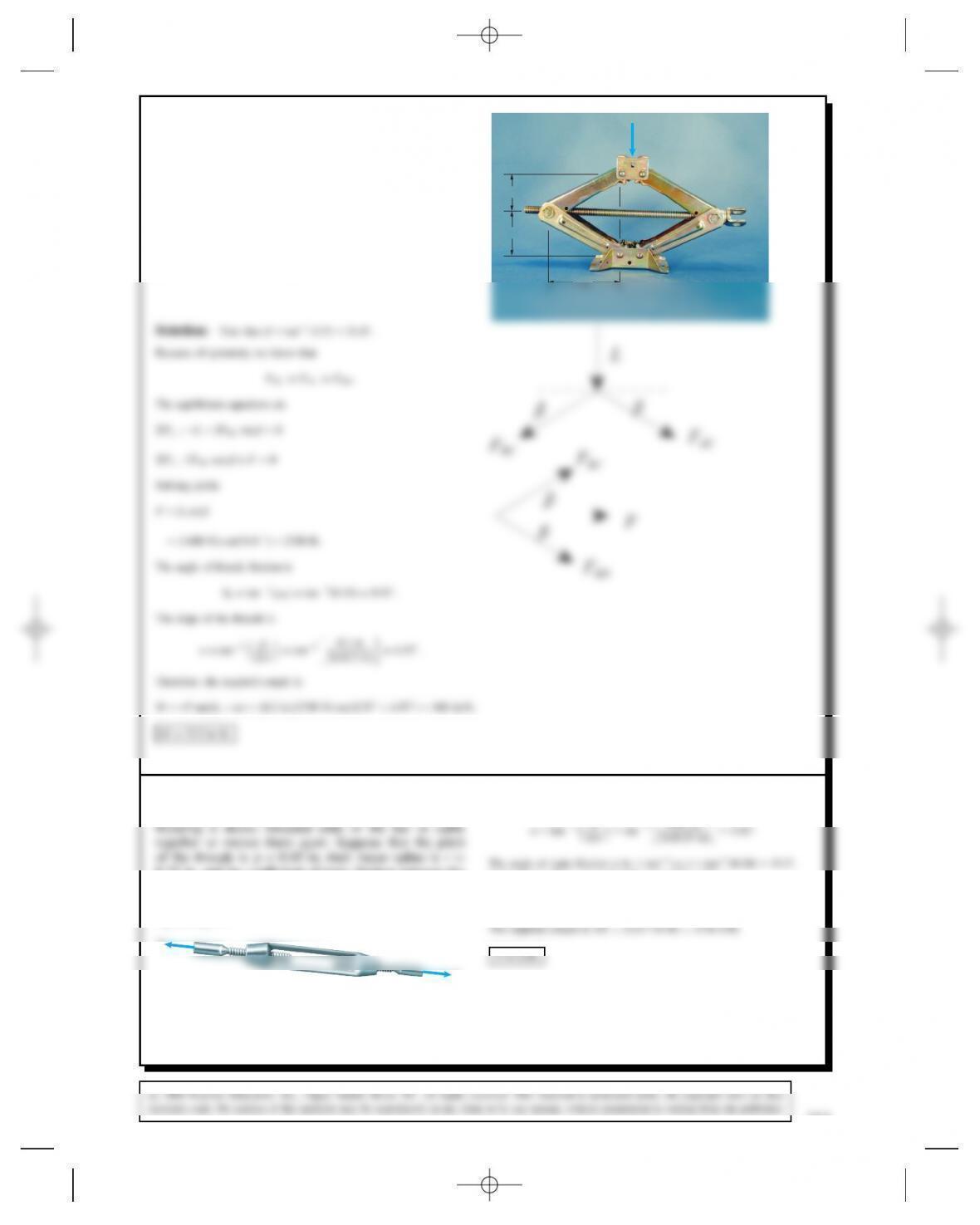
Problem 9.89 The car jack is operated by turning the
horizontal threaded shaft at A. The threaded shaft fits into
a mating threading collar at B. As the shaft turns, points
Aand Bmove closer together or farther apart, thereby
raising or lowering the jack. The pitch of the threaded
shaft is pD0.1 in, the mean radius of the thread is rD
0.2 in, and the coefficient of kinetic friction between
the threaded shaft and the mating collar at Bis 0.15.
What couple must be applied at Ato rotate the shaft
at a constant rate and lower the jack when it is in the
position shown if the load LD1400 lb?
3 in
3 in
B
L
A
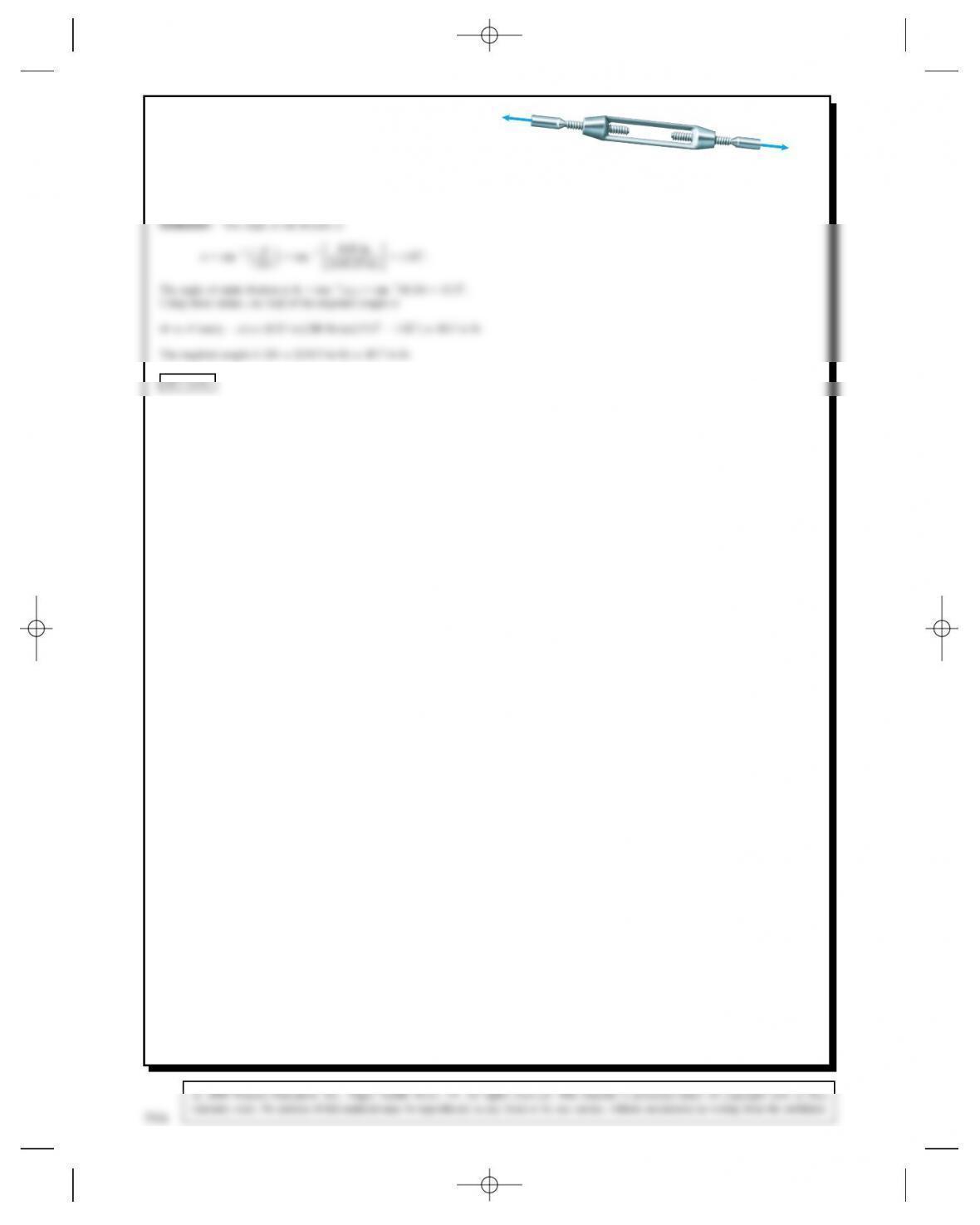
Problem 9.90 Aturnbuckle, used to adjust the length
or tension of a bar or cable, is threaded at both ends.
0.25 in, and the coefficient of static friction between the
threads and the mating grooves is 0.24. If TD200 lb,
what couple must be exerted on the turnbuckle to start
tightening it?
Solution: The slope of the threads is
Using these values, one half of the required couple is
MDrF tan⊲kC˛⊳ D⊲0.25 in⊳⊲200 lb⊳tan⊲13.5°C1.82°⊳D13.7 in-lb.
Problem 9.91 Suppose that the pitch of the threads of
the turnbuckle is pD0.05 in, their mean radius is rD
0.25 in, and the coefficient of static friction between the
threads and the mating grooves is 0.24. If TD200 lb,
what couple must be exerted on the turnbuckle to start
loosening it?
T
T
744