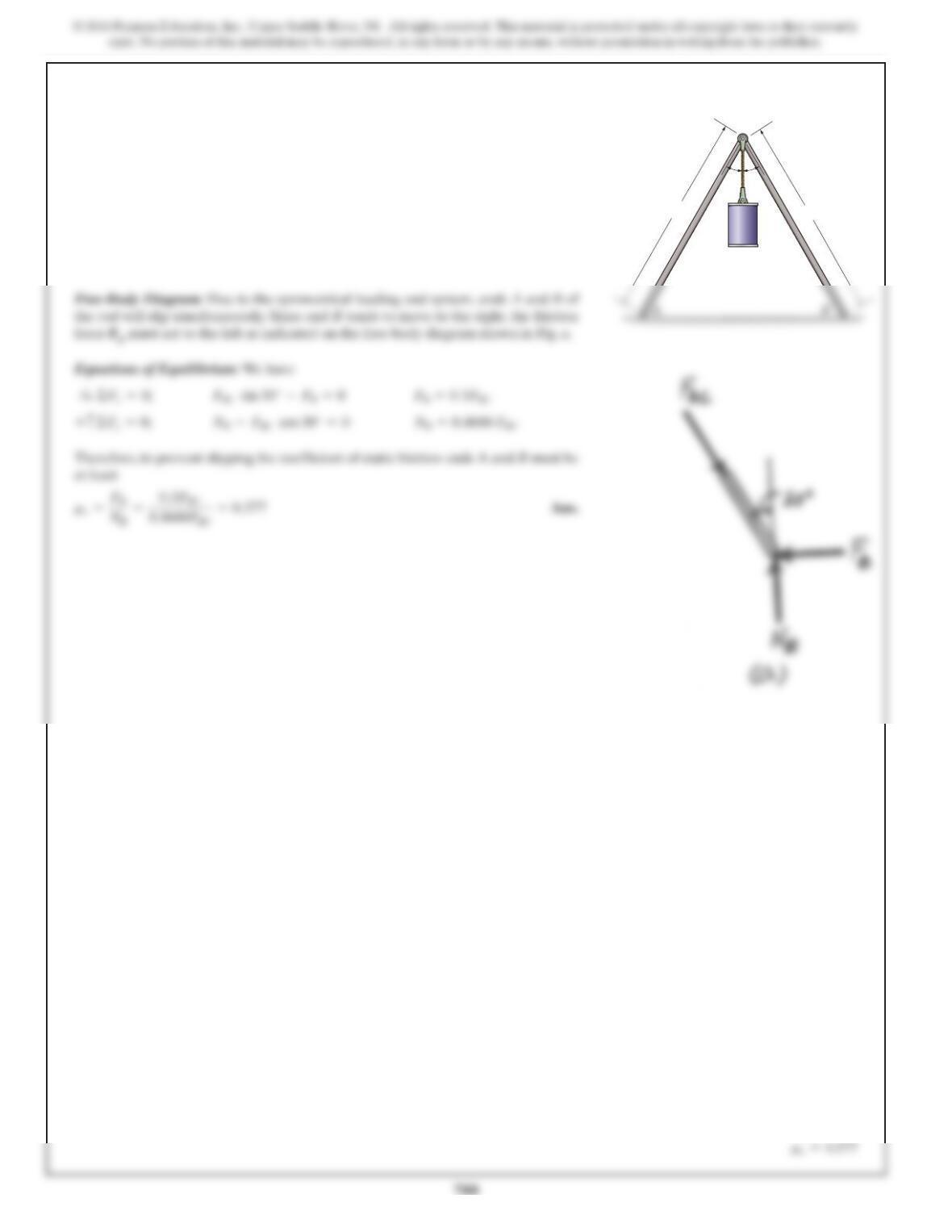
*8–40.
If determine the minimum coefficient of static
friction at Aand Bso that equilibrium of the supporting
frame is maintained regardless of the mass of the cylinder C.
Neglect the mass of the rods.
u
=30° C
LL
uu
SOLUTION
Ans:
789
8–41.
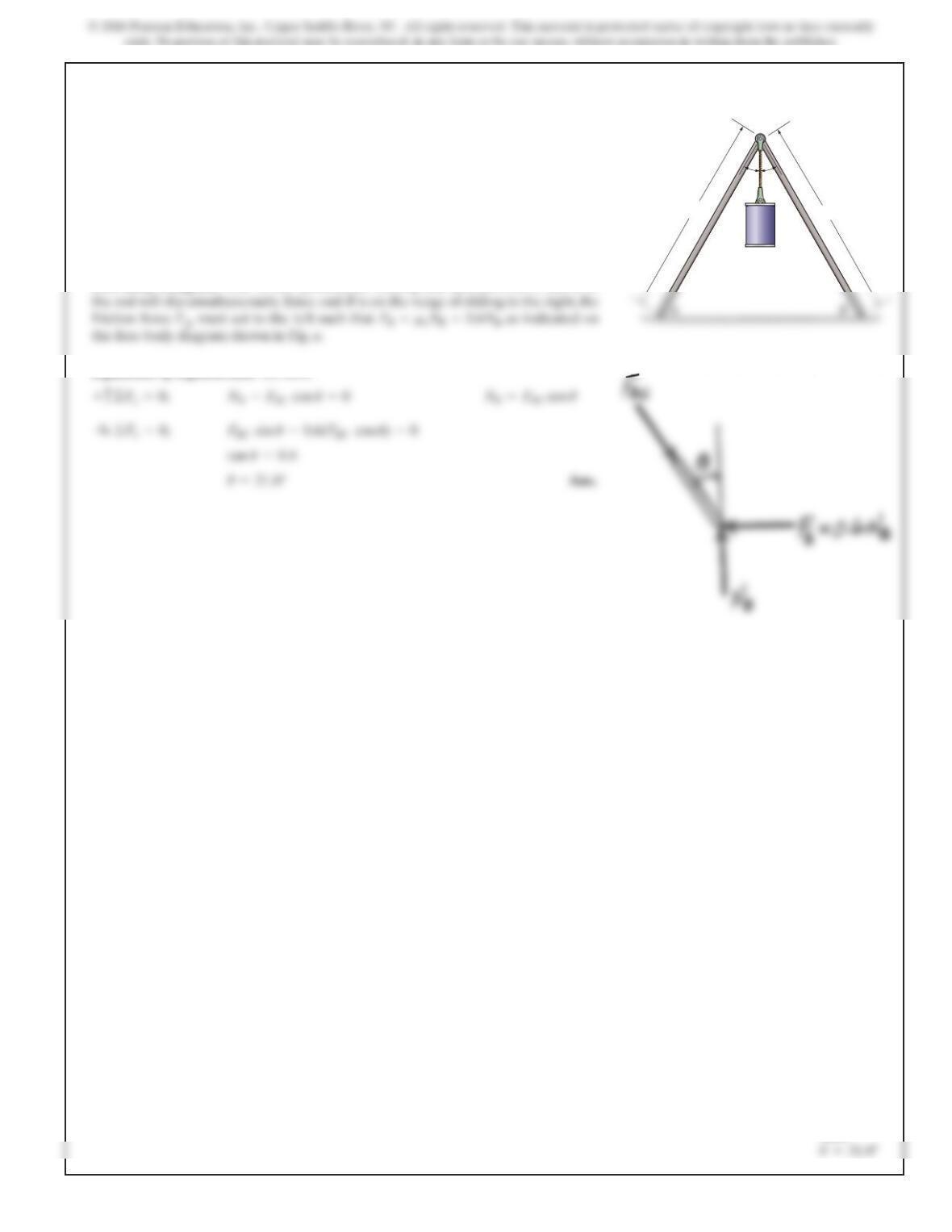
If the coefficient of static friction at Aand Bis
determine the maximum angle so that the frame remains
in equilibrium, regardless of the mass of the cylinder.
Neglect the mass of the rods.
SOLUTION
Free-Body Diagram:Due to the symmetrical loading and system, ends Aand Bof
Equations of Equilibrium:We have
u
ms
=0.6, C
LL
uu
Ans:
790
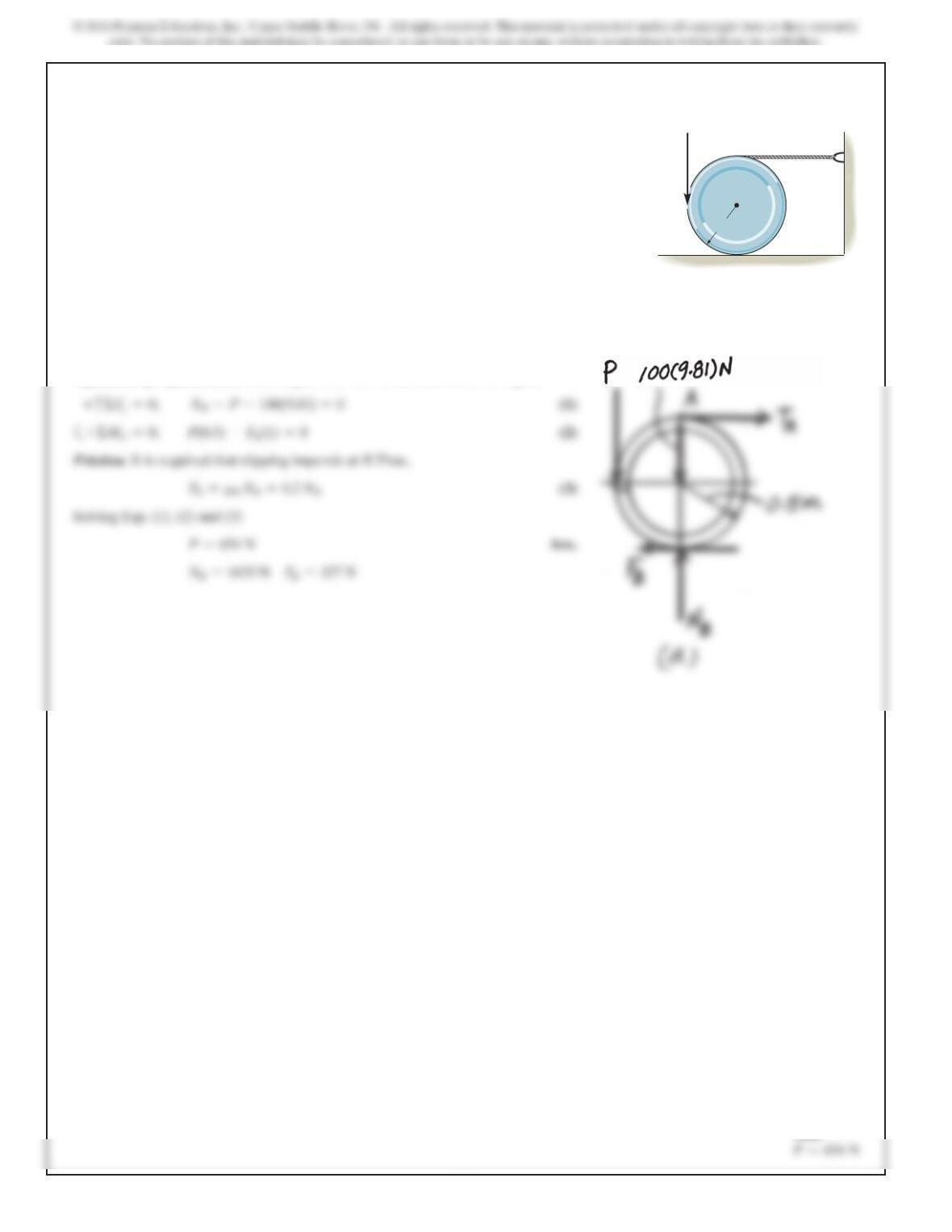
8–42.
The 100-kg disk rests on a surface for which m
B=0.2.
Determine the smallest vertical force P that can be applied
tangentially to the disk which will cause motion to impend.
Ans:
SOLUTION
Equations of Equilibrium. Referring to the FBD of the disk shown in Fig. a,
0.5 m
B
A
P
791
8–43.
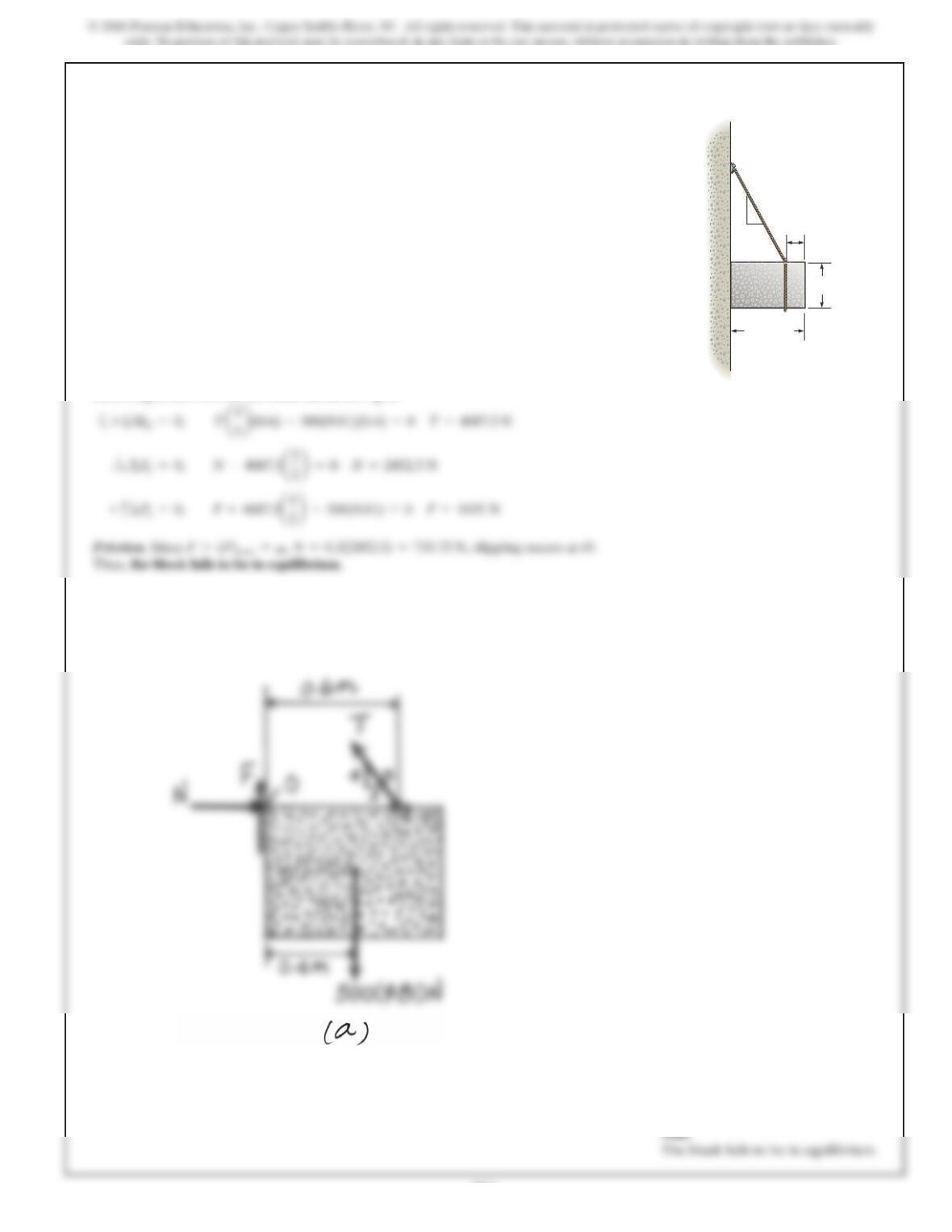
Investigate whether the equilibrium can be maintained. The
uniform block has a mass of 500 kg, and the coefficient of
static friction is m
s=0.3.
SOLUTION
Equations of Equilibrium. The block would move only if it slips at corner O.
Referring to the FBD of the block shown in Fig. a,
A
800 mm
200 mm
3
45
600 mm
B
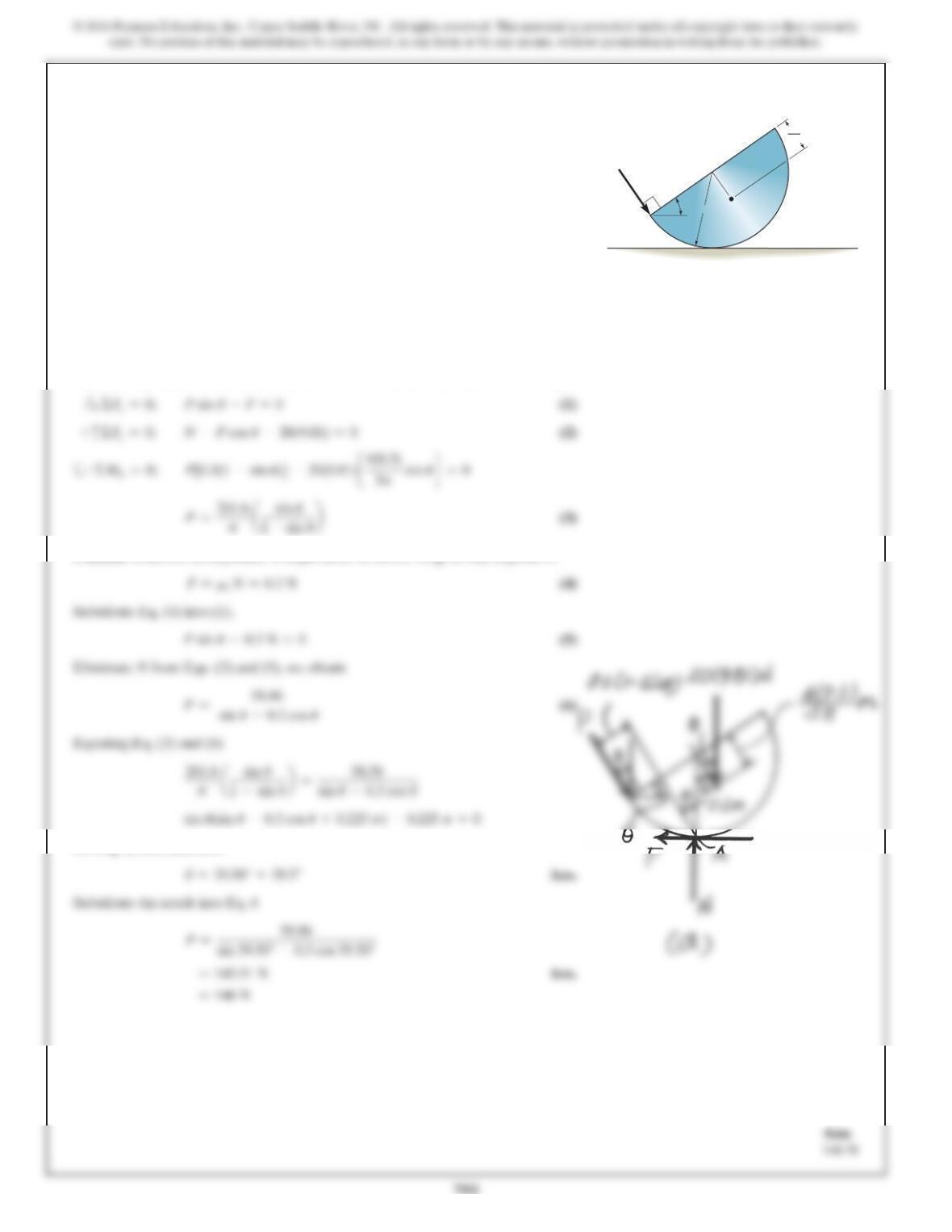
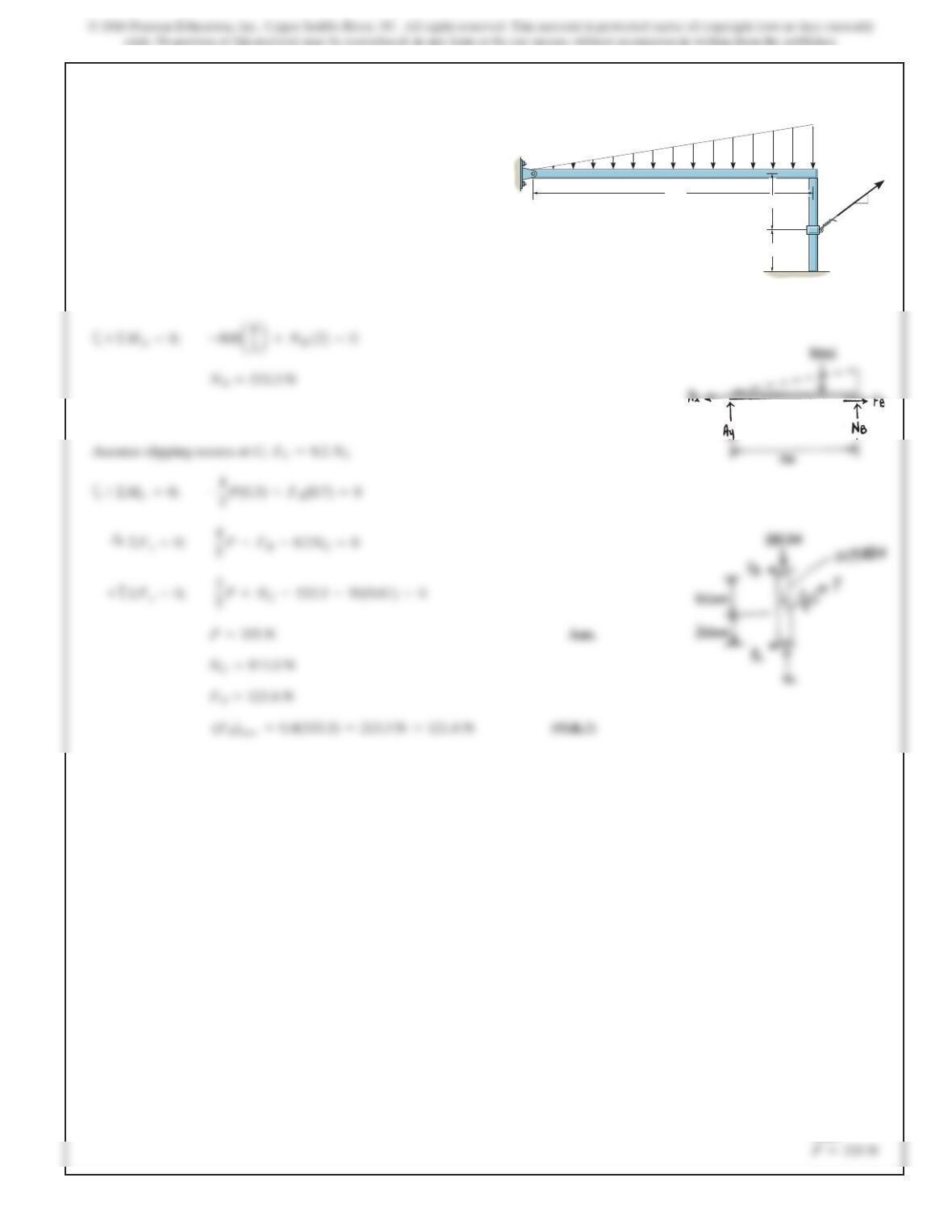
*8–44.
The homogenous semicylinder has a mass of 20 kg and mass
center at G. If force P is applied at the edge, and r
=
300mm,
determine the angle
u
at which the semicylinder is on the
verge of slipping. The coefficient of static friction between
the plane and the cylinder is m
s=0.3.
Also, what is the
corresponding force P for this case?
G
u
P
r
4r
3p
SOLUTION
Equations of Equilibrium. Referring to the FBD of the semicylinder shown in Fig. a,
Friction. Since the semicylinder is required to be on the verge to slip at point A,
Solving by trial and error
793
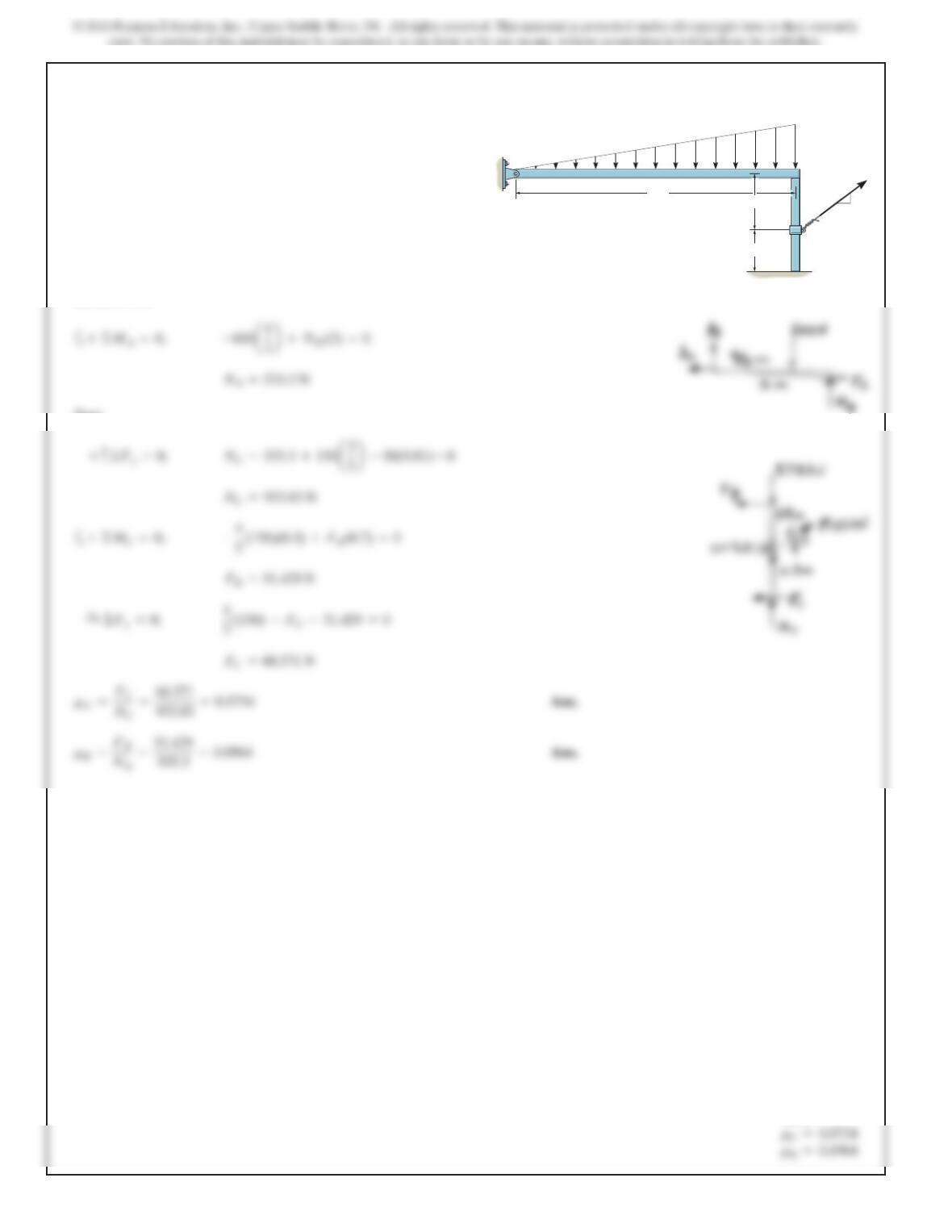
8–45.
SOLUTION
Member AB:
Post:
T
h
e
b
eam AB
h
as a neg
li
g
ibl
e mass an
d
t
hi
c
k
ness an
d
i
s
subjected to a triangular distributed loading. It is supported
at one end by a pin and at the other end by a post having a
mass of 50 kg and negligible thickness. Determine the
minimum force Pneeded to move the post.The coefficients
of static friction at Band Care and
respectively.
mC=0.2,mB=0.4
2m 400 mm
800 N/m
C
B
300 mm
A
P
4
3
5
Ans:
794
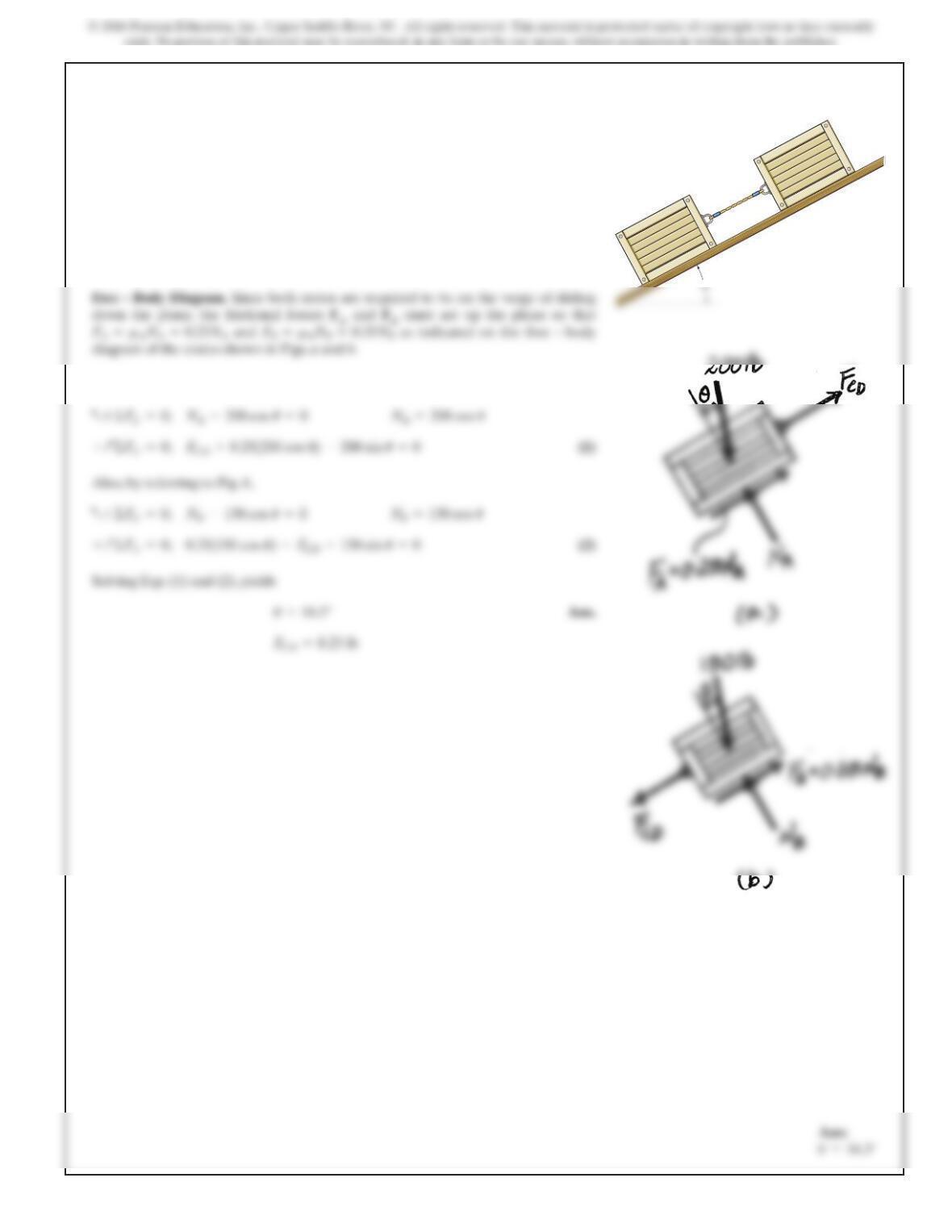
8–46.
T
h
e
b
eam AB
h
as a neg
li
g
ibl
e mass an
d
t
hi
c
k
ness an
d
i
s
subjected to a triangular distributed loading. It is supported
at one end by a pin and at the other end by a post having a
mass of 50 kg and negligible thickness. Determine the two
coefficients of static friction at Band at Cso that when the
magnitude of the applied force is increased to
the post slips at both Band Csimultaneously.
P=150 N,
SOLUTION
Member AB:
Post:
2m 400 mm
800 N/m
C
B
300 mm
A
P
4
3
5
Ans:
795
8–47.
B
AC
D
SOLUTION
Equations of Equilibrium. Referring to Fig. a,
Crates Aand Bweigh 200 lb and 150 lb, respectively.They
are connected together with a cable and placed on the
inclined plane. If the angle is gradually increased,
determine when the crates begin to slide.The coefficients
of static friction between the crates and the plane are
and .mB=0.35mA=0.25
u
u
796
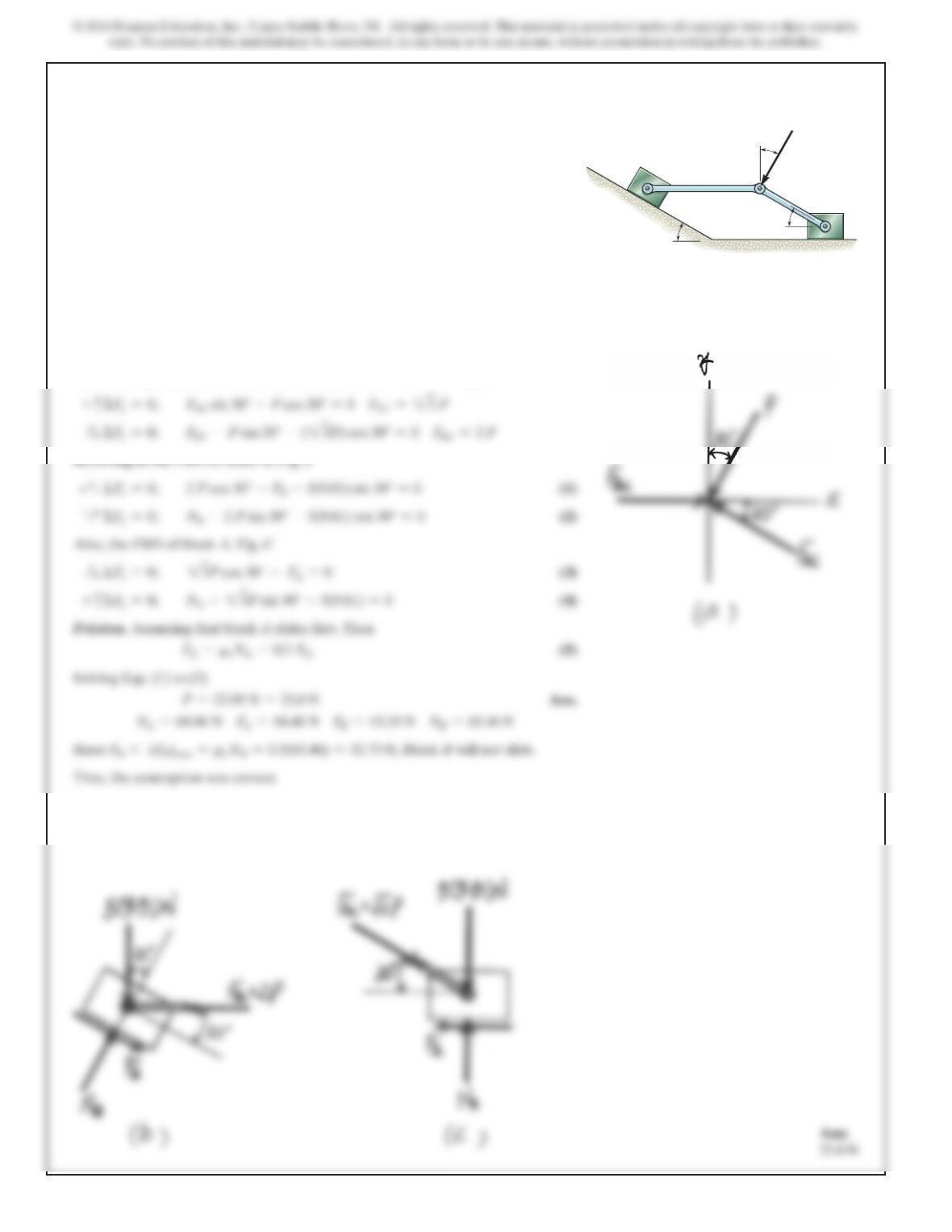
*8–48.
Two blocks A and B, each having a mass of 5 kg, are
connected by the linkage shown. If the coefficient of static
frictionat the contacting surfaces is m
s=0.5
, determine the
largest force P that can be applied to pin C of the linkage
without causing the blocks to move. Neglect the weight of
the links.
SOLUTION
Equations of Equilibrium. Analyze the equilibrium of Joint C Fig. a,
P
30
30
30
A
C
B
797
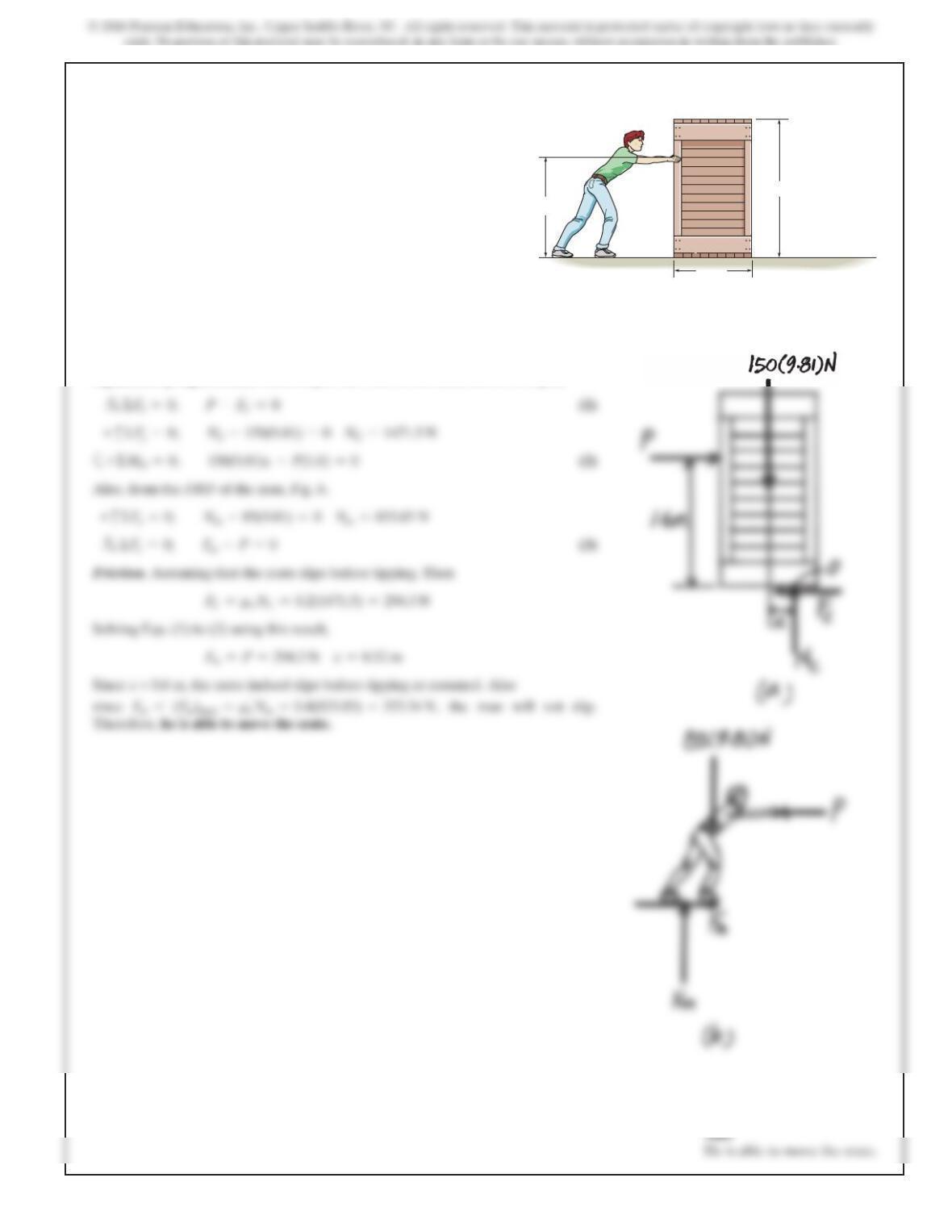
8–49.
The uniform crate has a mass of 150 kg. If the coefficient of
static friction between the crate and the floor is m
s=0.2
,
determine whether the 85-kg man can move the crate. The
coefficient of static friction between his shoes and the floor
is m
′
s=0.4
. Assume the man only exerts a horizontal force
on the crate.
SOLUTION
Equations of Equilibrium. Referring to the FBD of the crate shown in Fig. a,
2.4 m
1.2 m
1.6 m
798
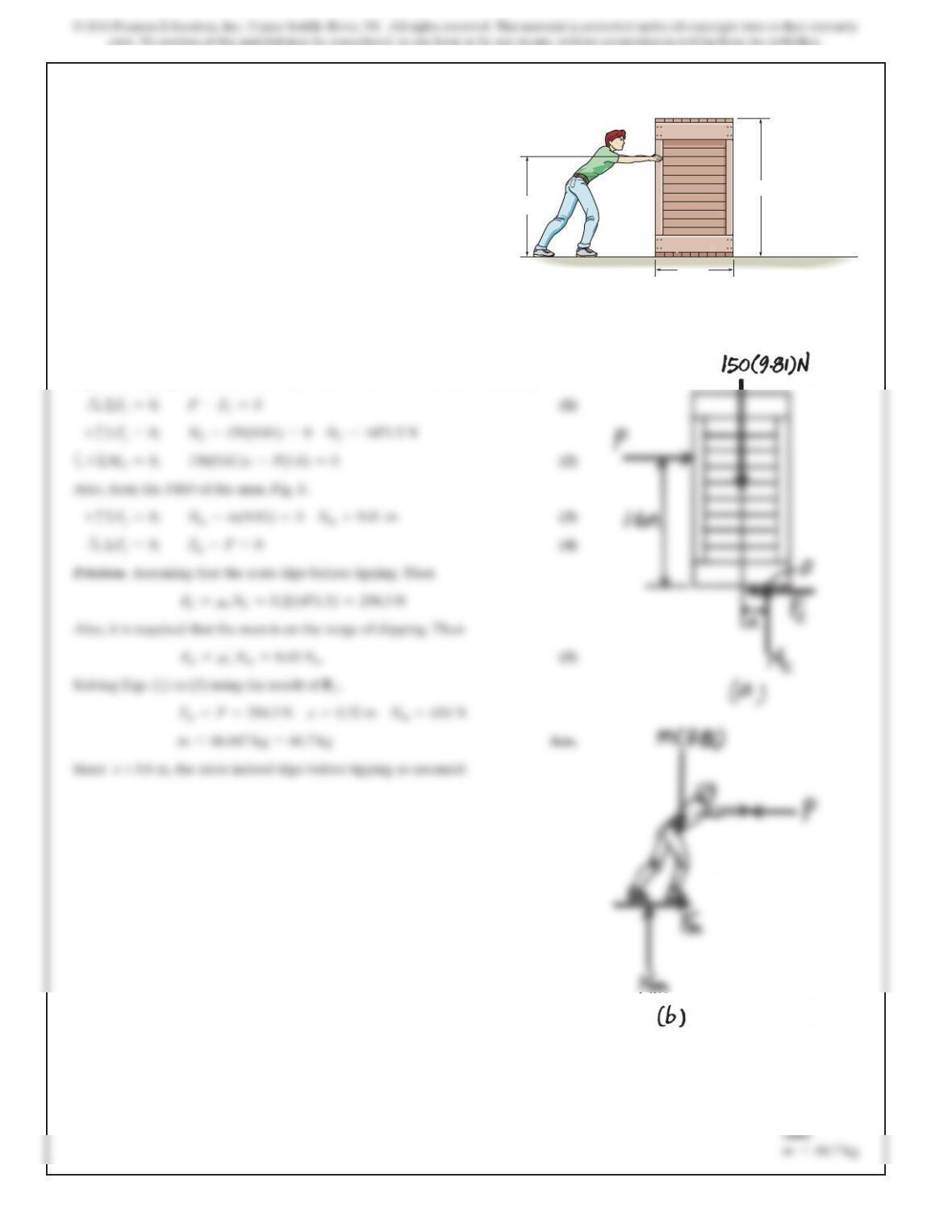
8–50.
The uniform crate has a mass of 150 kg. If the coefficient of
static friction between the crate and the floor is m
s=0.2
,
determine the smallest mass of the man so he can move the
crate. The coefficient of static friction between his shoes and
the floor is m
′
s=0.45
. Assume the man exerts only a
horizontal force on the crate.
SOLUTION
Equations of Equilibrium. Referring to the FBD of the crate shown in Fig. a,
2.4 m
1.2 m
1.6 m
799
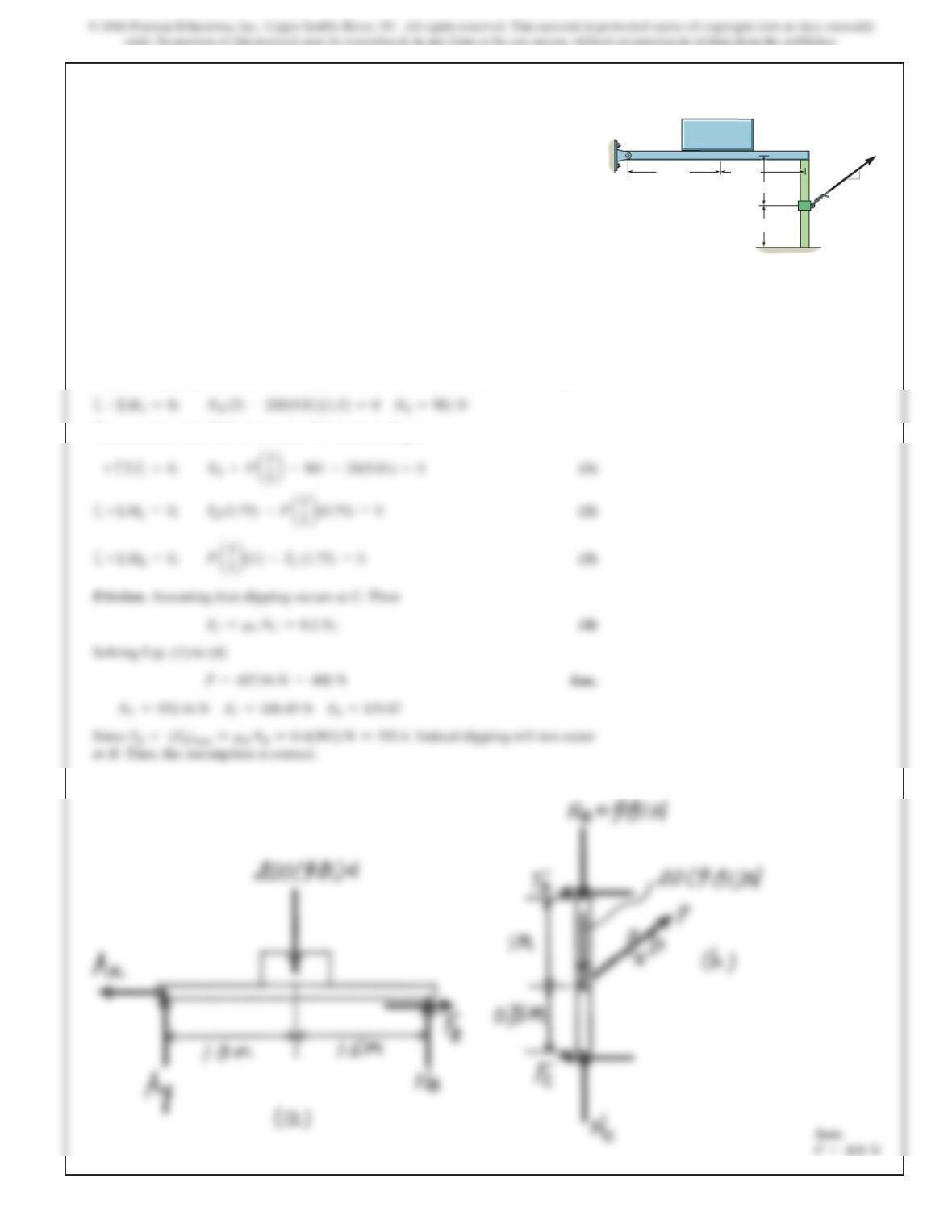
8–51.
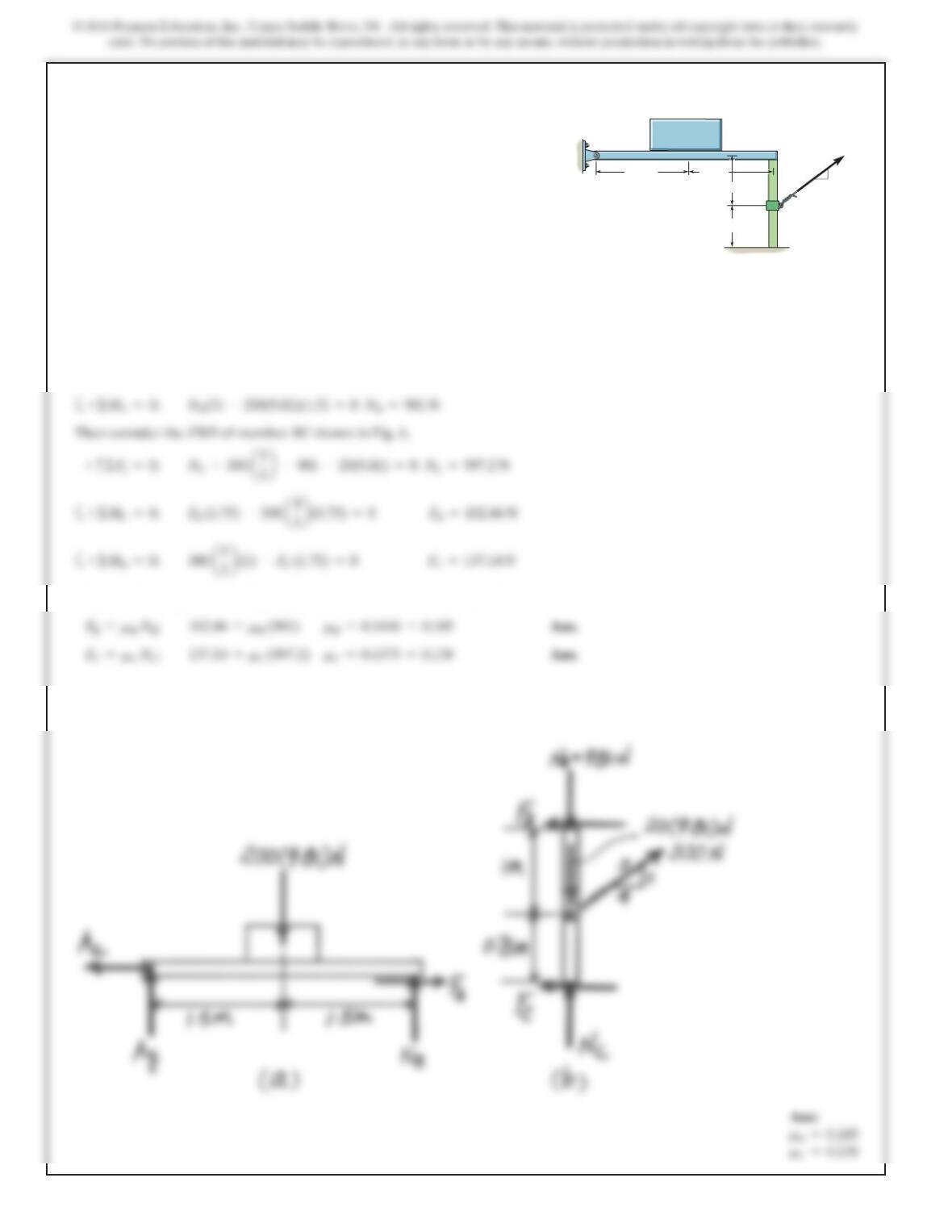
Beam AB has a negligible mass and thickness, and supports
the 200-kg uniform block. It is pinned at A and rests on the
top of a post, having a mass of 20 kg and negligible thickness.
Determine the minimum force P needed to move the post.
The coefficients of static friction at B and C are m
B=0.4
and m
C=0.2
, respectively.
SOLUTION
Equations of Equilibrium. Referring to the FBD of member AB shown in Fig. a,
Then consider the FBD of member BC shown in Fig. b,
1.5 m 1.5 m
C
B
0.75 m
1 m
AP
4
3
5
800
*8–52.
Beam AB has a negligible mass and thickness, and supports
the 200-kg uniform block. It is pinned at A and rests on the
top of a post, having a mass of 20 kg and negligible thickness.
Determine the two coefficients of static friction at B and atC
so that when the magnitude of the applied force is increased
to
P=300 N,
the post slips at both B and C simultaneously.
SOLUTION
Equations of Equilibrium. Referring to the FBD of member AB shown in Fig. a,
Friction. It is required that slipping occurs at B and simultaneously. Then
1.5 m 1.5 m
C
B
0.75 m
1 m
AP
4
3
5
801
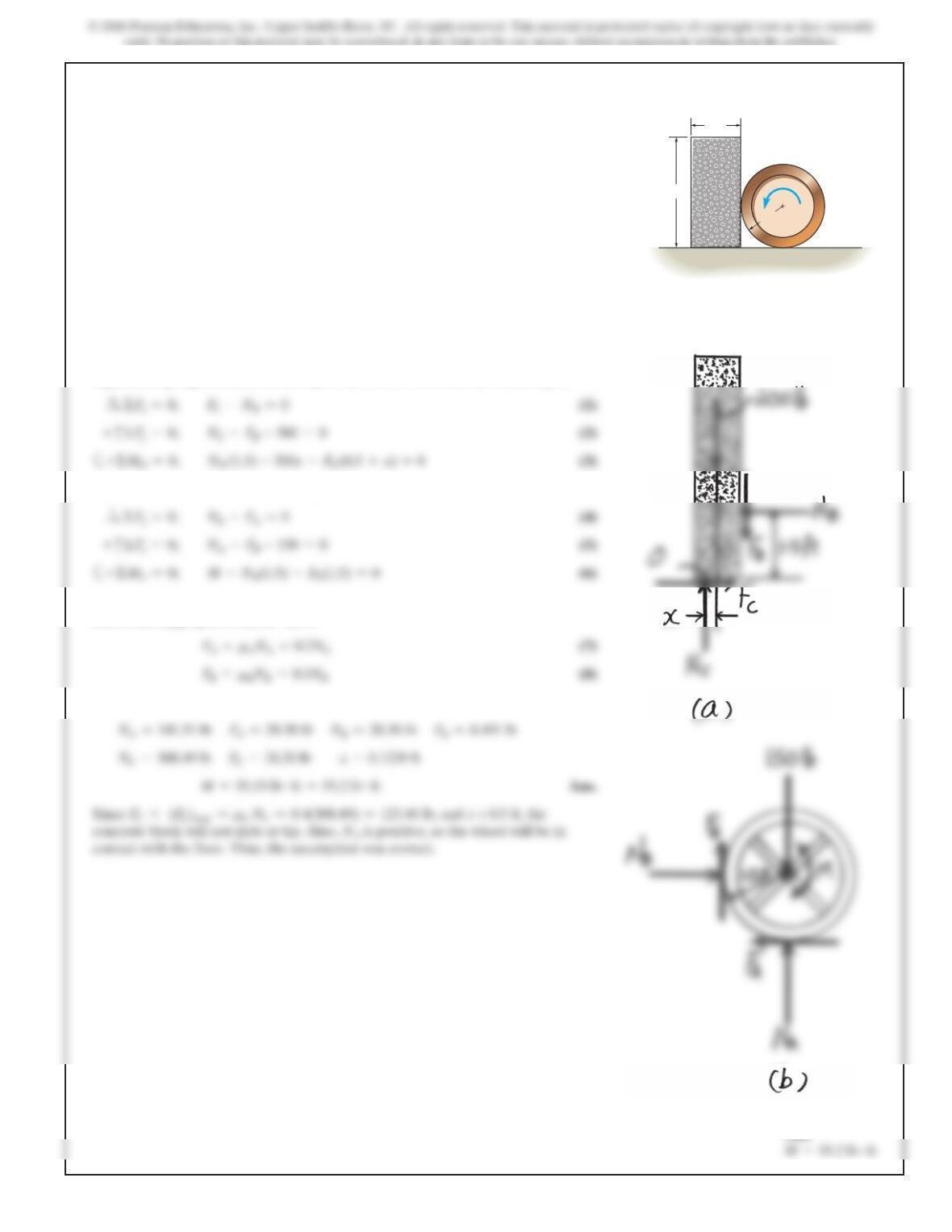
8–53.
Determine the smallest couple moment that can be applied
to the 150-lb wheel that will cause impending motion. The
uniform concrete block has a weight of 300 lb. The
coefficients of static friction are m
A=0.2
, m
B=0.3
, and
between the concrete block and the floor, m
=0.4
.
1 ft
5 ft
B
A
1.5 ft
M
Ans:
SOLUTION
Equations of Equilibrium. Referring to the FBD of the concrete block, Fig. a.
Also, from the FBD of the wheel, Fig. b.
Friction. Assuming that the impending motion is caused by the rotation of wheel
due to the slipping at A and B. Thus,
Solving Eqs. (1) to (8),
8–54.
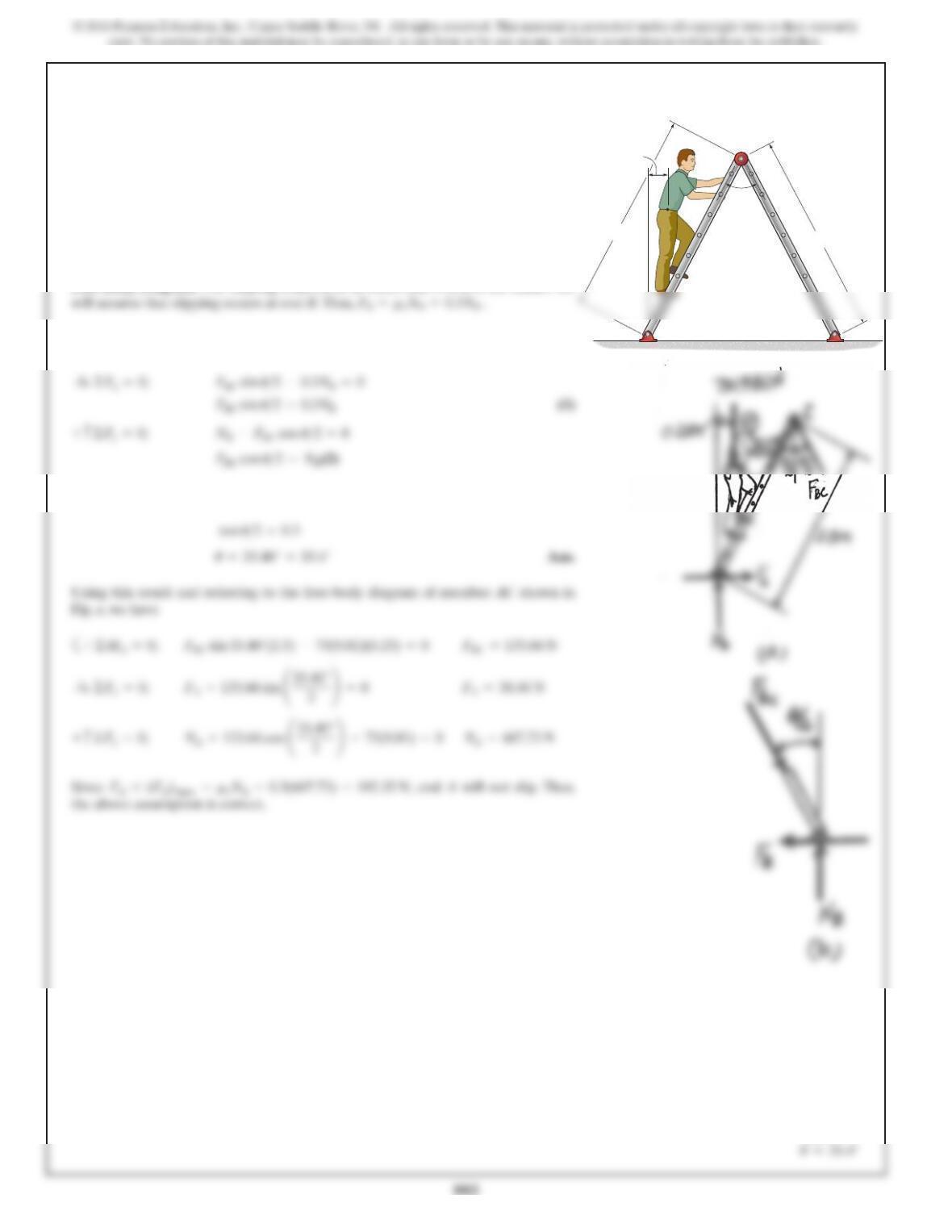
AB
C
G
2.5 m
0.25 m
2.5 m
u
Determine the greatest angle so that the ladder does not
slip when it supports the 75-kg man in the position shown.
The surface is rather slippery, where the coefficient of static
friction at Aand Bis .
SOLUTION
Free-Body Diagram:The slipping could occur at either end Aor Bof the ladder.We
Equations of Equilibrium:Referring to the free-body diagram shown in Fig.b,
we have
Dividing Eq. (1) by Eq. (2) yields
ms=0.3
X
Ans:
8–55.
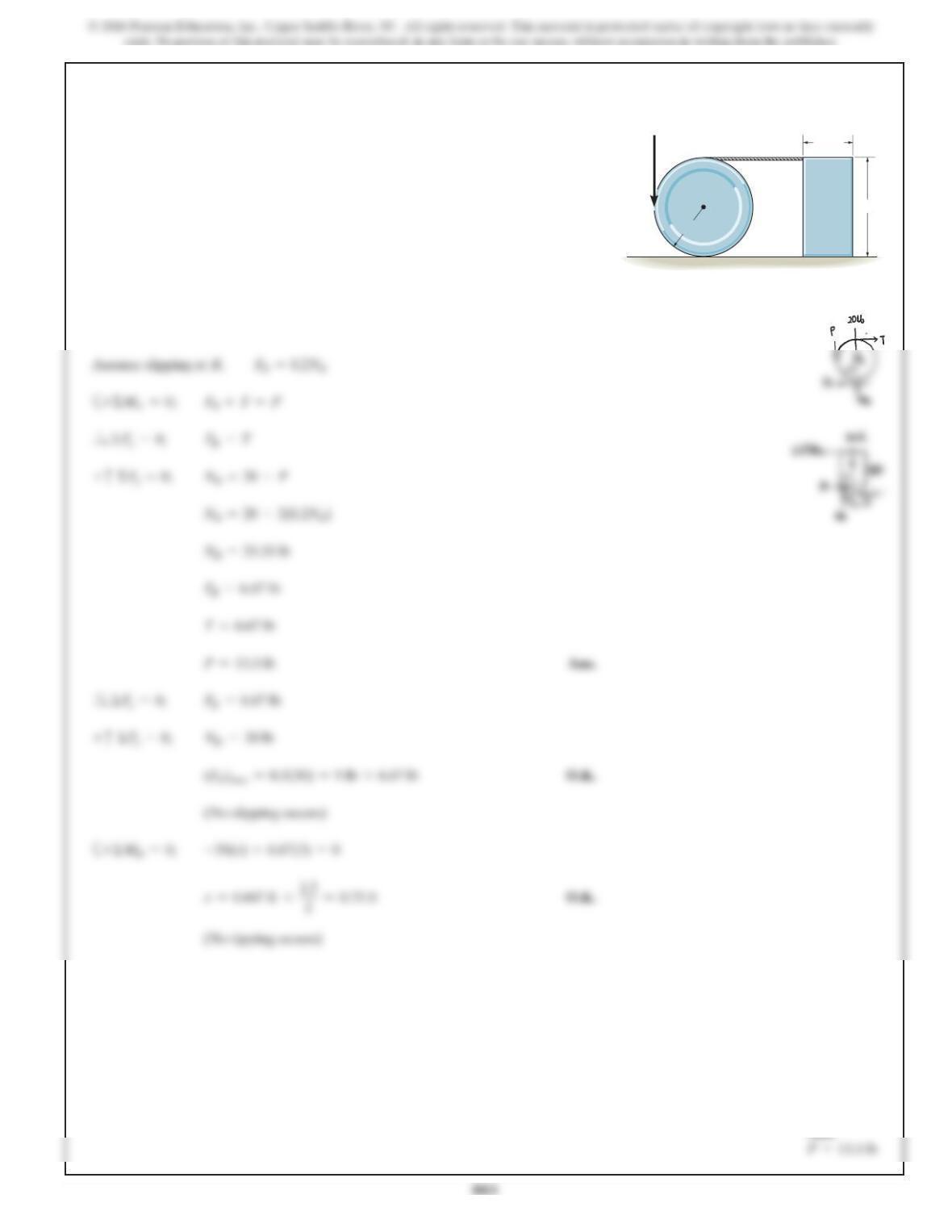
The wheel weighs 20 lb and rests on a surface for which
mB=0.2. A cord wrapped around it is attached to the top
of the 30-lb homogeneous block. If the coeffi cient of static
friction at D is mD=0.3, determine the smallest vertical
force that can be applied tangentially to the wheel which
will cause motion to impend.
SOLUTION
Cylinder A:
1.5 ft
1.5 ft
C
DB
A
P
3 ft
804
*8–56.
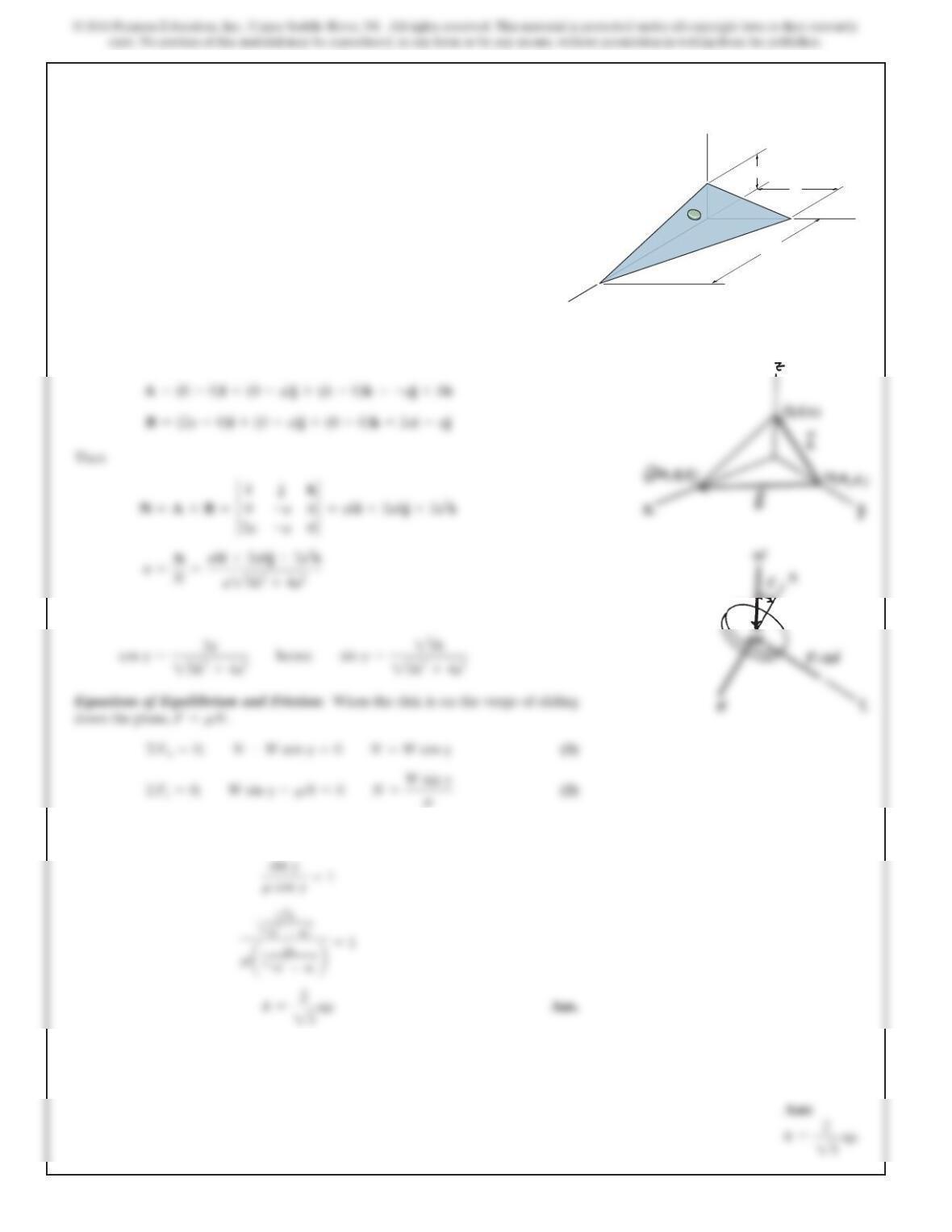
The disk has a weight Wand lies on a plane which has a
coefficient of static friction . Determine the maximum
height hto which the plane can be lifted without causing the
disk to slip.
m
SOLUTION
Unit Vector: The unit vector perpendicular to the inclined plane can be determined
using cross product.
Thus
Divide Eq. (2) by (1) yields
z
x
y
2a
a
h
805
8–57.
SOLUTION
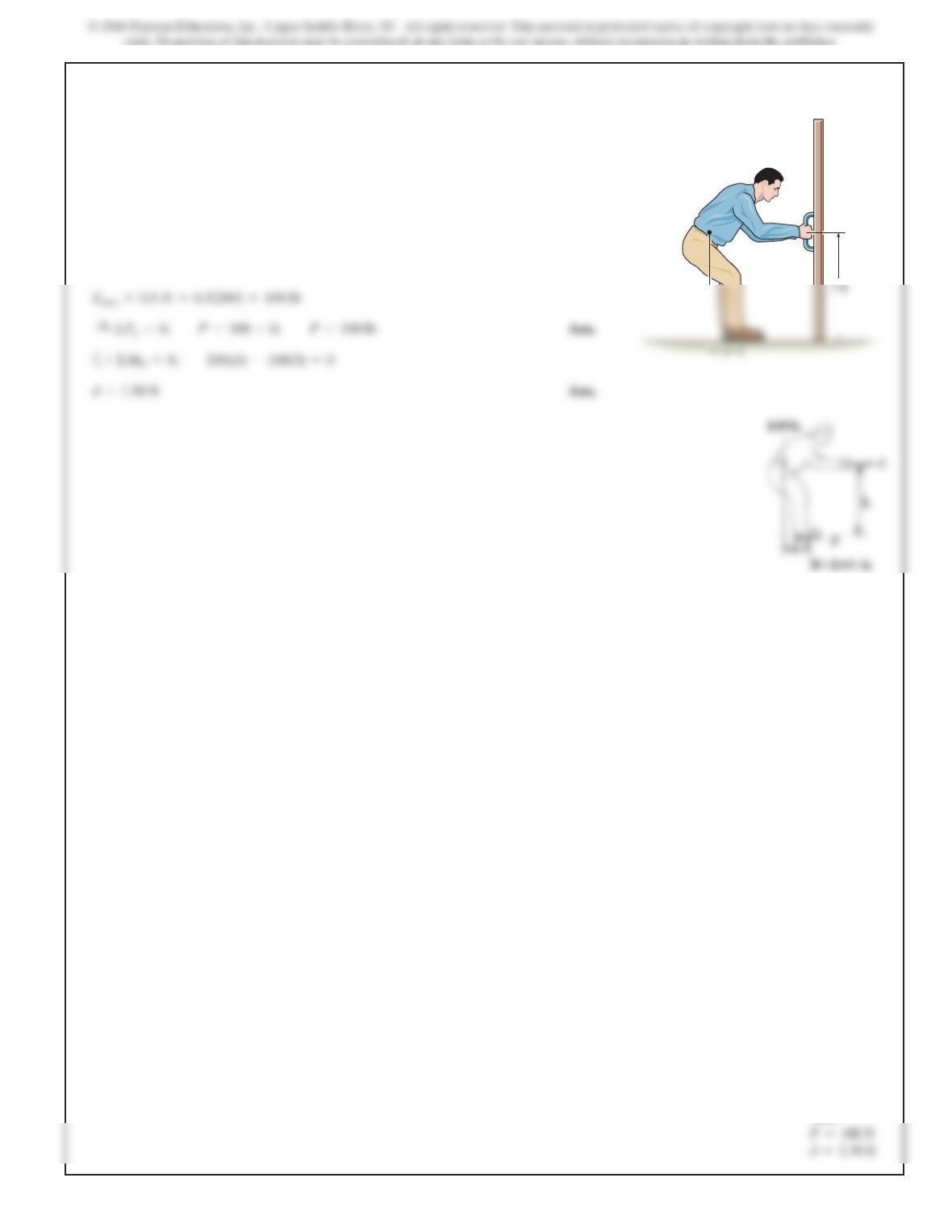
The man has a weight of 200 lb, and the coefficient of static
friction between his shoes and the floor is
Determine where he should position his center of gravity G
at din order to exert the maximum horizontal force on the
door.What is this force?
ms=0.5.
G
Ans:
806
8–58.
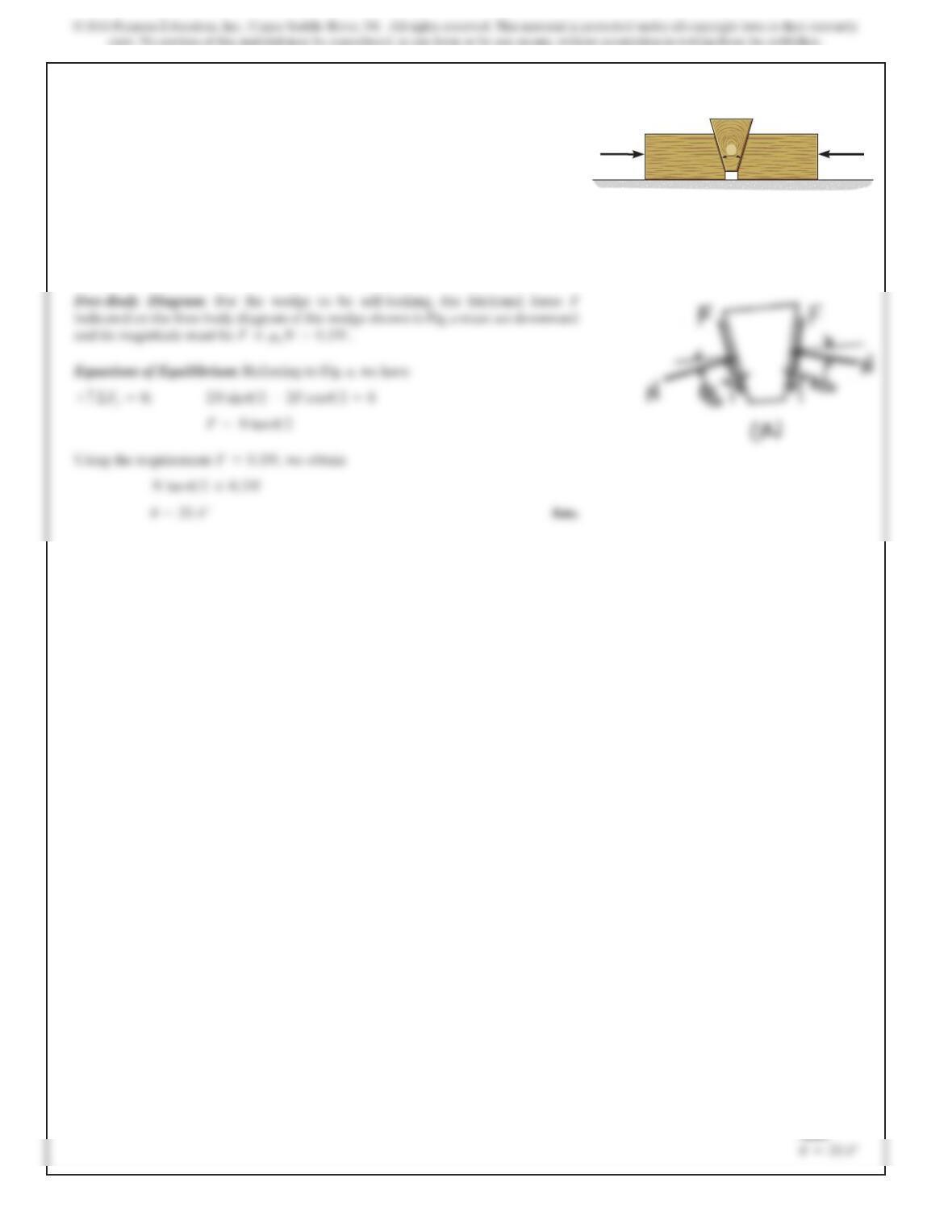
Determine the largest angle that will cause the wedge to
be self-locking regardless of the magnitude of horizontal
force Papplied to the blocks.The coefficient of static
friction between the wedge and the blocks is .
Neglect the weight of the wedge.
SOLUTION
ms=0.3
X
PP
u
8–59.
SOLUTION
Equations of Equilibrium and Friction: If the wedge is on the verge of moving to
From FBD (b),
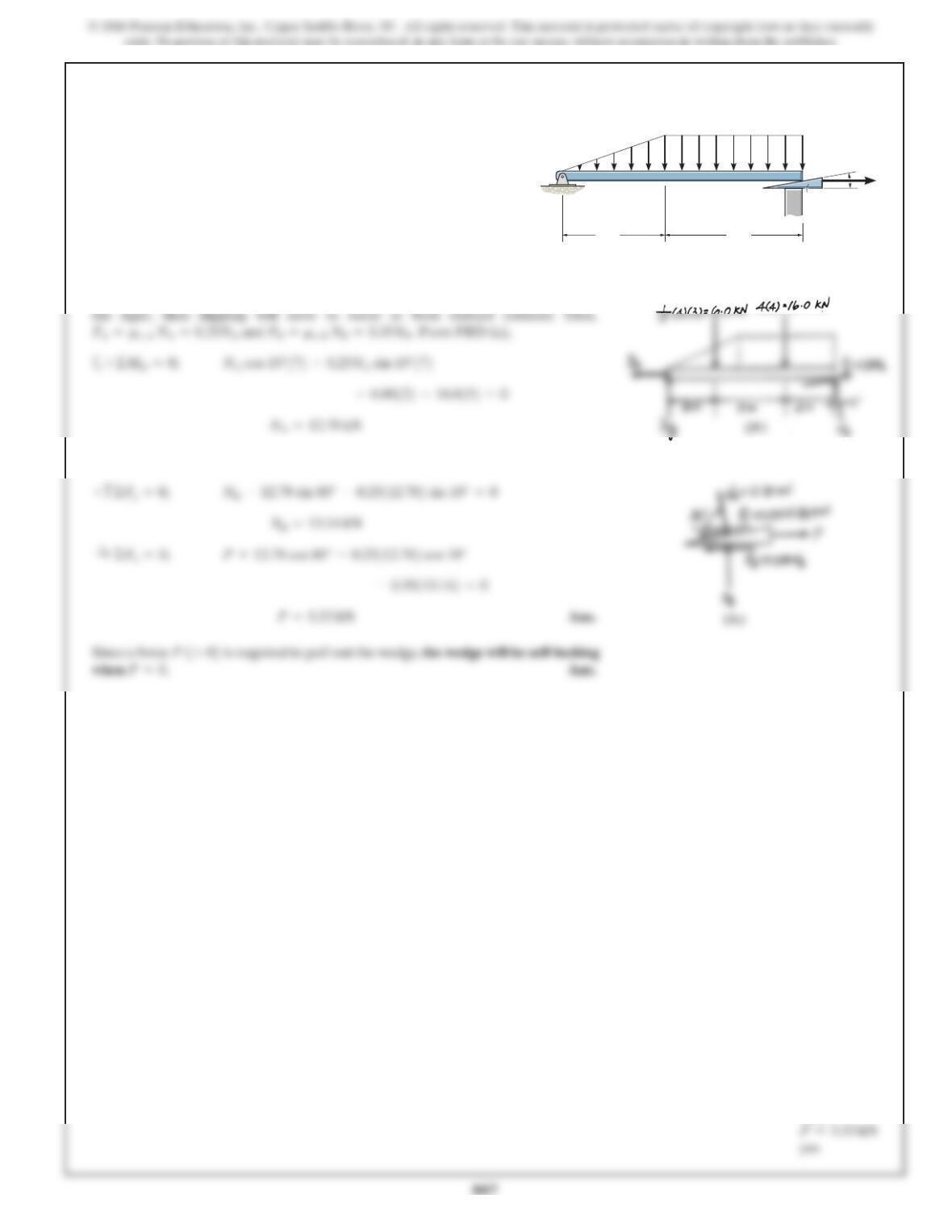
If the beam AD is loaded as shown, determine the
horizontal force Pwhich must be applied to the wedge in
order to remove it from under the beam.The coefficients of
static friction at the wedge’s top and bottom surfaces are
and respectively. If is the
wedge self-locking? Neglect the weight and size of the
wedge and the thickness of the beam.
P=0,mCB =0.35,mCA =0.25
3m
AP
10°
4 kN/m
C
B
4m
D
Ans: