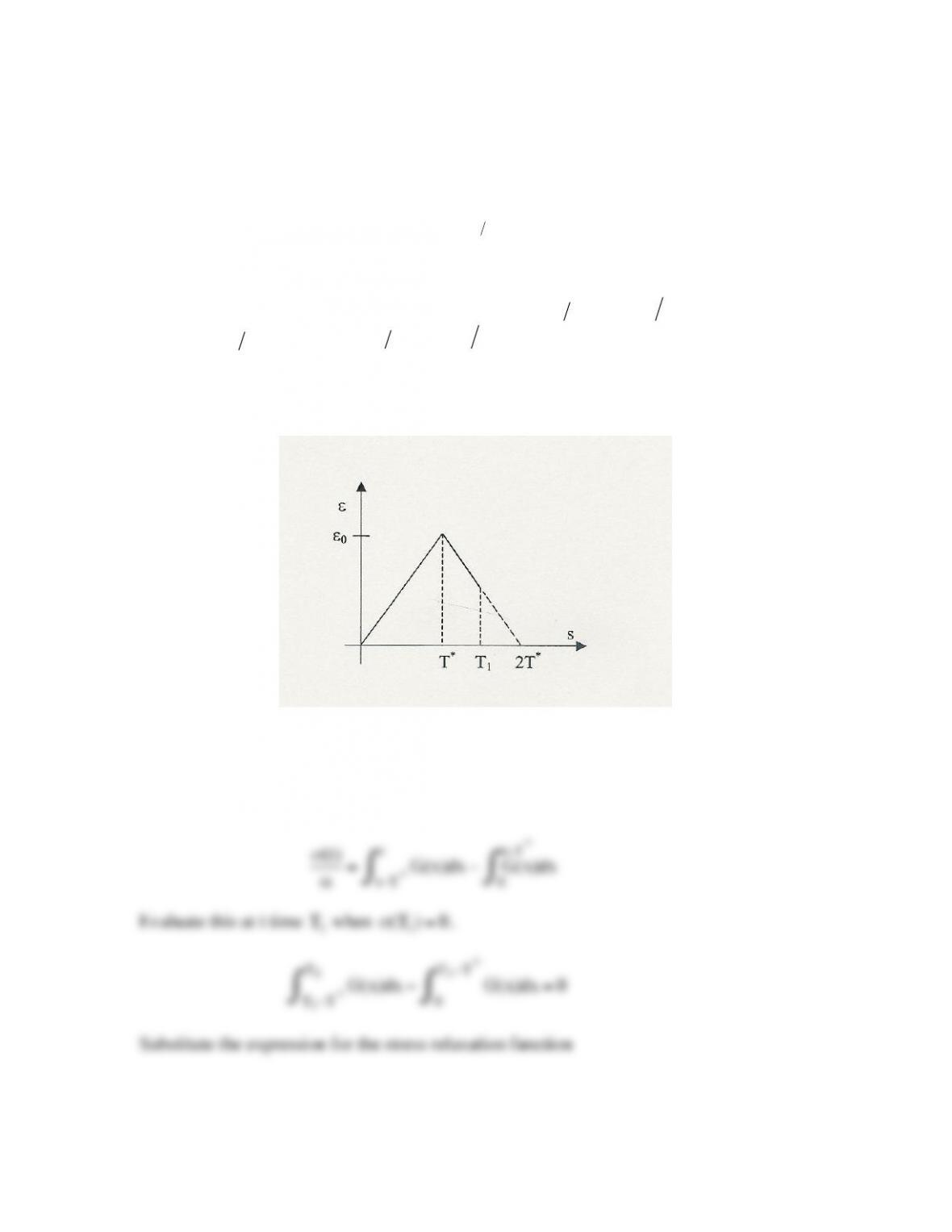
5.7 A linear viscoelastic material undergoes the strain history shown in Figure-
Problem 5.7
(a) Let the stress relaxation function have the form
!
G(t) =A+Be“t#
where
!
A=G“
and
!
B=Go“G#
. Set up an equation for the time
!
T
1
when the
stress becomes zero. Express the equation in terms of
!
T
1“R
and
!
T*“R
.
(b) Let
!
G“Go=0.1
. Find
!
T
1“R
for
!
T*“R=0.5, 1.0, 5.0
.
(c) Suppose that the stress remains zero for times
!
T
1“t
. Set up an expression
for the strain which applies for
!
T
1“t
.
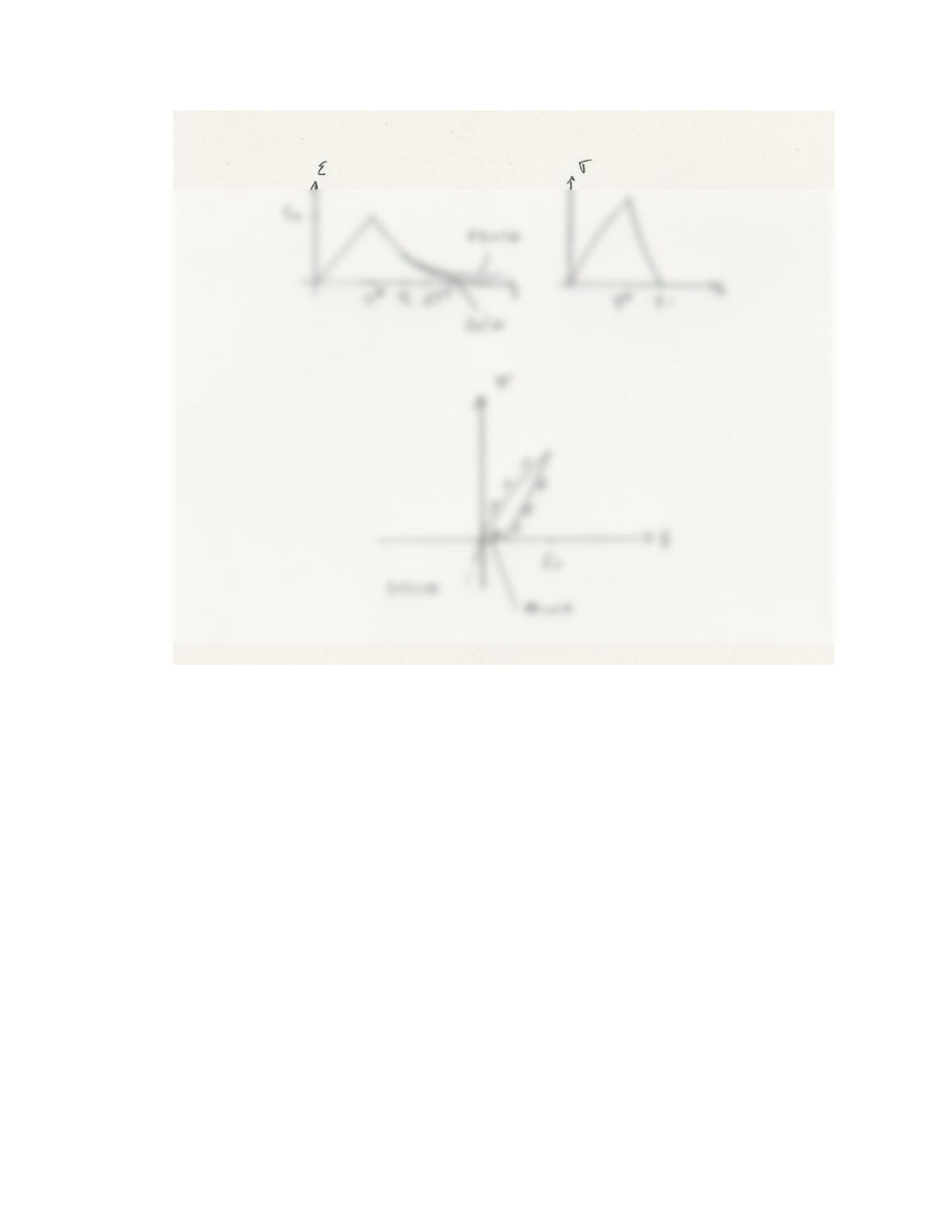
(d) Sketch a plot of stress vs. strain for all times.
Figure-Problem 5.7
SOLUTION
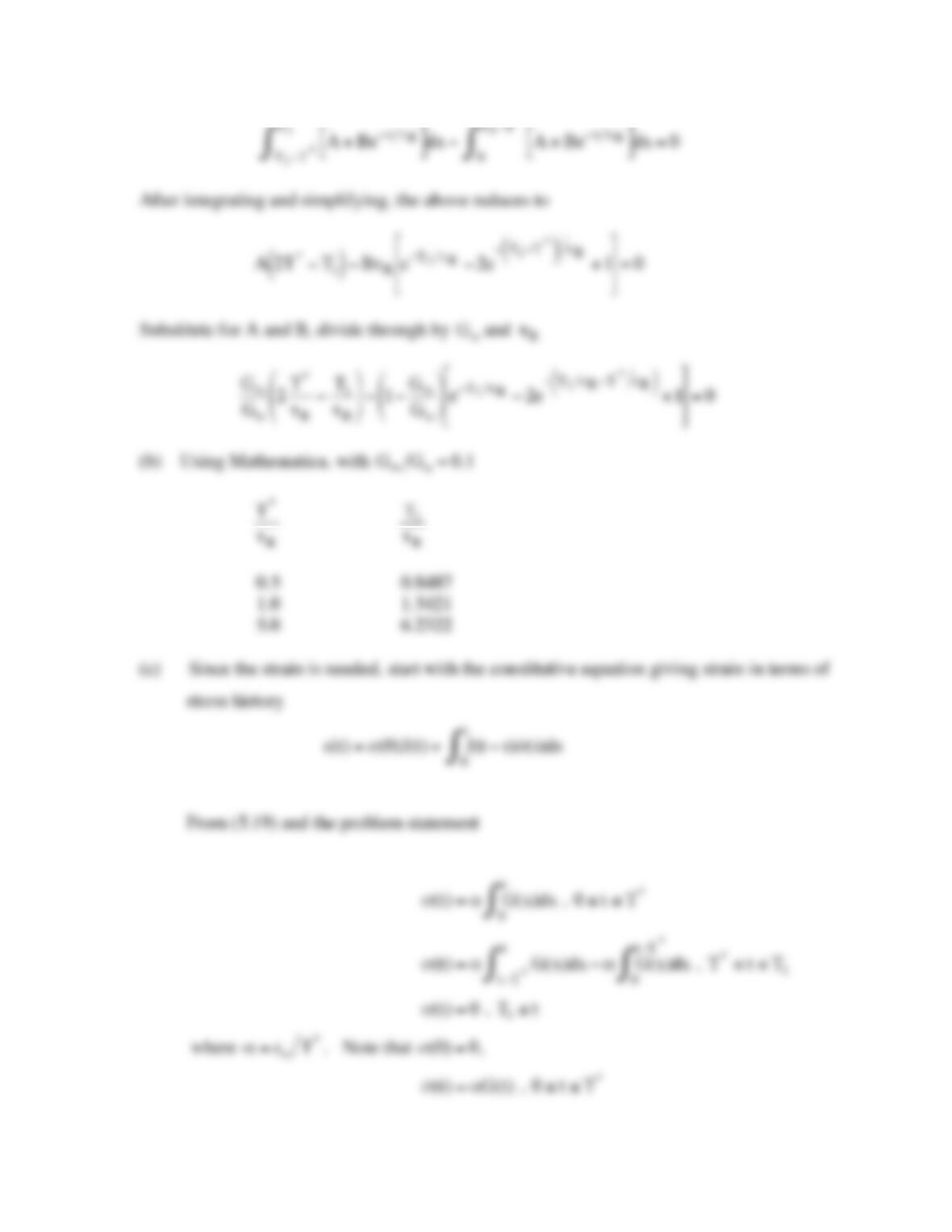
(a) From equation (5.19), the stress in the interval
!
T* “t“2T *
is given by
“(t)
#=G(x)dx $G(x)dx
0
t$T*
%
t$T*
t
%
A+Be“x#R
[ ]
dx “A+Be“x#R
[ ]
dx
0
T1“T*
$
T1“T*
T1
$=0
!
!
!
!
!
˙
“ (t) =#G(t)
,
!
0“t“T*
!
˙
“ (t) =#G(t) $2G(t $T*)
[ ]
,
!
T*“t“T
1
!
˙
“ (t) =0
,
!
T
1“t
.
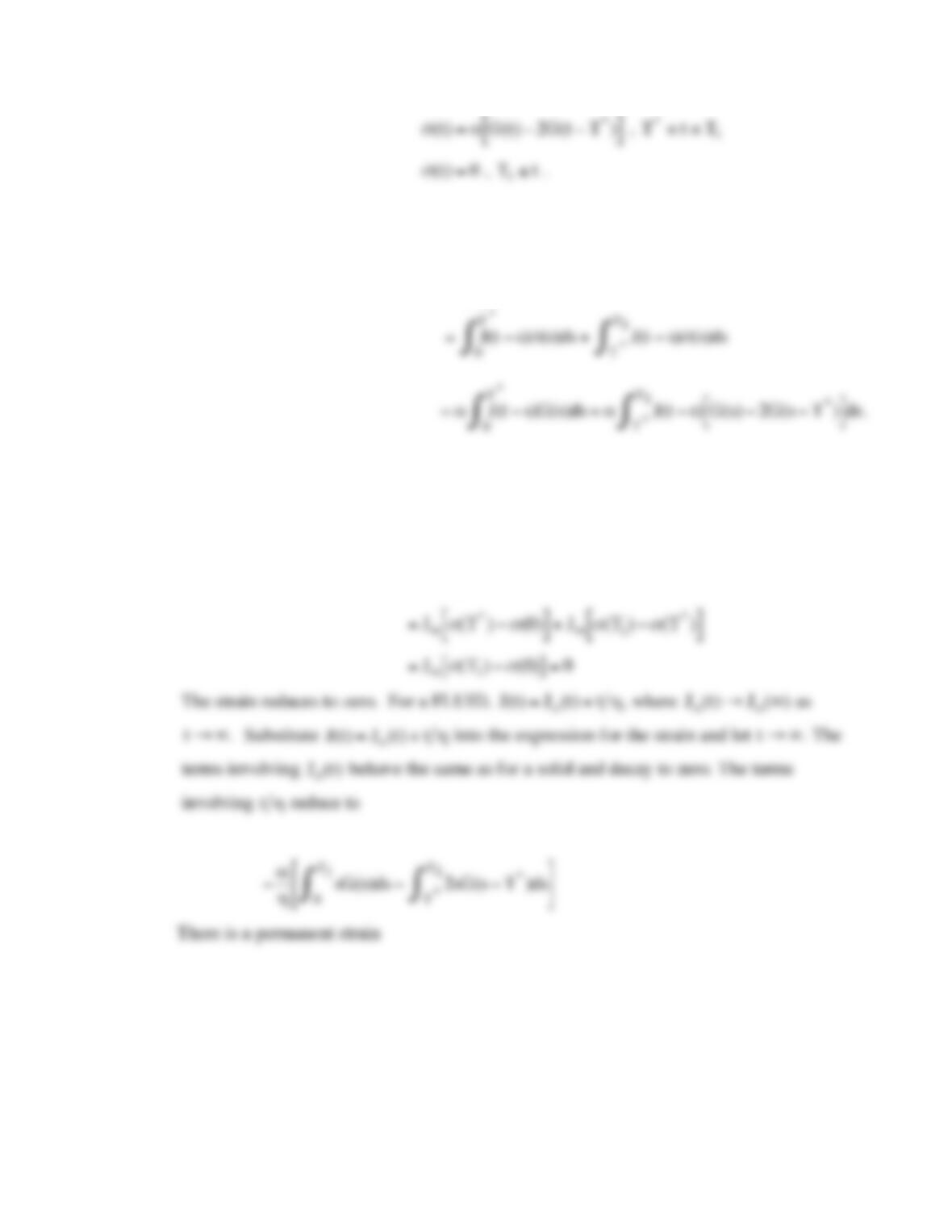
Let
!
T
1“t
. The expression for the strain is
“(t) =J(t #s) ˙
$ (s)ds
0
T1
%
=J(t “s) ˙
# (s)ds
0
T*
$+J(t “s) ˙
# (s)ds
T*
T1
$
!
Note: In these integrals, the variable ‘s’ is bounded by the limits of integration while the
variable ‘t’ can increase to any value. For a SOLID:
!
J(t “s) #J$
as
!
t” #
. Then
“(t) #J$˙
% (s)ds
0
T*
&+J$˙
% (s)ds
T*
T1
&
=J“#(T*)$ #(0)
[ ]
+J“#(T
1)$ #(T*)
[ ]
!
There is a permanent strain
(d)
5.8 A constant strain rate deformation and recovery test is performed on a
material whose stress relaxation function is
!
G(t) =200e“t 5 +100e“t 10 +5
( )
Co
,
where
!
Co
is a constant with the dimensions of stress.
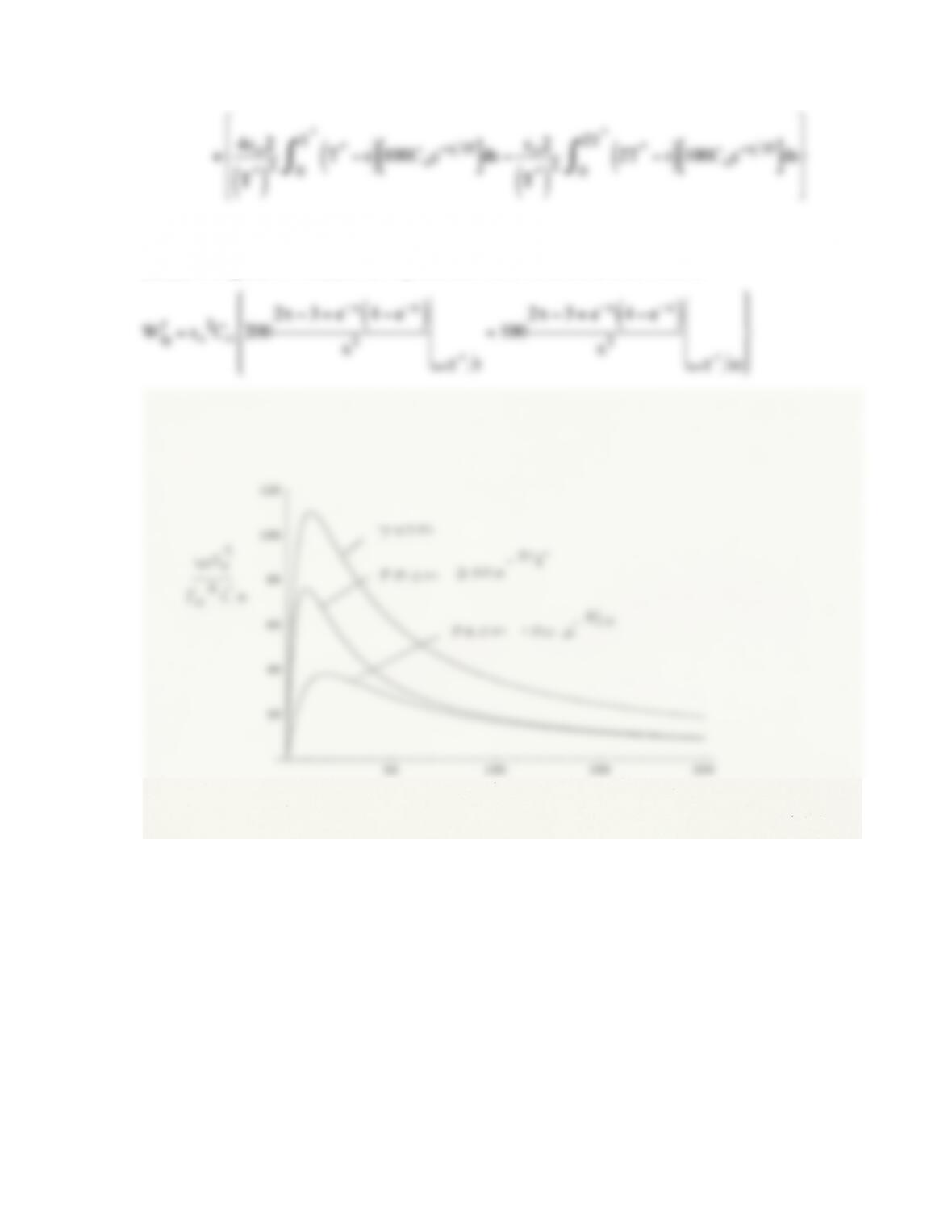
Write an expression for the work done,
!
W0
t
, in this test. Plot
!
W0
t
versus
!
T*
. Indicate
any local maxima.
SOLUTION
!
G(“)=5Co
!
“G(t) =200Coe#t 5 +100Coe#t 10
The expression for the work done is given in (5.32) for any
“G(t)
. If
“G(t) =Ae#t$
as in
(5.33), then
!
T*
( )
(
!
T*
( )
(
!
+4“o2
T*
( )
2T*#s
( )
0
T*
$100Coe#s 10
[ ]
ds
%
&
‘
(
!
“#o2
T*
( )
22T*“s
( )
0
2T*
$100Coe“s 10
[ ]
ds
%
&
‘
(
The expression in each set of braces is the work corresponding to one of the exponential terms in
!
“G(t)
. Using (1) to evaluate the expressions in the braces, the total work is
!
W0
t=“o
2Co200
2x #3+e#x4#e#x
( )
x2
x=T*5
$
%
&
‘
&
!
+100
2x “3+e“x4“e“x
( )
x2
x=T*10
#
$
%
&
%