CHAPTER 5
HVAC DELIVERY SYSTEMS
OVERVIEW
Section 5.1 introduces the range of system options available, from single package units to central
plants, emphasizing that all systems, regardless of size, work by one or a combination of two
principles – vary the temperature and/or the quantity of air supplied to a space.
Sections 5.2 and 5.3 are an overview of HVAC controls. The term “zone” is explained in its
strict HVAC context. Understanding “zoning” is key to a good working knowledge of HVAC
design and should be stressed in class. Basic control systems and hardware is introduced in
Section 5.3. In teaching this material, the author finds that posing a series of questions is useful.
First, what variable are we trying to control (temperature or humidity or airflow, etc.)? Then,
how do we measure, or sense, the variable? Finally, what must happen in the system to affect
the variable? These questions in conjunction with the schematic diagrams are useful for students
to think logically about controls.
The remainder of the chapter presents systems which are commonly used in buildings, describing
how they work along with their strengths and weaknesses. When presenting this material,
consider going through all the systems once quickly, then discussing specific buildings or
building types and which systems would be appropriate selections.
CHAPTER 5
HVAC DELIVERY SYSTEMS
QUESTIONS AND ANSWERS
5.1 Describe the basic difference between interior and perimeter space with respect to
HVAC loads.
5.2 What principles are used to vary the amount of HVAC service to a space with varying
loads?
Systems vary HVAC service by three methods:
5.3 What is an HVAC zone, and how might a zone differ from a room?
5.4 Name the HVAC delivery systems that are most flexible for adding or rearranging
zones. Why are they effective in this respect?
5.5 Which HVAC delivery systems are best for preventing high humidity in spaces? Why?
5.6 Which HVAC delivery systems are generally avoided because of their high energy
usage?
5.7 Which HVAC delivery systems are most energy efficient? Why?
5.8 Which HVAC delivery systems would be most appropriate in a building in which risk
of water damage is a serious concern?
5.9 Which HVAC delivery systems would be most appropriate in a building in which
intrusion for maintenance within occupied spaces must be kept at a minimum?
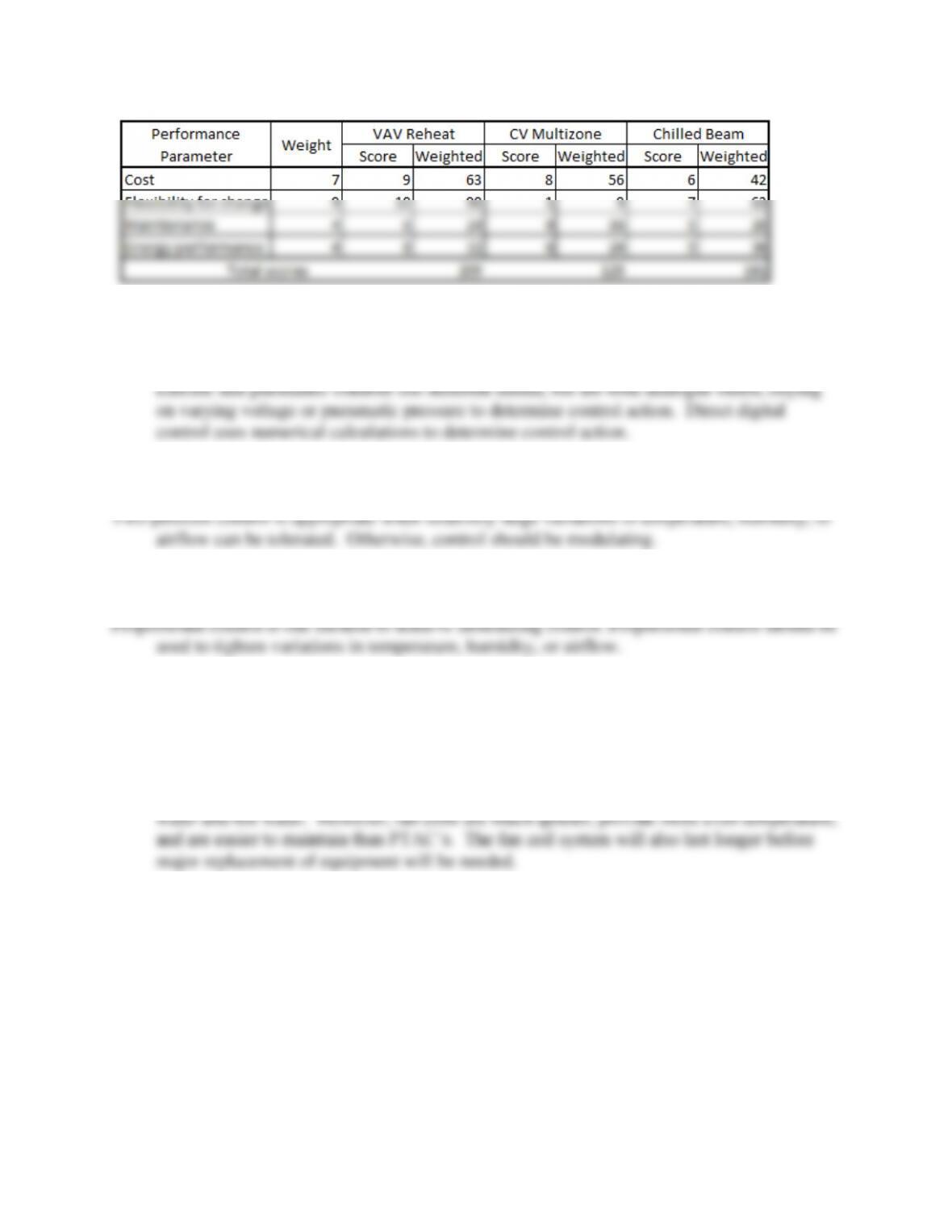
5.10 Prepare a decision matrix (see Chapter 1) for a high-tech brokerage office comparing
5.11 Describe the major difference between electric or pneumatic control and direct digital
control.
5.12 When is it appropriate to use two-position control?
5.13 When is it appropriate to use proportional control?
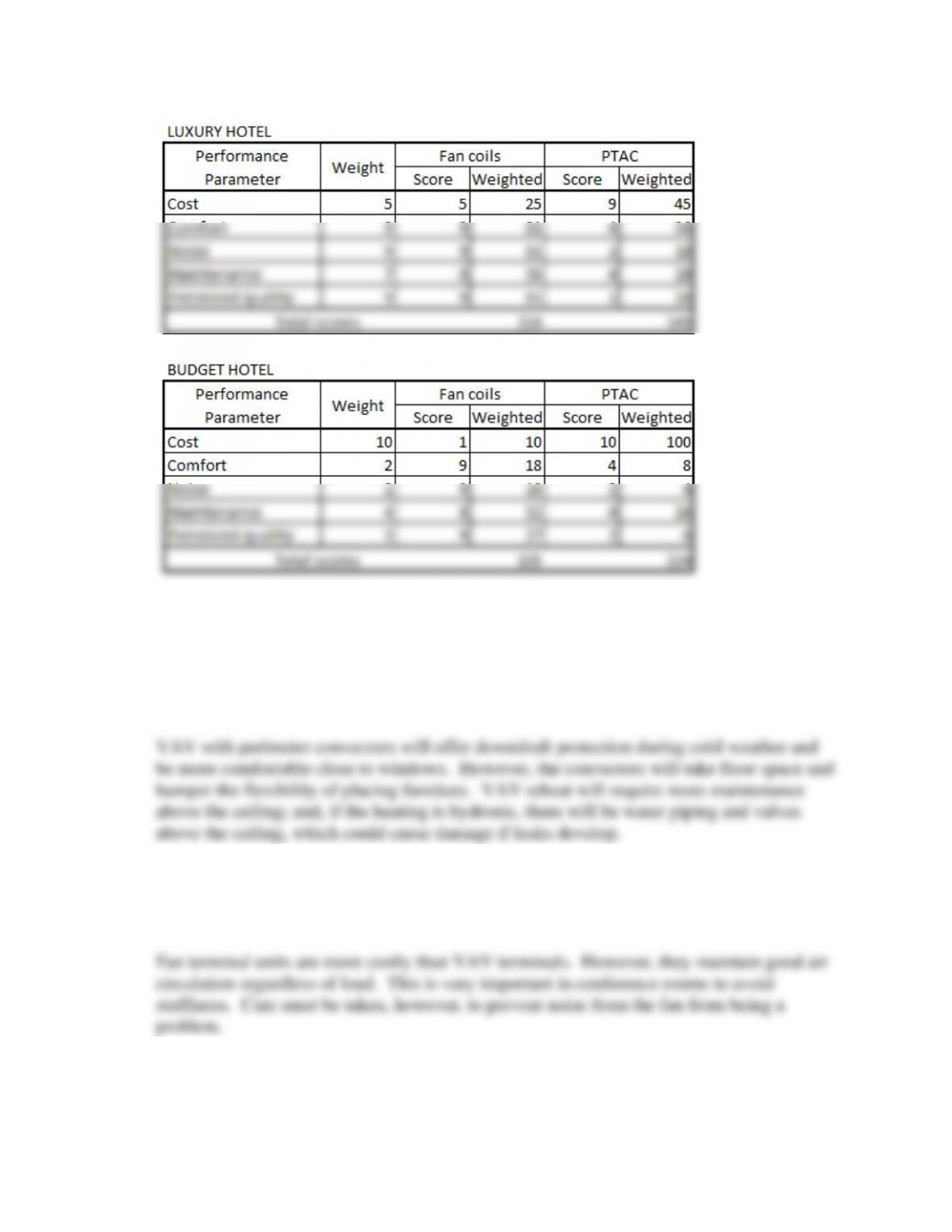
5.14 A luxury hotel developer is deciding whether to use fan coils or PTAC units. How would
you counsel him or her on matters of cost, comfort, noise, maintenance, and perceived
quality? What if he is planning a budget hotel? Prepare decision matrices (see Chapter
1) to support your advice.
Fan coils will be more expensive due to the need for a central plant to produce chilled
5.15 You are helping an owner decide on systems for a new office building. For perimeter
offices, either VAV reheat or VAV with perimeter convectors could be used. The
contractor will provide either system for the same cost. How would you counsel the
owner on matters of cost and quality?
5.16 You are helping an owner decide between VAV terminals and FTU terminals for
interior conference rooms in a new office building. How would you counsel the owner
on matters of cost and quality?
5.17 Why would you recommend the extra construction cost of a four-pipe fan coil system
versus a two-pipe fan coil system?
5.18 What is the primary energy advantage of using radiant cooling?
5.19 How are water-source heat pumps and PTAC units similar? How are they different?
5.20 How can a dedicated outside air system (DOAS) save energy when used in conjunction
with a central VAV system?
5.21 What are the energy and design advantages of a DOAS–chilled beam system
combination?