469
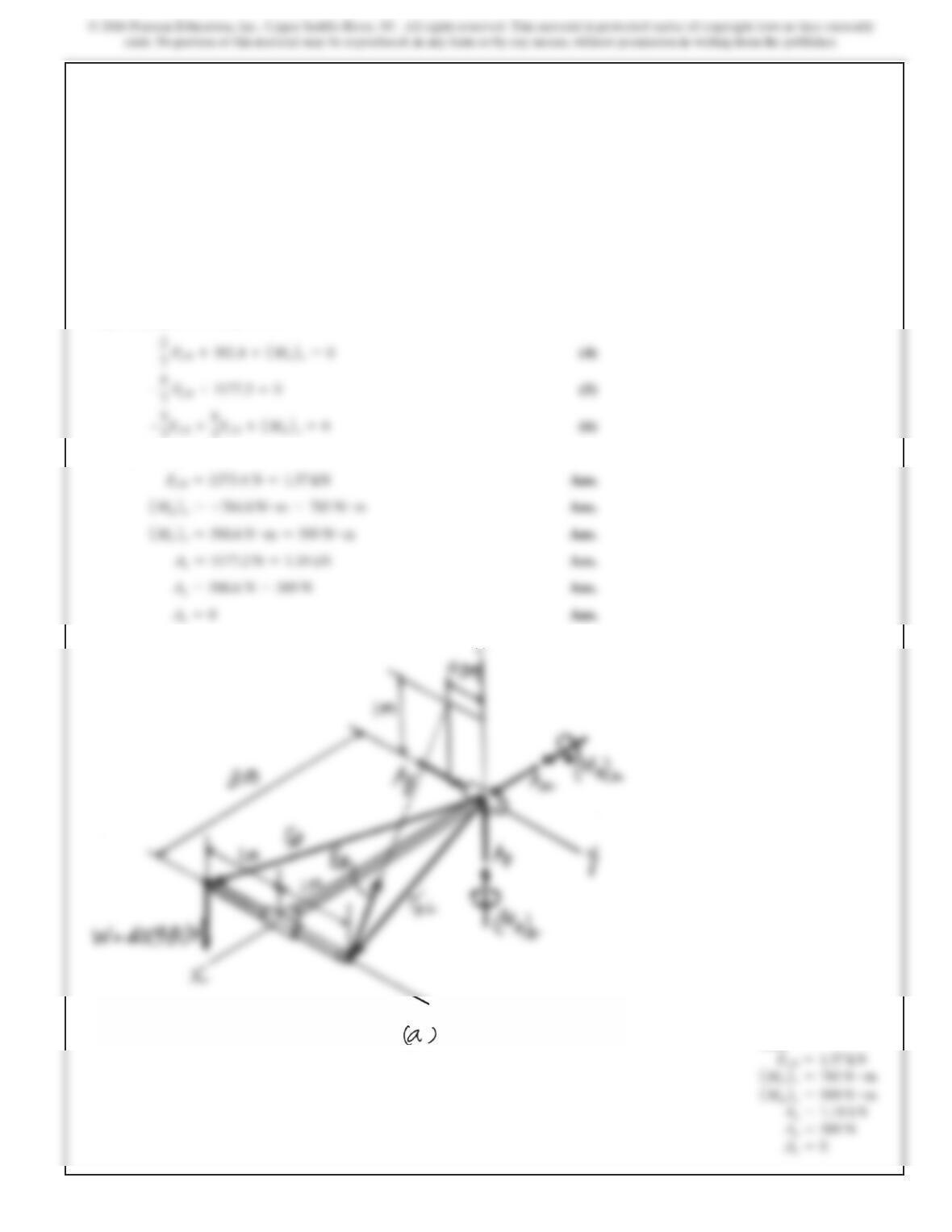
*5–76. Continued
Equating i, j and k components,
7
7
7
Solving Eqs (1) to (6),
Ans:
470
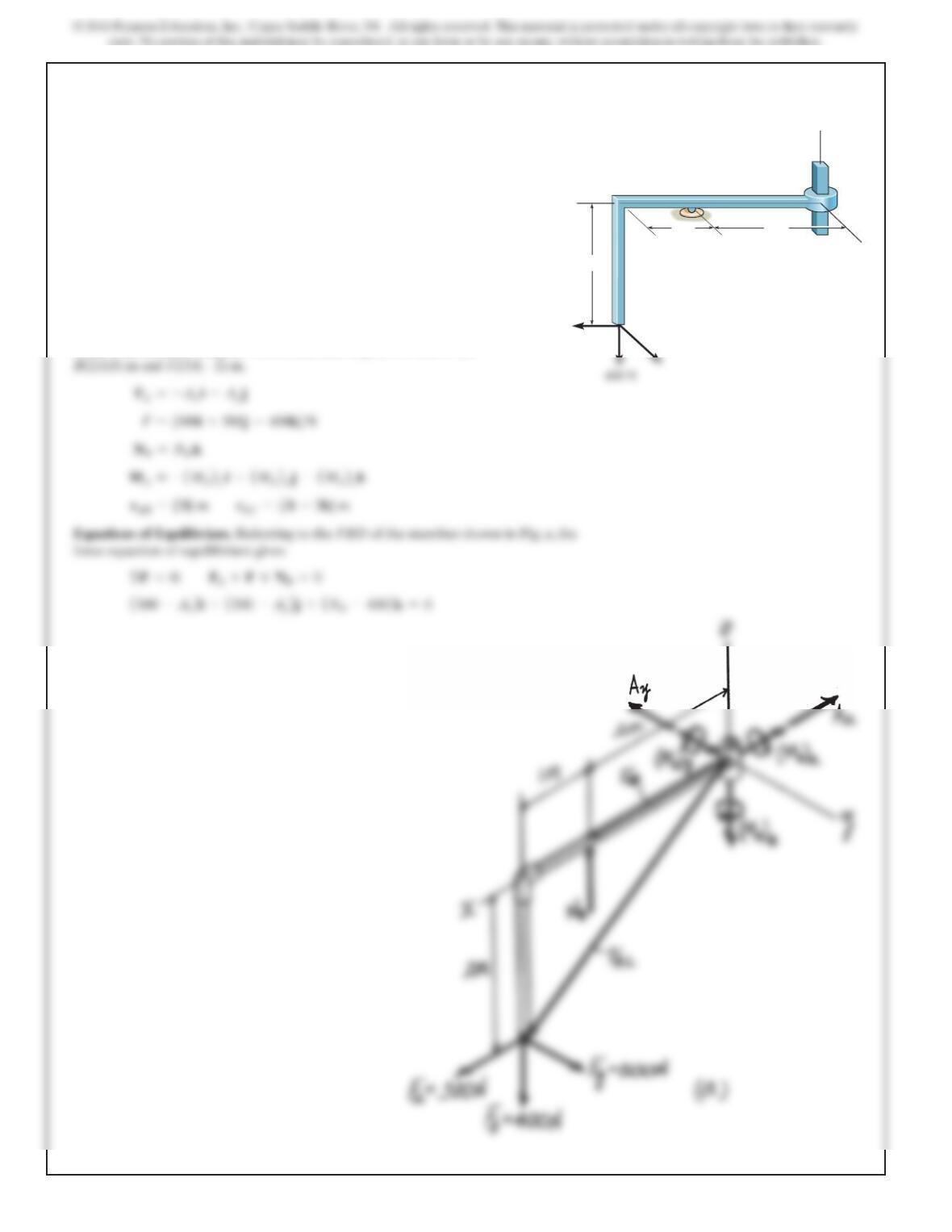
5–77.
The member is supported by a square rod which fits loosely
through the smooth square hole of the attached collar at A
and by a roller at B. Determine the components of reaction
at these supports when the member is subjected to the
loading shown.
y
z
xA
B1 m 2 m
2 m
300 N
500 N
C
SOLUTION
Force And Position Vectors. The coordinates of points B and C are
471
Ans:
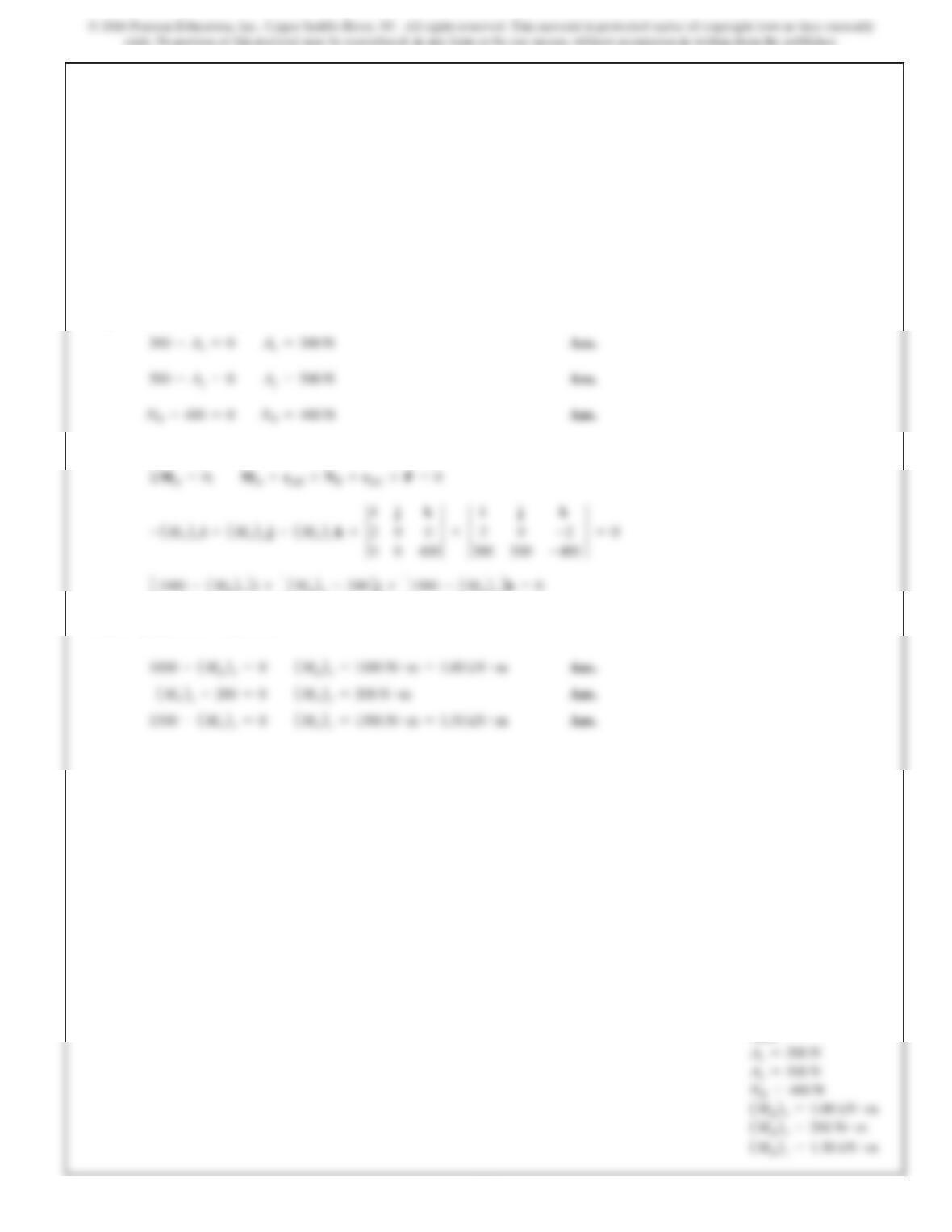
5–77. Continued
Equating i, j and k components,
The moment equation of equilibrium gives
x
y–200
z
Equating i, j and k components,
472
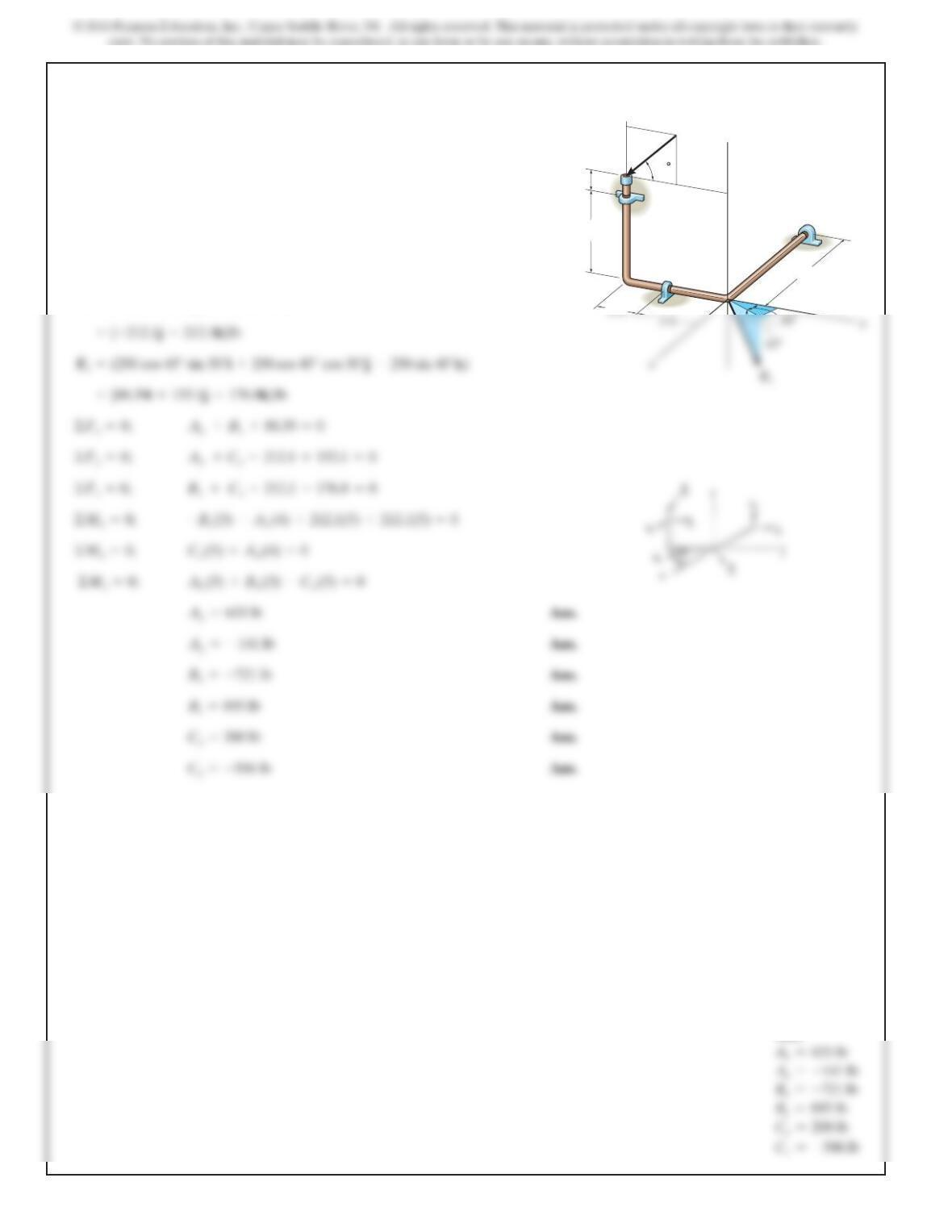
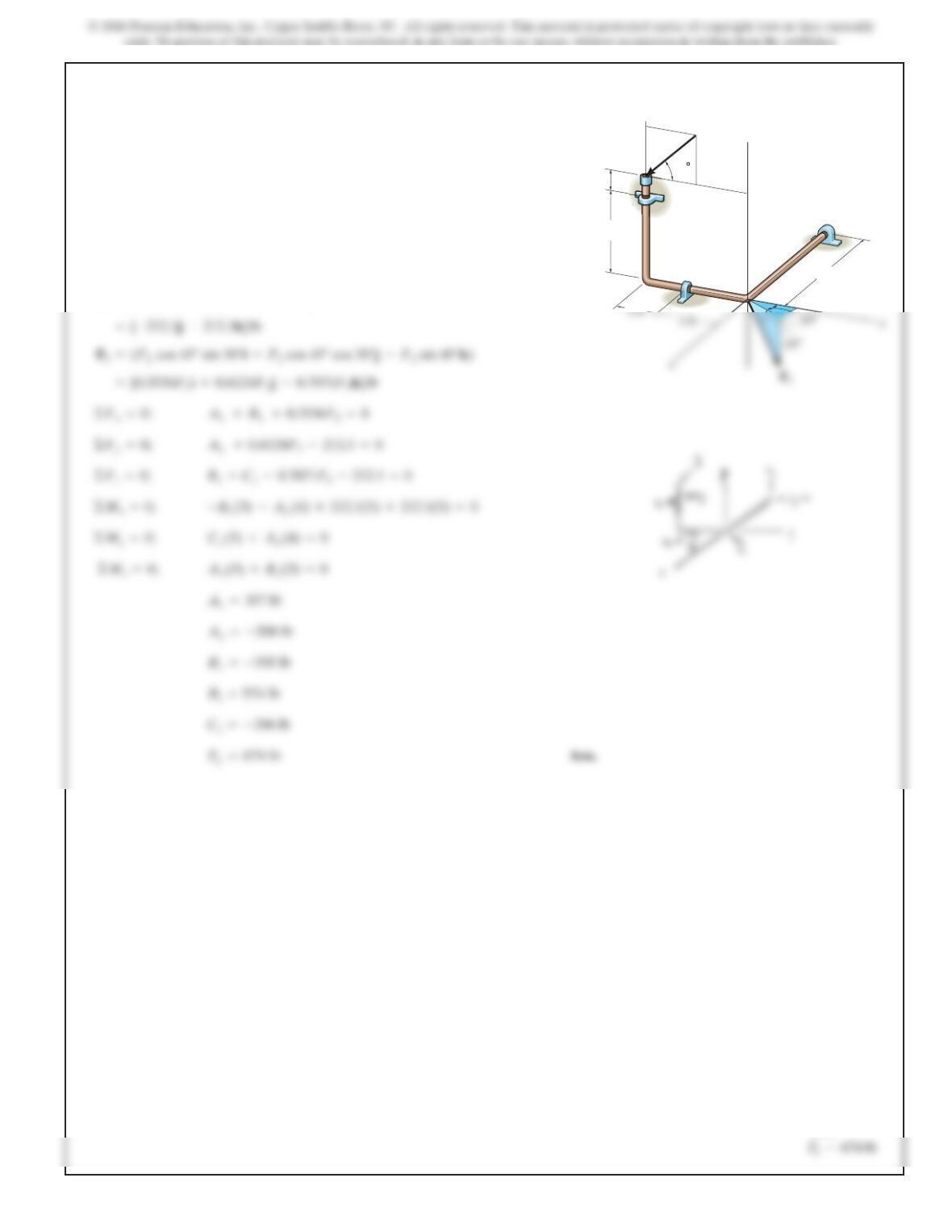
5–78.
The bent rod is supported at A, B, and Cby smooth journal
bearings. Compute the x, y, zcomponents of reaction at the
bearings if the rod is subjected to forces and
lies in the y–z plane.The bearings are in
proper alignment and exert only force reactions on the rod.
F
1
F
2=250 lb.
F
1=300 lb
SOLUTION
F1=(–300 cos 45°j–300 sin 45°k)
z
5ft
45
F
1
C
4ft
1ft
A
B
Ans:
473
5–79.
SOLUTION
F1=(–300 cos 45°j–300 sin 45°k)
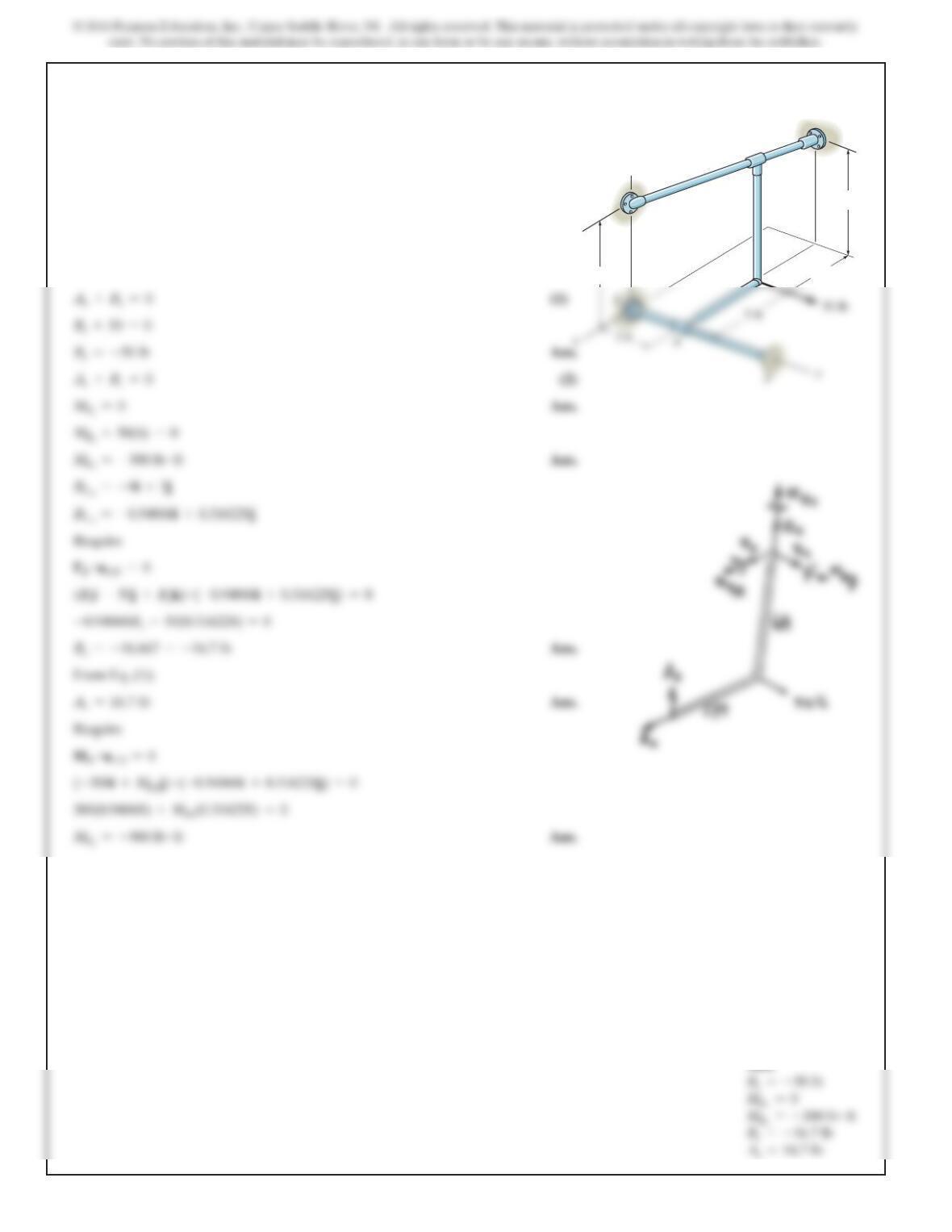
The bent rod is supported at A, B, and Cby smooth journal
bearings. Determine the magnitude of which will cause
the reaction at the bearing Cto be equal to zero. The
bearings are in proper alignment and exert only force
reactions on the rod. Set F
1=300 lb.
Cy
F2
z
5ft
45
F
1
C
4ft
1ft
A
B
Ans:
474
*5–80.
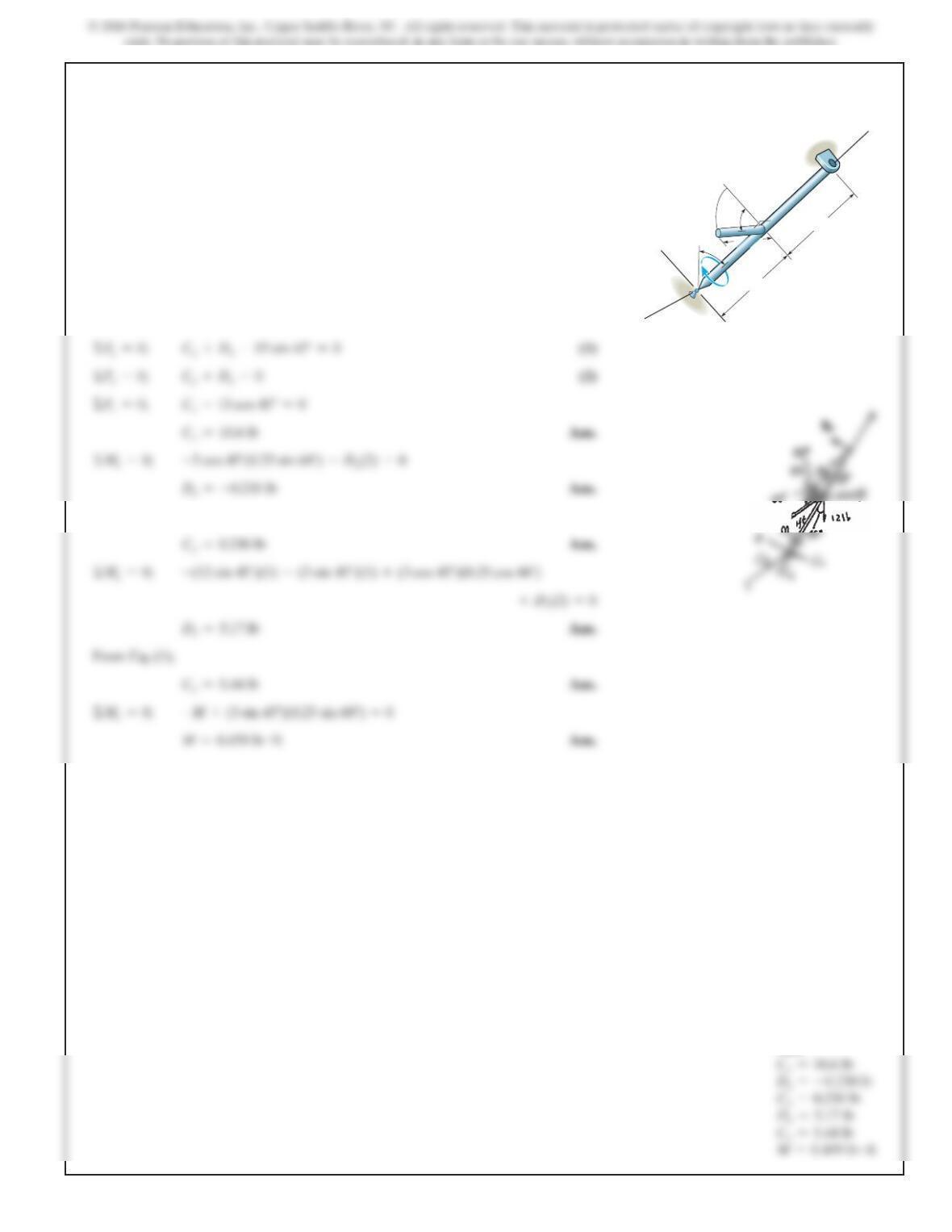
The bar AB is supported by two smooth collars. AtA the
connection is with a ball-and-socket joint and at B it is a
rigid attachment. If a 50-lb load is applied to the bar,
determine the x, y, z components of reaction at A and B.z
C
B
D
6 ft
4 ft
6 ft
SOLUTION
475
5–81.
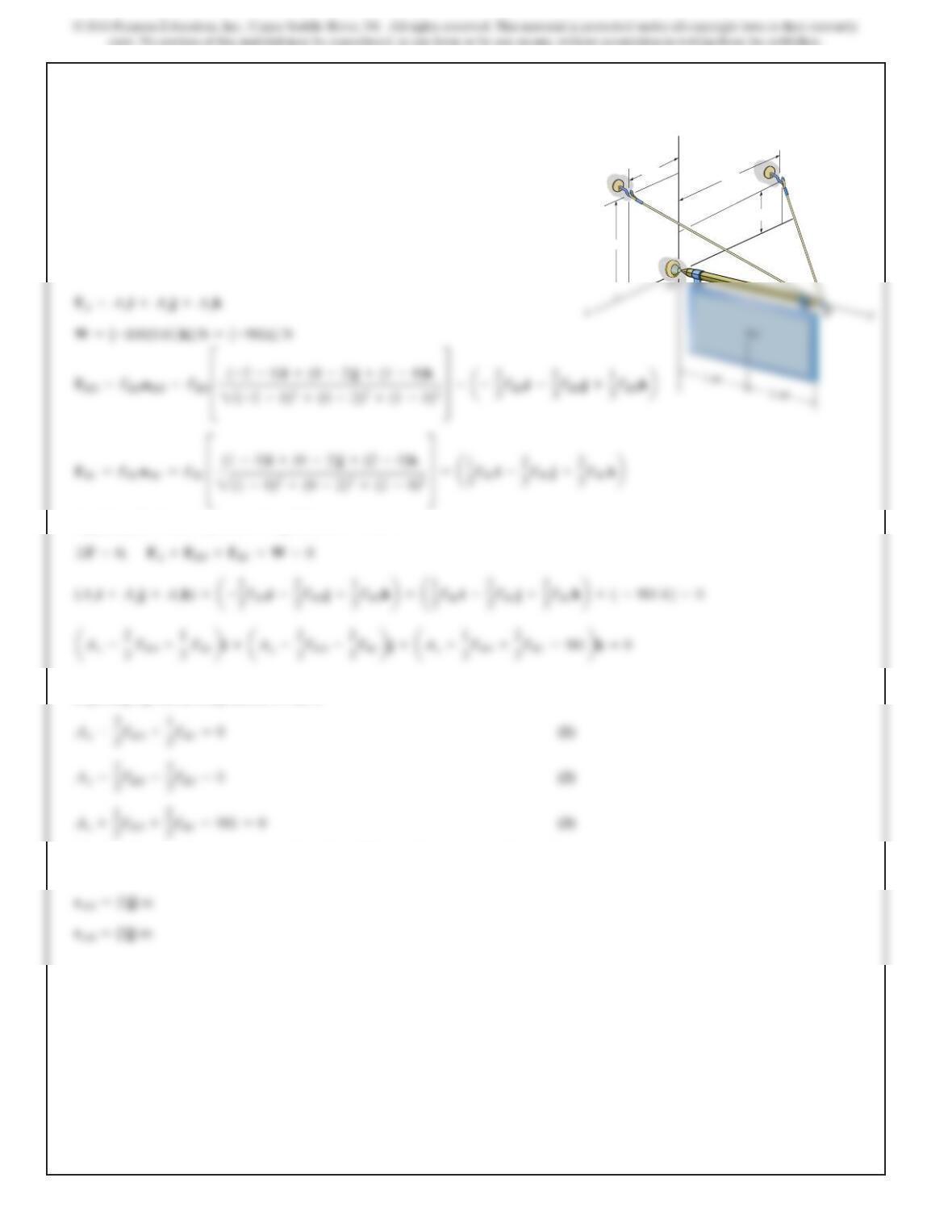
The rod has a weight of 6 lb
>
ft. If it is supported by a ball-
and-socket joint at C and a journal bearing at D, determine
the x, y, z components of reaction at these supports and the
moment M that must be applied along the axis of the rod to
hold it in the position shown.
z
y
A
D
C
M
0.5 ft
1 ft
B1 ft
x
60
45
SOLUTION
From Eq. (2);
Ans:
476
5–82.
The sign has a mass of 100 kg with center of mass at G.
Determine the x,y,zcomponents of reaction at the ball-and-
socket joint Aand the tension in wires BC and BD.
SOLUTION
Equations of Equilibrium: Expressing the forces indicated on the free-body
diagram, Fig. a, in Cartesian vector form, we have
Applying the forces equation of equilibrium, we have
Equating i,j, and kcomponents, we have
In order to write the moment equation of equilibrium about point A,the position
vectors and must be determined first.
rAB
rAG
z
D
C
1 m
2 m
1 m
2 m
477
5–82. Continued
Thus,
Equating i,j, and kcomponents we have
Ans:
478
5–83.
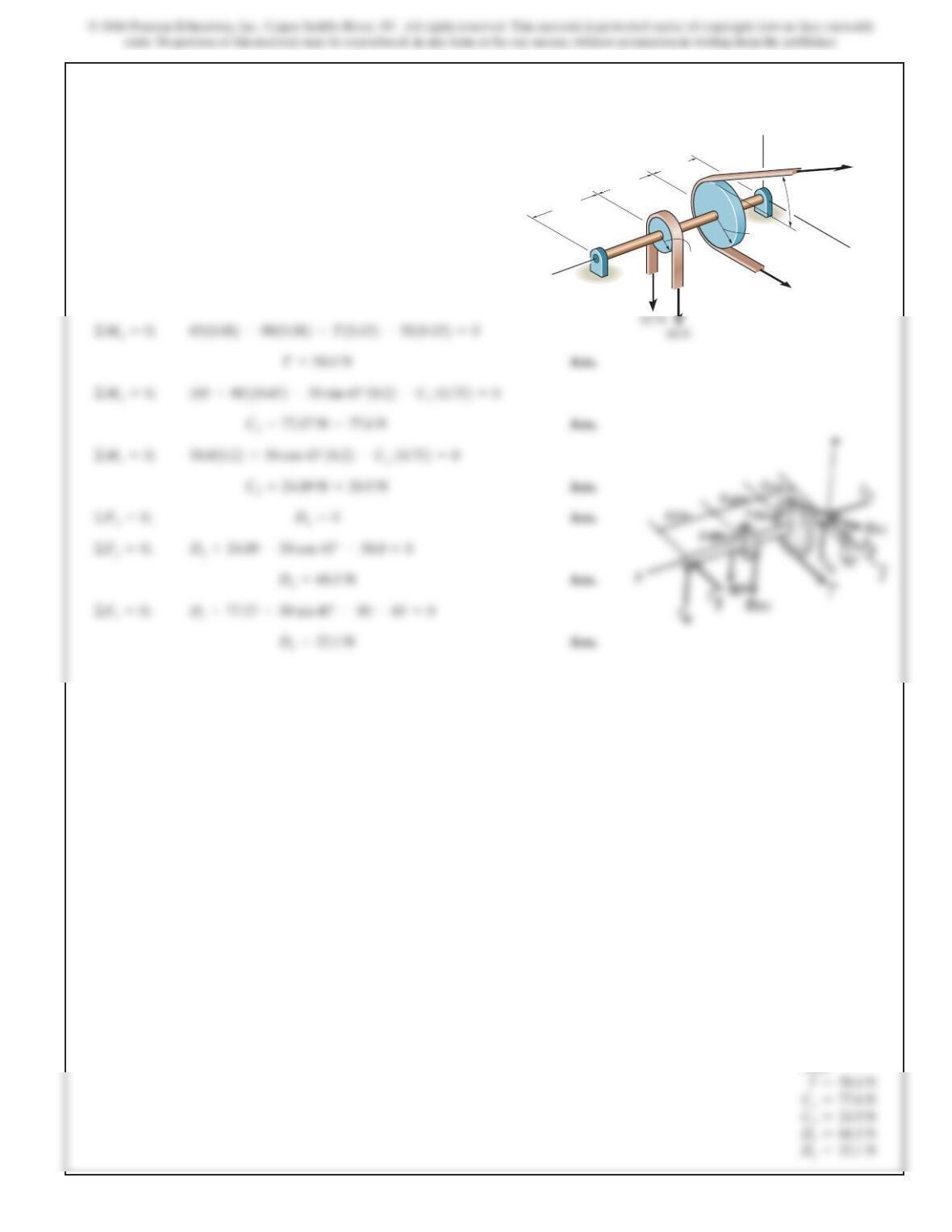
Both pulleys are fixed to the shaft and as the shaft turns
with constant angular velocity, the power of pulley Ais
transmitted to pulley B. Determine the horizontal tension T
in the belt on pulley Band the x, y, zcomponents of
reaction at the journal bearing Cand thrust bearing Dif
The bearings are in proper alignment and exert only
force reactions on the shaft.
u=0°.
SOLUTION
Equations of Equilibrium:
300 mm
250 mm
150 mm
80 mm
200 mm
T
50 N
z
y
A
B
C
D
x
u
Ans:
479
*5–84.
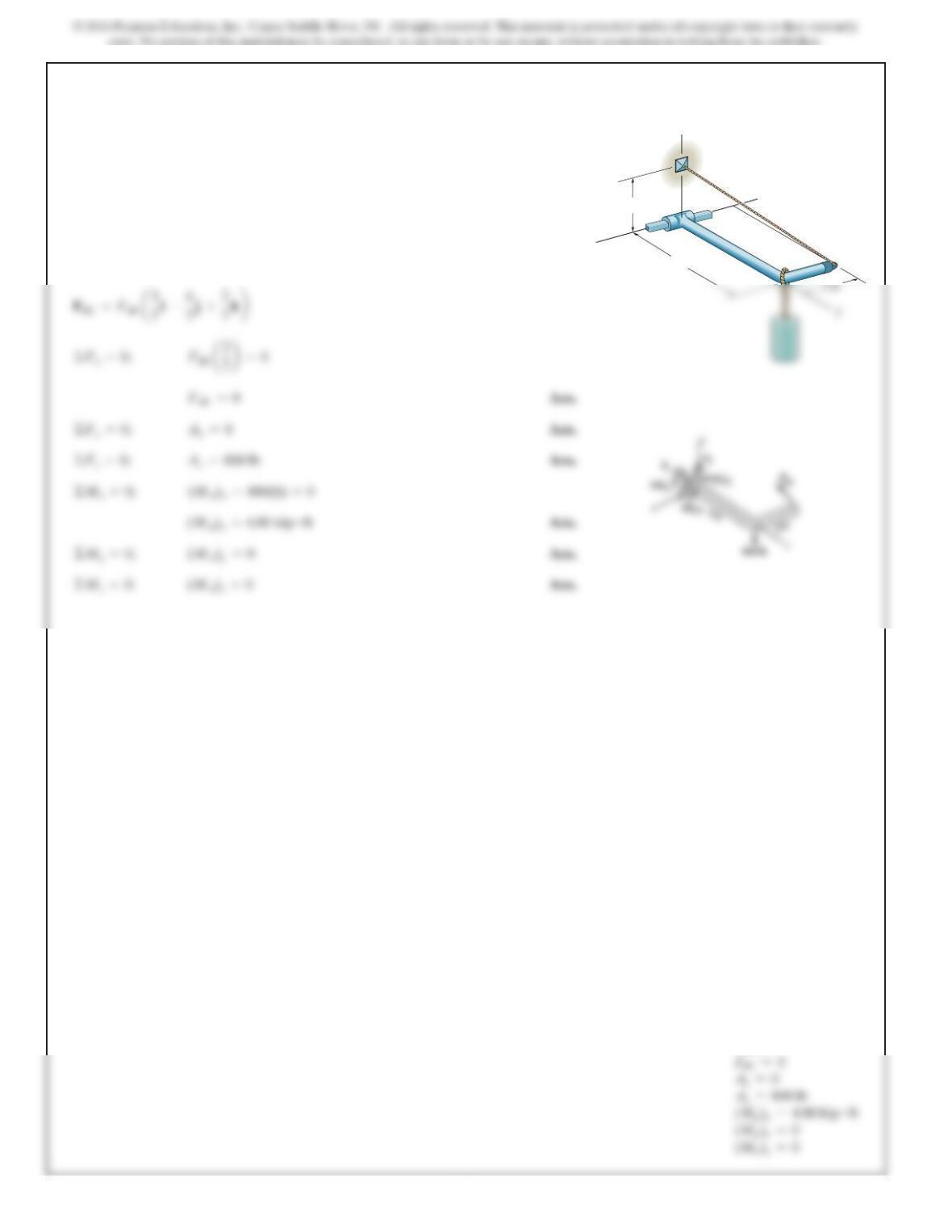
Both pulleys are fixed to the shaft and as the shaft turns
with constant angular velocity, the power of pulley Ais
transmitted to pulley B. Determine the horizontal tension T
in the belt on pulley Band the x, y, zcomponents of
reaction at the journal bearing Cand thrust bearing Dif
The bearings are in proper alignment and exert
only force reactions on the shaft.
u=45°.
SOLUTION
Equations of Equilibrium:
300 mm
250 mm
150 mm
80 mm
200 mm
T
50 N
z
y
A
B
C
D
x
u
Ans:
480
5–85.
Mem
b
er AB
i
s supporte
d
b
y a ca
bl
e BC an
d
at A
b
y a square
rod which fits loosely through the square hole at
the end joint of the member as shown. Determine the
components of reaction at Aand the tension in the cable
needed to hold the 800-lb cylinder in equilibrium.
SOLUTION
B
6ft
2ft
C
z
x
A
Ans: