397
5–10.
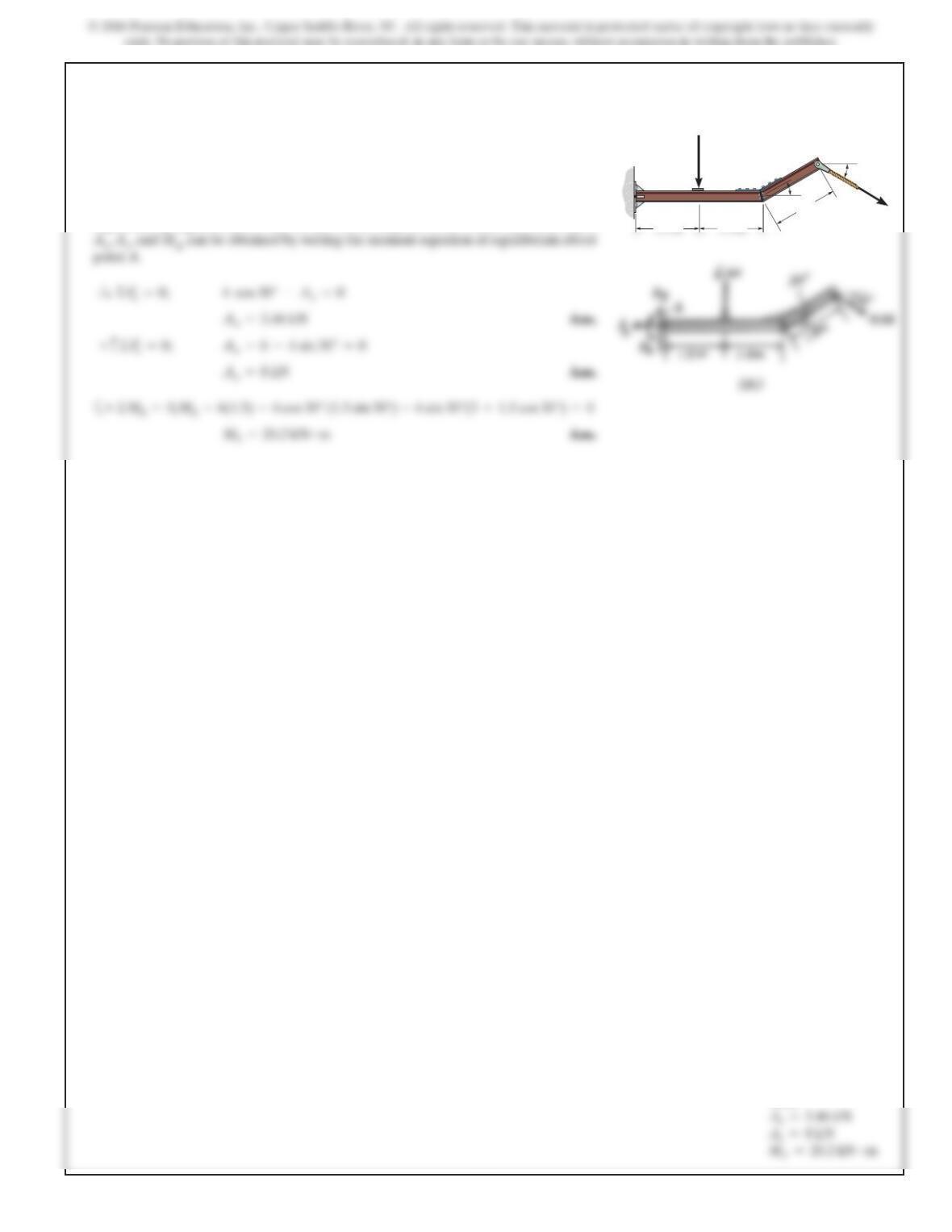
Determine the components of the support reactions at the
fixed support Aon the cantilevered beam.
1.5 m
30
30
4 kN
6 kN
A
SOLUTION
Equations of Equilibrium:From the free-body diagram of the cantilever beam, Fig. a,
Ans:
398
Ans:
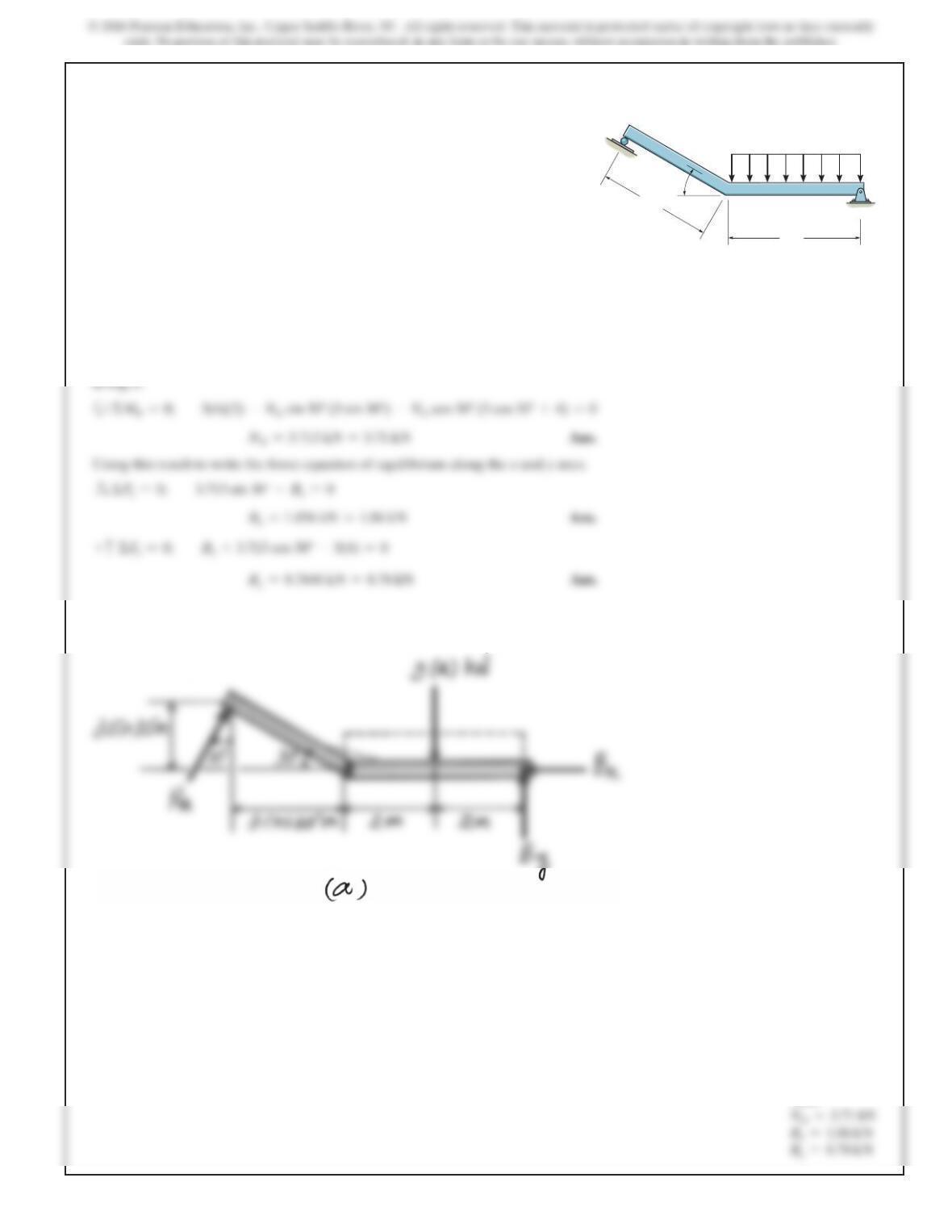
SOLUTION
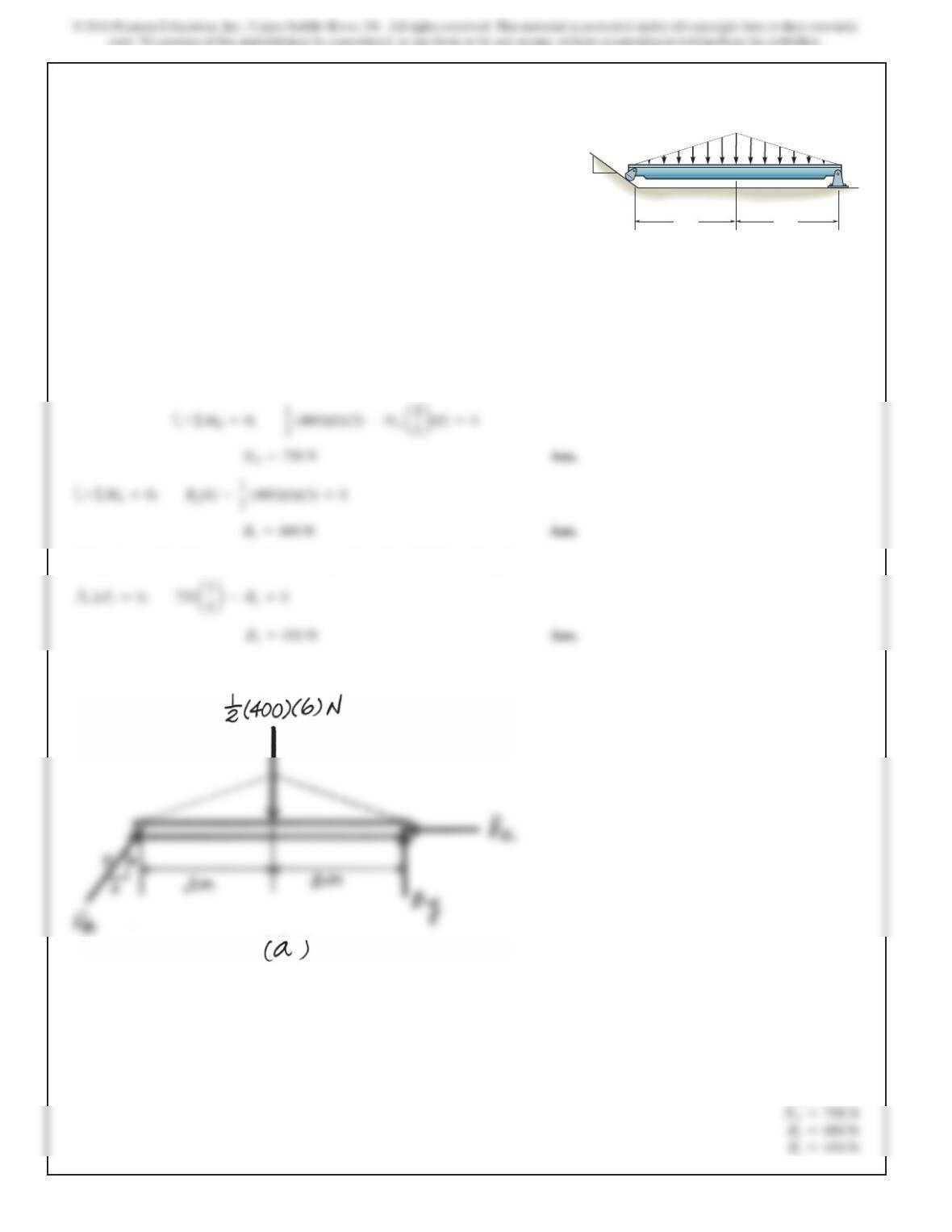
Equations of Equilibrium. NA and By can be determined directly by writing the
moment equations of equilibrium about points B and A, respectively, by referring to
the beam’s FBD shown in Fig. a.
Using the result of NA to write the force equation of equilibrium along the x axis,
5–11.
Determine the reactions at the supports.
400 N/m
3 m
3
4
5
3 m
A
B
399
exist. No portion of this material may be reproduced, in any form or by any means, without permission in writing from the publisher.
*5–12.
6 m
AB
4 kN
2 m
30
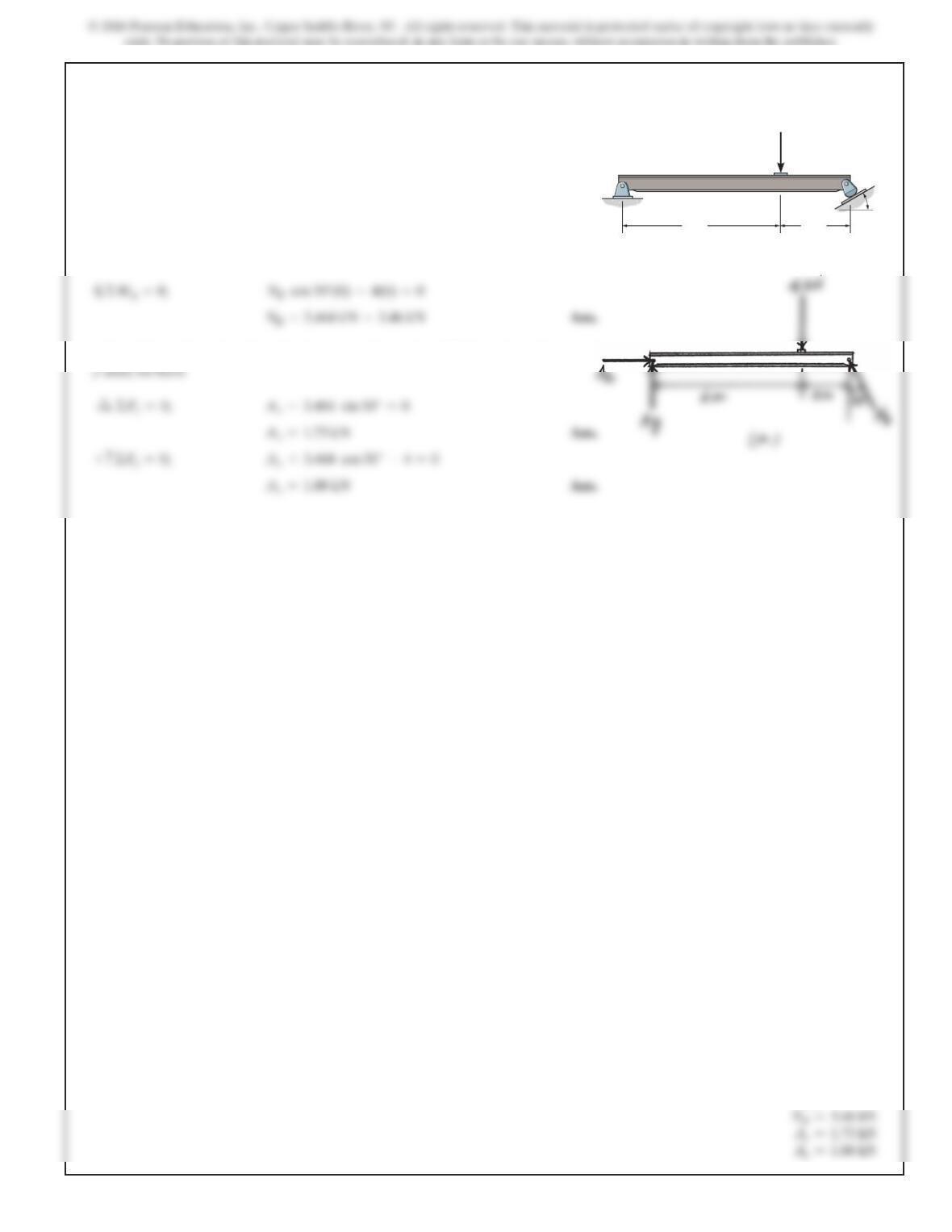
Determine the horizontal and vertical components of
reaction at the pin Aand the reaction of the rocker Bon
the beam.
SOLUTION
Equations of Equilibrium:From the free-body diagram of the beam, Fig.a,NBcan
be obtained by writing the moment equation of equilibrium about point A.
Using this result and writing the force equations of equilibrium along the xand
Ans:
400
Ans:
SOLUTION
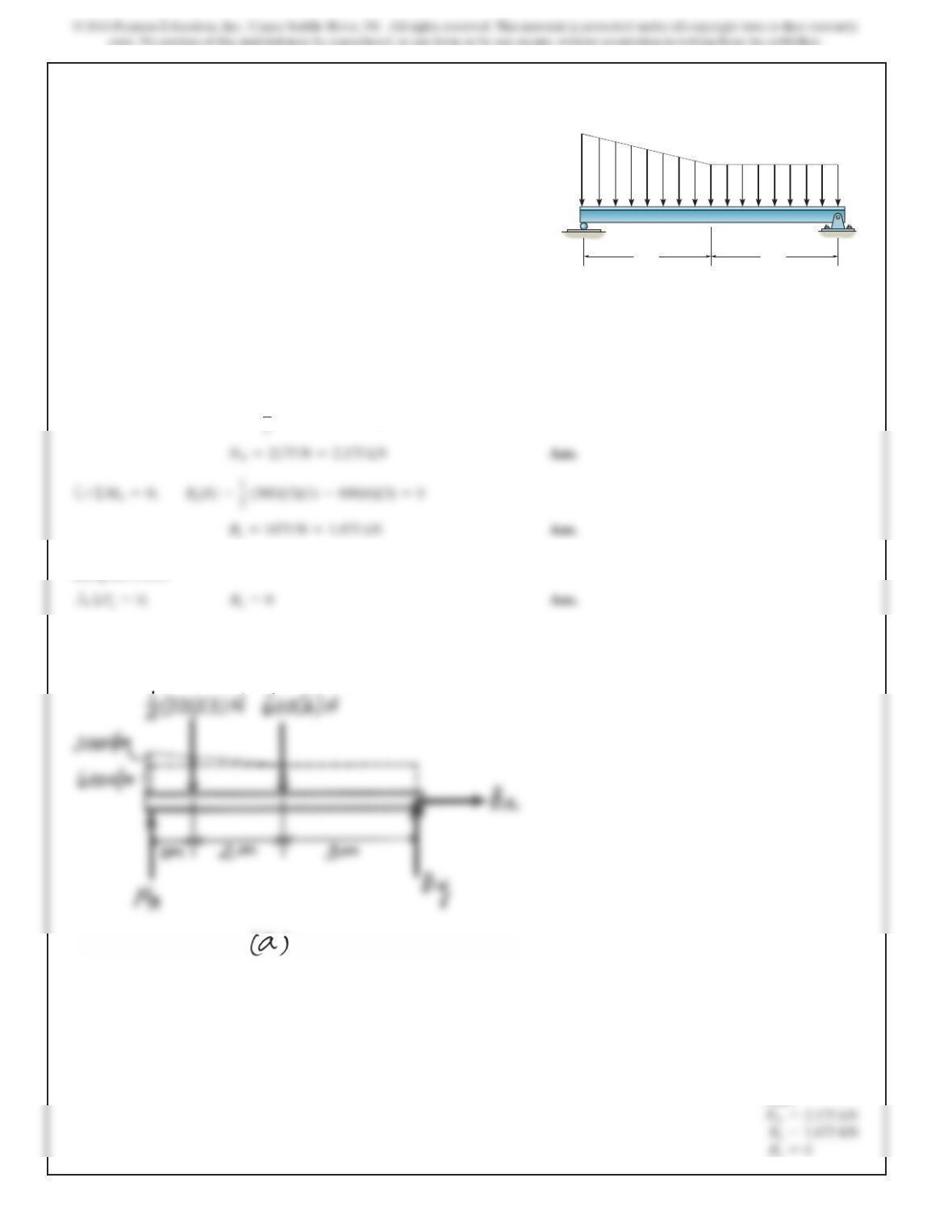
Equations of Equilibrium. NA and By can be determined directly by writing the
moment equations of equilibrium about points B and A, respectively, by referring to
the FBD of the beam shown in Fig. a.
a
+ΣMB=0;
600(6)(3) +
+ΣMA=0;
1
(300)(3)(5) –NA(6) = 0
Also, Bx can be determined directly by writing the force equation of equilibrium
along the x axis.
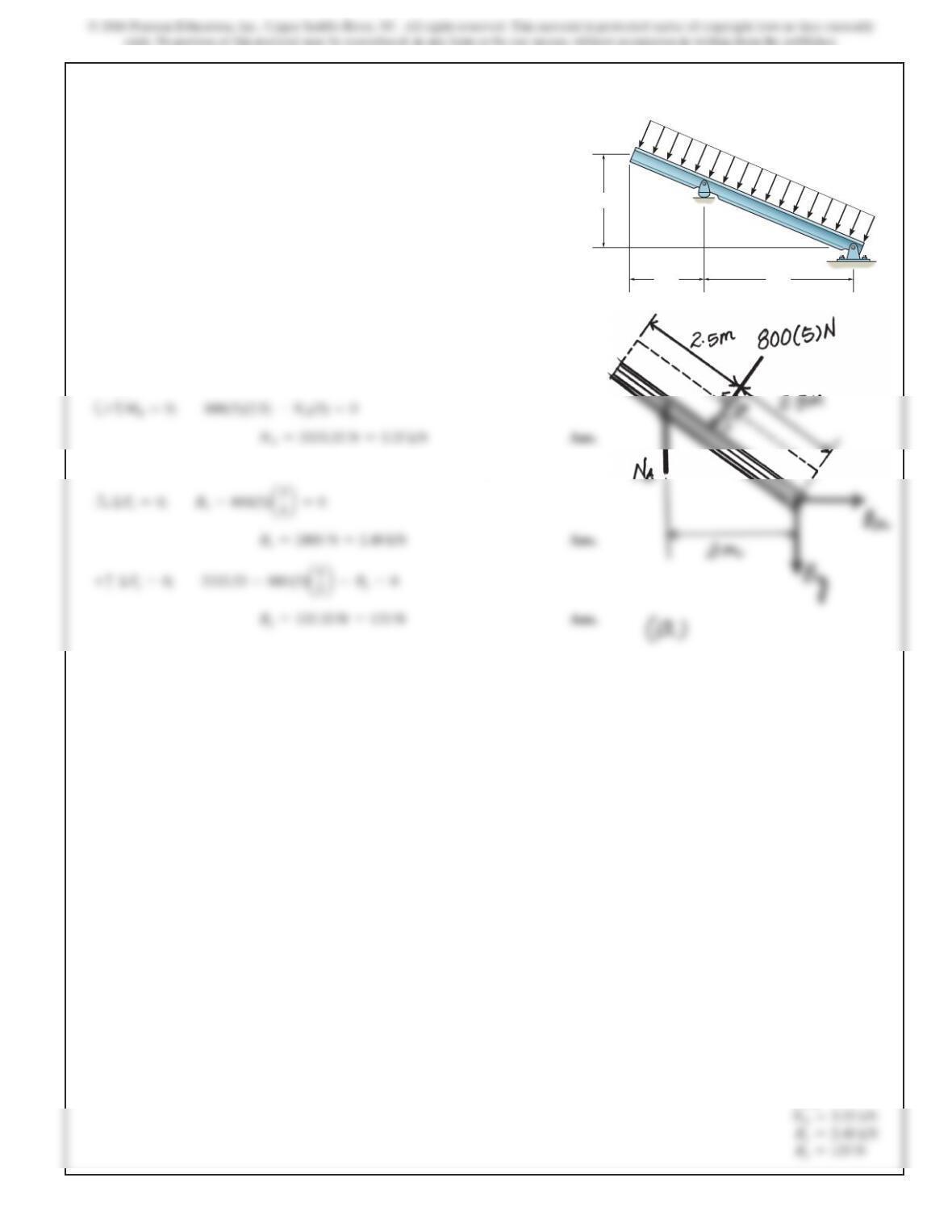
5–13.
Determine the reactions at the supports.
3
m3
m
AB
900 N/m
600 N/m
401
Ans:
SOLUTION
Equations of Equilibrium. NA can be determined directly by writing the moment
equation of equilibrium about point B by referring to the FBD of the beam shown
in Fig. a.
Using this result to write the force equations of equilibrium along the x and y axes,
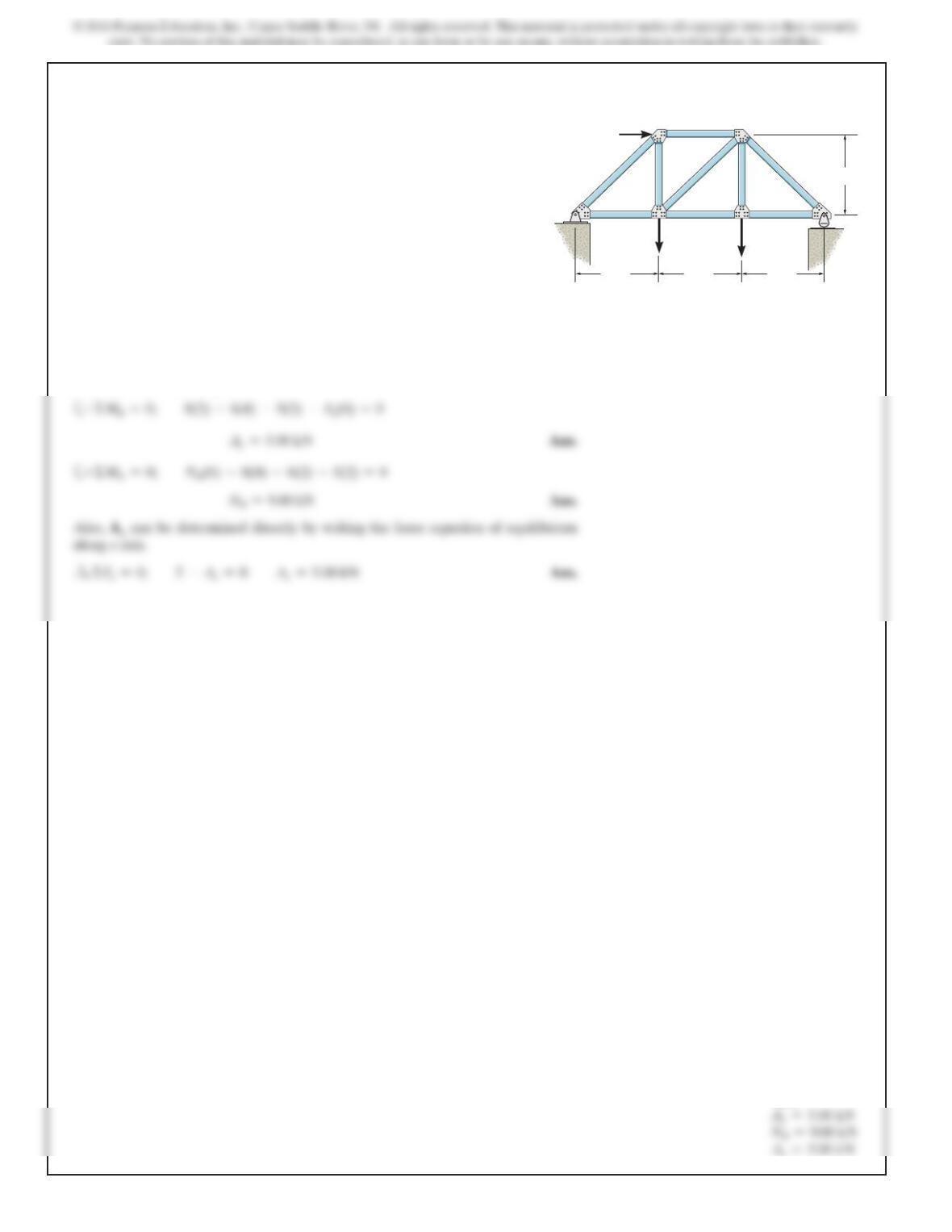
5–14.
Determine the reactions at the supports.
B
A
3 m
800 N/m
3 m
1 m
402
Ans:
SOLUTION
Equations of Equilibrium. Ay and NB can be determined by writing the moment
equations of equilibrium about points B and A, respectively, by referring to the FBD
of the truss shown in Fig. a.
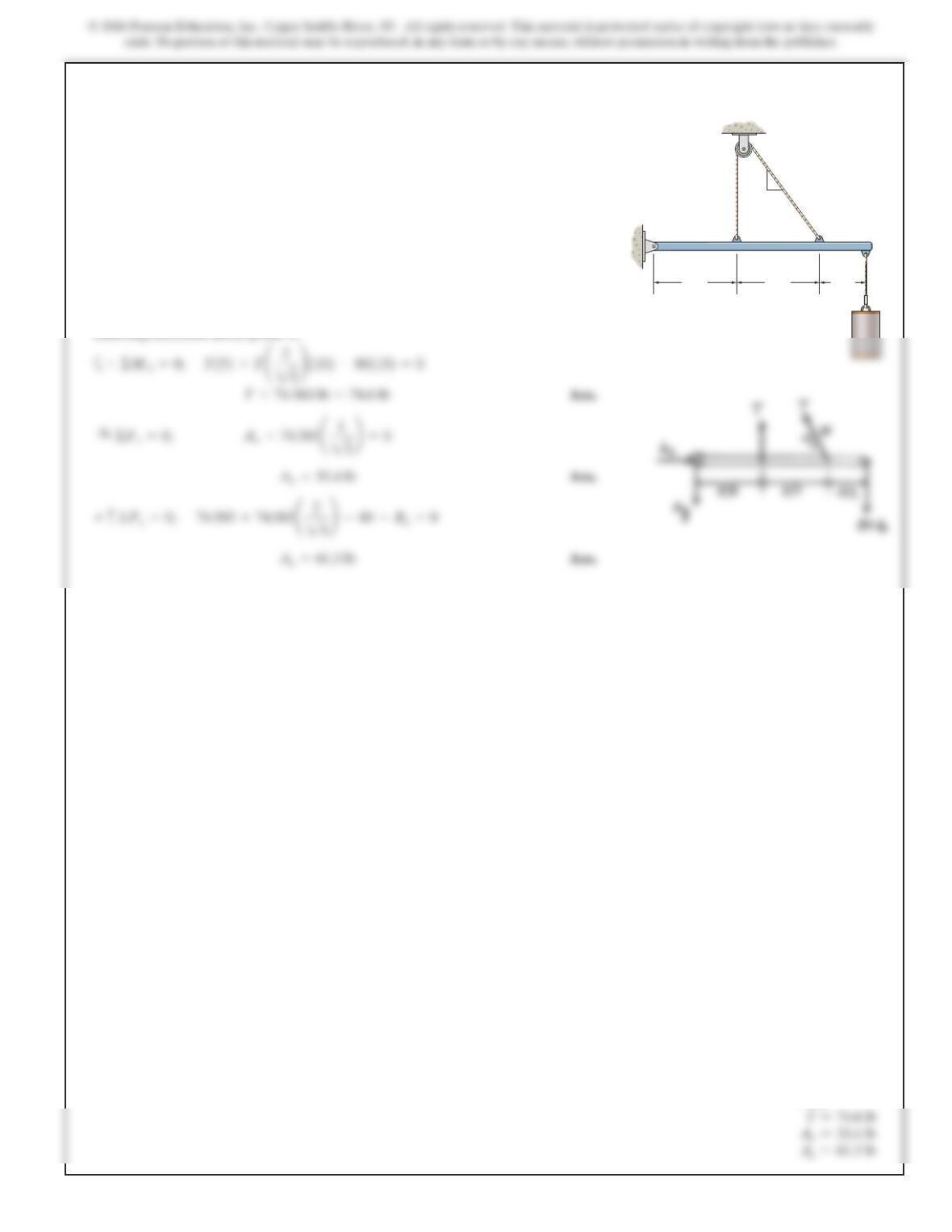
5–15.
Determine the reactions at the supports.
AB
2 m2 m2 m
2 m
6 kN
5 kN
8 kN
403
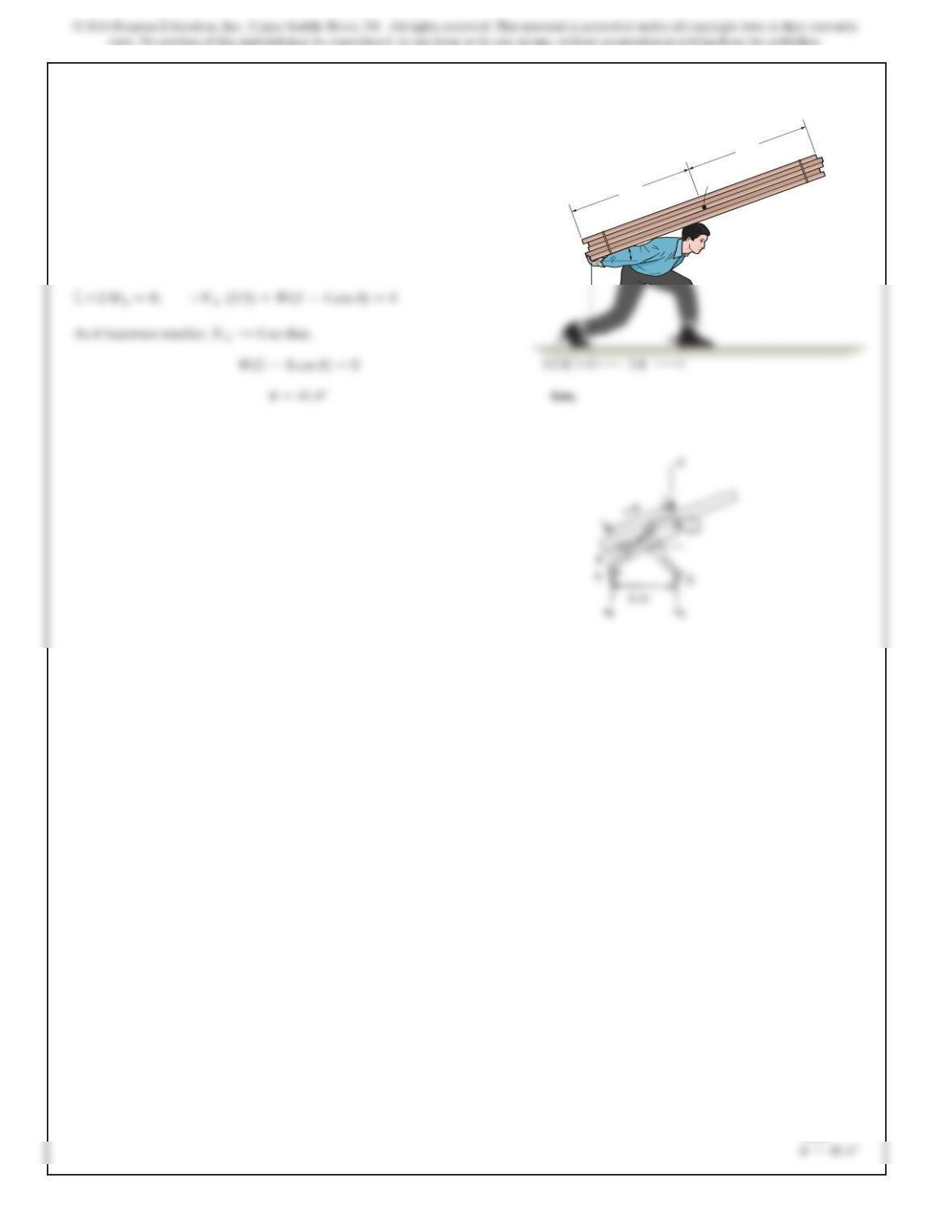
*5–16.
Determine the tension in the cable and the horizontal and
vertical components of reaction of the pin A.The pulley at
Dis frictionless and the cylinder weighs 80 lb.
SOLUTION
Equations of Equilibrium: The tension force developed in the cable is the same
throughout the whole cable.The force in the cable can be obtained directly by
summing moments about point A.
BA
D
C
5ft5ft
2
1
3ft
Ans:
404
5–17.
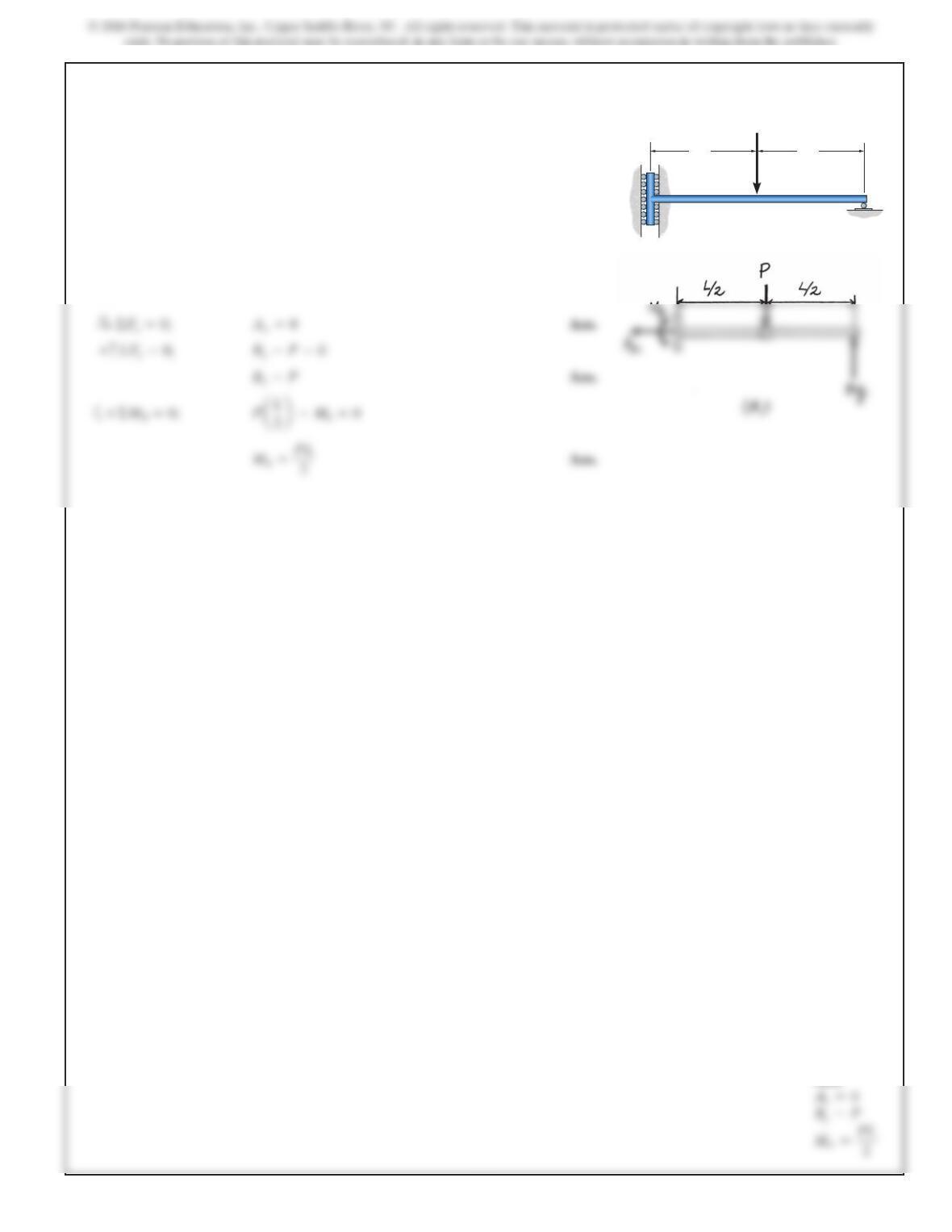
The man attempts to support the load of boards having a
weight Wand a center of gravity at G. If he is standing on a
smooth floor,determine the smallest angle at which he can
hold them up in the position shown. Neglect his weight.
u
SOLUTION
G
4ft
4ft
u
Ans:
405
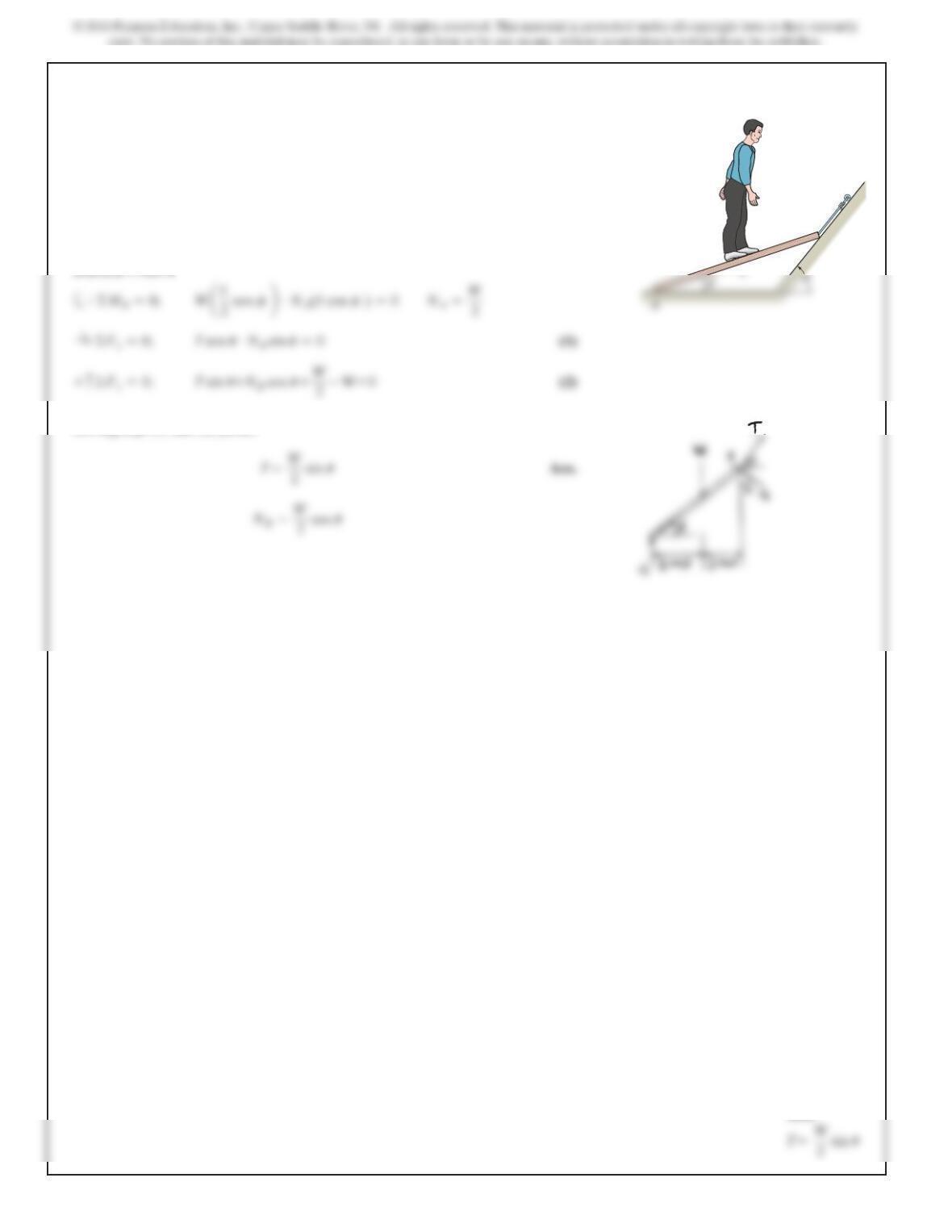
5–18.
Determine the components of reaction at the supports Aand
Bon the rod.
AB
P
L
––
2
L
––
2
SOLUTION
Equations of Equilibrium:Since the roller at offers no resistance to vertical
movement, the vertical component of reaction at support is equal to zero.From
the free-body diagram, ,,and can be obtained by writing the force
equations of equilibrium along the and axes and the moment equation of
equilibrium about point ,respectively.
B
yx
MA
By
Ax
A
A
Ans:
406
5–19.
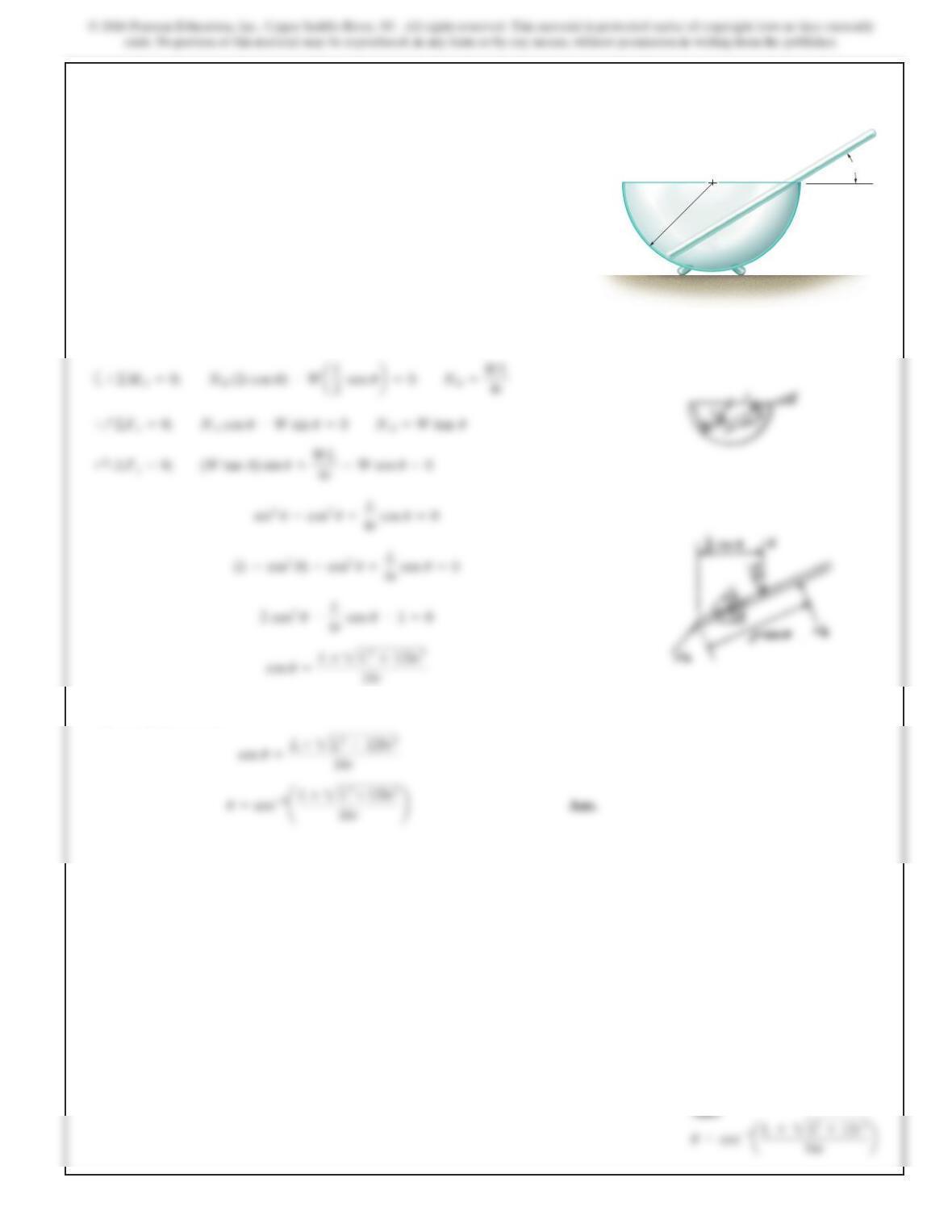
The man has a weight Wand stands at the center of the
plank. If the planes at Aand Bare smooth, determine the
tension in the cord in terms of Wand u.
SOLUTION
Solving Eqs. (1) and (2) yields:
B
Ans:
407
*5–20.
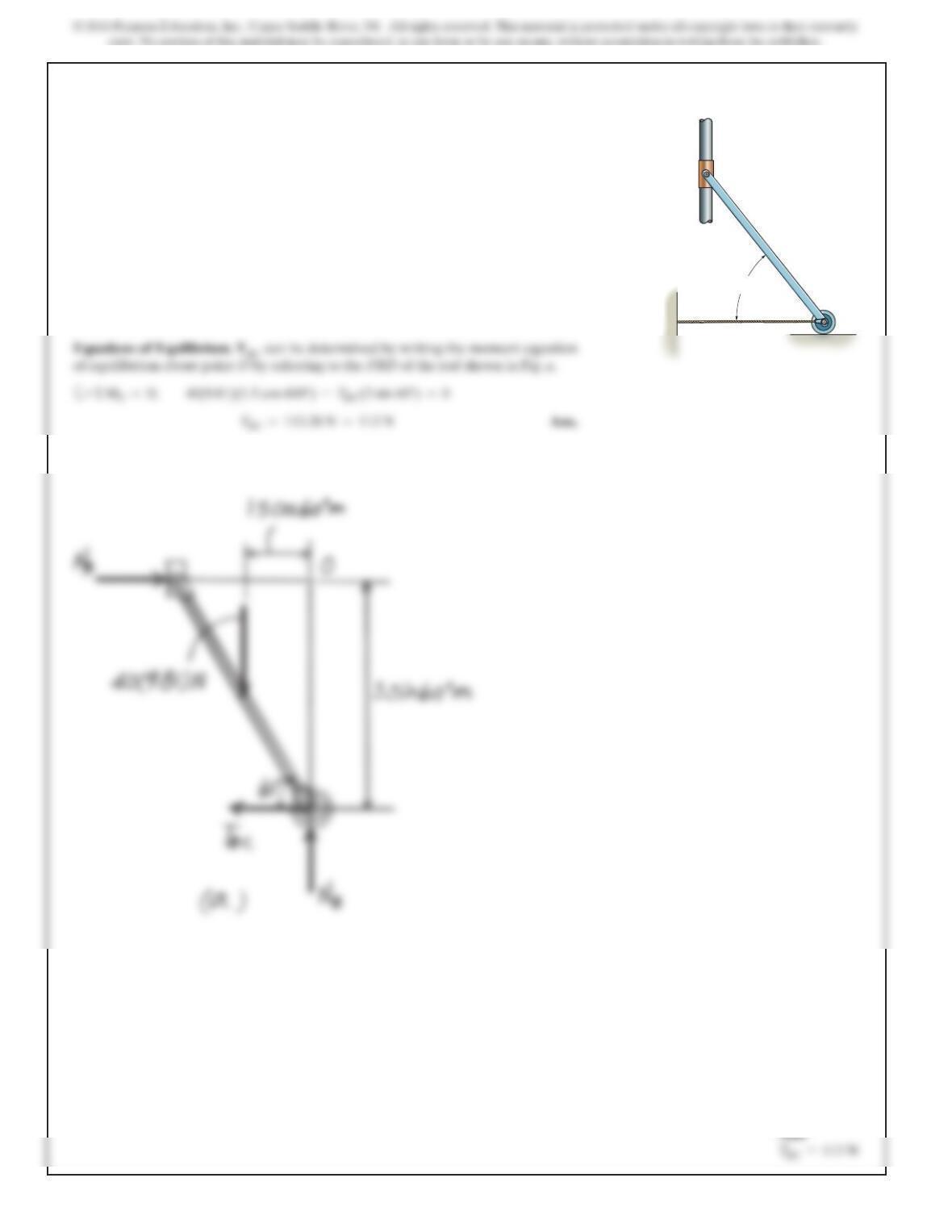
Auniform glass rod having a length Lis placed in the smooth
hemispherical
bowl having a radius r.Determine the angle of
inclination
for equilibrium.u
SOLUTION
By observation
.
Equilibrium:
T
ake the positive root
f=u
B
r
A
u
408
SOLUTION
5–21.
The uniform rod AB has a mass of 40 kg. Determine the
force in the cable when the rod is in the position shown.
There is a smooth collar at A.A
60
3 m
C
B
409
Ans:
SOLUTION
Equations of Equilibrium. NA can be determined directly by writing the moment
equation of equilibrium about point B by referring to the FBD of the beam shown
5–22.
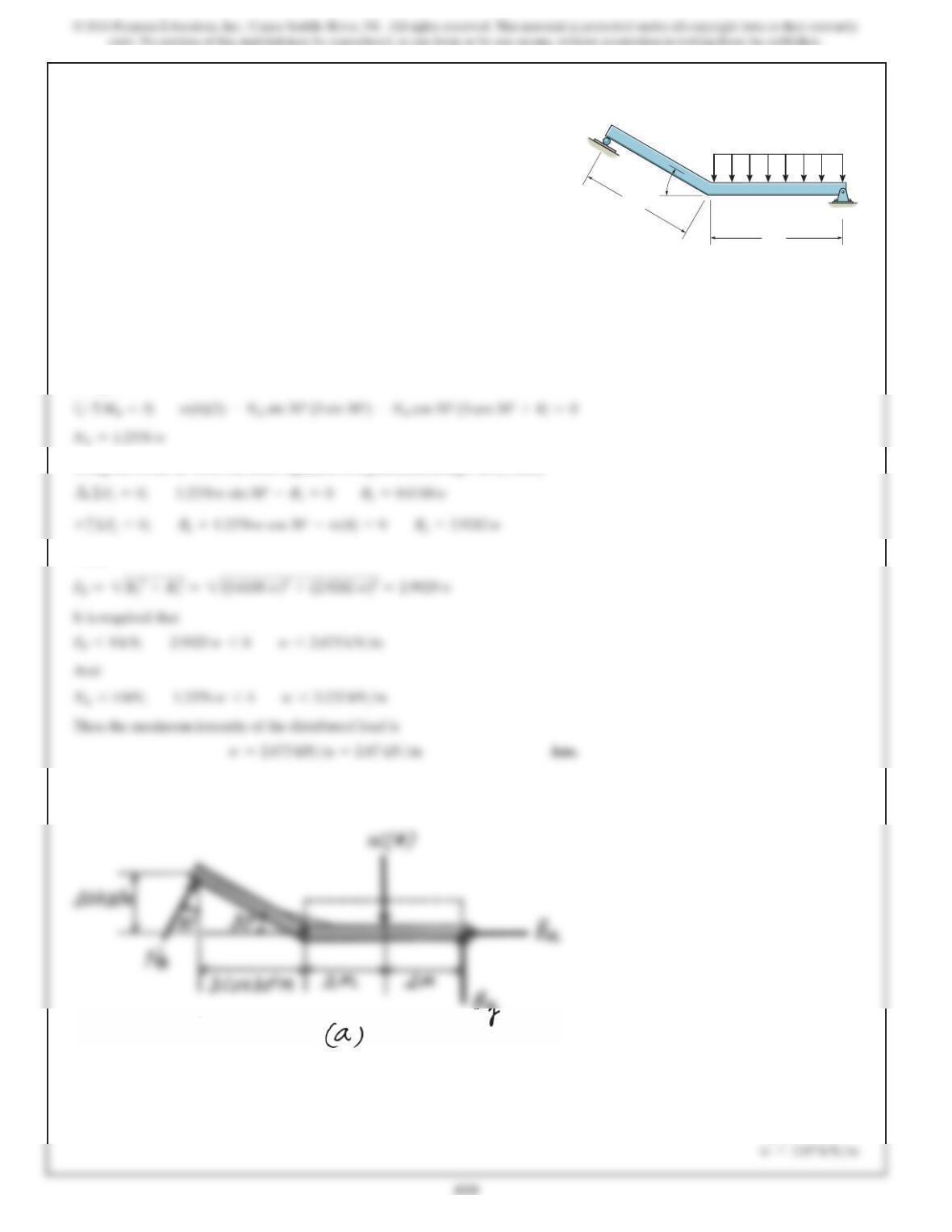
If the intensity of the distributed load acting on the beam
is w = 3 kN
>
m, determine the reactions at the roller A and
pin B.
A
B
w
3 m
30
4 m
Ans:
SOLUTION
Equations of Equilibrium. NA can be determined directly by writing the moment
equation of equilibrium about point B by referring to the FBD of the beam shown
in Fig. a.
Using this result to write the force equation of equilibrium along x and y axes,
Thus,
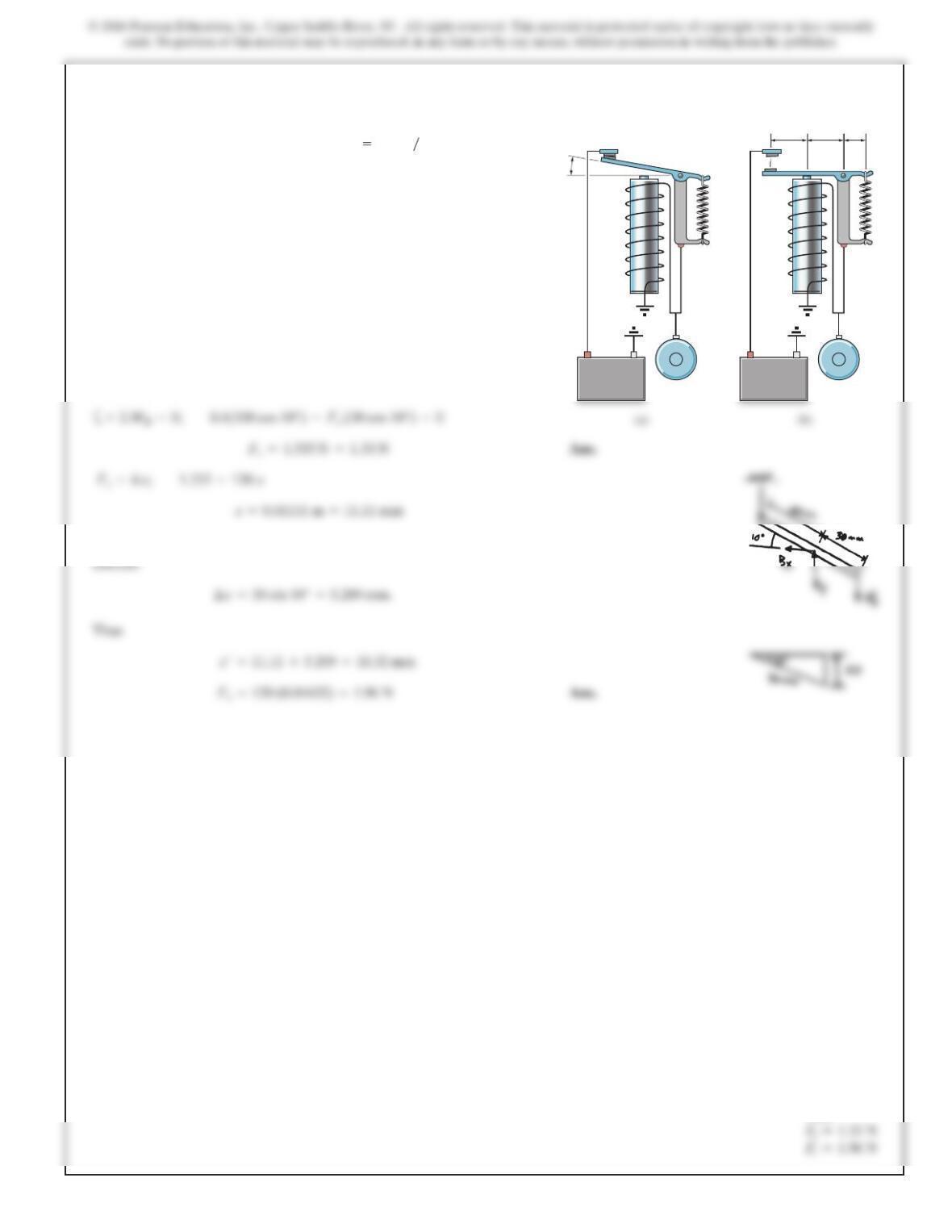
5–23.
If the roller at A and the pin at B can support a load up
to 4 kN and 8 kN, respectively, determine the maximum
intensity of the distributed load w, measured in kN
>
m, so
that failure of the supports does not occur.
A
B
w
3 m
30
4 m
411
*5–24.
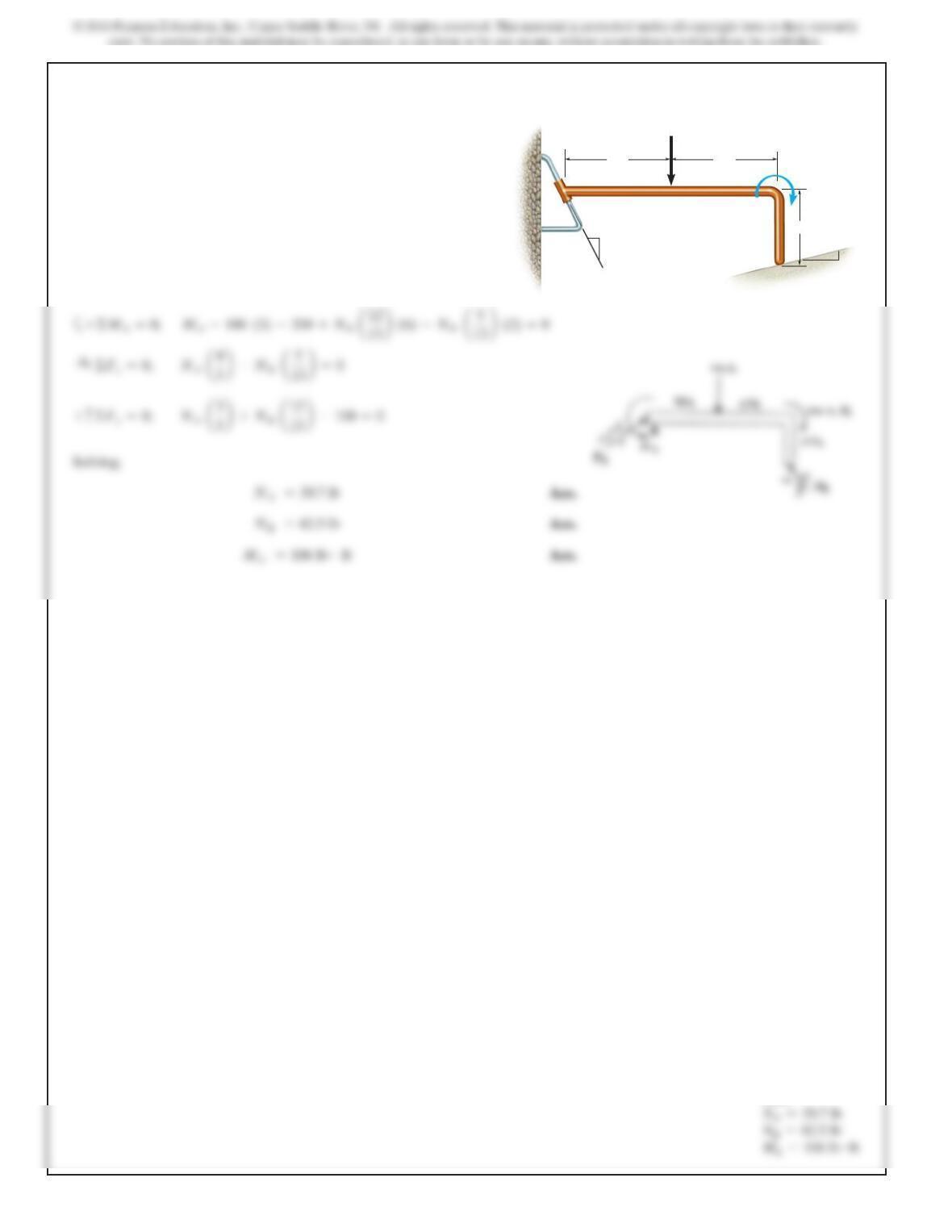
The relay regulates voltage and current. Determine the force
in the spring CD,which has a stiffness of k120 Nm, so
that it will allow the armature to make contact at Ain figure
(a) with a vertical force of 0.4 N. Also,determine the force
in the spring when the coil is energized and attracts the
armature to E,figure (b), thereby breaking contact at A.
50 mm 50 mm 30 mm
10°
D
D
k
k
C
CB
BEA
A
SOLUTION
From Fig. (a):
From Fig (b), energizing the coil requires the spring to be stretched an additional
Ans:
412
5–25.
Determine the reactions on the bent rod which is supported
byasmooth surface at Band by a collar at A, which is fixed
to the rod and is free to slide over the fixed inclined rod.
3ft3ft
3
4
5
100 lb
200lbft
2ft
B
12
5
13
A
SOLUTION
Ans:
413
5–26.
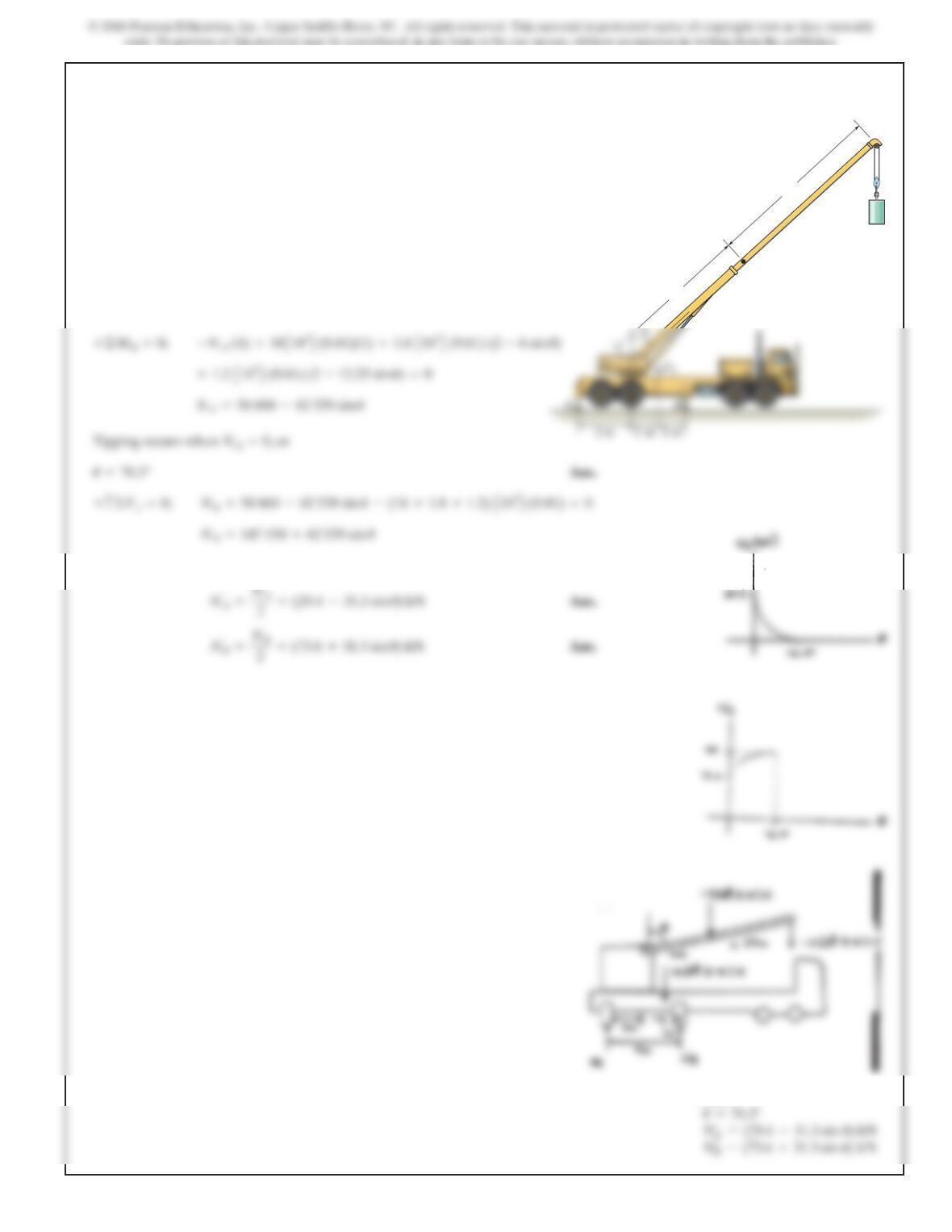
The mobile crane is symmetrically supported by two
outriggers at Aand two at Bin order to relieve the
suspension of the truck upon which it rests and to provide
greater stability. If the crane and truck have a mass of
18 Mg and center of mass at ,and the boom has a mass
of 1.8 Mg and a center of mass at ,determine the vertical
reactions at each of the four outriggers as a function of the
boom angle when the boom is supporting a load having a
mass of 1.2 Mg.Plot the results measured from to
the critical angle where tipping starts to occur.
u=0°
u
G2
G1
G
2
6.25 m
6m
SOLUTION
Since there are two outriggers on each side of the crane,
Ans:
414
Ans:
SOLUTION
5–27.
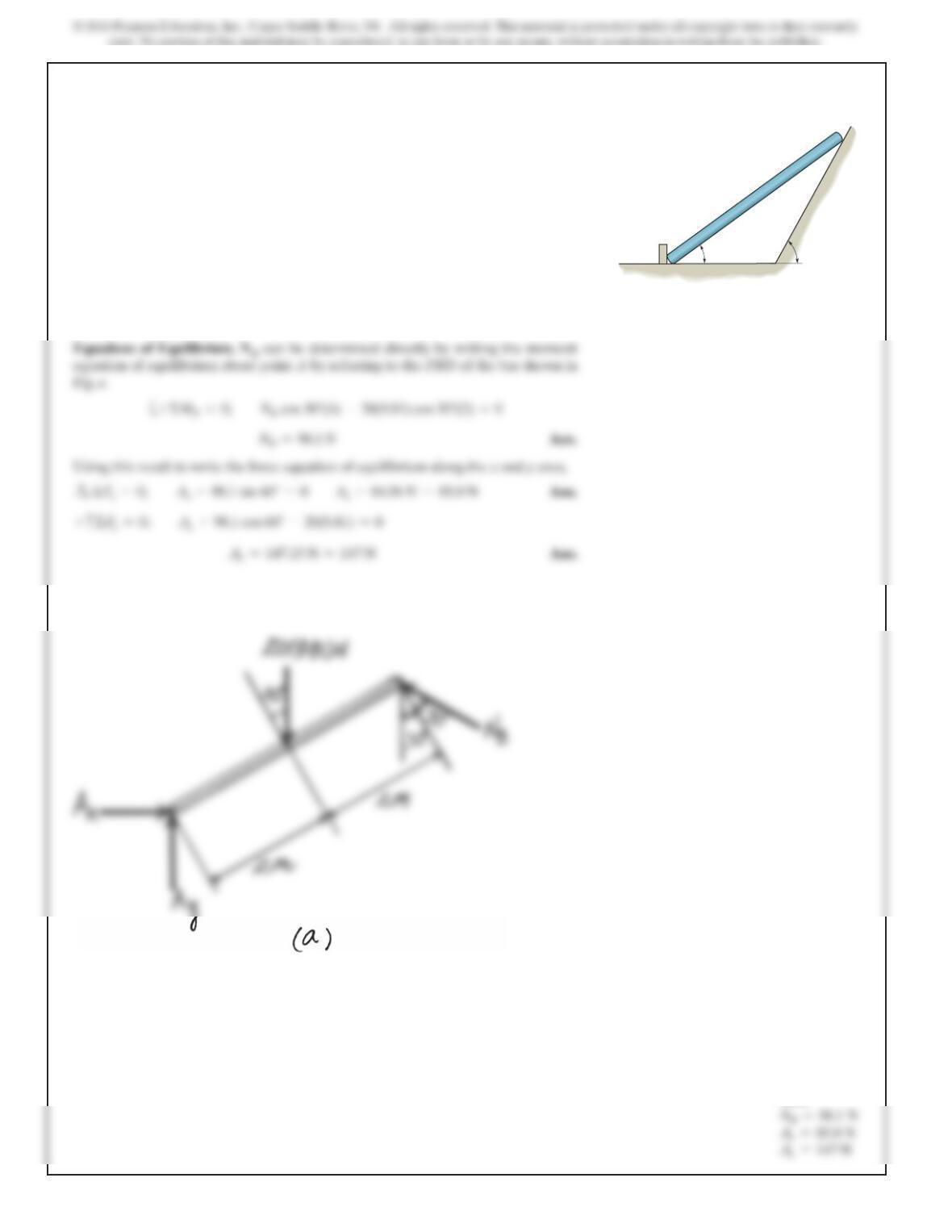
Determine the reactions acting on the smooth uniform bar,
which has a mass of 20 kg.
4 m
30ºA
B
60º
*5–28.
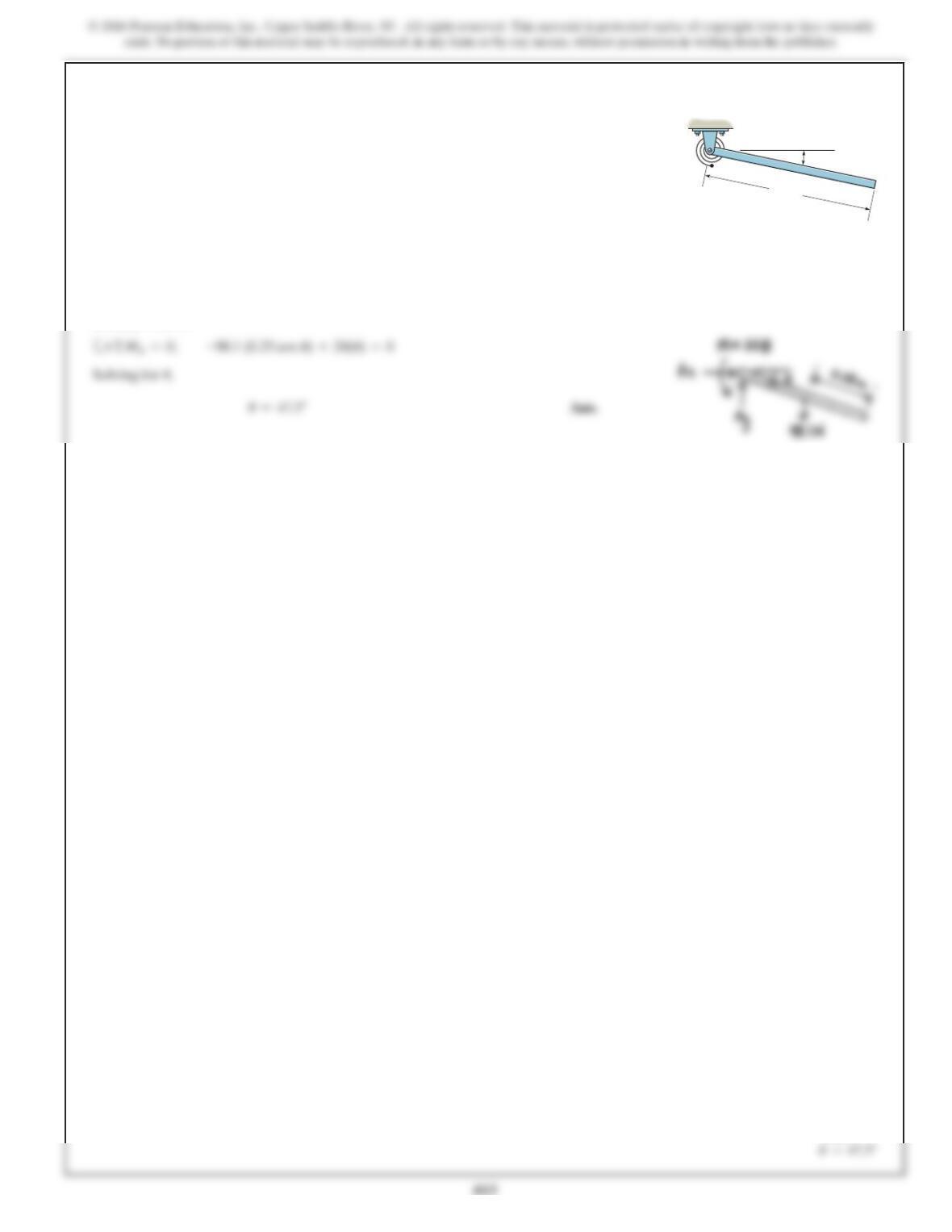
A linear torsional spring deforms such that an applied couple
moment M is related to the spring’s rotation
u
in radians by
the equation M = (20
u
)
N#m
. If such a spring is attached to
the end of a pin-connected uniform 10-kg rod, determine
the angle
u
for equilibrium. The spring is undeformed
when
u
= 0°.
SOLUTION
A
0.5 m
u
M (20 u) N m
Ans:
416
Ans:
SOLUTION
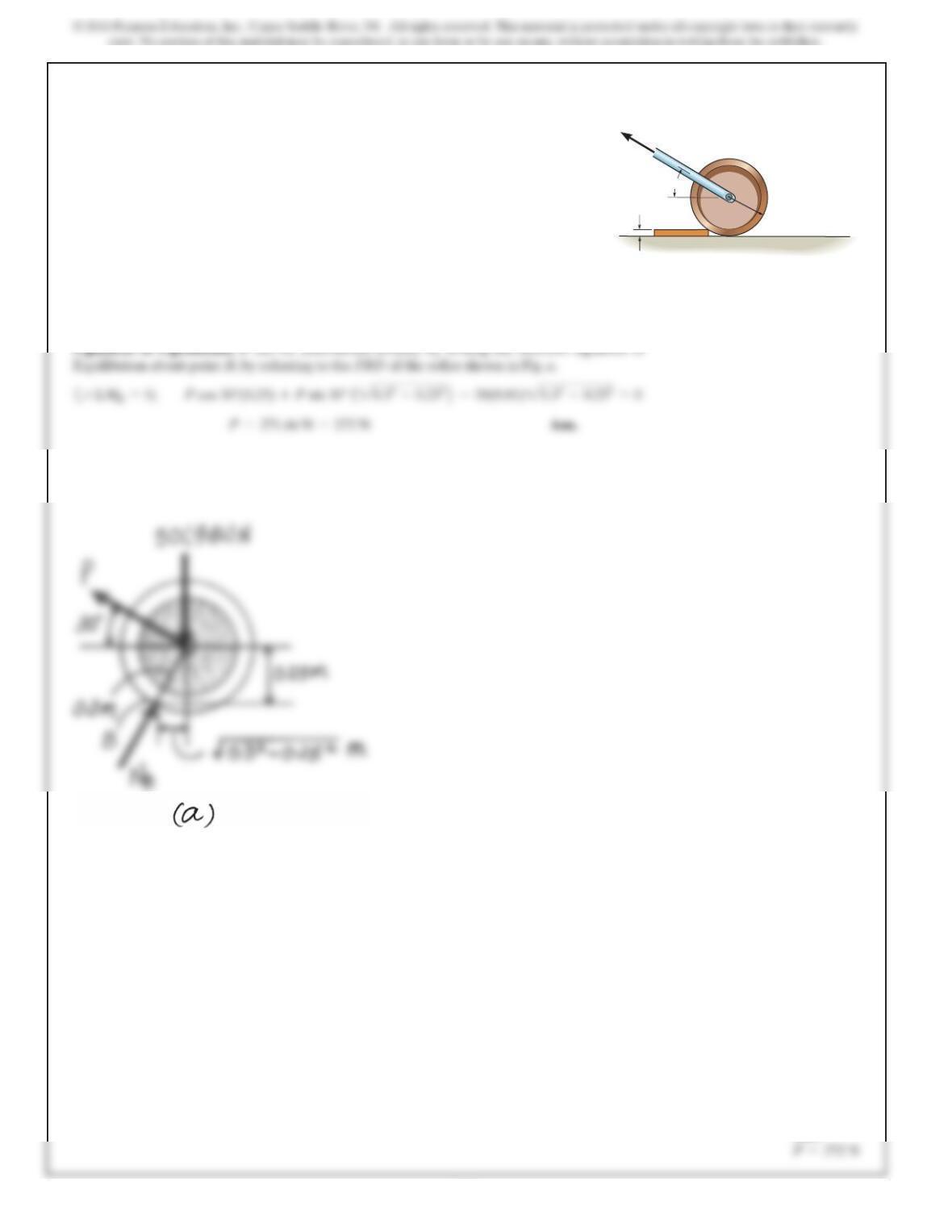
5–29.
Determine the force P needed to pull the 50-kg roller over
the smooth step. Take
u
= 30°.
A
B
P
300 mm
50 mm
u