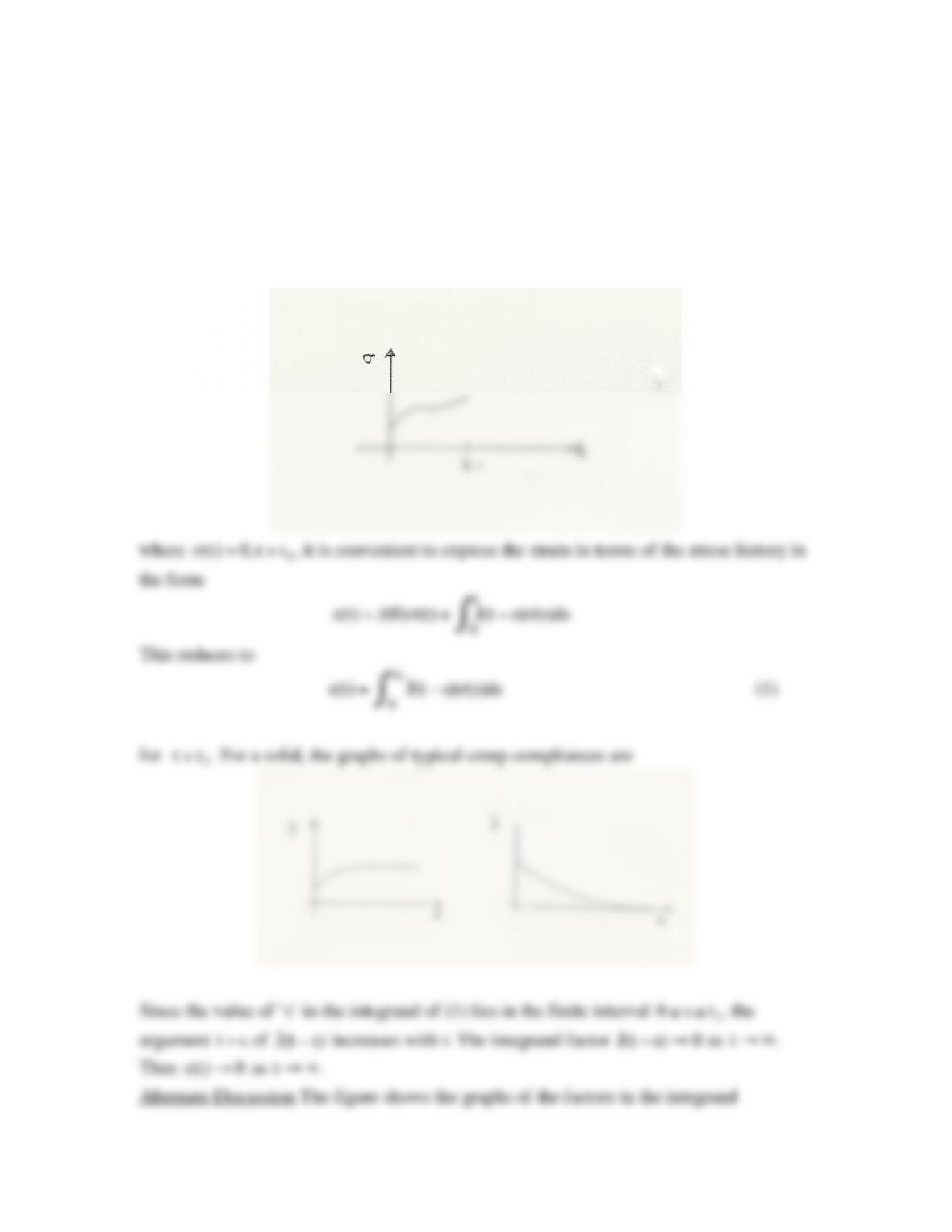
4.13 Consider a linear viscoelastic solid. Suppose that the stress varies
arbitrarily during the time interval
!
0“t“t1
, and is then removed so that
!
“(t) =0, t >t1
.
Show that the material recovers its original shape as
!
t” #
.
SOLUTION
Since the stress history is prescribed and has the form,
!
!
!
!
!
!
!
Alternate Discussion The figure shows the graphs of the factors in the integrand
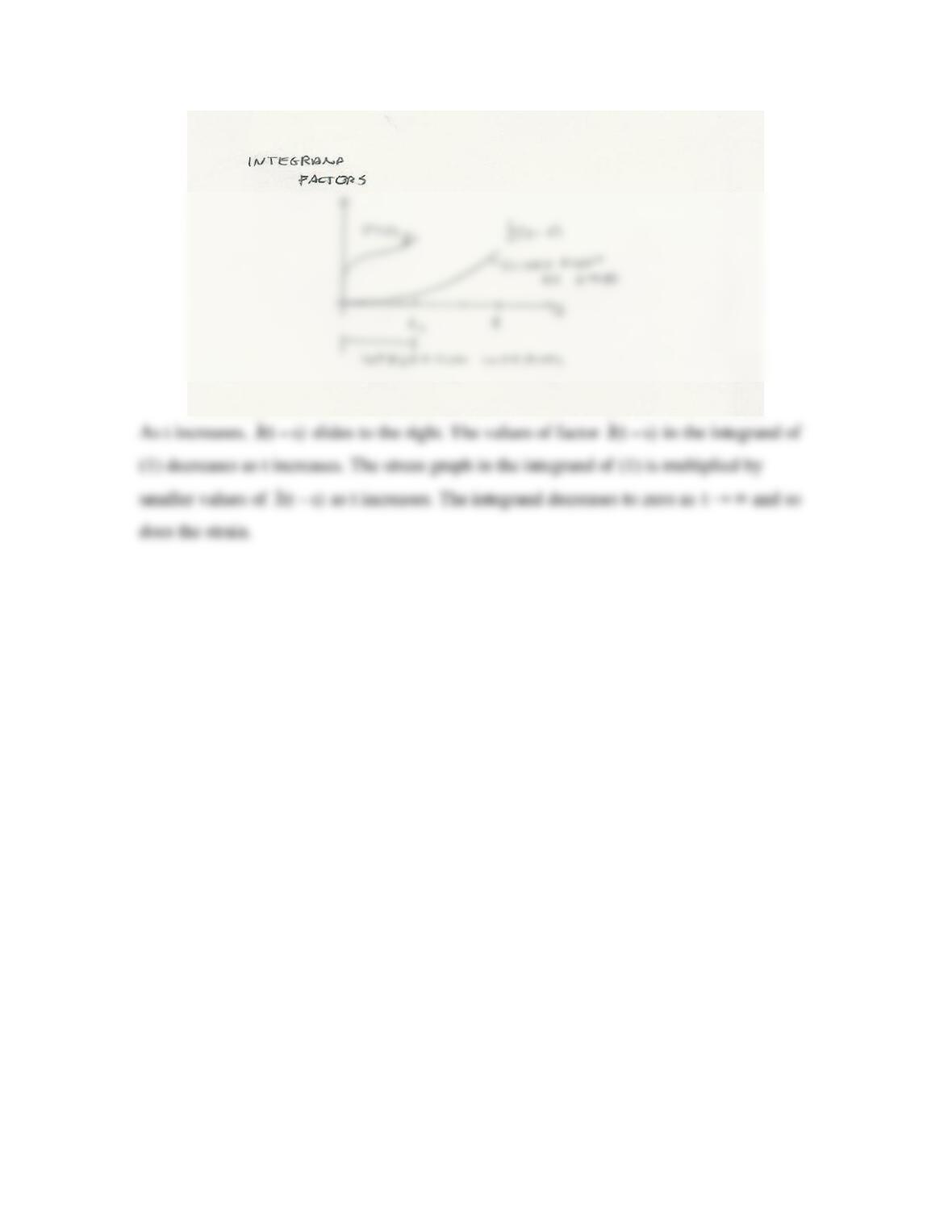
˙
˙
!
!
does the strain.
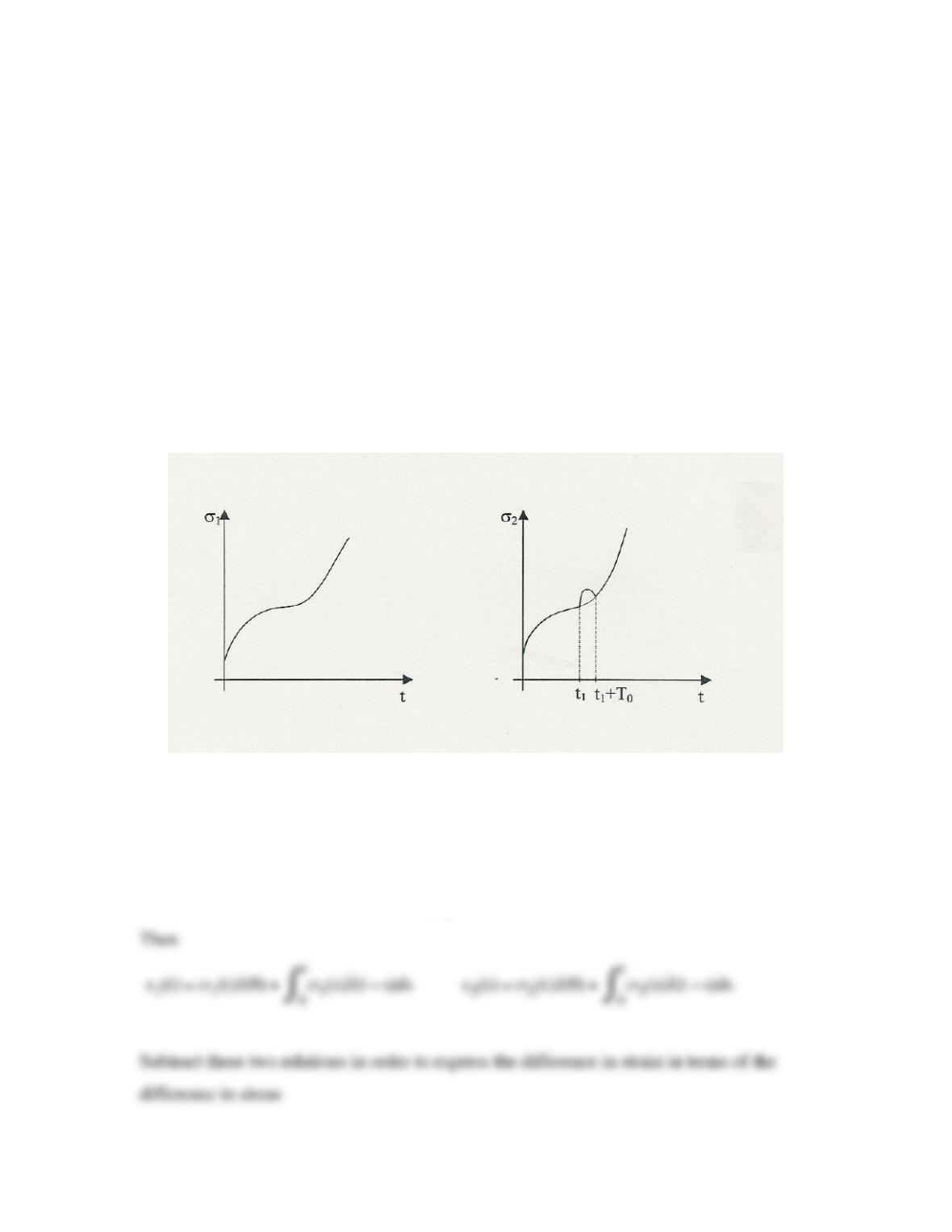
4.14 A linear viscoelastic material is subjected to a stress history
!
“1(t)
. An
identical specimen is subjected to a stress history
!
“2(t)
which differs from
!
“1(t)
by a
disturbance of finite duration
!
To
as shown in Figure-Problem 4.14.
Discuss the effect of the disturbance on the difference in strain histories,
!
“2(t) # “1(t)
, for times
!
t>t1+To
. Use the properties of a general creep or relaxation
function.
!
“2(t) =“1(t) +ˆ
“ (t)
!
ˆ
“ (t) =
0, t <t1
arbitrary,
0, t1+To<t
#
$
%
&
%
t1‘t‘t1+To
Figure-Problem 4.14
SOLUTION
Since the stress is prescribed, the most convenient form of the constitutive equation is
“(t) =#(t)J(0) +#(s)˙
J (t $s)ds
0
t
%
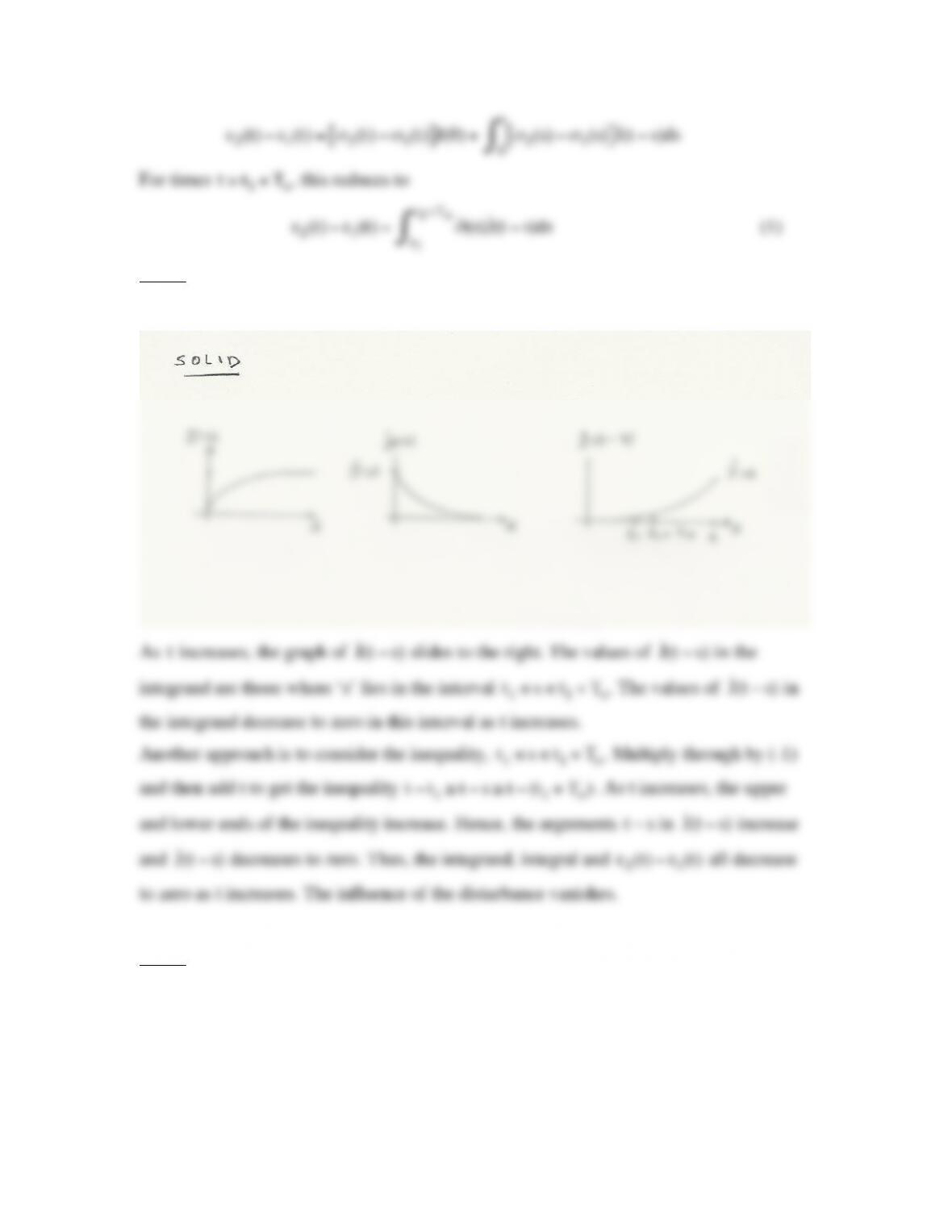
Then
!
“2(t) # “1(t) =$2(t) # $1(t)
[ ]
J(0) +$2(s) # $1(s)
[ ]
˙
J (t #s)ds
0
t
%
!
!
“2(t) # “1(t) =ˆ
$ (s)˙
J (t #s)ds
t1
t1+To
%
(1)
Solids
The graphs of
!
J(s), ˙
J (s), ˙
J (t “s)
are
!
!
!
!
to zero as t increases. The influence of the disturbance vanishes.
Fluids
The graphs of
!
J(s), ˙
J (s), ˙
J (t “s)
are
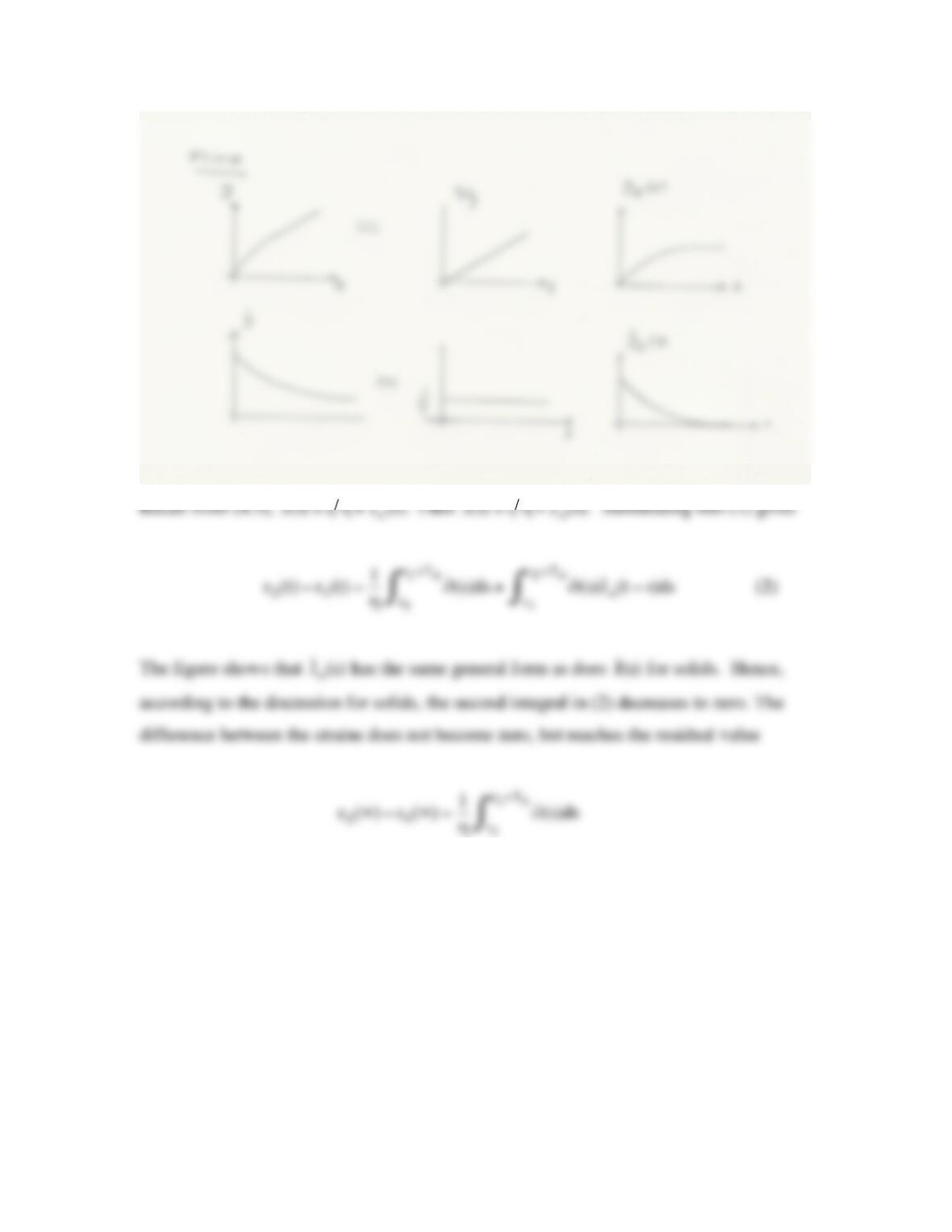
Recall from (4.5),
J(s) =s“+Jo(s)
. Then
˙
J (s) =1“+˙
J
o(s)
. Substituting into (1) gives