215
3–55.
SOLUTION
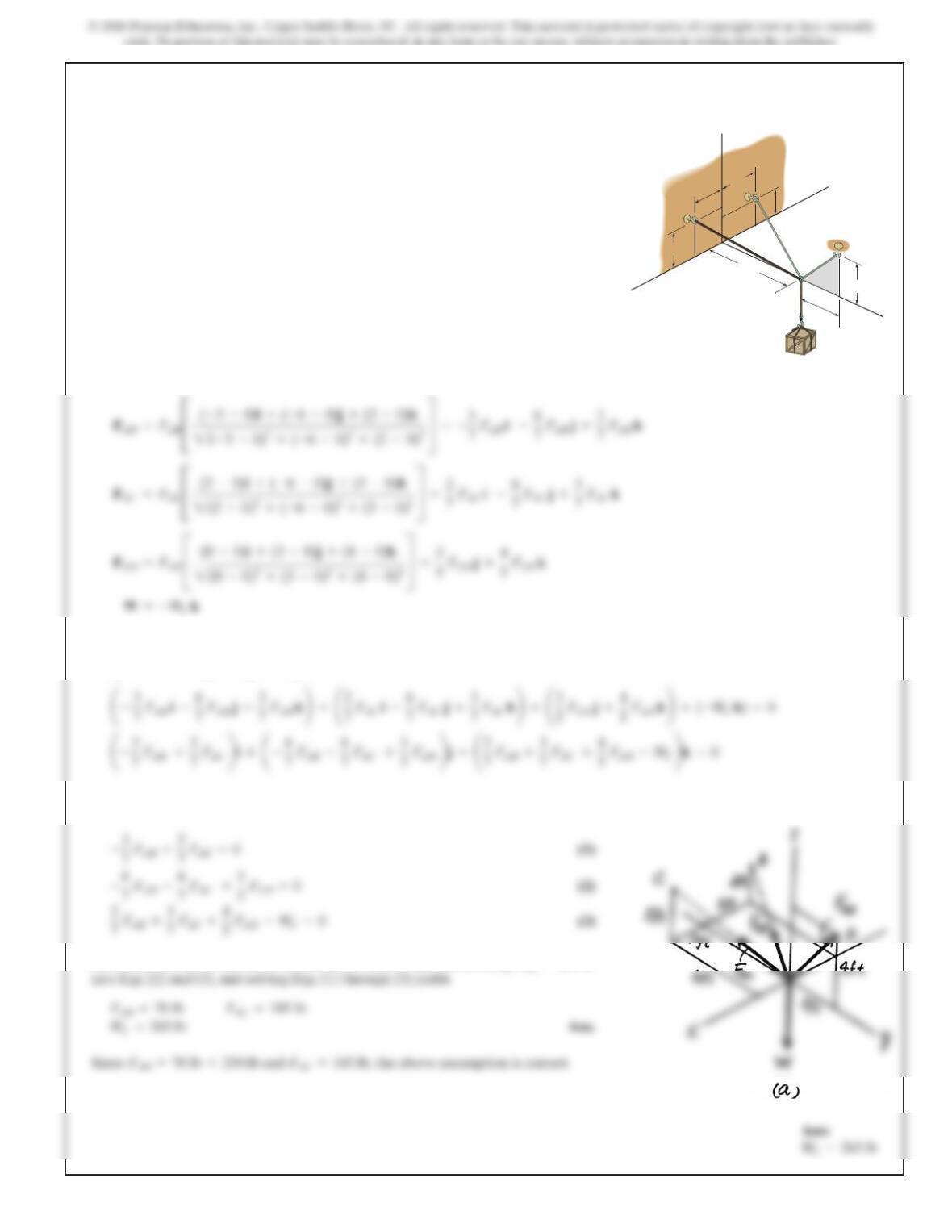
Force Vectors: We can express each of the forces shown in Fig. ain Cartesian vector
form as
Equations of Equilibrium: Equilibrium requires
Equating the i,j,and kcomponents yields
Assuming that cable AD achieves maximum tension first, substituting
F
AD =250 lb
gF=0;
FAB +FAC +FAD +W=0
Determine the maximum weight of the crate that can be
suspended from cables AB,AC,and AD so that the tension
developed in any one of the cables does not exceed 250 lb.
y
A
B
C
D
x
z
6 ft
3 ft
3 ft
2 ft 2 ft
3 ft
4 ft
216
*3–56.
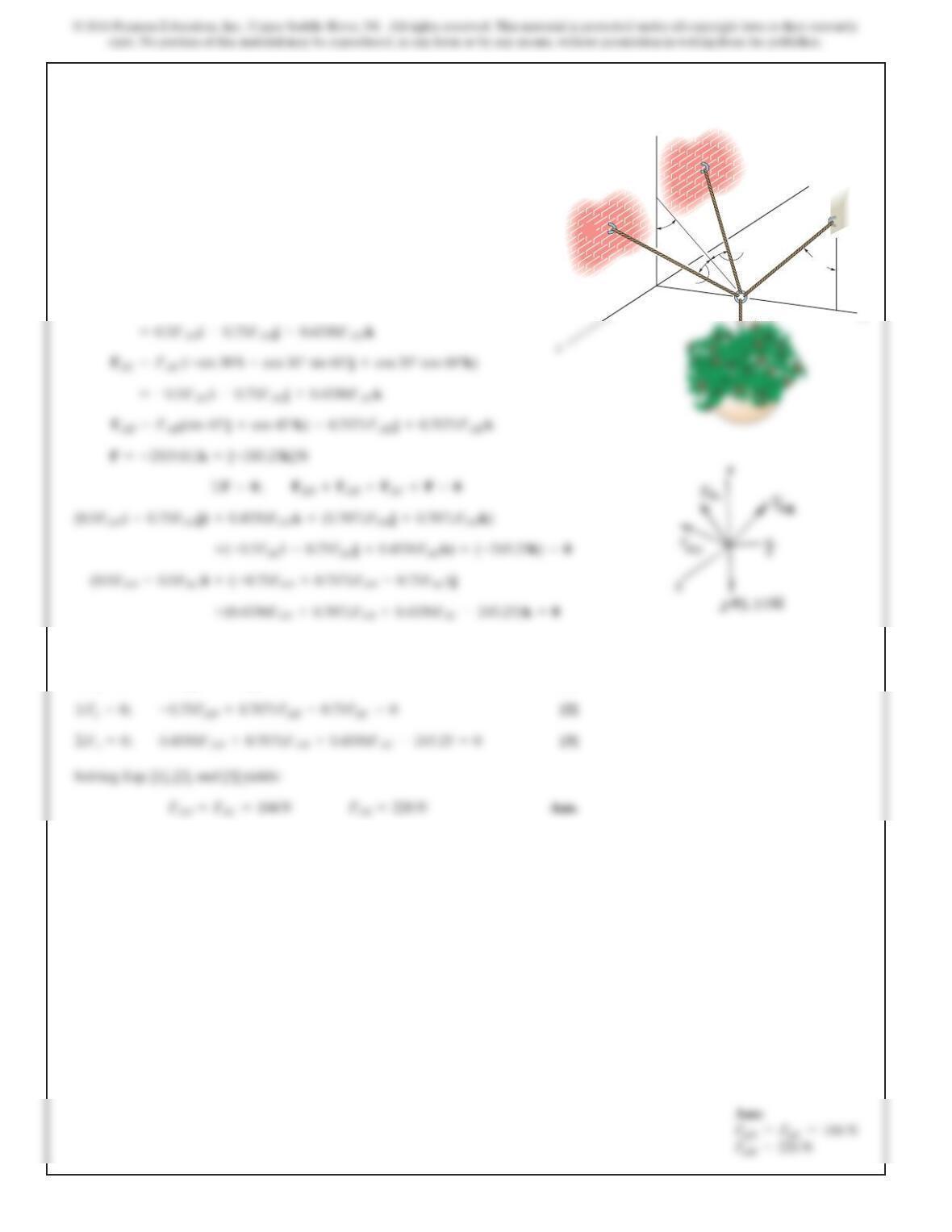
The 25-kg flowerpot is supported at Aby the three cords.
Determine the force acting in each cord for equilibrium.
SOLUTION
Thus,
[1]
©F
x=0; 0.5F
AD –0.5F
AC =0
FAD =FAD (sin 30°i–cos 30° sin 60°j+cos 30° cos 60°k)
30fi
30fi
60fi
45fi
A
z
B
y
D
C
217
3–57.
SOLUTION
©F
x=0; 0.5F
AD –0.5F
AC =0
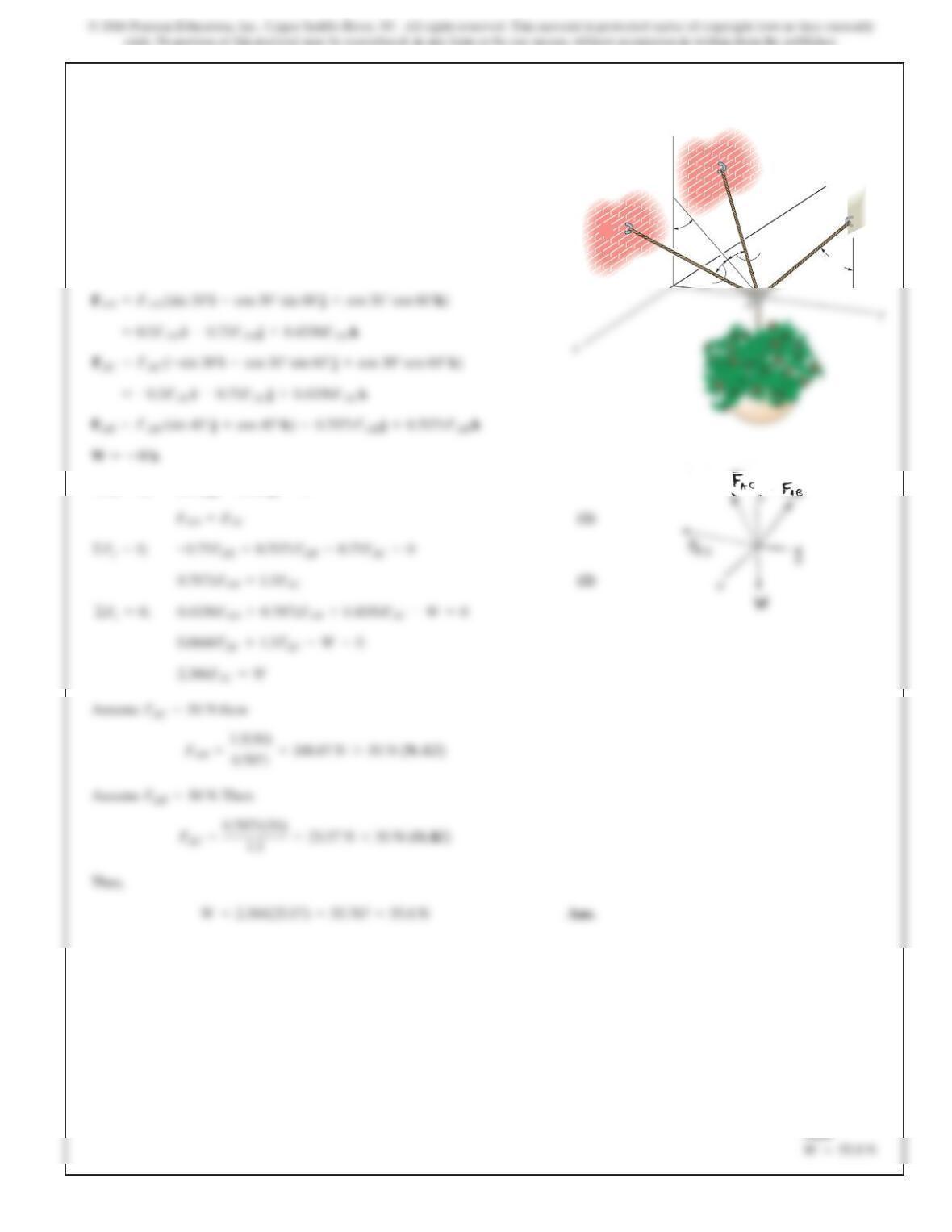
If each cord can sustain a maximum tension of 50 N before
it
fails, determine the greatest weight of the flowerpot the
cords can support.
30fi
30fi
60fi
45fi
z
B
D
C
218
3–58.
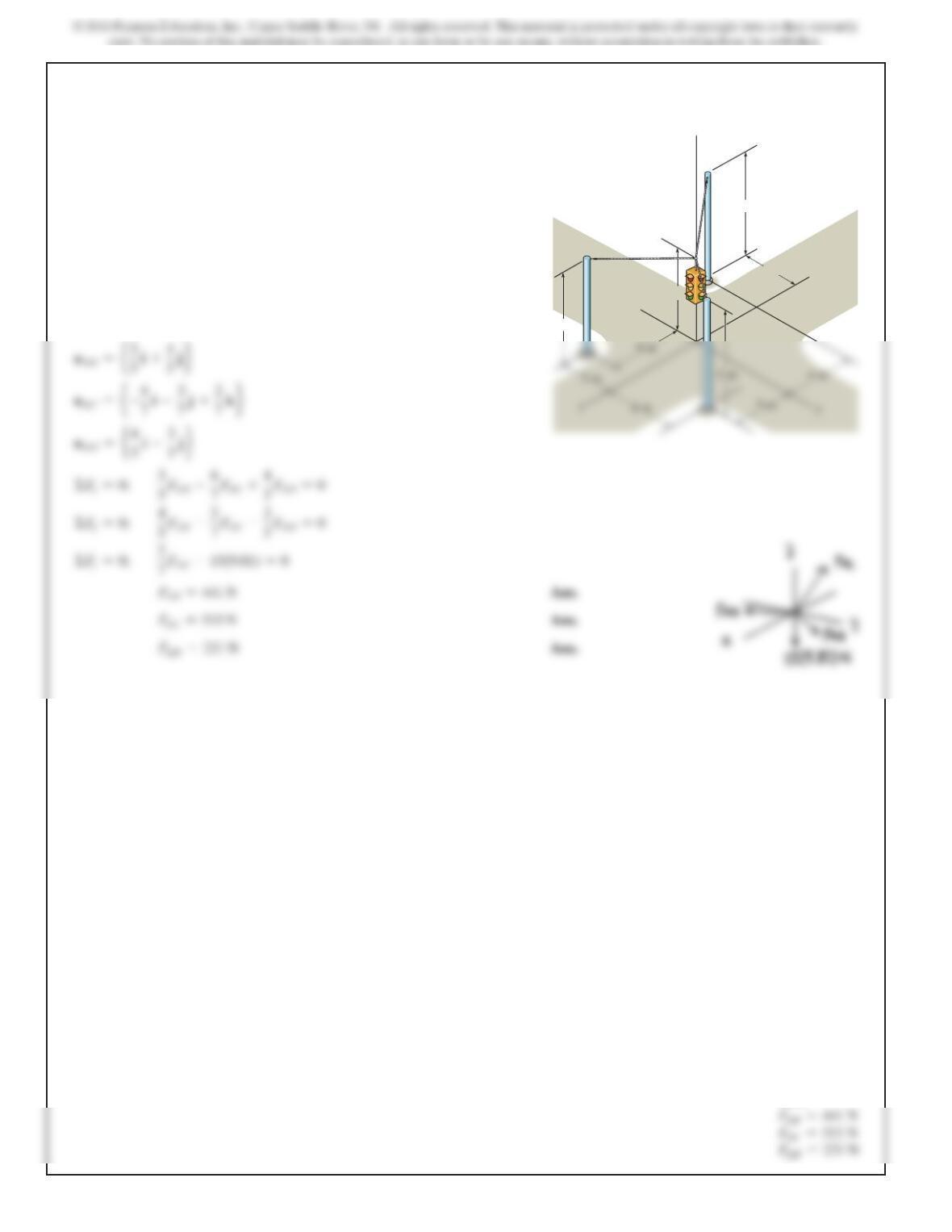
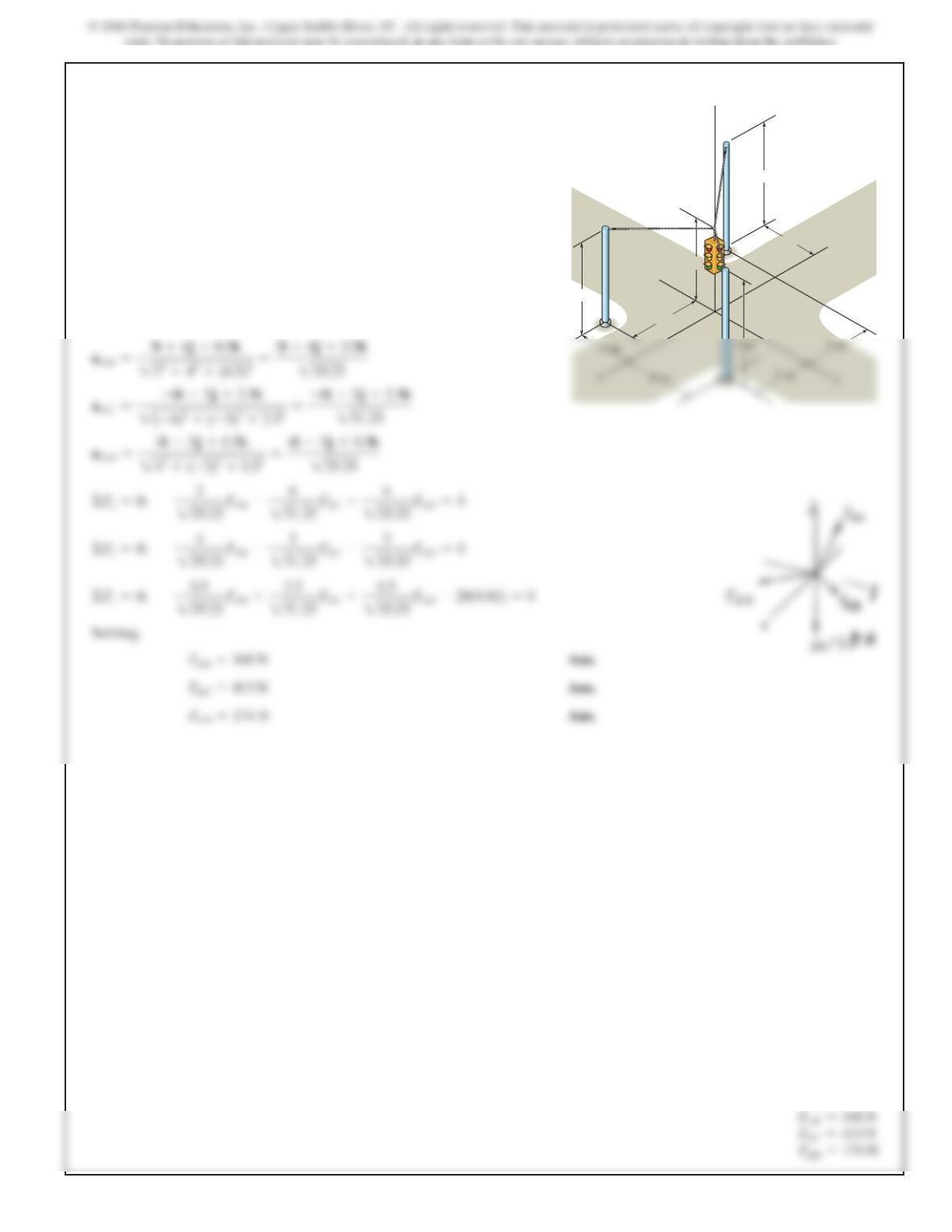
Determine the tension developed in the three cables
required to support the traffic light, which has a mass of
15 kg. Take h = 4 m.
SOLUTION
D
A
hB
C
4 m
6 m
3 m
z
Ans:
219
3–59.
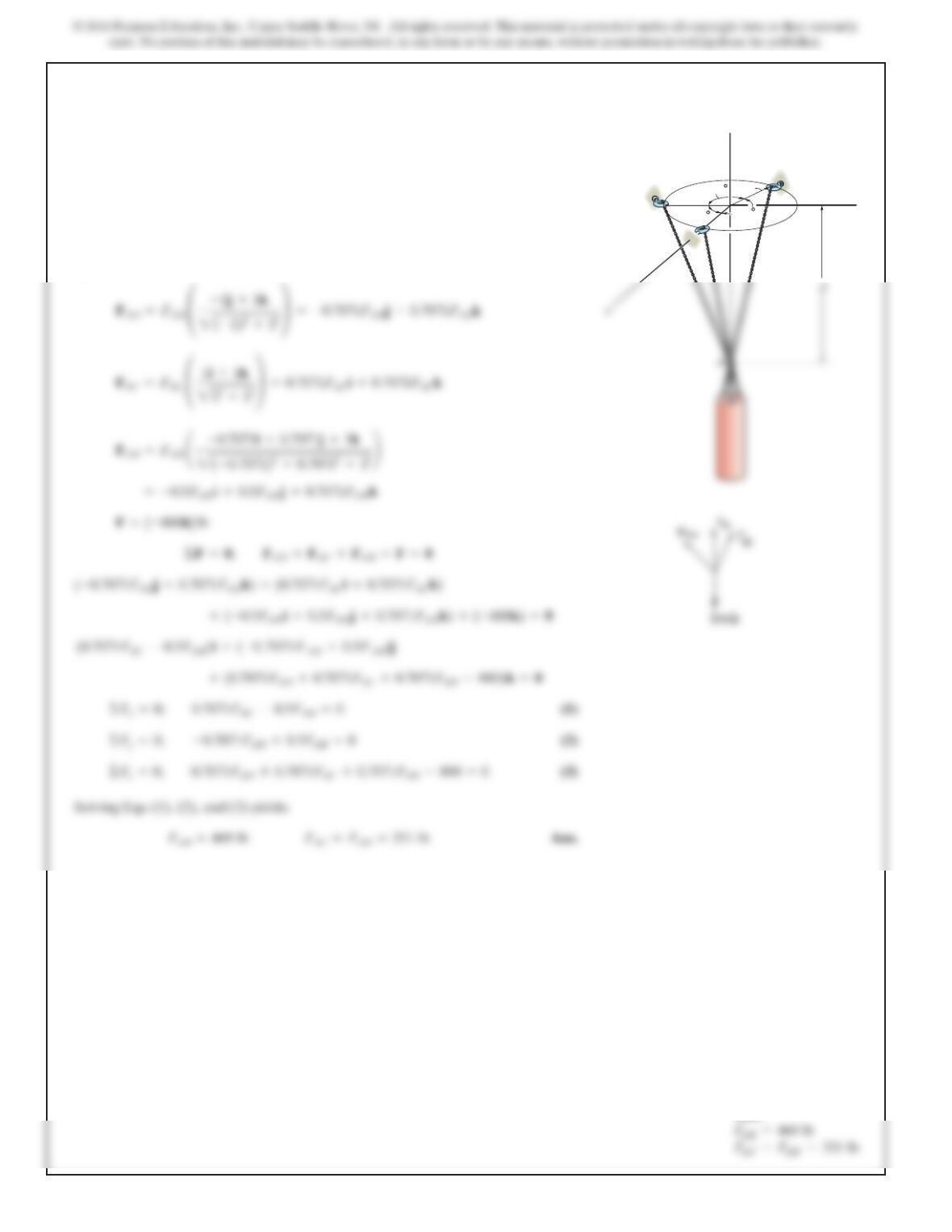
Determine the tension developed in the three cables
required to support the traffic light, which has a mass of
20 kg. Take h = 3.5 m.
Ans:
SOLUTION
D
A
hB
C
4 m
6 m
3 m
4 m
z
220
*3–60.
SOLUTION
T
h
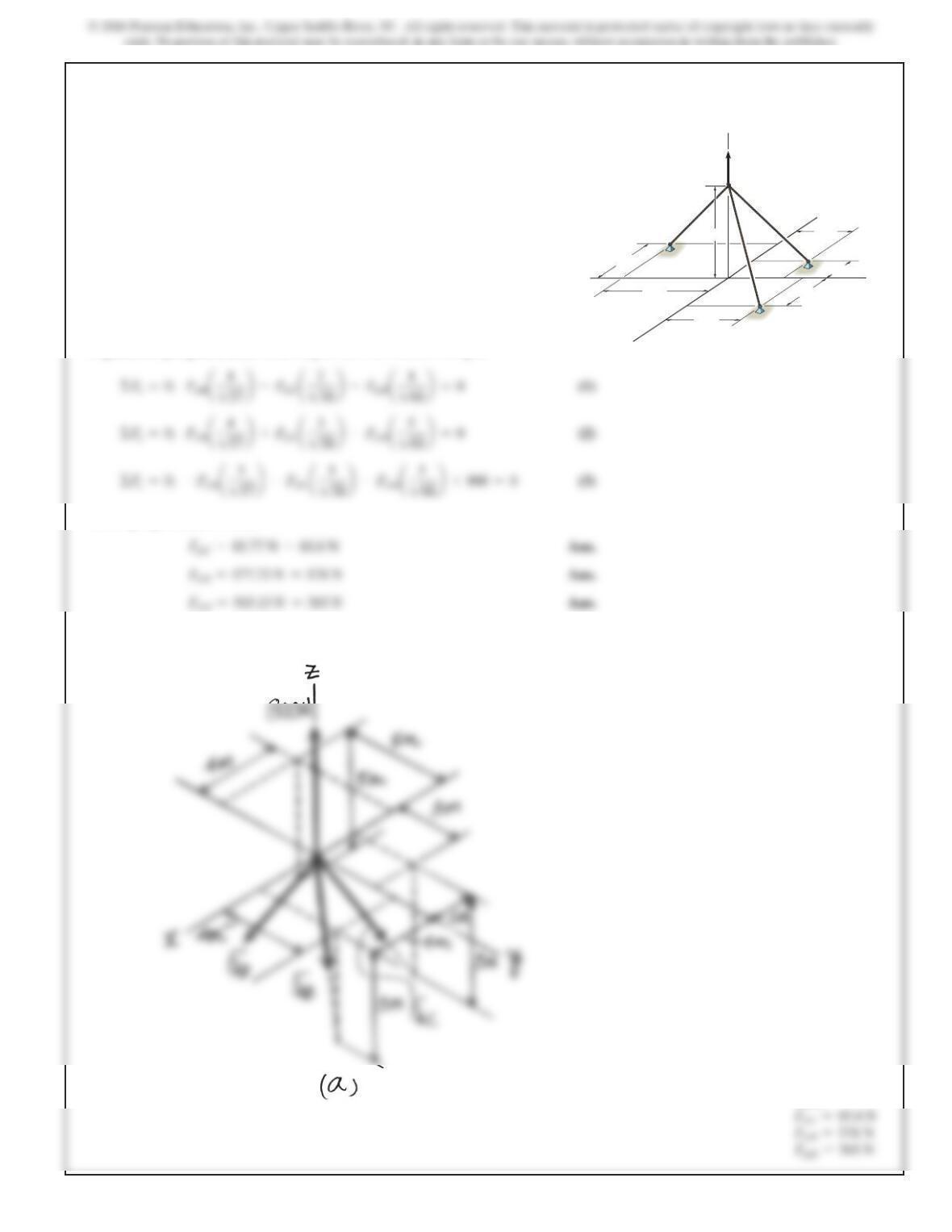
e 800-
lb
cy
li
n
d
er
i
ssupporte
db
yt
h
reec
h
a
i
ns as s
h
own.
Determinethe forcein eachchain for equilibrium. Take
d=1ft.
90
135
135
1ft
D
B
C
z
y
Ans:
221
Ans:
SOLUTION
Equations of Equilibrium. Referring to the FBD shown in Fig. a,
Solving Eqs (1), (2) and (3)
3–61.
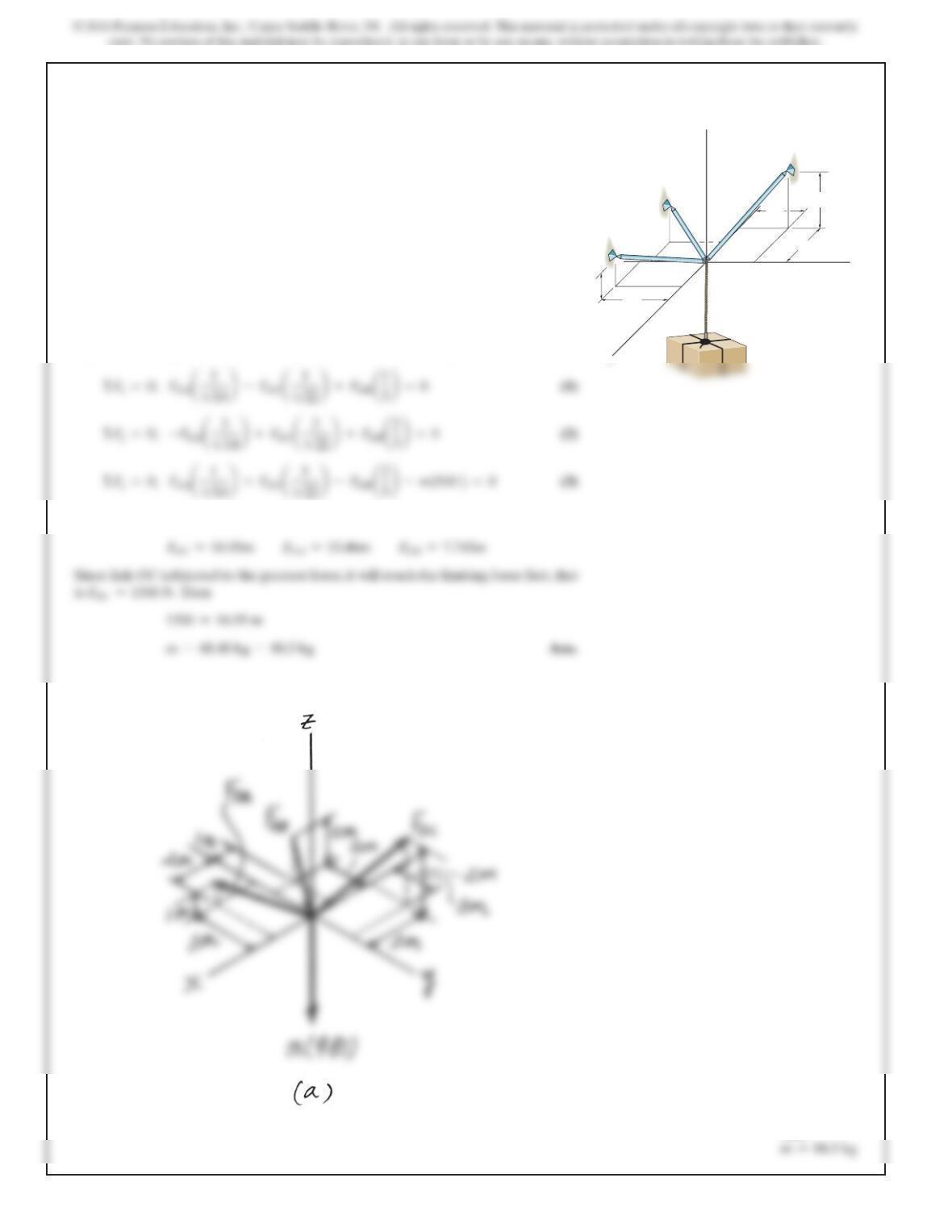
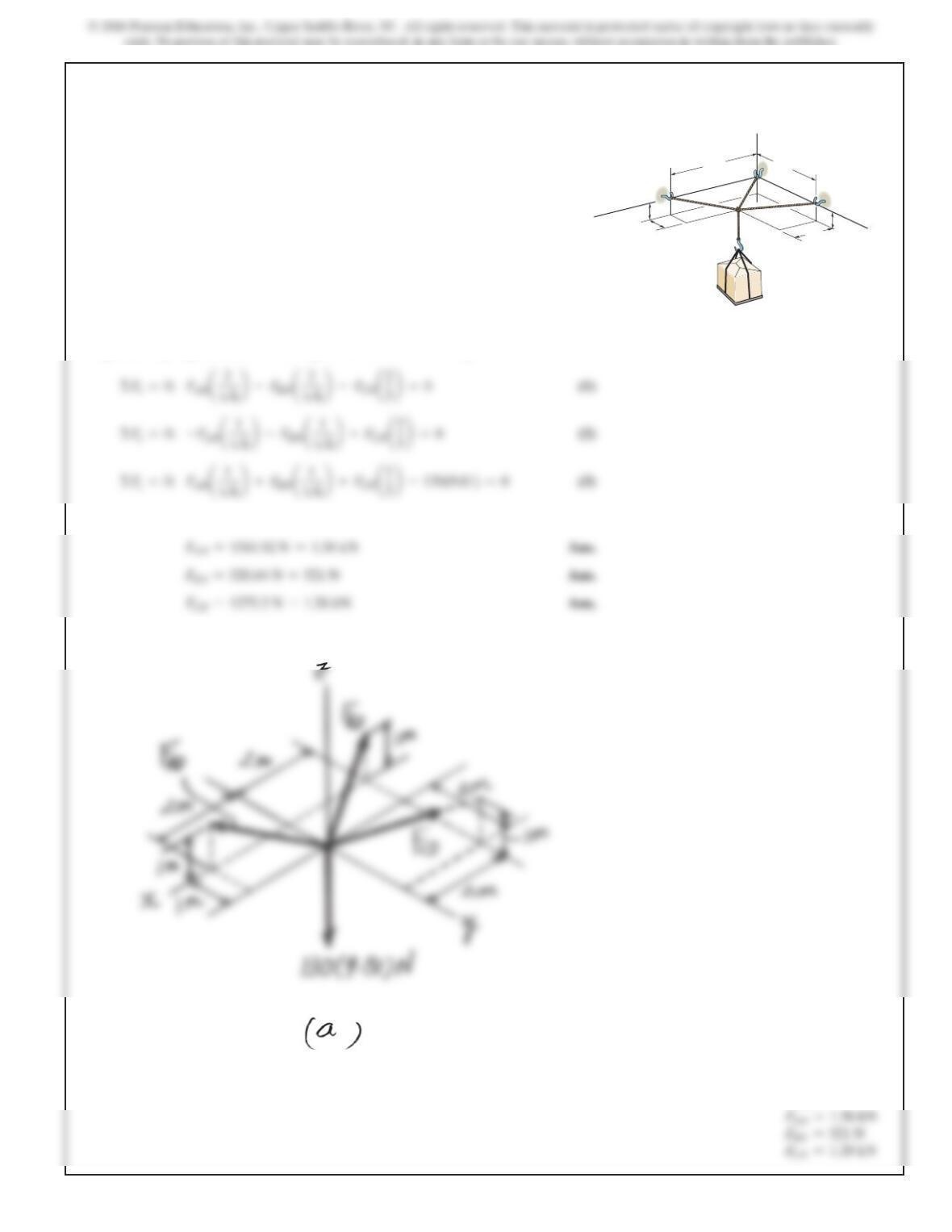
Determine the tension in each cable for equilibrium.
5 m
y
O
C
B
D
A
5 m
4 m
4 m
3 m
800 N
4 m
2 m
x
z
222
Ans:
SOLUTION
Equations of Equilibrium. Referring to the FBD shown in Fig. a,
Solving Eqs (1), (2) and (3),
3–62.
If the maximum force in each rod can not exceed 1500 N,
determine the greatest mass of the crate that can be
supported.
3 m
2 m
1 m
2 m
2 m
1 m
3 m
3 m
A
O
B
C
y
z
2 m
223
Ans:
SOLUTION
Equations of Equilibrium. Referring to the FBD shown in Fig. a,
Solving Eqs (1), (2) and (3)
3–63.
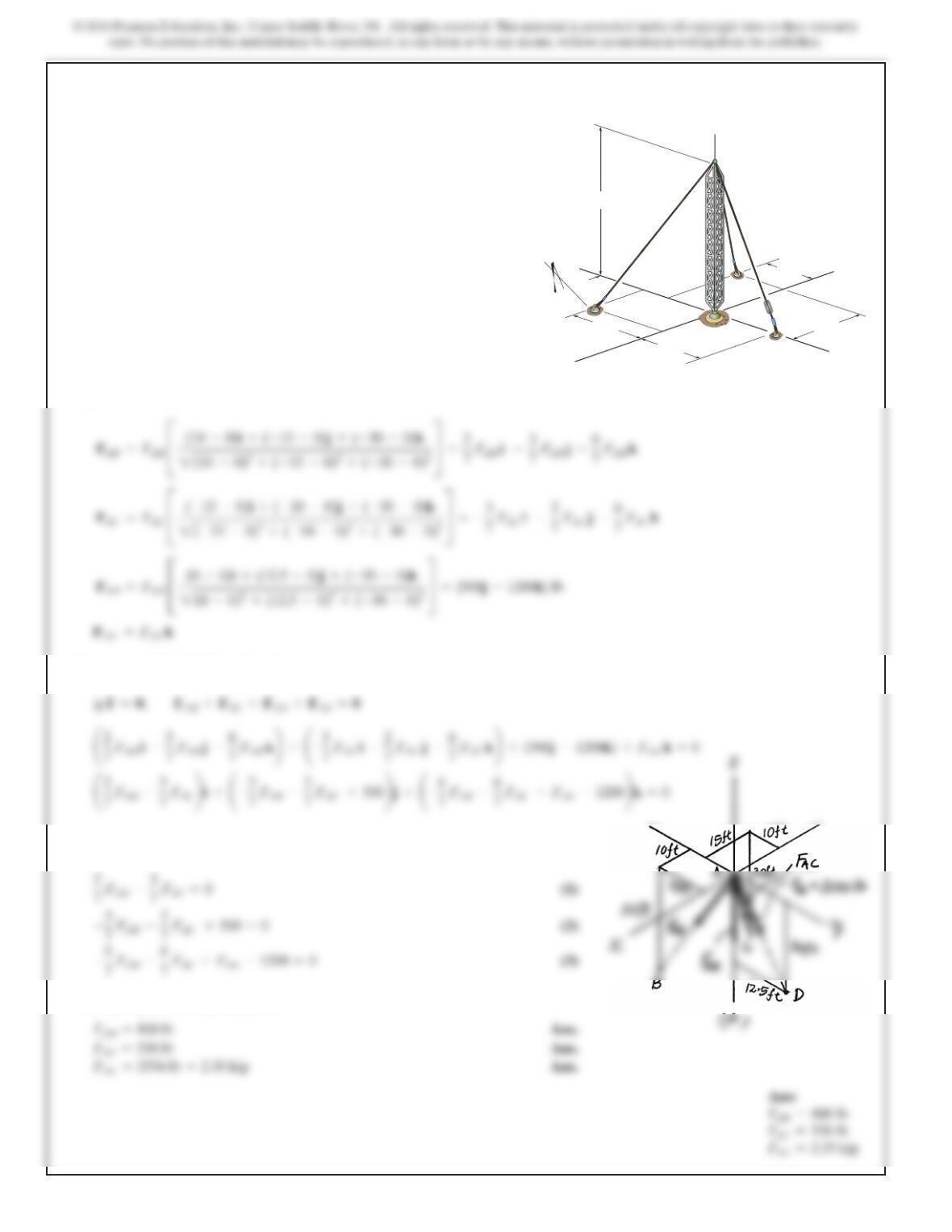
The crate has a mass of 130 kg. Determine the tension
developed in each cable for equilibrium.
3 m
4 m
y
C
2 m
1 m
1 m
1 m
AB
D
x
z
224
*3–64.
SOLUTION
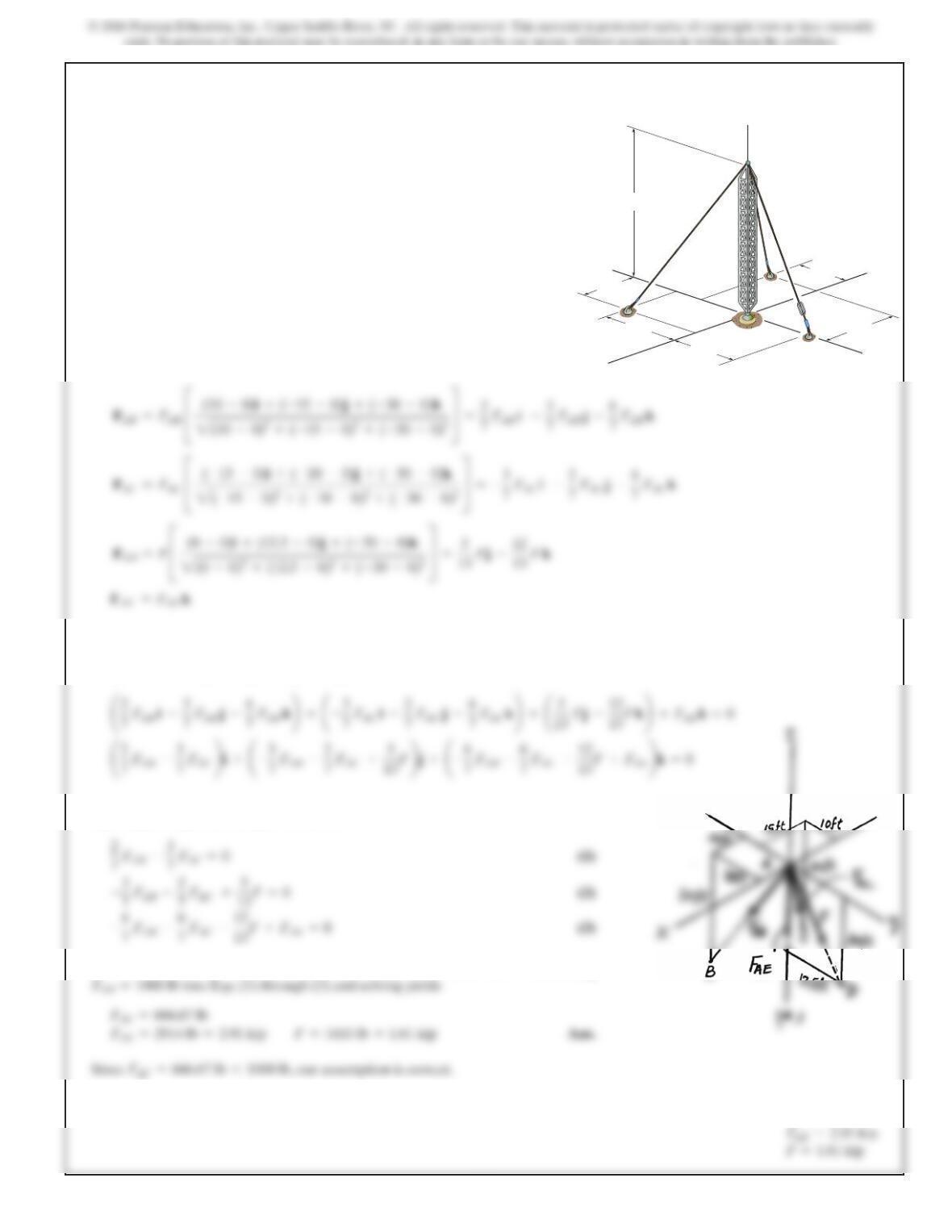
Force Vectors: We can express each of the forces on the free-body diagram shown in
Fig. ain Cartesian vector form as
Equations of Equilibrium: Equilibrium requires
Equating the i,j,and kcomponents yields
Solving Eqs. (1) through (3) yields
If cable AD is tightened by a turnbuckle and develops a
tension of 1300 lb,determine the tension developed in
cables AB and AC and the force developed along the
antenna tower AE at point A.
15 ft 15 ft
10 ft
10 ft
z
x
BE
D
C
A
y
30 ft
12.5 ft
225
3–65.
SOLUTION
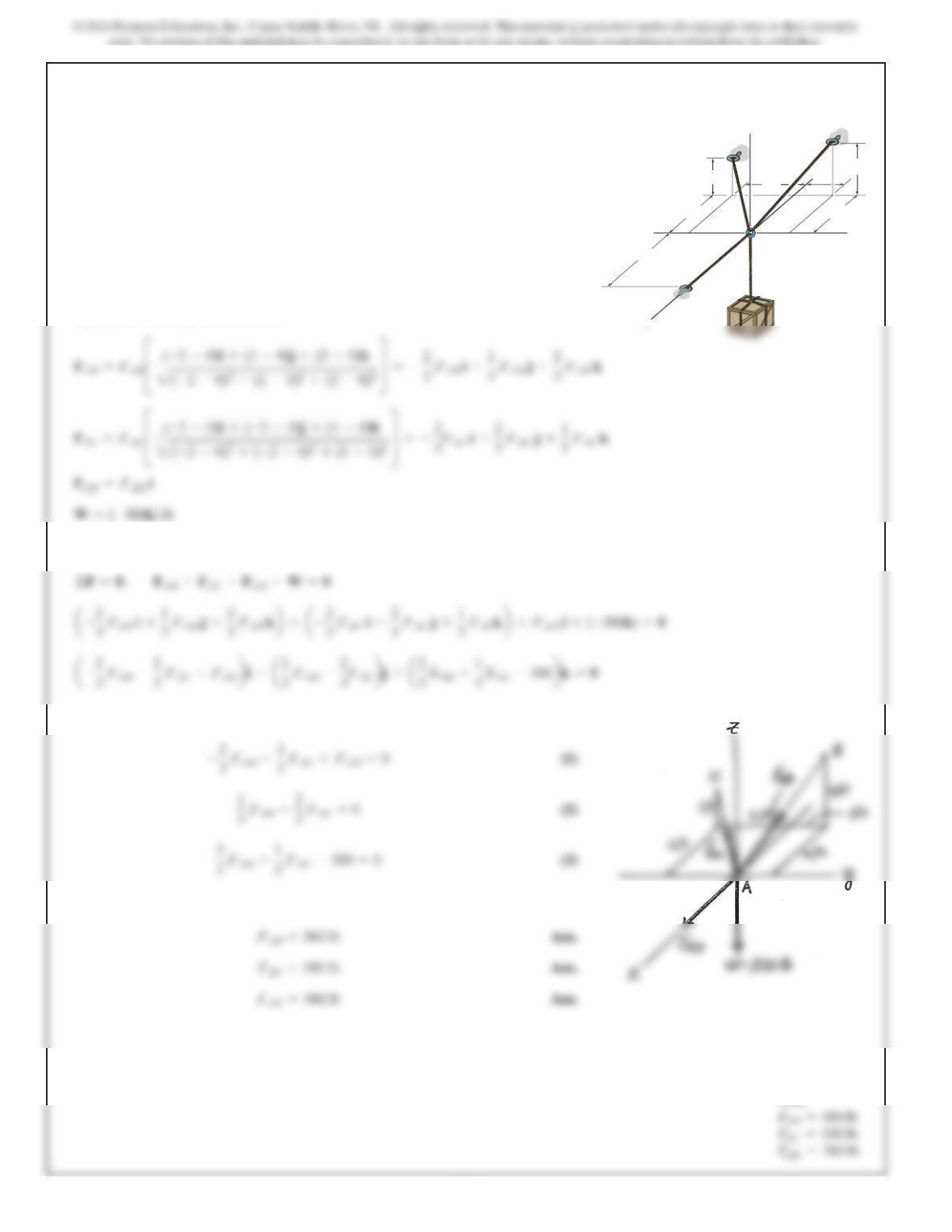
Force Vectors: We can express each of the forces on the free-body diagram shown in
Fig. ain Cartesian vector form as
Equations of Equilibrium: Equilibrium requires
Equating the i,j,and kcomponents yields
Let us assume that cable AB achieves maximum tension first. Substituting
gF=0;
FAB +FAC +FAD +FAE =0
If the tension developed in either cable AB or AC cannot
exceed 1000 lb,determine the maximum tension that can
be developed in cable AD when it is tightened by the
turnbuckle.Also, what is the force developed along the
antenna tower at point A?
15 ft 15 ft
10 ft
10 ft
z
x
BE
D
C
A
y
30 ft
12.5 ft
Ans:
226
3–66.
Determine the tension developed in cables ,,and
required for equilibrium of the 300-lb crate.
ADACAB
A
D
C
x
1 ft
3 ft
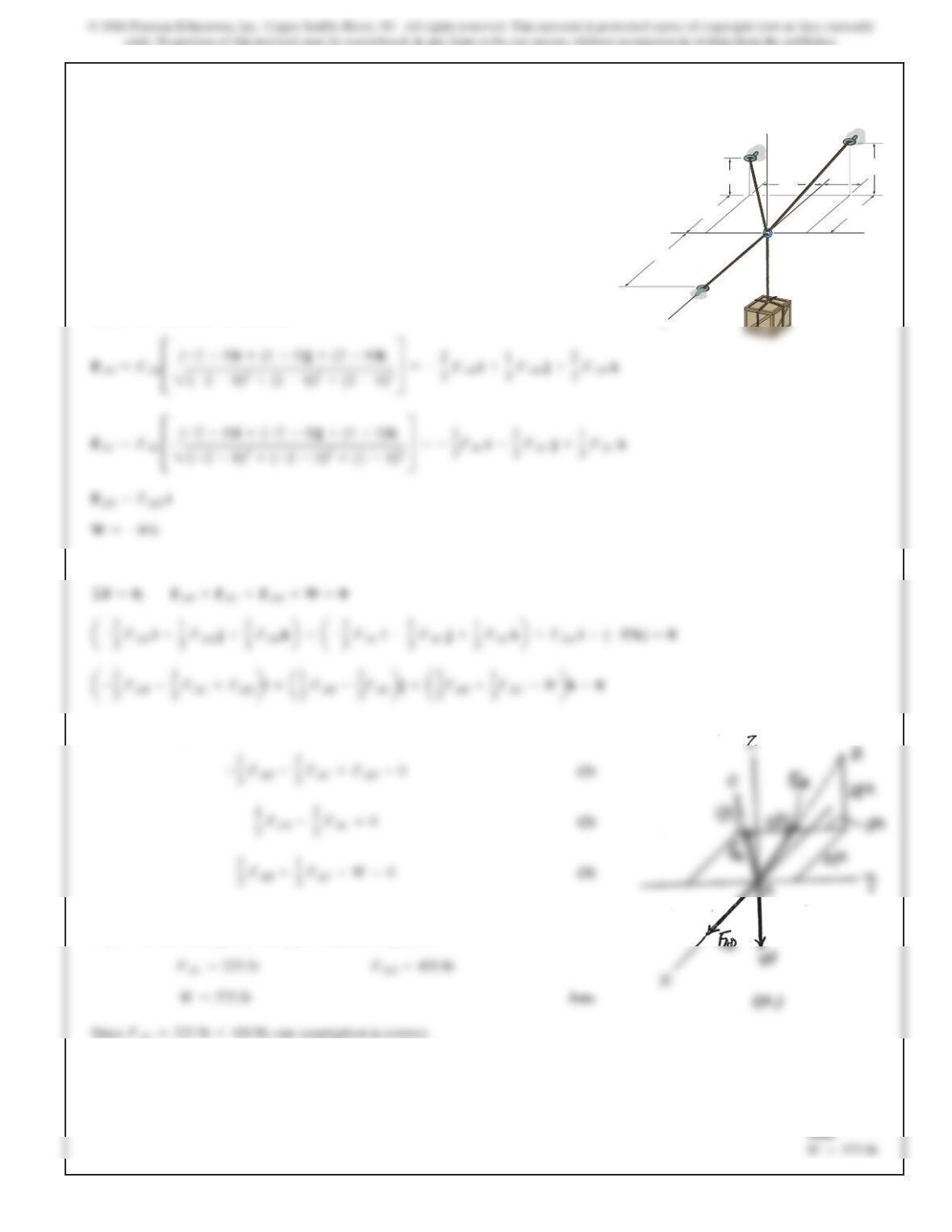
2 ft 1 ft 2 ft
2 ft
y
z
2 ft
B
SOLUTION
Force Vectors: We can express each of the forces on the free-body diagram shown in
Fig. (a) in Cartesian vector form as
Equations of Equilibrium: Equilibrium requires
Equating the i, j, and kcomponents yields
Solving Eqs. (1) through (3) yields
Ans:
227
3–67.
SOLUTION
F
orce Vectors: We can express each of the forces on the free-body diagram shown in
F
ig.(a) in Cartesian vector form as
Determine the maximum weight of the crate so that the
tension developed in any cable does not exceed 450 lb
.
A
D
C
x
1ft
3ft
2ft1ft2ft
2ft
y
z
2ft
B
Equating the
i, j, and kcomponents yields
Let us assume that cable
AB achieves maximum tension first. Substituting
into Eqs. (1) through (3) and solving, yields
FAB =450 lb
Equations of Equilibrium:
Equilibrium requires