201
3–41.
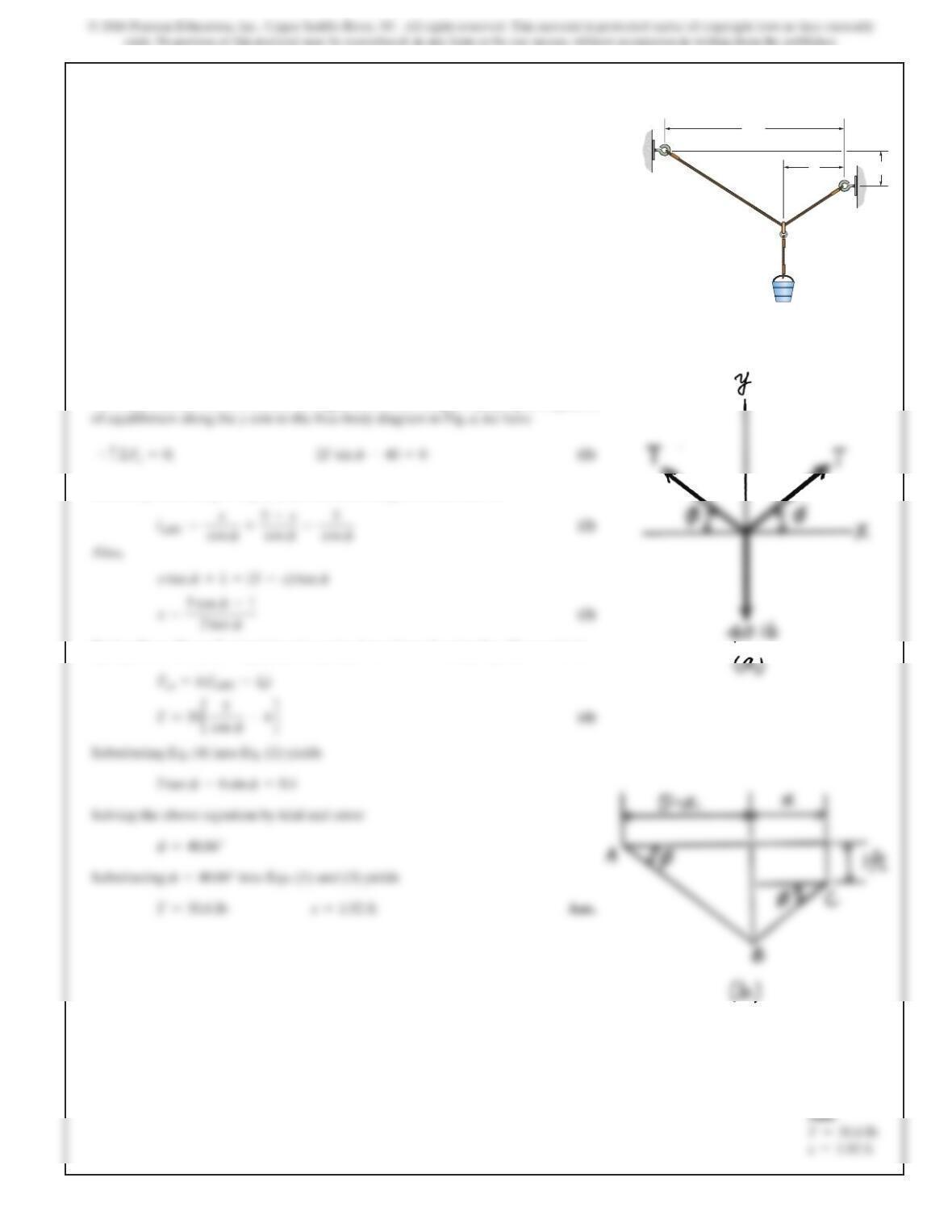
The single elastic cord ABC is used to support the 40-lb
load.Determine the position xand the tension in the cord
that is required for equilibrium. The cord passes through
the smooth ring at Band has an unstretched length of 6 ft
and stiffness of k=50 lb>ft.
A
C
B
x
5 ft
1 ft
SOLUTION
Equations of Equilibrium:Since elastic cord ABC passes over the smooth ring at B,
the tension in the cord is constant throughout its entire length.Applying the equation
Geometry: Referring to Fig. (b), the stretched length of cord ABC is
Spring Force Formula: Applying the spring force formula using Eq.(2), we obtain
202
3–42.
SOLUTION
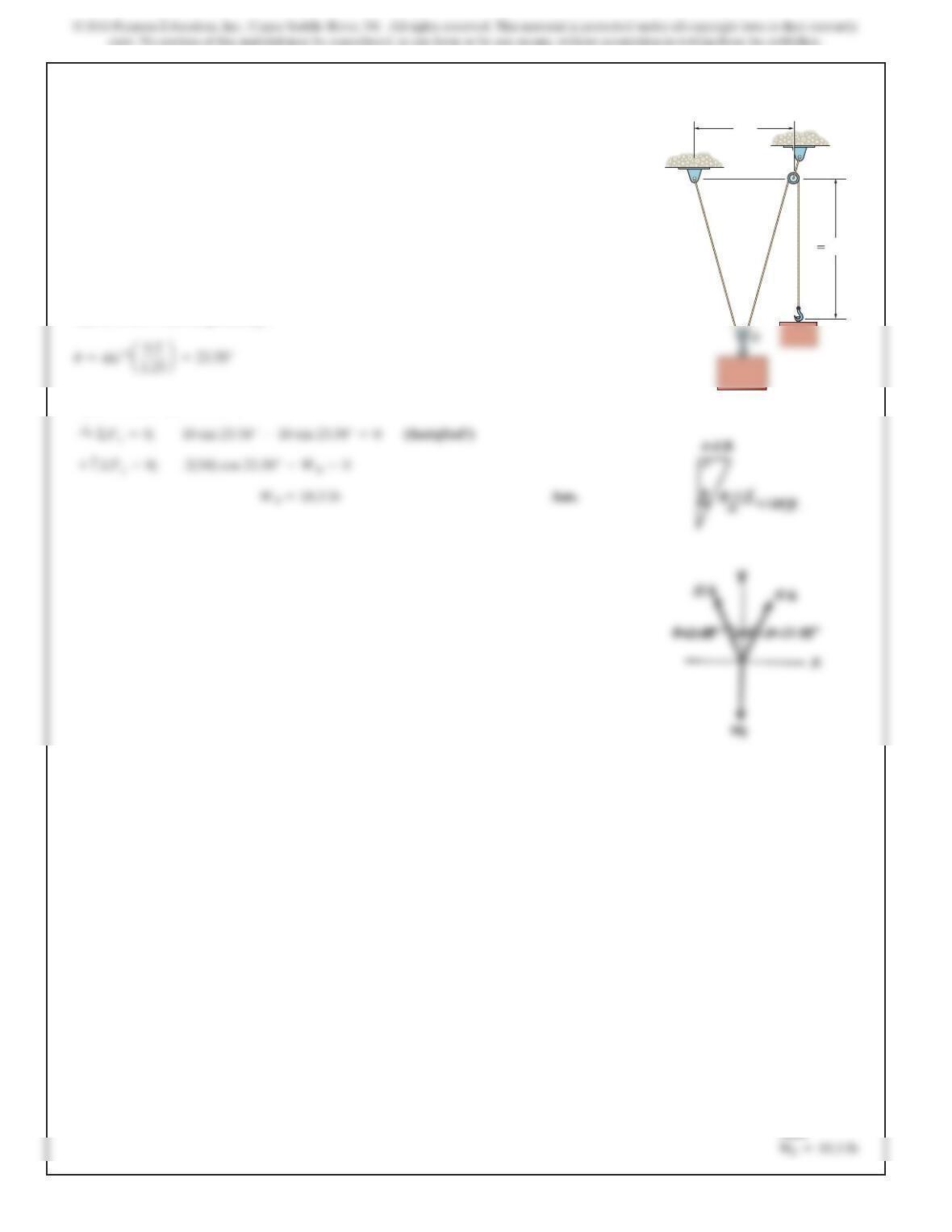
Free-Body Diagram: The tension force in the cord is the same throughout the cord,
that is, 10 lb. From the geometry,
Equations of Equilibrium:
A “scale”is constructed with a 4-ft-long cord and the 10-lb
block D.The cord is fixed to a pin at Aand passes over two
small pulleys at Band C.Determine the weight of the
suspended block at B if the system is in equilibrium when
s = 1.5 ft.
s 1.5 ft
C
D
A
1 ft
Ans:
203
Ans:
SOLUTION
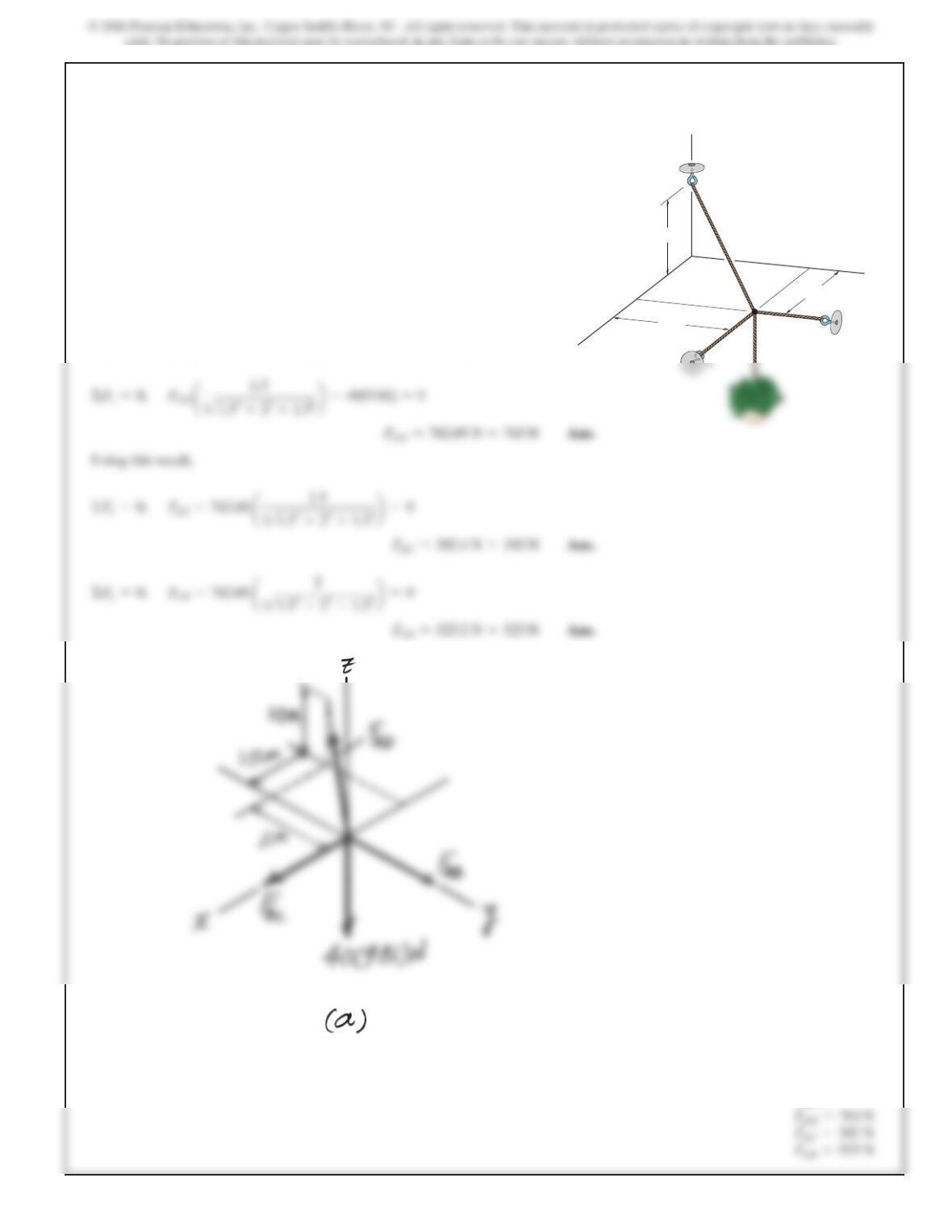
Equations of Equilibrium. Referring to the FBD shown in Fig. a,
3–43.
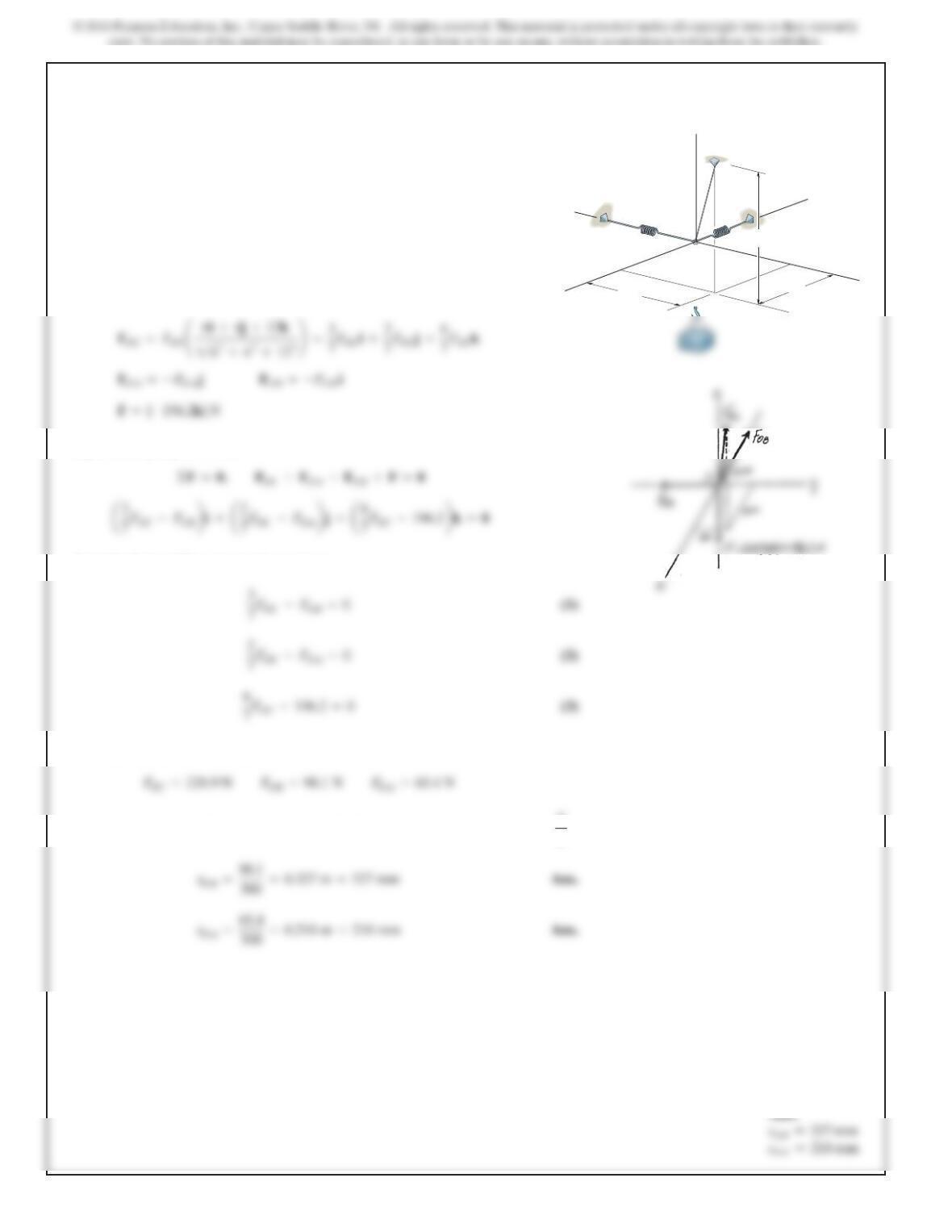
The three cables are used to support the 40-kg owerpot.
Determine the force developed in each cable for
equilibrium.
2 m
z
1.5 m
1.5 m
D
y
x
A
B
204
Ans:
SOLUTION
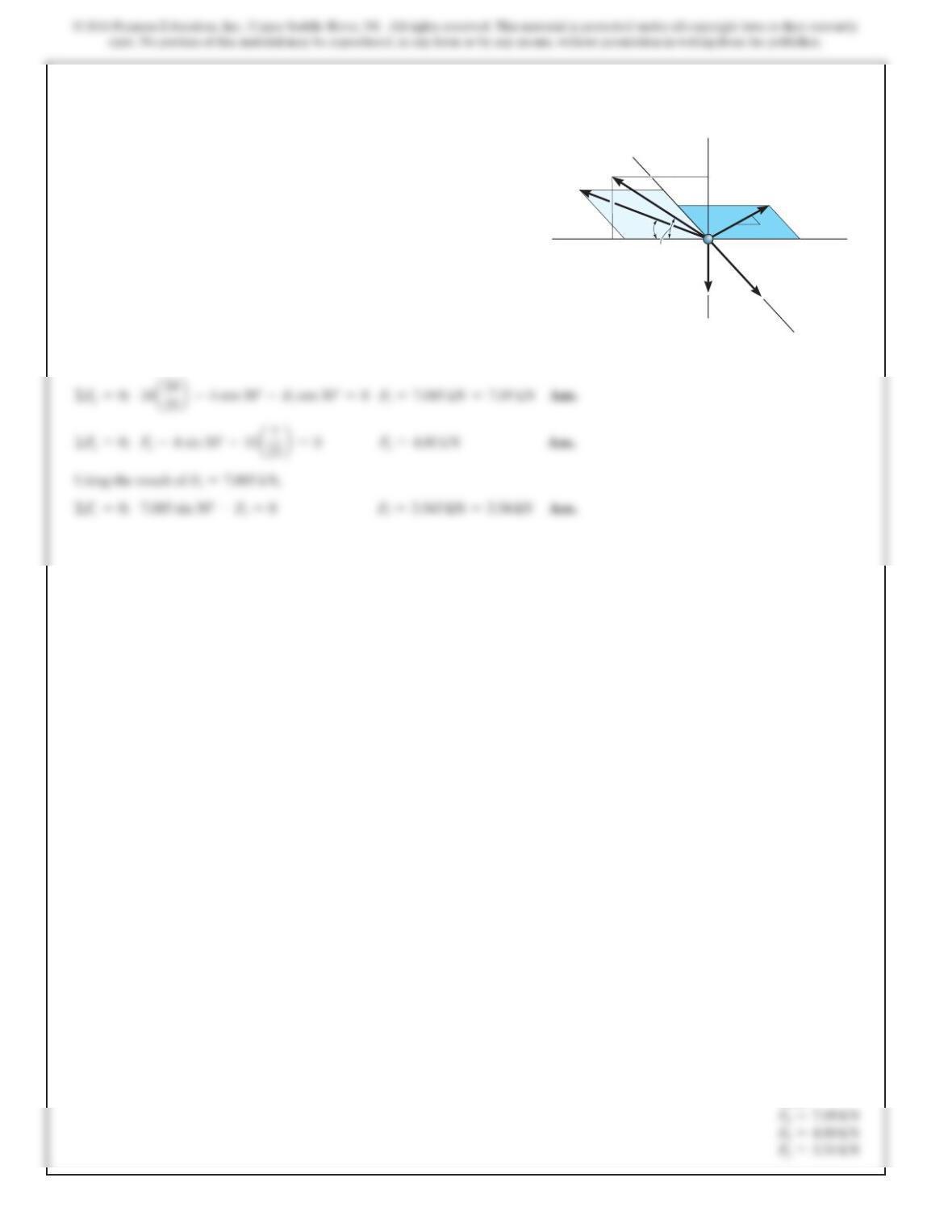
Equations of Equilibrium. Referring to the FBD shown,
*3–44.
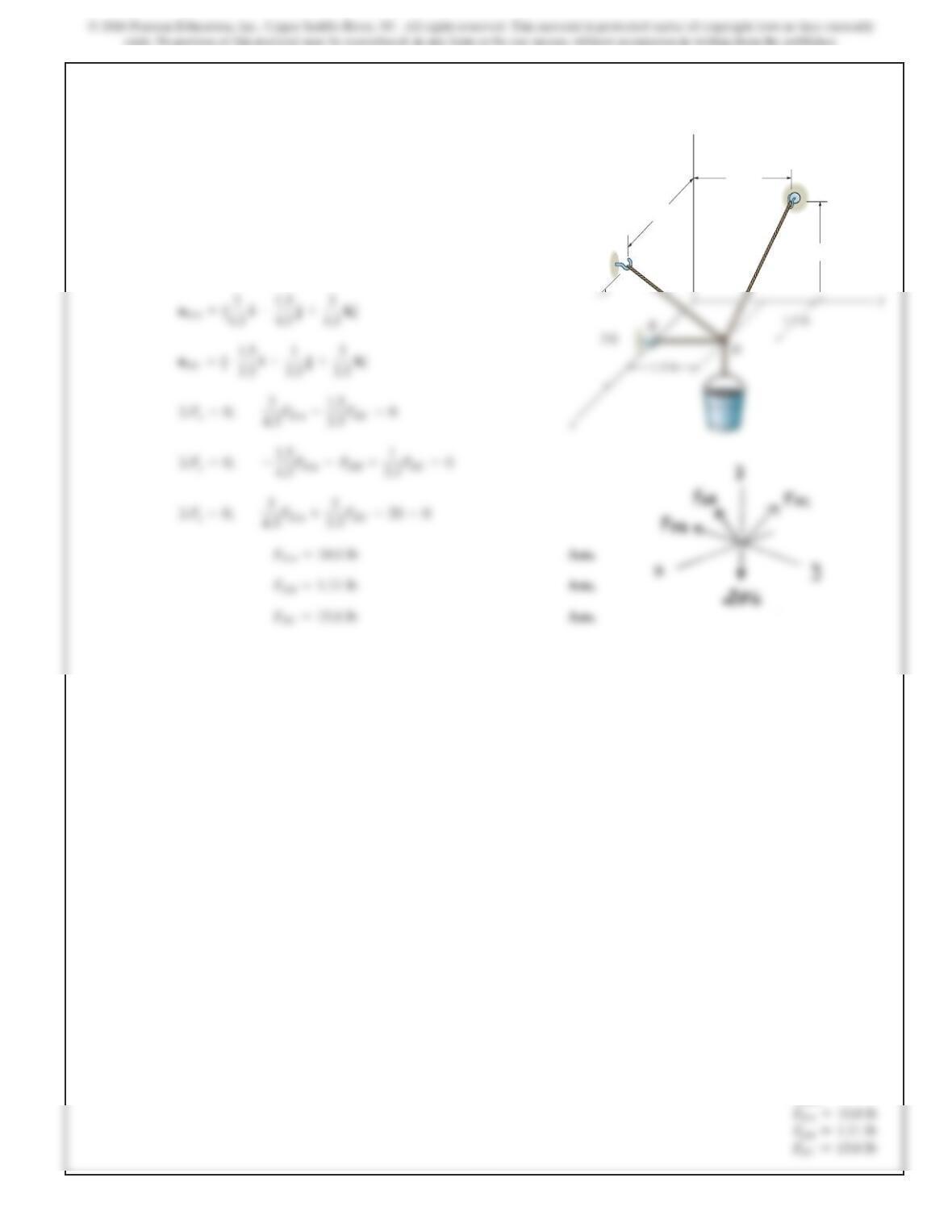
Determine the magnitudes of F1, F2, and F3 for equilibrium
of the particle.
y
30fi
30fi
25
24
7
4 kN 10 kN
F1
F2
F3
z
x
205
3–45.
If t
h
e
b
uc
k
et an
d
i
ts contents
h
ave a tota
l
we
i
g
h
t of 20
lb
,
determine the force in the supporting cables DA,DB,
and DC.
SOLUTION
4.5 ft
2.5 ft
3ft
A
C
z
Ans:
206
3–46.
SOLUTION
Cartesian Vector Notation:
Equations of Equilibrium:
Equating i, j, and k components, we have
Solving Eqs. (1),(2) and (3) yields
Spring Elongation: Using spring formula, Eq. 3–2, the spring elongation is .
s=F
k
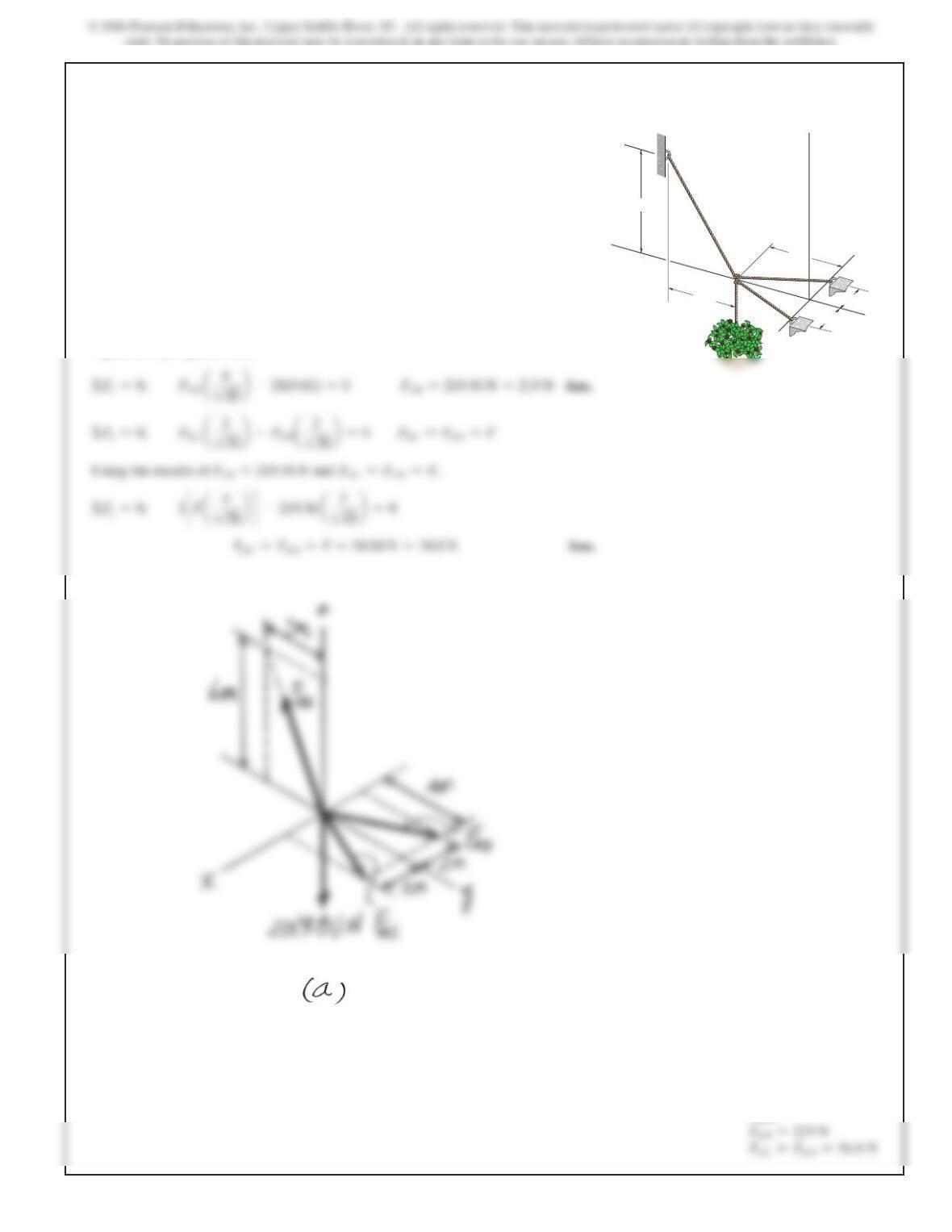
Determine the stretch in each of the two springs required to
hold the 20-kg crate in the equilibrium position shown.
Each spring has an unstretched length of 2 m and a stiffness
of k=360 N>m.
y
x
z
O
C
B
A12 m
6m
4m
207
Ans:
SOLUTION
Equations of Equilibrium.
3–47.
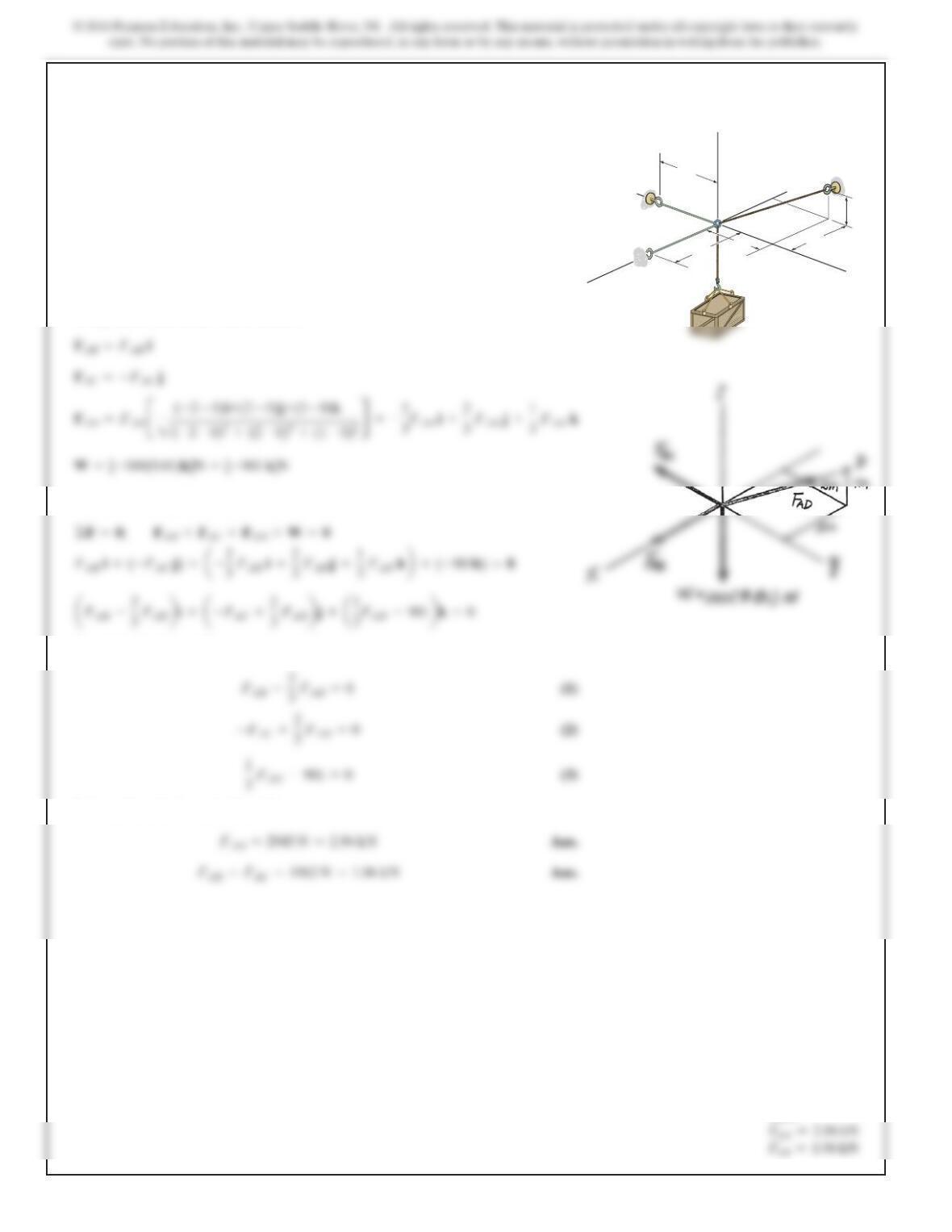
Determine the force in each cable needed to support the
20-kg owerpot.
D
y
x
C
A
B
4 m
2 m
2 m
6 m
3 m
z
208
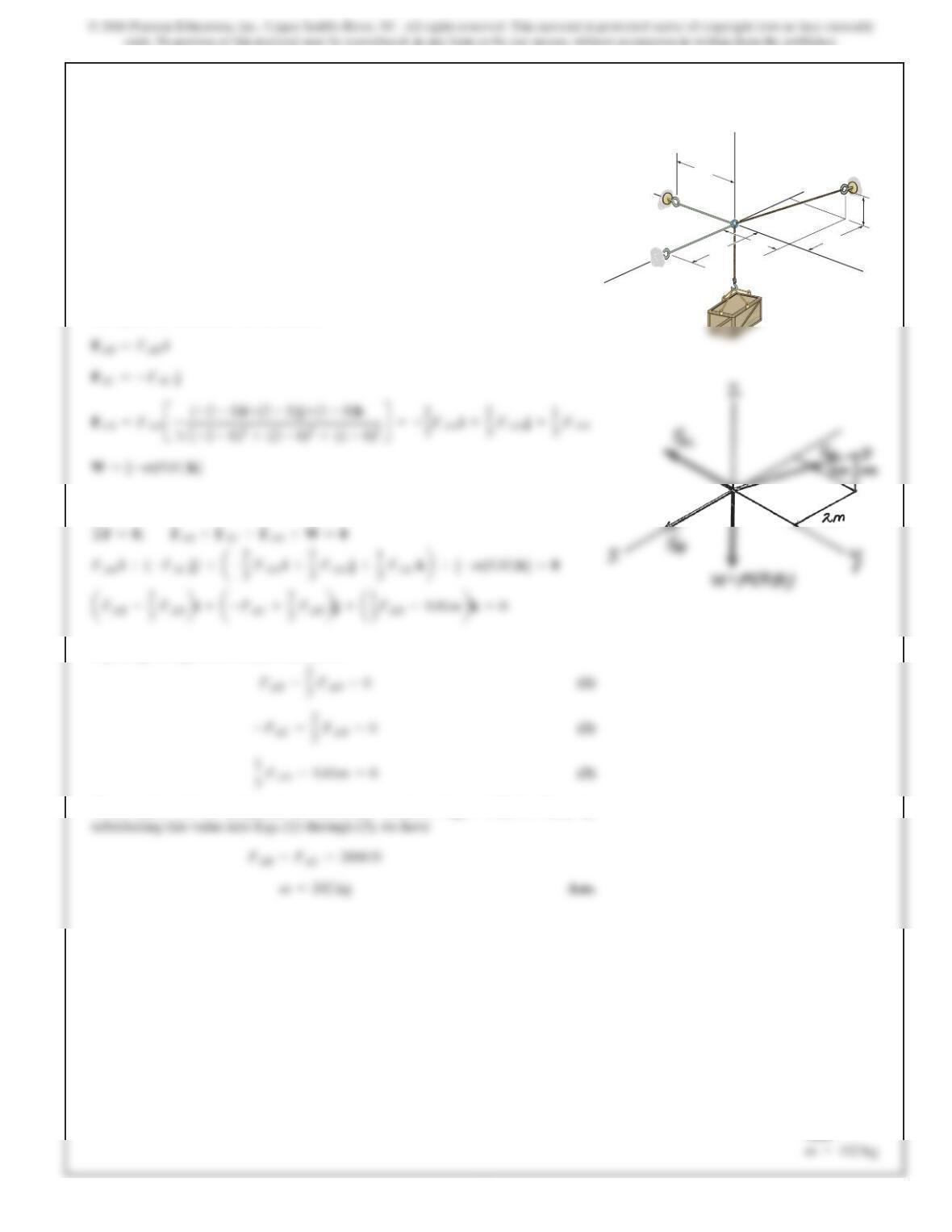
*3–48.
SOLUTION
Force Vectors: We can express each of the forces on the free-body diagram shown
in Fig. (a) in Cartesian vector form as
Determine the tension in the cables in order to support the
100-kg crate in the equilibrium position shown.
2.5 m 2 m
2 m
2 m
1 m
A
z
D
y
x
B
C
Equations of Equilibrium: Equilibrium requires
Equating the i, j, and kcomponents yields
Solving Eqs. (1) through (3) yields
Ans:
209
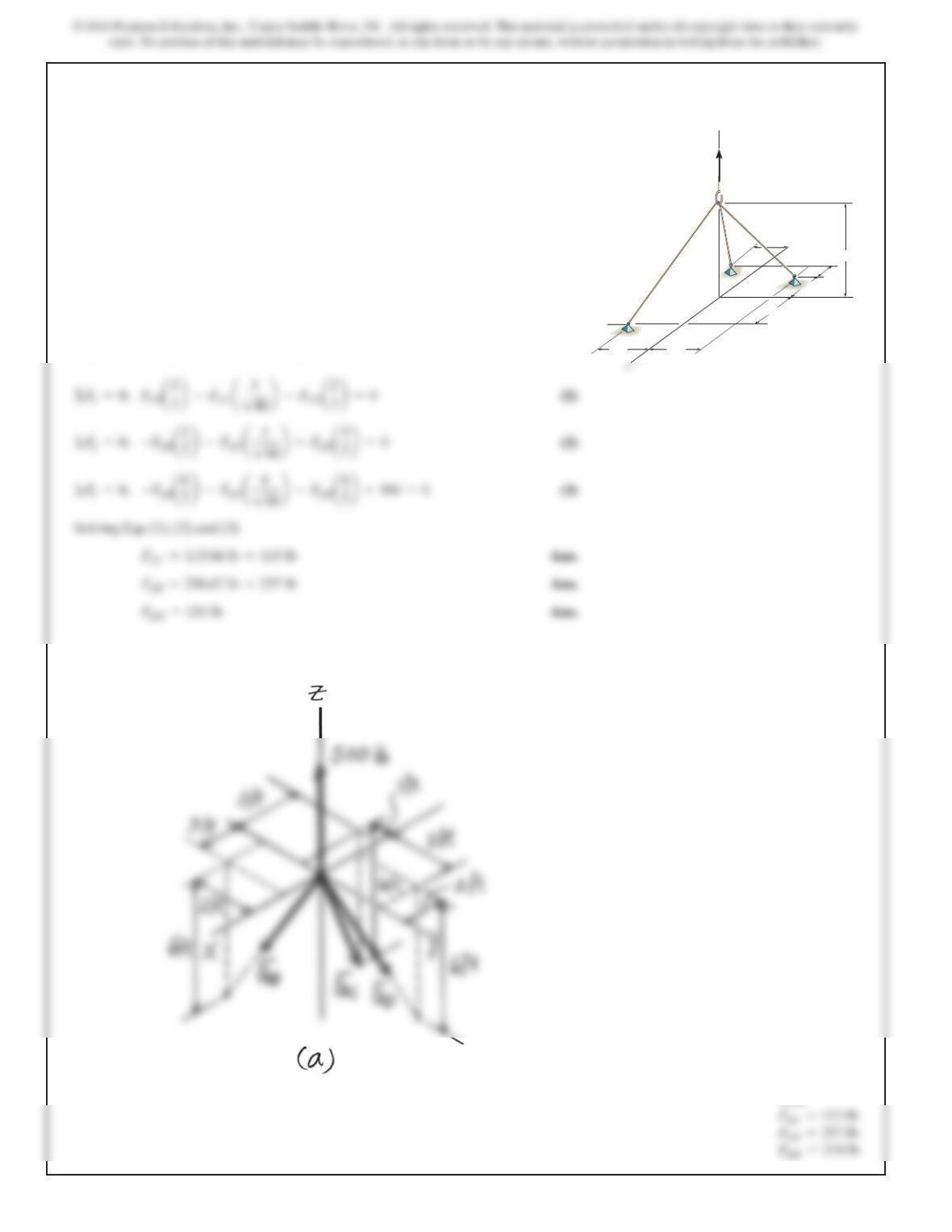
3–49.
SOLUTION
Force Vectors: We can express each of the forces on the free-body diagram shown
in Fig. (a) in Cartesian vector form as
Equations of Equilibrium: Equilibrium requires
Equating the i, j, and kcomponents yields
W
hen cable AD is subjected to maximum tension,.Thus,by
FAD =3000 N
Determine the maximum mass of the crate so that the tension
developed in any cable does not exceeded 3 kN.
2.5 m 2 m
2 m
2 m
1 m
A
z
D
y
x
B
C
Ans:
210
Ans:
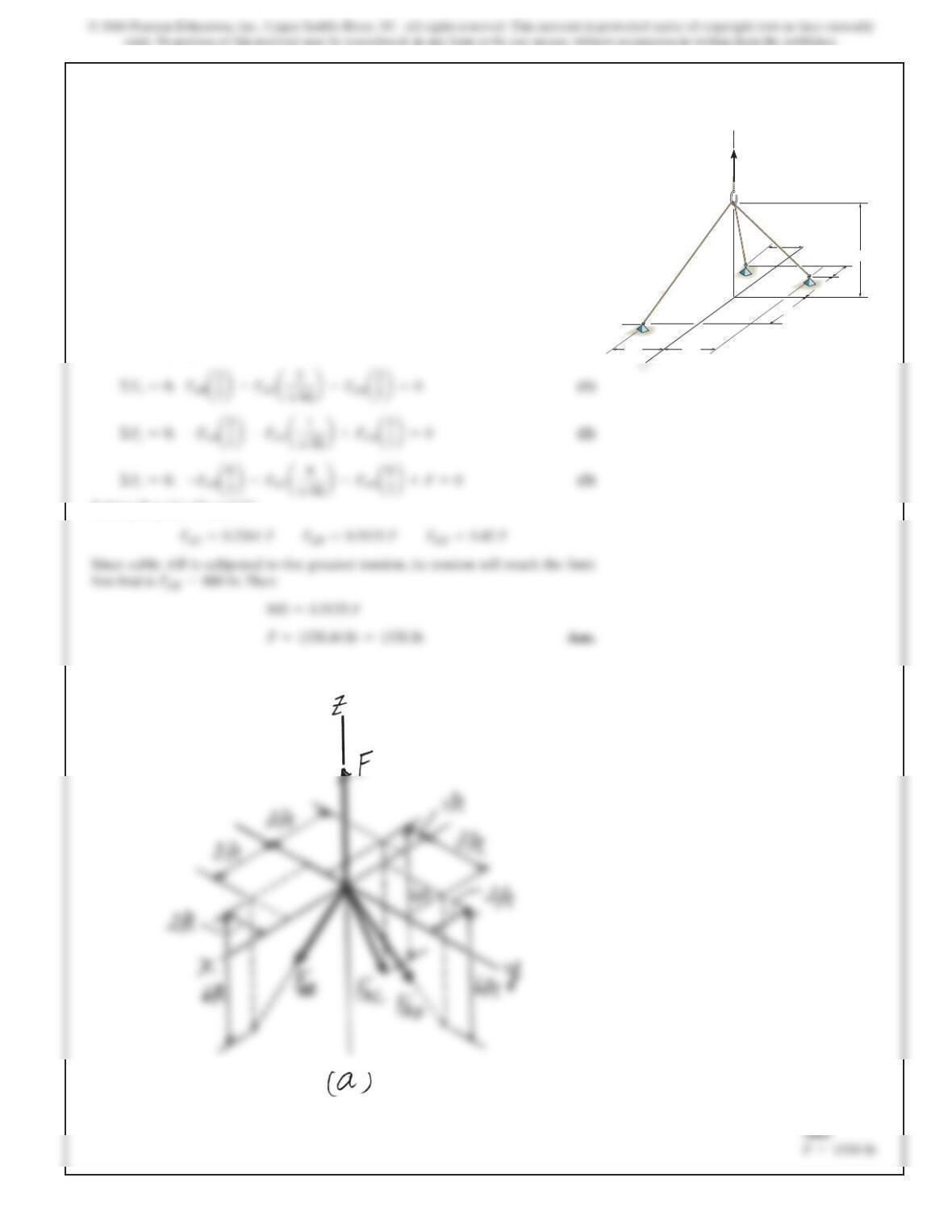
SOLUTION
Equations of Equilibrium. Referring to the FBD shown in Fig. a,
3–50.
Determine the force in each cable if F = 500 lb. z
A
B
y
D
F
1 ft
2 ft 3 ft
3 ft
6 ft
2 ft
1 ft
C
211
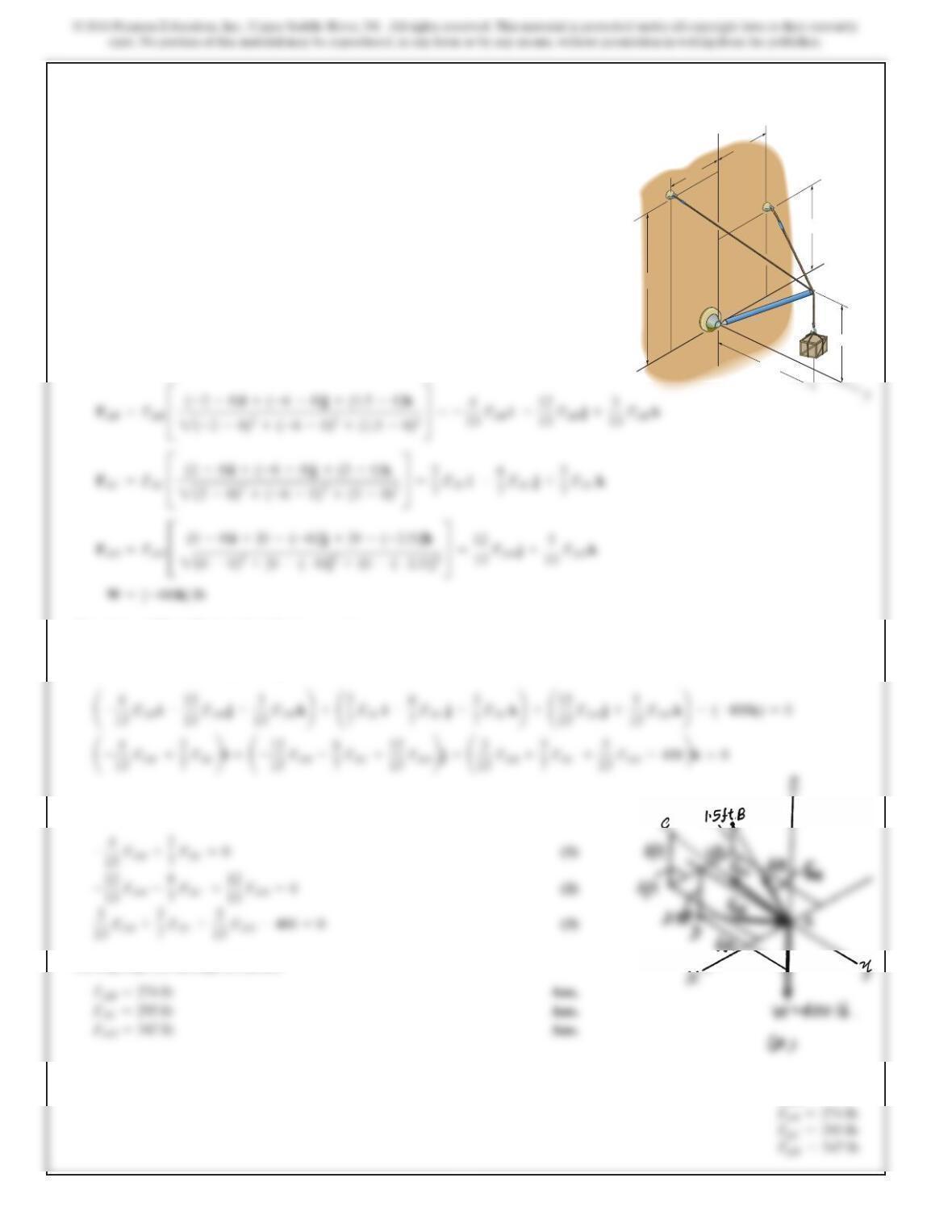
SOLUTION
Equations of Equilibrium. Referring to the FBD shown in Fig. a,
Solving Eqs (1), (2) and (3)
3–51.
Determine the greatest force F that can be applied to the
ring if each cable can support a maximum force
of 800 lb.
z
A
B
y
D
F
1 ft
2 ft 3 ft
3 ft
6 ft
2 ft
1 ft
C
212
*3–52.
SOLUTION
Force Vectors: We can express each of the forces on the free-body diagram shown in
Fig. ain Cartesian vector form as
Equations of Equilibrium: Equilibrium requires
Equating the i,j,and kcomponents yields
Solving Eqs. (1) through (3) yields
gF=0;
FAB +FAC +FAD +W=0
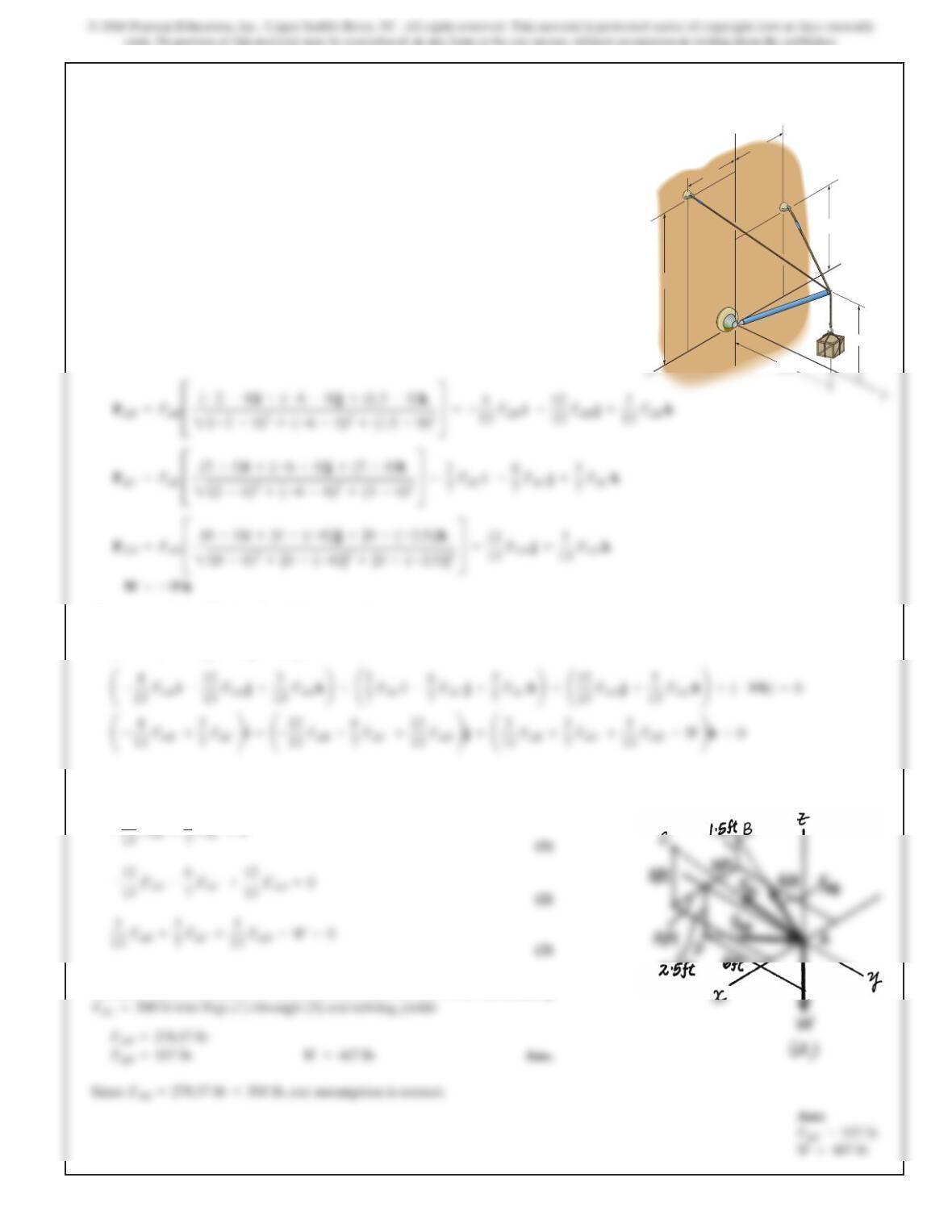
Determine the tension developed in cables AB and AC and
the force developed along strut AD for equilibrium of the
400-lb crate.
x
z
5.5 ft
2 ft
2 ft
A
B
D
C
4 ft
2.5 ft
6 ft
Ans:
213
3–53.
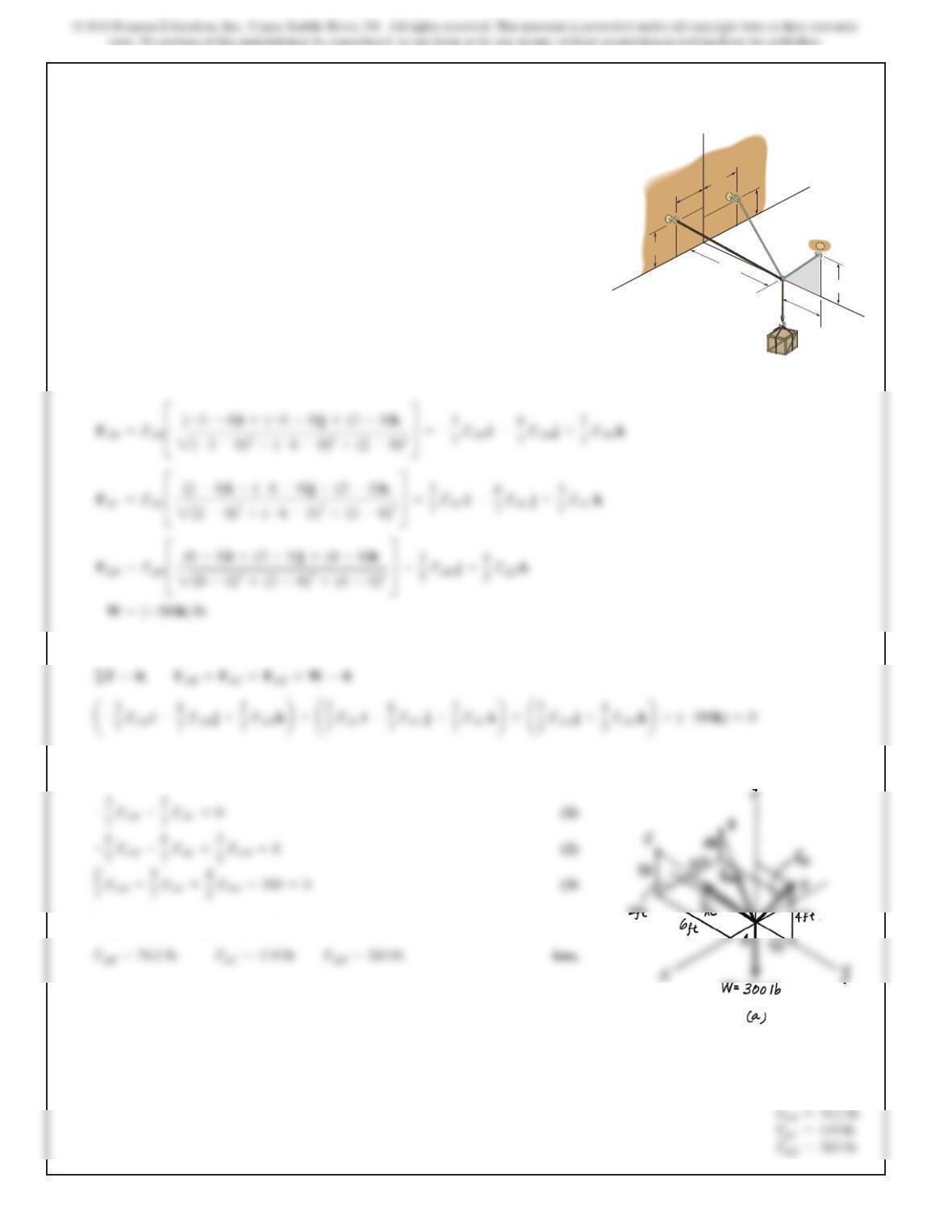
If the tension developed in each of the cables cannot
exceed 300 lb,determine the largest weight of the crate that
can be supported. Also,what is the force developed along
strut AD?
z
5.5 ft
2 ft
2 ft
A
B
D
C
4 ft
2.5 ft
6 ft
SOLUTION
Force Vectors: We can express each of the forces on the free-body diagram
shown in Fig. ain Cartesian vector form as
Equations of Equilibrium: Equilibrium requires
Equating the i,j,and kcomponents yields
Let us assume that cable AC achieves maximum tension first. Substituting
gF=0;
FAB +FAC +FAD +W=0
214
3–54.
SOLUTION
Force Vectors: We can express each of the forces shown in Fig. ain Cartesian vector
form as
Equations of Equilibrium: Equilibrium requires
Equating the i,j,and kcomponents yields
Solving Eqs. (1) through (3) yields
y
A
B
C
D
x
z
6 ft
3 ft
3 ft
2 ft 2 ft
3 ft
4 ft
Determine the tension developed in each cable for
equilibrium of the 300-lb crate.
Ans: