181
3–21.
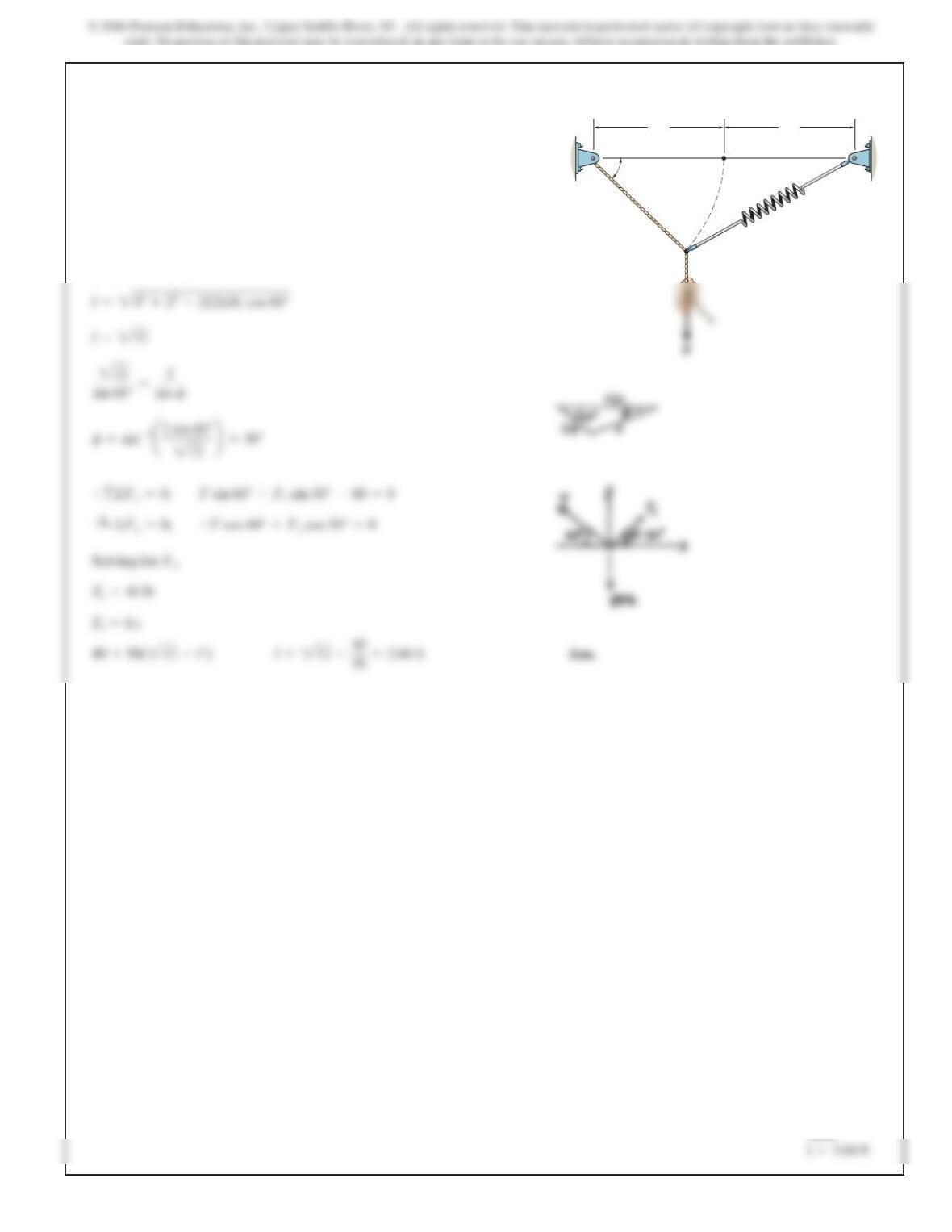
Determine the unstretched length of spring AC if a force
causes the angle for equilibrium. Cord
AB is 2 ft long.Take k=50 lb>ft.
u=60°P=80 lb
SOLUTION
2 ft
k
2 ft
A
BC
u
Ans:
182
3–22.
SOLUTION
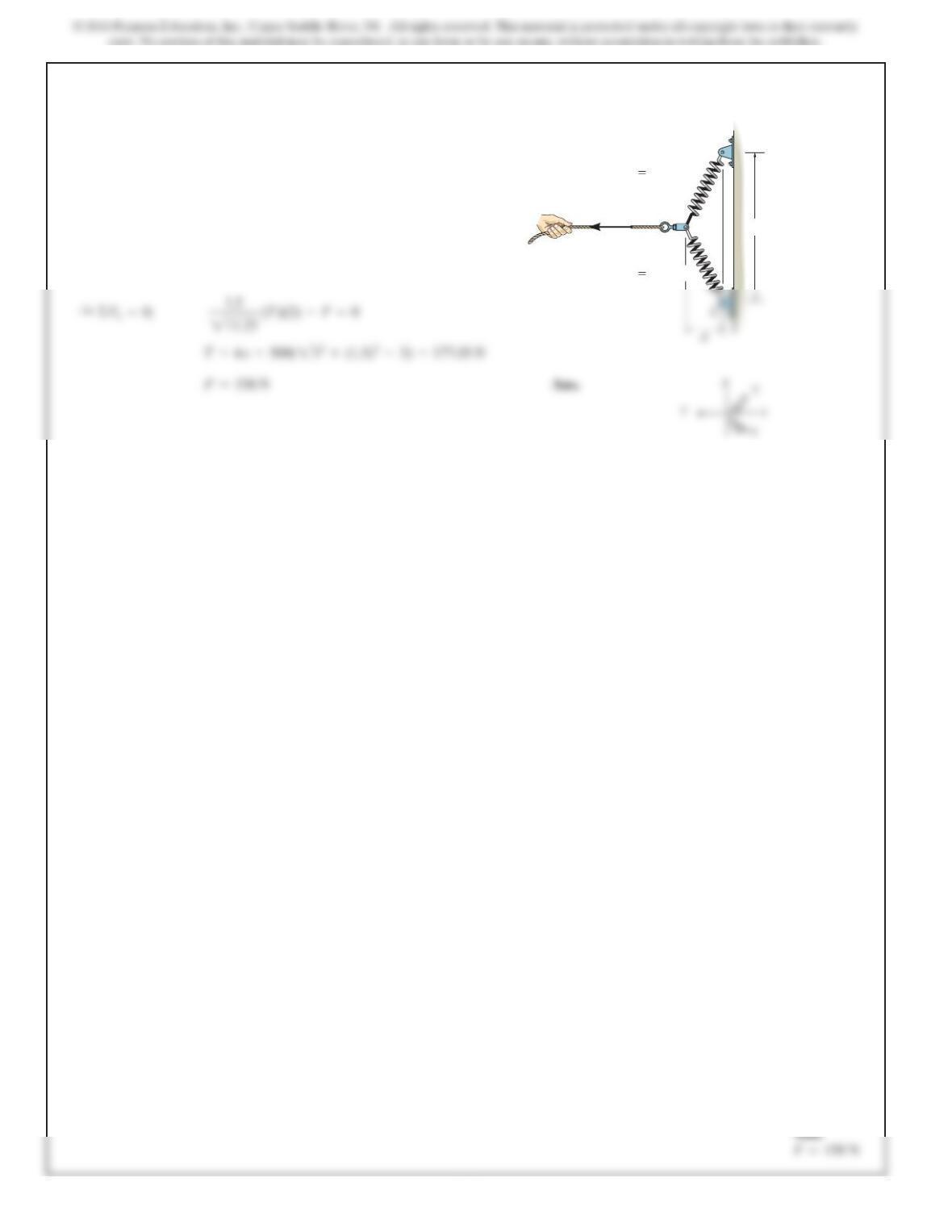
The springs BA and BC each have a stiffness of 500 N
>
m and an
unstretched length of 3 m. Determine the horizontal force F
applied to the cord which is attached to the small ring B so
that the displacement of the ring from the wall is d = 1.5 m.
F
B
A
k 500 N/m
k 500 N/m
6 m
183
3–23.
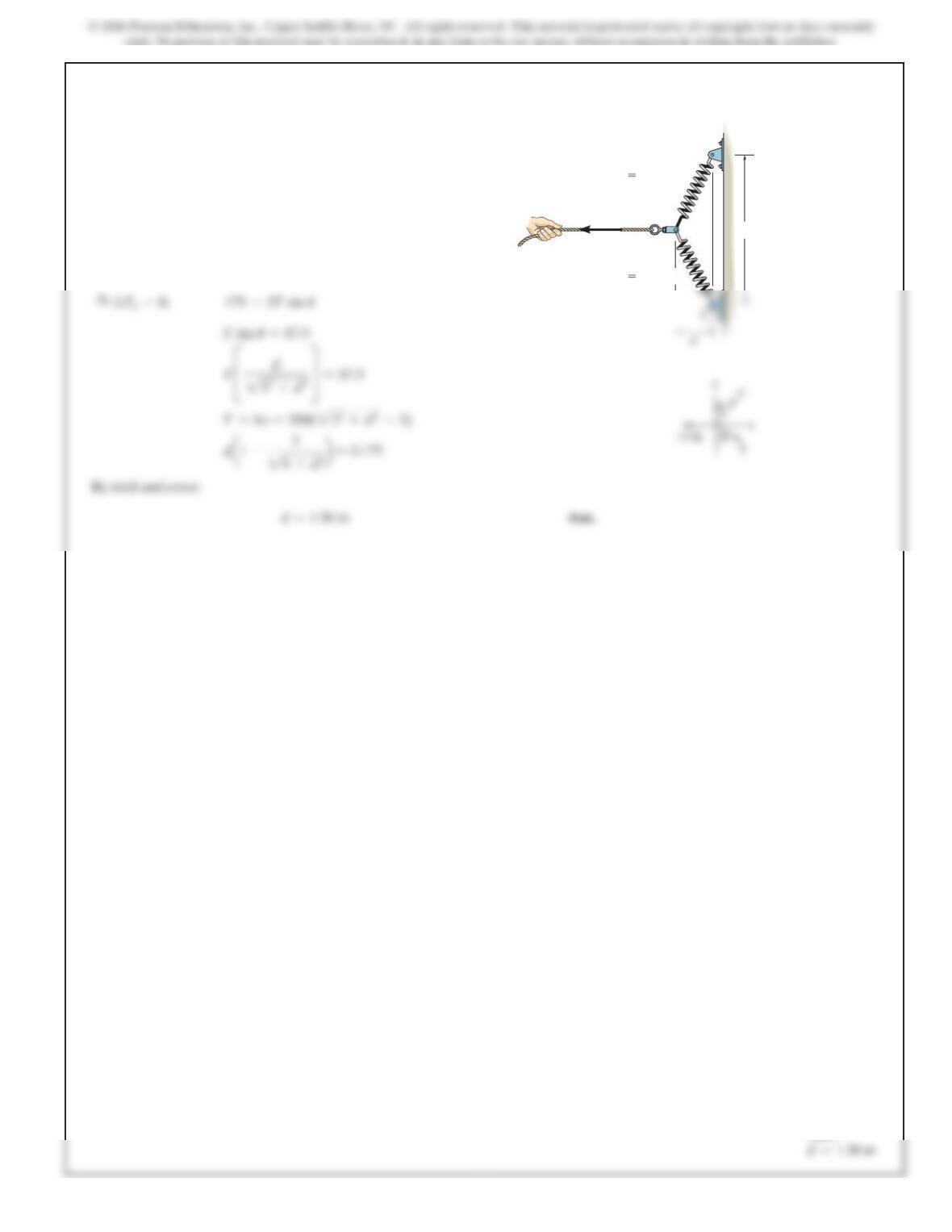
The springs
BA and BC each have a stiffness of 500 N
>
m and an
unstretched length of 3 m. Determine the displacement
d of the
cord from the wall when a force F = 175 N is applied to the cord.
SOLUTION
F
B
A
k 500 N/m
k 500 N/m
6 m
Ans:
184
184
Ans:
SOLUTION
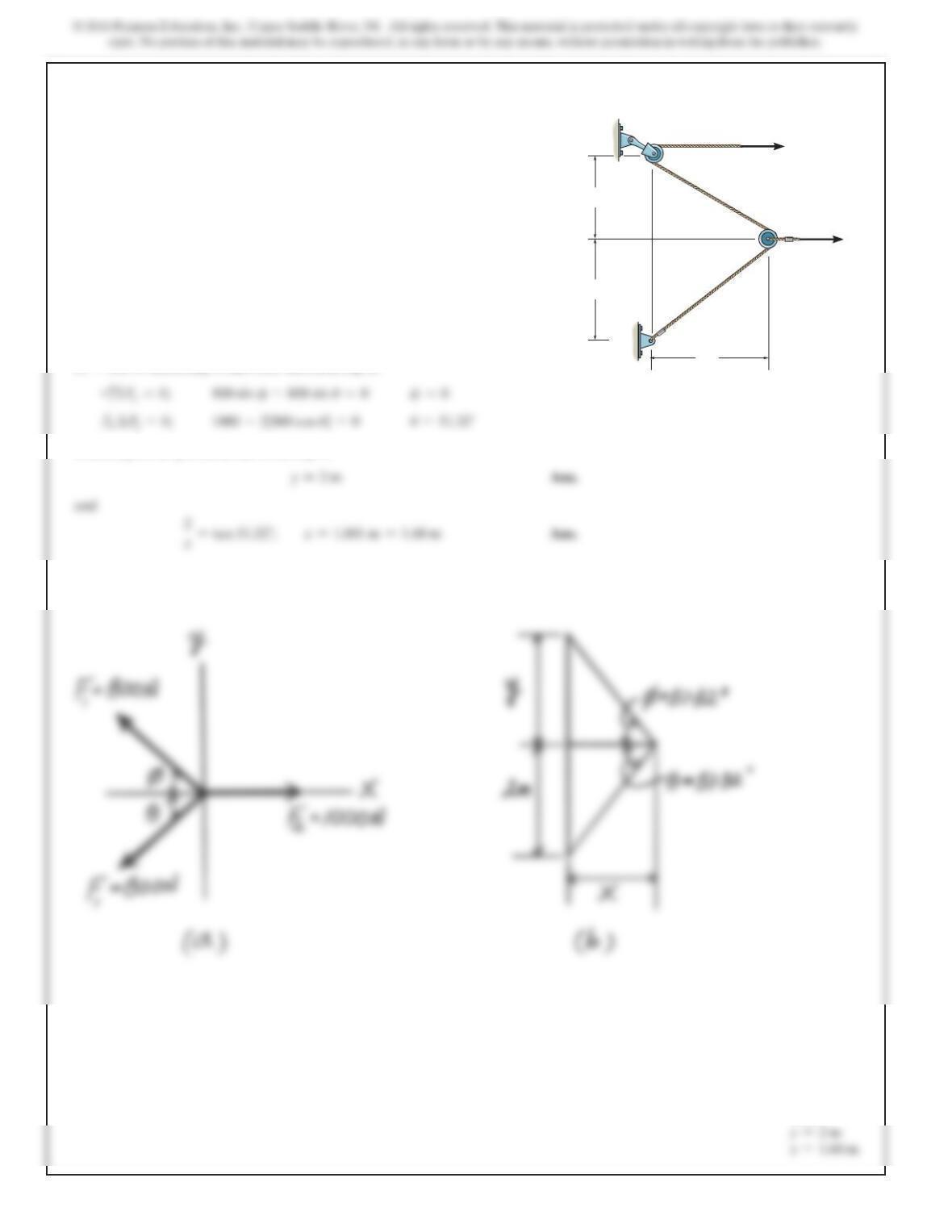
Equations of Equilibrium. The tension throughout rope ABCD is constant, that is
F1=800 N.
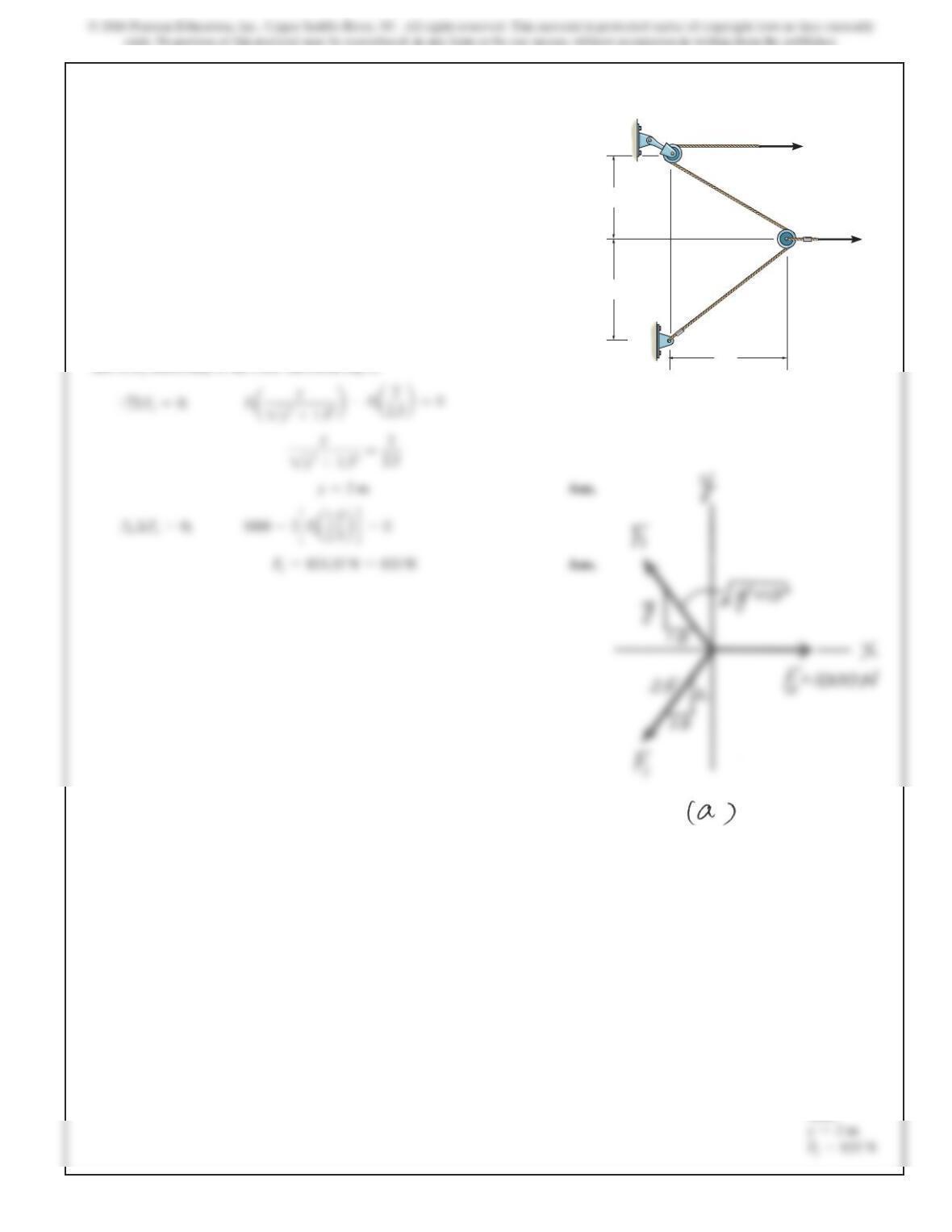
Referring to the FBD shown in Fig. a,
Referring to the geometry shown in Fig. b,
*3–24.
Determine the distances x and y for equilibrium if F1 = 800 N
and F2 = 1000 N.
B
A
CDF1
F2
x
2 m
y
185
185
Ans:
SOLUTION
Equations of Equilibrium. The tension throughout rope ABCD is constant,
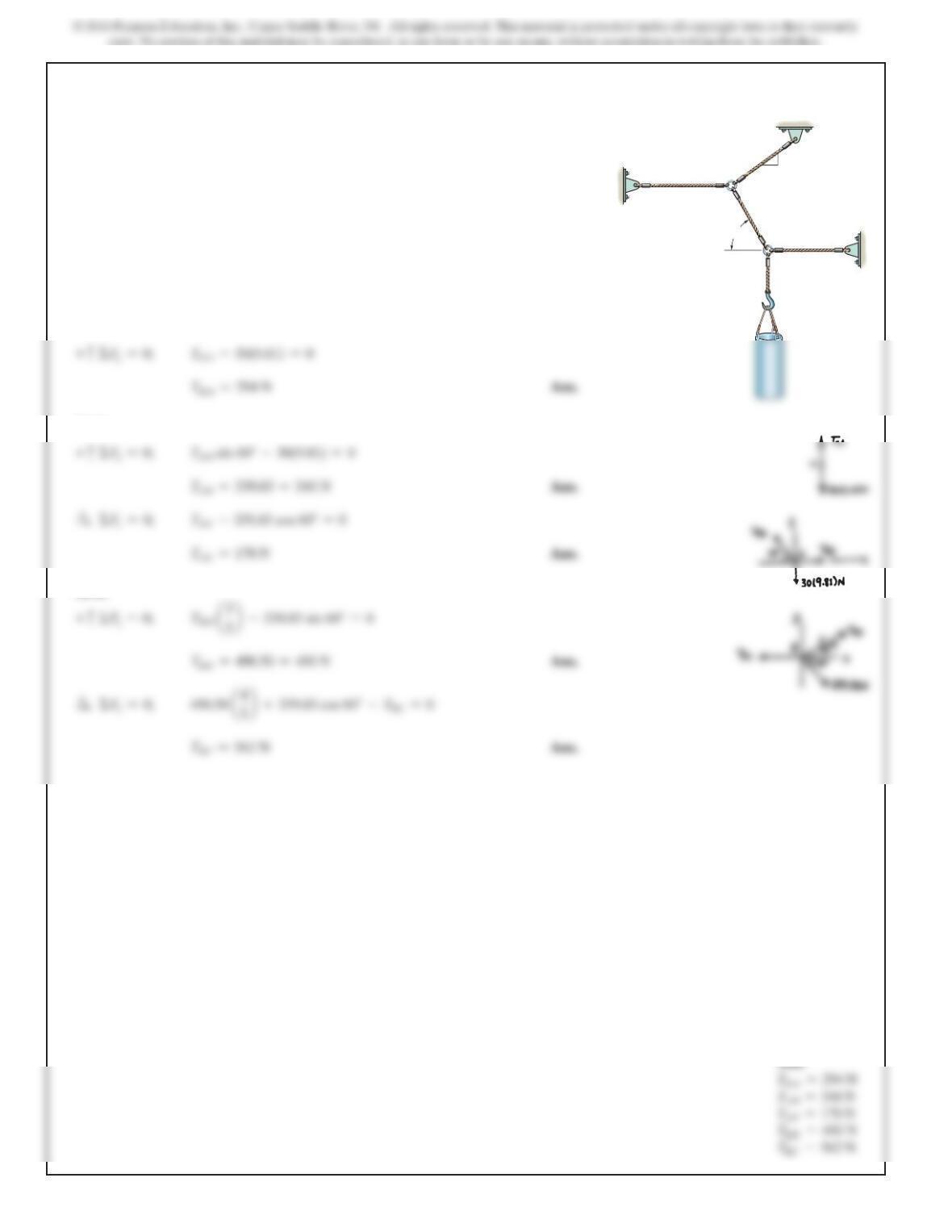
that is F1. Referring to the FBD shown in Fig. a,
3–25.
Determine the magnitude of F1 and the distance y if x = 1.5 m
and F2 = 1000 N.
B
A
CDF1
F2
x
2 m
y
186
3–26.
SOLUTION
At H:
At A:
At B:
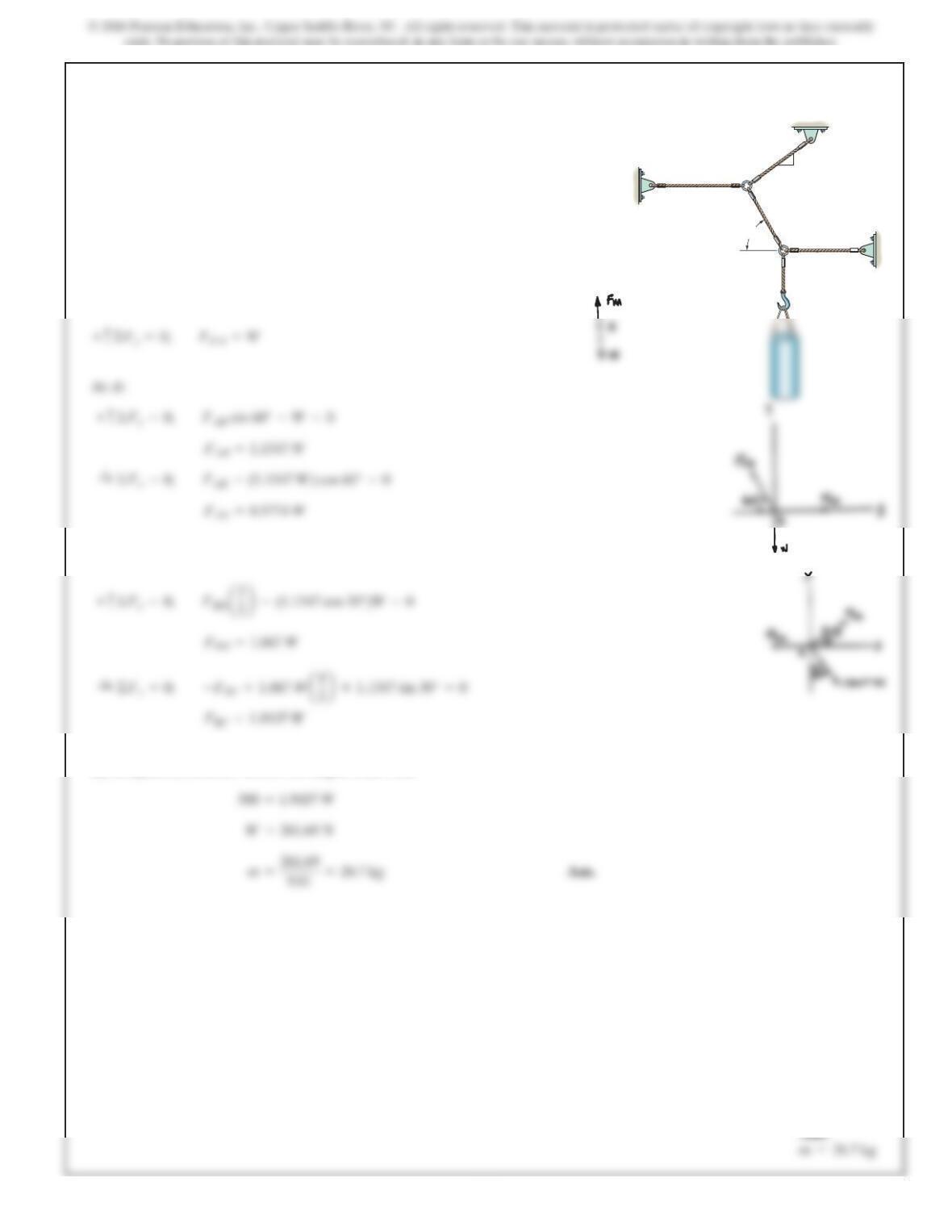
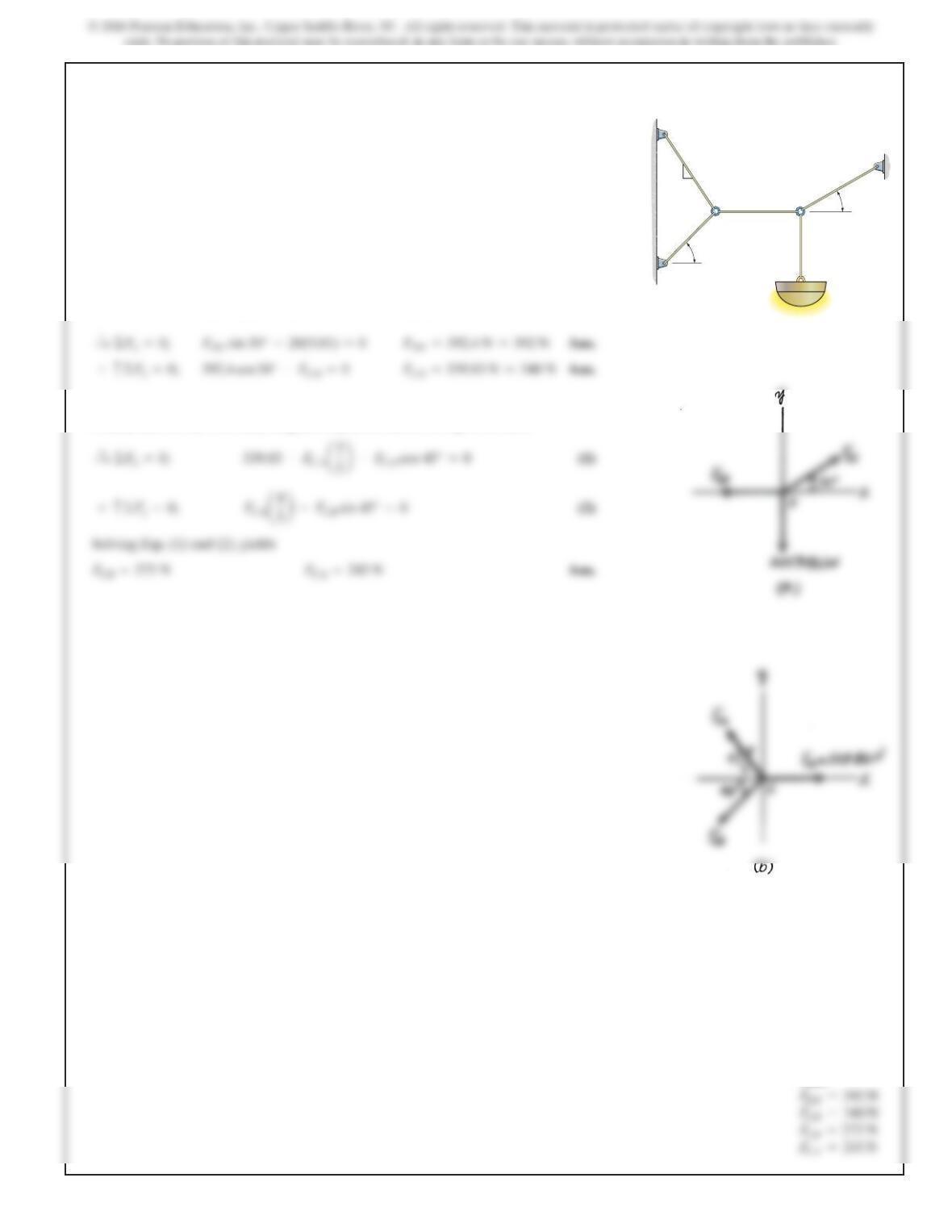
The 30-kg pipe is supported at A by a system of fivecords.
Determine the force in each cord for equilibrium.
A
H
E
B
C
D
60°
3
4
5
187
3–27.
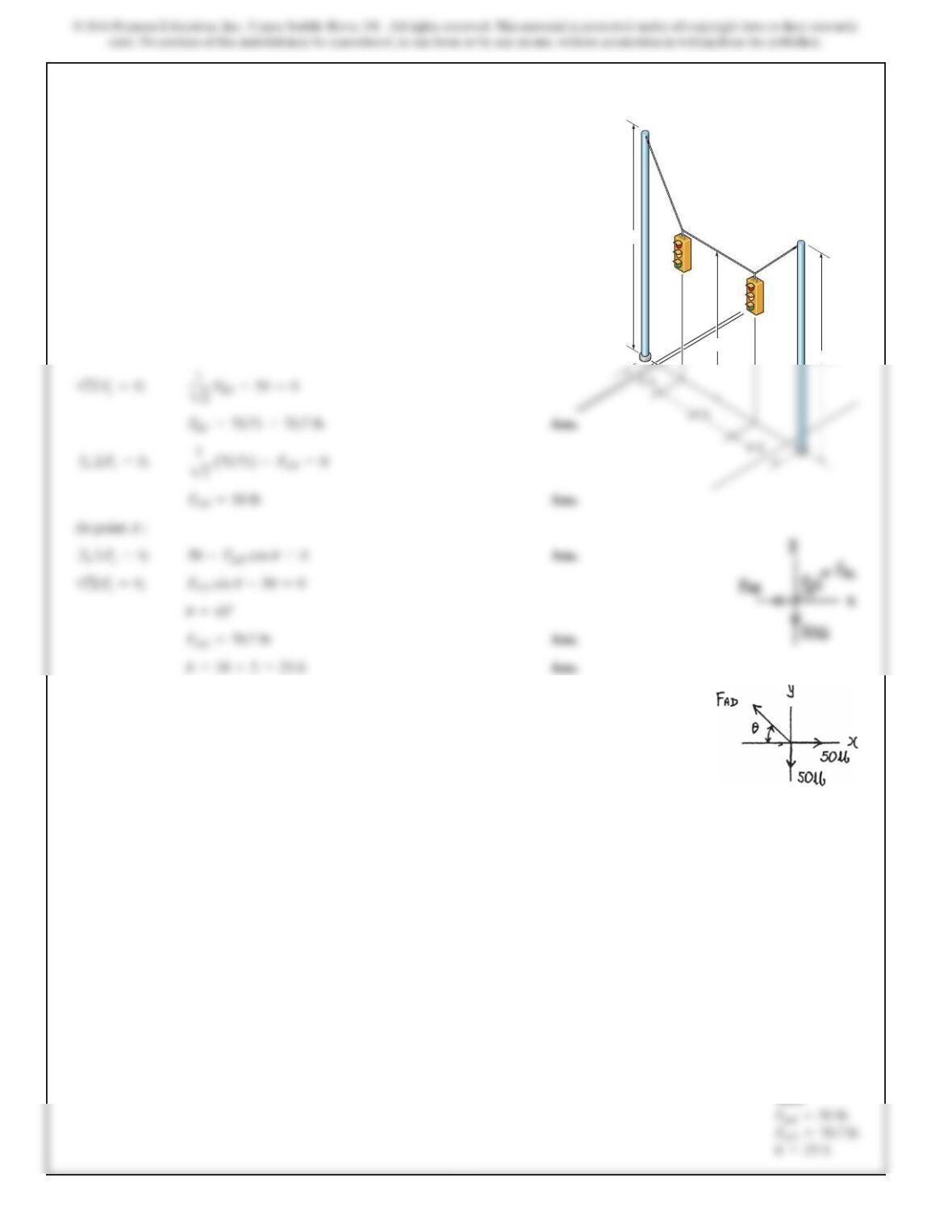
Each cord can sustain a maximum tension of 500 N.
Determine the largest mass of pipe that can be supported.
SOLUTION
At H:
At B:
By comparison, cord BC carries the largest load. Thus
A
H
E
B
C
D
60°
3
4
5
188
*3–28.
The street-lights at A and B are suspended from the two
poles as shown. If each light has a weight of 50 lb, determine
the tension in each of the three supporting cables and the
required height h of the pole DE so that cable AB is
horizontal.
SOLUTION
At point B :
D
A
h
B
C
E24 ft
18 ft
189
3–29.
SOLUTION
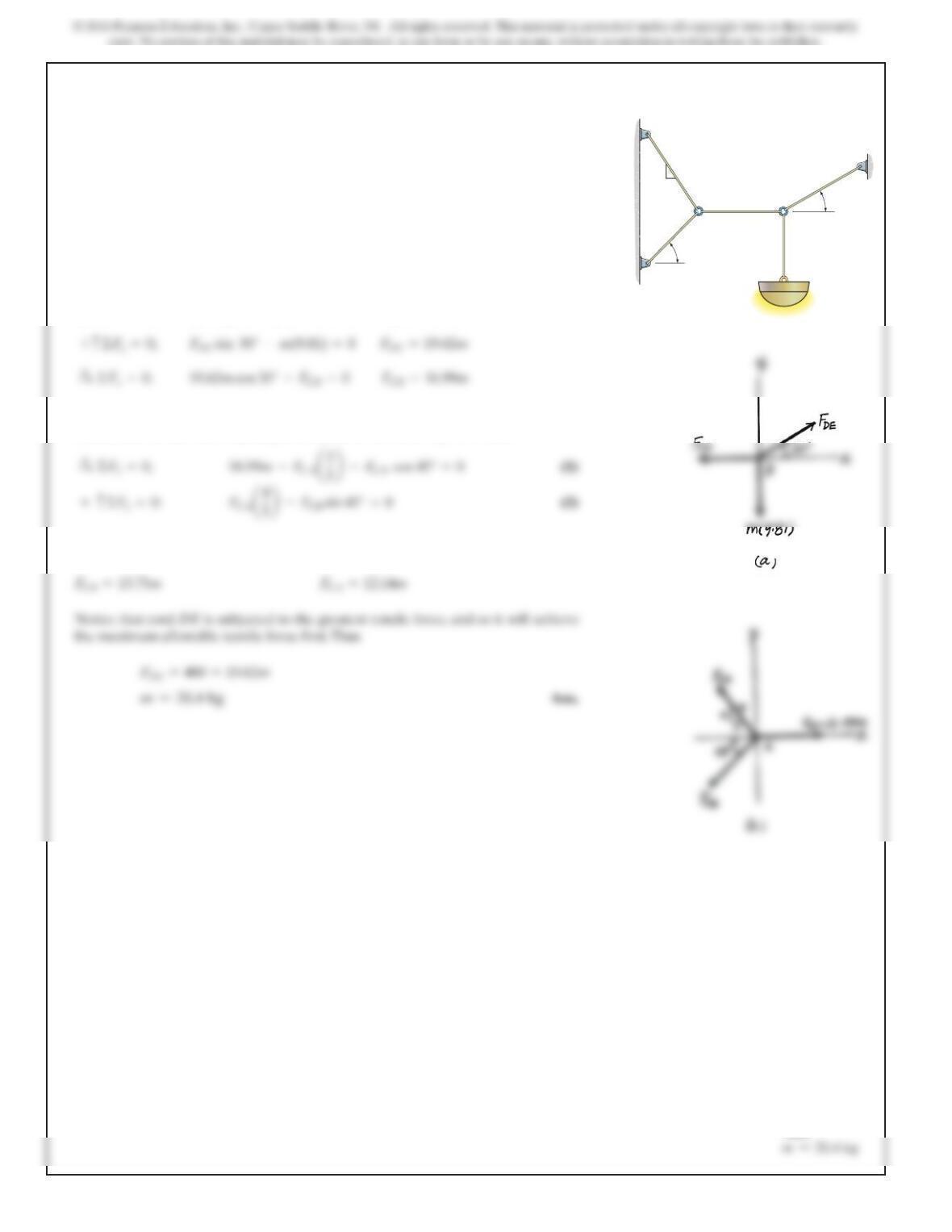
Equations of Equilibrium: Applying the equations of equilibrium along the xand y
axes to the free-body diagram of joint Dshown in Fig. a, we have
Using the result FCD = 339.83 N and applying the equations of equilibrium along the
xand yaxes to the free-body diagram of joint Dshown in Fig. b, we have
Determine the tension developed in each cord required for
equilibrium of the 20-kg lamp.
A
B
D
E
F
C
45°
30°
3
45
Ans:
190
3–30.
SOLUTION
Equations of Equilibrium: Applying the equations of equilibrium along the xand y
axes to the free-body diagram of joint Dshown in Fig. a, we have
Using the result FCD = 16.99mand applying the equations of equilibrium along the
xand yaxes to the free-body diagram of joint Dshown in Fig. b, we have
Solving Eqs. (1) and (2), yields
Determine the maximum mass of the lamp that the cord
system can support so that no single cord develops a tension
exceeding 400 N.
A
B
D
E
F
C
45°
30°
3
45
Ans:
191
SOLUTION
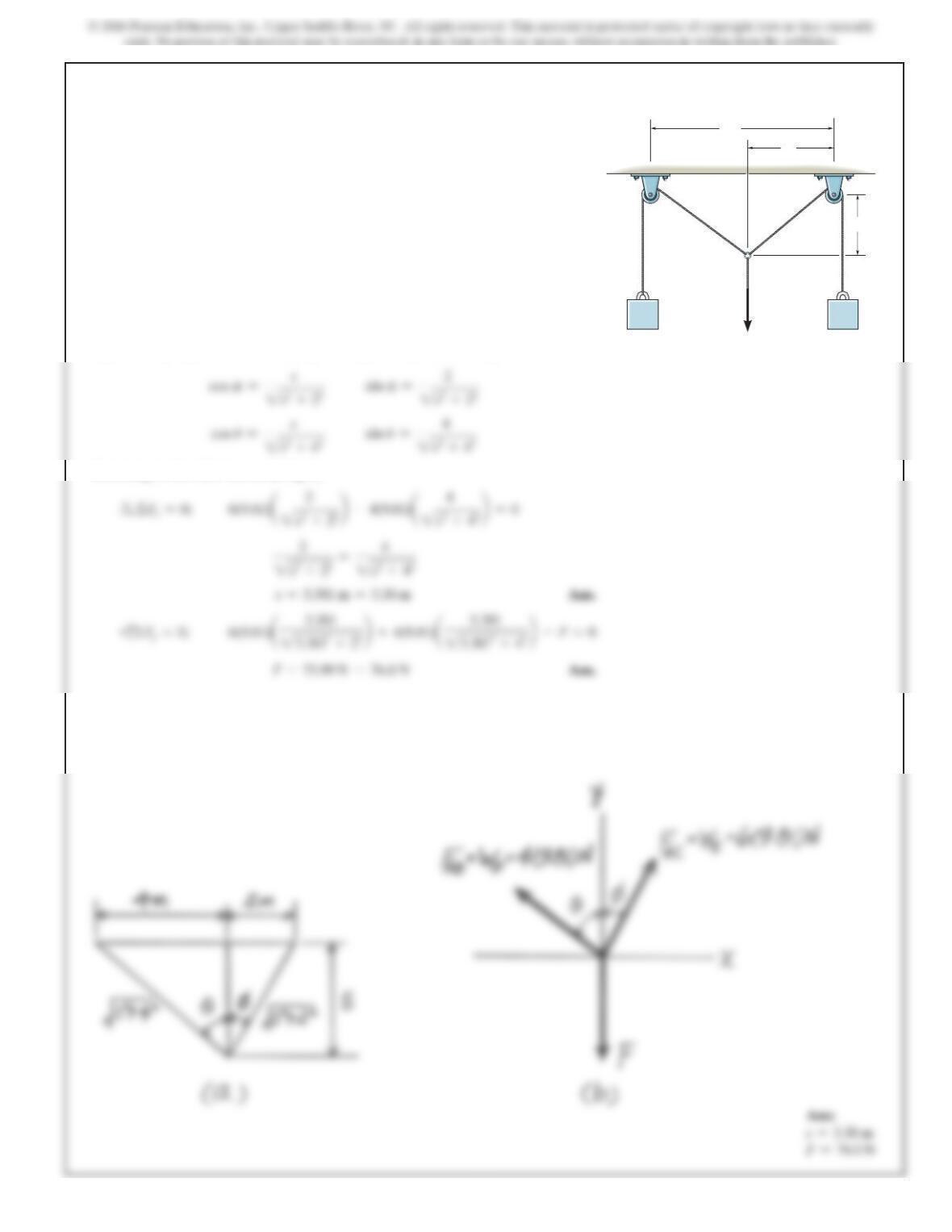
Equations of Equilibrium. Referring to the geometry shown in Fig. a,
Referring to the FBD shown in Fig. b,
3–31.
Blocks D and E have a mass of 4 kg and 6 kg, respectively. If
x = 2 m determine the force F and the sag s for equilibrium.
E
D
A
C
B
6 m
x
F
s
192
*3–32.
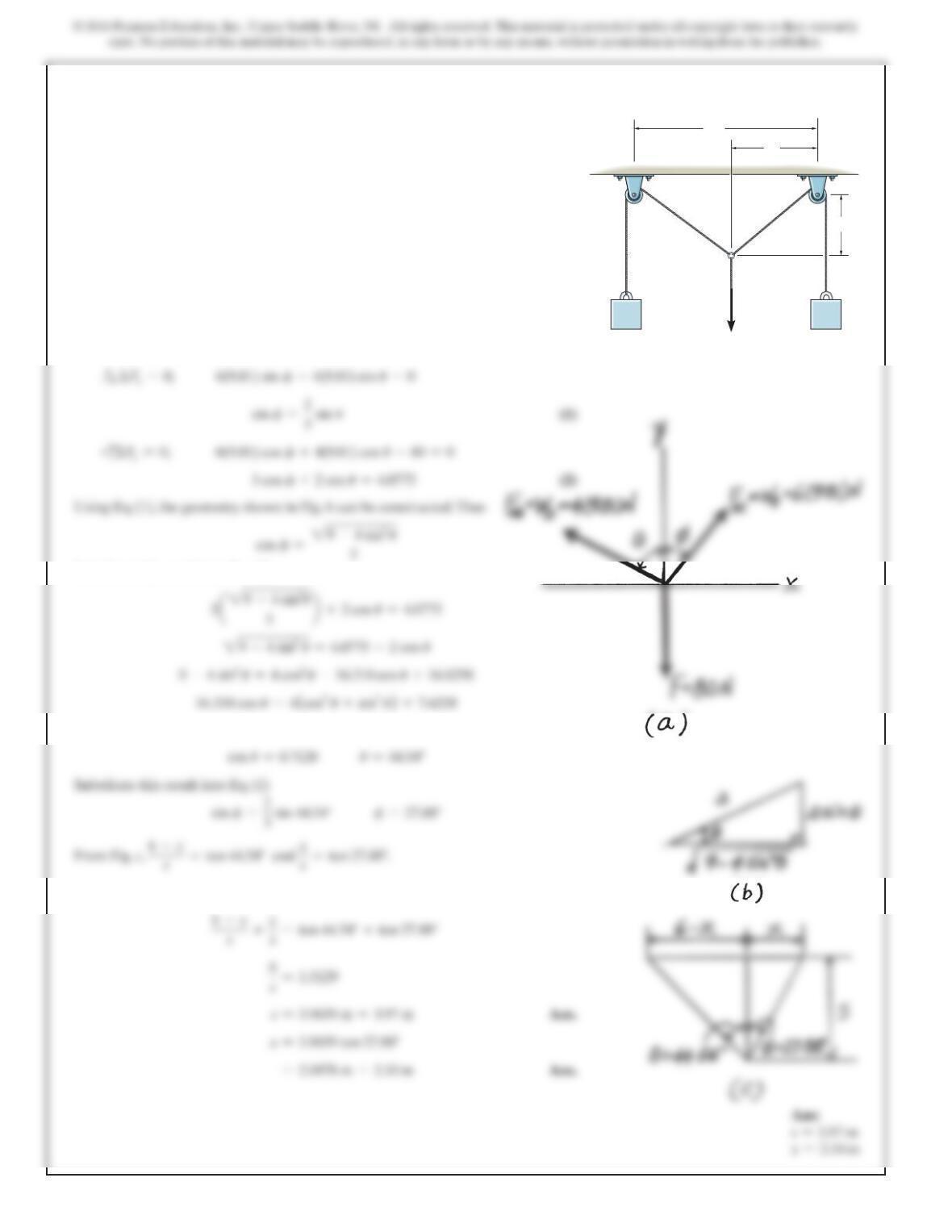
Blocks D and E have a mass of 4 kg and 6 kg, respectively. If
F = 80 N, determine the sag s and distance x for equilibrium.
E
D
A
C
B
6 m
x
F
s
SOLUTION
Equations of Equilibrium. Referring to the FBD shown in Fig. a,
Substitute this result into Eq. (2),
Here,
cos2 u+sin2 u=1.
Then
So then,
193
SOLUTION
Equations of Equilibrium. Considering the equilibrium of Joint A by referring to
its FBD shown in Fig. a,
Solving Eqs (1) and (2) yield
Finally joint C by referring to its FBD shown in Fig. c
Divided Eq (4) by (3)
3–33.
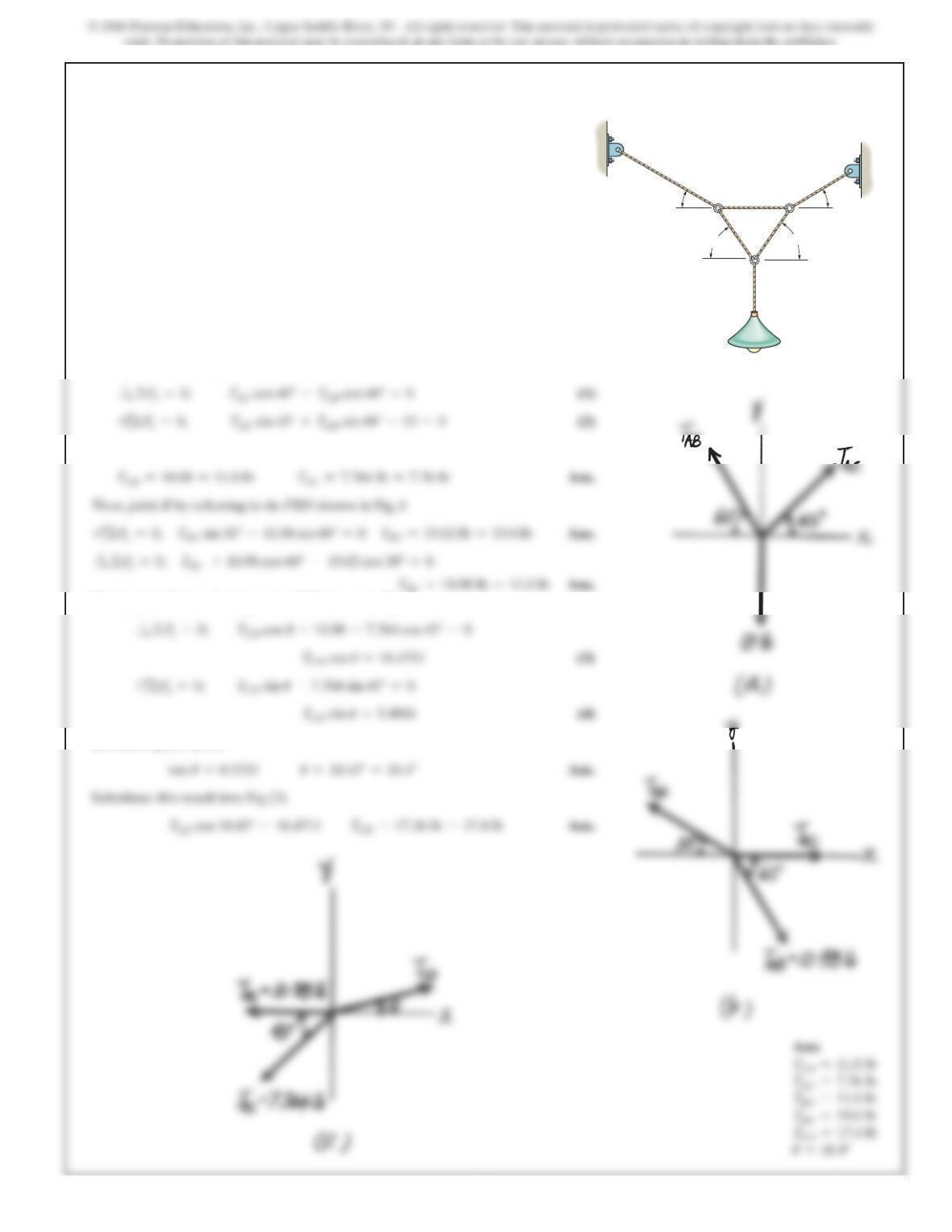
The lamp has a weight of 15 lb and is supported by the six
cords connected together as shown. Determine the tension
in each cord and the angle
u
for equilibrium. Cord BC is
horizontal.
E
BC
D
A
30fi
45fi
60fi
u
194
3–34.
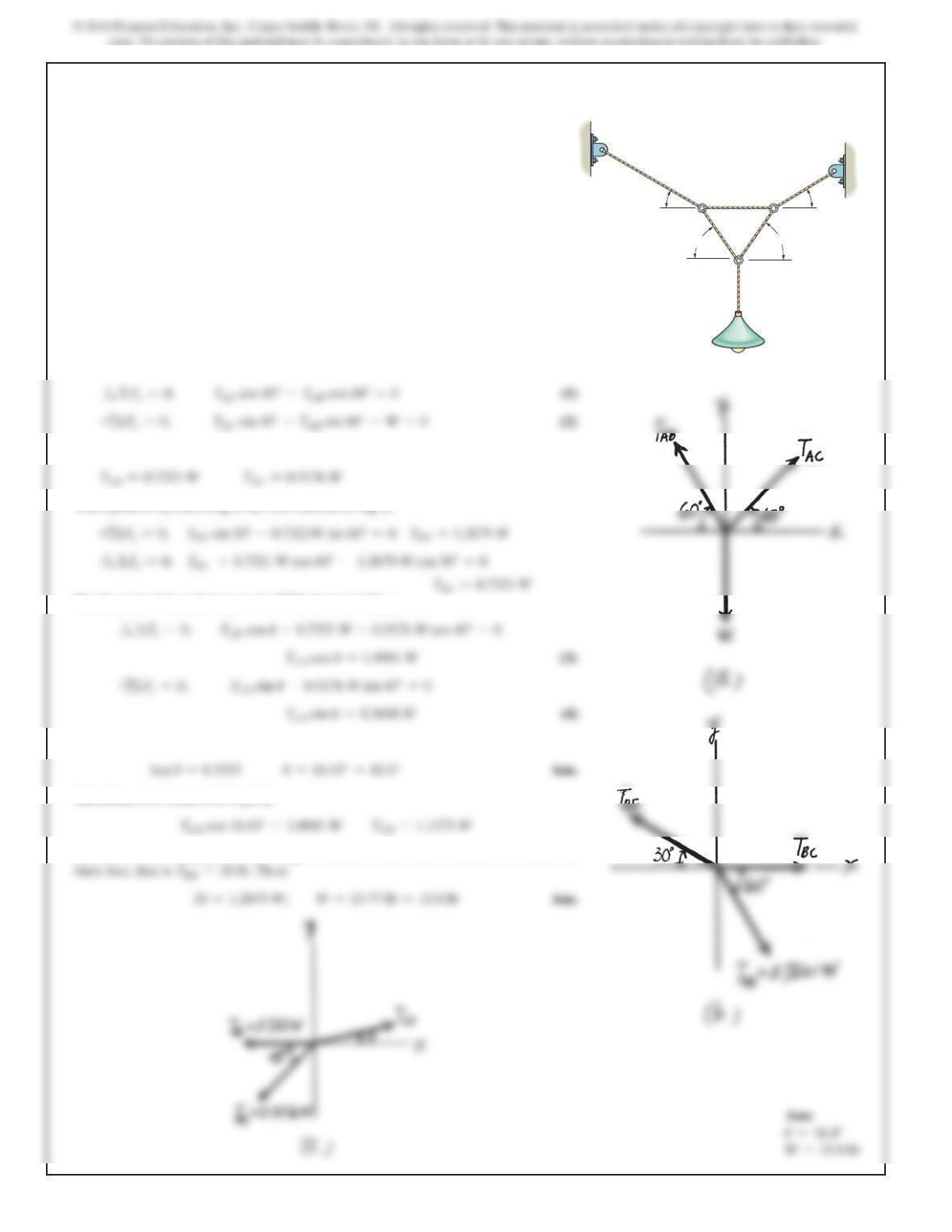
Each cord can sustain a maximum tension of 20 lb.
Determine the largest weight of the lamp that can be
supported. Also, determine
u
of cord DC for equilibrium.
SOLUTION
Equations of Equilibrium. Considering the equilibrium of Joint A by referring to
its FBD shown in Fig. a,
Solving Eqs (1) and (2) yield
Finally, joint C by referring to its FBD shown in Fig. c,
Divided Eq (4) by (3)
Substitute this result into Eq (3),
Here cord BE is subjected to the largest tension. Therefore, its tension will reach the
E
BC
D
A
30fi
45fi
60fi
u
195
3–35.
Solving by trial and error,
Also,
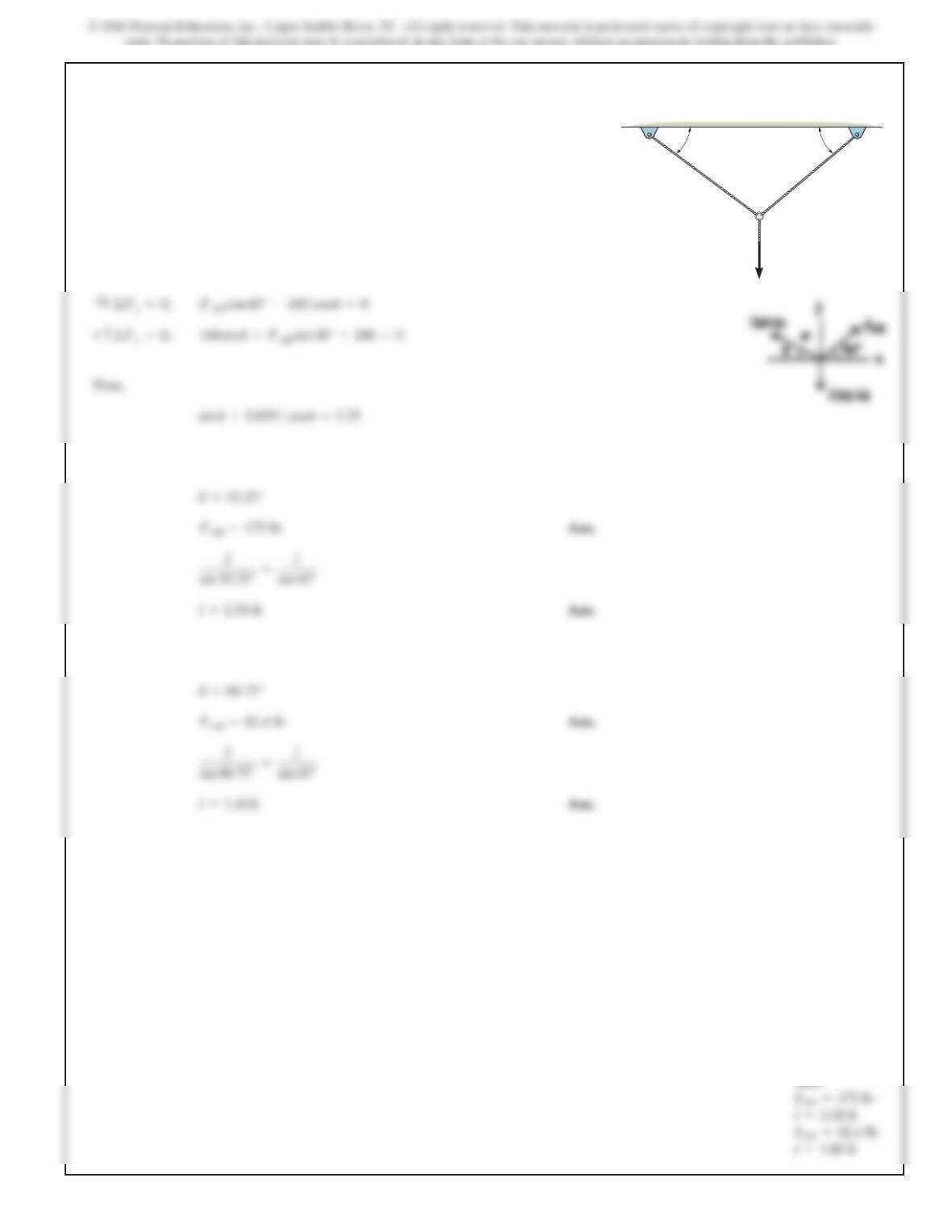
The ring of negligible size is subjected to a vertical force of
200 lb. Determine the required length lof cord AC such that
the tension acting in AC is 160 lb. Also, what is the force in
cord AB?Hint: Use the equilibrium condition to determine
the required angle for attachment, then determine lusing
trigonometry applied to triangle ABC.
u
40°
θ
BC
A
l2ft
200 lb
SOLUTION
196
*3–36.
SOLUTION
Equations of Equilibrium: Since cable ABC passes over the smooth pulley at B,the
tension in the cable is constant throughout its entire length.Applying the equation
of equilibrium along the yaxis to the free-body diagram in Fig. a, we have
Geometry: Referring to Fig. b, we can write
Also,
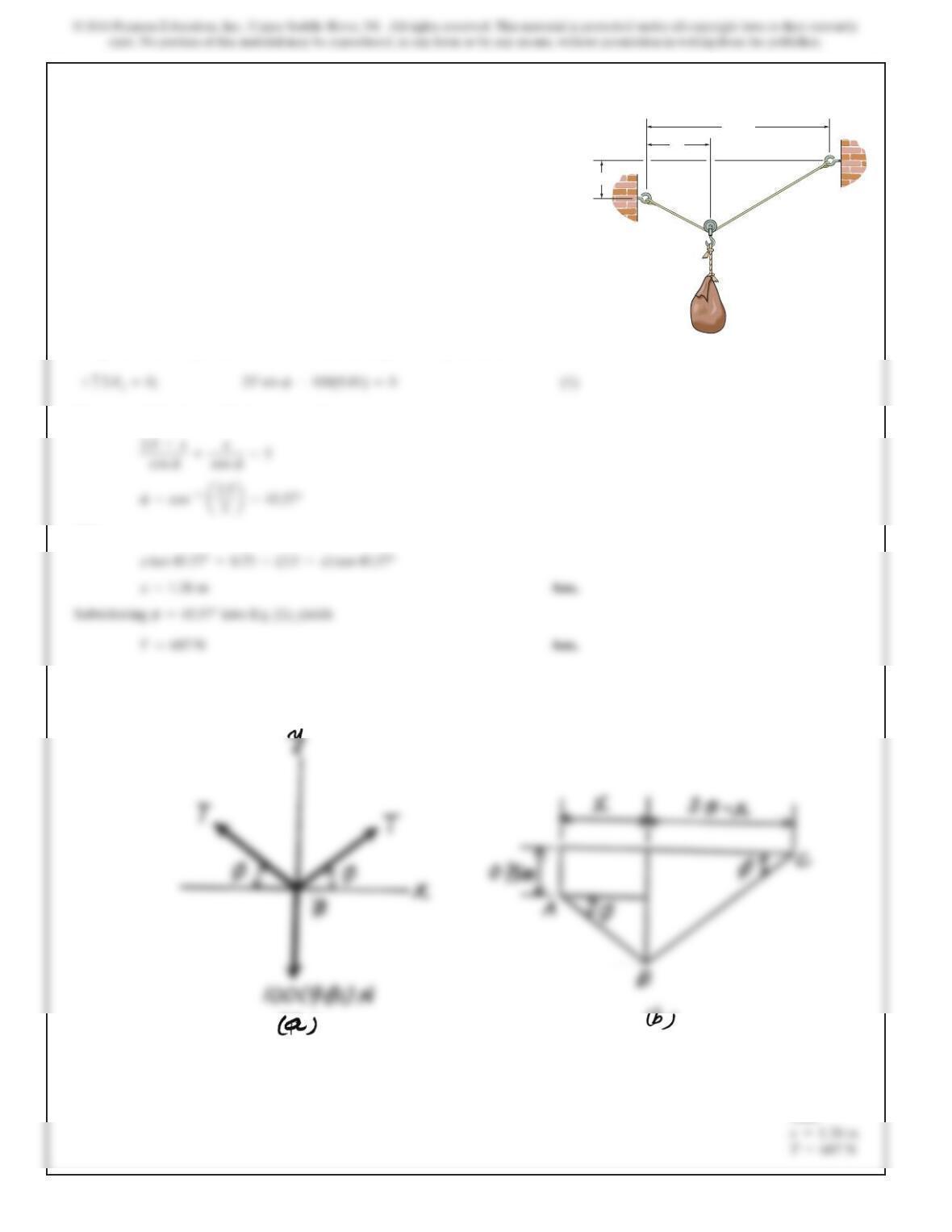
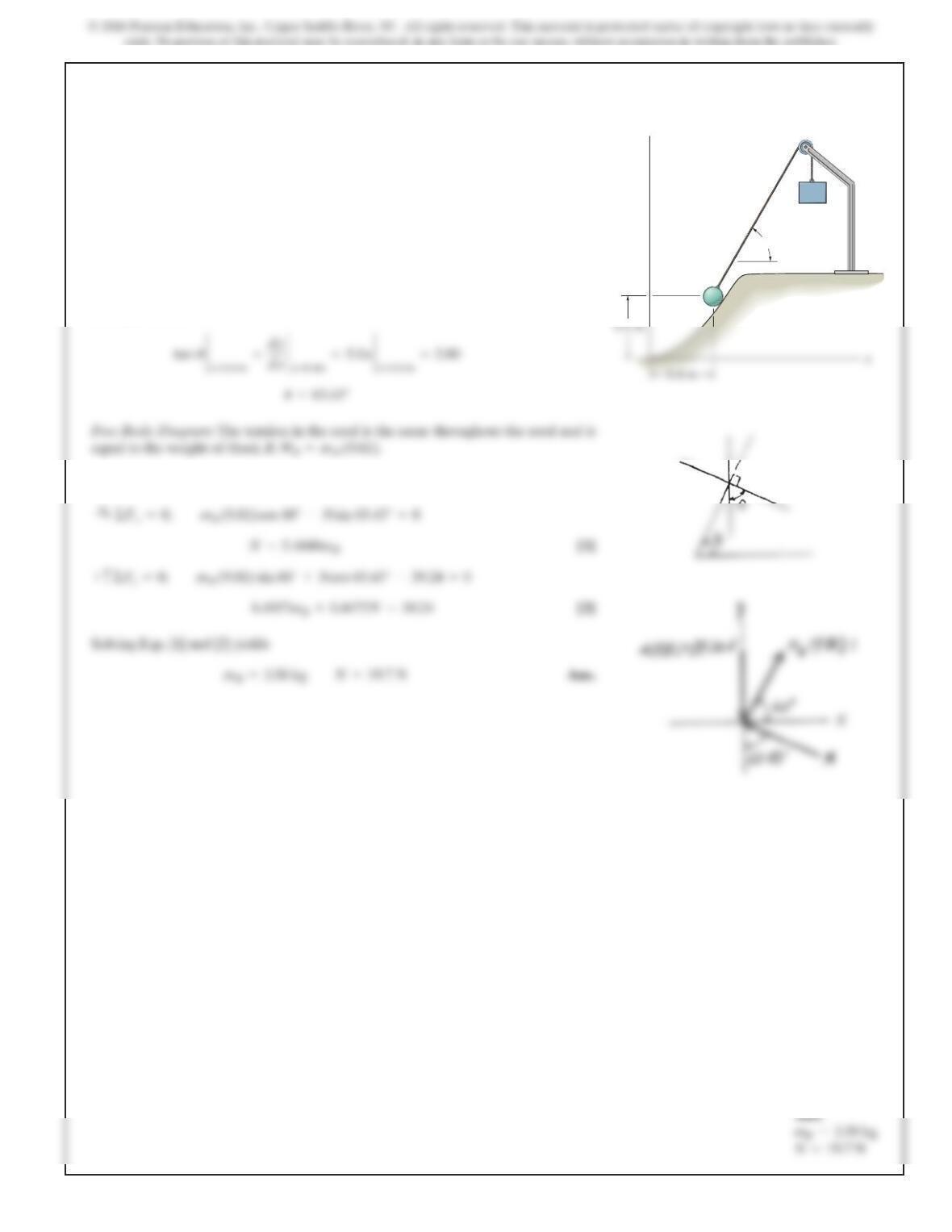
Cable ABC has a length of 5 m. Determine the position x
and the tension developed in ABC required for equilibrium
of the 100-kg sack.Neglect the size of the pulley at B.
A
B
C
x
3.5 m
0.75 m
Ans:
197
3–37.
SOLUTION
Geometry
:The angle which the surface make with the horizontal is to be
determined first.
Equations of Equilibrium
:
u
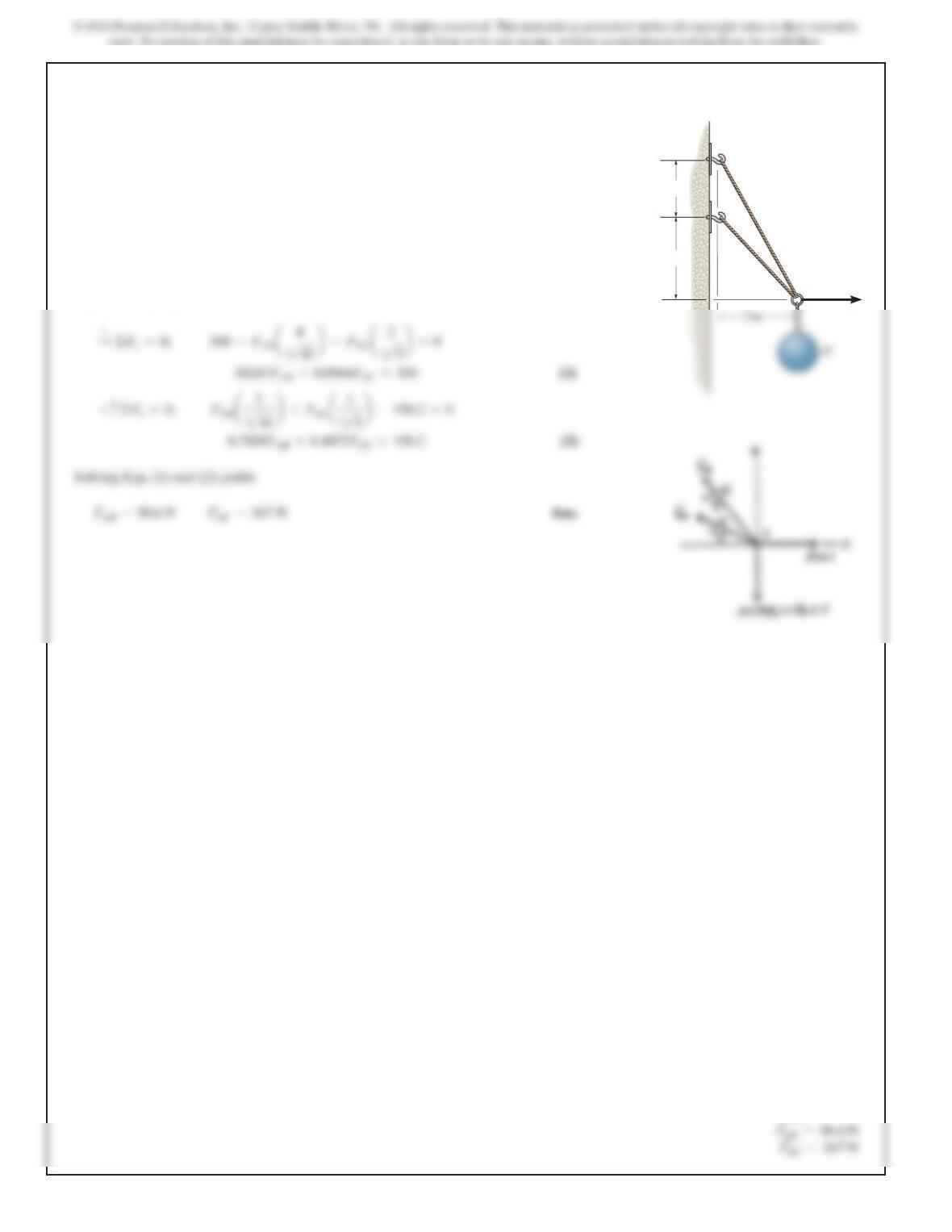
A4–kg sphere rests on the smooth parabolic surface.
Determine the normal force it exerts on the surface and the
mass of block Bneeded to hold it in the equilibrium
position shown.
mB
B
A
y
60fi
y2.5x
2
198
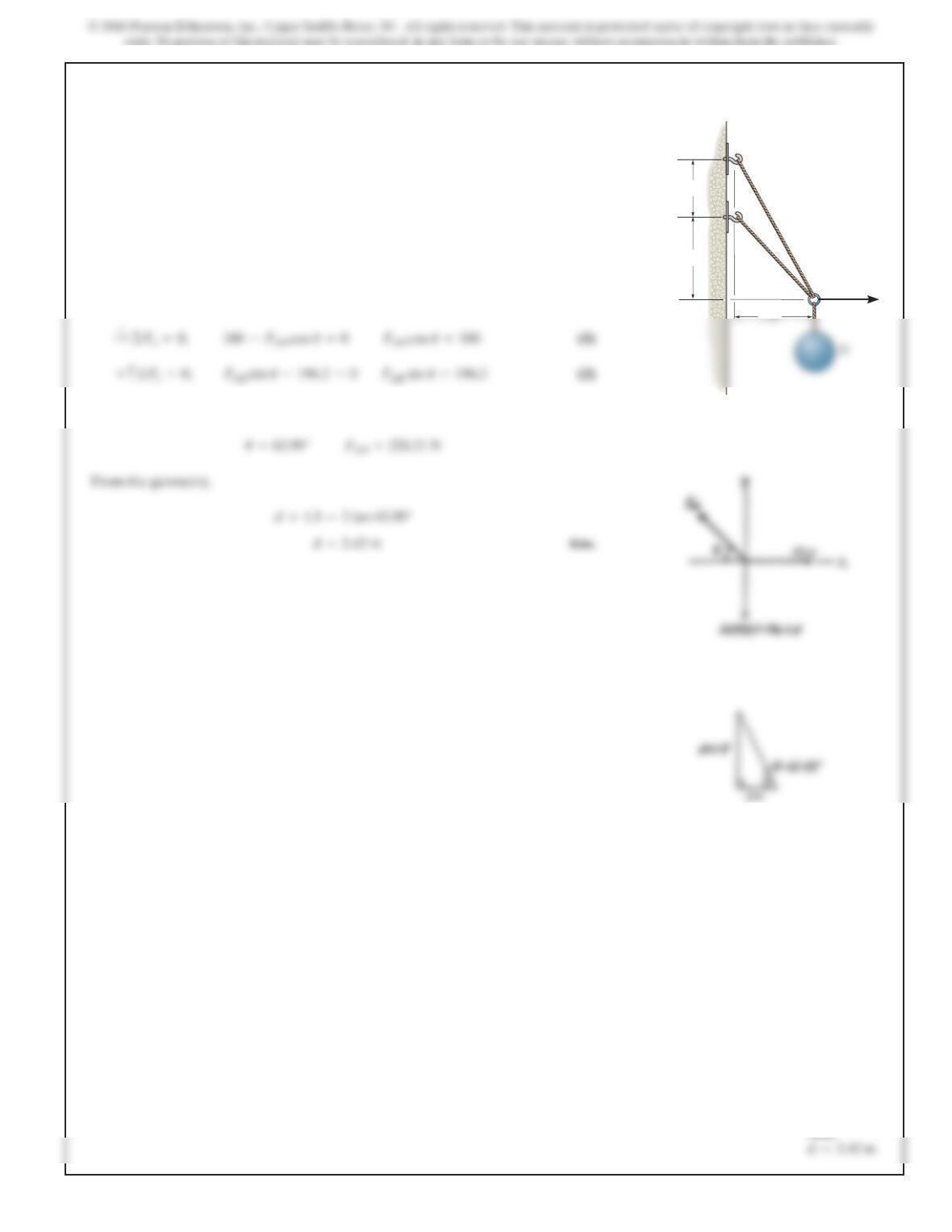
3–38.
Determine the forces in cables AC and AB needed to hold
the 20-kg ball Din equilibrium.Take F= 300 N and d= 1 m.
SOLUTION
Equations of Equilibrium:
A
C
B
F
1.5 m
d
Ans:
199
3–39.
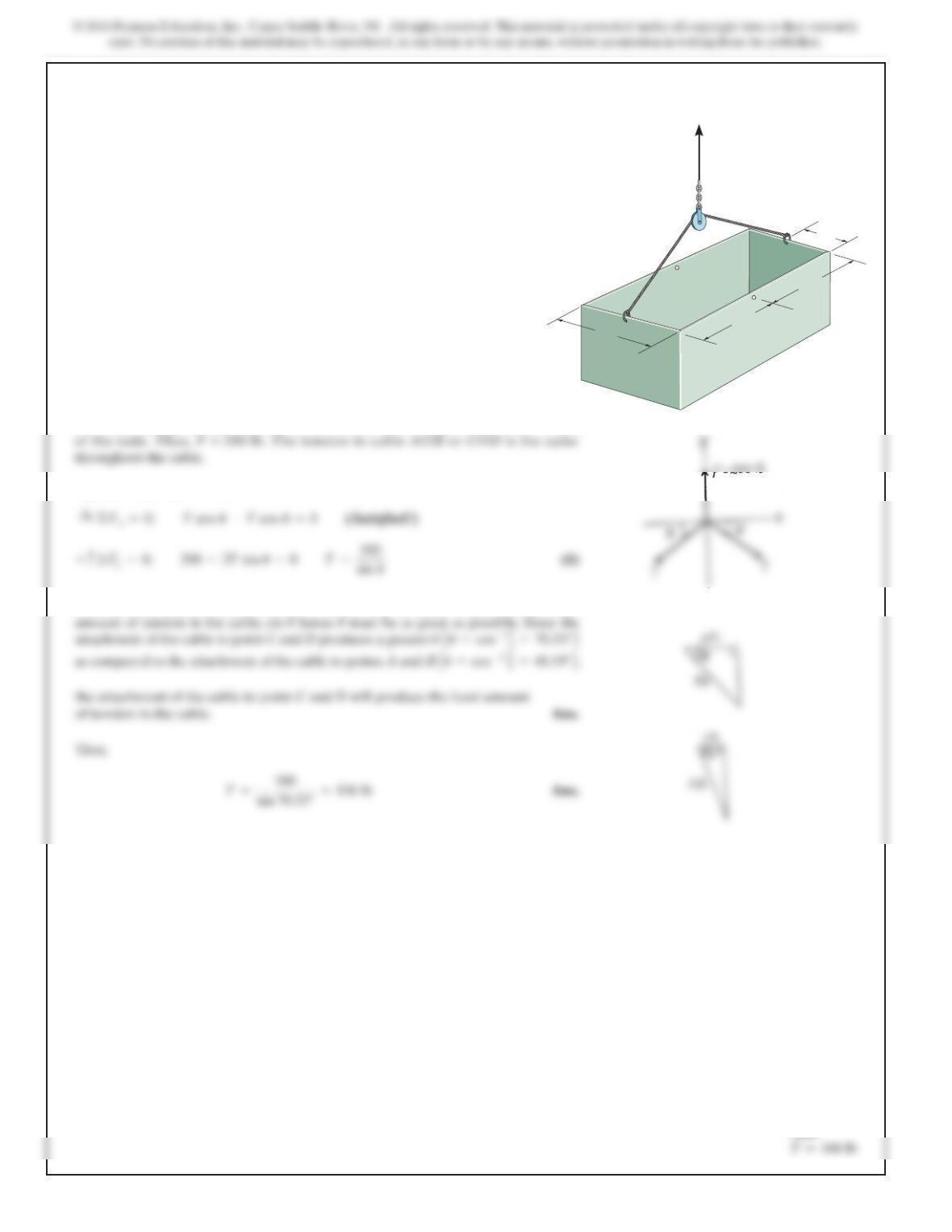
The ball Dhas a mass of 20 kg.If a force of F= 100 N is
applied horizontally to the ring at A,determine the largest
dimension dso that the force in cable AC is zero.
SOLUTION
Equations of Equilibrium:
Solving Eqs. (1) and (2) yields
A
C
B
F
1.5 m
d
Ans:
200
*3–40.
T
h
e 200-
lb
un
i
form tan
k
i
s suspen
d
e
d
b
y means of a
6
-ft-
long cable, which is attached to the sides of the tank and
passes over the small pulley located at O.If the cable can be
attached at either points Aand B,or Cand D,determine
which attachment produces the least amount of tension in
the cable. What is this tension?
SOLUTION
Free-Body Diagram: By observation, the force F has to support the entire weight
Equations of Equilibrium:
F
rom the function obtained above, one realizes that in order to produce the least
A
O
C
1 ft
B
2 ft
F
D
2 ft
2 ft
Ans: