1230
22–41.
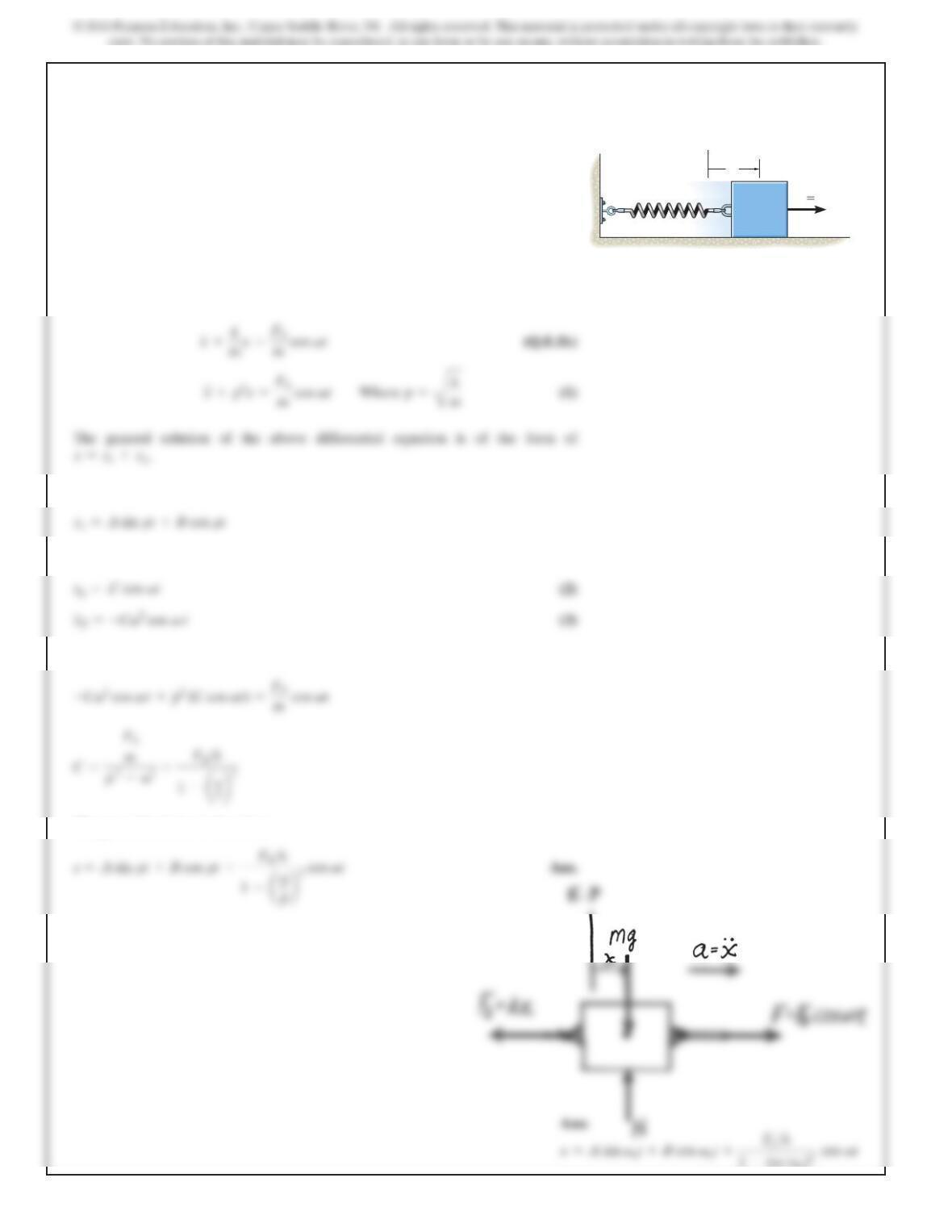
If the block-and-spring model is subjected to the periodic
force , show that the differential equation of
motion is , where xis
measured from the equilibrium position of the block. What
is the general solution of this equation?
x
$+(k>m)x=(F
0>m) cos vt
F=F
0cos vt
F F0cos vt
k
Equilibrium
position
x
m
SOLUTION
The complementary solution:
The particular solution:
Substitute Eqs. (2) and (3) into (1) yields:
The general solution is therefore
The constants Aand Bcan be found from the initial conditions.
:
+©Fx=max;F0cos vt–kx =mx
$
n
1231
22–42.
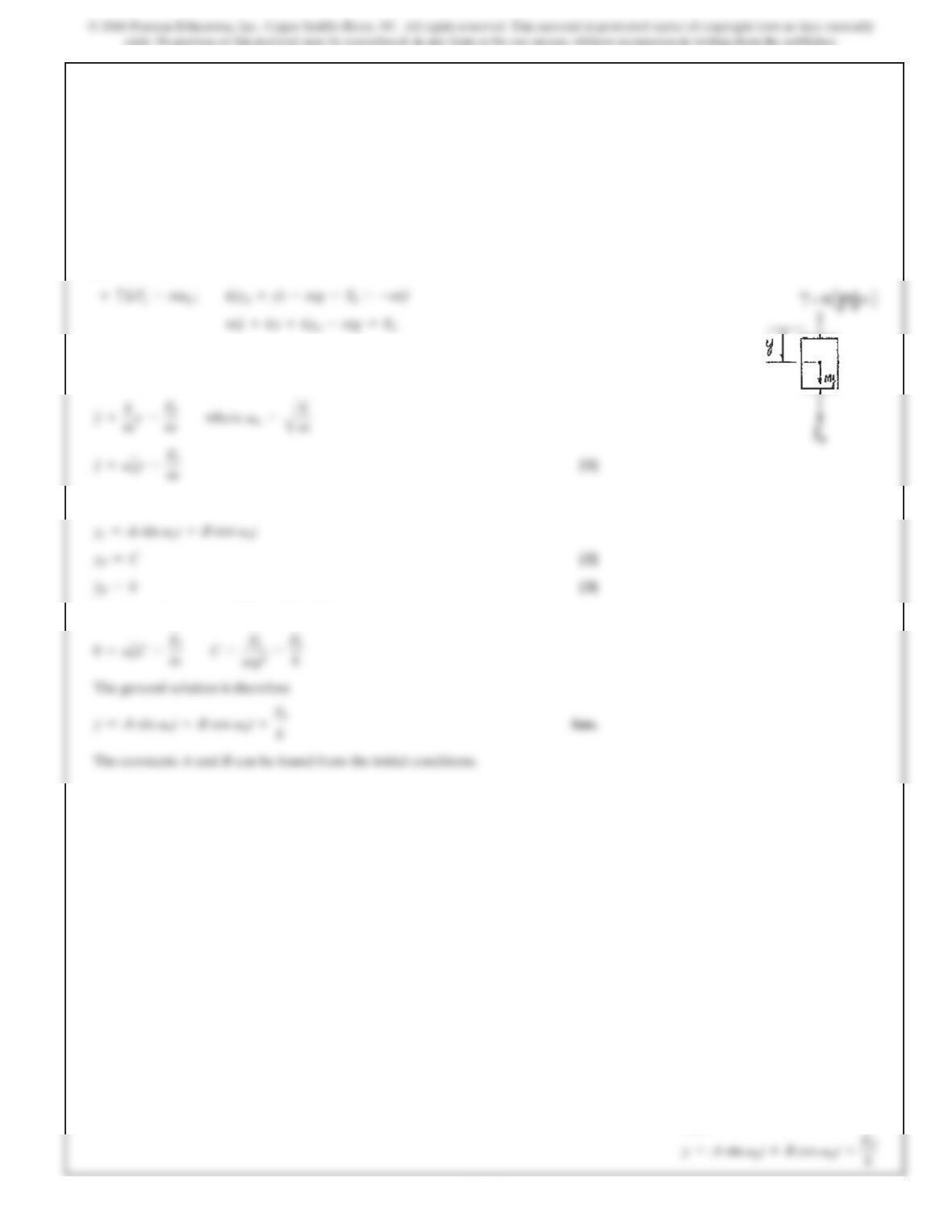
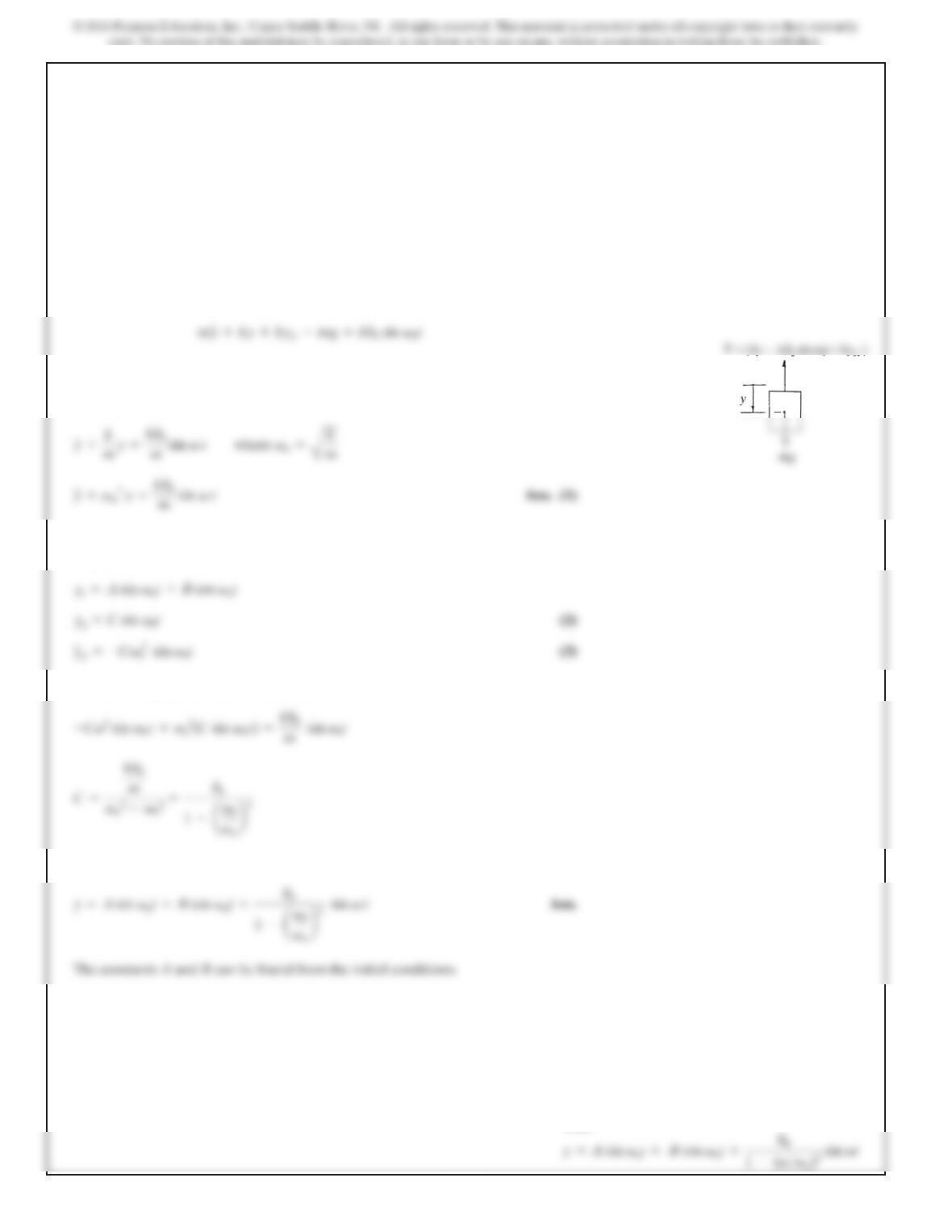
A block which has a mass m is suspended from a spring
having a stiffness k. If an impressed downward vertical force
F=FO
acts on the weight, determine the equation which
describes the position of the block as a function of time.
SOLUTION
my
$+ky +kyst –mg =F0
However, from equilbrium
kyst –mg =0
, therefore
my
$+ky =F0
The general solution of the above differential equation is of the form of
y=y
c
+y
p.
yP=C
y
Substitute Eqs. [2] and [3] into [1] yields :
Ans:
1232
22–43.
SOLUTION
The initial condition when ,, and
Thus,
v=v0
y=y0
t=0
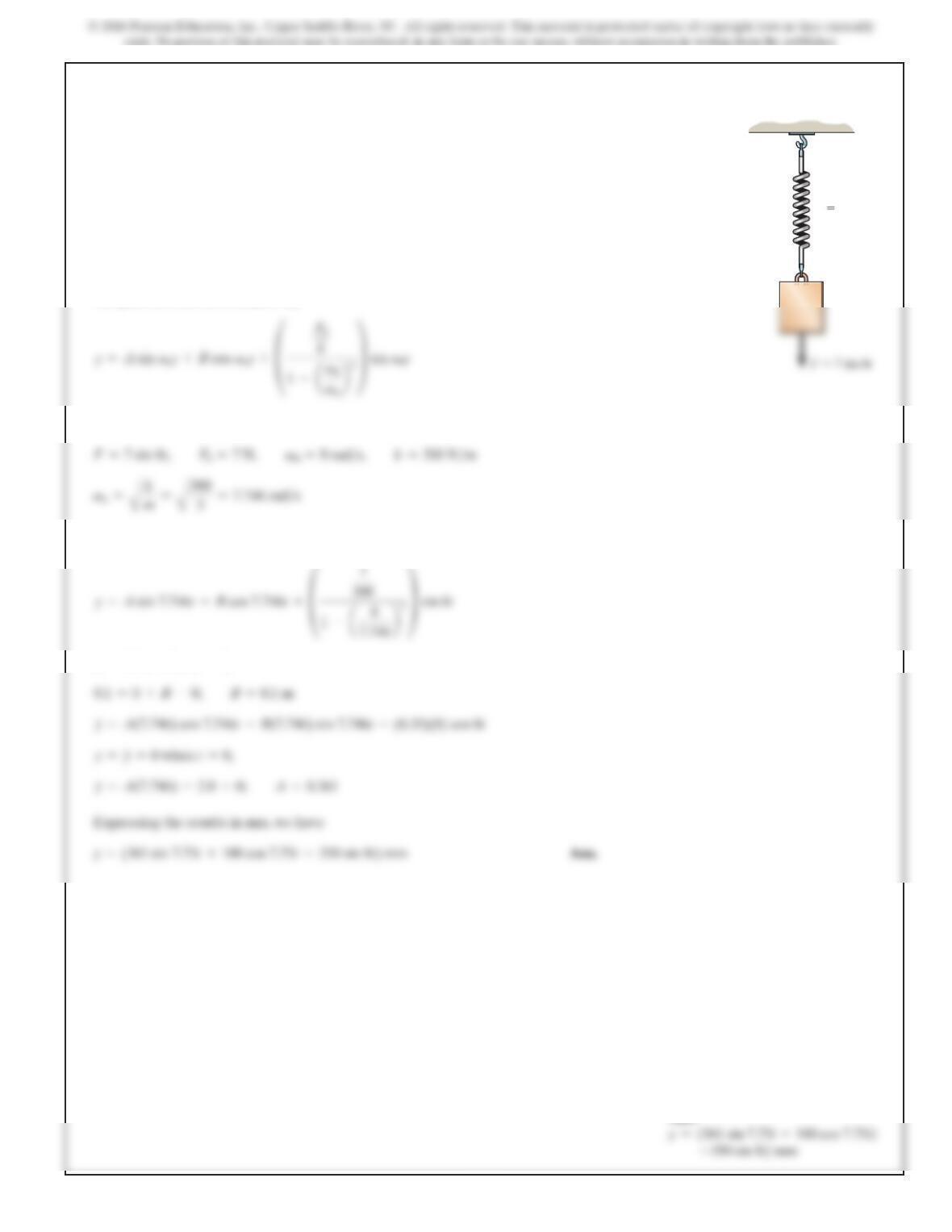
A4-lb weight is attached to a spring having a stiffness
The weight is drawn downward a distance of
4 in. and released from rest. If the support moves with a
vertical displacement in., where tis in
seconds, determine the equation which describes the
position of the weight as a function of time.
d=10.5 sin 4t2
k=10 lb>ft.
is
1233
*22–44.
A 4-kg block is suspended from a spring that has a stiffness
of The block is drawn downward 50 mm from
the equilibrium position and released from rest when
If the support moves with an impressed displacement of
where tis in seconds, determine the
equation that describes the vertical motion of the block.
Assume positive displacement is downward.
d=110 sin 4t2mm,
t=0.
k=600 N
>
m.
SOLUTION
The general solution is defined by Eq. 22–23 with substituted for .
F
0
kd0
1234
22–45.
Use a
bl
oc
k
-an
d
-spr
i
ng mo
d
e
l
lik
e t
h
at s
h
own
i
n F
i
g. 22–14a,
but suspended from a vertical position and subjected to a
periodic support displacement determine the
equation of motion for the system, and obtain its general
solution. Define the displacement ymeasured from the
static equilibrium position of the block when t=0.
d=d0sin v0t,
SOLUTION
However, from equilibrium
, therefore
The general solution of the above differential equation is of the form of ,
where
Substitute Eqs. (2) and (3) into (1) yields:
The general solution is therefore
y=yc+yp
kyst –mg =0
+c©Fx=max;k(y–d0sin v0t+yst)–mg =-my
$
Ans:
1235
22–46.
SOLUTION
The general solution is defined by:
Since
Thus,
y=0.1 m when t=0,
A 5-kg block is suspended from a spring having a stiffness
of If the block is acted upon by a vertical force
where tis in seconds, determine the
equation which describes the motion of the block when it is
pulled down 100 mm from the equilibrium position and
released from rest at Assume that positive displacement
is downward.
t=0.
F=17 sin 8t2N,
300 N>m.
k300 N/m
Ans:
1236
22–47.
SOLUTION
Equation of Motion: When the rod rotates through a small angle , the springs
Since is small, and .Thus, this equation becomes
The particular solution of this differential equation is assumed to be in the form of
Substituting Eqs. (2) and (3) into Eq. (1),
–Cv2sin vt+3
2ag
L+k
m
≤
(Csin vt)=3FO
mL sin vt
cos u1sin u0u
u
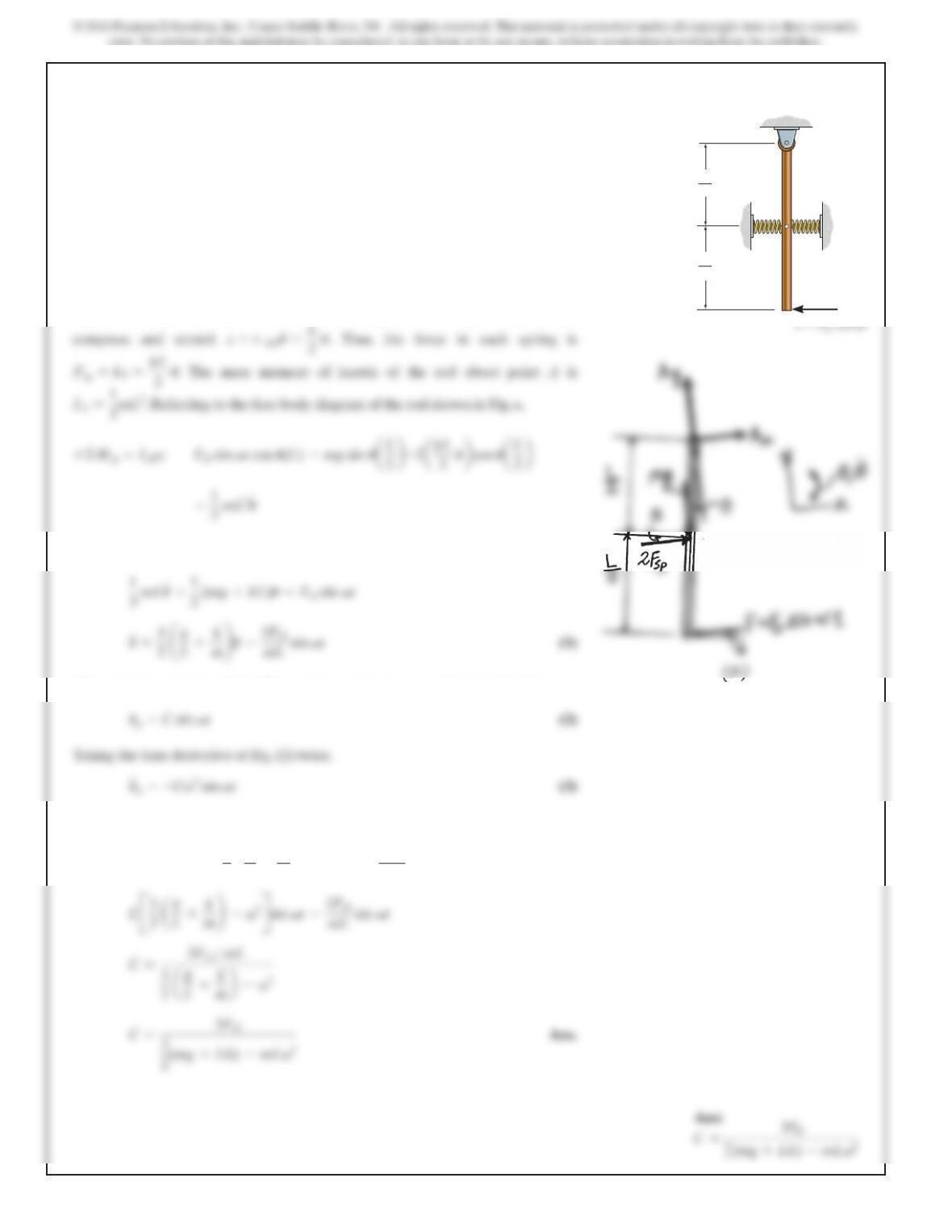
The uniform rod has a mass of m. If it is acted upon by a
periodic force of , determine the amplitude of
the steady-state vibration.
F=F0sin vt
kk
L
2
L
2
A
1237
*22–48.
SOLUTION
Fr
ee-body Diagram: When the block is being displaced by amount xto the right, the
Equation of Motion:
Kinematics:
Since , then substituting this value into Eq. [1], we have
T
aking second time derivative and substituting into Eq. [2], we have
T
hus,
a=d2x
$
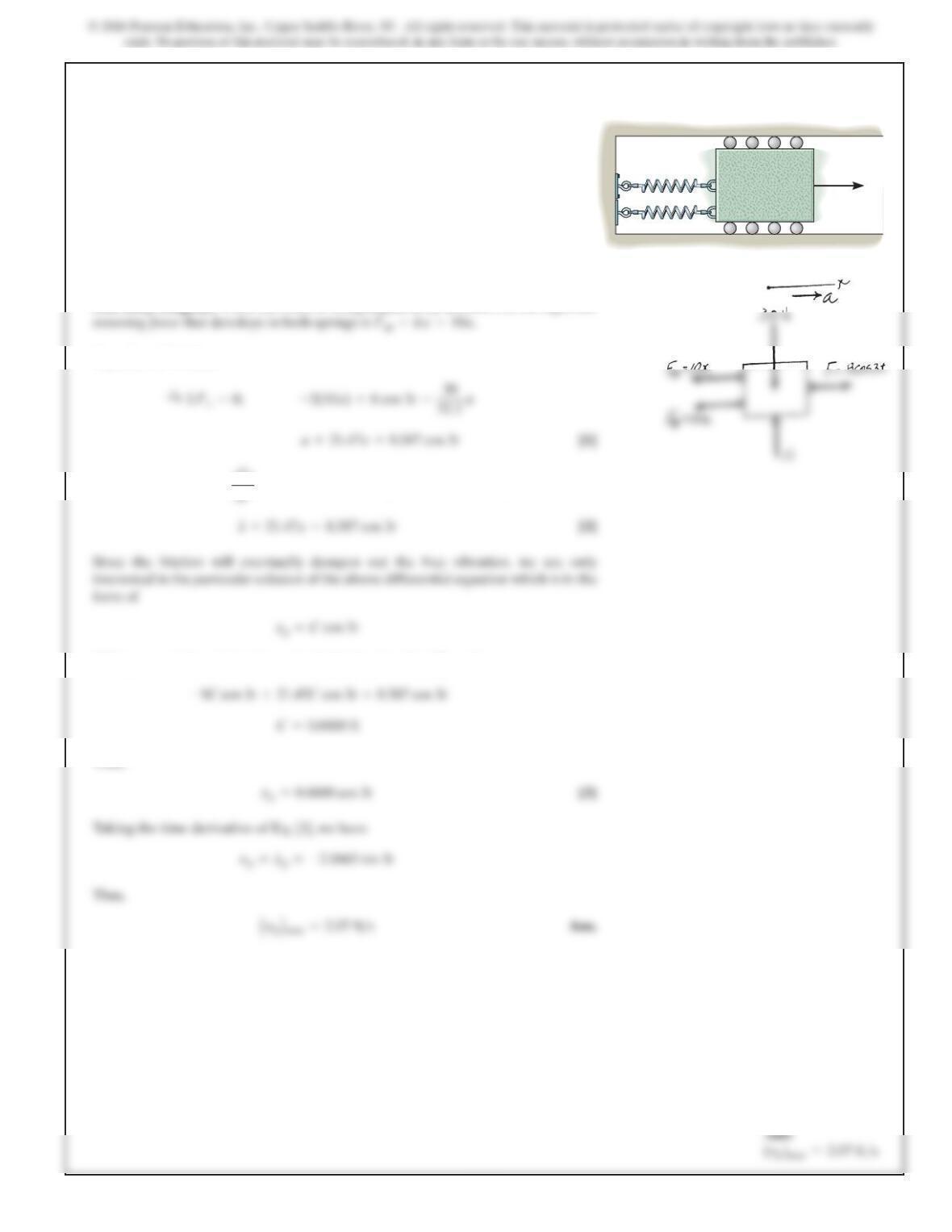
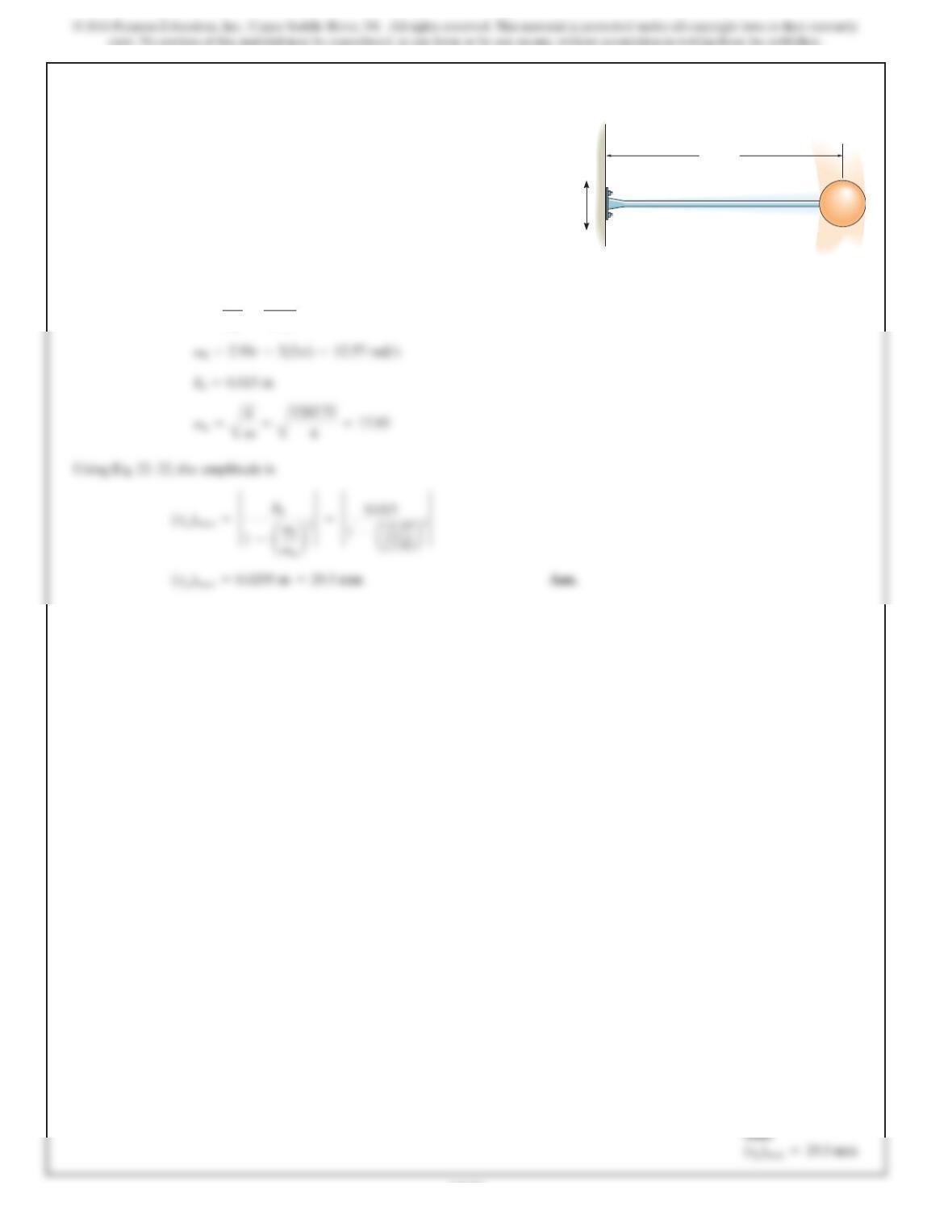
The 30-lb block is attached to two springs having a stiffness
of
A periodic force , where tis in
seconds
, is applied to the block. Determine the maximum
speed
of the block after frictional forces cause the free
vibrations to dampen out.
F=(8 cos 3t)lb10 lb>ft.
F8 cos 3t
k10 lb/ft
k10 lb/ft
1238
22–49.
SOLUTION
k=F
¢y=18
0.014 =1285.71 N>m
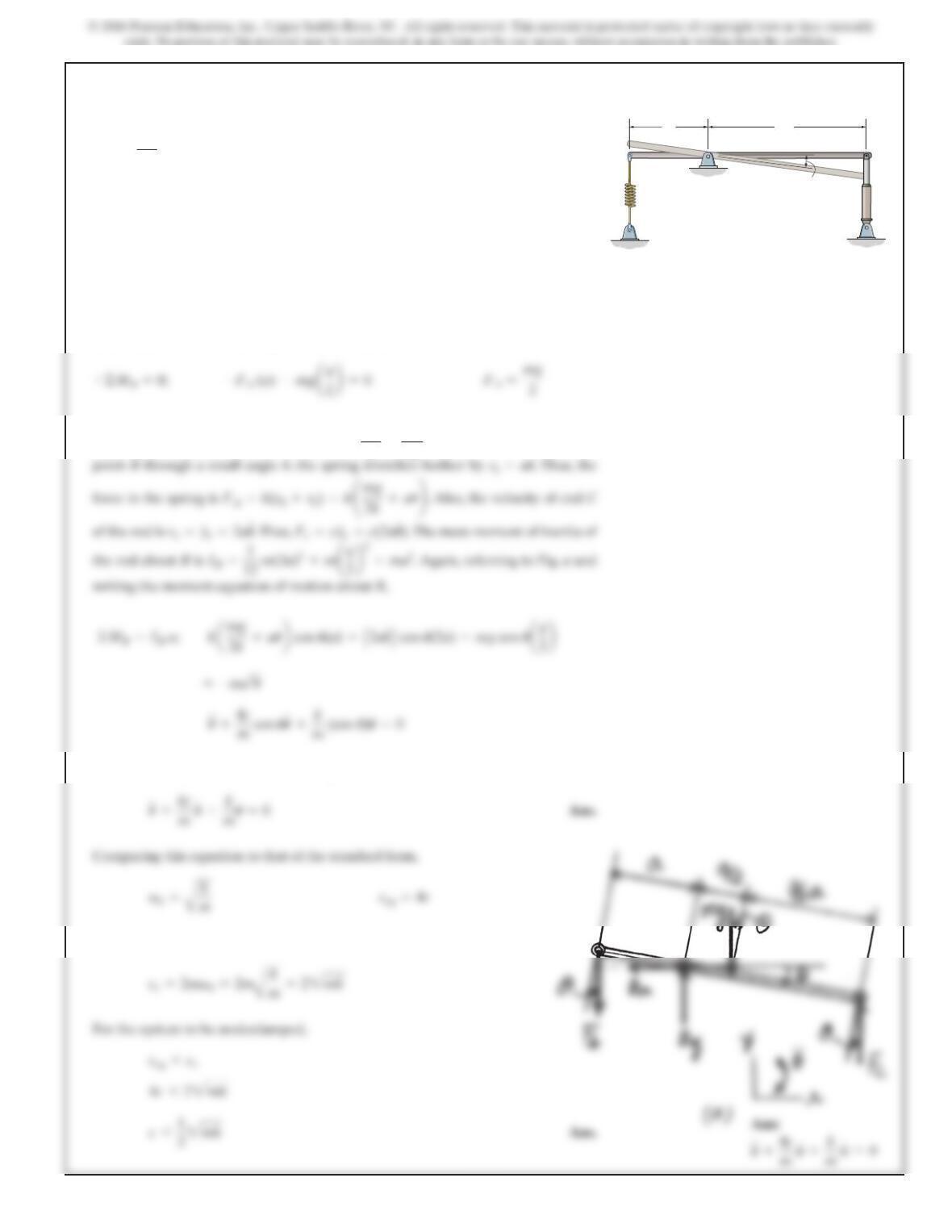
The light elastic rod supports a 4-kg sphere.When an 18-N
vertical force is applied to the sphere, the rod deflects
14 mm. If the wall oscillates with harmonic frequency of
2 Hz and has an amplitude of 15 mm, determine the
amplitude of vibration for the sphere.
0.75 m
1239
22–50.
SOLUTION
Equation
of Motion: When the rod is in equilibrium, , and
. writing the moment equation of motion about point Bby
referring to the free-body diagram of the rod,
Fig. a,
T
hus, the initial stretch of the spring is .When the rod rotates about
Since
is small, .Thus, this equation becomes
T
hus,
cos u1u
sO=FA
k=mg
2k
u
$
=0
Fc=cy
#
c=0u=0°
Find the differential equation for small oscillations in terms
of
for the uniform rod of mass m. Also show that if
, then the system remains underdamped. The
rod is in a horizontal position when it is in equilibrium.
c62mk>2
u
A
B
a
C
c
k
2
u
a
22–51.
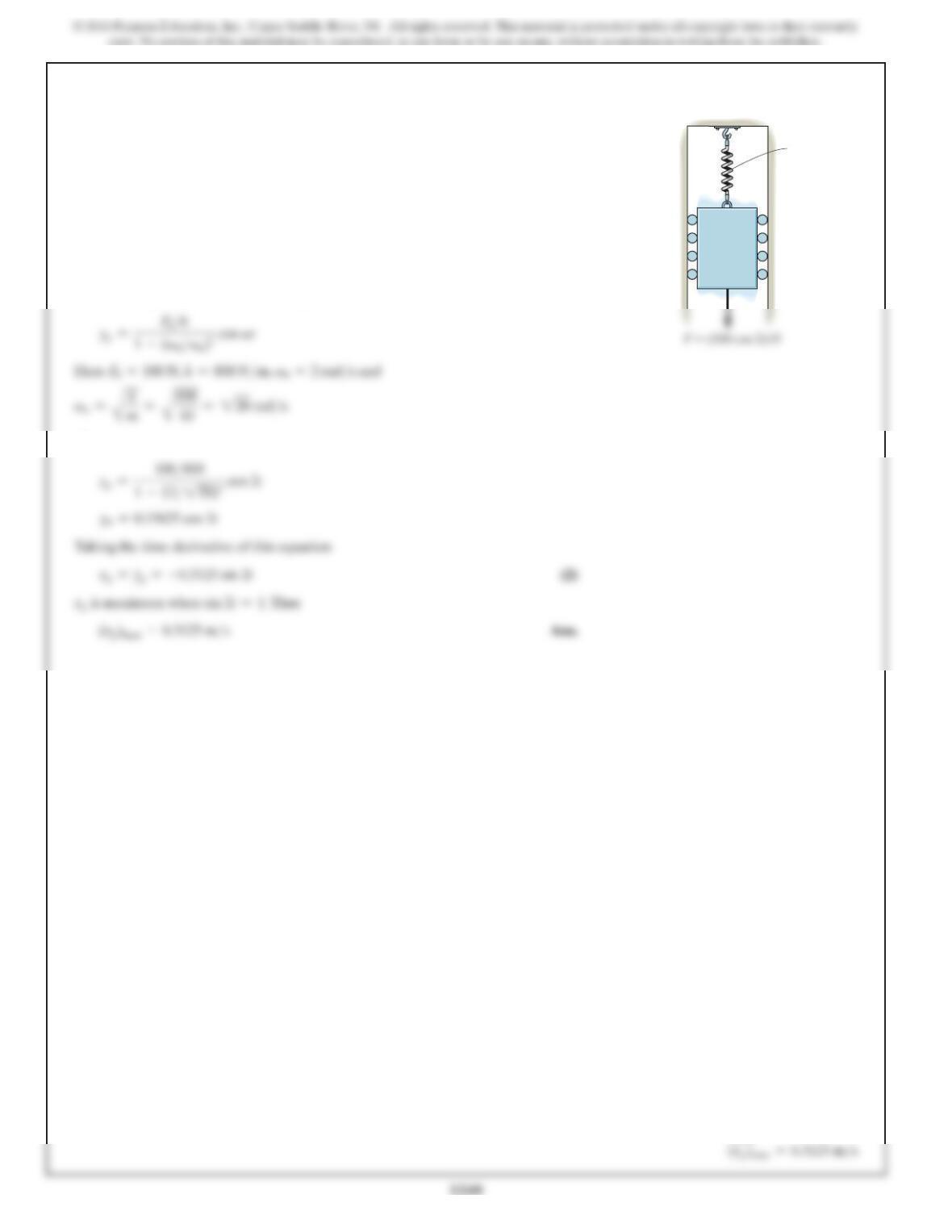
The 40-kg block is attached to a spring having a stiffness of
800 N>m
. A force
F=(100 cos 2t) N
, where t is in seconds
is applied to the block. Determine the maximum speed of
the block for the steady-state vibration.
k 800 N/m
SOLUTION
For the steady-state vibration, the displacement is
Thus
Ans:
1241
*22–52.
SOLUTION
Since ,
Substitute ypinto Eq. (1)
W=kdst
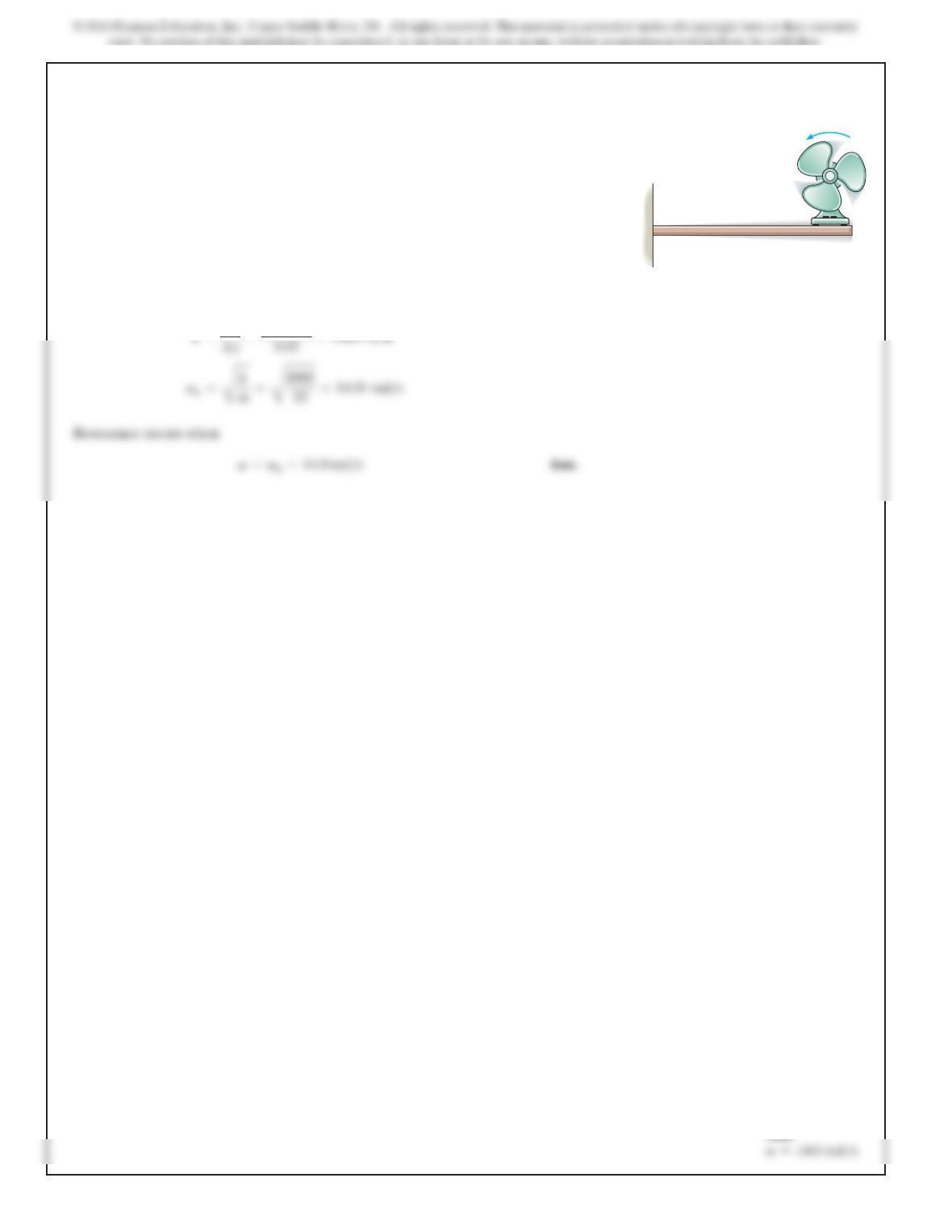
Use a block-and-spring model like that shown in
Fig. 22–14abut suspended from a vertical position and
subjected to a periodic support displacement of
determine the equation of motion for the
system, and obtain its general solution. Define the
displacement ymeasured from the static equilibrium
position of the block when t=0.
d=d0cos v0t,
1242
22–53.
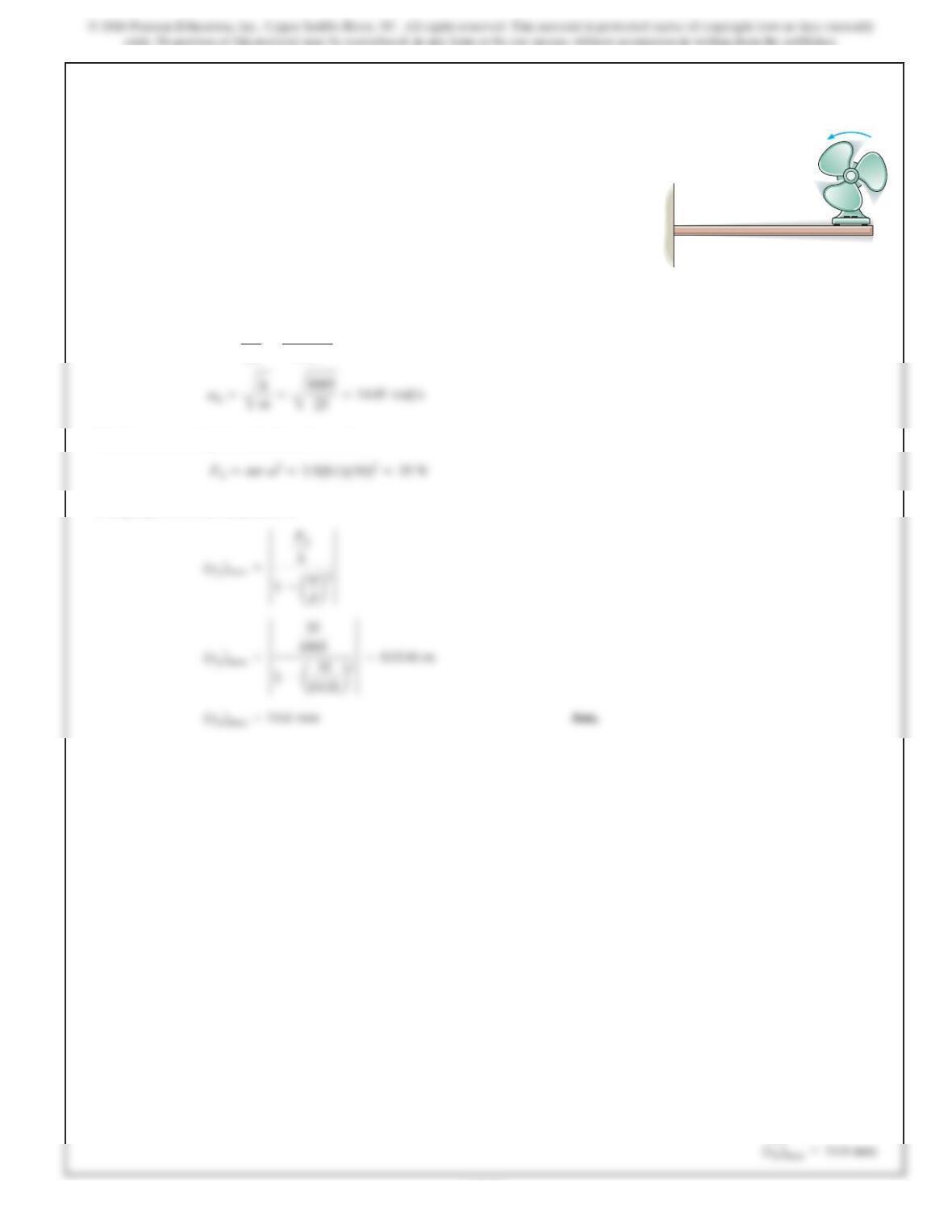
The fan has a mass of 25 kg and is fixed to the end of a
horizontal beam that has a negligible mass.The fan blade is
mounted eccentrically on the shaft such that it is equivalent
to an unbalanced 3.5-kg mass located 100 mm from the axis
of rotation. If the static deflection of the beam is 50 mm as a
result of the weight of the fan, determine the angular
velocity of the fan blade at which resonance will occur. Hint:
See the first part of Example 22.8.
SOLUTION
V
Ans:
1243
22–54.
SOLUTION
The force caused by the unbalanced rotor is
Using Eq. 22–22, the amplitude is
k=F
¢y=25(9.81)
0.05 =4905 N>m
10 rad>s
V
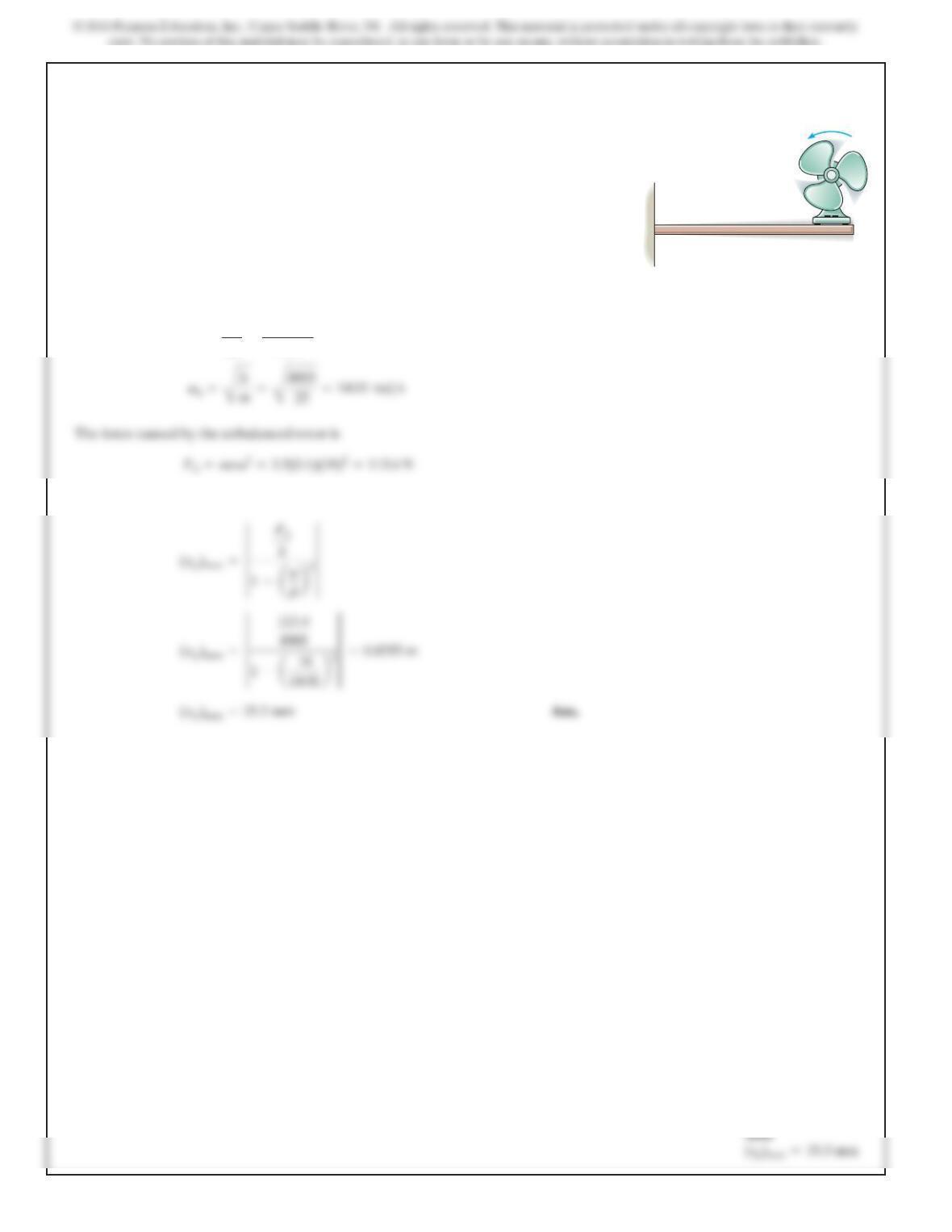
In Prob. 22–53, determine the amplitude of steady-state
vibration of the fan if its angular velocity is .
Ans:
1244
22–55.
? Hint: See the first part of Example 22.8.18 rad>s
SOLUTION
Using Eq. 22–22, the amplitude is
k=F
¢y=25(9.81)
0.05 =4905 N>m
V
What will be the amplitude of steady-state vibration of the
fan in Prob. 22–53 if the angular velocity of the fan blade is
*22–56.
SOLUTION
Thus,
–15(x–0.1 cos 15t)(1.2) =4(0.6)2u
$
+©MO=IOa; 4(9.81)(0.6) –Fs(1.2) =4(0.6)2u
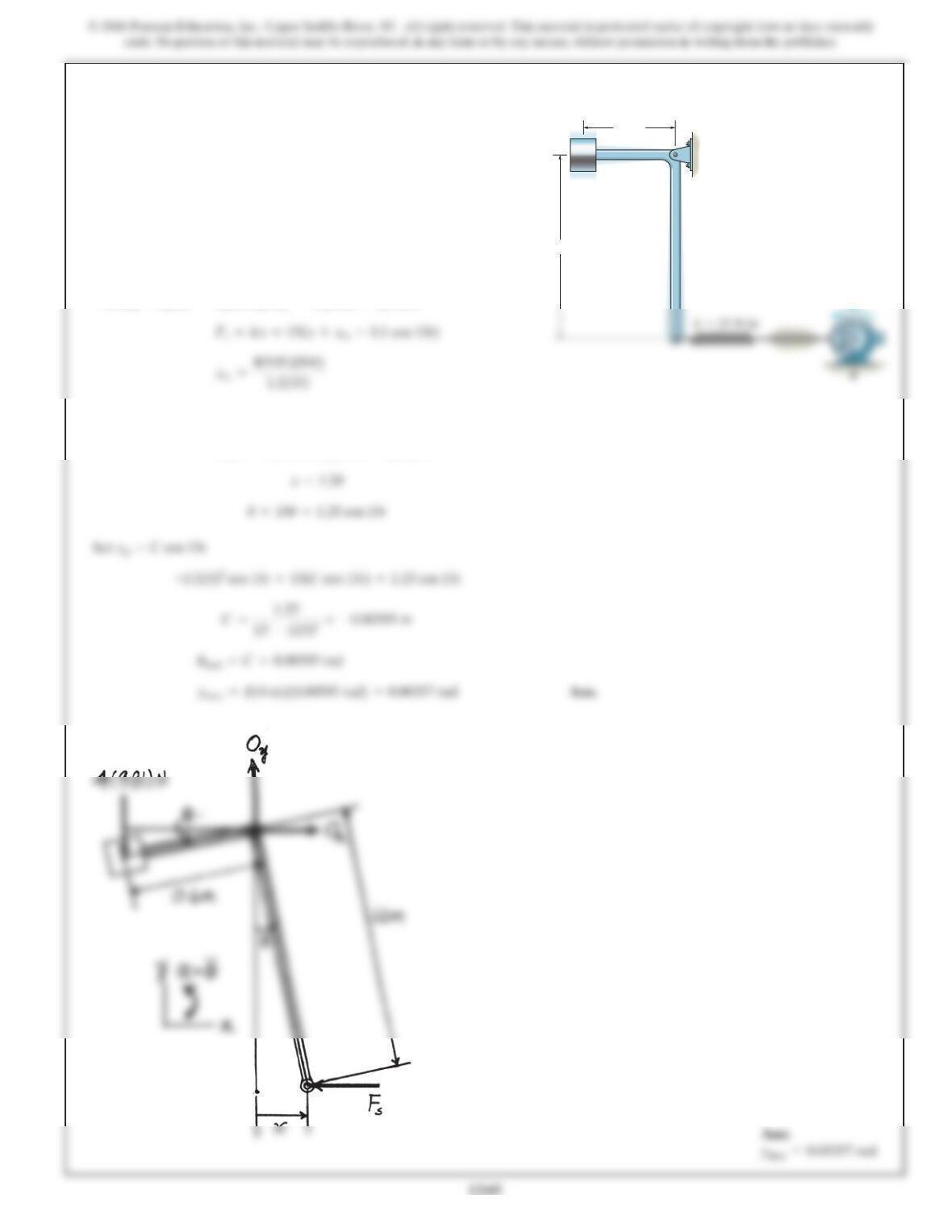
$
The small block at Ahas a mass of 4 kg and is mounted on
the bent rod having negligible mass. If the rotor at Bcauses
a harmonic movement , where tis in
seconds, determine the steady-state amplitude of vibration
of the block.
dB=(0.1 cos 15t)m
0.6 m
1.2 m
AO
V
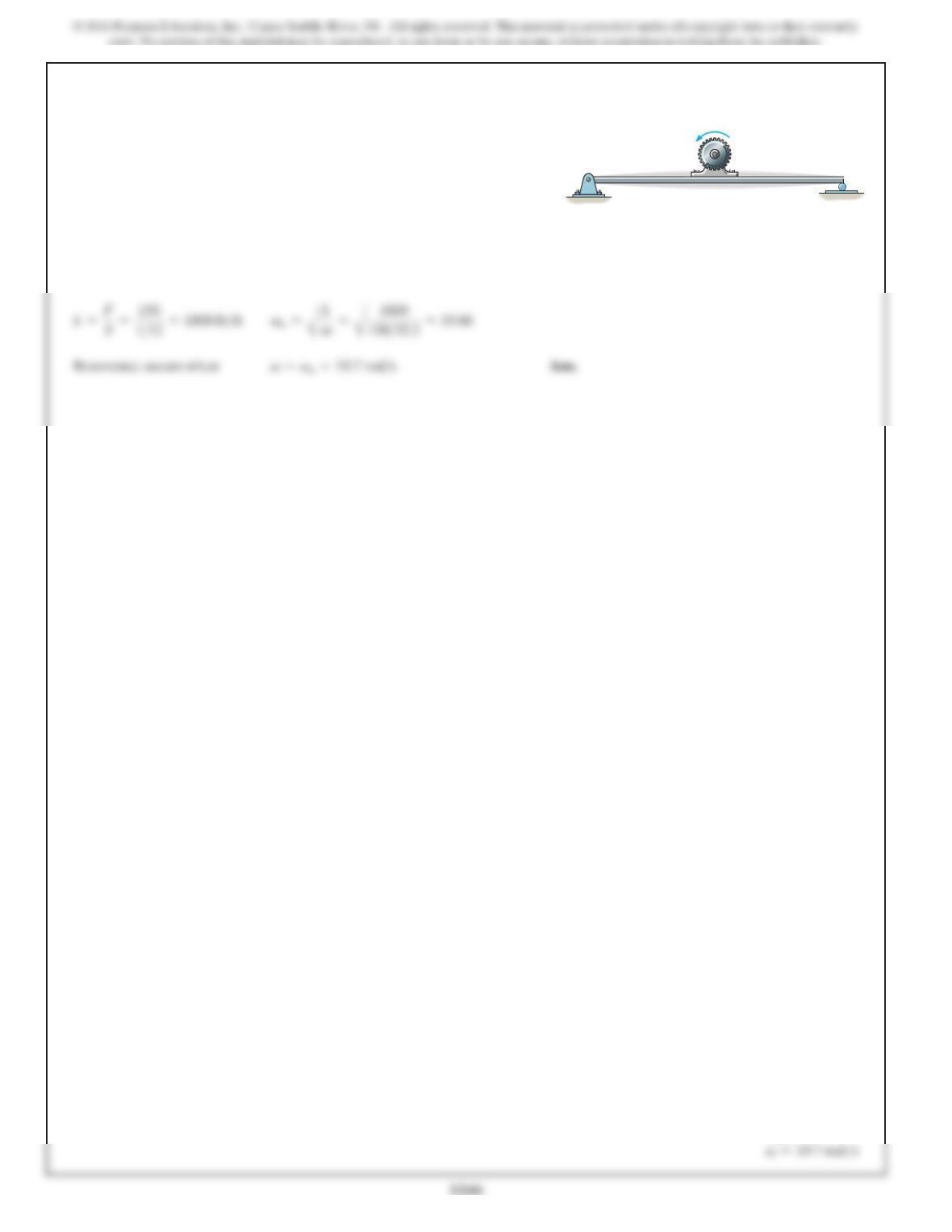
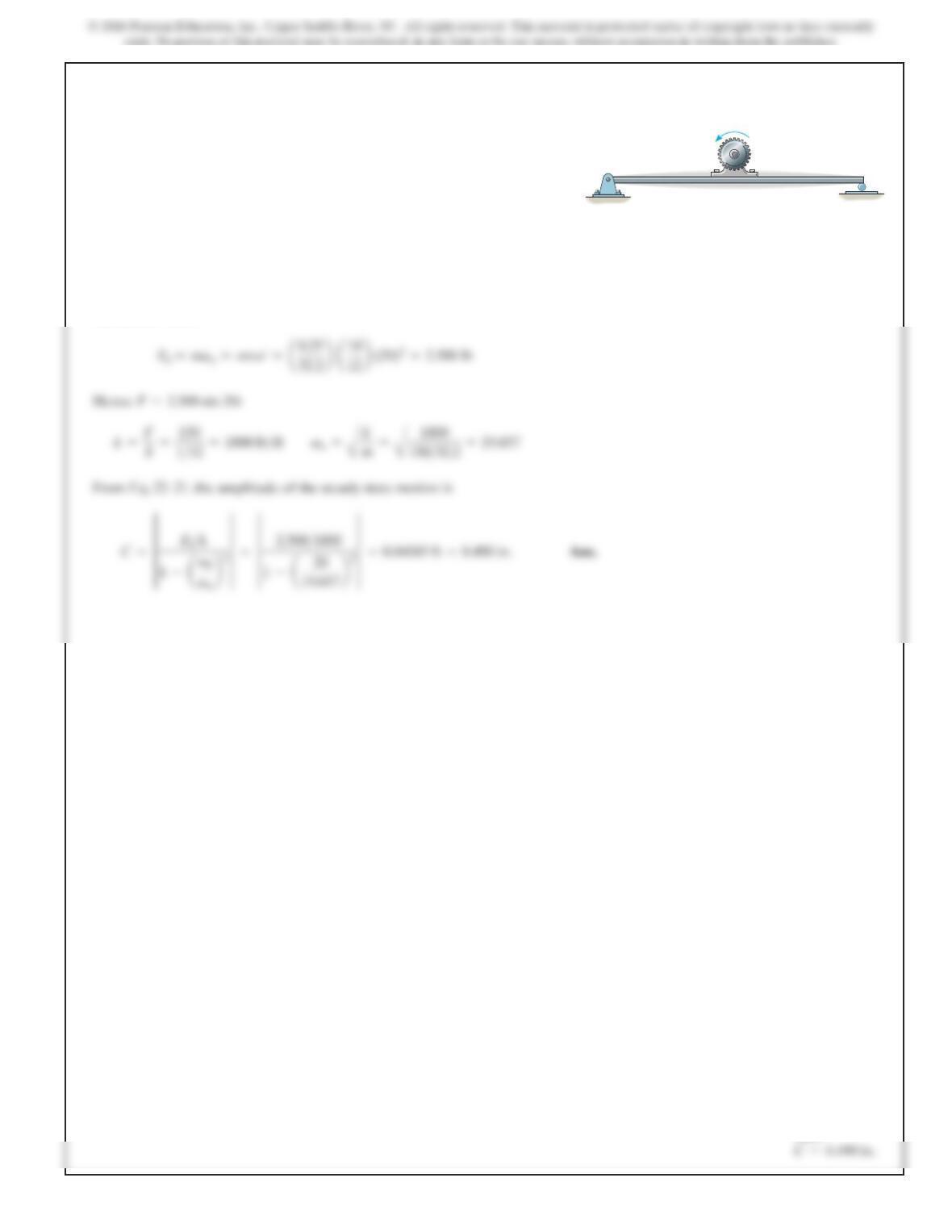
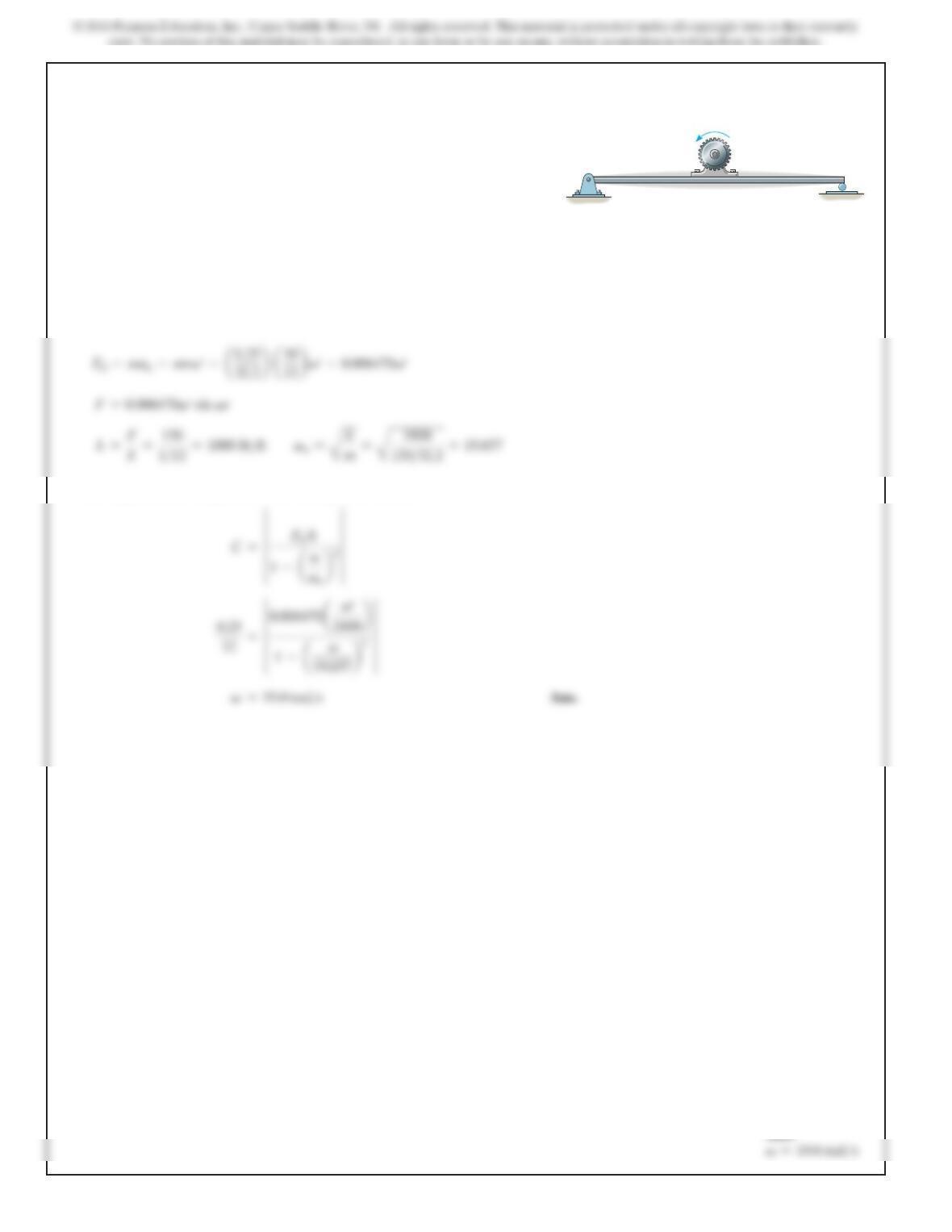
22–57.
The electric motor turns an eccentric flywheel which is
equivalent to an unbalanced 0.25-lb weight located 10 in.
from the axis of rotation. If the static deflection of the
beam is 1 in. due to the weight of the motor,determine
the angular velocity of the flywheel at which resonance
will occur.The motor weights 150 lb.Neglect the mass of
the beam.
SOLUTION
V
Ans:
1247
22–58.
SOLUTION
The constant value FOof the periodic force is due to the centrifugal force of the
unbalanced mass
.
W
h
at w
ill
b
e t
h
e amp
li
tu
d
e of stea
d
y-state v
ib
rat
i
on of t
h
e
motor in Prob. 22–57 if the angular velocity of the flywheel
is ?20 rad>s
V
Ans:
1248
22–59.
Determine the angular velocity of the flywheel in Prob.22–
5
7
which will produce an amplitude of vibration of 0.25 in.
SOLUTION
The constant value F
Oof the periodic force is due to the centrifugal force of the
unbalanced mass.
From Eq. 22.21, the amplitude of the steady-state motion is
V
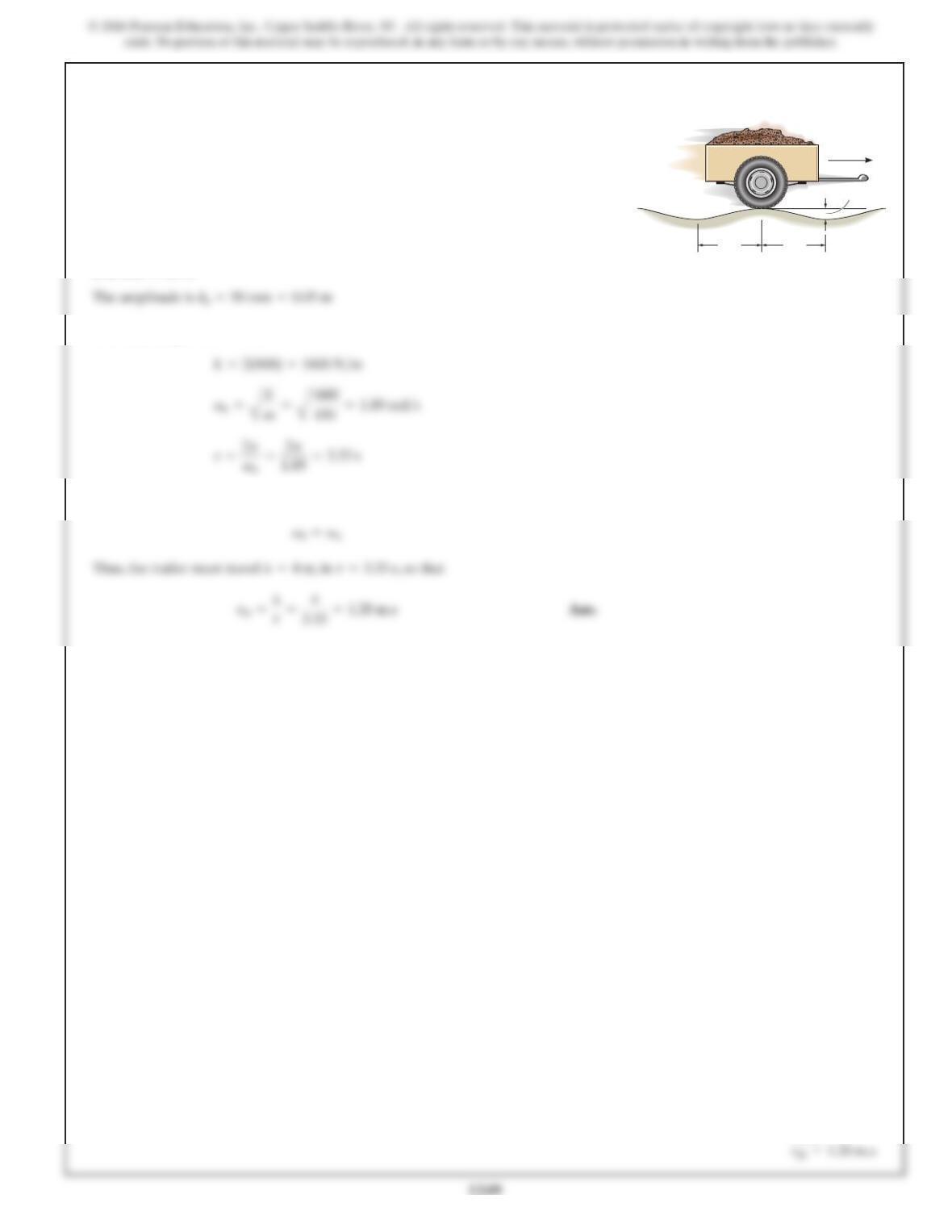
*22–60.
The 450-kg trailer is pulled with a constant speed over the
s
urface of a bumpy road, which may be approximated by a
cosine
curve having an amplitude of 50 mm and wave length of
4m
.If the two springs swhich support the trailer each have a
stiffness
of determine the speed which will cause
t
he greatest vibration (resonance) of the trailer.Neglect the
w
eight of the wheels.
v800 N>m,
SOLUTION
T
he wave length is
F
or maximum vibration of the trailer, resonance must occur, i.e.,
l=4m
v
100mm
2m 2m
s
Ans: