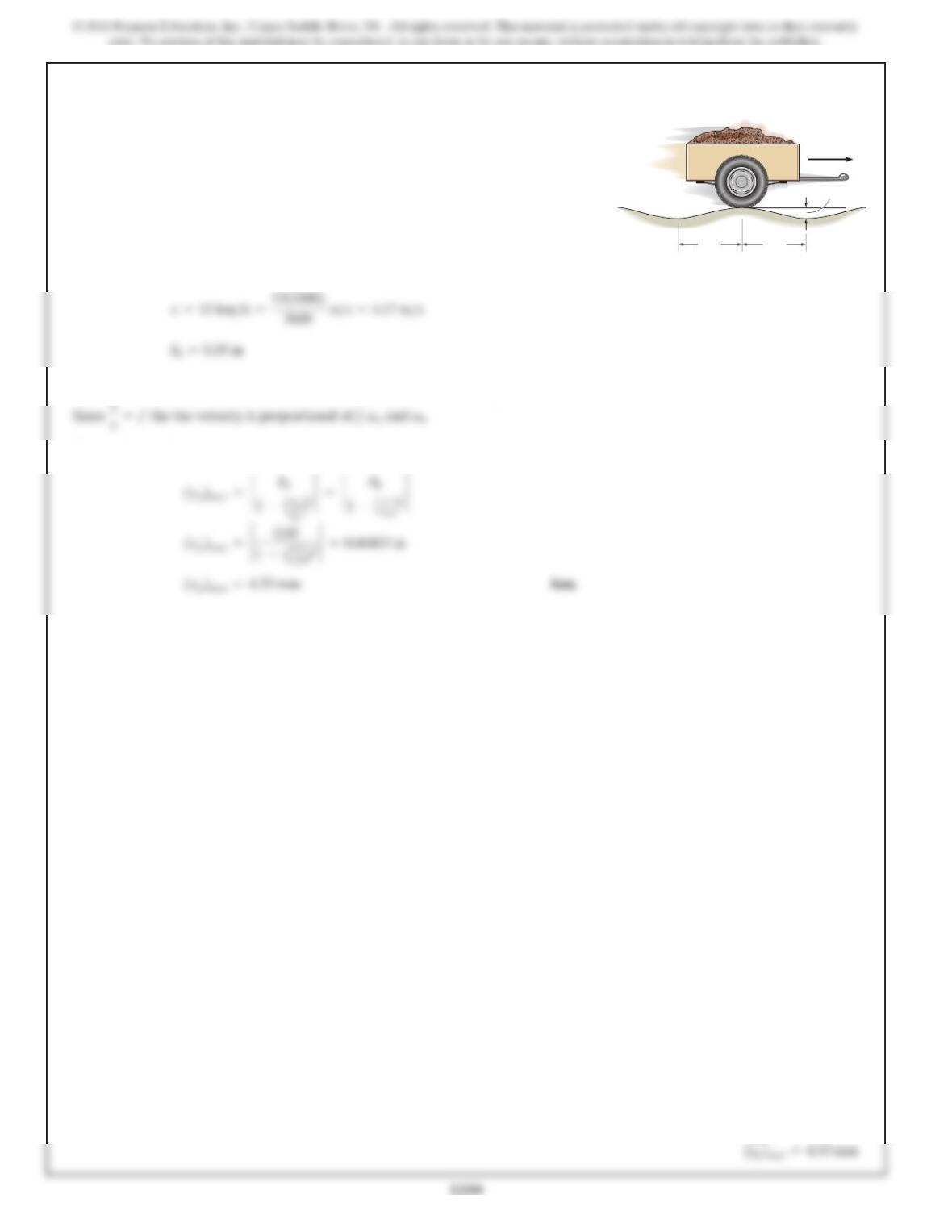
22–61.
SOLUTION
As shown in Prob. 22–50, the velocity is inversely proportional to the period.
Hence, the amplitude of motion is
v=15 km>h.
v
100 mm
2m 2m
s
Determine the amplitude of vibration of the trailer in
Prob. 22–60 if the speed
Ans:
1251
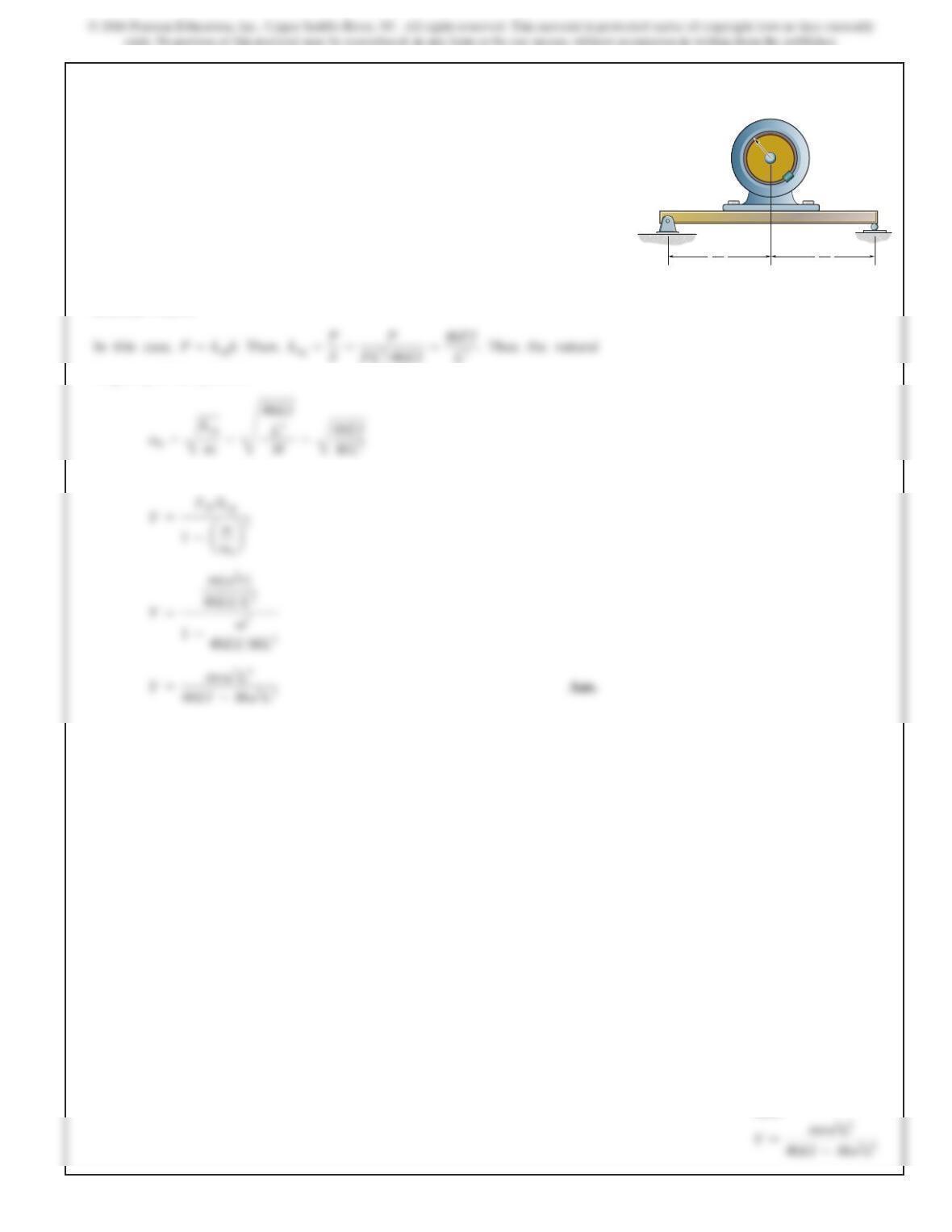
22–62.
A
r
L
2
L
2
The motor of mass Mis supported by a simply supported
beam
of negligible mass. If block Aof mass mis clipped
onto the rotor
, which is turning at constant angular velocity
of
, determine the amplitude of the steady-state vibration.
Hint
:When the beam is subjected to a concentrated force of
P
at its mid-span, it deflects at this point.
Here
Eis Young’s modulus of elasticity,a property of the
material,
and Iis the moment of inertia of the beam’s cross–
s
ectional area.
d=PL3>48EI
v
SOLUTION
frequenc
y of the system is
Here
,.Thus,
FO=man=m(v2r)
Ans:
1252
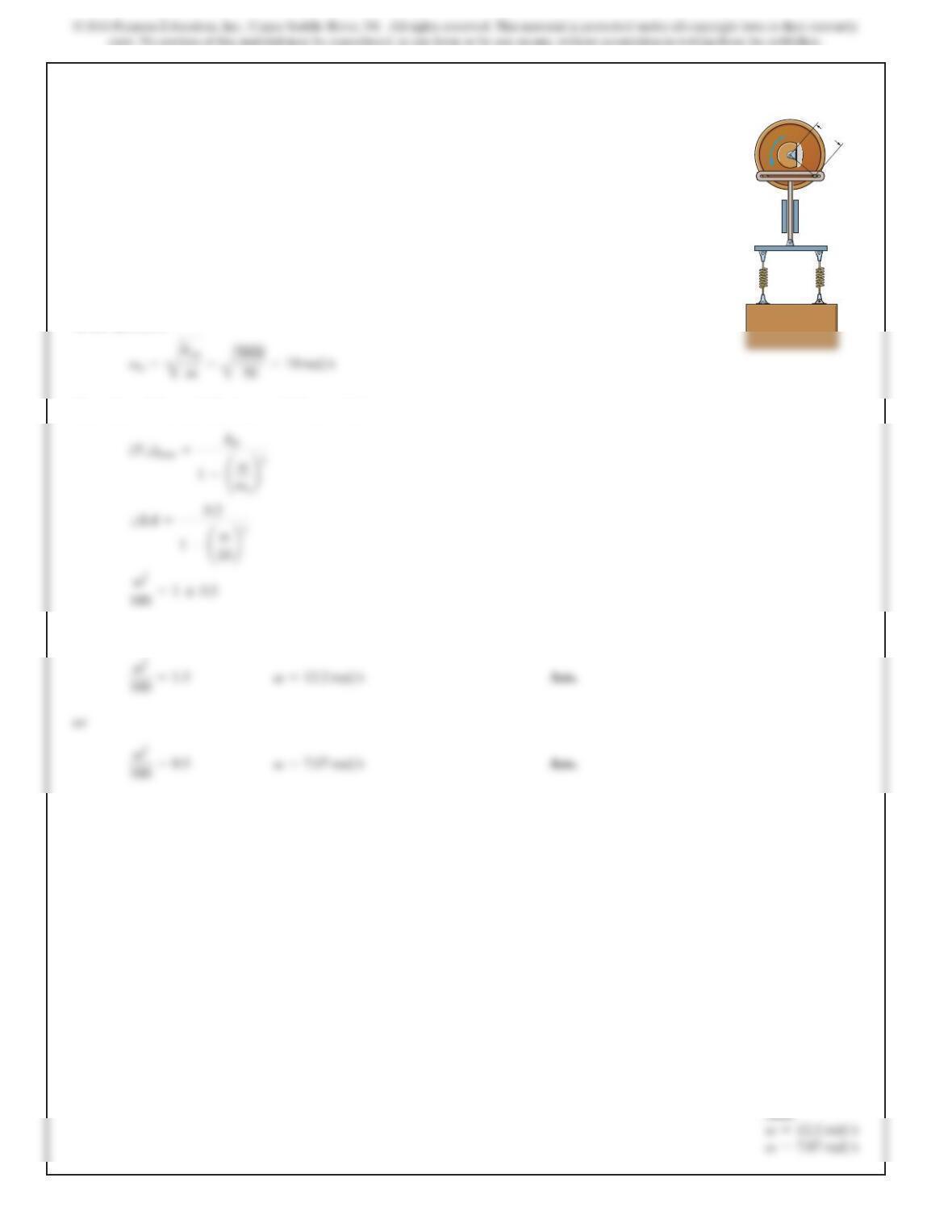
22–63.
SOLUTION
In this case,Thus, the natural circular frequency
of the system is
Here, and , so that
Thus,
(YP)max =;0.4 mdO=0.2 m
keq =2k=2(2500) =5000 N>m
The spring system is connected to a crosshead that oscillates
vertically when the wheel rotates with a constant angular
velocity of . If the amplitude of the steady-state vibration
is observed to be 400 mm, and the springs each have a
stiffness of , determine the two possible
values of at which the wheel must rotate.The block has a
mass of 50 kg.
V
k=2500 N>m
V
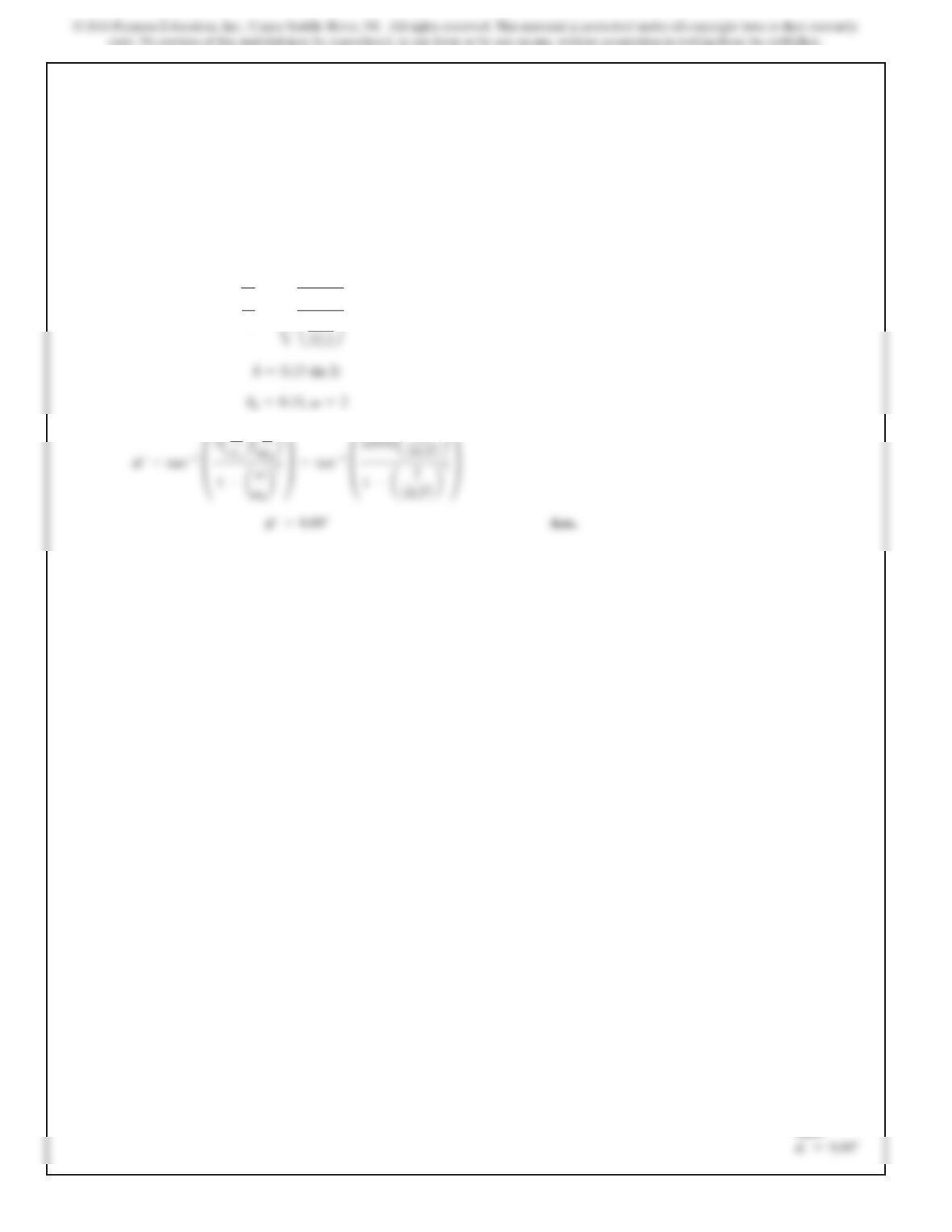
200 mm
kk
v
Ans:
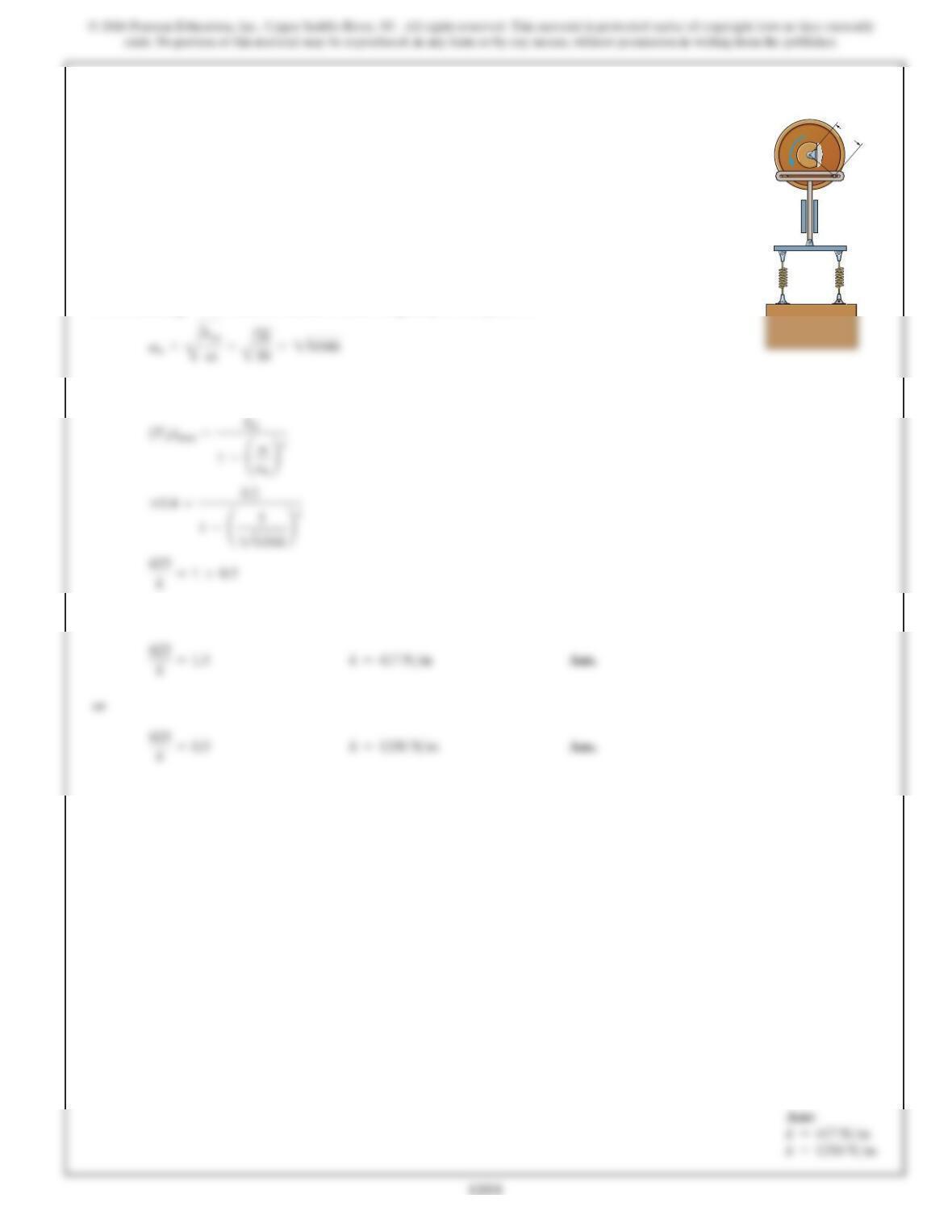
*22–64.
The spring system is connected to a crosshead that oscillates
vertically
when the wheel rotates with a constant angular
velocity of
. If the amplitude of the steady-state
vibration
is observed to be 400 mm, determine the two
possible
values of the stiffness kof the springs.The block
has a mass of 50 kg
.
v=5 rad>s
SOLUTION
In this case
,Thus, the natural circular frequency of the system is
Here
, and , so that
T
hus,
(YP)max =;0.4 mdO=0.2 m
keq =2k
200 mm
kk
v
1254
22–65.
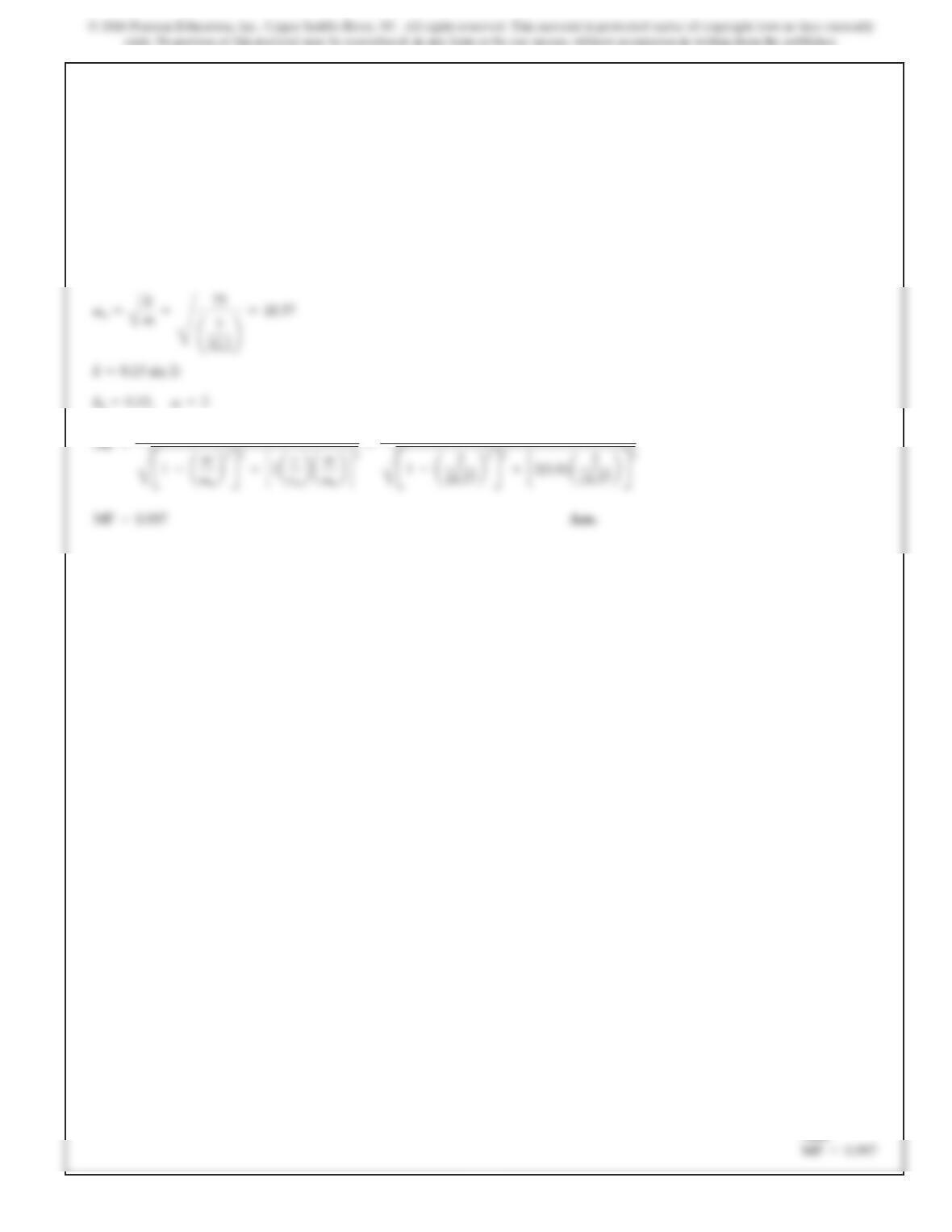
SOLUTION
=
C
k
m=S75
A7–
lb
bl
oc
k
i
s suspen
d
e
d
from a spr
i
ng
h
av
i
ng a st
i
ffness of
.The support to which the spring is attached is
given simple harmonic motion which may be expressed as
, where tis in seconds. If the damping
factor is , determine the phase angle of forced
vibration.
fc>cc=0.8
d=(0.15 sin 2t)ft
k=75 lb>ft
n
v
Ans:
1255
22–66.
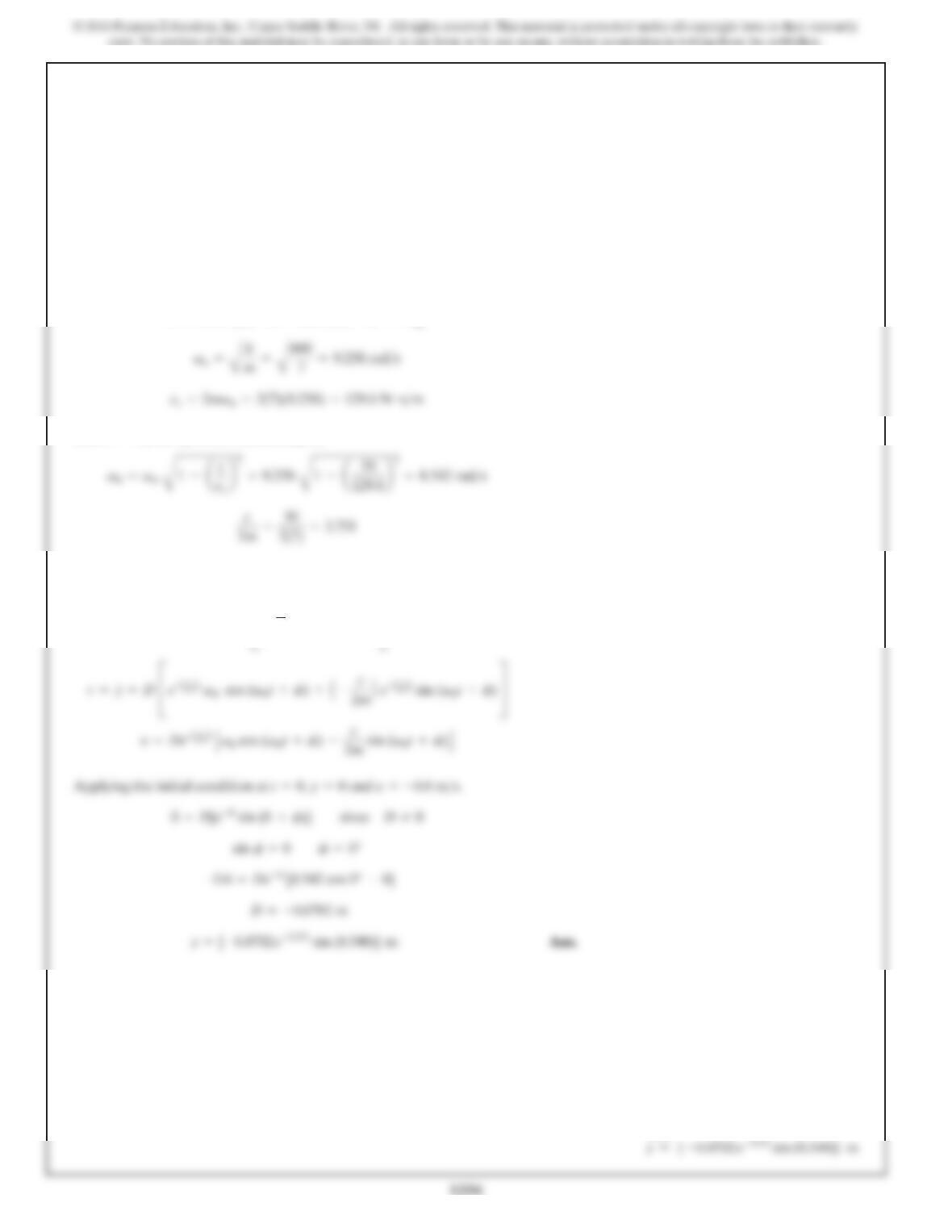
SOLUTION
Determ
i
ne t
h
e magn
i
f
i
cat
i
on factor of t
h
e
bl
oc
k
, spr
i
ng,an
d
dashpot combination in Prob. 22–65.
Ans:
22–67.
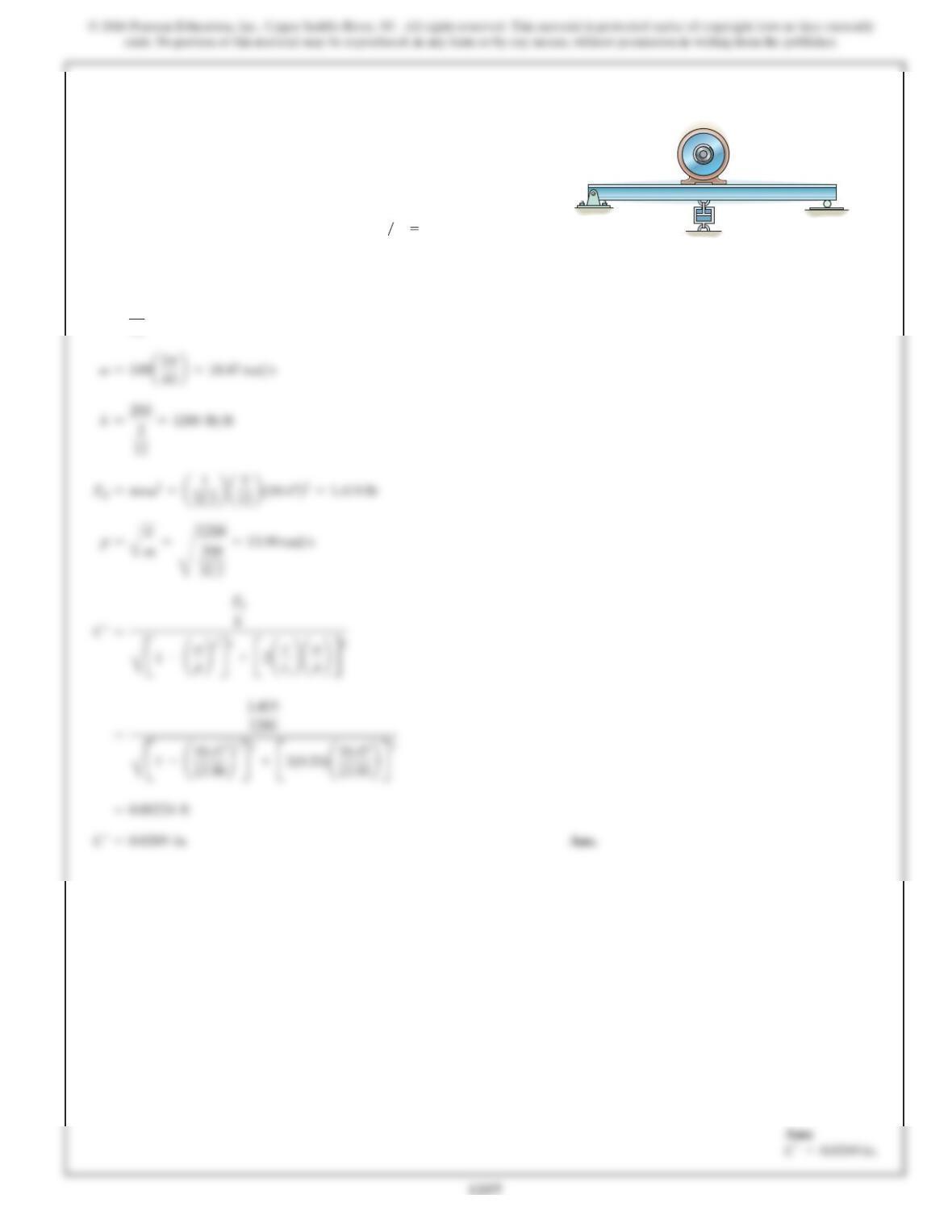
SOLUTION
Since , the system is underdamped,
From Eq. 22-32
y=DCe–
A
c
2m
B
tsin (vdt+f)S
c6cz
c=50 Ns>mk=600 N>mm=7kg
A block having a mass of 7 kg is suspended from a spring
that has a stiffness If the block is given an
upward velocity of from its equilibrium position at
determine its position as a function of time. Assume
that positive displacement of the block is downward and
that motion takes place in a medium which furnishes a
damping force where is in m>s.
vF =150 ƒvƒ2N,
t=0,
0.6 m>s
k=600 N>m.
Ans:
*22–68.
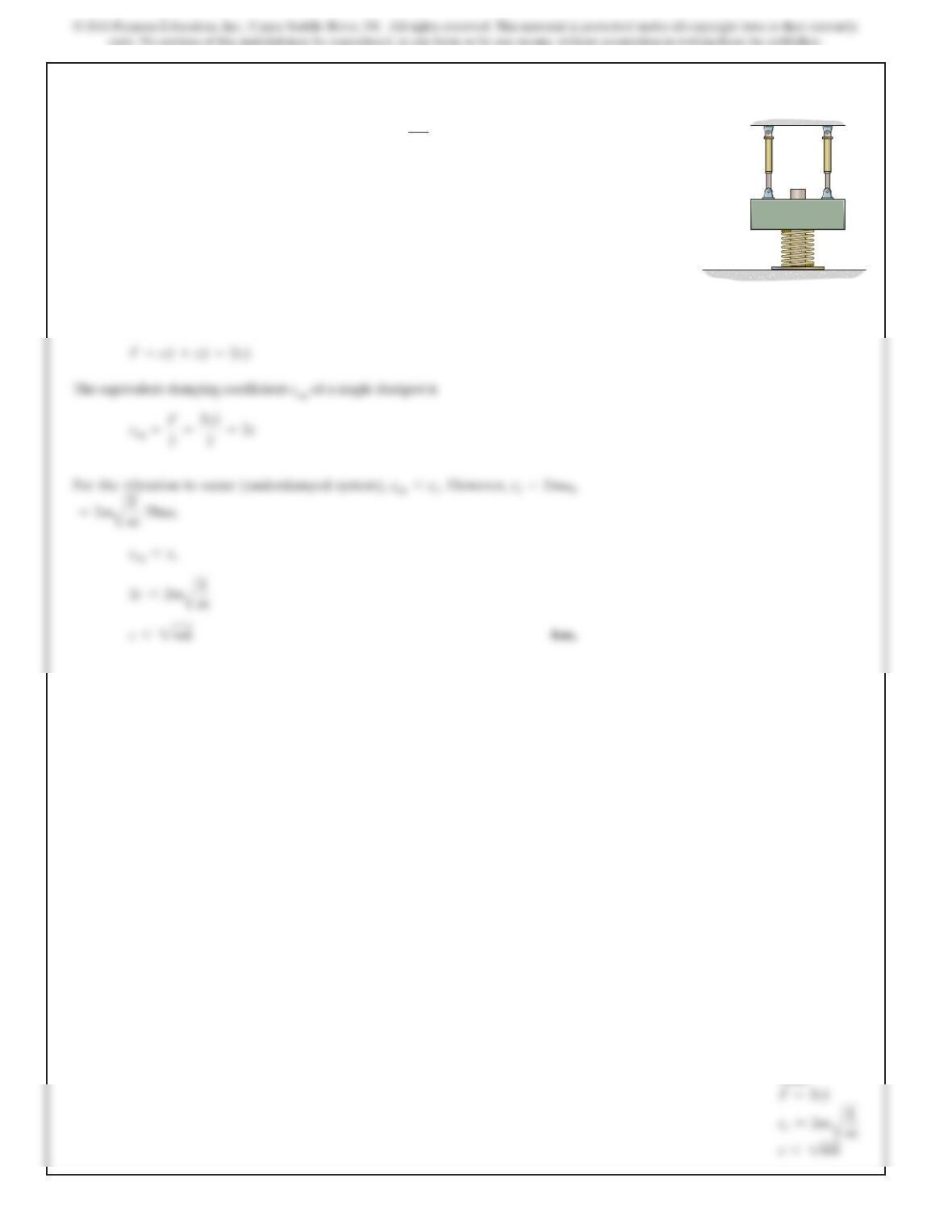
The 200-lb electric motor is fastened to the midpoint of the
simply supported beam.It is found that the beam deflects
2 in. when the motor is not running. The motor turns an
eccentric flywheel which is equivalent to an unbalanced
weight of 1 lb located 5 in. from the axis of rotation. If the
motor is turning at 100 rpm, determine the amplitude of
steady-state vibration.The damping factor is ccc0.20.
Neglect the mass of the beam.
SOLUTION
d=2
12 =0.167 ft
1258
22–69.
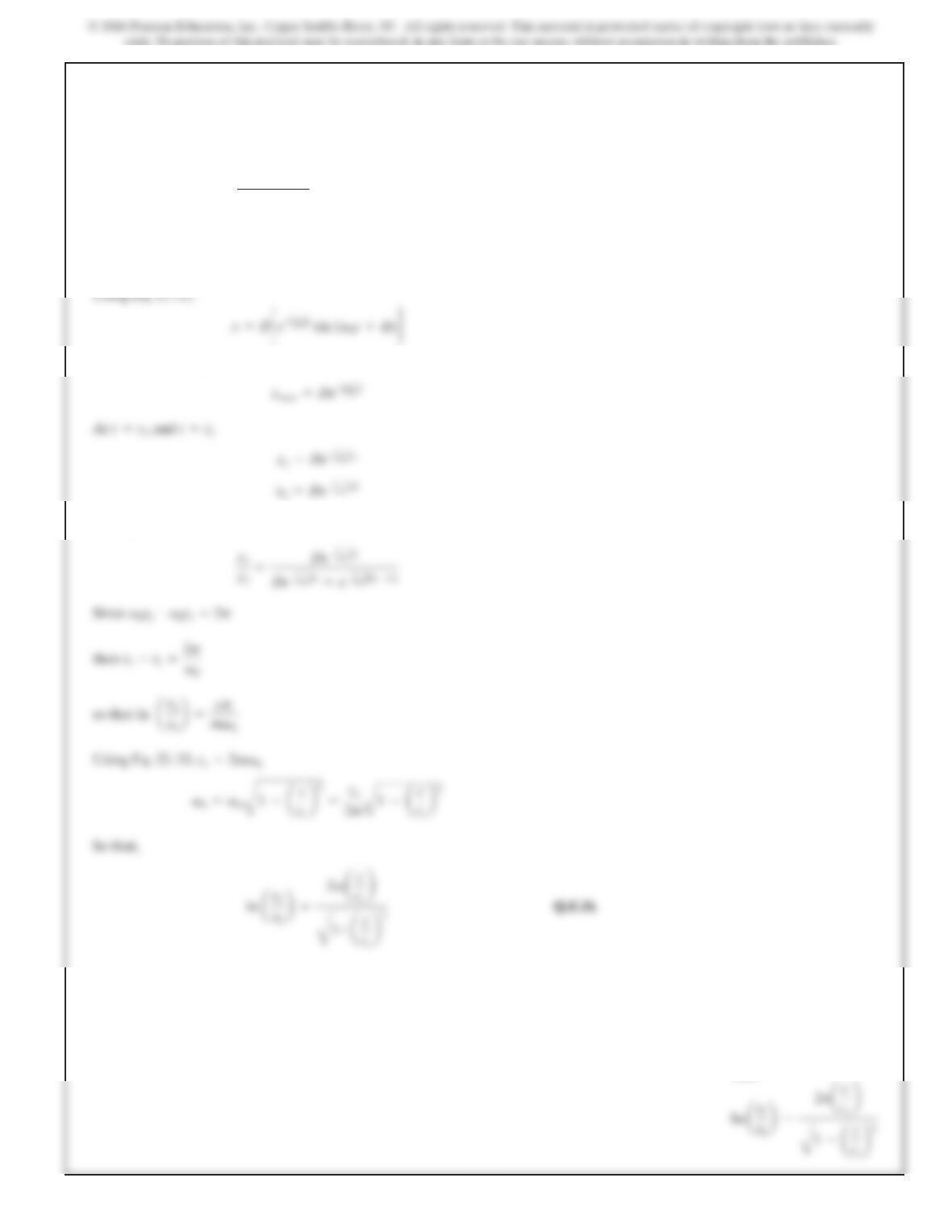
Two identical dashpots are arranged parallel to each other,
as shown. Show that if the damping coefficient ,
then the block of mass mwill vibrate as an underdamped
system.
c6
2
mk
SOLUTION
When the two dash pots are arranged in parallel, the piston of the dashpots have the
same velocity.Thus, the force produced is
k
cc
Ans:
1259
22–70.
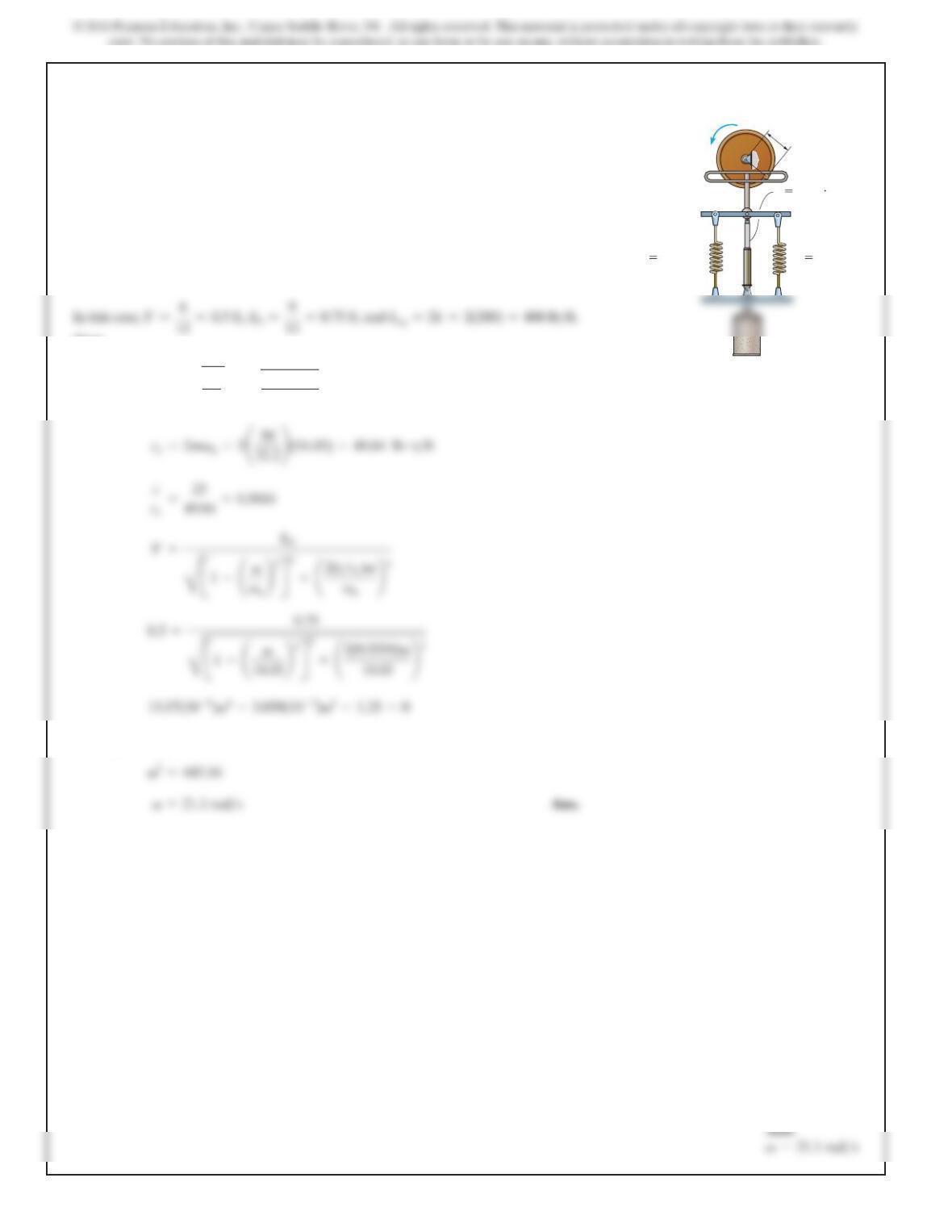
T
he damping factor,may be determined experimentally
by
measuring the successive amplitudes of vibrating motion
of
a system. If two of these maximum displacements can be
approximated
by and as shown in Fig. 22–16, show that
is called the
logarithmic decrement.
ln x1x2
The quantity
ln
c
1x>x1>2=2p1c>cc2>2–1cc22.
x2,x1
c
>
cc,
SOLUTION
T
he maximum displacement is
Hence
,
>
Ans:
1260
22–71.
c 25 lb s/ft
k 200 lb/ftk 200 lb/ft
9 in.
v
SOLUTION
Then
Solving for the positive root of this equation,
vn=
C
keq
m =B400
(50>32.2) =16.05 rad>s
If the amplitude of the 50-lb cylinder’s steady-state vibration
is 6 in., determine the wheel’s angular velocity
v.