1169
21–58.
SOLUTION
Hence
Solving,
Ans.
Ay=-1.69 lb
vx=-4, vy=vz=0,
v={–4i} rad>s
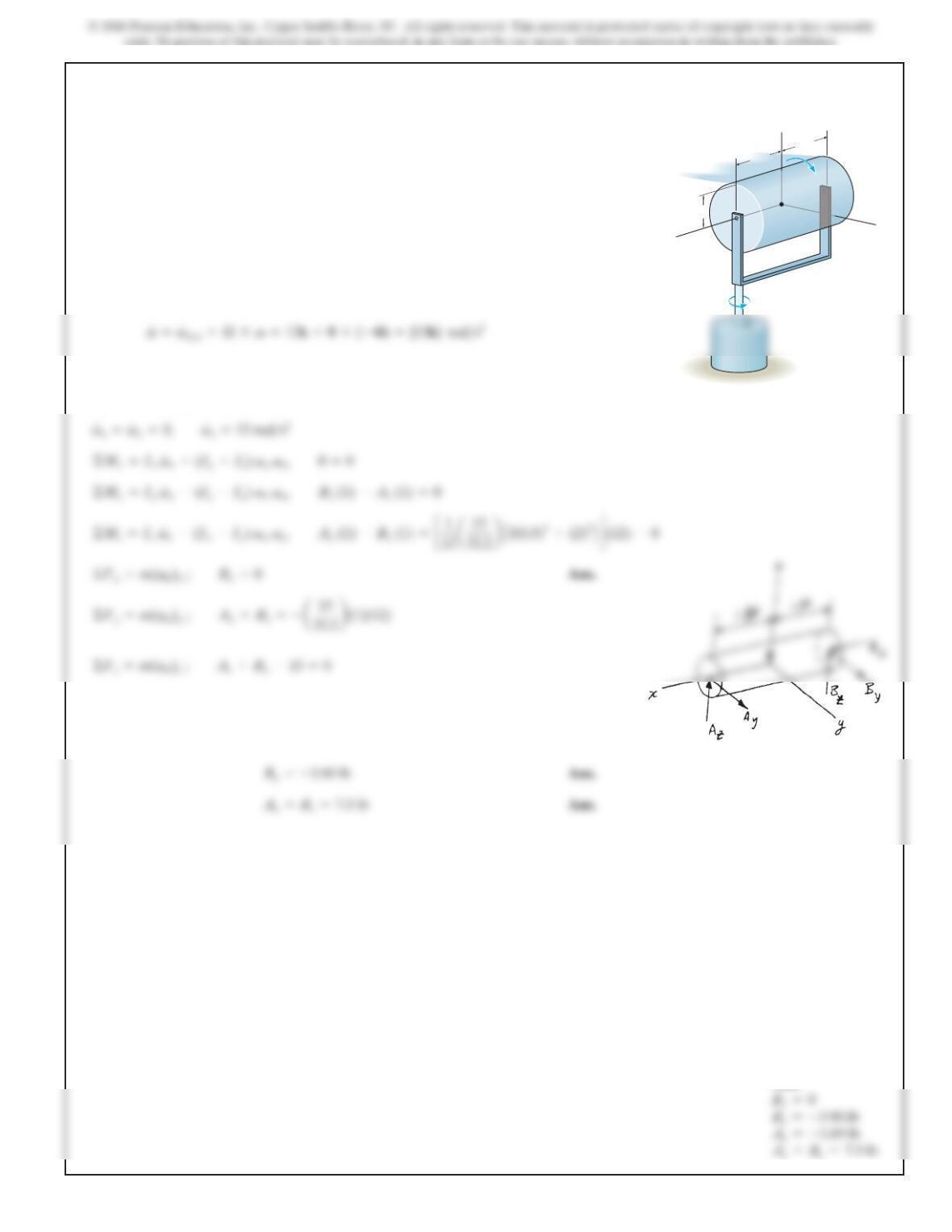
The 15-lb cylinder is rotating about shaft AB with a constant
angular speed .If the supporting shaft at C,
initially at rest, is given an angular acceleration
,determine the components of reaction at the
bearings Aand B. The bearing at Acannot support a force
component along the xaxis,whereas the bearing at Bdoes.
aC=12 rad>s2
v=4 rad>s
x
z
y
1ft
0.5 ft
1ft
A
B
G
C
α
ω
Ans:
1170
21–59.
SOLUTION
The x,y,z axes are fixed as shown.
Using Eqs. 21–25:
vx=2 sin u
u.
2 rad/s
z
x
y
Auu
.
= 6 rad>s,
u
.
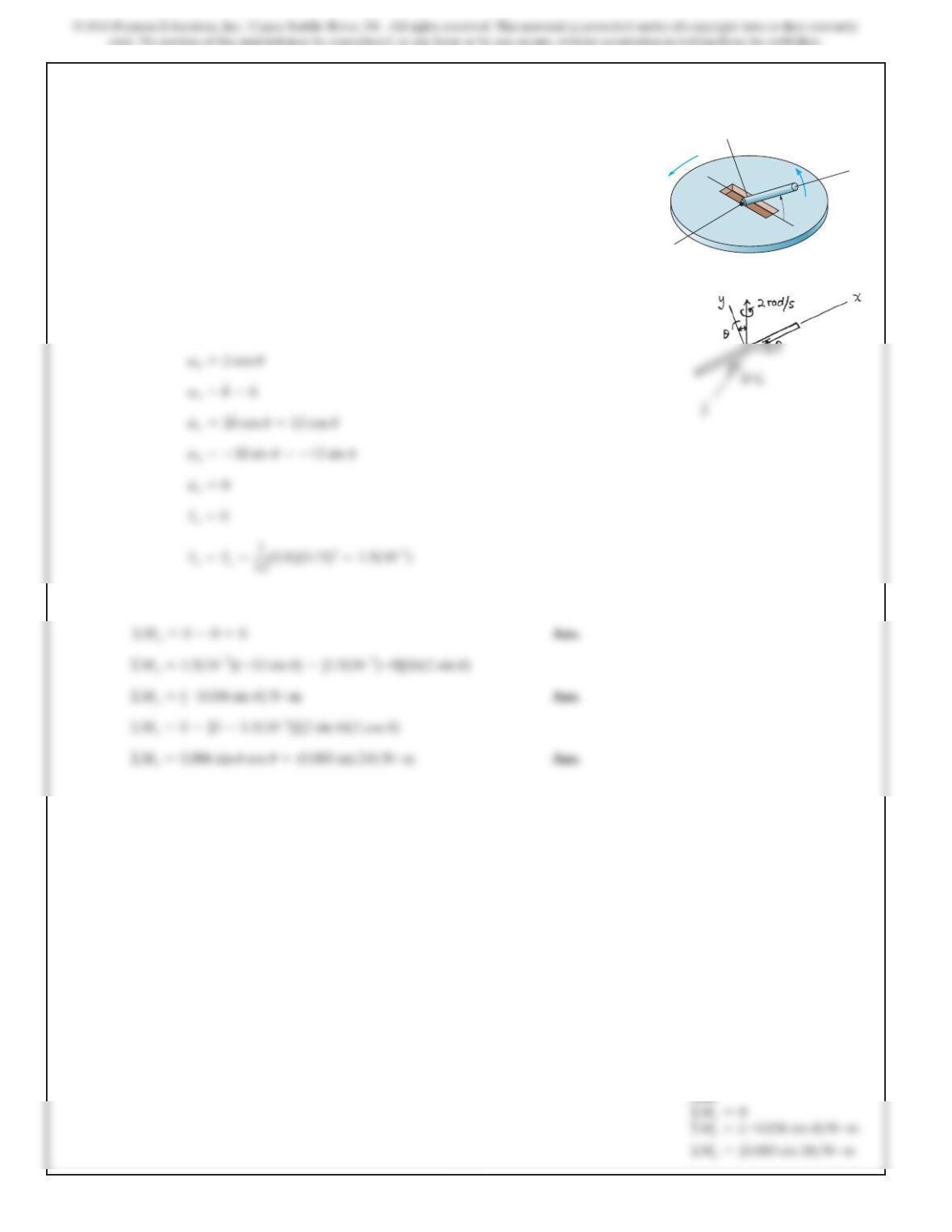
The thin rod has a mass of 0.8 kg and a total length of 150 mm.
It is rotating about its midpoint at a constant rate
while the table to which its axle A is fastened is rotating at
fastened is rotating at Determine the x, y, z moment
components which the axle exerts on the rod when the rod is
in any position
. 2 rad
>
s
Ans:
1171
*21–60.
S
h
ow t
h
at t
h
e angu
l
ar ve
l
oc
i
ty of a
b
o
d
y,
i
n terms of
Euler angles ,,and ,can be expressed as
, where i,j, and kare directed along the x,y,
zaxes as shown in Fig. 21–15d.
(f
#
cos u+c
#
)k
v=(f
#
sin usin c+u
#
cos c)i+(f
#
sin ucos c–u
#
sin c)j+
cuf
SOLUTION
From Fig. 21–15b. due to rotation , the x,y,zcomponents of are simply along
zaxis.
f
#
f
#
f
Ans:
1172
21–61.
SOLUTION
u=(1 sin 45°) sin 30° i–(1 sin 45°) cos 30°j+1cos 45° k
At
hi
n ro
d
i
s
i
n
i
t
i
a
ll
y co
i
nc
id
ent w
i
t
h
t
h
e Zax
i
s w
h
en
i
t
i
s
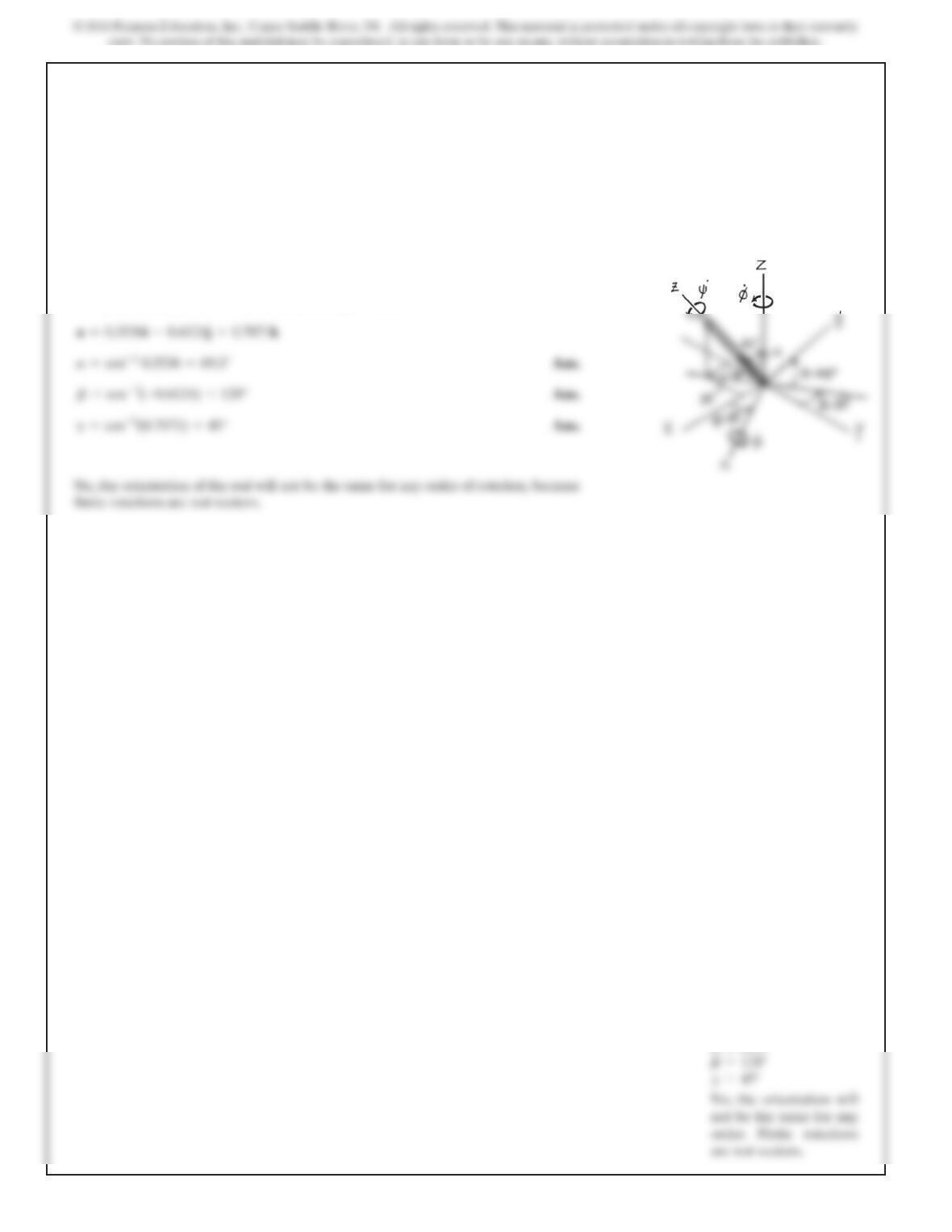
given three rotations defined by the Euler angles ,
,and .If these rotations are given in the
order stated, determine the coordinate direction angles ,,
of the axis of the rod with respect to the X,Y, and Zaxes.
Are these directions the same for any order of the
rotations? Why?
g
ba
c=60°u=45°
f=30°
Ans:
a=69.3°
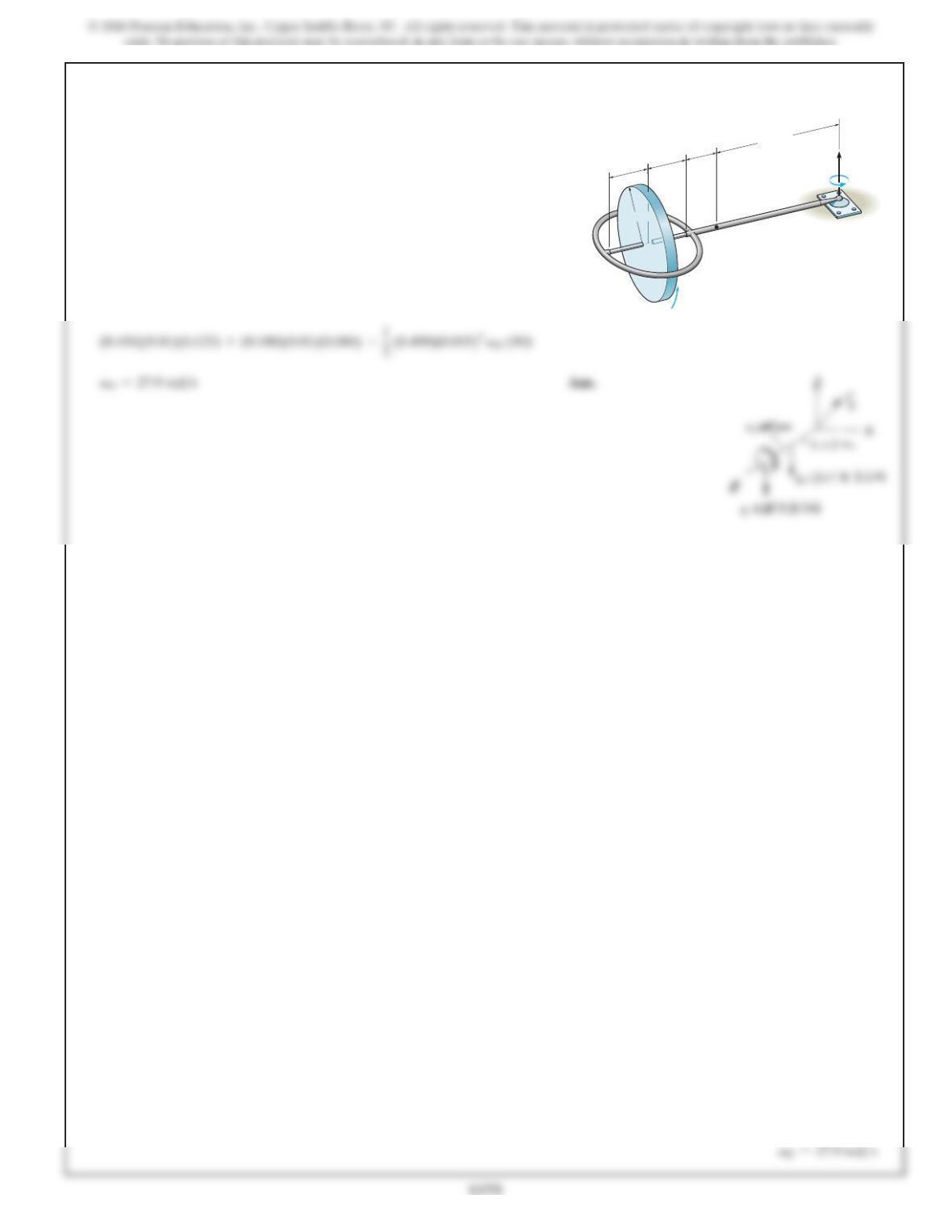
21–62.
SOLUTION
©Mx=IzÆyvz
The gyroscope consists of a uniform 450-g disk Dwhich is
attached to the axle AB of negligible mass. The supporting
frame has a mass of 180 g and a center of mass at G. If the
disk is rotating about the axle at , determine
the constant angular velocity at which the frame
precesses about the pivot point O. The frame moves in the
horizontal plane.
vp
vD=90 rad>s
25 mm
35 mm
25 mm 20 mm
80 mm
ω
D
ω
p
ABG
D
O
Ans:
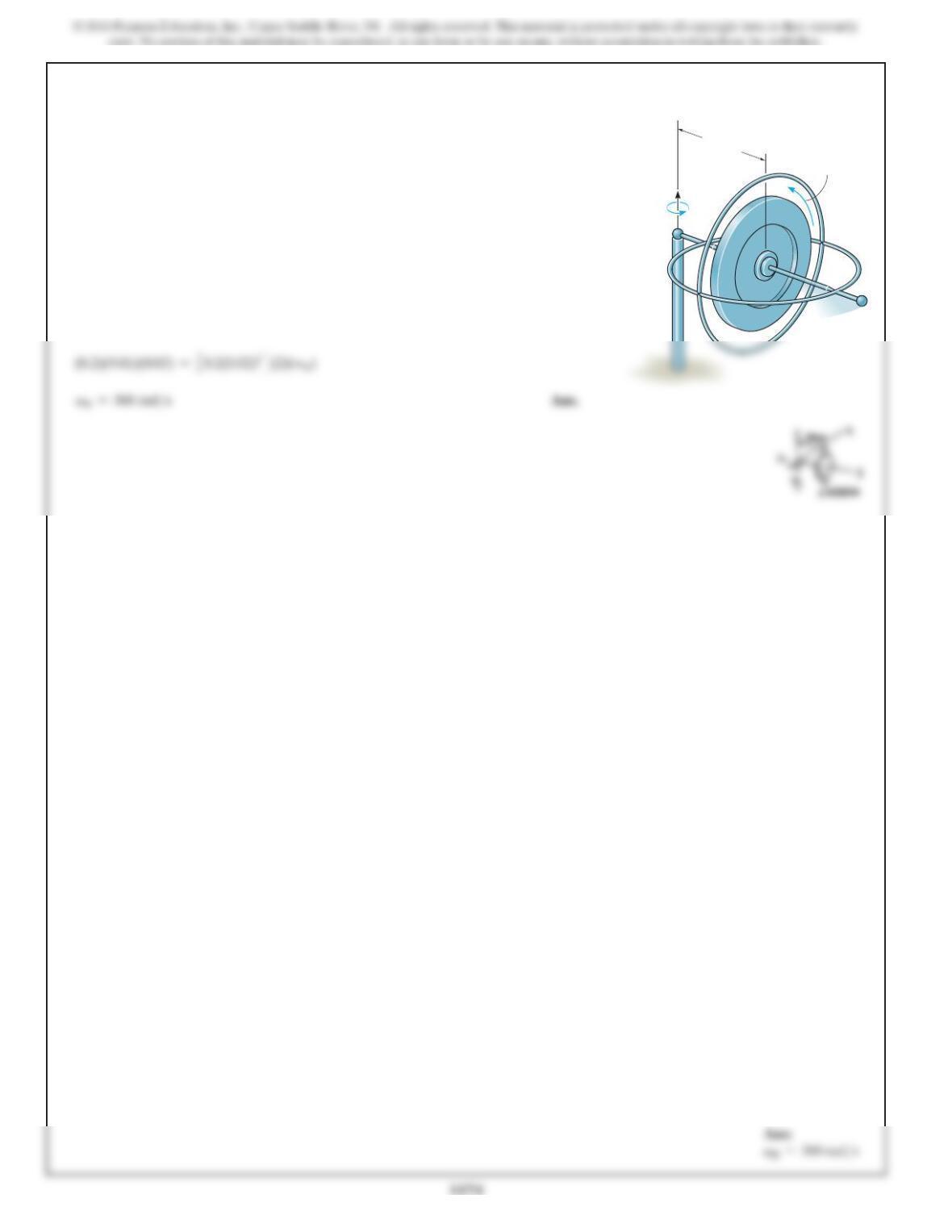
21–63.
The toy gyroscope consists of a rotor R which is attached
to the frame of negligible mass. If it is observed that the
frame is precessing about the pivot point O at vp=2 rad>s,
determine the angular velocity vR
of the rotor. The stem
OA moves in the horizontal plane. The rotor has a mass of
200 g and a radius of gyration kOA =20 mm about OA.
SOLUTION
ΣMx=IzΩywz
p
ω
30 mm
R
ω
O
A
R
1175
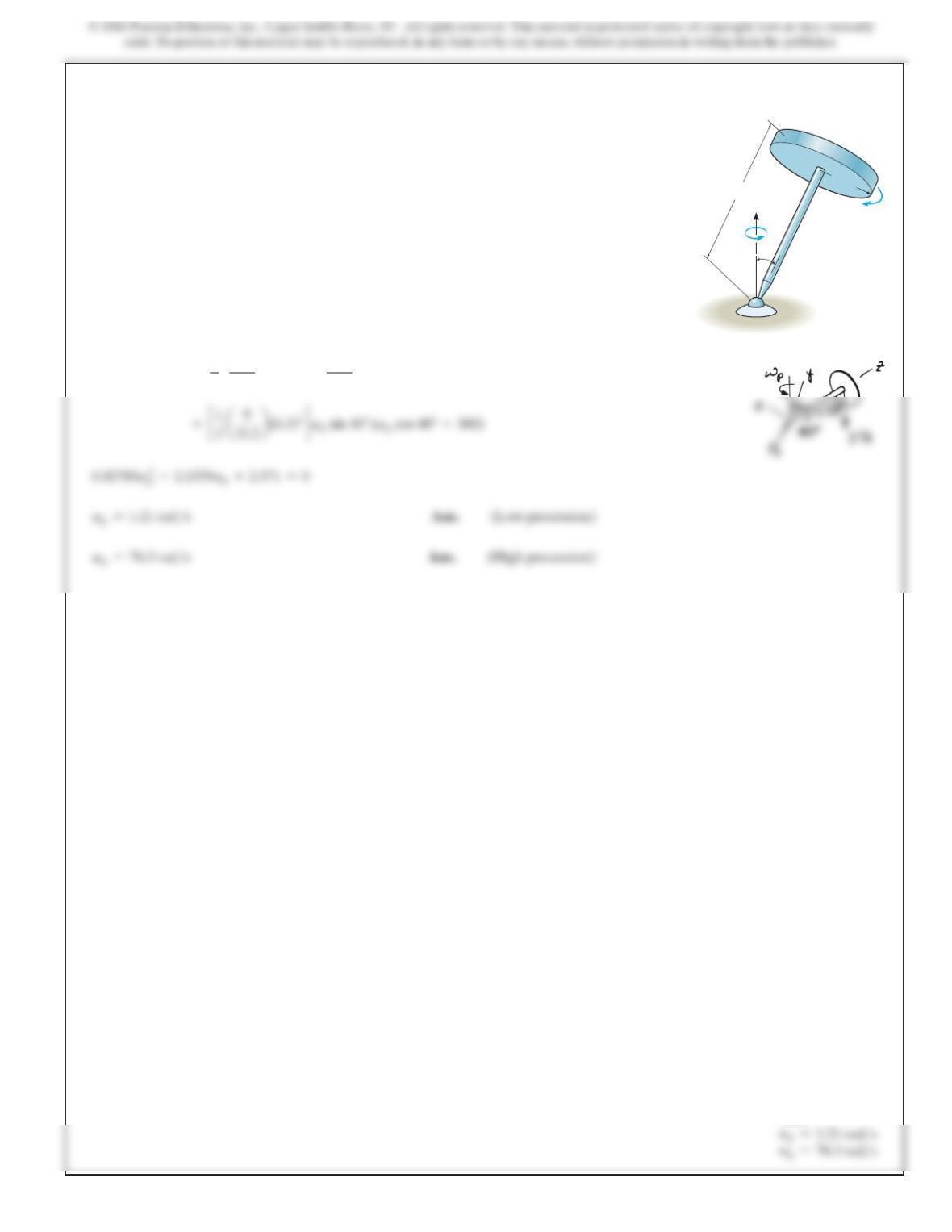
*21–64.
The top consists of a thin disk that has a weight of 8lb and
a radius of 0.3 ft. The rod has a negligible mass and a length
of 0.5 ft. If the top is spinning with an angular velocity
vs=300 rad>s, determine the steady-state precessional
angular velocity vp of the rod when u=40°.
SOLUTION
ΣMx=–I f
#2 sin
u cos
u+Izf
#
sin
u(
#
f cos
u+c
#
)
8(0.5 sin
40°)=–c1
4 a8
32.2b(0.3)2+a8
32.2b(0.5)2dv2
p sin
40° cos
40°
0.3 ft
0.5 ft
ω
p
ω
s
θ
Ans:
1176
21–65.
SOLUTION
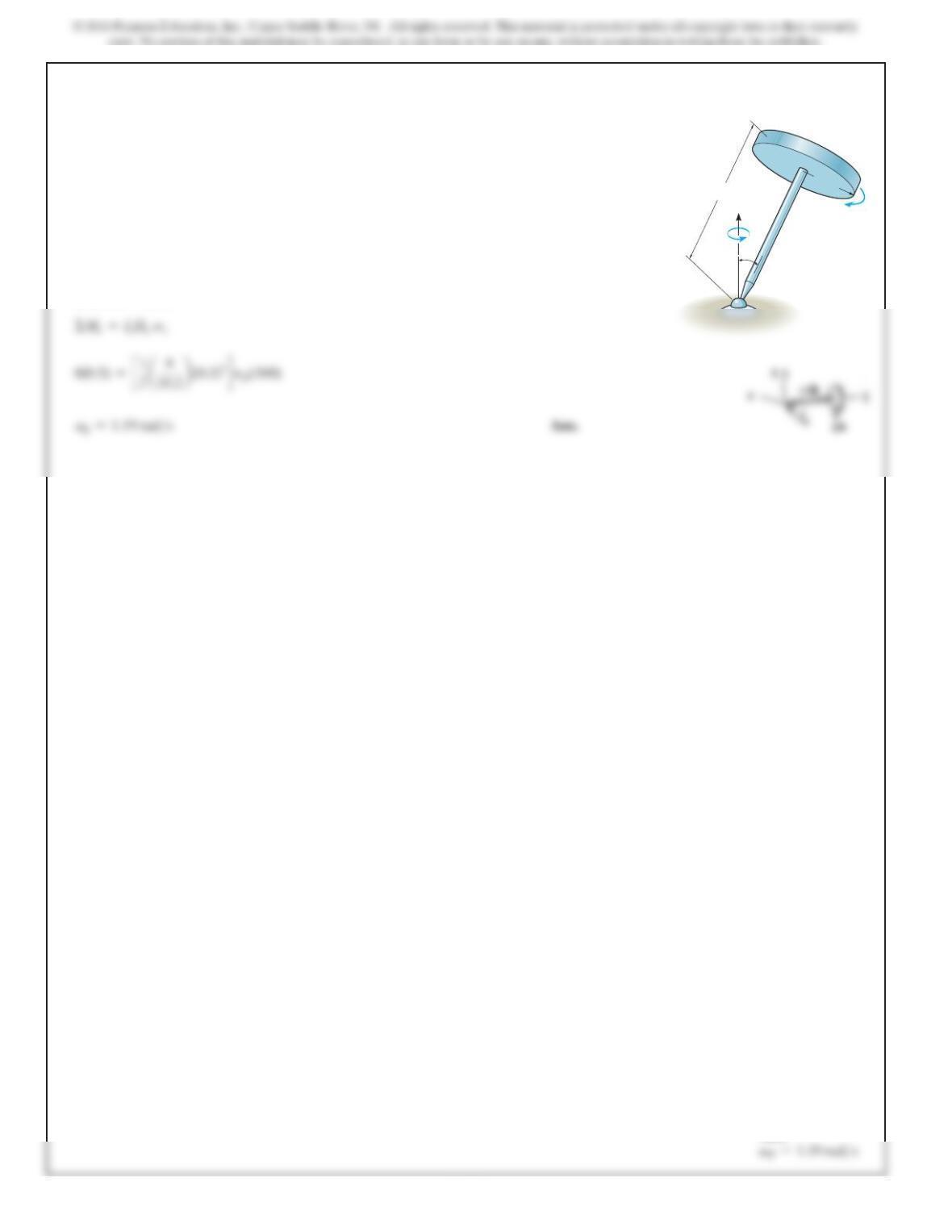
0.3 ft
0.5 ft
ω
p
ω
s
θ
Solve Prob. 21–64 when
u
= 90°.
Ans:
1177
21–66.
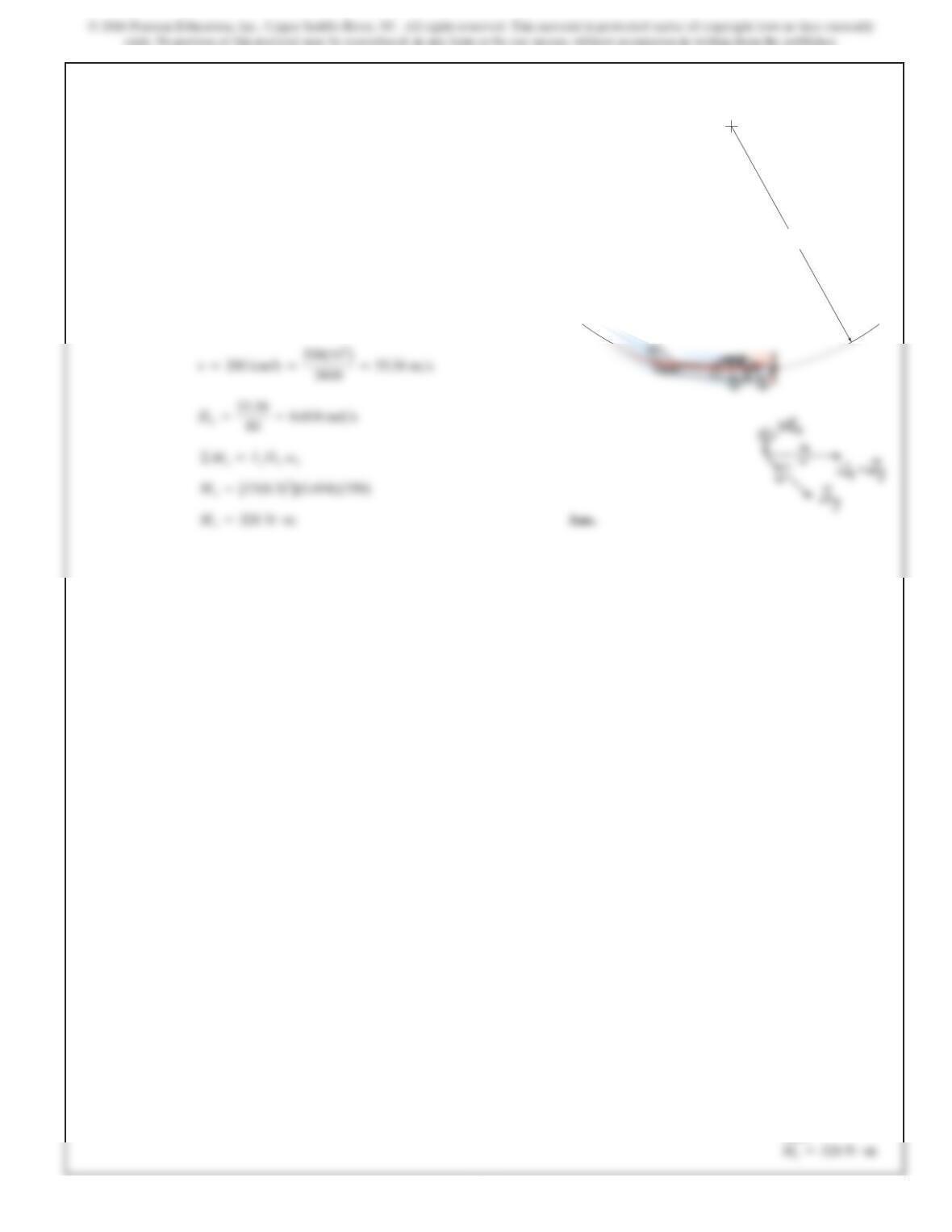
The propeller on a single-engine airplane has a mass of 15 kg
and a centroidal radius of gyration of 0.3 m computed about
the axis of spin. When viewed from the front of the airplane,
the propeller is turning clockwise at about the spin
axis.If the airplane enters a vertical curve having a radius
of80mand is traveling at ,determine the
gyroscopic bending moment which the propeller exerts on
the bearings of the engine when the airplane is in its
lowest position.
200 km>h
350 rad>s
SOLUTION
vs=350 rad>s=vz
r80 m
Ans:
1178
21–67.
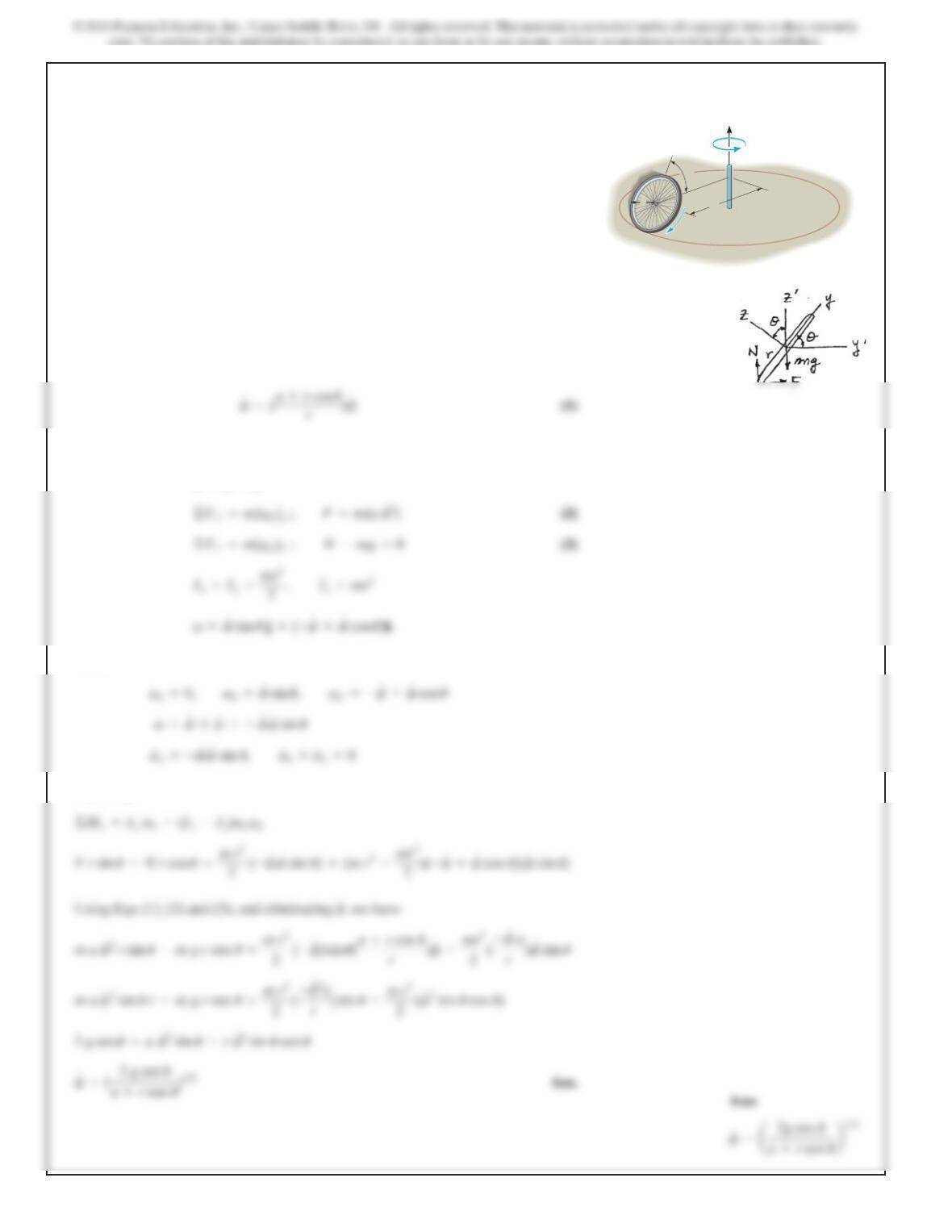
A wheel of mass mand radius rrolls with constant spin
about a circular path having a radius a. If the angle of
inclination is determine the rate of precession. Treat the
wheel as a thin ring. No slipping occurs.
u,
V
SOLUTION
Since no slipping occurs,
or
Also,
Thus,
Applying
v=f
#
+c
#
(r)c
#
=(a+rcos u)f
#
a
r
.
u
V
f
1179
*21–68.
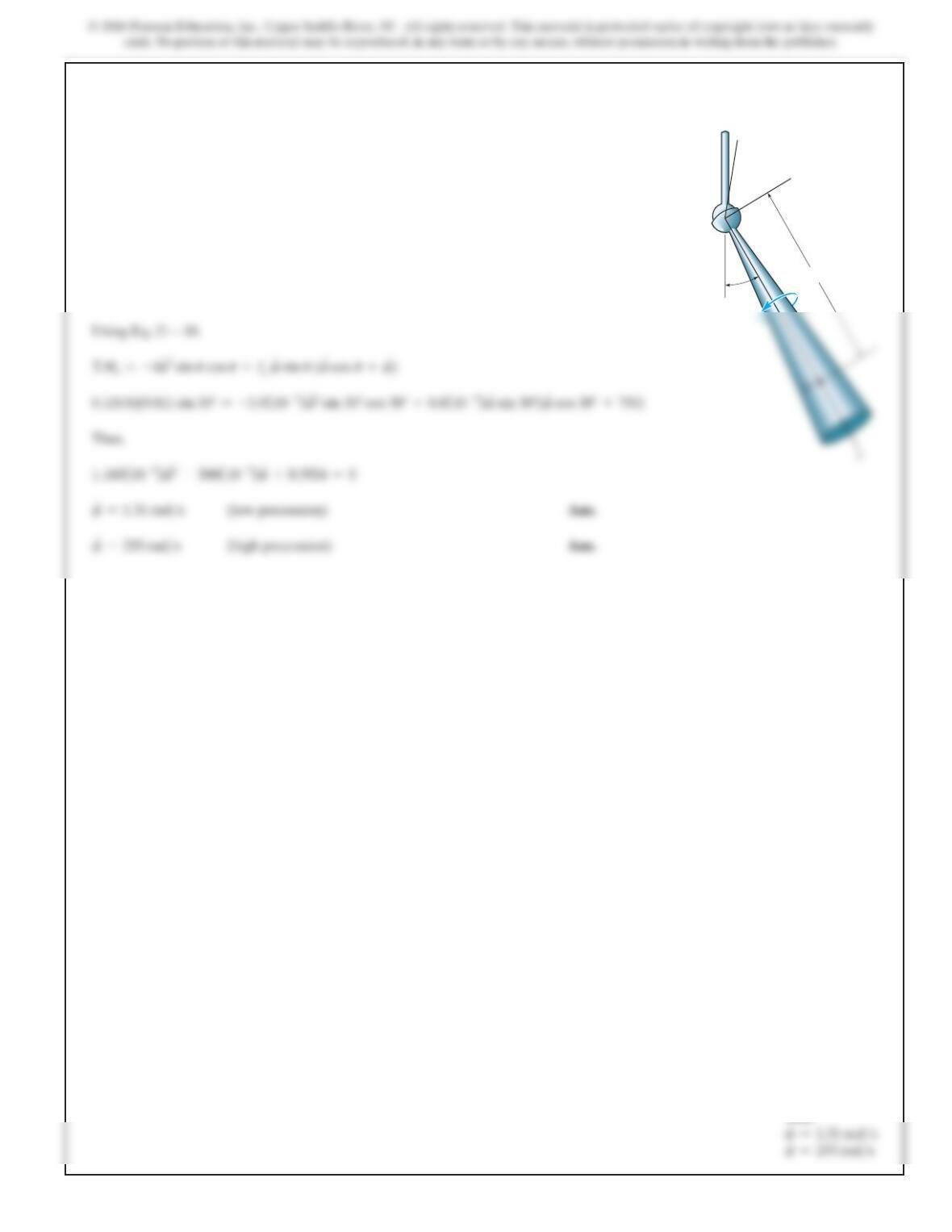
The conical top has a mass of 0.8 kg, and the moments
of inertia are Ix
=
Iy
=
3.5
(
10
–3
)
kg
#
m
2
and
Iz
=
0.8
(
10
–3
)
kg
#
m
2
. If it spins freely in the ball-and
socket joint at A with an angular velocity vs
=750 rad>s,
compute the precession of the top about the axis of the
shaft AB.
SOLUTION
v
s=750 rad>s
30
y
B
x
100 mm
A
vs
Ans: