1180
21–69.
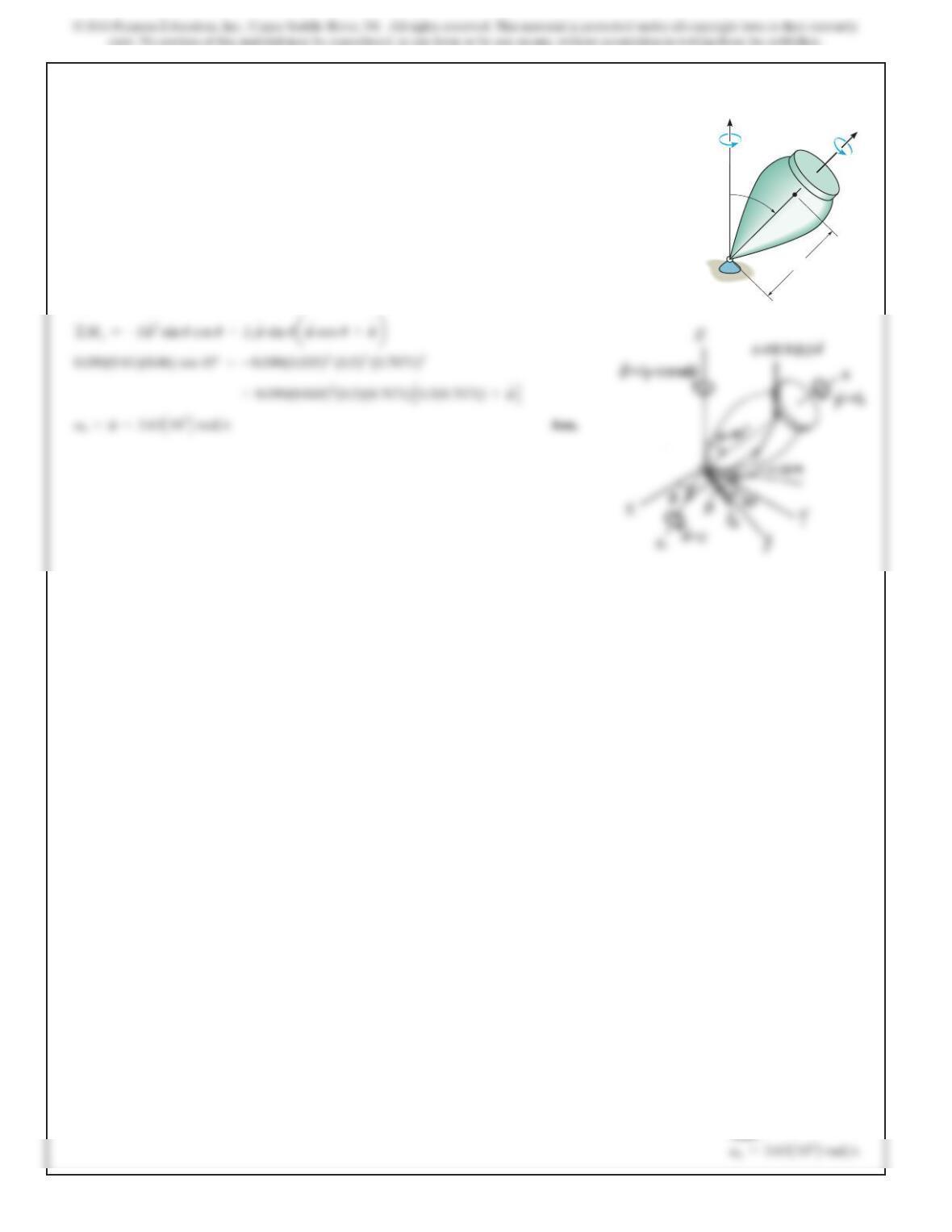
The top has a mass of 90 g, a center of mass at G,and a radius
of gyration about its axis of symmetry.About
any transverse axis acting through point Othe radius of
gyration is .If the top is connected to a ball-and-
socket joint at Oand the precession is ,
determine the spin .Vs
vp=0.5 rad>s
kt=35 mm
k=18 mm
SOLUTION
vp=0.5 rad>s
Vp
Vs
60 mm
G
O
45
Ans:
21–70.
SOLUTION
Since and and are constant, the top
undergoes steady precession.
uf
#
=vp=-10 rad>sc
#
=vs=60 rad>s
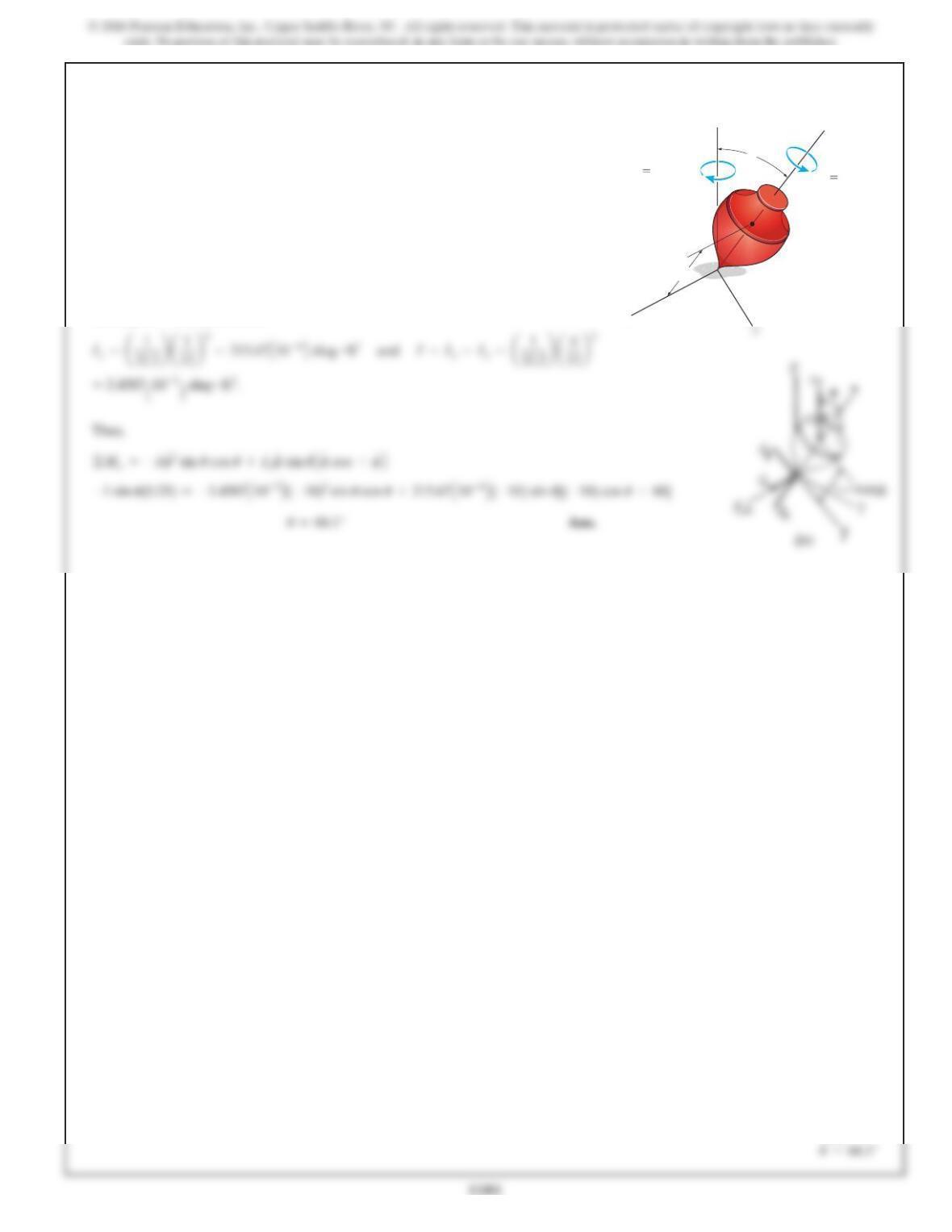
The 1-lb top has a center of gravity at point G. If it spins
about its axis of symmetry and precesses about the vertical
axis at constant rates of and ,
respectively, determine the steady state angle .The radius
of gyration of the top about the zaxis is ., and
about the xand yaxes it is .kx=ky=4in
kz=1in
u
vp=10 rad>svs=60 rad>s
x
O
z
3 in.
vp10 rad/s
u
G
vs60 rad/s
Ans:
1182
21–71.
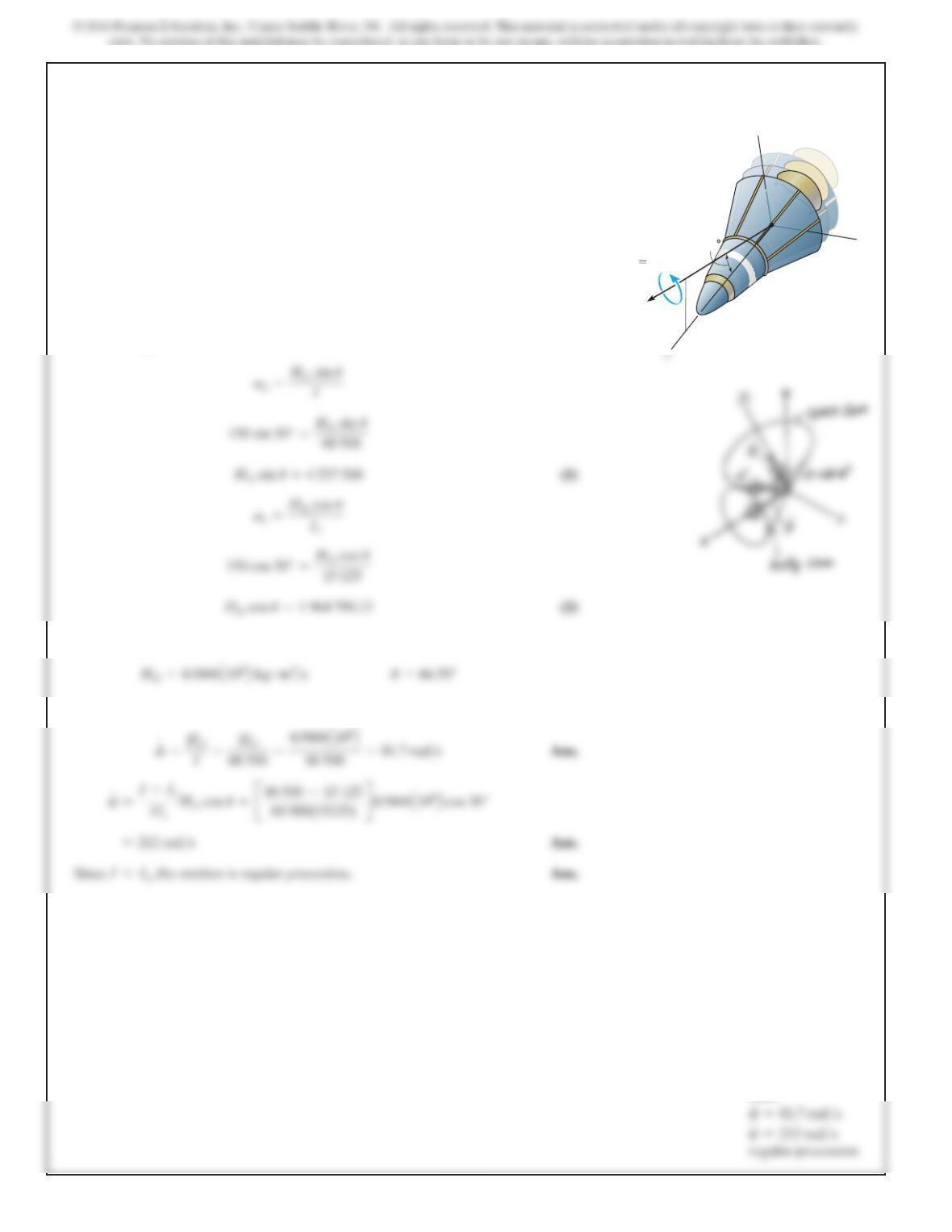
The space capsule has a mass of 2 Mg, center of mass at G,
and radii of gyration about its axis of symmetry (zaxis) and
its transverse axes (xor yaxis) of and
, respectively. If the capsule has the angular
velocity shown, determine its precession and spin .
Indicate whether the precession is regular or retrograde.
Also, draw the space cone and body cone for the motion.
c
#
f
#
kx=ky=5.5 m
kz=2.75 m
SOLUTION
The only force acting on the space capsule is its own weight. Thus, it undergoes
torque-free motion. ,
.Thus,
Solving Eqs. (1) and (2),
Using these results,
=60 500 kg #m2
I=Ix=Iy=2000
A
5.52
B
Iz=2000
A
2.752
B
=15 125 kg #m2
y
x
G
30
v150 rad/s
Ans:
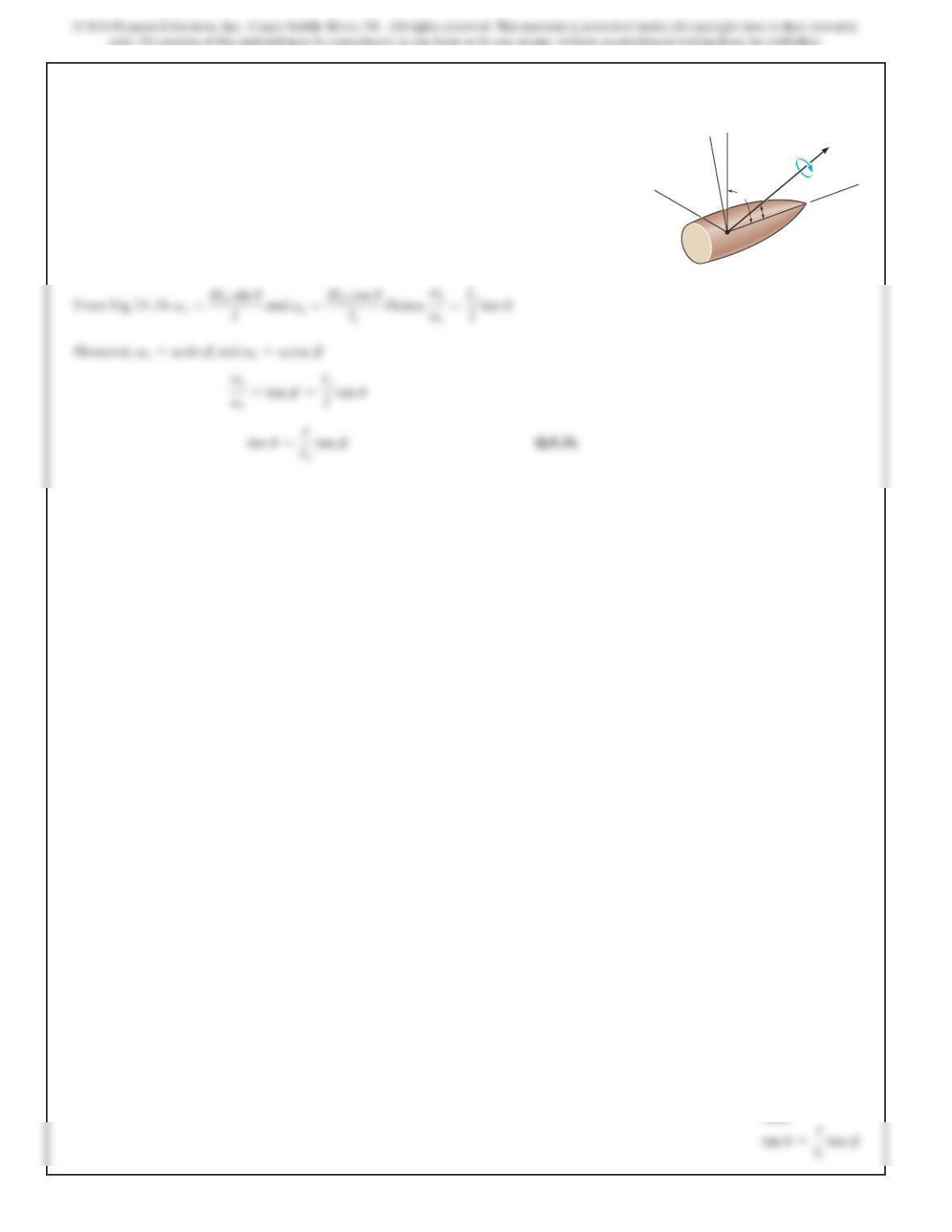
*21–72.
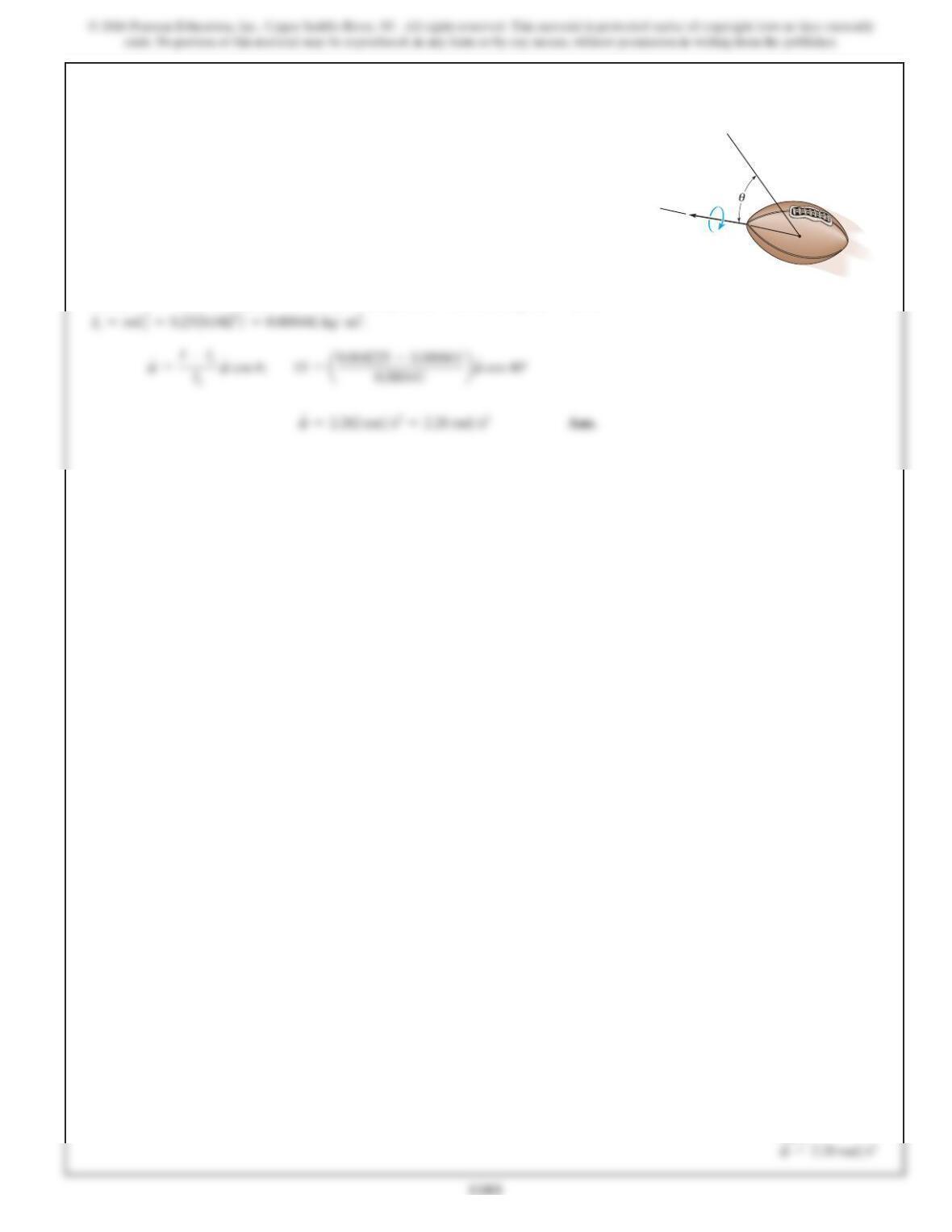
The 0.25 kg football is spinning at vz
=15 rad>s
as shown.
If
u=40°
, determine the precession about the zaxis. The
radius of gyration about the spin axis is
k
z
=0.042 m
, and
about a transverse axis is
k
y
=0.13 m
.
SOLUTION
Here, c
#
=
v
t=
15 rad
>
s, I=mky
2
=0.25
(
0.13
2
)
=0.004225 kg
#
m
2
and
#
=
Z
G
z
vz 15 rad/s
Ans:
1184
21–73.
S
OLUTION
T
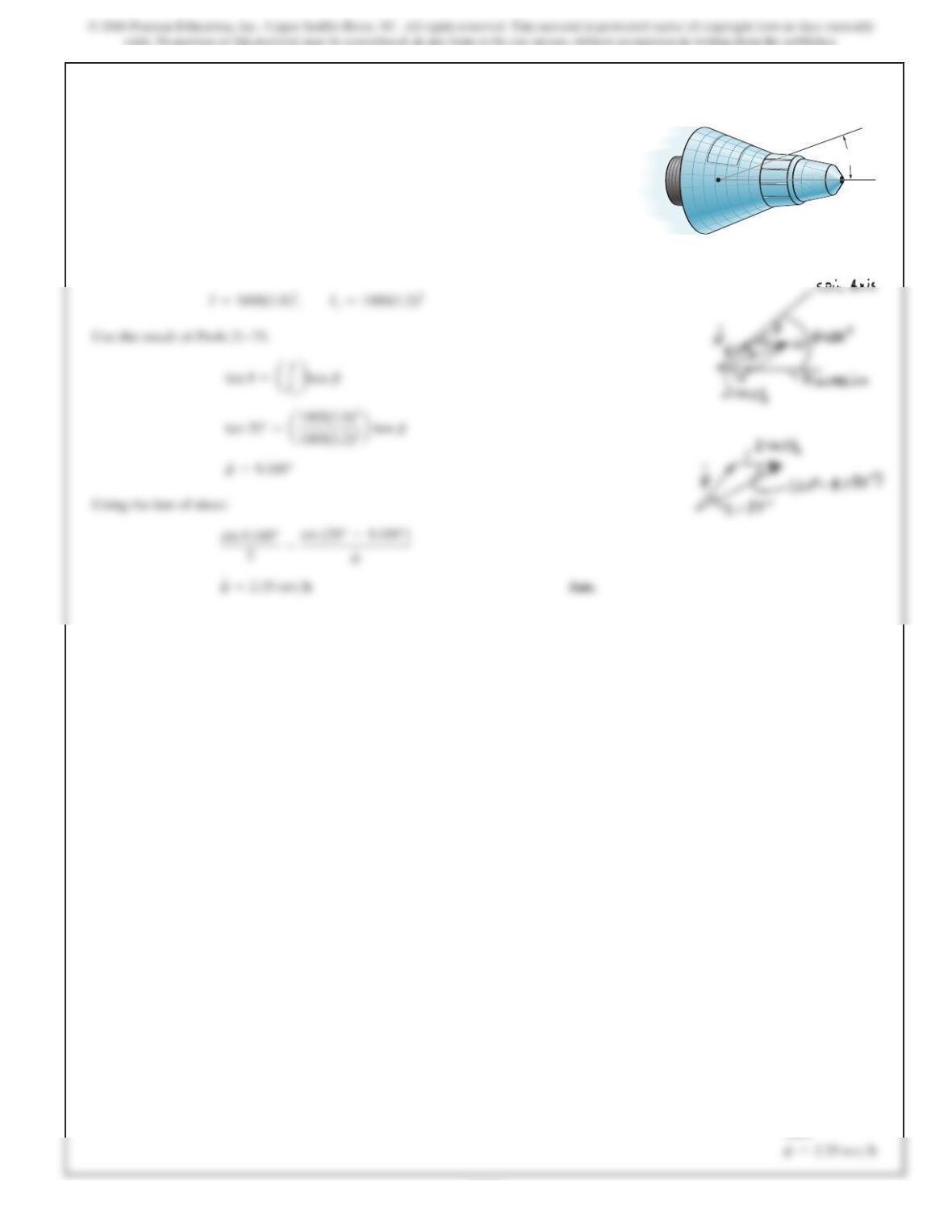
he projectile shown is subjected to torque-free motion.
T
he transverse and axial moments of inertia are Iand ,
r
espectively.If represents the angle between the
p
recessional axis Zand the axis of symmetry z,and
i
s the angle between the angular velocity and the
z
axis,show that and are related by the equation
.tan u=(I>Iz) tan b
ub
V
b
u
Iz
G
Z
u
V
y
xz
b
Ans:
1185
21–74.
SOLUTION
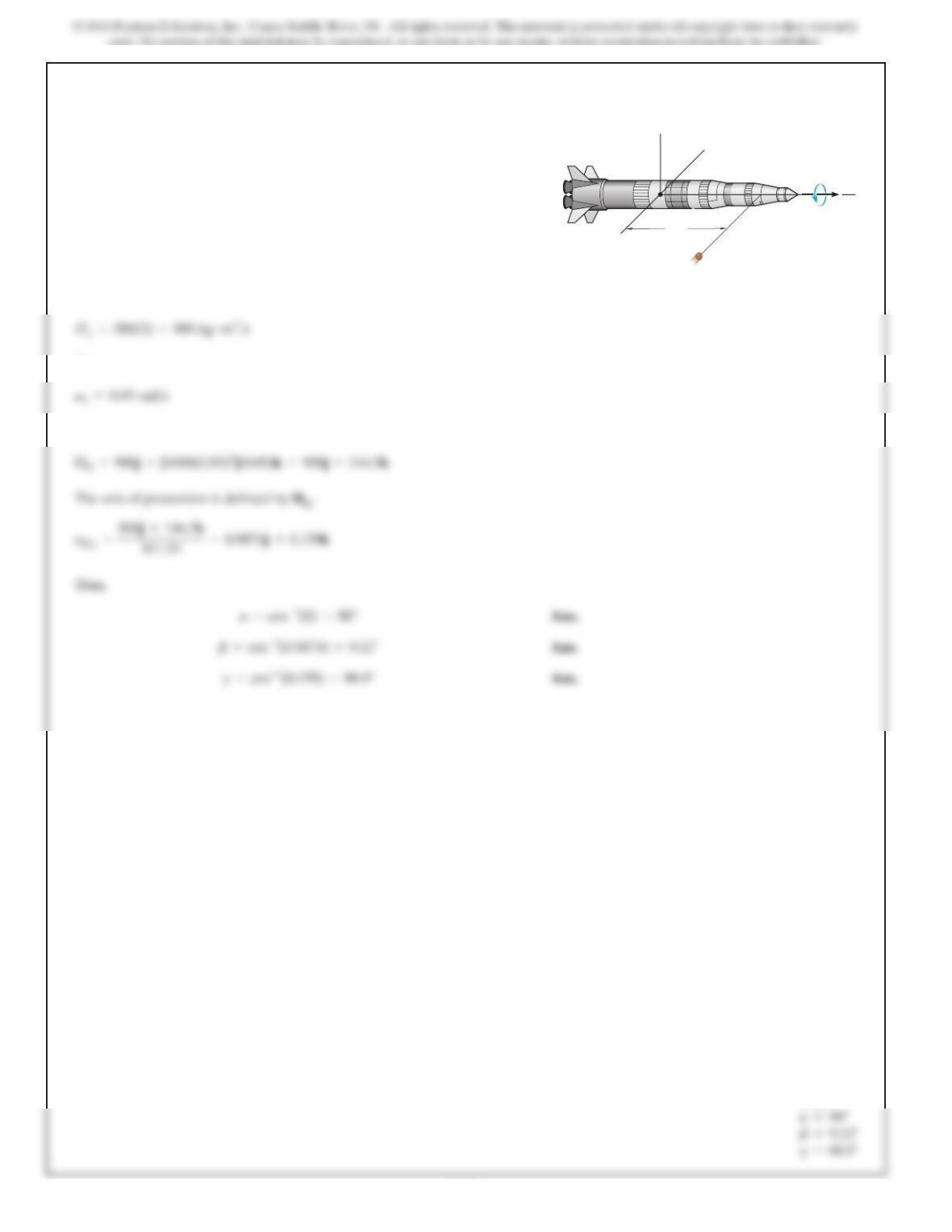
The radius of gyration about an axis passing through the
axis of symmetry of the 1.6-Mg space capsule is
and about any transverse axis passing through the center of
mass G, If the capsule has a known steady-state
precession of two revolutions per hour about the Zaxis,
determine the rate of spin about the zaxis.
kt=1.8 m.
kz=1.2 m,
Gz
Z
20
Ans:
1186
21–75.
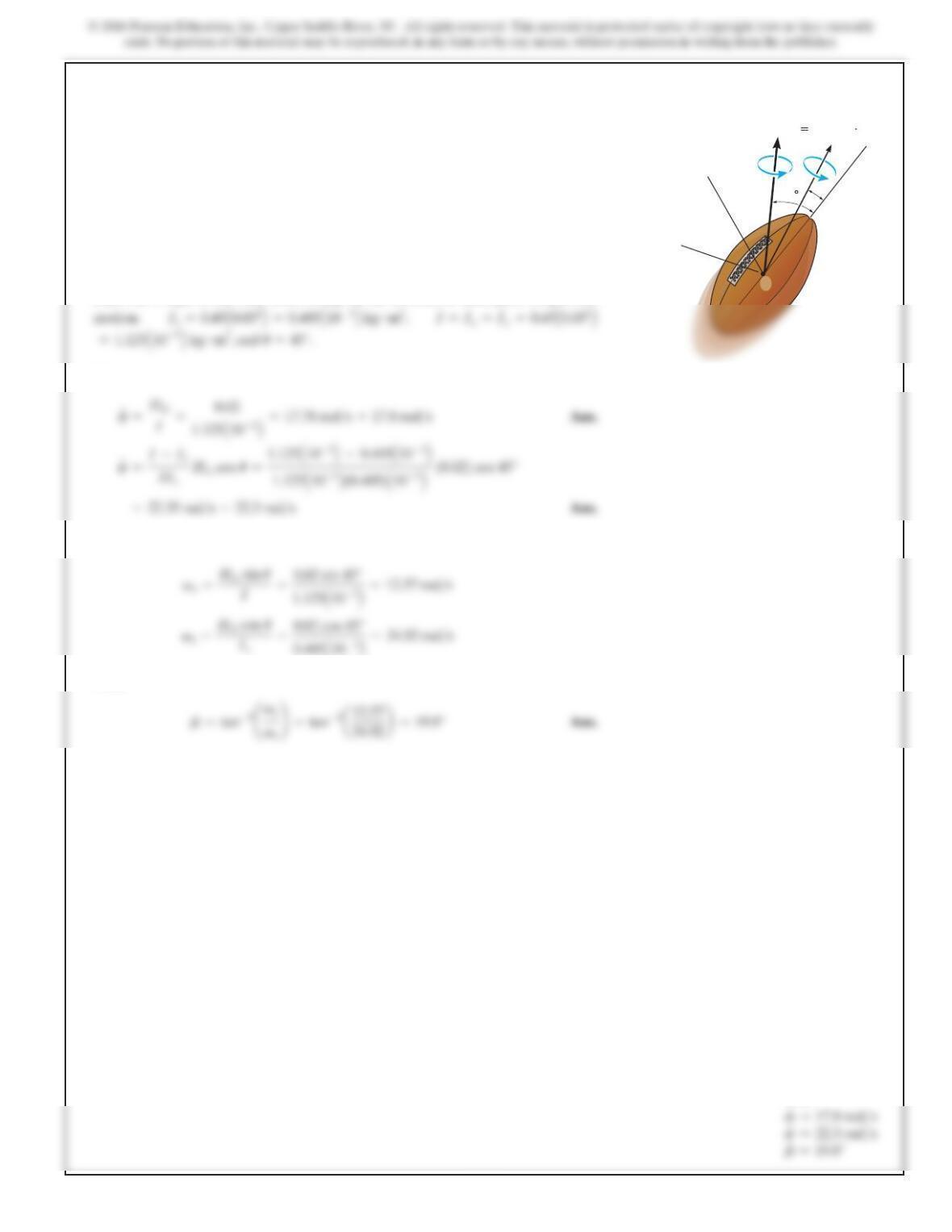
The rocket has a mass of 4 Mg and radii of gyration
and It is initially spinning about the
zaxis at when a meteoroid Mstrikes it at A
and creates an impulse Determine the axis
of precession after the impact.
I=5300i6N#s.
vz=0.05 rad>s
ky=2.3 m.kz=0.85 m
SOLUTION
The impulse creates an angular momentum about the yaxis of
Since
then
GA
M
z
x
y
3m
z
ω
Ans:
1187
*21–76.
SOLUTION
Since the weight is the only force acting on the football, it undergoes torque-free
Thus,
Also,
Thus,
z
y
x
G
45
V
B
HG0.02 kg m2/s
vector kes
k#2f
b
c. HG = 0.02 g m >s, determine its precession and spin
Also, find the angle that the angular velocity ma
with the z axis.
k
The football has a mass of 450 g and radii of gyration
about its axis of symmetry (z axis) and its transverse axes
(x or y axis) of
respectively. If the football has an angular momentum of
kz = 30mm and kx = y = 50mm,
Ans:
1188
21–77.
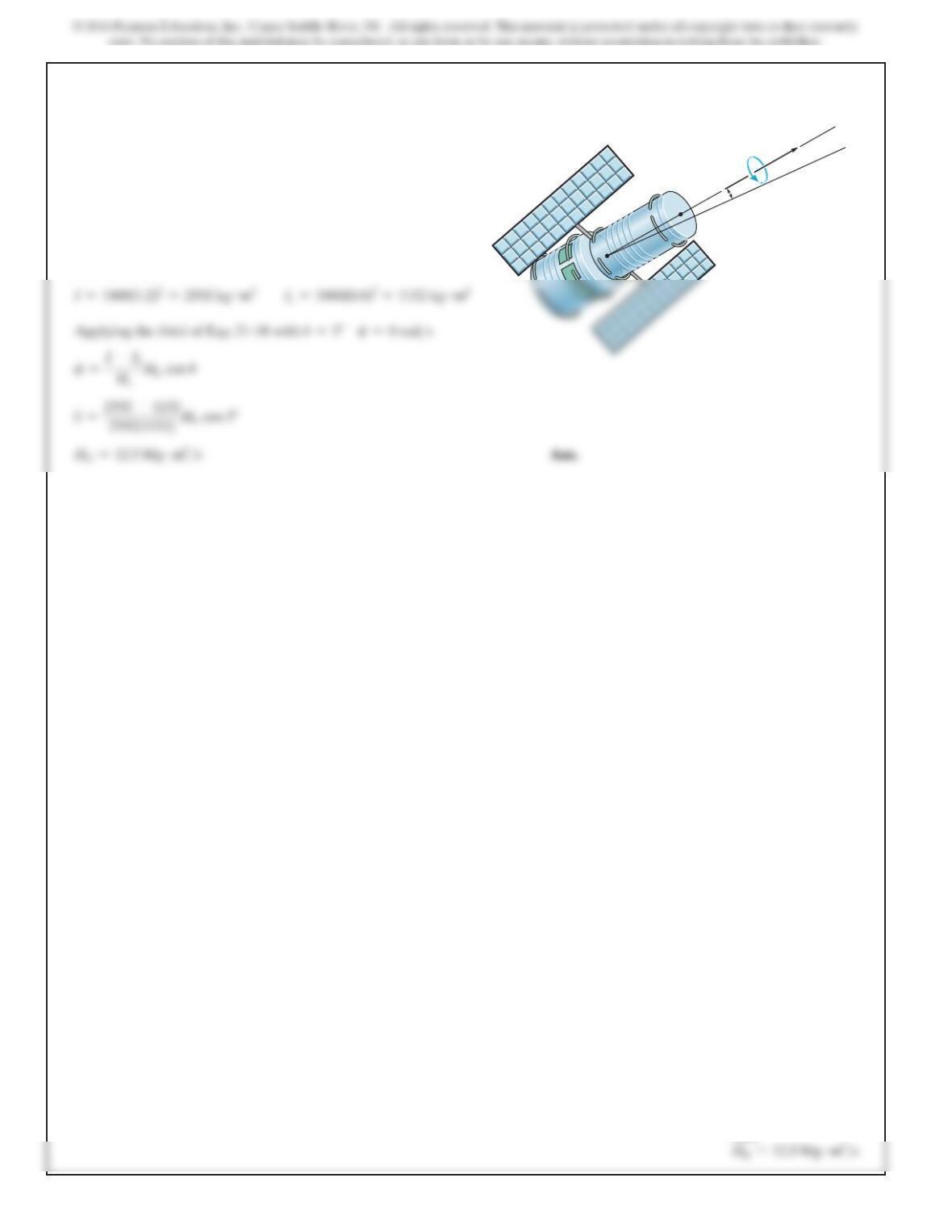
The satellite has a mass of 1.8 Mg, and about axes passing
through the mass center G the axial and transverse radii of
gyration are
k
z
=0.8 m
and
kt=1.2 m,
respectively. If it is
spinning at vs
=6 rad>s
when it is launched, determine its
angular momentum. Precession occurs about the Z axis.
Ans:
SOLUTION
5
vs
z
G
Z
1189
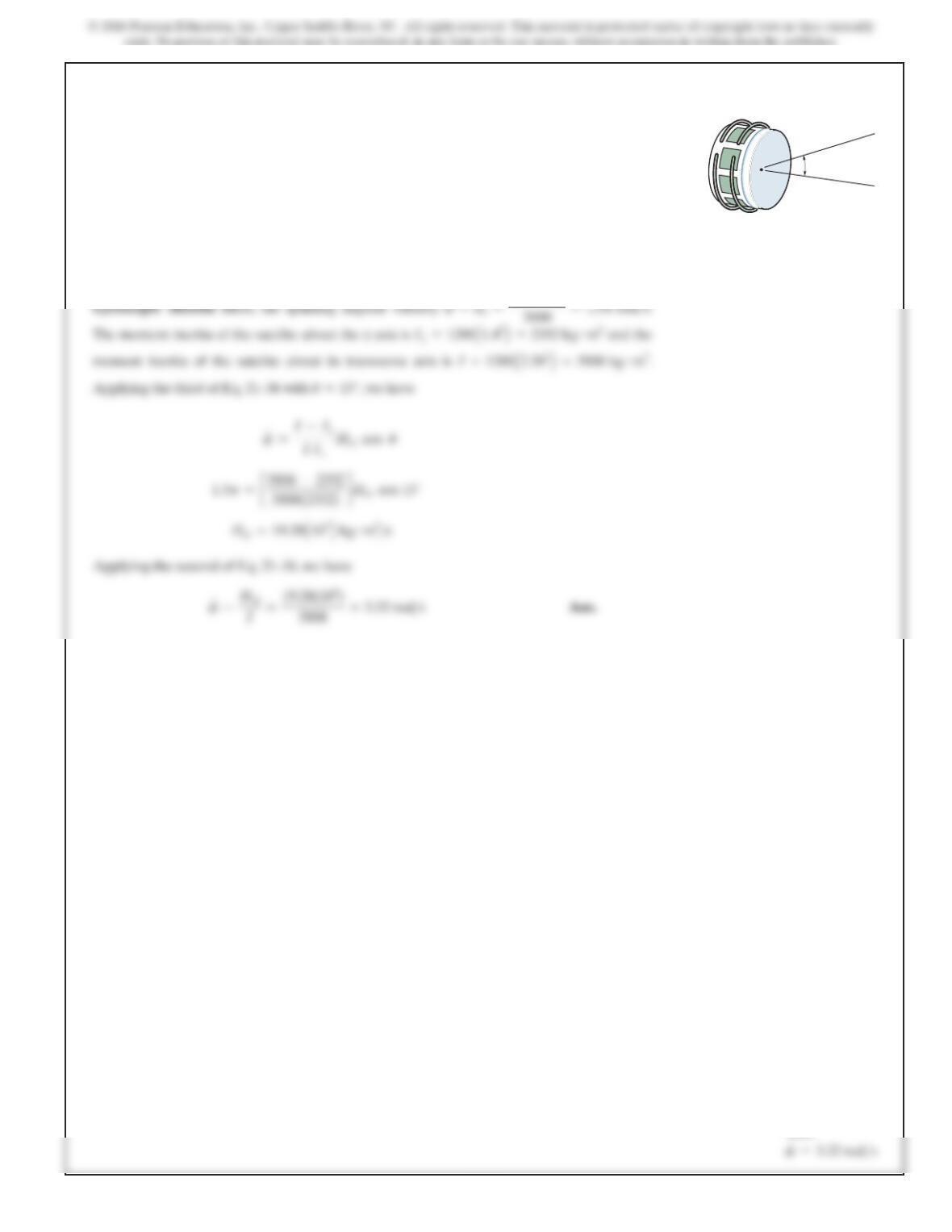
21–78.
The radius of gyration about an axis passing through the
axis of symmetry of the 1.2 Mg satellite is ,
known spin of about the zaxis, determine the
steady-state precession about the zaxis.
2700 rev>h
kz=1.4 m
SOLUTION
#
15°
z
Z
G
and about any transverse axis passing through the
center of mass G, If the satelite has a
kt=2.20 m.
Ans: