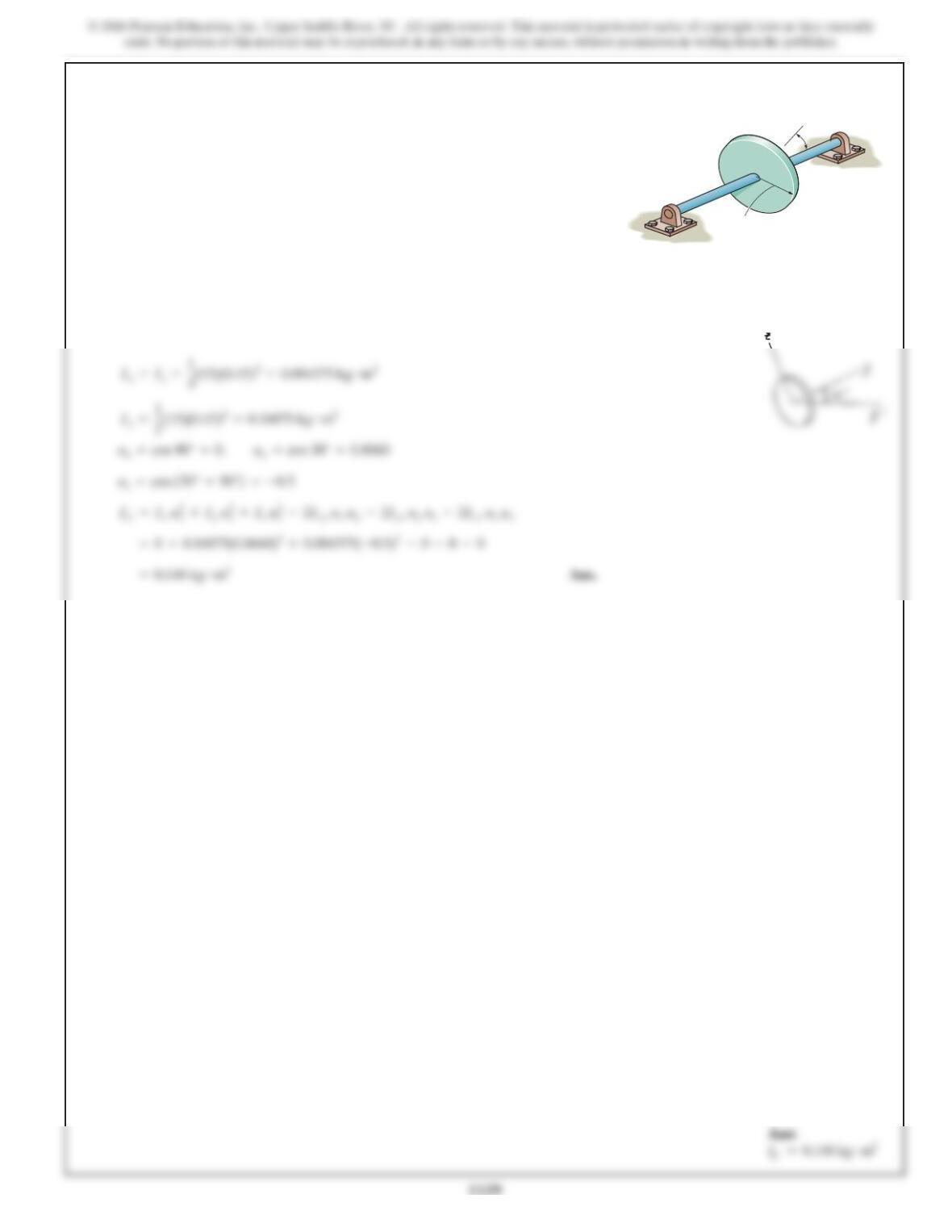
*21–20.
SOLUTION
Due to symmetry
Ixy =Iyz =Izx =0
Determine the moment of inertia of the disk about the axis
of shaft AB. The disk has a mass of 15 kg.
30°B
150 mm
A
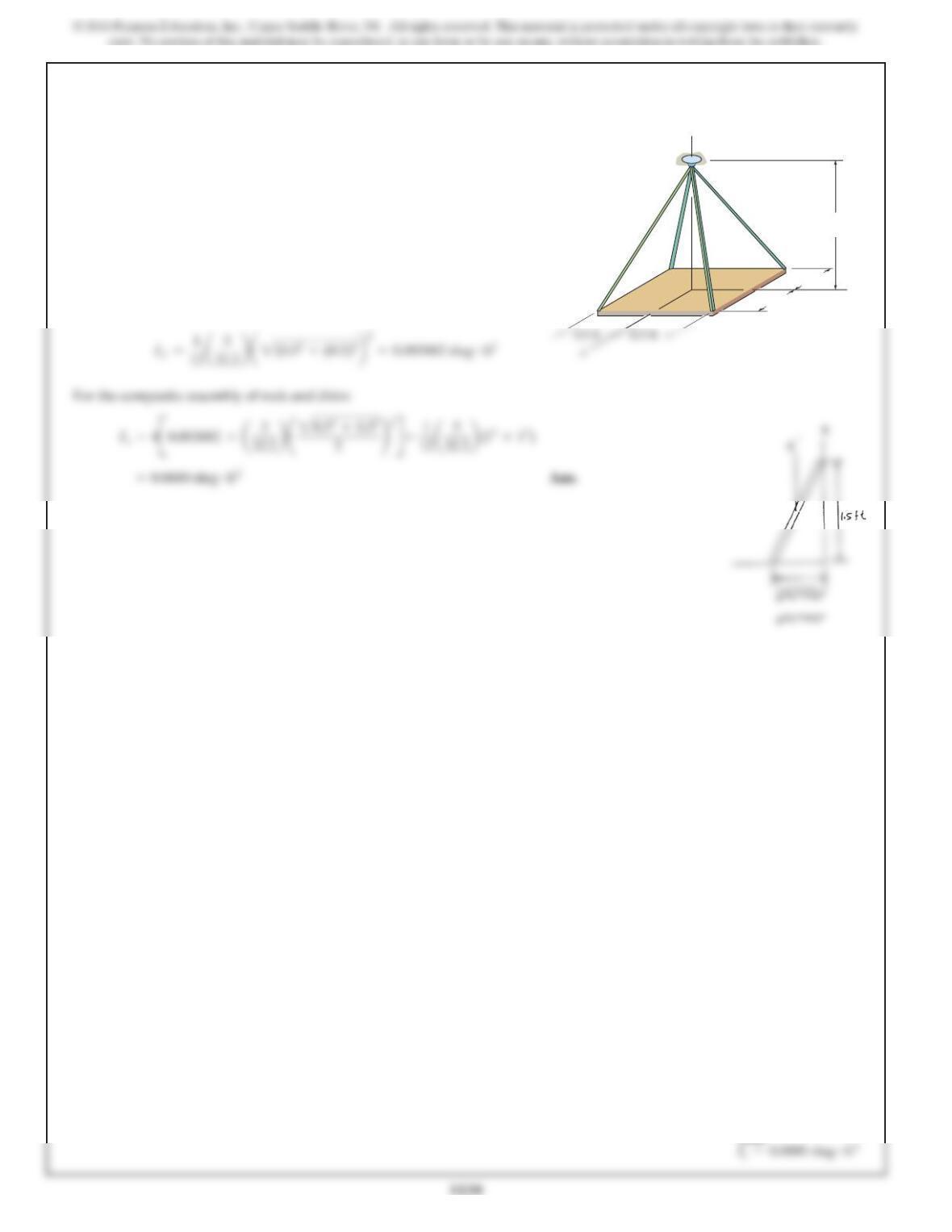
21–21.
The thin plate has a weight of 5 lb and each of the four rods
weighs 3 lb.Determine the moment of inertia of the assembly
about the zaxis.
SOLUTION
For the rod:
y
z
0.5 ft
0.5 ft
1.5 ft
Ans:
1131
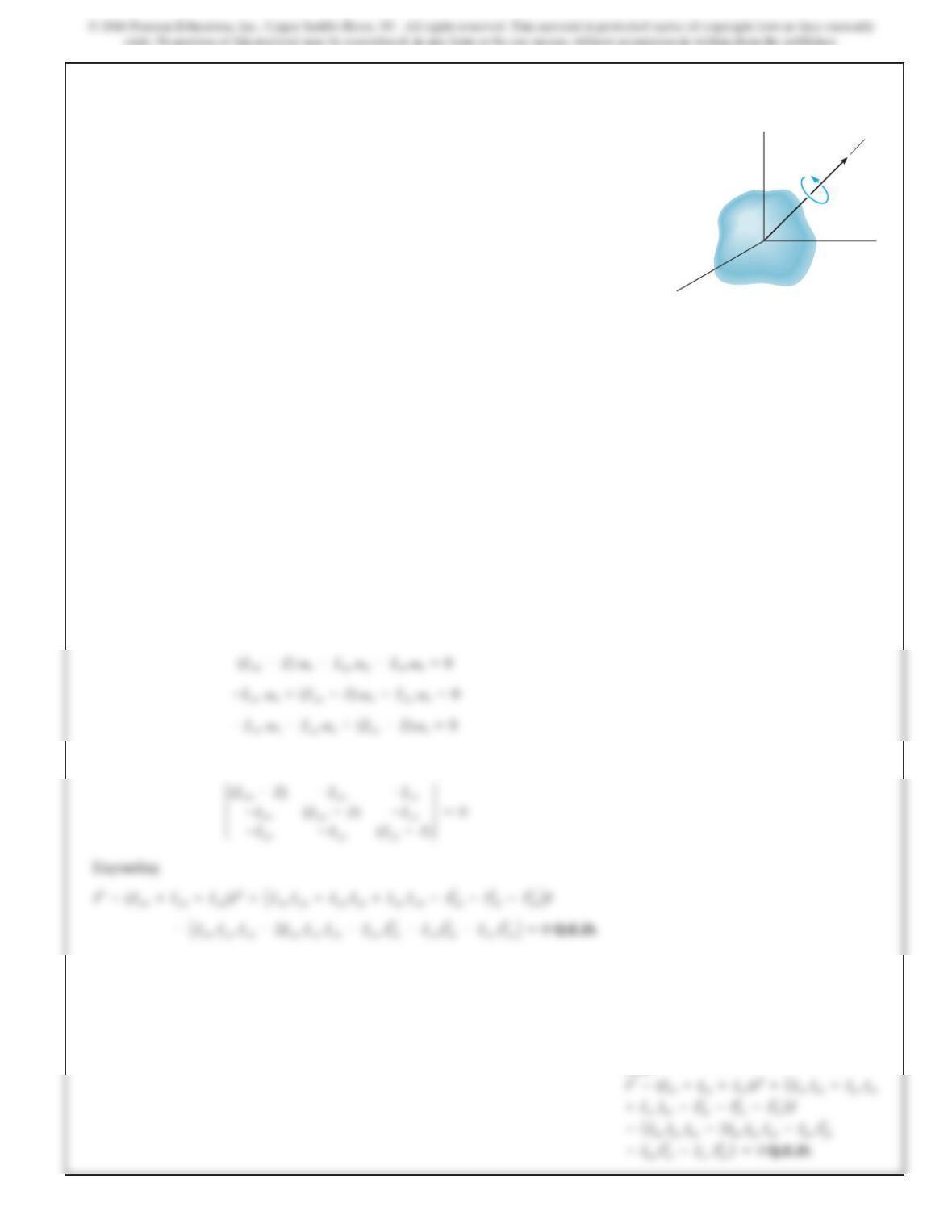
21–22.
If a body contains no planes of symmetry,the principal
moments of inertia can be determined mathematically.To
show how this is done,consider the rigid body which is
spinning with an angular velocity ,directed along one of its
principal axes of inertia. If the principal moment of inertia
about this axis is I,the angular momentum can be expressed
as .The components of H
may also be expressed by Eqs.21–10, where the inertia tensor
is assumed to be known. Equate the i,j,and kcomponents of
both expressions for Hand consider ,,and to be
unknown. The solution of these three equations is obtained
provided the determinant of the coefficients is zero.Show
that this determinant, when expanded, yields the cubic
equation
The three positive roots of I, obtained from the solution of
this equation, represent the principal moments of inertia
,,and .Iz
Iy
Ix
–IyyI2
zx –IzzI2
xy)=0
–(IxxIyyIzz –2IxyIyzIzx –IxxI2
yz
+(IxxIyy +IyyIzz +IzzIxx –I2
xy –I2
yz –I2
zx)I
I3–(Ixx +Iyy +Izz)I2
vz
vy
vx
H=IV=Ivxi+Ivyj+Ivzk
V
SOLUTION
Equating the i,j,kcomponents to the scalar equations (Eq. 21–10) yields
Solution for ,,and requires
vz
vy
vx
H=Iv=Ivxi+Ivyj+Ivzk
y
V
z
x
O
Ans:
1132
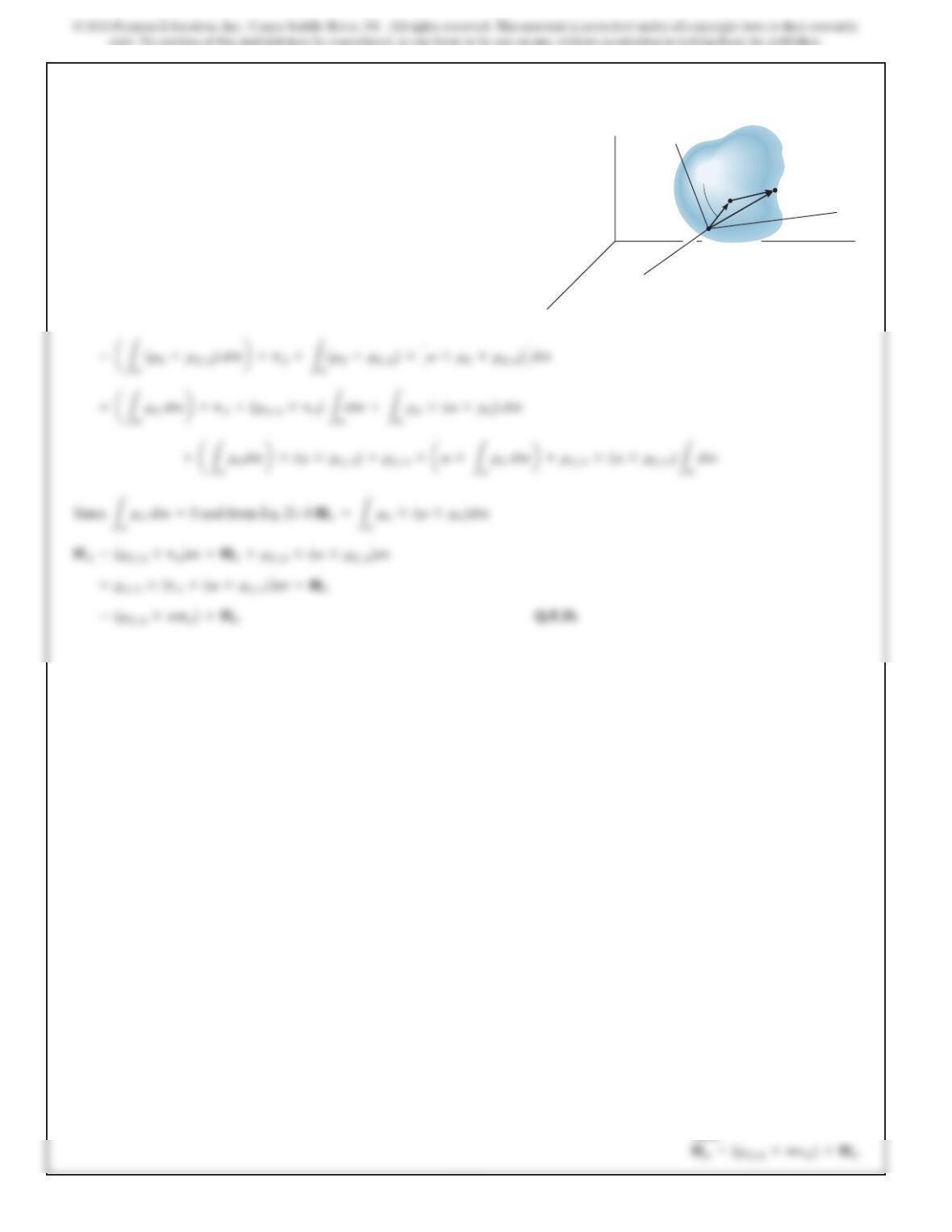
21–23.
SOLUTION
HA=aL
m
rAdmb*vA+L
m
rA*(v*rA)dm
t
.
vG=vA+V:RG>A
hat by definition of the mass center and
1RGdm =0
into Eq. 21–6 and expanding,noting RA=RG+RG>A
RA
RG
RG/A
GP
A
y
Y
Zz
x
X
Show that if the angular momentum of a body is
determined with respect to an arbitrary point A, then
can be expressed by Eq. 21–9. This requires substituting
HA
Ans:
1133
*21–24.
v1 10 rad/s
150 mm
y
x
z
O
T
he 15-kg circular disk spins about its axle with a constant
an
gular velocity of . Simultaneously, the yoke
i
s rotating with a constant angular velocity of .
Determine
the angular momentum of the disk about its
center of ma
ss O, and its kinetic energy.
v2=5 rad>s
v1=10 rad>s
SOLUTION
T
he mass moments of inertia of the disk about the x,y,and zaxes are
Due to
symmetry,
Here
, the angular velocity of the disk can be determined from the vector addition of
and .Thus,
S
ince the disk rotates about a fixed point O, we can apply
T
hus,
v2
v
1
Ans:
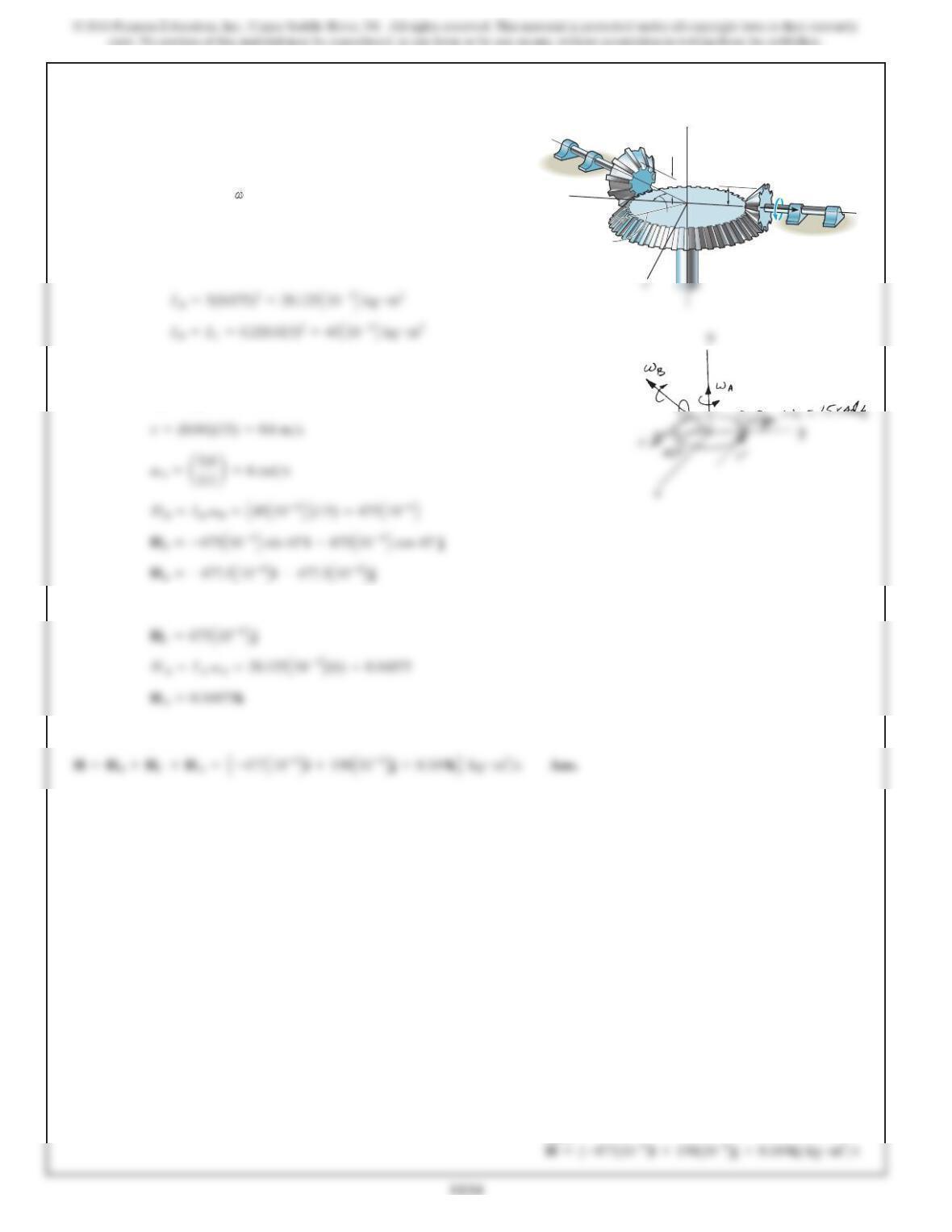
21–25.
SOLUTION
Kinematics:
The total angular momentum is therefore,
HC=ICvC=
A
45
A
10–6
BB
(15) =675
A
10–6
B
vC=vB=15 rad>s
200 g and a radius of gyration about the axis of their
connecting shaft of 15 mm. If the gears are in mesh and C
has an angular velocity of , determine the
total angular momentum for the system of three gears about
point A.
C={15j} rad>s
C
={15j} rad/s
40 mm
40 mm
100 mm C
A
45°
z
y
B
v
ω
The large gear has a mass of 5 kg and a radius of gyration
of kz = 75 mm. Gears B and C each have a mass of
Ans:
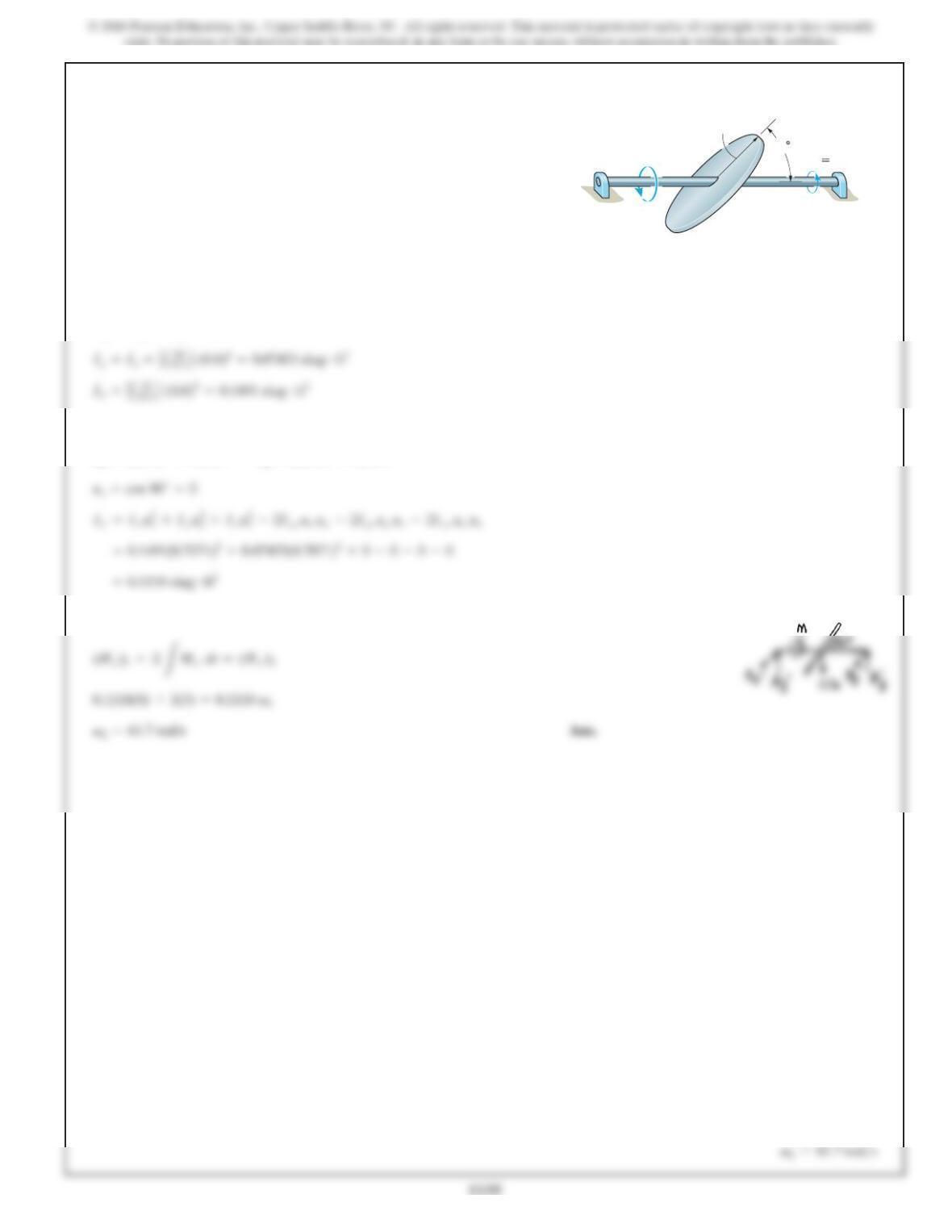
21–26.
The circular disk has a weight of 15 lb and is mounted on
the shaft AB at an angle of 45° with the horizontal.
Determine the angular velocity of the shaft when if
a constant torque is applied to the shaft. The
shaft is originally spinning at when the torque
is applied.
v1=8 rad>s
M=2lb#ft
t=3s
SOLUTION
Due to symmetry
For x’ axis
Principle of impulse and momentum:
ux=cos 45° =0.7071
uy=cos 45° =0.7071
Ixy =Iyz =Izx =0
v1 8 rad/s
BA
45
0.8 ft
M
Ans:
21–27.
SOLUTION
Due to symmetry
For x’ axis
Principle of impulse and momentum:
(Hx¿)1+©
LMx¿dt =(Hx¿)2
ux=cos 45° =0.7071
uy=cos 45° =0.7071
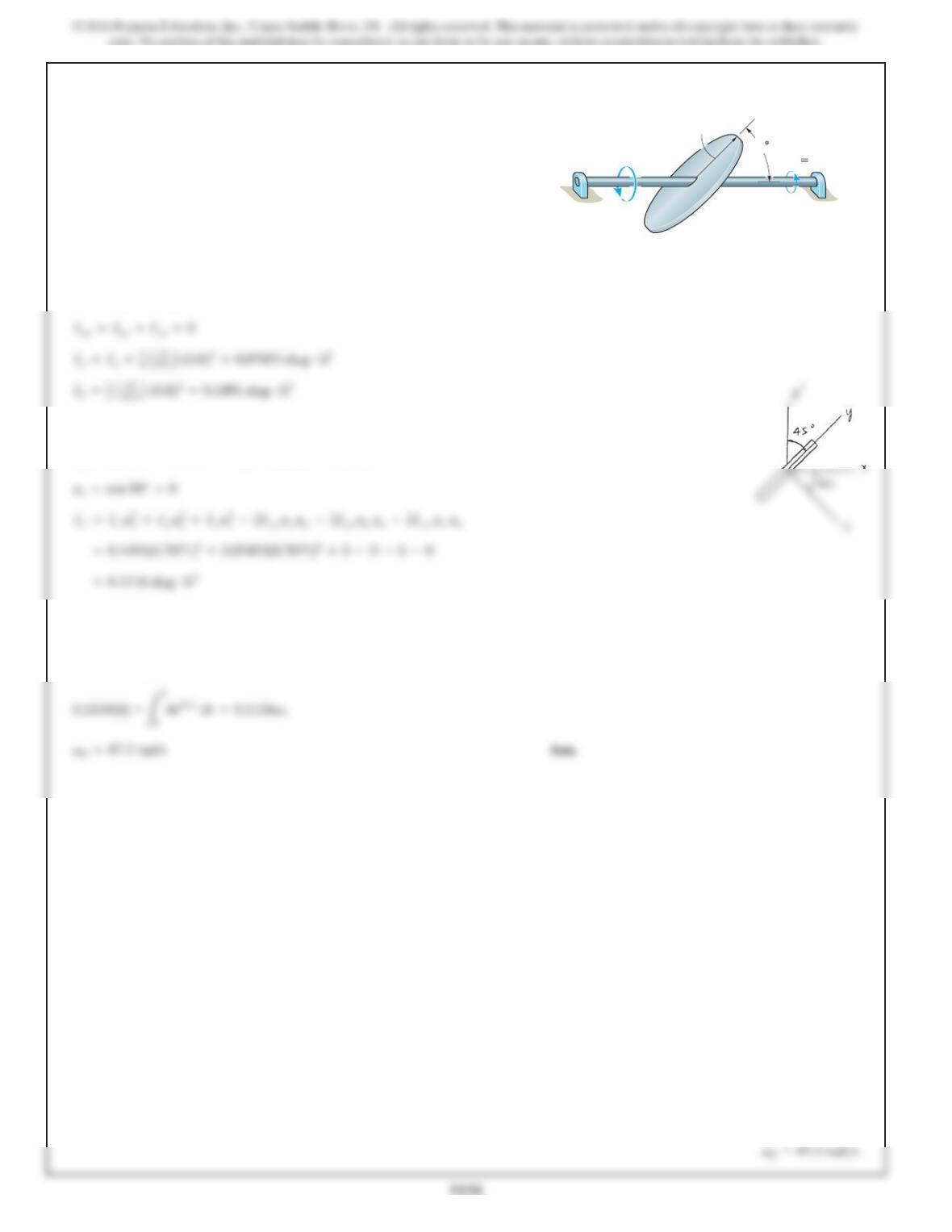
The circular disk has a weight of 15 lb and is mounted on
the shaft AB at an angle of 45° with the horizontal.
Determine the angular velocity of the shaft when if
a torque where tis in seconds, is applied
to the shaft. The shaft is originally spinning at
when the torque is applied.
v1=8 rad>s
M=14e0.1t2lb #ft,
t=2s v1 8 rad/s
BA
45
0.8 ft
M
Ans:
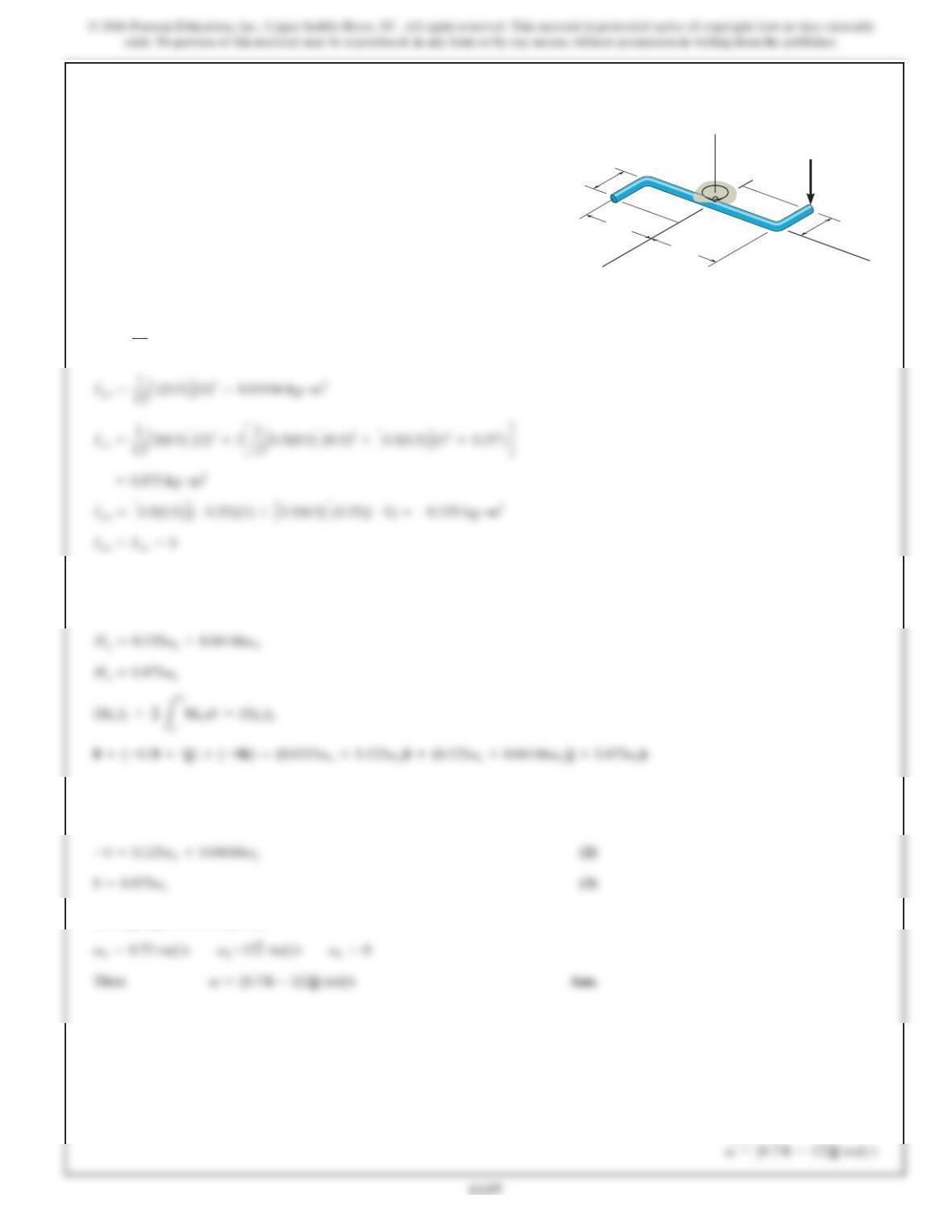
*21–28.
The rod assembly is supported at Gby a ball-and-socket
joint. Each segment has a mass of 0.5 kg/m. If the assembly
is originally at rest and an impulse of is
applied at D, determine the angular velocity of the
assembly just after the impact.
I=5–8k6N#s
SOLUTION
Moments and products of inertia:
From Eq. 21–10
Equating i,jand kcomponents
(1)
Solving Eqs. (1) to (3) yields:
–8=0.8333vx+0.125vy
Hx=0.8333vx+0.125vy
Ixx =1
12
C
2(0.5)
D
(2)2+2
C
0.5(0.5)
D
(1)2=0.8333 kg #m2
z
1m
D
1m
xy
C
G
B
A
0.5 m
0.5 m I= {–8k}N·s
Ans:
1138
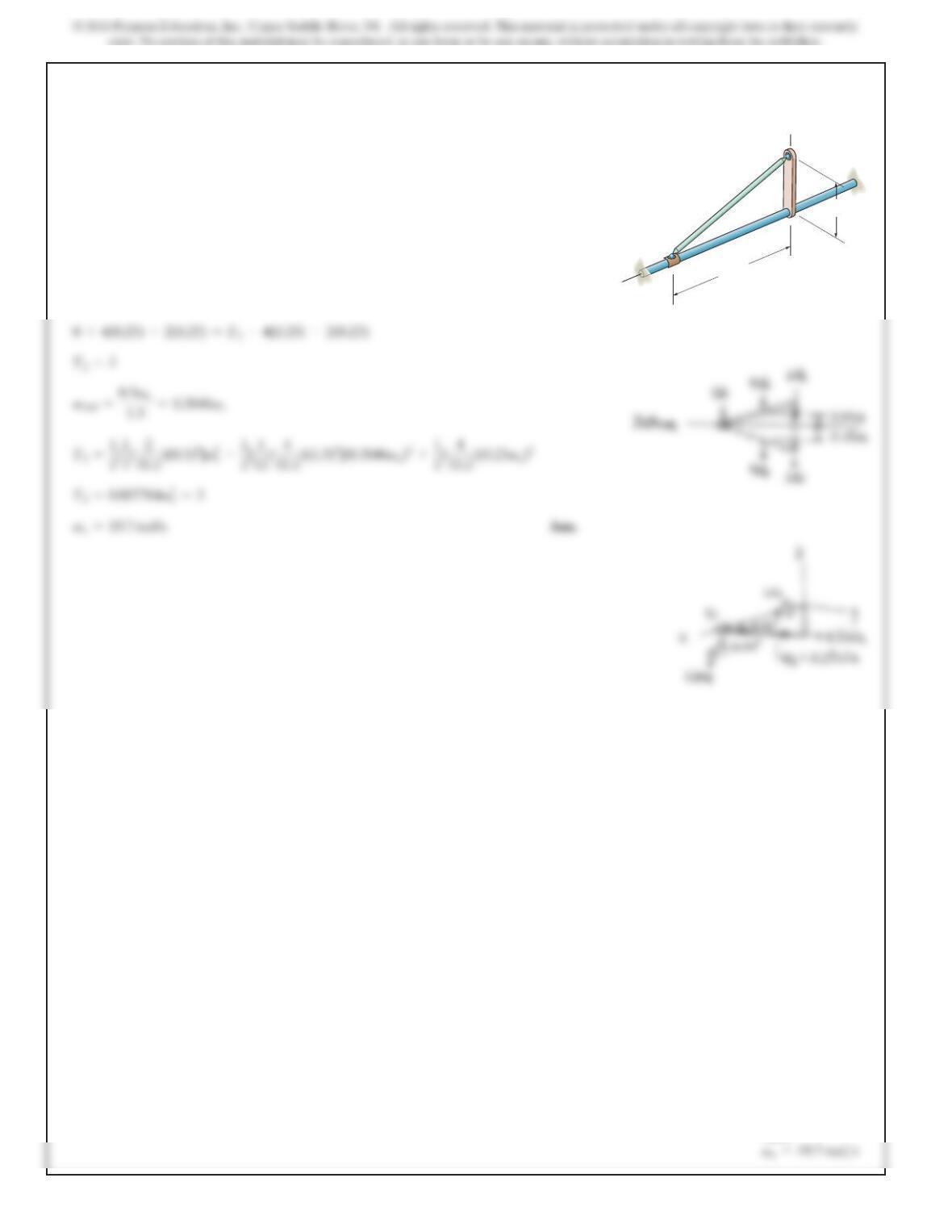
21–29.
The 4-lb rod AB is attached to the 1-lb collar at Aand a 2-lb
link BC using ball-and-socket joints. If the rod is released
from rest in the position shown, determine the angular
velocity of the link after it has rotated 180°.
SOLUTION
T1+V1=T2+V2
0.5 m
1.2 m
1.3 m
z
y
x
A
C
B
Ans:
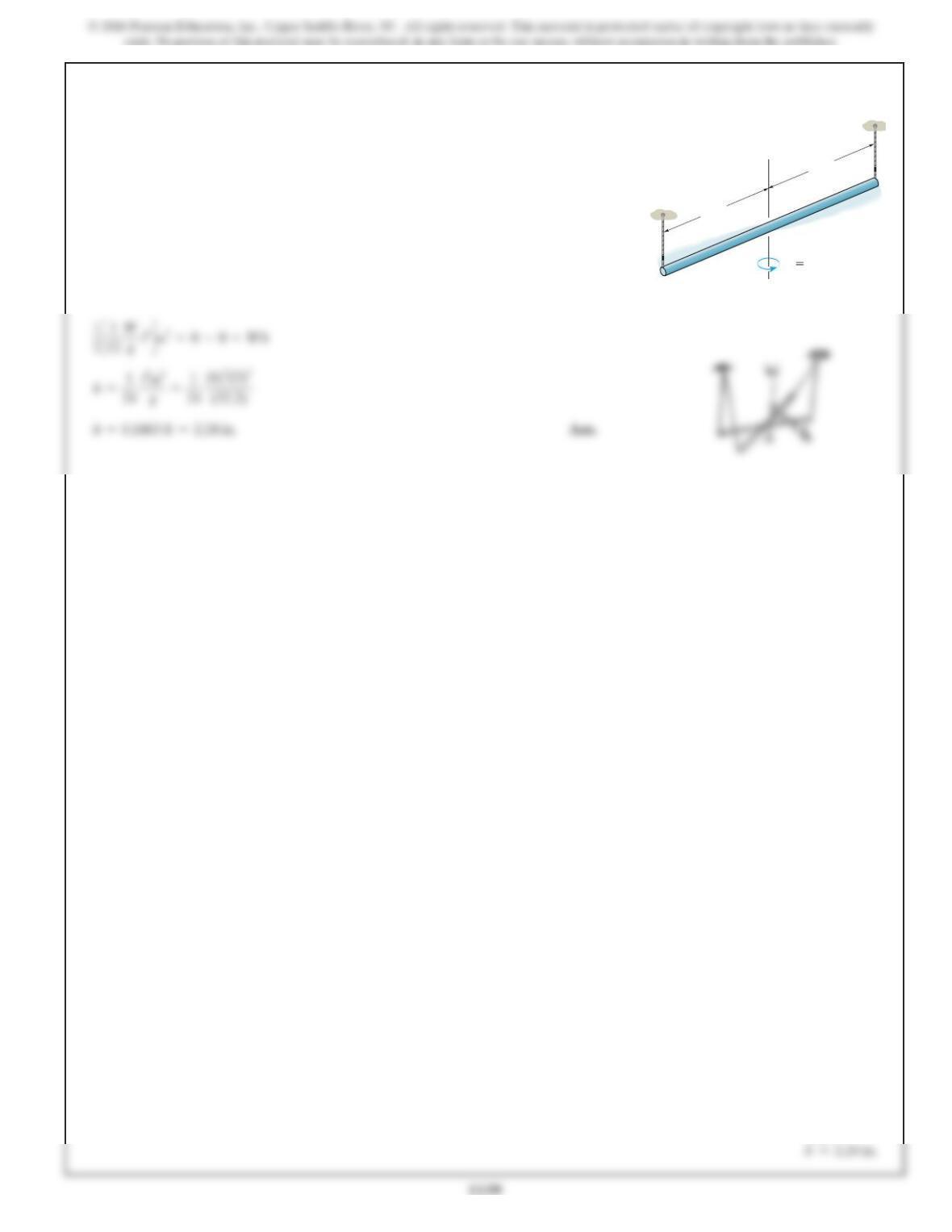
21–30.
SOLUTION
T1+V1=T2+V2
The rod weighs and is suspended from parallel cords
at Aand B. If the rod has an angular velocity of
about the zaxis at the instant shown, determine how high
the center of the rod rises at the instant the rod
momentarily stops swinging.
2 rad>s
3lb
>
ft
v 2 rad/s
3 ft
3 ft
z
A
Ans:
1140
21–31.
SOLUTION
Equating i, j and kcomponents
(1)
Since is perpendicular to the axis of the rod,
Solving Eqs. (1) to (4) yields:
Hence
vAB ={0.1818i–0.06061j+0.6061k} rad>svA={0.6667i}ft>s
vAB
vy–vz+yA=0
vA=yAiv
B+{–2j}ft>svAB =vxi+vyj+vzk
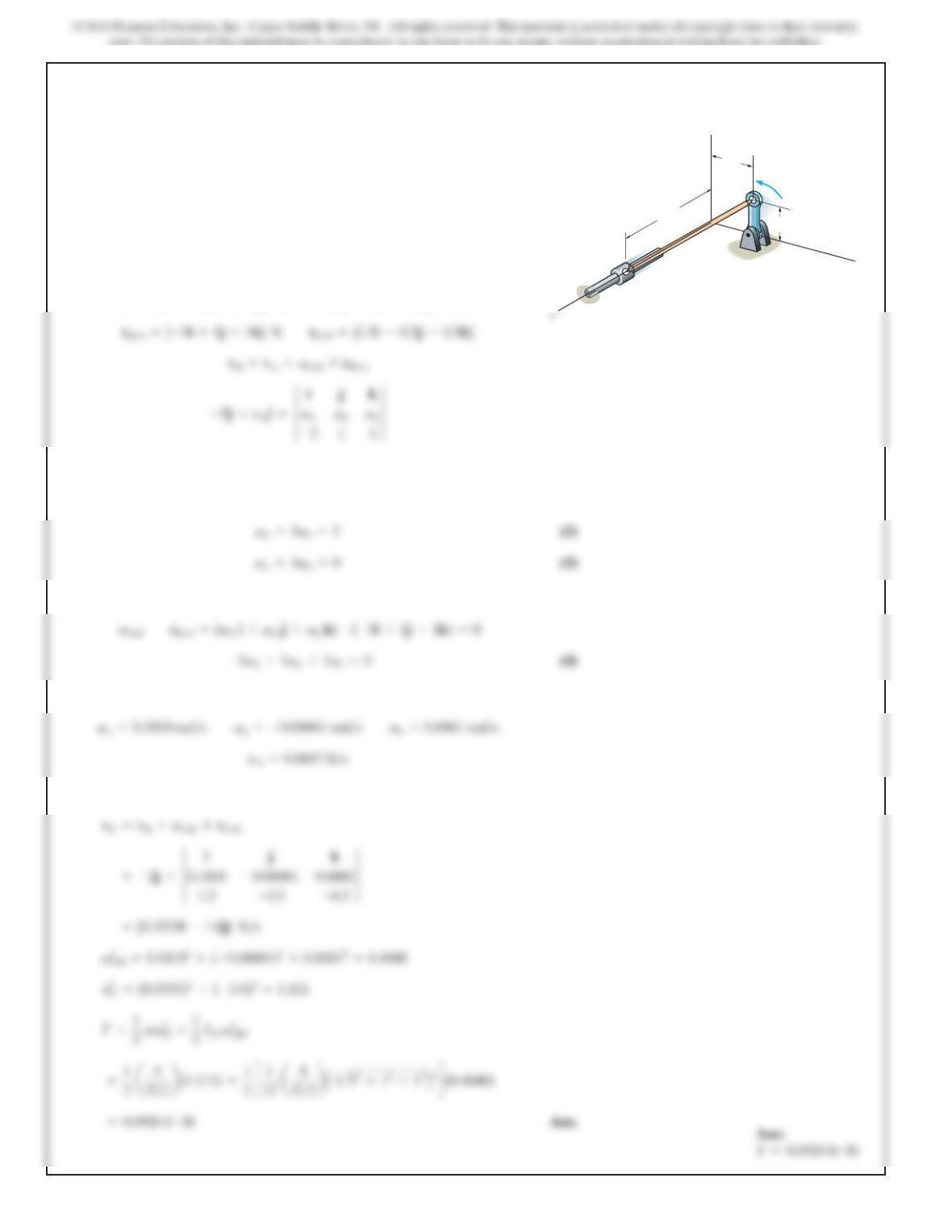
The 4-lb rod AB is attached to the rod BC and collar A
using ball-and-socket joints. If BC has a constant angular
velocity of , determine the kinetic energy of AB when
it is in the position shown. Assume the angular velocity of
AB is directed perpendicular to the axis of AB.
2 rad>s
2rad/s
1ft
z
y
A
3ft
B
C
1ft
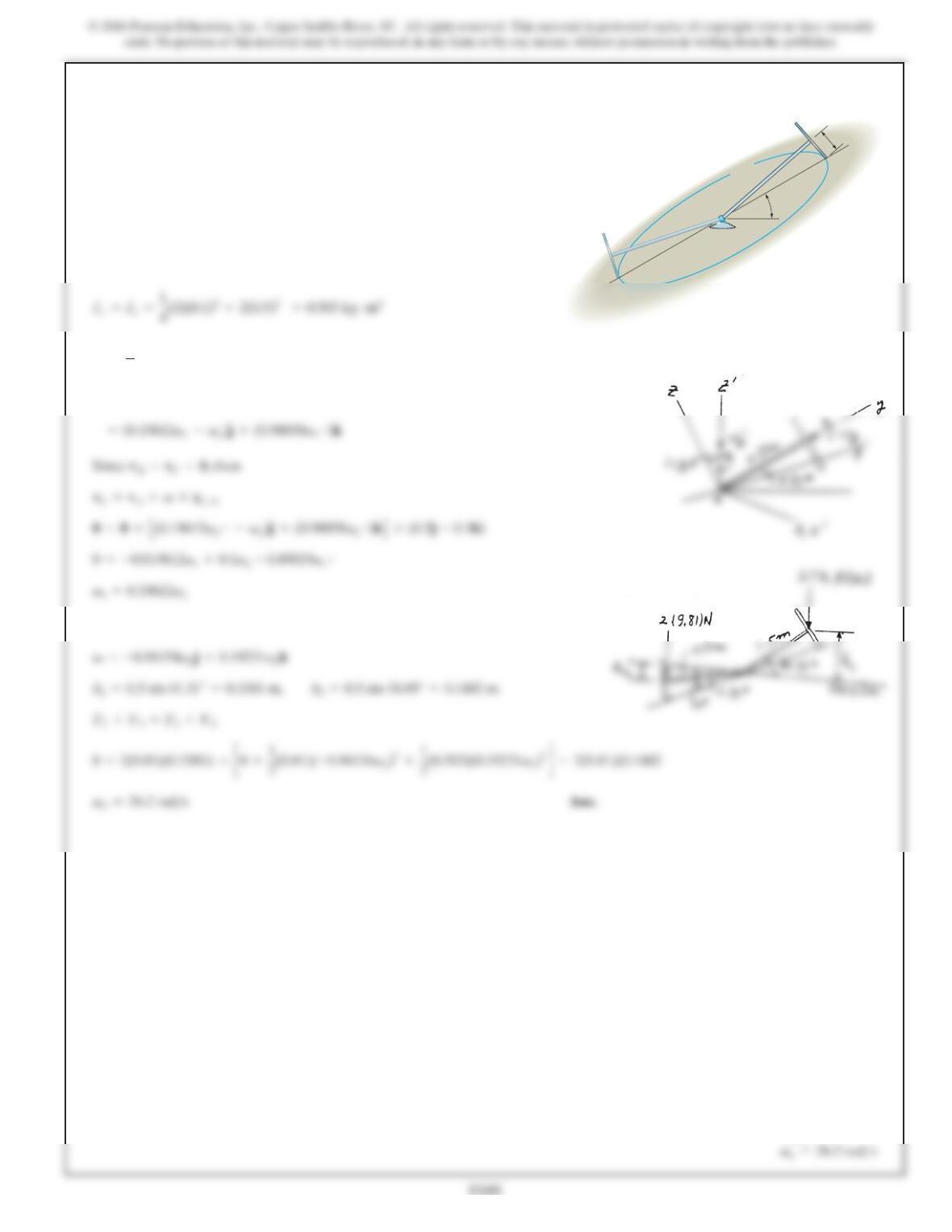
*21–32.
SOLUTION
Thus,
v=vy+vz=-vvj+vz#sin 11.31°j+vz#cos 11.31°k
Iy=1
2(2)(0.1)2=0.01 kg #m2
The 2-kg thin disk is connected to the slender rod which is
fixed to the ball-and-socket joint at A. If it is released from
rest in the position shown, determine the spin of the disk
about the rod when the disk reaches its lowest position.
Neglect the mass of the rod.The disk rolls without slipping.
0.1 m
30°
C
B
A
0.5 m
Ans:
1142
21–33.
z
D
CB
E
0.1 m
0.4 m
0.3 m
vs 60 rad/s
vp
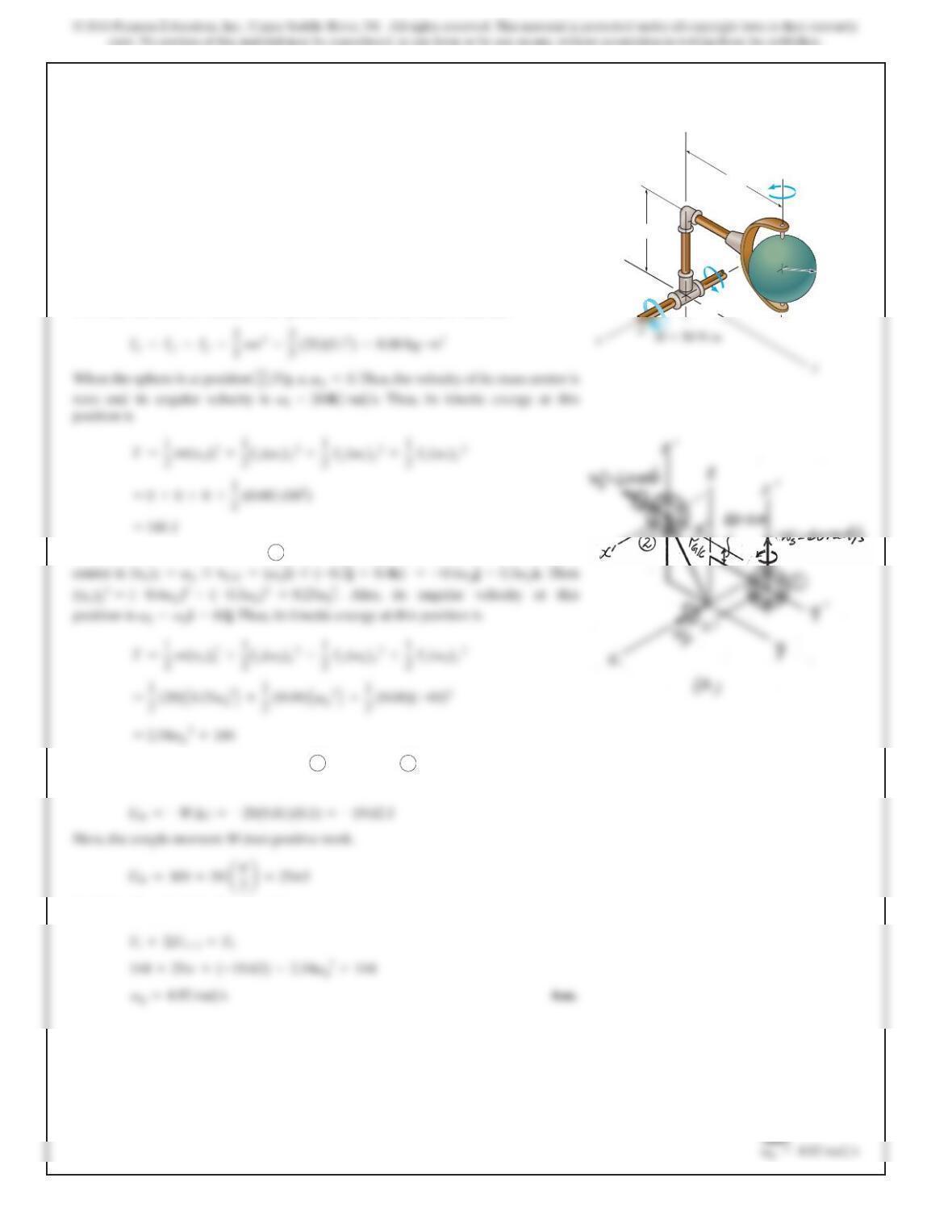
The 20-kg sphere rotates about the axle with a constant
angular velocity of .If shaft AB is subjected to
a torque of ,causing it to rotate,determine the
value of after the shaft has turned 90° from the position
shown. Initially,.Neglect the mass of arm CDE.vp=0
vp
M=50 N #m
vs=60 rad>s
SOLUTION
The mass moments of inertia of the sphere about the ,,and axes are
When the sphere is at position 2 ,Fig.a,.Then the velocity of its mass
When the sphere moves from position 1 to position 2 ,its center of gravity raises
vertically .Thus,its weight Wdoes negative work.
Applying the principle of work and energy,
¢z=0.1 m
vp=vpi
z¿y¿x¿
21–34.
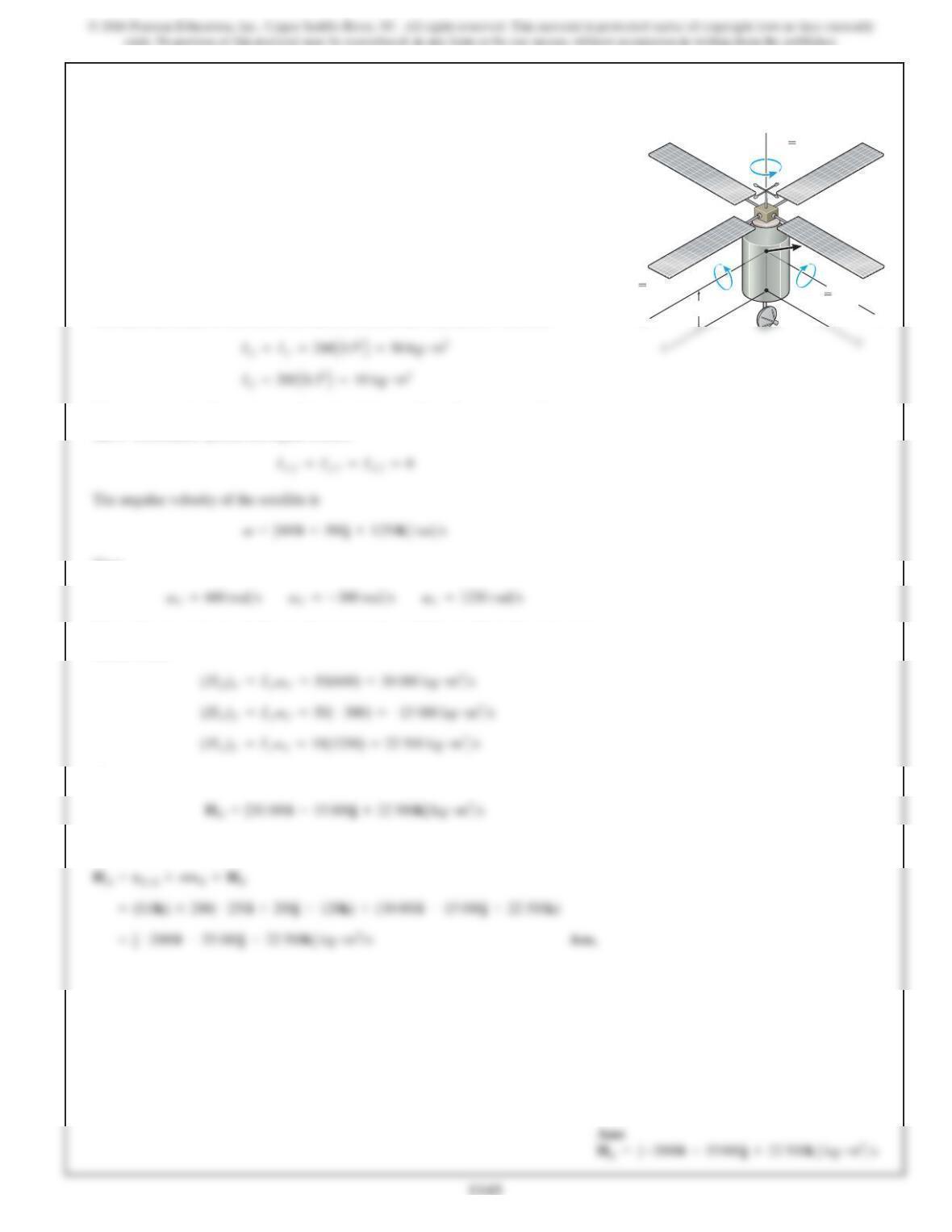
The 200-kg satellite has its center of mass at point G.Its radii
of gyration about the ,, axes are
,respectively.At the instant shown, the
satellite rotates about the ,and axes with the angular
velocity shown, and its center of mass Ghas a velocity of
.Determine the
angular momentum of the satellite about point Aat
this instant.
vG=5—250i+200j+120k6m>s
z¿y¿x¿,
kx¿=ky¿=500 mm
kz¿=300 mm,y¿x¿z¿
SOLUTION
The mass moments of inertia of the satellite about the ,,and axes are
Due to symmetry, the products of inertia of the satellite with respect to the ,,
and coordinate system are equal to zero.
Thus,
Then, the components of the angular momentum of the satellite about its mass
center Gare
Thus,
The angular momentum of the satellite about point Acan be determined from
z¿
y¿x¿
z¿y¿x¿x¿
y¿
G
A
800 mm
Vx¿600 rad/s
Vz¿1250 rad/s
Vy¿300 rad/s
z
,
z
¿
vG
1144
21–35.
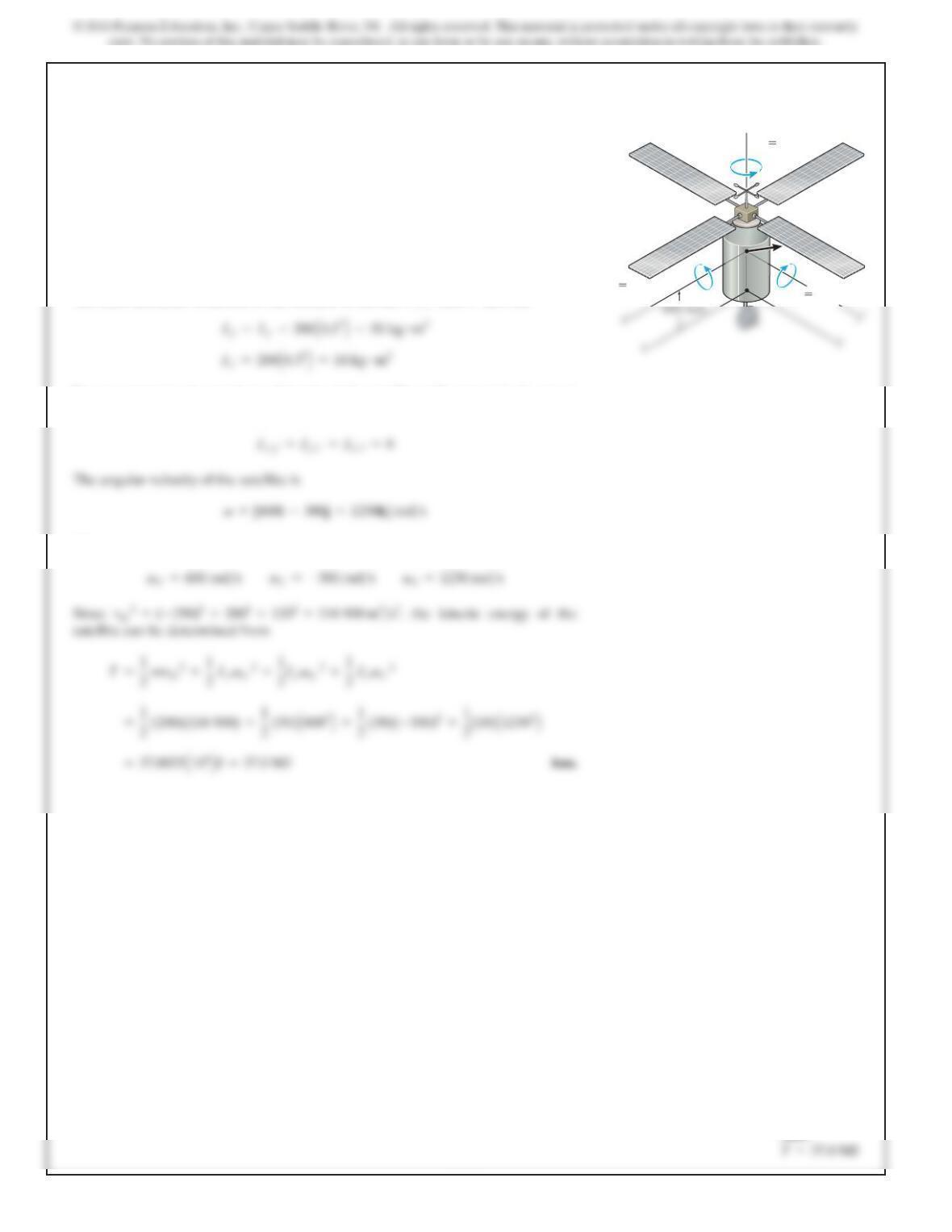
SOLUTION
The mass moments of inertia of the satellite about the ,,and axes are
Due to symmetry, the products of inertia of the satellite with respect to the ,,
and coordinate system are equal to zero.
Thus,
z¿
y¿x¿
z¿y¿x¿
T
h
e 200-
k
g sate
lli
te
h
as
i
ts center of mass at po
i
nt G.Its ra
dii
of gyration about the ,, axes are
,respectively.At the instant shown, the
satellite rotates about the ,,and axes with the angular
velocity shown, and its center of mass Ghas a velocity of
.Determine the kinetic
energy of the satellite at this instant.
vG=5—250i+200j+120k6m>s
z¿y¿x¿
kx¿=ky¿=500 mm
kz¿=300 mm,y¿x¿z¿
G
A
Vx¿600 rad/s
Vz¿1250 rad/s
Vy¿300 rad/s
z
,
z
¿
vG
Ans:
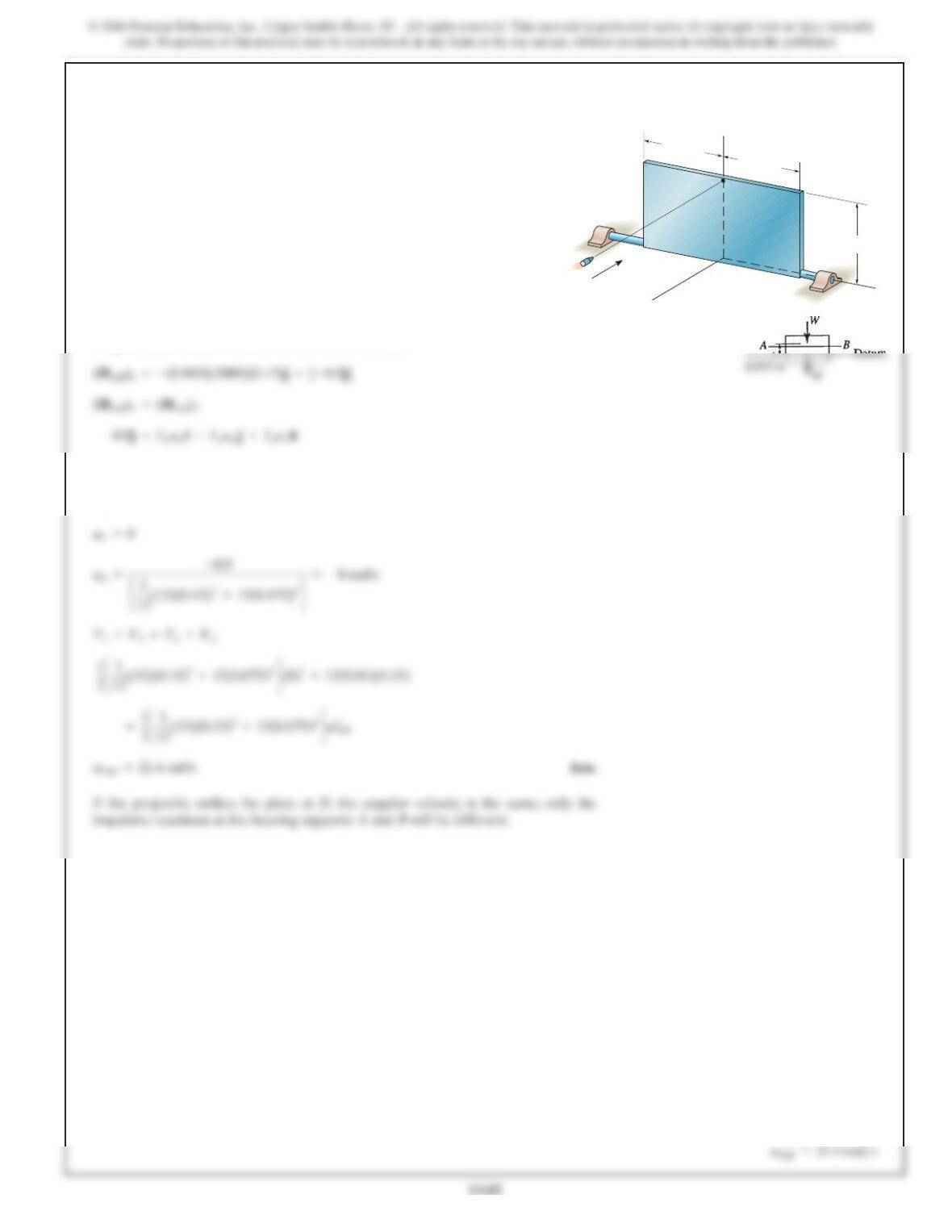
*21–36.
SOLUTION
Consider the projectile and plate as an entire system.
Angular momentum is conserved about the AB axis.
Equating components,
vx=0
B
D
A
y
x
z
150 mm
150 mm
150 mm
v
C
The 15-kg rectangular plate is free to rotate about the y axis
because of the bearing supports at A and B.When the plate is
balanced in the vertical plane, a 3-g bullet is fired into it,
perpendicular to its surface, with a velocity v = 5–2000i6 m>s.
Compute the angular velocity of the plate at the instant it has
rotated 180°. If the bullet strikes corner D with the same
velocity v, instead of at C, does the angular velocity remain the
same? Why or why not?
Ans:
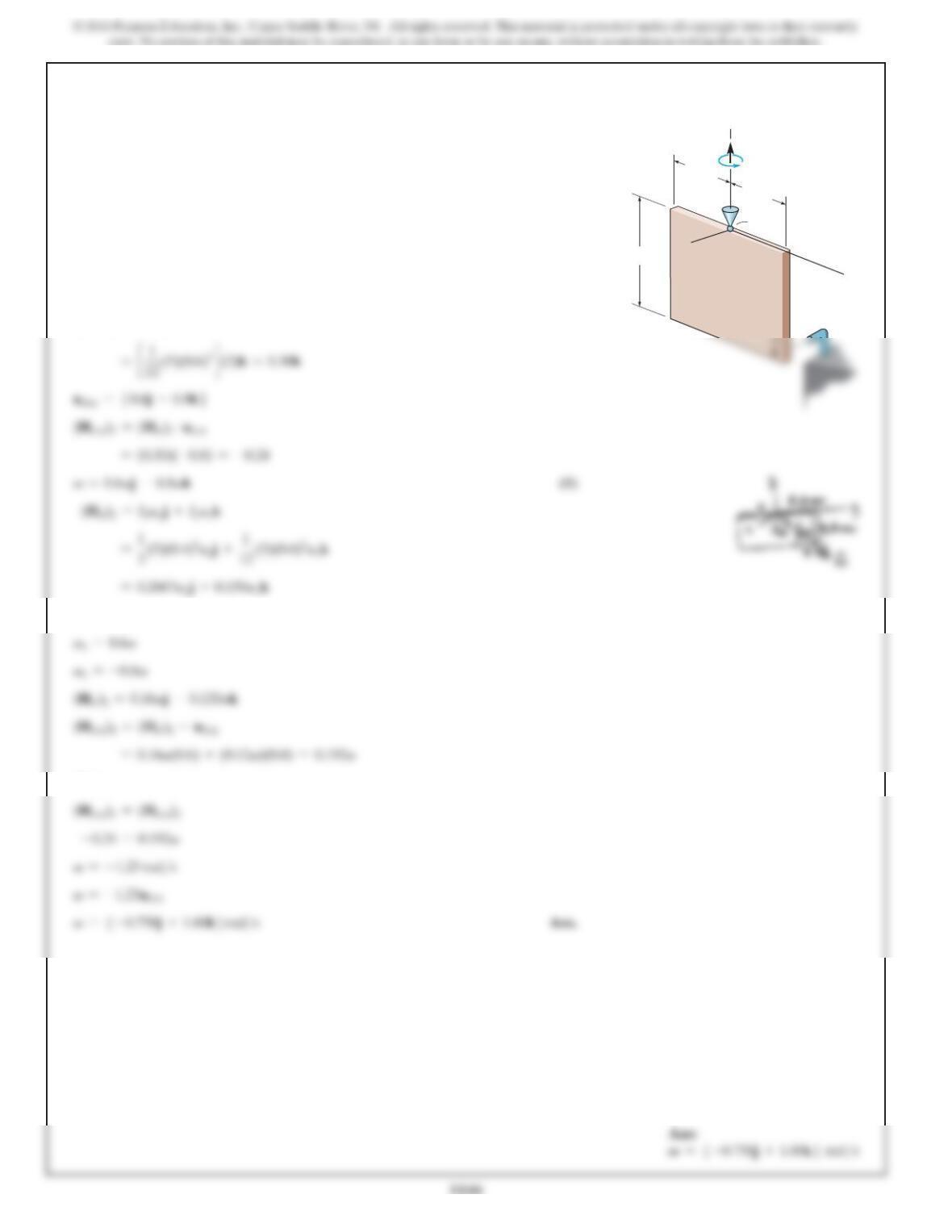
21–37.
The 5-kg thin plate is suspended at O using a ball-and-
socket joint. It is rotating with a constant angular velocity
V
=52k6 rad>s
when the corner A strikes the hook at S,
which provides a permanent connection. Determine the
angular velocity of the plate immediately after impact.
SOLUTION
Angular momentum is conserved about the OA axis.
(HO)1=Iz
v
zk
From Eq. (1),
Thus,
S
O
400 mm
300 mm
300 mm
z
y
x
V {2k} rad/s
1147
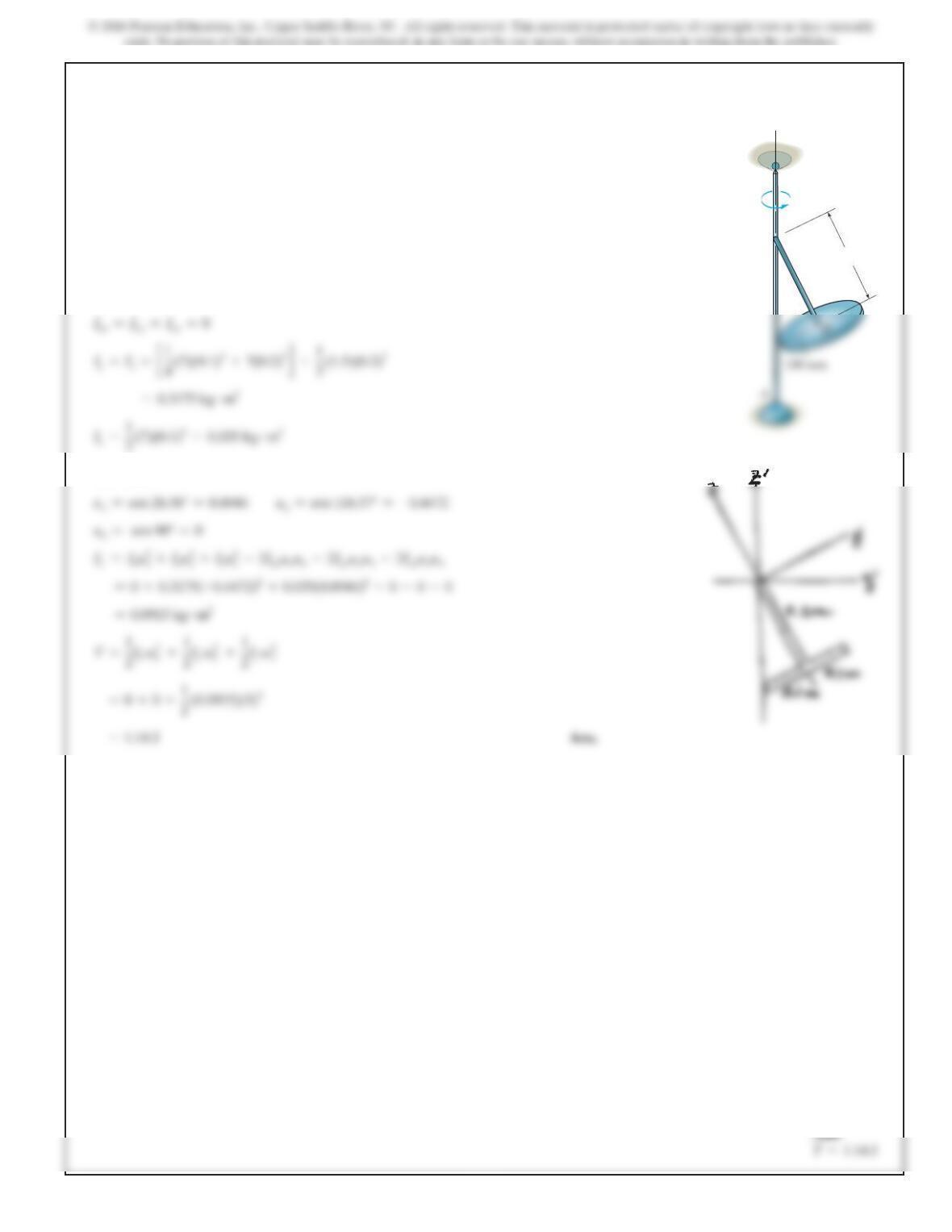
21–38.
Determine the kinetic energy of the 7-kg disk and 1.5-kg rod
when the assembly is rotating about the z axis at
v
=5 rad>s.
SOLUTION
Due to symmetry
For
z′
axis
B
C
200 mm
v 5 rad/s
z
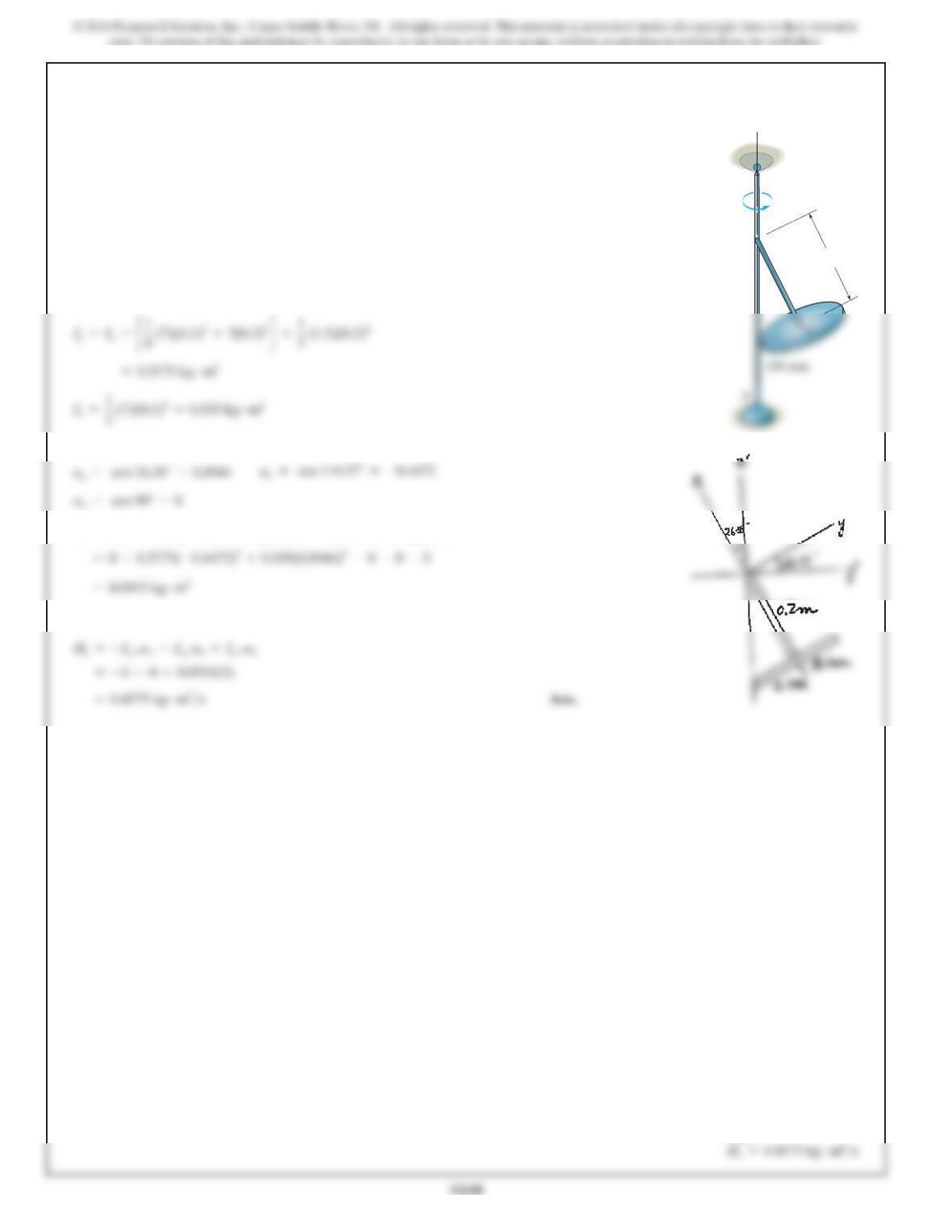
21–39.
Determine the angular momentum
H
z of the 7-kg disk and
1.5-kg rod when the assembly is rotating about the z axis at
v
=5 rad>s.
SOLUTION
Due to symmetry
I
xy
=I
yz
=I
zx
=0
For
z′
axis
u
I
z′=
I
x
u
x
2+I
y
u
y
2+I
z
u
z
2–2I
xy
u
x
u
y
–2I
yz
u
y
u
z
–2I
zx
u
z
u
x
vx
=
vy
=0
H
B
C
200 mm
v 5 rad/s
z
Ans: