−1−
CHAPTER 20
NOISE AND VIBRATIONS IN MECHANICAL AND ELECTRICAL SYSTEMS
OVERVIEW
This chapter introduces concepts of acoustical engineering. The objective is to develop
an awareness of the role of acoustics and vibrations in building systems. Of necessity, it
presumes little prior exposure to applied physical acoustics. A major impediment for the
first time exposure is that acoustical engineering involves an unfamiliar language and an
ancient mathematical concept often taught in school, but seldom used otherwise –
logarithms. All of this presents a formidable challenge to the beginner. Beyond this, our
experience with sound has been largely involuntary, but we have given little thought to
how to quantify sound and describe it in terms that can be used for design purposes.
In this chapter we first introduce some of the design criteria that we must satisfy
in building acoustics. But we cannot get very far before we need to expose ourselves to
the unfamiliar mathematical world of logarithms and their relation to the more familiar, if
misunderstood, decibels. We must address the formidable task of decibels and use
logarithms (and antilogarithms) in virtually every equation we use. This all takes place in
very limited print space. Thus, the instructors and students may find need to avail
themselves of outside reference material.
This very first concept to grasp is that everything we will discuss – sound
pressure, sound intensity – are all related to sound power. Sound power is measured in
root mean square (RMS) or mean square averages. Ideally, sound is described as a plane
or spherical propagation wave. However, sound waves are subjected to scatter by
geometrical objects. We cannot describe this scattering phenomenon except at a macro
level: i.e., spatial as well as time averages. Sound absorption, sound transmission and
other properties and behavior of sound are described in terms of gross averages – time
averages, spatial averages, all sorts of averages.
Many of the problems that occur in buildings and systems are sound related. This
chapter is extremely valuable for architects, engineers and contractors to anticipate
problems before they happen and understand how to avoid them.
There is a certain time required for anyone being exposed to applied acoustics for
the first time to get beyond the decibels and logarithms to the extent they can think about
the meat of the subject matter. Patience and repetition are necessary.
−2−
CHAPTER 20
NOISE AND VIBRATIONS IN MECHANICAL AND ELECTRICAL SYSTEMS
QUESTIONS AND ANSWERS
20.1 What are the Five Senses?
20.2 From now until the next class, listen carefully to the sounds around you.
Keep a log of these sounds. Classify them as Pleasant, Neutral, Obtrusive, or
Warning. What is the origin of the sounds you have identified? Aside from
the sounds you have identified, what are some other sounds that fit each of
the above five categories?
20.3 On a scale of 1 to 10, how do you rate your classroom acoustically for your
learning experience?
20.4 What is the speed of sound at (a) 50 Hz, (b) 500 Hz, and (c) 5000 Hz?
20.5 What is the wave length of (a) a 50 Hz sound wave, (b) a 100 Hz sound wave
and (c) a 1000 Hz sound wave ?
20.6 What is the rationale for measuring sound with A-weighting?
−3−
20.7 In the Devils Dictionary (1911) Ambrose Bierce defined noise thus: “Noise, n,. The
chief product and authenticating sign of civilization.”
20.8 How would you define noise as opposed to sound?
20.9 Noise has grown more intense over the passing years. How do you account for this?
20.10 Identify some spaces in buildings where a quiet environment is of primary
importance.
20.11 What are two primary components of sound and what are their characteristics?
20.11 What is the significance of the reference pressure fluctuation value used to calculate
the decibel level of SPL for a given sound?
20.12 A 5/8” mineral ceiling tile has octave band absorption coefficients of
125 250 1000 2000 4000 8000 Hz
0.31 0.29 0.70 0.71 0.71 0.58
What is the NRC for the tile?
−4−
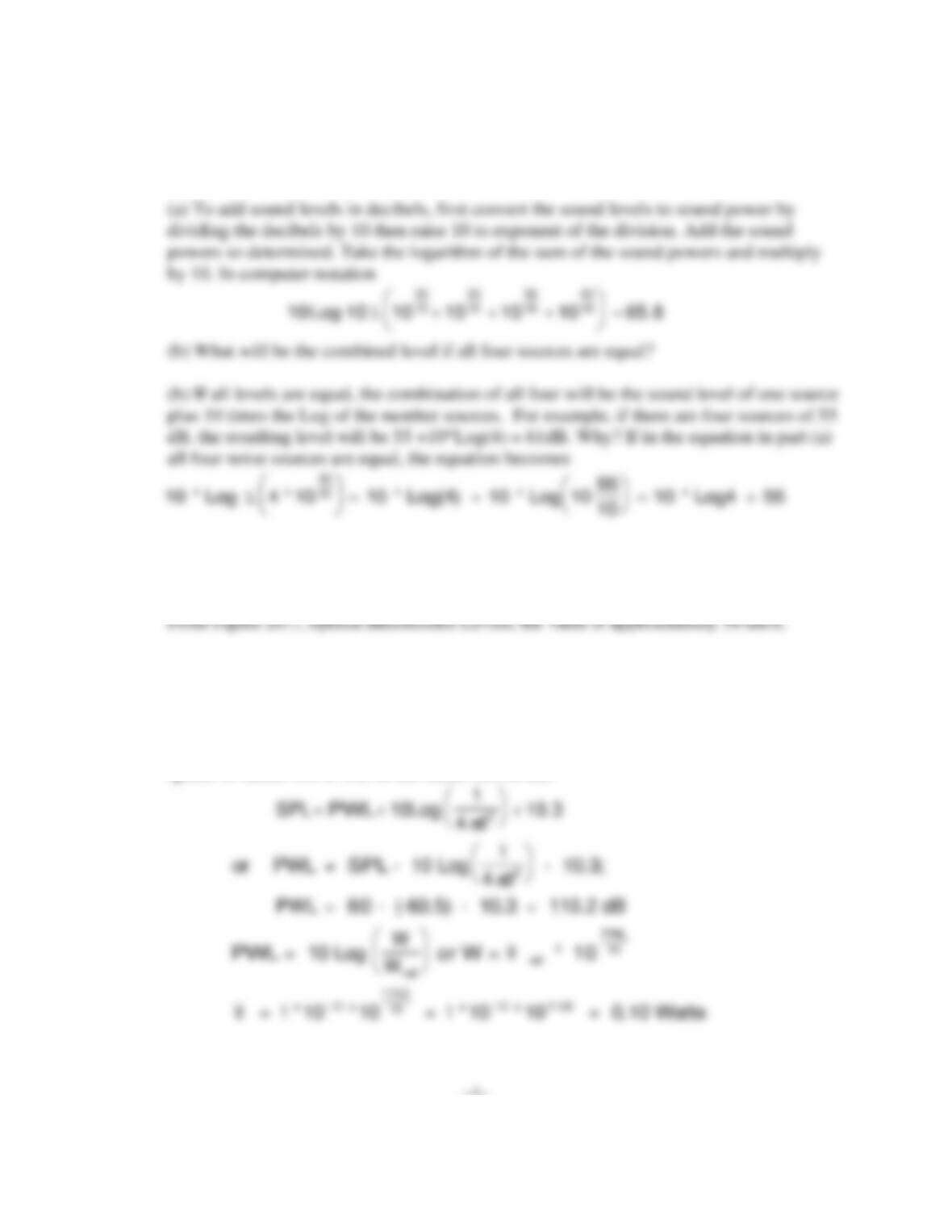
20.13 Four sound sources individually produce sounds of 55, 55, 58 and 64 dB at a
measurement location. What will be the sound level at the measurement location if
all sounds are active at the same time?
20.14 What is the approximate maximum background noise that will allow normal voice
communication at a distance of 16 ft from speaker to listener?
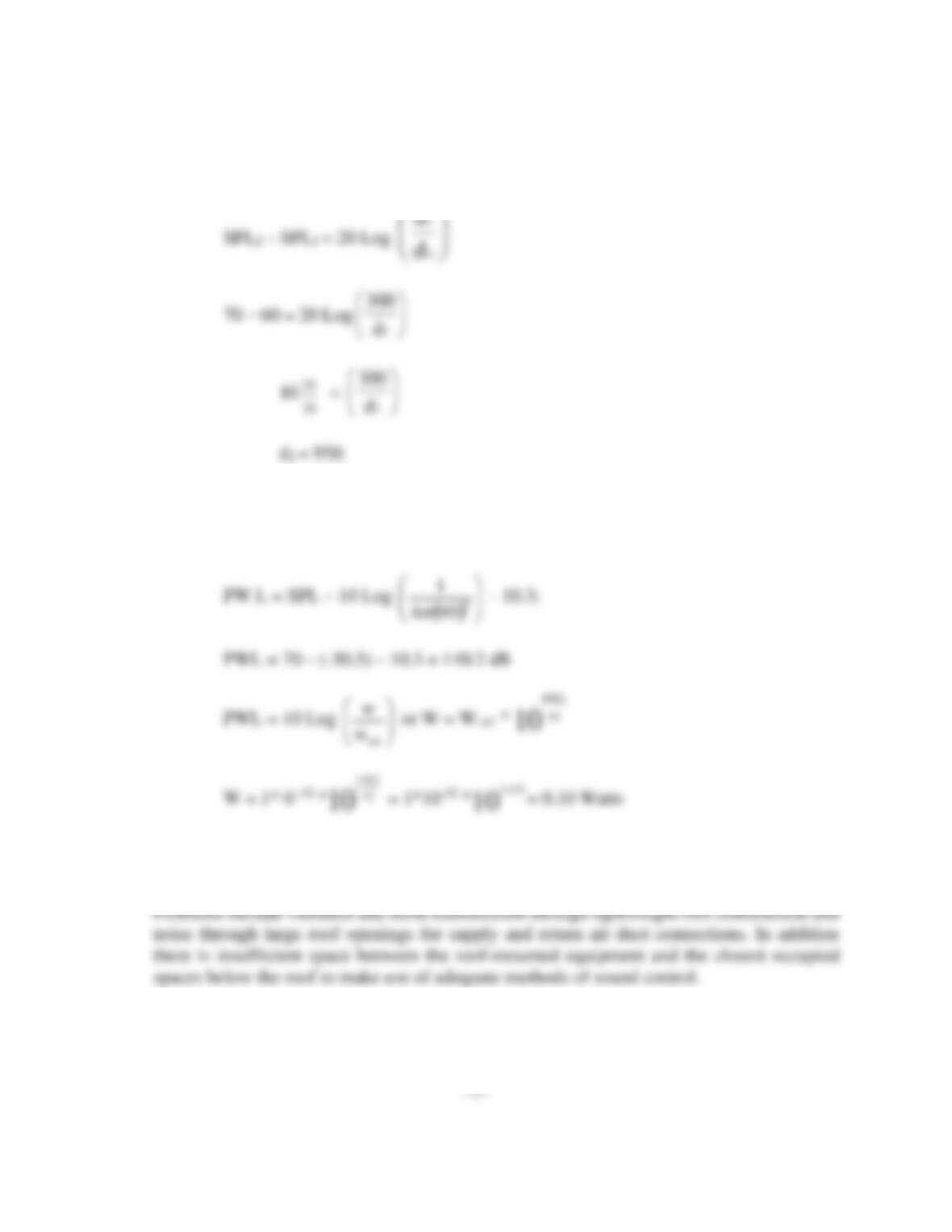
20.15 A point noise source measured at 300 ft in a free field is 60 dB. What is the sound
power of the source in Watts?
This is a point source in a free field. Therefore, the sound measured at any point in a
sphere of radius 300 ft will be the same; i.e., 60 dB.
SPL
PWL
10Log
1
4 d
10.3
or PWL
=
SPL
–
10 Log
1
4 d –
10.3;
PWL
=
60
–
(-60.5)
–
10.3
=
110.2 dB
PWL
=
10 Log
W
W
or W
=
W
*
10
2
2
ref ref
PWL
10
–12
110.2
10
–12
11.02
= +
+
−5−
20.16 For the point source in Question 20.15, how close to the source would one have to
move for the sound pressure level to be 70 dB?
1
d
20.17 For the distance in Question 20.16, what is the sound power at the closer location?
10 10
10 02.11
20.18 How do rooftop units present special problems for noise and vibration?
20.19 How does acoustical duct liner performance vary with respect to frequency of duct
noise?
−6−
20.20 How do active duct silencers work? What advantages do they offer over absorptive
duct silencers? Why are active silencers seldom used?
20.21 A centrifugal fan operating at 38,000 cfm, 1800 rpm, 8 blades, 2-in. H20 generates
the total sound power levels in each octave band given in the following table. These
data do not contain a correction for blade passage frequency.
Center frequency
63
125
250
500
1k
2k
4k
8k
Fan PWL
92
92
91
86
81
75
71
69
What is the blade passage frequency?
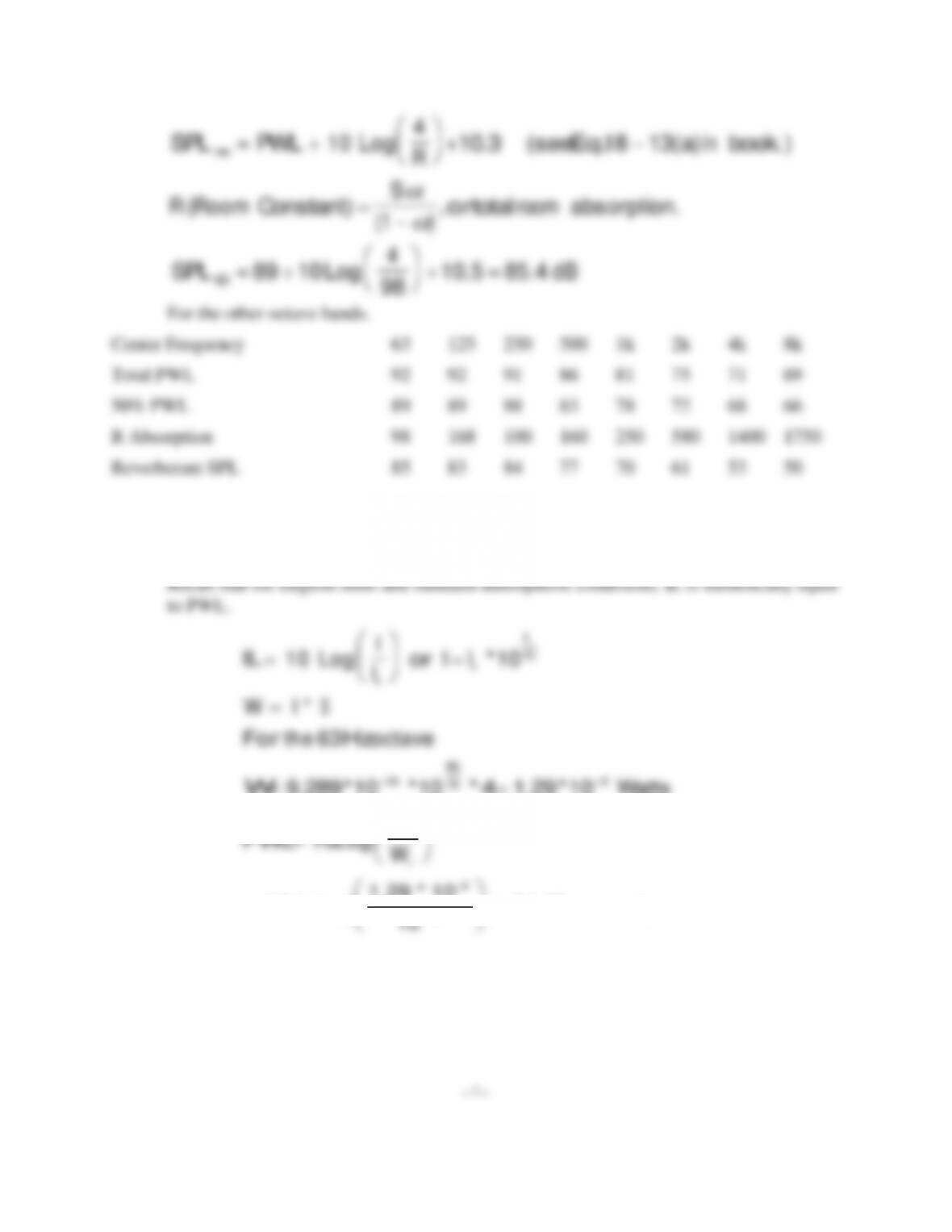
20.22 The fan in Question 20.21 sits in a mechanical equipment room. The supply is
ducted from the room. The HVAC system is an open return. The inlet to the fan is
open to the room. The room absorption is given in the following table. What is the
nominal reverberant SPL in the room? Assume that half of the total sound power is
emitted to the room and that no direct sound reaches the opening.
Center frequency
63
125
250
500
1k
2k
4k
8k
Absorption, Sabins
98
168
100
160
250
580
1400
1750
SPL
PWL
10
Log
4
R
10.3
(see
Eq.
18
13(a)
in
book.
)
R
(Room
Constant)
S
(1
),
or
total
room
absorption
.
SPL
89
10
Log
4
98
10.5
85.4
dB
rev
63
= +
+ −
=−
= +
+ =
For the other octave bands.
Center Frequency 63 125 250 500 1k 2k 4k 8k
Total PWL 92 92 91 86 81 75 71 69
50% PWL 89 89 88 83 78 72 68 66
R Absorption 98 168 100 160 250 580 1400 1750
Reverberant SPL 85 83 84 77 70 61 53 50
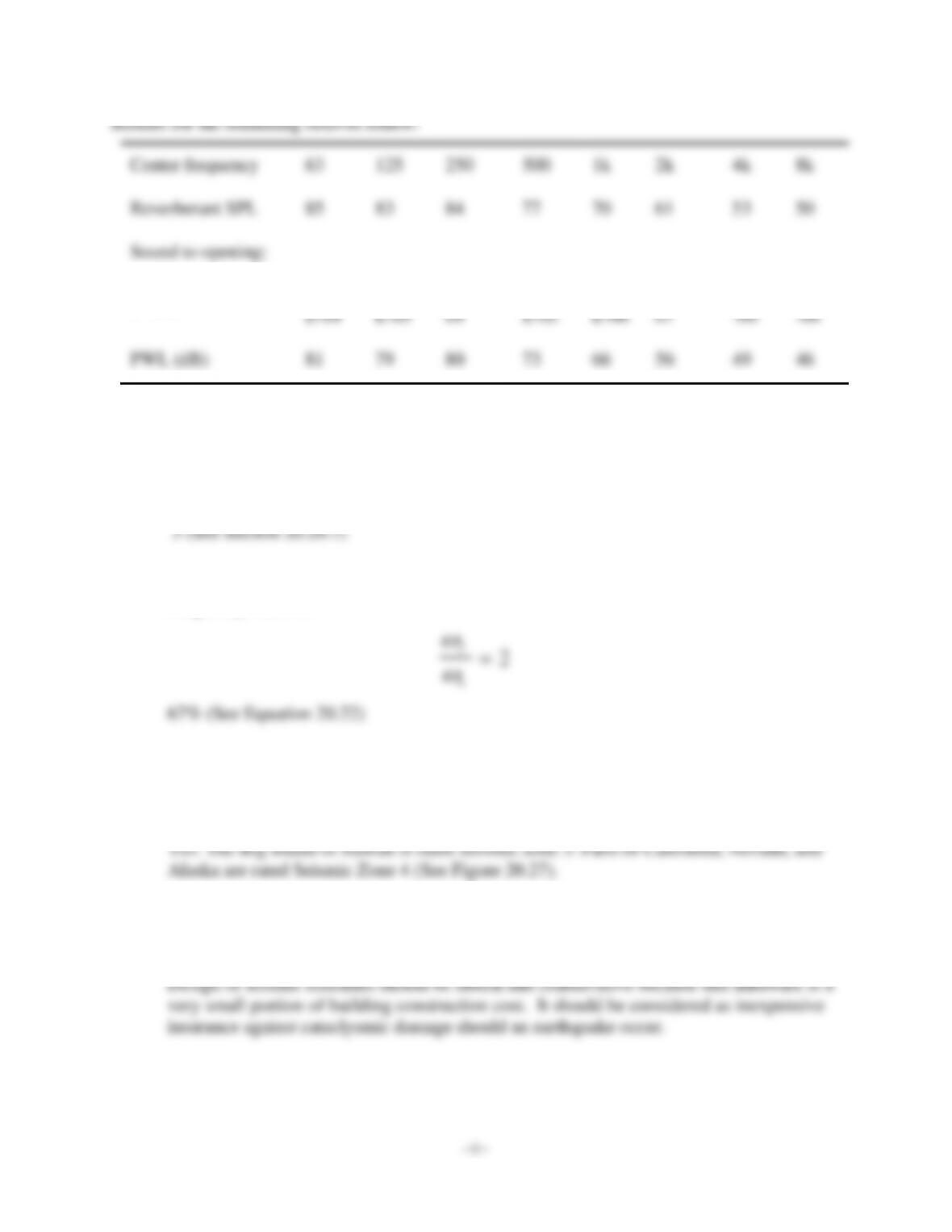
20.23 For Question 20.22, assume that the reverberant sound in the MER is as given in the
following table and the return opening in the wall is 2 ft wide x 2 ft high. What is the
reverberant sound power level emitted through the opening?
−8−
Results for the remaining octaves follow:
Center frequency
63
125
250
500
1k
2k
4k
8k
Reverberant SPL
85
83
84
77
70
61
53
50
Sound to opening:
I watts
1.29
E-04
7.53
E-05
1.01 E-
04
1.99
E-05
4.02
E-06
4.35 E-
07
7.18E
-08
3.62E
-08
PWL (dB)
81
79
80
73
66
56
49
46
20.24 For good vibration isolation, what should be the minimum ratio of the disturbing
force frequency ωf to the resonant (natural) frequency ωn?
20.25 What is the isolation frequency for a system with a single degree of freedom whose
frequency ratio is:
f
n
=
2
67% (See Equation 20.22)
20.26 Hawaii is famous for its volcanoes and earthquakes. Are there any areas in the
United States that have a worse potential for earthquakes?
20.26 What is the rationale for the liberally conservative design of seismic restraints?