1045
20–1.
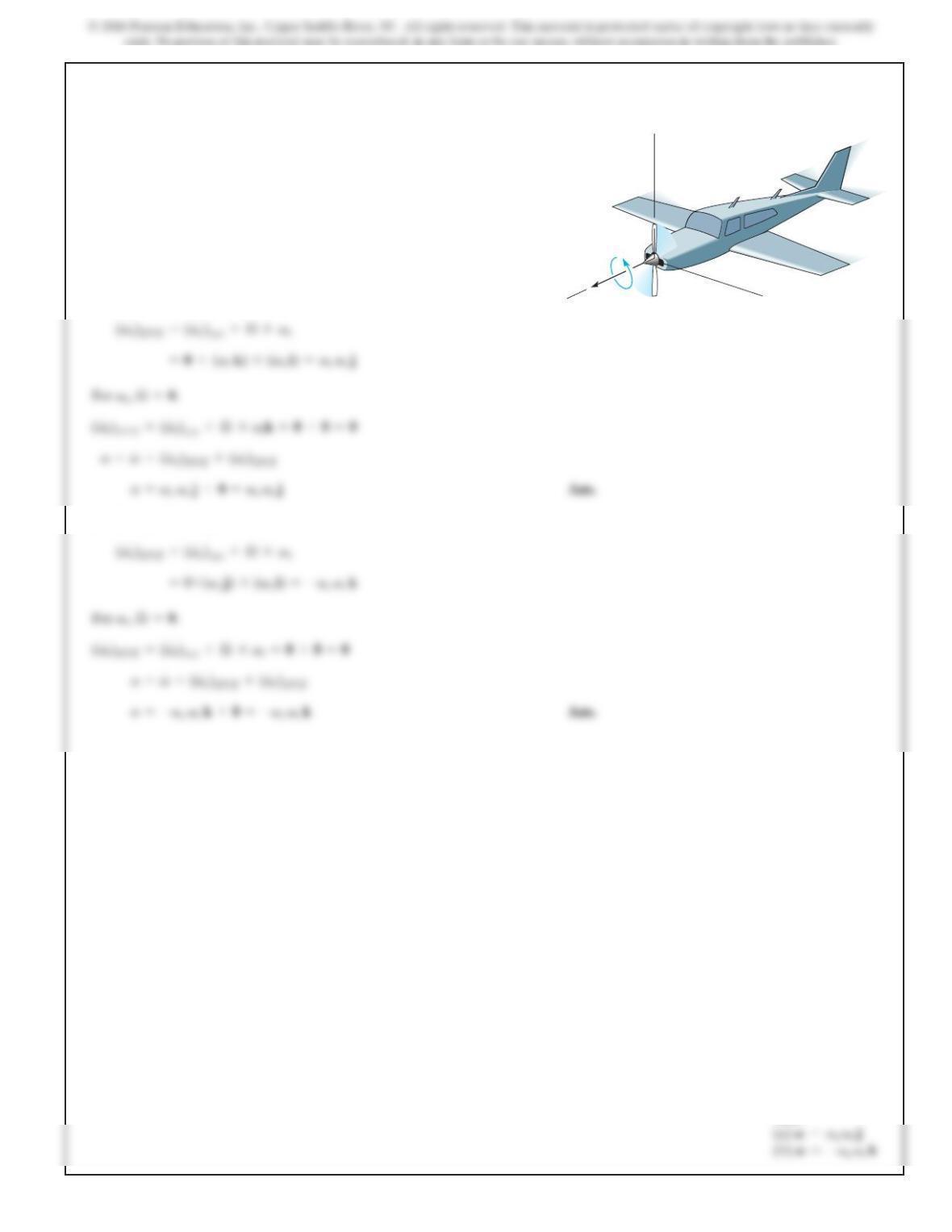
The propeller of an airplane is rotating at a constant speed
while the plane is undergoing a turn at a constant rate
Determine the angular acceleration of the propeller if
(a) the turn is horizontal, i.e., and (b) the turn is
vertical, downward, i.e., vtj.
vtk,
vt.
vsi,
SOLUTION
(a) For ,.
(b) For ,.
Æ=vtjvs
Æ=vtkvs
z
xy
V
s
Ans:
1046
20–2.
SOLUTION
Angular Velocity: The coordinate axes for the fixed frame (X, Y, Z) and rotating
frame (x, y, z) at the instant shown are set to be coincident. Thus, the angular
Equating kand jcomponents, we have
Angular Acceleration: The angular acceleration will be determined by
investigating the time rate of change of angular velocity with respect to the fixed
Velocity and Acceleration: Applying Eqs.20–3 and 20–4 with the and obtained above
av
a
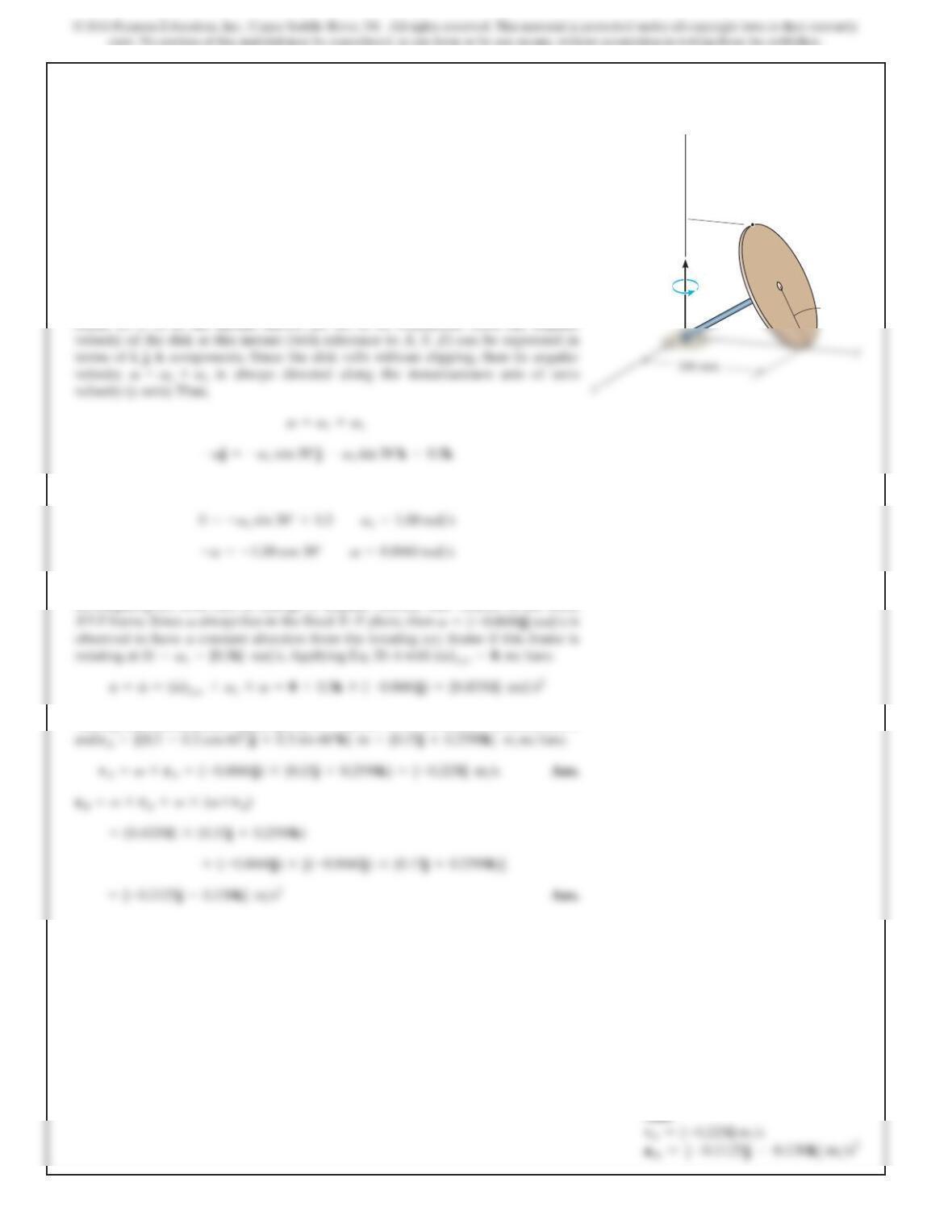
The disk rotates about the zaxis at a constant rate
without slipping on the horizontal plane.
Determine the velocity and the acceleration of point Aon
the disk.
vz=0.5 rad>s
z
A
= 0.5 rad/s
150 mm
z
V
Ans:
1047
20–3.
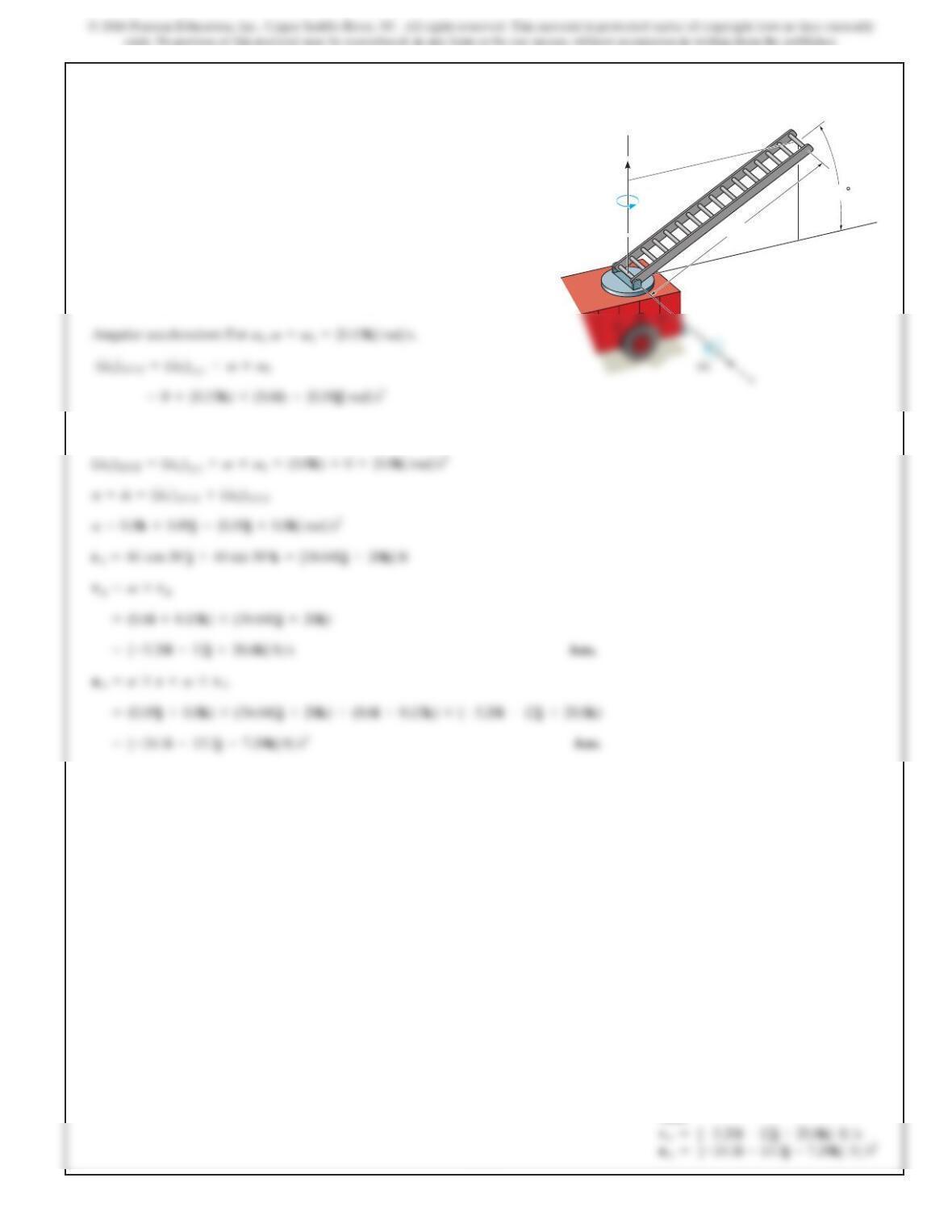
The ladder of the fire truck rotates around the zaxis with an
angular velocity which is increasing at
At the same instant it is rotating upward at a
constant rate Determine the velocity and
acceleration of point Alocated at the top of the ladder at
this instant.
v2=0.6 rad>s.
0.8rad>s2.
v1=0.15 rad>s,
z
y
A
40 ft
1
30
SOLUTION
For ,.
Æ=0v1
v=v1+v2=0.15k+0.6i={0.6i+0.15k}rad>s
v
Ans:
1048
*20–4.
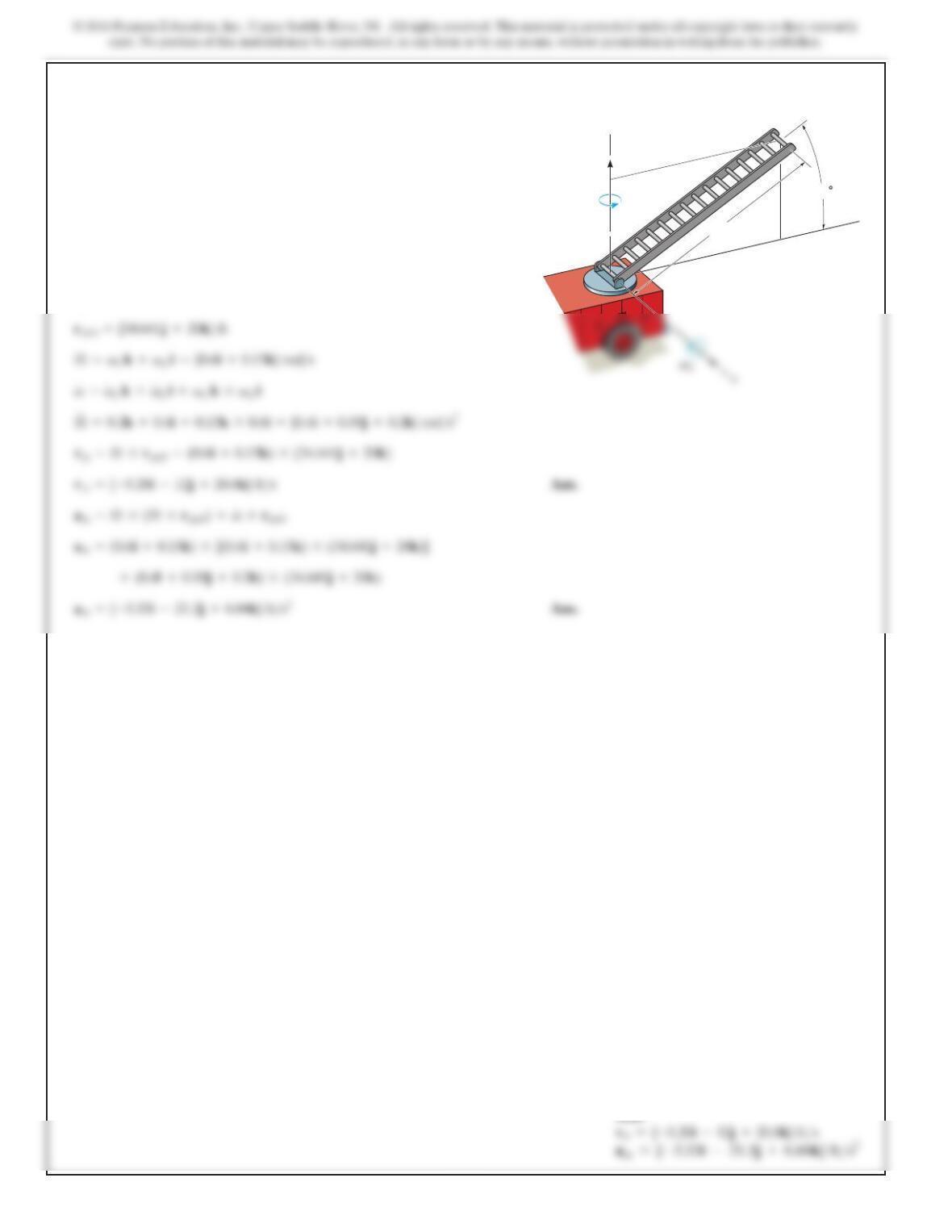
The ladder of the fire truck rotates around the zaxis with
an angular velocity of which is increasing
at
while increasing at Determine the
velocity and acceleration of point Alocated at the top of
the ladder at this instant.
0.4 rad>s2.v2=0.6 rad>s
0.2 rad>s2.
v1=0.15 rads,
SOLUTION
rA/O=40 cos 30°j+40 sin 30°k
y
A
40 ft
30
z
1
v
At the same instant it is rotating upward at
Ans:
1049
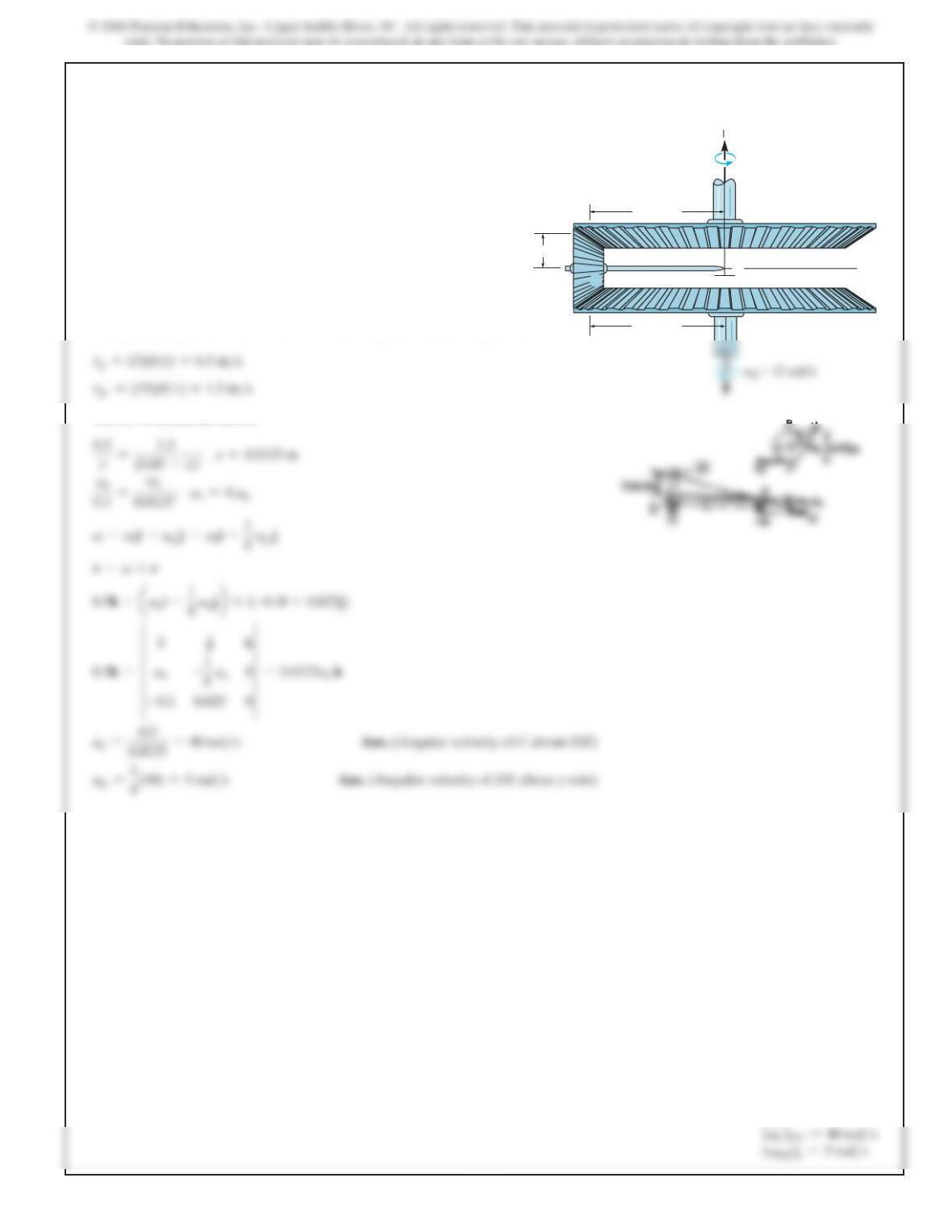
20–5.
If the plate gears A and B are rotating with the angular
velocities shown, determine the angular velocity of gear C
about the shaft DE. What is the angular velocity of DE
about the y axis?
SOLUTION
The speeds of points P and
P′,
located at the top and bottom of gear C, are
The IC is located as shown.
100 mm
100 mm
A
B
DE
25 mm
y
x
vA 5 rad/s
C
Ans:
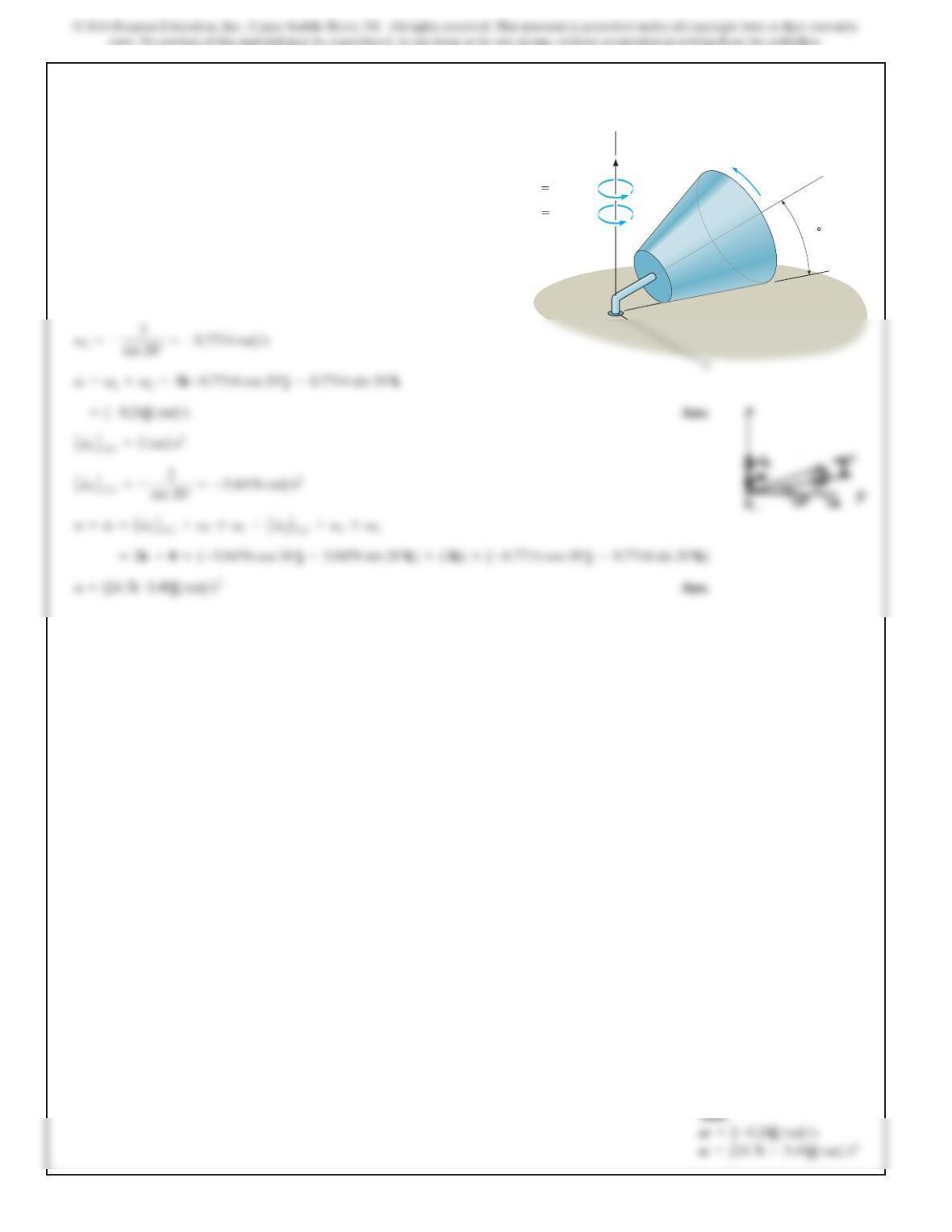
1050
20–6.
T
h
e con
i
ca
l
spoo
l
ro
ll
s on t
h
e p
l
ane w
i
t
h
out s
li
pp
i
ng.If t
h
e
axle has an angular velocity of and an
angular acceleration of at the instant shown,
determine the angular velocity and angular acceleration of
the spool at this instant.
a1=2 rad>s2
v1=3 rad>s
SOLUTION
v1=3 rad>s
20
B
A
v
1
3rad/s
a
1
2rad/s
2
y
z
1051
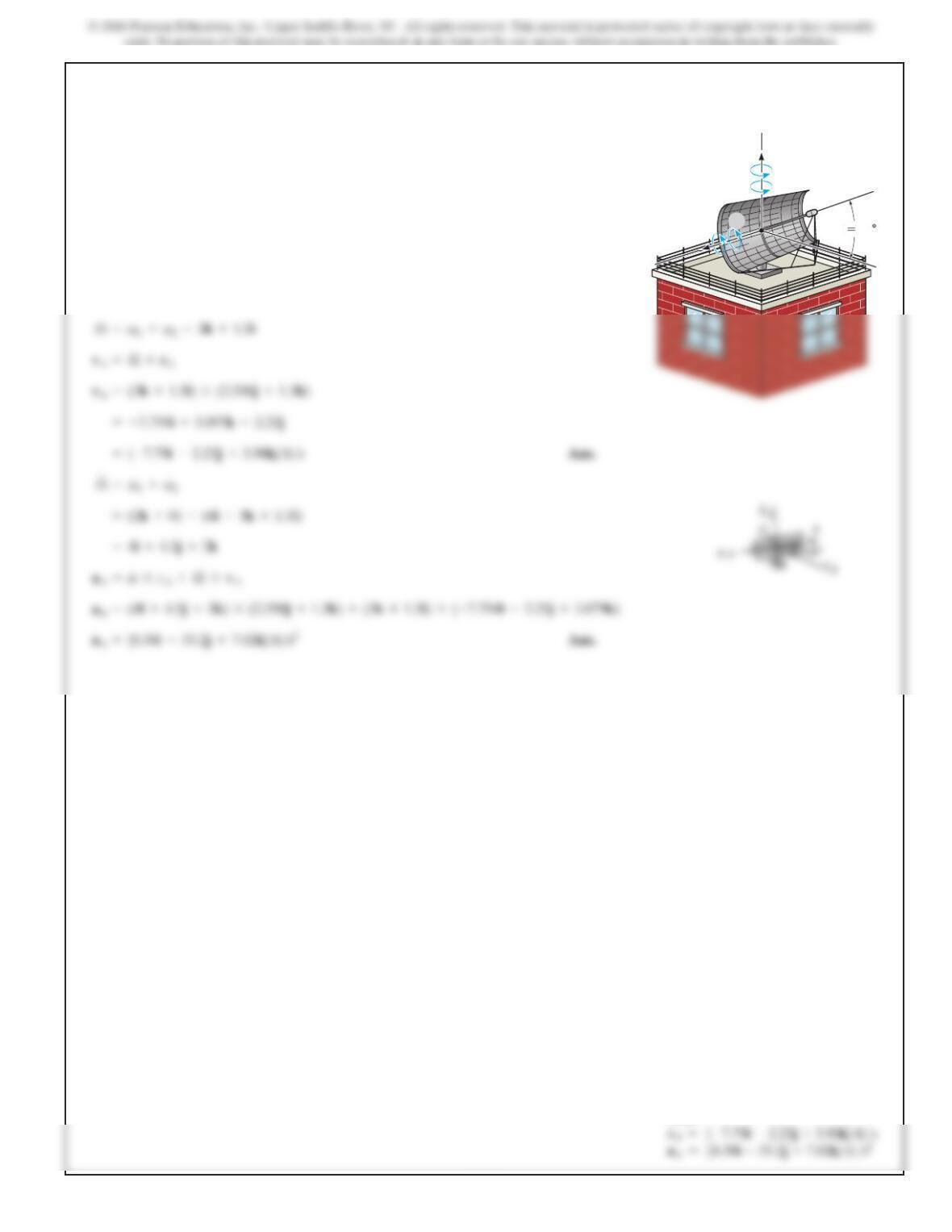
20–7.
SOLUTION
rA=3 cos 30°j+3 sin 30°k={2.598j+1.5k}ft
At a given instant, the antenna has an angular motion
and about the zaxis. At this
same instant the angular motion about the xaxis is
and Determine the velocity
and acceleration of the signal horn Aat this instant. The
distance from Oto Ais d=3ft.
v
#
2=4 rad>s2.v2=1.5 rad>s,
u=30°,
v
#
1=2 rad>s2
v1=3 rad>s
z
xy
u30
O
A
·
·
d
v
1
v
2
v
2
v
1
Ans:
1052
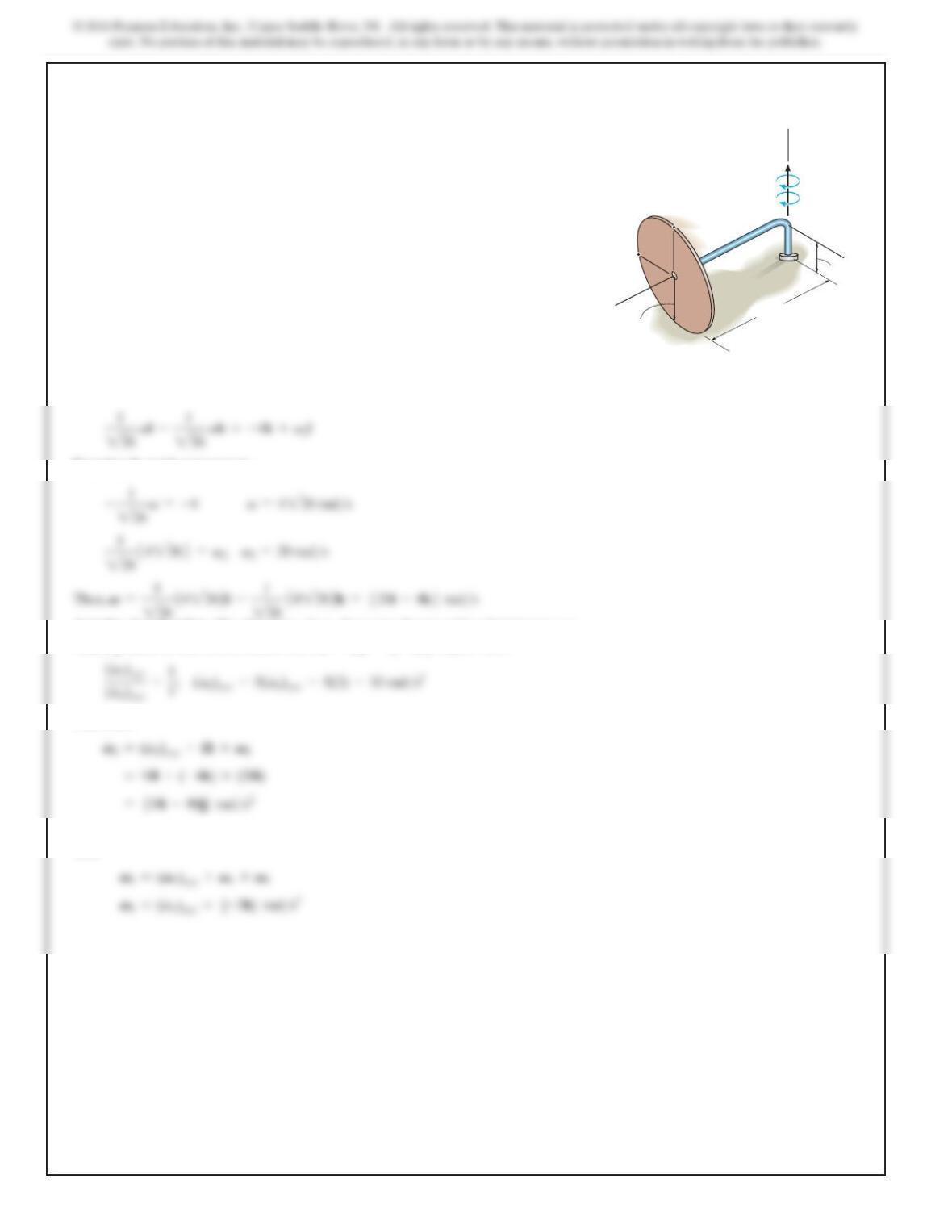
*20–8.
The disk rotates about the shaft S, while the shaft is
turning about the z axis at a rate of
v
z = 4 rad
>
s, which is
increasing at 2 rad
>
s2. Determine the velocity and
acceleration of point A on the disk at the instant shown.
No slipping occurs.
SOLUTION
Angular Velocity. The instantaneous axis of zero velocity (IA) is indicated in Fig.a,
Here, the resultant angular velocity is always directed along IA. The fixed XYZ
reference frame is set to coincide with the rotating xyz frame.
V=V1+v2
Equating k and i components,
Angular Acceleration. The direction of
V2
does not change with reference to xyz
rotating frame if this frame rotates with
𝛀=
V
1=5–4k6 rad>s
. Here
Therefore
Since the direction of
V1
will not change that is always along z axis when
𝛀=
V
1,
then
z
y
A
B
S
x
2 rad/s2
4 rad/s
0.1 m
0.1 m
0.5 m
1053
*20–8. Continued
Finally,
Velocity and Acceleration. Here
rA=50.5i+0.1k6 m
Ans:
1054
20–9.
The disk rotates about the shaft S, while the shaft is
turning about the z axis at a rate of
v
z = 4 rad
>
s, which is
increasing at 2 rad
>
s2. Determine the velocity and
acceleration of point B on the disk at the instant shown.
No slipping occurs.
SOLUTION
Angular velocity. The instantaneous axis of zero velocity (IA) is indicated in Fig.a.
Here the resultant angular velocity is always directed along IA. The fixed XYZ
reference frame is set coincide with the rotating xyz frame.
V=V1+V2
Equating k and i components,
Angular Acceleration. The direction of
V2
does not change with reference to xyz
rotating frame if this frame rotates with
𝛀=
V
1=5–4k6 rad>s
. Here
Therefore,
v
#
2
=(
v
#
2
)
xyz
+𝛀*
V2
Since the direction of
V1
will not change that is always along z axis when
𝛀=
V
1,
then
)
z
y
A
B
S
x
2 rad/s2
4 rad/s
0.1 m
0.1 m
0.5 m
1055
20–9. Continued
Finally,
Velocity and Acceleration. Here
rB=50.5i–0.1j6 m
Ans:
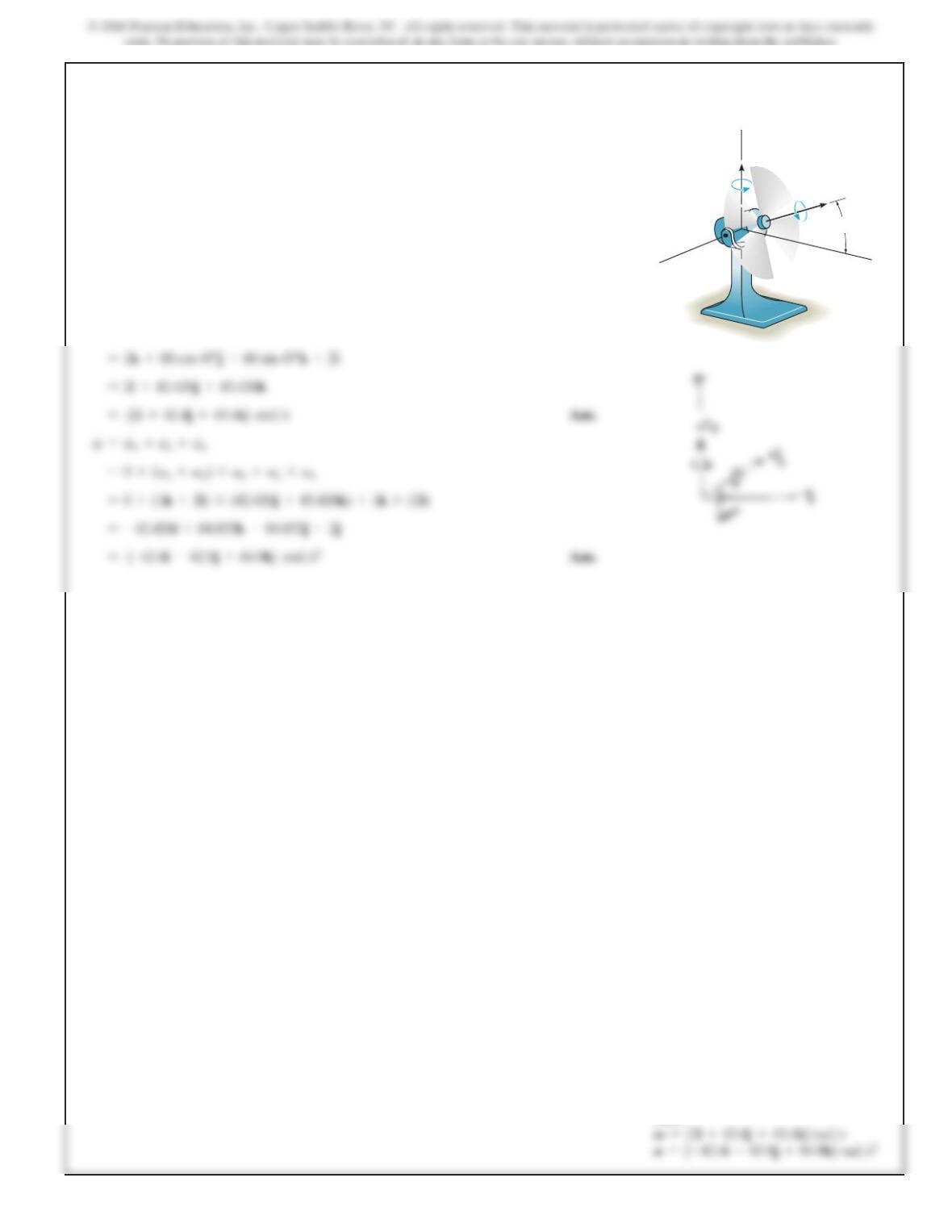
20–10.
The electric fan is mounted on a swivel support such
that the fan rotates about the z axis at a constant rate
of
v
z = 1 rad
>
s and the fan blade is spinning at a
constant rate
vs
= 60 rad
>
s. If f = 45° for the motion,
determine the angular velocity and the angular
acceleration of the blade.
SOLUTION
v=vz+vs
\
x
z
Vz
Vs
f
1057
20–11.
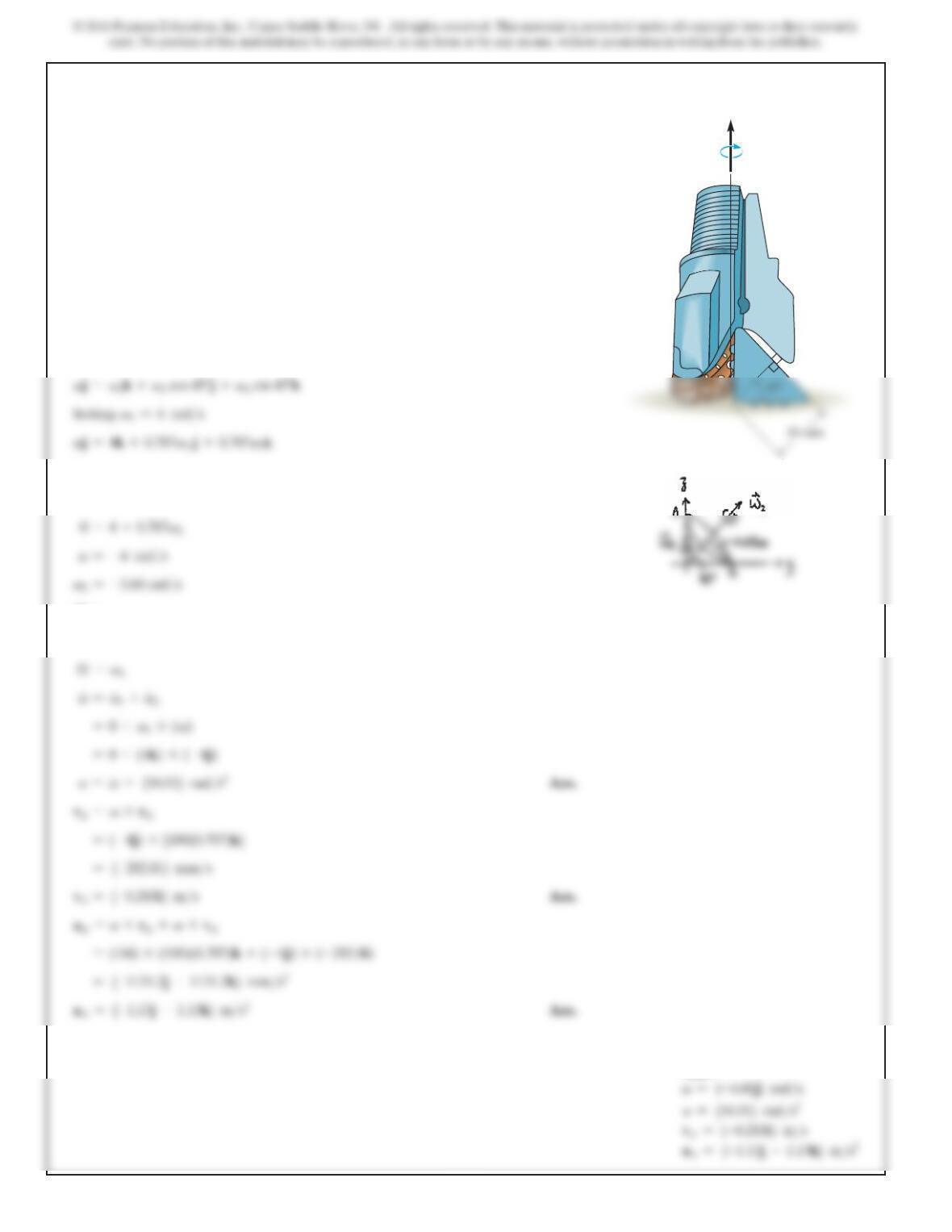
The electric fan is mounted on a swivel support such thatthe
fan rotates about the z axis at a constant rate of
v
z = 1 rad
>
s
and the fan blade is spinning at a constant rate
vs
= 60 rad
>
s.
If at the instant f = 45°, f
#
= 2 rad
>
s for the motion,
determine the angular velocity and the angular acceleration
of the blade.
\
x
z
Vz
Vs
f
Ans:
SOLUTION
v=vz+vs+vx
1058
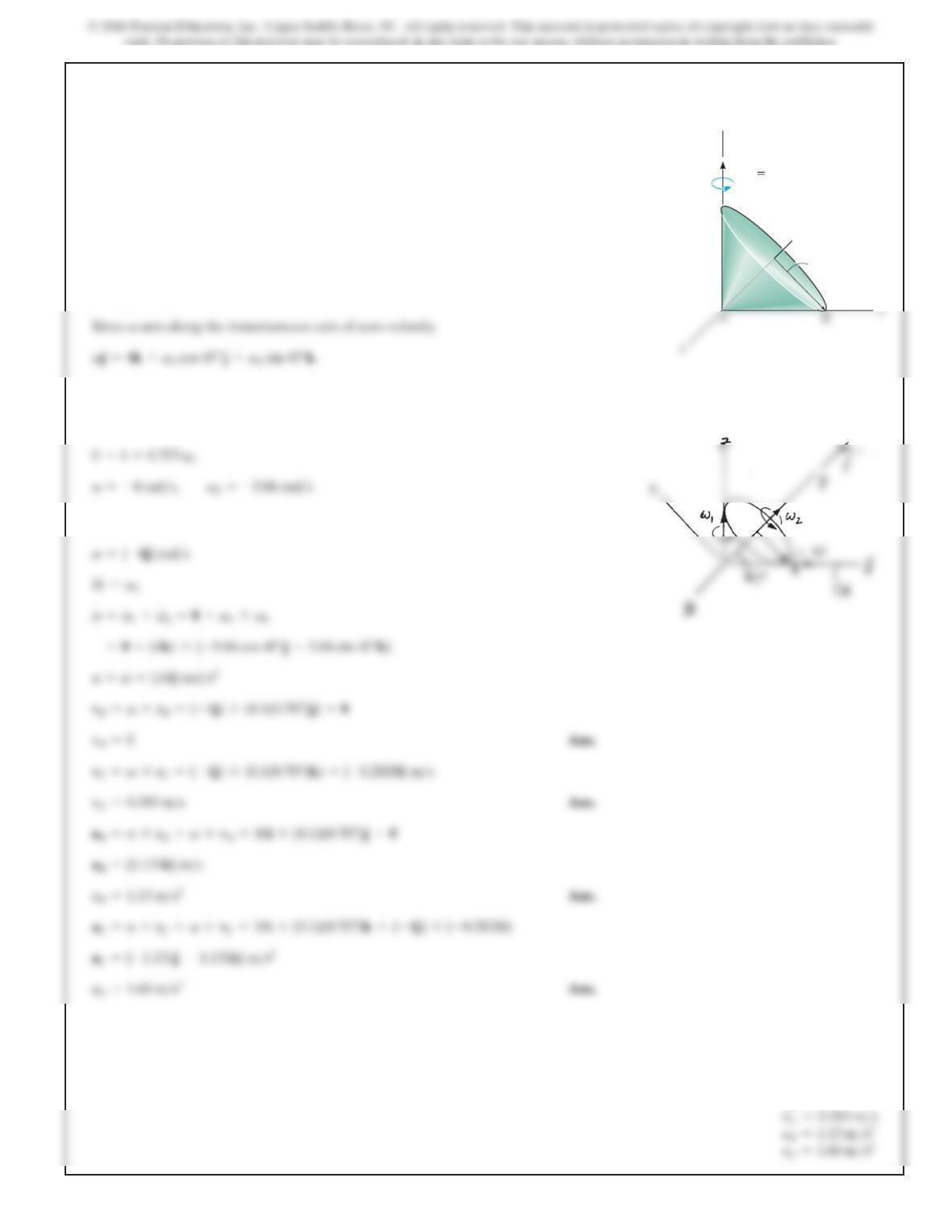
*20–12.
The drill pipe P turns at a constant angular rate
vP
= 4 rad
>
s. Determine the angular velocity and
angular acceleration of the conical rock bit, which rolls
without slipping. Also, what are the velocity and
acceleration of point A?
P
A
v
P
4 rad/s
SOLUTION
v
=
v
1+
v
2
Since
v
acts along the instantaneous axis of zero velocity,
Equating components
v
=0.707
v
2
=–4 rad>s
Thus,
v
=5–4.00j6 rad>s
Ans.
Ans:
1059
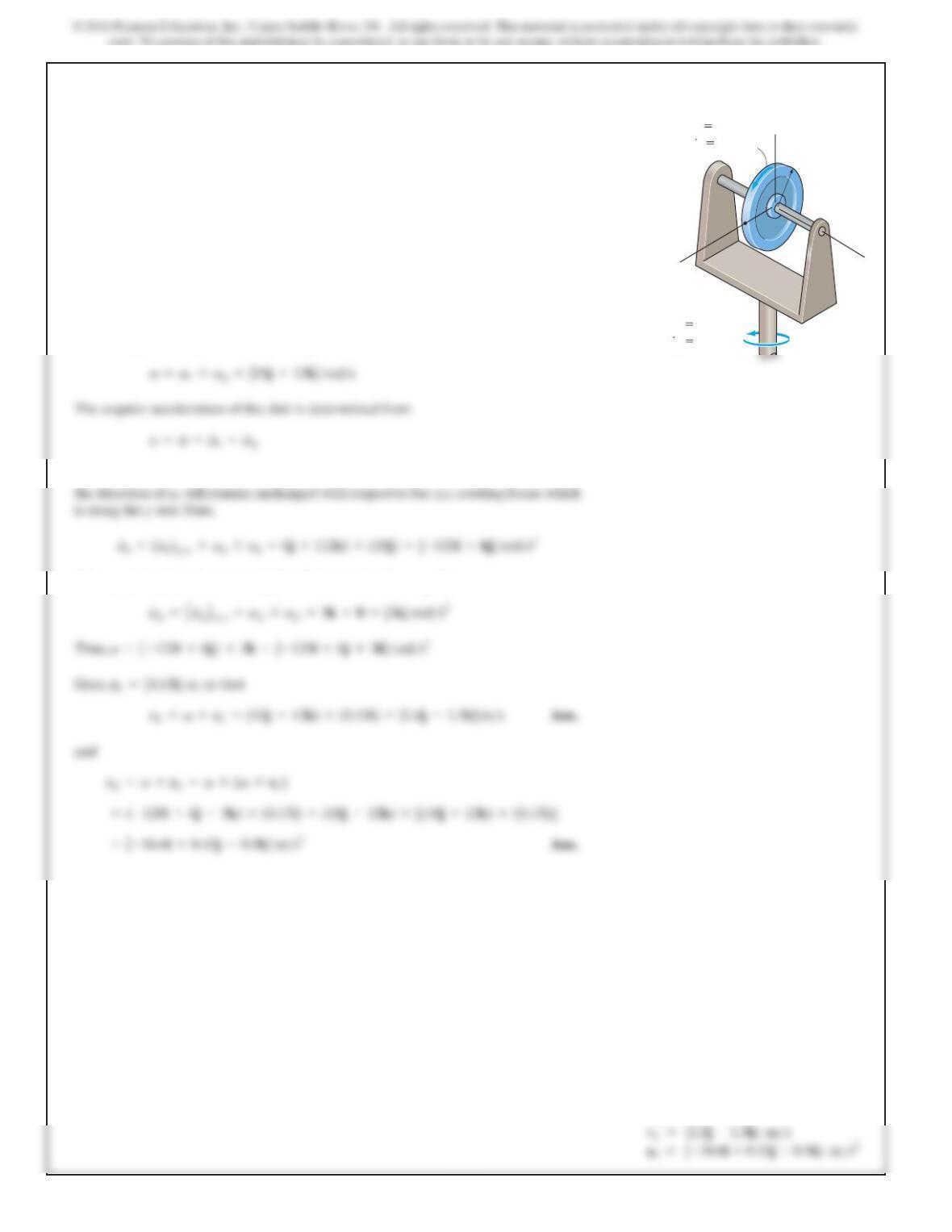
20–13.
T
h
e r
i
g
h
t c
i
rcu
l
ar cone rotates a
b
out t
h
e zax
i
s at a constant
rate of without slipping on the horizontal
plane. Determine the magnitudes of the velocity and
acceleration of points Band C.
v1=4 rad>s
SOLUTION
Equating components,
Thus,
v=0.707 v2
v=v1+v2
C
50 mm
z
v
1
4 rad/s
Ans:
vB=0
1060
20–14.
z
x
vp 12 rad/s
vp 3 rad/s2
vs 10 rad/s
vs 6 rad/s2
A
B
C
0.15 m
y
The wheel is spinning about shaft AB with an angular
velocity of = 10 rad>s, which is increasing at a constant
rate of = 6 rad>s , while the frame precesses about the
z axis with an angular velocity of v = 12 rad>s, which is
increasing at a constant rate of v = 3 rad>s . Determine
the velocity and acceleration of point C located on the rim
of the wheel at this instant.
#
p2
p
v
#
s2
vs
SOLUTION
The XYZ fixed reference frame is set to coincide with the rotatingxyz reference frame
at the instant considered. Thus,the angular velocity of the wheel at thisinstant can be
obtained by vector addition of and .
If we set the xyz rotating frame to have an angular velocity of ,
Since is always directed along the Zaxis where , then
Æ=vp
vp
Æ=vp=[12k] rad>s
vp
vs
Ans:
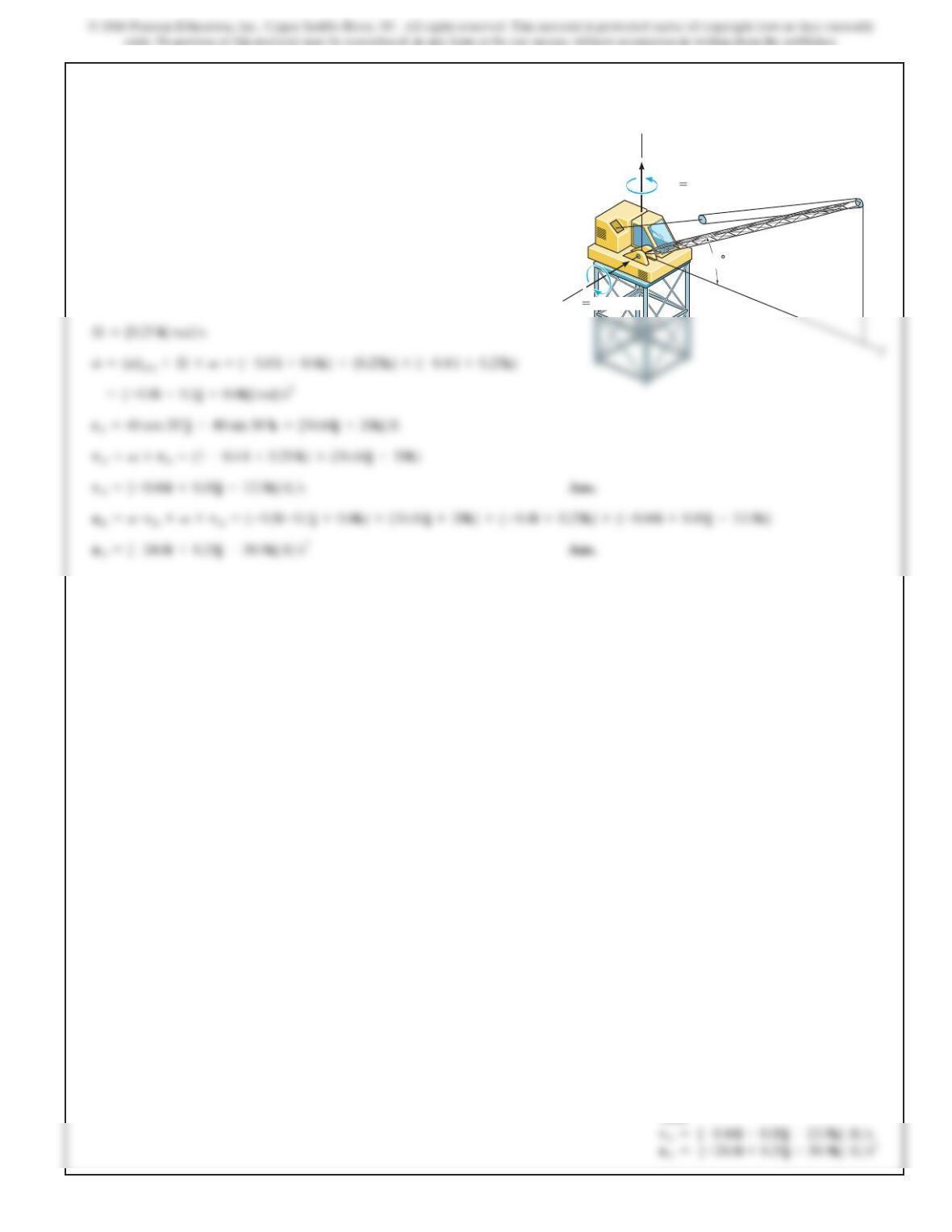
1061
20–15.
At the instant shown, the tower crane rotates about the
zaxis with an angular velocity , which is
increasing at .The boom OA rotates downward
with an angular velocity , which is increasing
at . Determine the velocity and acceleration of
point Alocated at the end of the boom at this instant.
0.8 rad>s2
v2=0.4 rad>s
0.6 rad>s2
v1=0.25 rad>s
v10.25 rad/s
40 ft
z
x
A
O
v20.4 rad/s
30
SOLUTION
v=v1+v2={–0.4 i+0.25k} rad>s
Ans:
1062
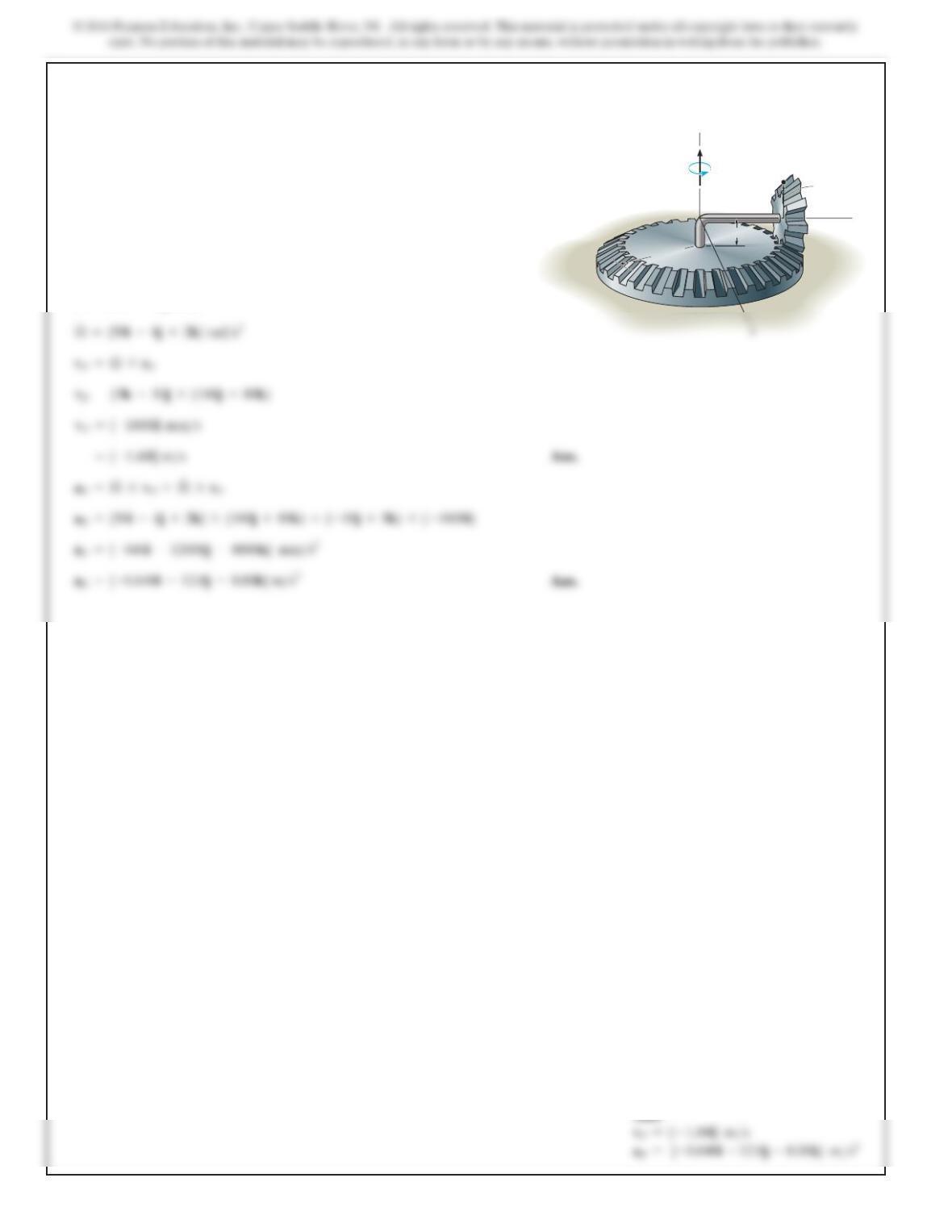
*20–16.
Gear Ais fixed while gear Bis free to rotate on the shaft S.
If the shaft is turning about the zaxis at
while increasing at determine the velocity and
acceleration of point Pat the instant shown. The face of
gear Blies in a vertical plane.
2 rad>s2,
vz=5 rad>s,
y
z
AB
S
P
80 mm
80 mm
160 mm
V
z
SOLUTION
Æ={5k–10j} rad>s
1063
20–17.
SOLUTION
(1)
v
#=(v
#)xyz +Æ*v
u=sin–1a0.5
1b=30°
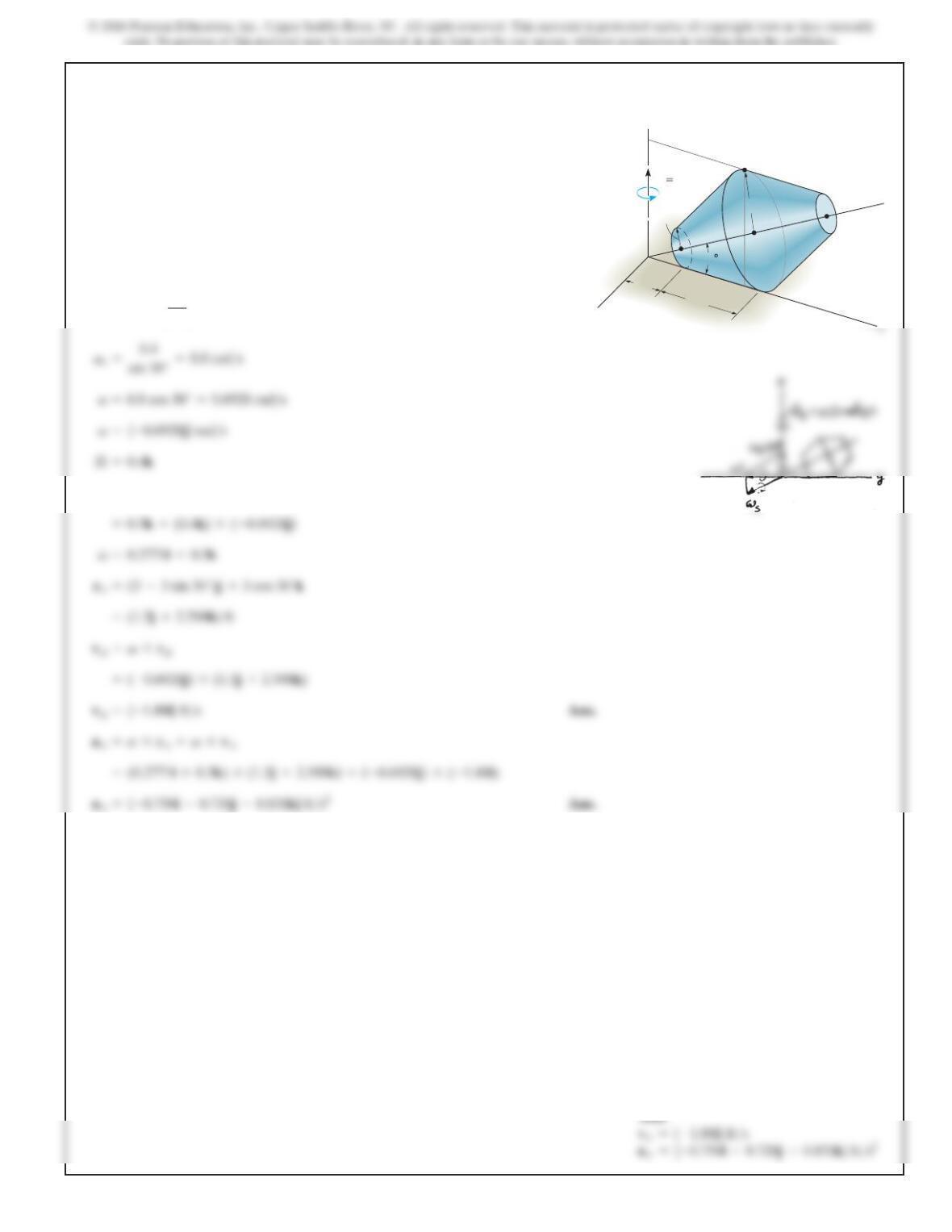
T
h
e truncate
d
d
ou
bl
e cone rotates a
b
out t
h
e zax
i
s at
without slipping on the horizontal plane.If
at this same instant is increasing at
determine the velocity and acceleration of point Aon
the cone.
v
#
z=0.5 rad>s2,vz
vz=0.4 rad>s
1.5 ft
0.5ft
30
A
z
x
v
z
0.4rad/s
1ft
2ft
1064
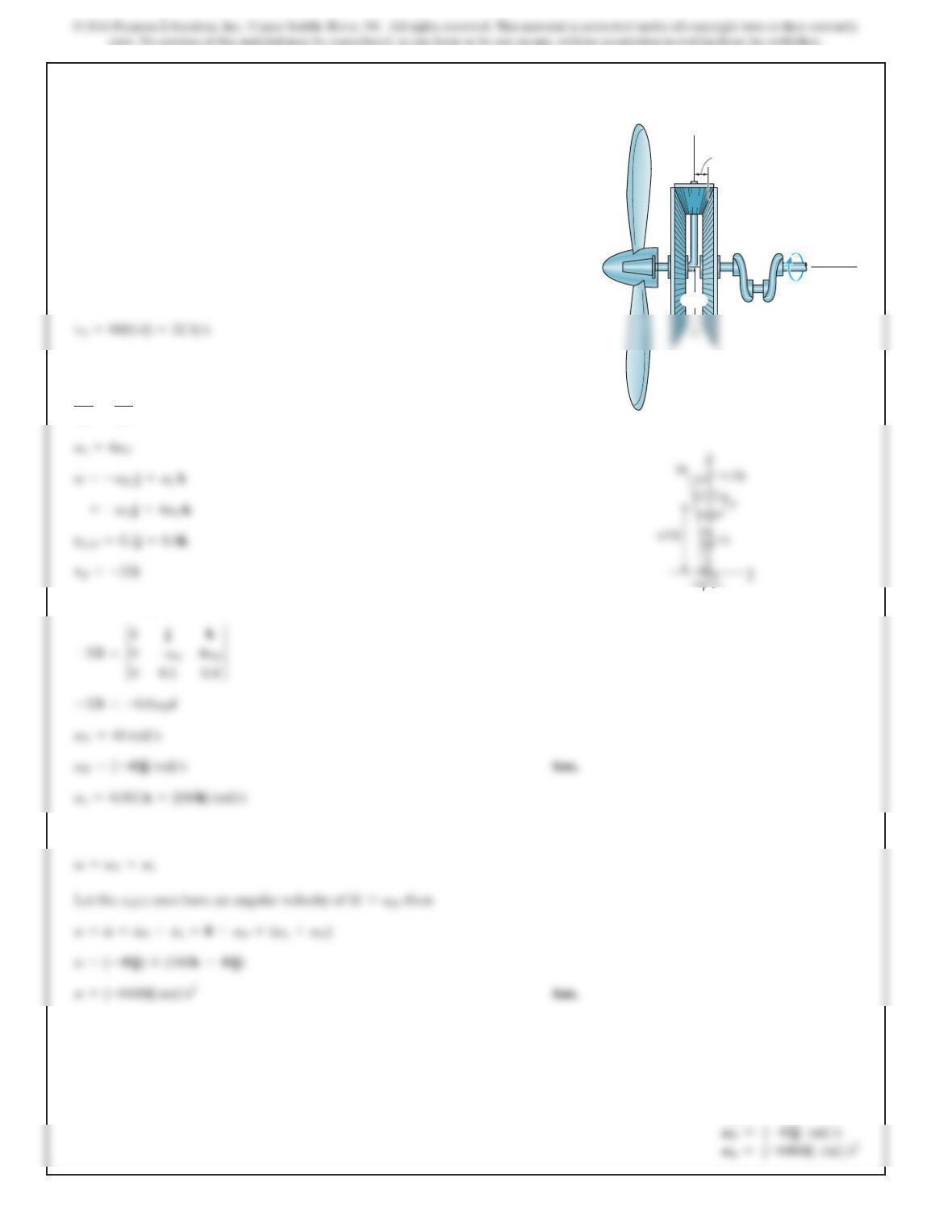
20–18.
SOLUTION
Point Pon gear Bhas a speed of
The IA is located along the points of contant of Band C
Thus,
vP=v*rP/O
vP
0.1 =vs
0.4
0.1 ft
CA
B
S
y
z
80 rad/s
0.4 ft
Gear A is fixed to the crankshaft S, while gear C is fixed.
Gear B and the propeller are free to rotate. The crankshaft is
turning at 80 rad
>
s about its axis. Determine the magnitudes
of the angular velocity of the propeller and the angular
acceleration of gear B.
Ans: