4 2
Ans:
SOLUTION
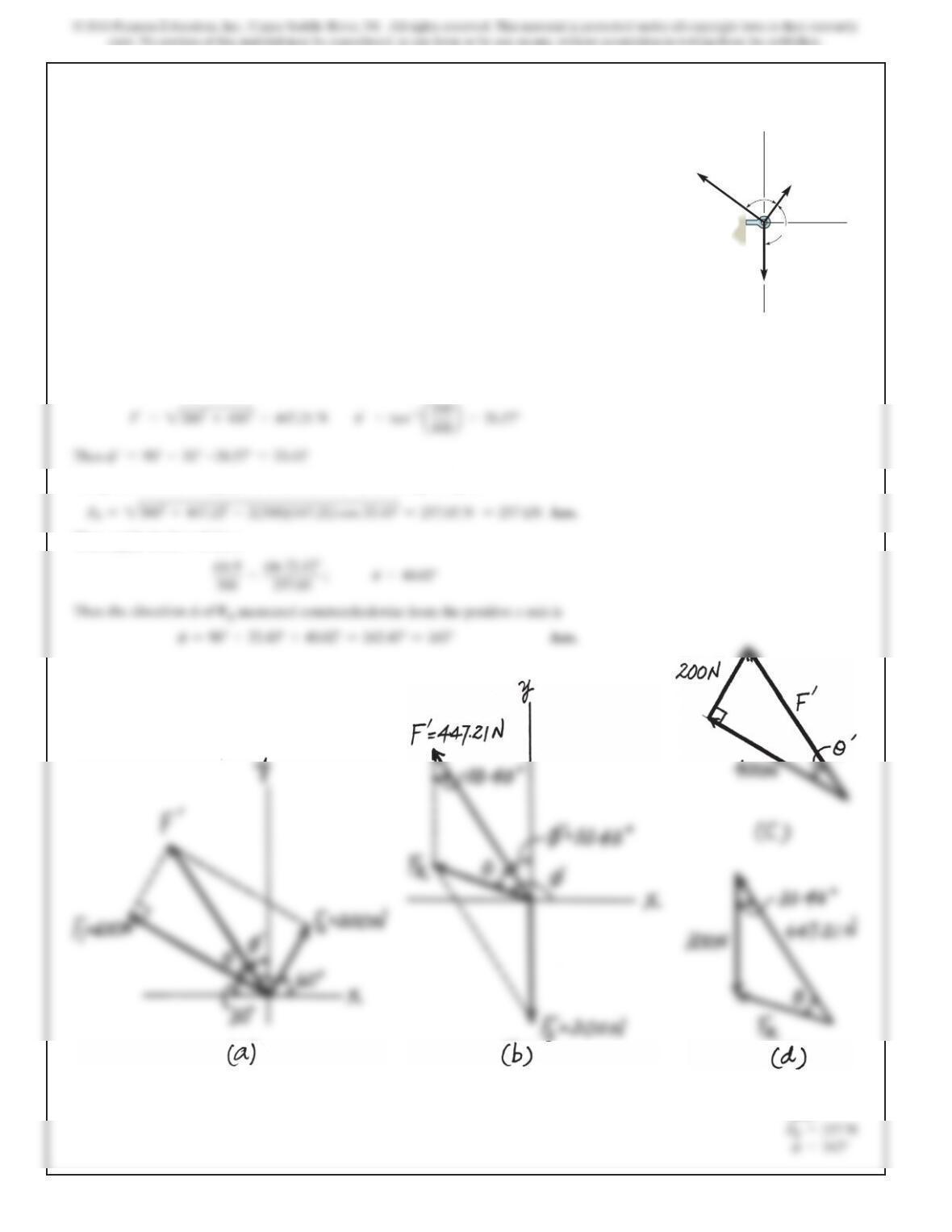
Parallelogram Law. The parallelogram law of addition for F1 and F2 and then their
resultant
F′
and F3 are shown in Figs. a and b, respectively.
Trigonometry. Referring to Fig. c,
Using these results to apply the law of cosines by referring to Fig. d,
Then, apply the law of sines,
x
y
90º
150º
F1 400 N
F2 200 N
F3 300 N
2–21.
Determine the magnitude and direction of the resultant
force, FR measured counterclockwise from the positive x
axis. Solve the problem by first finding the resultant
F′
= F1
+ F2 and then forming FR =
F′
+ F3.
4 3
Ans:
SOLUTION
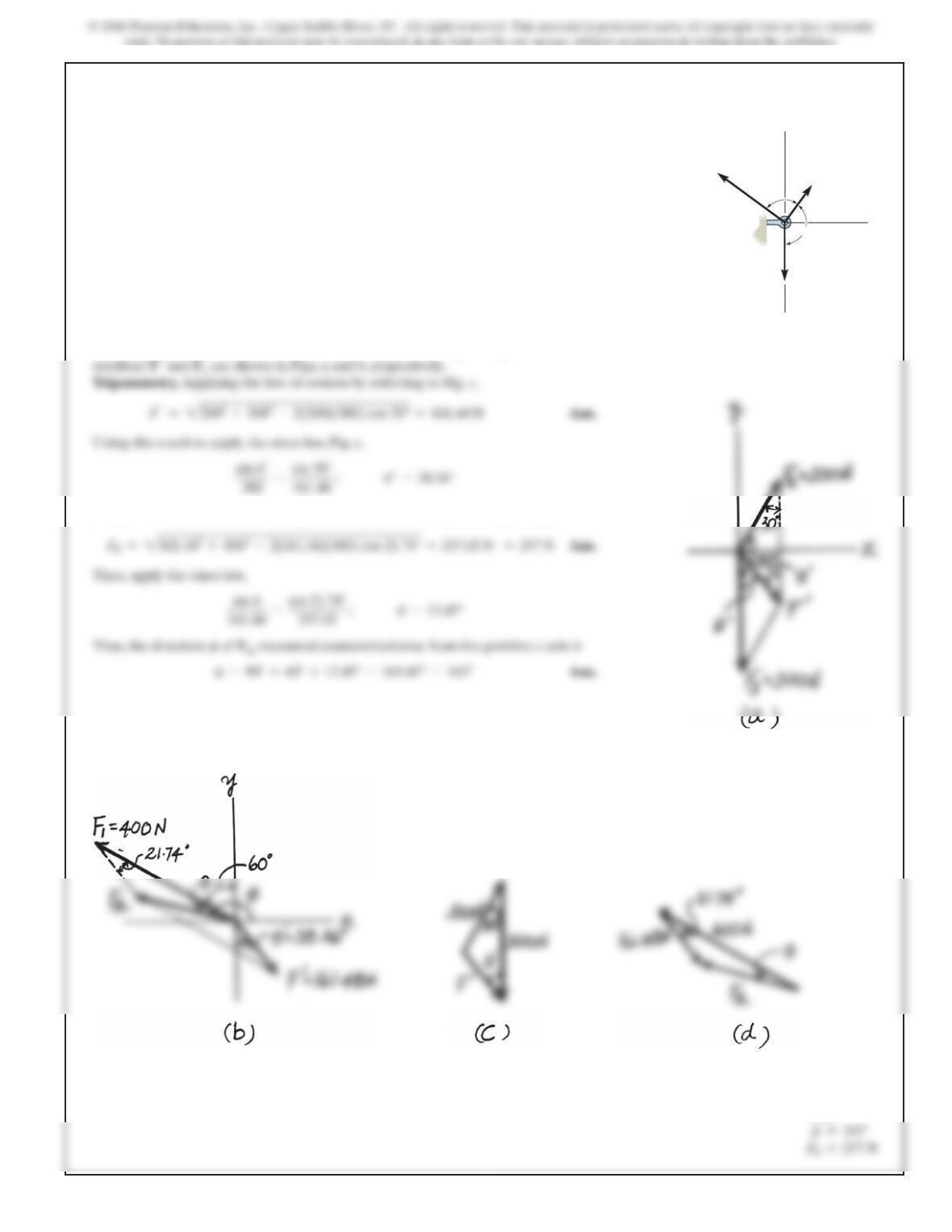
Parallelogram Law. The parallelogram law of addition for F2 and F3 and then their
F′
Using the results of
F′
and
u′
to apply the law of cosines by referring to Fig. d,
2–22.
Determine the magnitude and direction of the resultant force,
measured counterclockwise from the positive x axis. Solve l by
first finding the resultant
F′
= F2 + F3 and then forming
FR =
F′
+ F1.
x
y
90º
150º
F1 400 N
F2 200 N
F3 300 N
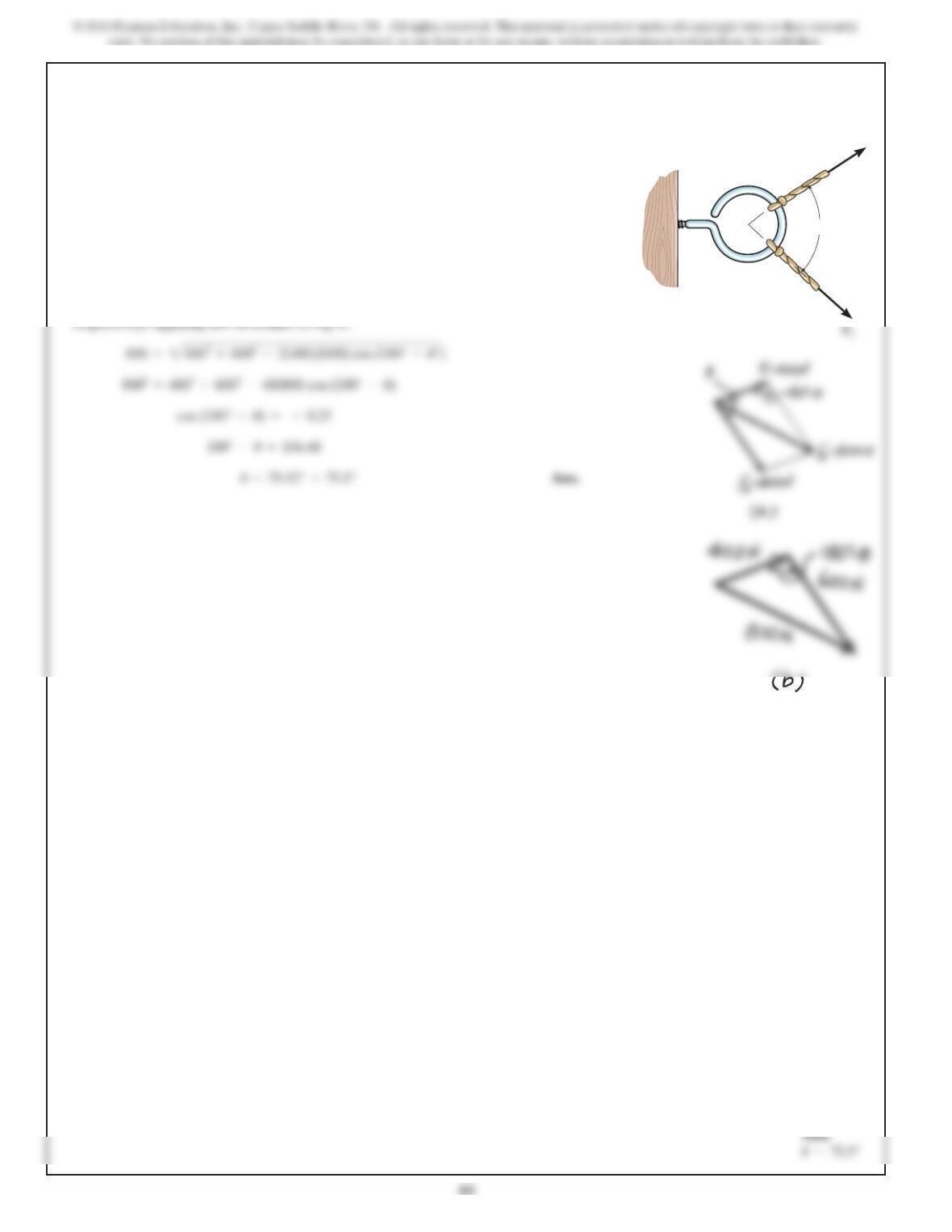
2–23.
Two forces act on the screw eye. If and
, determine the angle
between them, so that the resultant force has a magnitude
of .FR=800 N
u(0° …u…180°)F2=600 N
F1=400 N
SOLUTION
The parallelogram law of addition and triangular rule are shown in Figs. aand b,
F1
u
4 5
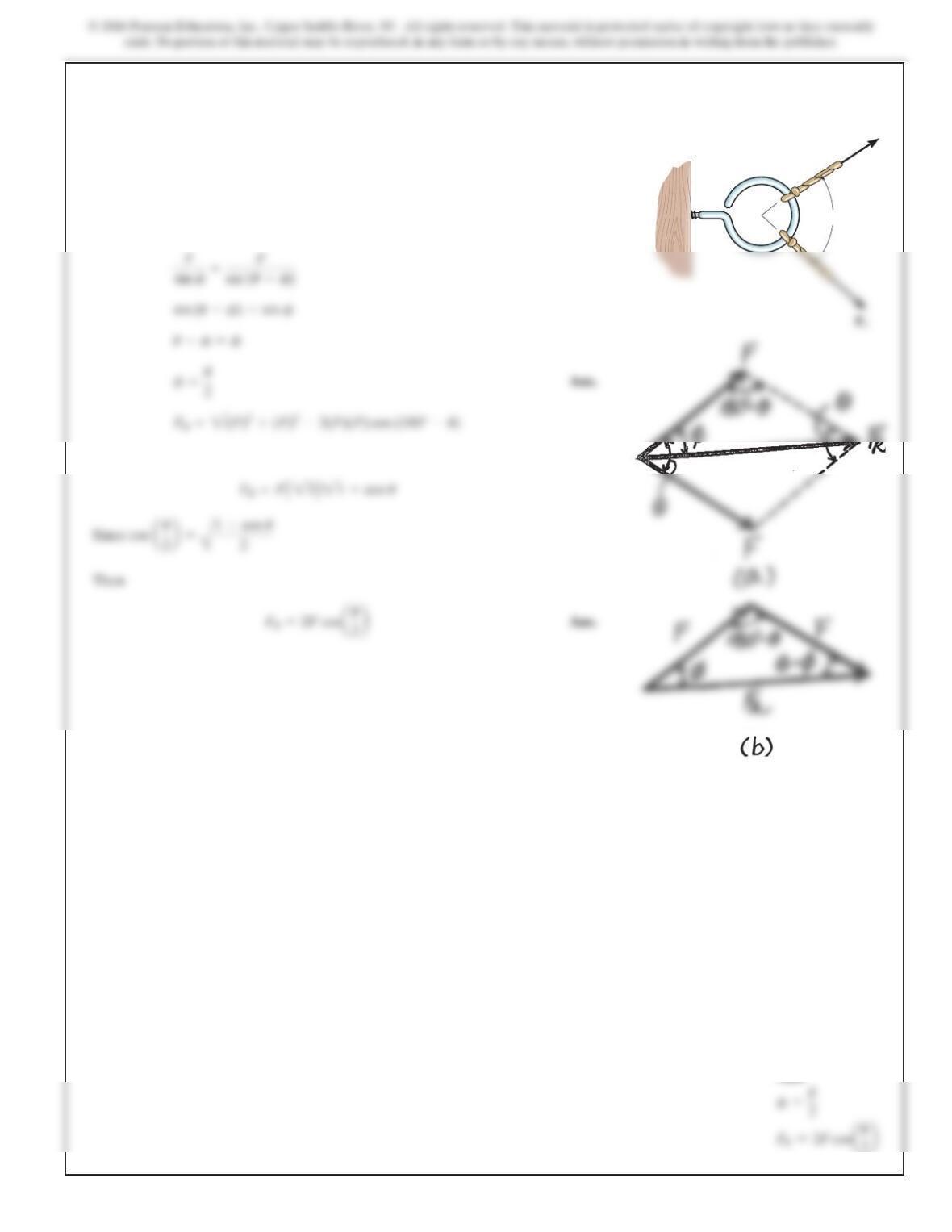
*2–24.
SOLUTION
Since
cos (180° –u)=-cos u
Two forces F
1
and F
2
act on the screw eye. If their lines of
action are at an angle apart and the magnitude of each
force is determine the magnitude of the
resultant force FRand the angle between FRand F1.
F
1=F
2=F,
u
F
1
u
Ans:
2b
4 6
Ans:
SOLUTION
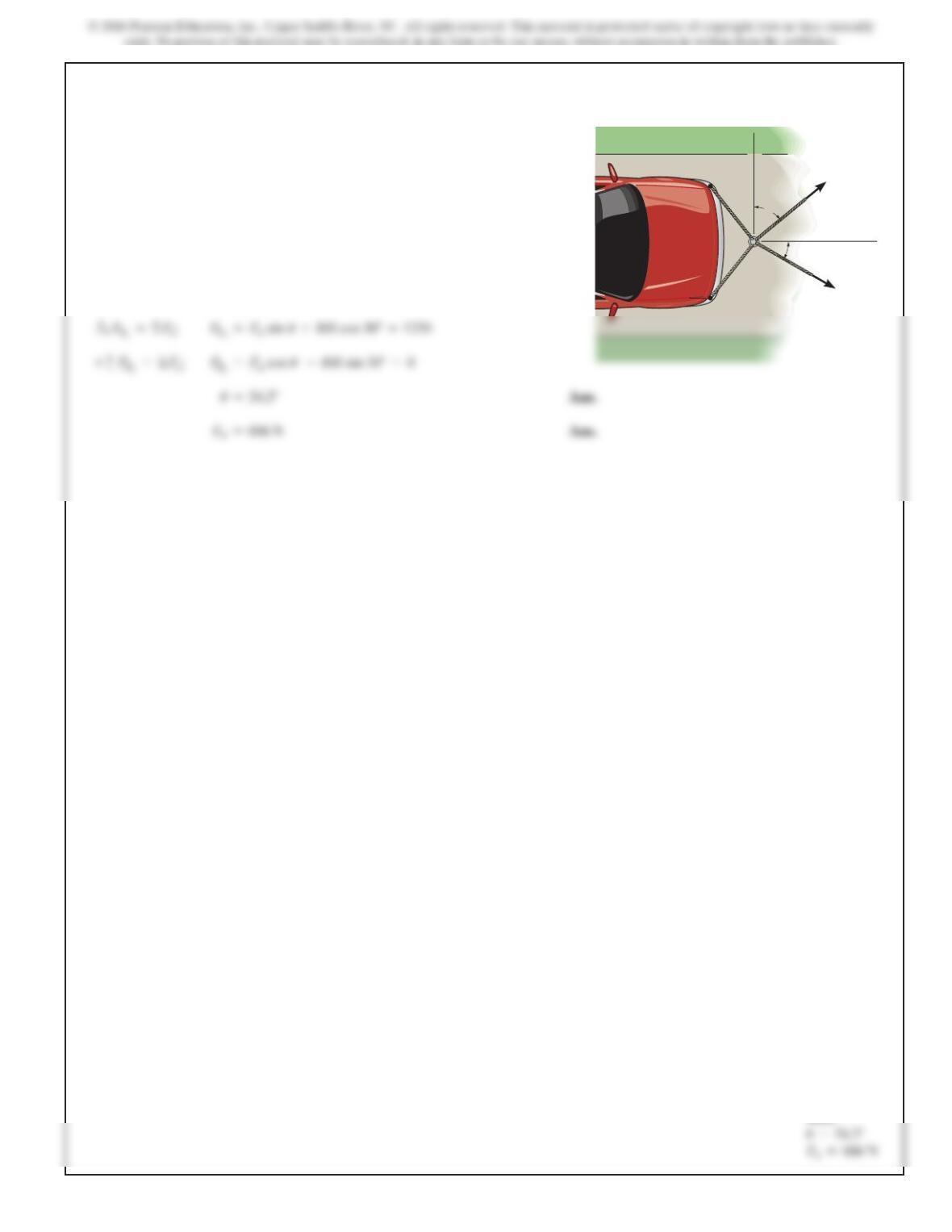
Parallelogram Law. The parallelogram law of addition is shown in Fig. a,
Trigonometry. Applying the law of cosine by referring to Fig. b,
2–25.
If F1 = 30 lb and F2 = 40 lb, determine the angles
u
and f so
that the resultant force is directed along the positive x axis
and has a magnitude of FR = 60 lb.
y
x
θ
φ
F1
F2
4 7
2–26.
SOLUTION
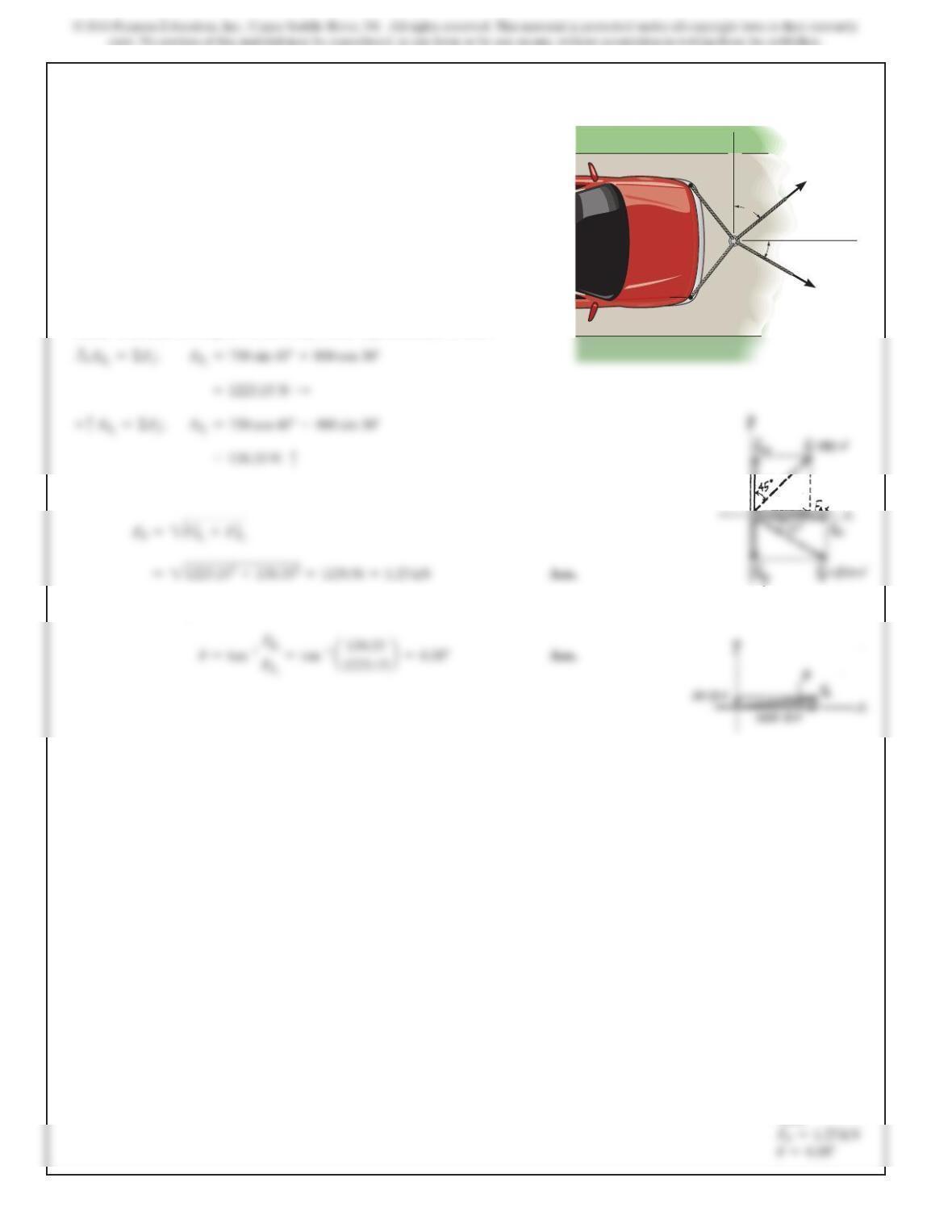
Determine the magnitude and direction u of FA so that the
resultant force is directed along the positive x axis and has a
magnitude of 1250 N.
30°
y
x
O
B
A
B
F
= 800 N
FA
θ
Ans:
4 8
2–27.
SOLUTION
Scalar Notation: Suming the force components algebraically, we have
The magnitude of the resultant force FR is
The directional angle u measured counterclockwise from positive x axis is
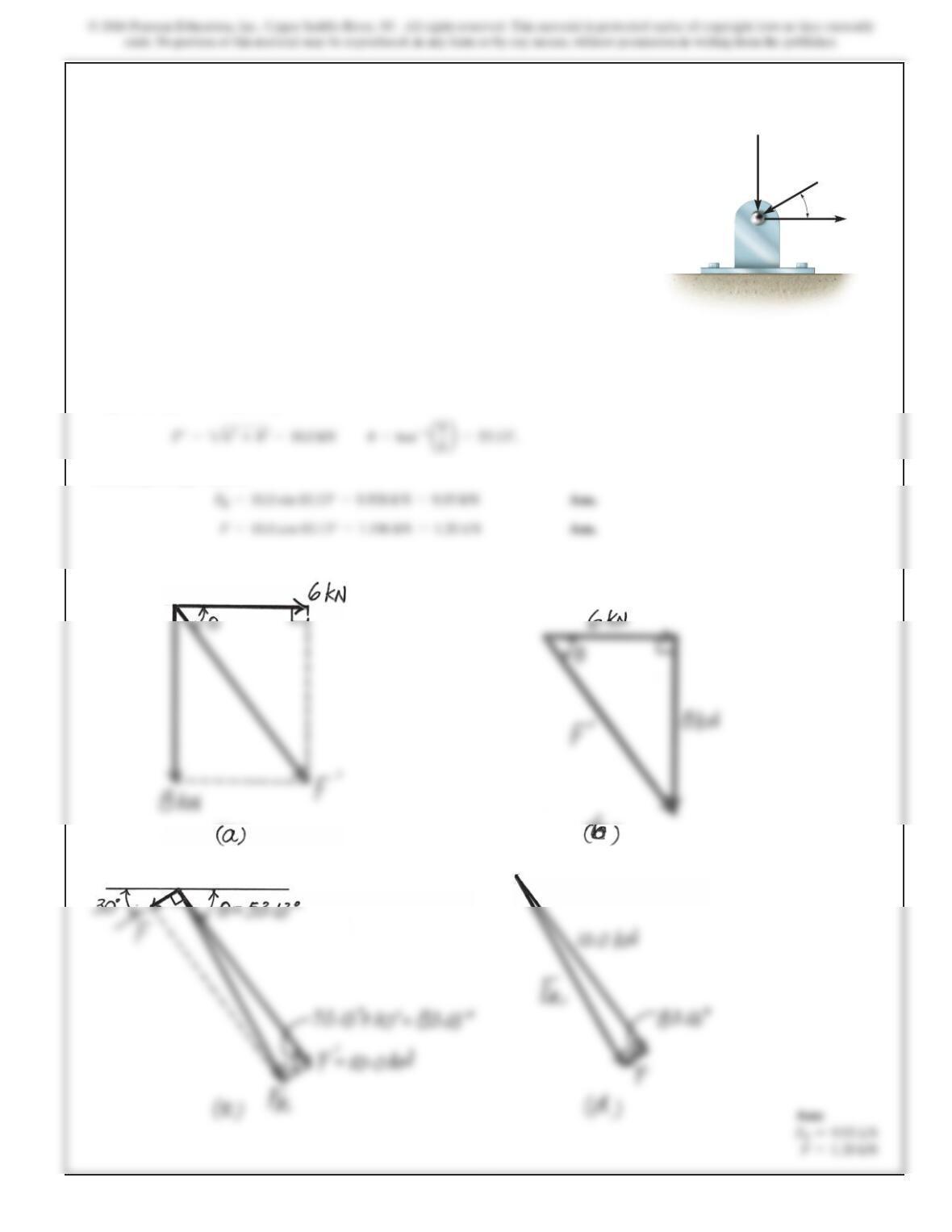
Determine the magnitude and direction, measured
counterclockwise from the positive x axis, of the resultant
force acting on the ring at O, if FA=750 N and u=45°.
30°
y
x
O
B
A
B
F
= 800 N
FA
θ
Ans:
4 9
SOLUTION
Parallelogram Law. The parallelogram laws of addition for 6 kN and 8 kN and then
their resultant
F′
and F are shown in Figs. a and b, respectively. In order for
FR
to be
minimum, it must act perpendicular to F.
Trigonometry. Referring to Fig. b,
Referring to Figs. c and d,
*2–28.
Determine the magnitude of force F so that the resultant FR
of the three forces is as small as possible. What is the
minimum magnitude of FR?.
6 kN
8 kN
F
30
5 0
2–29.
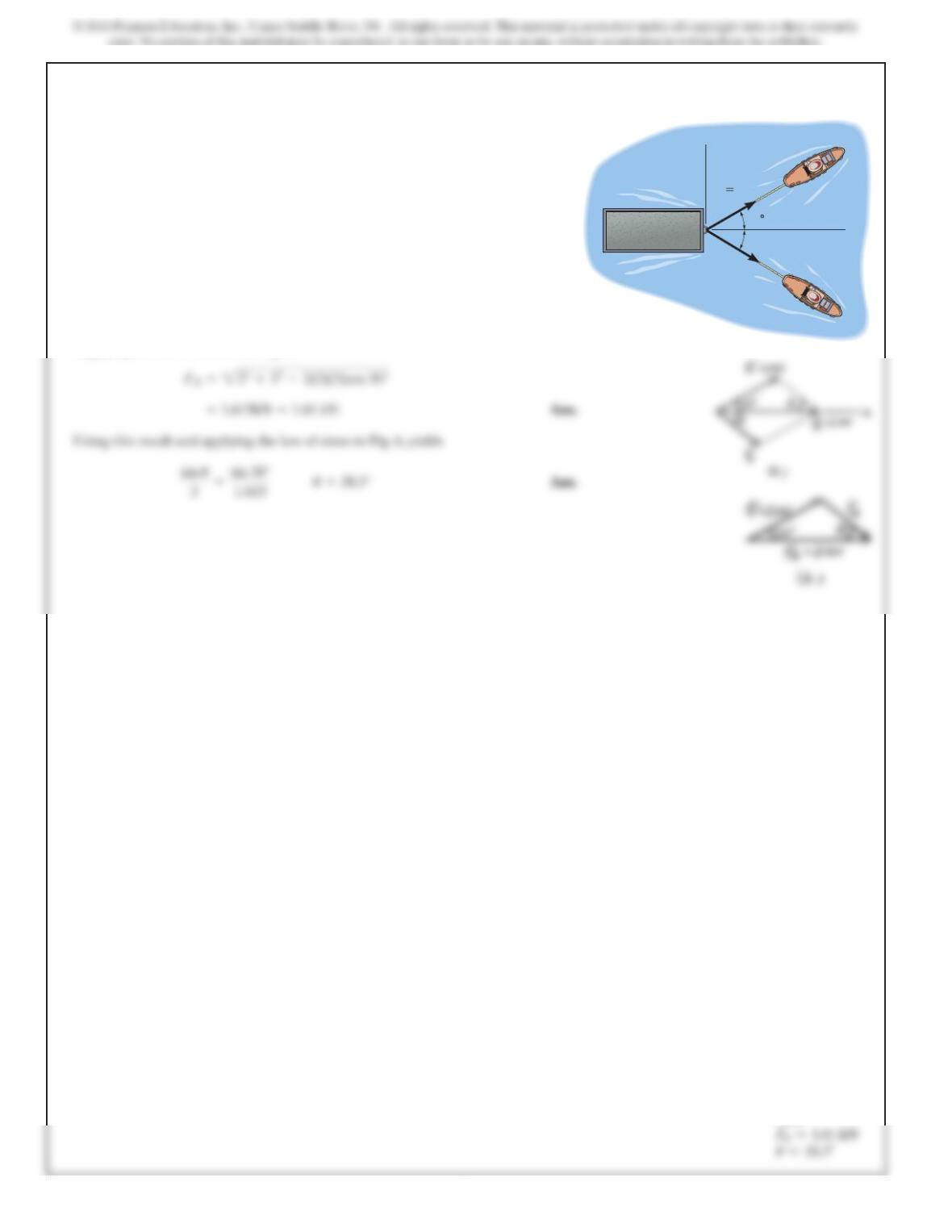
If the resultant force of the two tugboats is , directed
along the positive axis, determine the required magnitude
of force and its direction .uFB
x
3 kN
SOLUTION
The parallelogram law of addition and the triangular rule are shown in Figs. aand b,
respectively.
Applying the law of cosines to Fig. b,
x
yA
B
FB
FA 2 kN
30
C
u
Ans:
5 1
2–30.
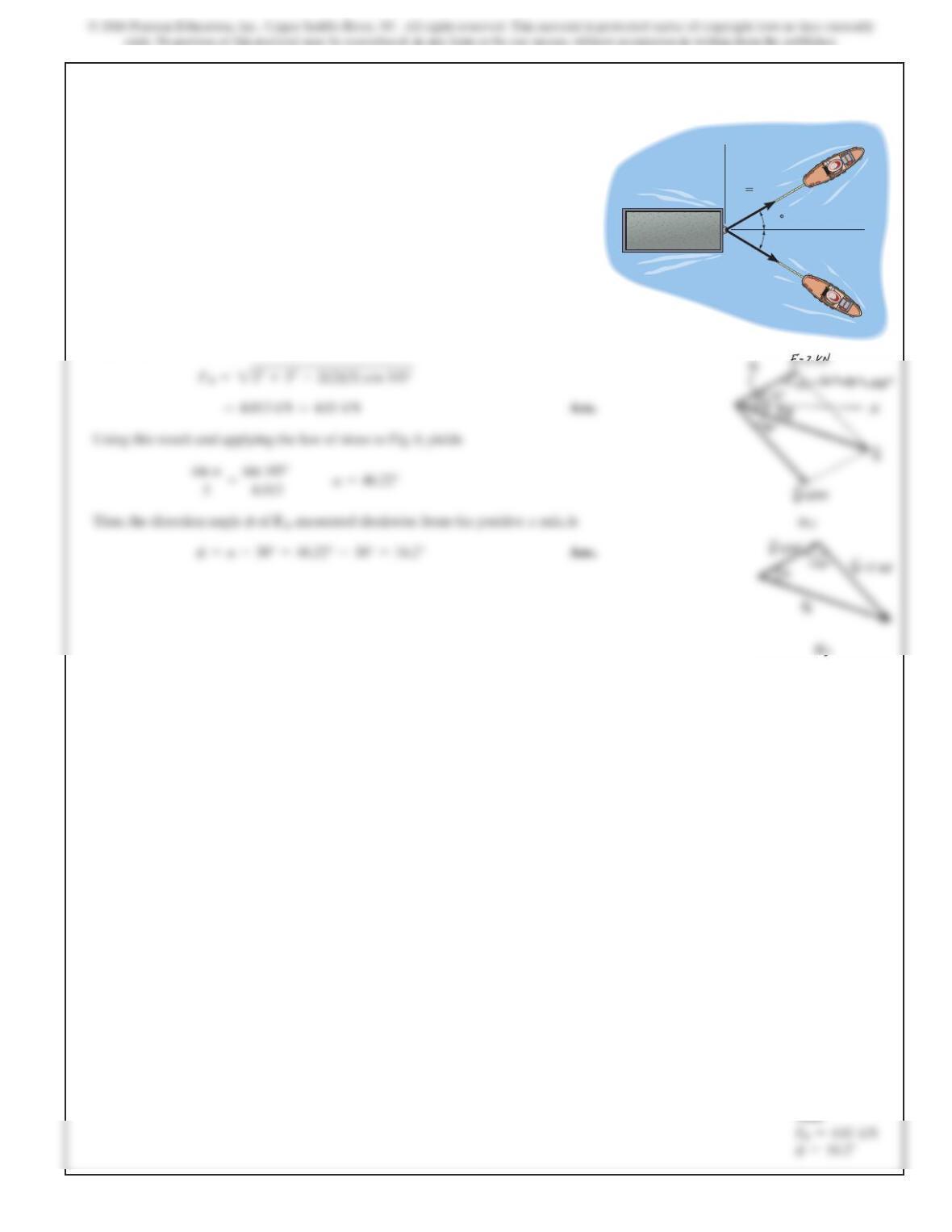
If and , determine the magnitude of the
resultant force of the two tugboats and its direction
measured clockwise from the positive axis.x
u=45°FB=3 kN
SOLUTION
The parallelogram law of addition and the triangular rule are shown in Figs. aand b,
respectively.
Applying the law of cosines to Fig. b,
x
yA
B
FB
FA 2 kN
30
C
u
5 2
2–31.
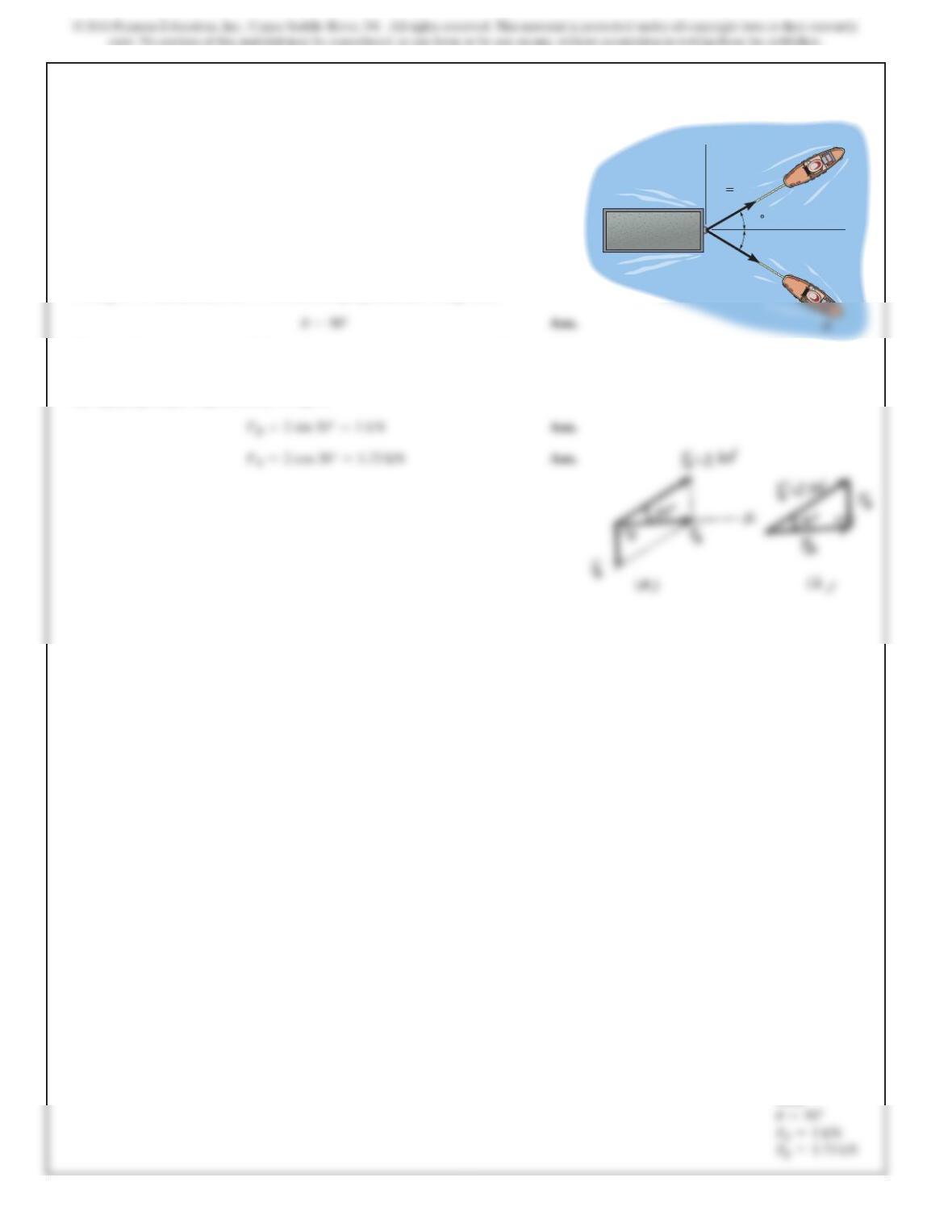
If the resultant force of the two tugboats is required to be
directed towards the positive axis, and is to be a
minimum, determine the magnitude of and and the
angle .u
FB
FR
FB
x
SOLUTION
For to be minimum, it has to be directed perpendicular to .Thus,
The parallelogram law of addition and triangular rule are shown in Figs. aand b,
respectively.
By applying simple trigonometry to Fig. b,
FR
FB
x
yA
FB
FA 2 kN
30
C
u
Ans:
5 3
SOLUTION
Scalar Notation. Summing the force components along x and y axes algebraically by
referring to Fig. a,
Referring to Fig. b, the magnitude of the resultant force FR is
And the directional angle
u
of FR measured counterclockwise from the positive
xaxis is
*2–32.
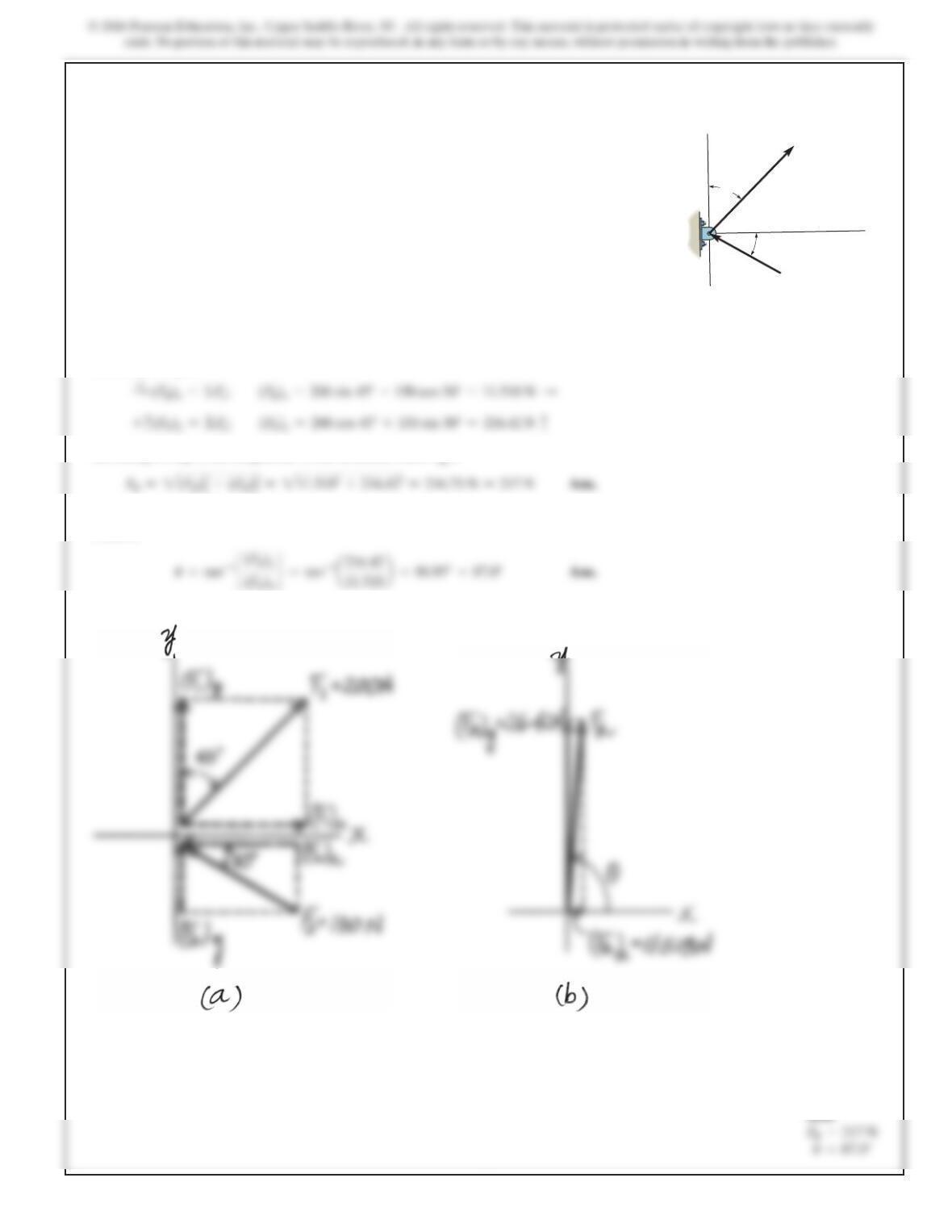
Determine the magnitude of the resultant force and its
direction, measured counterclockwise from the positive
xaxis.
y
x
30
F1 200 N
F2 150 N
45
5 4
Ans:
SOLUTION
Scalar Notation. Summing the force components along x and y axes by referring
toFig. a,
Referring to Fig. b, the magnitude of the resultant force is
2–33.
Determine the magnitude of the resultant force and its
direction, measured clockwise from the positive x axis.
800 N
400 N
x
y
B
45
30
5 5
2–34.
Resolve and into their and components.yxF2
F1
SOLUTION
F1 400 N
x
y
60
30
45
Ans:
5 6
2–35.
Determine the magnitude of the resultant force and its
direction measured counterclockwise from the positive xaxis.
SOLUTION
Rectangular Components: By referring to Fig. a, the xand ycomponents of and
can be written as
Resultant Force: Summing the force components algebraically along the and
axes, we have
The magnitude of the resultant force is
FR
y
x
F2
F1
F1 400 N
x
y
60
30
45
Ans:
5 7
*2–36.
Resolve each force acting on the gusset plate into its and
components, and express each force as a Cartesian vector.y
x
F2 750 N
45
F3 650 N
3
4
5
x
y
Ans:
5 8
2–37.
Determine the magnitude of the resultant force acting on
the plate and its direction, measured counterclockwise from
the positive xaxis.
SOLUTION
Rectangular Components: By referring to Fig. a, the xand ycomponents of ,,
and can be written as
Resultant Force: Summing the force components algebraically along the and
axes,we have
The magnitude of the resultant force is
FR
y
x
F3
F2
F1
F2 750 N
45
F3 650 N
3
4
5
x
y
Ans:
5 9
SOLUTION
Cartesian Notation. Referring to Fig. a,
Thus, the resultant force is
Referring to Fig. b, the magnitude of FR is
2–38.
Express each of the three forces acting on the support in
Cartesian vector form and determine the magnitude of the
resultant force and its direction, measured clockwise from
positive x axis.
y
x
F2 80 N
F1 50 N
15
3
4
5
4
F3 30 N
2–39.
SOLUTION
Determine the xand ycomponents of and F
2
.F
1
y
30
F
1
200 N
45
6 1
*2–40.
Determine the magnitudeofthe resultant force andits
direction, measured counterclockwise from the positive
xaxis.
SOLUTION
y
30
F
1
200 N
45
Ans: