102
2–81.
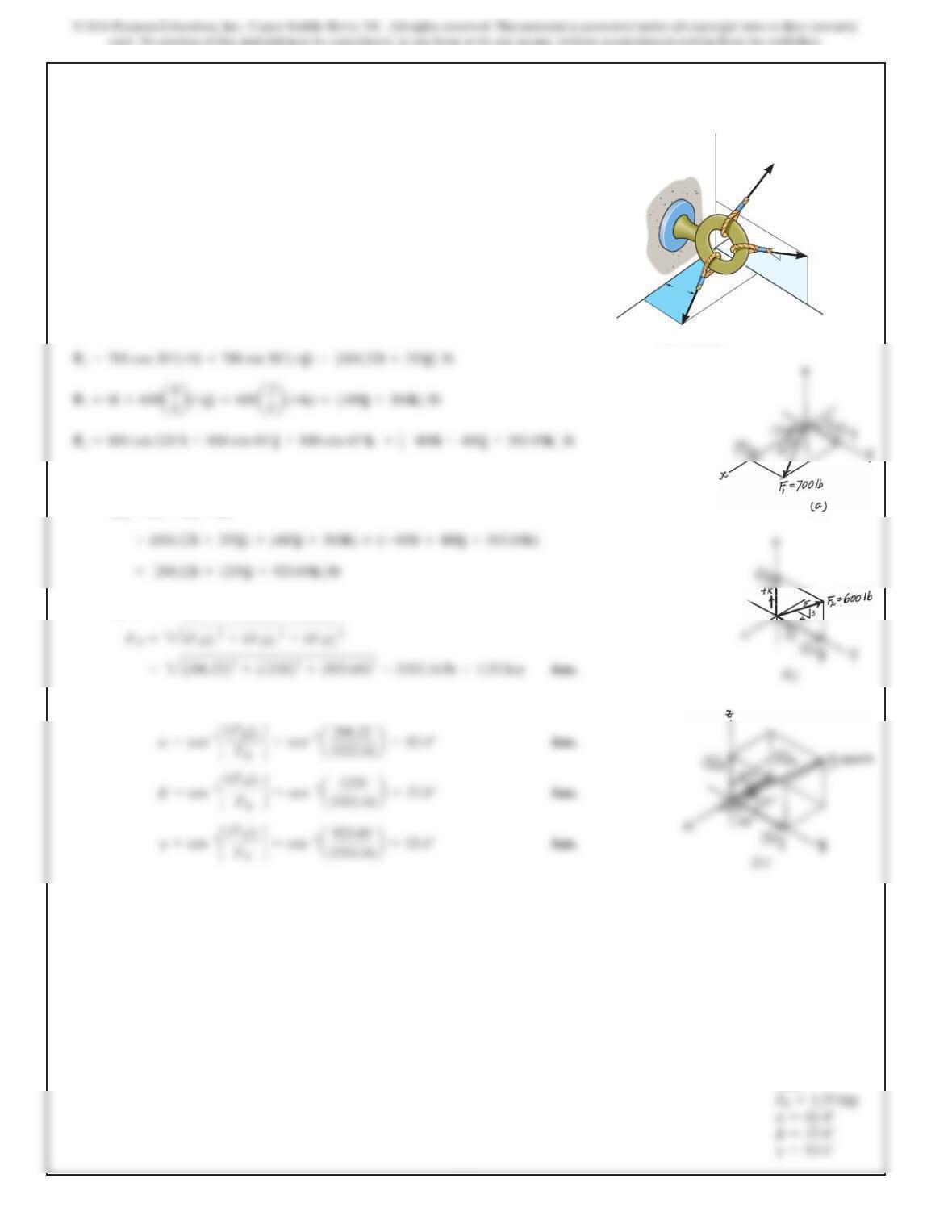
If the coordinate direction angles for are ,
and , determine the magnitude and
coordinate direction angles of the resultant force acting on
the eyebolt.
g3=45°b3=60°
a3=120°F3
SOLUTION
Force Vectors: By resolving , and into their x,y, and zcomponents, as shown
in Figs. a,b, and c,respectively,, and can be expressed in Cartesian vector
form as
Resultant Force: By adding , and vectorally, we obtain .Thus,
The magnitude of is
The coordinate direction angles of are
FR
FR
FR=F1+F2+F3
FR
F3
F2
F1
F3
F2
F1
F3
F2
F1
x
30
43
5
y
z
F2 600 lb
F1 700 lb
F3 800 lb
Ans:
103
2–82.
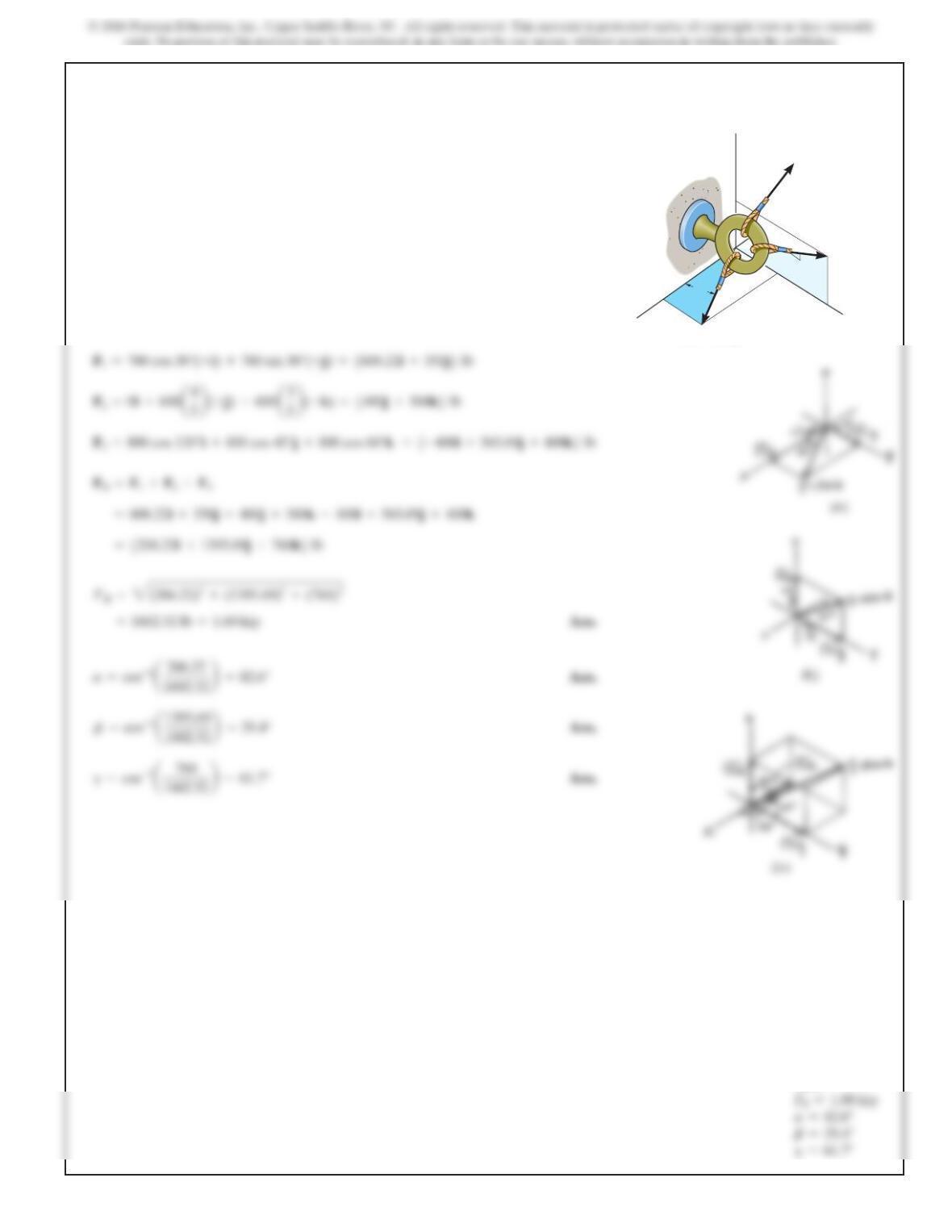
If the coordinate direction angles for are ,
and , determine the magnitude and
coordinate direction angles of the resultant force acting on
the eyebolt.
g3=60°b3=45°
a3=120°F3
SOLUTION
Force Vectors: By resolving , and into their x,y, and zcomponents, as shown
in Figs. a,b, and c,respectively,,,and can be expressed in Cartesian vector
form as
F3
F2
F1
F3
F2
F1
x
30
43
5
y
z
F2 600 lb
F1 700 lb
F3 800 lb
Ans:
104
2–83.
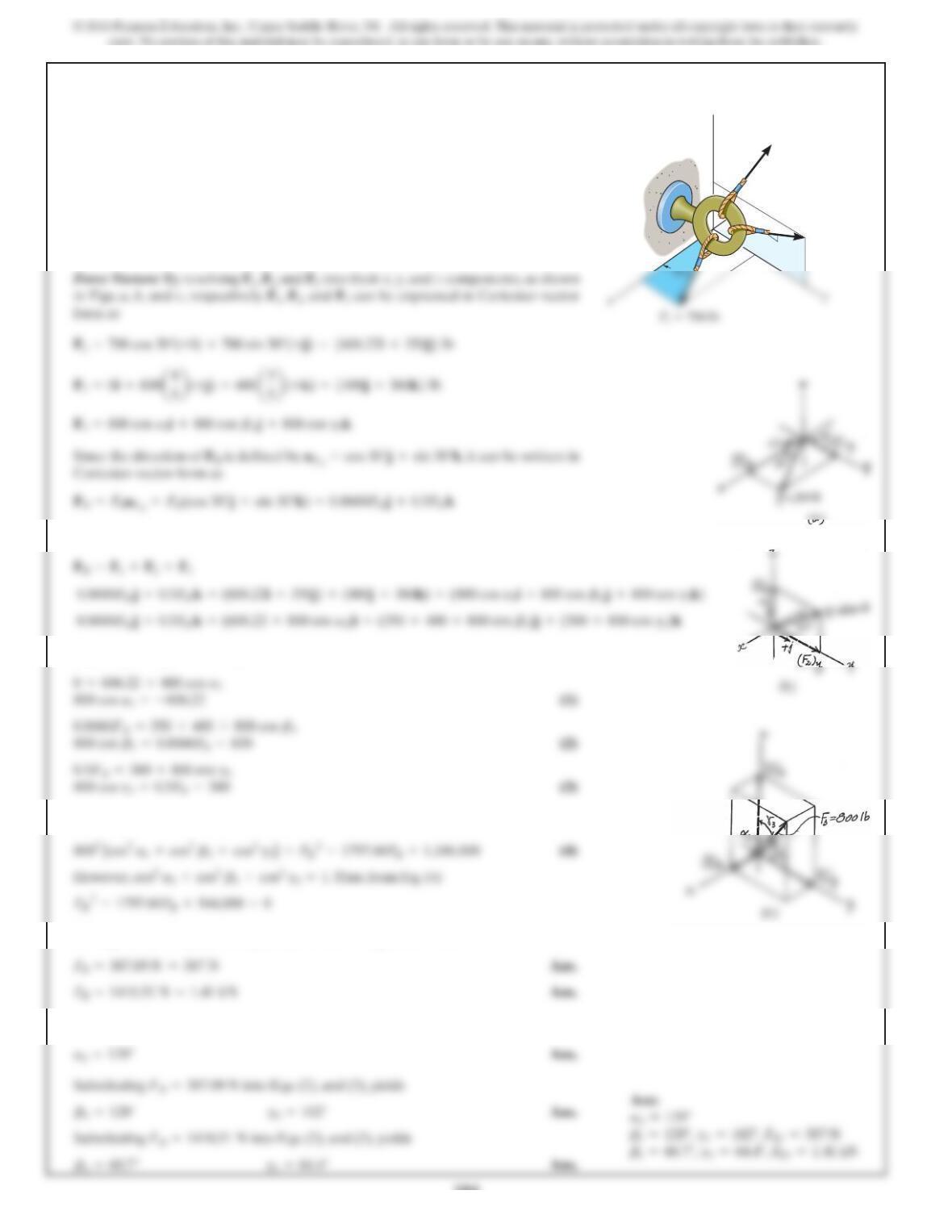
If the direction of the resultant force acting on the eyebolt
is defined by the unit vector ,
determine the coordinate direction angles of and the
magnitude of .FR
F3
uFR
=cos 30°j+sin 30°k
SOLUTION
Resultant Force: By adding ,,and vectorally, we obtain .Thus,
FR
F3
F2
F1
Equating the ,,and components, we havekji
Squaring and then adding Eqs. (1), (2), and (3), yields
Solving the above quadratic equation, we have two positive roots
From Eq. (1),
43
5
z
F2 600 lb
F3 800 lb
105
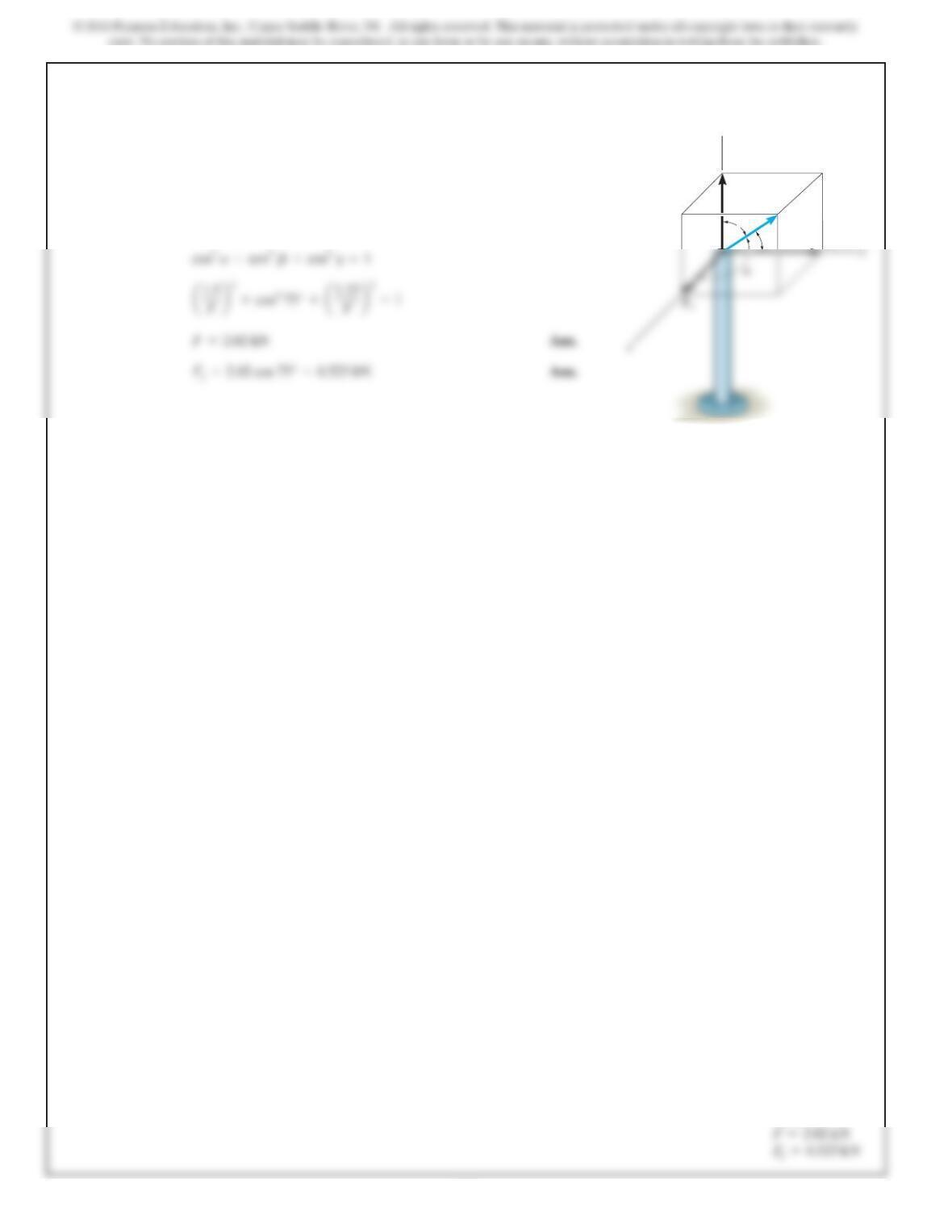
*2–84.
SOLUTION
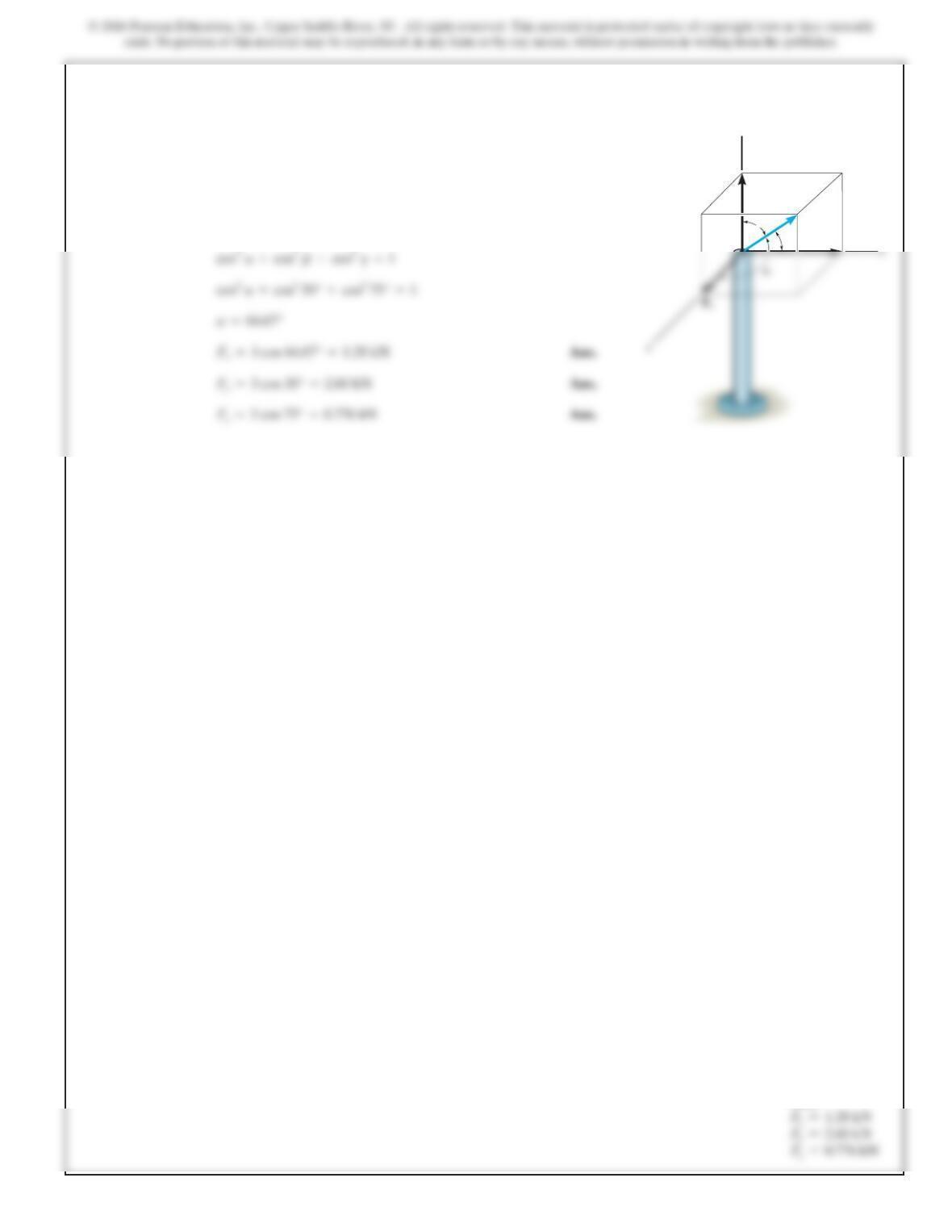
The pole is subjected to the force F, which has components
acting along the x, y, zaxes as shown. If the magnitude of F
is 3 kN,,and , determine the magnitudes of
its three components.
g=75°b=30°
z
Fz
Fy
F
b
g
Ans:
106
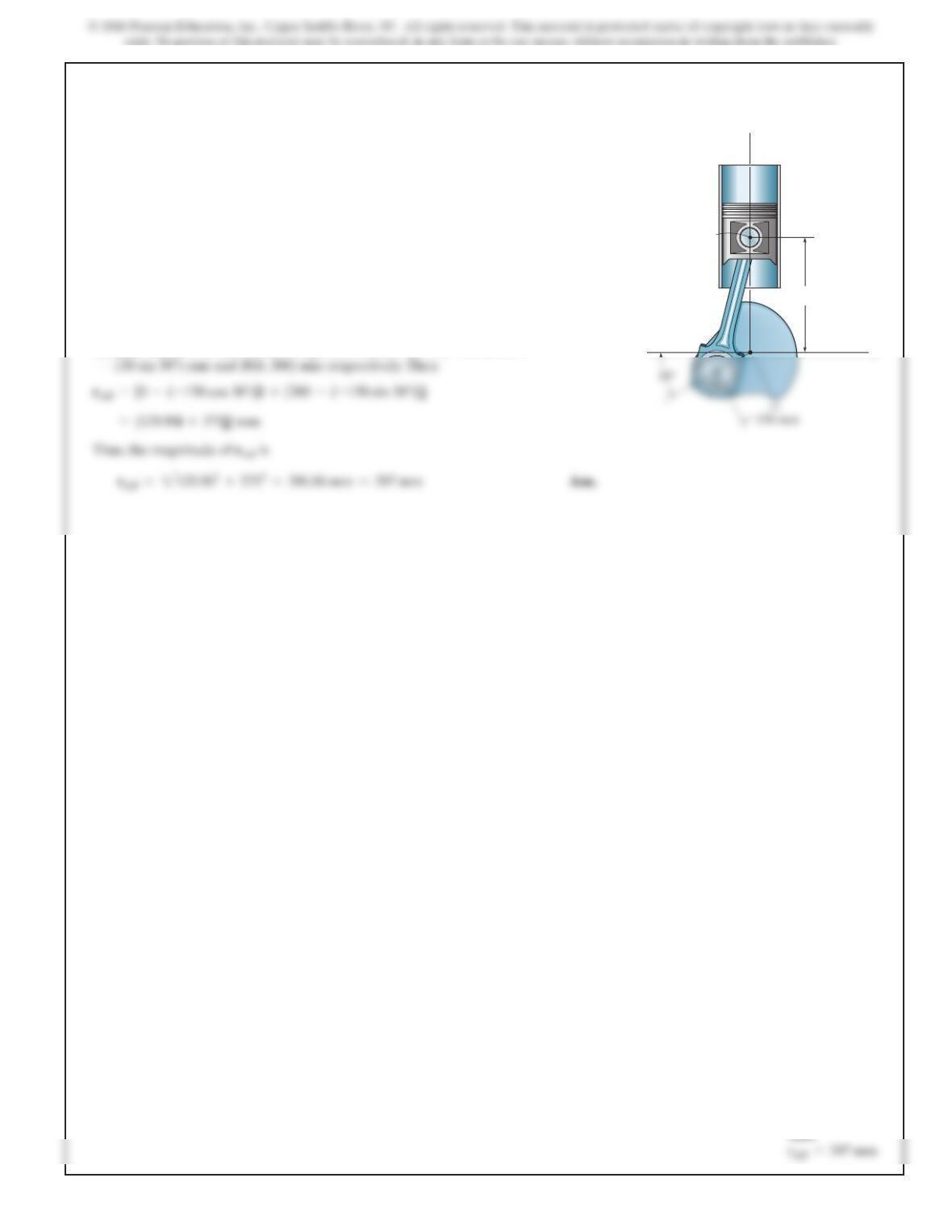
2–85.
The pole is subjected to the force Fwhich has components
and .If ,determine the
magnitudes of Fand Fy.
b=75°F
z=1.25 kNF
x=1.5 kN
SOLUTION
z
Fz
Fy
F
b
g
Ans:
107
Ans:
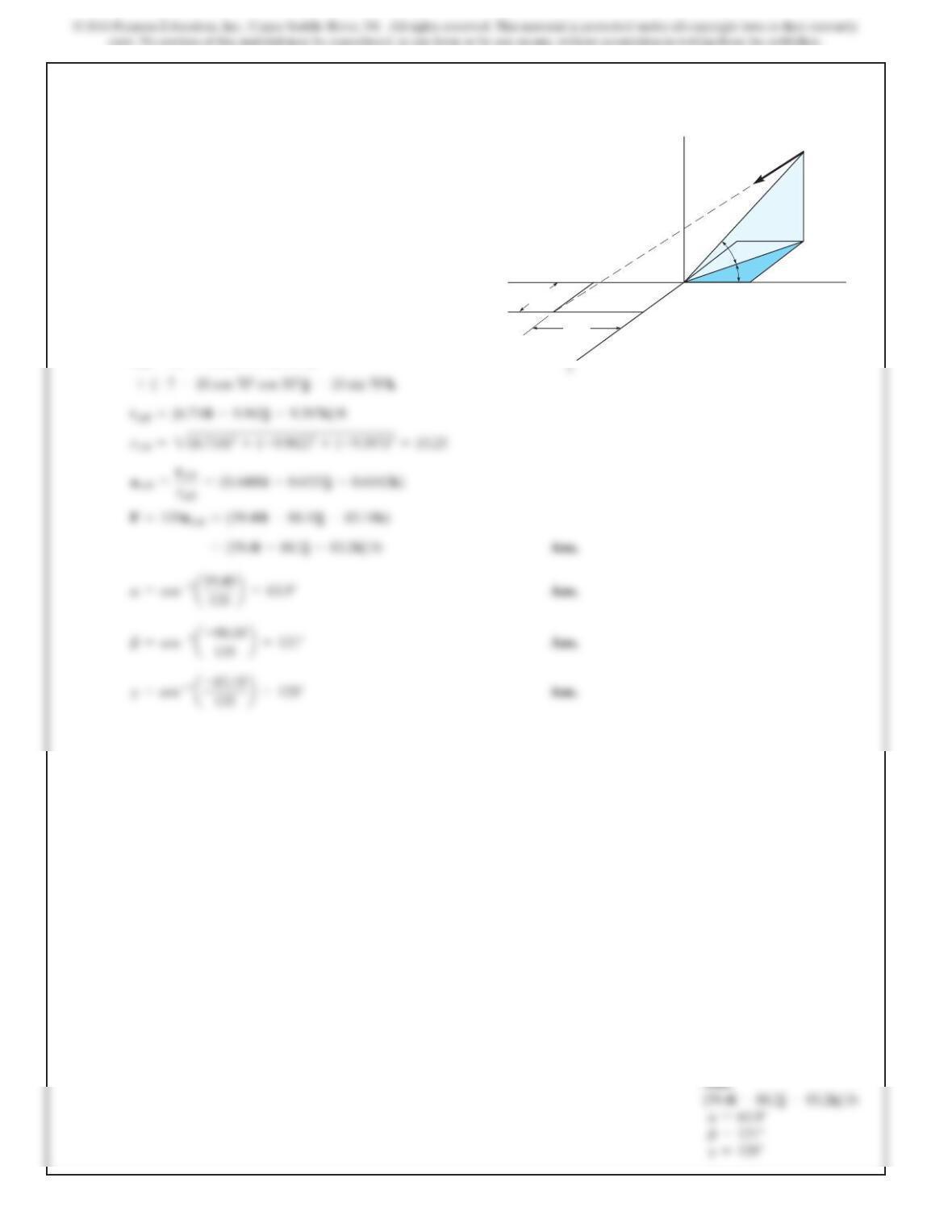
2–86.
Determine the length of the connecting rod AB by first
formulating a Cartesian position vector from A to B and
then determining its magnitude.
SOLUTION
Position Vector. The coordinates of points A and B are
A(–150 cos 30°,
300 mm
O
B
x
y
108
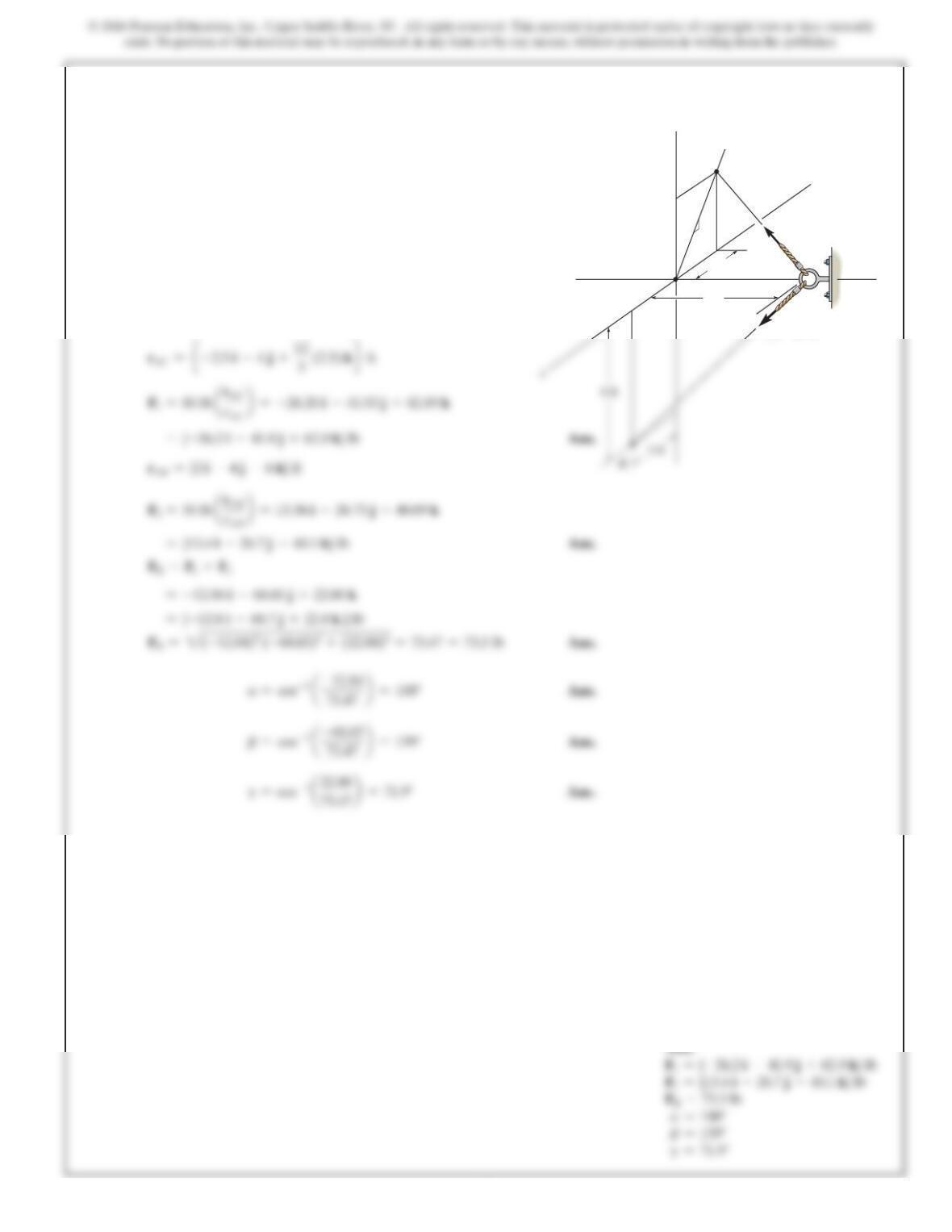
2–87.
Express force F as a Cartesian vector; then determine its
coordinate direction angles.
SOLUTION
rAB =(5 +10 cos 70° sin 30°)i
F=135uAB =(59.40i–88.18j–83.18k)
F 135 lb
70
30
B
A
7 ft
10 ft
5 ft
y
z
109
*2–88.
Express each of the forces in Cartesian vector form and
determine the magnitude and coordinate direction angles
of the resultant force.
SOLUTION
F2 50 lb
F1 80 lb
C
O
A
4 ft
y
z
12
13
5
2.5 ft
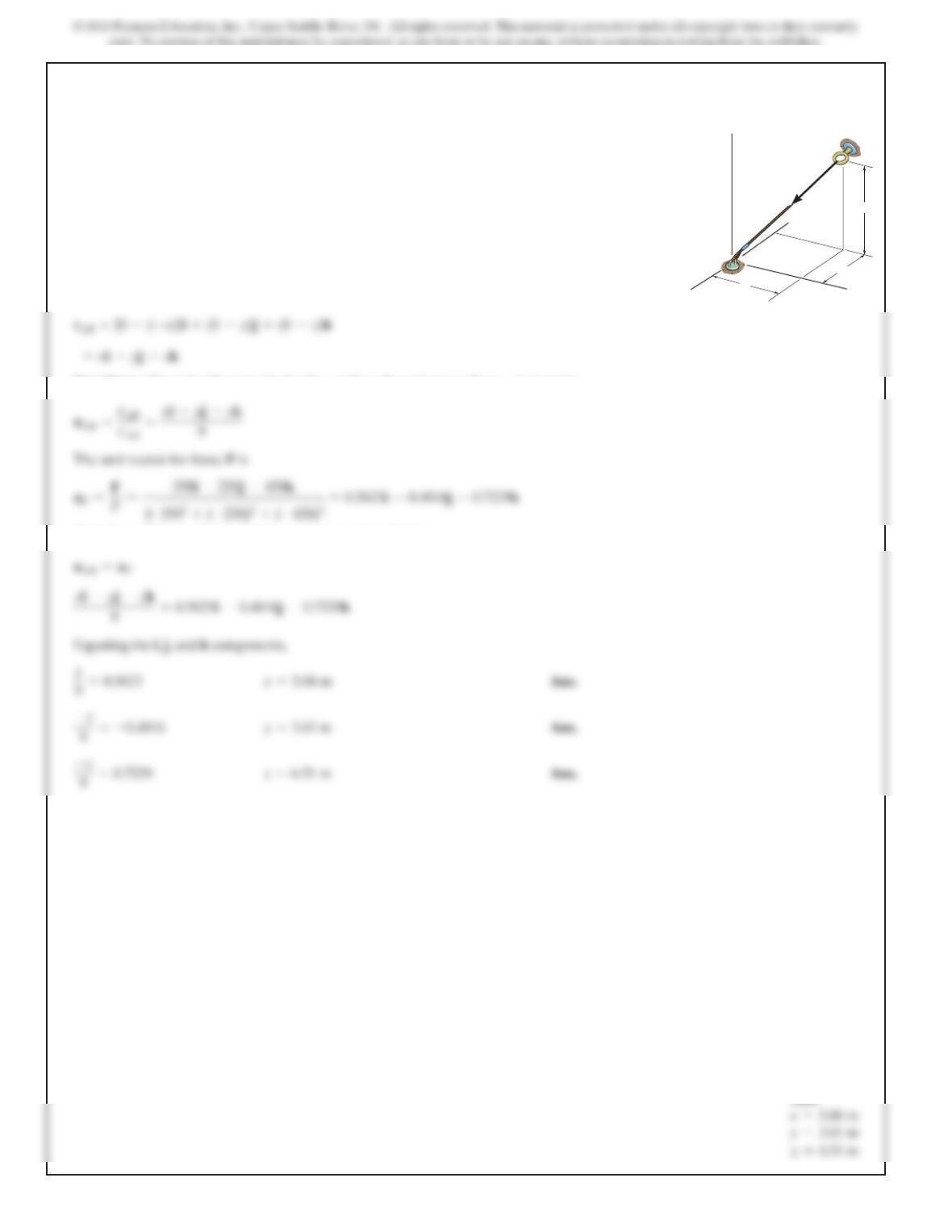
110
2–89.
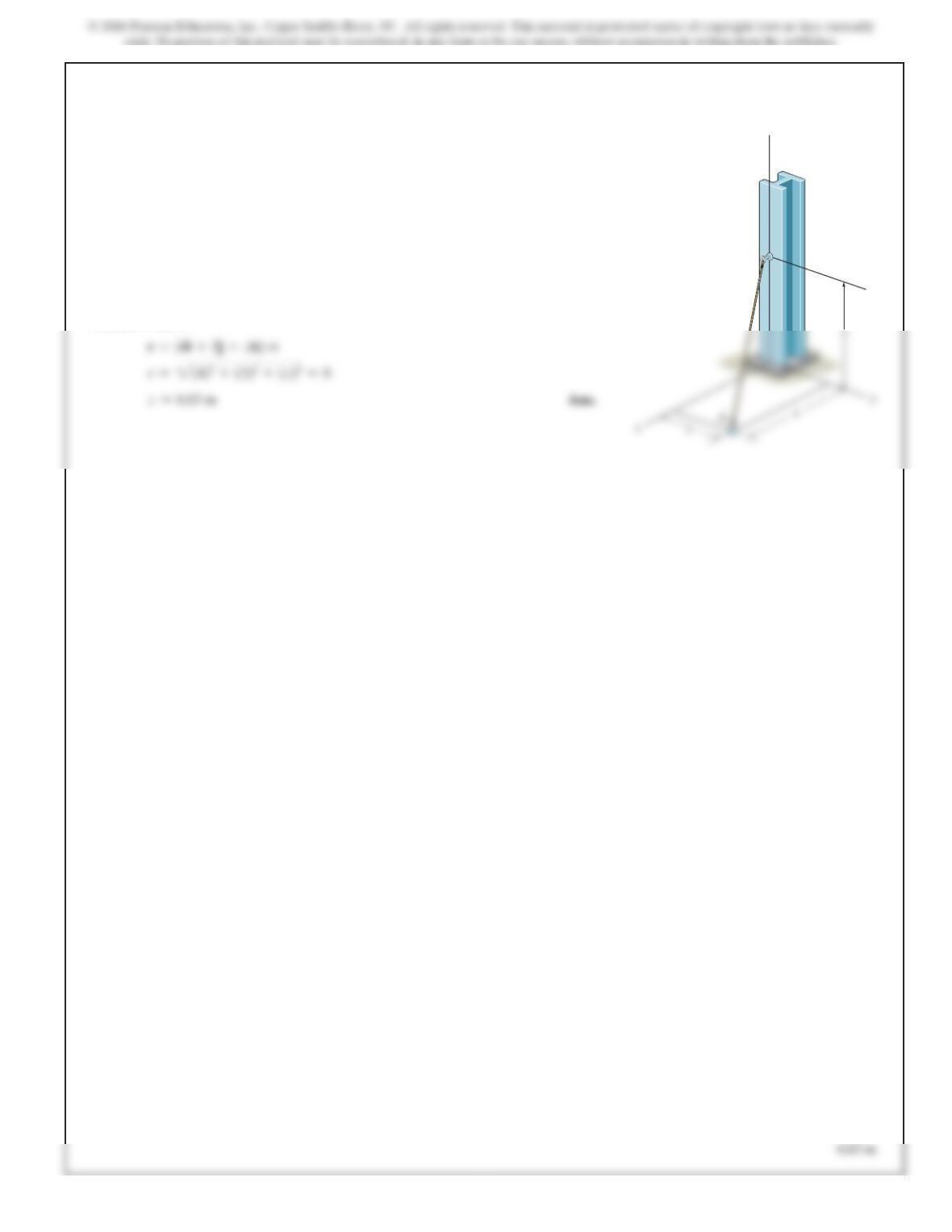
If and cable is 9 m long,
determine the coordinates of point .Ax, y, z
ABF=5350i–250j–450k6 N
SOLUTION
Position Vector: The position vector ,directed from point to point ,is given by
Unit Vector: Knowing the magnitude of is 9 m, the unit vector for is given by
Since force is also directed from point to point , then
BAF
rAB
rAB
BArAB x
x
B
A
y
y
z
z
F
Ans:
111
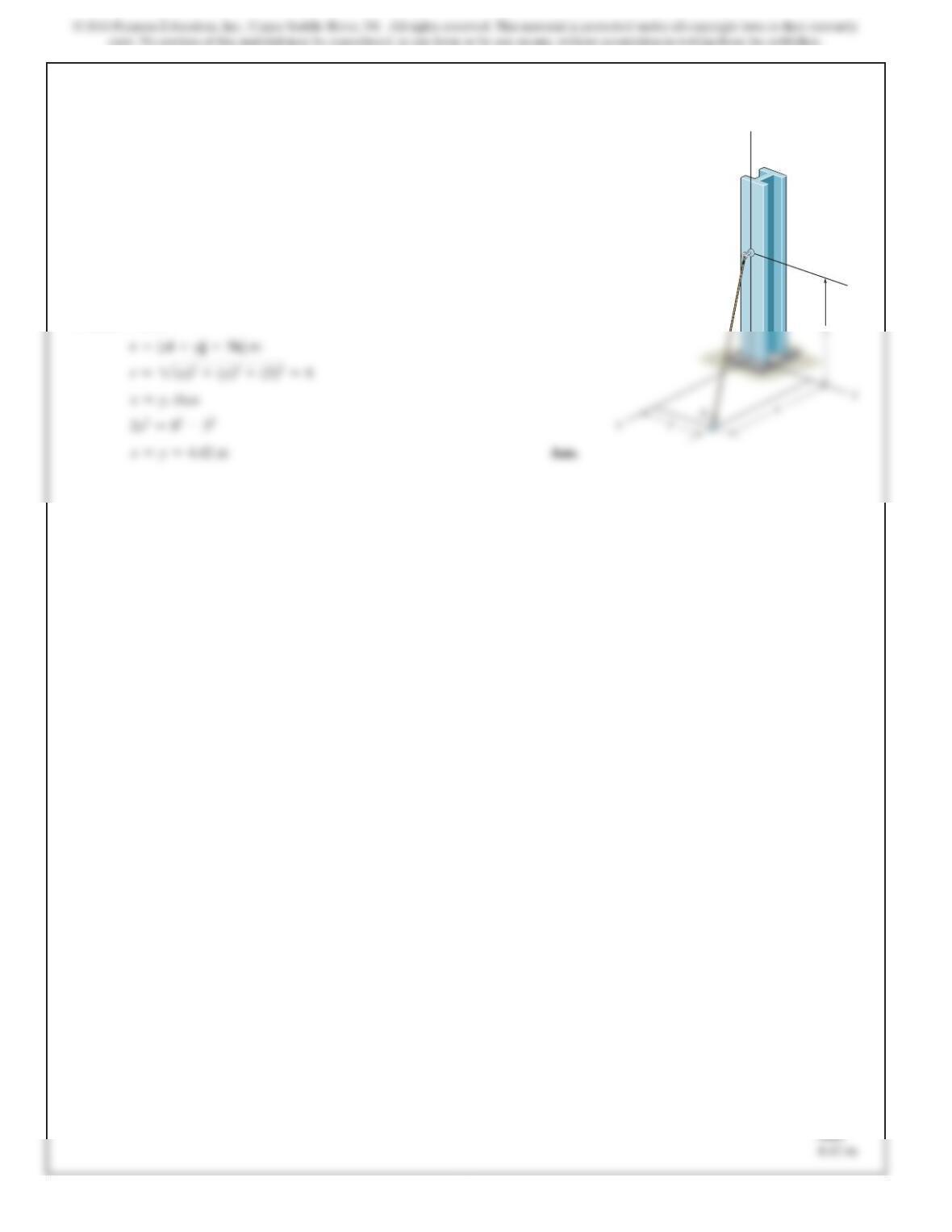
2–90.
The 8-m-long cable is anchored to the ground at A.
If x = 4 m and y = 2 m, determine the coordinate z to the
highest point of attachment along the column.
SOLUTION
Ans:
z
B
112
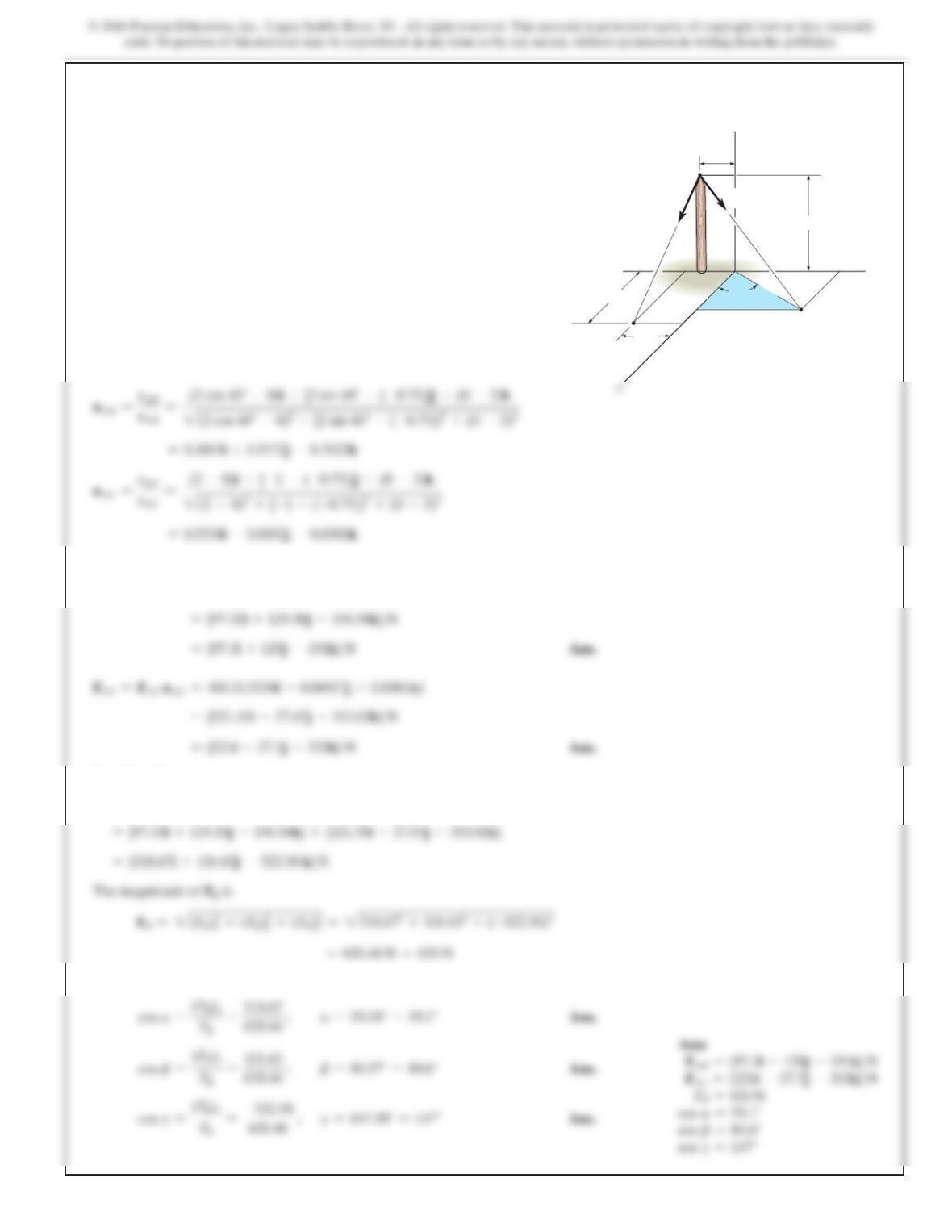
2–91.
The 8-m-long cable is anchored to the ground at A.
If z = 5 m, determine the location + x, + y of point A. Choose
a value such that x = y.
SOLUTION
Ans:
z
B
113
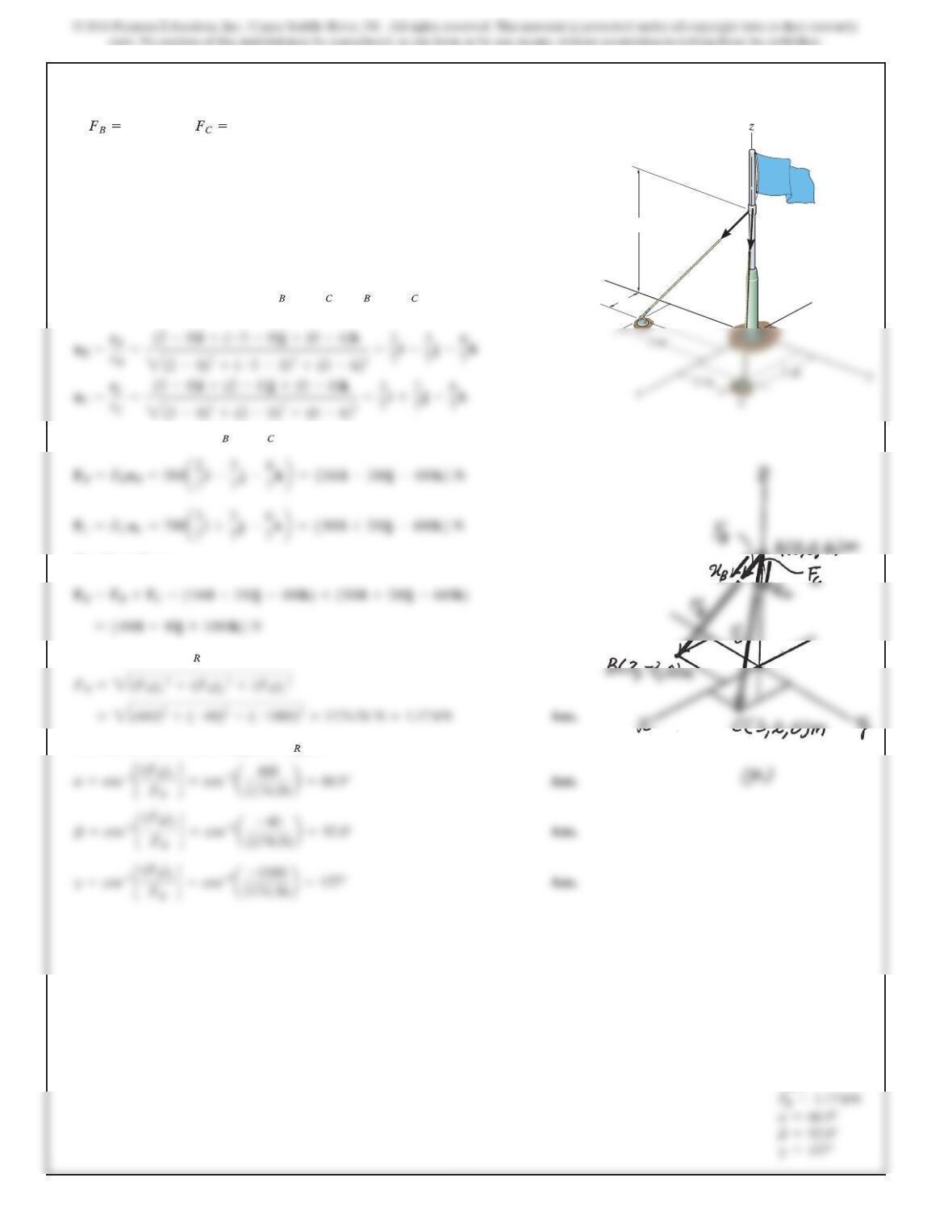
*2–92.
Express each of the forces in Cartesian vector form and
determine the magnitude and coordinate direction angles
of the resultant force.
SOLUTION
Unit Vectors. The coordinates for points A, B and C are
(0, –0.75, 3) m
,
B(2 cos 40°, 2 sin 40°, 0) m
and
C(2, –1, 0) m
respectively.
Force Vectors
FAB =FAB uAB =250 (0.3893i+0.5172j–0.7622k)
FAC =FAC uAC =400 (0.5534i–0.06917j–0.8301k)
Resultant Force
FR=FAB +FAC
And its coordinate direction angles are
FAC 400 N
FAB 250 N
y
0.75 m
z
A
40
B
C
1 m
2 m 2 m
3 m
114
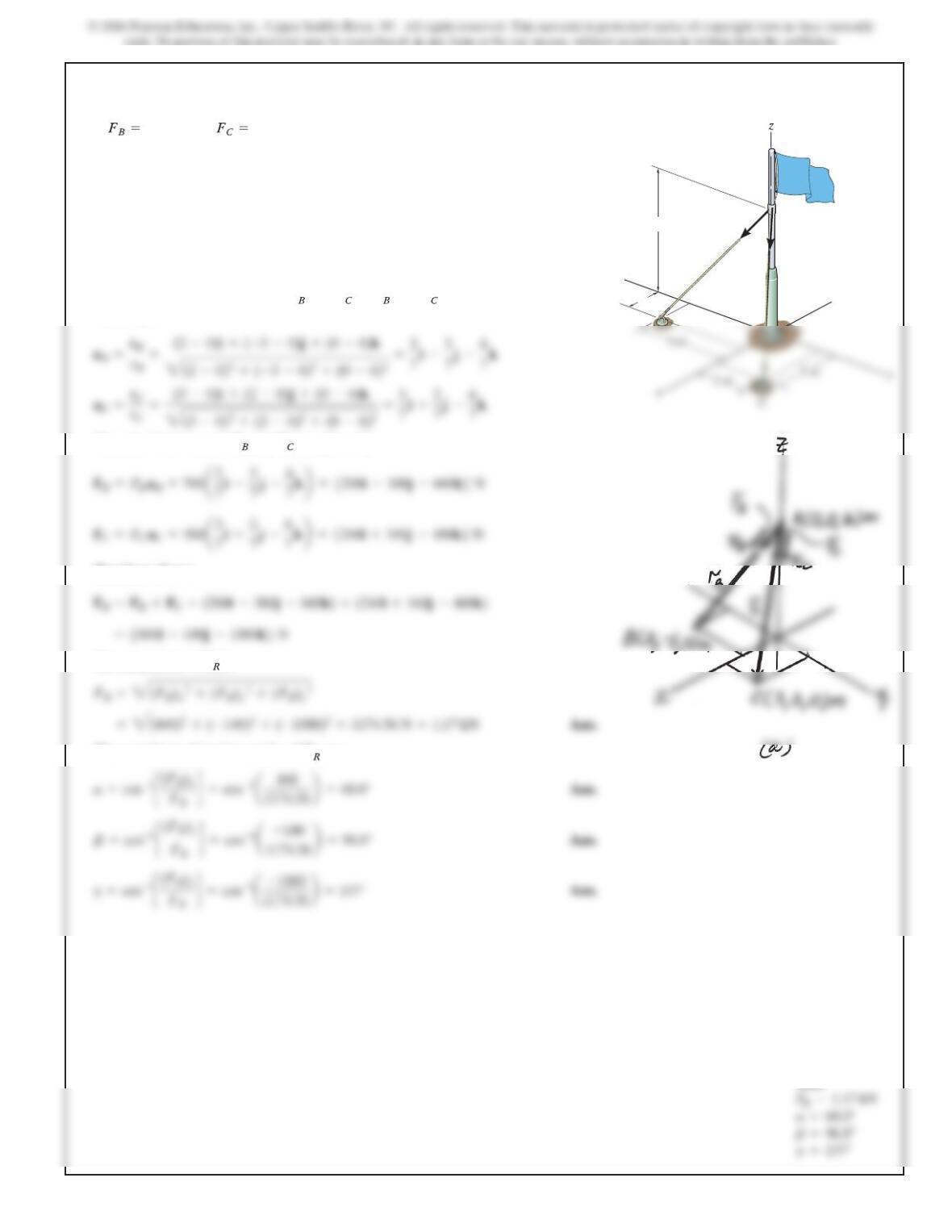
2–93.
If and , determine the magnitude
and coordinate direction angles of the resultant force acting
on the flag pole.
700 N560 N
SOLUTION
Force Vectors: The unit vectors and of and must be determined first.
From Fig. a
Thus, the force vectors and are given by
Resultant Force:
The magnitude of is
The coordinate direction angles of are
F
F
F
F
F
Fuu
A
B
6 m
2 m
FB
FC
Ans:
115
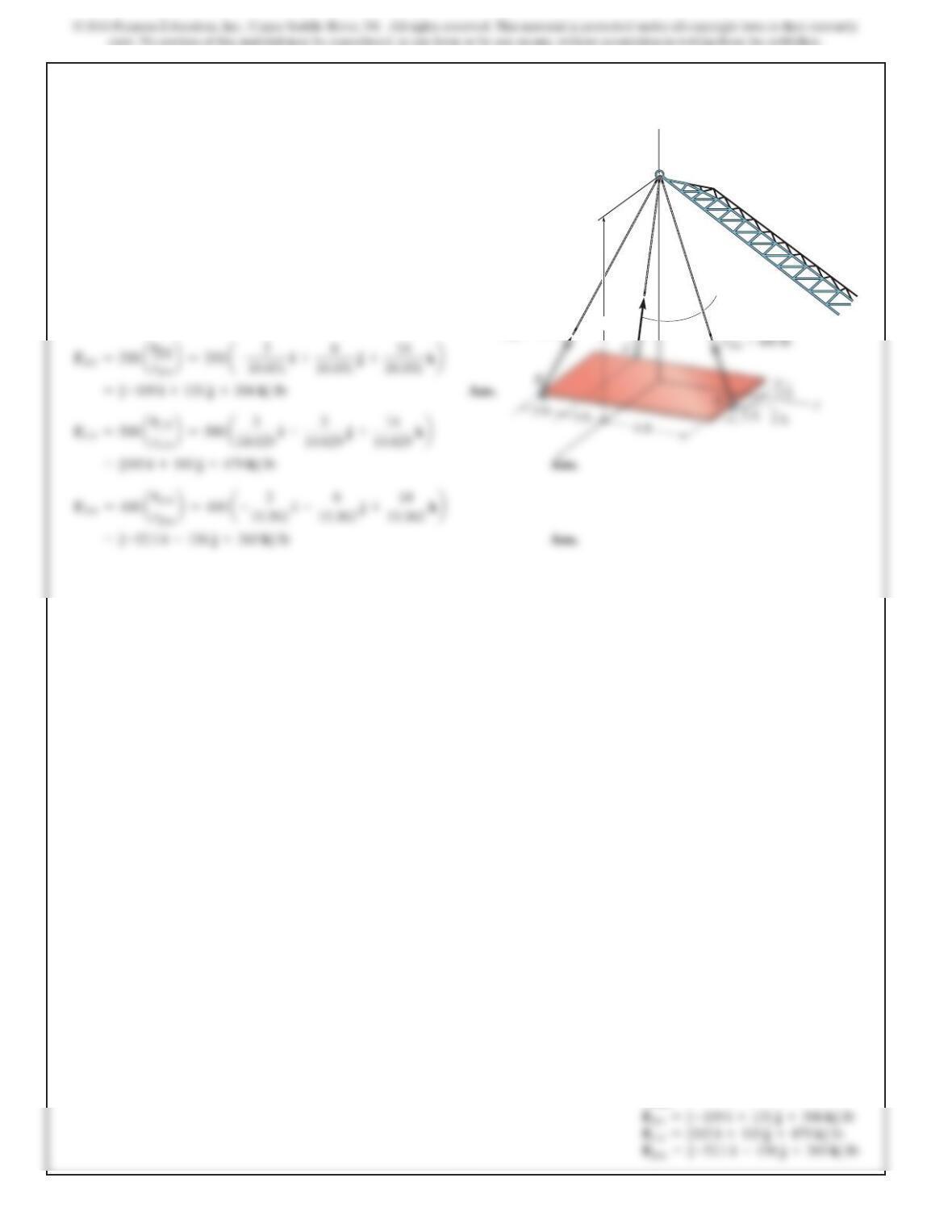
2–94.
If , and , determine the magnitude
and coordinate direction angles of the resultant force acting
on the flag pole.
560 N700 N
SOLUTION
Force Vectors: The unit vectors and of and must be determined first.
From Fig. a
Thus, the force vectors and are given by
Resultant Force:
The magnitude of is
The coordinate direction angles of are
F
F
F
F
F
Fuu
A
B
6 m
2 m
FB
FC
Ans:
116
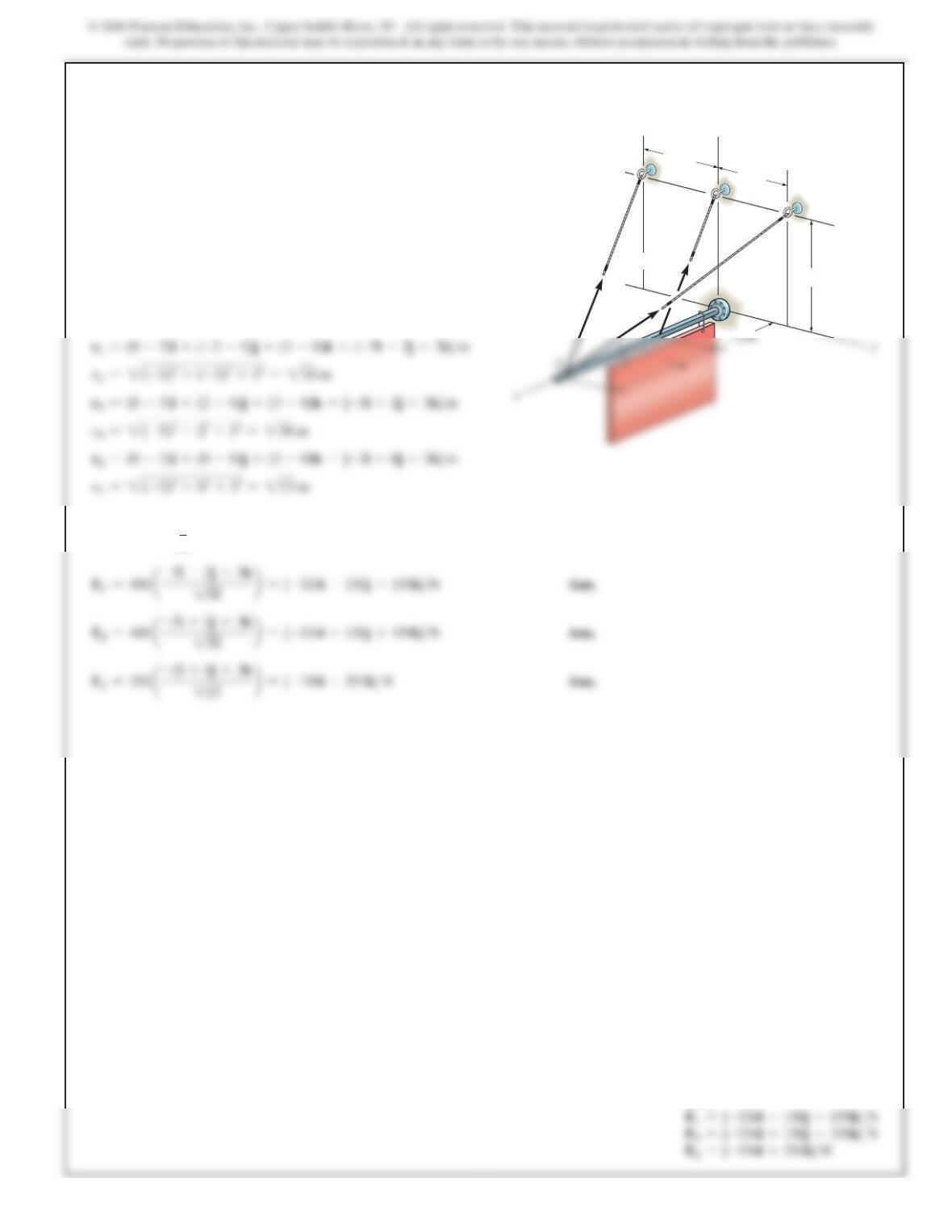
2–95.
The plate is suspended using the three cables which exert
the forces shown. Express each force as a Cartesian vector.
z
FBA 350 lb FDA 400 lb
FCA 500 lb
A
14 ft
SOLUTION
Ans:
117
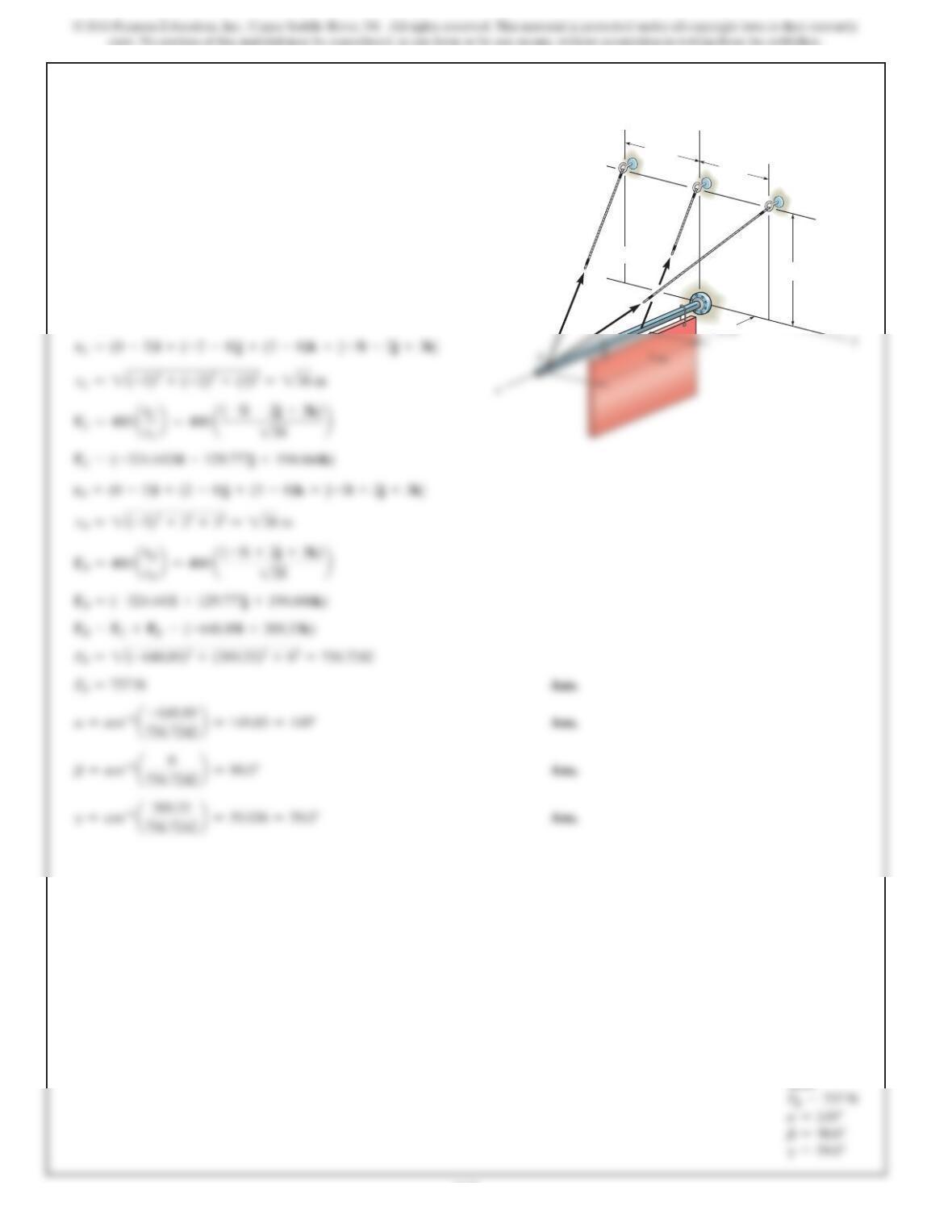
*2–96.
The three supporting cables exert the forces shown on the
sign. Represent each force as a Cartesian vector.
Ans:
z
D
C
E
B
3 m
2 m
2 m
FC 400 N
FB 400 N
FE 350 N
SOLUTION
F=Fu=F
ar
r
b
118
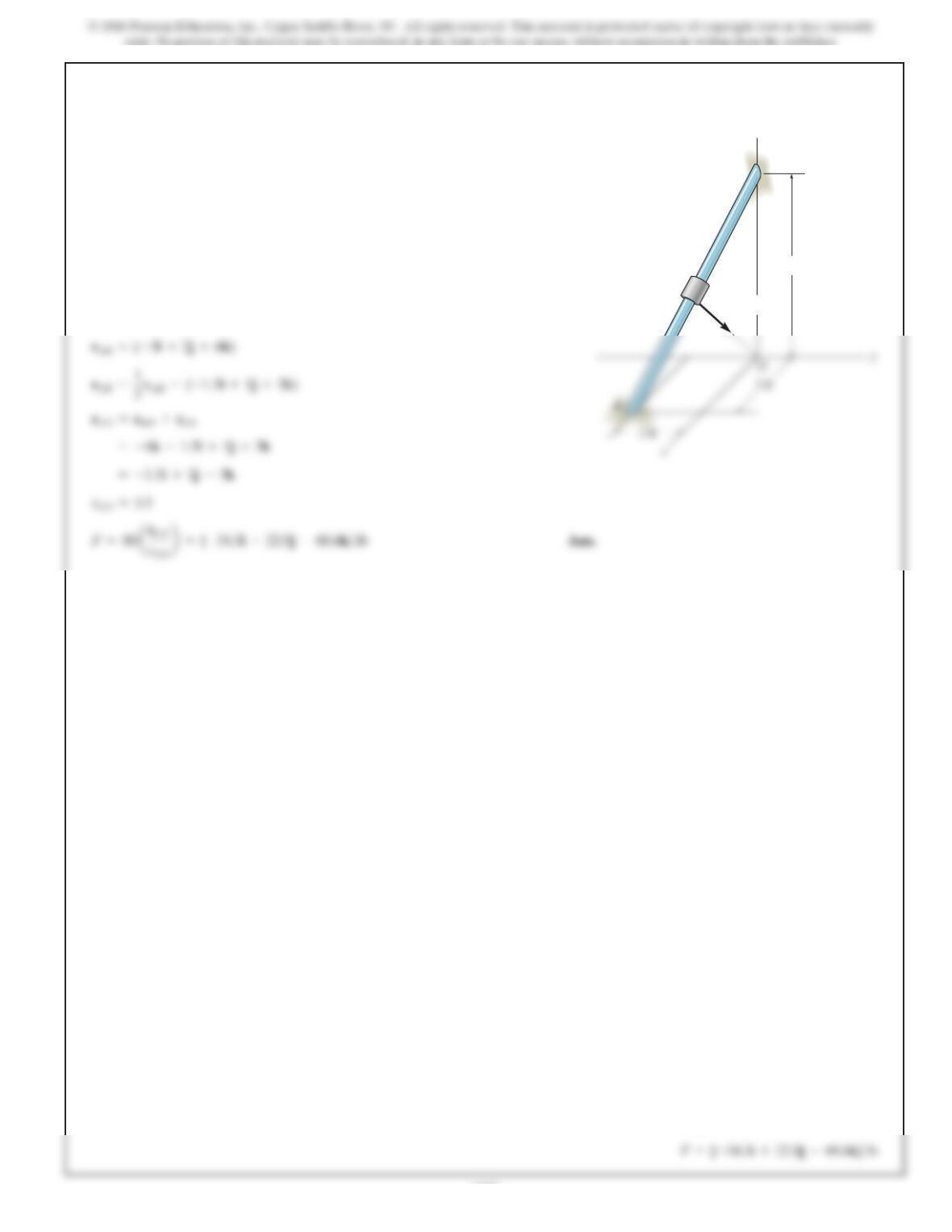
2–97.
Determine the magnitude and coordinate direction angles
of the resultant force of the two forces acting on the sign at
point A.
z
D
C
E
B
3 m
2 m
2 m
FC 400 N
FB 400 N
FE 350 N
SOLUTION
Ans:
119
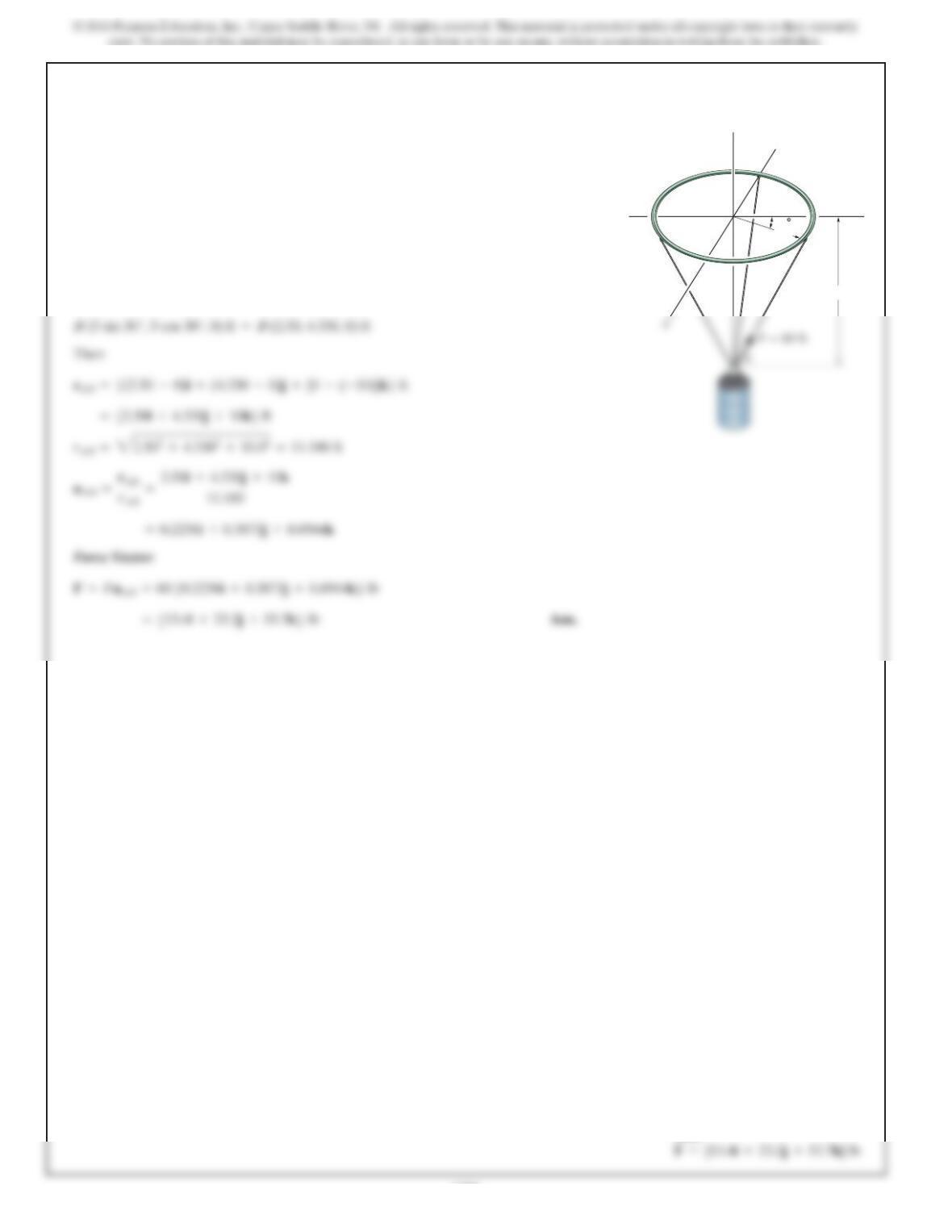
2–98.
The force F has a magnitude of 80 lb and acts at the
midpointC of the thin rod. Express the force as a Cartesian
vector.
Ans:
6 ft
F 80 lb
B
C
z
SOLUTION
120
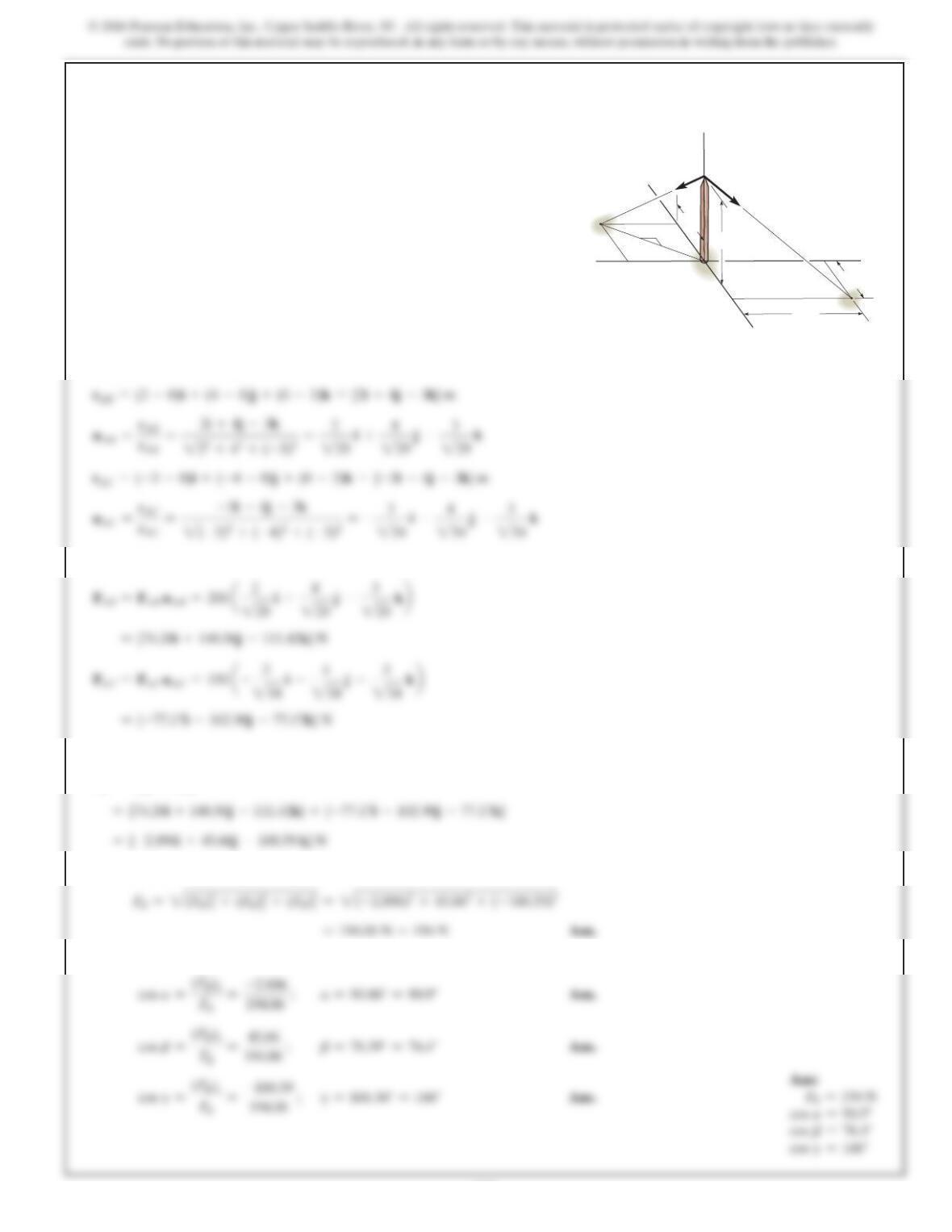
2–99.
The load at creates a force of in wire .Express
this force as a Cartesian vector acting on and directed
toward as shown.B
A
AB60 lbA
SOLUTION
Unit Vector: First determine the position vector .The coordinates of point are
BrAB 10 ft
5 ft
30
z
y
B
Ans:
121
*2–100.
Determine the magnitude and coordinate direction angles of
the resultant force acting at point A on the post.
SOLUTION
Unit Vector. The coordinates for points A, B and C are
A(0, 0, 3) m
,
B(2, 4, 0) m
and
C(–3, –4, 0) m
respectively
Force Vectors
Resultant Force
FR=FAB +FAC
The magnitude of the resultant force is
And its coordinate direction angles are
4 m
3 m
3 m
2 m
3
4
5
O
A
C
B
FAC 150 N
FAB 200 N
y
z
x