1005
19–21.
SOLUTION
Since no slipping occurs
Set
Also,
c
+)
(HA)1+©MA dt =(HA)2
(
vG=0.9 v
(:
+)
m(vx)1+©
LF
xdt =m(vx)2
(+c)
m(vy)+©
LF
y dt =m(vy)2
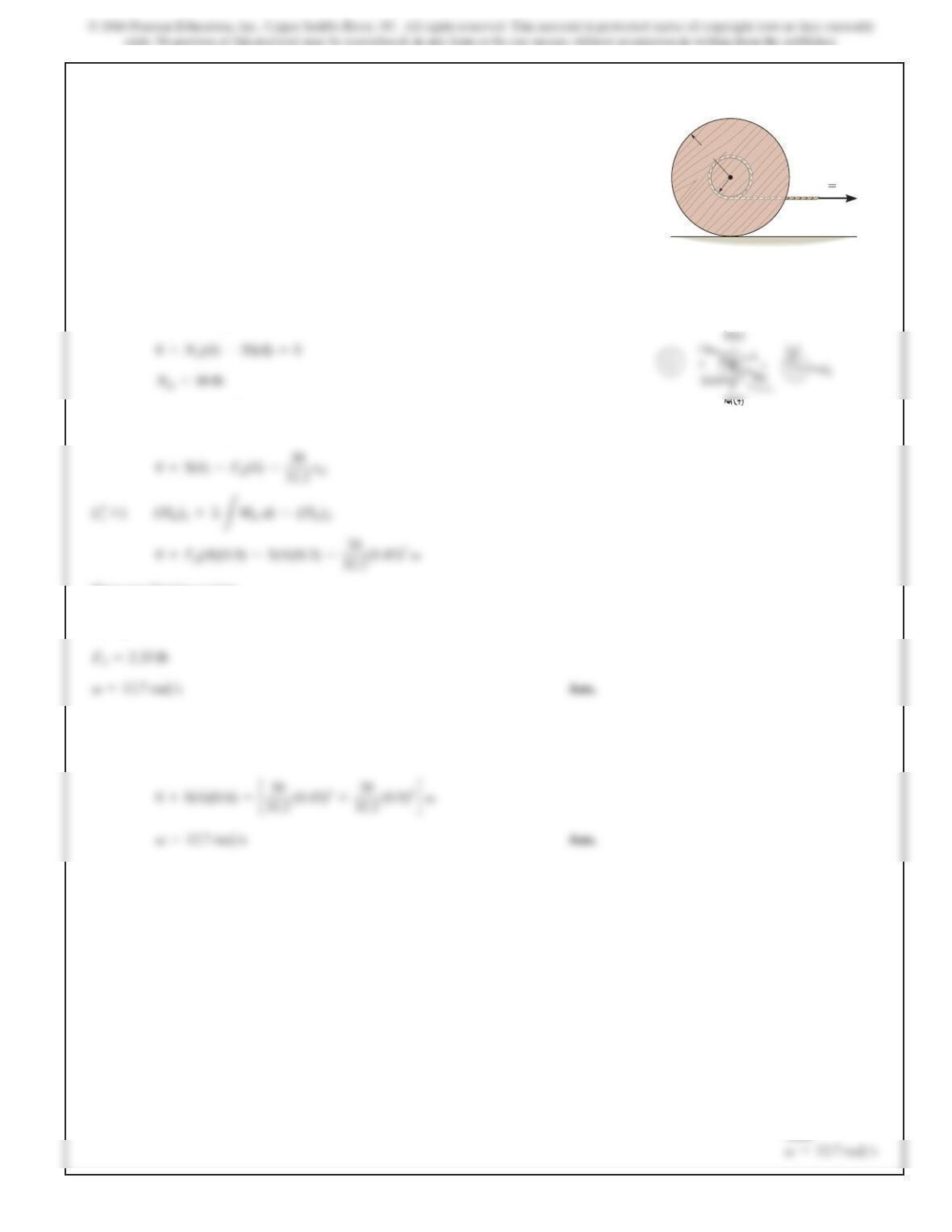
The spool has a weight of 30 lb and a radius of gyration
A cord is wrapped around its inner hub and the
end subjected to a horizontal force Determine the
spool’s angular velocity in 4 s starting from rest. Assume
the spool rolls without slipping.
P=5 lb.
kO=0.45 ft.
P 5 lb
0.9 ft
0.3 ft
O
A
Ans:
19–22.
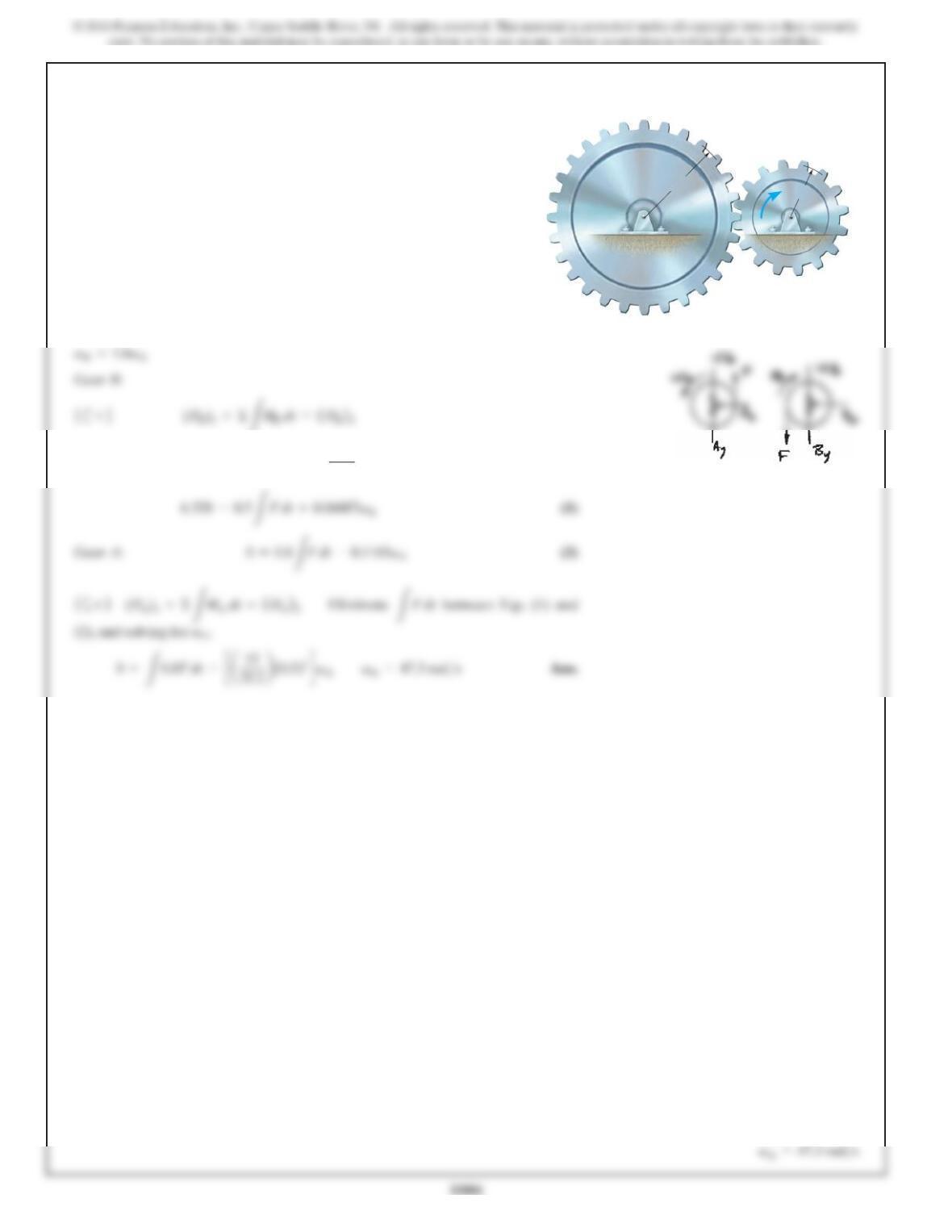
The two gears A and B have weights and radii of gyration of
W
A=15 lb,
kA=0.5 ft
and
W
B=10 lb,
kB=0.35 ft,
respectively. If a motor transmits a couple moment to gear
B of M
=
2(1
–
e
–0.5t
) lb
#
ft, where t is in seconds,
determine the angular velocity of gear A in
t=5 s,
starting
from rest.
Ans:
0.8 ft
A
B
0.5 ft
M
SOLUTION
v
A(0.8) =
v
B(0.5)
L
0+
L5
0
2
(
1–e–0.5t
)
dt –
L
0.5F dt =
ca
10
32.2
b
(0.35)2
d
(
1.6vA
)
L
19–23.
SOLUTION
b+ mvx1+aLFxdt =mvx2
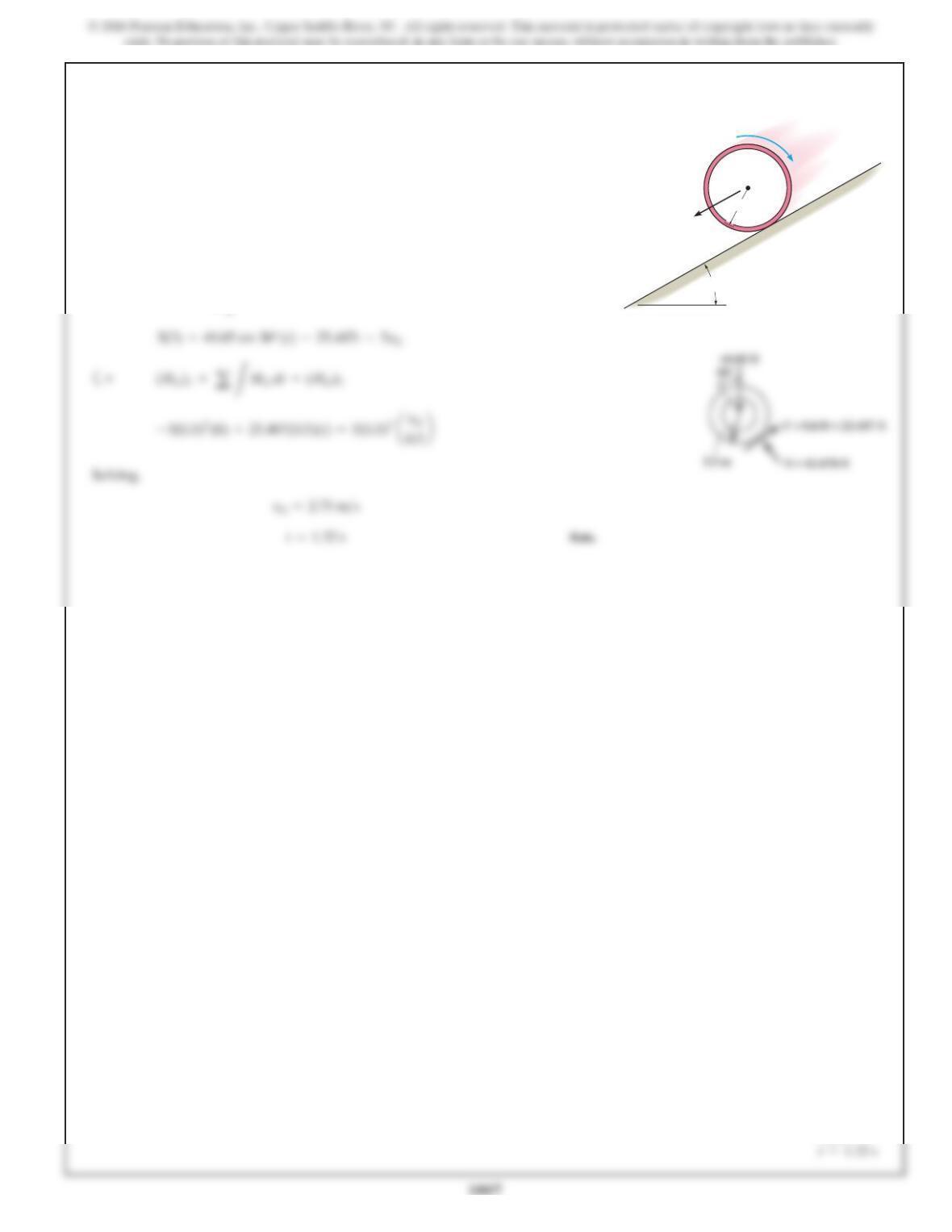
The hoop (thin ring) has a mass of 5 kg and is released down
the inclined plane such that it has a backspin
and its center has a velocity as shown. If the
coefficient of kinetic friction between the hoop and the
plane is determine how long the hoop rolls before
it stops slipping.
mk=0.6,
vG=3m>s
v=8 rad>s
G
0.5 m
30°
ω
=8rad/s
=3m/svG
Ans:
1008
*19–24.
P (20t) N
BA
O
150 mm
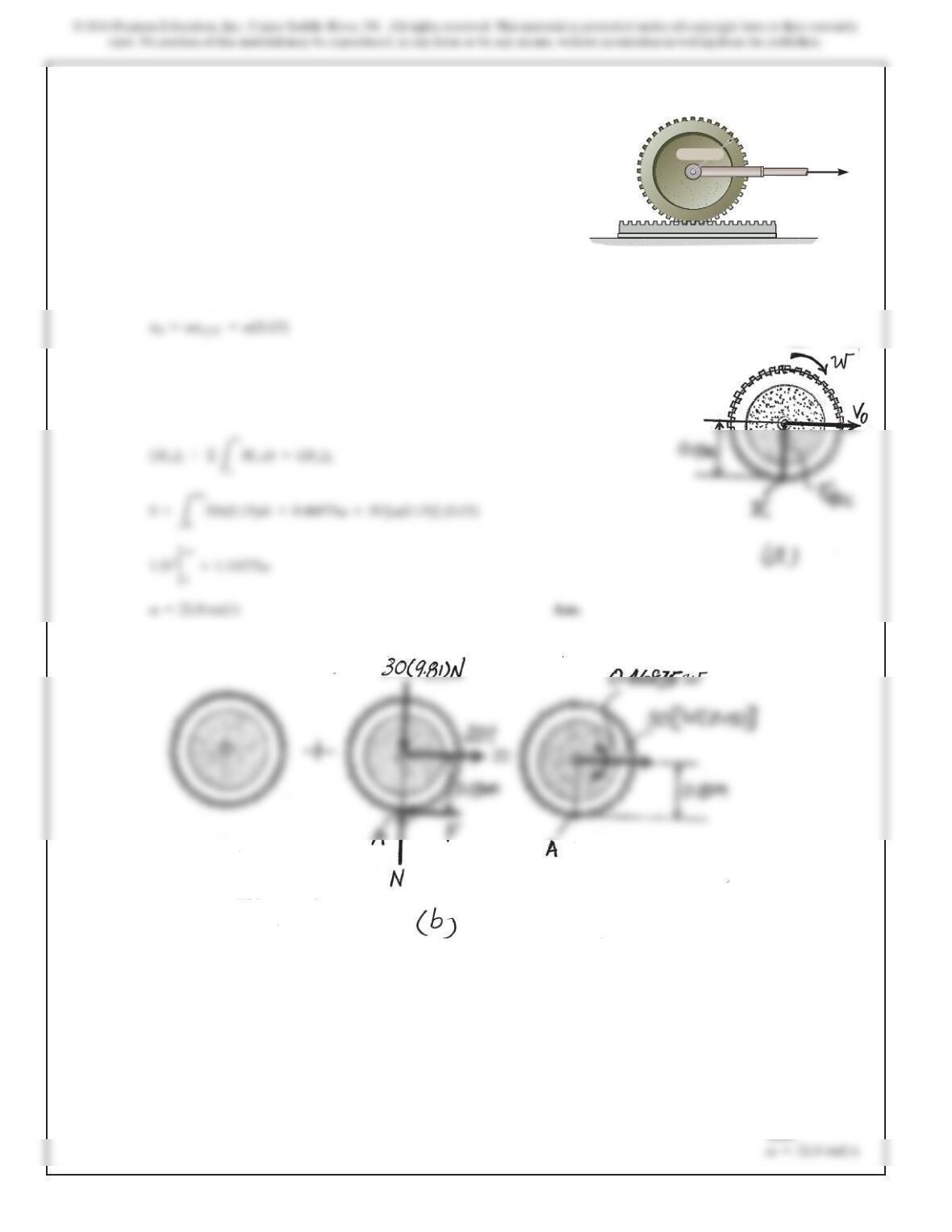
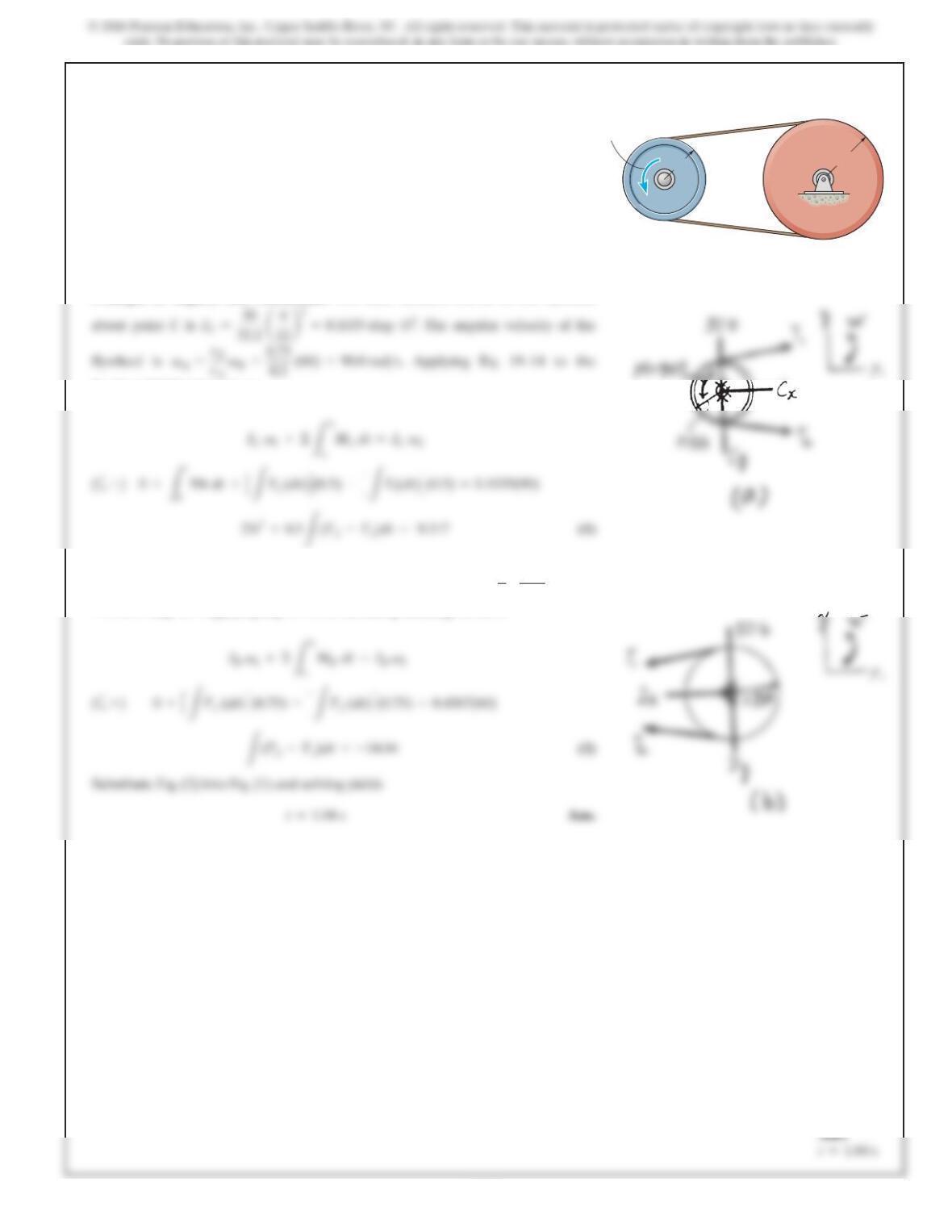
The 30-kg gear is subjected to a force of , where
tis in seconds. Determine the angular velocity of the gear at
,starting from rest.Gear rack Bis fixed to the
horizontal plane, and the gear’s radius of gyration about its
mass center Ois .kO=125 mm
t=4 s
P=(20t) N
SOLUTION
Kinematics: Referring to Fig.a,
Principle of Angular Impulse and Momentum: The mass moment of inertia of
the gear about its mass center is .
Writing the angular impulse and momentum equation about point Ashown in
Fig.b,
IO=mkO
2=30(0.1252)=0.46875 kg#m2
Ans:
1009
19–25.
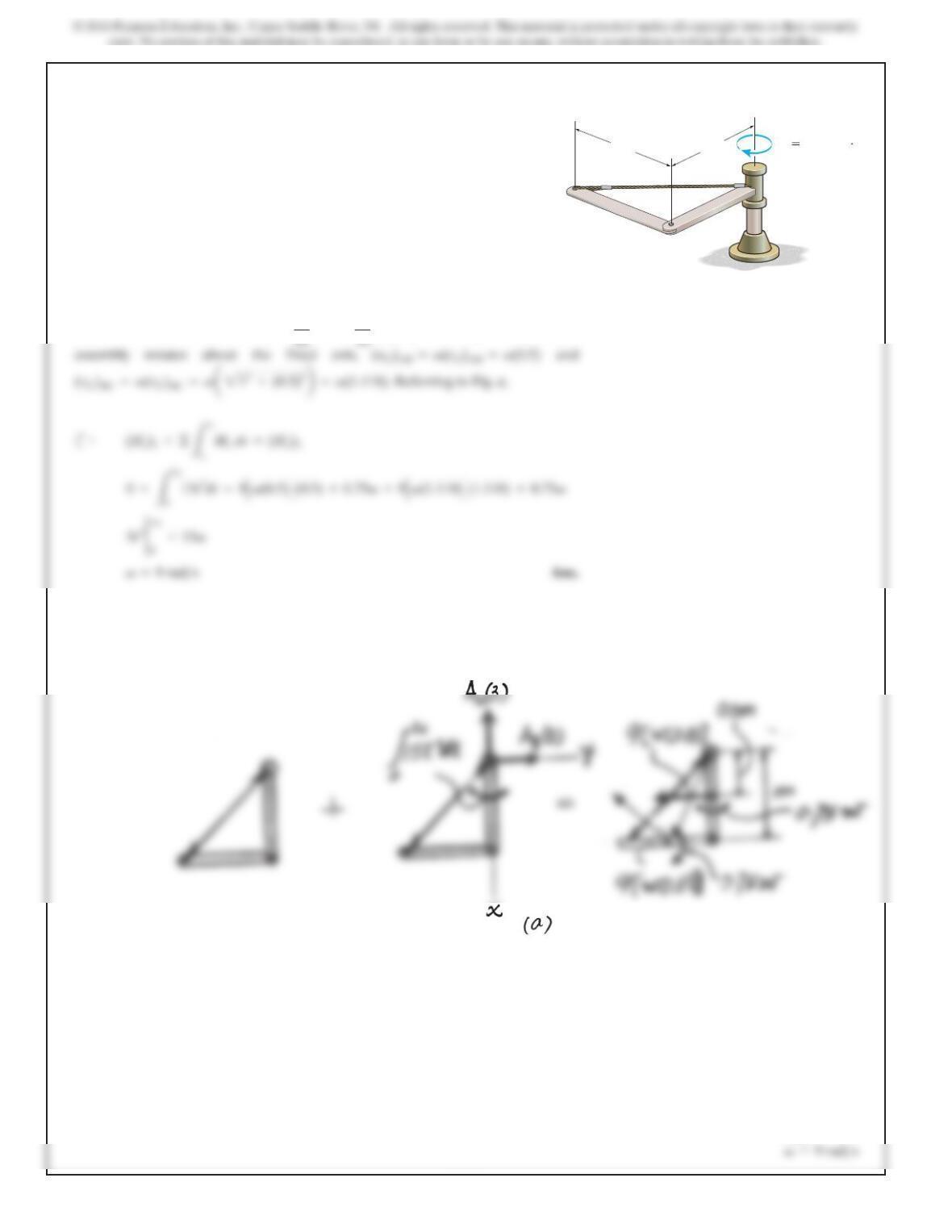
The 30-lb flywheel Ahas a radius of gyration about its center
of 4in. Disk Bweighs 50 lb and is coupled to the flywheel by
means of a belt which does not slip at its contacting surfaces.
If a motor supplies a counterclockwise torque to the
flywheel of ,where tis in seconds,
determine the time required for the disk to attain an angular
velocity of 60 starting from rest.rad>s
M=(50t)lb #ft
SOLUTION
Principle of Impulse and Momentum: The mass moment inertia of the flywheel
flywheel [FBD(a)], we have
The mass moment inertia of the disk about point Dis
. Applying Eq. 19–14 to the disk [FBD(b)], we have
=0.4367 slug #ft2
ID=1
2a50
32.2 b(0.752)
6 in.
A
9 in.
B
M
(50
t
)lb
ft
1010
19–26.
SOLUTION
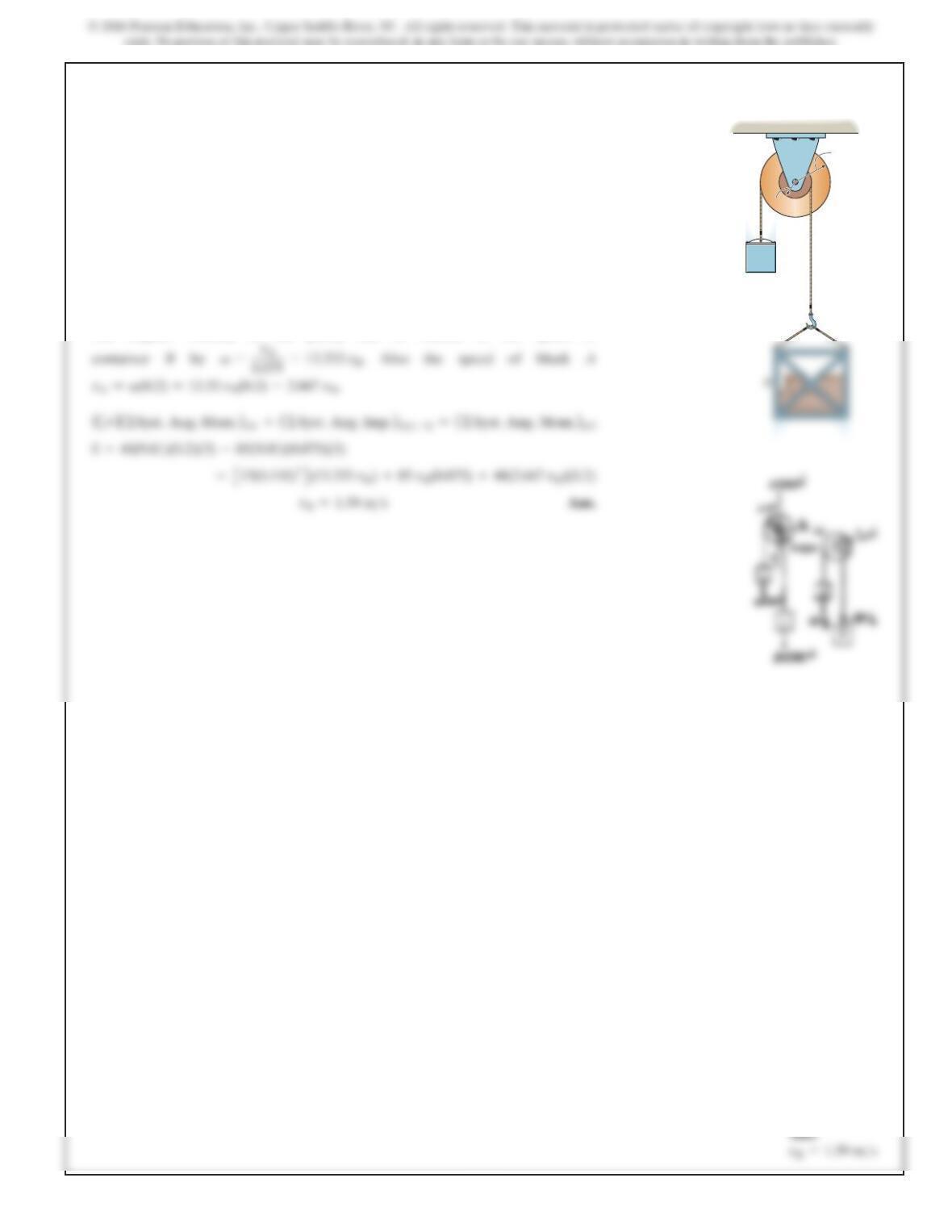
Principle of Impulse and Momentum:The mass moment of inertia of the rods
about their mass center is . Since the
IG=1
A
12
B
=0.75 kg #m2
If the shaft is subjected to a torque of ,
where tis in seconds, determine the angular velocity of the
assembly when , starting from rest. Rods AB and BC
each have a mass of 9 kg.
t=3s
M=(15t2)N
#
m
1m
C
B
A
M(15t2)N m
1m
Ans:
1011
19–27.
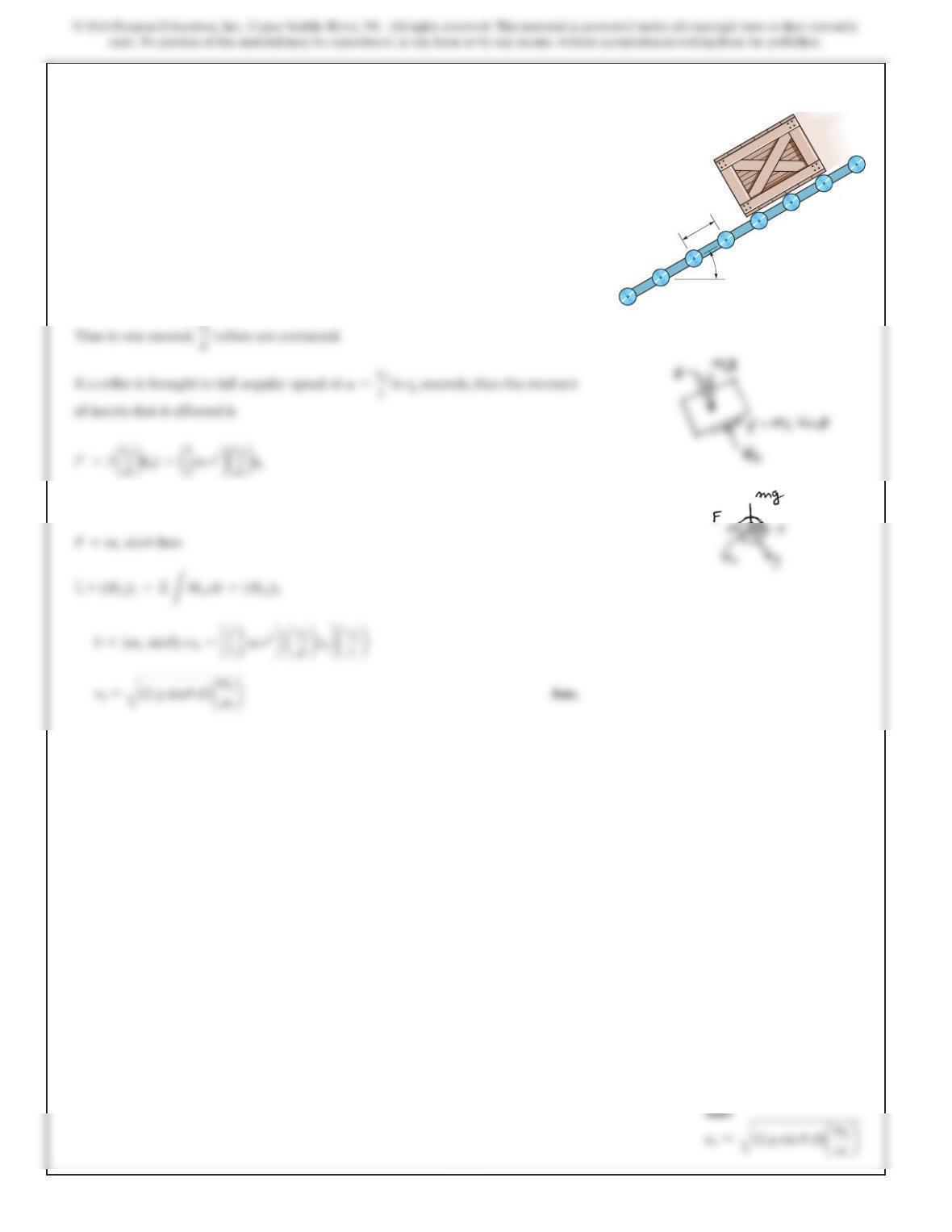
The double pulley consists of two wheels which are attached
to one another and turn at the same rate. The pulley has a
mass of 15 kg and a radius of gyration of
kO = 110 mm. If the block at A has a mass of 40 kg and the
container at B has a mass of 85 kg, including its contents,
determine the speed of the container when
t=3 s
after it is
released from rest.
SOLUTION
The angular velocity of the pulley can be related to the speed of
75 mm
200 mm
A
C
O
1012
*19–28.
SOLUTION
The number of rollers per unit length is 1/d.
Since the frictional impluse is
The crate has a mass Determine the constant speed it
acquires as it moves down the conveyor.The rollers each
have a radius of r, mass m, and are spaced dapart. Note that
friction causes each roller to rotate when the crate comes in
contact with it.
v0
mc.
A
d
30°
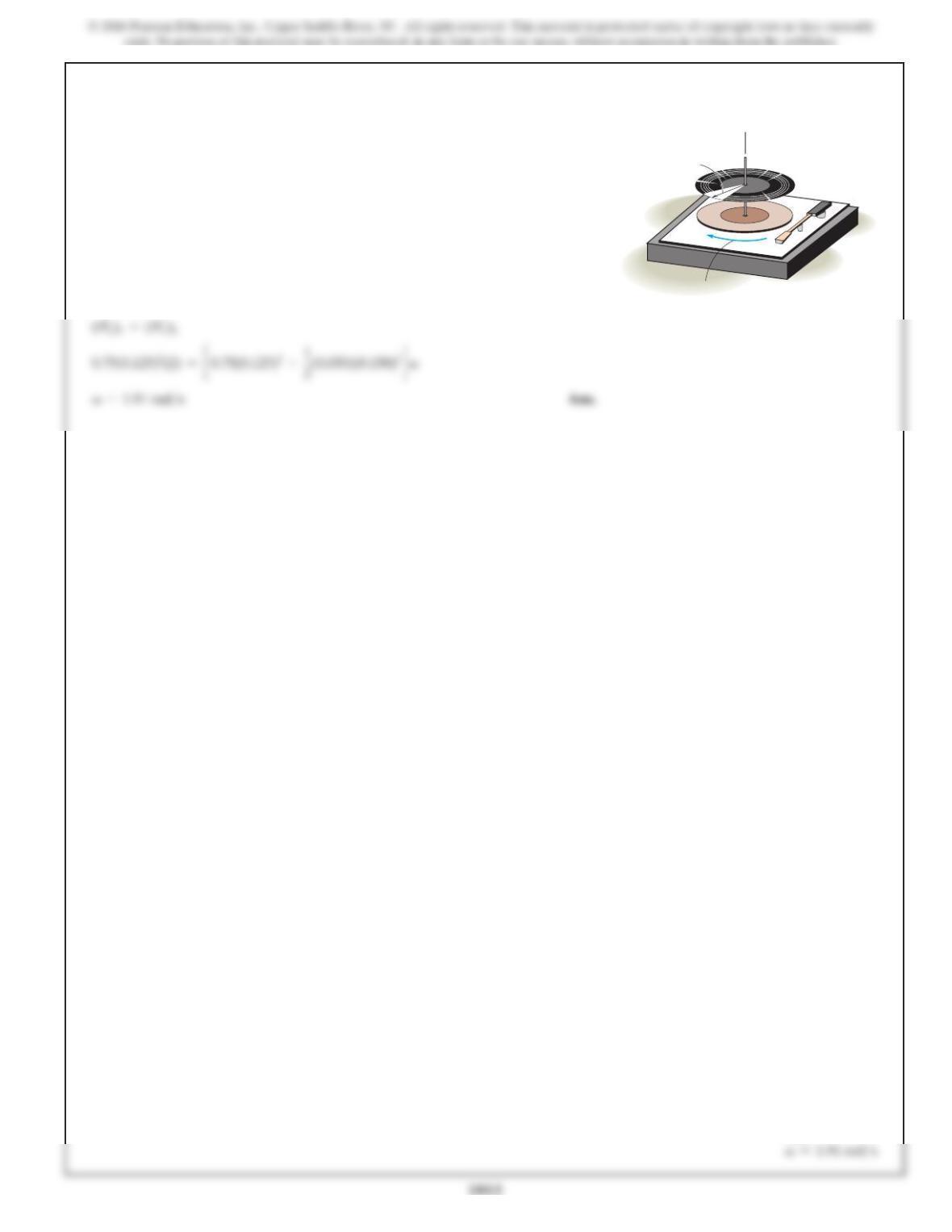
19–29.
The turntable T of a record player has a mass of 0.75 kg and
a radius of gyration
k
z
=125 mm.
It is turning freely at
vT
=2 rad>s
when a 50-g record (thin disk) falls on it.
Determine the final angular velocity of the turntable just
after the record stops slipping on the turntable.
150 mm
z
vT 2 rad/s
T
Ans:
SOLUTION
1014
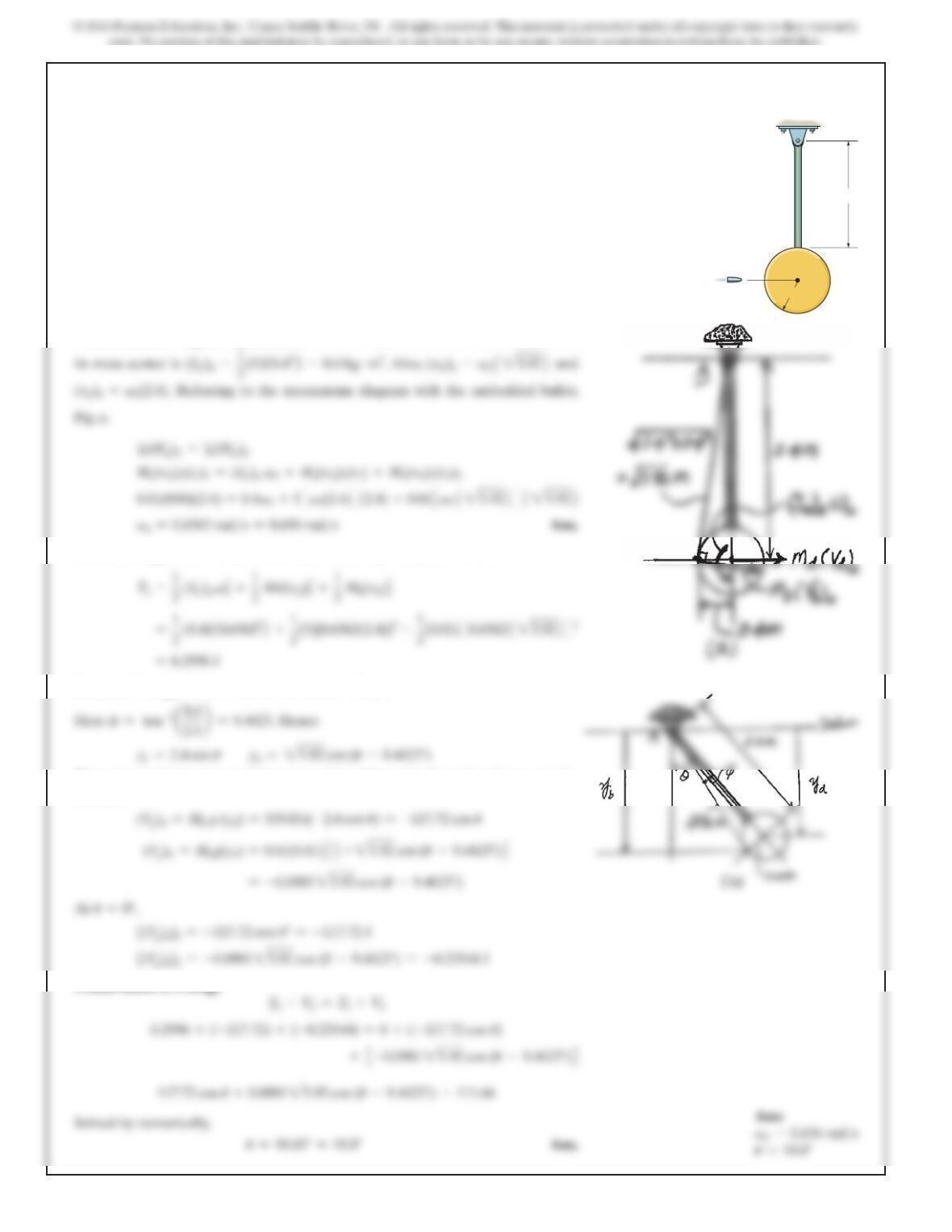
19–30.
The 10-g bullet having a velocity of
800 m>s
is fired into the
edge of the 5-kg disk as shown. Determine the angular
velocity of the disk just after the bullet becomes embedded
into its edge. Also, calculate the angle
u
the disk will swing
when it stops. The disk is originally at rest. Neglect the mass
of the rod AB.
0.4 m
2 m
B
v 800 m/s
A
SOLUTION
Conservation of Angular Momentum. The mass moment of inertia of the disk about
Kinetic Energy. Since the system is required to stop nally,
T3=0
. Here
Potential Energy. Datum is set as indicated on Fig. b.
Thus, the gravitational potential energy of the disk and bullet with reference to the
datum is
Conservation of Energy.
1015
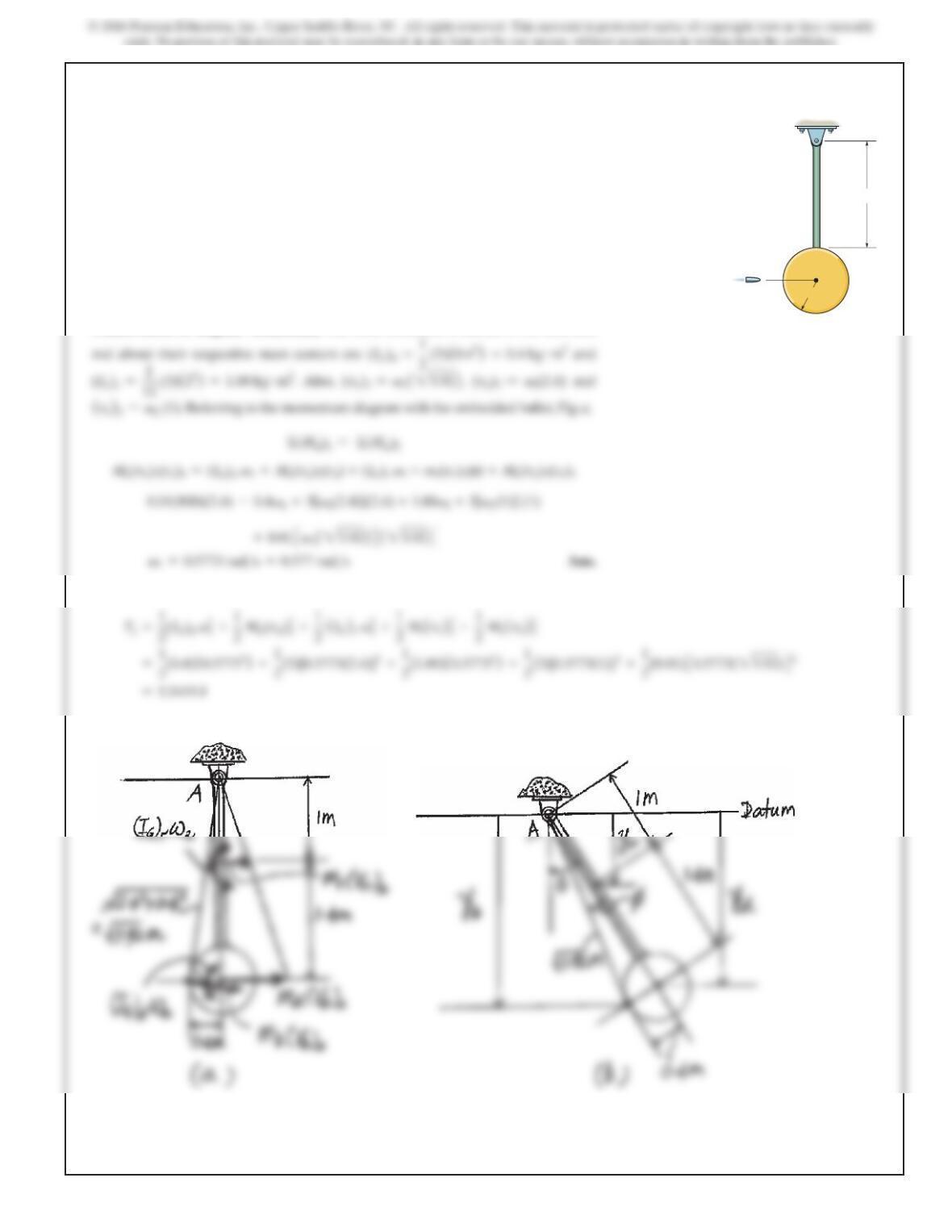
19–31.
The 10-g bullet having a velocity of
800 m>s
is fired into the
edge of the 5-kg disk as shown. Determine the angular
velocity of the disk just after the bullet becomes embedded
into its edge. Also, calculate the angle
u
the disk will swing
when it stops. The disk is originally at rest. The rod AB has a
mass of 3 kg.
0.4 m
2 m
B
v 800 m/s
A
SOLUTION
Conservation of Angular Momentum. The mass moments of inertia of the disk and
Kinetic Energy. Since the system is required to stop nally,
T3=0
. Here
19–31. Continued
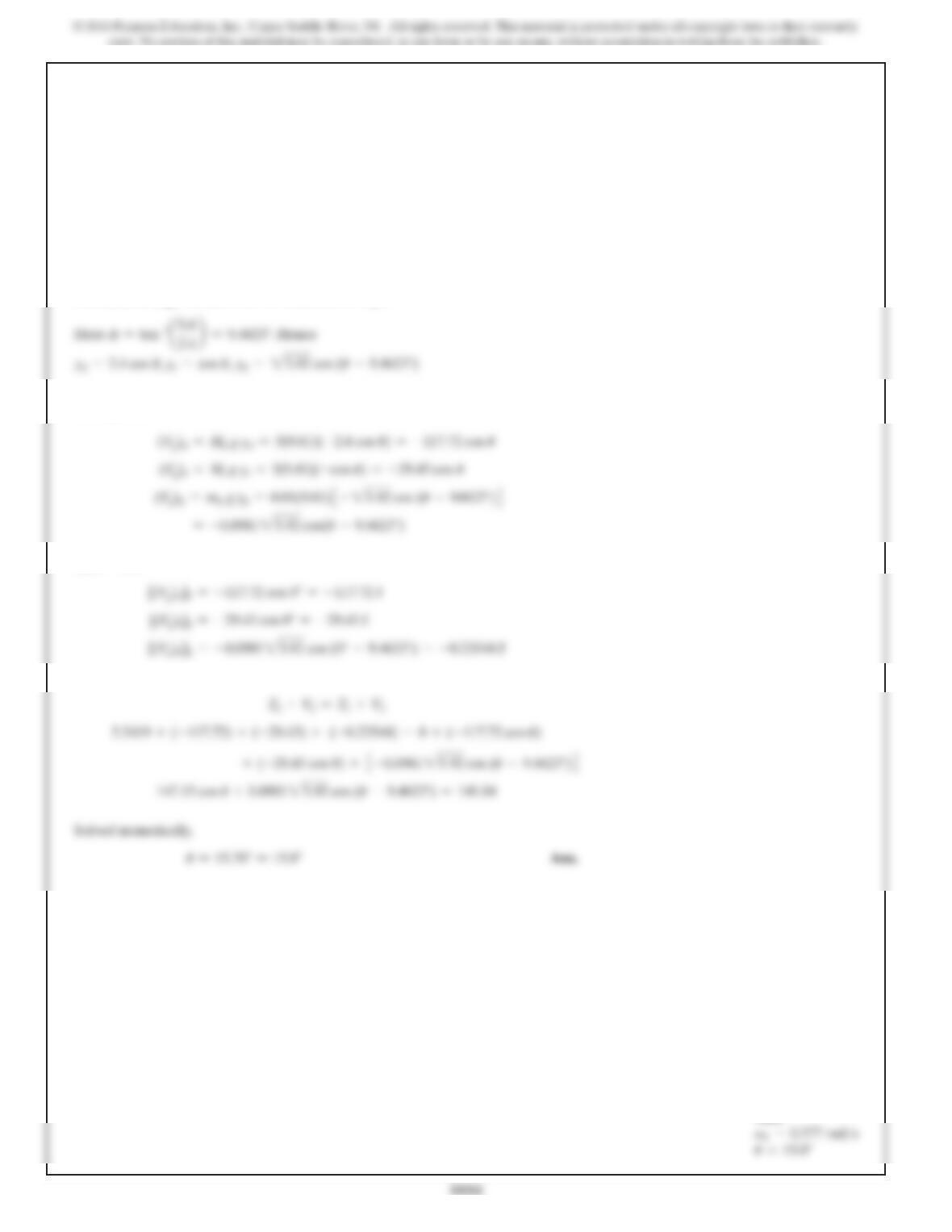
Potential Energy. Datum is set as indicated on Fig. b.
Thus, the gravitational potential energy of the disk, rod and bullet with reference to
the datum is
At
u=0°
,
Conservation of Energy.
u=15.78°=15.8°
Ans:
1017
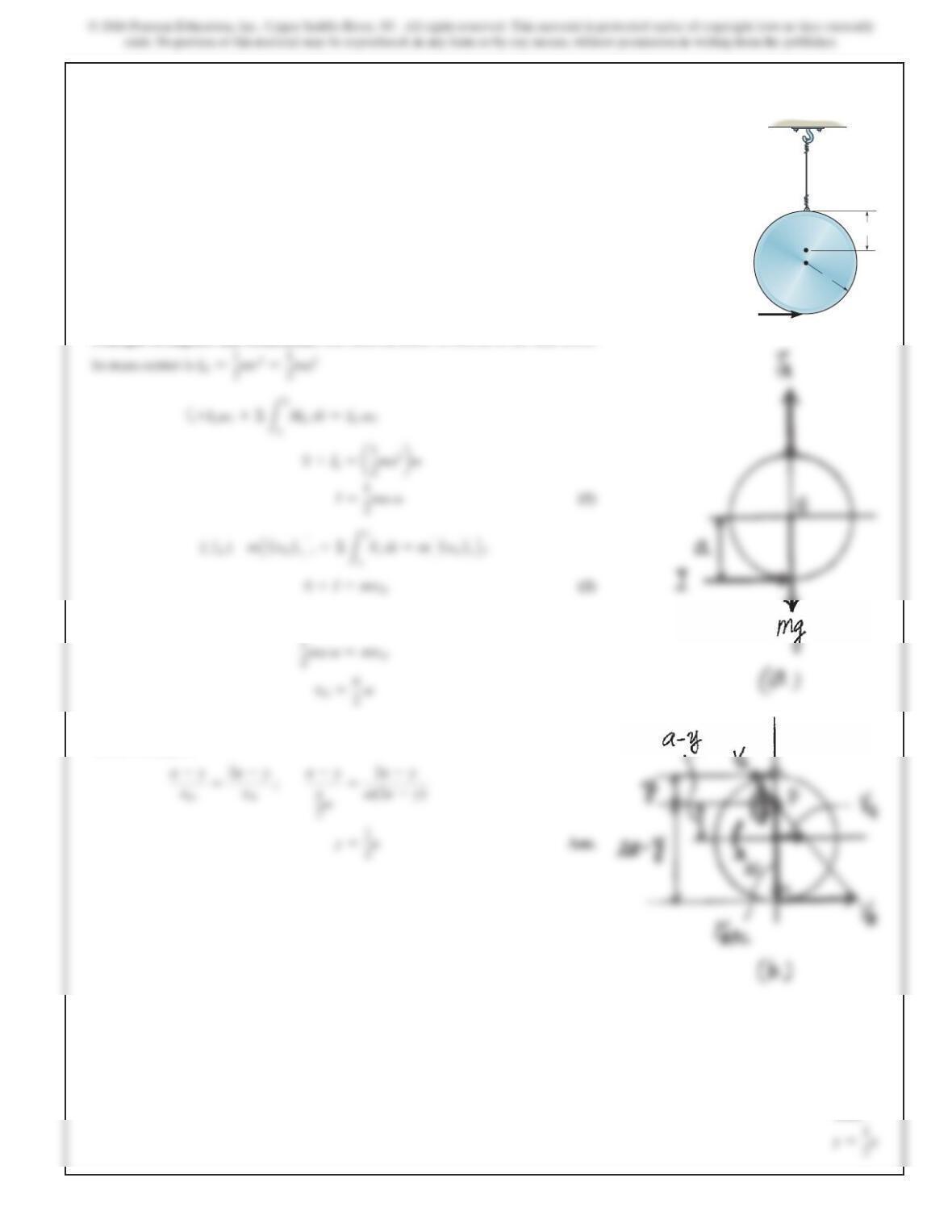
*19–32.
The circular disk has a mass m and is suspended at A by the
wire. If it receives a horizontal impulse I at its edge B,
determine the location y of the point P about which the disk
appears to rotate during the impact.
B
A
P
I
y
a
SOLUTION
Principle of Impulse and Momentum. The mass moment of inertia of the disk about
Equating Eqs. (1) and (2),
Kinematics. Here, IC is located at P, Fig. b. Thus,
v
B
=
v
r
B
>
IC
=
v
(2a–y)
. Using
similar triangles,
Ans:
19–33.
0.65 m
0.20 m
0.3 m 0.3 m
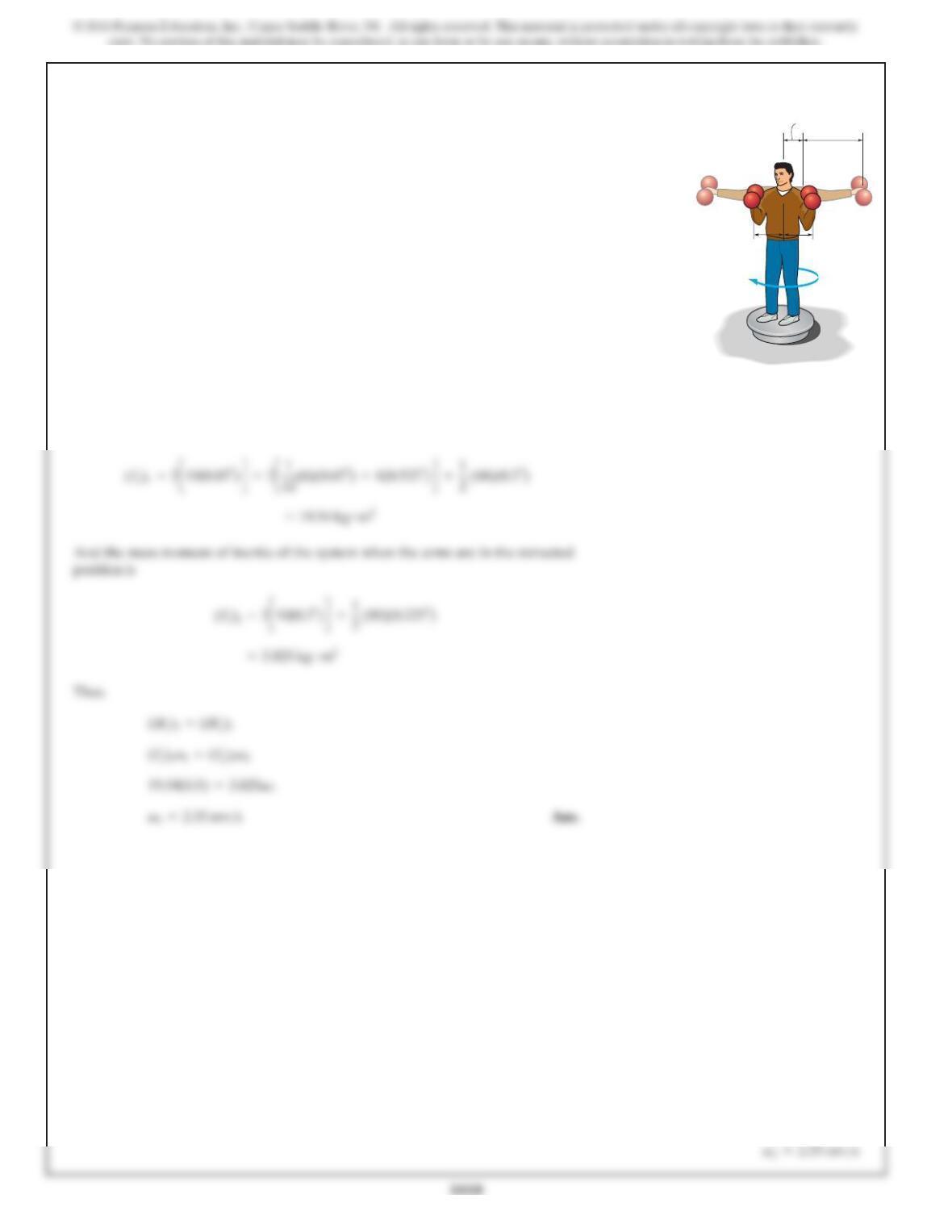
The 80-kg man is holding two dumbbells while standing on a
turntable of negligible mass,which turns freely about a
vertical axis.When his arms are fully extended, the turn–
table is rotating with an angular velocity of .
Determine the angular velocity of the man when he retracts
his arms to the position shown. When his arms are fully
extended, approximate each arm as a uniform 6-kg rod
having a length of 650 mm,and his body as a 68-kg solid
cylinder of 400-mm diameter. With his arms in the retracted
position, assume the man as an 80-kg solid cylinder of 450-mm
diameter. Each dumbbell consists of two 5-kg spheres of
negligible size.
0.5 rev>s
SOLUTION
Conservation of Angular Momentum: Since no external angular impulse acts on the
system during the motion, angular momentum about the axis of rotation (zaxis) is
conserved. The mass moment of inertia of the system when the arms are in the fully
extended position is
Ans:
1019
19–34.
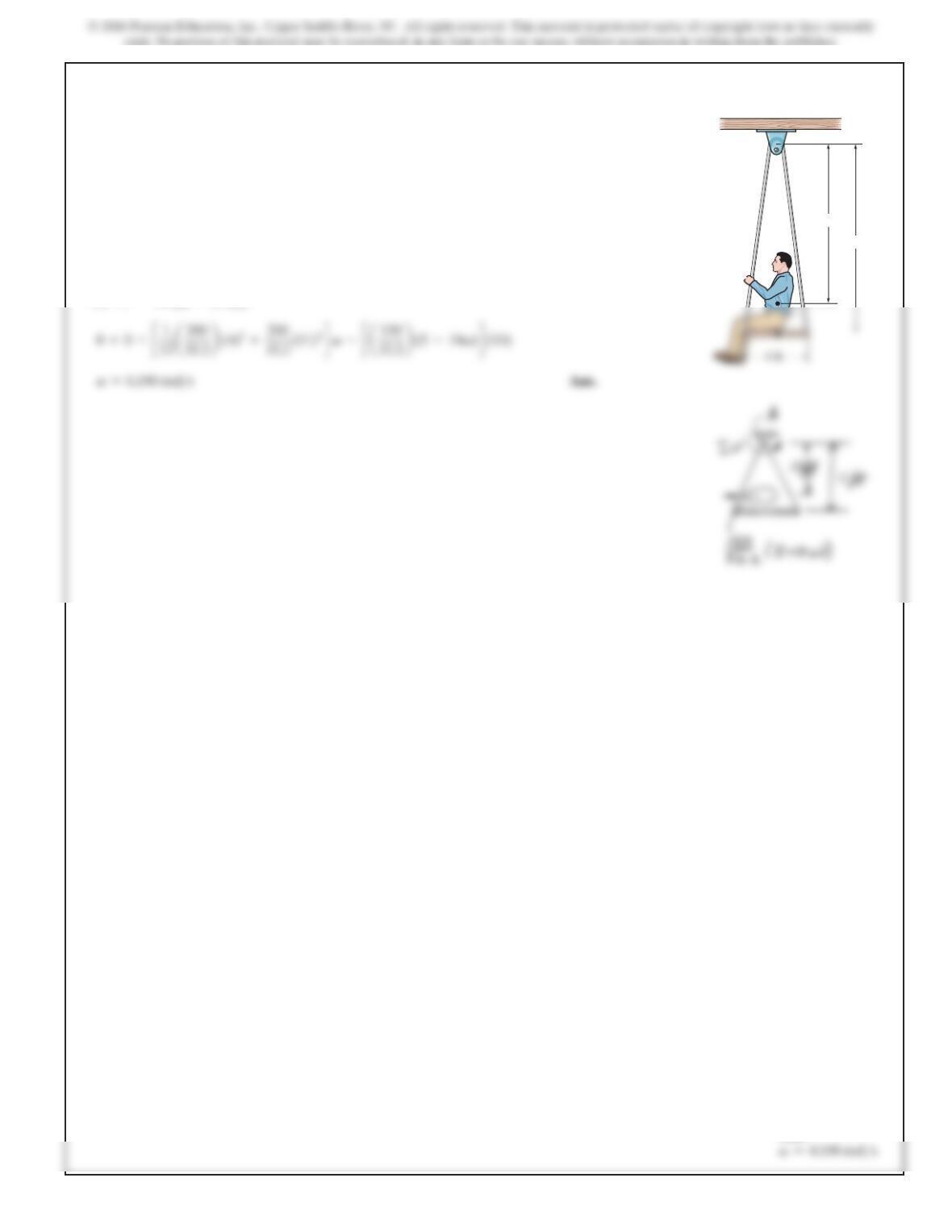
The platform swing consists of a 200-lb flat plate suspended
by four rods of negligible weight. When the swing is at rest,
the 150-lb man jumps off the platform when his center of
gravity Gis 10 ft from the pin at A.This is done with a
horizontal velocity of , measured relative to the swing
at the level of G. Determine the angular velocity he imparts
to the swing just after jumping off.
5 ft>s
SOLUTION
a
+)
(HA)1=(HA)2
(
A
10 ft
11 ft
Ans:
19–35.
SOLUTION
c
+
H1=H2
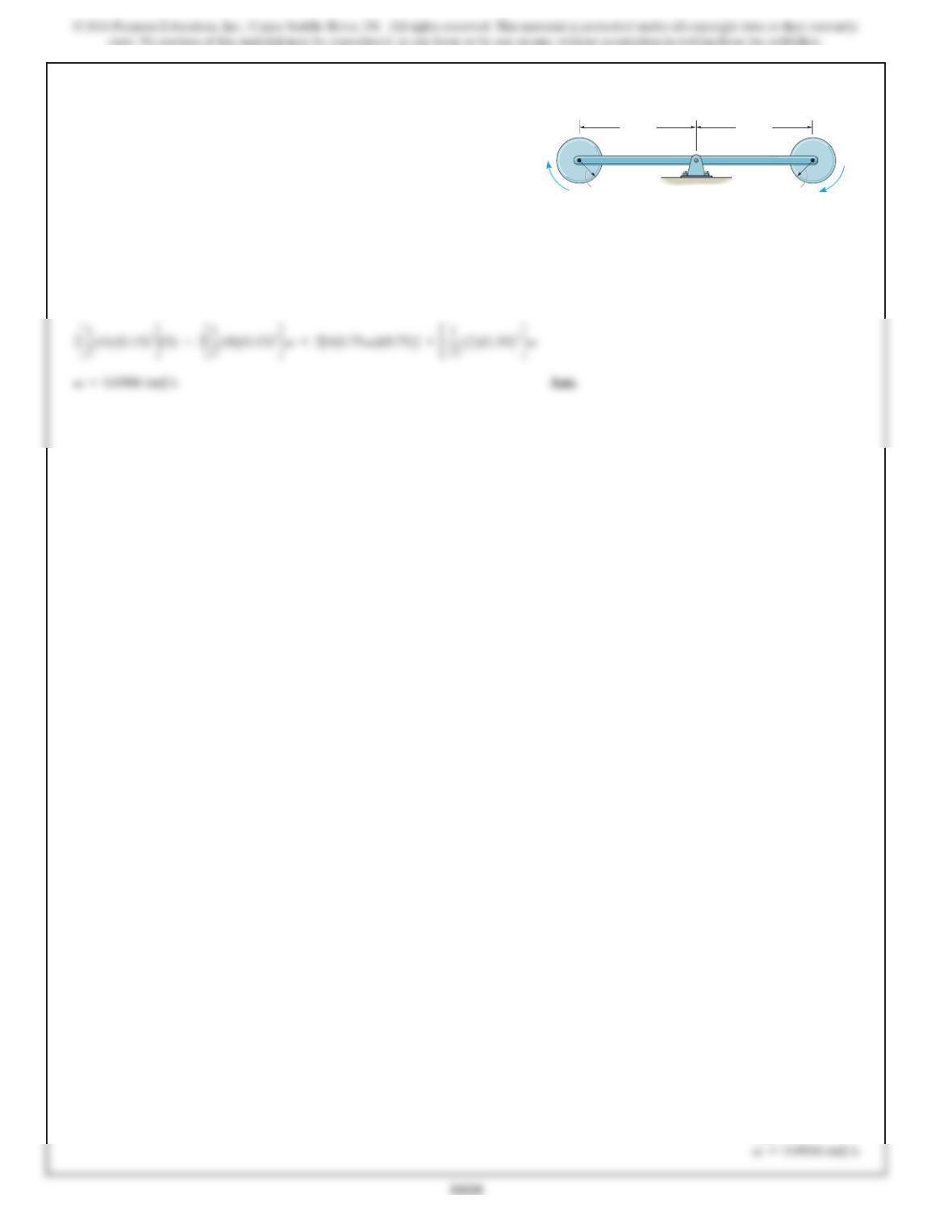
The 2-kg rod ACBsupports the two 4-kg disks at its ends.If
both disks are given a clockwise angular velocity
while the rod is held stationary
and then released, determine the angular velocity of the rod
after both disks have stopped spinning relative to the rod
due to frictional resistance at the pins Aand B. Motion is in
the horizontal plane. Neglect friction at pin C.
1vA21=1vB21=5 rad>s
B
0.15 m0.15 m
A
C
0.75m 0.75m
(V
B
)
1
(V
A
)
1
Ans:
1021
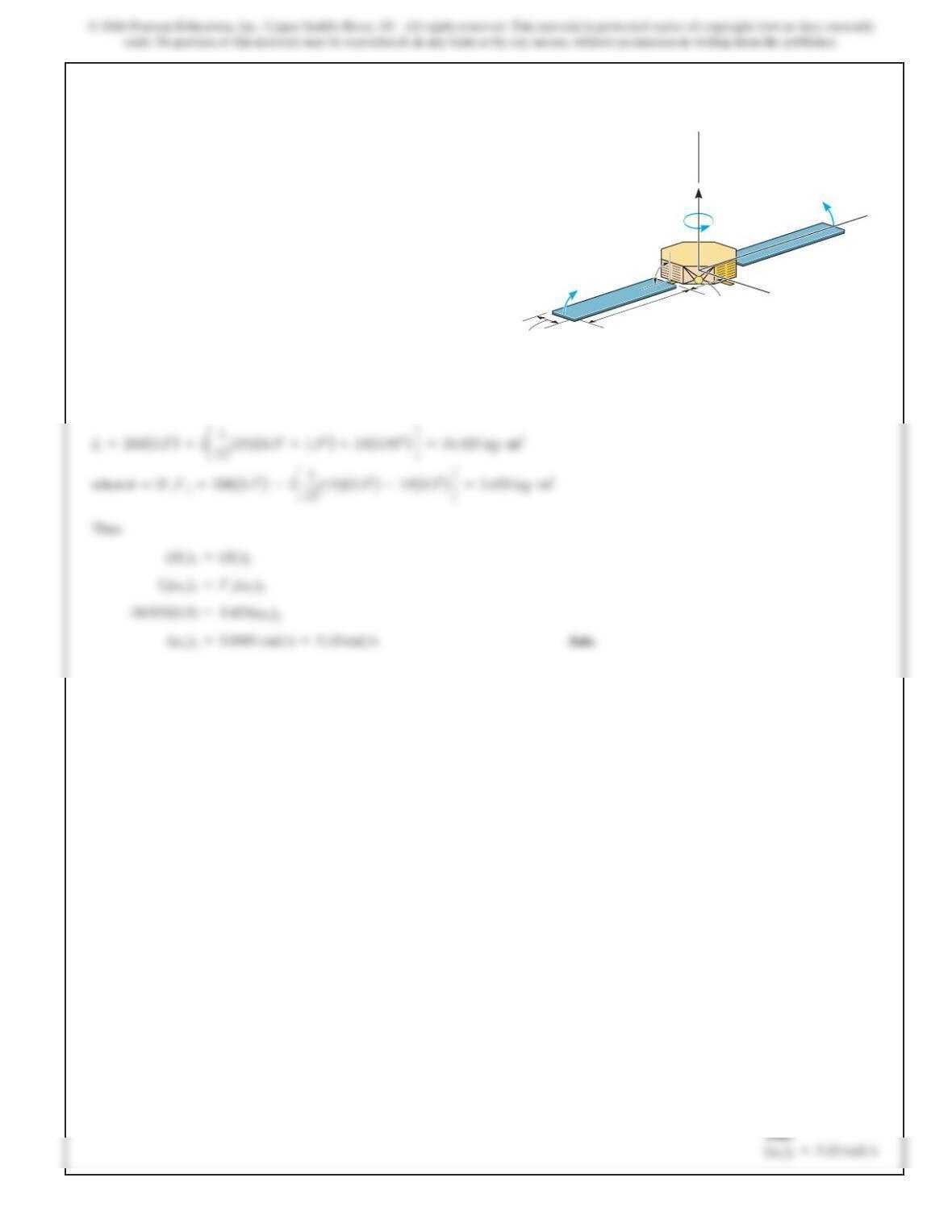
*19–36.
The satellite has a mass of 200 kg and a radius of gyration
about z axis of
k
z
=0.1 m,
excluding the two solar panels
A and B. Each solar panel has a mass of 15 kg and can be
approximated as a thin plate. If the satellite is originally
spinning about the z axis at a constant rate
vz
=0.5 rad>s when
u
=90°,
determine the rate of spin if
both panels are raised and reach the upward position,
u
=0°,
at the same instant.
0.3 m
1.5 m
0.2 m
u 90
A
B
z
y
x
v
z
SOLUTION
Conservation of Angular Momentum. When
u=90°
, the mass moment of inertia of
the entire satellite is
u=0°
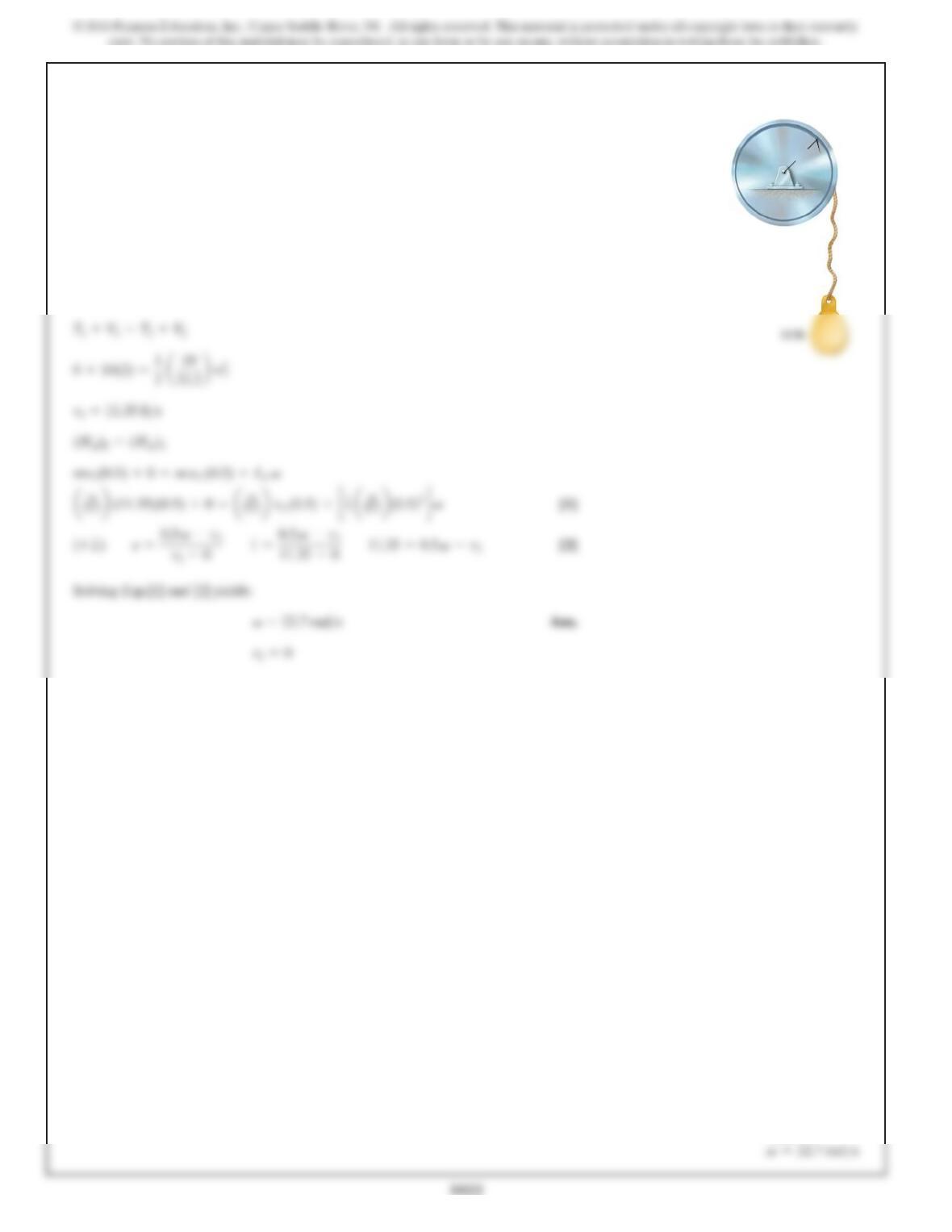
19–37.
Disk Ahas a weight of 20 lb. An inextensible cable is
attached to the 10-lb weight and wrapped around the disk.
The weight is dropped 2 ft before the slack is taken up.If
the impact is perfectly elastic, i.e., determine the
angular velocity of the disk just after impact.
e=1,
SOLUTION
For the weight
0.5 ft
A
Ans:
1023
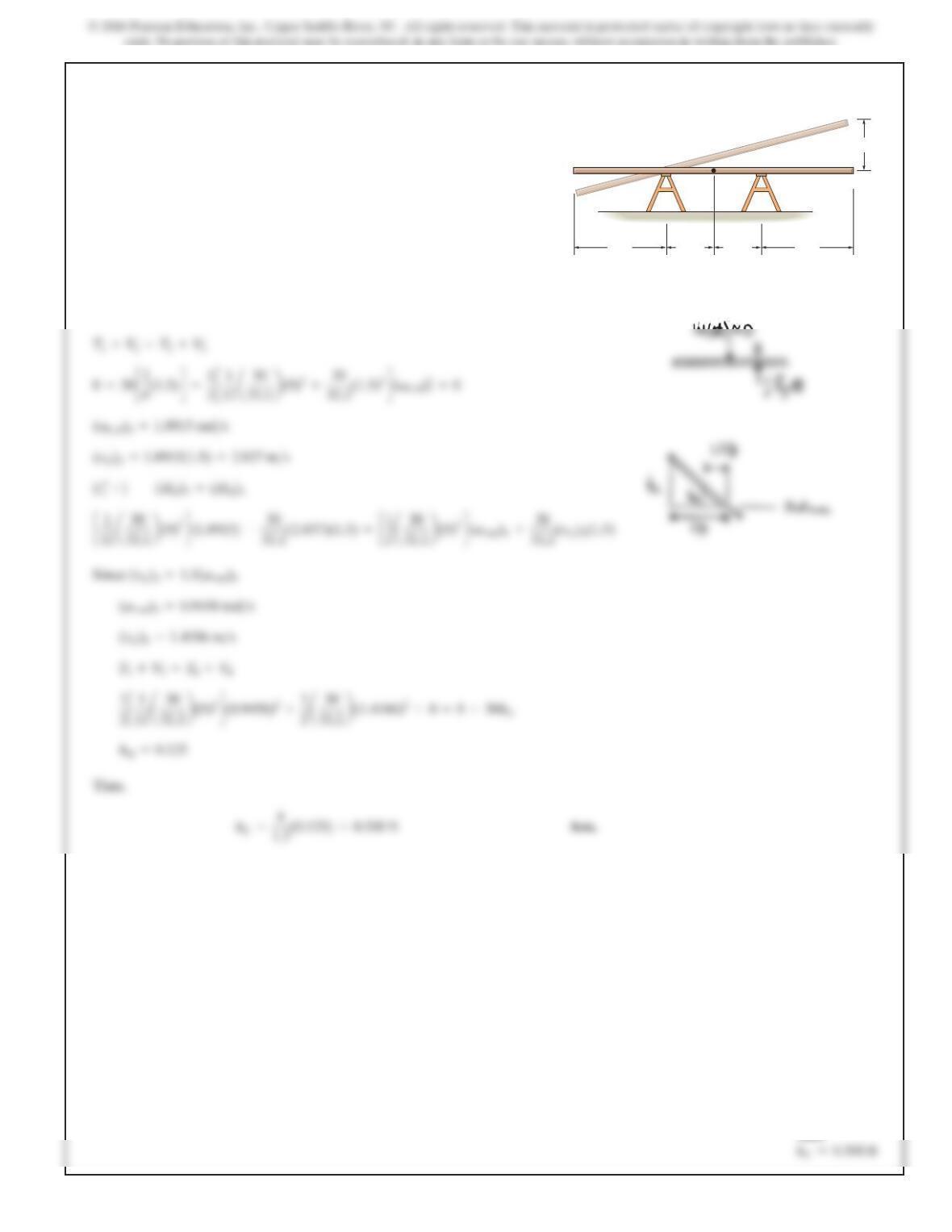
19–38.
SOLUTION
Establishing a datum through AB, the angular velocity of the plank just before striking
Bis
The plank has a weight of 30 lb, center of gravity at G,and it
rests on the two sawhorses at Aand B. If the end Dis raised
2 ft above the top of the sawhorses and is released from
rest, determine how high end Cwill rise from the top of the
sawhorses after the plank falls so that it rotates clockwise
about A, strikes and pivots on the sawhorses at B, and
rotates clockwise off the sawhorse at A.
A
CD
G
B
3 ft 3 ft
2 ft
1.5 ft 1.5 ft
Ans:
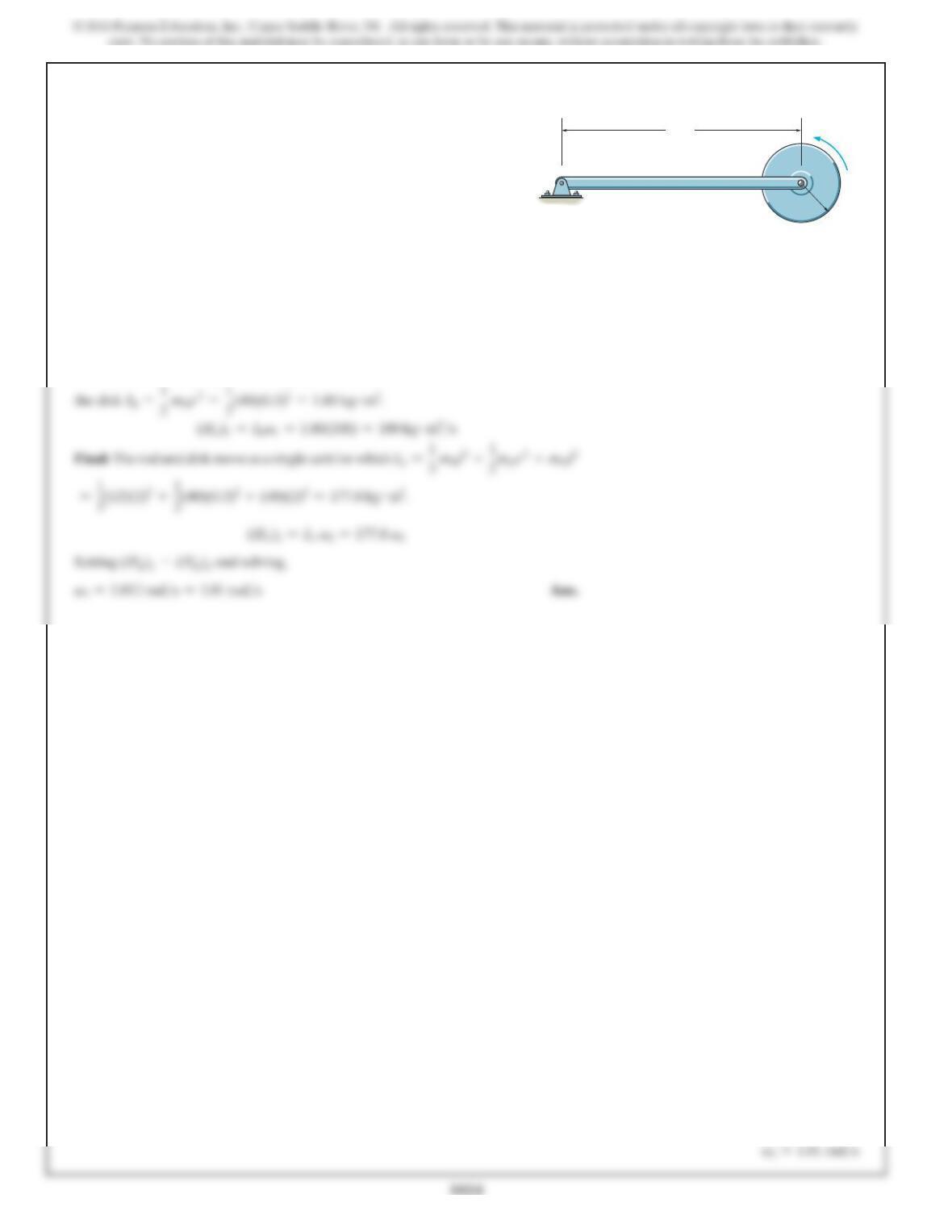
19–39.
The 12-kg rod AB is pinned to the 40-kg disk. If the disk is
given an angular velocity vD
=100 rad>s
while the rod is
held stationary, and the assembly is then released, determine
the angular velocity of the rod after the disk has stopped
spinning relative to the rod due to frictional resistance at
the bearing B. Motion is in the horizontal plane. Neglect
friction at the pin A.
AB
2 m
0.3 m
vD
SOLUTION
Conservation of Angular Momentum
Initial: Since the rod is stationary and the disk is not translating, the total angular
momentum about A equals the angular momentum of the disk about B, where for
Ans: