912
18–1.
SOLUTION
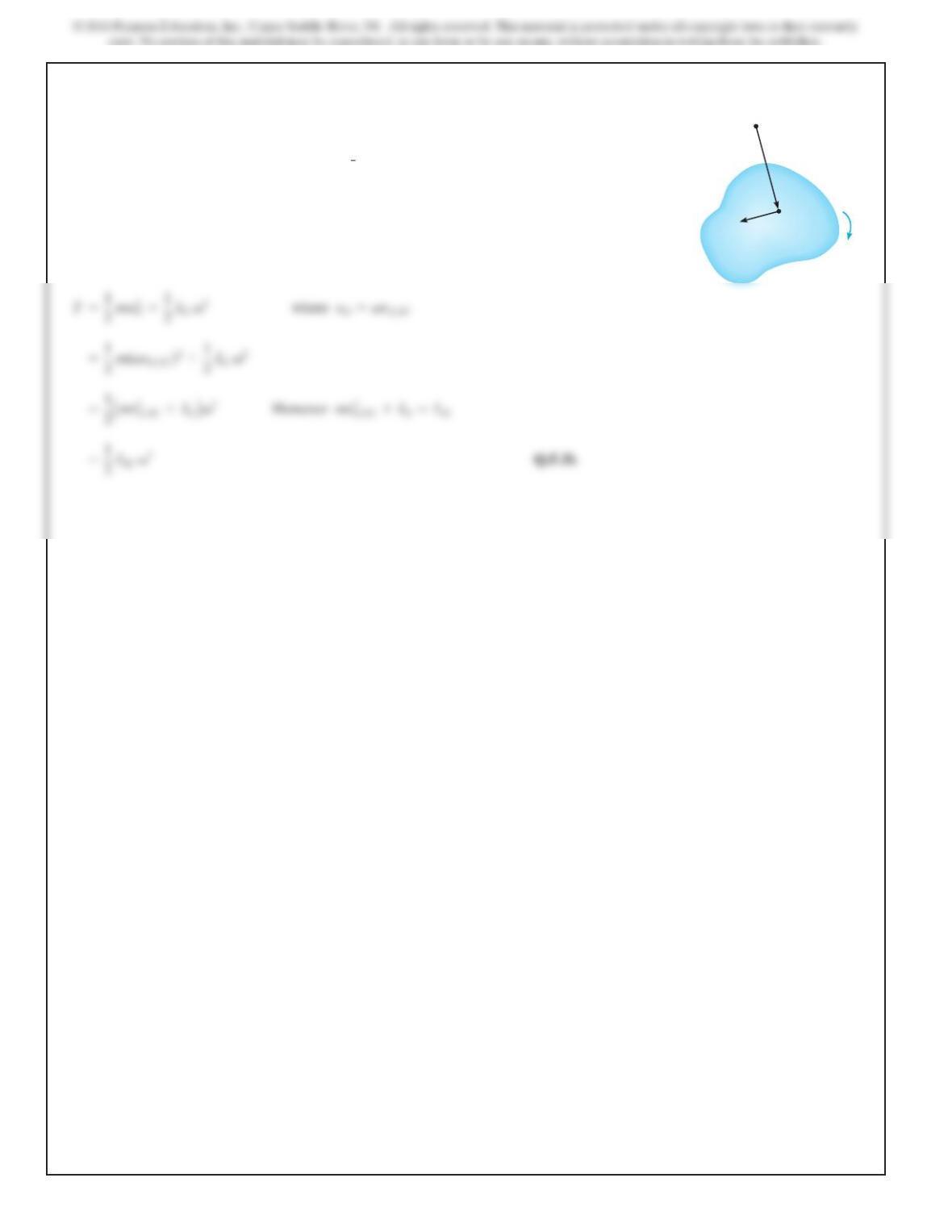
At a given instant the body of mass mhas an angular
velocity and its mass center has a velocity . Show that
its kinetic energy can be represented as , where
is the moment of inertia of the body determined about
the instantaneous axis of zero velocity, located a distance
from the mass center as shown.rG>IC
IIC
T=1
2IICv2
vG
V
IC
G
V
rG/IC
vG
913
18–2.
M
O
0.5 m
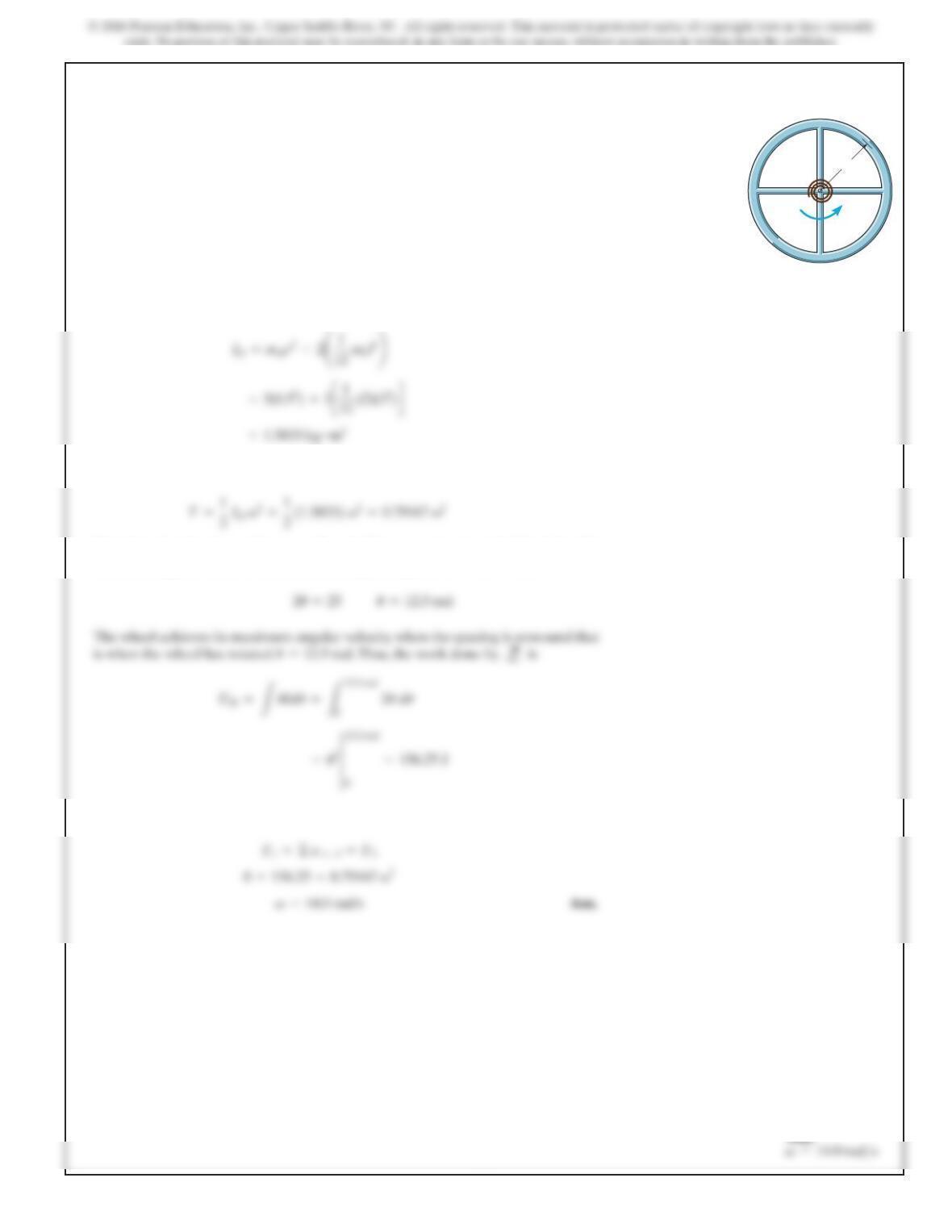
The wheel is made from a 5-kg thin ring and two 2-kg
slender rods. If the torsional spring attached to the wheel’s
center has a stiffness , and the wheel is
rotated until the torque is developed,
determine the maximum angular velocity of the wheel if it
is released from rest.
M=25 N #m
k=2 N #m>rad
SOLUTION
Kinetic Energy and Work: The mass moment of inertia of the wheel about point Ois
Thus, the kinetic energy of the wheel is
Since the wheel is released from rest, .The torque developed is .
Here, the angle of rotation needed to develop a torque of is
Principle of Work and Energy:
M=25 N #m
M=ku=2uT1=0
18–3.
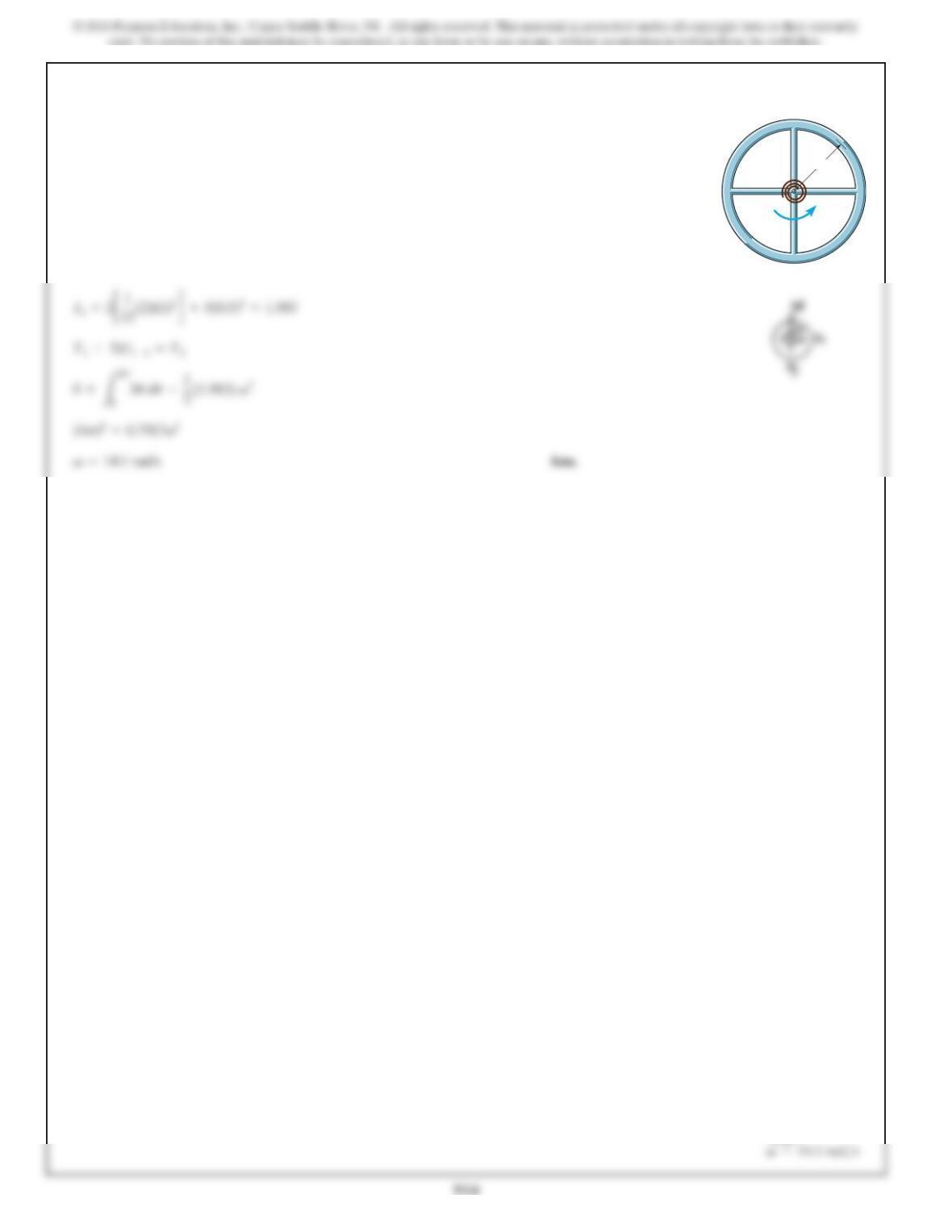
The wheel is made from a 5-kg thin ring and two 2-kg slender
rods. If the torsional spring attached to the wheel’s center has
a stiffness so that the torque on the center
of the wheel is where is in radians,
determine the maximum angular velocity of the wheel if it is
rotated two revolutions and then released from rest.
uM=12u2N#m,
k=2N#m>rad,
SOLUTION
M
O
0.5 m
Ans:
915
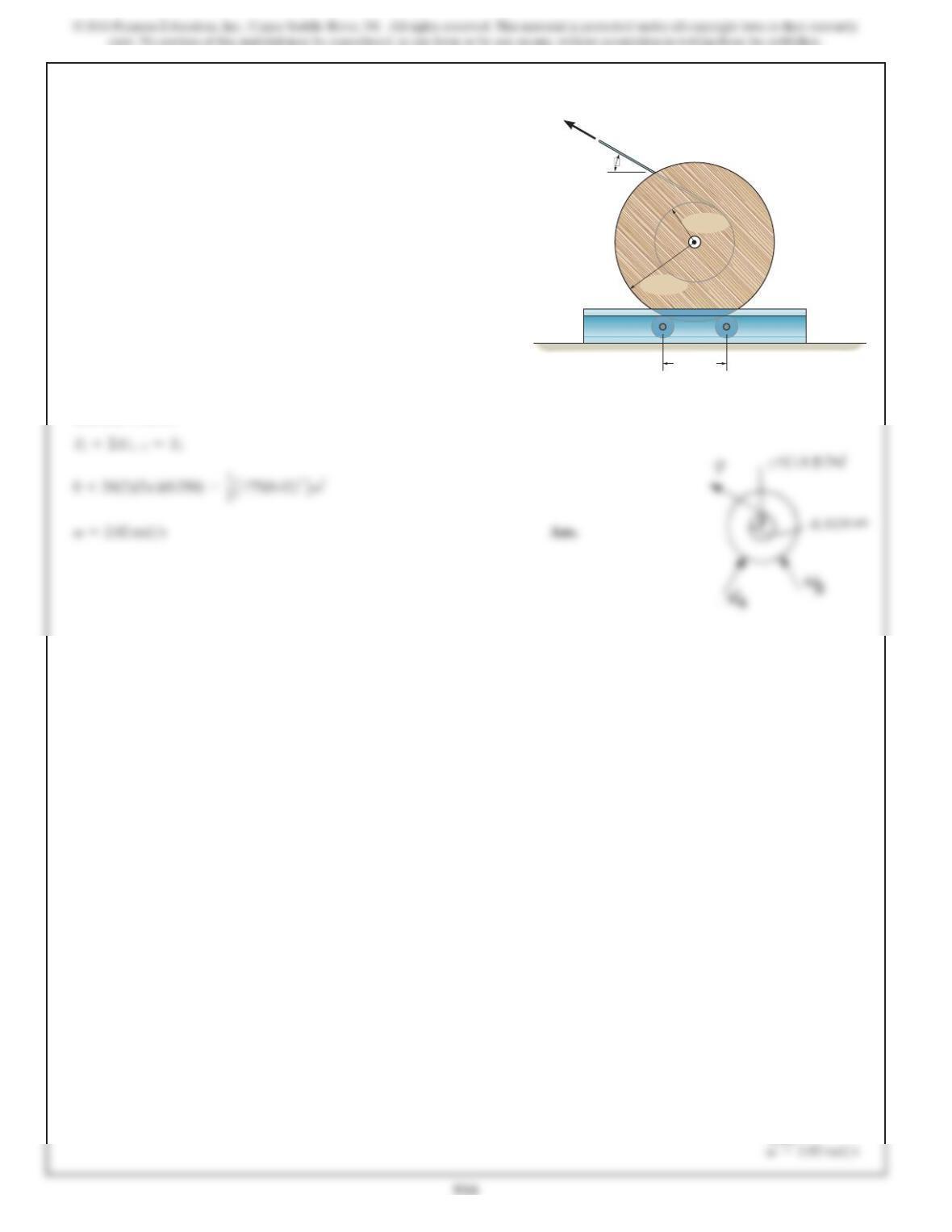
*18–4.
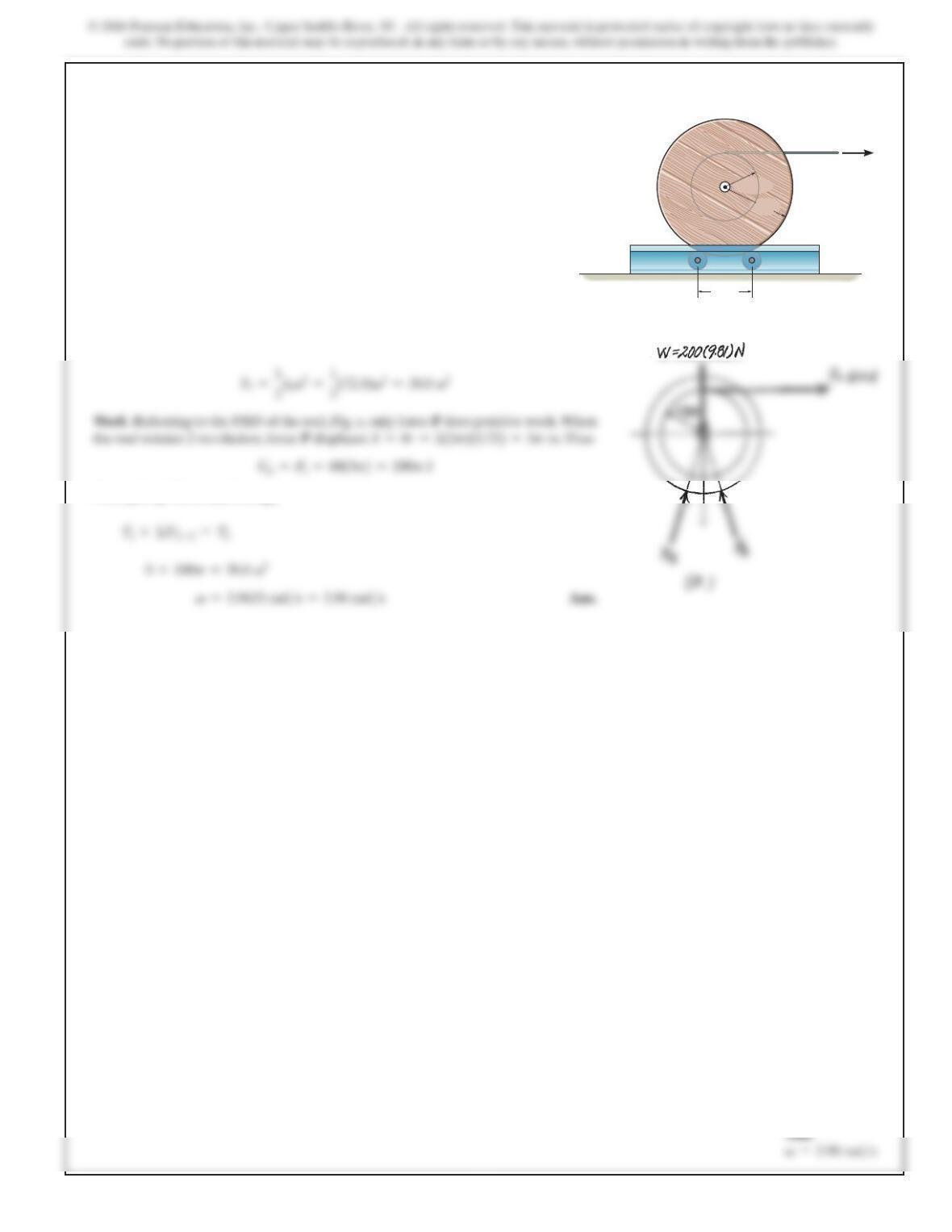
A force of P
=
60 N is applied to the cable, which causes
the 200-kg reel to turn since it is resting on the two rollers
Aand B of the dispenser. Determine the angular velocity of
the reel after it has made two revolutions starting from rest.
Neglect the mass of the rollers and the mass of the cable.
Assume the radius of gyration of the reel about its center
axis remains constant at kO
=
0.6 m.
SOLUTION
Kinetic Energy. Since the reel is at rest initially, T1
=
0. The mass moment of inertia
of the reel about its center O is I
0=
mk
0
2=
200
(
0.6
2
)
=
72.0 kg
#
m
2
. Thus,
Principle of Work and Energy.
0.75 m
0.6 m
1 m
P
A
O
B
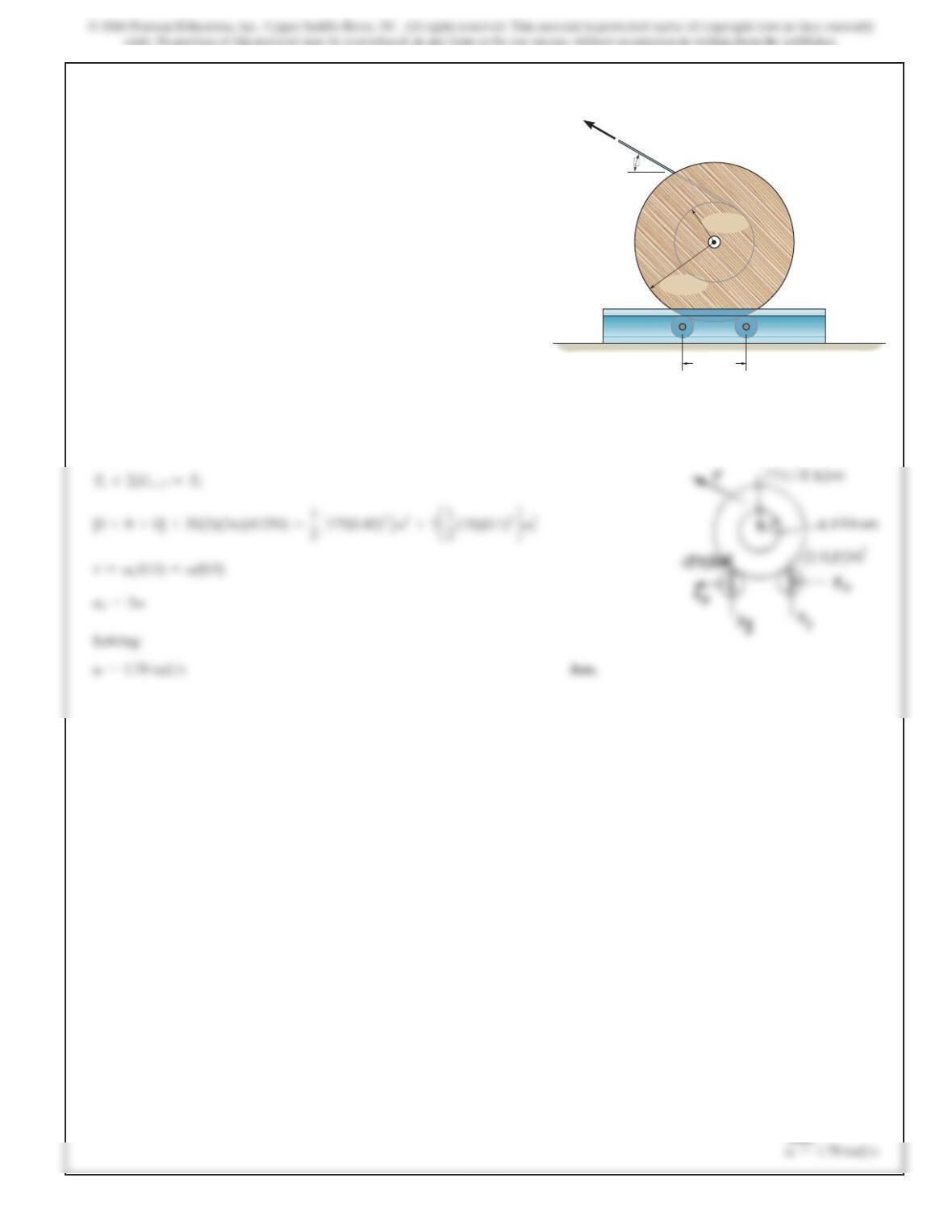
18–5.
A force of P=20 N is applied to the cable, which causes
the 175-kg reel to turn since it is resting on the two rollers
A and B of the dispenser. Determine the angular velocity of
the reel after it has made two revolutions starting from rest.
Neglect the mass of the rollers and the mass of the cable.
The radius of gyration of the reel about its center axis is
kG=0.42
m.
SOLUTION
500 mm
400 mm
250 mm
30°
P
A
G
B
Ans:
917
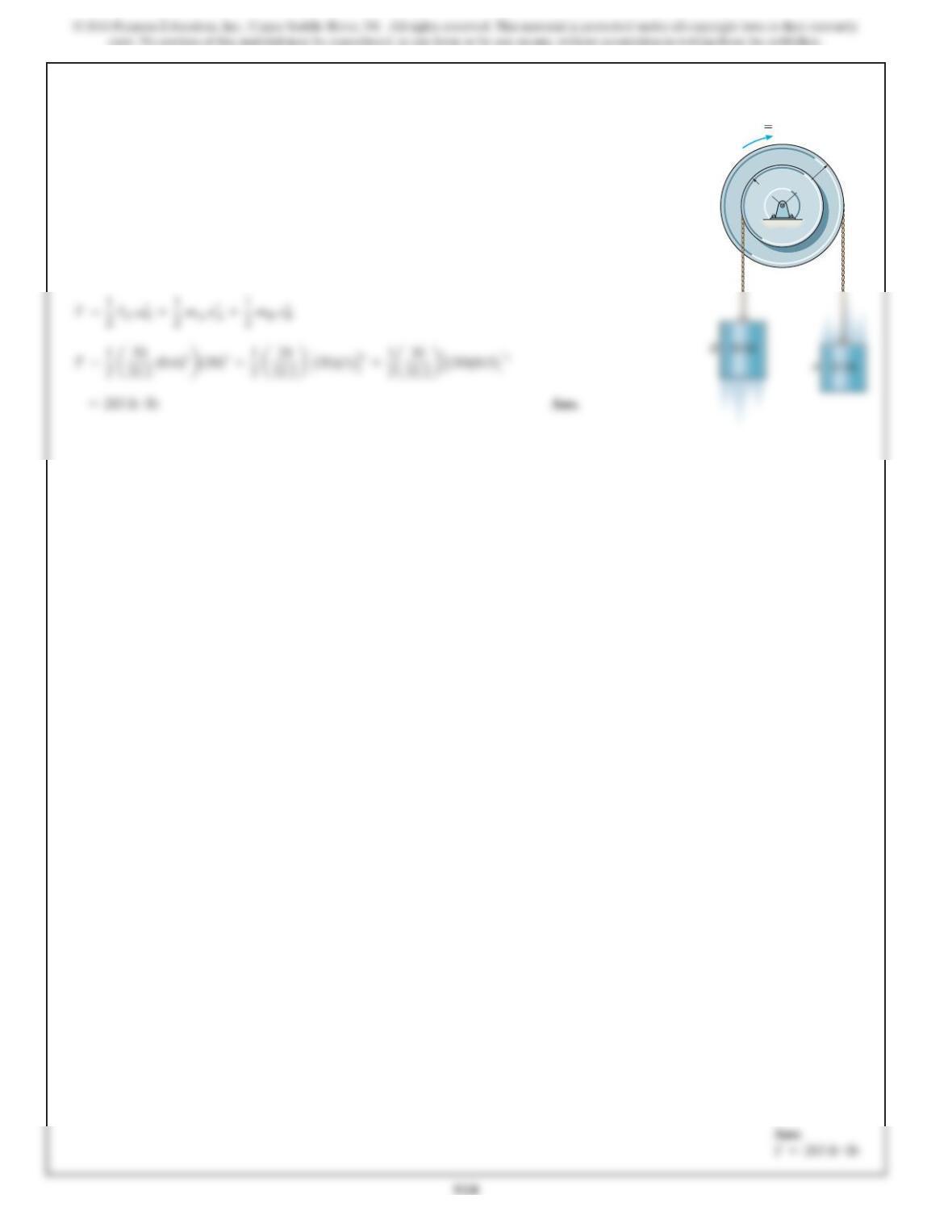
18–6.
A force of P=20 N is applied to the cable, which causes
the 175-kg reel to turn without slipping on the two rollers A
and B of the dispenser. Determine the angular velocity of
the reel after it has made two revolutions starting from rest.
Neglect the mass of the cable. Each roller can be considered
as an 18-kg cylinder, having a radius of 0.1 m. The radius of
gyration of the reel about its center axis is kG=0.42
m.
SOLUTION
System:
500 mm
400 mm
250 mm
30°
P
A
G
B
18–7.
SOLUTION
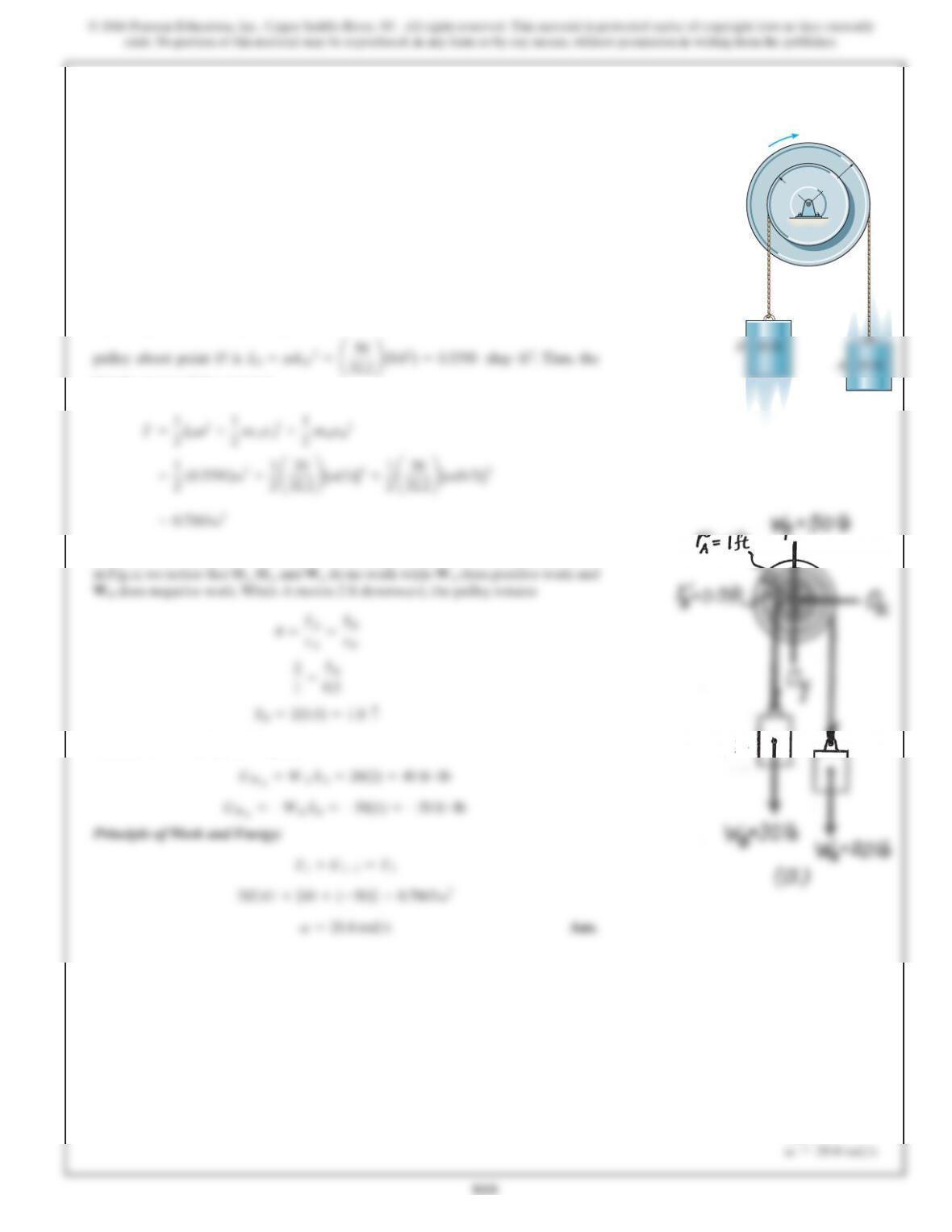
1 ft
0.5ft
O
v 20 rad/s
The double pulley consists of two parts that are attached to
one another. It has a weight of 50 lb and a radius of gyration
about its center of k = 0.6 ft and is turning with an angular
velocity of 20 rad>s clockwise. Determine the kinetic energy
of the system. Assume that neither cable slips on the pulley.
O
*18–8.
1 ft
0.5 ft
O
v
20 rad
/
s
The double pulley consists of two parts that are attached to
one another. It has a weight of 50 lb and a centroidal radius
of gyration of and is turning with an angular
velocity of 20 rad s clockwise. Determine the angular
velocity of the pulley at the instant the 20-lb weight moves
2 ft downward.
>
kO=0.6 ft
SOLUTION
Kinetic Energy and Work: Since the pulley rotates about a fixed axis,
.The mass moment of inertia of the
kinetic energy of the system is
Thus,.Referring to the FBD of the system shown
Thus, the work of are
WA and WB
T1=0.7065(202)=282.61 ft #lb
vA=vrA=v(1) and vB=vrB=v(0.5)
Ans:
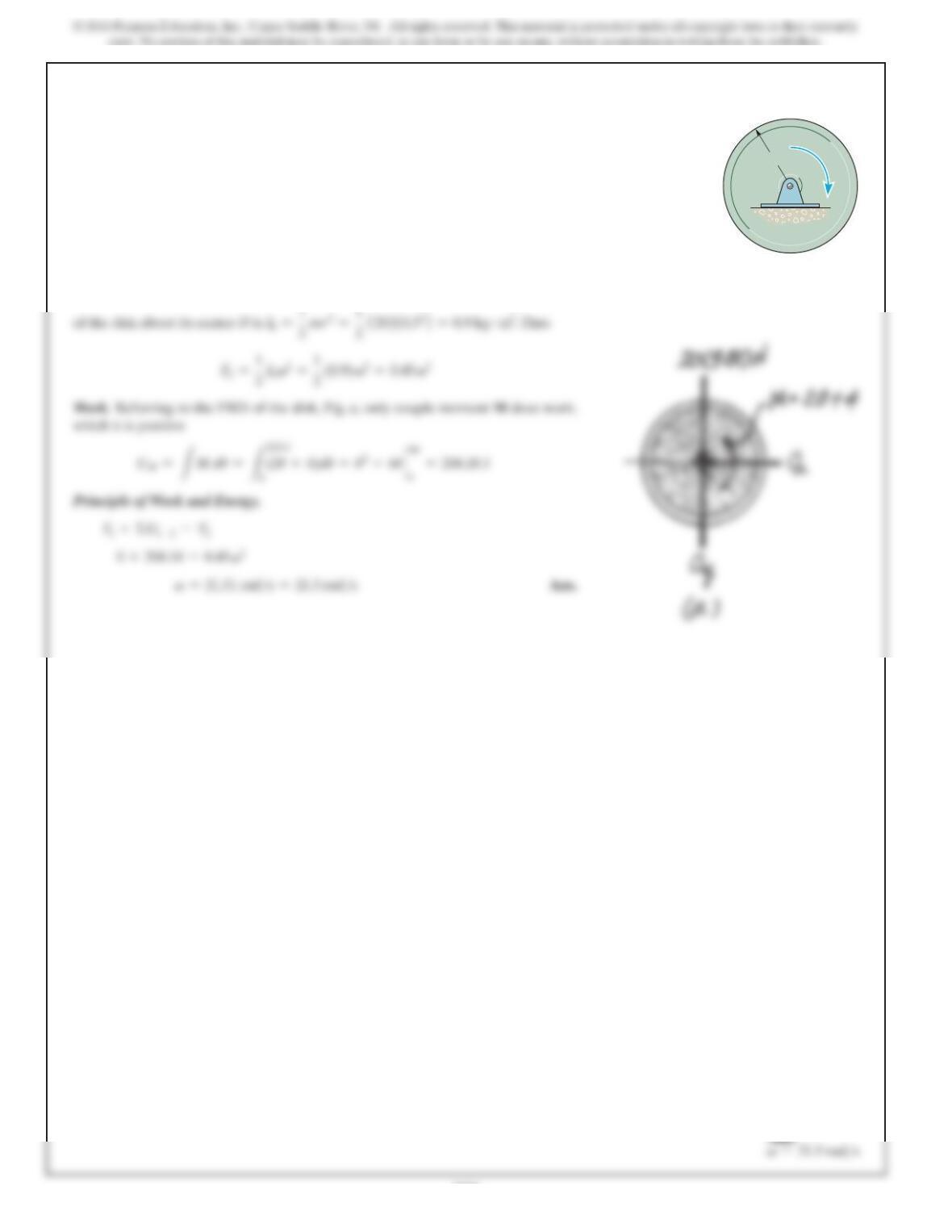
920
18–9.
The disk, which has a mass of 20 kg, is subjected to the
couple moment of M
=(2
u
+4)
N
#
m, where
u
is in
radians. If it starts from rest, determine its angular velocity
when it has made two revolutions.
SOLUTION
Kinetic Energy. Since the disk starts from rest, T1
=
0. The mass moment of inertia
O
M
300 mm
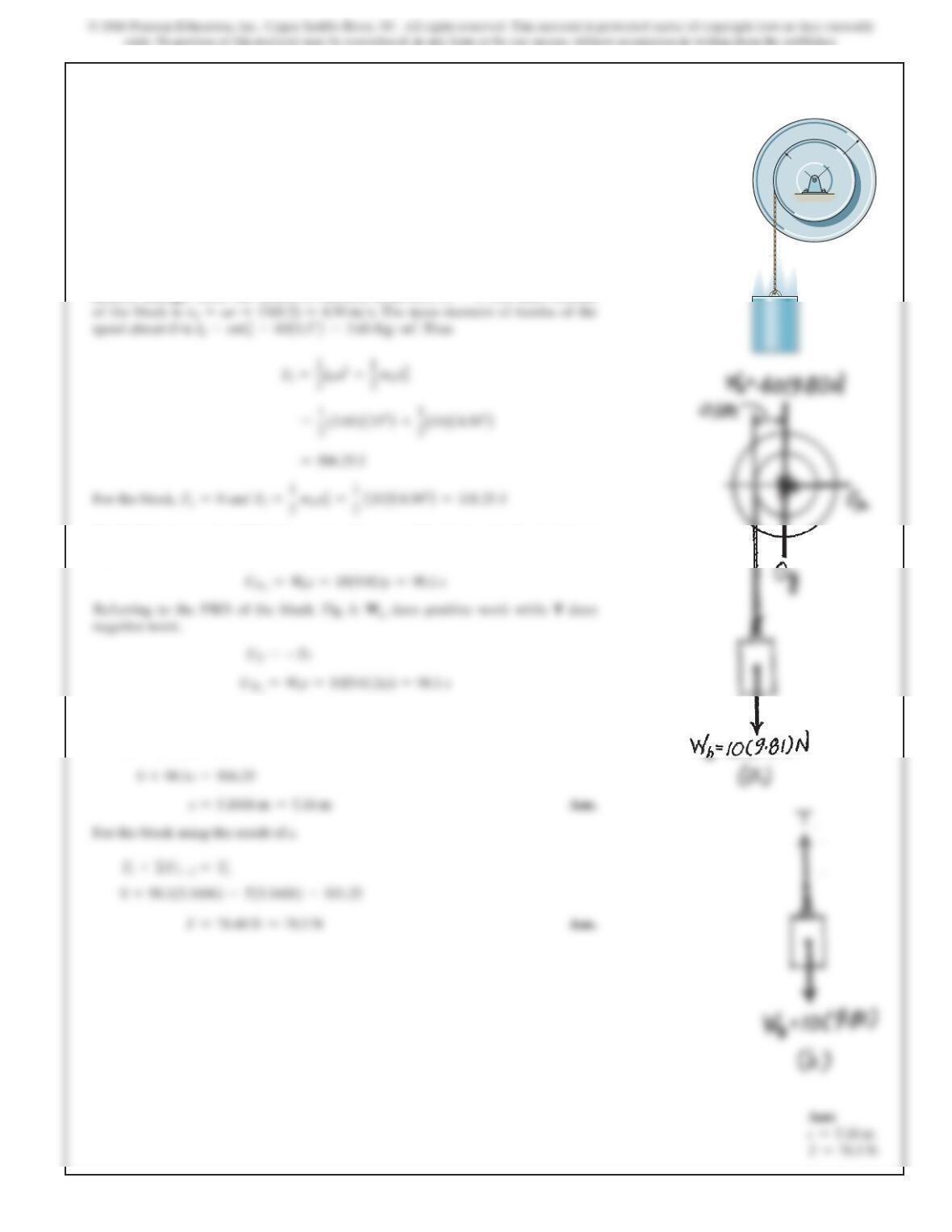
921
18–10.
The spool has a mass of 40 kg and a radius of gyration of
kO
=
0.3 m. If the 10-kg block is released from rest,
determine the distance the block must fall in order for the
spool to have an angular velocity
v
=
15 rad
>
s. Also, what
is the tension in the cord while the block is in motion?
Neglect the mass of the cord.
SOLUTION
Kinetic Energy. Since the system is released from rest, T1
=
0. The final velocity
=
Work. Referring to the FBD of the system Fig. a, only Wb does work when the block
displaces s vertically downward, which it is positive.
Principle of Work and Energy. For the system,
T1+ΣU1–2=T2
T1+ΣU1–2=T2
500 mm
300 mm
O
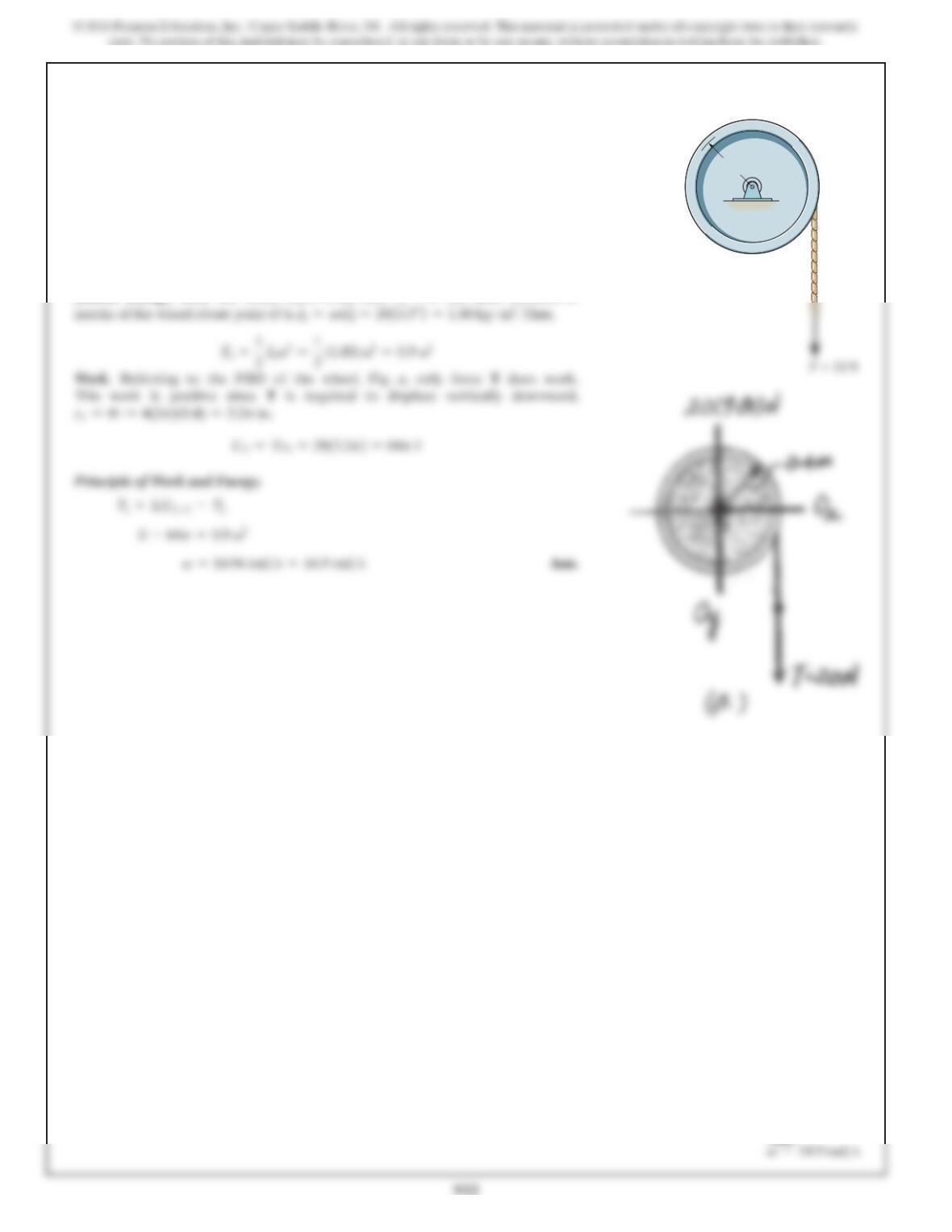
18–11.
The force of T
=
20 N is applied to the cord of negligible
mass. Determine the angular velocity of the 20-kg wheel
when it has rotated 4 revolutions starting from rest. The
wheel has a radius of gyration of kO
=
0.3 m.
SOLUTION
Kinetic Energy. Since the wheel starts from rest, T1
=
0. The mass moment of
O
0.4 m
Ans:
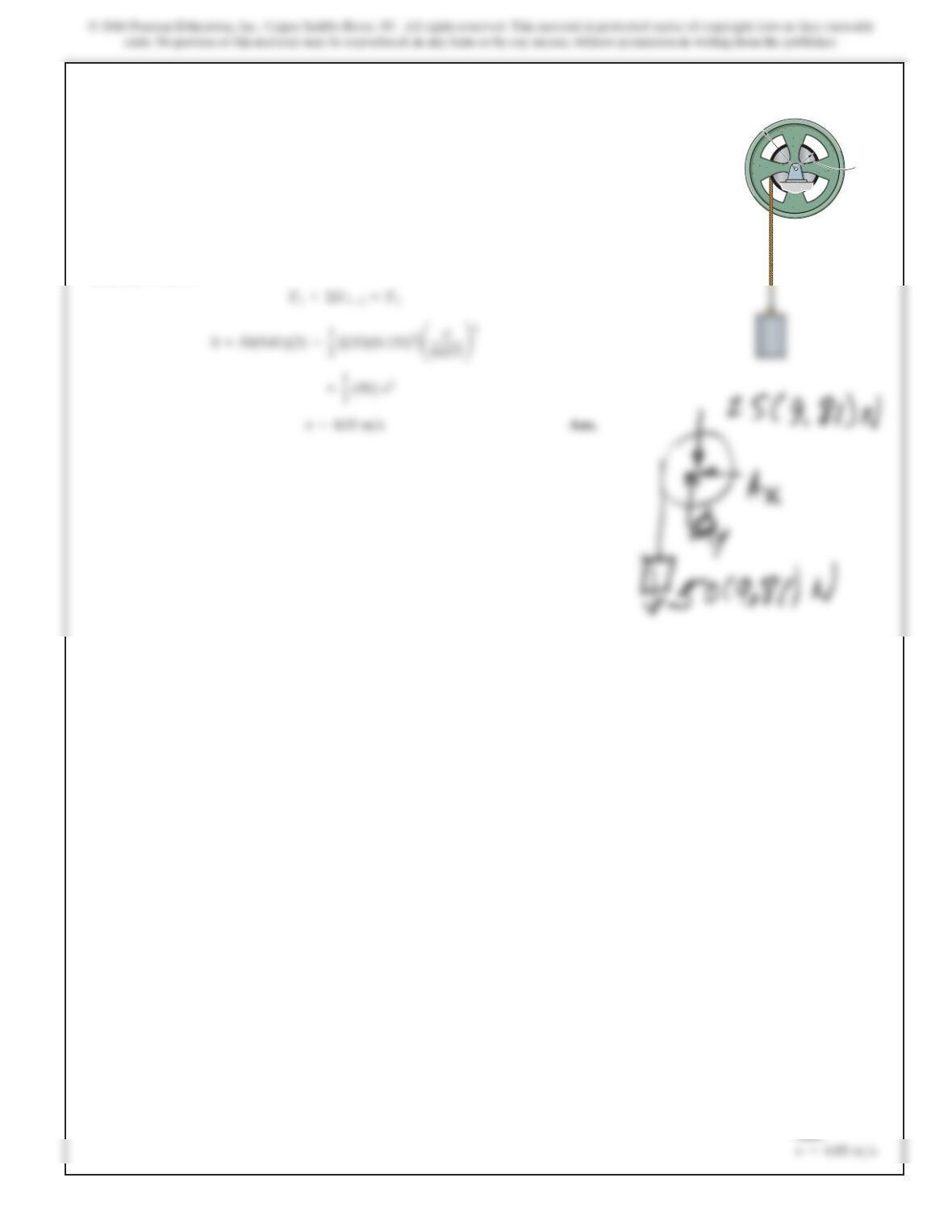
923
*18–12.
75 mm
A
Determine the velocity of the 50-kg cylinder after it has
de
scended a distance of 2 m. Initially,the system is at rest.
T
he reel has a mass of 25 kg and a radius of gyration about its
center of ma
ss Aof .kA=125 mm
SOLUTION
Ans:
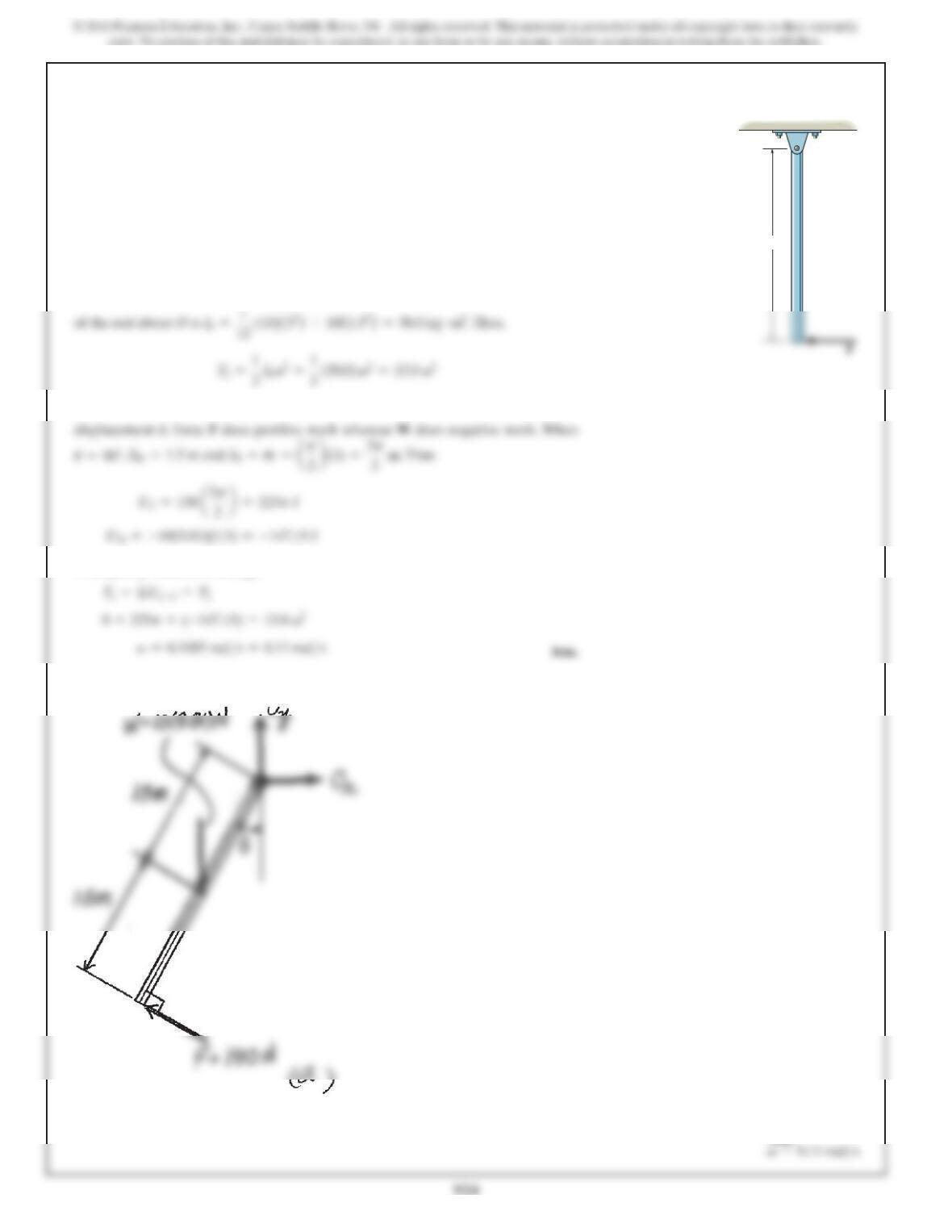
SOLUTION
Kinetic Energy. Since the rod starts from rest,
T1=0
. The mass moment of inertia
Work. Referring to the FBD of the rod, Fig. a, when the rod undergoes an angular
Principle of Work and Energy.
18–13.
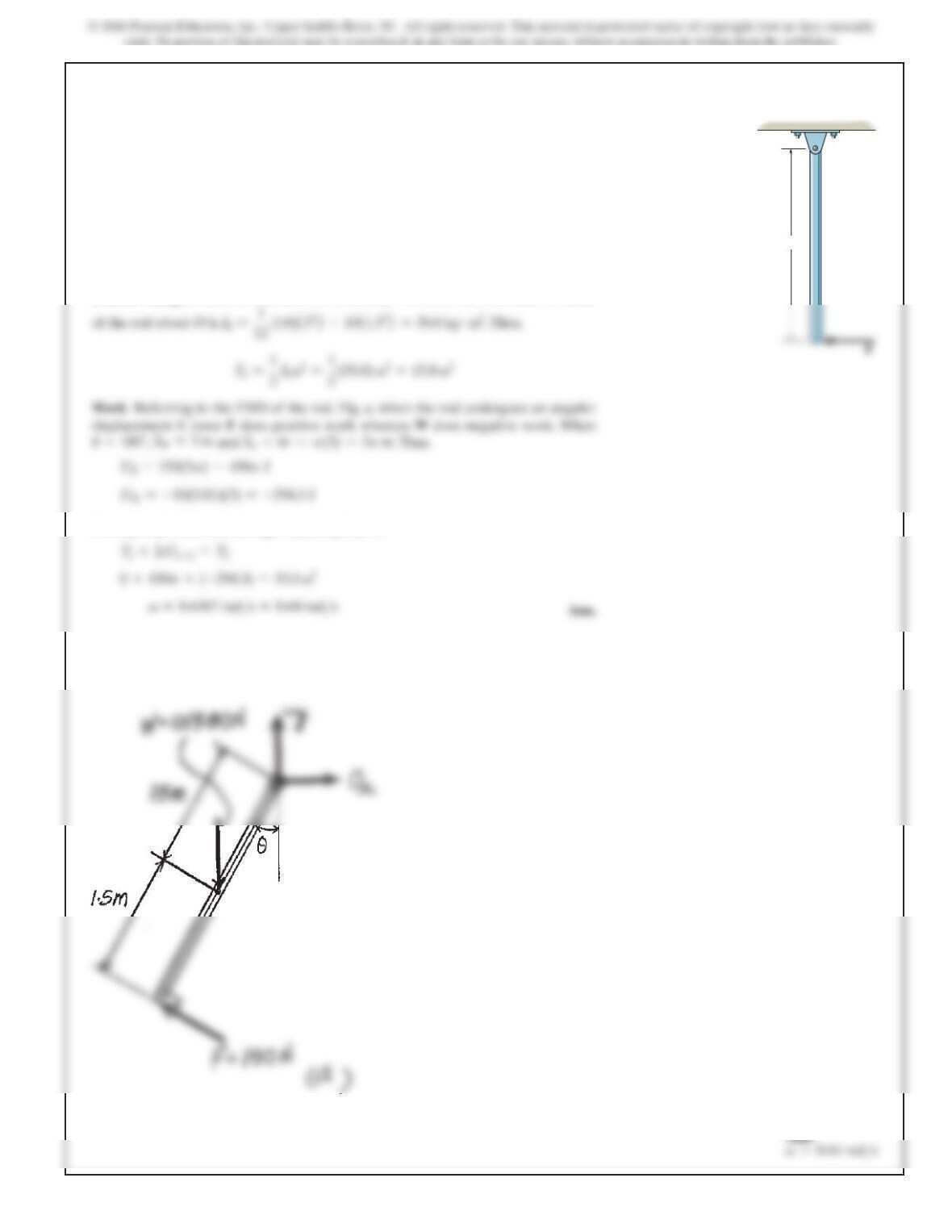
The 10-kg uniform slender rod is suspended at rest when
the force of F
=
150 N is applied to its end. Determine the
angular velocity of the rod when it has rotated 90° clockwise
from the position shown. The force is always perpendicular
to the rod.
O
3 m
Ans:
925
SOLUTION
Kinetic Energy. Since the rod starts from rest,
T1=0
. The mass moment of inertia
Principle of Work and Energy. Applying Eq. 18,
18–14.
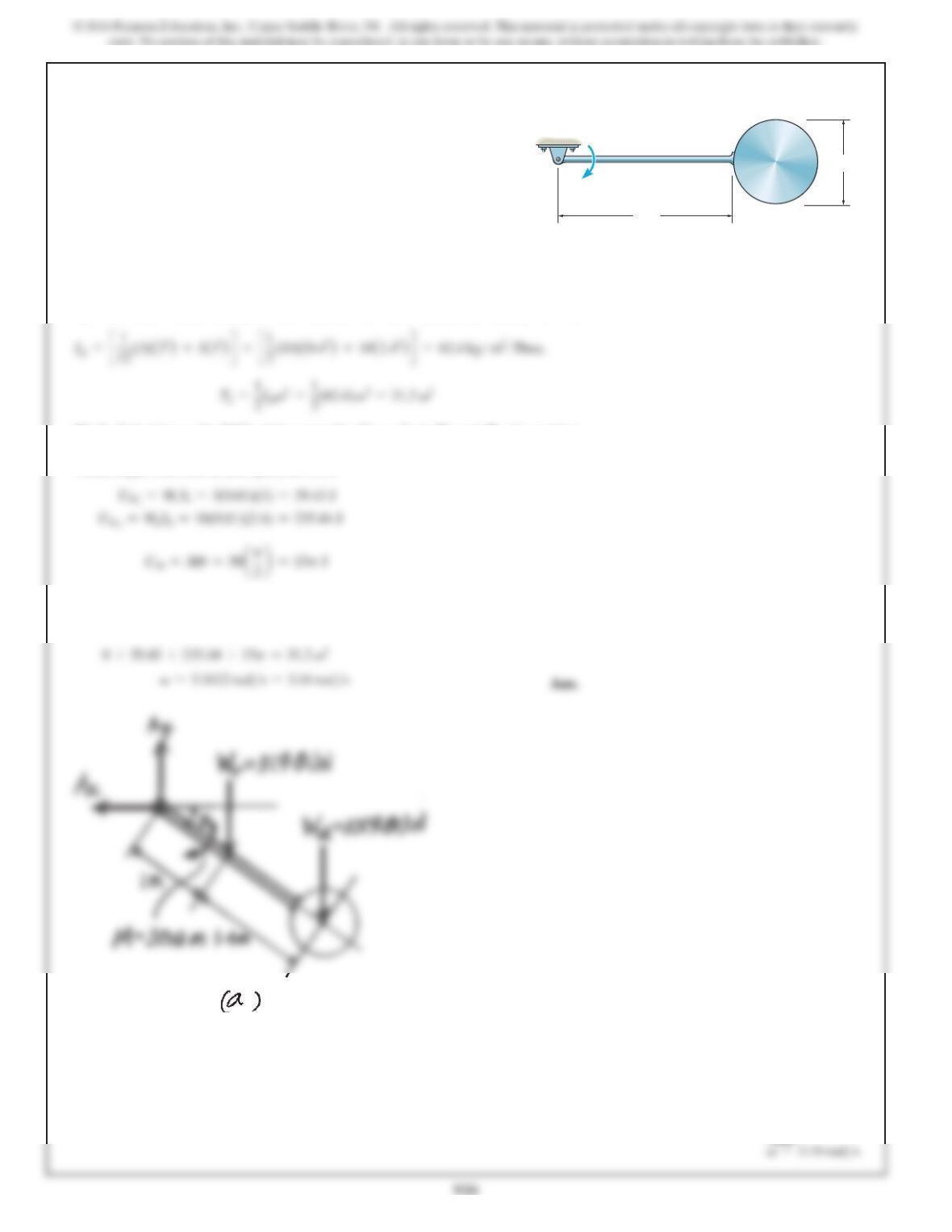
The 10-kg uniform slender rod is suspended at rest when
the force of F
=
150 N is applied to its end. Determine the
angular velocity of the rod when it has rotated 180°
clockwise from the position shown. The force is always
perpendicular to the rod.
O
3 m
SOLUTION
Kinetic Energy. Since the assembly is released from rest, initially,
T1=0
. The mass moment of inertia of the assembly about A is
Work. Referring to the FBD of the assembly, Fig. a. Both Wr and Wd do positive
work, since they displace vertically downward
Sr=1 m
and
Sd=2.4 m
, respectively.
Also, couple moment M does positive work
Principle of Work and Energy.
T1+ΣU1–2=T2
18–15.
The pendulum consists of a 10-kg uniform disk and a 3-kg
uniform slender rod. If it is released from rest in the position
shown, determine its angular velocity when it rotates
clockwise 90°.
2 m
M 30 N fi m
A
B
D
0.8 m
Ans:
927
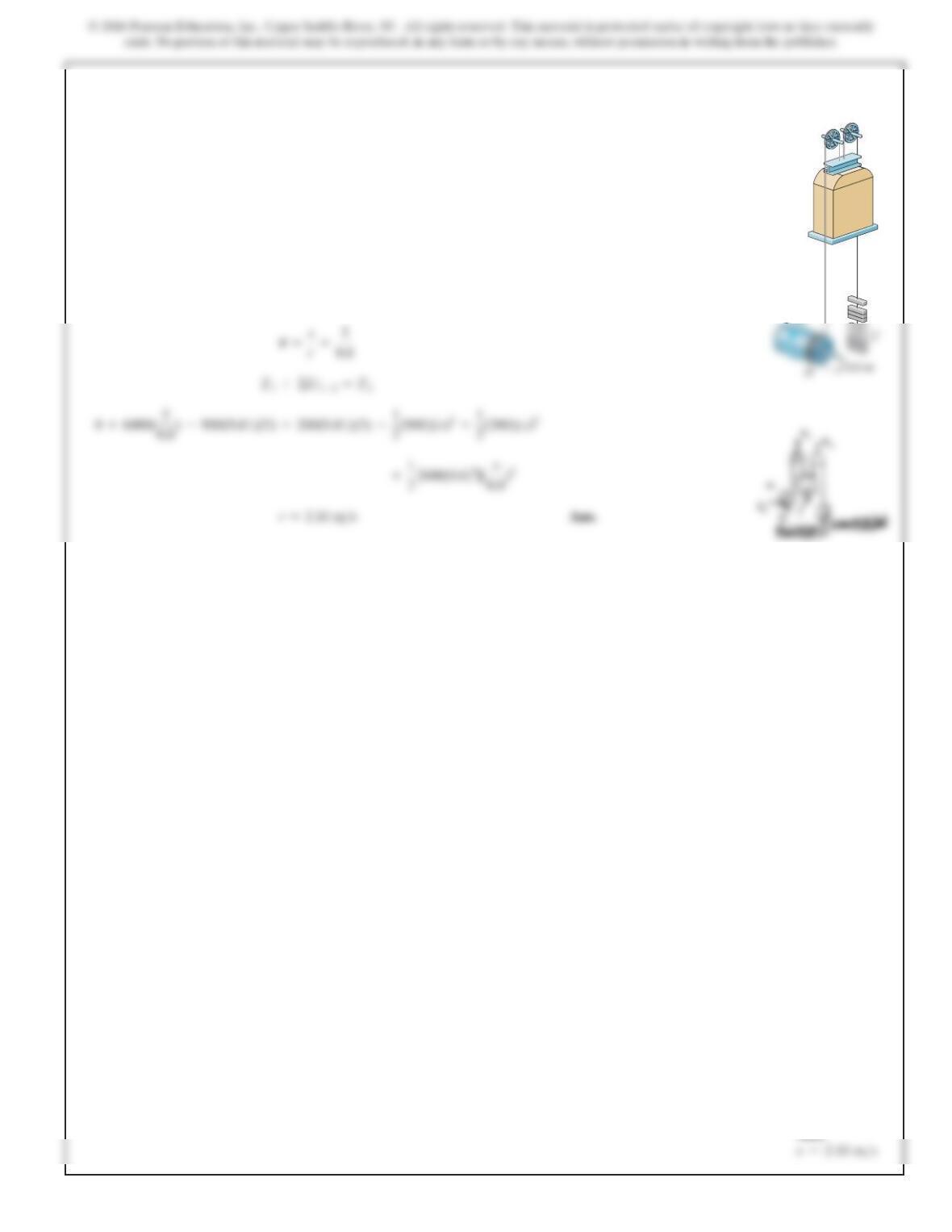
*18–16.
Amotor supplies a constant torque to the
winding drum that operates the elevator. If the elevator has a
mass of 900 kg,the counterweight Chas a mass of 200 kg,and
the winding drum has a mass of 600 kg and radius of gyration
about its axis of determine the speed of the
elevator after it rises 5 m starting from rest. Neglect the mass
of the pulleys.
k=0.6 m,
M=6kN
#
m
SOLUTION
v
E=
v
C
M
928
18–17.
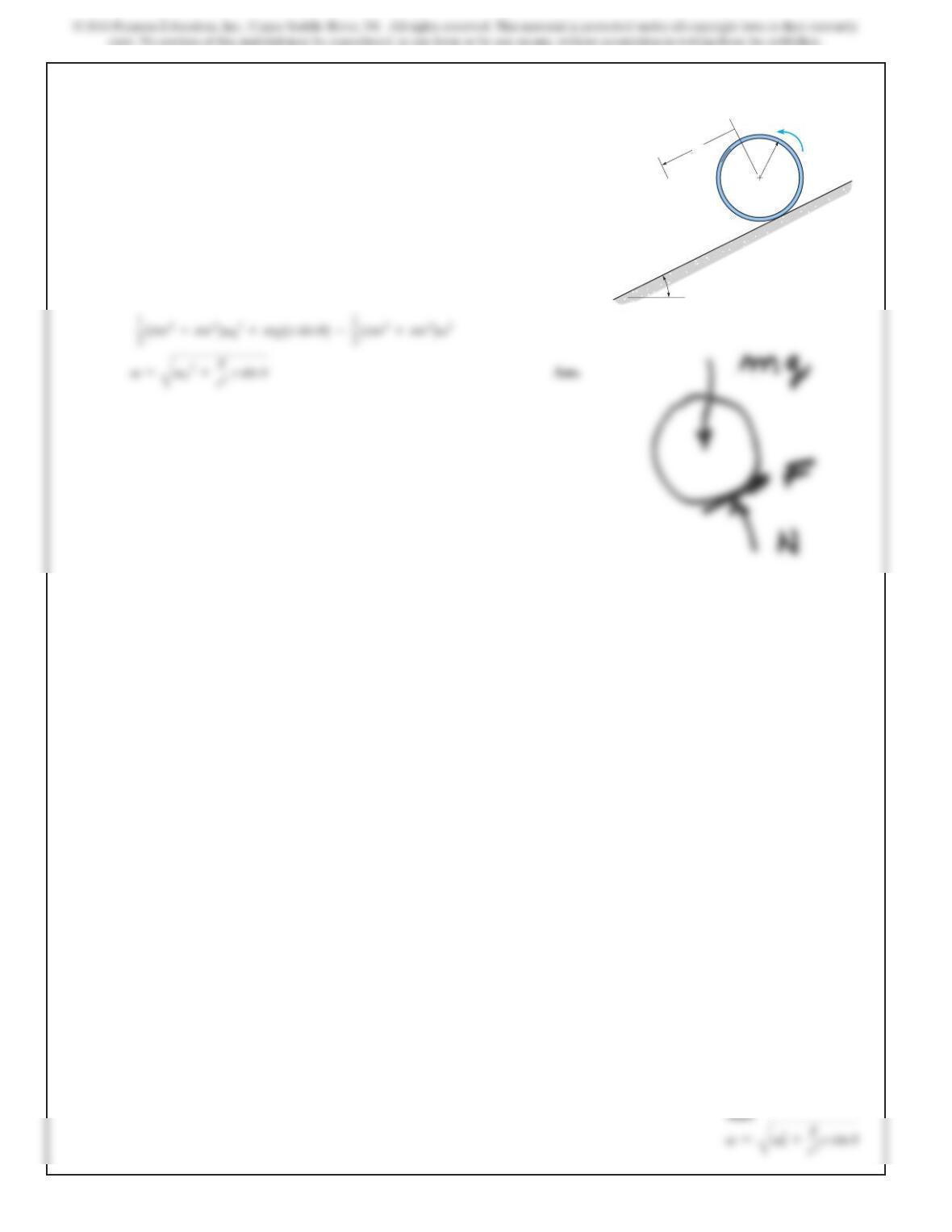
s
O
r
u
v0
The center Oof the thin ring of mass mis given an angular
velocity of . If the ring rolls without slipping, determine
its angular velocity after it has traveled a distance of sdown
the plane.Neglect its thickness.
v0
SOLUTION
T1+©U1–2=T2
929
18–18.
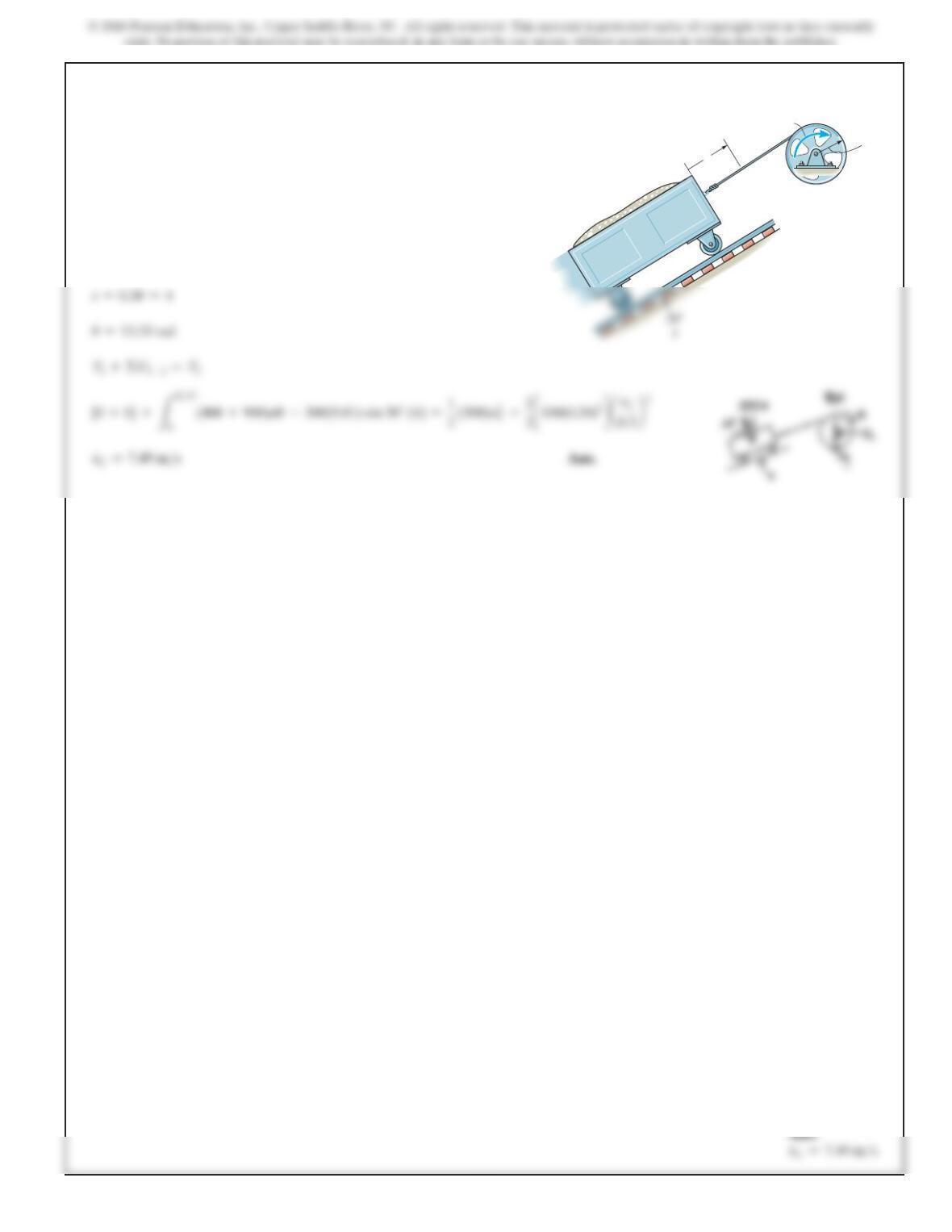
The wheel has a mass of 100 kg and a radius of gyration
of
kO=0.2 m
. A motor supplies a torque
M=(40
u
+900) N #m
, where
u
is in radians, about the
drive shaft at O. Determine the speed of the loading car,
which has a mass of 300 kg, after it travels
s=4 m
. Initially
the car is at rest when
s=0
and
u=0°
. Neglect the mass of
the attached cable and the mass of the car’s wheels.
SOLUTION
M
s
0.3 m
O
930
18–19.
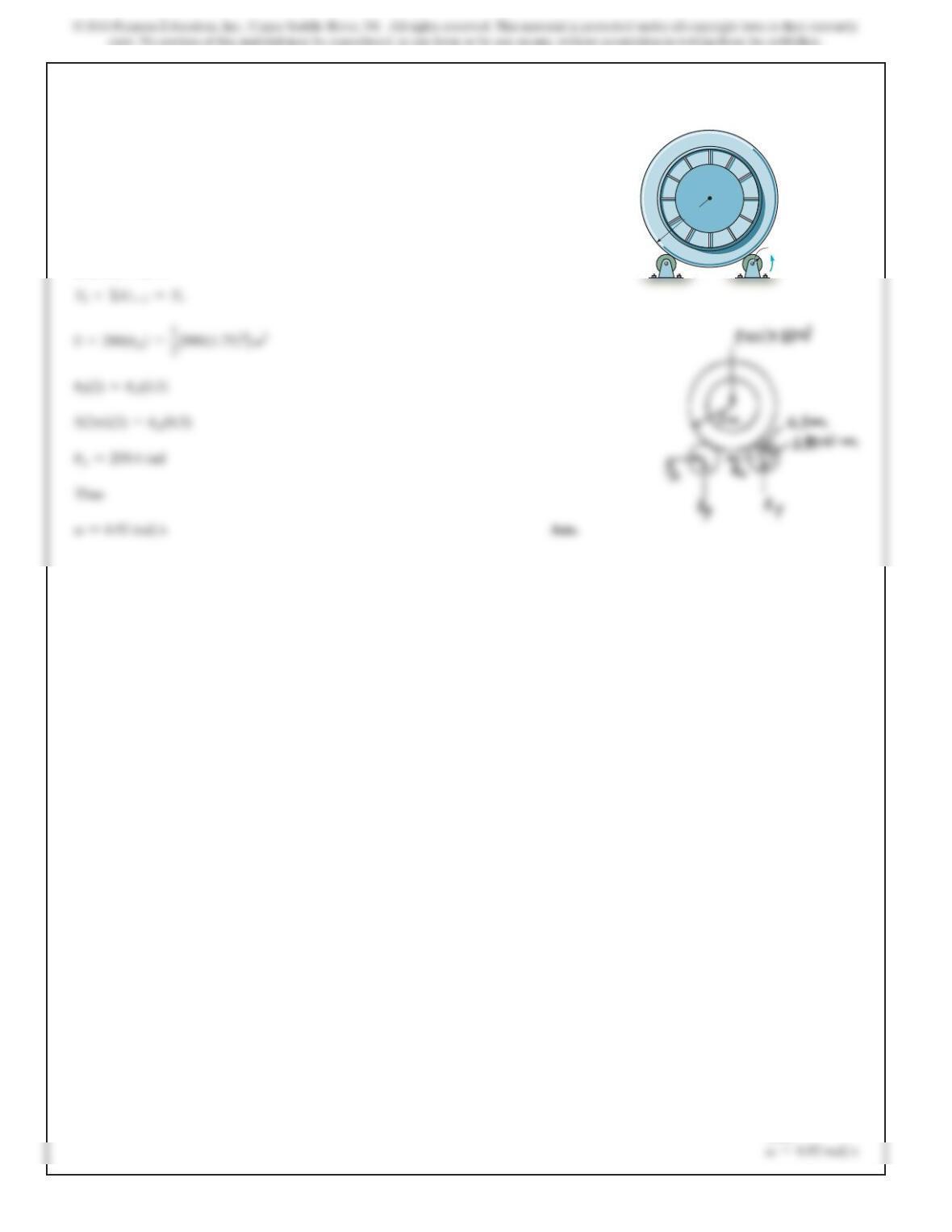
The rotary screen S is used to wash limestone. When empty
it has a mass of 800 kg and a radius of gyration of
kG=1.75 m
. Rotation is achieved by applying a torque of
M=280 N #m
about the drive wheel at A. If no slipping
occurs at A and the supporting wheel at B is free to roll,
determine the angular velocity of the screen after it has
rotated 5 revolutions. Neglect the mass of A and B.
0.3 m
A
S
M 280 N fi
m
B
2 m
SOLUTION
Ans:
931
*18–20.
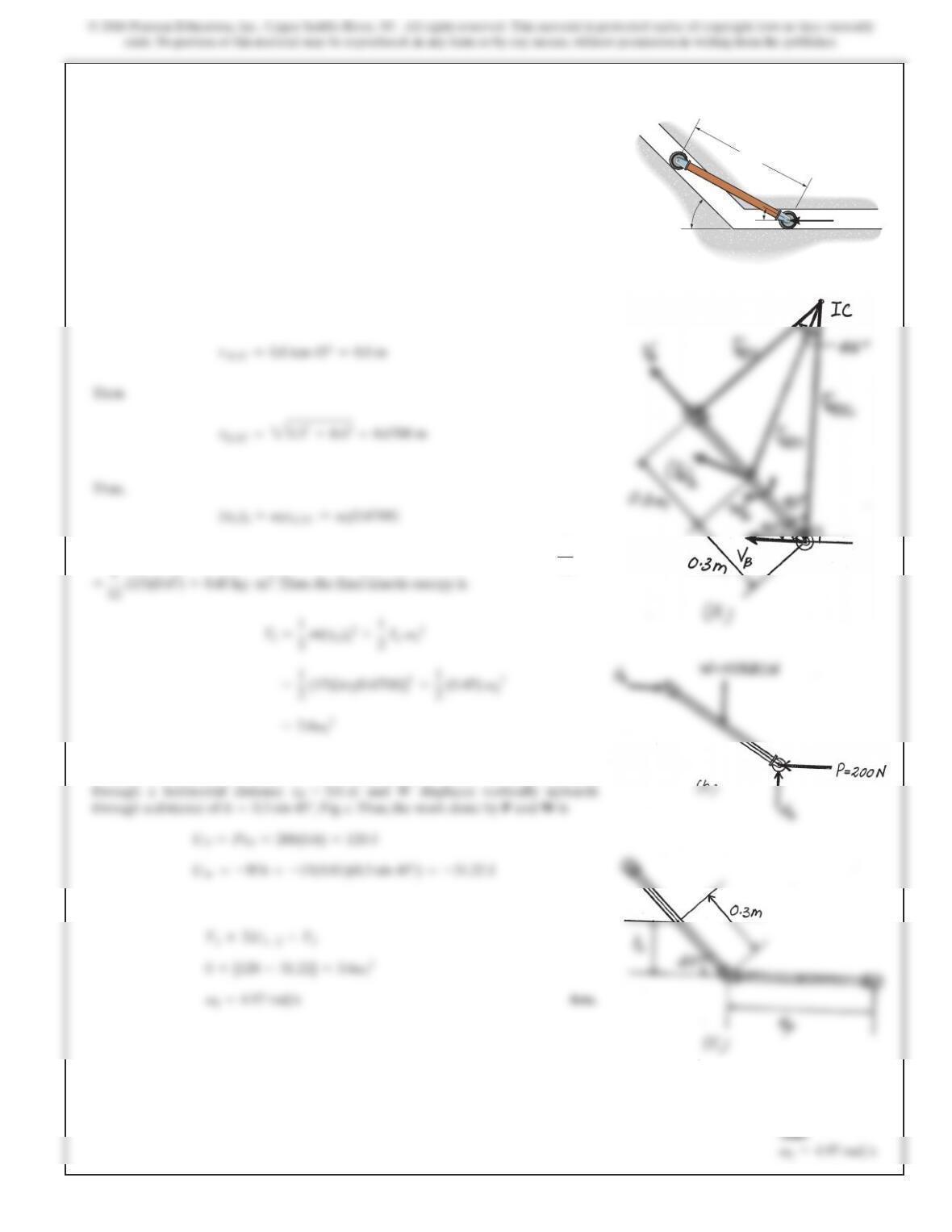
A
B
45°
600 mm
P 200 N
u
If and the 15-kg uniform slender rod starts from
rest at , determine the rod’s angular velocity at the
instant just before .u=45°
u=0°
P=200 N
SOLUTION
Kinetic Energy and Work: Referring to Fig. a,
The mass moment of inertia of the rod about its mass center is
Since the rod is initially at rest, . Referring to Fig. b, and do no work,
while does positive work and does negative work. When ,displaces
Principle of Work and Energy:
Pu=45°WP
NB
NA
T1=0
IG=1
12 ml2