932
18–21.
SOLUTION
vG=(0.02)70 =1.40 ft>s
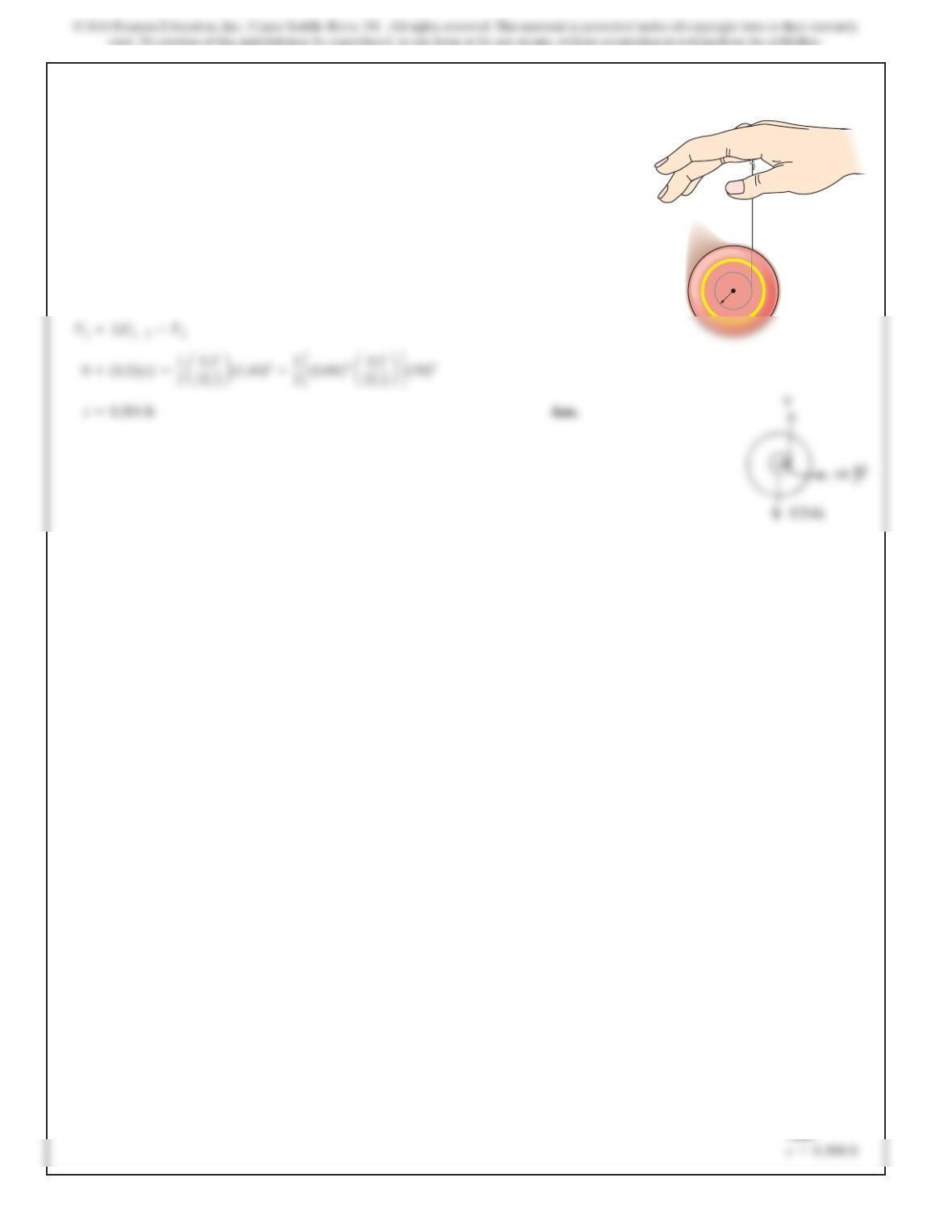
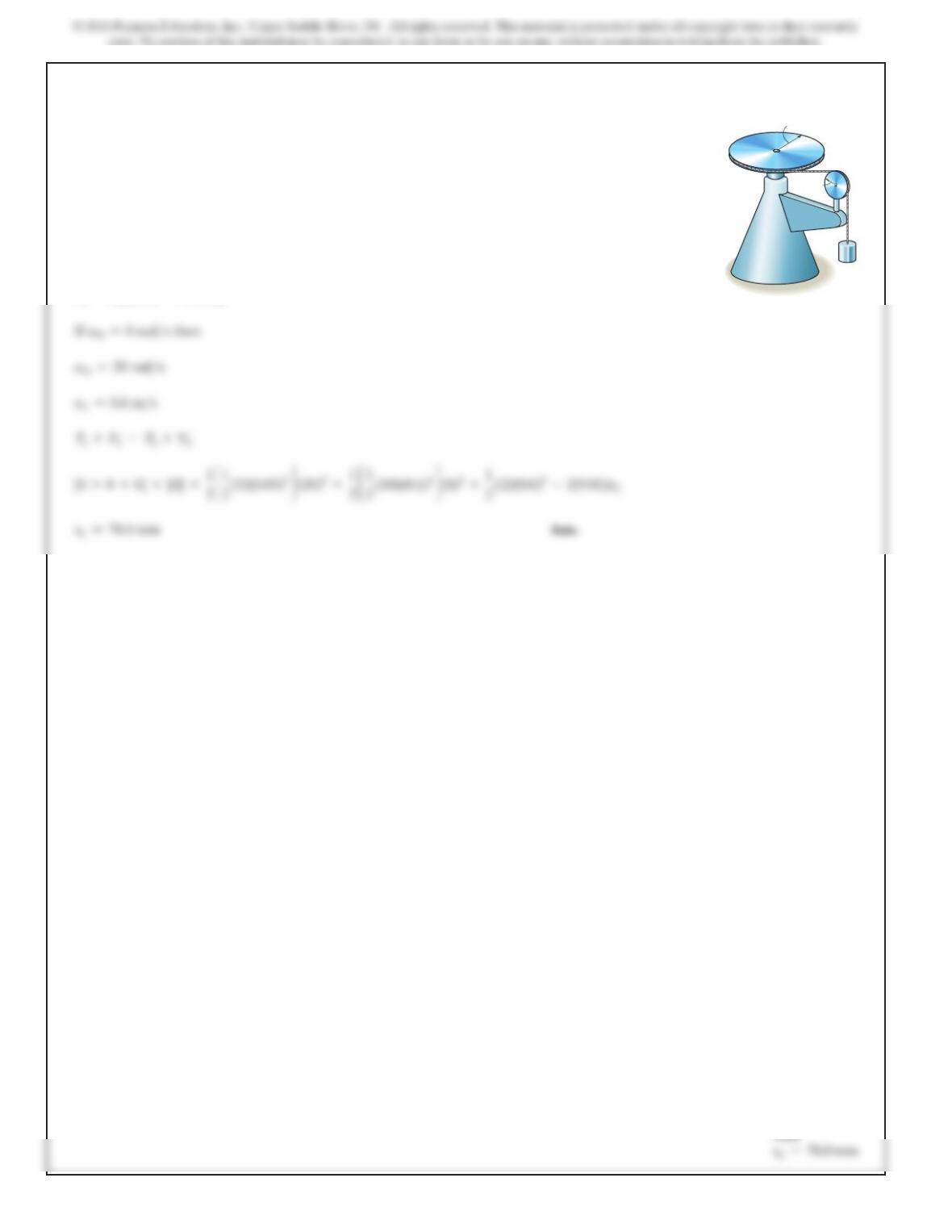
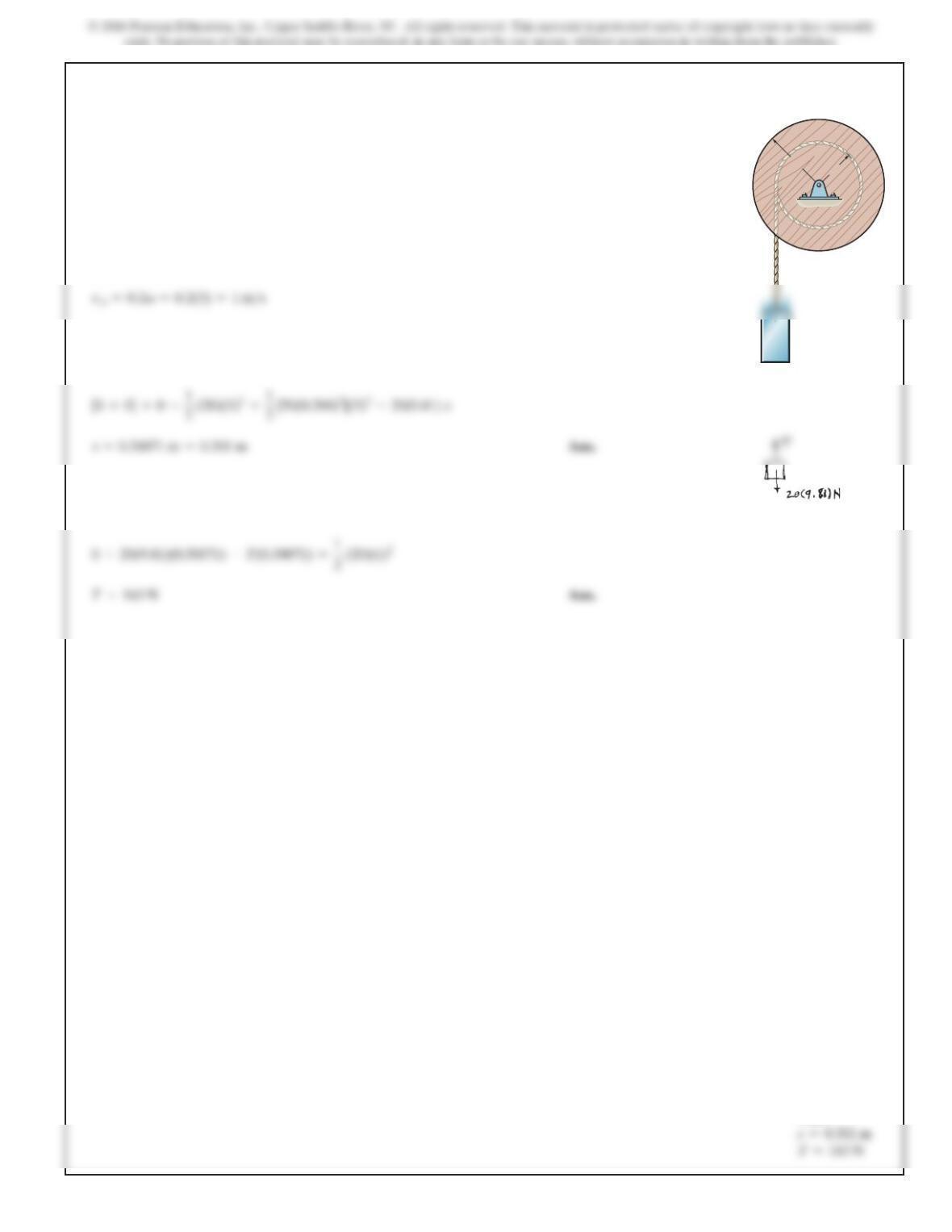
A yo-yo has a weight of 0.3 lb and a radius of gyration
If it is released from rest, determine how far it
must descend in order to attain an angular velocity
Neglect the mass of the string and assume
that the string is wound around the central peg such that the
mean radius at which it unravels is r=0.02 ft.
v=70 rad>s.
kO=0.06 ft.
O
r
Ans:
933
18–22.
SOLUTION
Kinetic Energy and Work:Since the windlass rotates about a fixed axis,
Thus, the kinetic energy of the system is
Since the system is initially at rest, . Referring to Fig. a,WA,Ax,Ay, and RB
Principle of Work and Energy:
T1+©U1–2=T2
T1=0
vC=vArA
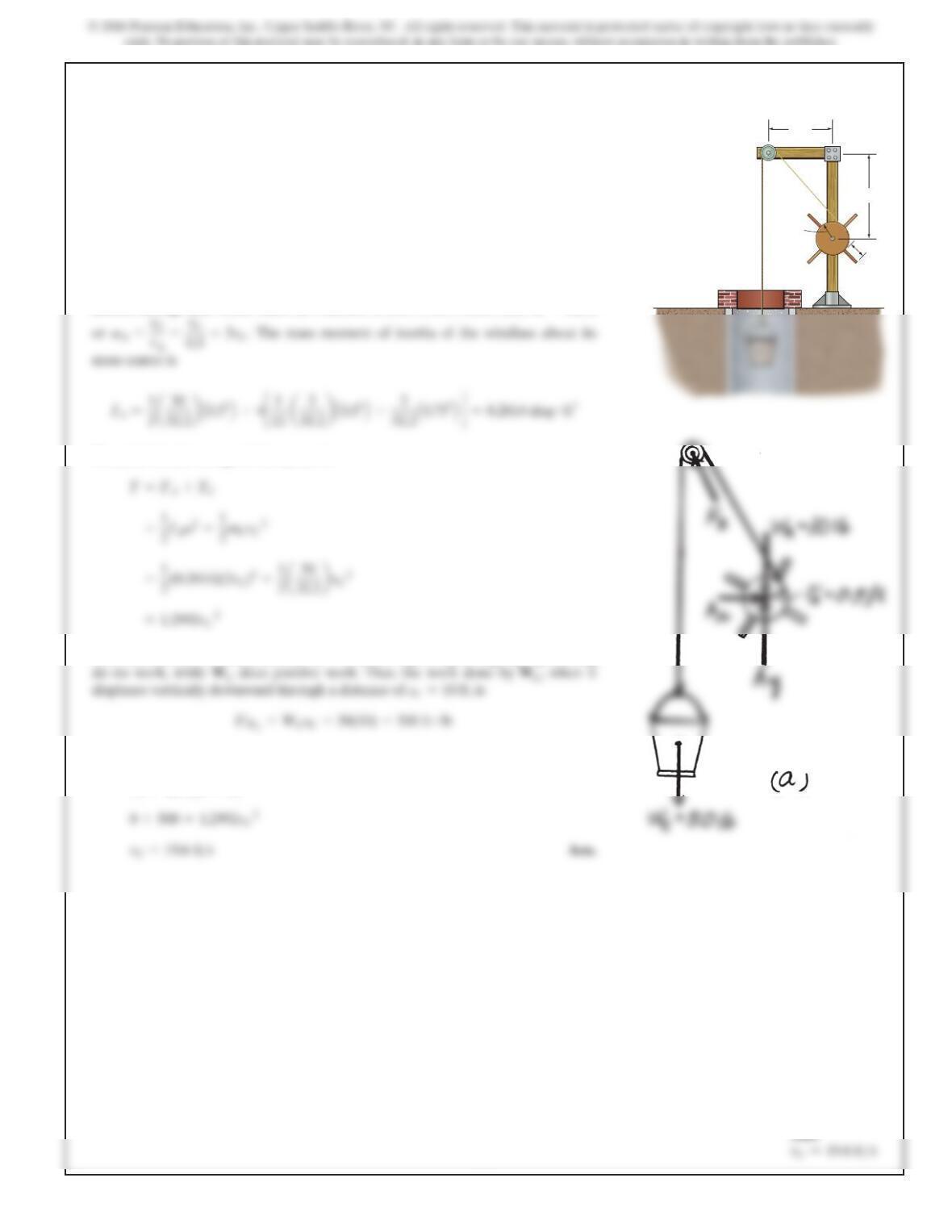
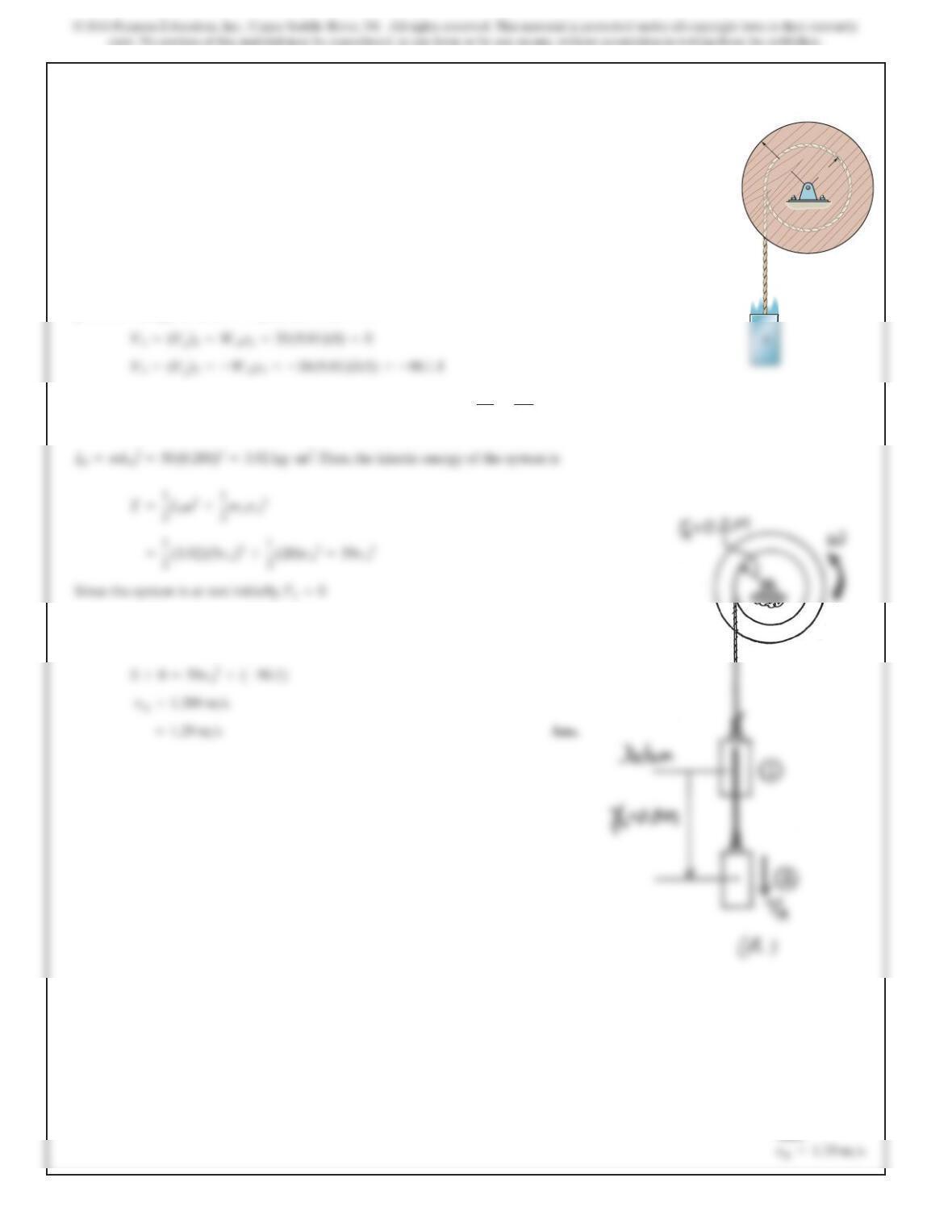
If the 50-lb bucket is released from rest, determine its
velocity after it has fallen a distance of 10 ft.The windlass A
can be considered as a 30-lb cylinder, while the spokes are
slender rods, each having a weight of 2 lb. Neglect the
pulley’s weight. 4ft
0.5 ft
0.5 ft
3ft
B
A
Ans:
934
18–23.
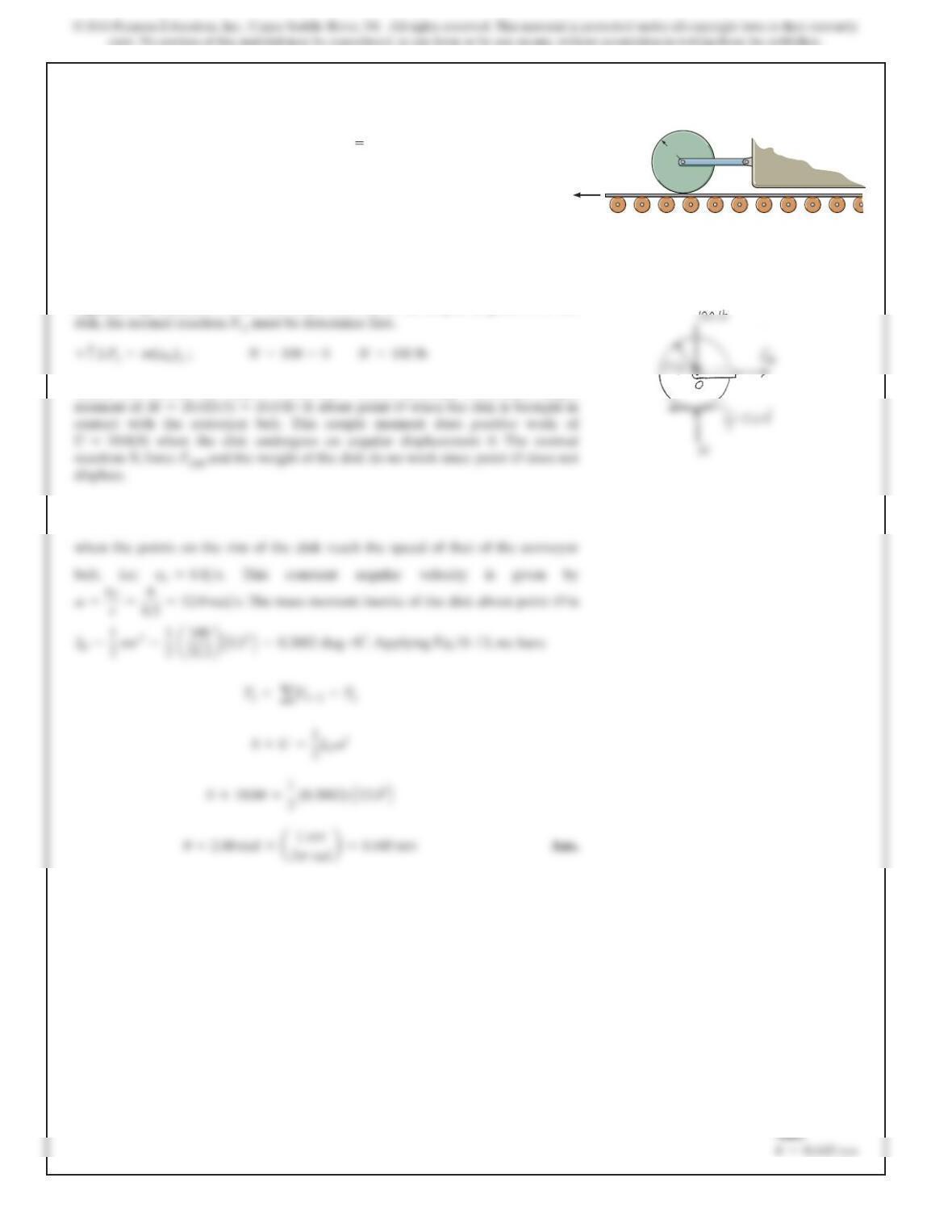
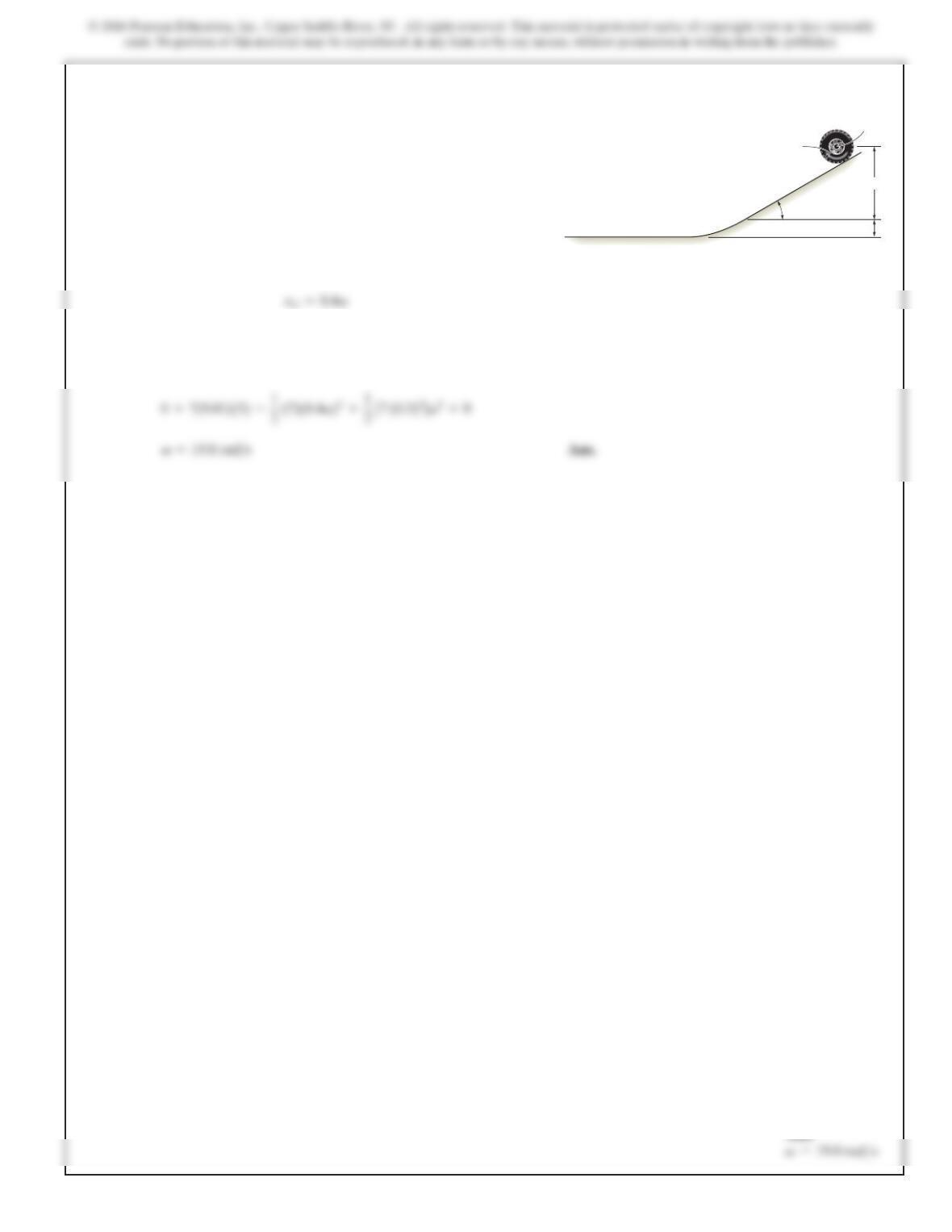
The coefficient of kinetic friction between the 100-lb disk
and the surface of the conveyor belt is 0.2. If the
conveyor belt is moving with a speed of when
the disk is placed in contact with it, determine the number
of revolutions the disk makes before it reaches a constant
angular velocity.
vC=6ft>s
mA
SOLUTION
Equation of Motion:In order to obtain the friction developed at point Aof the
Work:elpuoc tnatsnoc a spoleved noitcirf ehT
Principle of Work and Energy:The disk achieves a constant angular velocity
F
f=mkN=0.2(100) =20.0 lb
C
=6ft/sv
A
B
0.5 ft
935
*18–24.
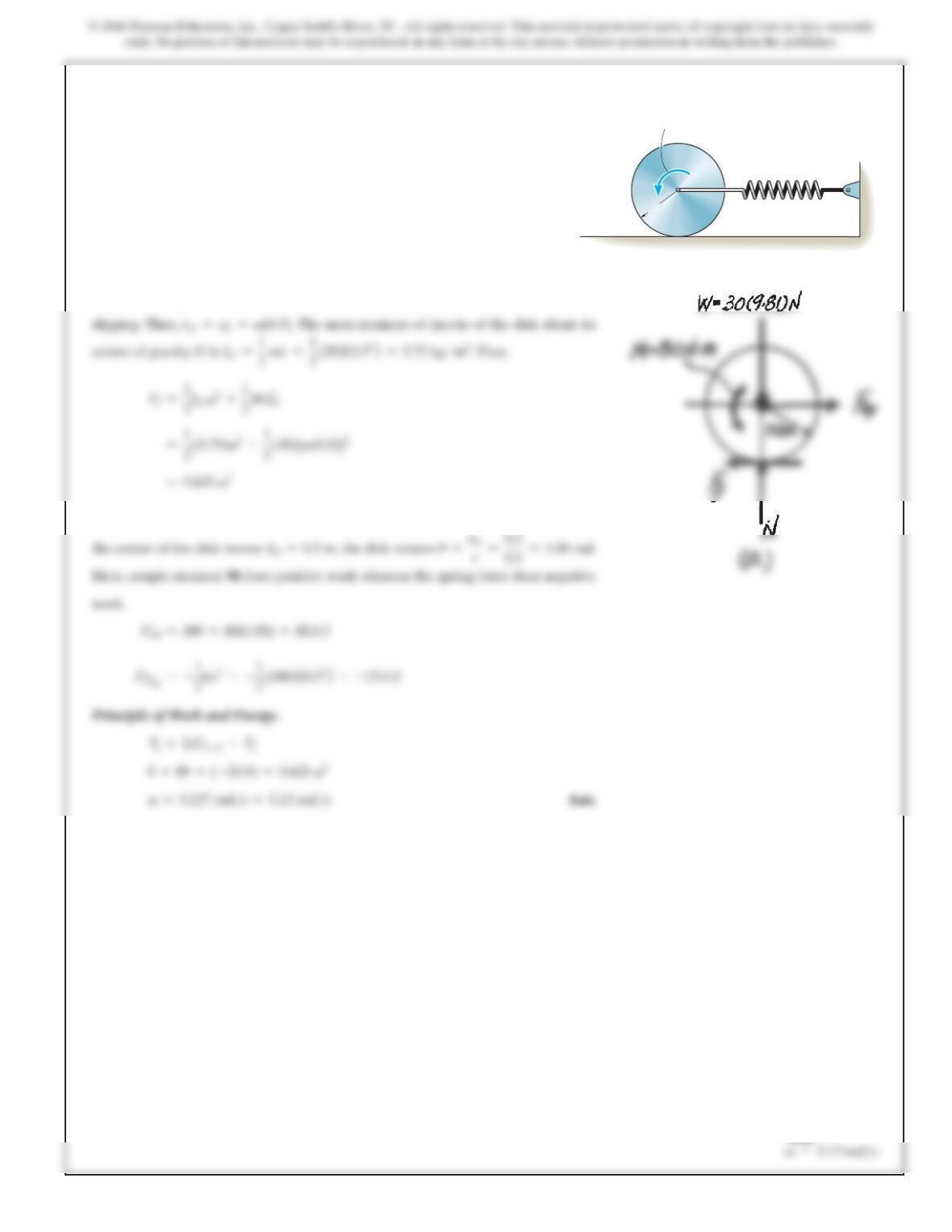
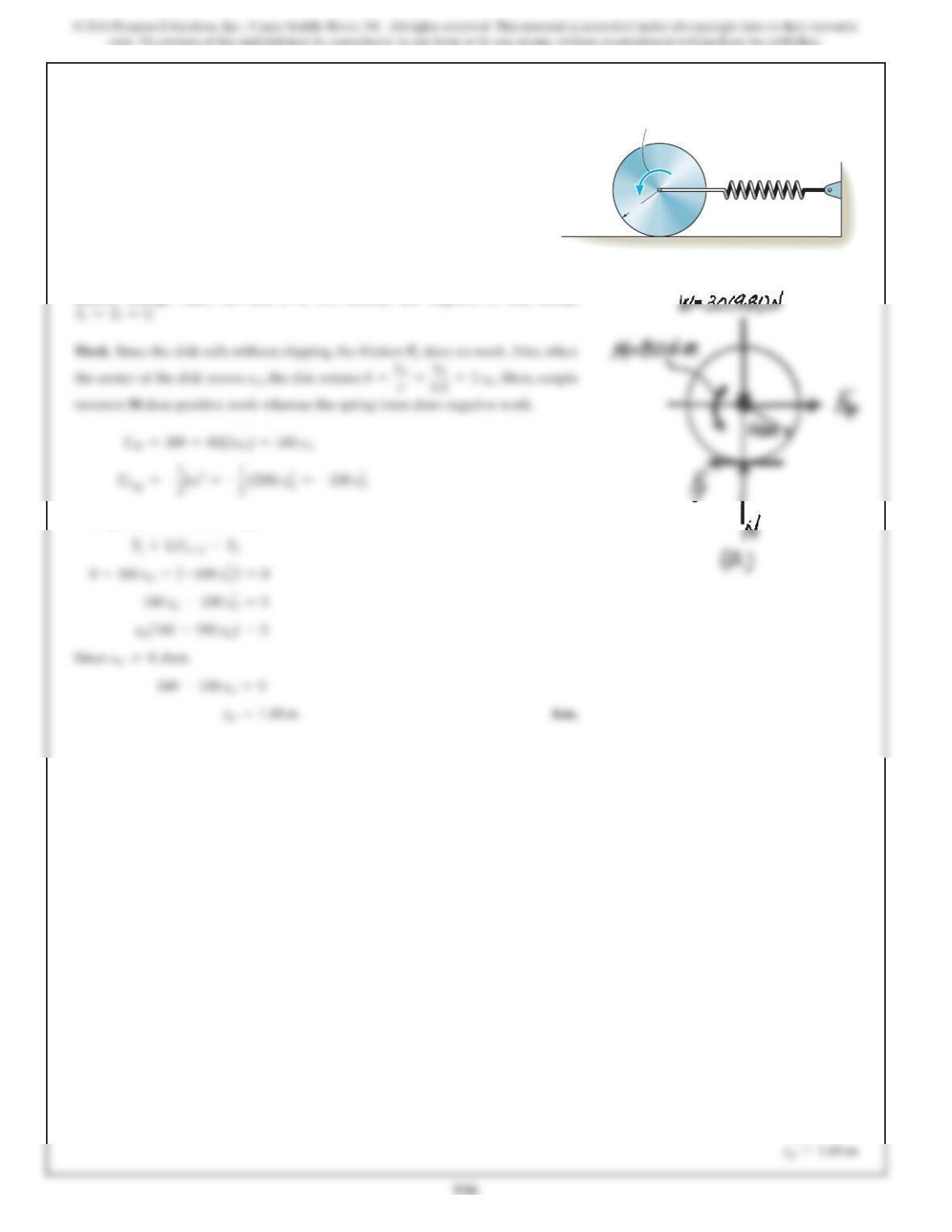
The 30-kg disk is originally at rest, and the spring is
unstretched. A couple moment of
M=80 N #m
is then
applied to the disk as shown. Determine its angular velocity
when its mass center G has moved 0.5 m along the plane.
The disk rolls without slipping.
0.5 m
G
M 80 N m
k 200 N/mA
SOLUTION
Kinetic Energy. Since the disk is at rest initially,
T1=0
. The disk rolls without
Work. Since the disk rolls without slipping, the friction
F
f does no work. Also when
18–25.
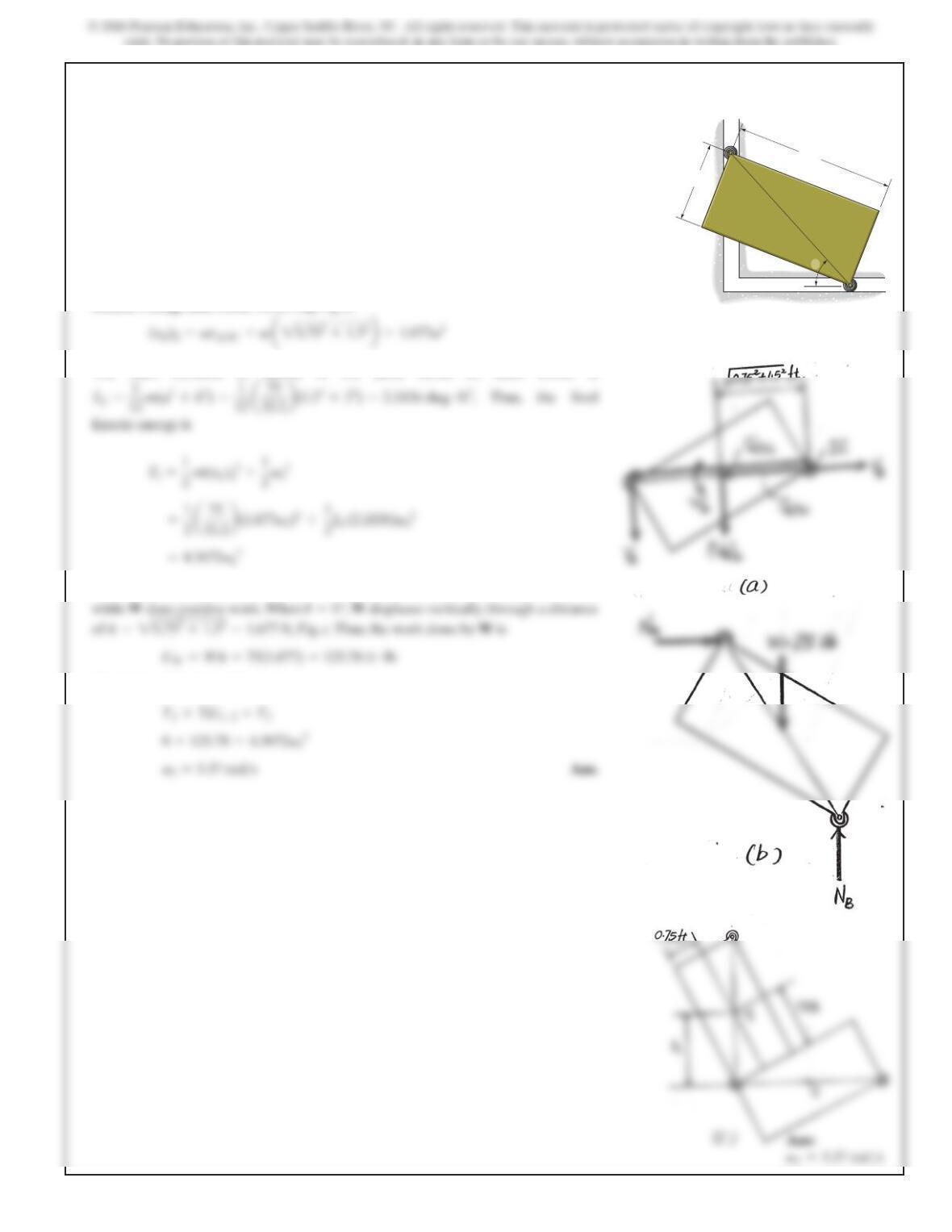
The 30-kg disk is originally at rest, and the spring is
unstretched. A couple moment
M=80 N #m
is then
applied to the disk as shown. Determine how far the center
of mass of the disk travels along the plane before it
momentarily stops. The disk rolls without slipping.
0.5 m
G
M 80 N m
k 200 N/mA
SOLUTION
Kinetic Energy. Since the disk is at rest initially and required to stop nally,
Principle of Work and Energy.
Ans:
937
18–26.
A
B
1.5 ft
3 ft
u
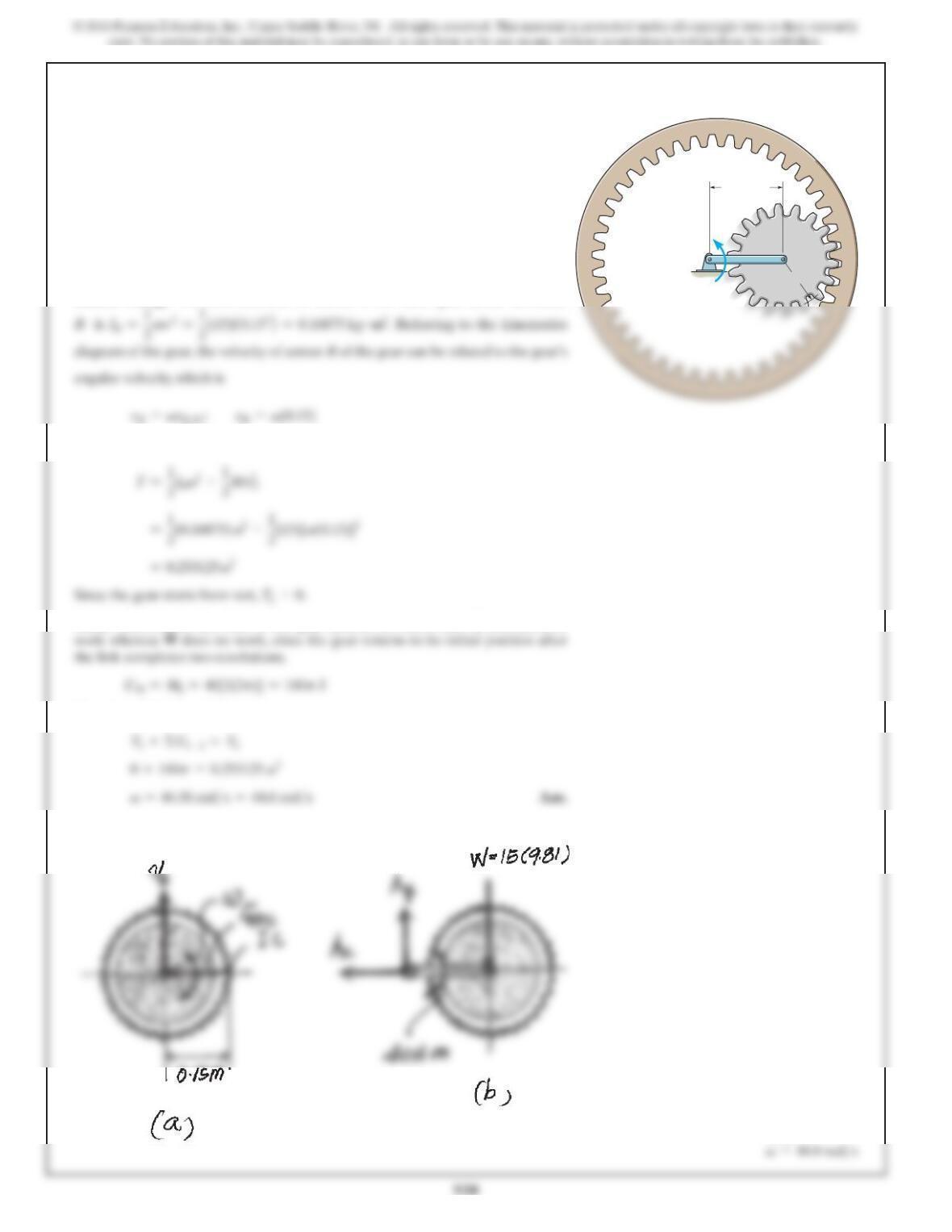
Two wheels of negligible weight are mounted at corners A
and Bof the rectangular 75-lb plate. If the plate is released
from rest at , determine its angular velocity at the
instant just before .u=0°
u=90°
SOLUTION
Kinetic Energy and Work: Referring Fig. a,
The mass moment of inertia of the plate about its mass center is
Since the plate is initially at rest,.Referring to Fig. b, and do no work,
Principle of Work and Energy:
NB
NA
T1=0
18–27.
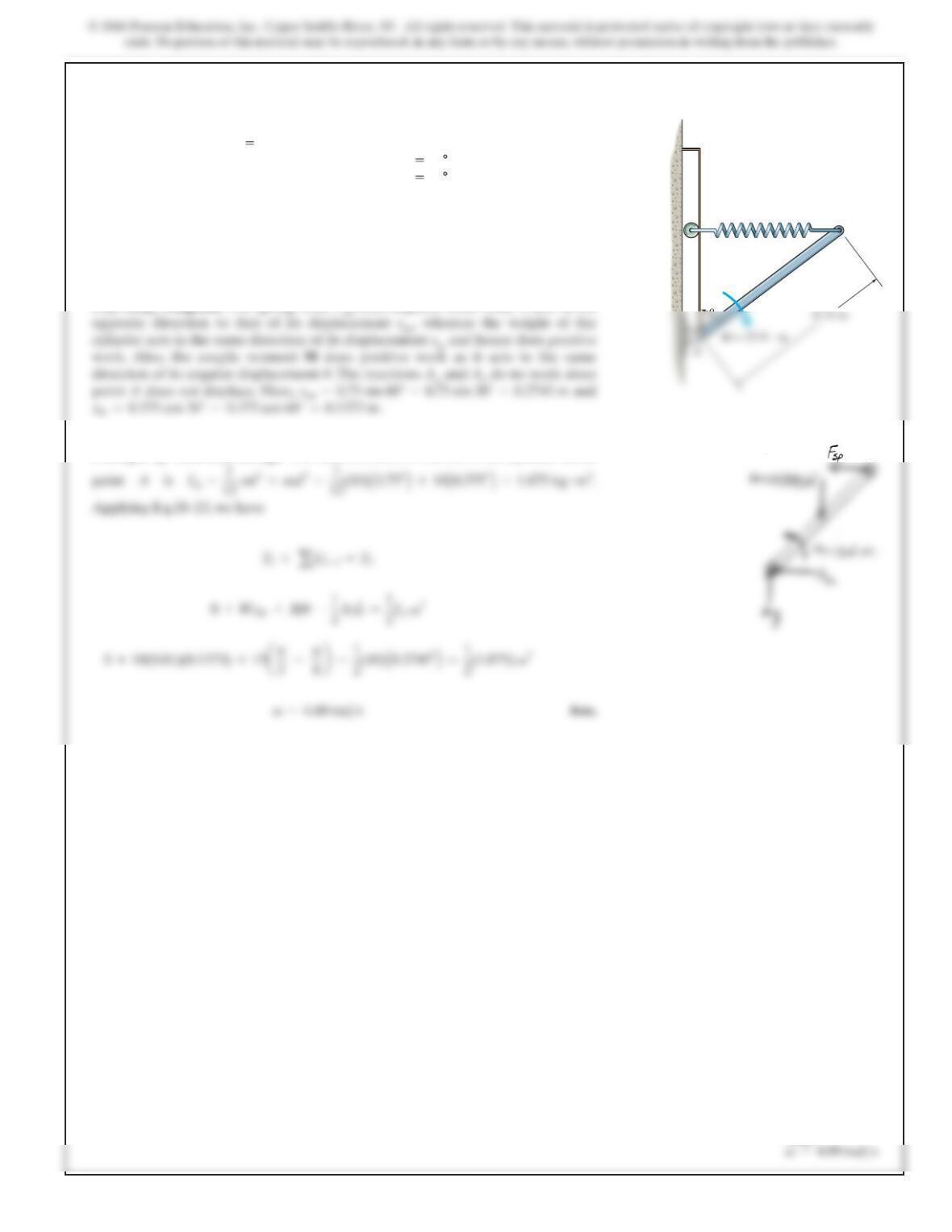
The link AB is subjected to a couple moment of
M=40 N #m
. If the ring gear C is fixed, determine the
angular velocity of the 15-kg inner gear when the link has
made two revolutions starting from rest. Neglect the mass
of the link and assume the inner gear is a disk. Motion
occurs in the vertical plane.
150 mm
200 mm
M 40 N m
AB
C
SOLUTION
Kinetic Energy. The mass moment of inertia of the inner gear about its center
Thus,
Work. Referring to the FBD of the gear system, we notice that M does positive
Principle of Work and Energy.
Ans:
939
*18–28.
SOLUTION
Free Body Diagram:The spring force FsP does negative work since it acts in the
Principle of Work and Energy: The mass moment of inertia of the cylinder about
The 10-kg rod AB is pin-connected at Aand subjected to
acouple moment of M15 Nm.If the rod is released
from rest when the spring is unstretched at 30 ,
determine the rod’s angular velocity at the instant 60 .
As the rod rotates, the spring always remains horizontal,
because of the roller support at C.
u
u
.
C
B
k=40 N/m
Ans:
940
18–29.
SOLUTION
Kinematics:
vG=0.5vG
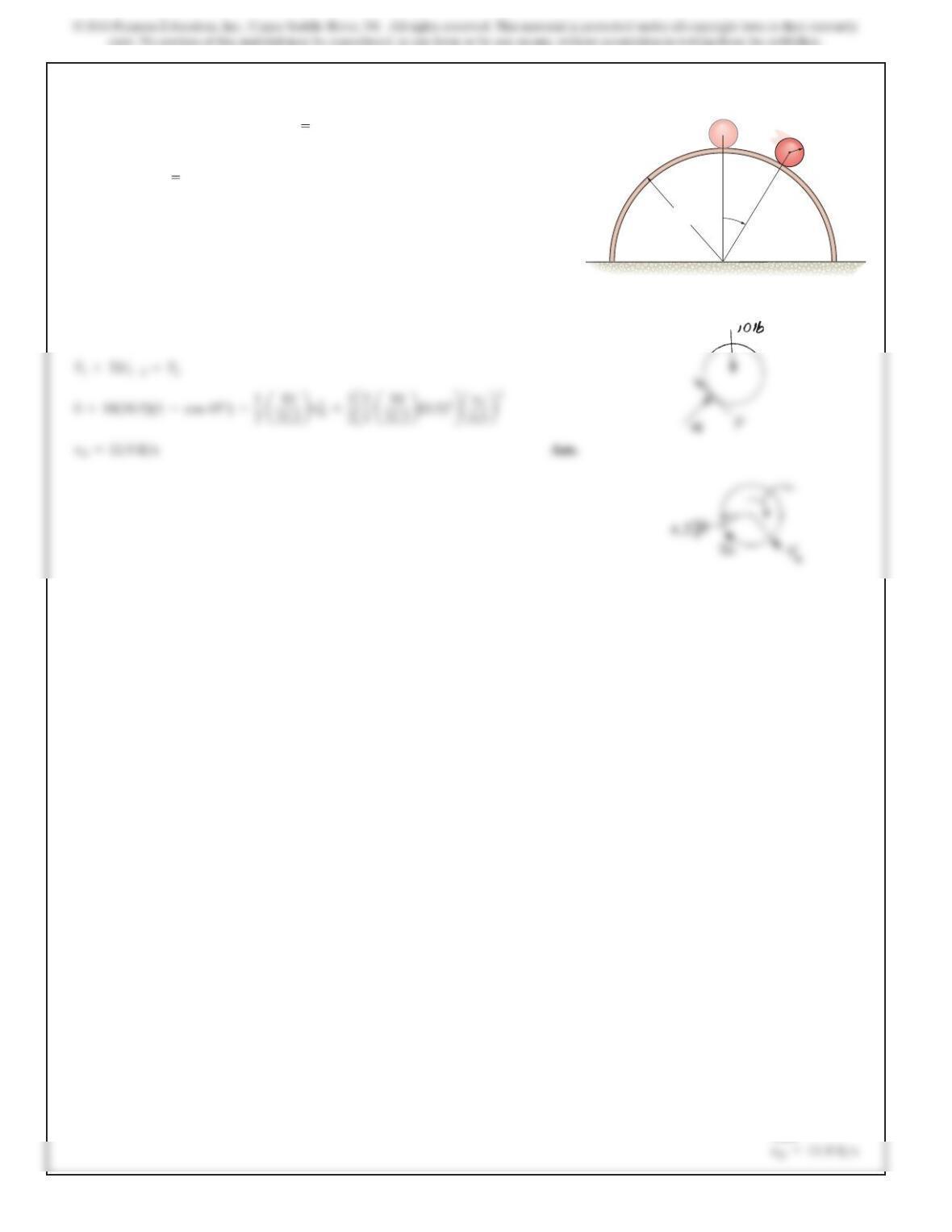
The 10-lb sphere starts from rest at 0° and rolls without
slipping down the cylindrical surface which has a radius of
10 ft. Determine the speed of the sphere’s center of mass
at the instant 45°.u
u
10 ft
0.5 ft
θ
Ans:
18–30.
MC
P
750 N
3 m
4 m
A
u
B
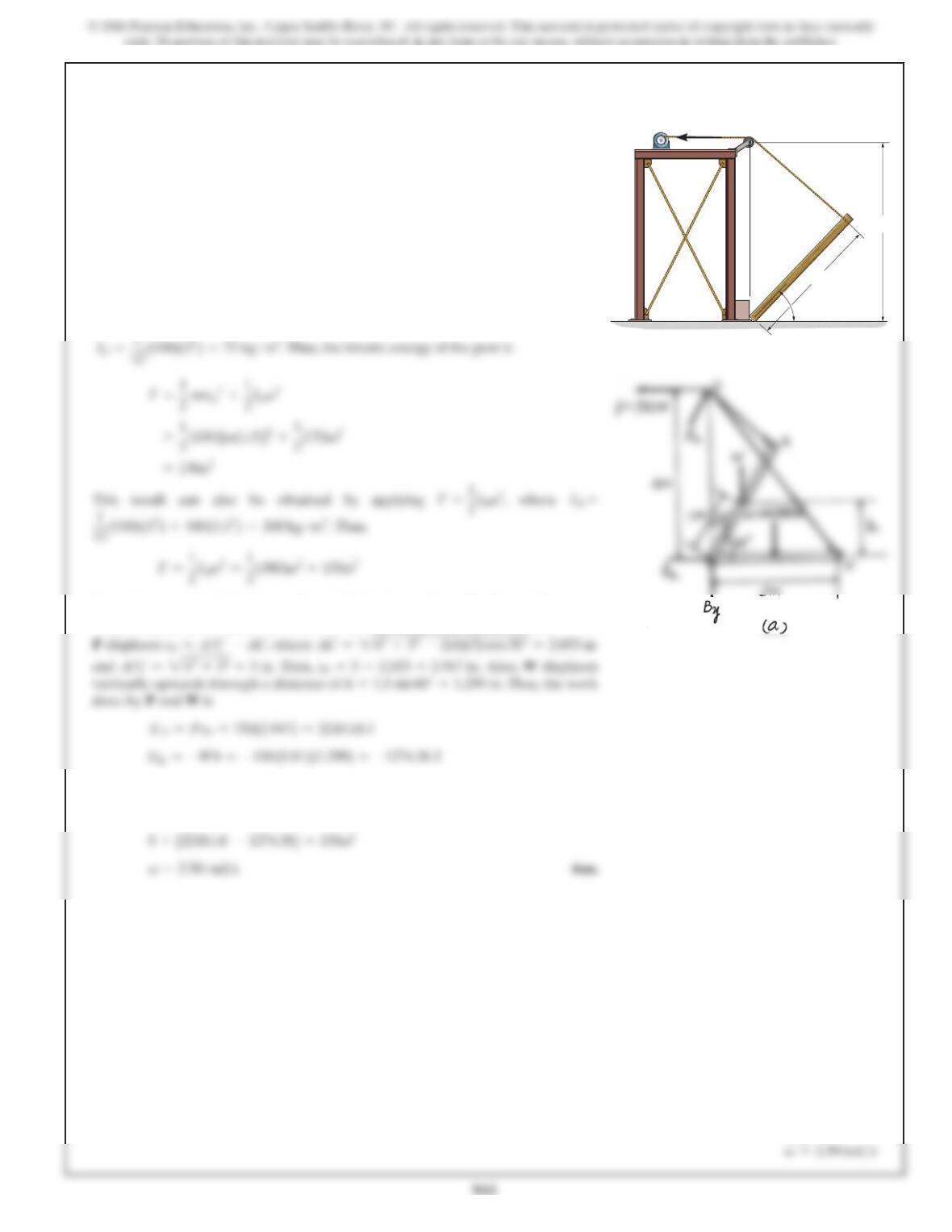
Motor Mexerts a constant force of on the rope.
If the 100-kg post is at rest when , determine the
angular velocity of the post at the instant .Neglect
the mass of the pulley and its size, and consider the post as a
slender rod.
u=60°
u=0°
P=750 N
SOLUTION
Kinetic Energy and Work: Since the post rotates about a fixed axis,
The mass moment of inertia of the post about its mass center is
Since the post is initially at rest, .Referring to Fig.a,,,and do no
work, while does positive work and does negative work. When ,
Principle of Work and Energy:
T1+©U1–2=T2
u=60°WP
RC
By
Bx
T
1=0
vG=vrG=v (1.5).
Ans:
18–31.
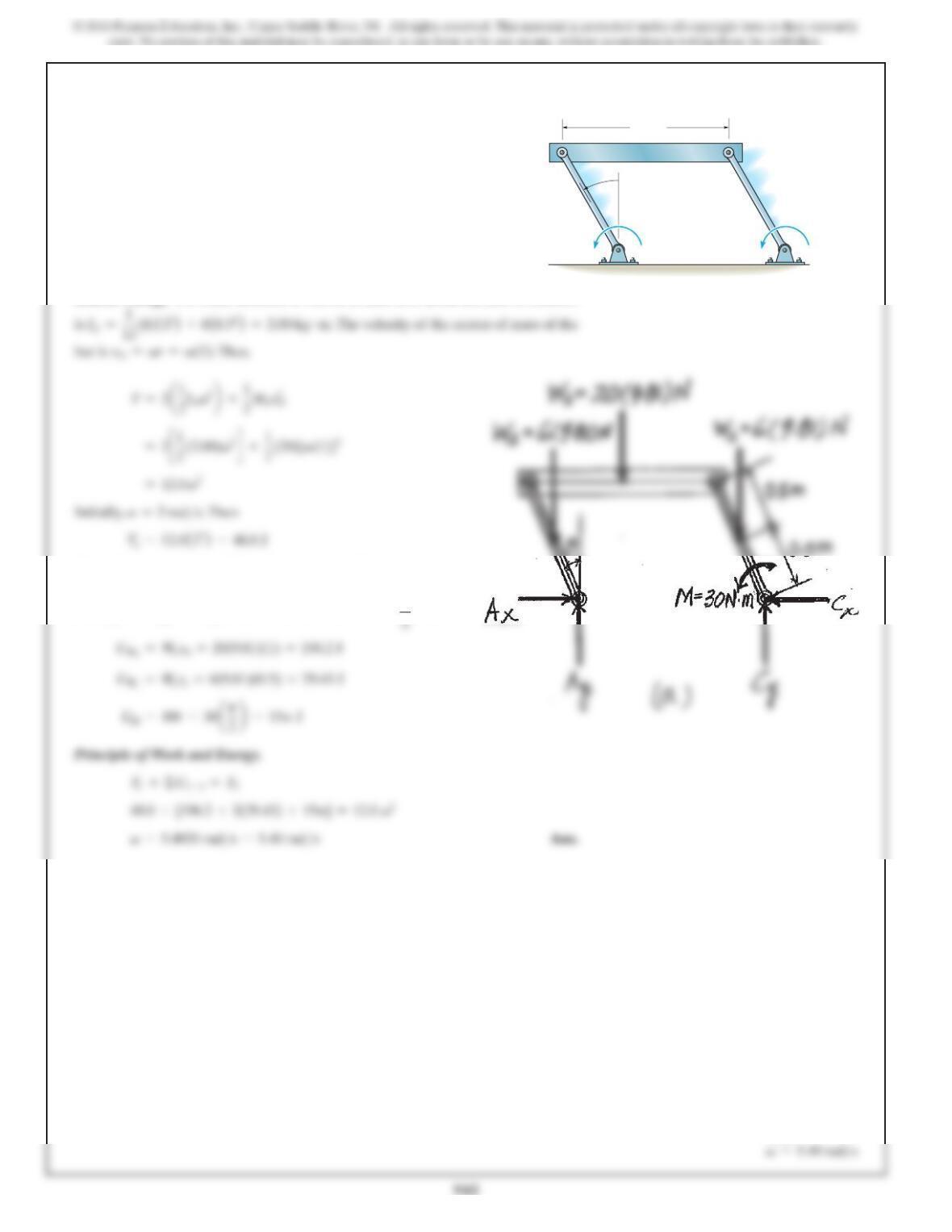
The linkage consists of two 6-kg rods AB and CD and a
20-kg bar BD. When
u=0°
, rod AB is rotating with an
angular velocity
v=2
rad
>
s. If rod CD is subjected to a
couple moment of
M=30 N #m
, determine
v
AB at the
instant
u=90°
.
SOLUTION
Kinetic Energy. The mass moment of inertia of each link about the axis of rotation
Work. Referring to the FBD of the assembly, Fig. a, the weights
W
b
,
W
c
and couple moment M do positive work when the links
undergo an angular displacement
u
. When u=90°=
p
rad,
Ans:
1.5 m
1 m 1 m
u
vM 30 N m
B
C
A
D
943
*18–32.
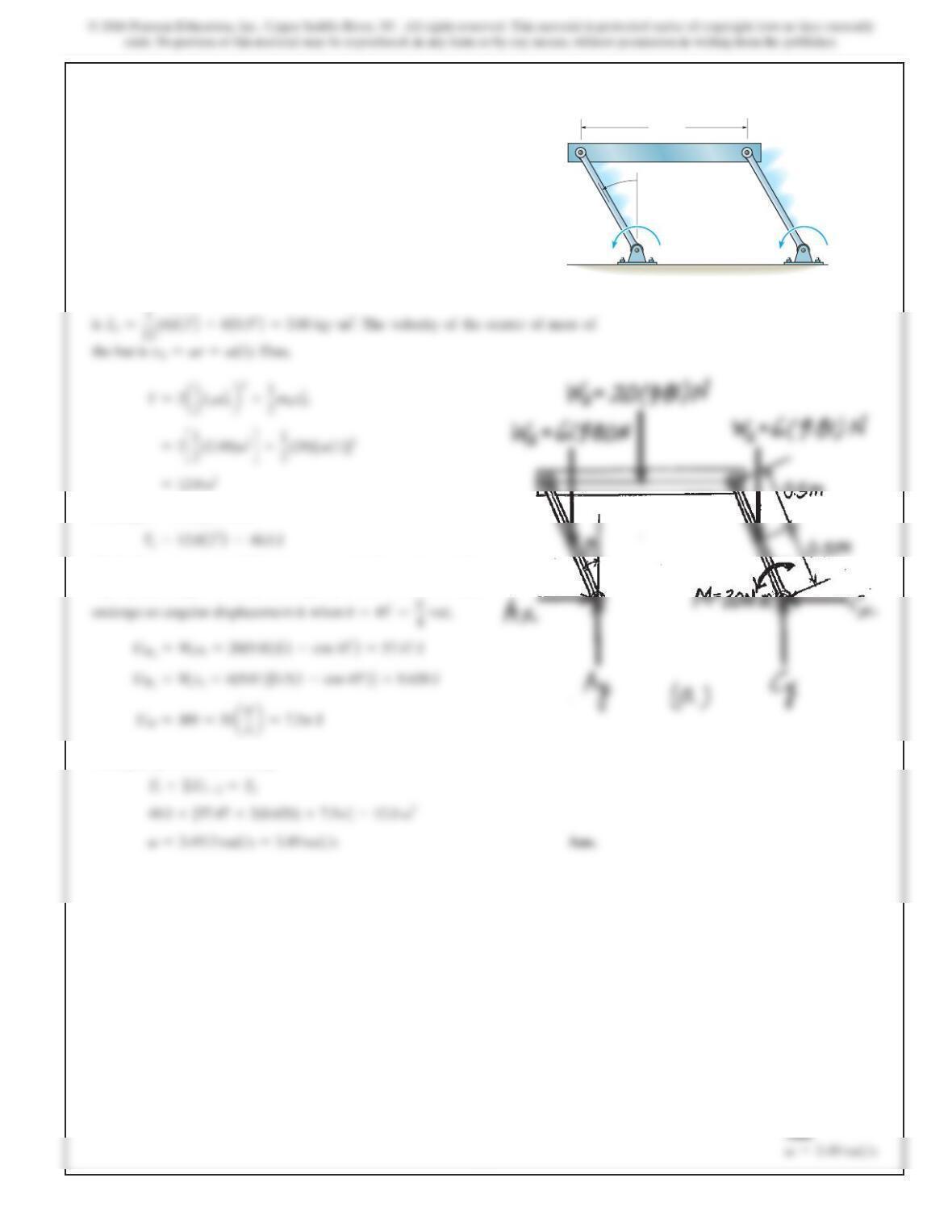
The linkage consists of two 6-kg rods AB and CD and a
20-kg bar BD. When
u=0°
, rod AB is rotating with an
angular velocity
v=2
rad
>
s. If rod CD is subjected to a
couple moment
M=30 N #m
, determine
v
at the instant
u=45°
.
SOLUTION
Kinetic Energy. The mass moment of inertia of each link about the axis of rotation
Initially, v
=2 rad>s
. Then
Work. Referring to the FBD of the assembly, Fig. a, the weights
W
b
,
W
c
and couple moment M do positive work when the links
Principle of Work and Energy.
1.5 m
1 m 1 m
u
vM 30 N m
B
C
A
D
944
18–33.
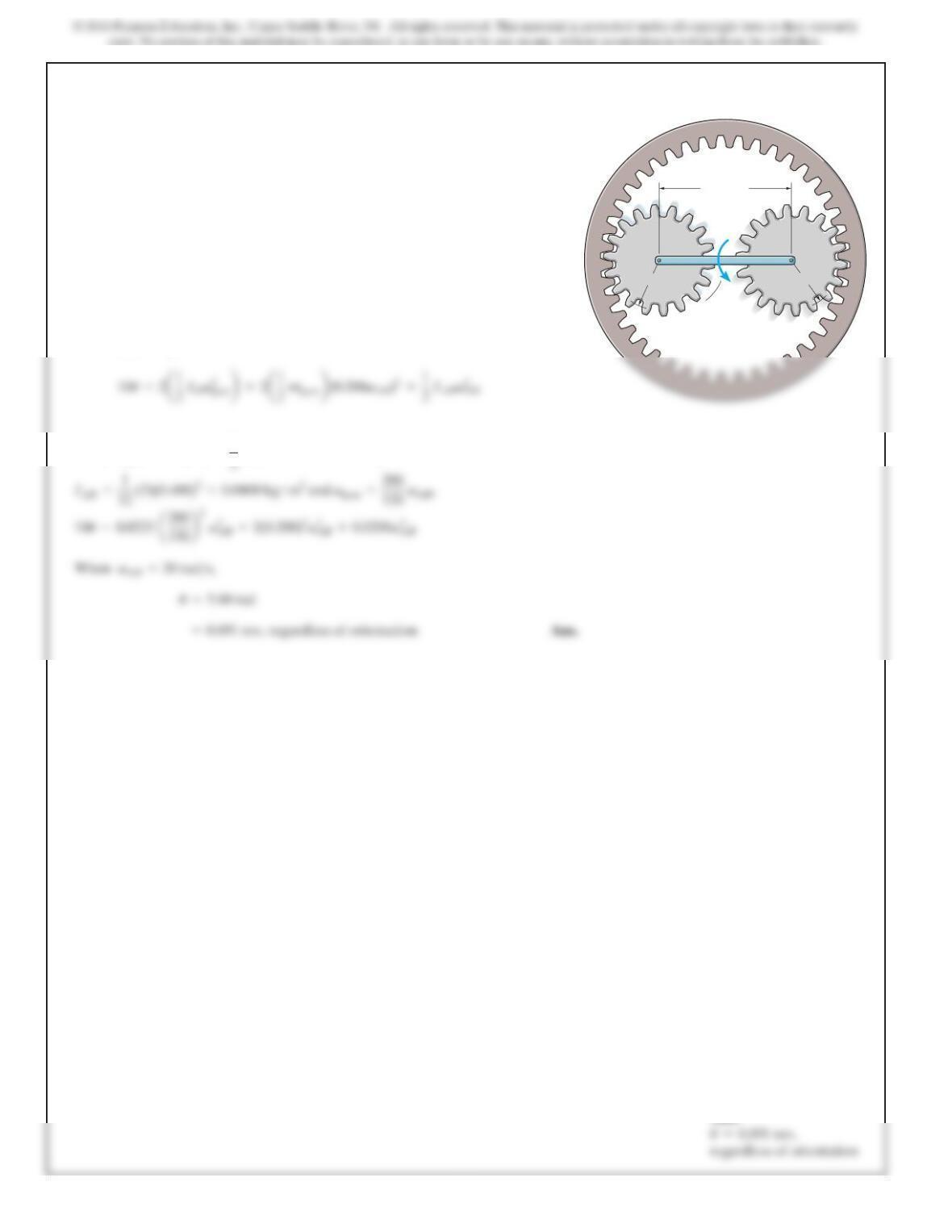
The two 2-kg gears Aand Bare attached to the ends of a
3-kg slender bar.The gears roll within the fixed ring gear C,
which lies in the horizontal plane.If a torque is
applied to the center of the bar as shown, determine the
number of revolutions the bar must rotate starting from rest
in order for it to have an angular velocity of
Forthe calculation, assume the gears can be approximated by
thin disks.What is the result if the gears lie in the vertical plane?
vAB =20 rad>s.
10-N #m
SOLUTION
Energy equation (where Grefers to the center of one of the two gears):
,, gnisU
IG=1
mgear =2kg
Mu=T2
400 mm
150 mm
M=10N·m
150 mm
AB
C
Ans:
945
18–34.
SOLUTION
T1+ΣU1–2=T2
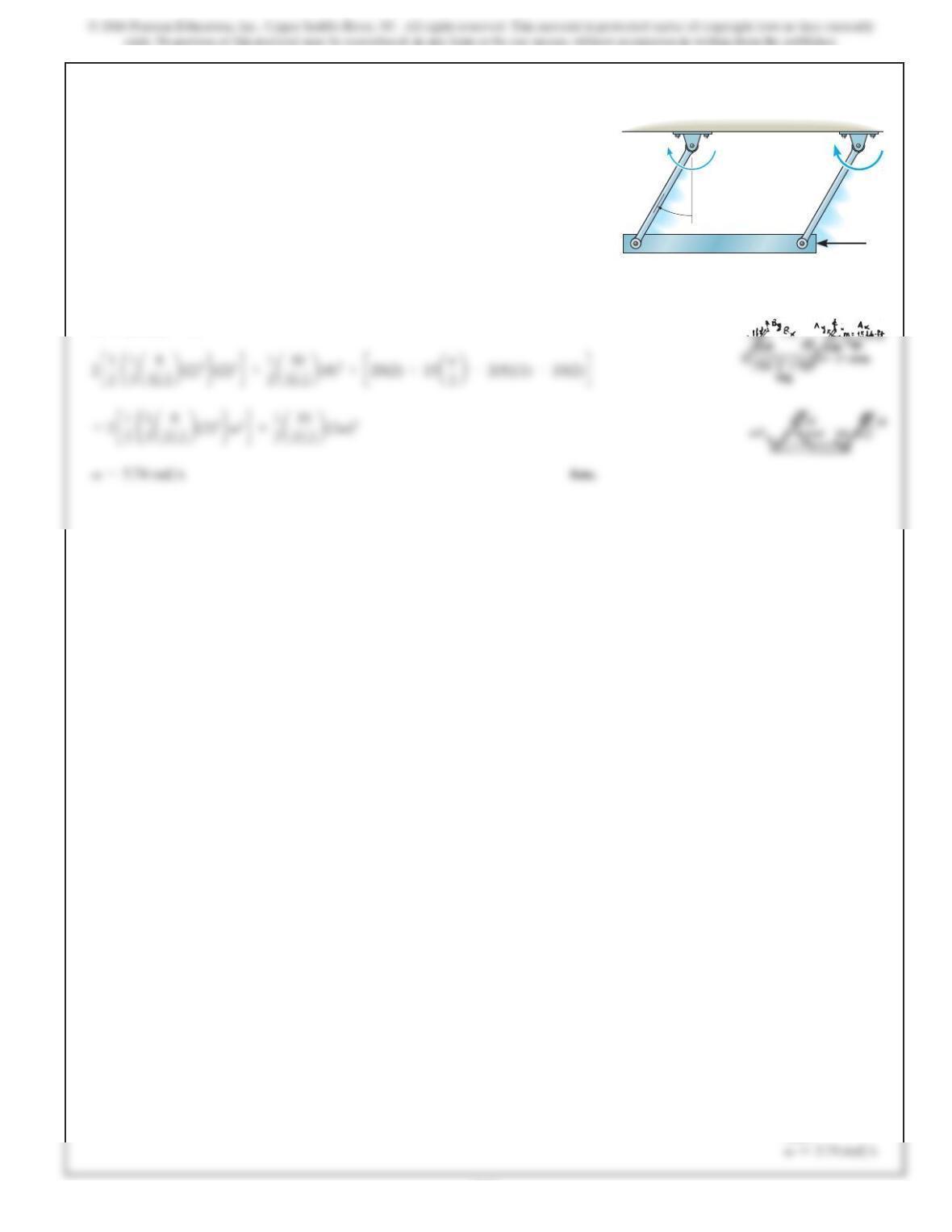
The linkage consists of two 8-lb rods AB and CD and
a 10-lb bar AD. When u=0°, rod AB is rotating with an
angular velocity vAB =2 rad>s. If rod CD is subjected to a
couple moment M=15 lb #ft and bar AD is subjected to a
horizontal force P=20 lb as shown, determine vAB at the
instant u=90°.
Ans:
3 ft
2 ft 2 ft
M 15 lb · ft
BC
AD
P 20 lb
u
vAB
18–35.
SOLUTION
T1+ΣU1–2=T2
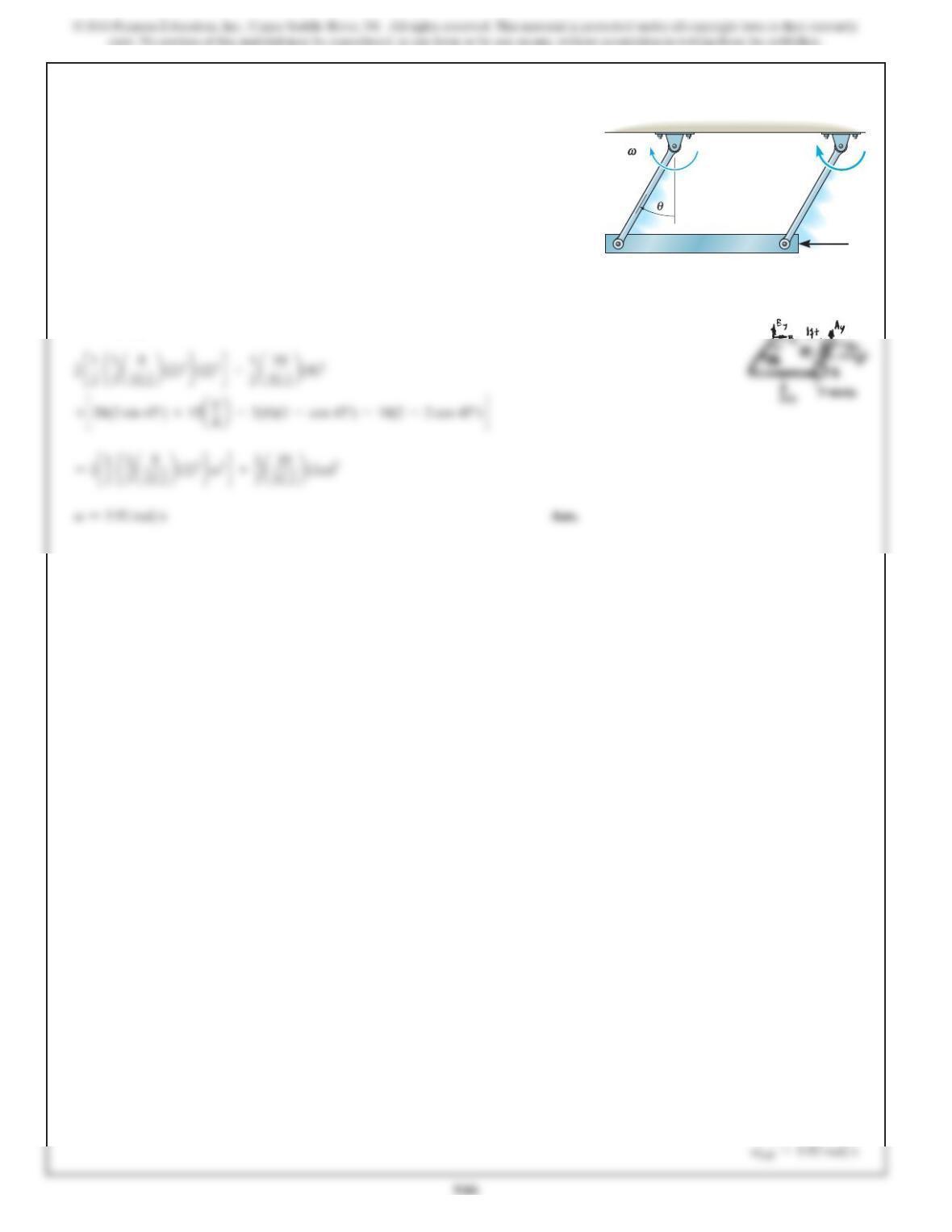
The linkage consists of two 8-lb rods AB and CD and
a 10-lb bar AD. When u=0°, rod AB is rotating with an
angular velocity vAB =2 rad>s. If rod CD is subjected to a
couple moment M=15 lb #ft and bar AD is subjected to a
horizontal force P=20 lb as shown, determine vAB at the
instant u=45°.
3 ft
2 ft 2 ft
M = 15 lb · ft
AB
BC
AD
P = 20 lb
Ans:
*18–36.
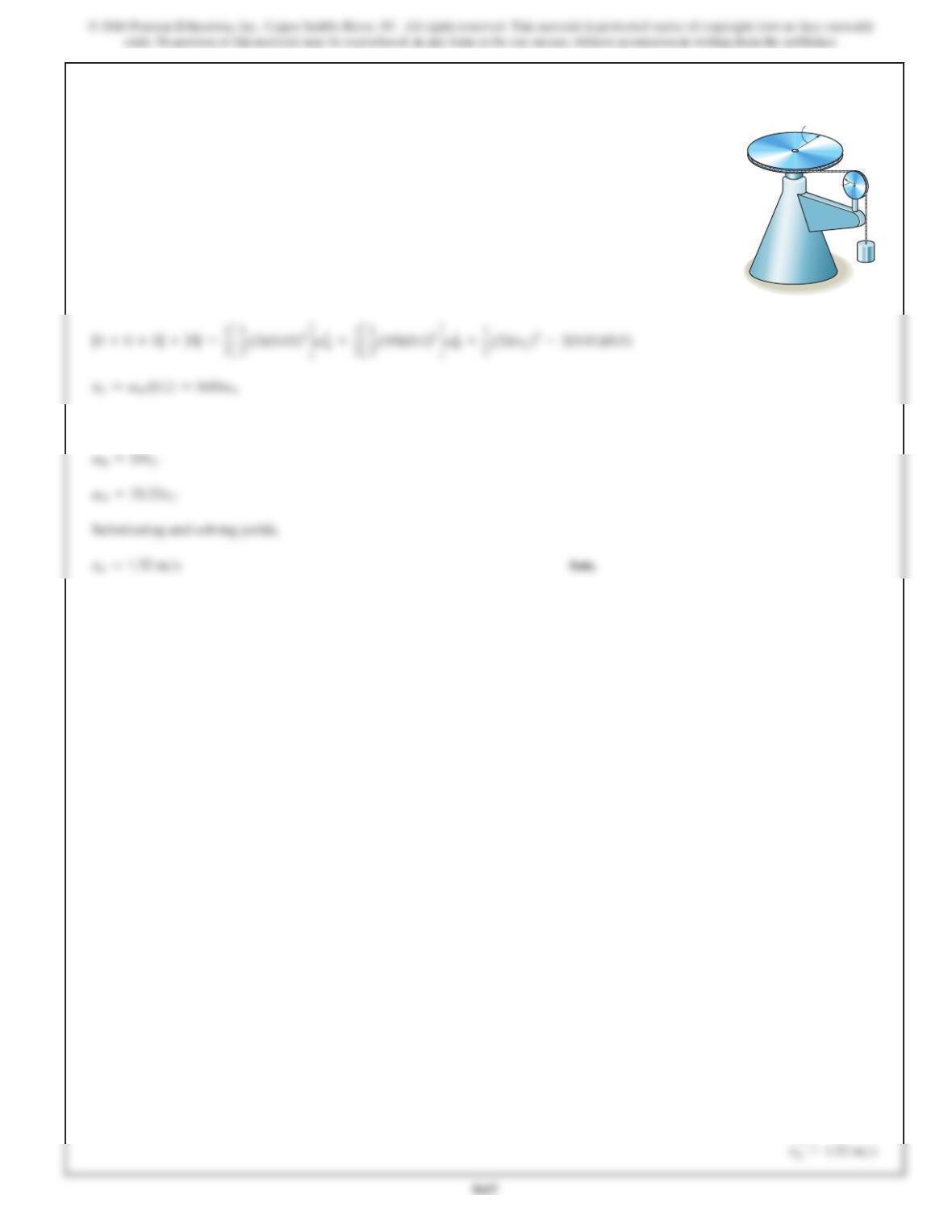
The assembly consists of a 3-kg pulley A and 10-kg pulley B.
If a 2-kg block is suspended from the cord, determine the
block’s speed after it descends 0.5 m starting from rest.
Neglect the mass of the cord and treat the pulleys as thin
disks. No slipping occurs.
A
B
30 mm
100 mm
SOLUTION
T1+V1=T2+V2
Thus,
Ans:
948
18–37.
The assembly consists of a 3-kg pulley A and 10-kg pulley B.
If a 2-kg block is suspended from the cord, determine the
distance the block must descend, starting from rest, in order
to cause B to have an angular velocity of 6 rad
>
s. Neglect
the mass of the cord and treat the pulleys as thin disks. No
slipping occurs.
A
B
30 mm
100 mm
SOLUTION
vC=
v
B (0.1) =0.03
v
A
949
18–38.
SOLUTION
System:
Block:
T1+©U1–2=T2
T1+V1=T2+V2
The spool has a mass of 50 kg and a radius of gyration
If the 20-kg block Ais released from rest,
determine the distance the block must fall in order for the
spool to have an angular velocity Also, what is
the tension in the cord while the block is in motion? Neglect
the mass of the cord.
v=5 rad>s.
kO=0.280 m.
A
0.2 m
O
0.3 m
A
0.2 m
O
0.3 m
Ans:
950
18–39.
0.2 m
O
0.3 m
The spool has a mass of 50 kg and a radius of gyration
. If the 20-kg block Ais released from rest,
determine the velocity of the block when it descends 0.5 m.
kO=0.280 m
SOLUTION
Potential Energy: With reference to the datum established in Fig.a, the gravitational
potential energy of block Aat position 1 and 2 are
Kinetic Energy: Since the spool rotates about a fixed axis,.
Here, the mass moment of inertia about the fixed axis passes through point Ois
Conservation of Energy:
T1+V1=T2+V2
v=vA
rA
=vA
0.2 =5vA
Ans:
951
*18–40.
An automobile tire has a mass of 7 kg and radius of gyration
If it is released from rest at Aon the incline,
determine its angular velocity when it reaches the horizontal
plane.The tire rolls without slipping.
kG=0.3 m.
SOLUTION
Datum at lowest point.
T1+V1=T2+V2
0.4 m
30°
5m
G
A
B
0.4 m