18–55.
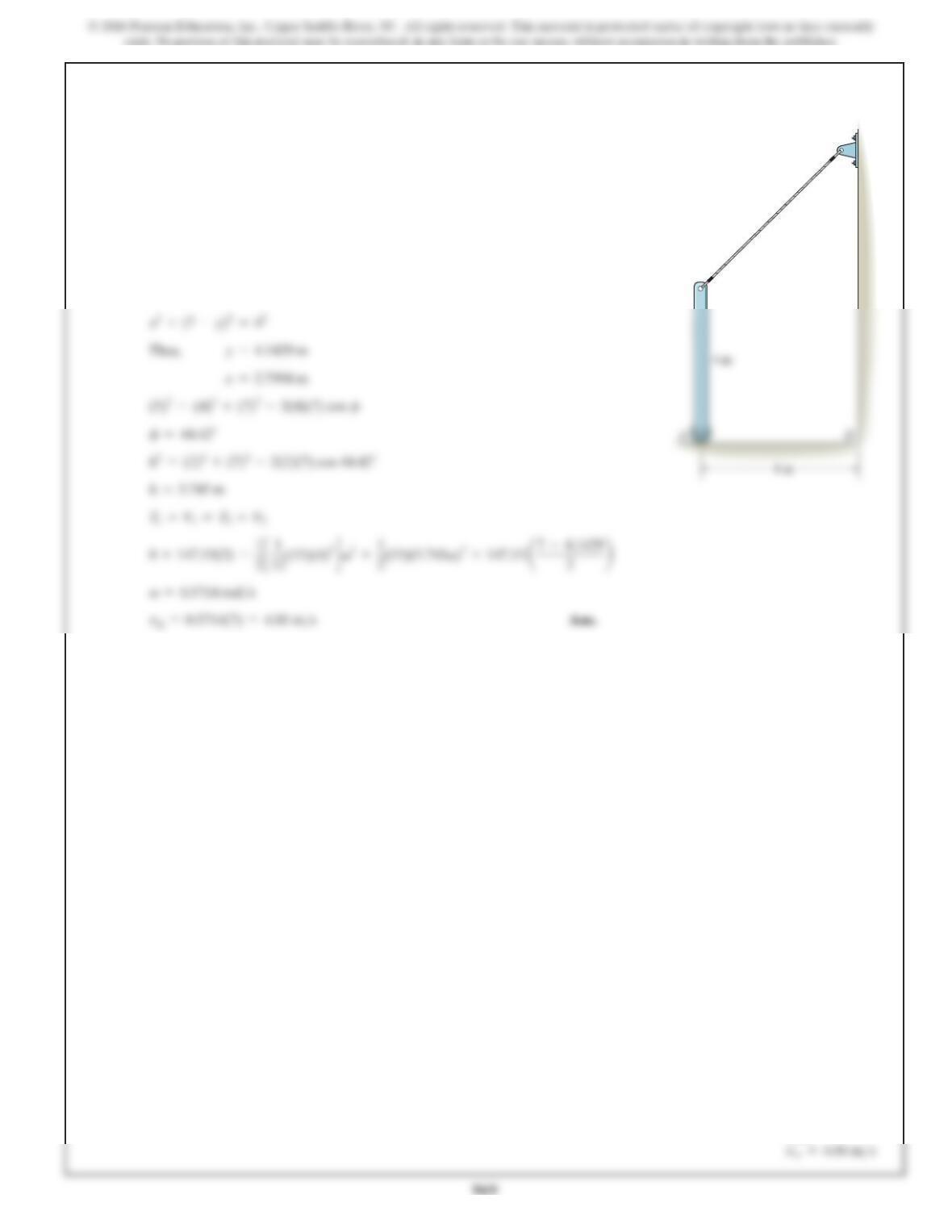
The slender 15-kg bar is initially at rest and standing in the
vertical position when the bottom end A is displaced slightly
to the right. If the track in which it moves is smooth,
determine the speed at which end A strikes the corner D.
The bar is constrained to move in the vertical plane. Neglect
the mass of the cord BC.
SOLUTION
x
2+
y
2=
5
2
Ans:
5 m
B
C
970
*18–56.
B
6 ft
4 ft
0.5 ft
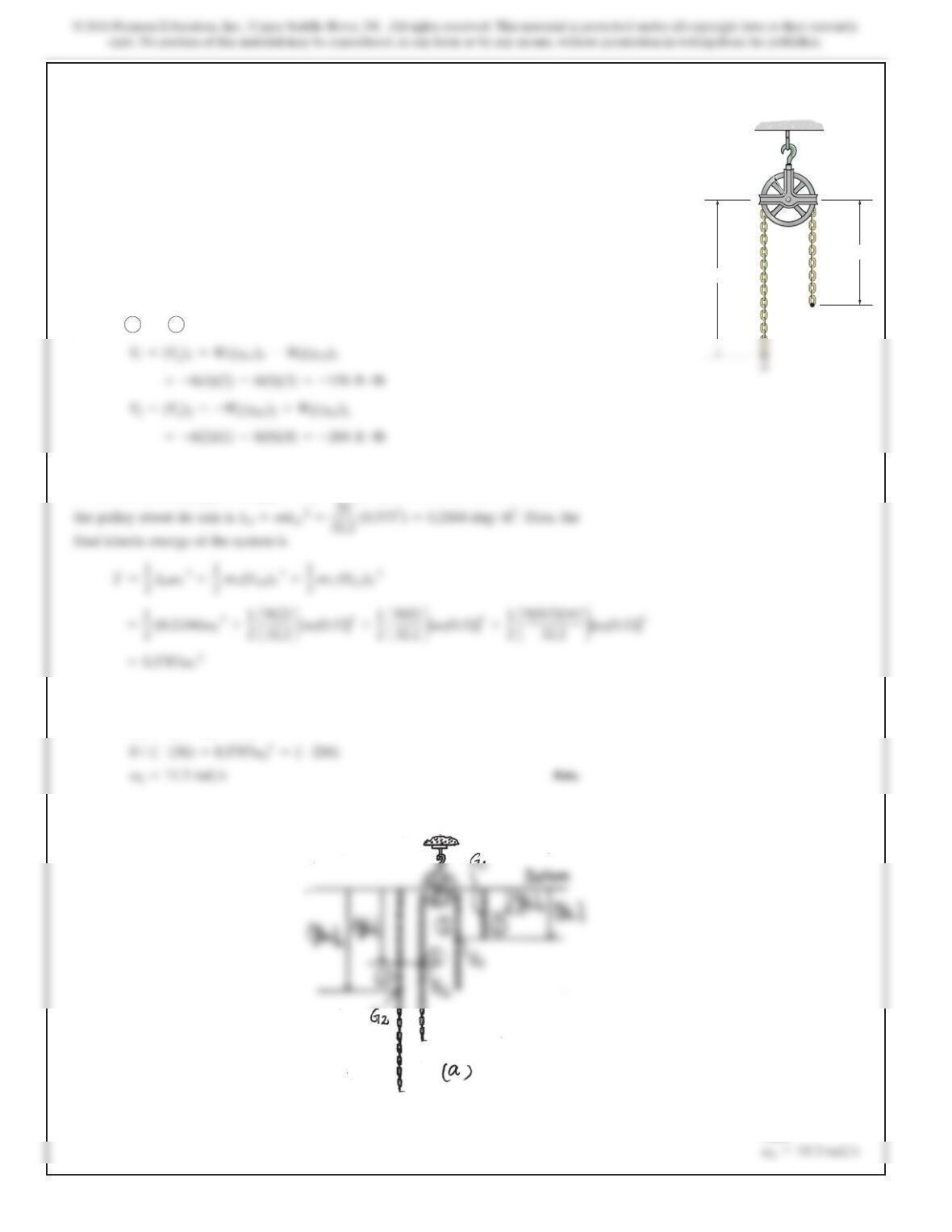
If the chain is released from rest from the position shown,
determine the angular velocity of the pulley after the end B
has risen 2 ft.The pulley has a weight of 50 lb and a radius of
gyration of 0.375 ft about its axis.The chain weighs 6 lb/ft.
SOLUTION
Potential Energy: ,,, and .With
reference to the datum in Fig.a, the gravitational potential energy of the chain at
position 1 and 2 is
Kinetic Energy: Since the system is initially at rest, .The pulley rotates about
a fixed axis, thus,.The mass moment of inertia of
(VG1)2=(VG2)2 =v2 r=v2(0.5)
T1=0
(yG2)2=4 ft(yG1)2=1 ft(yG 2)1=3 ft(yG1)1=2 ft
Conservation of Energy:
T1+V1=T2+V2
Ans:
18–57.
1 ft
O
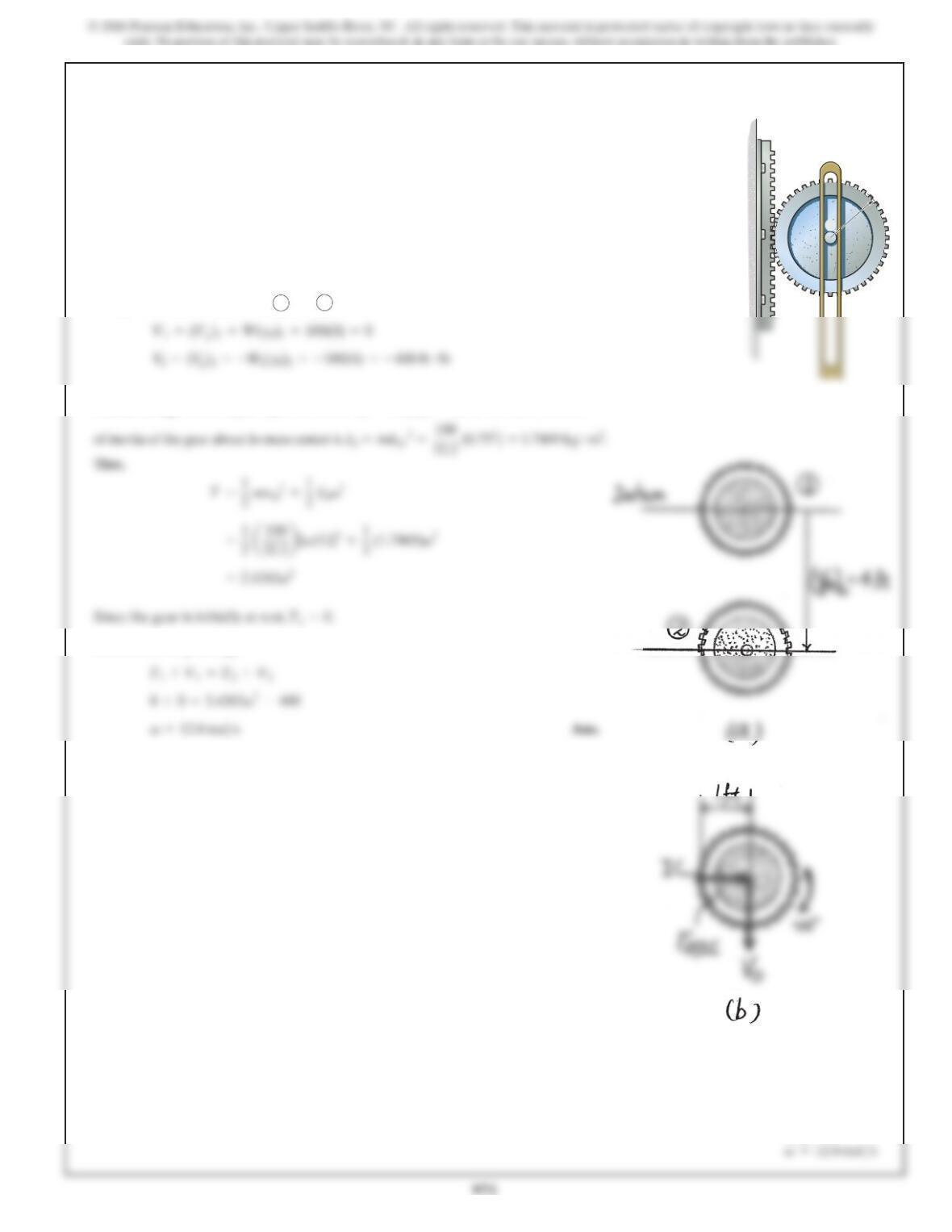
If the gear is released from rest, determine its angular
velocity after its center of gravity Ohas descended a
distance of 4 ft. The gear has a weight of 100 lb and a radius
of gyration about its center of gravity of .k=0.75 ft
SOLUTION
Potential Energy: With reference to the datum in Fig. a, the gravitational potential
energy of the gear at position 1 and 2 is
Kinetic Energy: Referring to Fig. b,we obtain .The mass momentvO=vrO / IC =v(1)
Conservation of Energy:
Ans:
972
18–58.
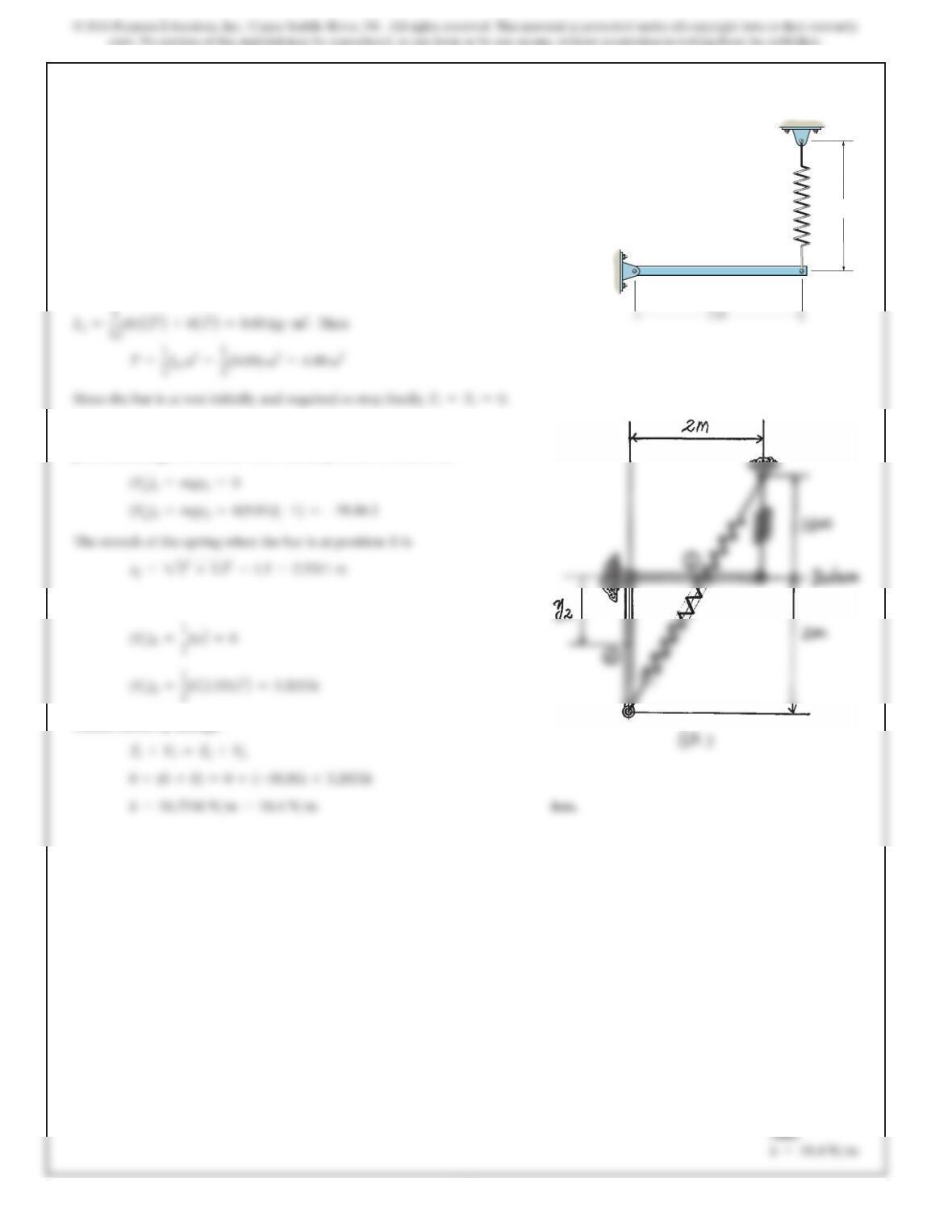
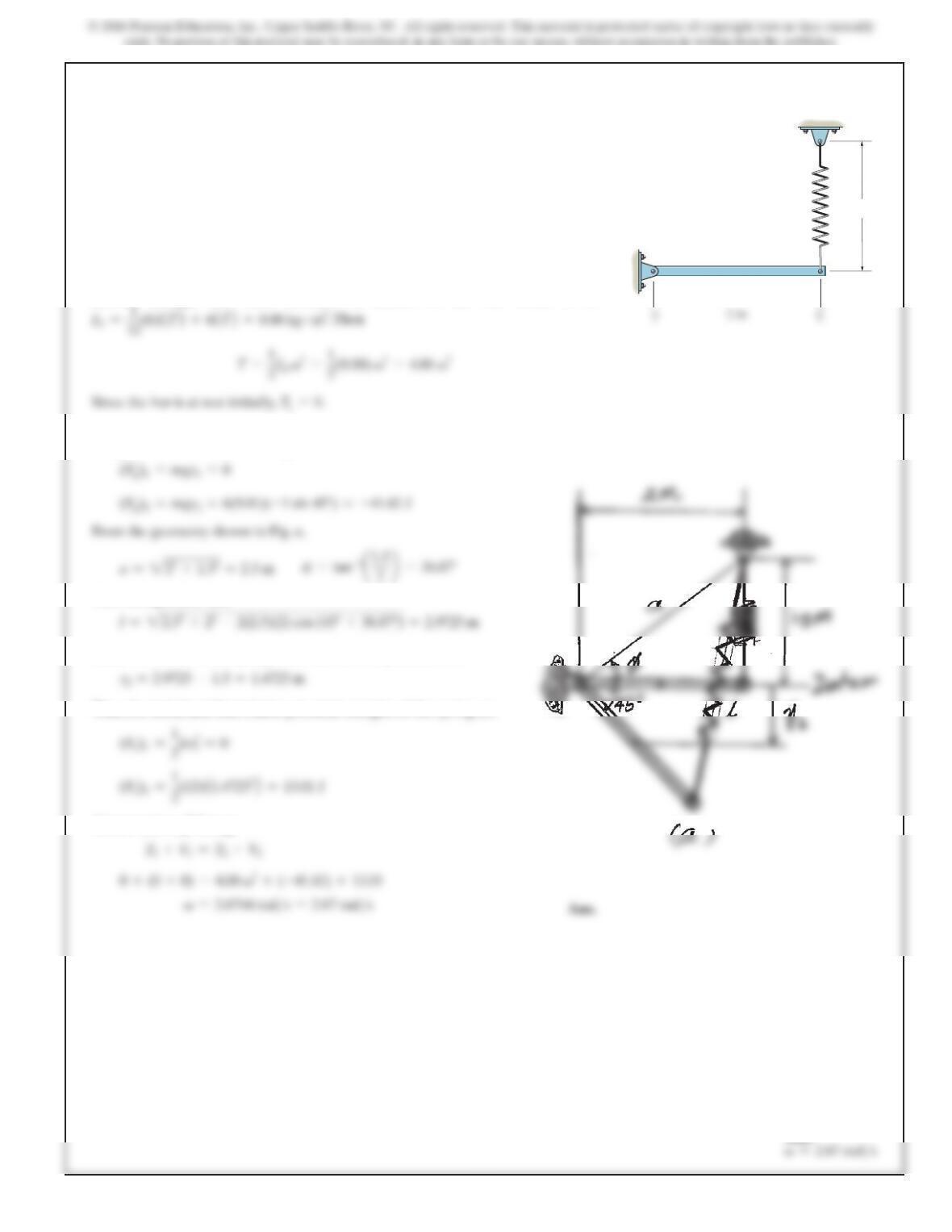
The slender 6-kg bar AB is horizontal and at rest and the
spring is unstretched. Determine the stiffness k of the spring
so that the motion of the bar is momentarily stopped when
it has rotated clockwise 90° after being released.
k
AB
C
1.5 m
SOLUTION
Kinetic Energy. The mass moment of inertia of the bar about A is
Potential Energy. With reference to the datum set in Fig. a, the gravitational
potential energies of the bar when it is at positions ➀ and ➁ are
Thus, the initial and final elastic potential energy of the spring are
Conservation of Energy.
973
18–59.
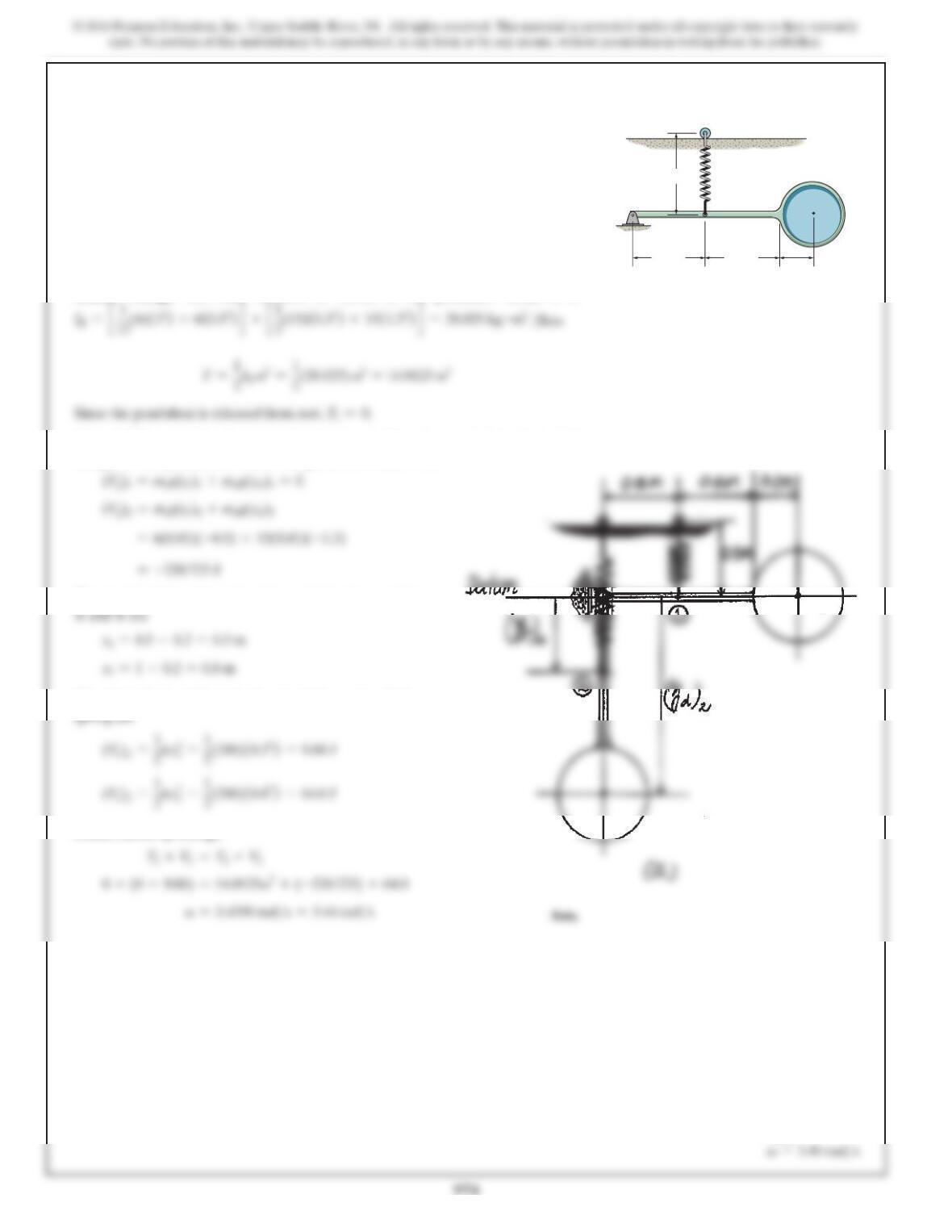
The slender 6-kg bar AB is horizontal and at rest and the
spring is unstretched. Determine the angular velocity of the
bar when it has rotated clockwise 45° after being released.
The spring has a stiffness of
k=12 N>m
.
k
AB
C
1.5 m
SOLUTION
Kinetic Energy. The mass moment of inertia of the bar about A is
Potential Energy. with reference to the datum set in Fig. a, the gravitational potential
energies of the bar when it is at positions ① and ② are
Then, using cosine law,
Thus, the stretch of the spring when the bar is at position ② is
Thus, the initial and final elastic potential energies of the spring are
Conservation of Energy.
Ans:
*18–60.
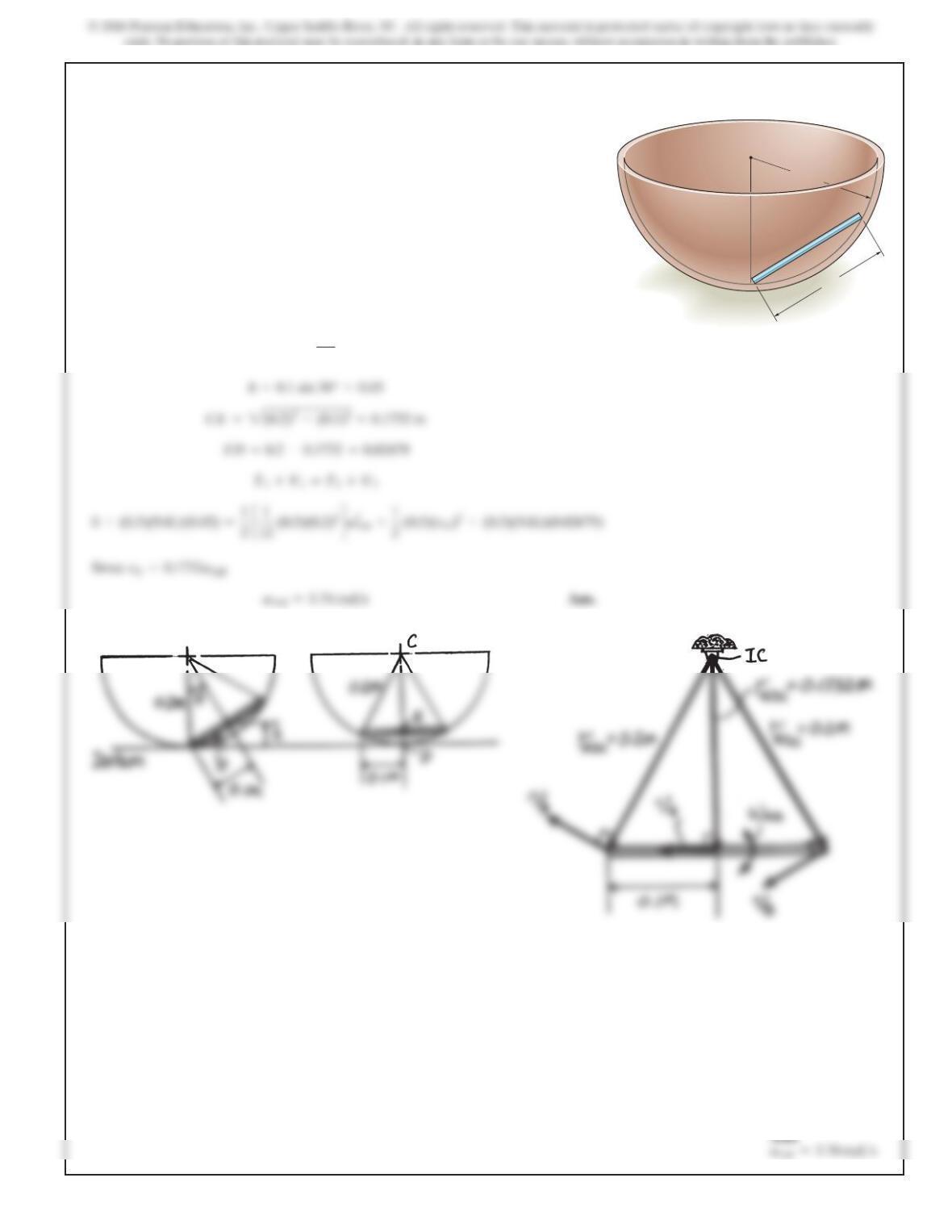
The pendulum consists of a 6-kg slender rod fixed to a 15-kg
disk. If the spring has an unstretched length of 0.2 m,
determine the angular velocity of the pendulum when it is
released from rest and rotates clockwise 90° from the
position shown. The roller at C allows the spring to always
remain vertical.
0.5 m 0.5 m 0.3 m
k 200 N/m
C
BD
A
0.5 m
SOLUTION
Kinetic Energy. The mass moment of inertia of the pendulum about B is
Potential Energy. with reference to the datum set in Fig. a, the gravitational potential
energies of the pendulum when it is at positions ① and ② are
The stretch of the spring when the pendulum is at positions
Thus, the initial and final elastic potential energies of the
Conservation of Energy.
Ans:
975
18–61.
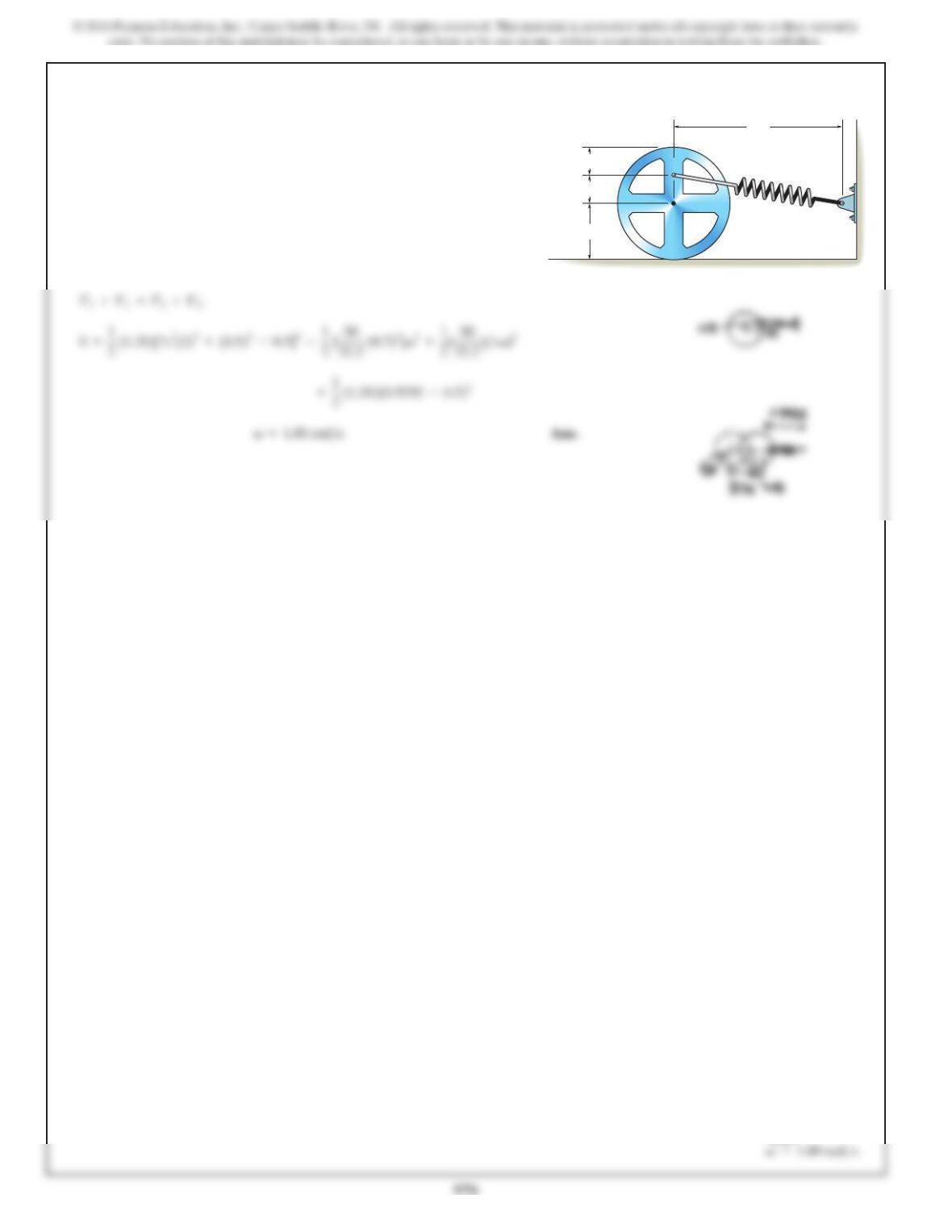
The 500-g rod AB rests along the smooth inner surface of a
hemispherical bowl. If the rod is released from rest from the
position shown, determine its angular velocity at the instant
it swings downward and becomes horizontal.
SOLUTION
Select datum at the bottom of the bowl.
u=sin–1a0.1
0.2 b=30°
A
B
200 mm
200 mm
18–62.
The 50-lb wheel has a radius of gyration about its center of
gravity Gof If it rolls without slipping,
determine its angular velocity when it has rotated clockwise
90° from the position shown. The spring AB has a stiffness
and an unstretched length of 0.5 ft.The wheel
is released from rest.
k=1.20 lb/ft
kG=0.7 ft.
SOLUTION
G
B
A
k= 1.20 lb/ft
3ft
1ft
0.5 ft
0.5 ft
Ans:
977
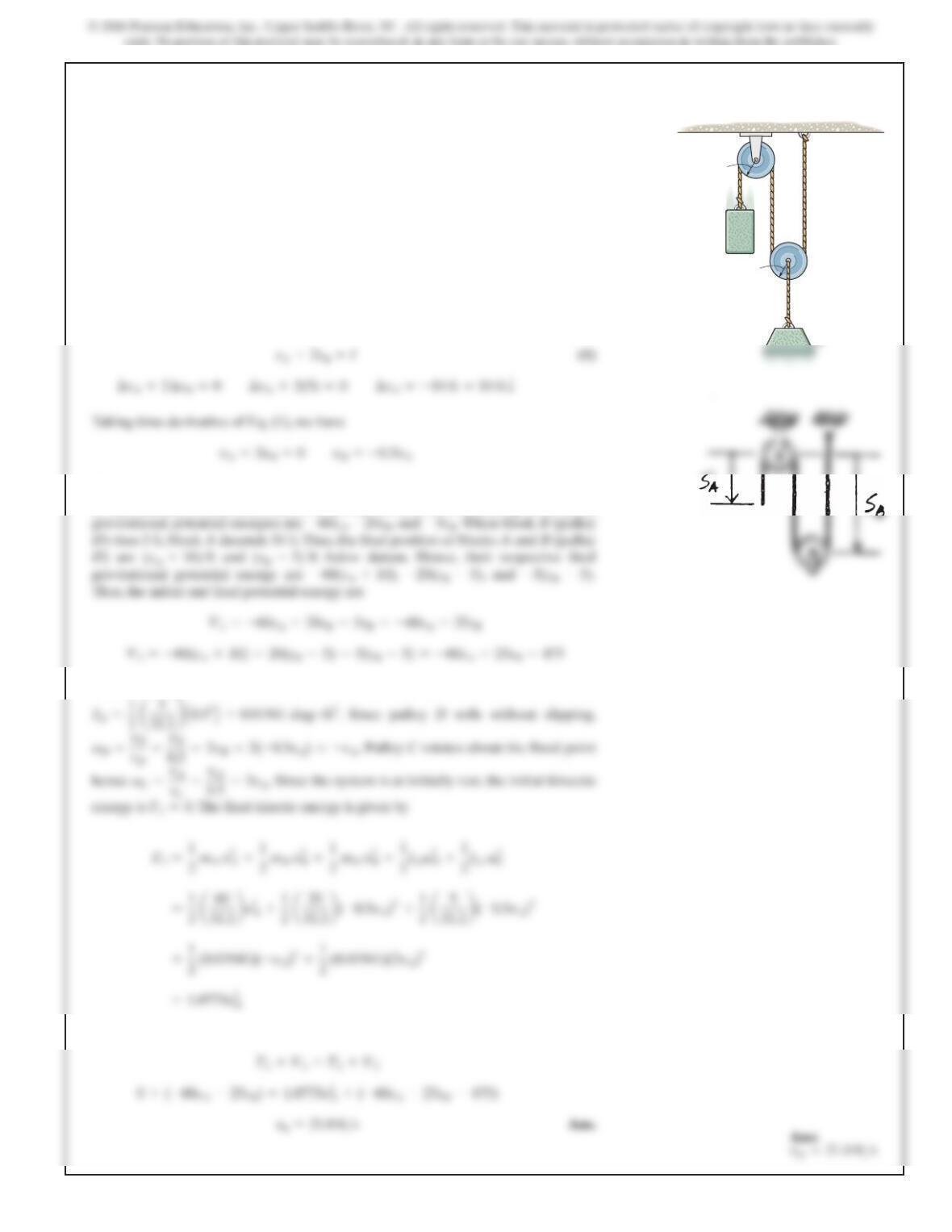
18–63.
The system consists of 60-lb and 20-lb blocks Aand B,
respectively,and 5-lb pulleys Cand Dthat can be treated as
thin disks.Determine the speed of block Aafter block Bhas
risen 5 ft, starting from rest. Assume that the cord does not
slip on the pulleys,and neglect the mass of the cord.
SOLUTION
Kinematics: The speed of block Aand Bcan be related using the position
coordinate equation.
Potential Energy: Datum is set at fixed pulley C.When blocks Aand B(pulley D)are
at their initial position, their centers of gravity are located at sAand sB.Their initial
Kinetic Energy: The mass moment inertia of the pulley about its mass center is
Conservation of Energy: Applying Eq. 18–19, we have
0.5 ft
A
C
D
0.5 ft
B
*18–64.
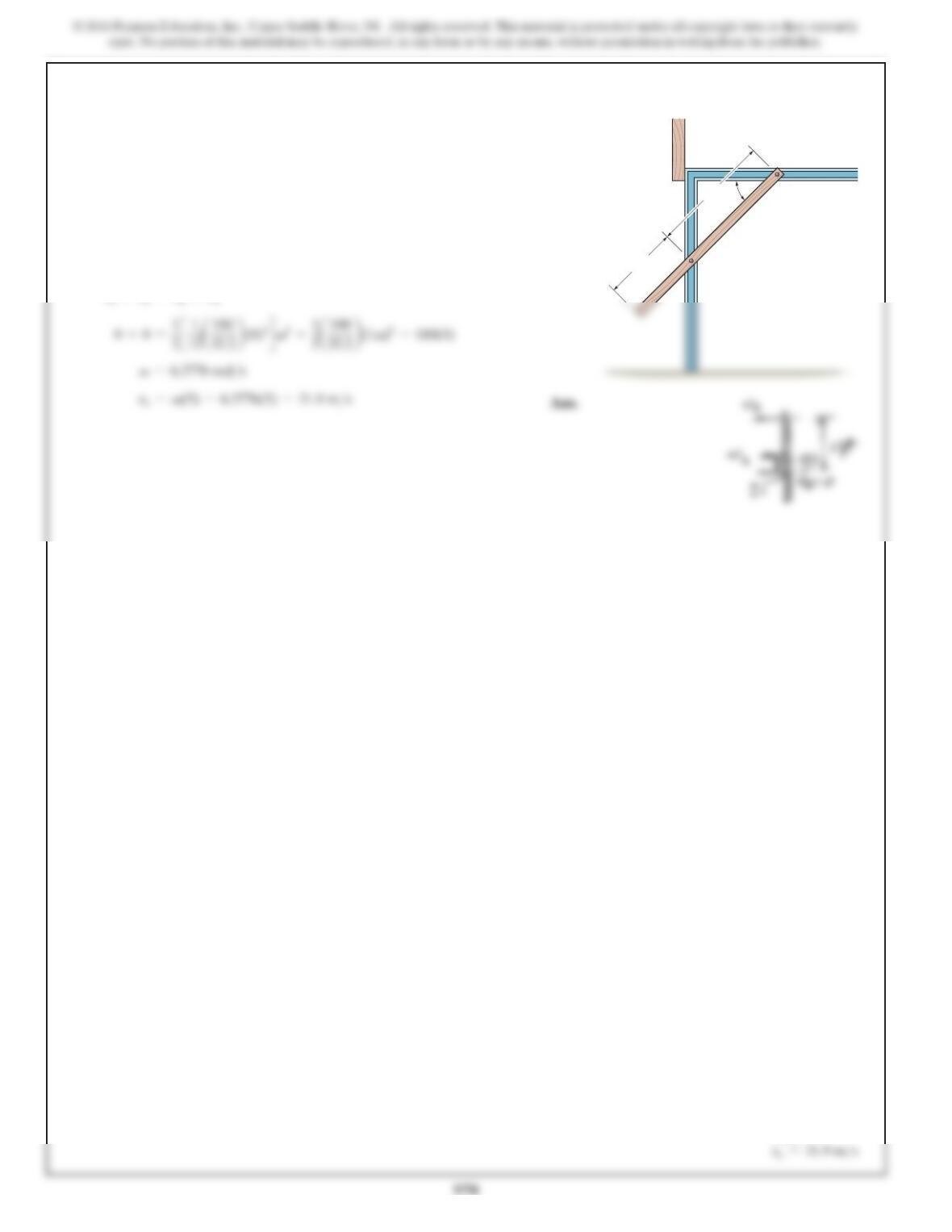
The door is made from one piece, whose ends move along
the horizontal and vertical tracks. If the door is in the open
position, u
=0°,
and then released, determine the speed at
which its end A strikes the stop at C. Assume the door is a
180-lb thin plate having a width of 10 ft.
CA
B
5 ft
3 ft
u
SOLUTION
T1+V1=T2+V2
Ans:
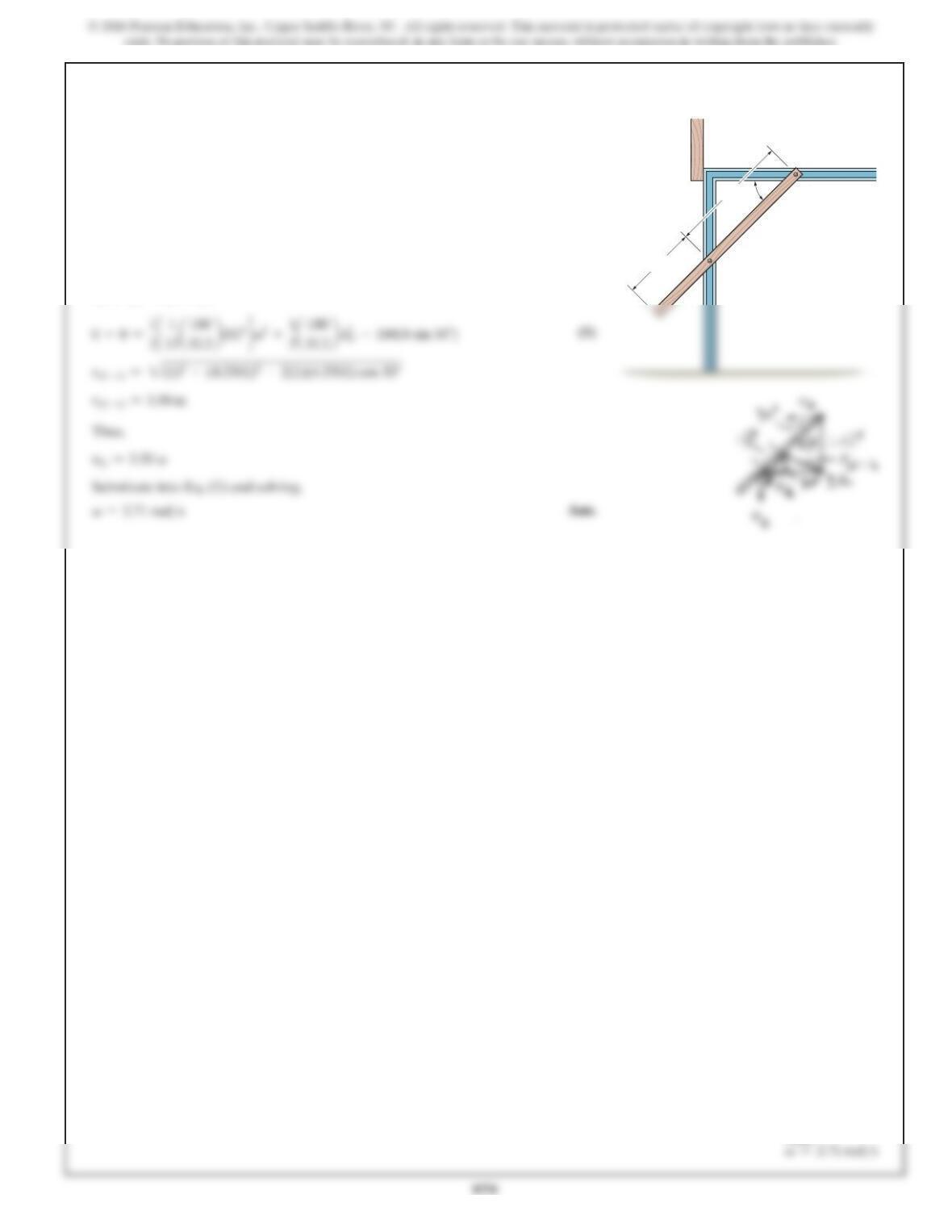
18–65.
The door is made from one piece, whose ends move along
the horizontal and vertical tracks. If the door is in the open
position, u
=0°,
and then released, determine its angular
velocity at the instant
u=30°
. Assume the door is a 180-lb
thin plate having a width of 10 ft.
CA
B
5 ft
3 ft
u
SOLUTION
T1+V1=T2+V2
Ans:
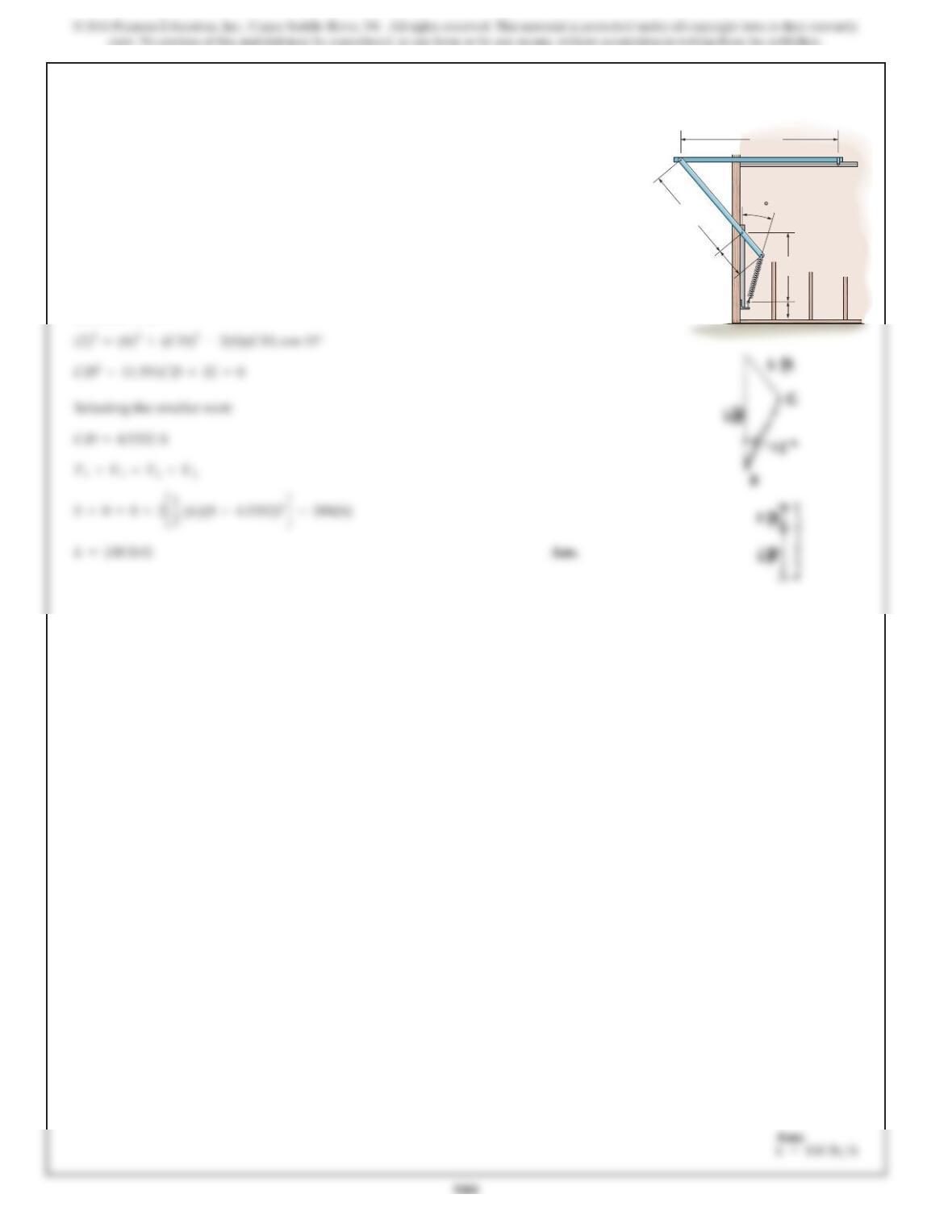
18–66.
SOLUTION
The end Aof the garage door AB travels along the
horizontal track, and the end of member BC is attached to a
spring at C. If the spring is originally unstretched, determine
the stiffness kso that when the door falls downward from
rest in the position shown, it will have zero angular velocity
the moment it closes, i.e., when it and BC become vertical.
Neglect the mass of member BC and assume the door is a
thin plate having a weight of 200 lb and a width and height
of 12 ft. There is a similar connection and spring on the
other side of the door.
15
7 ft
12 ft A
B
C
D
2 ft 6 ft
1 ft
981
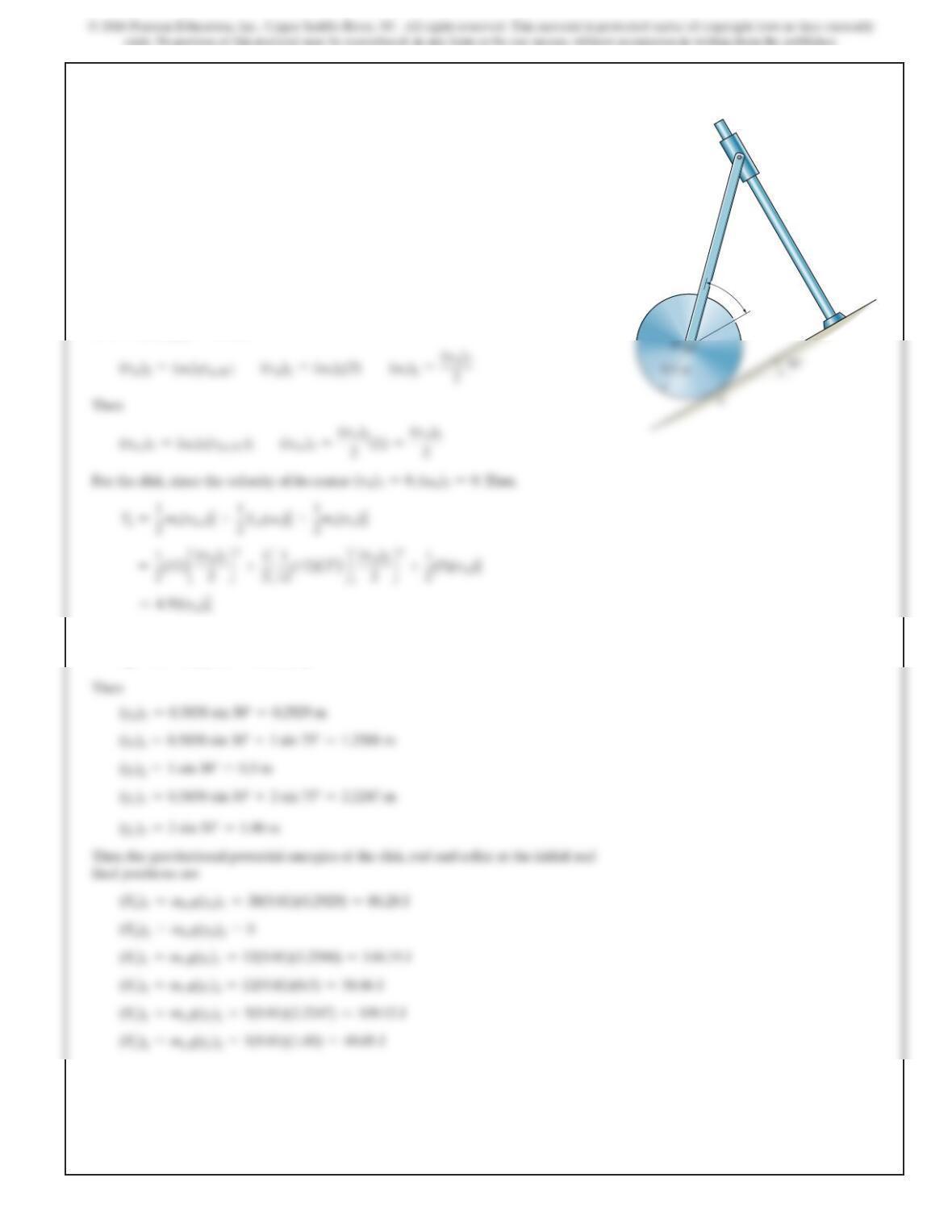
18–67.
The system consists of a 30-kg disk, 12-kg slender rod BA,
and a 5-kg smooth collar A. If the disk rolls without slipping,
determine the velocity of the collar at the instant
u=0°
.
The system is released from rest when
u=45°
.
SOLUTION
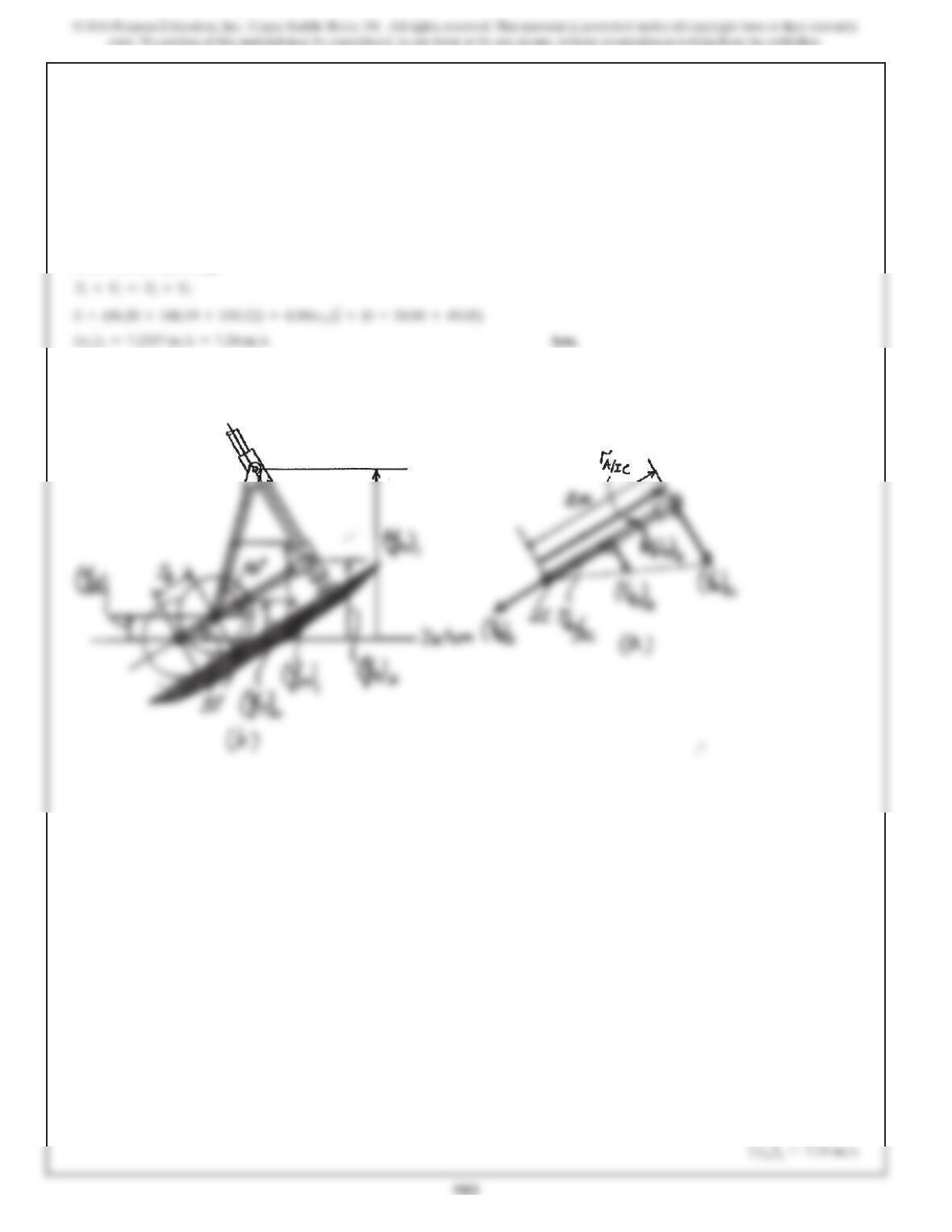
Kinetic Energy. Since the system is released from rest,
T1=0
. Referring to the
kinematics diagram of the rod at its final position, Fig. a, we found that IC is located
at B. Thus,
(
v
B)2=0
. Also
(
Potential Energy. Datum is set as shown in Fig. a. Here,
SB=2–2 cos 45°=0.5858 m
2 m
A
u
18–67. Continued
Conservation of Energy.
Ans.
Ans:
983
SOLUTION
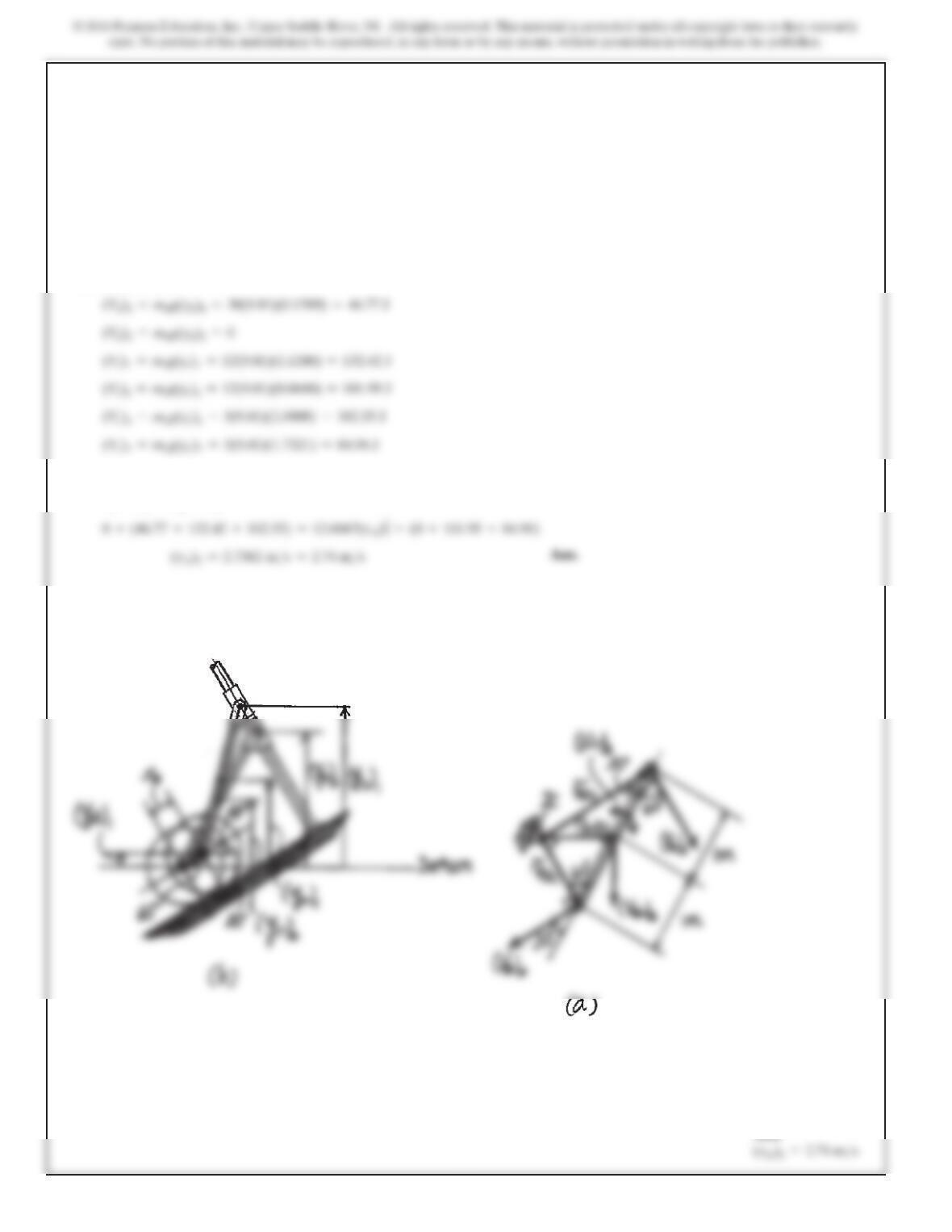
Kinetic Energy. Since the system is released from rest,
T1=0
. Referring to the
kinematics diagram of the rod at final position with IC so located, Fig. a,
Since the disk rolls without slipping,
Thus, the kinetic energy of the system at final position is
Potential Energy. Datum is set as shown in Fig. a. Here,
SB=2 cos 30°–2 cos 45°=0.3178 m
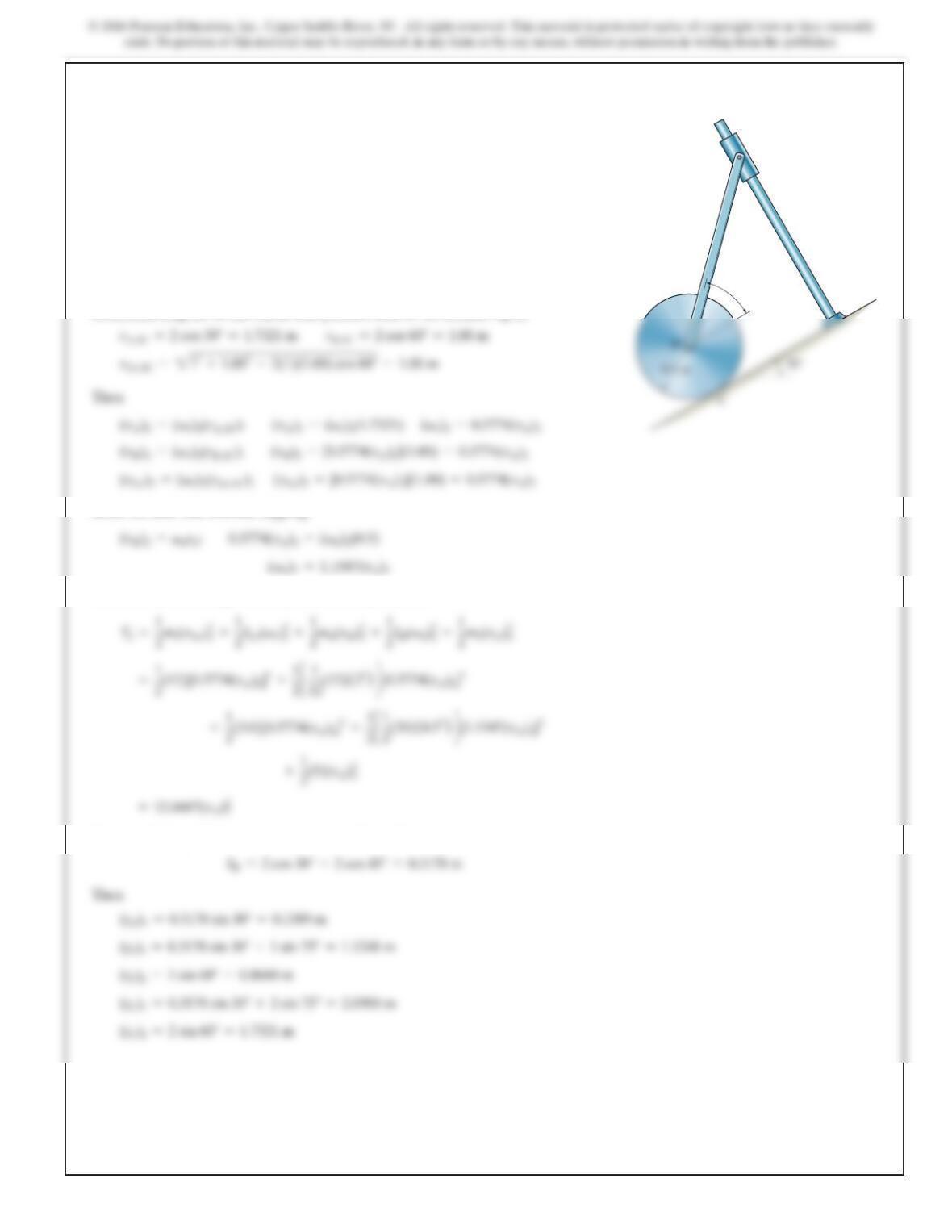
*18–68.
The system consists of a 30-kg disk A, 12-kg slender rod BA,
and a 5-kg smooth collar A. If the disk rolls without slipping,
determine the velocity of the collar at the instant
u=30°
.
The system is released from rest when
u=45°
.
2 m
A
u
984
Thus, the gravitational potential energies of the disk, rod and collar at initial and
final position are
Conservation of Energy.
T1+V1=T2+V2
*18–68. Continued