CHAPTER 18
CALCULATIONS OF ILLUMINATION
OVERVIEW
This chapter deals with calculations of illumination by manual procedures even though
computer programs are readily available. We found the lumen’s method most useful in general
illumination calculations while the point-by-point method can produce more accurate results.
The manual lumen’s method gives the designer a chance to evaluate the appropriateness of each
input factor during preliminary design while computer calculations can be used in the final
design. On the other hand, computer method must be used for large indoor and outdoor sports
facilities inasmuch as the degree of uniformity, glare ratings, etc. are so critical to the players and
television broadcasters.
The instructors are encouraged to use the installed lighting system in your classroom as a
design project. First, calculate the lighting level of the existing lighting, then, select one or two
alternative lighting fixtures from catalogs and compare the layouts as to illuminance levels,
power inputs, unit power density (UPD) and visual quality. This is one homework assignment
that generates the most interest and class discussions.
Most architectural and engineering design firms use computers exclusively in final design
of any project. However, computer technology cannot replace the manual methods for
preliminary design because lighting design is as much an art as a science. Not knowing the
technical background of the students and the type of computer laboratory available in each
school, it is difficult for the authors to prepare any questions of homework for the students to
practice on computer calculations and computer graphics. We recommend each instructor
should develop your own homework assignments appropriate to your class.

CHAPTER 18
CALCULATIONS OF ILLUMINATION
QUESTIONS AND ANSWERS
18.1 What are two most important factors that make up the Light Loss Factor (LLF)?
18.2 Is ballast factor always lower than 1.0?
18.3 What is the ceiling cavity ratio (CCR) for a ceiling recess-mounted fluorescent
fixture? What is the effective ceiling reflectance if the base ceiling reflectance is
18.4 What is the simplified approach in zonal cavity method calculations? What variance
can be expected and is it significant in most cases?
18.5 What is the maintenance category for a luminaire with open top and bottom and
with 65% uplight?
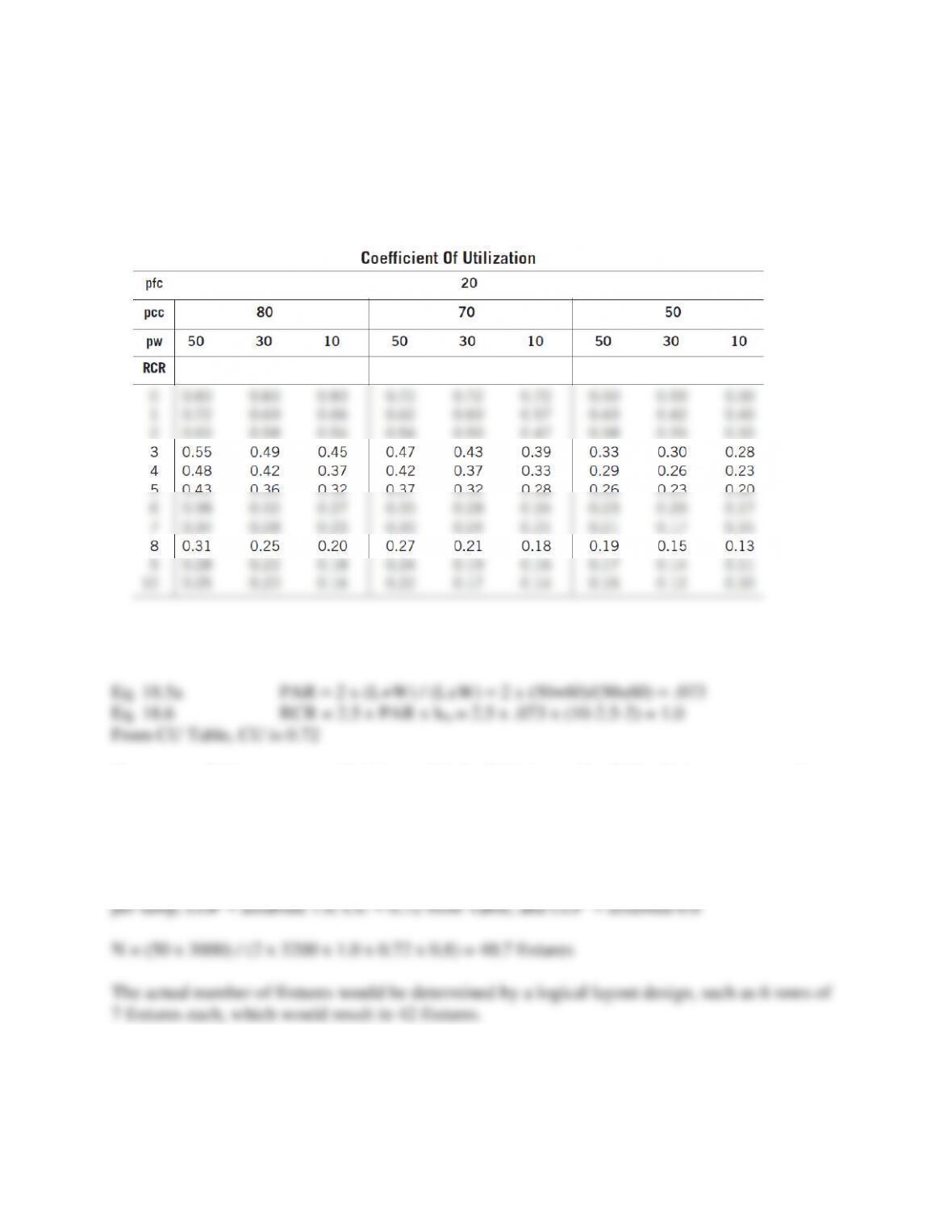
18.6 Determine the coefficient of utilization of an indirect distribution incandescent
luminaire installed in a 50 ft × 60 ft room with a 10 ft ceiling height, 30 in. task plane, and
luminaires mounted 2 ft from below the ceiling. The ρcc = 80 percent, ρw = 50 percent, ρfc =
20 percent. Use the CU table below.
To use the CU Table we must find the RCR.
How many fixtures are required to maintain 50 foot-candles if the fixtures are two-lamp,
3200 lumens per lamp and LLF is 0.8?
Eq. 18.1b N = (E x A) / LPF x RLL x LOF x CU x LLF, where
E = 50 foot-candles, A = 50 x 60 = 3,000 sq.ft., LPF =2 lamps per fixture, RLL = 3200 lumens

18.7 For the luminaire in question 18.6, but installed in a 10 ft × 15 ft room with the
same heights and reflectances, what is the CU? How many fixtures are required to
maintain 50 foot-candles if the fixtures are two-lamp, 3200 lumens per lamp and
LLF is 0.8?
Eq. 18.5a PAR = 2 x (L+W) / (LxW) = 2 x (10+15)/(10×15) = .33
Eq. 18.6 RCR = 2.5 x PAR x hrc = 2.5 x .33 x (10-2.5-2) = 4.5
18.8 If the luminaire in Question 18.6 is installed in an air-conditioned office building in
a suburban environment with a 12-month cleaning cycle, what is your estimate of
the appropriate LDD factor which might be included in the LLF of 0.8?
18.8 (yes, there are 2 – 18.8 problems…) If the luminaire in Question 18.6 is installed in a
print shop prone to airborne paper chaff with a 6-month cleaning cycle, what is your
estimate of an appropriate LDD factor which might be included in the LLF for this
case? How many more fixtures would be required for this application to achieve the
same illumination level as the office space in Question 18.8?
18.9 A spot light is aimed at the bulletin board on the wall. The light is 6 feet in front of
the board. The center of the board is 12 feet below the light. If the maximum
candlepower of the light is 10,000 candela based on rated lamp lumen, what is the
illuminance at the center of the board?

18.10 What are the principal applications of the point method?