CHAPTER 16
LIGHT AND LIGHTING
OVERVIEW
This chapter introduces the physics of light and the application of light to produce useful
visual environment called lighting. Light can be easily demonstrated by the use of some simple
instruments, such as a flashlight, a prism that can be obtained from scientific instrument houses,
colored glasses, colored papers, etc. Lighting fixture manufacturers also can provide small
samples of lighting control mediums, such as diffusers, reflectors, Fresnel lens, polarizers, etc. A
portable light (illuminance) meter is a must for teaching illumination classes. It costs about $40
for a simple unit to about $200 for a more actuate one. Illuminance meter may also be used to
measure the luminance of a surface with approximation by reversing the meter positioning from
aiming at the light source to aiming at the task surface. The first reading is the illuminance, the
second reading is the luminance and ratio of luminance to illuminance is per unit reflectance.
Even though the physics of light has been basically taught in high school science or
college physics classes, the application of light to lighting is new. We found this subject has
generated enthusiastic response from most students. For the first time, students begin to realize
how knowledge of light can become such an important tool in the building design process and
how creative lighting design can help to create exciting solutions.
The leading lighting product manufacturers, such as Philips Lighting, Osram Sylvania, all
have portable lighting control demonstration units to illustrate the lighting effect of various light
sources on a side-by-side comparison. These units can be borrowed by the school or by the
instructor without cost. Students can benefit very much by such demonstrations.
CHAPTER 16
LIGHT AND LIGHTING
QUESTIONS AND ANSWERS
16.1 Natural light is radiant energy from the sun. The visible spectrum ranges from
_____ ( _____) to _____ ( _____) nanometers.
16.2 Light generated from electrical light sources (lamps) is also radiant energy.
( True ) ( False ).
16.3 The primary colors of light are _____ ( _____), _____ ( _____) , and _____ (
_____)
16.4 The three subtractive primaries or light are _____ ( _____), _____ ( _____) , and
_____ ( _____)
16.5 What is the unit of measure used for illuminance, or illumination level?
16.6 Daylight under direct sunlight is about _____ fc.
16.7 Daylight under an overcast sky is about _____ fc.
16.8 Color temperature is a method to define the heat generated by various types of
lamps. ( True ) ( False ).
False. Color temperature has nothing to do with the heat generated by lamps. It is a
16.9 What is the approximate color temperature of a gas-filled incandescent lamp? A
fluorescent lamp?
16.10 What is the unit of measure of light power in conventional unit? and in SI unit?.
16.11 What are the normal human responses to various colors?
16.12 What is the meaning of illuminous intensity?
16.13 Color difference also improves visual acuity even the objects and its background
are at the same luminance level or zero contrast. ( True )
( False ).
16.14 A higher luminance contrast is desired for viewing a fast-moving object, such as a
baseball, but is not important for a stationary task. ( True )
( False )
16.15 Does a high luminance contrast provide more visual comfort?
16.16 What is glare, direct glare, reflected glare, discomfort glare, disability glare and
blinding glare?
16.17 The sun’s ray reaching the earth has a balanced energy level of all wavelengths.
16.18 What wavelength is most sensitive to human’s eyes?
16.19 A white light is a mixture of colored lights. ( True ) ( False )
16.20 What are the basic characteristics of color?
16.21 If 64 lumens reaches a surface of 10 sq ft, what is the illumination level in foot-
candles and in lux?
16.22 What is typical illuminance level for office occupancies?
16.23 When is inverse square law and cosine law used?
16.24 A surface 2 feet from a light source is illuminated by a light source having a
candlepower of 20 candela. What will be illuminance on the source?
16.25 If the light source in Question 16.24 is at a 30 degree angle with the normal of the
surface, what is the illuminance?
16.26 What are the means of light controls?
16.27 Light travels in a straight line in a single medium, such as air, water or glass.
( True ) ( False )
16.28 Light always bends at the same way between media. ( True ) (False )
16.29 What is the refracted angle inside of the glass if light enters from air into a glass at
40 from the normal axis and the index of refraction of glass is 1.4?
16.30 Describe the light control principles used for the following light sources or lighting
fixtures.
The fixtures utilize the following light control principles:
16.31 A book is printed in black ink on buff colored paper. The luminance measured on
the paper is 60 cd/m2 and the prints are 4 cd/m2. What is the contrast of the
reading task (prints and its background)?
16.32 A book with 0.80 sq. ft. in area is placed on a desk having 4 sq. ft. in area. If the
average light power, directly and indirectly, reaching the desk is 75 lumens. What
is the illuminance on the book? On the desk?
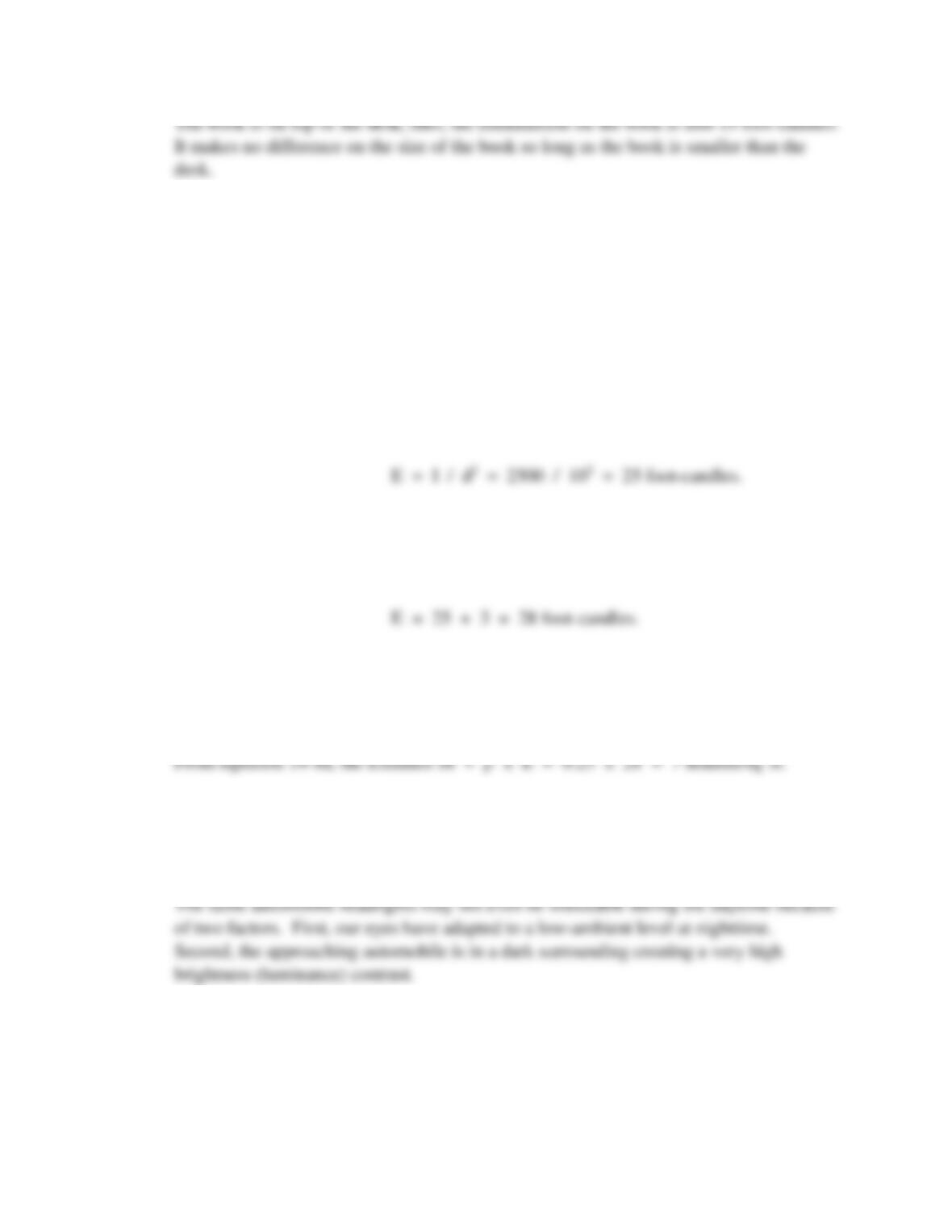
16.33 A lighting system consists of 10 spotlights of which one is located directly above a
task and the other 9 are aimed elsewhere. The reflected illuminance from these 9
fixtures is calculated to be 3 foot-candles on the task. What is the illuminance on
the task if the candlepower at the center of the spotlight is 2500 candela and the
spotlight is 10 feet above the task.
From equation 14-5c, illuminance from the fixture directly above,
and the total illuminance from direct and reflected components is:
16.34 What is the luminous exitance of the task if its reflectance is 25%?
16.35 Why do the approaching automobile headlights appear so bright at night?
16.36 How would you describe your visual sensation when the approaching
headlight is on low beam? and on high beam?
16.37 A lamp rated for 1000 lumens light power is installed within a lighting
fixture (luminaire). Can all of the lumens be utilized to produce useful illumination
in the space?
16.38 When a lamp or several lamps are installed in a lighting fixture, not all the lamp
light power (lumens) may be emitted from a luminaire. If 80% of the total lumens
are emitted from a luminaire, then the luminaire is said to be 80% efficient. Does
this mean that 80% of the total lamp light power will be utilized on the task
anywhere in the room?