750
*16–116.
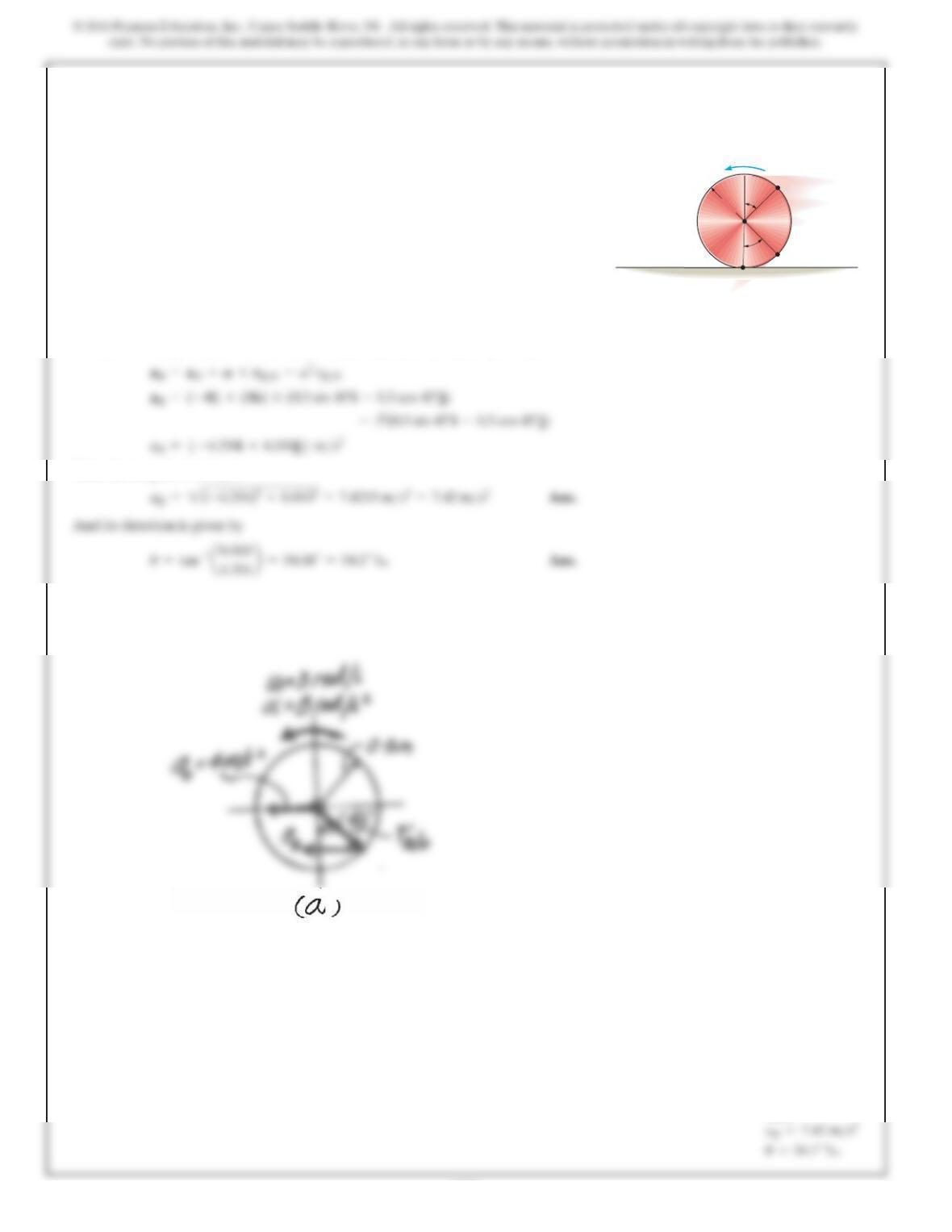
The disk has an angular acceleration a
=
8 rad
>
s
2
and
angular velocity v
=3 rad>s
at the instant shown. If it does
not slip at A, determine the acceleration of point B.
C
A
B
0.5 m 45
45
fi
3 rad
/
s
fi 8 rad/s2
a
v
SOLUTION
General Plane Motion. Since the disk rolls without slipping,
aO=
a
r=8(0.5)
=
4 m
>
s
2
d
. Applying the relative acceleration equation by referring to Fig. a,
Thus, the magnitude of
aB
is
Ans:
751
16–117.
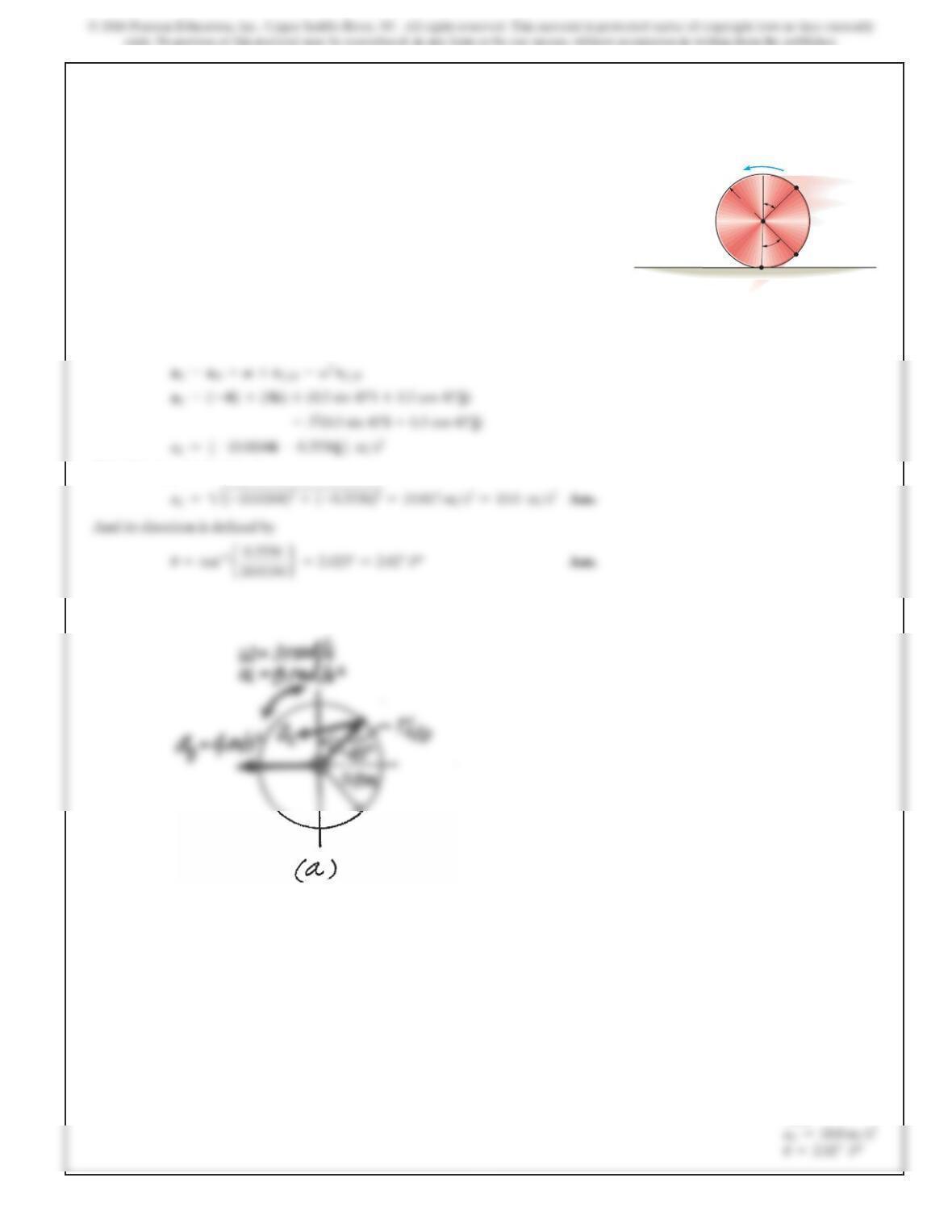
The disk has an angular acceleration a
=
8 rad
>
s
2
and
angular velocity v
=3 rad>s
at the instant shown. If it does
not slip at A, determine the acceleration of point C.
Ans:
C
A
B
0.5 m 45
45
fi
3 rad
/
s
fi 8 rad/s2
a
v
SOLUTION
General Plane Motion. Since the disk rolls without slipping,
aO=
a
r=8(0.5)
=
4 m
>
s
2
d
. Applying the relative acceleration equation by referring to Fig. a,
Thus, the magnitude of
aC
is
752
16–118.
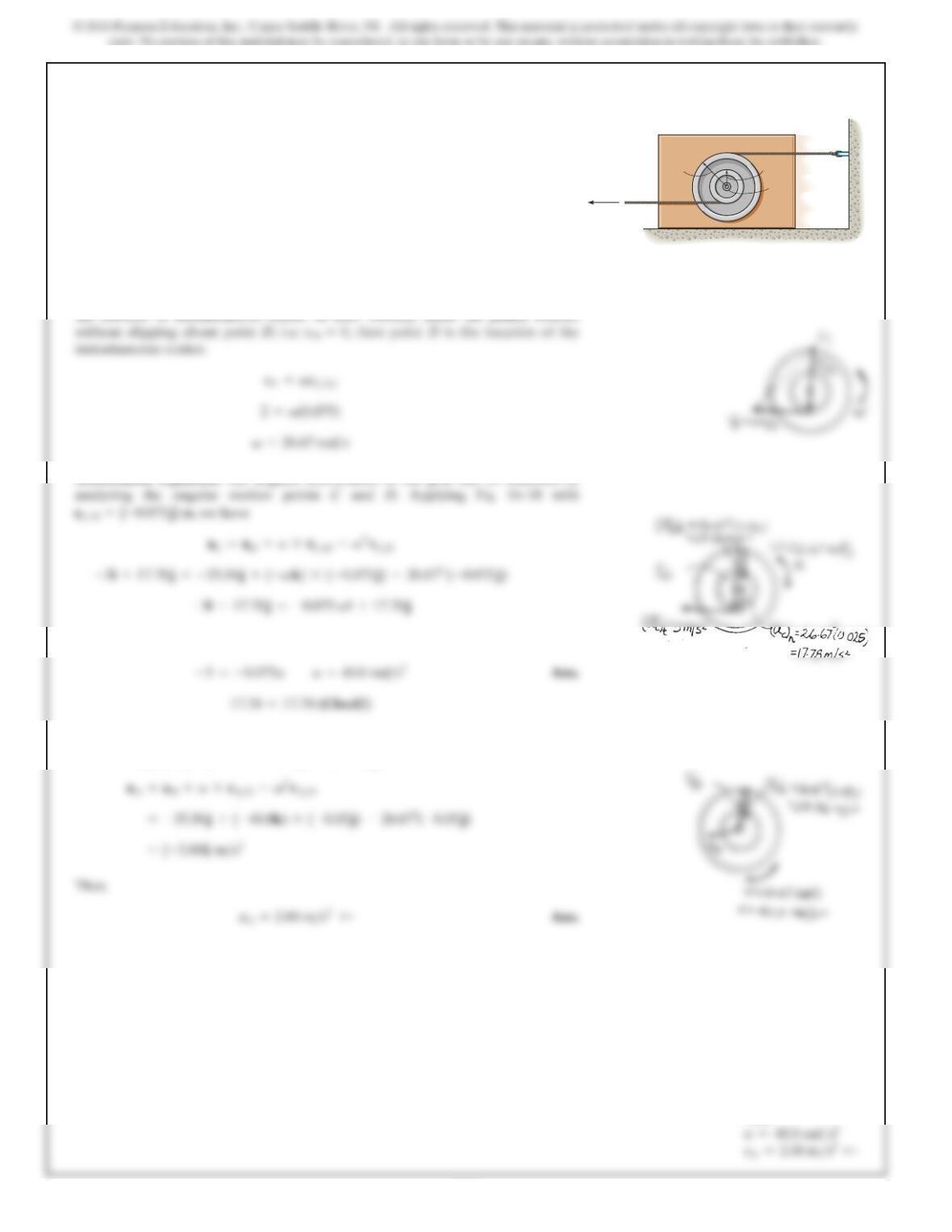
A single pulley having both an inner and outer rim is pin-
connected to the block at A. As cord CF unwinds from the
inner rim of the pulley with the motion shown, cord DE
unwinds from the outer rim. Determine the angular
acceleration of the pulley and the acceleration of the block
at the instant shown.
SOLUTION
Velocity Analysis:The angular velocity of the pulley can be obtained by using
Acceleration Equation: The angular acceleration of the gear can be obtained by
Equating iand jcomponents, we have
The acceleration of point Acan be obtained by analyzing the angular motion points
Aand D. Applying Eq. 16–18 with . we have
rA>D={–0.05j}m
E
D
CA
25 mm
50 mm
F
a
F
=3m/s
2
v
F
=2m/s
Ans:
753
16–119.
SOLUTION
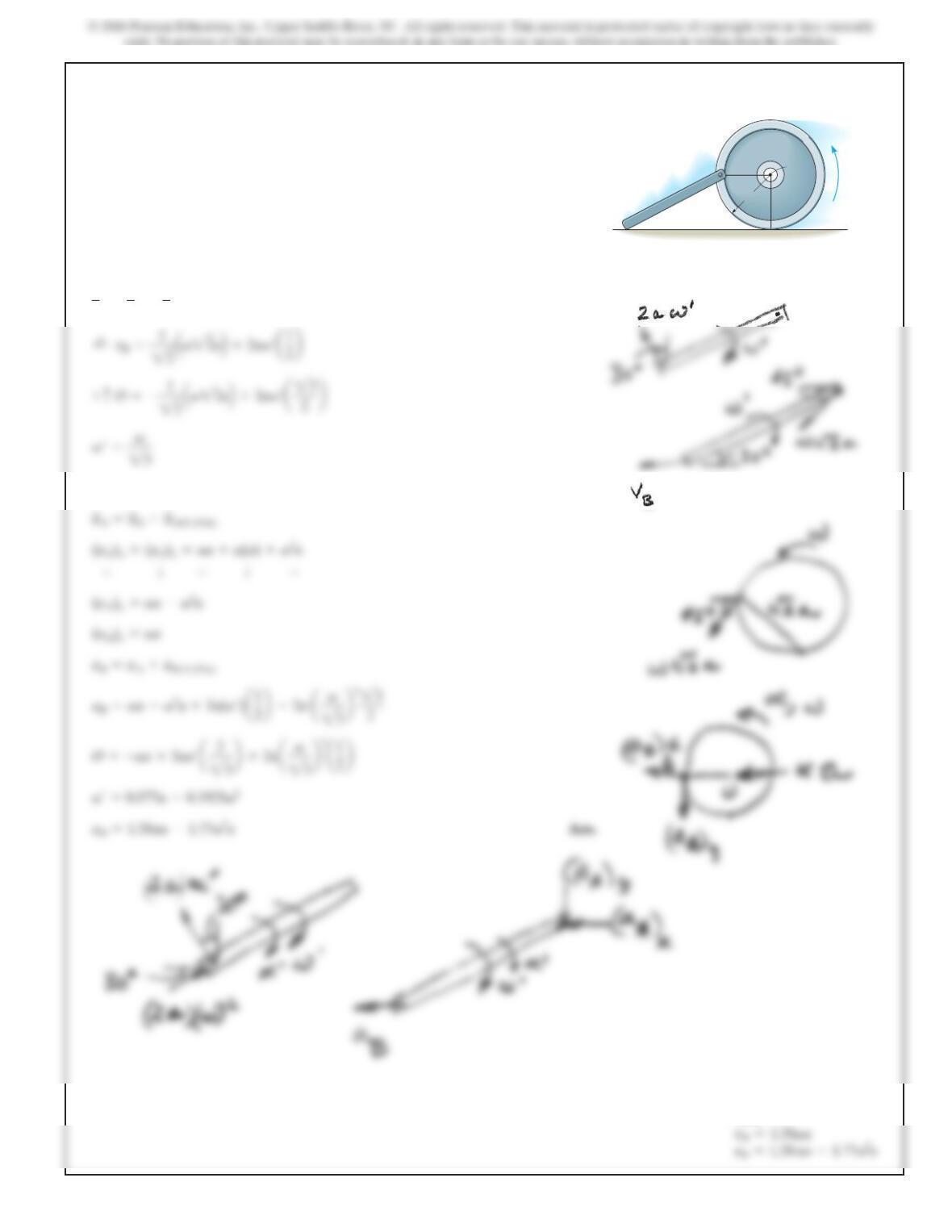
The wheel rolls without slipping such that at the instant
shown it has an angular velocity and angular acceleration
Determine the velocity and acceleration of point Bon
the rod at this instant.
A.
V
2aa
OA
B
,
Ans.
vB=1.58 va
vB=vA+vB/A (Pin)
va
Ans:
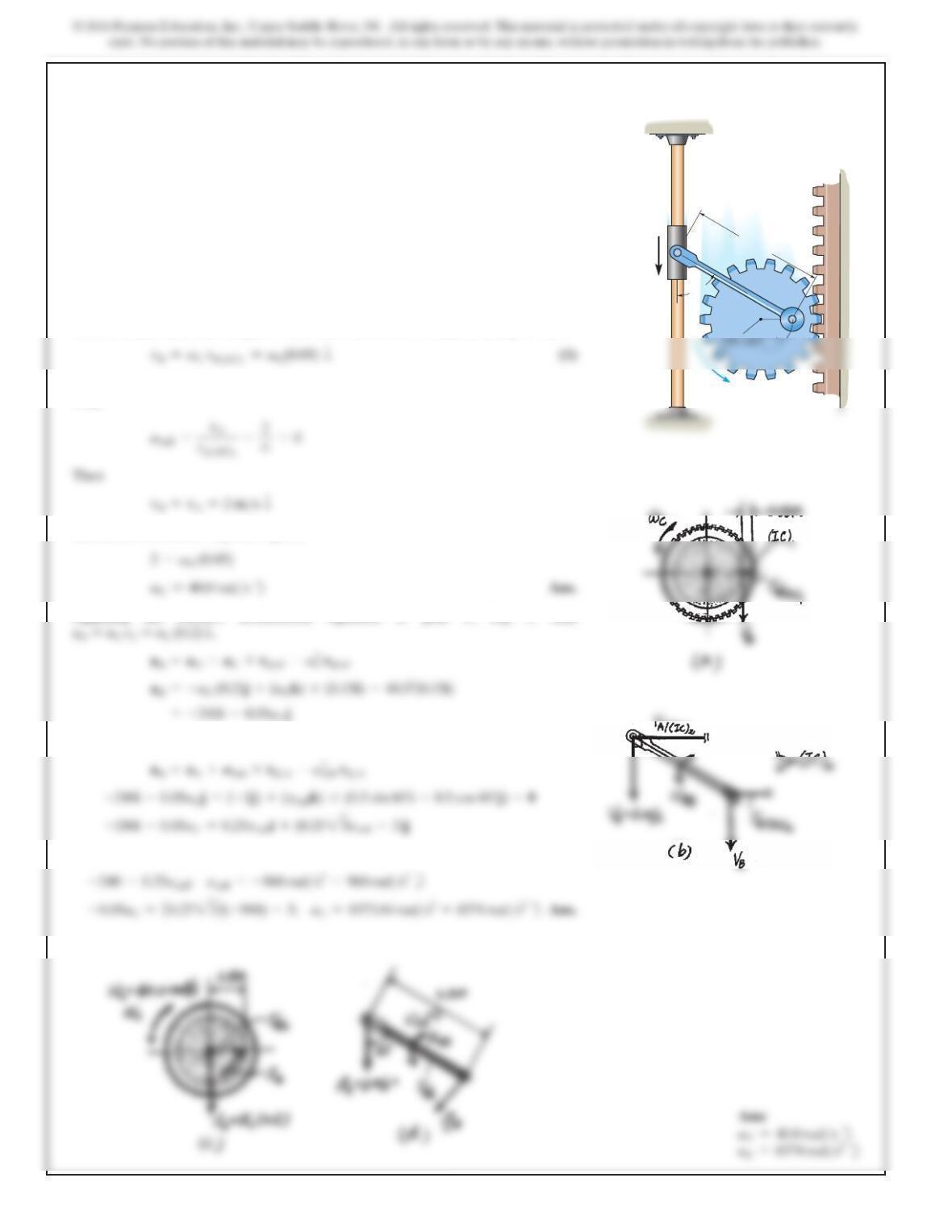
754
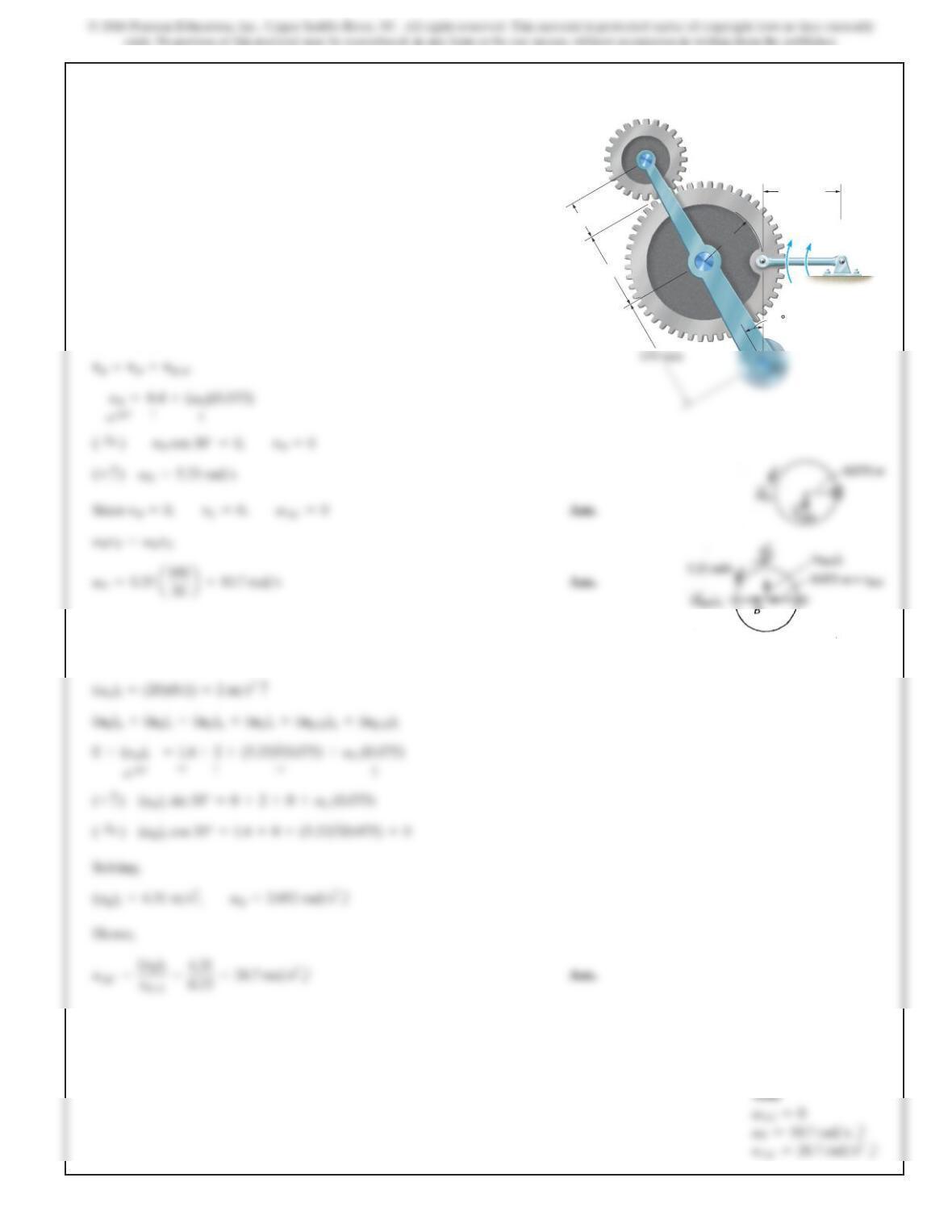
*16–120.
The collar is moving downward with the motion shown.
Determine the angular velocity and angular acceleration
of the gear at the instant shown as it rolls along the fixed
gear rack.
O
60
500 mm
A
v 2 m/s
a 3 m/s2
B
150 mm
SOLUTION
General Plane Motion. For gear C, the location of its IC is indicate in Fig. a. Thus
The IC of link AB can be located using
vA
and
vB
, which in this case is at infinity.
Thus
Substitute the result of
vB
into Eq. (1)
Applying the relative acceleration equation to gear C, Fig. c, with
For link AB, Fig. d,
Equating i and j components
755
16–121.
SOLUTION
V elocity analysis:
Acceleration analysis:
(aD)n=(4)2(0.1) =1.6 m>s2:
yD=vDErD>E=4(0.1) =0.4 m>sc
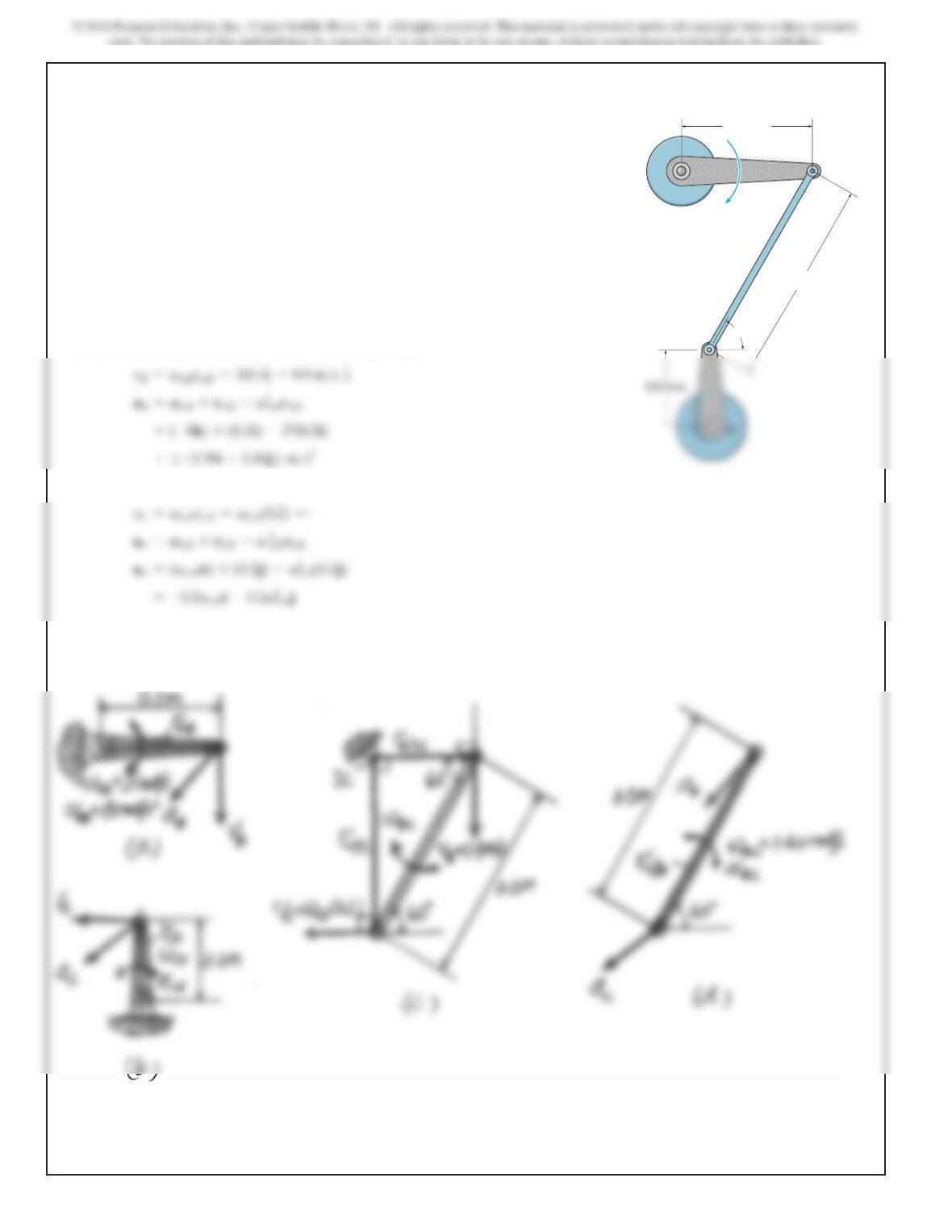
Thetied crank and gear mechanism gives rocking motion to
crank AC,necessary for the operation of aprinting press.If
link DE has the angular motion shown, determine the
respective angular velocities of gear Fand crank AC at this
instant, and the angular acceleration of crank AC.
100 mm
DE
20 rad/s
2
DE
4rad/s
100 mm
75 mm
B
G
F
C
D
E
50 mm
30
v
a
756
SOLUTION
Rotation About A Fixed Axis. For link AB, refer to Fig. a.
For link CD, refer to Fig. b.
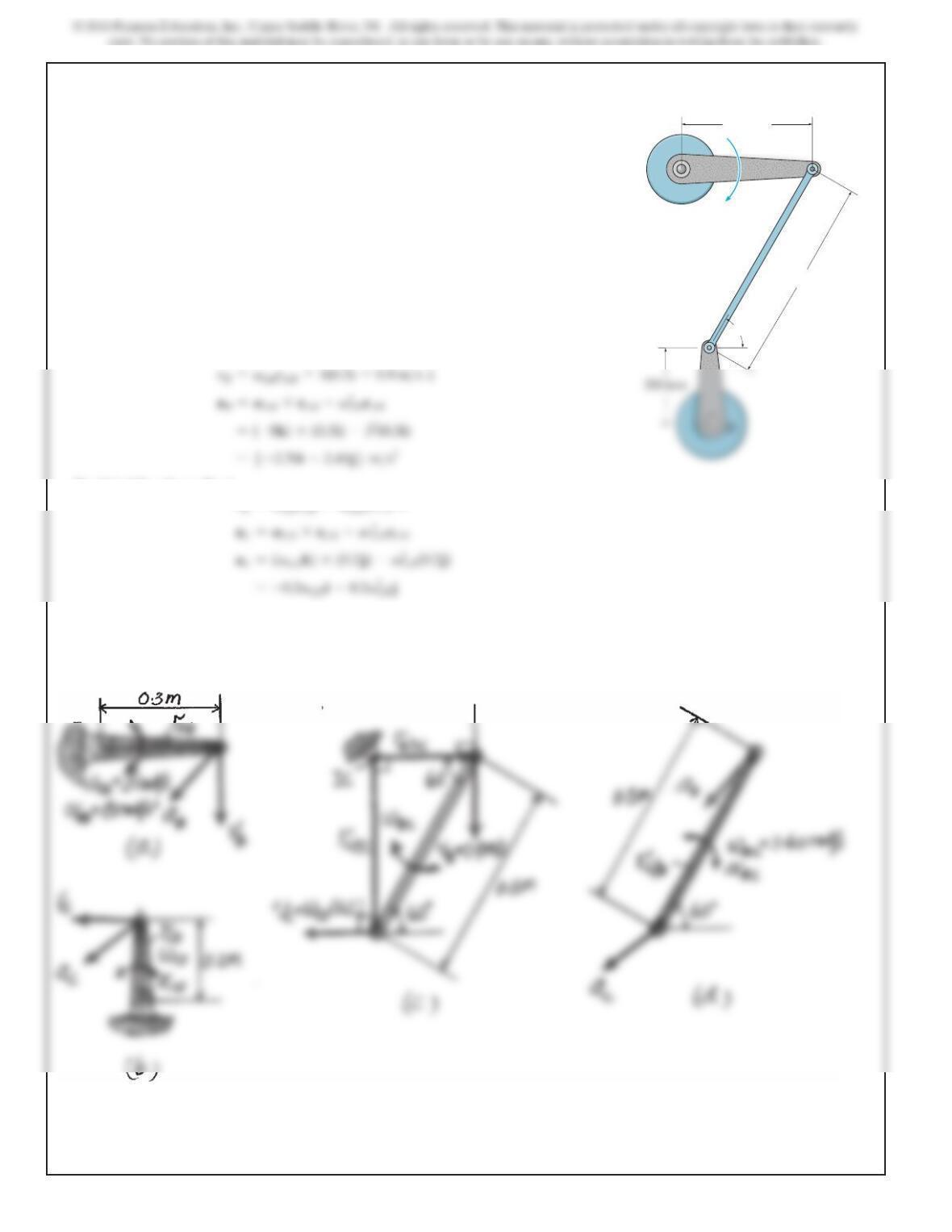
16–122.
If member AB has the angular motion shown, determine
the angular velocity and angular acceleration of member
CD at the instant shown.
u
vAB 3 rad/s
aAB 8 rad/s2
300 mm
A B
C
60
500 mm
757
16–122. Continued
Ans:
General Plane Motion. The IC of link BC can be located using
vB
and
vC
as shown
in Fig. c. From the geometry of this figure,
Then kinematics gives
v
B
=v
BC
r
B
>
IC;
0.9 =
v
BC(0.25)
v
BC =3.60 rad>s
b
v
=v
r
>
Applying the relative acceleration equation by referring to Fig. d,
Equating the j components,
758
SOLUTION
Rotation About A Fixed Axis. For link AB, refer to Fig. a.
For link CD, refer to Fig. b.
vC=
v
v
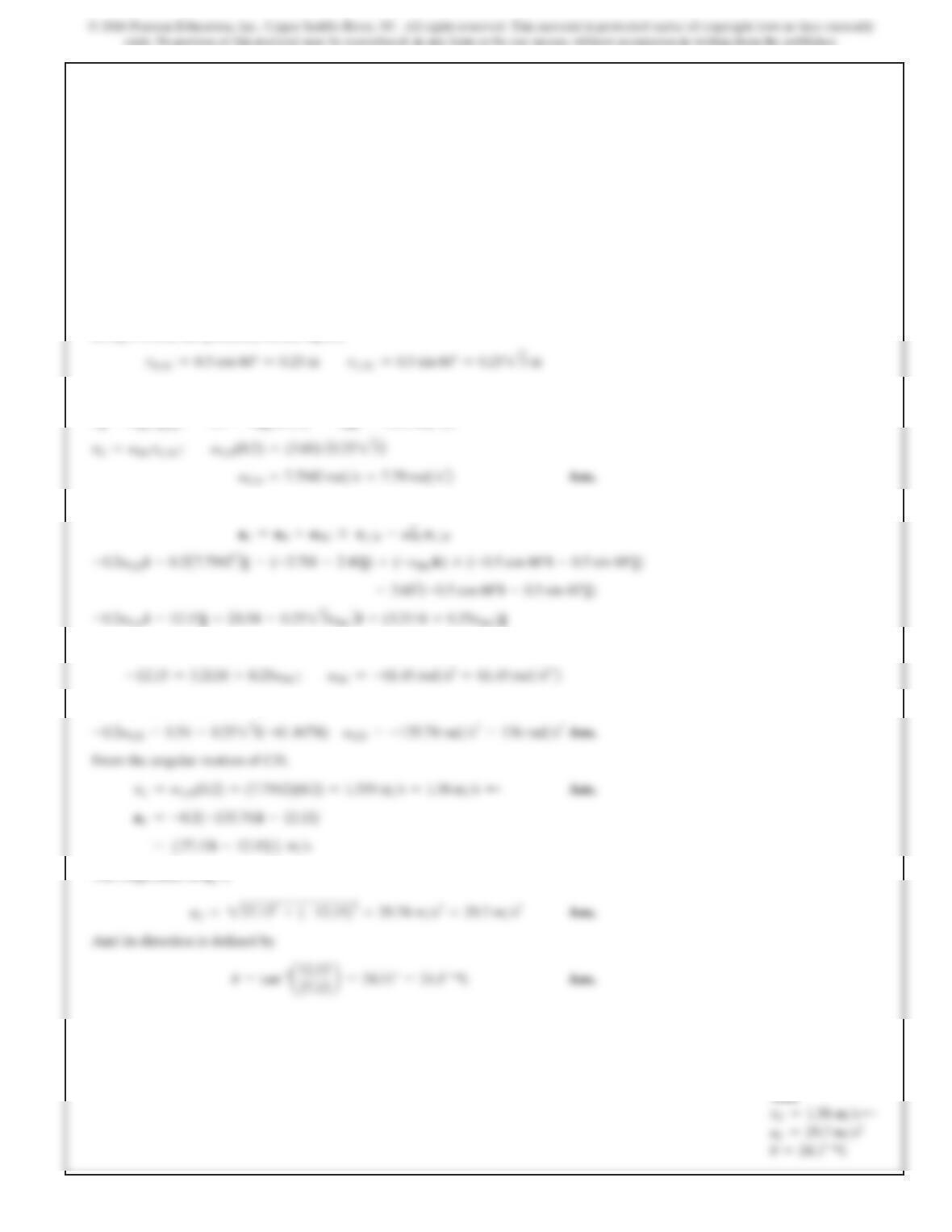
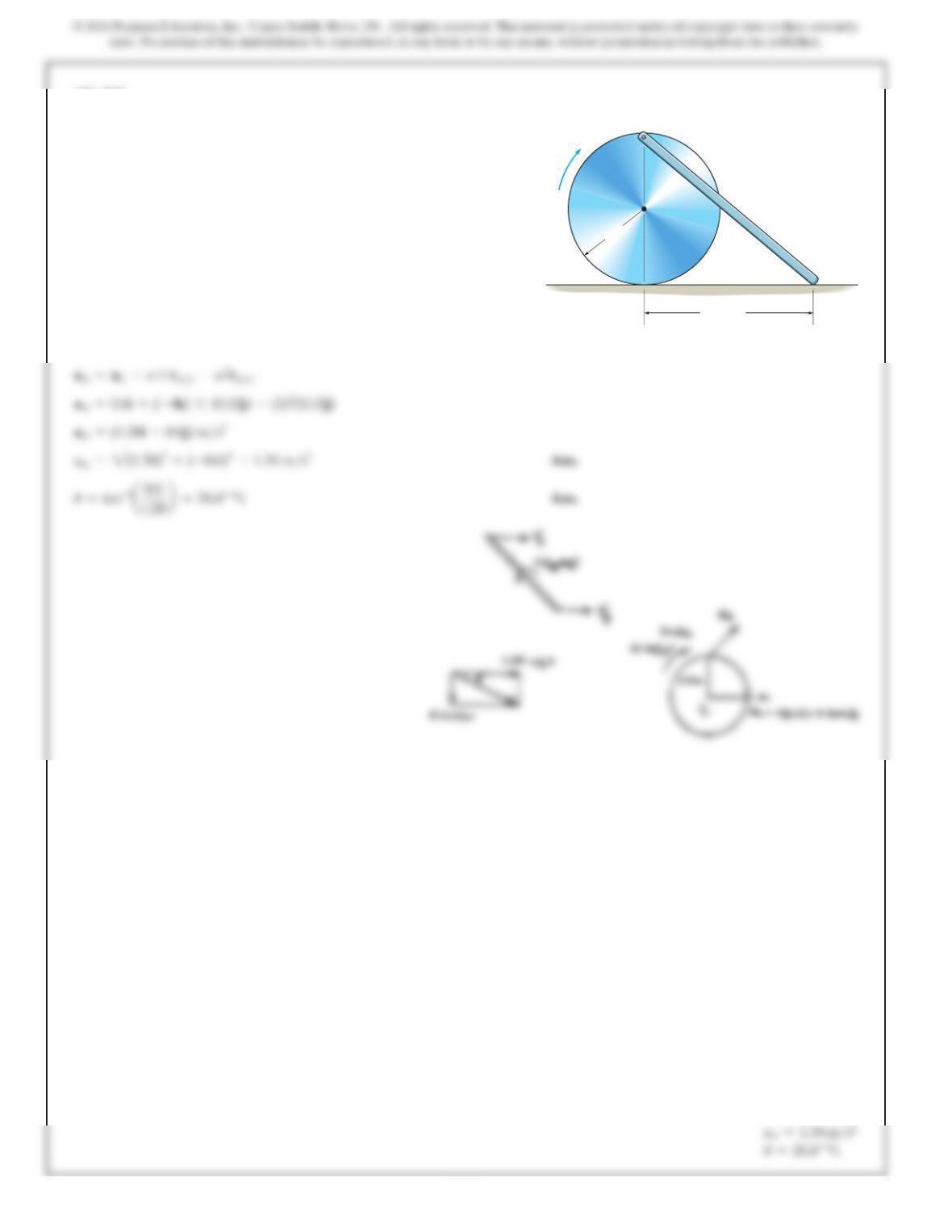
16–123.
If member AB has the angular motion shown, determine
the velocity and acceleration of point C at the instant
shown.
u
vAB 3 rad/s
aAB 8 rad/s2
300 mm
A B
C
60
500 mm
759
16–123. Continued
General Plane Motion. The IC of link BC can be located using
vB
and
vC
as shown
in Fig. c. From the geometry of this figure,
Then kinematics gives
v
v
=v
r
=v
r
0.9 =
v
v
b
Applying the relative acceleration equation by referring to Fig. d,
Equating the j components,
Then the i component gives
The magnitude of aC is
760
Ans:
SOLUTION
The IC is at
∞,
so
v=0
.
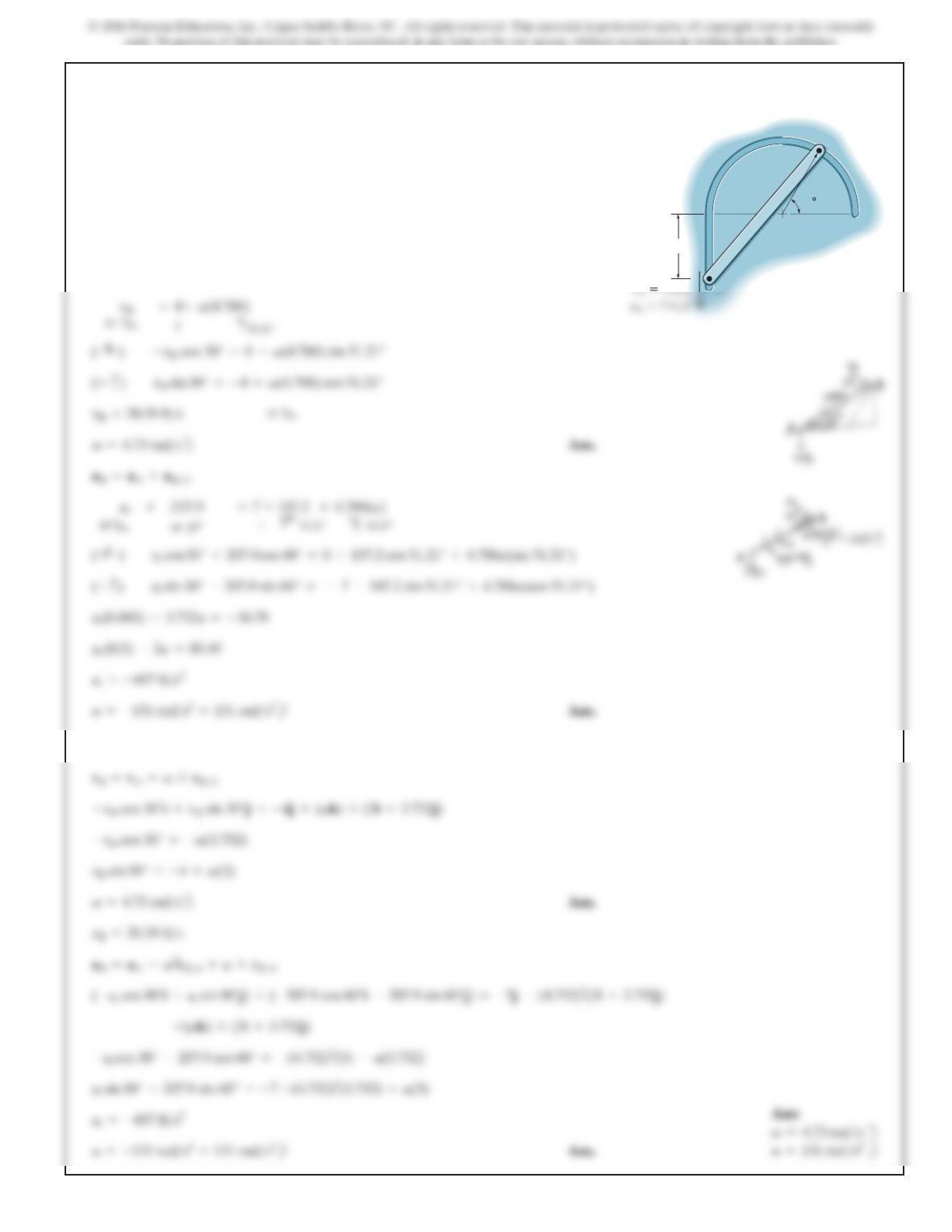
*16–124.
The disk rolls without slipping such that it has an angular
acceleration of a
=
4 rad
>
s
2
and angular velocity of
v
=2 rad>s
at the instant shown. Determine the
acceleration of points A and B on the link and the link’s
angular acceleration at this instant. Assume point A lies on
the periphery of the disk, 150 mm from C.
v 2 rad/s
a 4 rad/s2
500 mm
400 mm
150 mm
C
B
A
761
16–125.
SOLUTION
Also:
vB=vA+vB>A
The ends of the bar AB are confined to move along the
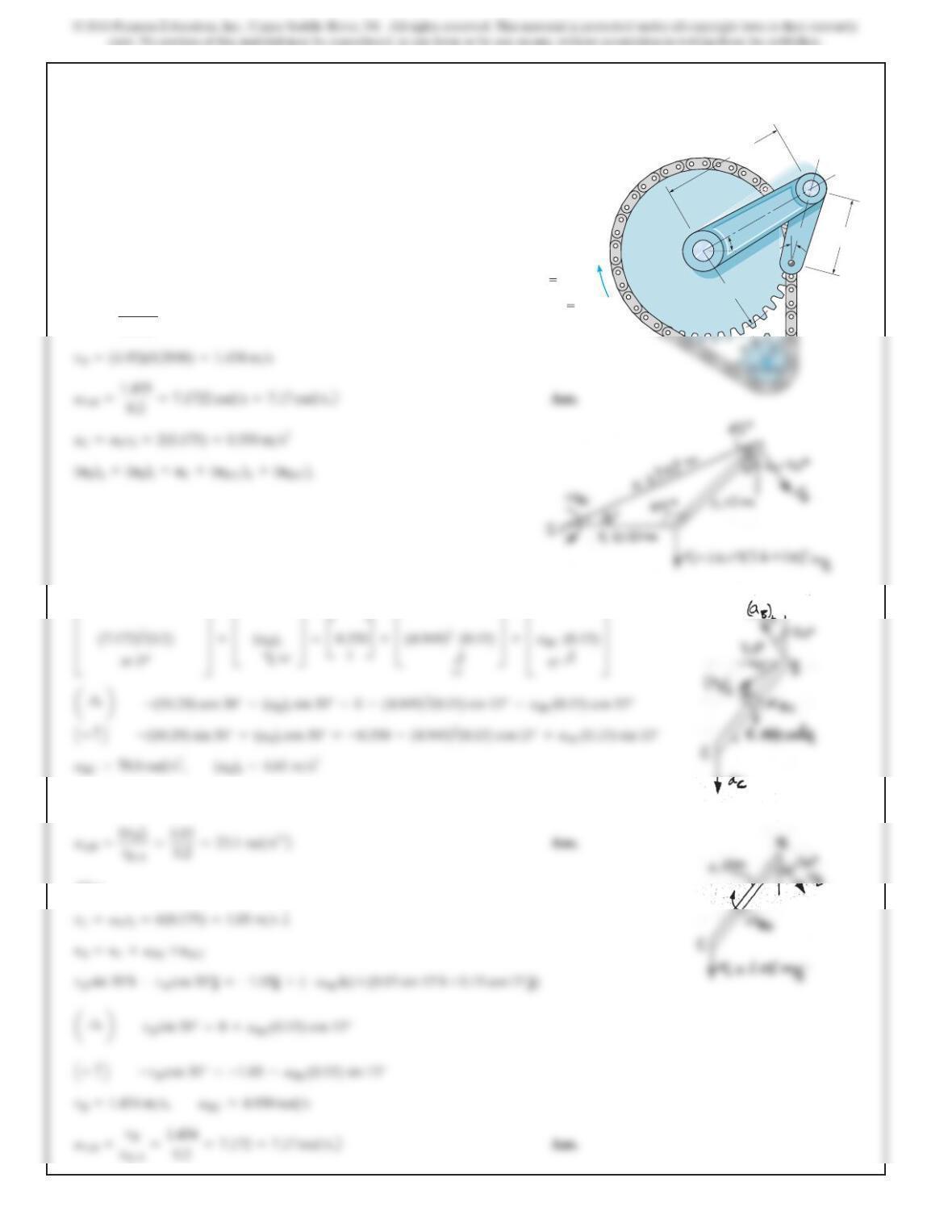
paths shown. At a given instant, Ahas a velocity of
and an acceleration of Determine
the angular velocity and angular acceleration of AB at this
instant.
aA=7ft>s2.vA=4ft>s
2ft
2ft
60
A
B
762
16–126.
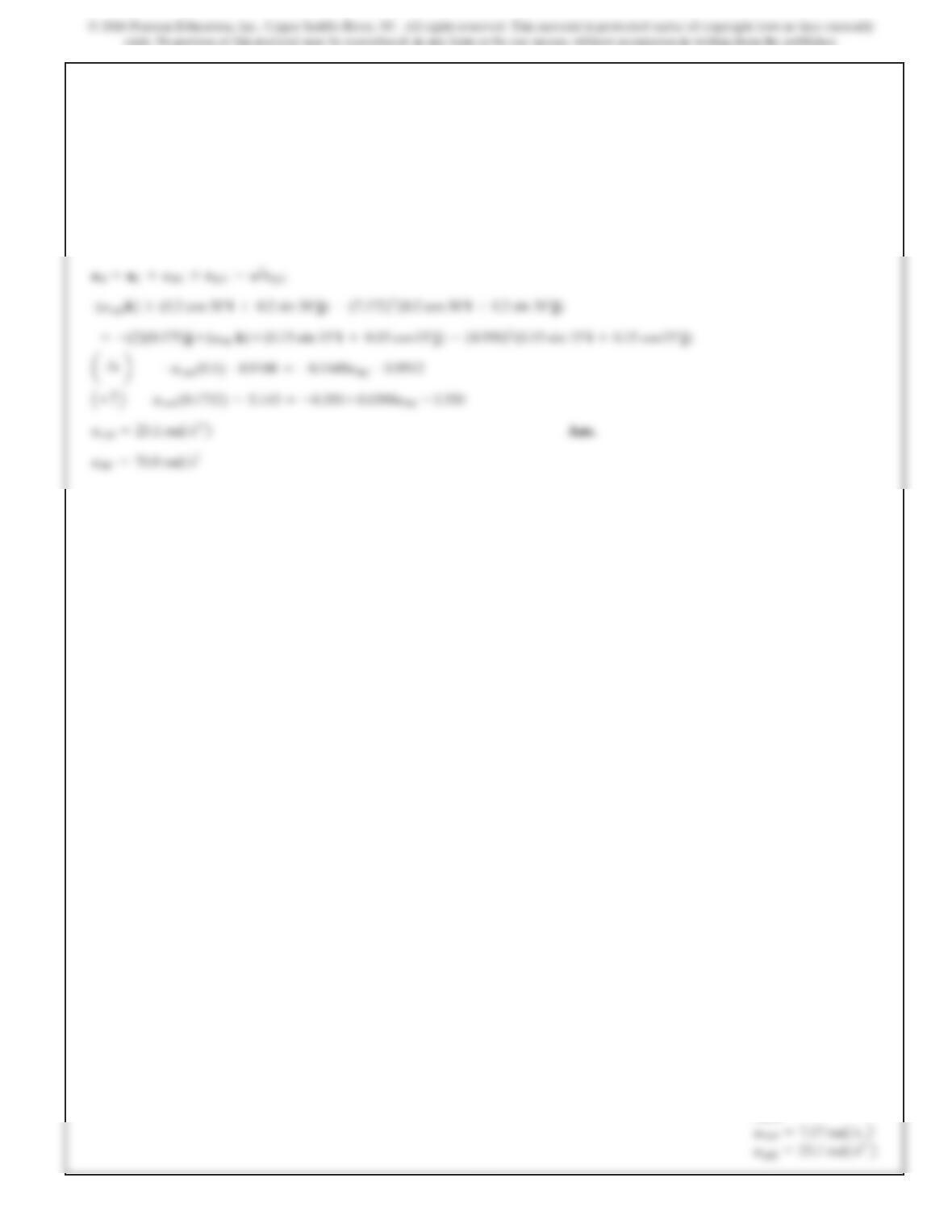
The mechanism produces intermittent motion of link AB.If
the sprocket Sis turning with an angular acceleration
and has an angular velocity at
the instant shown, determine the angular velocity and
angular acceleration of link AB at this instant.The sprocket
Sis mounted on a shaft which is separate from a collinear
shaft attached to AB at A.The pin at Cis attached to one of
the chain links such that it moves vertically downward.
vS=6 rad>saS=2 rad>s2
SOLUTION
Hence,
Also,
vBC =1.05
0.2121 =4.950 rad>s
15
30
200mm
150mm
175mm
A
B
C
S
v
S
6rad/s
a
S
2 rad/s
2
763
Ans:
16–126. Continued
764
16–127.
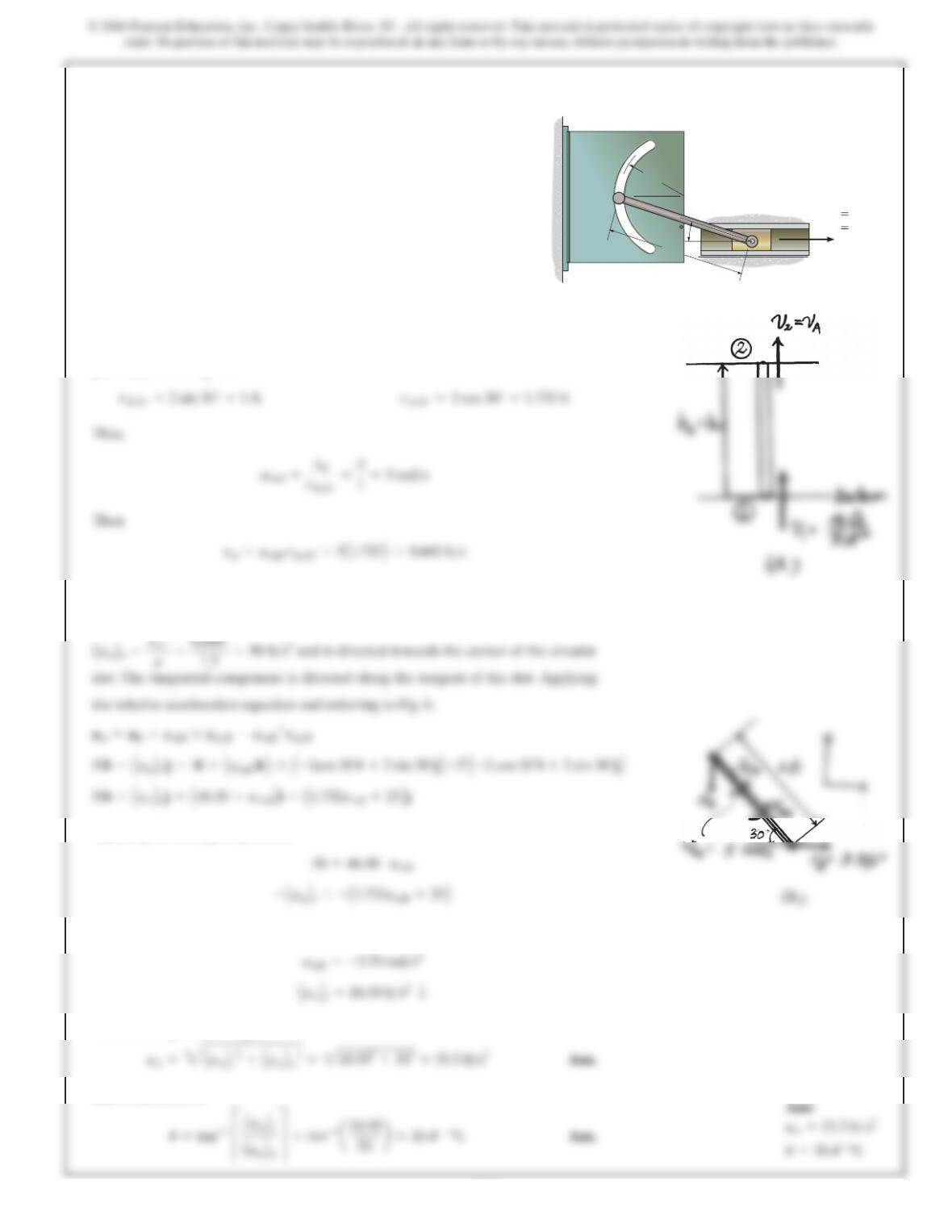
SOLUTION
Angular Velocity:The velocity of point Ais directed along the tangent of the
circular slot. Thus, the location of the IC for rod AB is indicated in Fig. a.From the
geometry of this figure,
Acceleration and Angular Acceleration:Since point Atravels along the circular
The slider block moves with a velocity of and an
acceleration of . Determine the angular
acceleration of rod AB at the instant shown.
aB=3ft>s2
vB=5ft>s
B
vB5ft/s
aB3ft/s
2
A
1.5 ft
2ft
30
Ans:
765
*16–128.
The slider block moves with a velocity of and an
acceleration of . Determine the acceleration of
Aat the instant shown.
aB=3ft>s2
vB=5ft>s
SOLUTION
Angualr Ve locity: The velocity of point Ais directed along the tangent of the
circular slot. Thus, the location of the IC for rod AB is indicated in Fig. a.From the
geometry of this figure,
Acceleration and Angular Acceleration: Since point Atravels along the circular
slot, the normal component of its acceleration has a magnitude of
B
vB5ft/s
aB3ft/s2
A
1.5 ft
2ft
30
Equating the iand jcomponents,
Solving,
Thus, the magnitude of aAis
and its direction is
766
16–129.
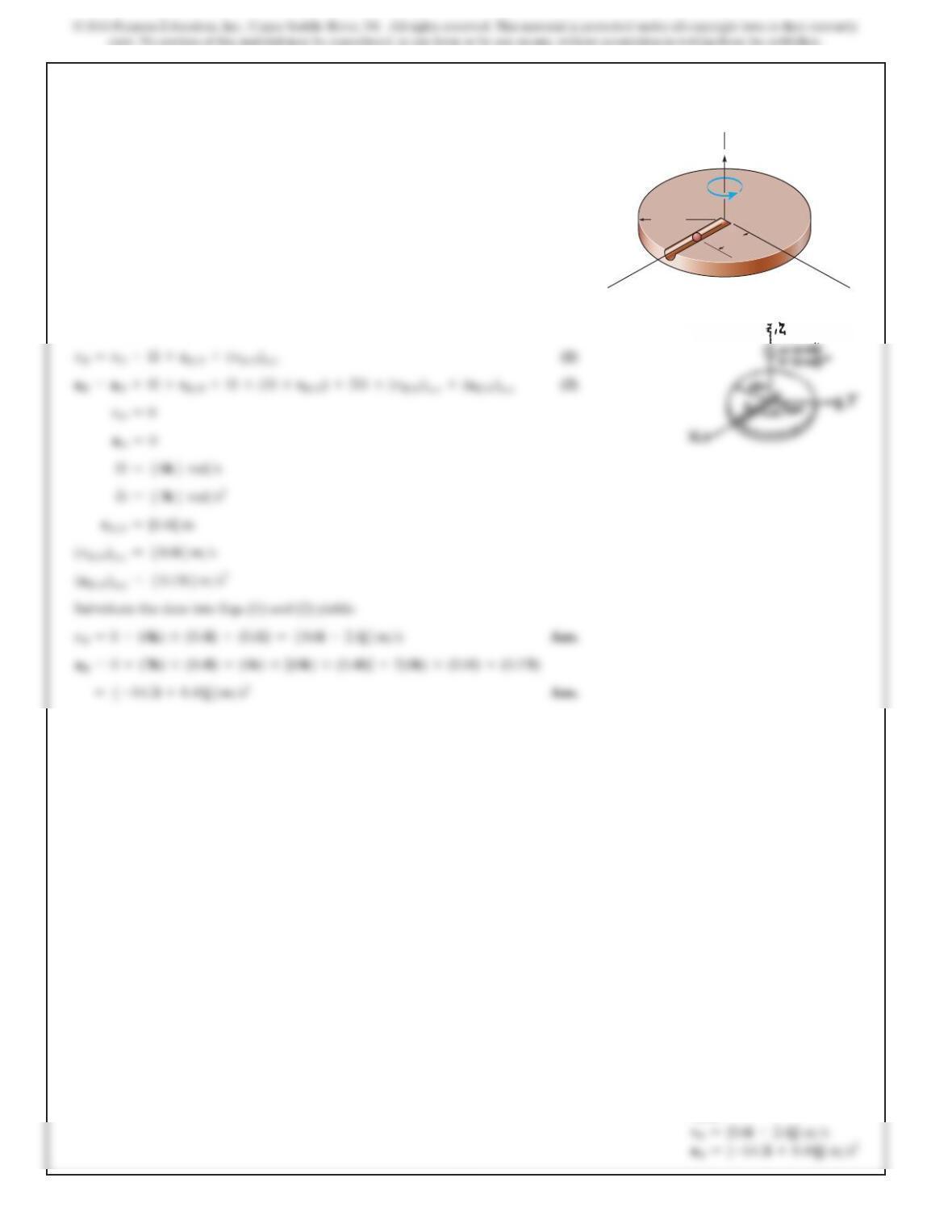
At the instant shown, ball B is rolling along the slot in the
disk with a velocity of 600 mm
>
s and an acceleration of
150mm
>
s2, both measured relative to the disk and directed
away from O. If at the same instant the disk has the angular
velocity and angular acceleration shown, determine the
velocity and acceleration of the ball at this instant.
Ans:
SOLUTION
Kinematic Equations:
y
x
z
v 6 rad/s
a 3 rad/s2
0.4 m
0.8 m B
O
767
16–130.
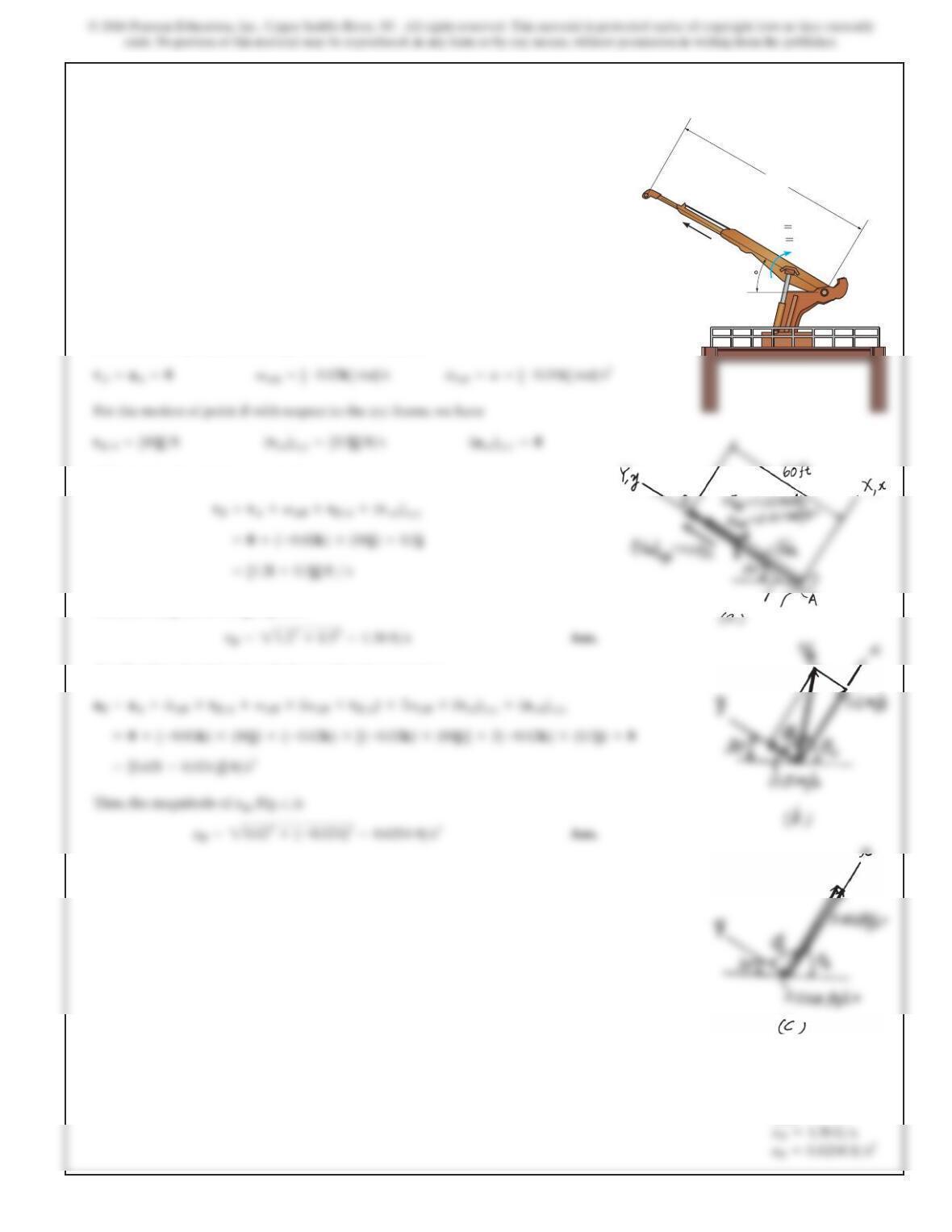
The crane’s telescopic boom rotates with the angular
velocity and angular acceleration shown. At the same
instant, the boom is extending with a constant speed of
, measured relative to the boom. Determine the
magnitudes of the velocity and acceleration of point Bat
this instant.
0.5 ft>s
SOLUTION
Reference Frames: The xyz rotating reference frame is attached to boom AB and
B
A
30
60 ft
vAB 0.02 rad/s
aAB 0.01 rad/s2
coincides with the XY fixed reference frame at the instant considered, Fig. a.Thus, the
motion of the xy frame with respect to the XY frame is
Velocity:Applying the relative velocity equation,
Thus, the magnitude of vB,Fig. b,is
Acceleration: Applying the relative acceleration equation,
Ans:
768
16–131.
SOLUTION
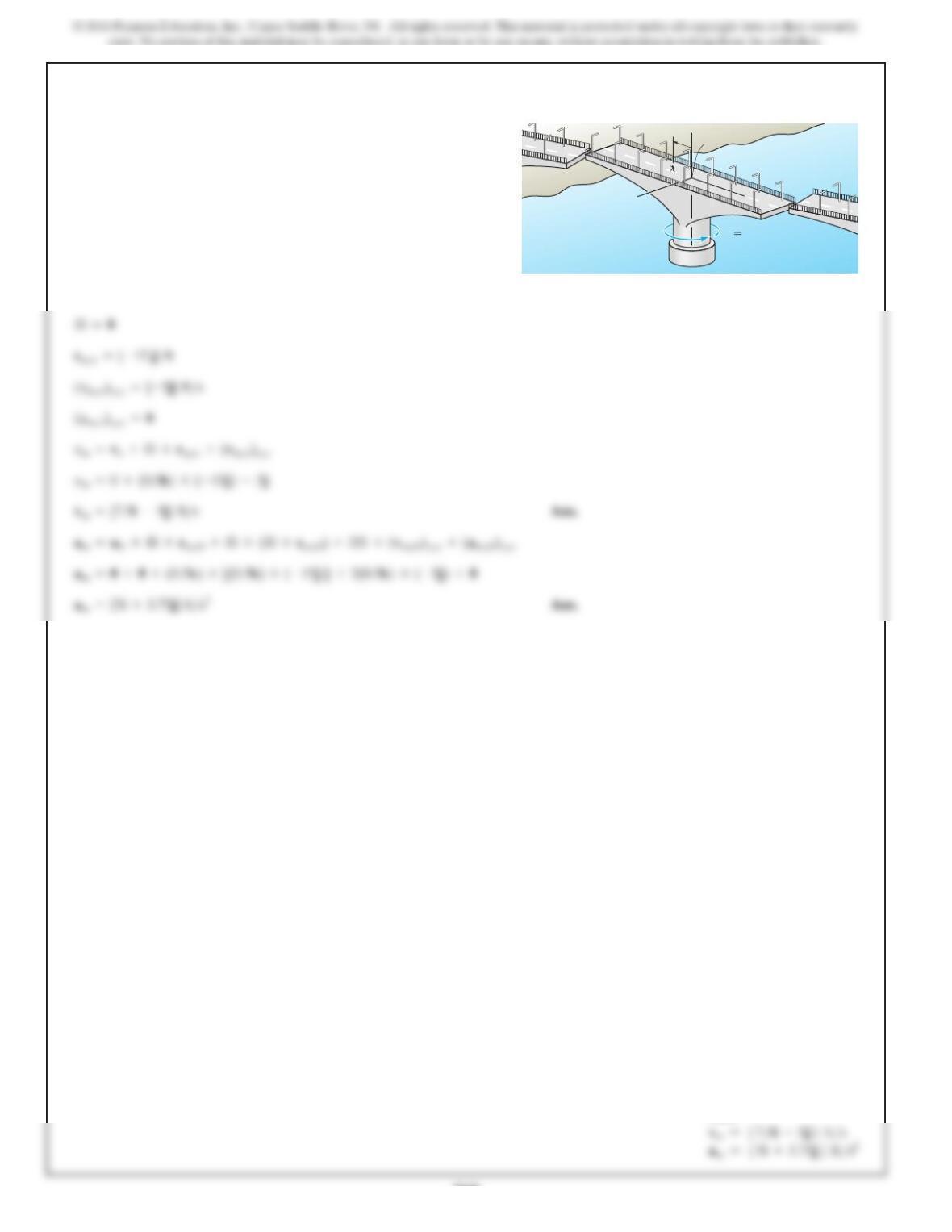
Æ={0.5k} rad>s
While the swing bridge is closing with a constant rotation of
a man runs along the roadway at a constant speed
of relative to the roadway. Determine his velocity and
acceleration at the instant d=15 ft.
5ft>s
0.5 rad>s, d
z
xy
O
v 0.5 rad/s
Ans:
769
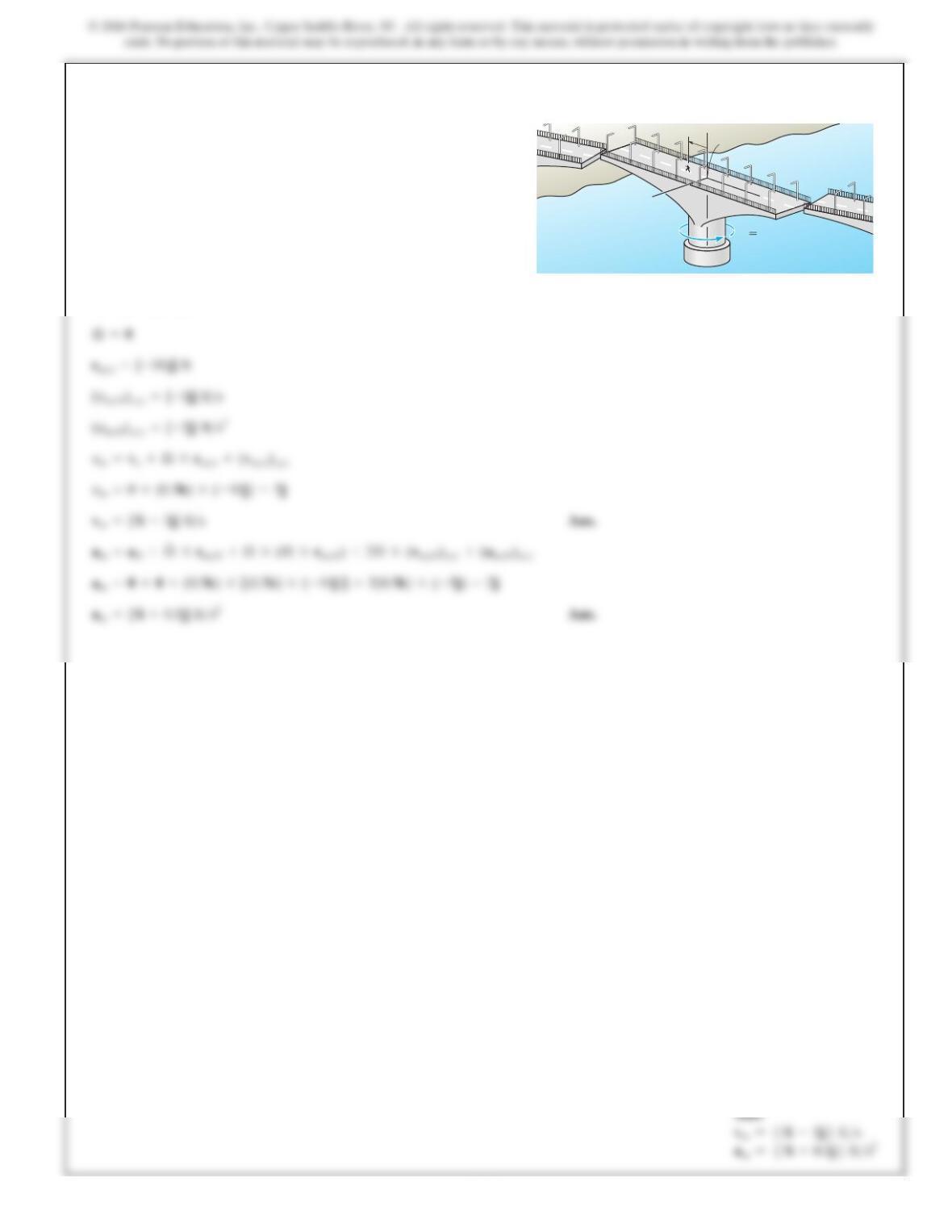
*16–132.
SOLUTION
Æ={0.5k} rad>s
While the swing bridge is closing with a constant rotation of
a man runs along the roadway such that when
he is running outward from the center at
with an acceleration of both measured relative to the
roadway. Determine his velocity and acceleration at this
instant.
2ft>s2,
5ft>sd=10 ft
0.5 rad>s, d
z
xy
O
v 0.5 rad/s