630
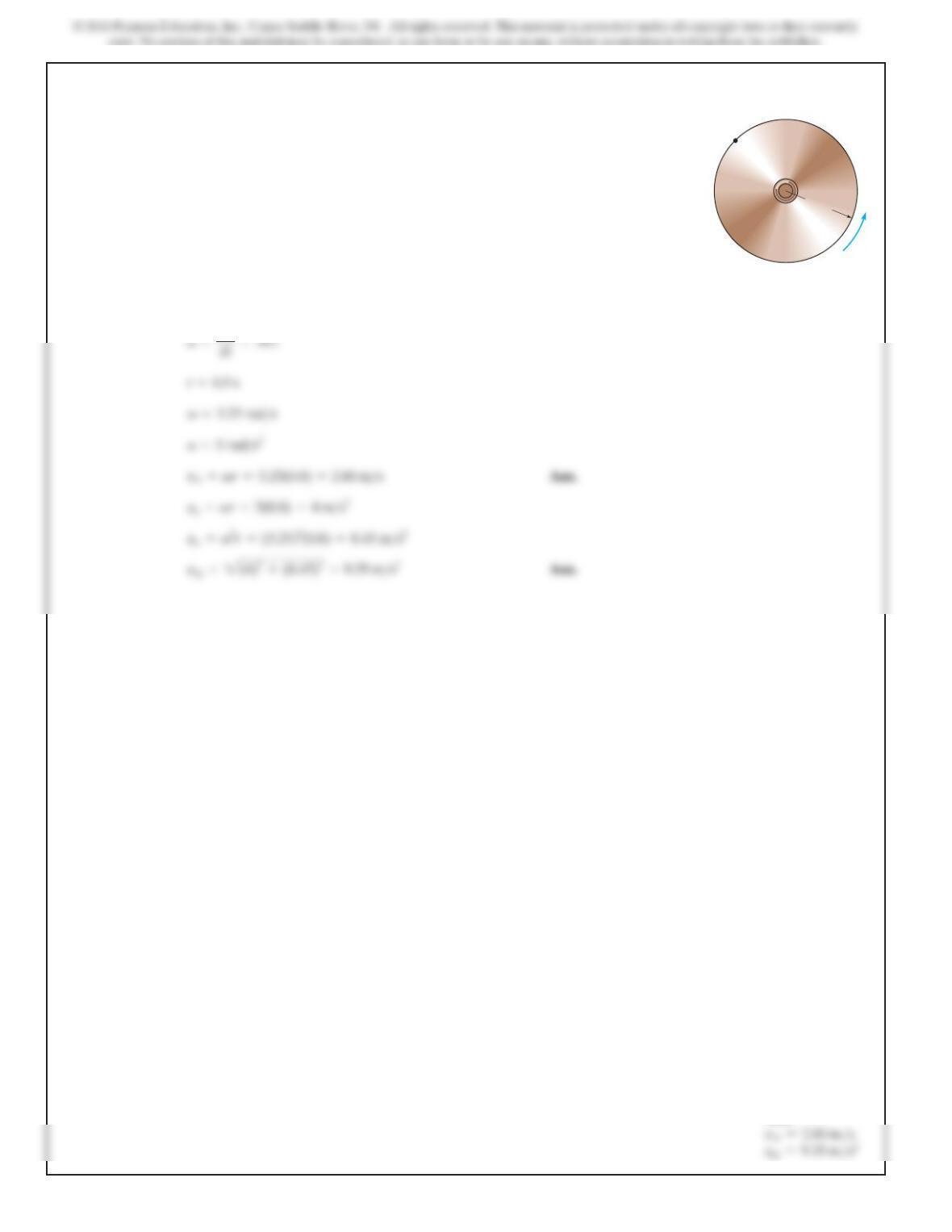
16–1.
SOLUTION
v=(5 t2+2) rad>s
The angular velocity of the disk is defined by
where tis in seconds. Determine the
magnitudes of the velocity and acceleration of point Aon
the disk when t=0.5 s.
v=15t2+22rad>s,
A
0.8 m
Ans:
631
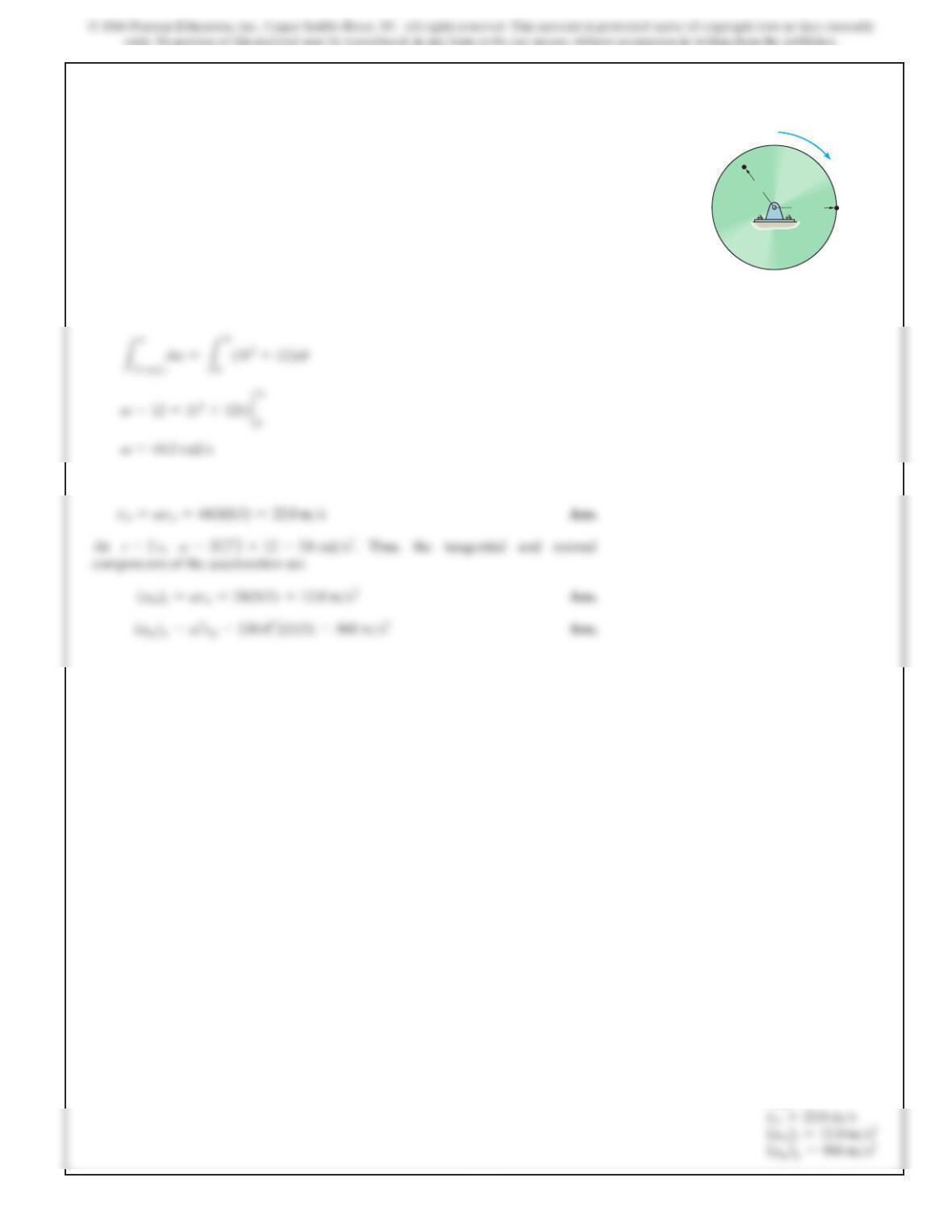
16–2.
The angular acceleration of the disk is defined by
a=3t2+12
rad
>
s, where t is in seconds. If the disk is
originally rotating at v
0=12
rad
>
s, determine the
magnitude of the velocity and the n and t components of
acceleration of point A on the disk when t
=
2 s.
SOLUTION
Angular Motion. The angular velocity of the disk can be determined by integrating
dv=a dt
with the initial condition v
=12 rad>s
at
t=0
.
Motion of Point A. The magnitude of the velocity is
0.4 m
0.5 m
B
A
v0
12 rad
/
s
Ans:
632
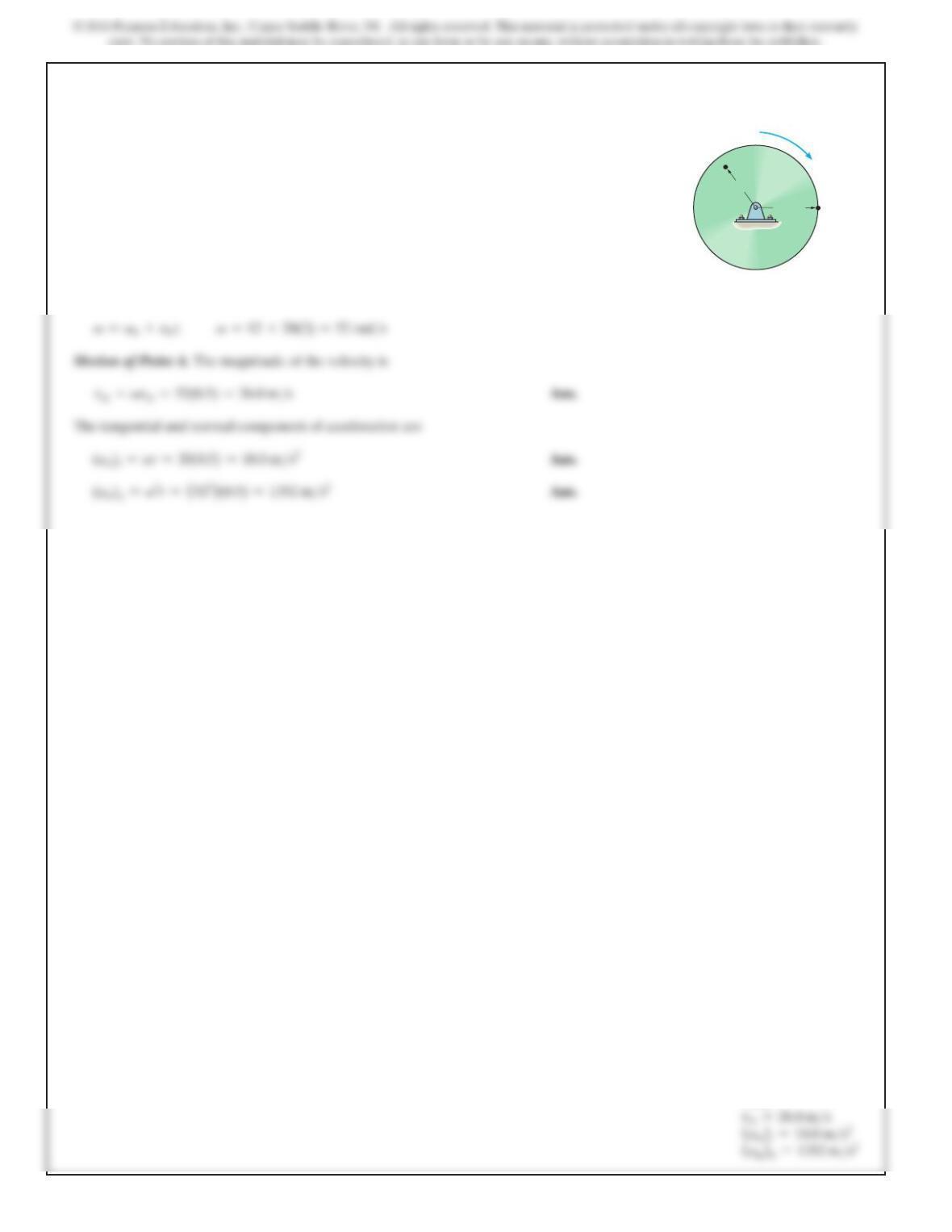
16–3.
The disk is originally rotating at
v
0
=
12 rad
>
s. If it is
subjected to a constant angular acceleration of
a
=
20 rad
>
s2, determine the magnitudes of the velocity
and the n and t components of acceleration of point A at the
instant t
=
2 s.
SOLUTION
Angular Motion. The angular velocity of the disk can be determined using
0.4 m
0.5 m
B
A
v0
12 rad
/
s
Ans:
633
Ans:
0.4 m
0.5 m
A
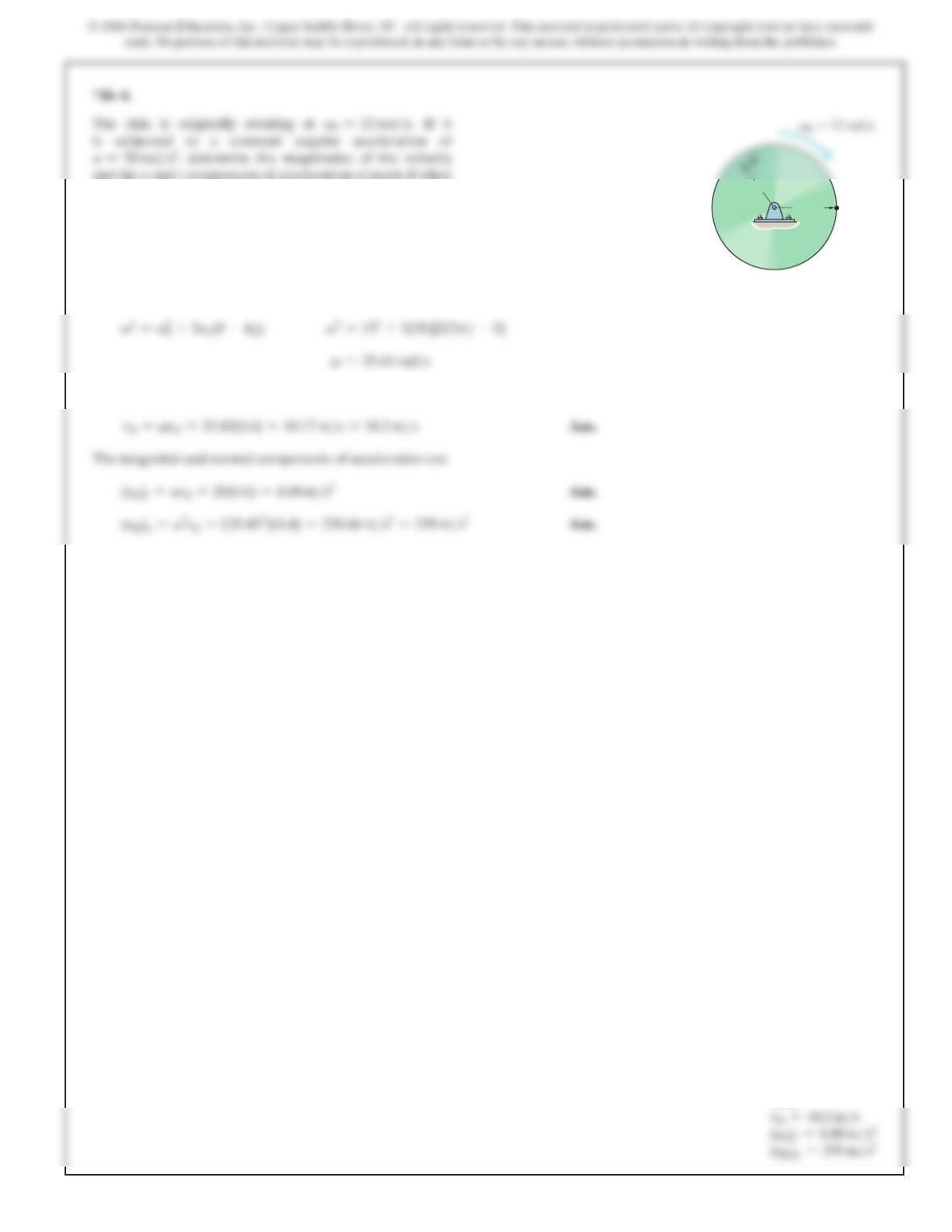
the disk undergoes 2 revolutions.
SOLUTION
Angular Motion. The angular velocity of the disk can be determined using
Motion of Point B. The magnitude of the velocity is
634
16–5.
SOLUTION
Angular Displacement: At .
t=90 s
The disk is driven by a motor such that the angular position
of the disk is defined by where tis in
seconds. Determine the number of revolutions, the angular
velocity, and angular acceleration of the disk when t=90 s.
u=120t+4t22rad,
0.5 ft
θ
Ans:
635
16–6.
SOLUTION
v2=v0
2+2ac(u–u0)
Awheel has an initial clockwise angular velocity of
a
nd a constant angular acceleration of Determine
t
he number of revolutions it must undergo to acquire a
c
lockwise angular velocity of .What time is
r
equired?
15 rad>s
3rad>s2.
10 rad>s
Ans:
636
16–7.
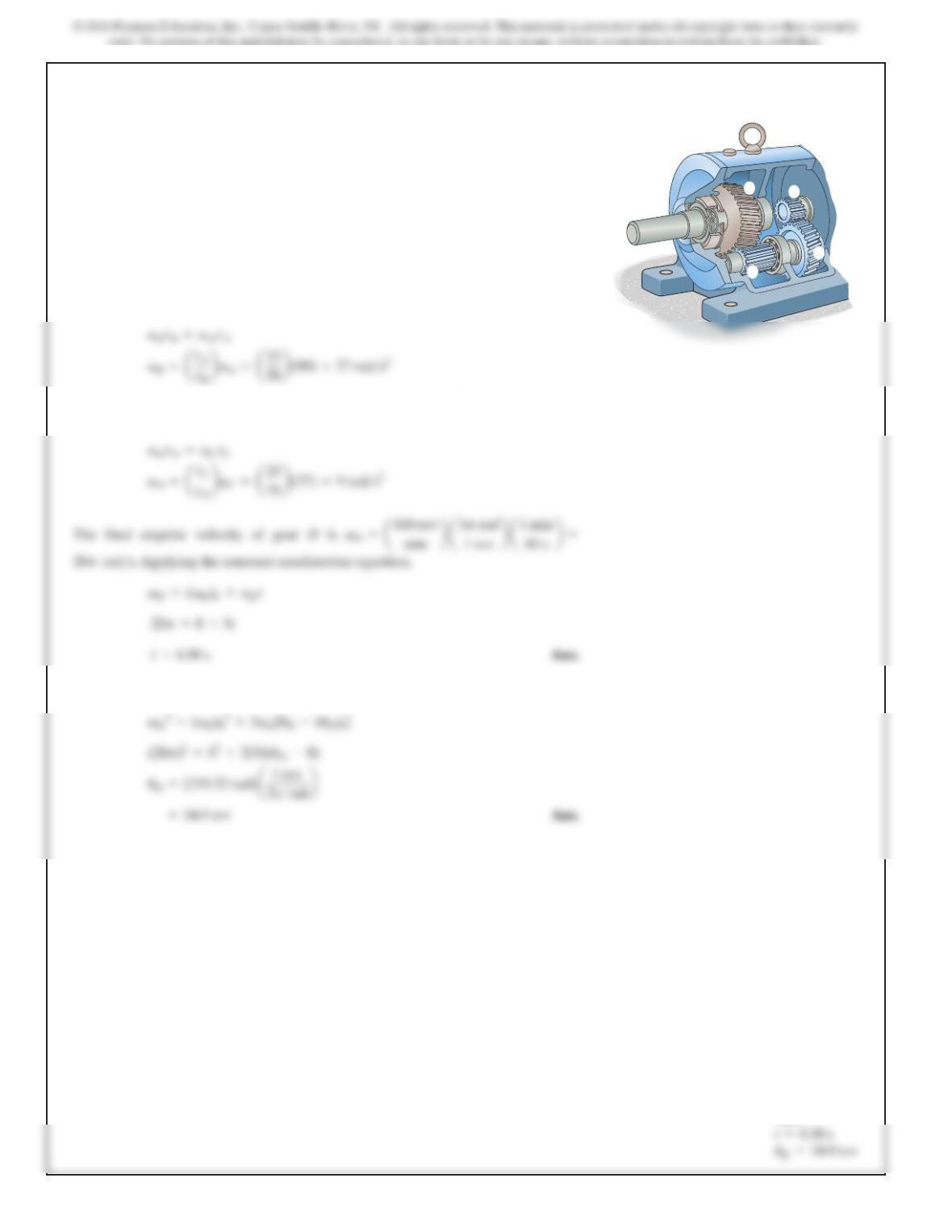
DA
B
C
F
If gear Arotates with a constant angular acceleration of
starting from rest, determine the time
required for gear Dto attain an angular velocity of 600 rpm.
Also, find the number of revolutions of gear Dto attain this
angular velocity. Gears A,B,C, and Dhave radii of 15 mm,
50 mm, 25 mm, and 75 mm, respectively.
aA=90 rad>s2,
SOLUTION
Gear Bis in mesh with gear A.Thus,
Since gears Cand Bshare the same shaft, .Also, gear Dis in
mesh with gear C.Thus,
and
aC=aB=27 rad>s2
Ans:
637
Ans:
*16–8.
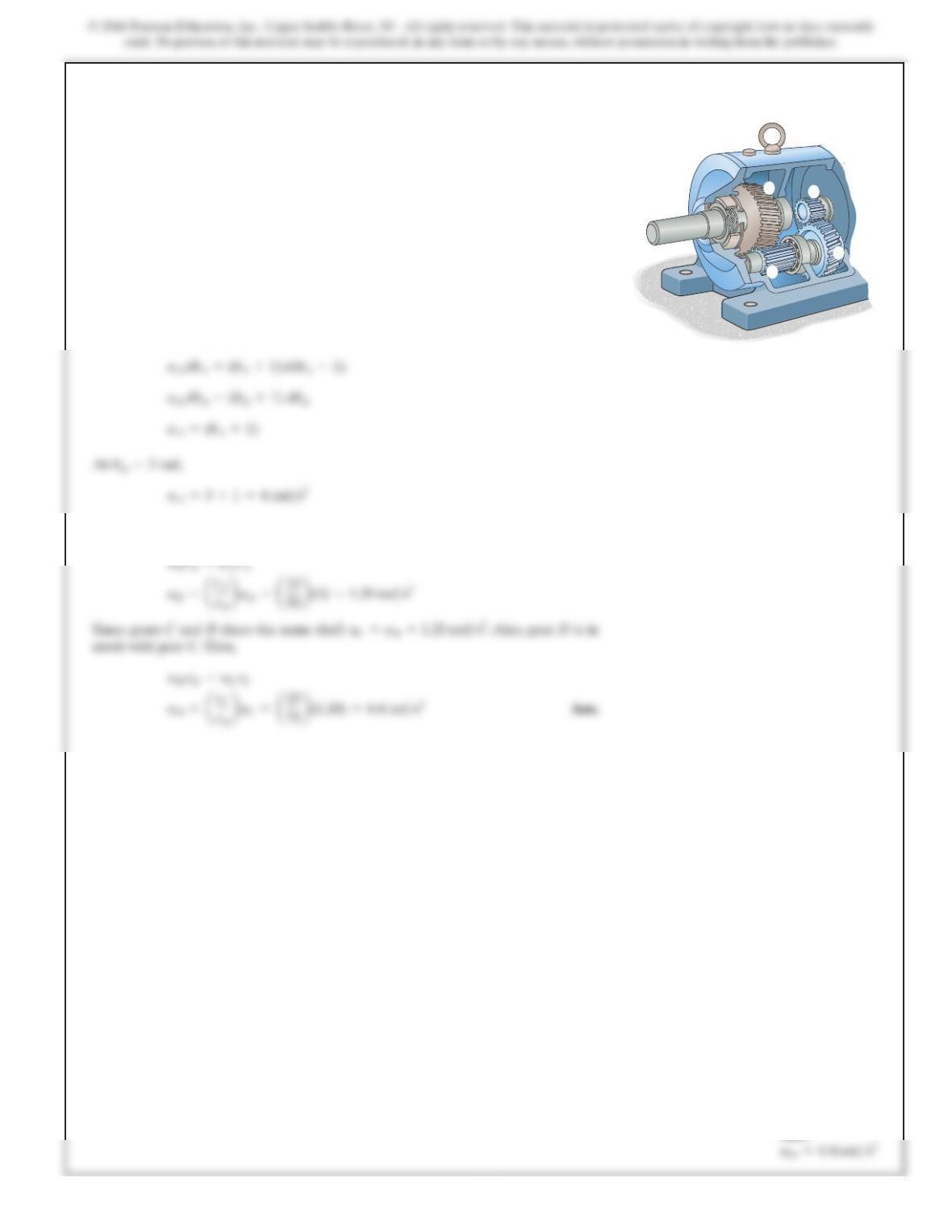
DA
B
C
F
If gear Arotates with an angular velocity of
,where is the angular displacement of
g
ear A, measured in radians, determine the angular
acceleration
of gear Dwhen , starting from rest.
Gear
s A,B,C, and Dhave radii of 15 mm, 50 mm, 25 mm,
and 75 mm,
respectively.
uA=3 rad
uA
(uA+1) rad>s
vA
=
SOLUTION
M
otion of Gear A:
M
otion of Gear D: Gear Ais in mesh with gear B.Thus,
aA duA=vA dvA
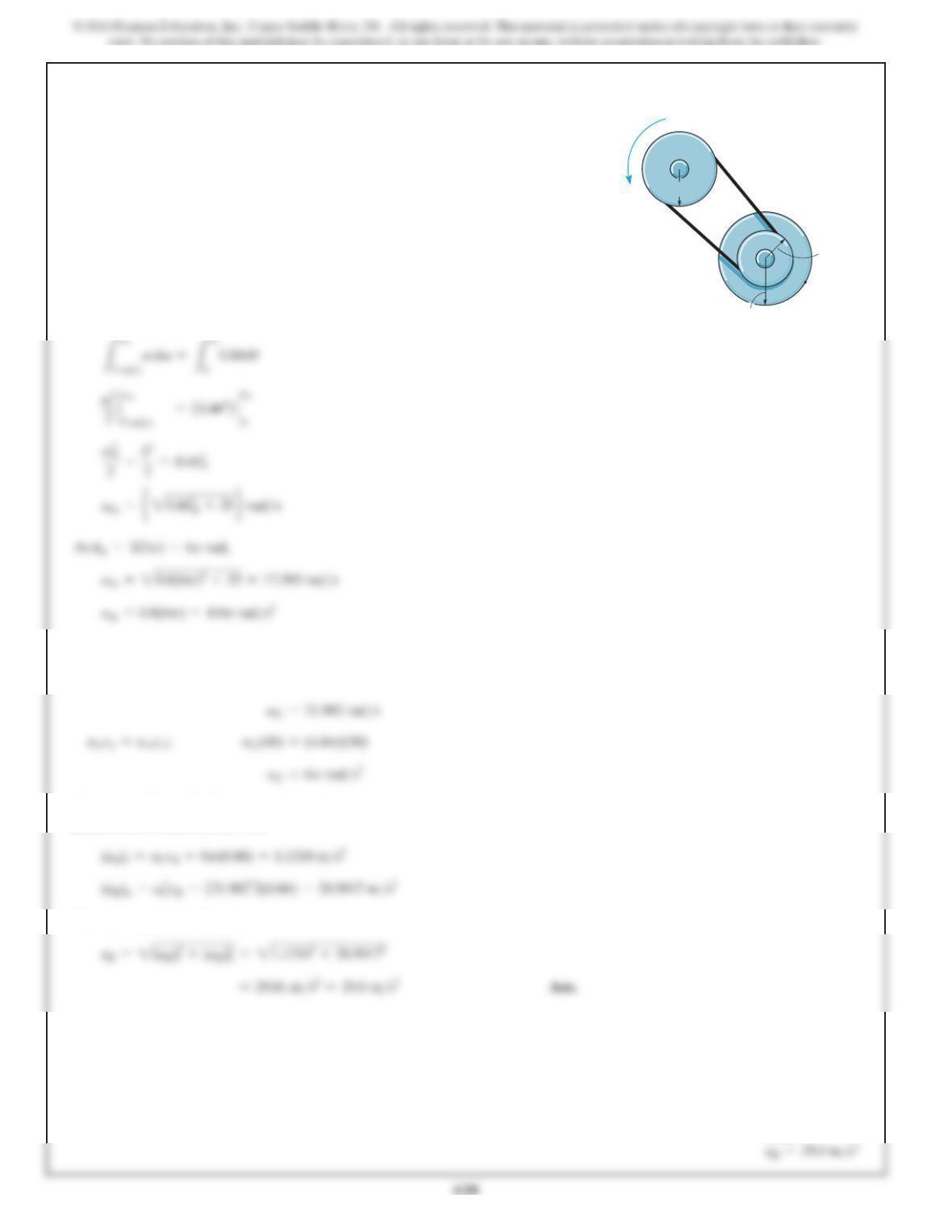
16–9.
At the instant vA
=5 rad>s
, pulley A is given an angular
acceleration a
=
(0.8u) rad
>
s
2
, where
u
is in radians.
Determine the magnitude of acceleration of point B on
pulley C when A rotates 3 revolutions. Pulley C has an inner
hub which is fixed to its outer one and turns with it.
SOLUTION
Angular Motion. The angular velocity of pulley A can be determined by integrating
v dv=a du
with the initial condition v
A=5 rad>s
at u
A=0.
Since pulleys A and C are connected by a non-slip belt,
vCrC=vArA
; v
C(40) =17.585(50)
Motion of Point B. The tangential and normal components of acceleration of
pointB can be determined from
Thus, the magnitude of
aB
is
50 mm
40 mm
60 mm
B
A
C
vA
aA
Ans:
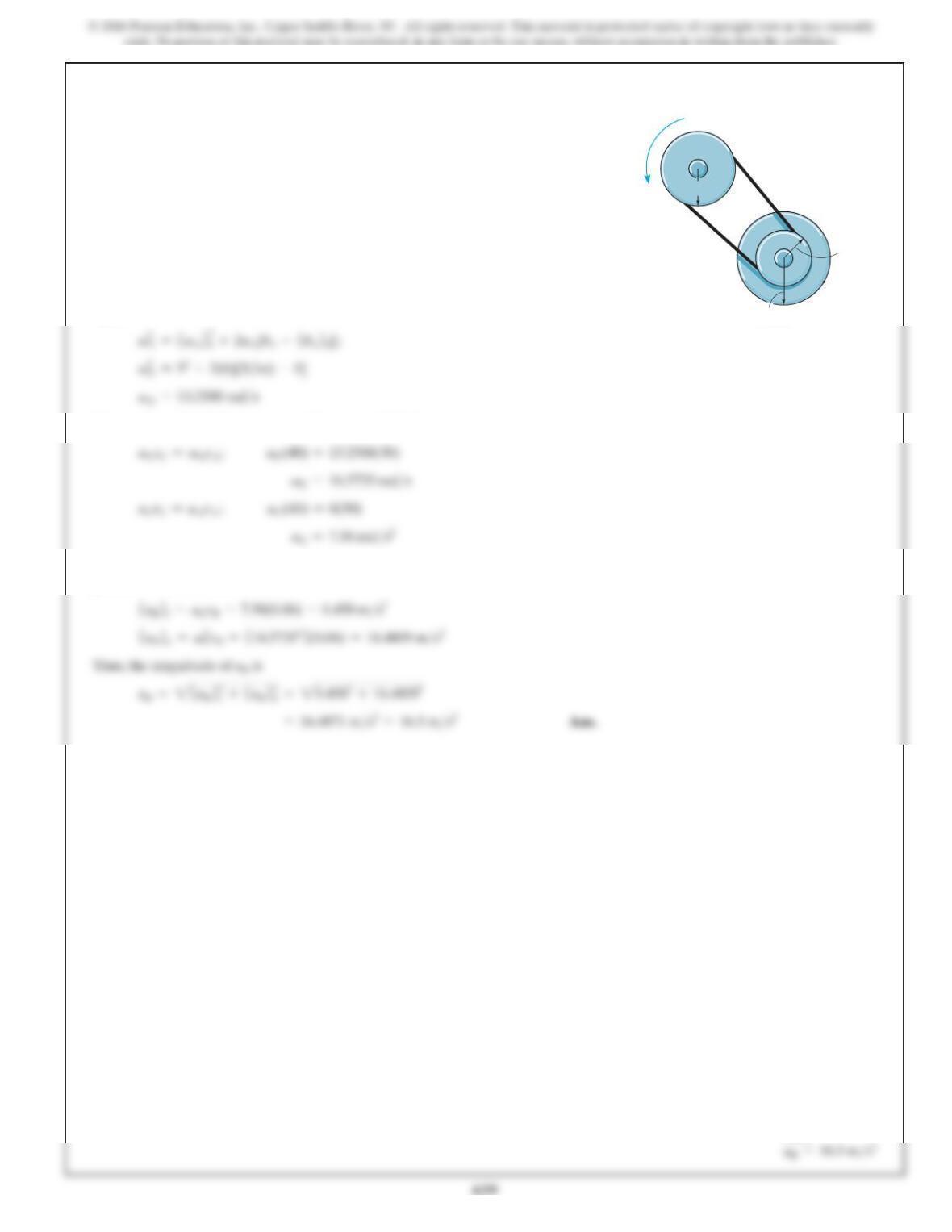
16–10.
At the instant vA
=5 rad>s
, pulley A is given a constant
angular acceleration aA
=
6 rad
>
s
2
. Determine the
magnitude of acceleration of point B on pulley C when A
rotates 2 revolutions. Pulley C has an inner hub which is
fixed to its outer one and turns with it.
SOLUTION
Angular Motion. Since the angular acceleration of pulley A is constant, we can
apply
Since pulleys A and C are connected by a non-slip belt,
Motion of Point B. The tangential and normal component of acceleration of
pointB can be determined from
50 mm
40 mm
60 mm
B
A
C
vA
aA
Ans:
640
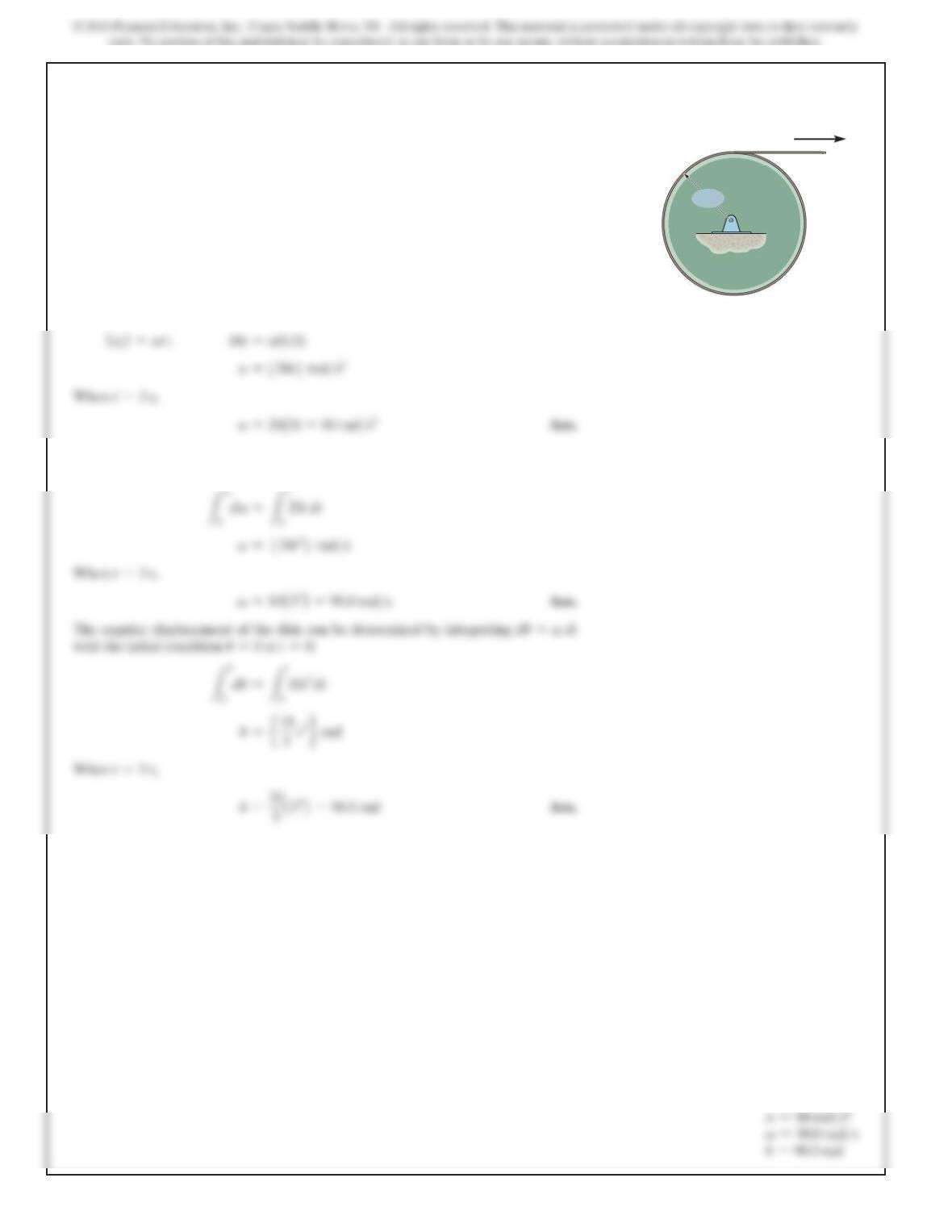
16–11.
The cord, which is wrapped around the disk, is given an
acceleration of a
=
(10t) m
>
s
2
, where t is in seconds.
Starting from rest, determine the angular displacement,
angular velocity, and angular acceleration of the disk when
t=3 s
.
SOLUTION
Motion of Point P. The tangential component of acceleration of a point on the rim
is equal to the acceleration of the cord. Thus
t=3 s
Angular Motion. The angular velocity of the disk can be determined by integrating
dv=a dt
with the initial condition
v=0
at
t=0
.
t=3 s
t=0
t=3 s
a (10t) m/s2
0.5 m
Ans:
641
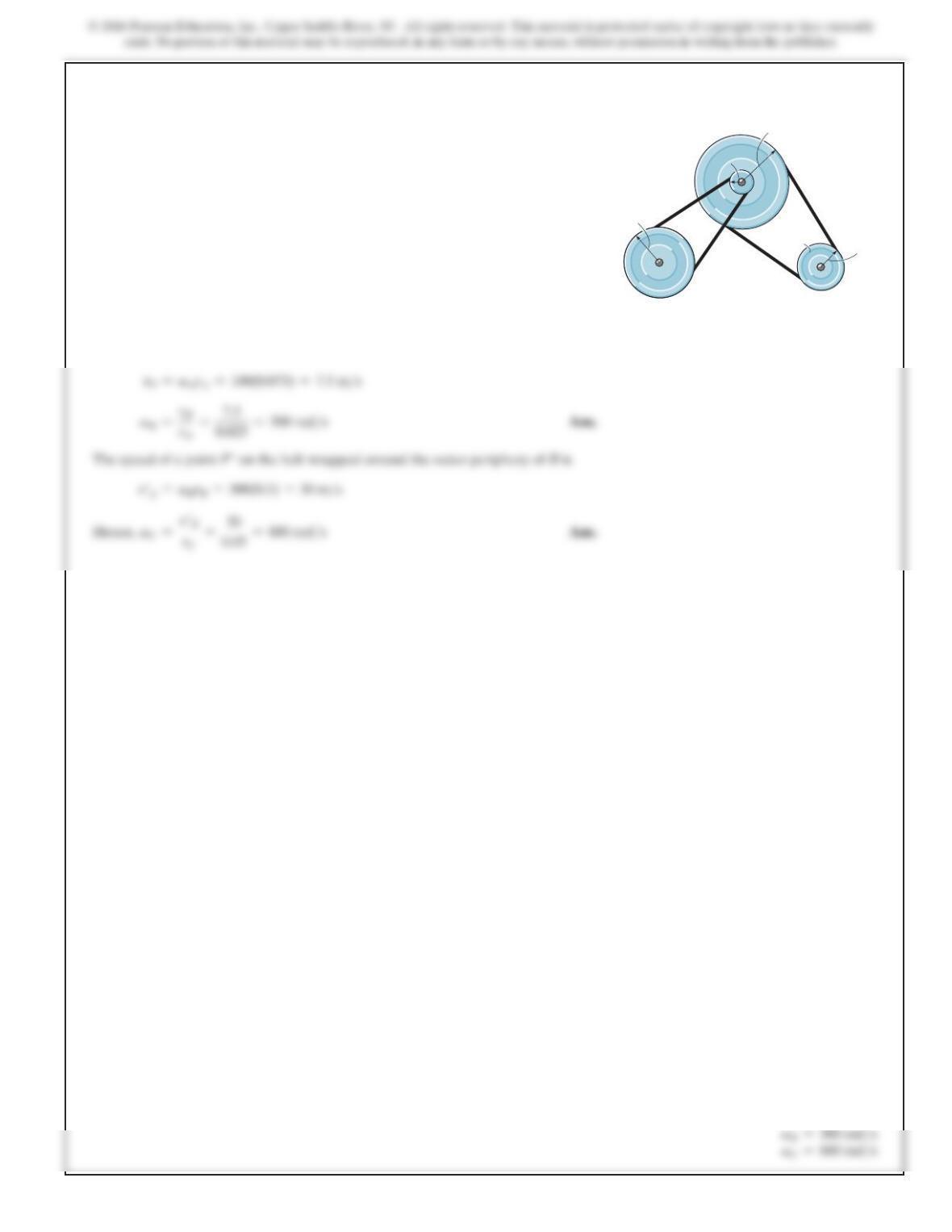
*16–12.
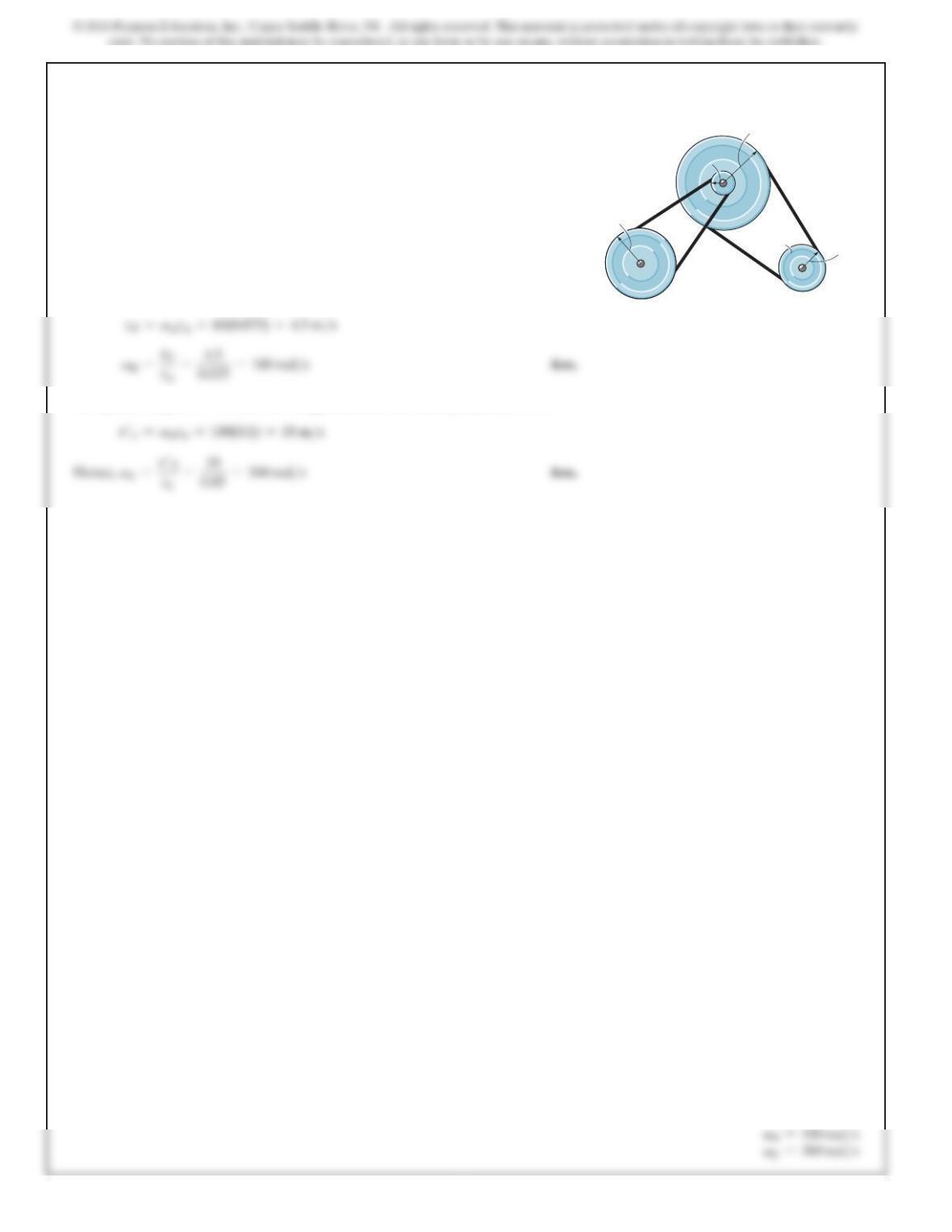
The power of a bus engine is transmitted using the belt-and-
pulley arrangement shown. If the engine turns pulley A at
vA
=(20t+40) rad>s
, where t is in seconds, determine the
angular velocities of the generator pulley B and the
air-conditioning pulley C when
t=3 s
.
Ans:
SOLUTION
When
t=3 s
v
A=20(3) +40 =100 rad>s
The speed of a point P on the belt wrapped around A is
B
D
C
A
25 mm
75 mm
50 mm
100 mm
vA
vB
vC
642
16–13.
The power of a bus engine is transmitted using the belt-and-
pulley arrangement shown. If the engine turns pulley A at
vA
=60 rad>s
, determine the angular velocities of the
generator pulley B and the air-conditioning pulley C. The
hub at D is rigidly connected to B and turns with it.
SOLUTION
The speed of a point P on the belt wrapped around A is
The speed of a point
P′
on the belt wrapped around the outer periphery of B is
B
D
C
A
25 mm
75 mm
50 mm
100 mm
vA
vB
vC
Ans:
643
16–14.
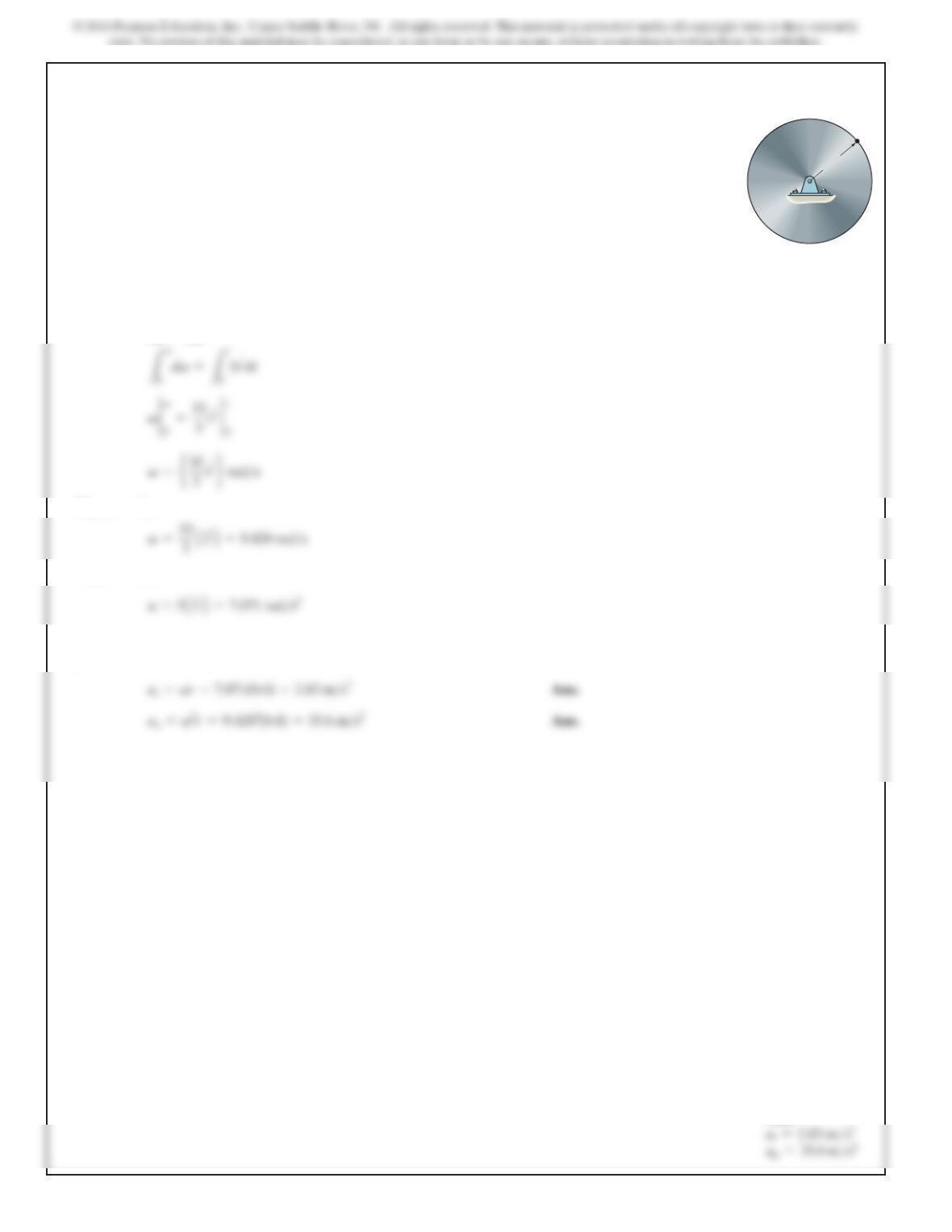
The disk starts from rest and is given an angular acceleration
where tis in seconds.Determine the
an
gular velocity of the disk and its angular displacement
when
t=4 s.
a
=(2t 2) rad>s2,
SOLUTION
W
hen ,
Ans.
v=2
3(4)3=42.7 rad>s
t=4 s
a=dv
dt =2 t2
0.4 m
P
Ans:
644
16–15.
0.4 m
P
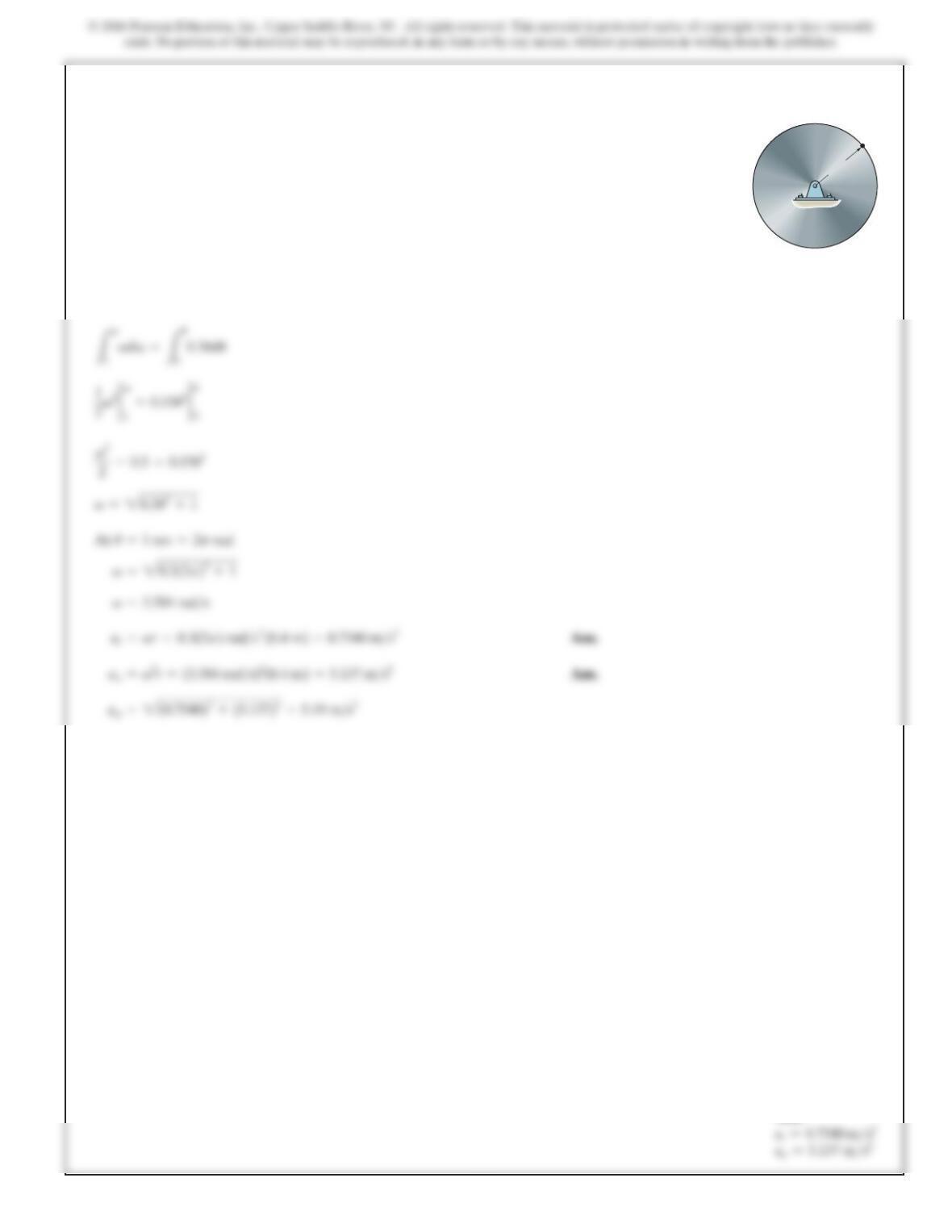
The disk starts from rest and is given an angular acceleration
,where tis in seconds.Determine the
magnitudes of the normal and tangential components of
acceleration of a point Pon the rim of the disk when t=2 s.
a=(5t1>2) rad>s2
SOLUTION
Motion of the Disk: Here, when ,.
When ,
When ,
Motion of point P: The tangential and normal components of the acceleration of
point P when are
t=2 s
t=2 s
t=2 s
dv=adt
v=0t=0
Ans:
645
*16–16.
SOLUTION
0.4 m
P
The disk starts at
v0
= 1 rad>s when
u
= 0, and is given an
angular acceleration a = (0.3u) rad>s2, where u is in radians.
Determine the magnitudes of the normal and tangential
components of acceleration of a point P on the rim of the
disk when u = 1 rev.
a=0.3u
Ans:
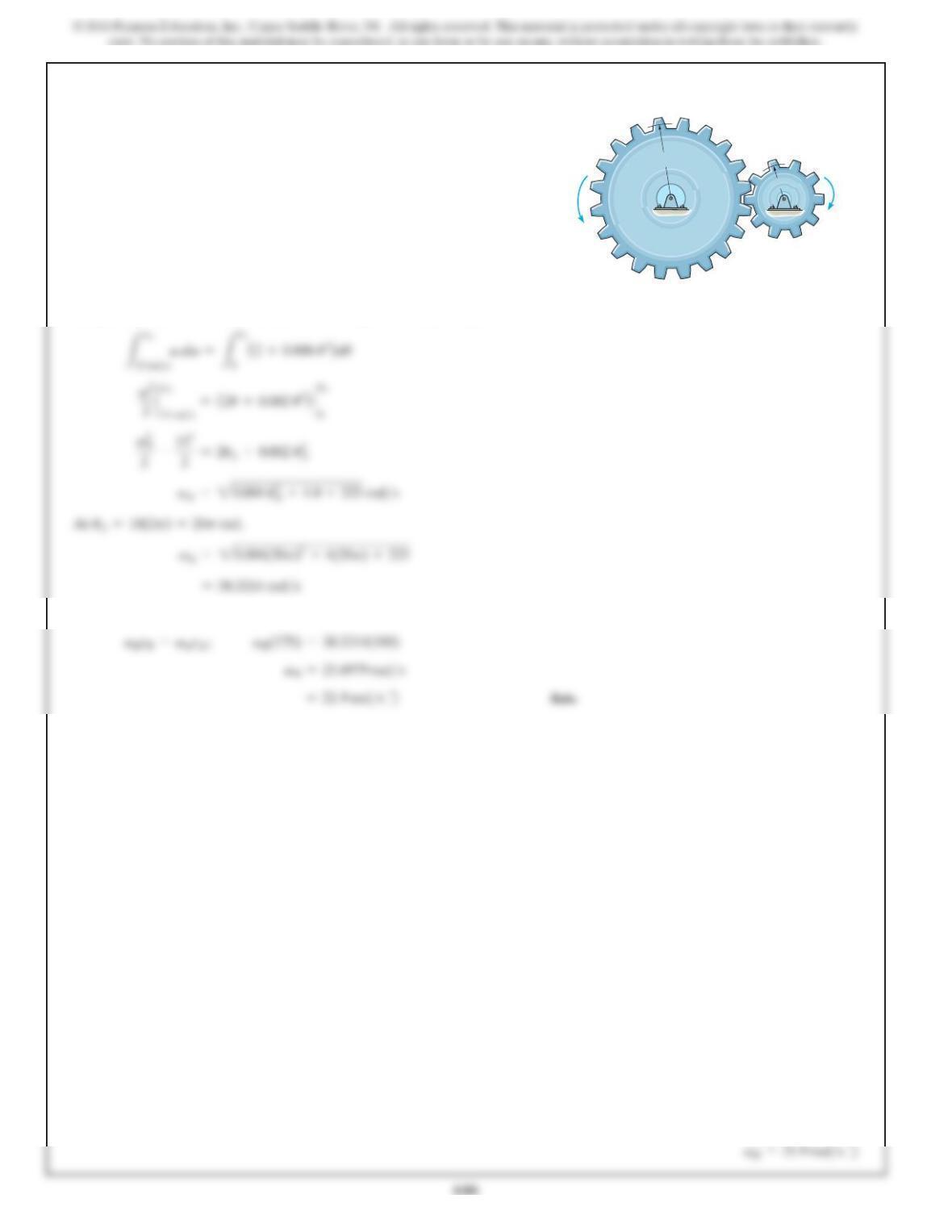
16–17.
A motor gives gear A an angular acceleration of
aA
=
(2
+
0.006 u
2
) rad
>
s
2
, where
u
is in radians. If this
gear is initially turning at vA
=15 rad>s
, determine the
angular velocity of gear B after A undergoes an angular
displacement of 10 rev.
SOLUTION
Angular Motion. The angular velocity of the gear A can be determined by
integrating
v dv=a du
with initial condition v
A=15 rad>s
at u
A=0
.
Since gear B is meshed with gear A,
B
175 mm
100 mm
A
a
A
v
A
a
B
Ans:
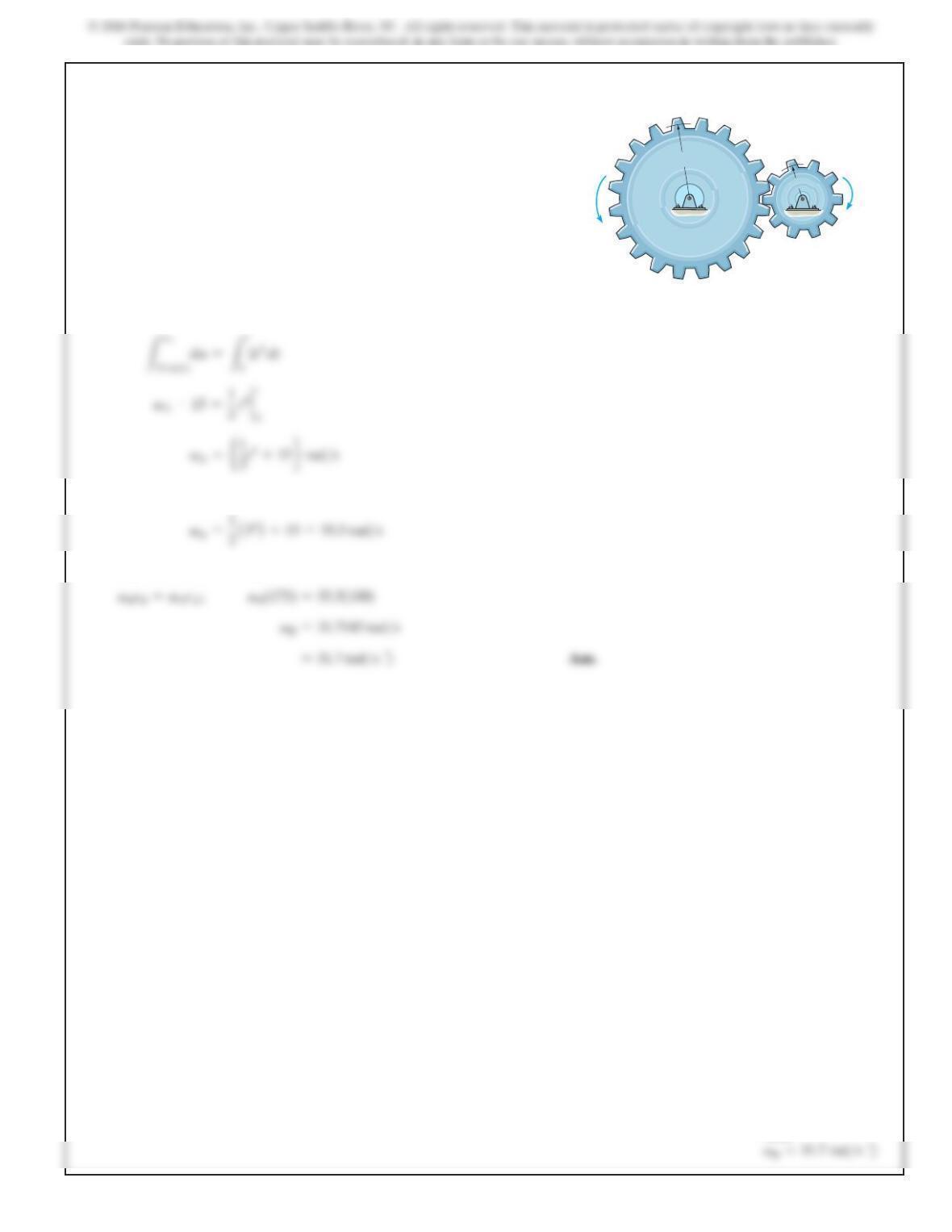
647
16–18.
A motor gives gear A an angular acceleration of
aA
=
(2t
3
) rad
>
s
2
, where t is in seconds. If this gear is
initially turning at vA
=15 rad>s
, determine the angular
velocity of gear B when
t=3 s
.
SOLUTION
Angular Motion. The angular velocity of gear A can be determined by integrating
dv=a dt
with initial condition v
A=15 rad>s
at
t=0 s
.
At
t=3 s
,
Since gear B meshed with gear A,
B
175 mm
100 mm
A
a
A
v
A
a
B
Ans:
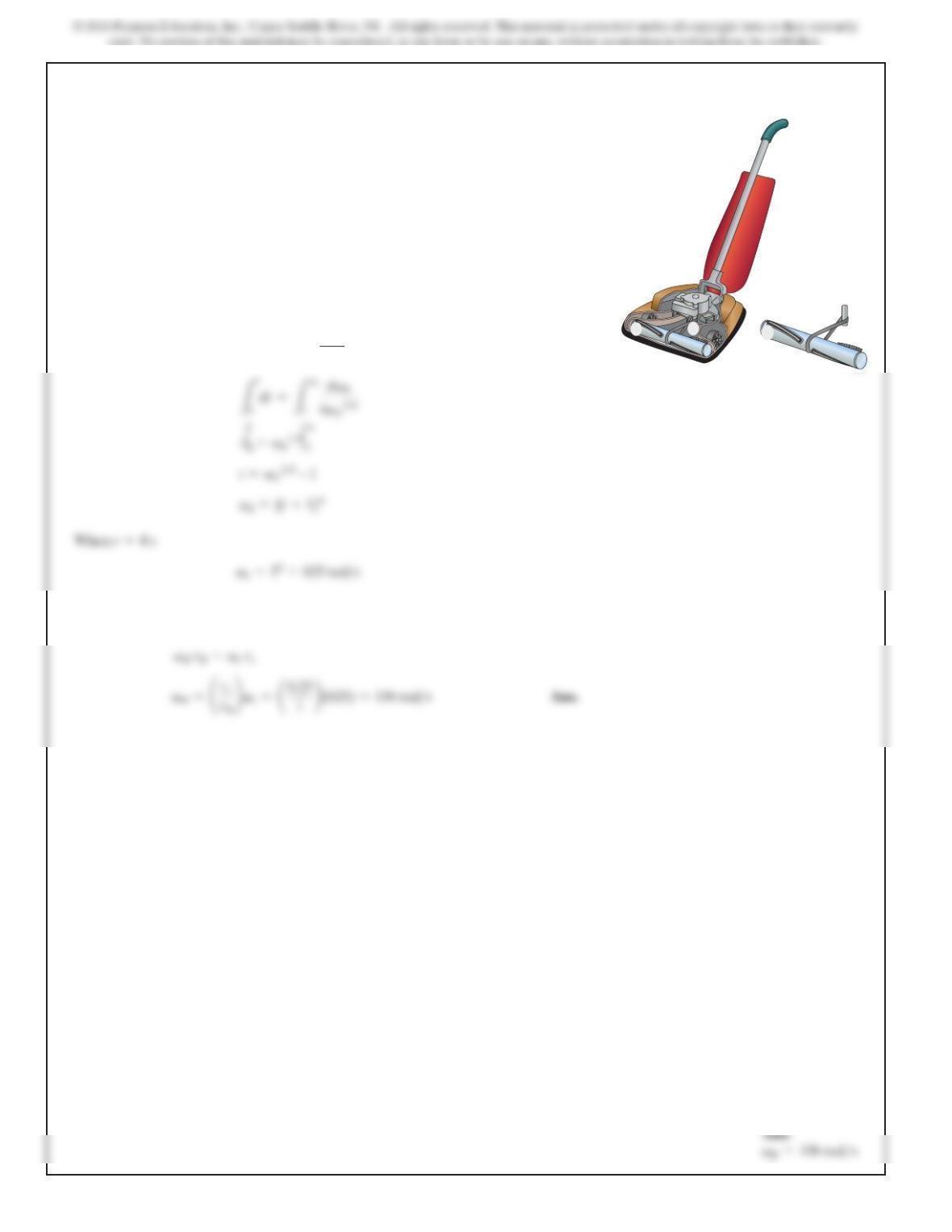
648
16–19.
SOLUTION
Motion of the Shaft:The angular velocity of the shaft can be determined from
Motion of the Beater Brush: Since the brush is connected to the shaft by a non-slip
belt, then
Ldt =LdvS
aS
ASAS
The vacuum cleaner’s armature shaft S rotates with an
angular acceleration of a = 4v
3>4
rad>s
2
, where v is in
rad>s. Determine the brush’s angular velocity when t = 4 s,
starting from v
0
= 1 rad>s, at u = 0. The radii of the shaft
and the brush are 0.25 in. and 1 in., respectively. Neglect the
thickness of the drive belt.
649
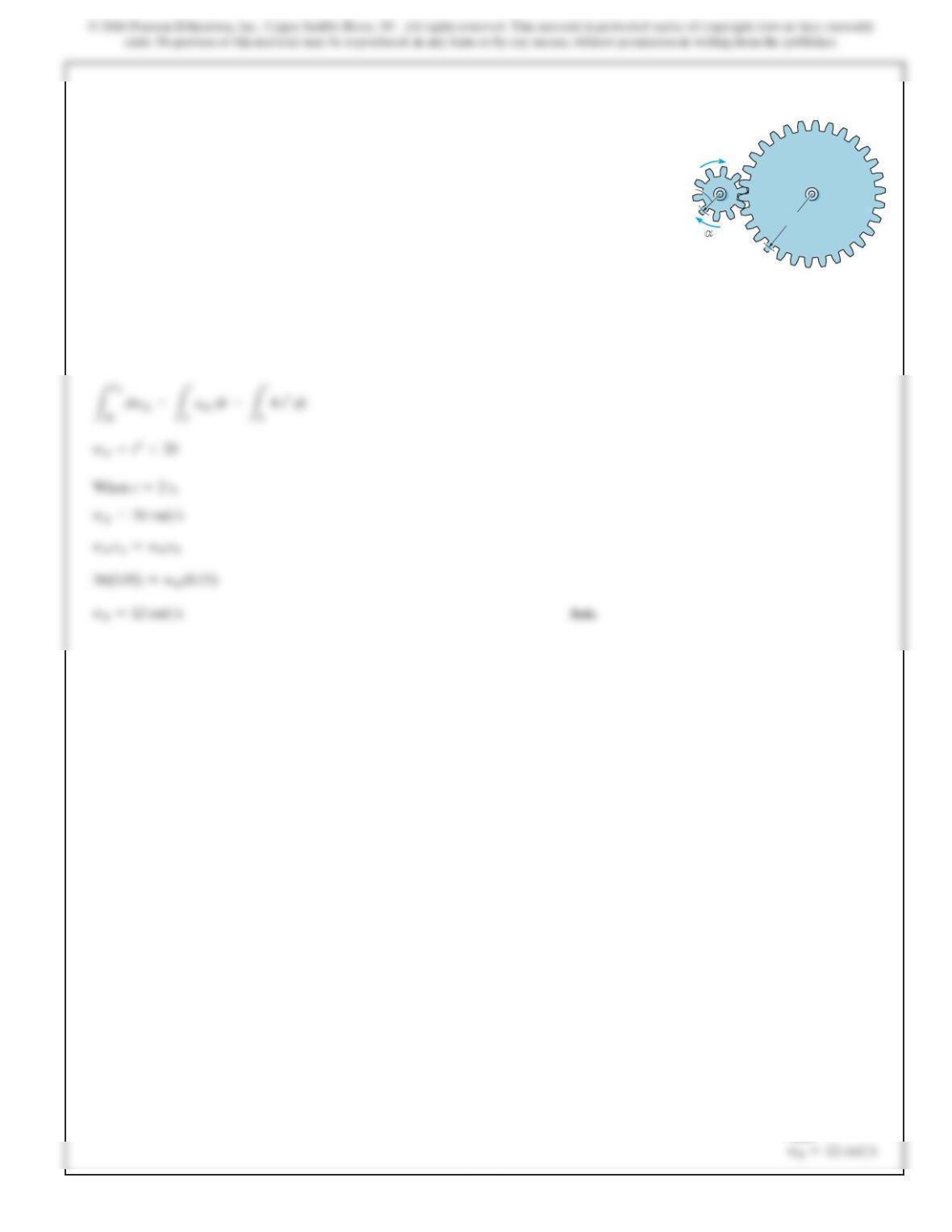
*16–20.
SOLUTION
aA=4 t3
dw =a dt
A motor gives gear A an angular acceleration of
aA=(4t3) rad>s2, where t is in seconds. If this gear is
initially turning at (vA)0=20 rad>s, determine the angular
velocity of gear B when t=2 s. A
B
0.15 m
0.05 m
( A)0 = 20 rad/s
A
α
ω
Ans: