770
16–133.
SOLUTION
Reference Frame: The xyz rotating reference frame is attached to the impeller and
coincides with the XYZ fixed reference frame at the instant considered, Fig. a.Thus,
the motion of the xyz frame with respect to the XYZ frame is
The motion of point Awith respect to the xyz frame is
Velocity: Applying the relative velocity equation.
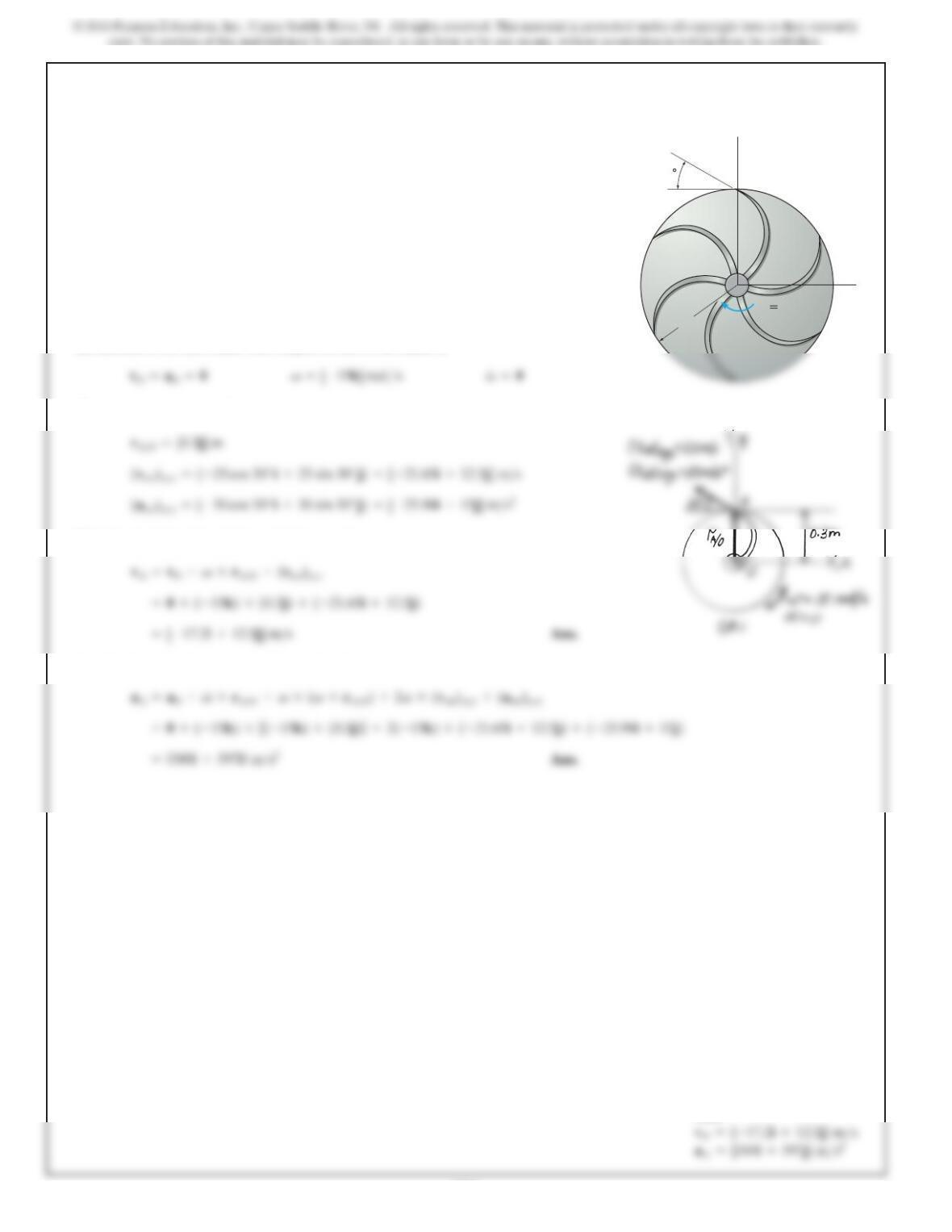
Water leaves the impeller of the centrifugal pump with a
velocity of and acceleration of , both
measured relative to the impeller along the blade line AB.
Determine the velocity and acceleration of a water particle
at Aas it leaves the impeller at the instant shown. The
impeller rotates with a constant angular velocity of
.v=15 rad>s
30 m>s2
25 m>s
v15 rad/s
B
A
0.3 m
y
x
30
Acceleration: Applying the relative acceleration equation,
Ans:
771
16–134.
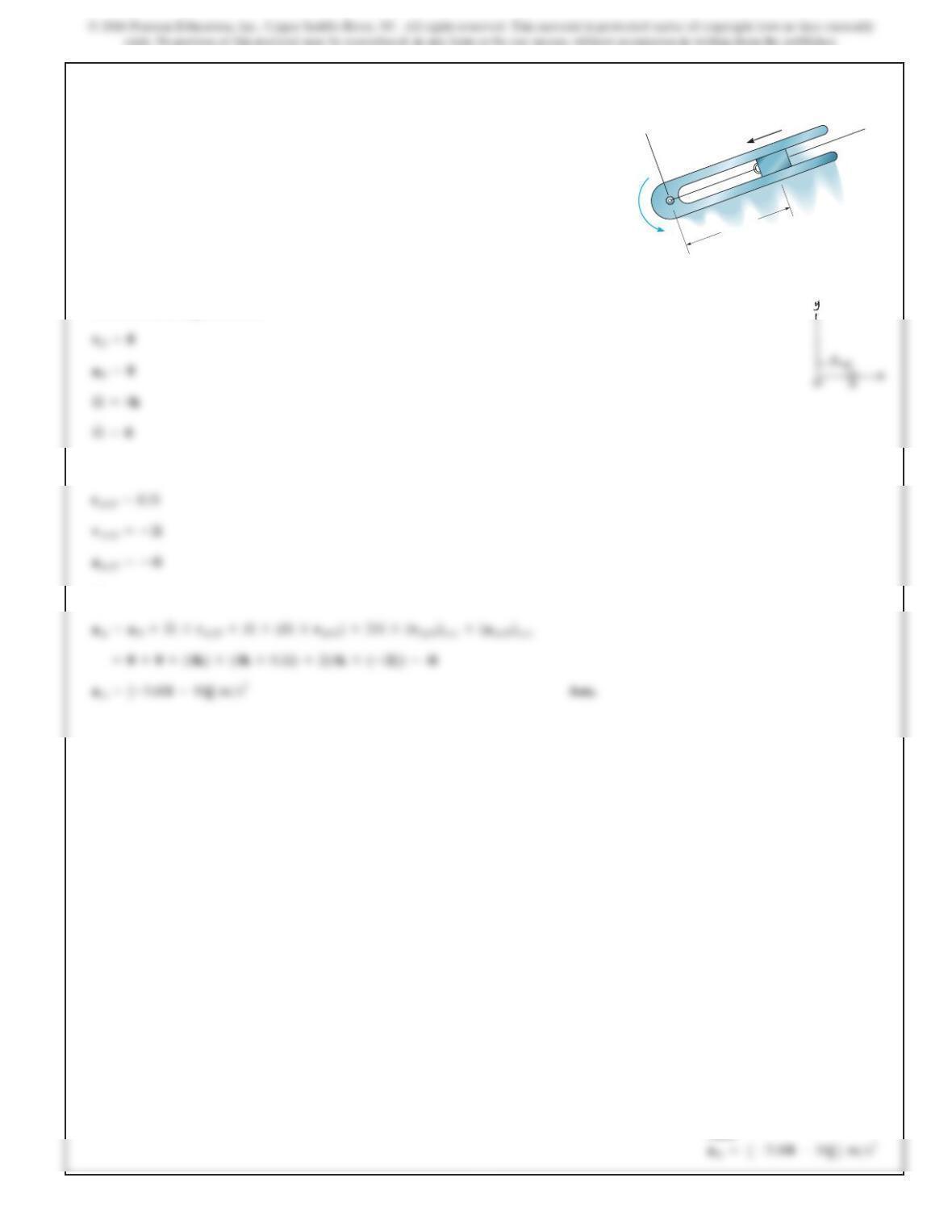
Block A, which is attached to a cord, moves along the slot of
a horizontal forked rod. At the instant shown, the cord is
pulled down through the hole at Owith an acceleration of
and its velocity is . Determine the acceleration
of the block at this instant. The rod rotates about Owith a
constant angular velocity v=4 rad>s.
2m>s4m>s2
SOLUTION
Motion of moving reference.
Motion of Awith respect to moving reference.
Thus,
O
100 mm
A
yx
v
Ans:
772
16–135.
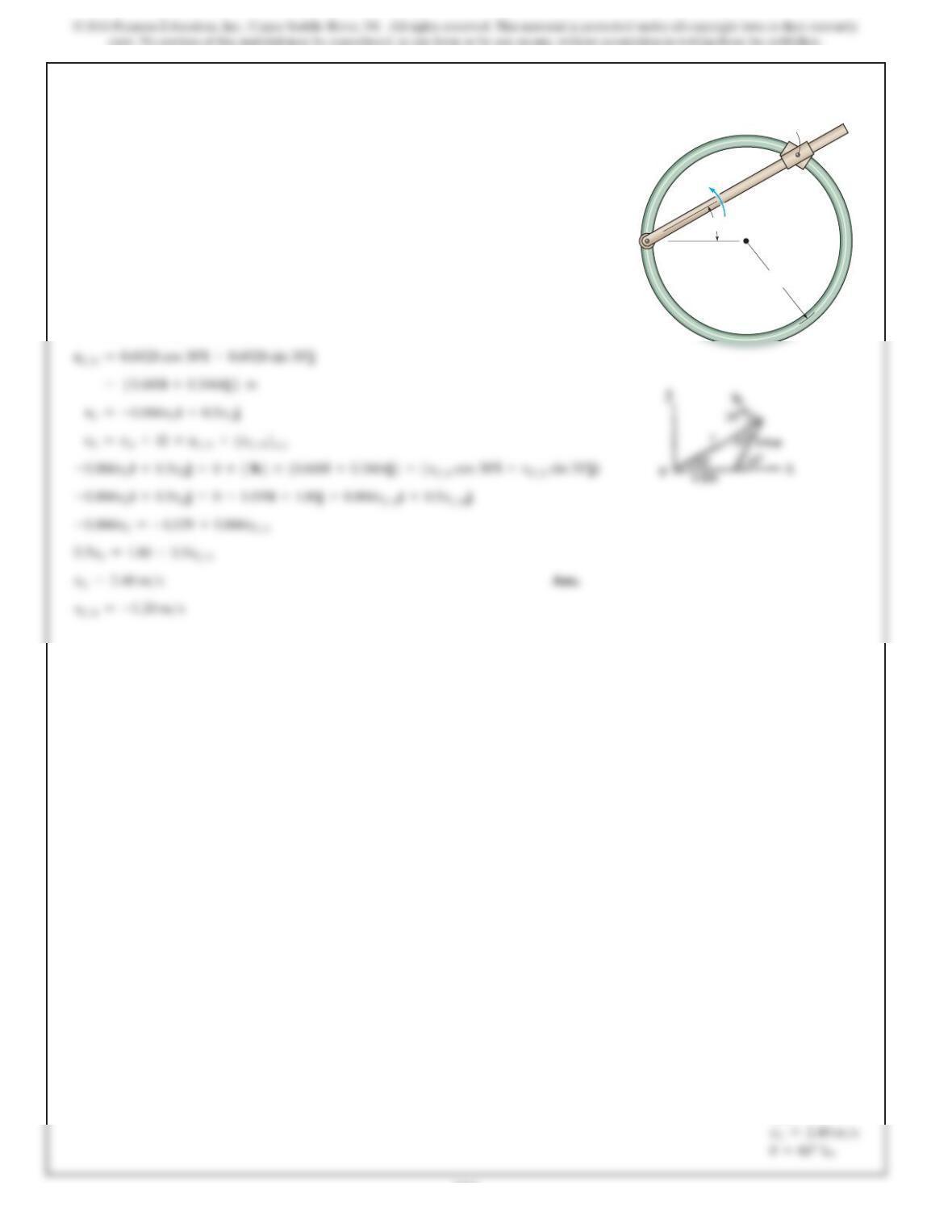
Rod AB rotates counterclockwise with a constant angular
velocity
v
=
3 rad
>
s. Determine the velocity of point C
located on the double collar when
u
=
30°. The collar
consists of two pin-connected slider blocks which are
constrained to move along the circular path and the rodAB.
B
C
0.4 m
A
v = 3 rad/s
u
SOLUTION
r=2(0.4 cos 30°)=0.6928 m
Ans:
773
*16–136.
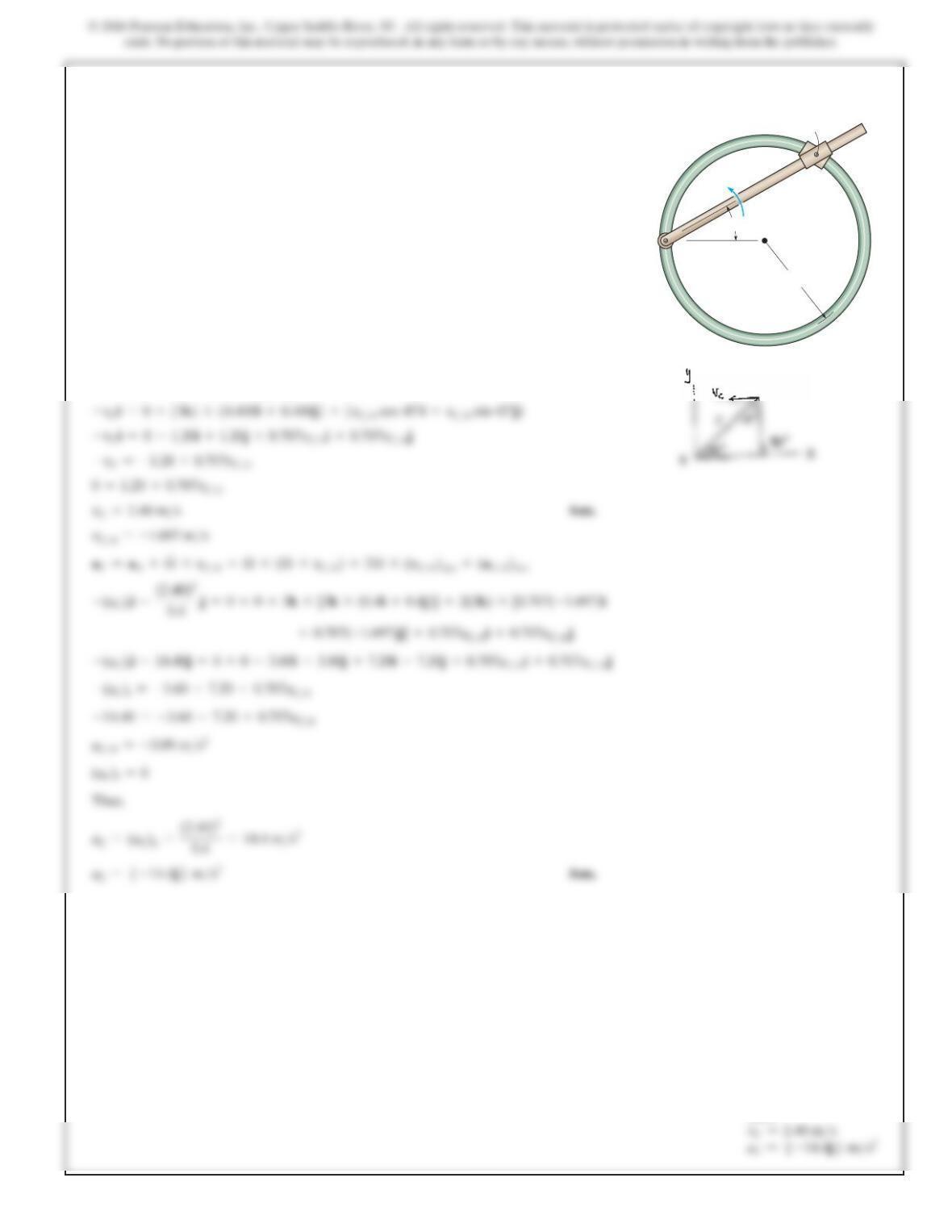
Rod AB rotates counterclockwise with a constant angular
velocity v
=3 rad>s.
Determine the velocity and acceleration
of point C located on the double collar when
u=45°
. The
collar consists of two pin-connected slider blocks which are
constrained to move along the circular path and the rod AB.
B
C
0.4 m
A
v = 3 rad/s
u
SOLUTION
r
C
>
A
=50.400i+0.400j6
vC=–vCi
v
C
= v
A
+Ω*r
C
>
A
+(v
C
>
A
)
xyz
=–1.20 +0.707v
>
=–1.697 m>s
Ans:
774
16–137.
SOLUTION
Æ=8
1=8 rad>s2,Æ={–8k} rad>s
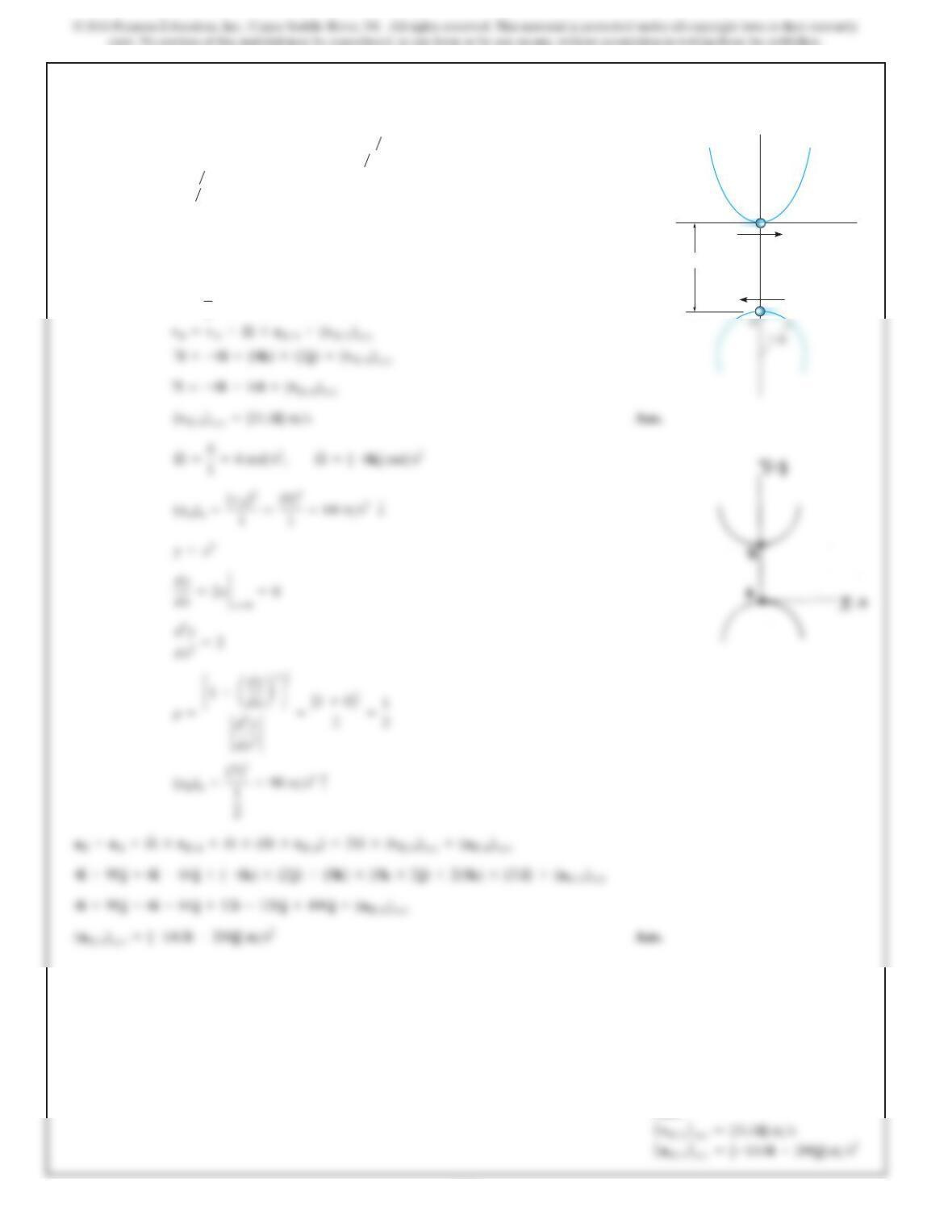
Particles Band Amove along the parabolic and circular
paths, respectively. If Bhas a velocity of 7 m sin the
direction shown and its speed is increasing at 4 ms2, while A
has a velocity of 8 m s in the direction shown and its speed
is decreasing at 6 m s2, determine the relative velocity and
relative acceleration of Bwith respect to A.
Bx
y
2m
y
B
=7m/s
y
A
=8m/s
y=x
2
Ans:
775
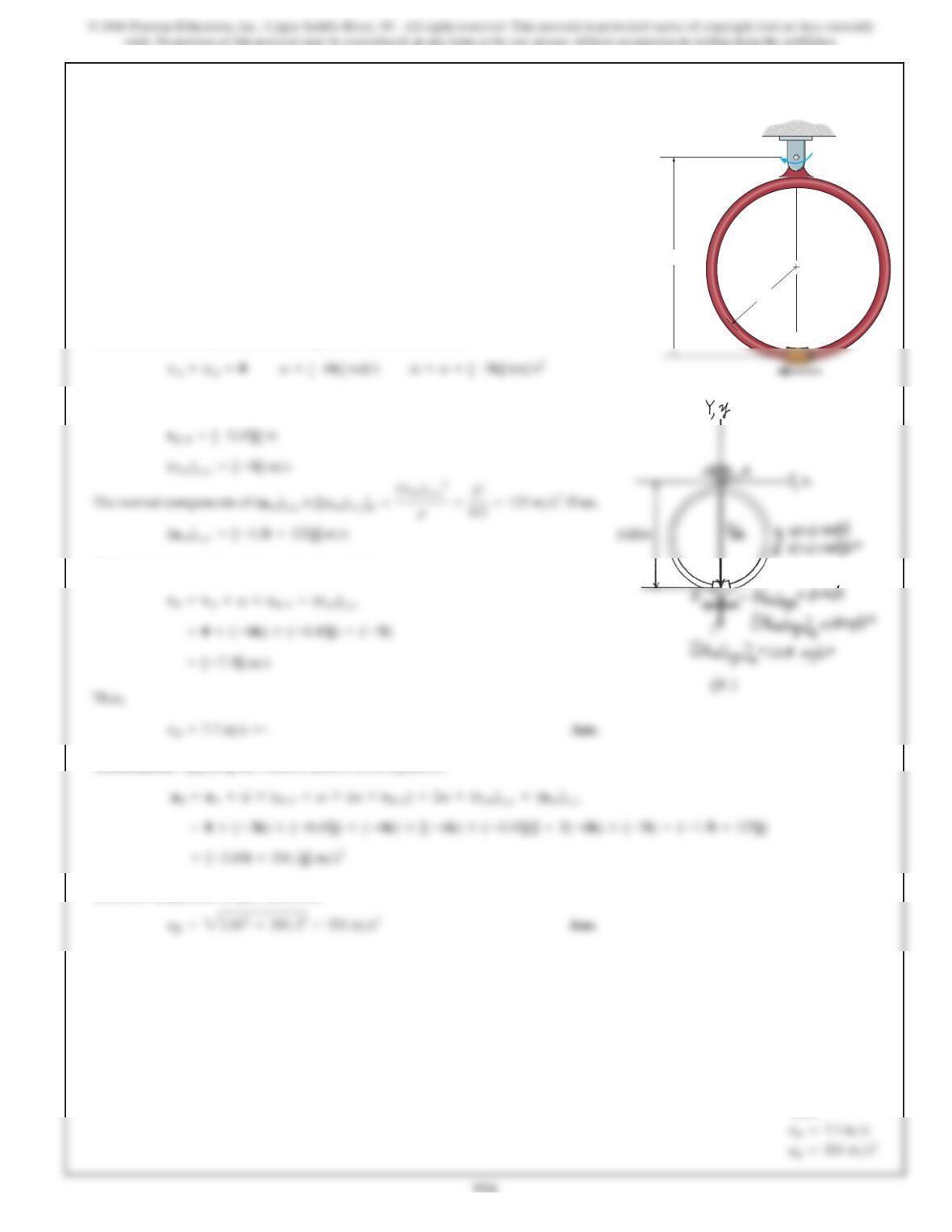
16–138.
A
B
200 mm
450 mm
v 6 rad/s
a 3 rad/s2
Collar Bmoves to the left with a speed of , which is
increasing at a constant rate of , relative to the
hoop, while the hoop rotates with the angular velocity and
angular acceleration shown. Determine the magnitudes of
the velocity and acceleration of the collar at this instant.
1.5 m>s2
5 m>s
SOLUTION
Reference Frames: The xyz rotating reference frame is attached to the hoop and
coincides with the XYZ fixed reference frame at the instant considered, Fig.a.Thus,
the motion of the xyz frame with respect to the XYZ frame is
For the motion of collar Bwith respect to the xyz frame,
Velocity: Applying the relative velocity equation,
Acceleration: Applying the relative acceleration equation,
Thus, the magnitude of is therefore
aB
Ans:
776
16–139.
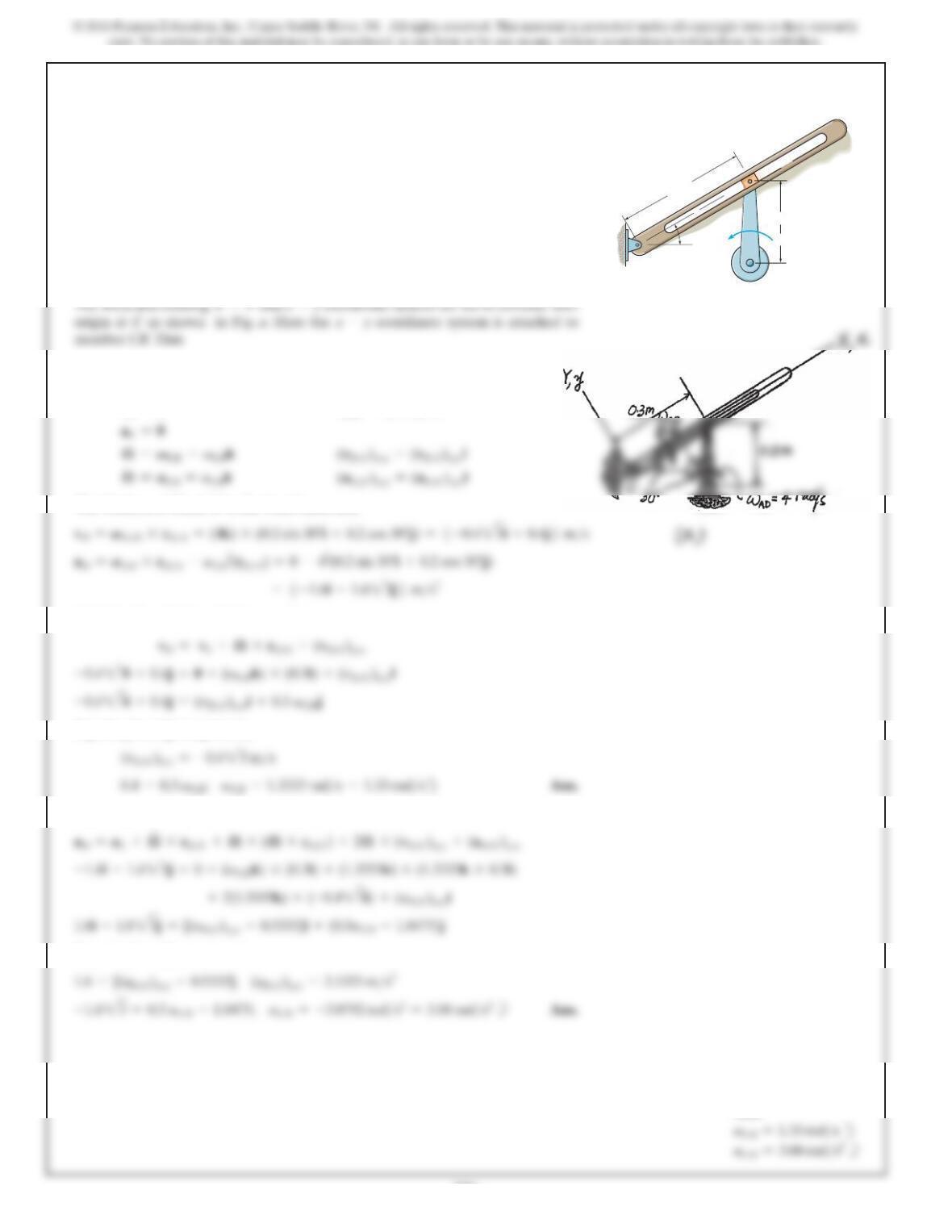
Block D of the mechanism is confined to move within the slot
of member CB. If link AD is rotating at a constant rate of
v
AD =4 rad>s,
determine the angular velocity and angular
acceleration of member CB at the instant shown.
30
D
A
B
300 mm
200 mm
C
vAD fi 4 rad/s
SOLUTION
Motion of moving Motion of Block D
Reference with respect to moving Reference
vC=0
r
D
>
C
=50.3i6 m
The Motions of Block D in the fixed frame are,
a
Applying the relative velocity equation,
v
Equating i and j components,
Applying the relative acceleration equation,
Equating i and j components
Ans:
777
*16–140.
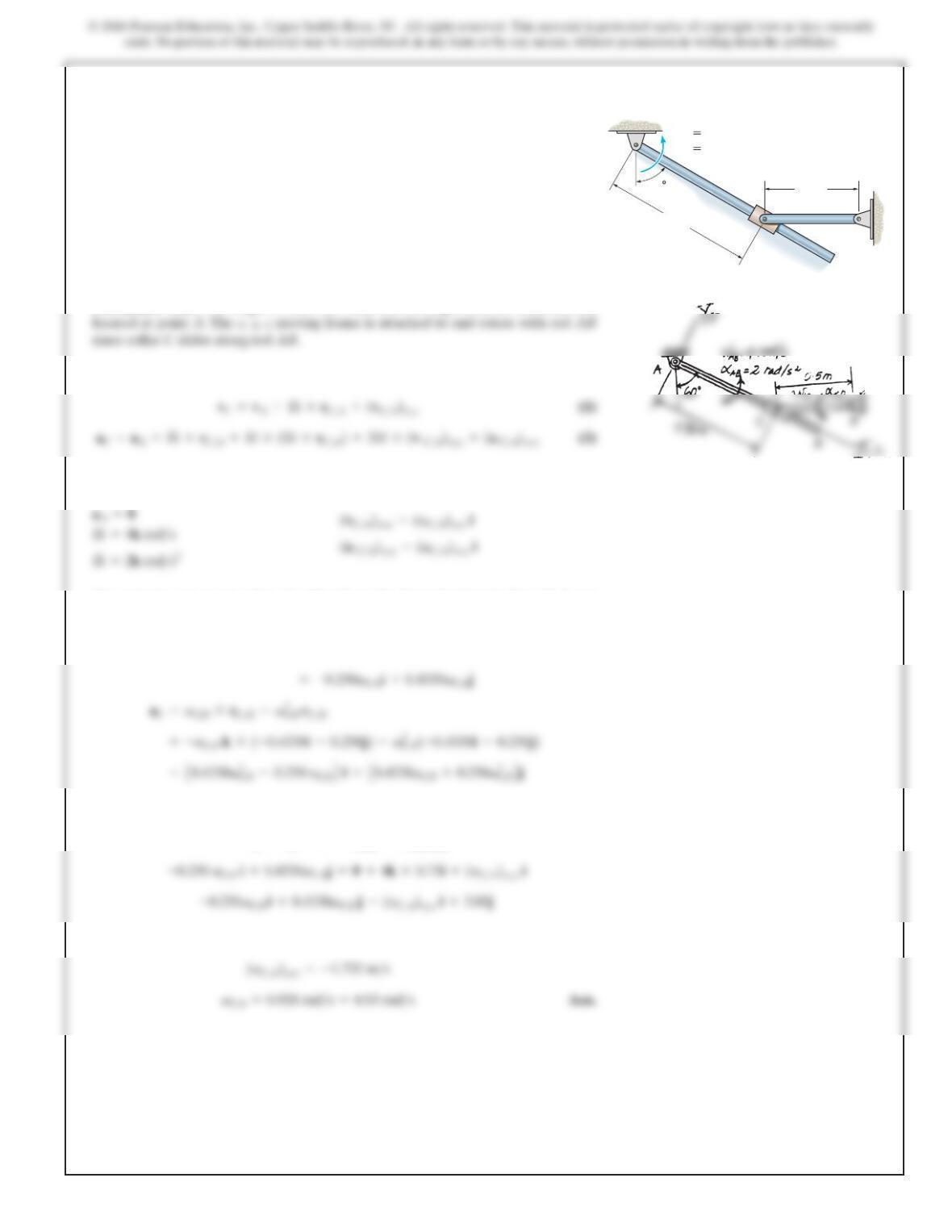
At the instant shown rod AB has an angular velocity
and an angular acceleration .
Determine the angular velocity and angular acceleration of
rod CD at this instant.The collar at Cis pin connected to CD
and slides freely along AB.
aAB =2 rad>s2
vAB =4 rad>s
SOLUTION
Coordinate Axes: The origin of both the fixed and moving frames of reference are
Kinematic Equation: Applying Eqs. 16–24 and 16–27, we have
Motion of moving reference Motion of C with respect to moving reference
The velocity and acceleration of collar Ccan be determined using Eqs. 16–9 and
16–14 with .
Substitute the above data into Eq.(1) yields
Equating iand jcomponents and solve, we have
vC=vA+Æ*rC>A+(vC>A)xyz
vC=vCD *rC>D=-vCDk*(–0.4330i–0.250j)
rC>D={–0.5 cos 30°i–0.5 sin 30°j}m ={–0.4330i–0.250j}m
rC>A=50.75i6m
vA=0
B
v
a
D
A
C
0.5 m
60
AB 4 rad/s
AB 2 rad/s2
0.75 m
778
*16–140. Continued
Substitute the above data into Eq.
(
2
)
yields
aC=aA+Æ
#*rC>A+Æ*(Æ*rC>A)+2Æ*(vC>A)xyz +(aC>A)xyz
779
16–141.
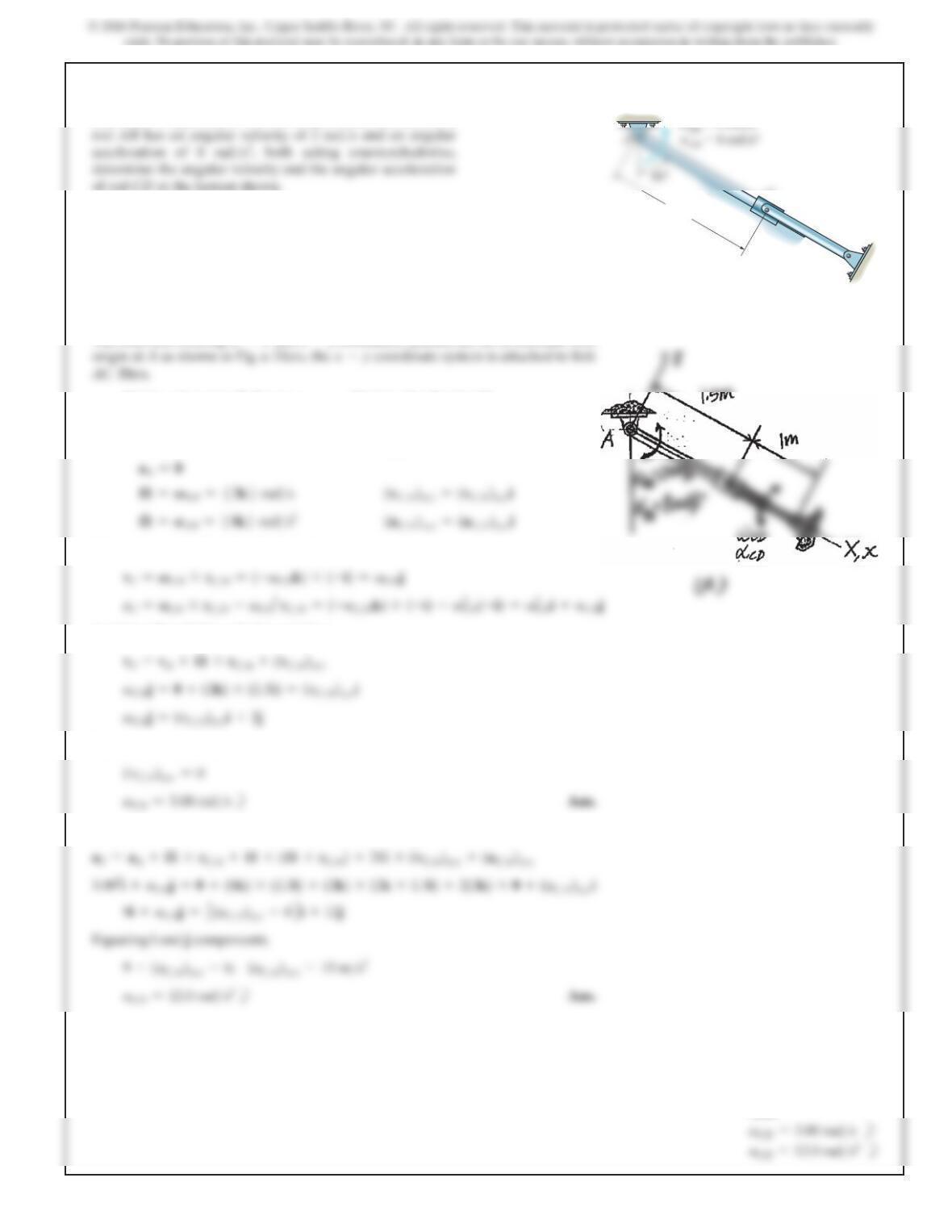
The collar C is pinned to rod CD while it slides on rod AB. If
Ans:
SOLUTION
The fixed and rotating
X–Y
and
x–y
coordinate systems are set to coincide with
x–y
Motion of moving Reference Motion of collar C with
respect to moving Reference
vA=0
r
C
>
A
=51.5i6 m
The motions of collar C in the fixed system are
v
Applying the relative velocity equation,
v
Equating i and j components
Applying the relative acceleration equation,
D
B
C
1 m
1.5 m
vAB 2 rad/s
780
16–142.
SOLUTION
Motion of Motion of C with respect
moving reference to moving reference
Motion of B:
Substitute the data into Eqs. (1) and (2) yields:
vB=v*rB>A
rC>B={0.125 cos 15°i+0.125 sin 15°j}m
15°
30°
125 mm
300 mm
ω
,
α
ω
,
α
y
x
C
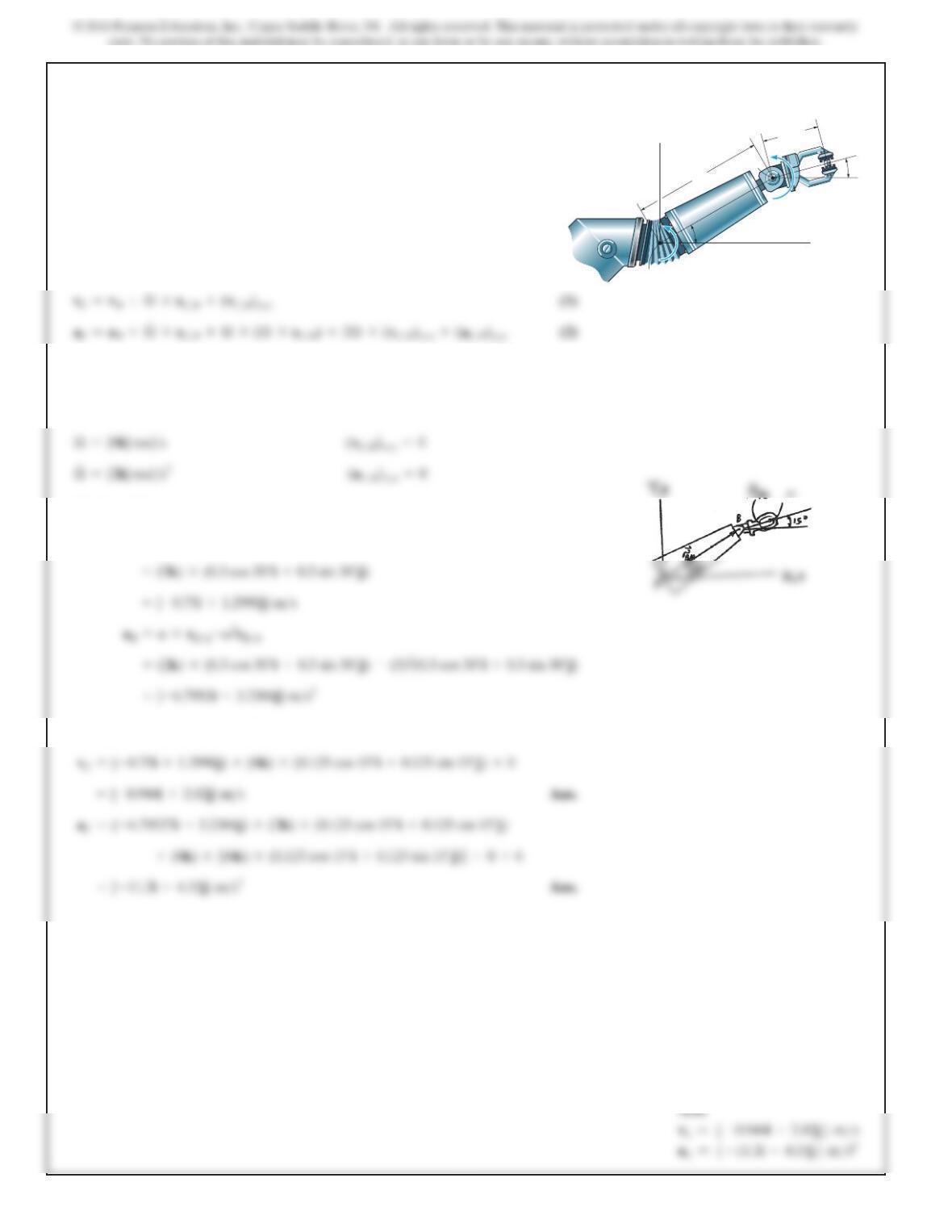
At the instant shown, the robotic arm AB is rotating
counterclockwise at v = 5 rad>s and has an angular
acceleration a = 2 rad>s2
2
. Simultaneously, the grip BC is
rotating counterclockwise at v¿ = 6 rad>s and a¿ = 2 rad>s,
both measured relative to a fixed reference. Determine the
velocity and acceleration of the object held at the grip C.
A
B