781
16–143.
SOLUTION
Gear Motion:The IC of the gear is located at the point where the gear and
Since the gear rolls on the gear rack, .By referring to Fig. b,
Reference Frame: The rotating reference frame is attached to link AB and
coincides with the XYZ fixed reference frame, Figs. cand d.Thus, vBand aBwith
respect to the XYZ frame is
For motion of the frame with reference to the XYZ reference frame,
For the motion of point Bwith respect to the frame is
Equating the iand jcomponents yields
Acceleration: Applying the relative acceleration equation.
x¿y¿z¿
x¿y¿z¿
x¿y¿z¿
a=aO
r=1.5
0.15 =10 rad>s
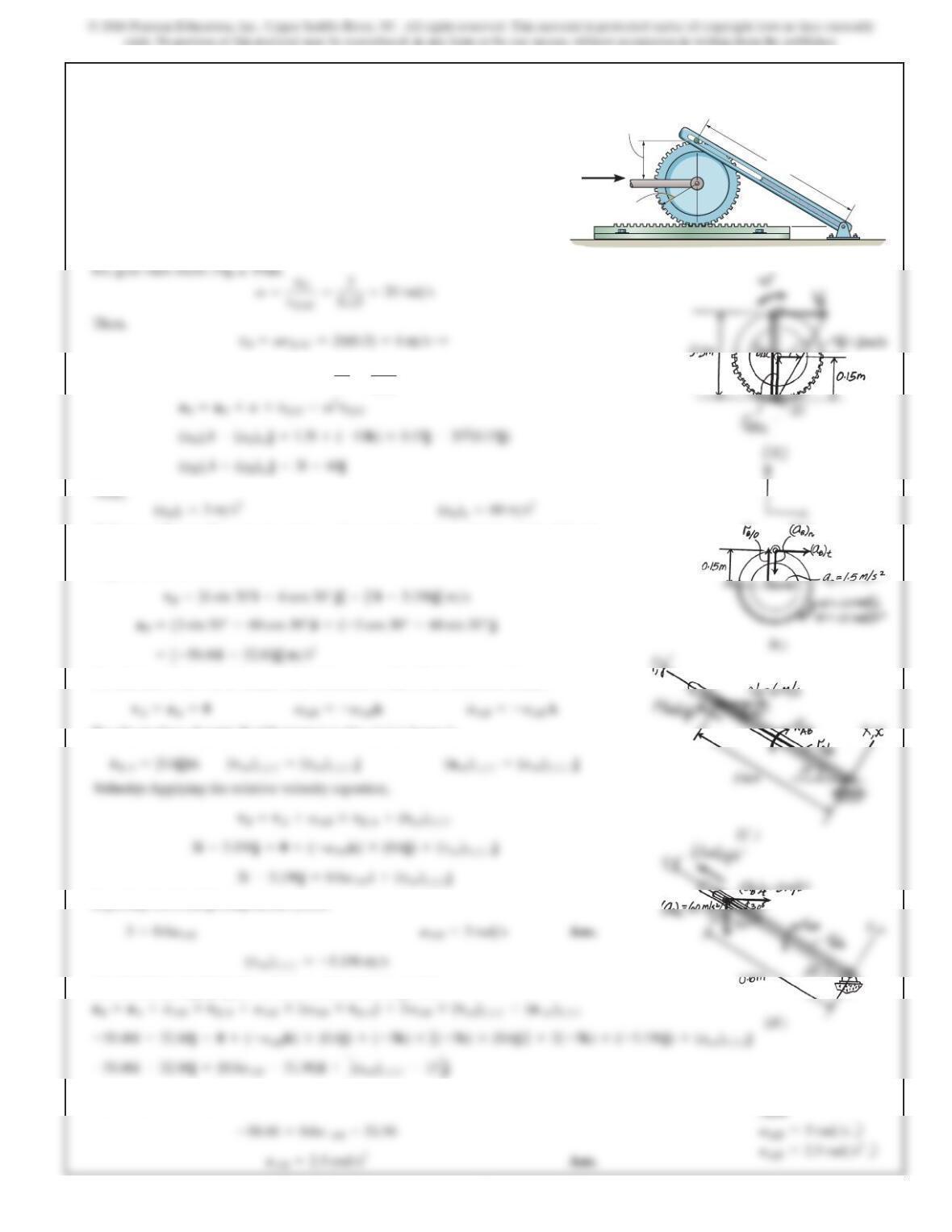
Peg Bon the gear slides freely along the slot in link AB.If
the gear’s center Omoves with the velocity and
acceleration shown, determine the angular velocity and
angular acceleration of the link at this instant.
Equating the icomponents,
vO 3 m/s
aO 1.5 m/s2
A
O
B
600 mm
150 mm
150 mm
Ans:
782
Ans:
*16–144.
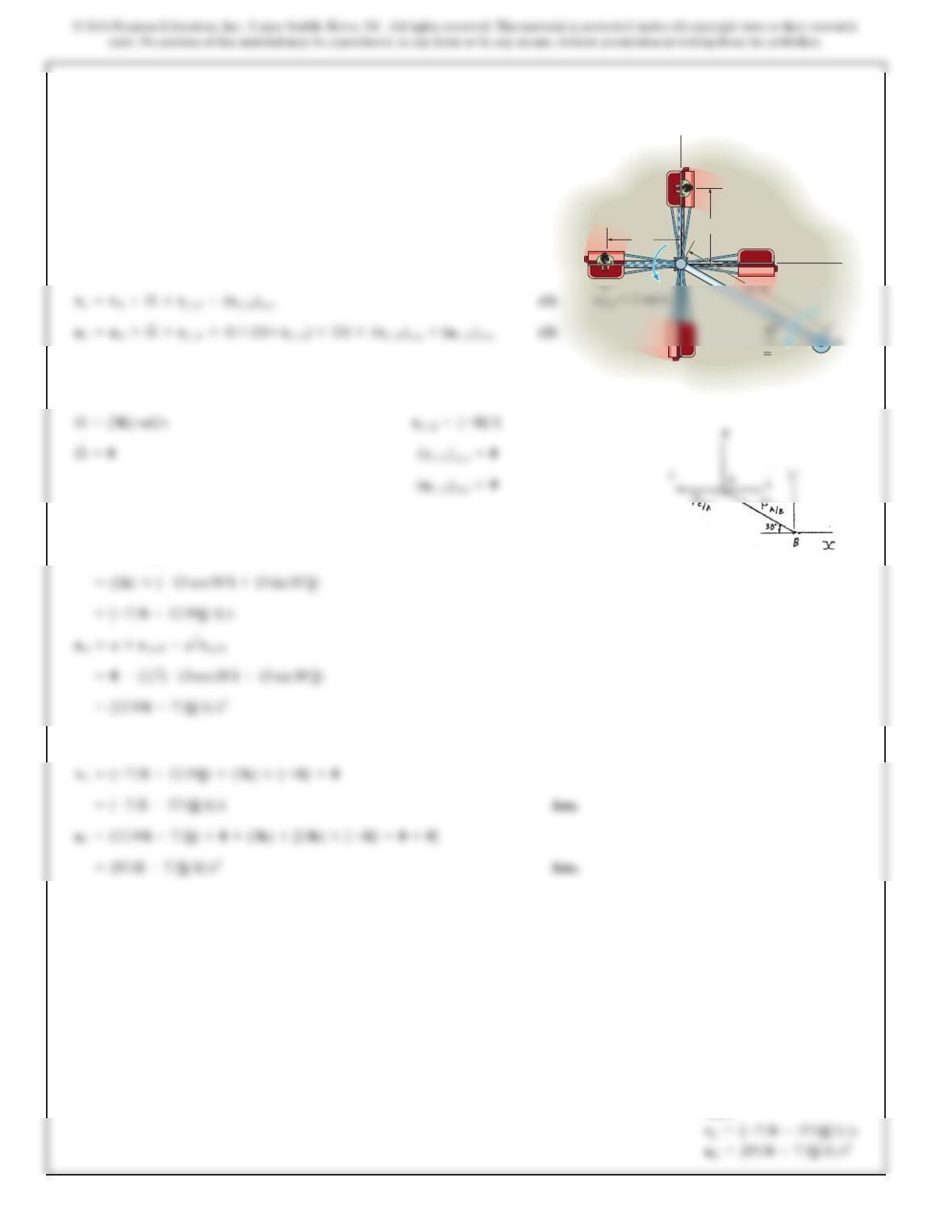
The cars on the amusement-park ride rotate around the
axle at Awith a constant angular velocity
measured relative to the frame AB. At the same time the
frame rotates around the main axle support at Bwith a
constant angular velocity Determine the
velocity and acceleration of the passenger at Cat the
instant shown.
vf=1 rad>s.
vA>f=2 rad>s,
D
8ft
8ft
v
f
1 rad/s
A
B
x
y
Motion of
moving refernce
Motion of C with respect
to moving reference
Motion of A:
Substitute the data into Eqs.(1) and (2) yields:
vA=v*rA>B
SOLUTION
783
16–145.
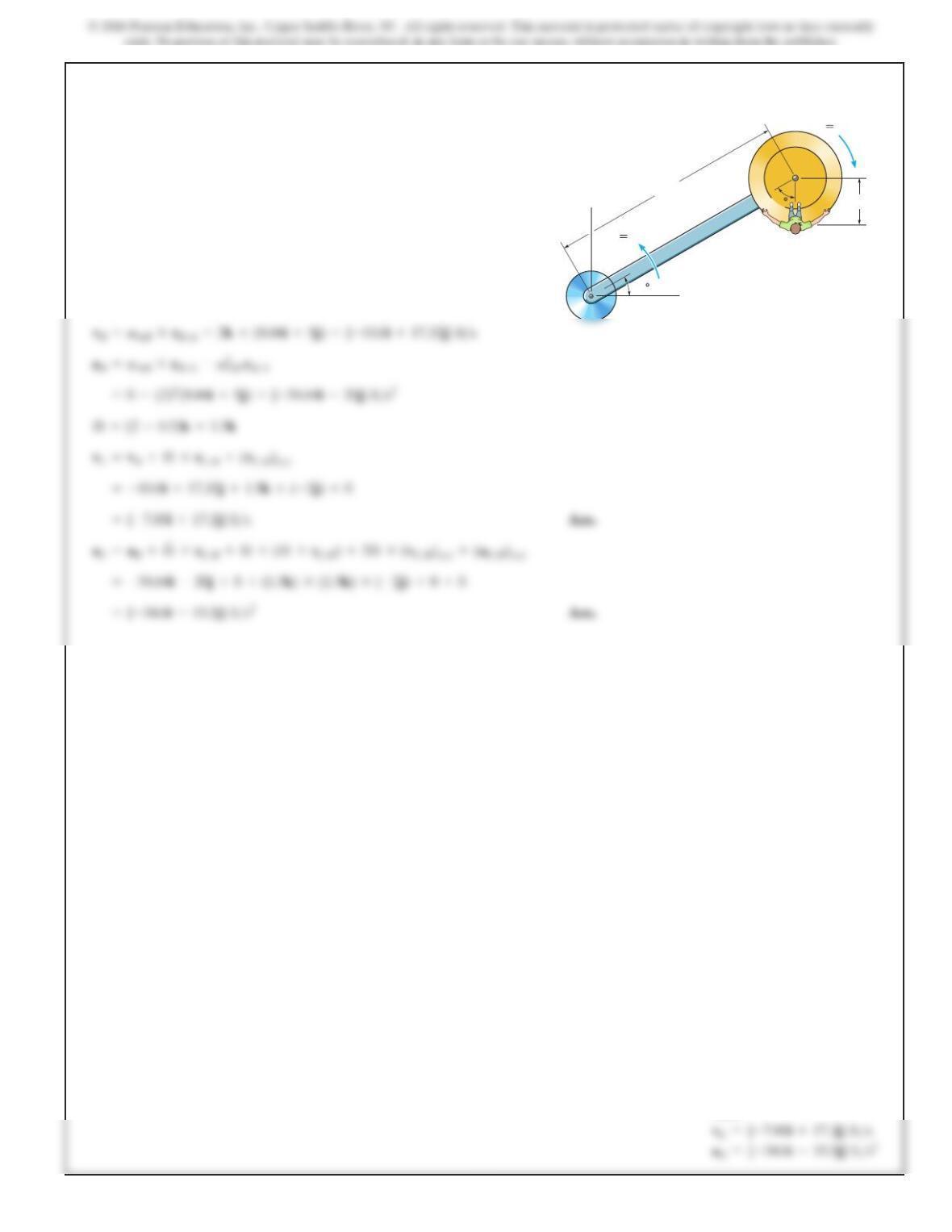
Aride in an amusement park consists of a rotating arm AB
having a constant angular velocity about point
Aand a car mounted at the end of the arm which has a
constant angular velocity measured
relative to the arm. At the instant shown, determine the
velocity and acceleration of the passenger at C.
V¿=5–0.5k6rad>s,
vAB =2 rad>s
SOLUTION
rB>A=(10 cos 30° i+10 sin 30° j)={8.66i+5j}ft
60
30
B
C
A
x
y2ft
10 ft
vAB 2 rad/s
v¿0.5 rad/s
Ans:
784
16–146.
SOLUTION
rB>A=(10 cos 30°i+10 sin 30°j)={8.66i+5j}ft
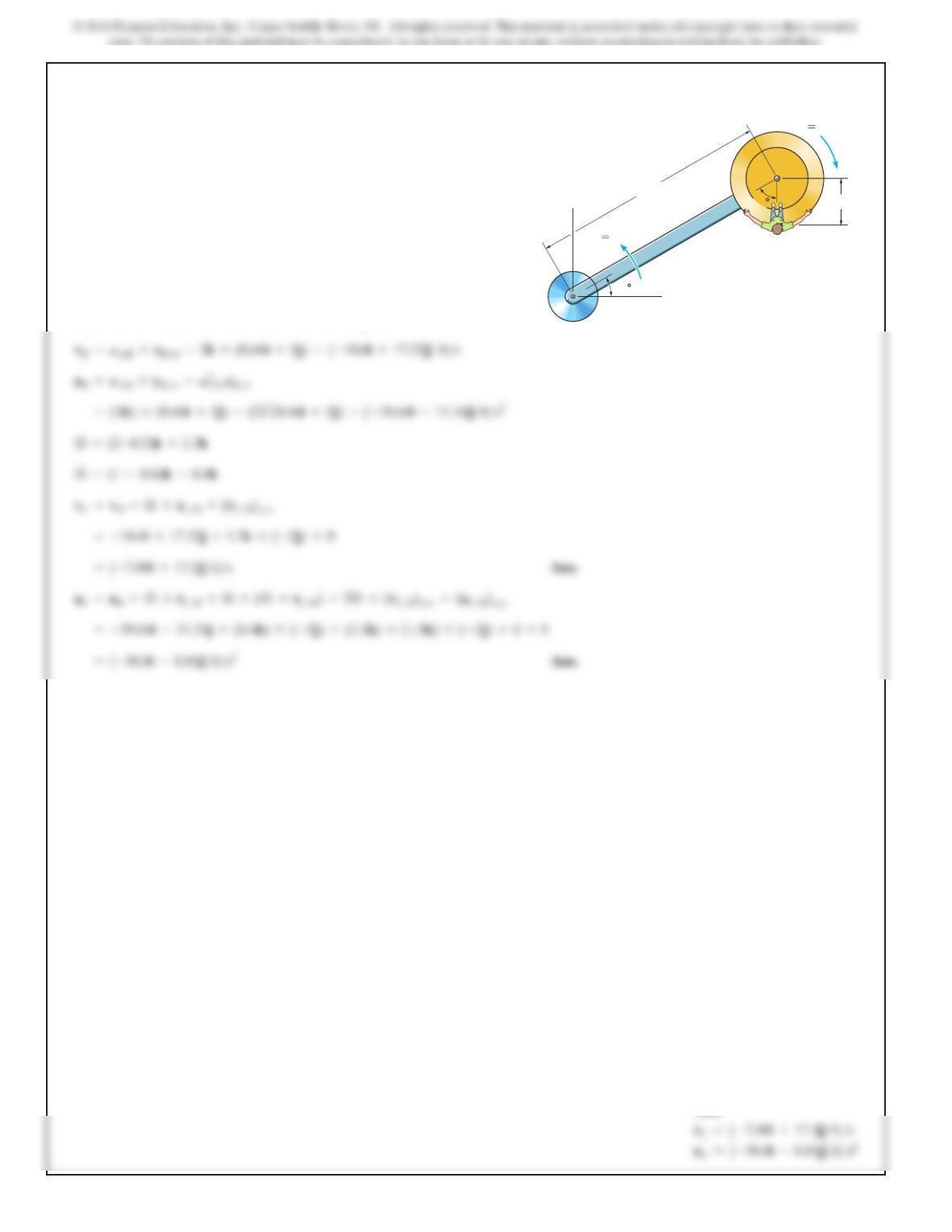
Aride in an amusement park consists of a rotating arm AB
that has an angular acceleration of when
at the instant shown. Also at this instant the
car mounted at the end of the arm has an angular
acceleration of and angular velocity of
measured relative to the arm.
Determine the velocity and acceleration of the passenger C
at this instant.
V¿=5–0.5k6rad>s,
A
= 5–0.6k6rad>s2
vAB =2 rad>s
aAB =1 rad>s2
60
30
B
C
A
x
y2ft
10 ft
vAB 2 rad/s
v¿0.5 rad/s
Ans:
785
16–147.
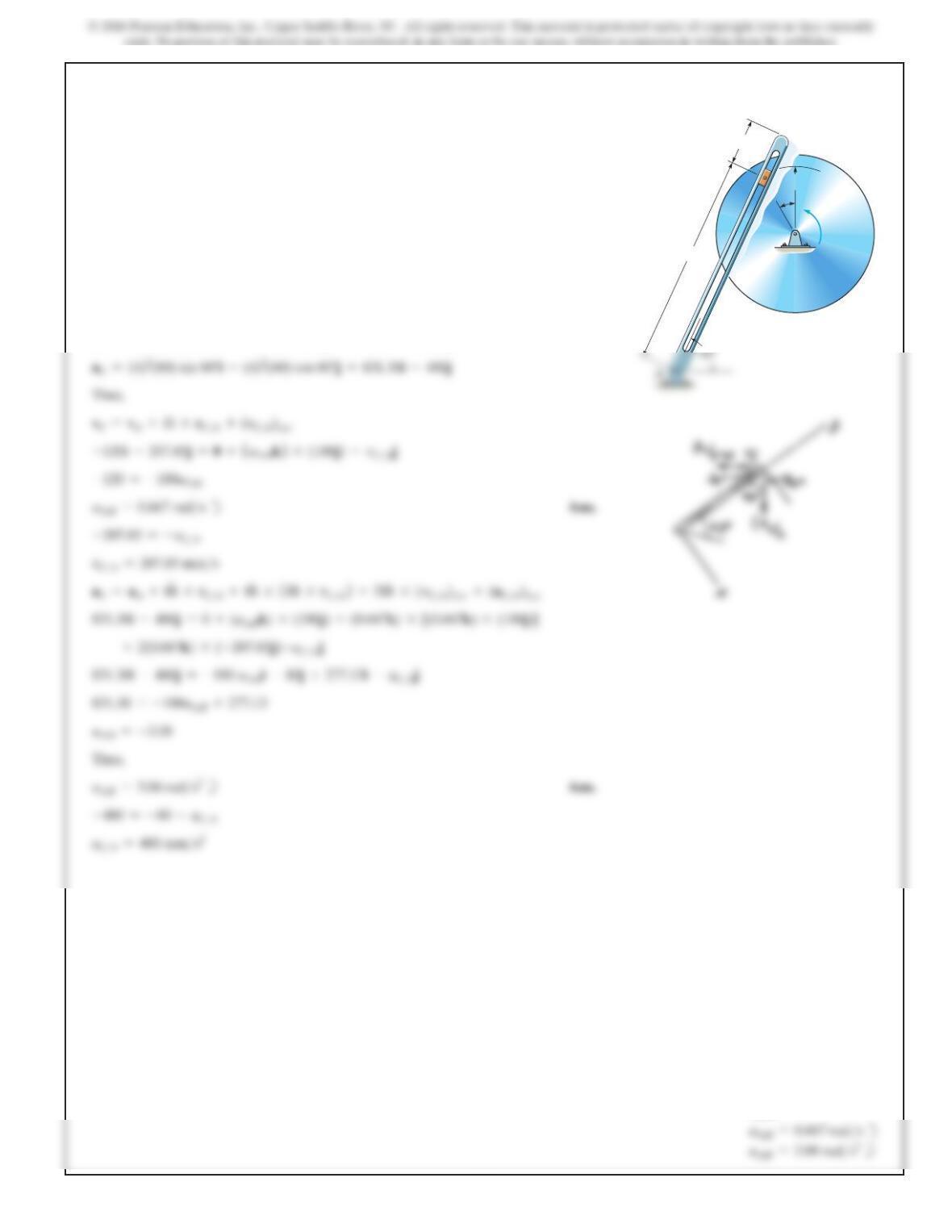
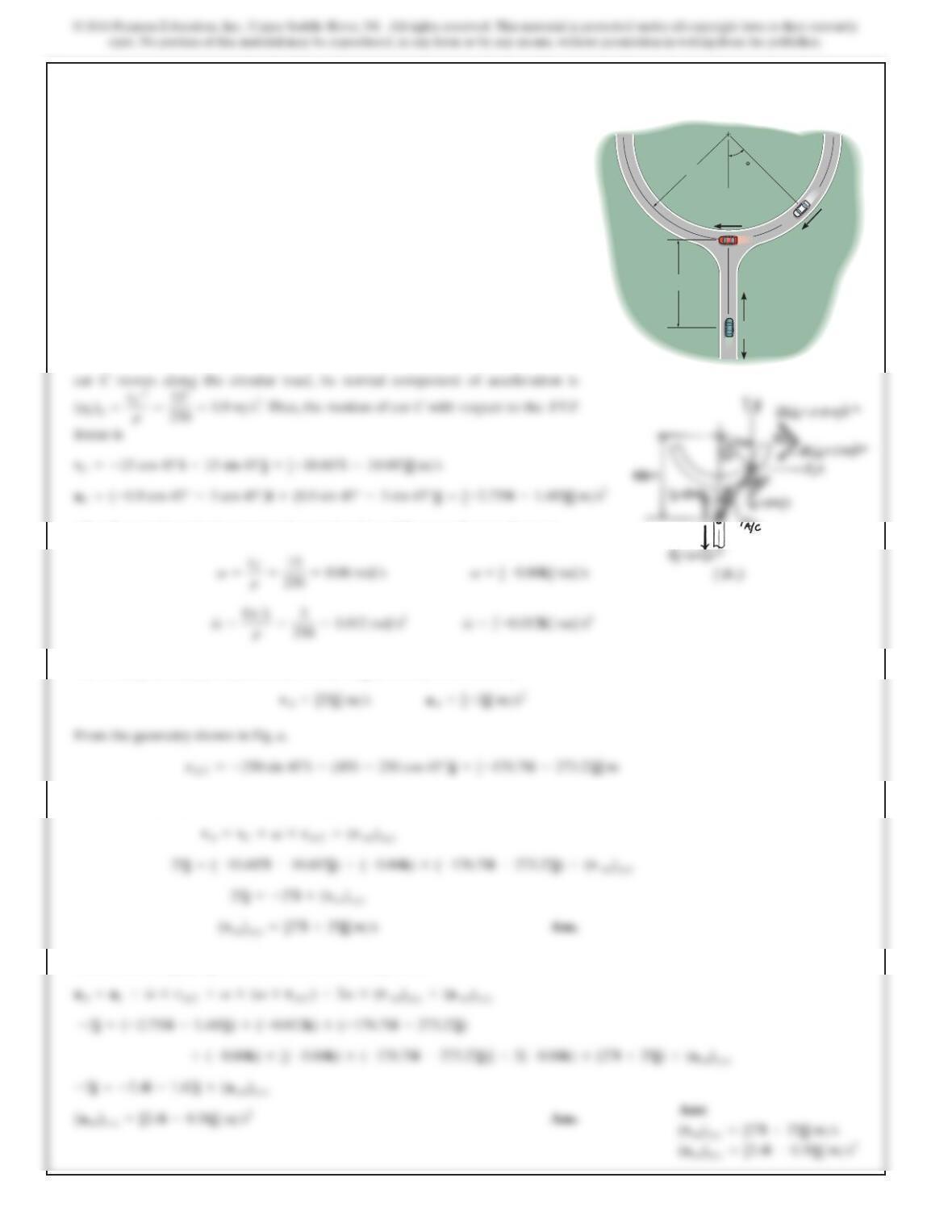
If the slider block C is fixed to the disk that has a constant
counterclockwise angular velocity of 4 rad
>
s, determine the
angular velocity and angular acceleration of the slotted arm
AB at the instant shown.
Ans:
180 mm
B
40 mm
C60 mm
v 4 rad/s
30
SOLUTION
vC=–(4)(60) sin 30°i–4(60) cos 30°j=–120i–207.85j
786
*16–148.
SOLUTION
Reference Frame: The xyz rotating reference frame is attached to car Cand
coincides with the XYZ fixed reference frame at the instant considered, Fig. a. Since
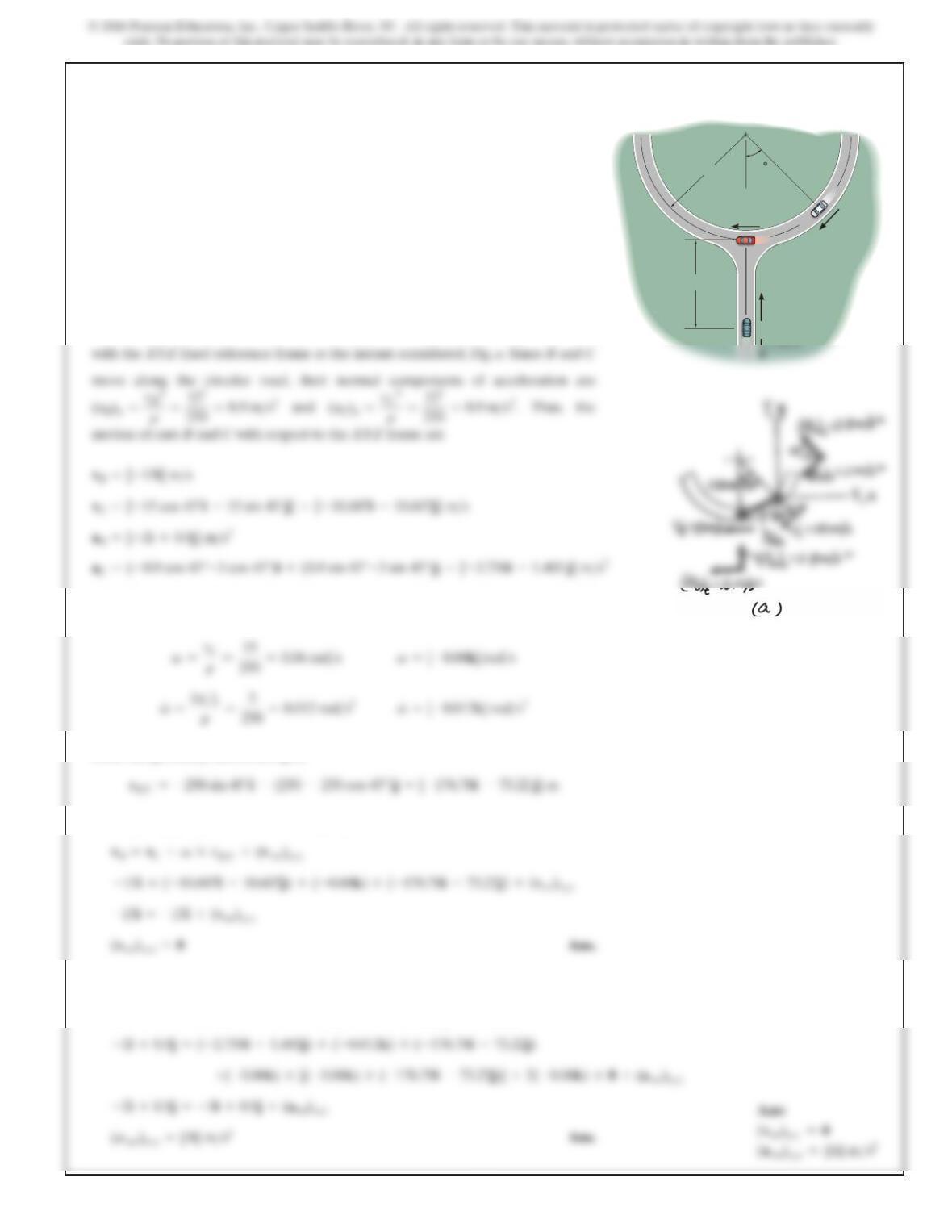
At the instant shown, car Atravels with a speed of ,
which is decreasing at a constant rate of , while car C
travels with a speed of , which is increasing at a
constant rate of . Determine the velocity and
acceleration of car Awith respect to car C.
3m>s2
15 m>s
2m>s2
25 m
>
s
250 m
15 m/s
2m/s2
200 m
A
B
15 m/s
3m/s2
25 m/s
2m/s2
C
45
Also, the angular velocity and angular acceleration of the xyz reference frame is
The velocity and accdeleration of car Awith respect to the XYZ frame is
Velocity: Applying the relative velocity equation,
Acceleration: Applying the relative acceleration equation,
787
16–149.
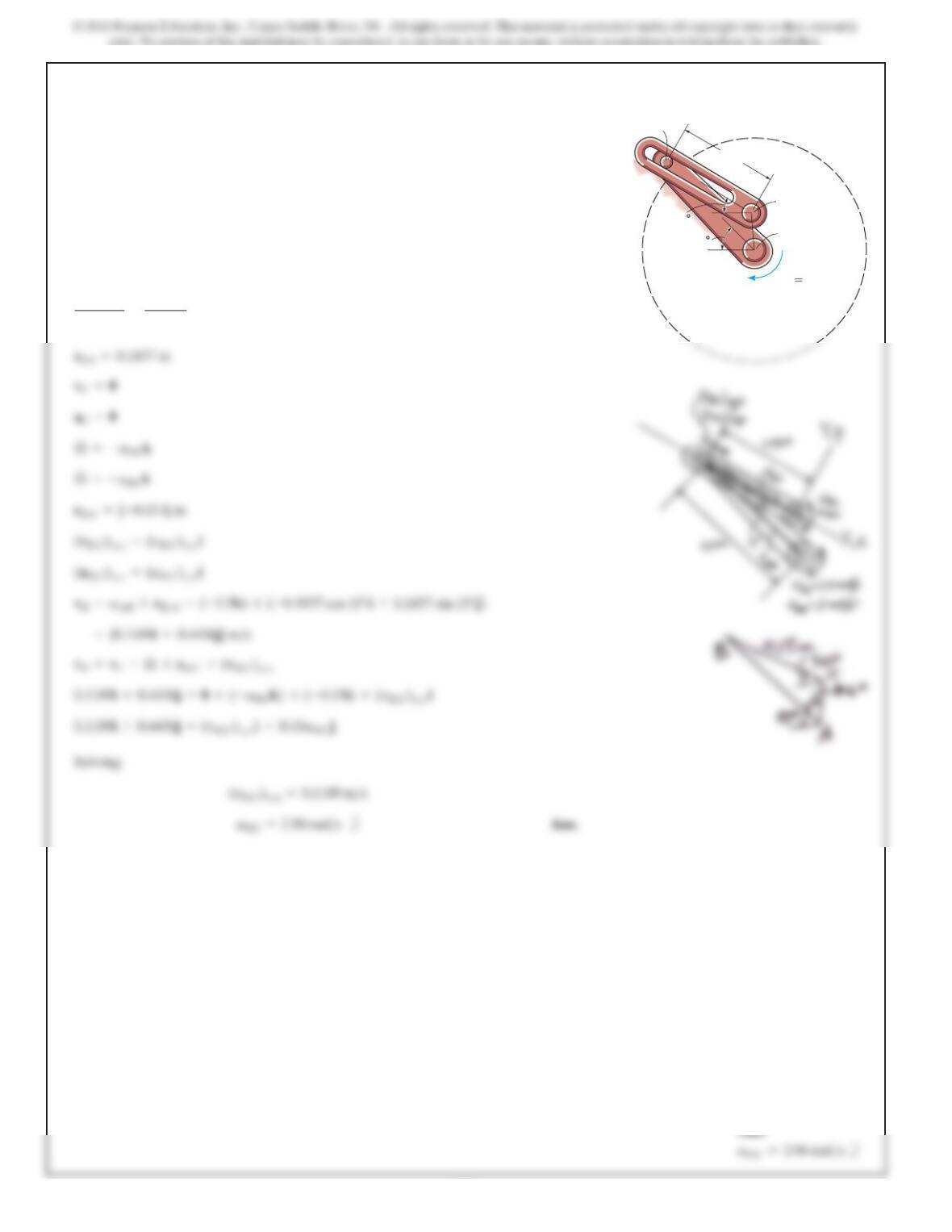
At the instant shown, car Btravels with a speed of 15 ,
which is increasing at a constant rate of , while car C
travels with a speed of which is increasing at a
constant rate of . Determine the velocity and
acceleration of car Bwith respect to car C.
3 m>s2
15 m>s,
2m>s2
m
>
s
SOLUTION
Reference Frame: The xyz rotating reference frame is attached to Cand coincides
250 m
15 m/s
2m/s2
200 m
A
B
15 m/s
3m/s2
25 m/s
C
45
Also, the angular velocity and angular acceleration of the xyz reference frame with
respect to the XYZ reference frame are
From the geometry shown in Fig. a,
Velocity: Applying the relative velocity equation,
Acceleration: Applying the relative acceleration equation,
aB=aC+v
#*rB>C+v*(v*rB>C)+2v*(vrel)xyz +(arel)xyz
788
16–150.
SOLUTION
AB 2.5 rad/s
45
30
150 mm
C
A
v
B
D
rBA
sin 120° =0.15 m
sin 45°
The two-link mechanism serves to amplify angular motion.
Link AB has a pin at B which is confined to move within the
slot of link CD. If at the instant shown, AB (input) has an
angular velocity of vAB = 2.5 rad>s, determine the angular
velocity of CD (output) at this instant.
789
16–151.
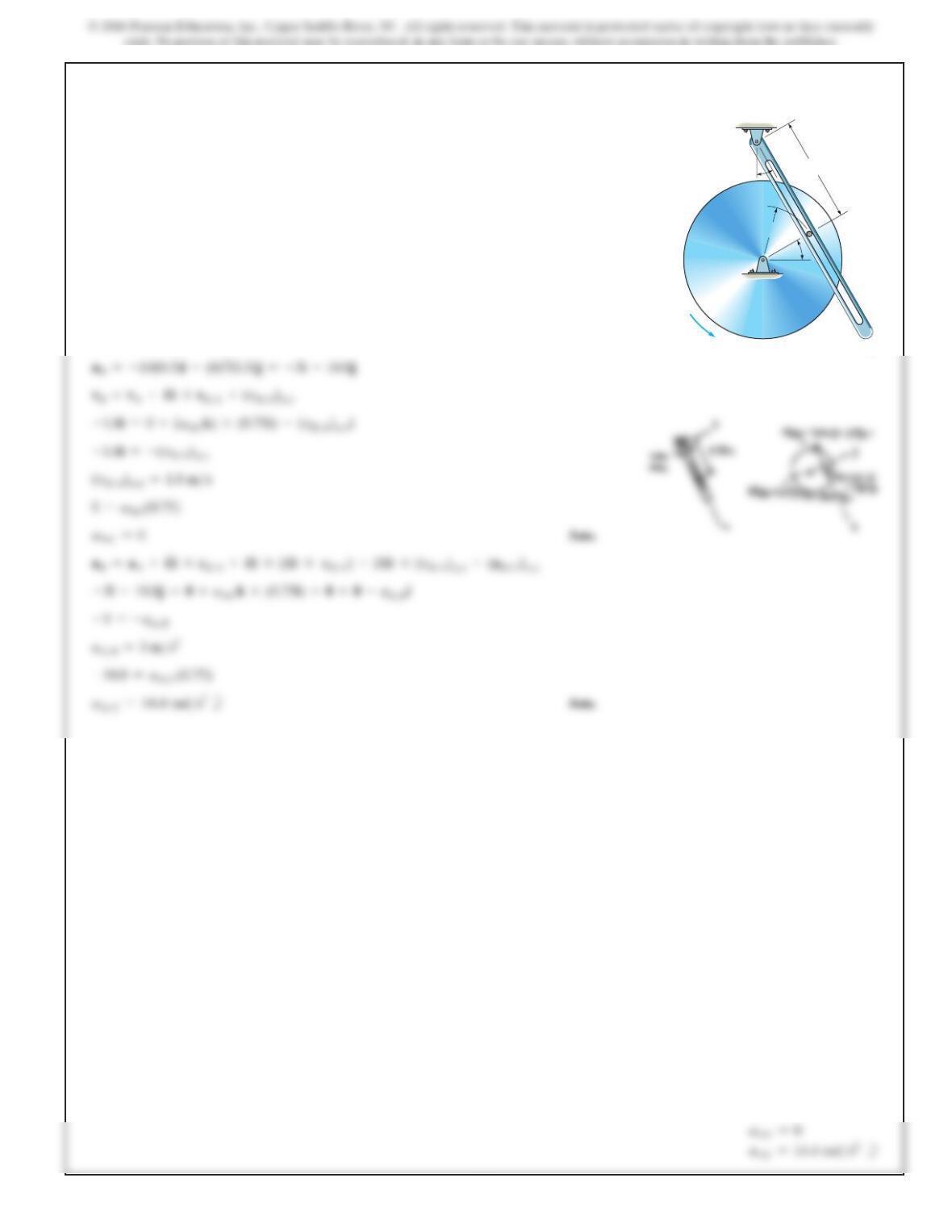
The disk rotates with the angular motion shown. Determine
the angular velocity and angular acceleration of the slotted
link AC at this instant. The peg at B is fixed to the disk.
A
C
v 6 rad/s
a 10 rad/s2
30
30
0.3 m
0.75 m
B
SOLUTION
vB=–6(0.3)i=–1.8i
Ans:
790
*16–152.
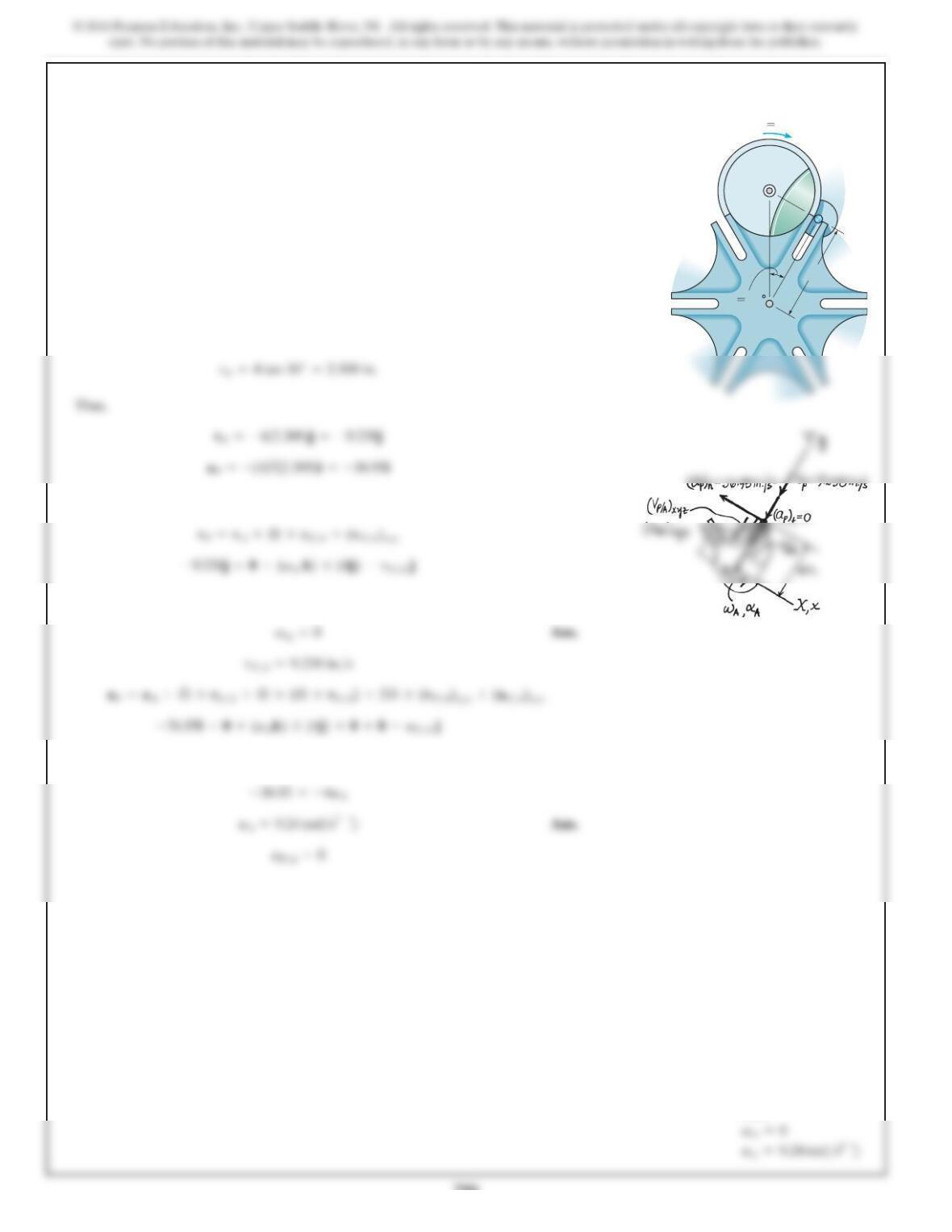
The Geneva mechanism is used in a packaging system to
convert constant angular motion into intermittent angular
motion. The star wheel Amakes one sixth of a revolution
for each full revolution of the driving wheel Band the
attached guide C.To do this, pin P, which is attached to B,
slides into one of the radial slots of A, thereby turning
wheel A, and then exits the slot. If Bhas a constant angular
velocity of , determine and of wheel A
at the instant shown.
AA
VA
vB=4 rad>s
SOLUTION
The circular path of motion of Phas a radius of
Thus,
Solving,
Solving,
A
vB
BC
P
4 in.
u 30
4 rad/s
Ans: