494
*15–20.
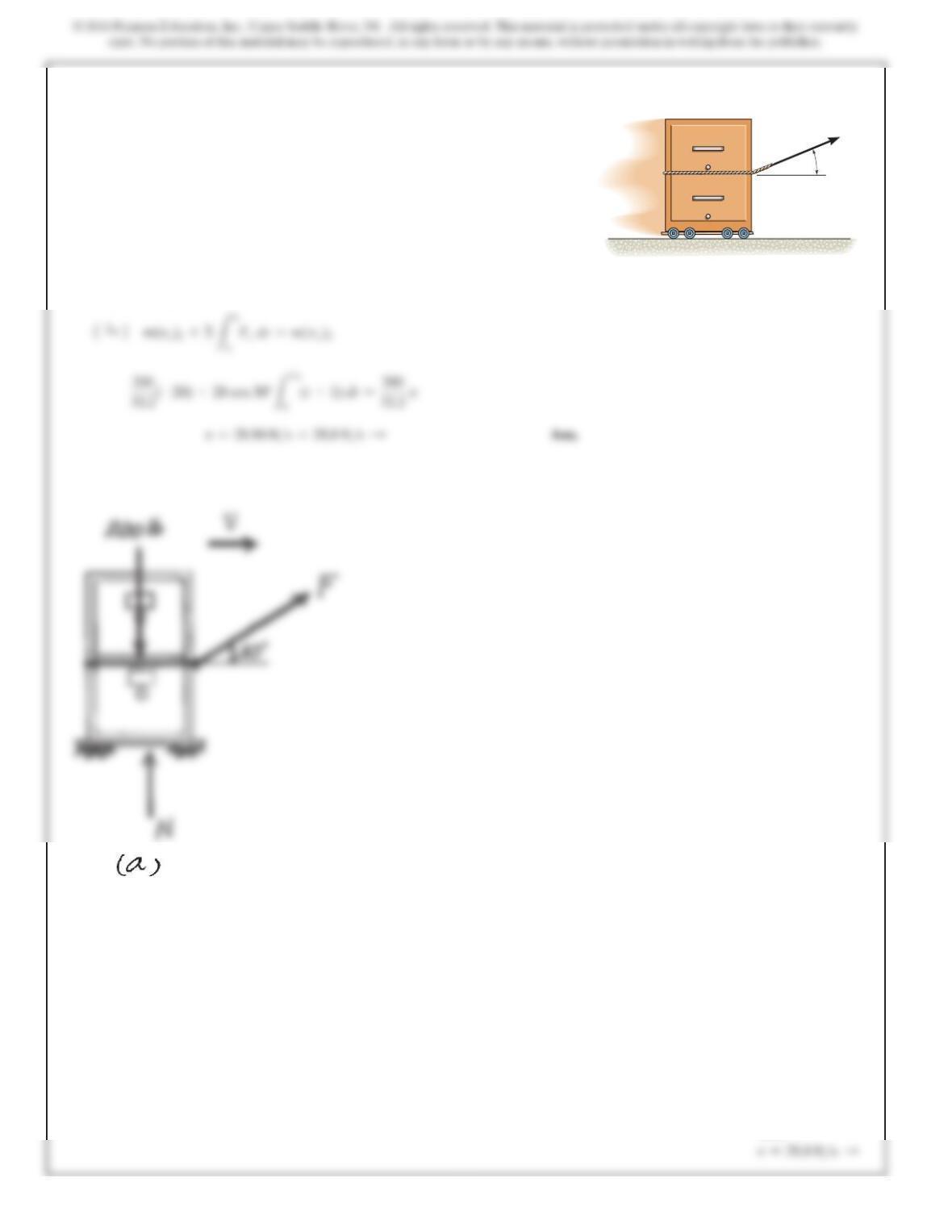
The 200-lb cabinet is subjected to the force
F=20(t+1) lb
where t is in seconds. If the cabinet is initially moving to
the left with a velocity of 20 ft
>
s, determine its speed when
t=5
s. Neglect the size of the rollers.
SOLUTION
Principle of Impulse and Momentum. Referring to the FBD of the cabinet, Fig. a
30
F
Ans:
495
15–21.
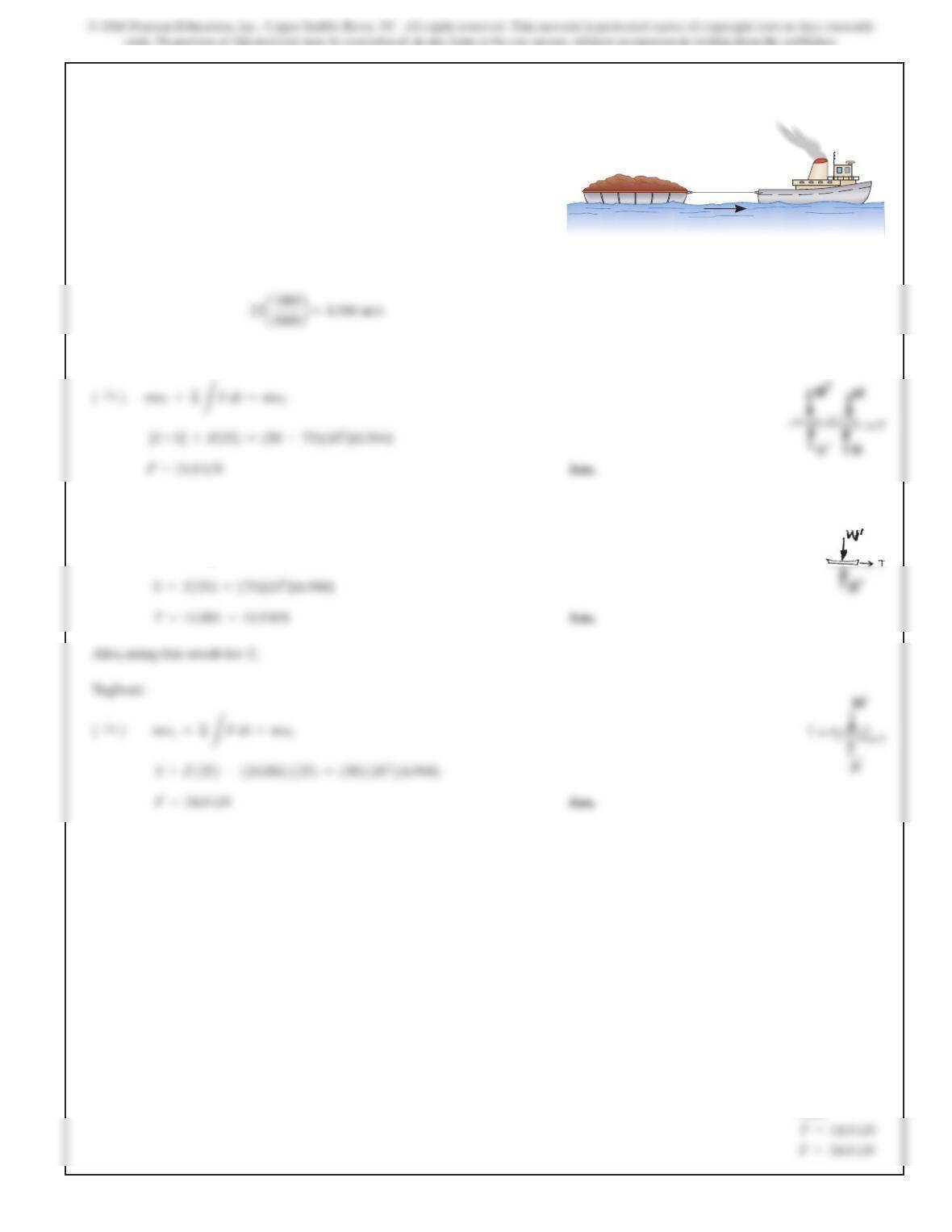
If it takes 35 s for the 50-Mg tugboat to increase its speed
uniformly to starting from rest, determine the
force of the rope on the tugboat.The propeller provides the
propulsion force Fwhich gives the tugboat forward motion,
whereas the barge moves freely.Also, determine Facting on
the tugboat. The barge has a mass of 75 Mg.
25 km>h,
SOLUTION
System:
Barge:
(:
+)mv1+©
LFdt=mv2
F
Ans:
15–22.
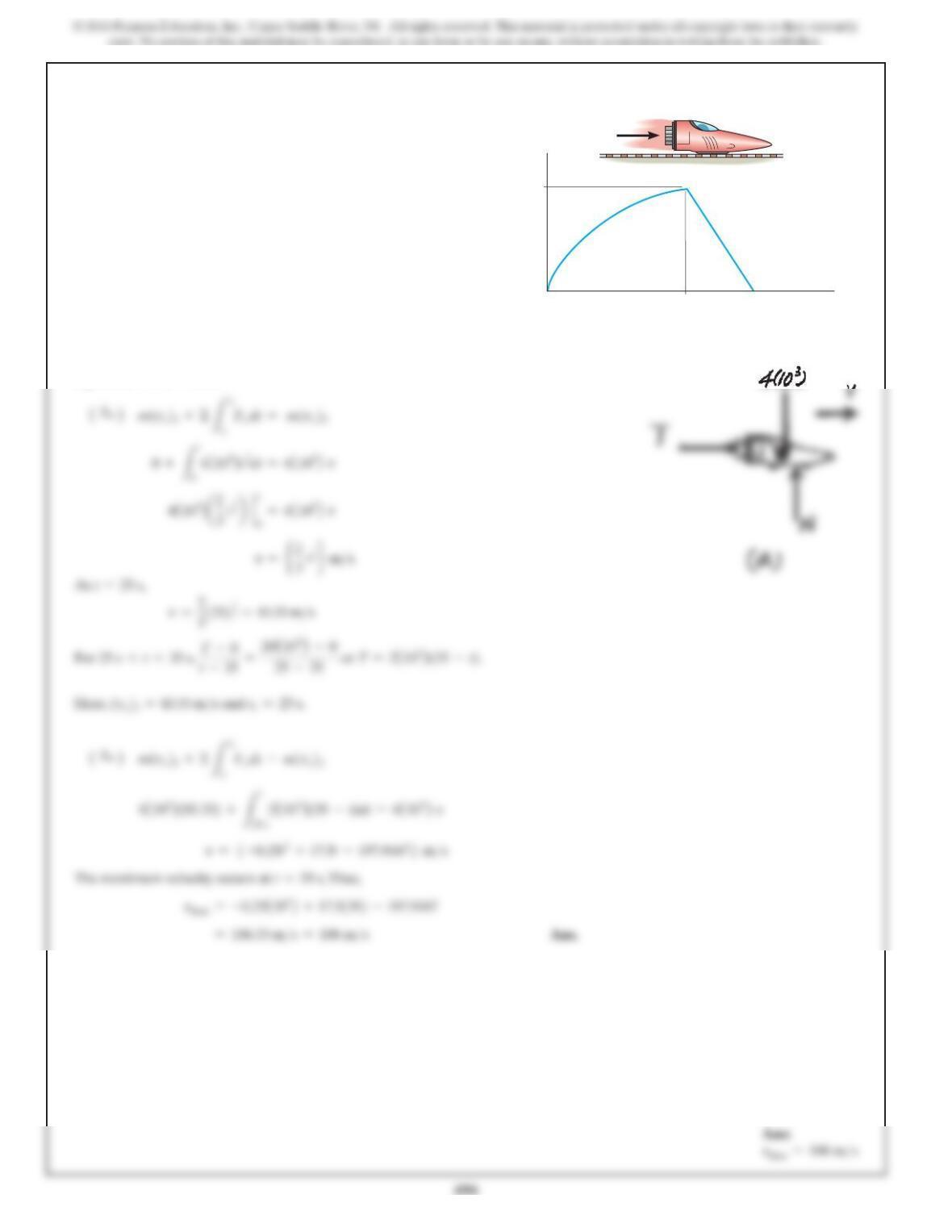
The thrust on the 4-Mg rocket sled is shown in the graph.
Determine the sleds maximum velocity and the distance the
sled travels when
t=35
s. Neglect friction.
SOLUTION
Principle of Impulse And Momentum. The FBD of the rocket sled is shown in
Fig.a. For
0…t625 s
,
t=25 s
t=35 s
T (kN)
t
(s)
T
T 4 t1/2
20
25 35
497
15–22. Continued
Kinematics. The displacement of the sled can be determined by integrating
ds =vdt.
For
0…t625 s
, the initial condition is
s=0
at
t=0
.
t=25 s
For
25 6t…35 s
, the initial condition is
s=833.33
at
t=25 s
.
t=35 s
Ans:
498
15–23.
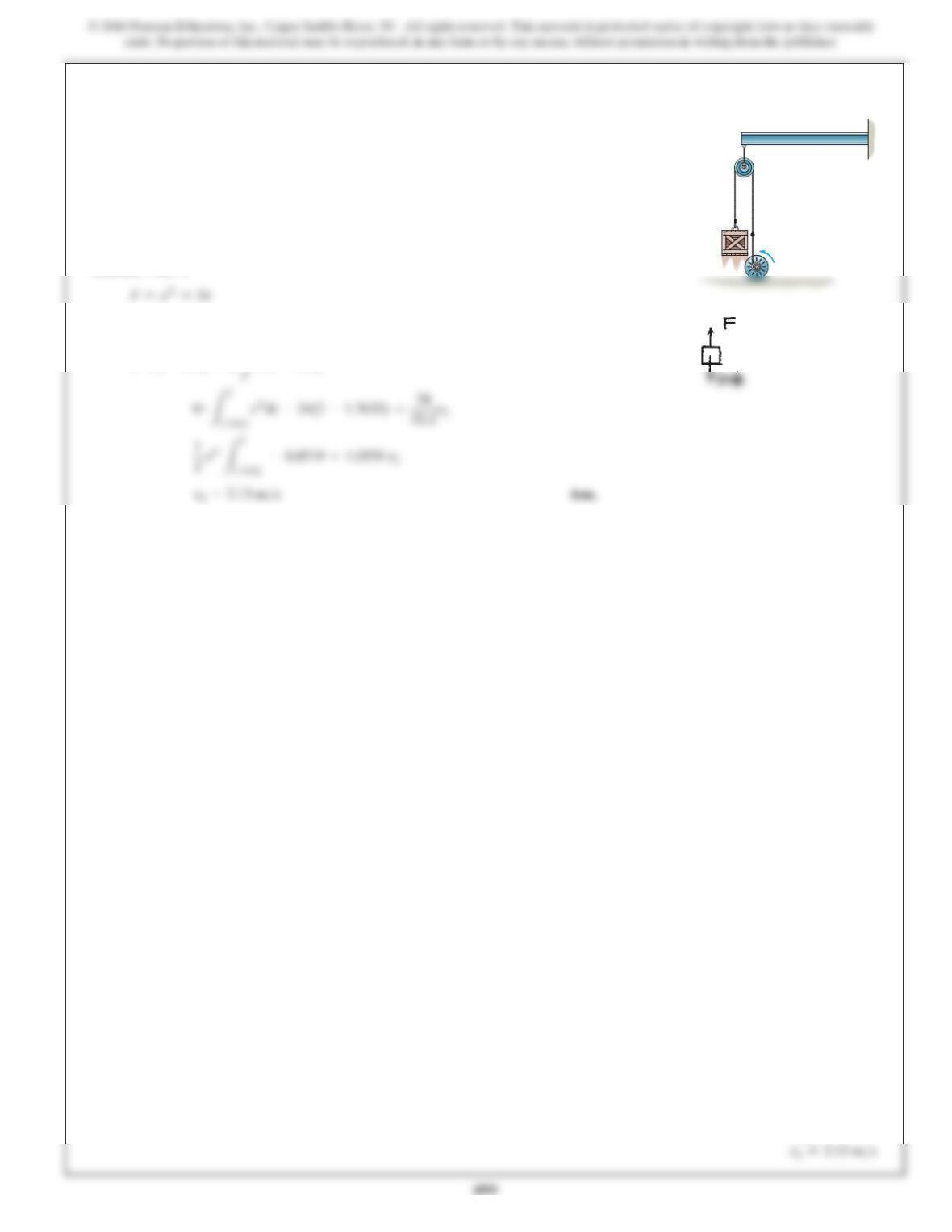
The motor pulls on the cable at A with a force
F
=
(
30
+
t
2
)
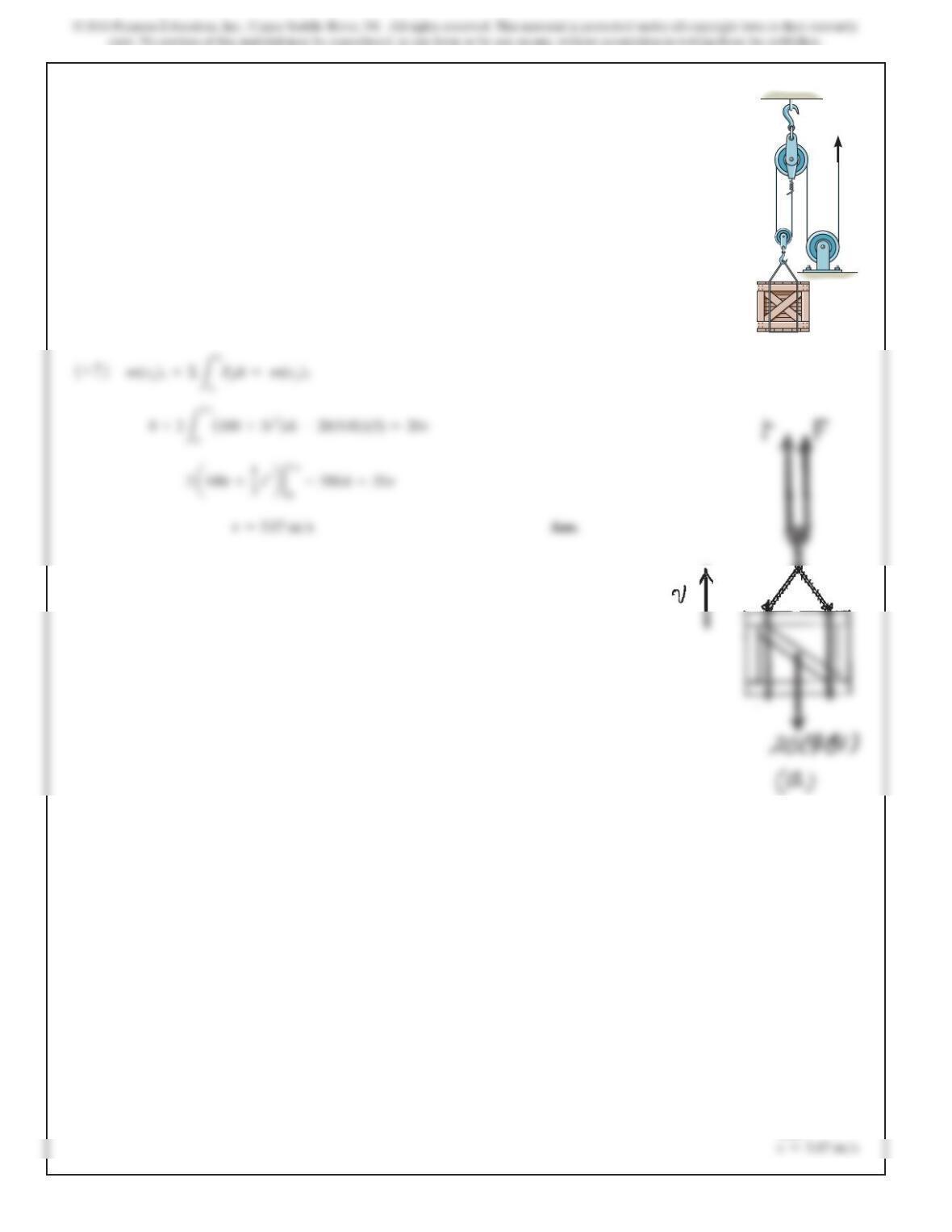
lb, where t is in seconds. If the 34-lb crate is
originally on the ground at
t=0
, determine its speed in
t=4
s. Neglect the mass of the cable and pulleys. Hint:
First find the time needed to begin lifting the crate.
SOLUTION
30 +t2=34
t=2 s
A
Ans:
*15–24.
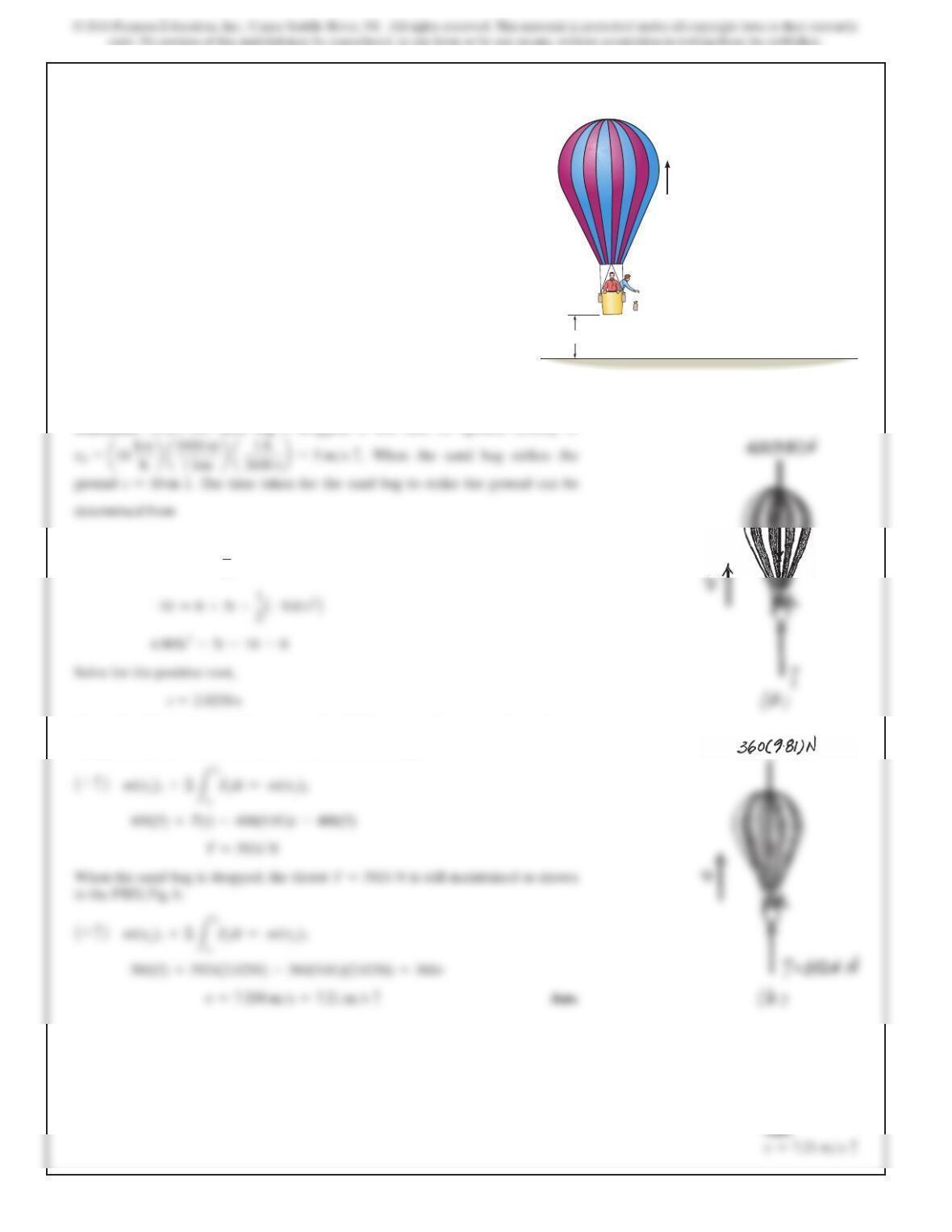
The motor pulls on the cable at A with a force F
=
(e
2t
) lb,
where t is in seconds. If the 34-lb crate is originally at rest
on the ground at
t=0
, determine the crate’s velocity when
t=2
s. Neglect the mass of the cable and pulleys. Hint:
First find the time needed to begin lifting the crate.
SOLUTION
t=1.7632 s
for crate to start moving
(
+
c
)
mv1+Σ
Fdt =mv2
A
Ans:
500
15–25.
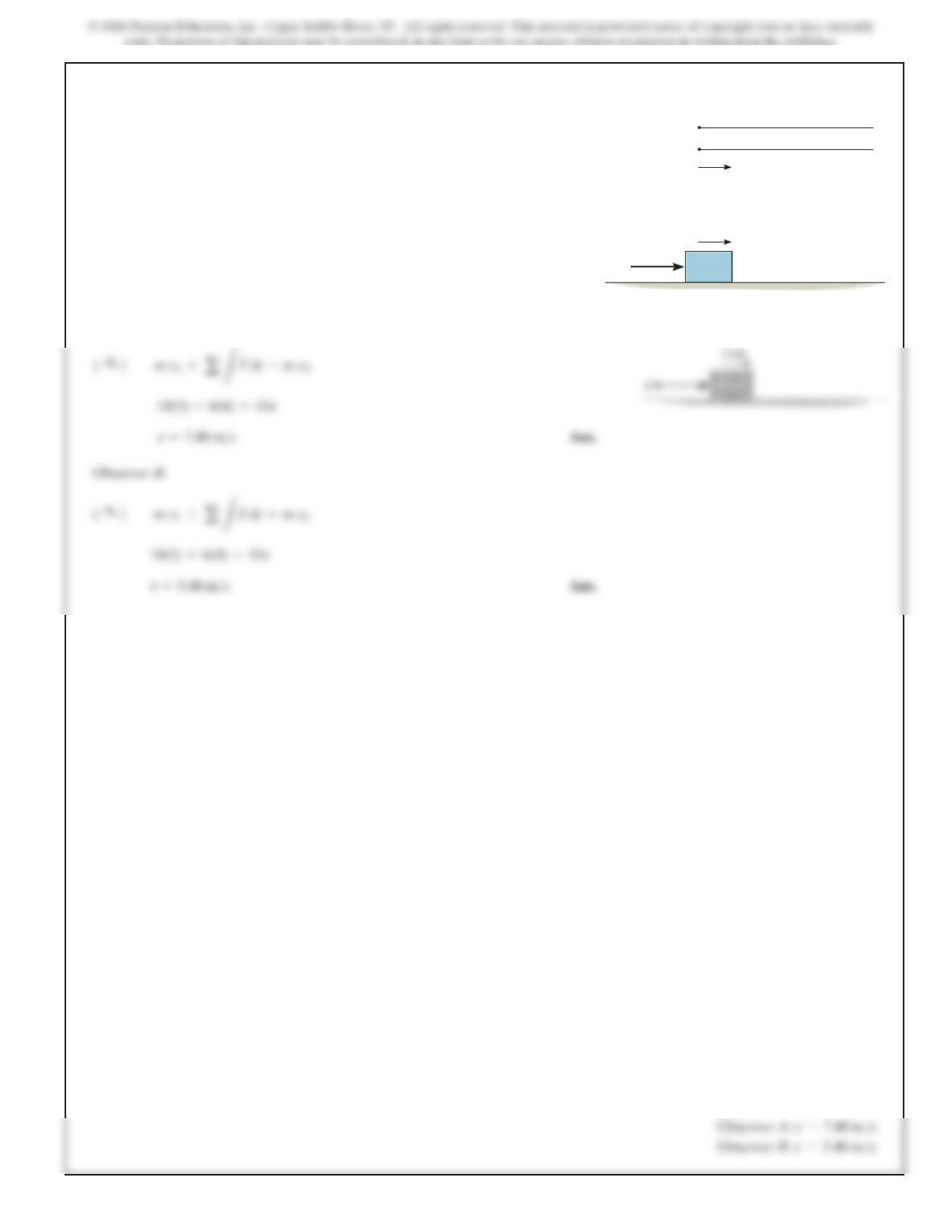
The balloon has a total mass of 400 kg including the
passengers and ballast. The balloon is rising at a constant
velocity of 18 km
>
h when
h=10
m. If the man drops the
40-kg sand bag, determine the velocity of the balloon when
the bag strikes the ground. Neglect air resistance.
SOLUTION
Kinematic. When the sand bag is dropped, it will have an upward velocity of
(
+
c
)
s=s0+ v0t+
1
2
act2;
Principle of Impulse and Momentum. The FBD of the ballon when the ballon is
rising with the constant velocity of
5 m>s
is shown in Fig. a
h
vA 18 km/h
A
501
15–26.
As
i
n
di
cate
d
b
y t
h
e
d
er
i
vat
i
on, t
h
e pr
i
nc
i
p
l
e of
i
mpu
l
se an
d
momentum is valid for observers in any inertial reference
frame.Show that this is so,by considering the 10-kg block
horizontal force of 6 N. If observer Ais in a fixed frame x,
determine the final speed of the block in 4 s if it has an initial
speed of measured from the fixed frame. Compare the
result with that obtained by an observer B,attached to the
axis that moves at a constant velocity of relative to A.2m>s
x¿
5m>s
SOLUTION
Observer A:
6N
5m/s
2m/s
x
A
x¿
B
which slides along the smooth surface and is subjected to a
Ans:
502
15–27.
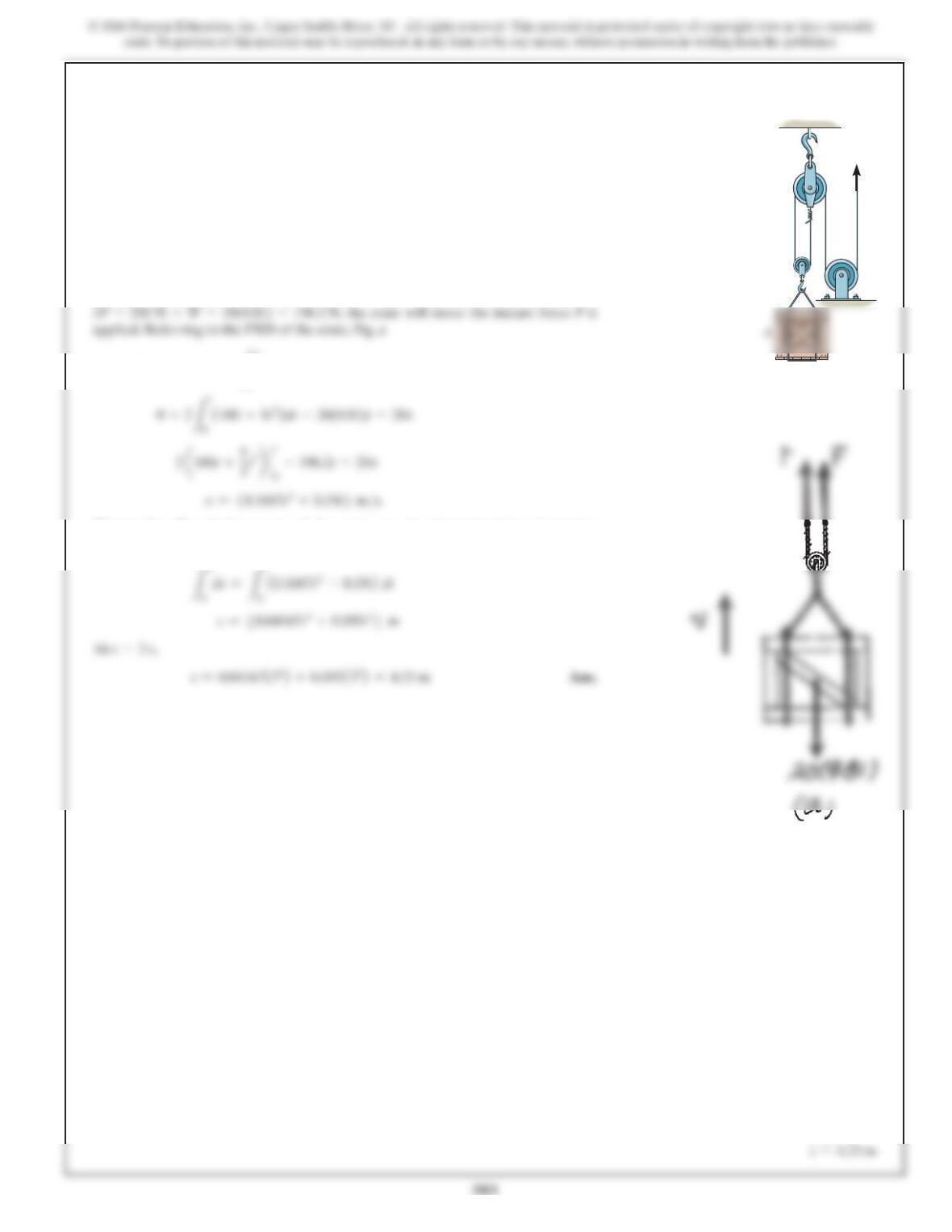
The 20-kg crate is lifted by a force of F
=
(100
+
5t
2
) N,
where t is in seconds. Determine the speed of the crate when
t=3
s, starting from rest.
SOLUTION
Principle of Impulse and Momentum. At
t=0
,
F=100 N
. Since at this instant,
2F=200 N 7W=20(9.81) =196.2 N
, the crate will move the instant force F is
applied. Referring to the FBD of the crate, Fig. a,
Ans:
A
B
F
*15–28.
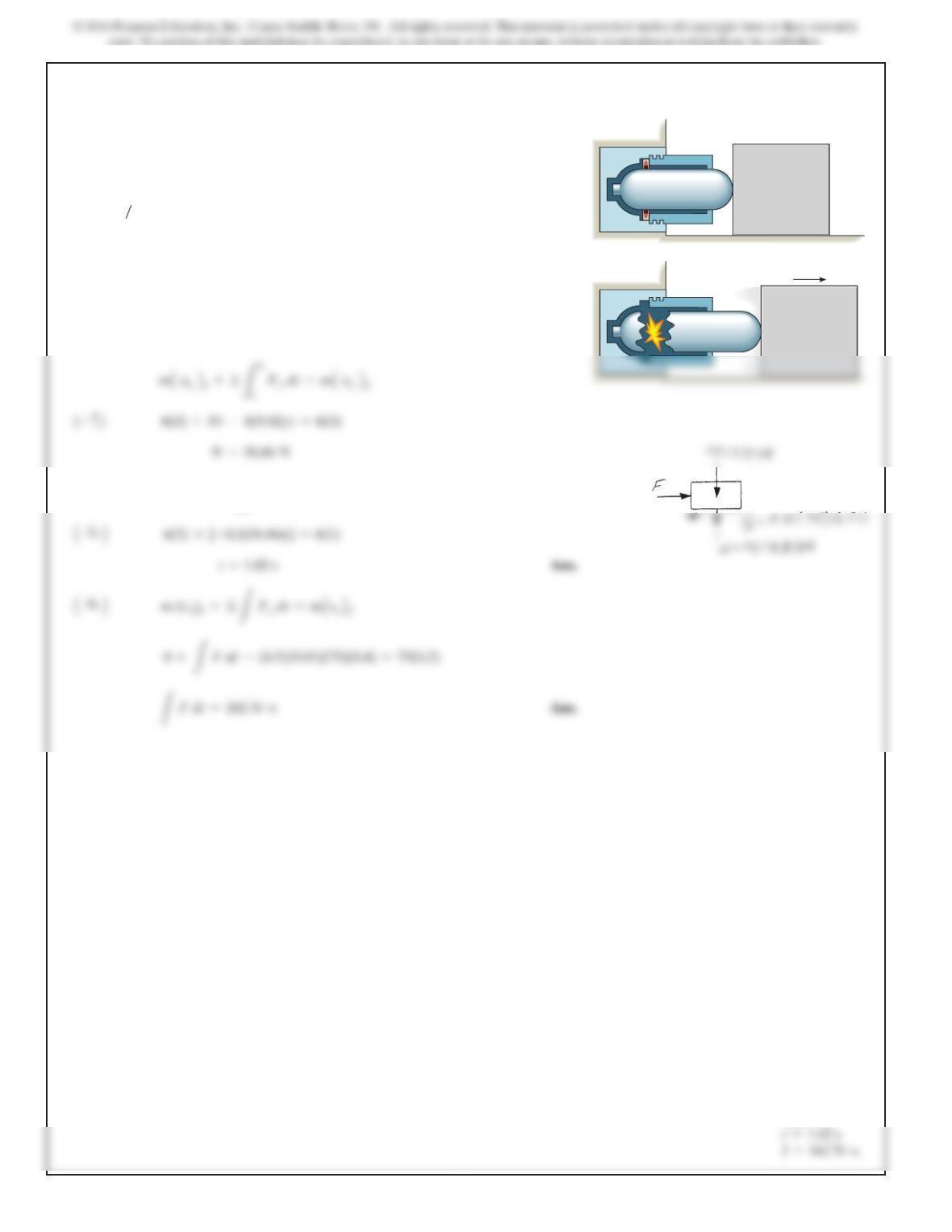
The 20-kg crate is lifted by a force of F
=
(
100
+
5t
2
)
N,
where t is in seconds. Determine how high the crate has
moved upward when
t=3
s, starting from rest.
SOLUTION
Principle of Impulse and Momentum. At
t=0
,
F=100 N
. Since at this instant,
(
+
c
)
m(vy)1+ΣLt2
t
1
Fydt = m(vy)2
Kinematics. The displacement of the crate can be determined by integrating
ds =v dt
with the initial condition
s=0
at
t=0
.
t=3 s
B
F
Ans:
504
15–29.
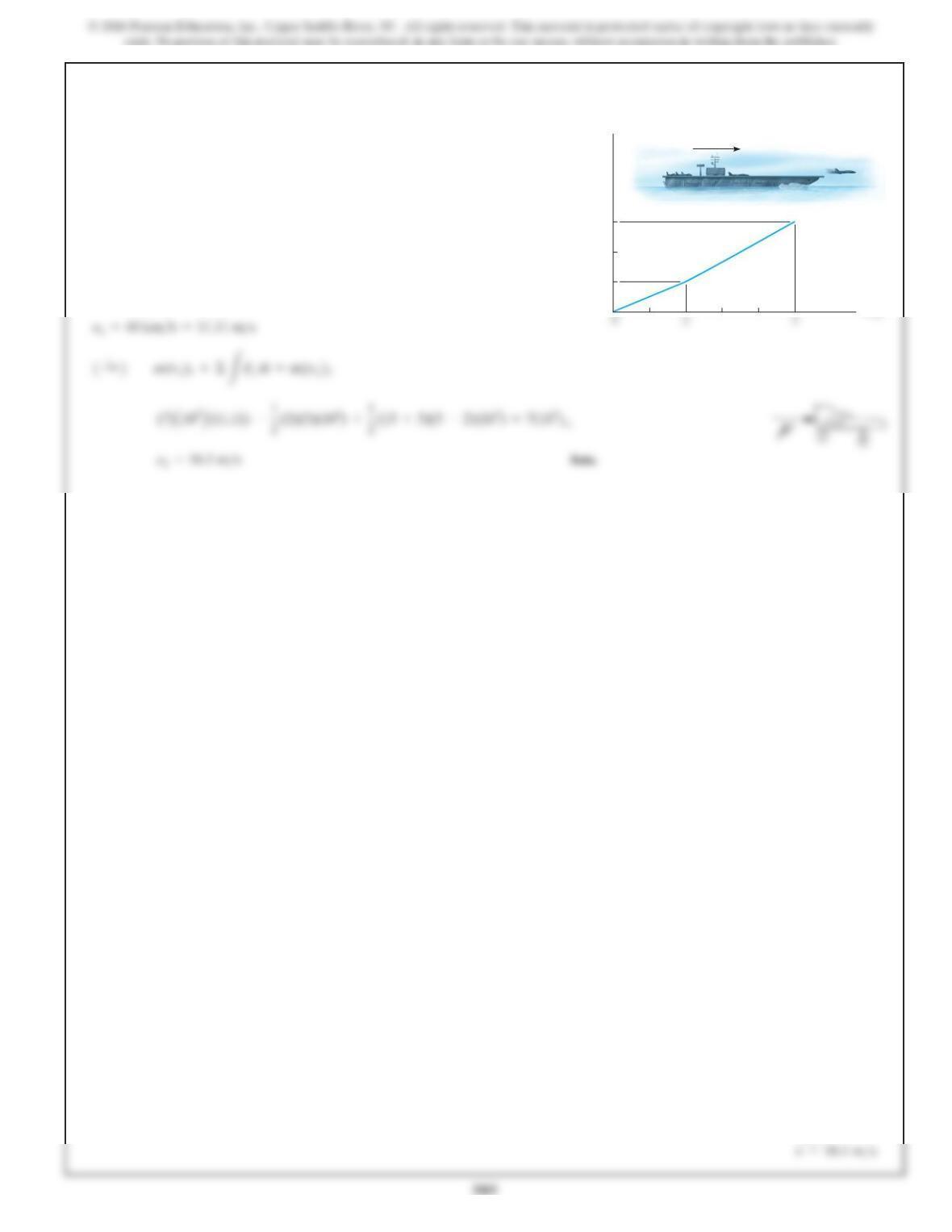
In case of emergency, the gas actuator is used to move a
75-kg block Bby exploding a charge Cnear a pressurized
cylinder of negligible mass. As a result of the explosion, the
cylinder fractures and the released gas forces the front part
of the cylinder, A, to move Bforward, giving it a speed of
200 mm s in 0.4 s. If the coefficient of kinetic friction
between Band the floor is , determine the impulse
that the actuator imparts to B.
mk=0.5
SOLUTION
Principle of Linear Impulse and Momentum: In order for the package to rest on
top of the belt,it has to travel at the same speed as the belt. Applying Eq.15–4,
we have
m(yx)1+©
Lt2
t1
Fxdt =m(yx)2
v
B
= 200 mm/s
B
B
A
C
A
Ans:
15–30.
SOLUTION
T
he impulse exerted on the plane is equal to the area under the graph.
A
j
et p
l
ane
h
av
i
ng a mass of 7 Mg ta
k
es off from an a
i
rcraft
carrier such that the engine thrust varies as shown by the
graph. If the carrier is traveling forward with a speed of
determine the plane’s airspeed after 5 s.40 km>h,
t(s)
F(kN)
15
5
40 km/h
Ans:
15–31.
SOLUTION
1+T2mv1+©
LFdt=mv2
sA+2sB=l
Block Aweighs 10 lb and block Bweighs 3lb. If Bis
moving downward withavelocity at
determine the velocity of Awhen Assume that the
horizontal plane is smooth. Neglect the mass of the pulleys
and cords.
t=1s.
t=0,1vB21=3ft>s
A
Ans:
*15–32.
Block Aweighs 10 lb and block Bweighs 3lb. If Bis
moving downward with a velocity at
determine the velocity of Awhen The coefficient of
kinetic friction between the horizontal plane and block Ais
mA=0.15.
t=1s.
t=0,1vB21=3ft>s
SOLUTION
1;
+2mv1+©
LFdt=mv2
sA+2sB=l
A
Ans:
508
15–33.
SOLUTION
:
+©F
x=0;F–0.5(500)(9.81) =0
The log has a mass of 500 kg and rests on the ground for
which the coefficients of static and kinetic friction are
and respectively.The winch delivers a
horizontal towing force Tto its cable at Awhich varies as
shown in the graph. Determine the speed of the log when
Originally the tension in the cable is zero.Hint: First
determine the force needed to begin moving the log.
t=5s.
mk=0.4,ms=0.5
T(N)
1800
t(s)
T200 t
2
3
AT
Ans:
15–34.
The
0.15-kg baseball has a speed of v = 30 m
>
s just before
it
is struck by the bat. It then travels along the trajectory
shown
before the outfielder catches it. Determine the
magnitude
of the average impulsive force imparted to the
ball if it is in contact with the bat for 0.75 ms.
SOLUTION
(:
+)mA(vA)1+mB(vB)1=(mA+mB)v2
100 m
2.5 m
0.75 m
15
v1 30 m/s
v215
Ans:
510
SOLUTION
Conservation of Linear Momentum.
15–35.
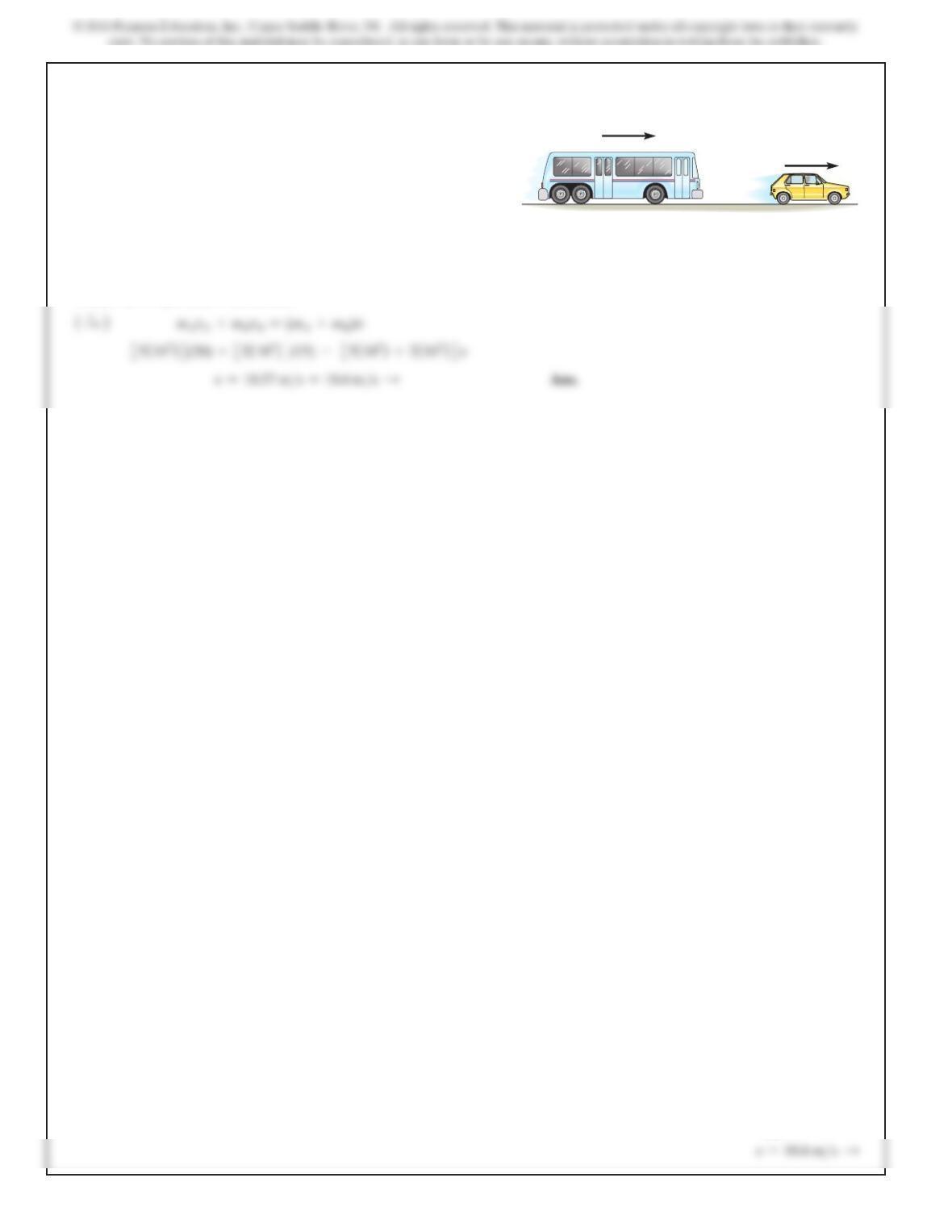
The 5-Mg bus B is traveling to the right at 20 m
>
s. Meanwhile
a 2-Mg car A is traveling at 15 m
>
s to the right. If the
vehicles crash and become entangled, determine their
common velocity just after the collision. Assume that the
vehicles are free to roll during collision.
vB 20 m/s
vA 15 m/s
B
A
Ans:
511
*15–36.
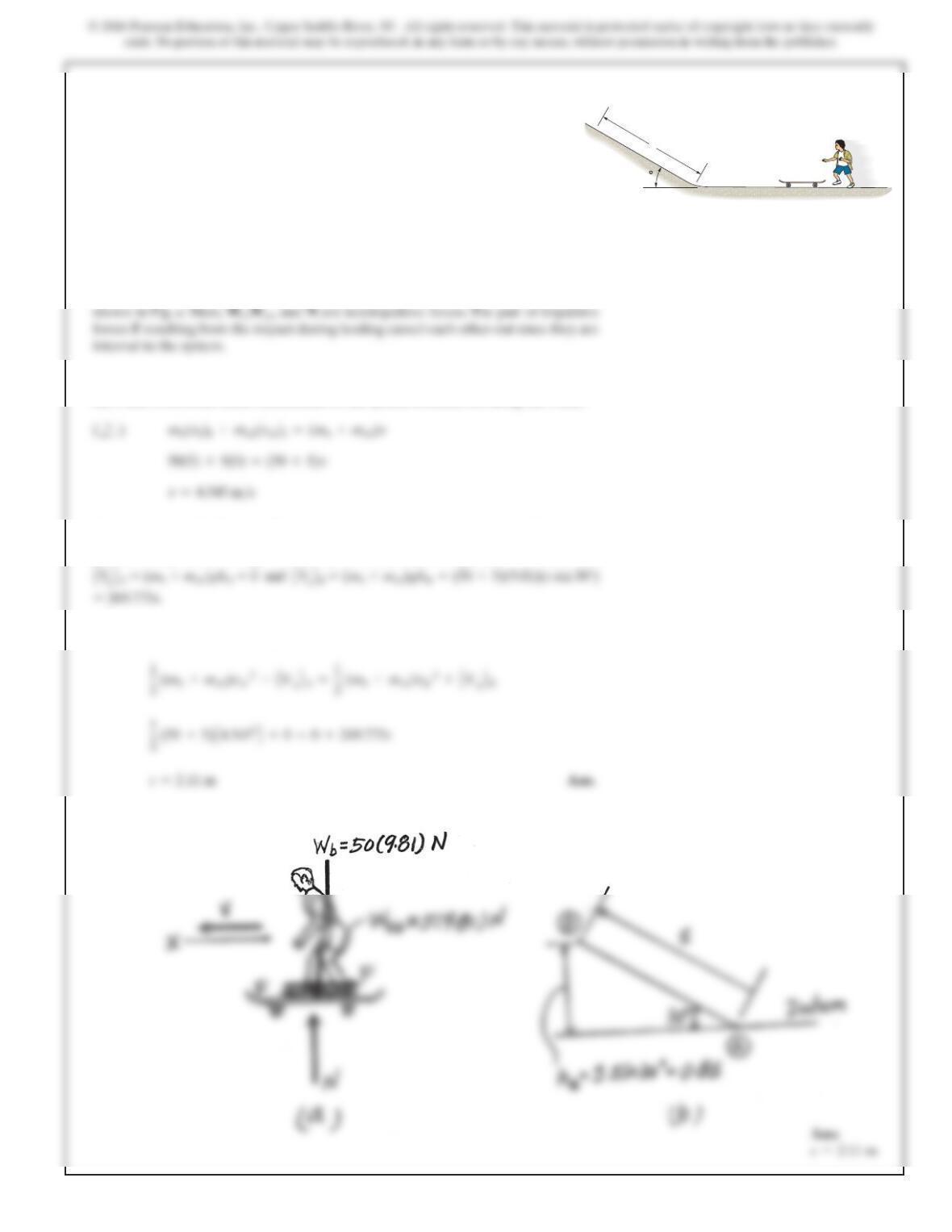
30
s
The 50-kg boy jumps on the 5-kg skateboard with a hori-
zontal velocity of . Determine the distance sthe boy
reaches up the inclined plane before momentarily coming
to rest.Neglect the skateboard’s rolling resistance.
5 m>s
SOLUTION
Free-Body Diagram: The free-body diagram of the boy and skateboard system is
Conservation of Linear Momentum: Since the resultant of the impulsive force along
the xaxis is zero,the linear momentum of the system is conserved along the xaxis.
Conservation of Energy: With reference to the datum set in Fig. b,the
gravitational potential energy of the boy and skateboard at positions Aand Bare
TA+VA=TB+VB
512
15–37.
30 km
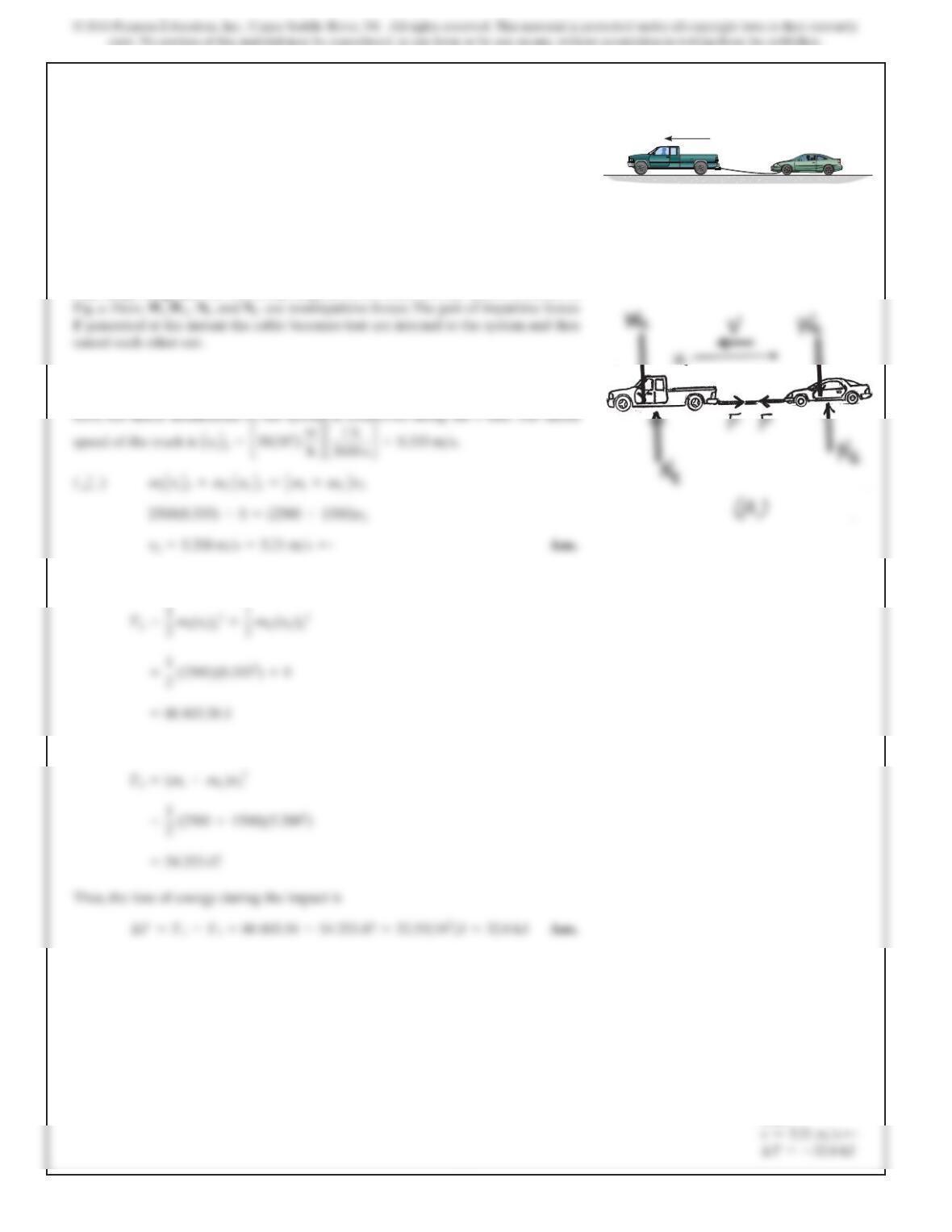
/
h
The 2.5-Mg pickup truck is towing the 1.5-Mg car using a
cable as shown. If the car is initially at rest and the truck is
coasting with a velocity of when the cable is slack,
determine the common velocity of the truck and the car just
after the cable becomes taut. Also, find the loss of energy.
30 km>h
SOLUTION
Free-Body Diagram: The free-body diagram of the truck and car system is shown in
Conservation of Linear Momentum: Since the resultant of the impulsive force is
Kinetic Energy: The initial and final kinetic energy of the system is
and
Ans:
513
15–38.
A railroad car having a mass of 15 Mg is coasting at 1.5 m
>
s
on a horizontal track. At the same time another car having
a mass of 12 Mg is coasting at 0.75 m>s in the opposite
direction. If the cars meet and couple together, determine
the speed of both cars just after the coupling. Find the
difference between the total kinetic energy before and
after coupling has occurred, and explain qualitatively what
happened to this energy.
SOLUTION
(S
+) Σmv1=Σmv2
Ans: