15–1.
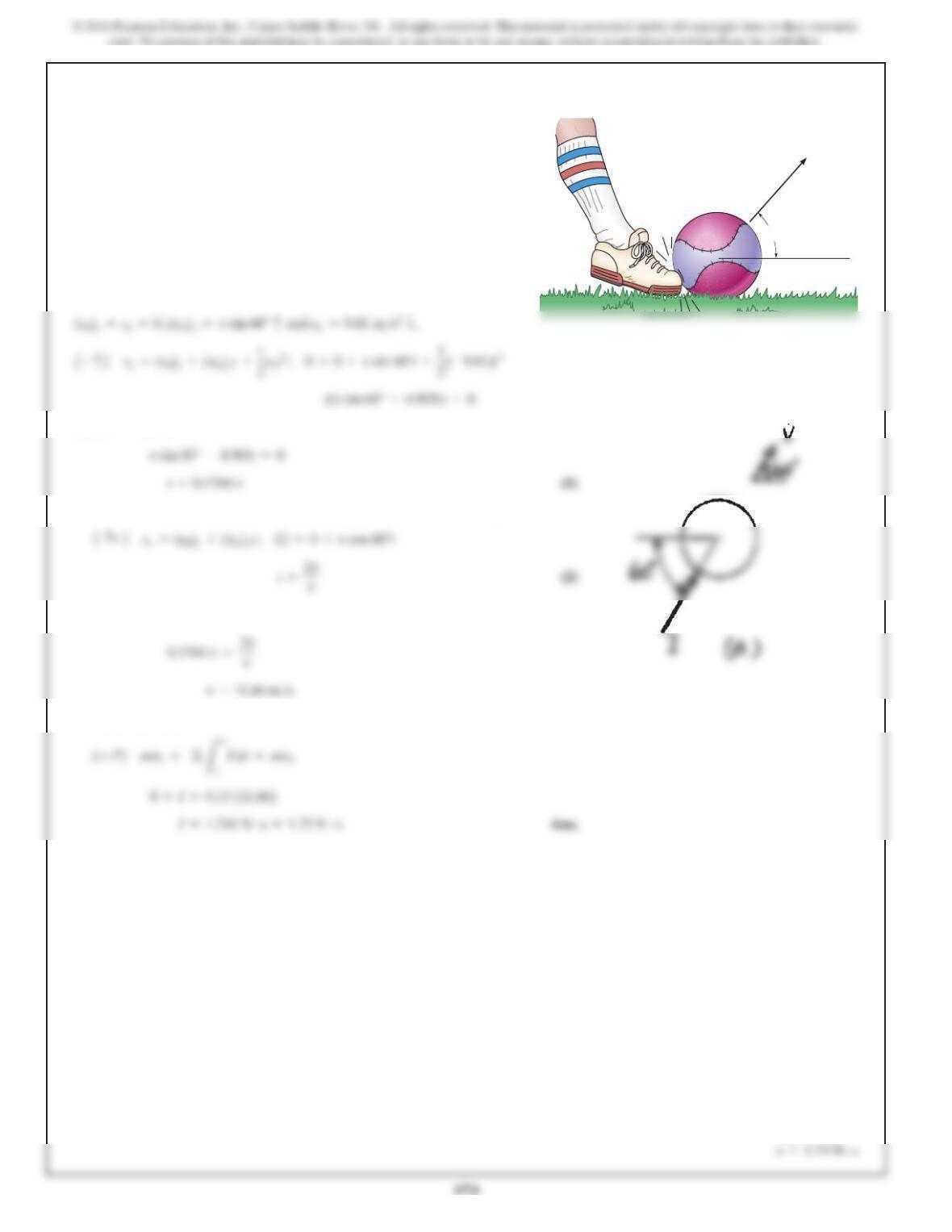
A man kicks the 150-g ball such that it leaves the ground at
an angle of 60
°
and strikes the ground at the same elevation
a distance of 12 m away. Determine the impulse of his foot
on the ball at A. Neglect the impulse caused by the ball’s
weight while it’s being kicked.
SOLUTION
Kinematics. Consider the vertical motion of the ball where
Since
t≠0
, then
Then, consider the horizontal motion where
(
v
0
)
x=
v
cos 60°
, and
(s0)x=0
,
Equating Eqs. (1) and (2)
Principle of Impulse and Momentum.
A
60
v
Ans:
475
15–2.
SOLUTION
A
+a
B
m1vvœ2+©
Lt2
t1
F
yœdt =m1vyœ22
A
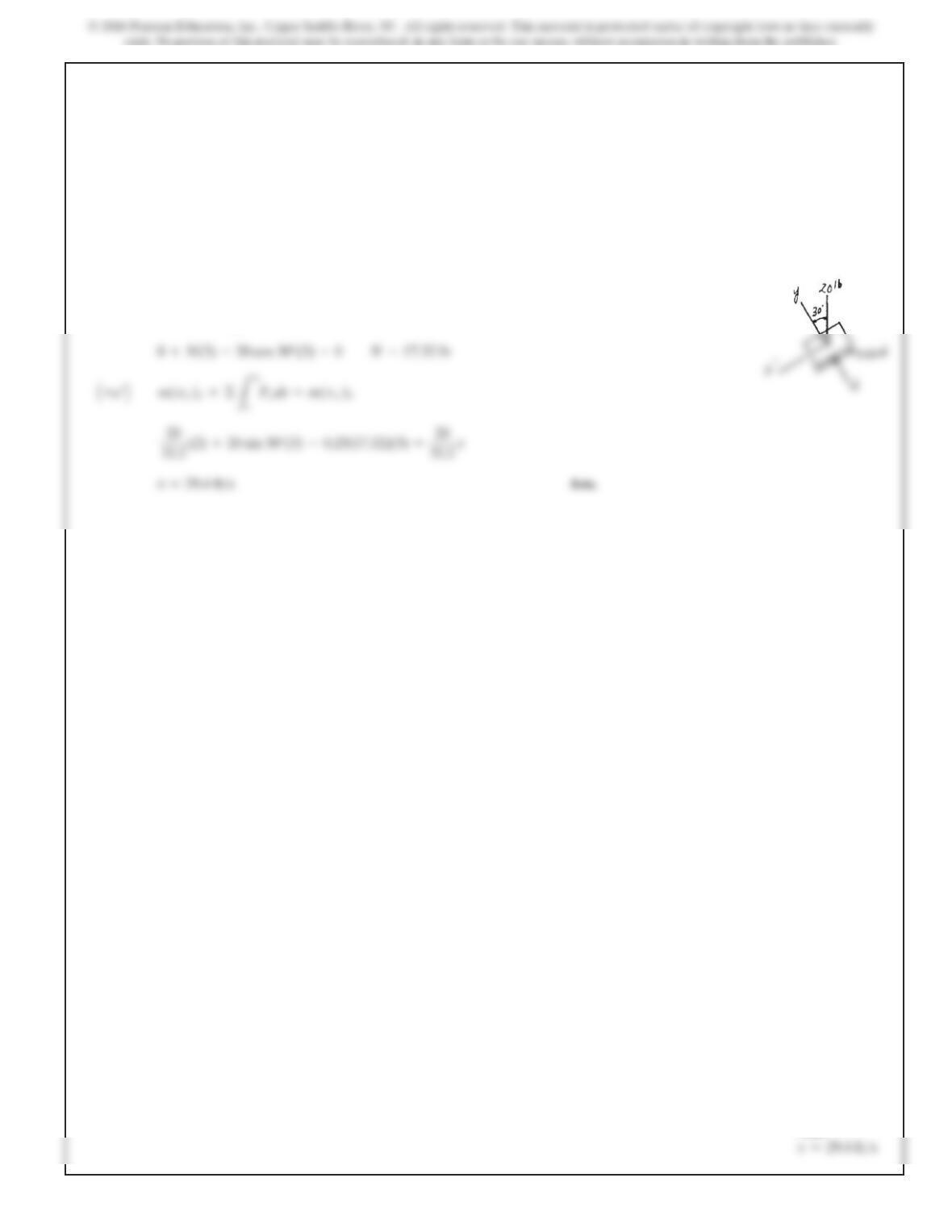
20-lb block slides down a 30° inclined plane with an
initial velocity of Determine the velocity of the block
in 3 s if the coefficient of kinetic friction between the block
and the plane is mk=0.25.
2ft>s.
Ans:
15–3.
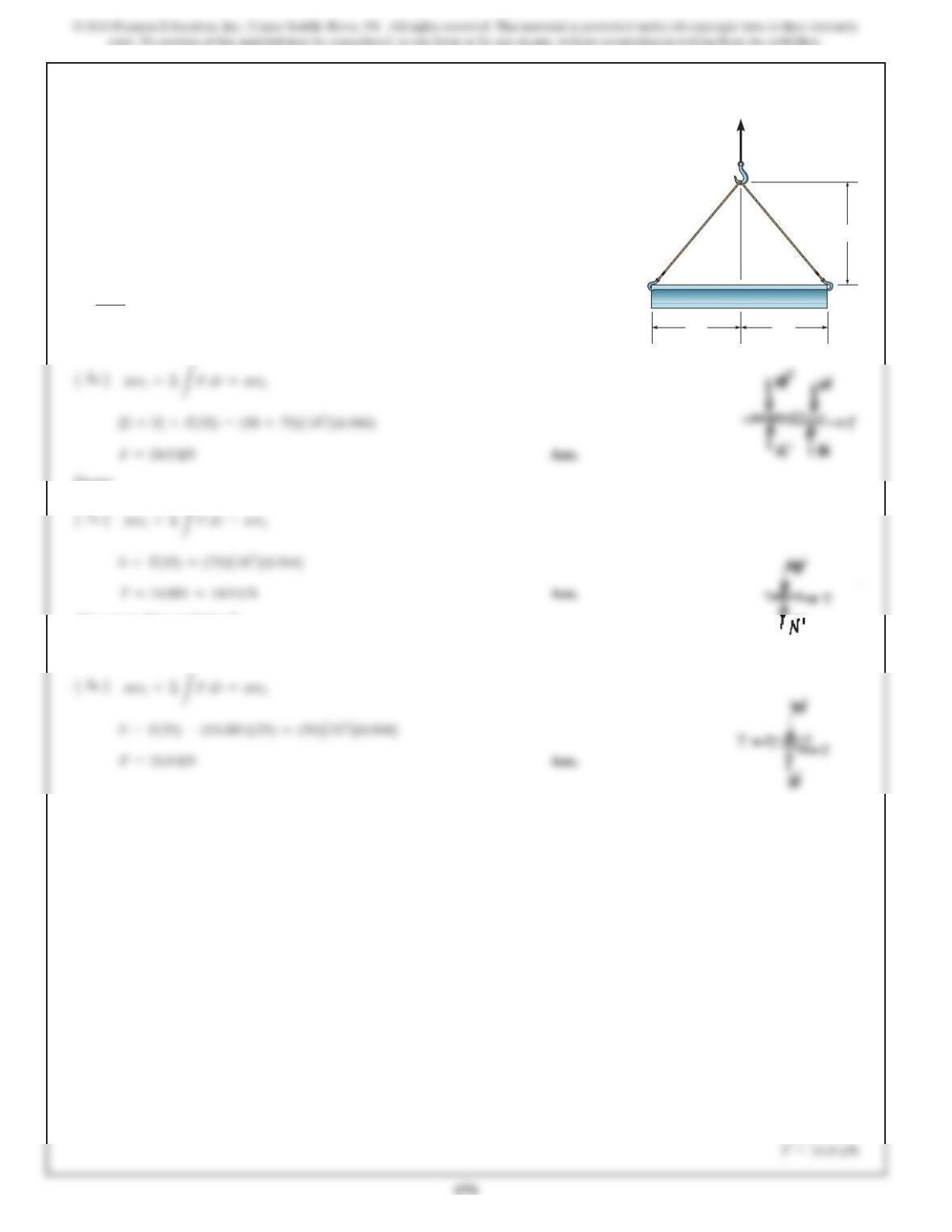
The uniform beam has a weight of 5000 lb. Determine the
average tension in each of the two cables AB and AC if the
beam is given an upward speed of 8 ft
>
s in 1.5 s starting
from rest. Neglect the mass of the cables.
SOLUTION
25
a1000
3600
b
=6.944 m
>
s
System:
Barge:
Also, using this result for T,
Tugboat:
Ans:
P
3 ft
A
4 ft
BC
3 ft
*15–4.
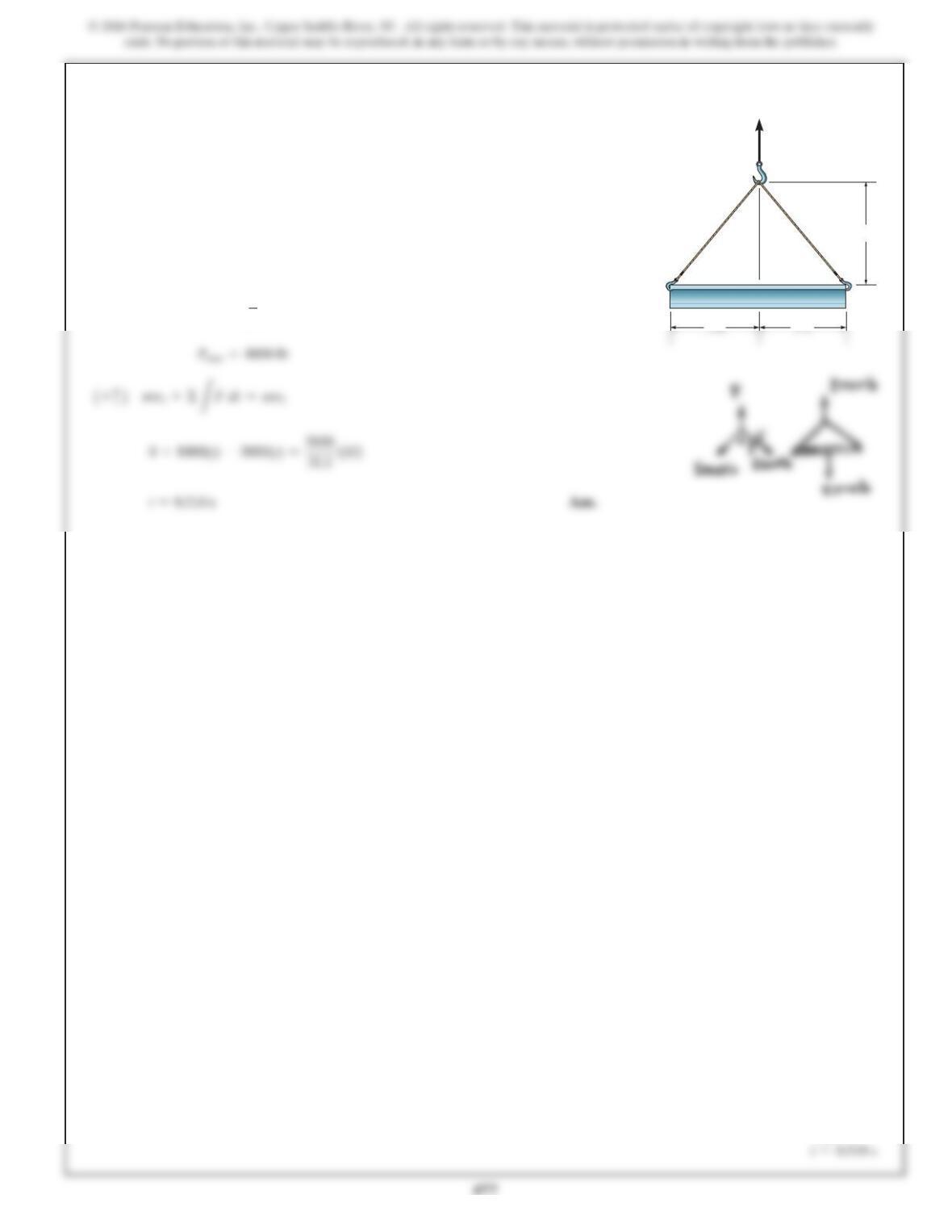
Each of the cables can sustain a maximum tension of
5000 lb. If the uniform beam has a weight of 5000 lb,
determine the shortest time possible to lift the beam with a
speed of 10 ft
>
s starting from rest.
SOLUTION
+
c
Σ
Fy=
0
; Pmax –2
a4
5
b
(5000) =0
P
A
4 ft
BC
Ans:
478
15–5.
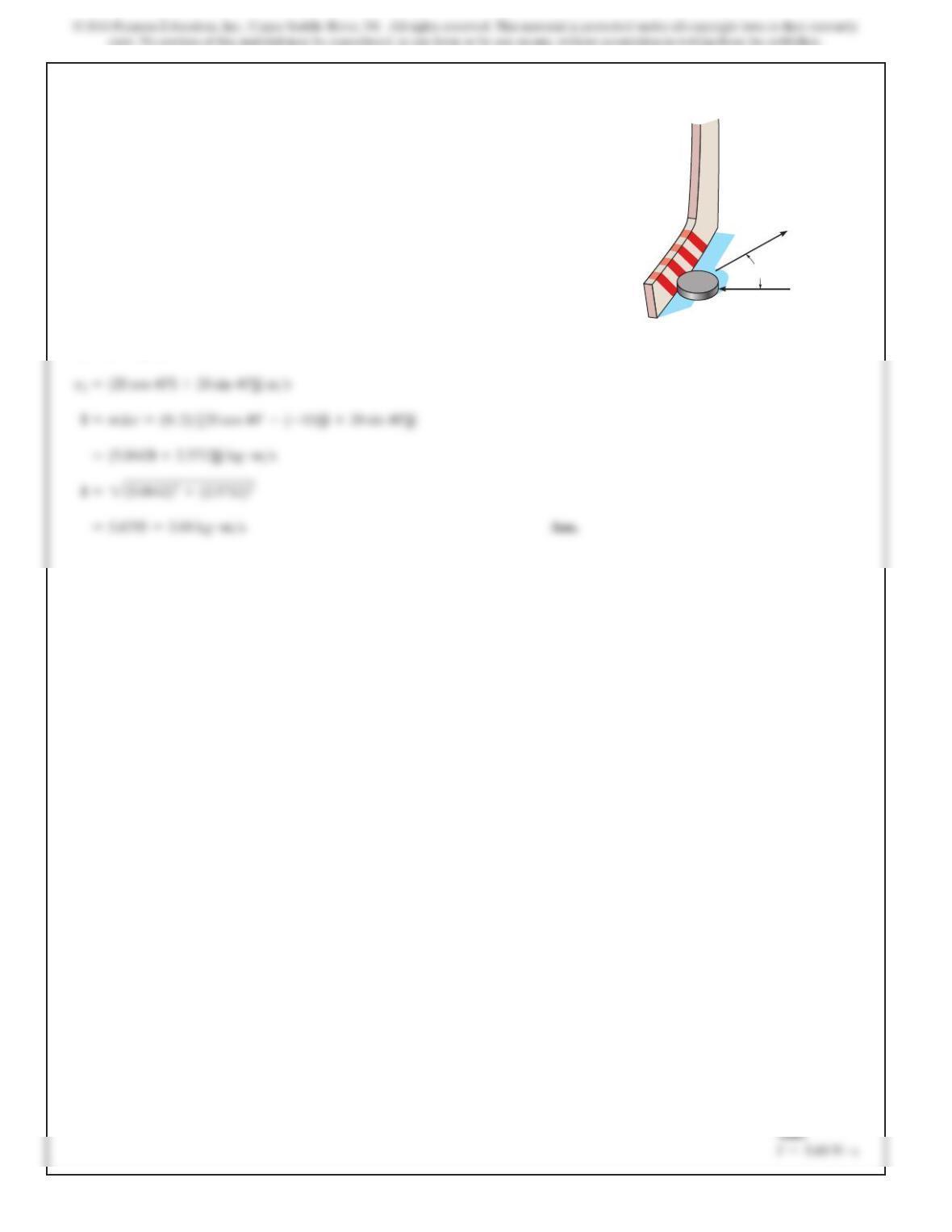
A hockey puck is traveling to the left with a velocity of
v
1=10 m>s
when it is struck by a hockey stick and given a
velocity of v
2=20 m>s
as shown. Determine the magnitude
of the net impulse exerted by the hockey stick on the puck.
The puck has a mass of 0.2 kg.
SOLUTION
v1={–10i} m>s
v2={20 cos 40°i+20 sin 40°j} m>s
v1 10 m/s
v2 20 m/s
40
479
15–6.
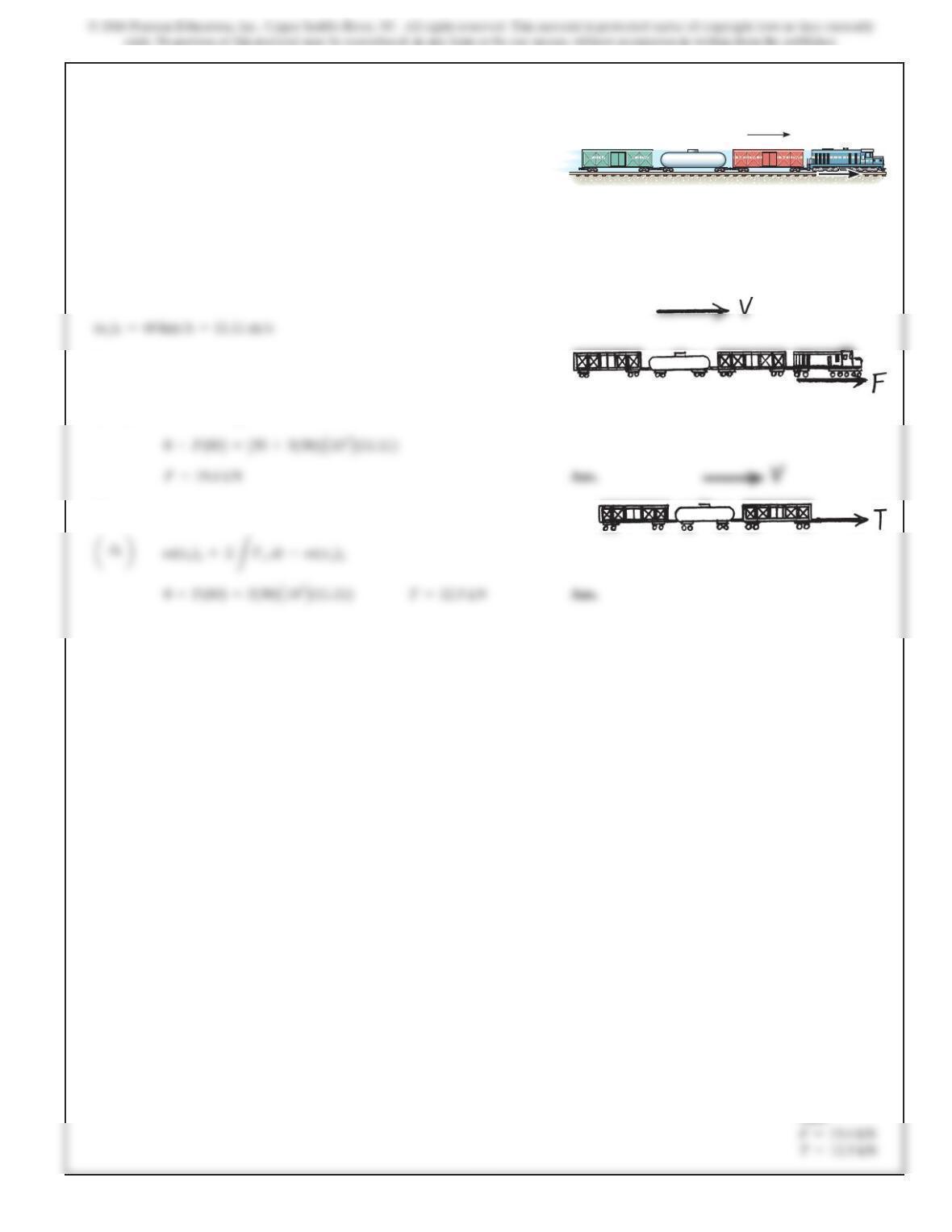
A train consists of a 50-Mg engine and three cars, each
having a mass of 30 Mg. If it takes 80 s for the train to
increase its speed uniformly to 40 , starting from rest,
determine the force Tdeveloped at the coupling between
the engine Eand the first car A. The wheels of the engine
provide a resultant frictional tractive force Fwhich gives
the train forward motion, whereas the car wheels roll freely.
Also, determine Facting on the engine wheels.
km>h
F
v
EA
SOLUTION
Entire train:
Three cars:
a:
+bm(vx)1+©
LFxdt =m(vx)2
Ans:
480
15–7.
P 50 lb
A
B
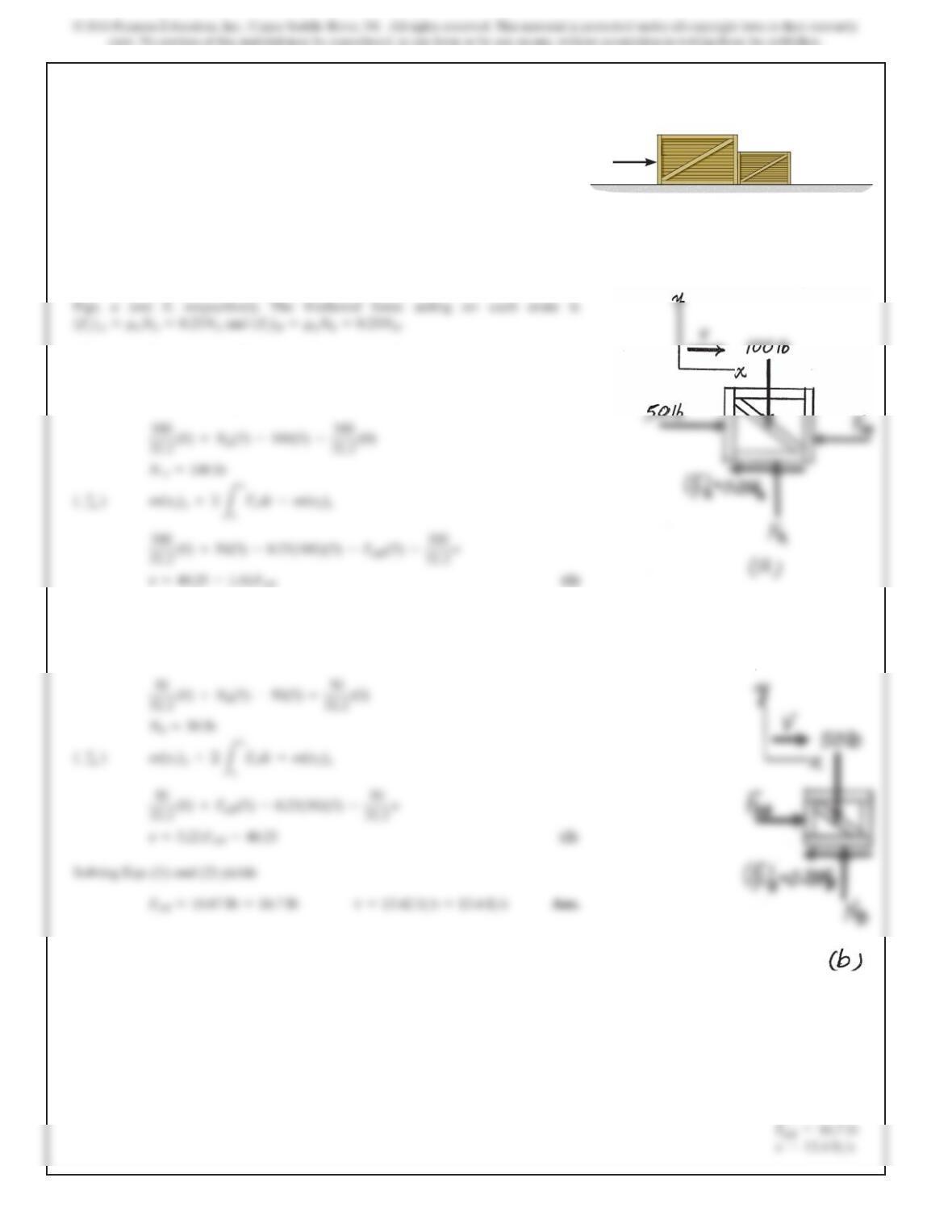
Crates Aand Bweigh 100 lb and 50 lb,respectively. If they
start from rest, determine their speed when .Also,
find the force exerted by crate Aon crate Bduring the
motion. The coefficient of kinetic friction between the
crates and the ground is .mk=0.25
t=5 s
SOLUTION
Free-Body Diagram: The free-body diagram of crates Aand B are shown in
Principle of Impulse and Momentum: Referring to Fig.a,
By considering Fig.b,
m(v1)y+©
Lt2
t1
F
y dt =m(v2)y
(+c)
m(v1)y+©
Lt2
t1
F
y dt =m(v2)y
(+c)
Ans:
481
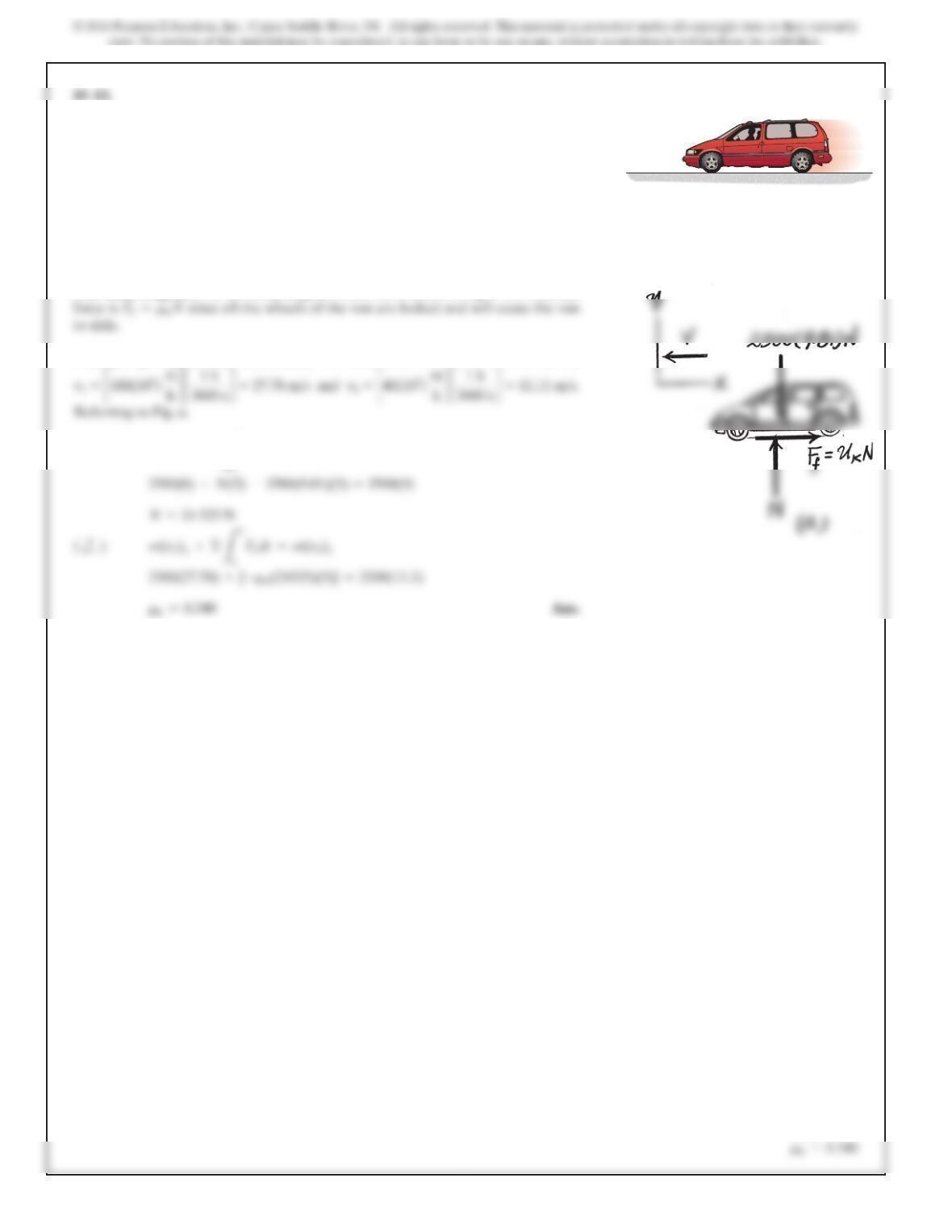
*15–8.
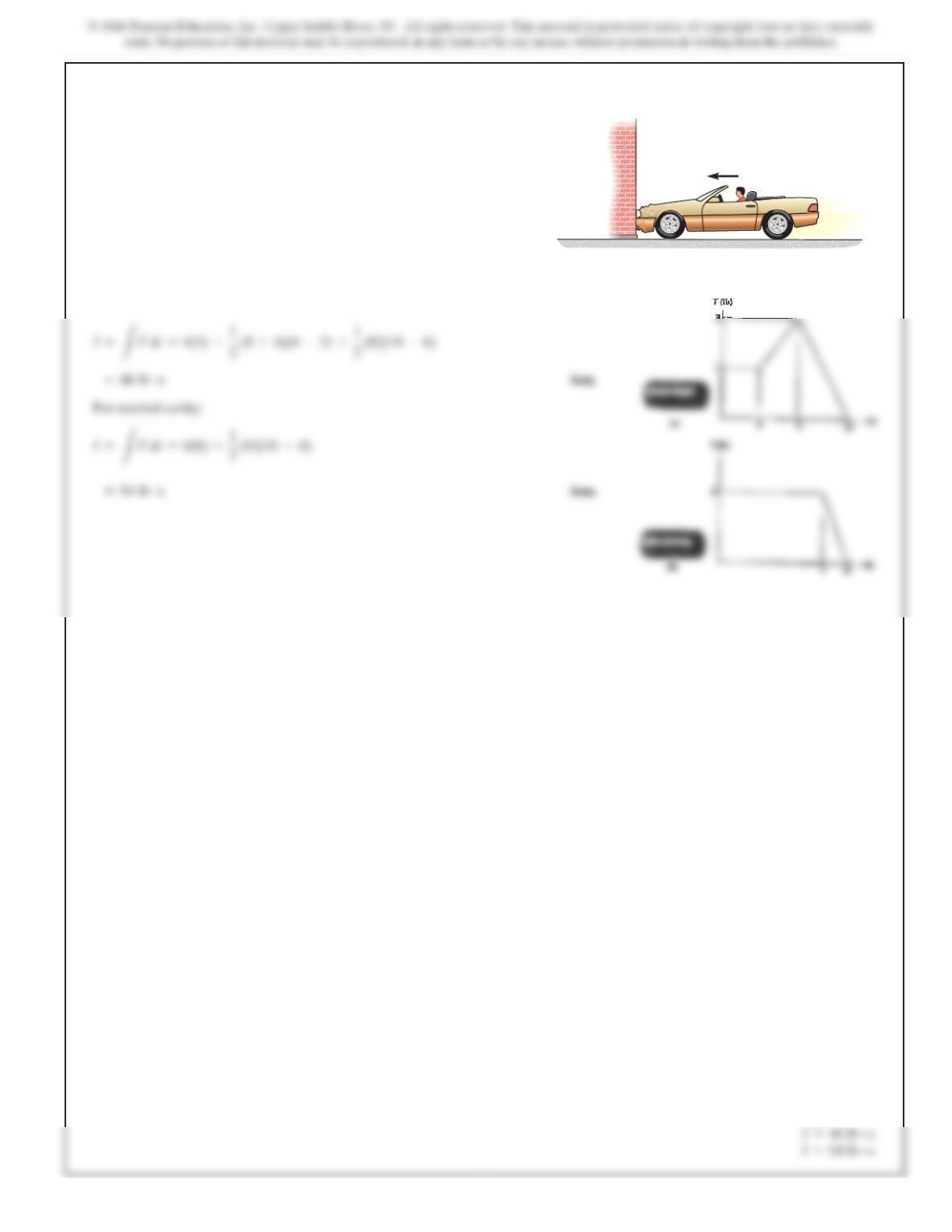
The automobile has a weight of 2700 lb and is traveling
forward at 4 ft
>
s when it crashes into the wall. If the impact
occurs in 0.06 s, determine the average impulsive force acting
on the car. Assume the brakes are not applied. If the
coefficient of kinetic friction between the wheels and the
pavement is m
k=0.3,
calculate the impulsive force on the
wall if the brakes were applied during the crash.The brakes
are applied to all four wheels so that all the wheels slip.
SOLUTION
Impulse is area under curve for hole cavity.
Ans:
482
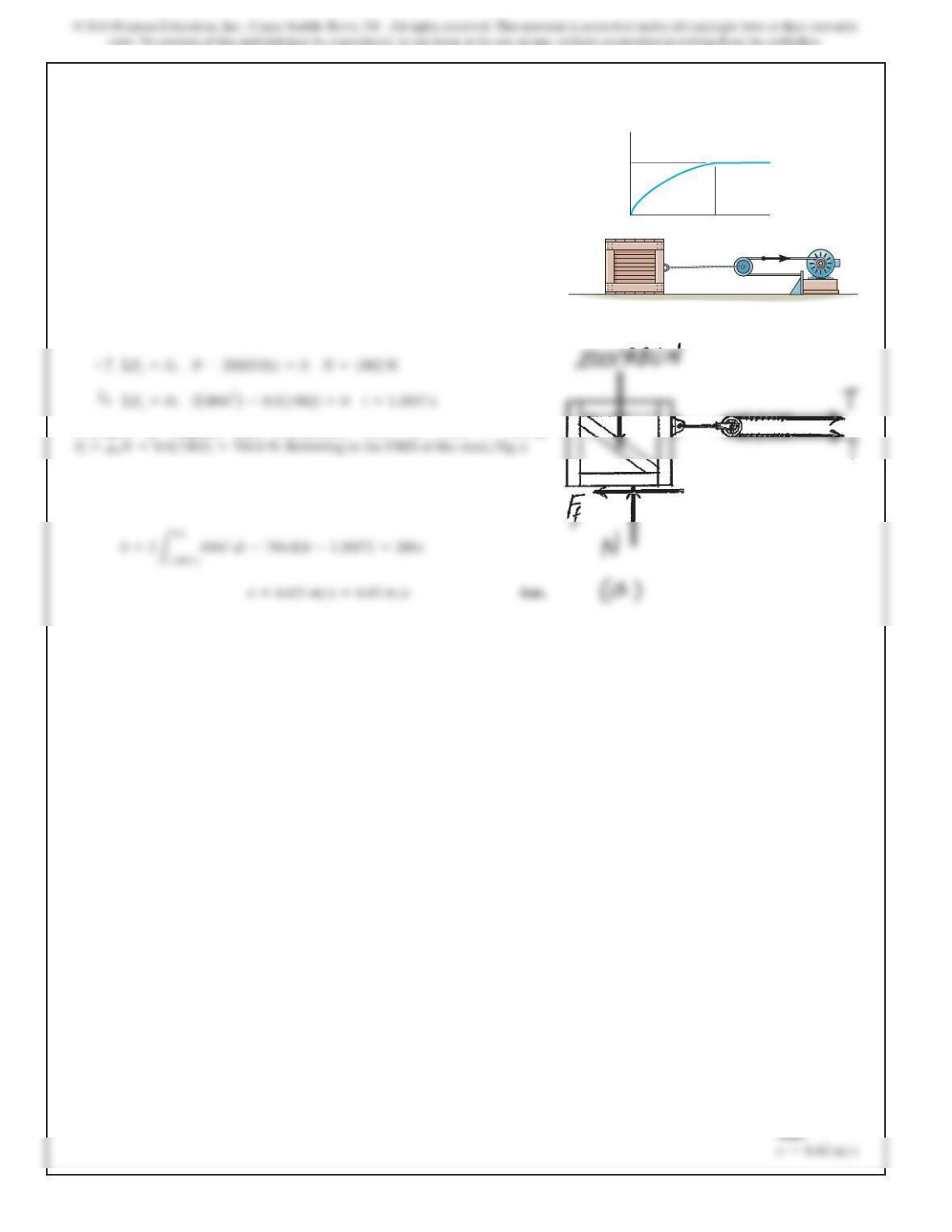
15–9.
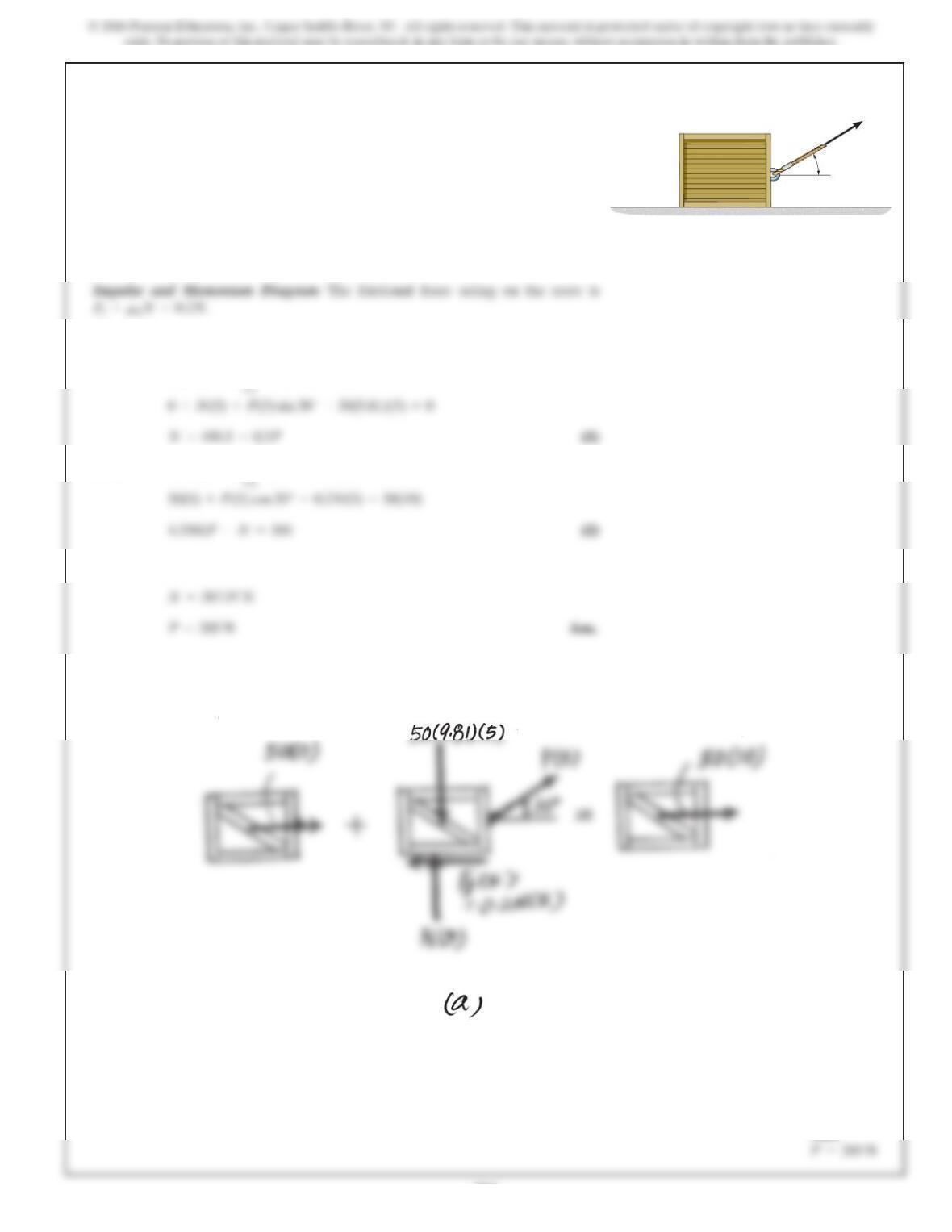
The 200-kg crate rests on the ground for which the
coefficients of static and kinetic friction are m
s=0.5
and
m
k=0.4,
respectively. The winch delivers a horizontal
towing force T to its cable at A which varies as shown in the
graph. Determine the speed of the crate when
t=4
s.
Originally the tension in the cable is zero. Hint: First
determine the force needed to begin moving the crate.
SOLUTION
Equilibrium. The time required to move the crate can be determined by
considering the equilibrium of the crate. Since the crate is required to be on the
verge of sliding,
F
f
=
ms
N=0.5 N
. Referring to the FBD of the crate, Fig. a,
t=1.5037 s
Principle of Impulse and Momentum. Since the crate is sliding,
F
=
(
S
+
)
m(vx)1+ΣLt2
t
1
Fxdt =m(vx)2
T (N)
800
t (s)
T 400 t1/2
4
AT
483
15–10.
30
P
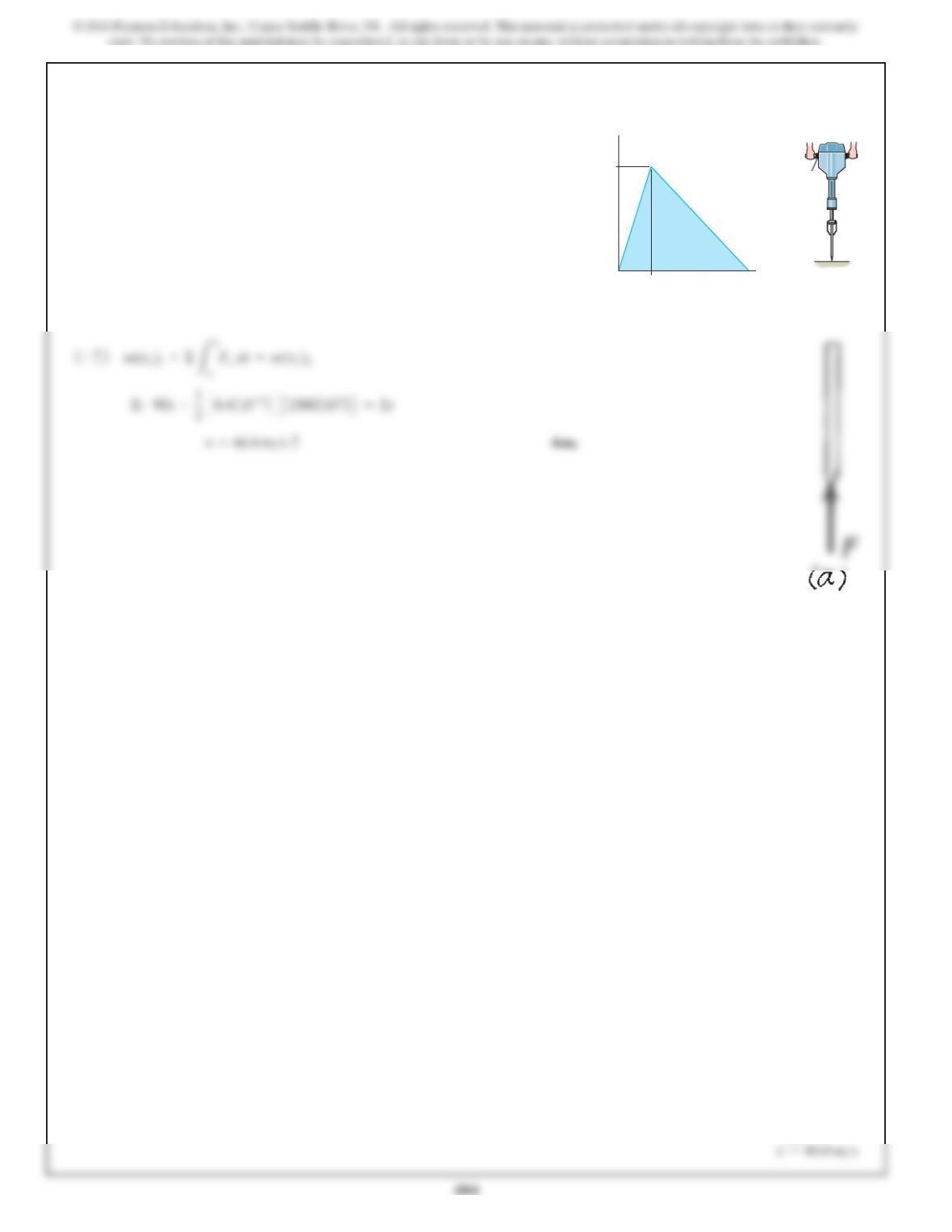
The 50-kg crate is pulled by the constant force P. If the crate
starts from rest and achieves a speed of in 5 s, deter-
mine the magnitude of P.The coefficient of kinetic friction
between the crate and the ground is .mk=0.2
10 m>s
SOLUTION
Principle of Impulse and Momentum:
Solving Eqs.(1) and (2), yields
m(v1)x+©
F
x dt =m(v2)x
(:
+)
m(v1)y+©
F
y dt =m(v2)y
(+c)
Ans:
15–11.
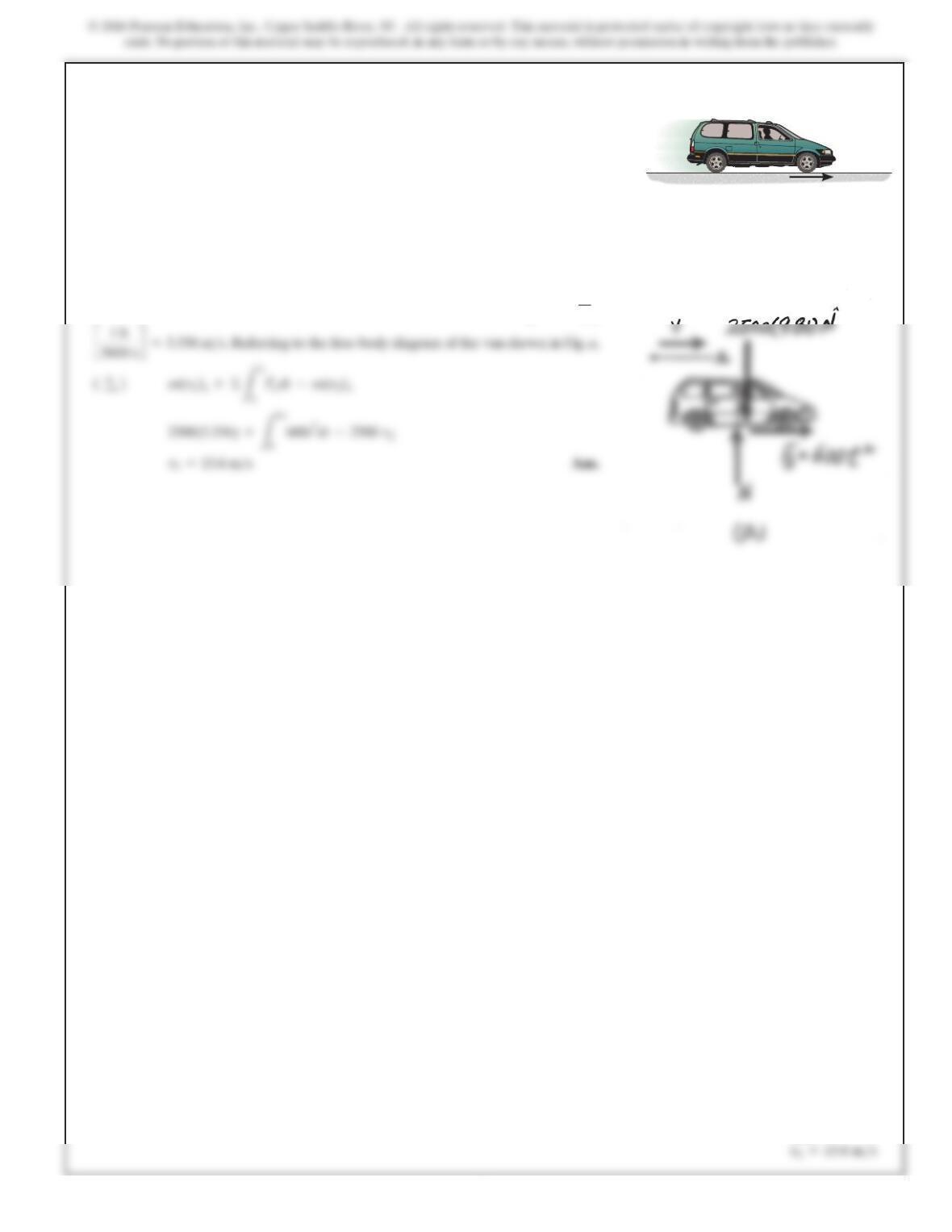
During operation the jack hammer strikes the concrete surface
with a force which is indicated in the graph. To achieve this the
2-kg spike S is fired into the surface at 90 m
>
s. Determine the
speed of the spike just after rebounding.
SOLUTION
Principle of Impulse and Momentum. The impulse of the force F is equal to the
area under the F–t graph. Referring to the FBD of the spike, Fig. a
F (kN)
0
1500
0.10 0.4
t (ms)
S
Ans:
485
*15–12.
FD
For a short period of time,the frictional driving force acting
on the wheels of the 2.5-Mg van is ,where t
is in seconds.If the van has a speed of when ,
determine its speed when .t=5 s
t=020 km>h
FD=(600
t2) N
SOLUTION
Principle of Impulse and Momentum: The initial speed of the van is
v1=c20(103)m
hd
Ans:
486
The 2.5-Mg van is traveling with a speed of when
the brakes are applied and all four wheels lock. If the speed
decreases to in 5 s, determine the coefficient of
kinetic friction between the tires and the road.
40 km>h
100 km>h
SOLUTION
Free-Body Diagram: The free-body diagram of the van is shown in Fig.a.The frictional
Principle of Impulse and Momentum: The initial and final speeds of the van are
m(v1)y+©
F
y dt =m(v2)y
(+c)
Ans:
487
15–14.
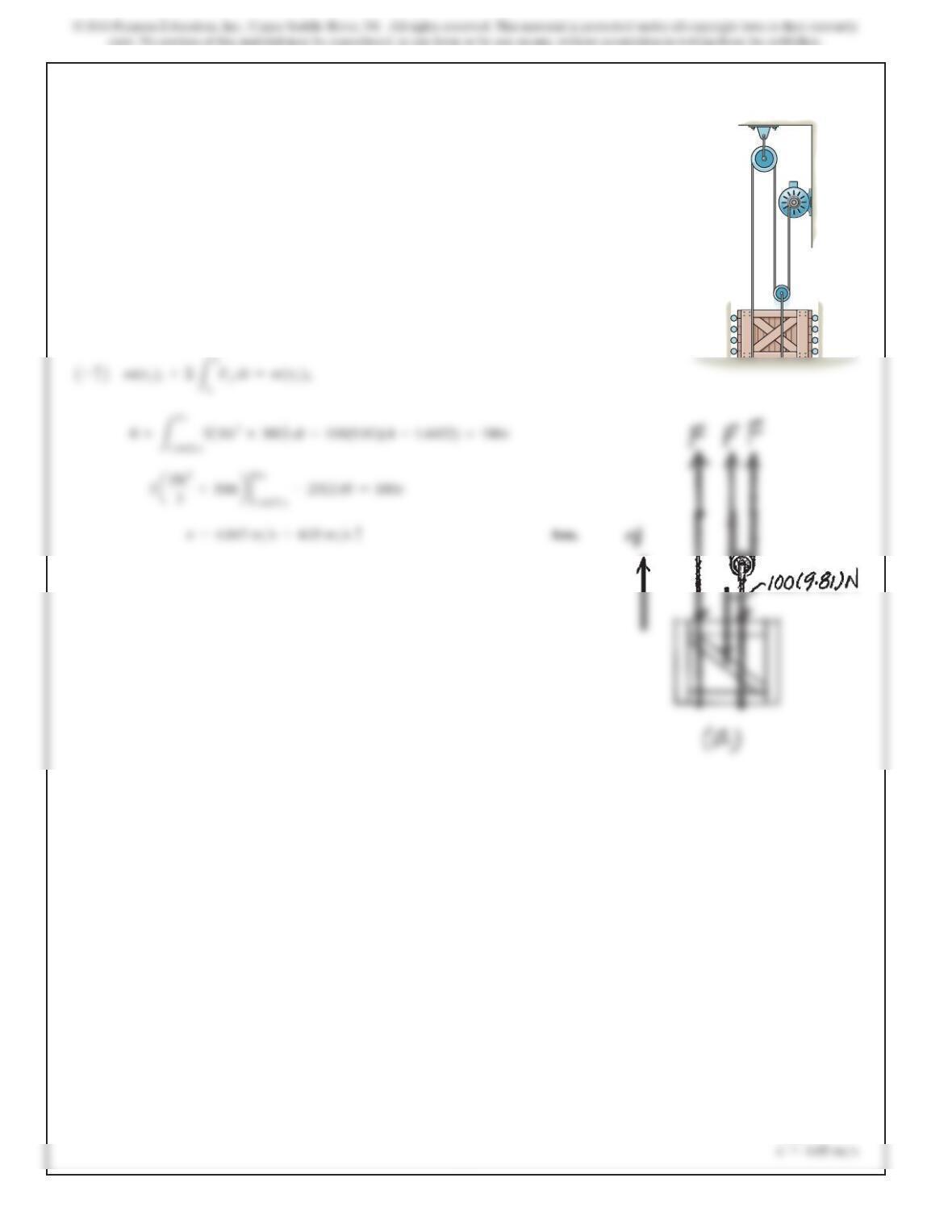
A tankcar has a mass of 20 Mg and is freely rolling to the
right with a speed of 0.75 m
>
s. If it strikes the barrier,
determine the horizontal impulse needed to stop the car if
the spring in the bumper B has a stiffness (a)
kS∞
(bumper is rigid), and (b)
k=15 kN>m
.
SOLUTION
a) b) (
S
+
) mv1+Σ
L
F dt =mv2
k=15 kN>m,
kS∞
v
0.75 m
/
s
k
B
Ans:
488
15–15.
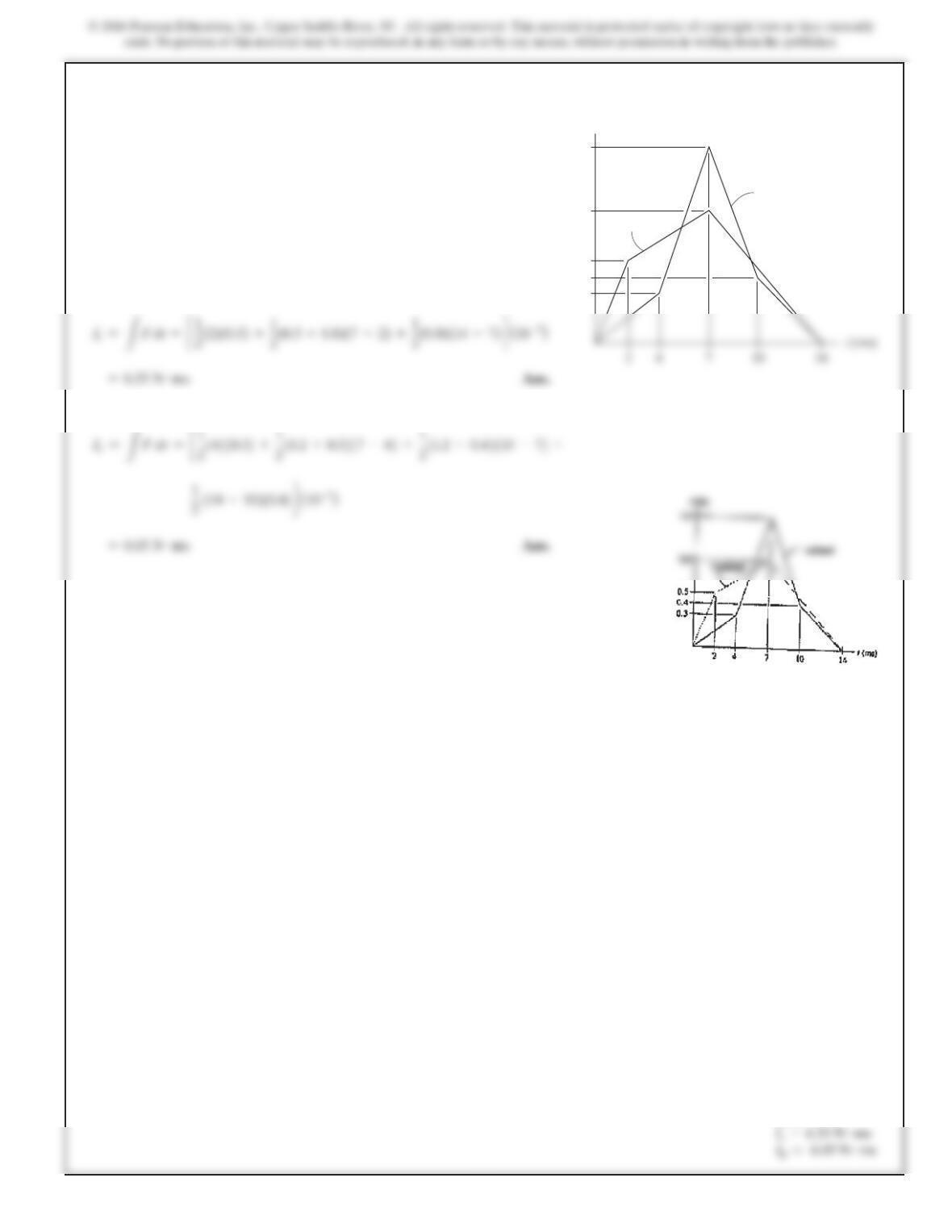
The motor, M, pulls on the cable with a force F
=
(10t
2+
300)
N, where t is in seconds. If the 100 kg crate is originally at rest
at
t=0
, determine its speed when
t=4
s. Neglect the mass
of the cable and pulleys. Hint: First find the time needed to
begin lifting the crate.
SOLUTION
Principle of Impulse and Momentum. The crate will only move when
3
(
10t
2+
300
)
=
100(9.81). Thus, this instant is
t=1.6432 s
. Referring to the FBD
of the crate, Fig. a,
M
Ans:
489
*15–16.
The choice of a seating material for moving vehicles
depends upon its ability to resist shock and vibration. From
the data shown in the graphs, determine the impulses
created by a falling weight onto a sample of urethane foam
and CONFOR foam.
SOLUTION
CONFOR foam:
Urethane foam:
F (N)
urethane
CONFOR
1.2
0.8
0.5
0.4
0.3
Ans:
490
15–17.
The towing force acting on the 400-kg safe varies as shown on
the graph. Determine its speed, starting from rest, when
t=8
s.
How far has it traveled during this time?
SOLUTION
Principle of Impulse and Momentum. The FBD of the safe is shown in Fig. a.
(
S
+
)
m(vx)1+ΣLt2
t
1
Fx dt =m(vx)2
t=5 s
(
S
+
)
m(vx)1+ΣL
t
2
t
1
Fx dt =m(vx)2
t=8 s
t (s)
F (N)
600
750
F
491
15–17. Continued
Kinematics. The displacement of the safe can be determined by integrating
s=0
t=0
t=5 s
For
5 s 6t…8 s
, the initial condition is
s=6.25
m at
t=5 s
.
t=8 s
492
15–18.
The motor exerts a force F on the 40-kg crate as shown in
the graph. Determine the speed of the crate when
t=3
s
and when
t=6
s. When
t=0
, the crate is moving downward
at 10 m
>
s.
SOLUTION
Principle of Impulse and Momentum. The impulse of force F is equal to the area
t=3 s
At
t=6 s
,
F (N)
t (s)
150
450
6
B
A
F
Ans:
493
15–19.
The 30-kg slider block is moving to the left with a speed of
5 m
>
s when it is acted upon by the forces F1 and F2. If
these loadings vary in the manner shown on the graph,
determine the speed of the block at
t=6
s. Neglect friction
and the mass of the pulleys and cords.
SOLUTION
Principle of Impulse and Momentum. The impulses produced by F1 and F2
are equal to the area under the respective F–t graph. Referring to the FBD of
the block Fig. a,
F2
F2
F (N)
40
F1
30
20
Ans: