534
15–59.
SOLUTION
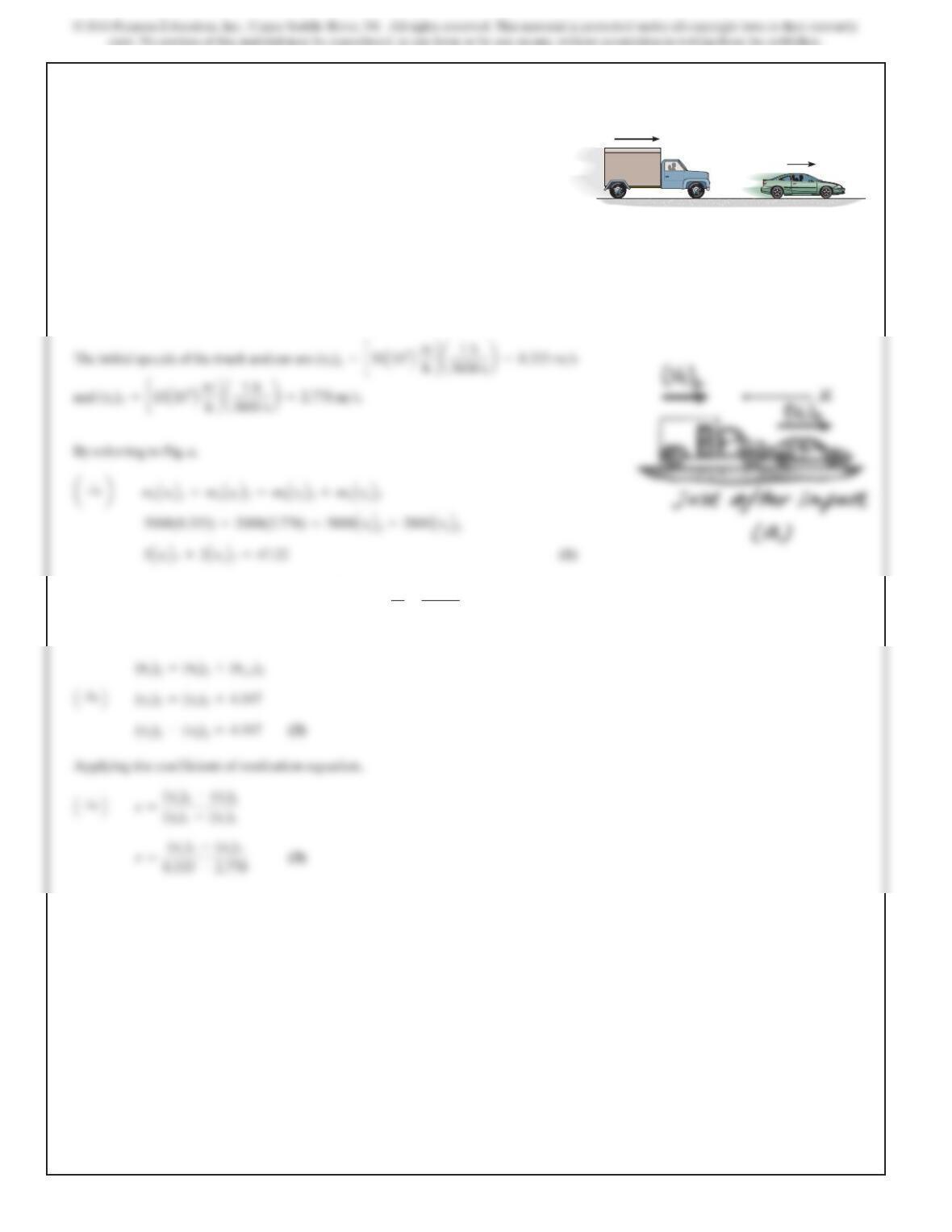
Conservation of Linear Momentum: The linear momentum of the system is
conserved along the xaxis (line of impact).
Coefficient of Restitution: Here
,.
Applying the relative velocity equation,
(vc>t)=c15
A
103
B
m
hda 1h
3600 s b=4.167 m>s:
The 5-Mg truck and 2-Mg car are traveling with the free-
rolling velocities shown just before they collide. After the
collision, the car moves with a velocity of to the
right relative to the truck. Determine the coefficient of
restitution between the truck and car and the loss of energy
due to the collision.
15 km>h
30 km/h
10 km/h
535
15–59. Continued
Ans:
Substituting Eq. (2) into Eq. (3),
Solving Eqs. (1) and (2) yields
Kinetic Energy: The kinetic energy of the system just before and just after the
collision are
8.333 –2.778 =0.75
536
*15–60.
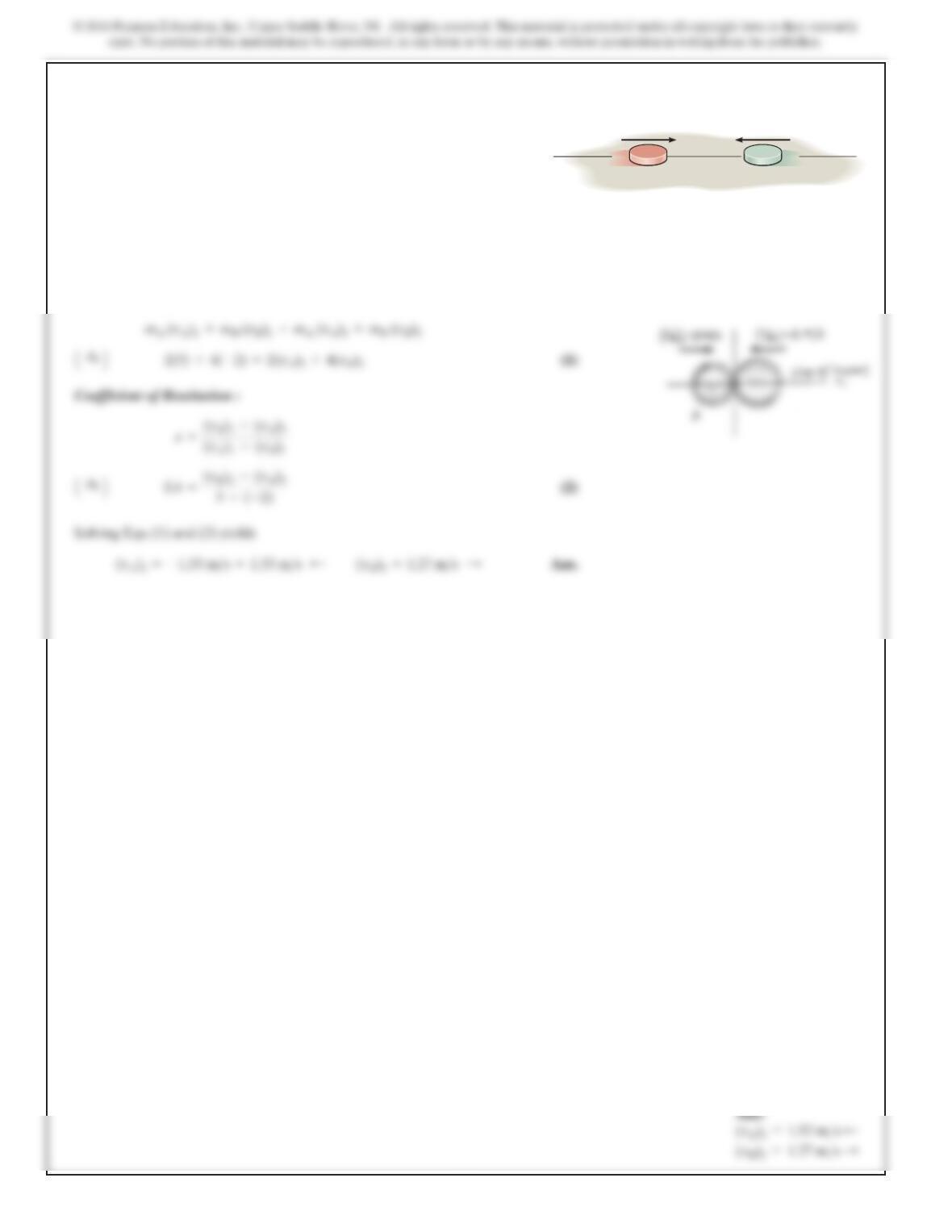
Disk Ahas a mass of 2 kg and is sliding forward on the
smooth surface with a velocity when it strikes
the 4-kg disk B, which is sliding towards Aat
with direct central impact. If the coefficient of restitution
between the disks is compute the velocities of A
and Bjust after collision.
e=0.4,
1vB21=2m/s,
1vA21=5m/s
SOLUTION
Conservation of Momentum :
(vA)1=5m/s(vB)1=2m/s
AB
SOLUTION
Principle of Work and Energy. Referring to the FBD of block A, Fig. a,
Conservation of Momentum.
Coefcient of Restitution.
Solving Eqs. (1) and (2)
A)2=3.1478 m>s d
Conservation of Energy. When block B stops momentarily, the compression of the
spring is maximum. Thus,
T2=0
.
xmax =0.8394 m =0.839 m
15–61.
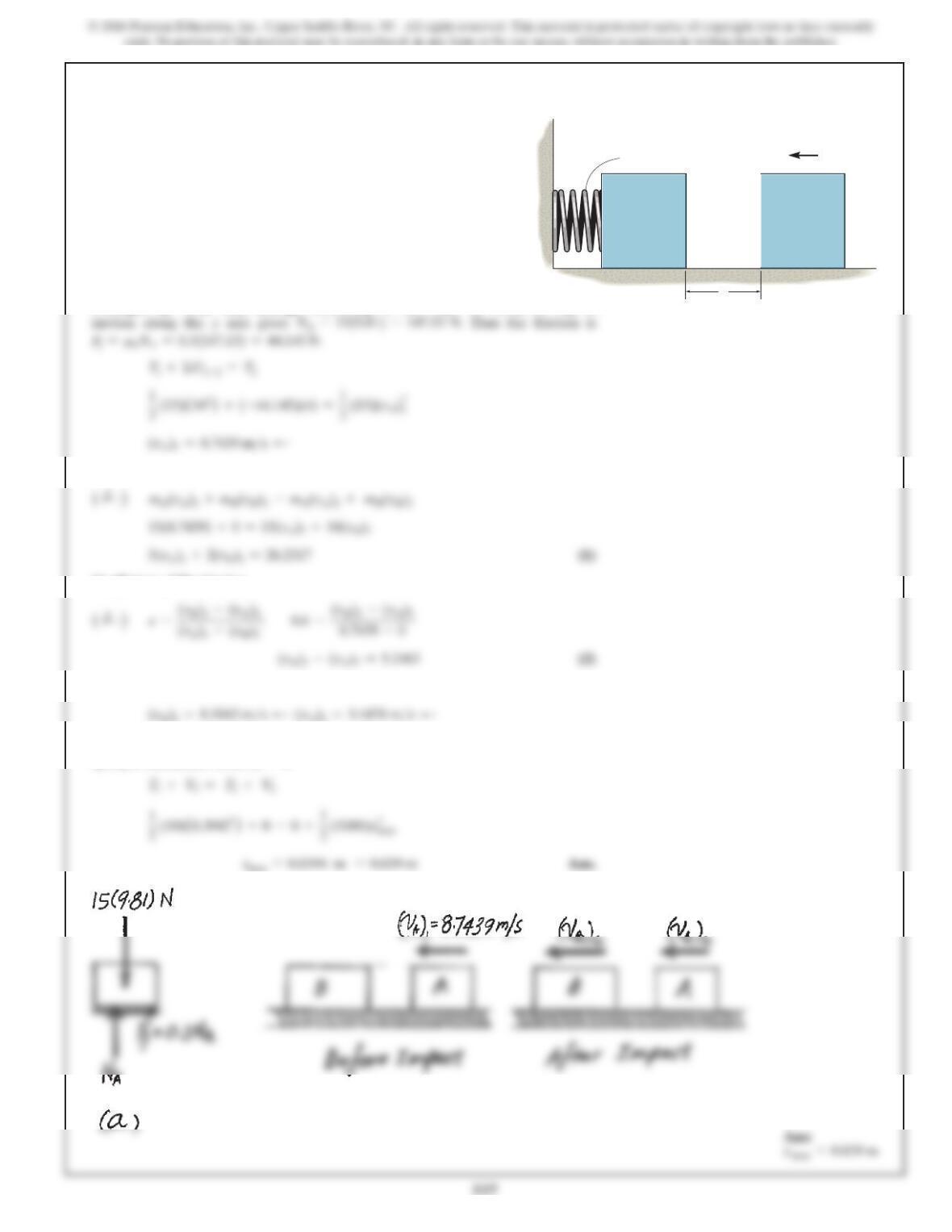
The 15-kg block A slides on the surface for which
mk=0.3.
The block has a velocity
v=
10 m
>
s when it is s
=
4mfrom
the 10-kg block B. If the unstretched spring hasastiffness
k
=
1000 N
>
m, determine the maximum compression of
the spring due to the collision. Take e
=
0.6.
k 1000 N/m
A
B
s
10 m/s
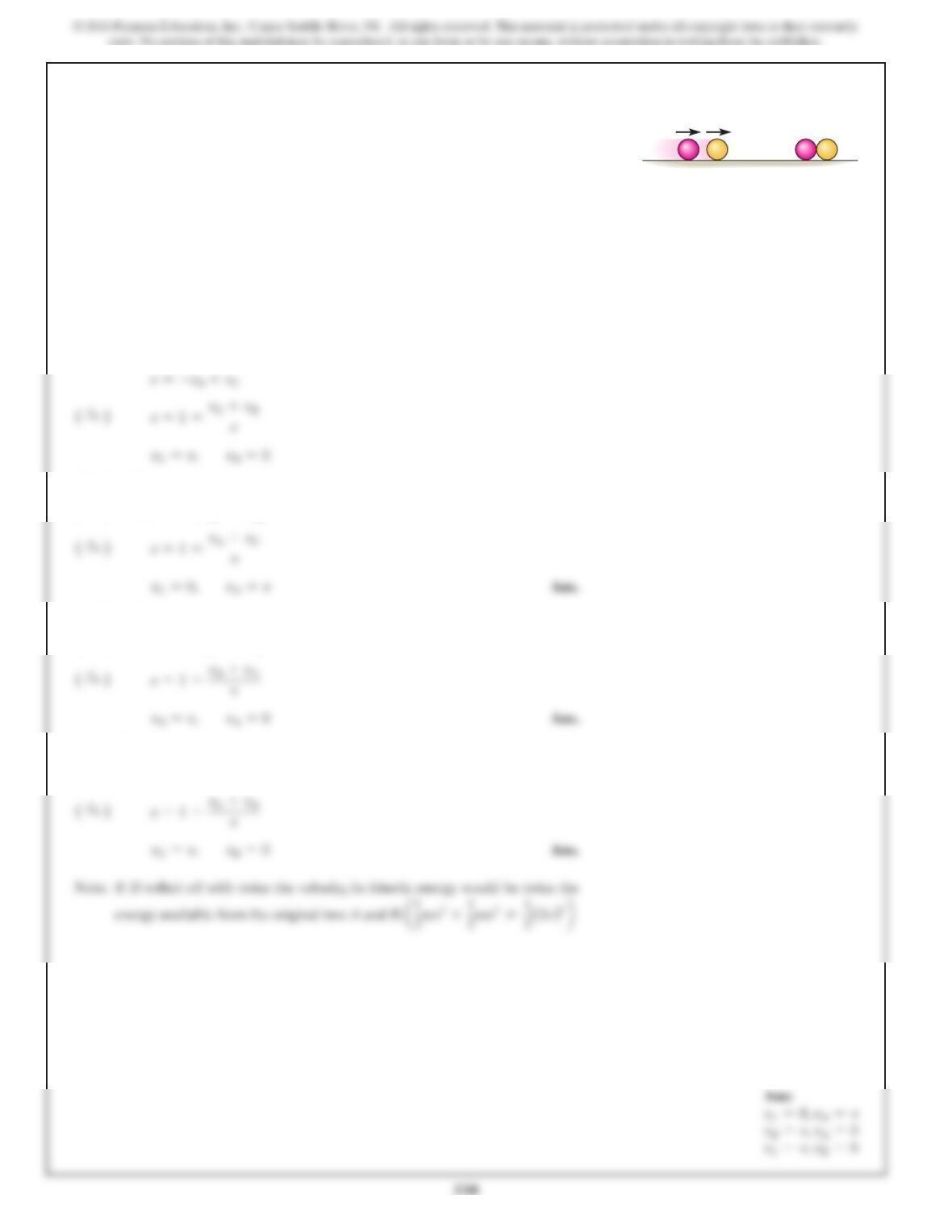
15–62.
The four smooth balls each have the same mass m. If A and
B are rolling forward with velocity v and strike C, explain
why after collision C and D each move off with velocity v.
Why doesn’t D move off with velocity 2v? The collision is
elastic,
e=1
. Neglect the size of each ball.
v
AB CD
v
SOLUTION
Collision will occur in the following sequence;
B strikes C
(
S
+
)
mv=–mvB+mvC
(
S
+
)
C strikes D
(
S
+
)
mv=–mvC+mvD
(
+
)
A strikes B
(
S
+
)
mv=–mvA+mvB
(
S
+
)
Finally, B strikes C
(
S
+
)
mv=–mvB+mvC
(
S
)
539
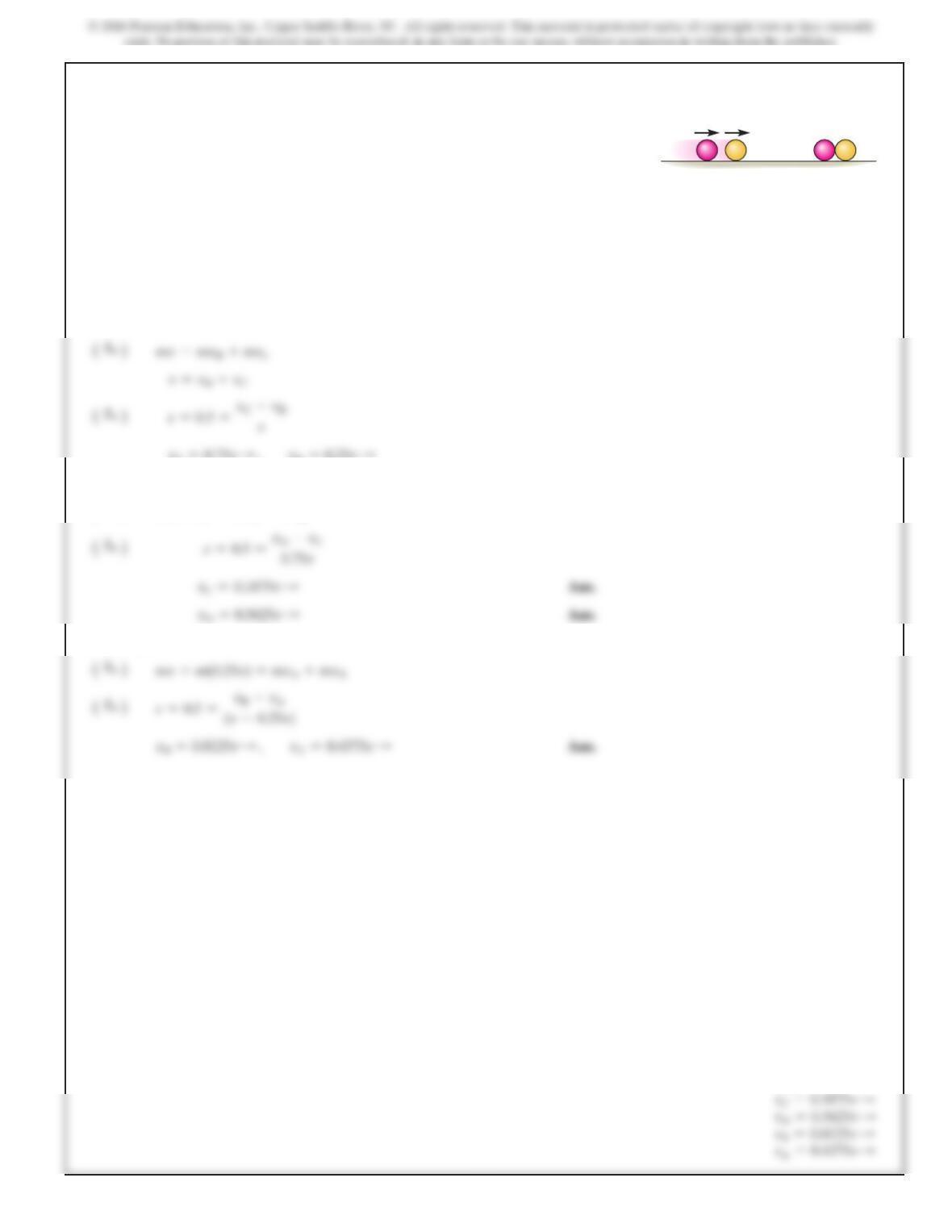
15–63.
The four balls each have the same mass m. If A andB are
rolling forward with velocity v and strike C, determine the
velocity of each ball after the first three collisions. Take
e=0.5
between each ball.
SOLUTION
Collision will occur in the following sequence;
B strikes C
(
+
)
(
)
vC=0.75vS
,
vB=0.25vS
C strikes D
(
S
+
)
m(0.75
v
)=m
v
C+m
v
D
(
+
)
vC=0.1875vS
A strikes B
(
)
(
)
vA=0.4375vS
v
AB CD
v
Ans:
vD=0.5625vS
vB=0.8125vS
vA=0.4375vS
540
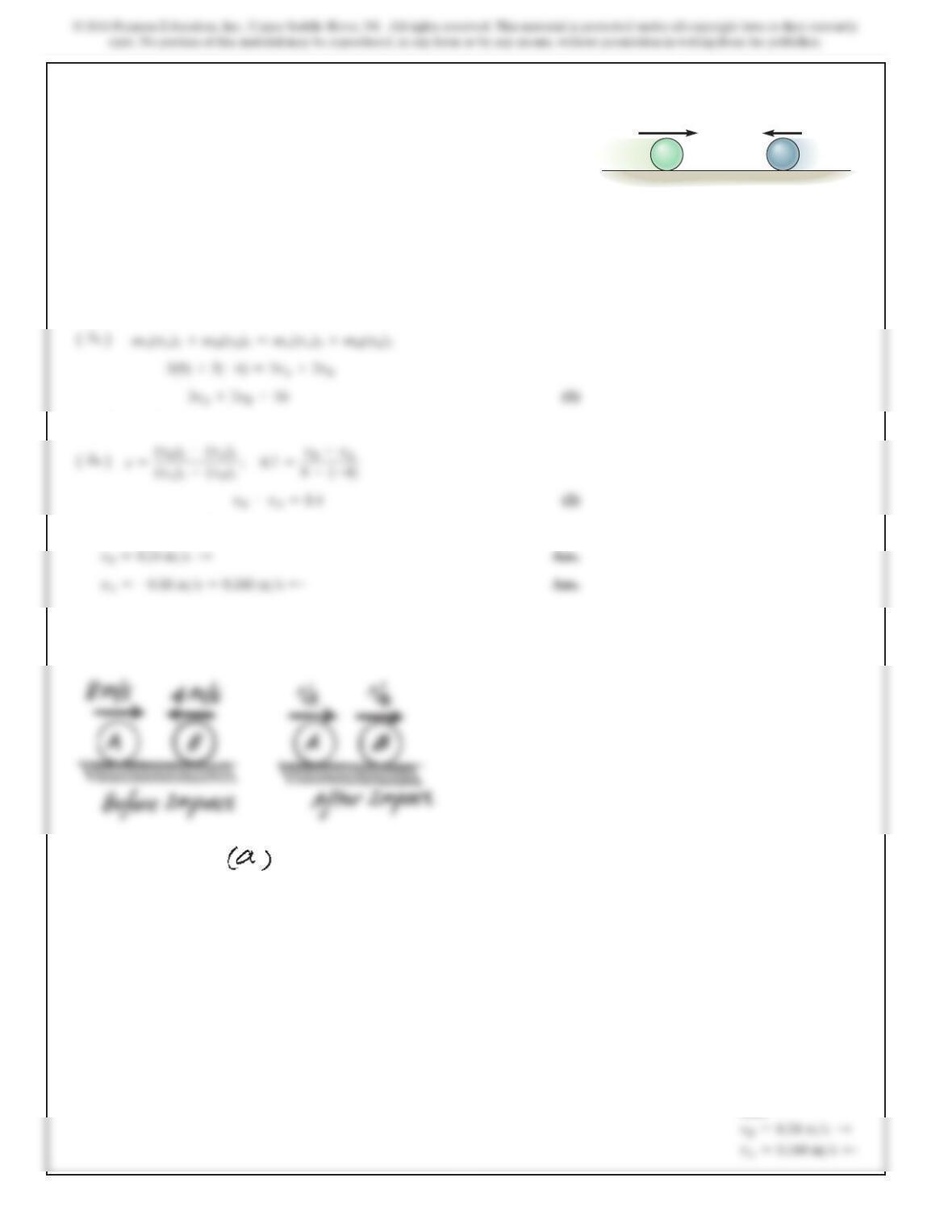
*15–64.
Ball A has a mass of 3 kg and is moving with a velocity of
8m
>
s when it makes a direct collision with ball B, which has
a mass of 2 kg and is moving with a velocity of 4 m
>
s.
If
e=0.7
, determine the velocity of each ball just after the
collision. Neglect the size of the balls.
SOLUTION
Conservation of Momentum. The velocity of balls A and B before and after impact
are shown in Fig. a
Coefcient of Restitution.
Solving Eqs. (1) and (2),
AB
8 m
/
s4 m
/
s
Ans:
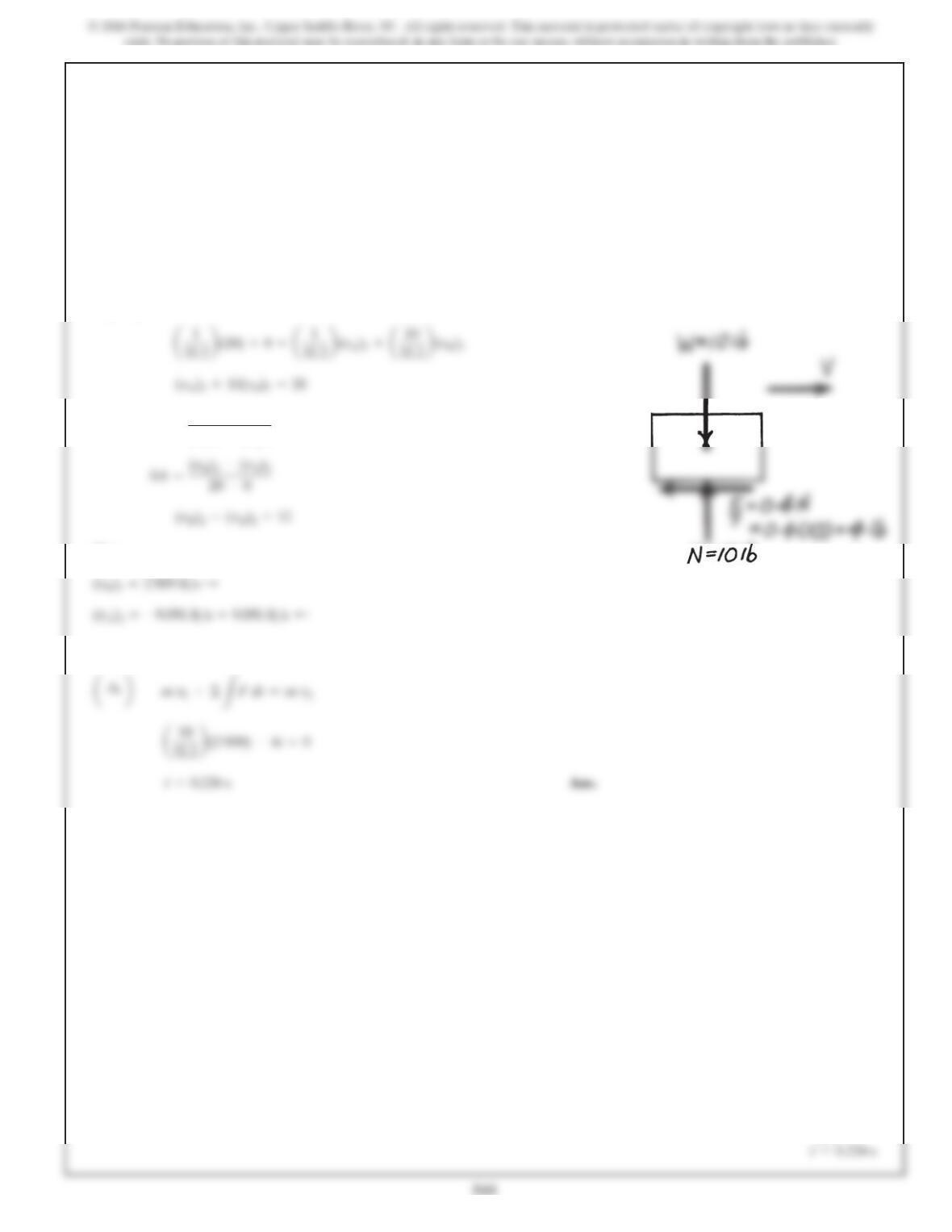
15–65.
A 1-lb ball Ais traveling horizontally at when it
strikes a 10-lb block Bthat is at rest. If the coefficient of
restitution between Aand Bis , and the coefficient
of kinetic friction between the plane and the block is
, determine the time for the block Bto stop sliding.mk=0.4
e=0.6
20 ft
>
s
SOLUTION
Thus,
Block B:
a:
+be=(vB)2–(vA)2
(vA)1–(vB)1
a:
+b©m1v1=©m2v2
Ans:
542
15–66.
SOLUTION
Just before impact, the velocity of Ais
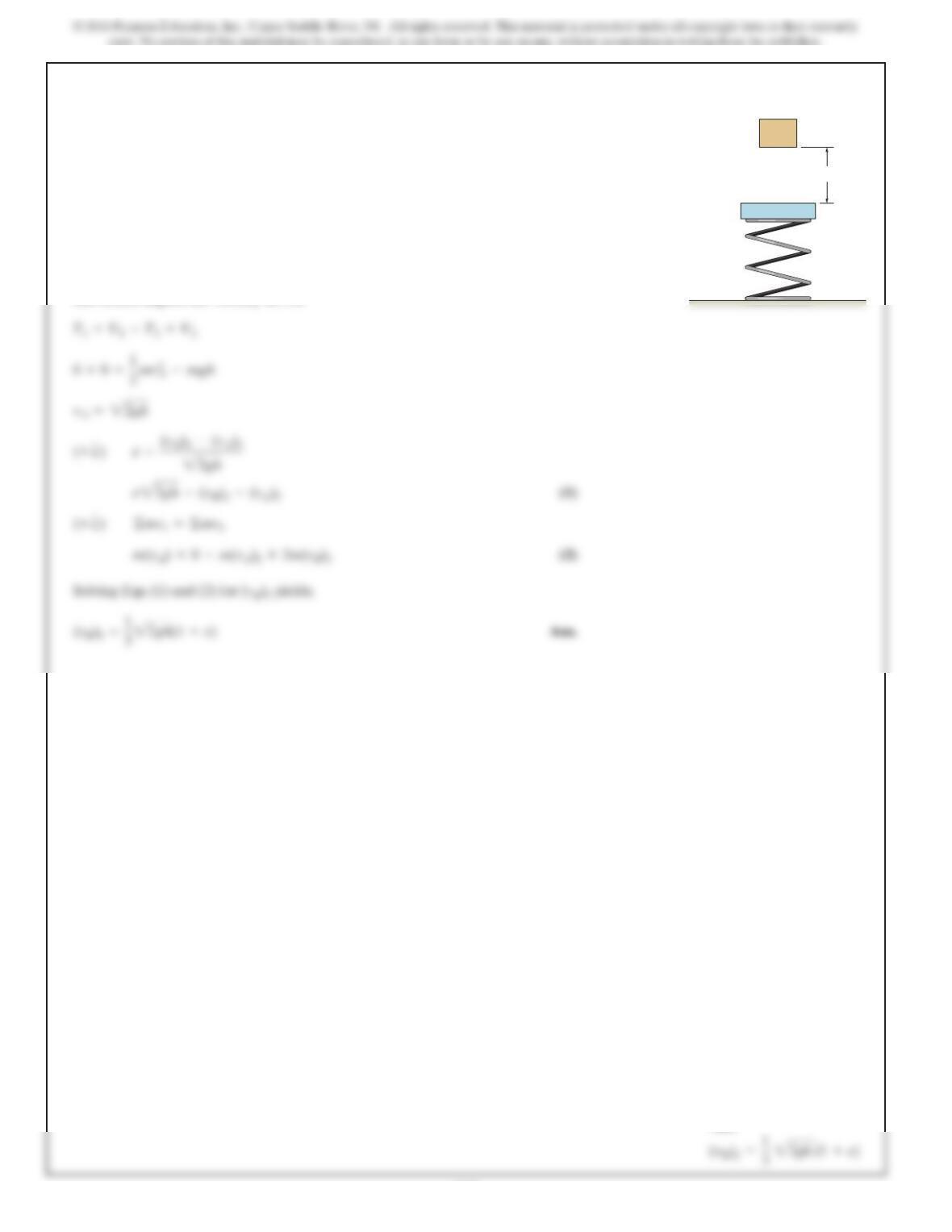
Block A, having a mass m, is released from rest, falls a
distance hand strikes the plate Bhaving a mass 2m. If the
coefficient of restitution between Aand Bis e, determine
the velocity of the plate just after collision. The spring has
a stiffness k.
A
B
k
h
Ans:
543
15–67.
SOLUTION
Ball A:
Datum at lowest point.
Balls Aand B:
Solving:
Balls Band C:
Solving:
A
:
+
B
©mv2=©mv3
A
:
+
B
©mv1=©mv2
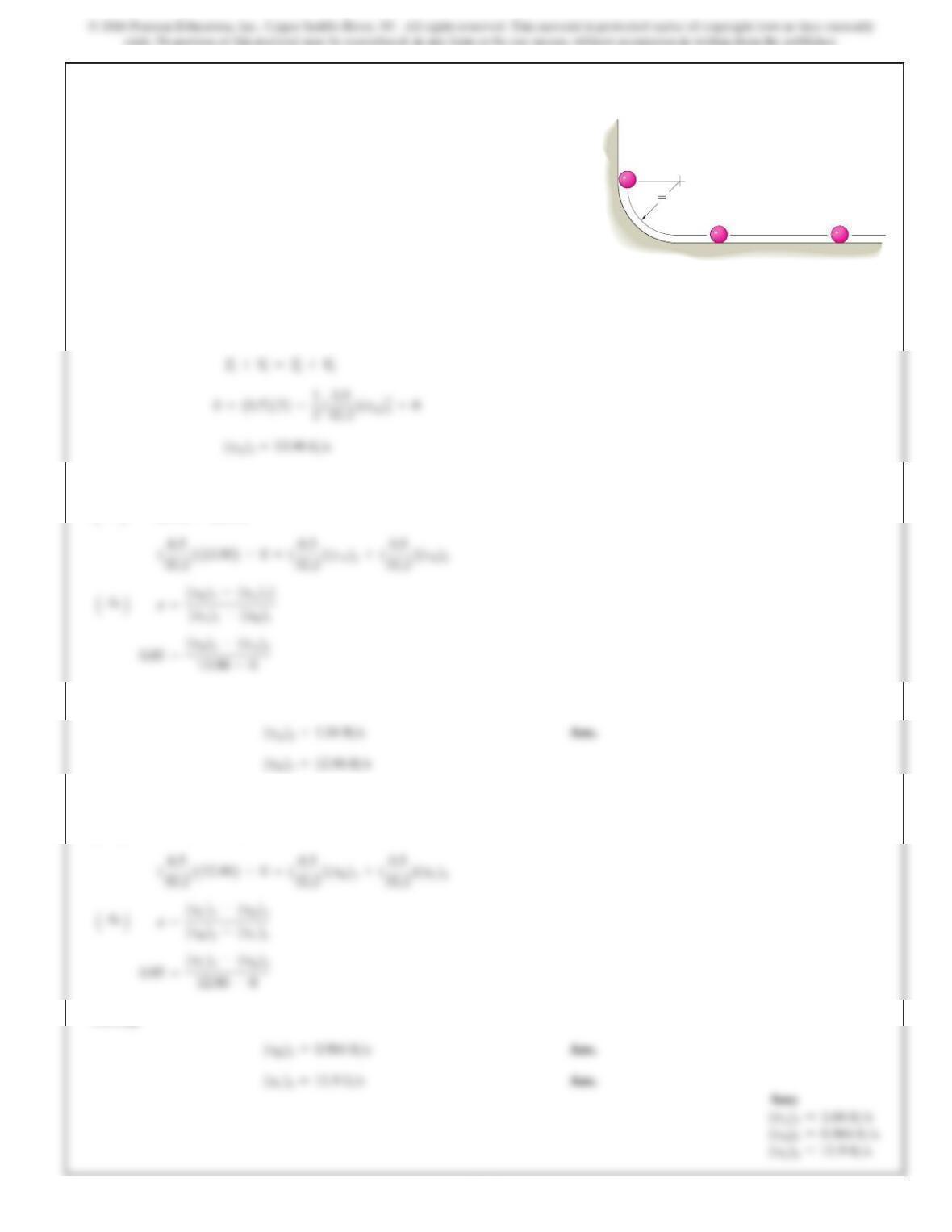
The three balls each weigh 0.5 lb and have a coefficient of
restitution of If ball Ais released from rest and
strikes ball Band then ball Bstrikes ball C, determine the
velocity of each ball after the second collision has occurred.
The balls slide without friction.
e=0.85.
r3ft
A
BC
544
*15–68.
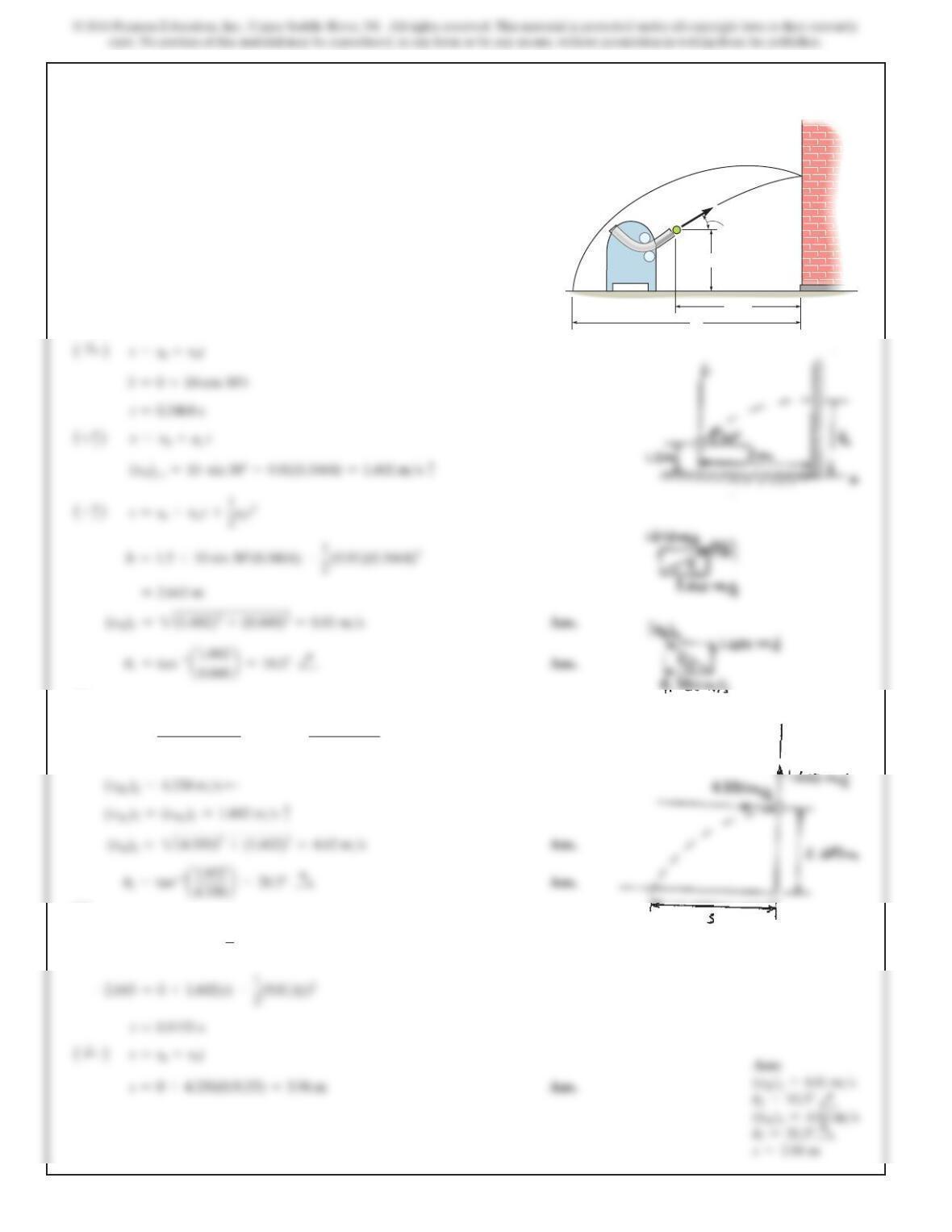
A pitching machine throws the 0.5-kg ball toward the wall
with an initial velocity vA
=10 m>s
as shown. Determine
(a) the velocity at which it strikes the wall at B, (b) the
velocity at which it rebounds from the wall if
e=0.5
, and
(c) the distance s from the wall to where it strikes the ground
at C.
SOLUTION
(a)
(vB)x1=10 cos 30°=8.660 m>sS
(
+
)
(
+
c
)
(
+
c
)
(b)
(
S
+
)
e=
(v
B
)
2
–(v
A
)
2
(v
A
)
1–
(v
B
)
1
; 0.5 =
(v
Bx
)
2
–0
0
–
(8.660)
(vBx)2=4.330 m>sd
(c)
(
+
c
)
s=s0+vBt +
1
2
ac t2
(
+
)
3 m
30
1.5 m
vA 10 m/s
s
B
A
C
545
15–69.
SOLUTION
Kinematics: The parabolic trajectory of the football is shown in Fig. a. Due to the
Conservation of Linear Momentum: Since no impulsive force acts on the football
along the xaxis, the linear momentum of the football is conserved along the xaxis.
Coefficient of Restitution: Since the ground does not move during the impact, the
coefficient of restitution can be written as
Thus, the magnitude of is
vœ
B
A
+c
B
e=0–
A
vœ
B
B
y
a;
+bm
A
vB
B
x=m
A
vœ
B
B
x
AB
u30
vA25 m>s
v¿B
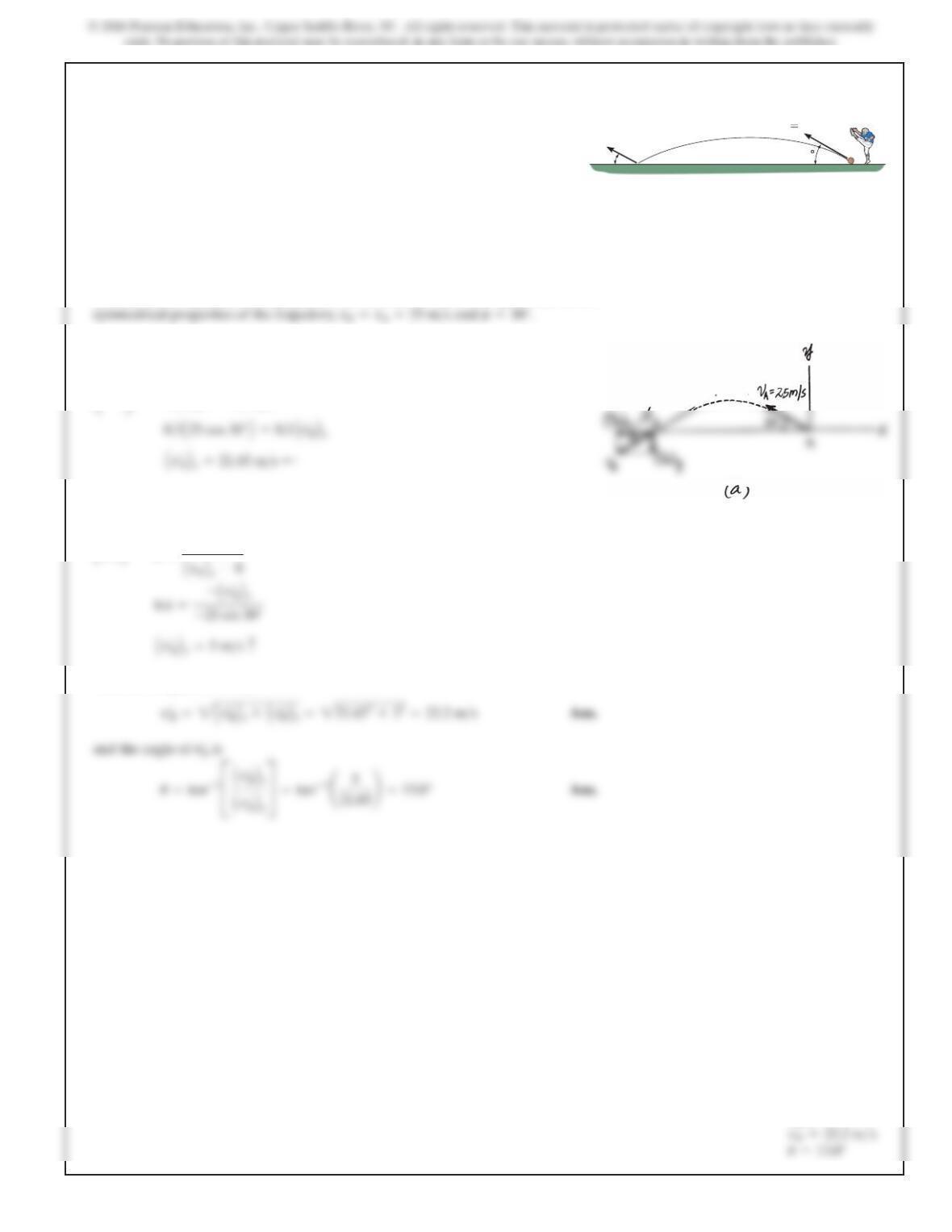
A 300-g ball is kicked with a velocity of vA = 25 m>s at point A
as shown. If the coefficient of restitution between the ball and
the field is e = 0.4, determine the magnitude and direction u
of the velocity of the rebounding ball at B.
Ans:
546
15–70.
A B
v0
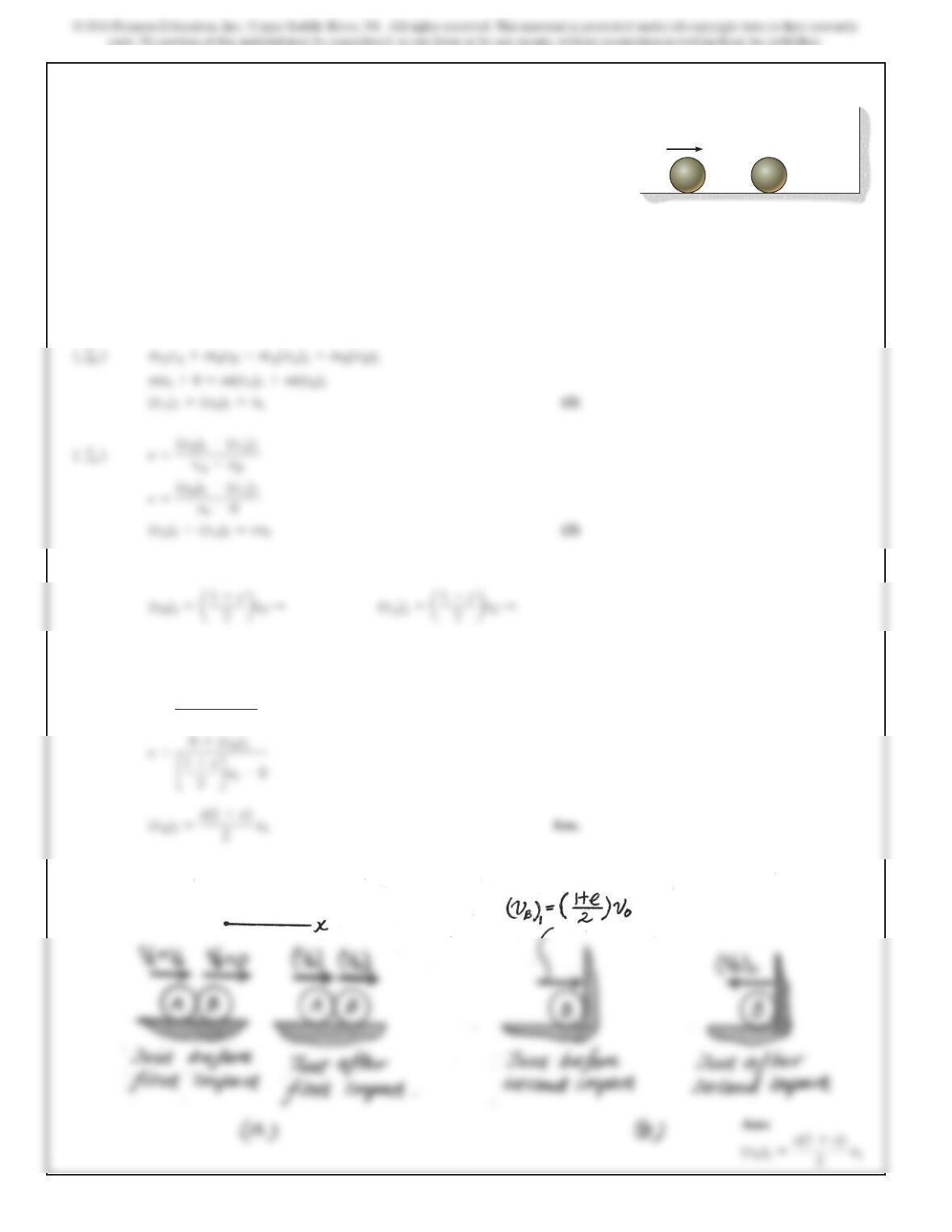
Two smooth spheres Aand Beach have a mass m. If Ais
given a velocity of , while sphere Bis at rest, determine
the velocity of Bjust after it strikes the wall.The coefficient
of restitution for any collision is e.
v0
SOLUTION
Impact: The first impact occurs when sphere Astrikes sphere B.When this occurs,the
linear momentum of the system is conserved along the xaxis (line of impact).
Referring to Fig.a,
Solving Eqs. (1) and (2) yields
The second impact occurs when sphere Bstrikes the wall, Fig.b. Since the wall does
not move during the impact, the coefficient of restitution can be written as
e=0–
C
–(vB)2
D
(vB)1–0
(:
+)
547
15–71.
SOLUTION
(:
+)s=s0+v0t
It was o
b
serve
d
t
h
at a tenn
i
s
b
a
ll
w
h
en serve
d
h
or
i
zonta
ll
y
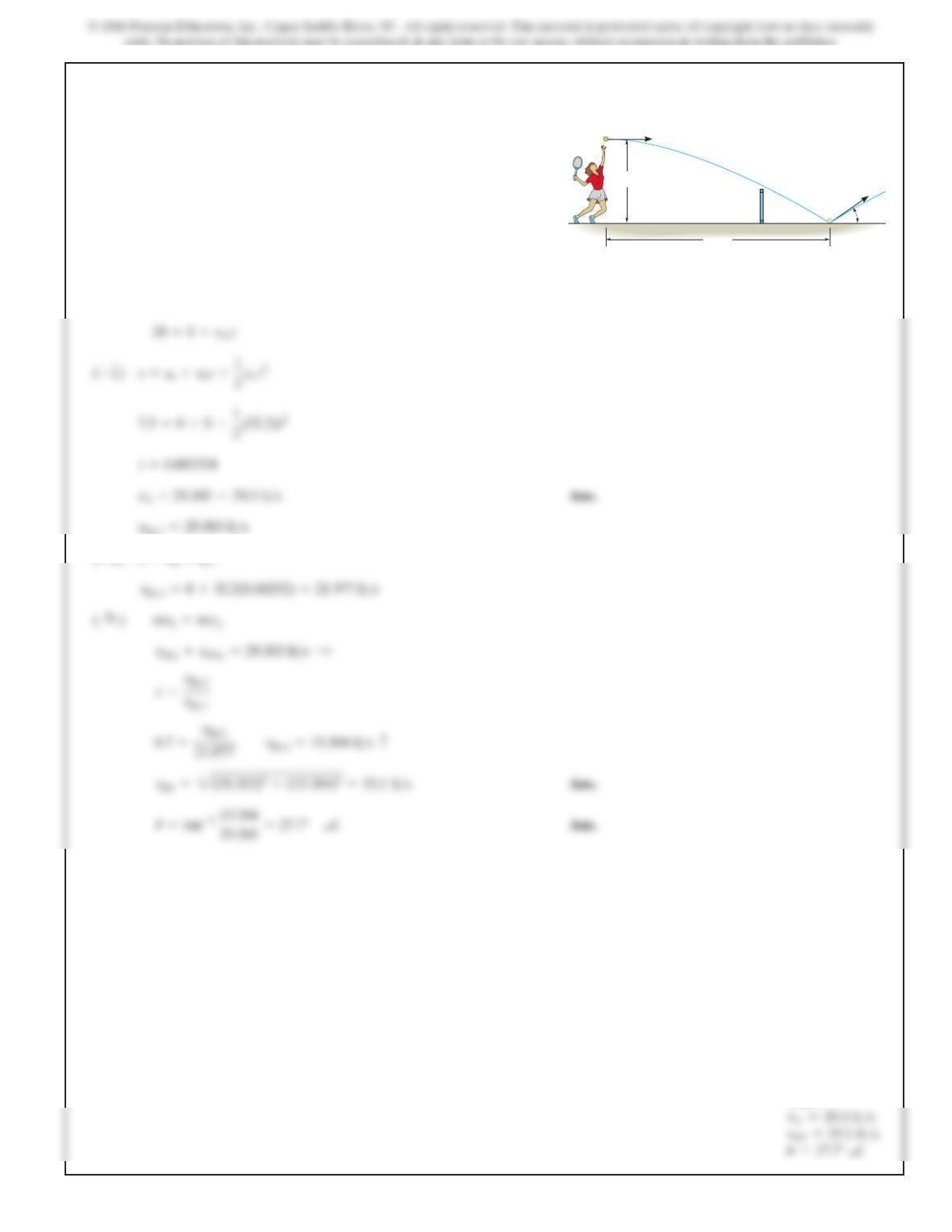
7.5 ft above the ground strikes the smooth ground at B20 ft
away. Determine the initial velocity of the ball and the
velocity (and ) of the ball just after it strikes the court at
B.Take e=0.7.
uvB
vA
20 ft
v
B
v
A
7.5ft
A
B
u
Ans:
548
*15–72.
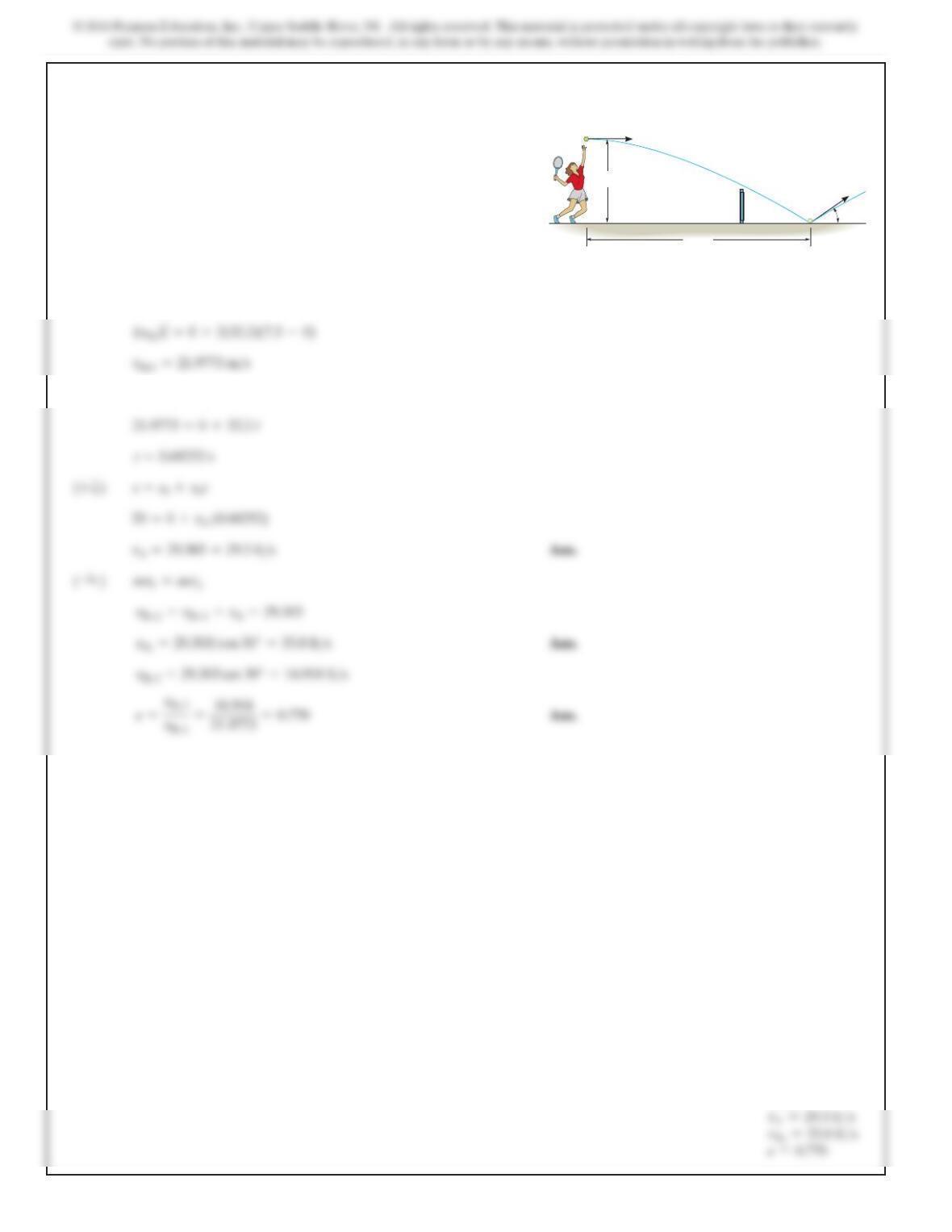
The tennis ball is struck with a horizontal velocity
strikes the smooth ground at B, and bounces upward at
Determine the initial velocity the final velocity
and the coefficient of restitution between the ball and
the ground.
vB,
vA,u=30°.
v
A
,
SOLUTION
(+T)v=v0+act
(+T)v2=v2
0+2ac(s–s0)
20 ft
v
B
v
A
7.5 ft
A
B
u
Ans:
549
15–73.
SOLUTION
(+c)my1=my2
(:
+)©my1=©my2
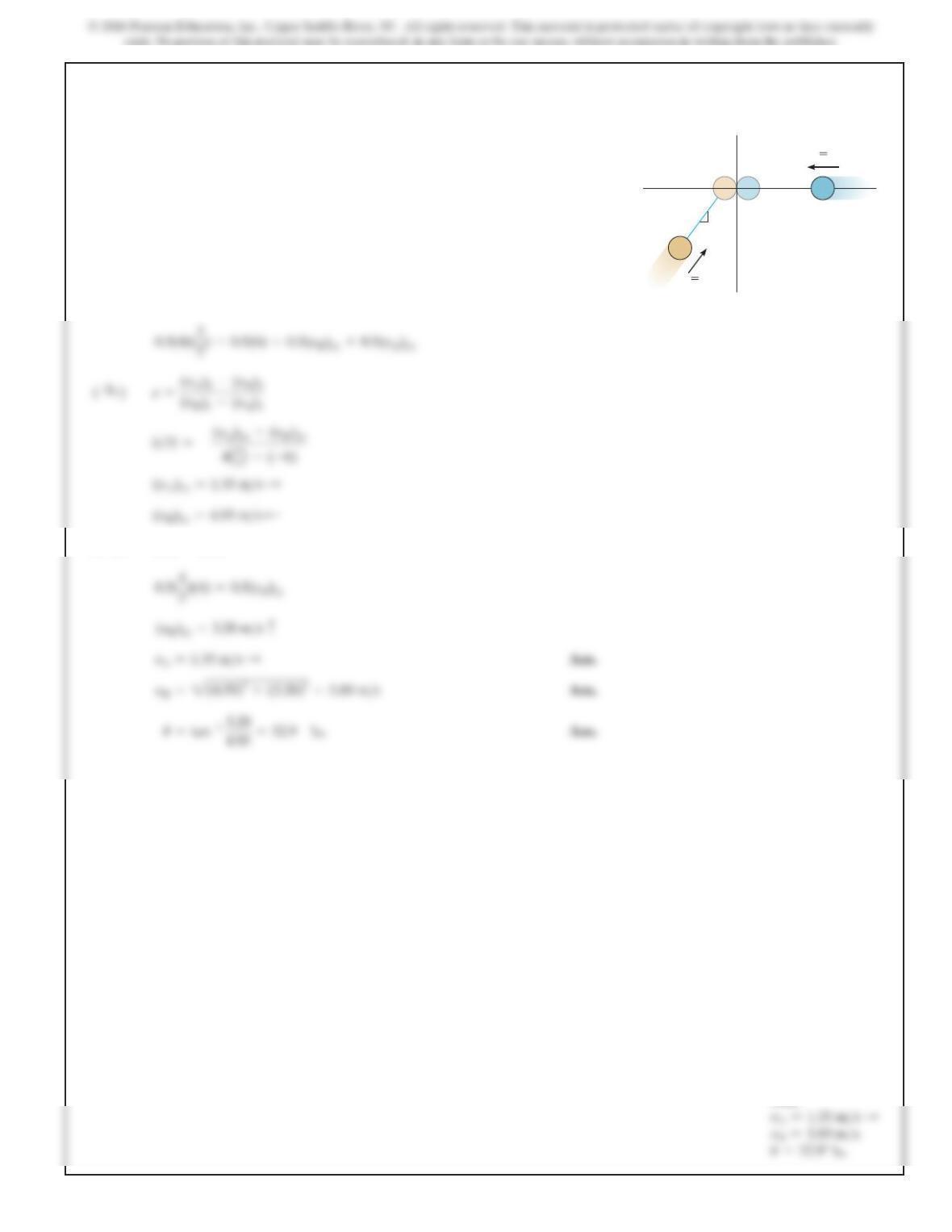
Two smooth disks Aand Beach have a mass of 0.
5
kg.If
both
disks are moving with the velocities shown when they
collide
, determine their final velocities just after collision.
T
he coefficient of restitution is e=0.75.
y
54
3
x
A
B
(v
A
)
1
6m/s
(v
B
)
1
4m/s
Ans:
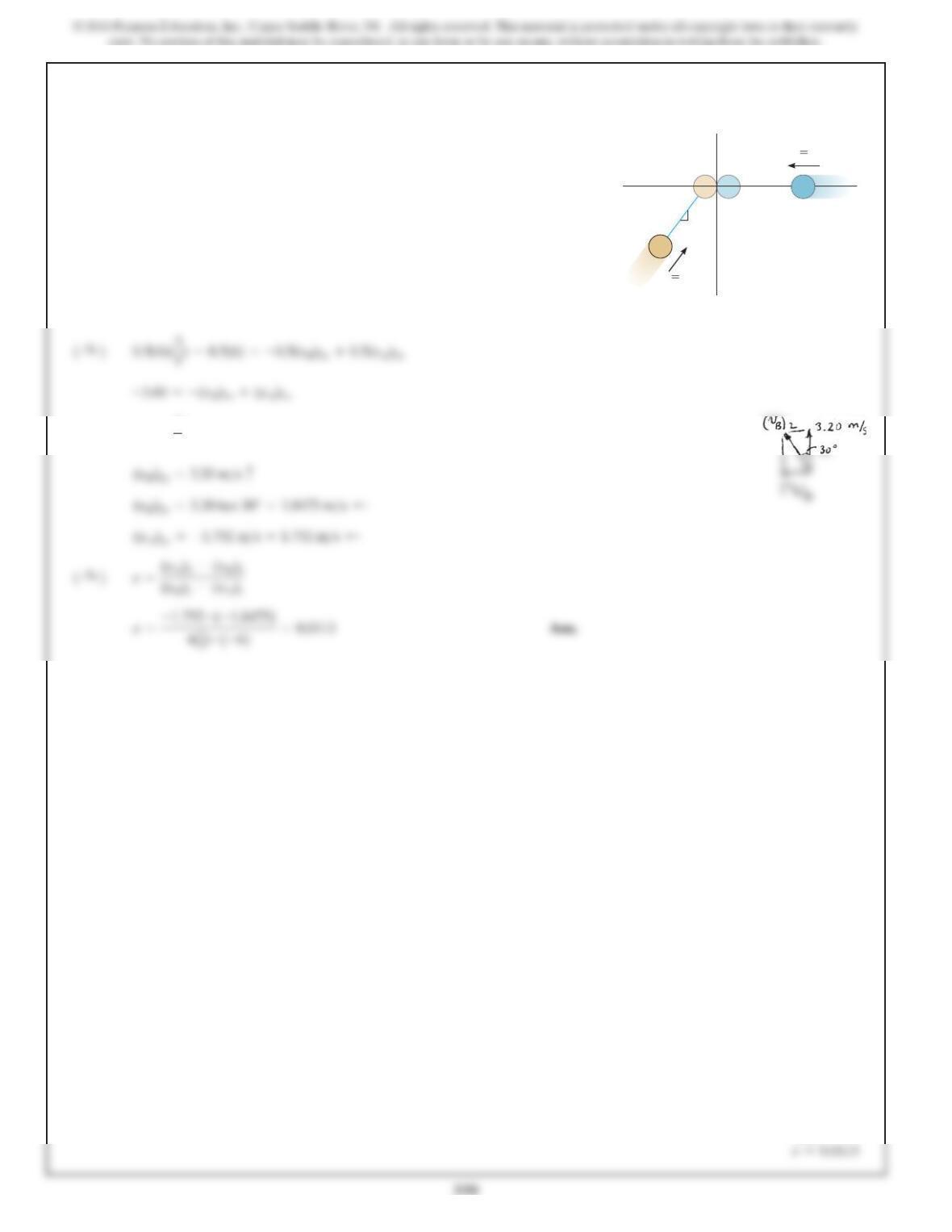
15–74.
Two smooth disks Aand Beach have a mass of 0.
5
kg.If
both disks are moving with the velocities shown when they
collide, determine the coefficient of restitution between the
disks if after collision Btravels along a line, 30°
counterclockwise from the yaxis.
SOLUTION
(+c) 0.5(4)(4
5)=0.5(yB)2y
©my1=©my2
y
54
3
x
A
B
(v
A
)
1
6m/s
(v
B
)
1
4m/s
Ans:
551
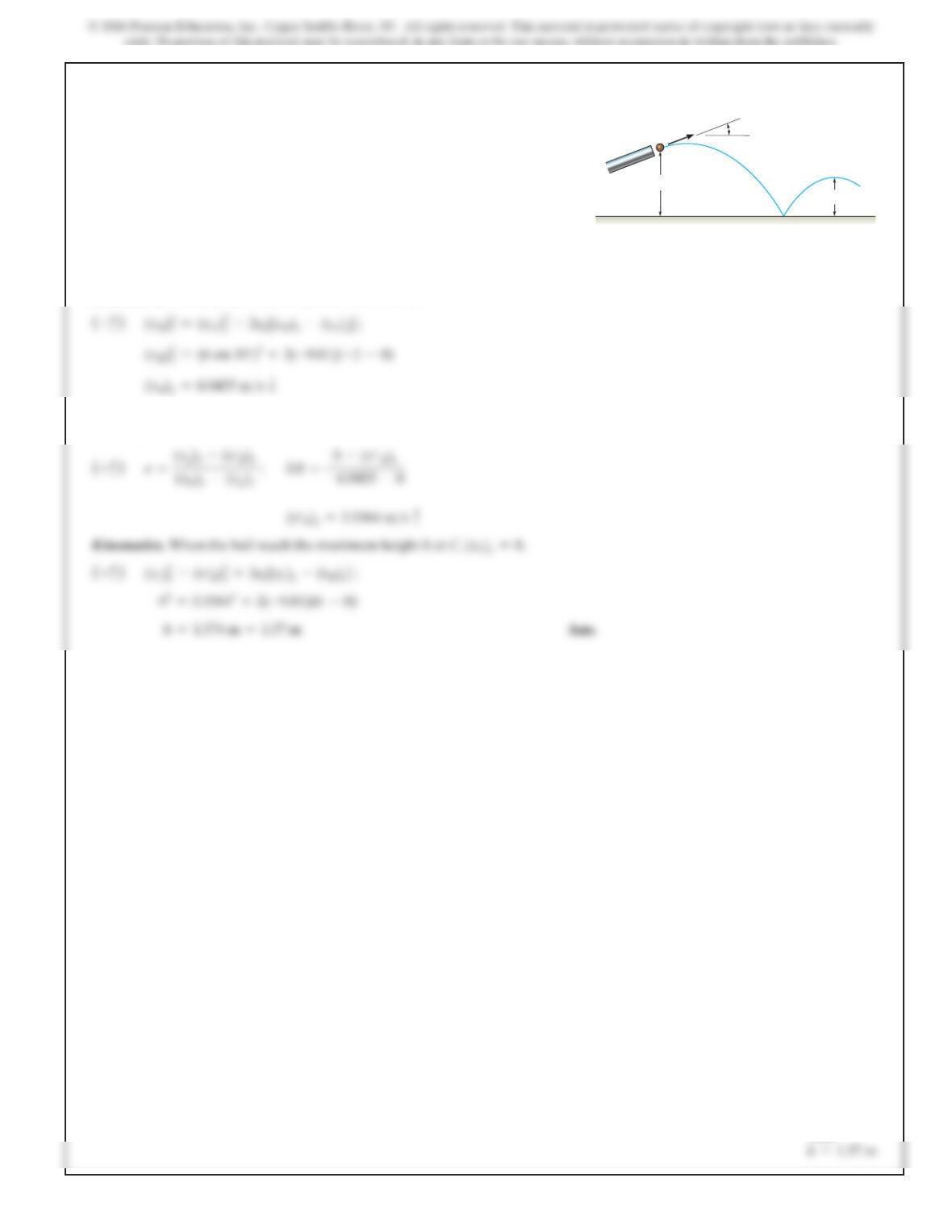
15–75.
The 0.5-kg ball is fired from the tube at A with a velocity of
v
=6 m>s
. If the coefficient of restitution between the ball
and the surface is
e=0.8
, determine the height h after it
bounces off the surface.
SOLUTION
Kinematics. Consider the vertical motion from A to B.
Coefcient of Restitution. The y-component of the rebounding velocity at B is
(v′
B
)
y
and the ground does not move. Then
)
2 m
h
30
B
C
A
v 6 m/s
Ans:
552
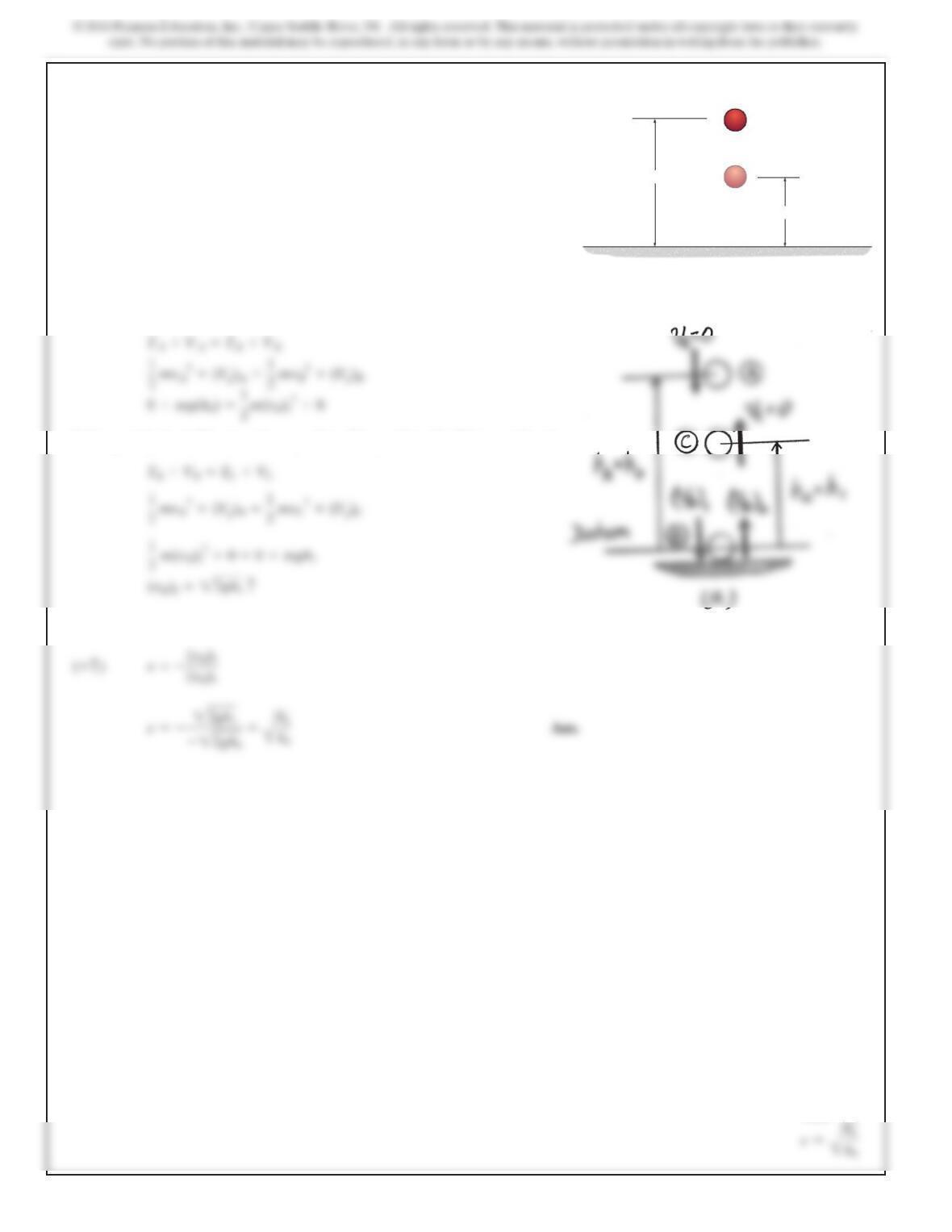
*15–76.
A ball of mass mis dropped vertically from a height
above the ground. If it rebounds to a height of , determine
the coefficient of restitution between the ball and the
ground.
h1
h0
SOLUTION
Conservation of Energy: First, consider the ball’s fall from position Ato position B.
Referring to Fig.a,
Subsequently, the ball’s return from position Bto position Cwill be considered.
Coefficient of Restitution: Since the ground does not move,
h1
h0
Ans:
553
15–77.
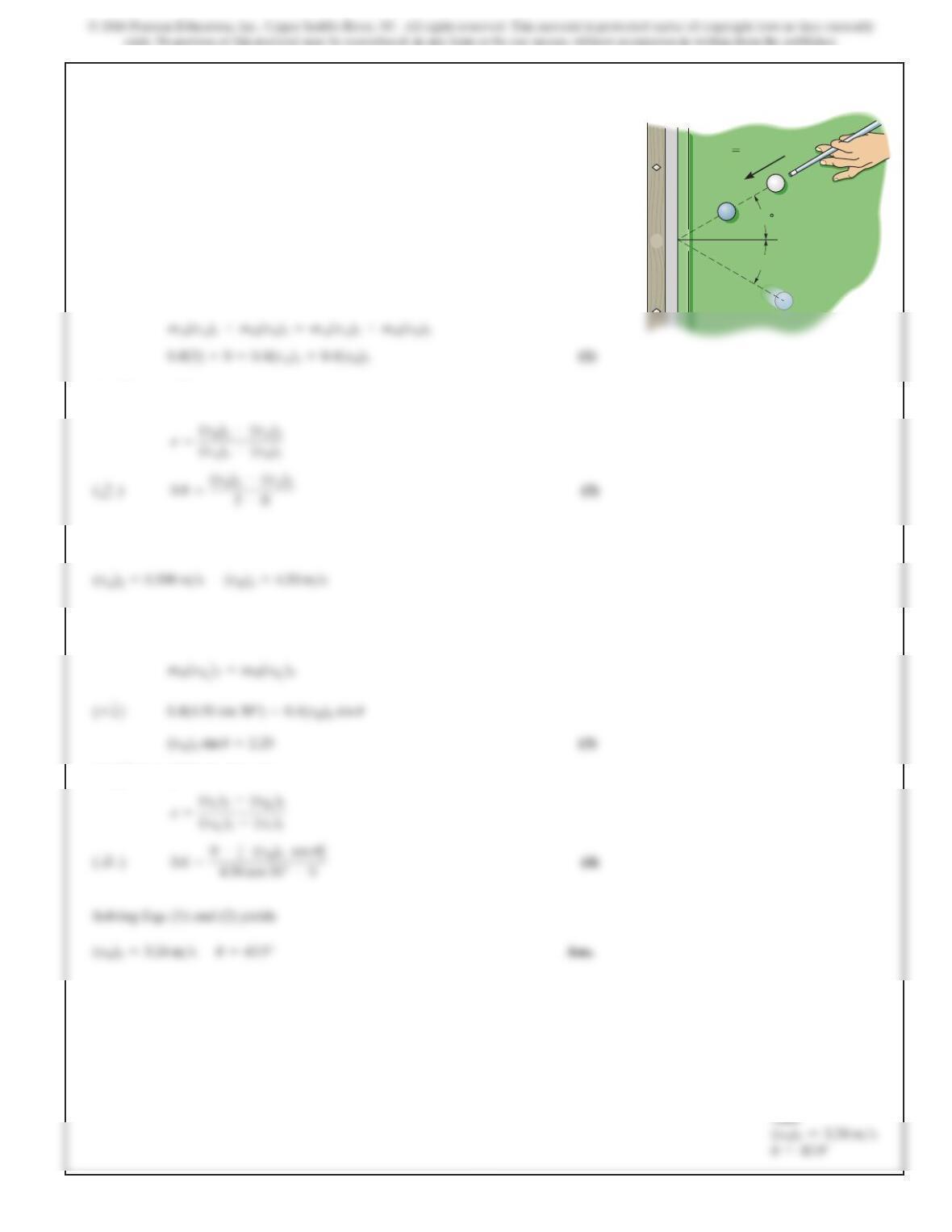
The cue ball Ais given an initial velocity If
it makes a direct collision with ball determine
the velocity of Band the angle just after it rebounds from
the cushion at Each ball has a mass of 0.4 kg.C (e¿=0.6).
u
B (e=0.8),
(vA)1=5 m>s.
SOLUTION
Conservation of Momentum: When ball Astrikes ball B,we have
Coefficient of Restitution:
Solving Eqs. (1) and (2) yields
Conservation of “y” Momentum: When ball Bstrikes the cushion at C, we have
Coefficient of Restitution (x):
u
(vA)1 5 m/s
30
C
A
B
Neglect their size.