554
15–78.
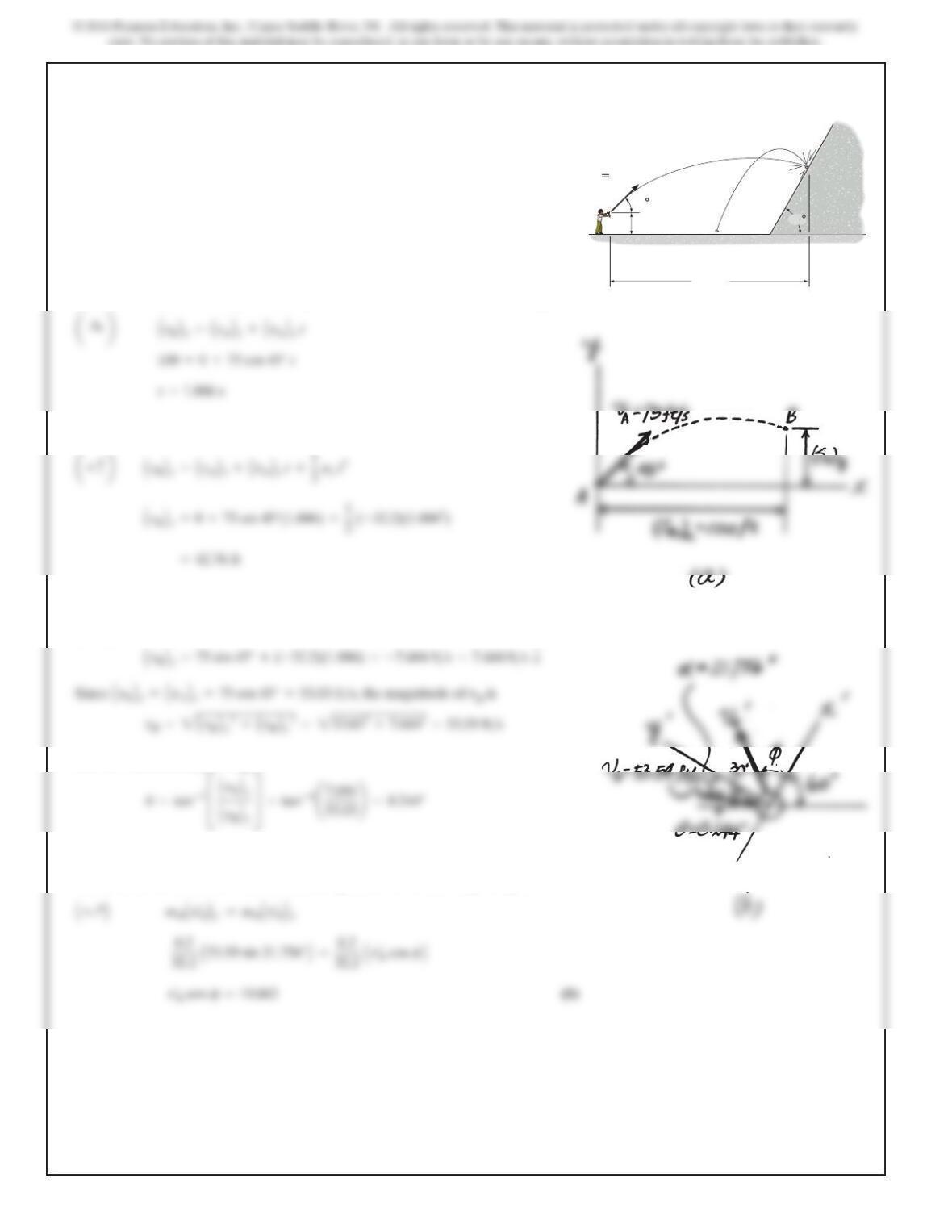
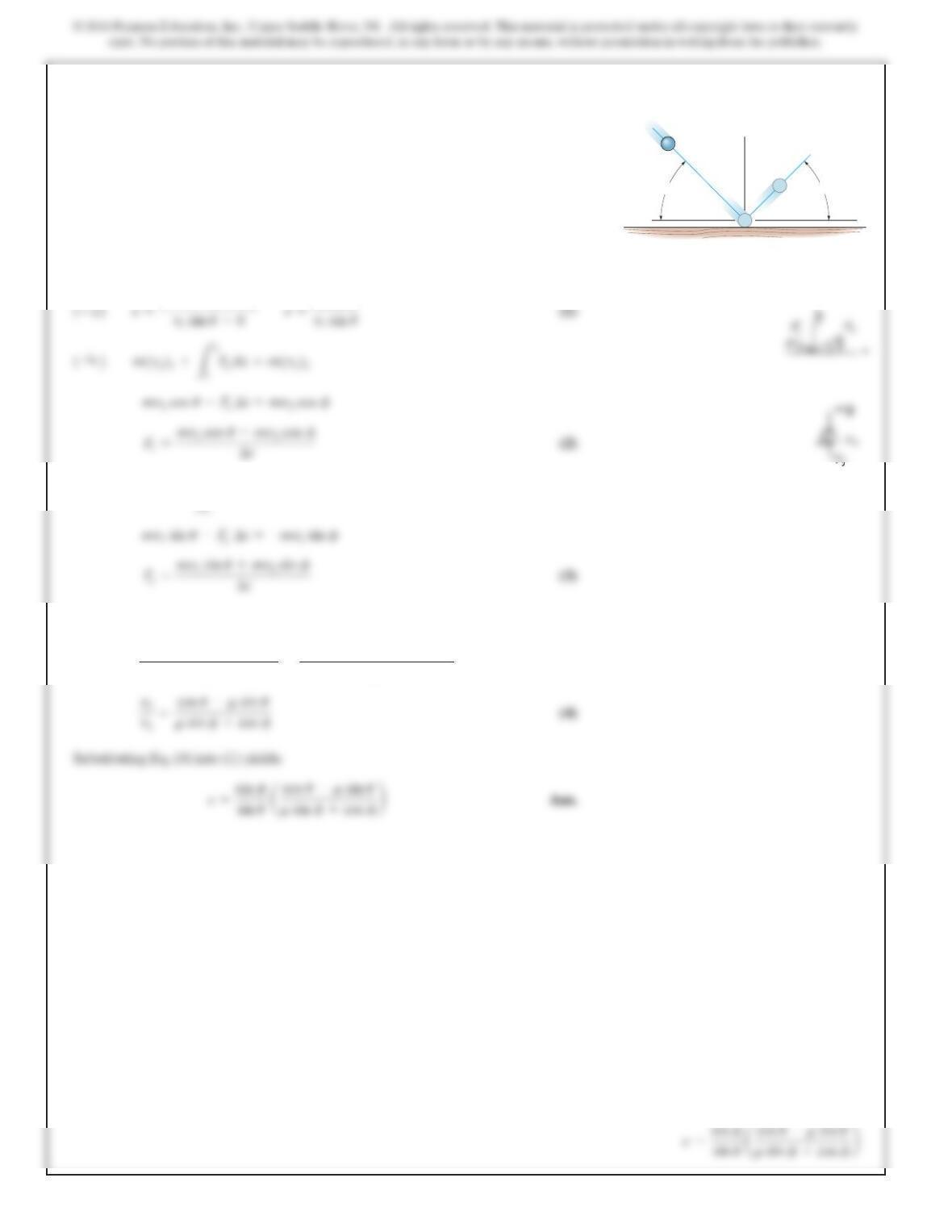
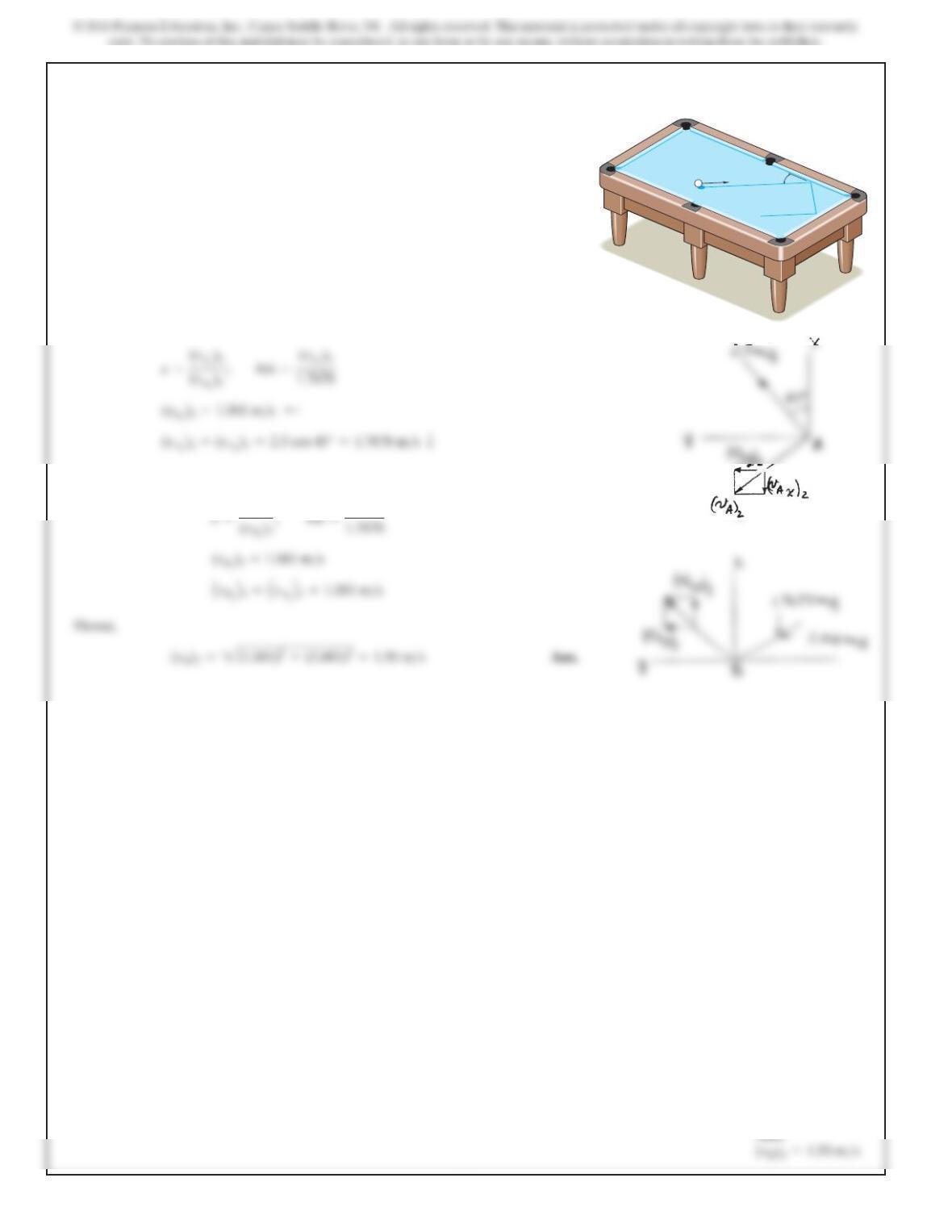
Using a slingshot, the boy fires the 0.2-lb marble at the
concrete wall, striking it at B. If the coefficient of restitution
between the marble and the wall is , determine the
speed of the marble after it rebounds from the wall.
e=0.5
5ft
A
B
C
100 ft
vA75 ft>s
45
60
SOLUTION
Kinematics: By considering the xand ymotion of the marble from Ato B,Fig. a,
and
and
and the direction angle of vBis
Conservation of Linear Momentum: Since no impulsive force acts on the marble
along the inclined surface of the concrete wall ( axis) during the impact, the linear
momentum of the marble is conserved along the axis. Referring to Fig. b,
x¿
x¿
a+cb
A
vB
B
y=
A
vA
B
y+ayt
Coefficient of Restitution: S
i
nce t
h
e concrete wa
ll
d
oes not move
d
ur
i
ng t
h
e
i
mpact
,
the coefficient of restitution can be written as
Solving Eqs. (1) and (2) yields
15–78. Continued
15–79.
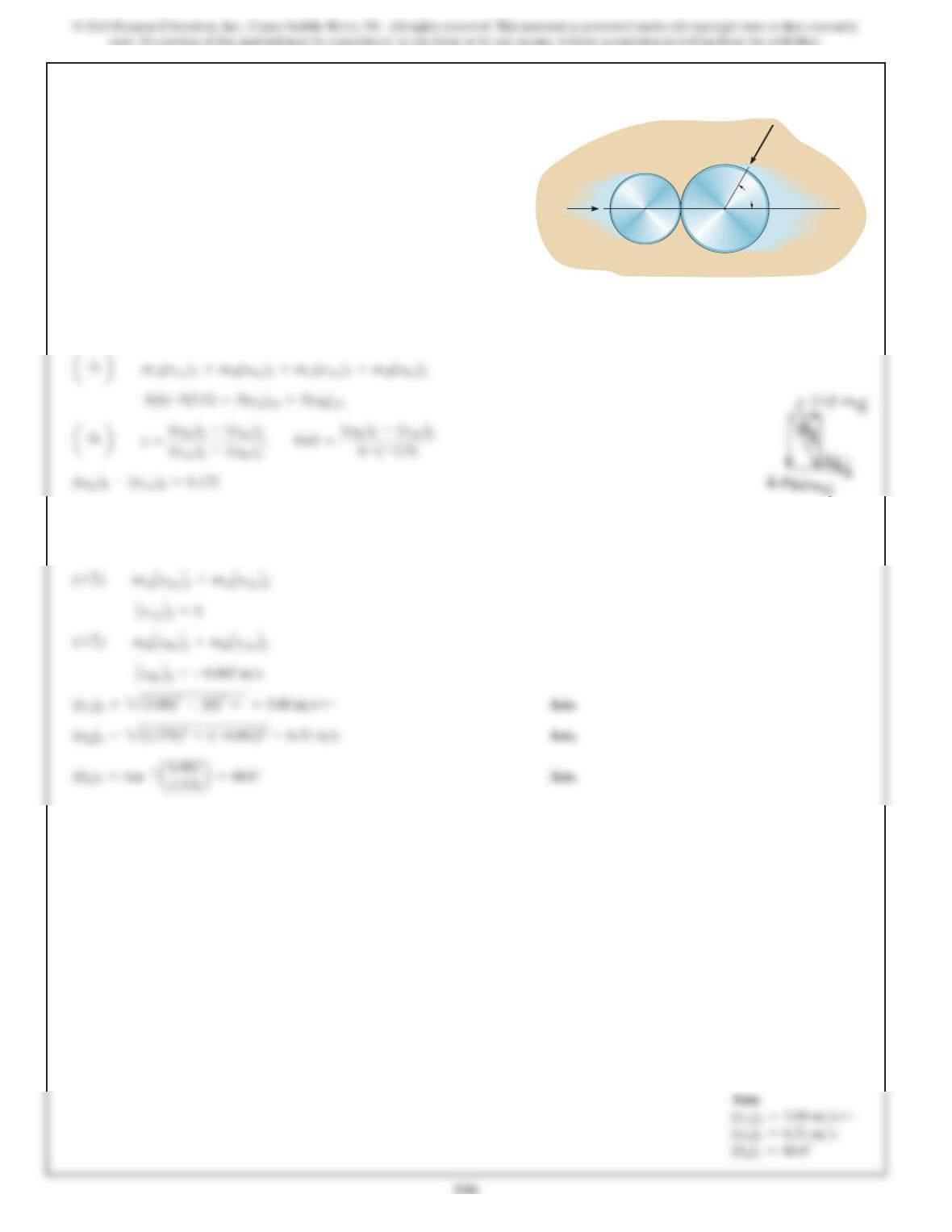
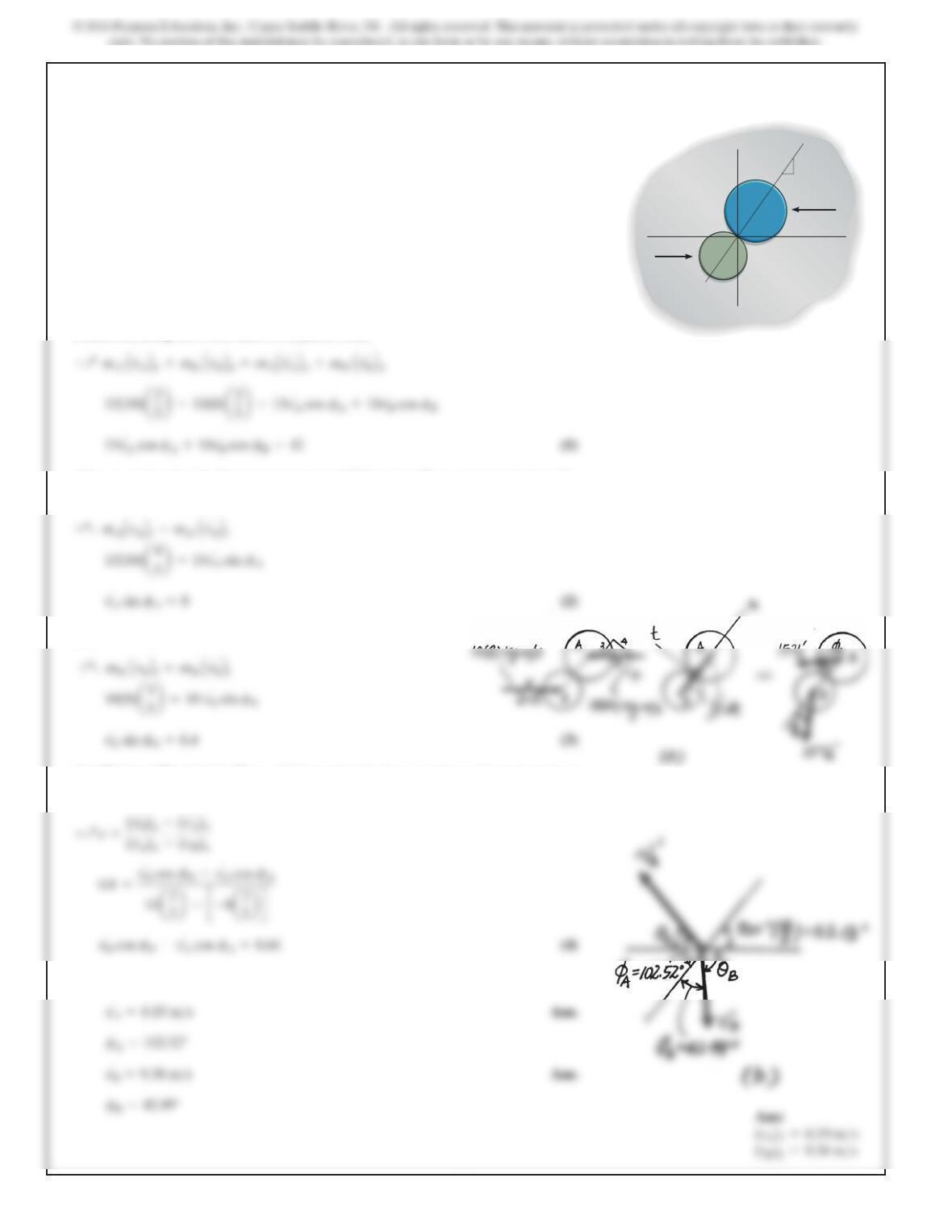
The two disks Aand Bhave a mass of 3 kg and 5 kg,
respectively. If they collide with the initial velocities shown,
determine their velocities just after impact. The coefficient
of restitution is e=0.65.
SOLUTION
Solving,
(yAx)2=-3.80 m>s(yBx)2=2.378 m>s
(yBx)1=-7 cos 60° =-3.5 m>s
A
yBy
B
1=-7 cos 60° =-6.062 m>s
(yAx)=6m>s(yAy)1=0
Line of impact
AB
60
(v
A
)
1
fi6m/s
(v
B
)
1
fi7m/s
557
*15–80.
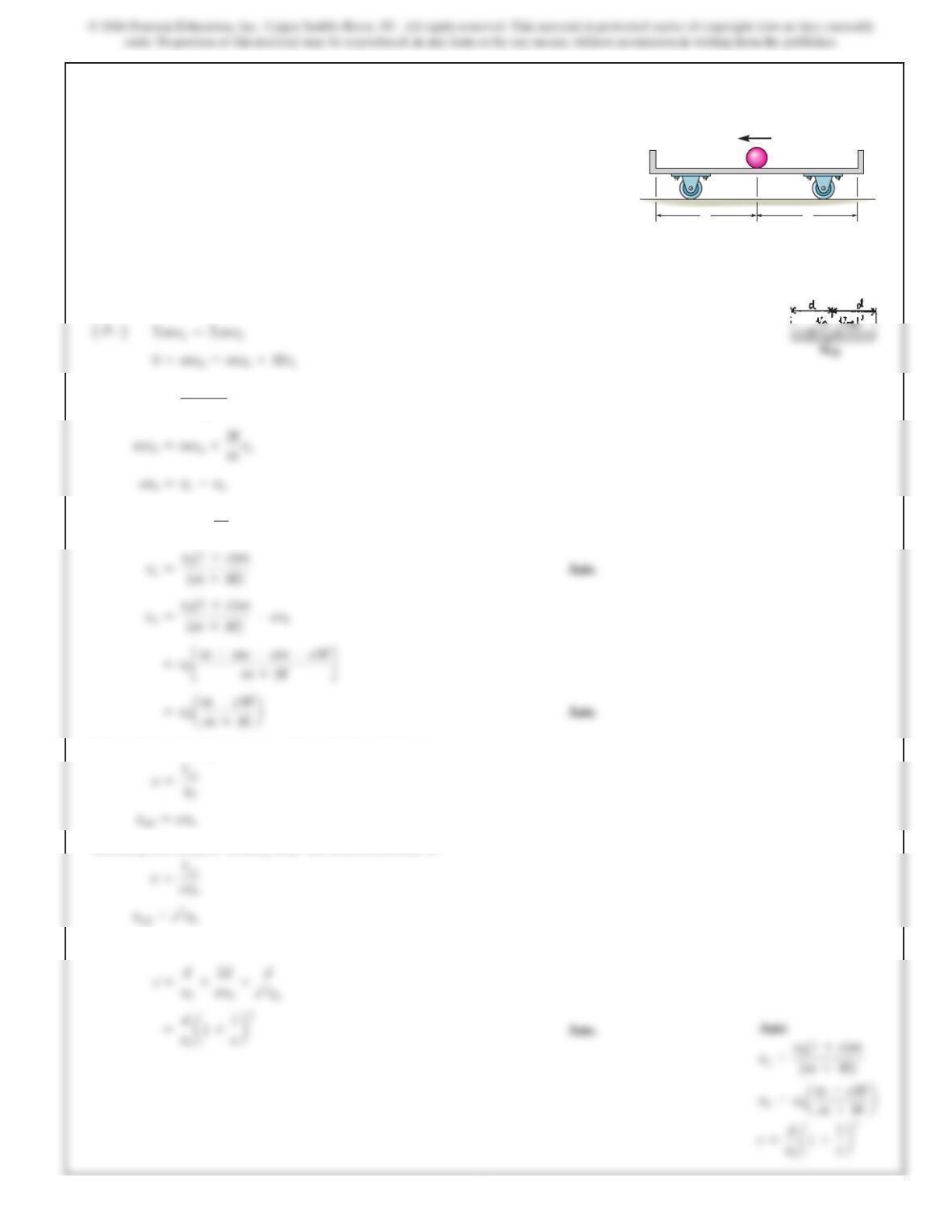
A ball of negligible size and mass m is given a velocity of v0
on the center of the cart which has a mass M and is originally
at rest. If the coefficient of restitution between the ball and
walls A and B is e, determine the velocity of the ball and the
cart just after the ball strikes A. Also, determine the total
time needed for the ball to strike A, rebound, then strike B,
and rebound and then return to the center of the cart.
Neglect friction.
SOLUTION
After the first collision;
(
+
)
(
d
+
)
e=
v
c
–v
b
v
0
v0(1 +e)=
a
1+
M
m
b
vc
The relative velocity on the cart after the first collision is
Similarly, the relative velocity after the second collision is
Total time is
v0
A B
d
d
558
15–81.
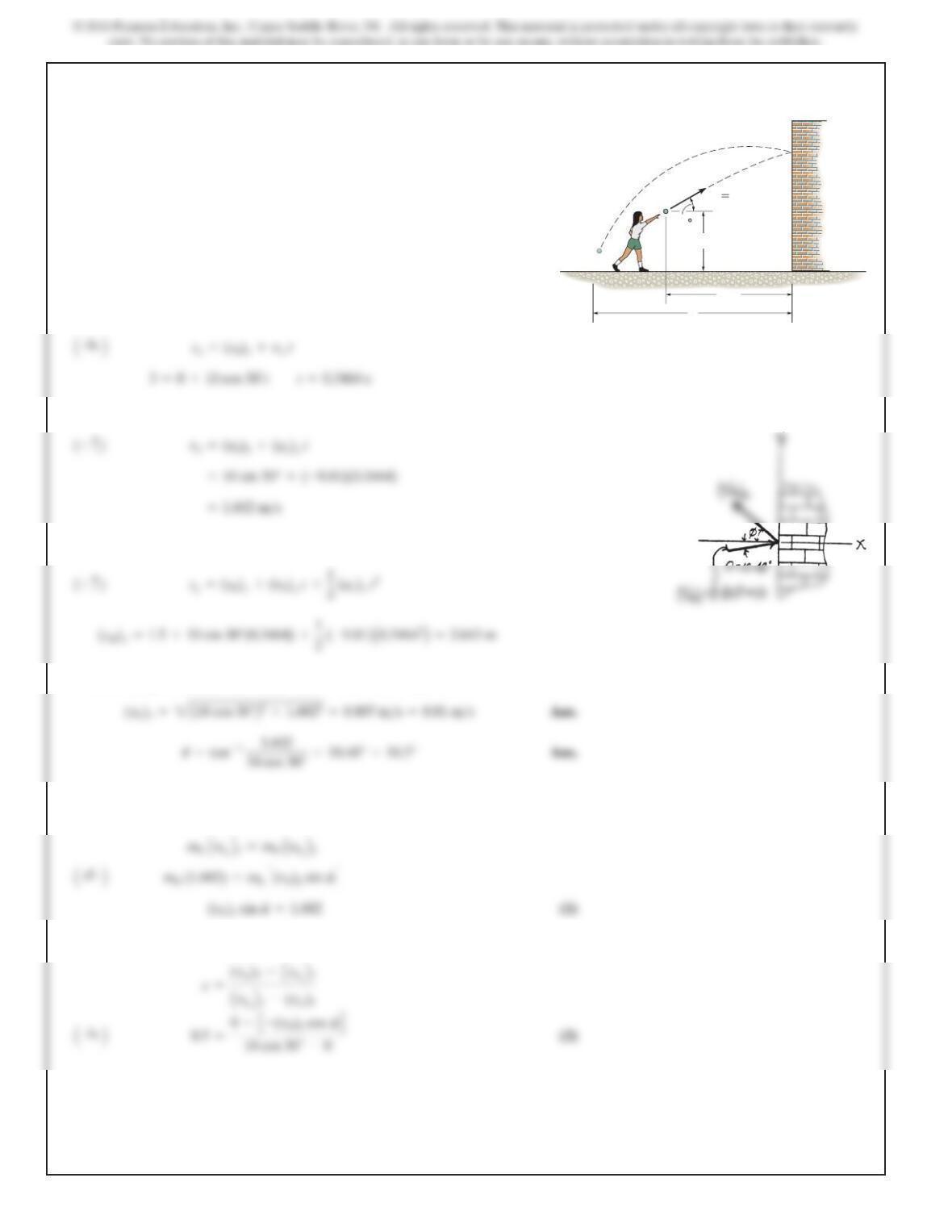
The girl throws the 0.5-kg ball toward the wall with an
initial velocity . Determine (a) the velocity at
which it strikes the wall at B, (b) the velocity at which it
rebounds from the wall if the coefficient of restitution
, and (c) the distance sfrom the wall to where it
strikes the ground at C.
e=0.5
vA=10 m>s
vA10 m/s
1.5 m
30
3m
s
A
C
B
SOLUTION
Kinematics: By considering the horizontal motion of the ball before the impact,
we have
By considering the vertical motion of the ball before the impact, we have
The vertical position of point Babove the ground is given by
Thus, the magnitude of the velocity and its directional angle are
Conservation of “y” Momentum: When the ball strikes the wall with a speed of
, it rebounds with a speed of .
Coefficient of Restitution (x):
(vb)2
(vb)1=8.807 m>s
559
Solving Eqs.
(
1
)
and
(
2
)
yields
Kinematics:By considering the vertical motion of the ball after the impact,we have
By considering the horizontal motion of the ball after the impact, we have
15–81. Continued
Ans:
15–82.
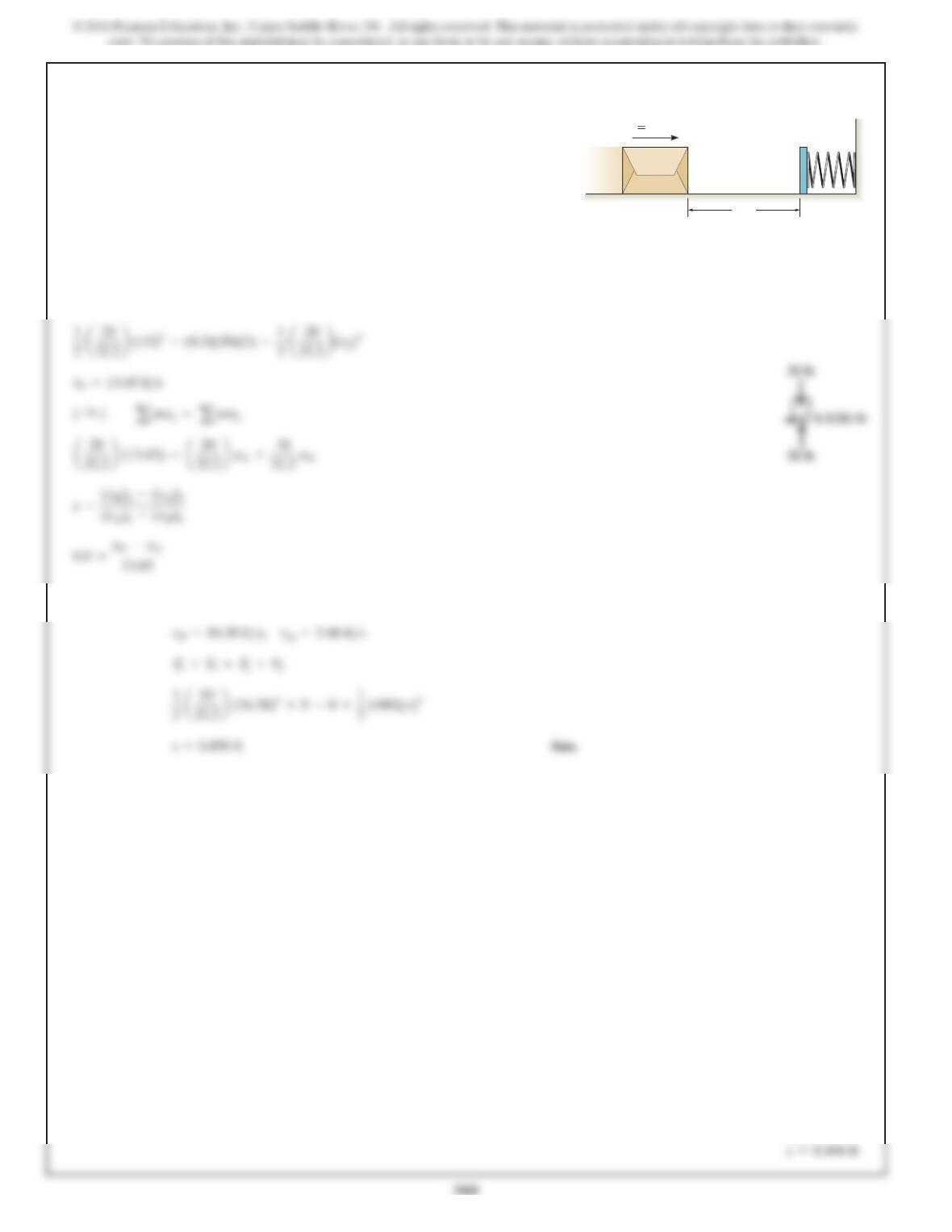
The 20-lb box slides on the surface for which The
box has a velocity when it is 2ft from the plate.
If it strikes the smooth plate, which has a weight of 10 lb and
is held in position by an unstretched spring of stiffness
determine the maximum compression
imparted to the spring.Take between the box and
the plate. Assume that the plate slides smoothly.
e=0.8
k=400 lb>ft,
v=15 ft>s
mk
=0.3.
SOLUTION
Solving,
T
1+aU
1–2=T
2
v15 ft/s
k
2ft
Ans:
561
15–83.
SOLUTION
Collar
Bafter impact:
System:
Solving:
Collar
A:
A
:
+
B
©m1v1=©m1v2
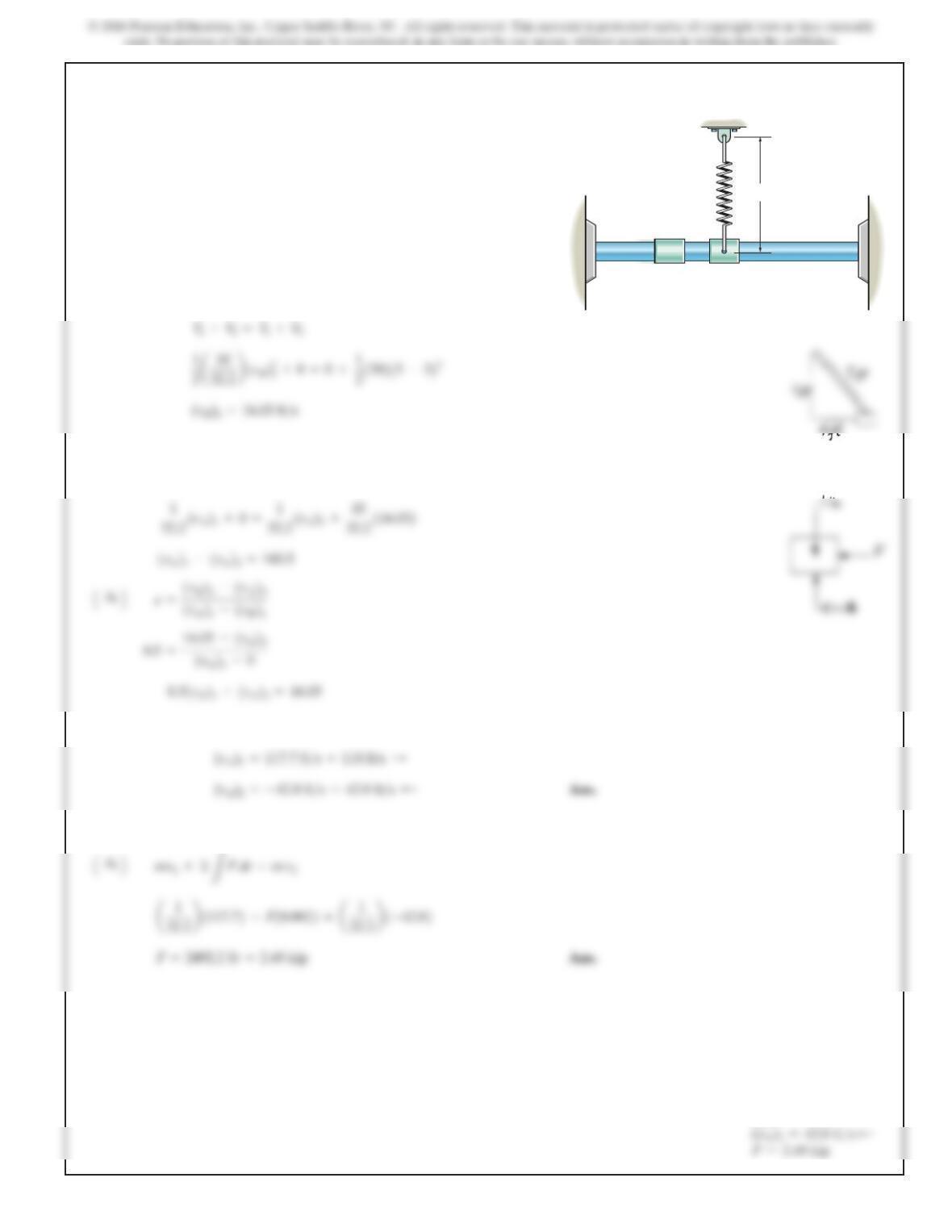
The 10-lb collar Bis at rest, and when it is in the position
shown the spring is unstretched. If another 1-lb collar A
strikes it so that Bslides 4 ft on the smooth rod before
momentarily stopping, determine the velocity of Ajust after
impact, and the average force exerted between Aand B
during the impact if the impact occurs in 0.002 s. The
coefficient of restitution between Aand Bis e=0.5.
AB
k20 lb/ft 3ft
Ans:
562
*15–84.
SOLUTION
Since , from Eqs. (2) and (3)
mv1cos u–mv2cos f
¢t=m1mv1sin u+mv2sin f)
¢t
F
x=mF
y
(+T)m1vy21+Lt2
F
ydx =m1vy22
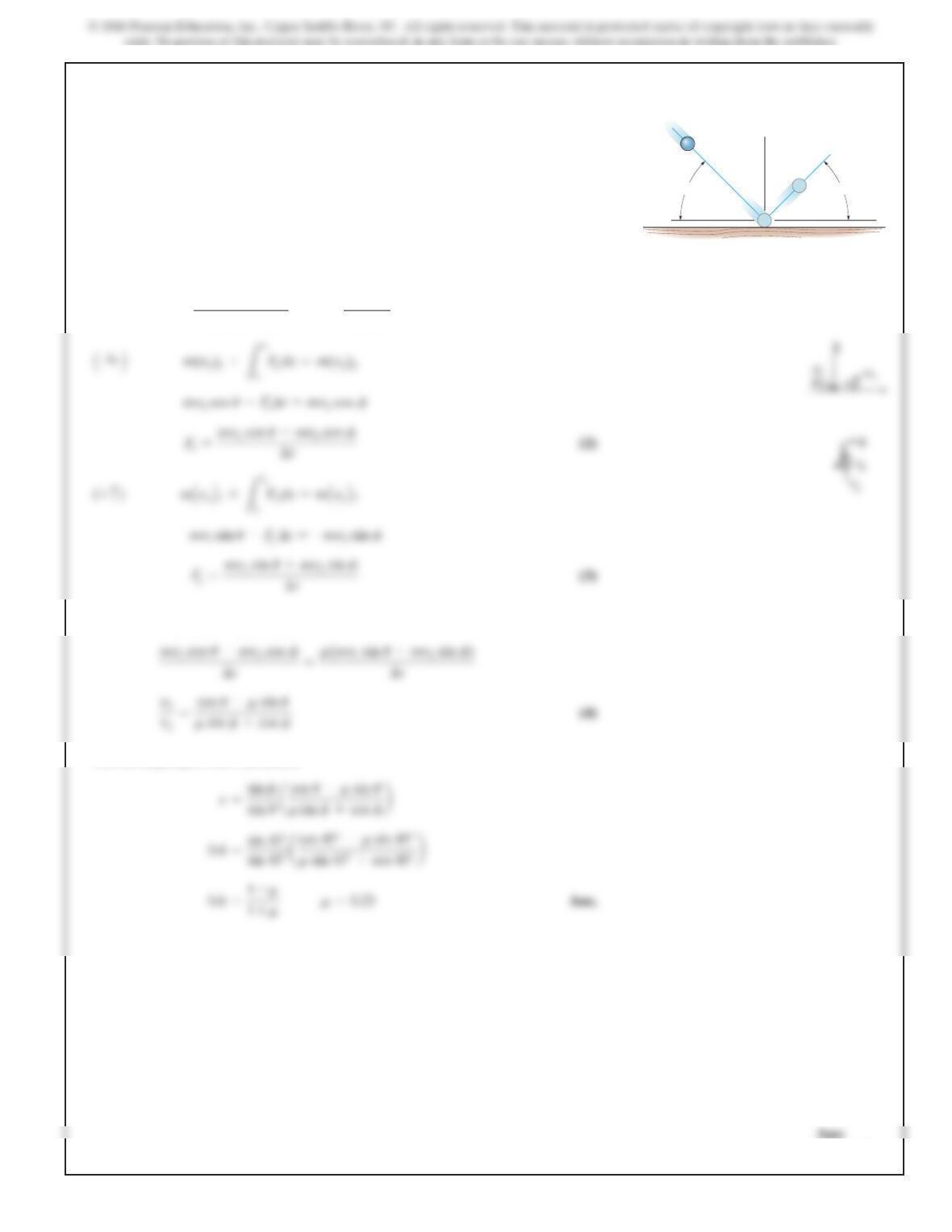
Aball is thrown onto arough floor at an angle If it rebounds
at an angle and the coefficient of kinetic friction
is determine the coefficient of restitution e.Neglect the size
of the ball. Hint: Show that during impact, the average
impulses in the xand ydirections are related by
Since the time of impact is the same,or
F
x=mF
y.
F
x¢t=mF
y¢t
Ix=mIy.
m,
f
u
.
y
x
uf
Ans:
563
15–85.
A ball is thrown onto a rough floor at an angle of If
it rebounds at the same angle determine the
coefficient of kinetic friction between the floor and the ball.
The coefficient of restitution is Hint: Show that
during impact, the average impulses in the xand y
directions are related by Since the time of impact
is the same, or F
x=mF
y.F
x¢t=mF
y¢t
Ix=mIy.
e=0.6.
f=45°,
u
=45°.
SOLUTION
(1)
Since , from Eqs. (2) and (3)
Substituting Eq. (4) into (1) yields:
F
x=mF
y
(+T)e=0–[–v2sin f]
v1sin u–0e=v2sin f
v1sin u
y
x
uf
m
k=0.25
564
15–86.
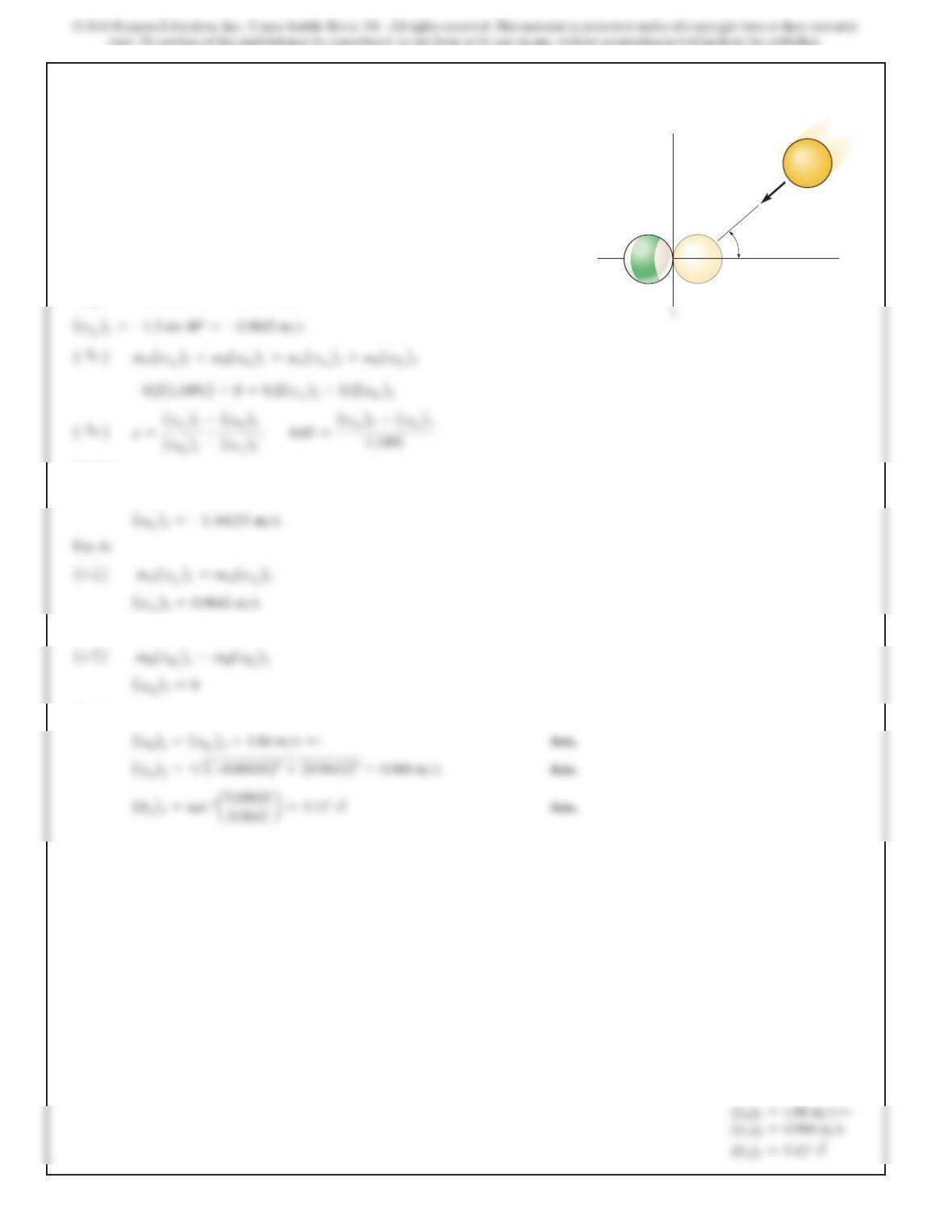
Two smooth billiard balls A and B each have a mass of
200 g. If A strikes B with a velocity
(
vA
)1=1.5 m>s
as
shown, determine their final velocities just after collision.
Ball B is originally at rest and the coefficient of restitution is
e=0.85
. Neglect the size of each ball.
SOLUTION
(v
A
x)
1
=–1.5 cos 40°=–1.1491 m>s
Solving,
(
vA
x
)
2=–
0.08618 m
>
s
(
x
)
For B:
Hence.
(
40
x
y
B
(vA)1 1.5 m/s
A
Ans:
565
15–87.
The “stone” A used in the sport of curling slides over the ice
track and strikes another “stone” B as shown. If each “stone”
is smooth and has a weight of 47 lb, and the coefficient of
restitution between the “stones” is
e=0.8
, determine their
speeds just after collision. Initially A has a velocity of
8 ft>s
and B is at rest. Neglect friction.
SOLUTION
Line of impact (x-axis):
Σmv1=Σmv2
Solving:
Plane of impact (y-axis):
Stone A:
Stone B:
30
x
y
B
(vA)1 8 ft/s
3 ft
A
Ans:
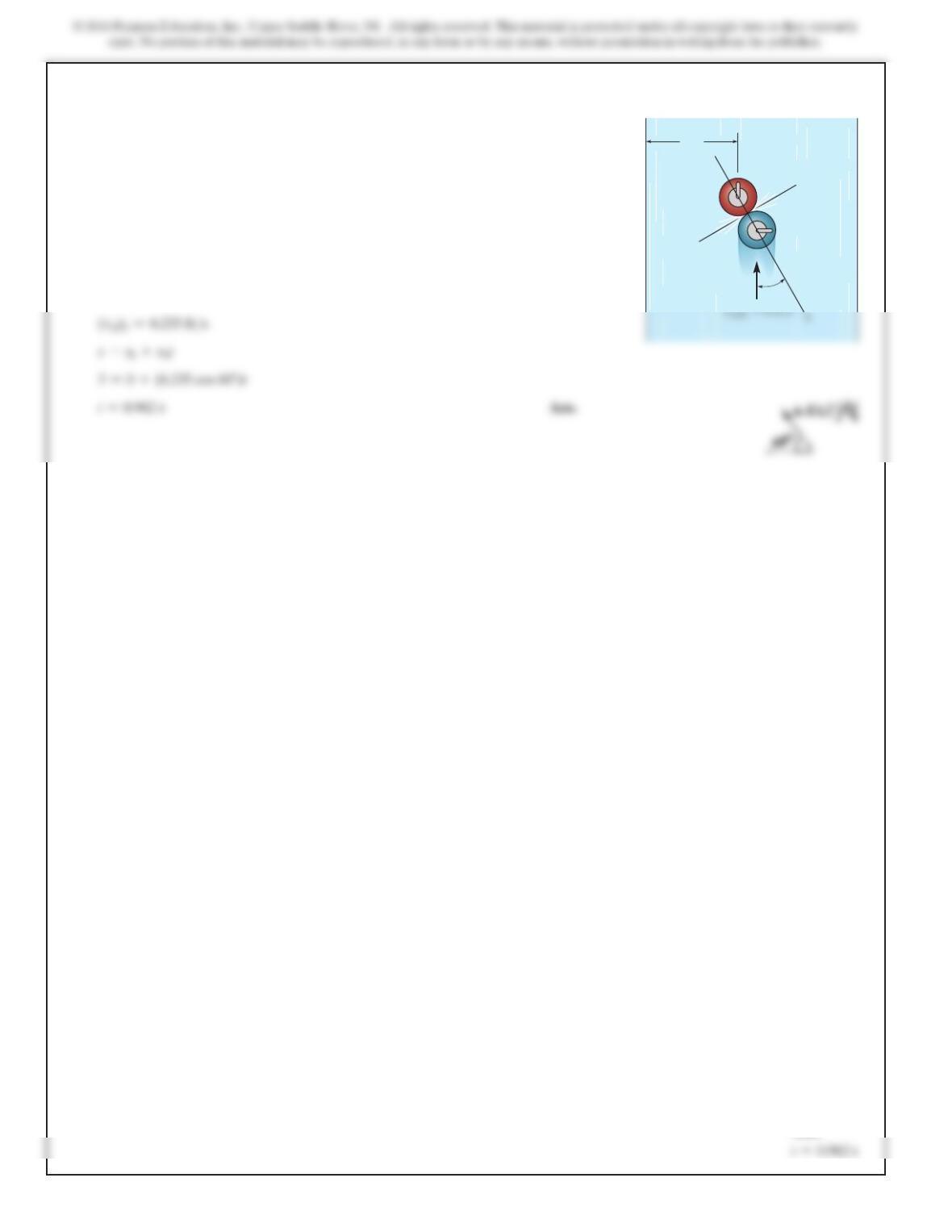
566
*15–88.
The “stone” A used in the sport of curling slides over the ice
track and strikes another “stone” B as shown. If each “stone”
is smooth and has a weight of 47 lb, and the coefficient of
restitution between the “stone” is
e=0.8
, determine the
time required just after collision for B to slide off the
runway. This requires the horizontal component of
displacement to be 3 ft.
SOLUTION
See solution to Prob. 15–87.
30
y
B
3 ft
A
Ans:
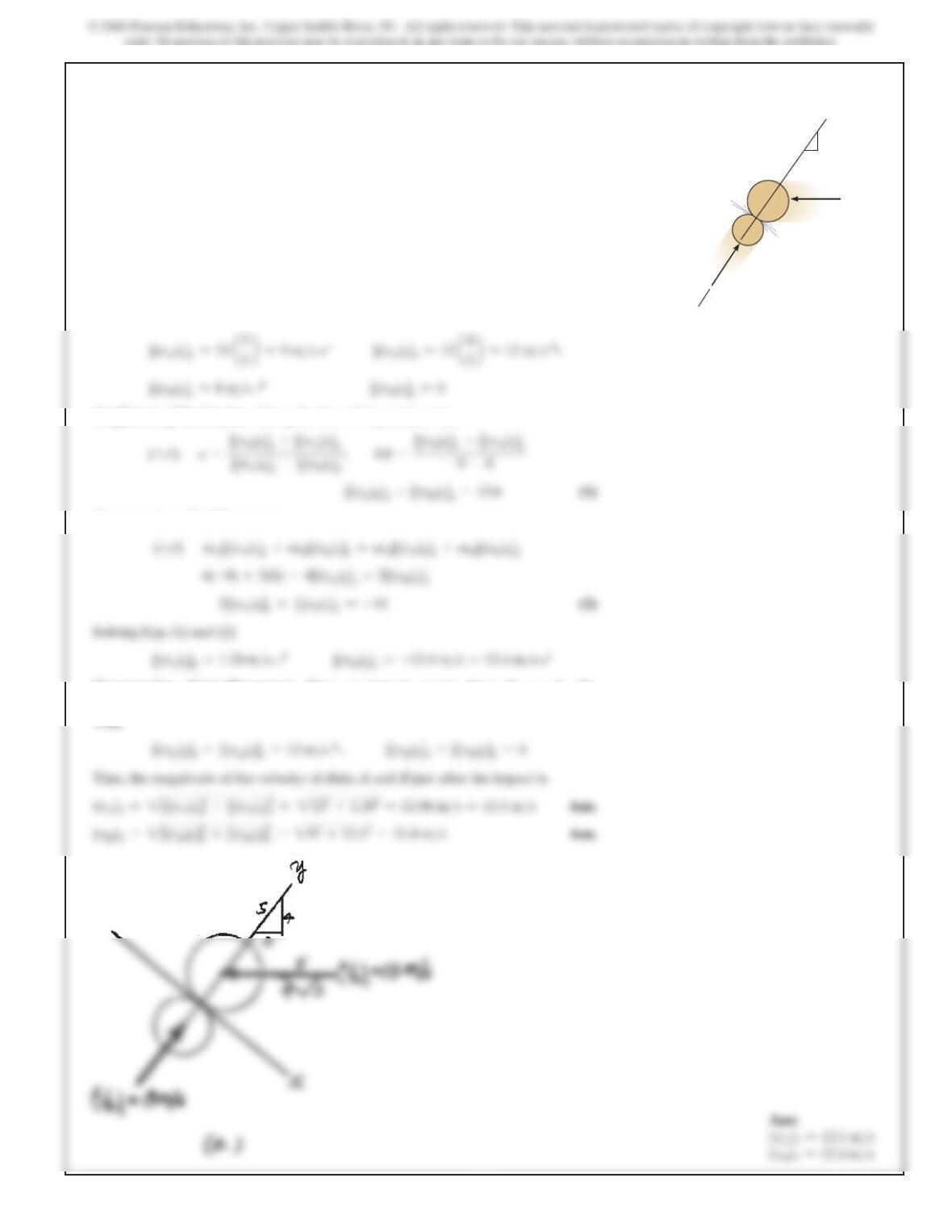
567
15–89.
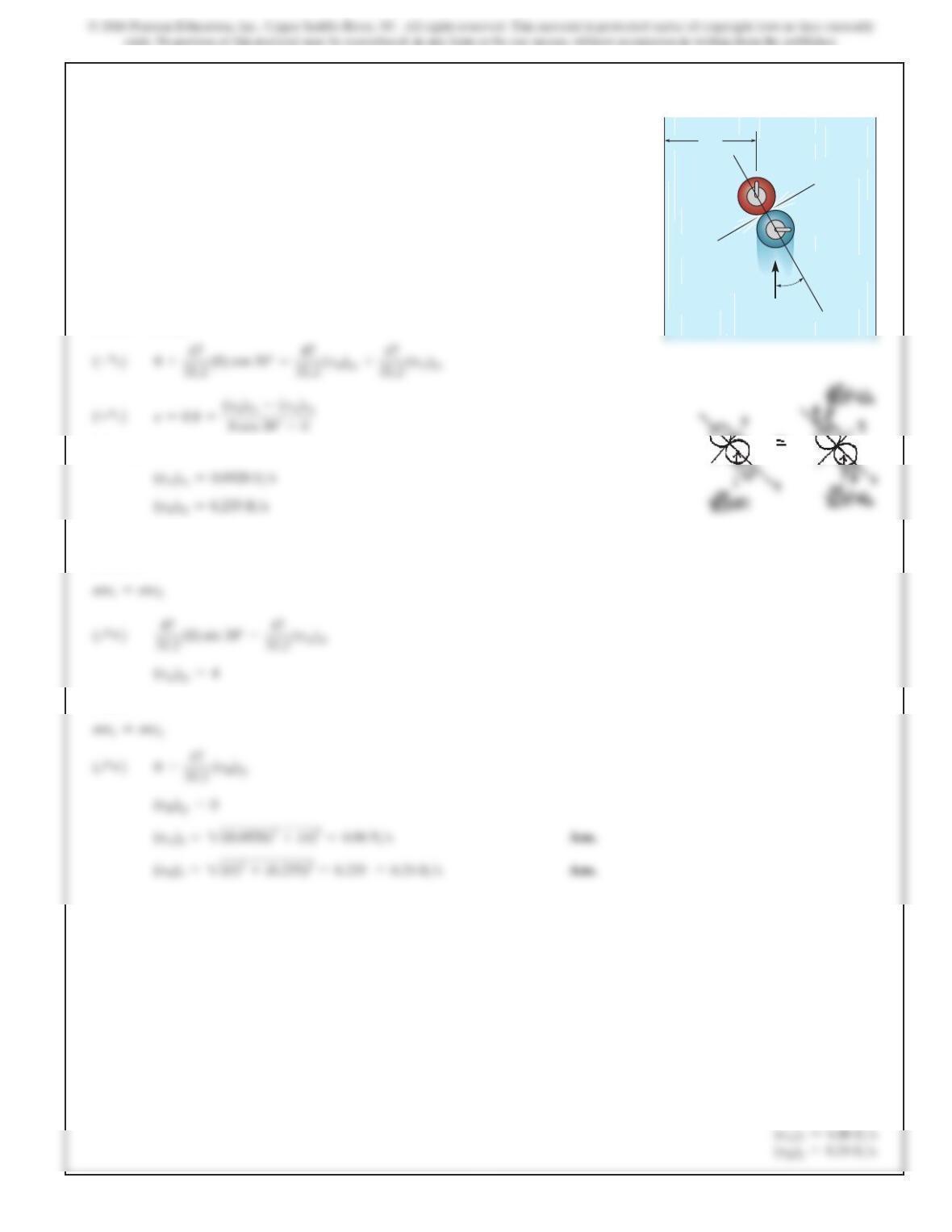
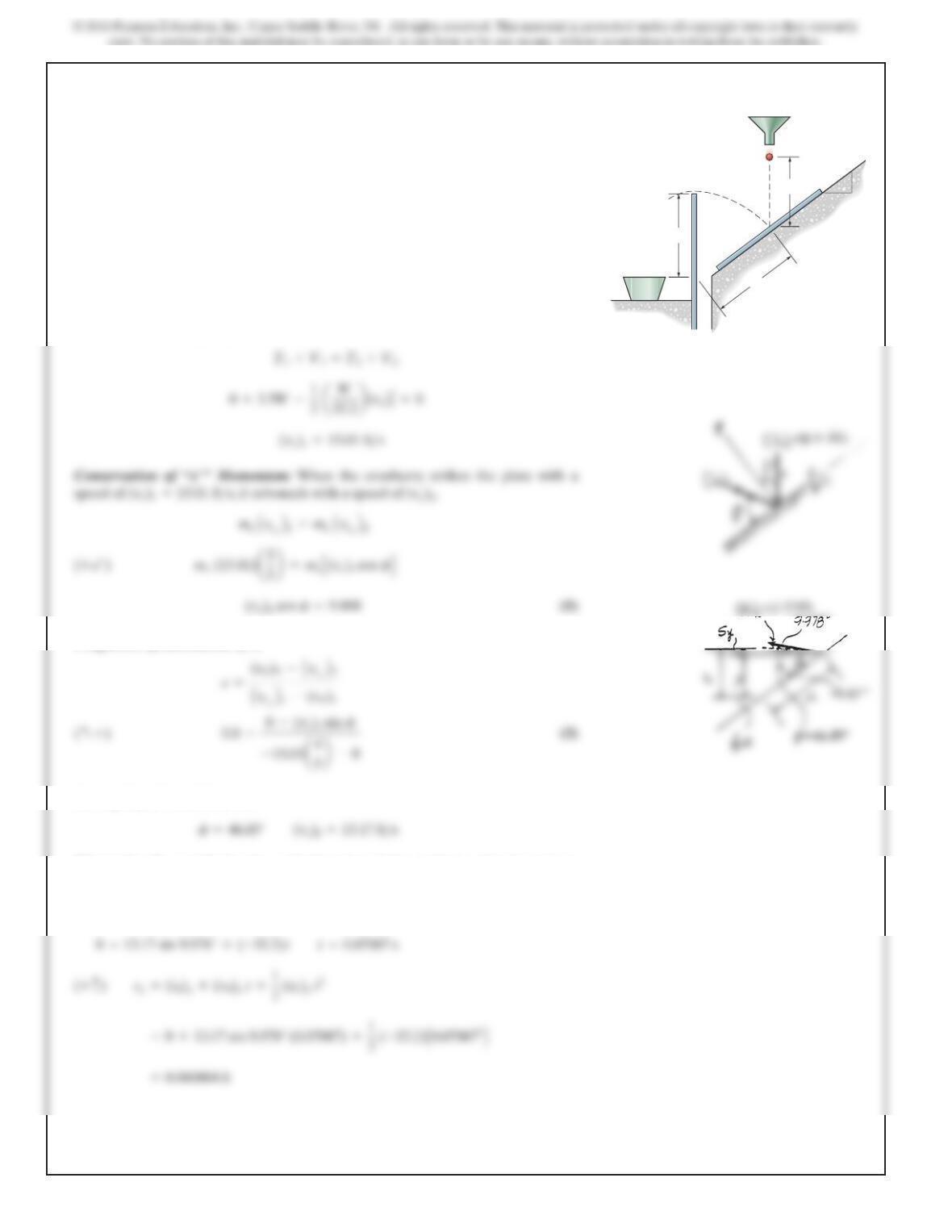
Two smooth disks A and B have the initial velocities shown
just before they collide. If they have masses
mA=4 kg
and
mB=2 kg,
determine their speeds just after impact. The
coefficient of restitution is
e=0.8.
SOLUTION
Impact. The line of impact is along the line joining the centers of disks A and B
represented by y axis in Fig. a. Thus
Coefcient of Restitution. Along the line of impact (y axis),
Conservation of ‘y’ Momentum.
Conservation of ‘x’ Momentum. Since no impact occurs along the x axis, the
component of velocity of each disk remain constant before and after the impact.
A
B
4
5
3
vA 15 m/s
vB 8 m/s
568
15–90.
Before a cranberry can make it to your dinner plate, it must
pass a bouncing test which rates its quality. If cranberries
having an are to be accepted, determine the
dimensions dand hfor the barrier so that when a cranberry
falls from rest at Ait strikes the incline at Band bounces
over the barrier at C.
eÚ0.8
SOLUTION
Conservation of Energy: The datum is set at point B.When the cranberry falls from
a height of 3.5 ft above the datum, its initial gravitational potential energy is
. Applying Eq. 14–21, we have
Coefficient of Restitution ():
Solving Eqs. (1) and (2) yields
Kinematics: By considering the vertical motion of the cranberry after the impact,
we have
(+c)vy=(v0)y+act
y¿
W(3.5) =3.5 W
53
4
3.5 ft
h
C
B
A
d
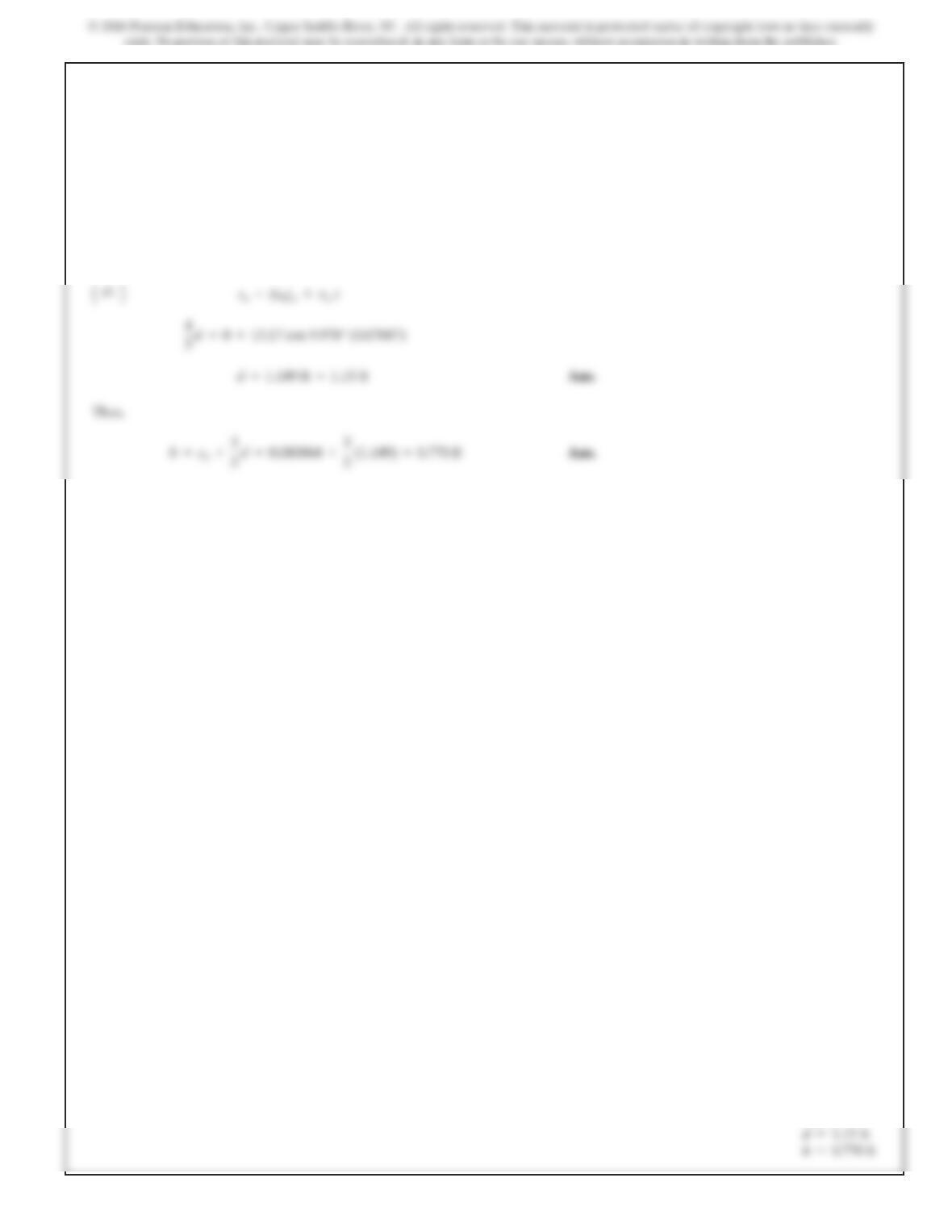
569
By considering the horizontal motion of the cranberry after the impact, we have
15–90. Continued
Ans:
570
15–91.
SOLUTION
At A:
At B:
(vA)y1=2.5(sin 45°) =1.7678 m>s:
The 200-g billiard ball is moving with a speed of
when it strikes the side of the pool table at A. If the
coefficient of restitution between the ball and the side of
the table is determine the speed of the ball just
after striking the table twice, i.e., at A, then at B. Neglect the
size of the ball.
e=0.6,
2.5 m>s
v2.5m/s45fi
A
B
571
*15–92.
SOLUTION
Conservation of “x” momentum:
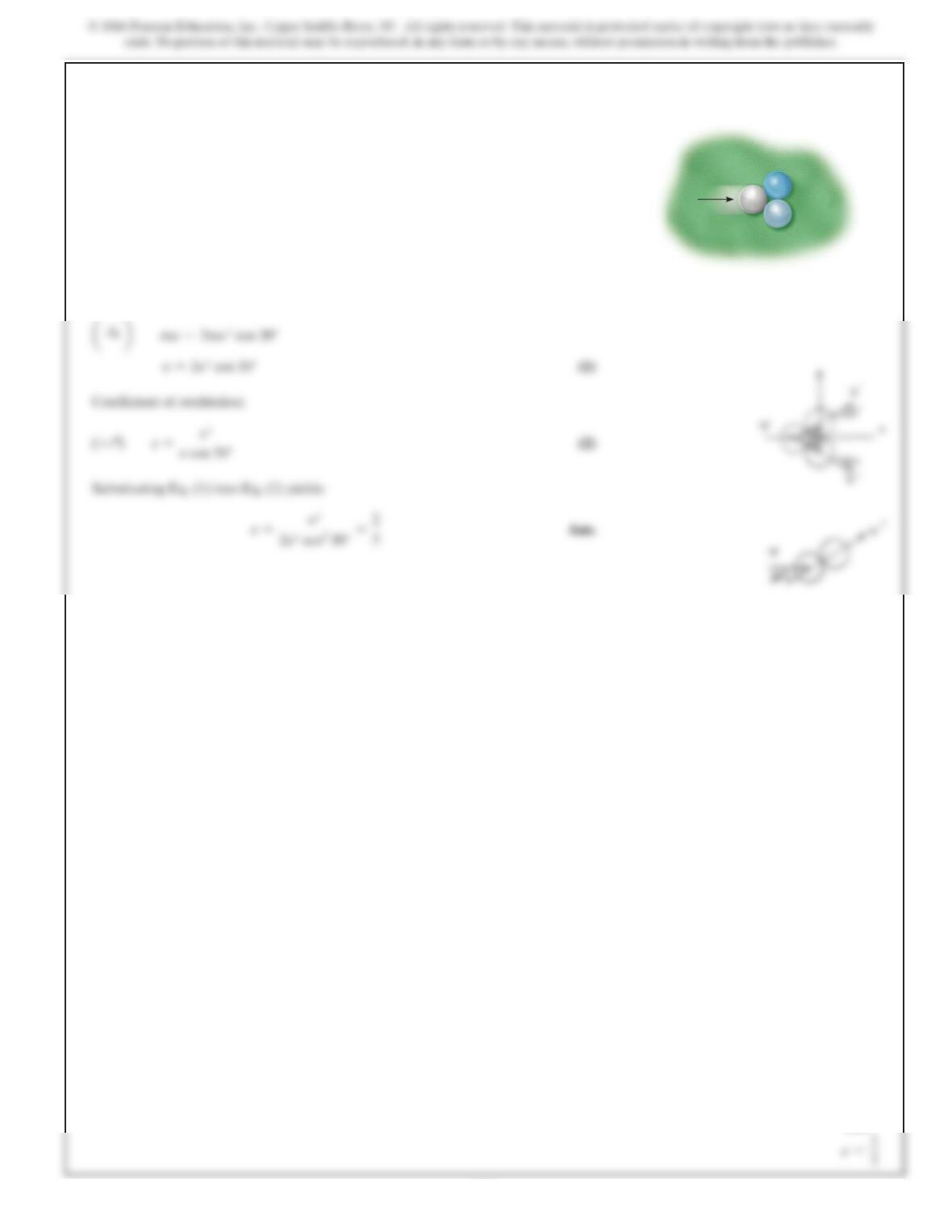
Thetwo billiard balls Aand Bare originally in contact with
one another when athird ball Cstrikes each of them at the
same time as shown. If ball Cremains at rest after the
collision, determine the coefficient of restitution.All the balls
have the same mass.Neglect the size of each ball.
CB
A
v
Ans:
572
15–93.
Disks Aand Bhave a mass of 15 kg and 10 kg, respectively.
If they are sliding on a smooth horizontal plane with the
velocities shown, determine their speeds just after impact.
The coefficient of restitution between them is .e=0.8
y
x
A
B
10 m/s
Line of
impact
8m/s
4
3
5
SOLUTION
Conservation of Linear Momentum: By referring to the impulse and momentum of
the system of disks shown in Fig. a, notice that the linear momentum of the system is
conserved along the naxis (line of impact). Thus,
Also, we notice that the linear momentum of disks Aand Bare conserved along the
taxis (tangent to? plane of impact). Thus,
and
Coefficient of Restitution:The coefficient of restitution equation written along the n
axis (line of impact) gives
Solving Eqs. (1), (2), (3), and (4), yeilds
573
15–94.
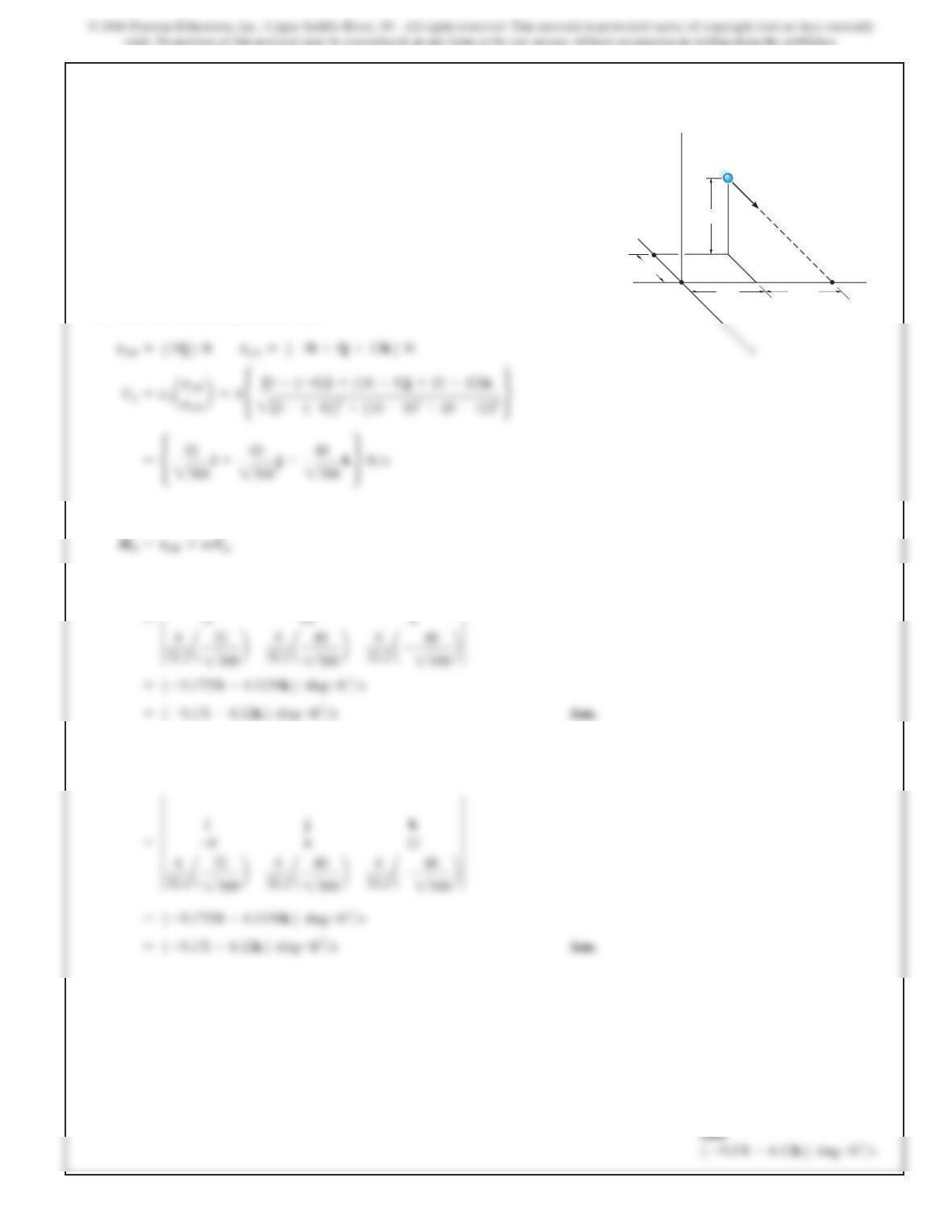
Determine the angular momentum
HO
of the 6-lb particle
about point O.
SOLUTION
Position and Velocity Vector. The coordinates of points A and B are
A(–8, 8, 12) ft and B(0, 18, 0) ft.
Then
Angular Momentum about Point O.
HO=rOB *mVA
5
i j k
Also,
HO=rOA *mVA
5
y
z
8 ft
8 ft 10 ft
12 ft
O
P
4 ft/s
6 lb
B
A