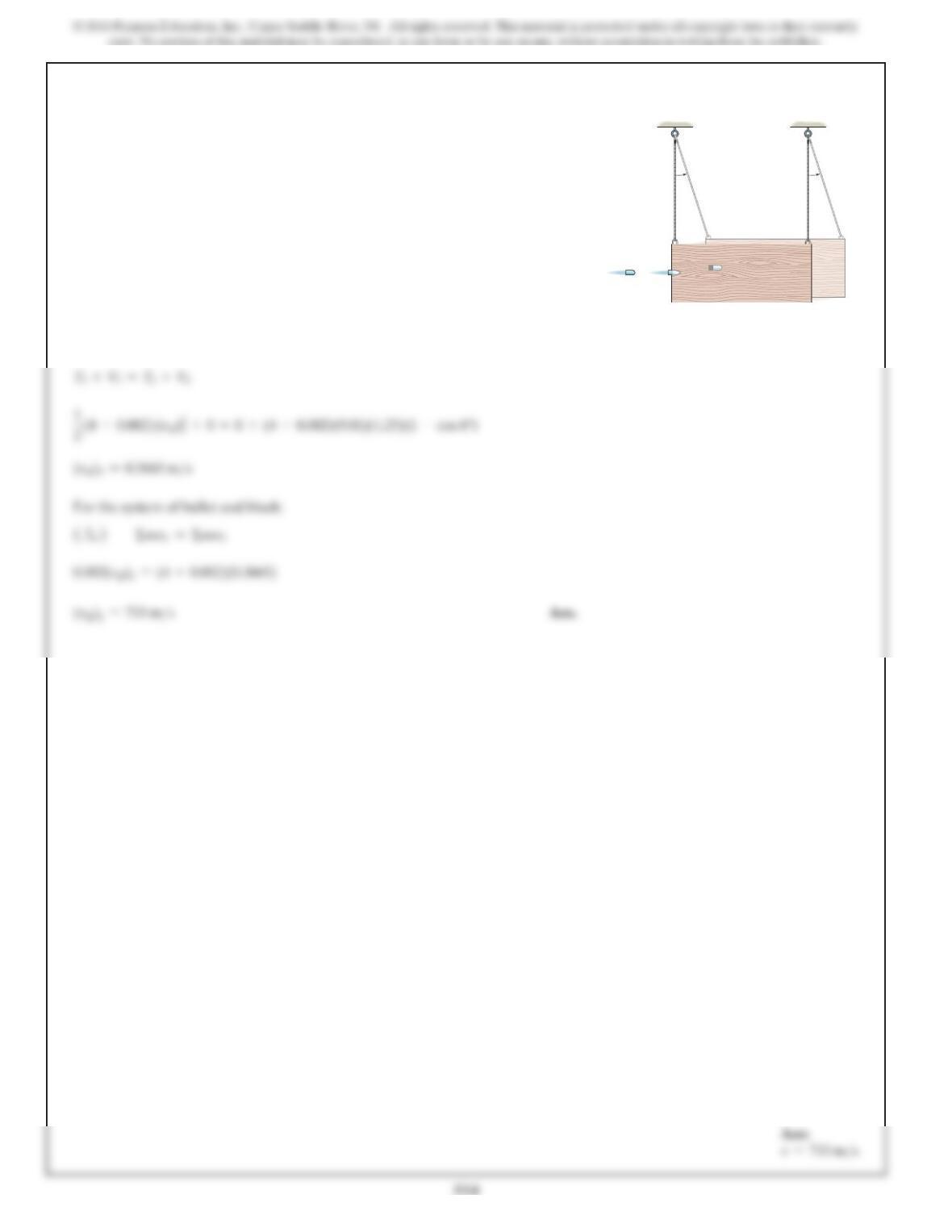
15–39.
SOLUTION
Just after impact:
Datum at lowest point.
A ballistic pendulum consists of a 4-kg wooden block
originally at rest, u=0°. When a 2-g bullet strikes and
becomes embedded in it, it is observed that the block swings
upward to a maximum angle of u=6°. Estimate the speed
of the bullet. 1.25 m
θ
1.25 m
θ
515
SOLUTION
(
d
+
)
Σm(v1)=Σm(v2)
(
d
+
)
(
d
)
Σm(v1)=Σm(v2)
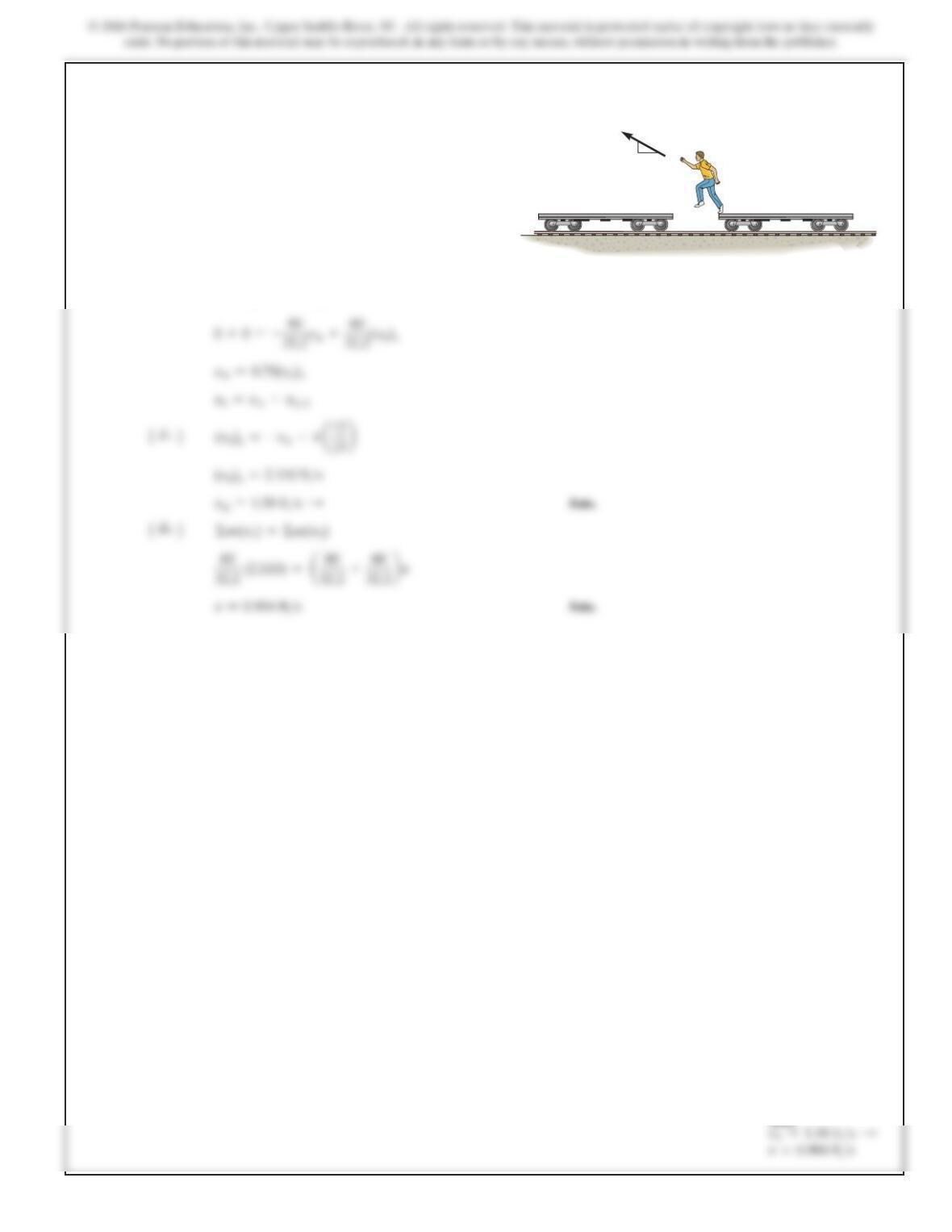
*15–40.
The boy jumps off the flat car at A with a velocity of
v
=4 ft>s
relative to the car as shown. If he lands on the
second flat car B, determine the final speed of both cars
after the motion. Each car has a weight of 80 lb. The boy’s
weight is 60 lb. Both cars are originally at rest. Neglect the
mass of the car’s wheels.
v 4 ft/s
13
12
5
AB
Ans:
516
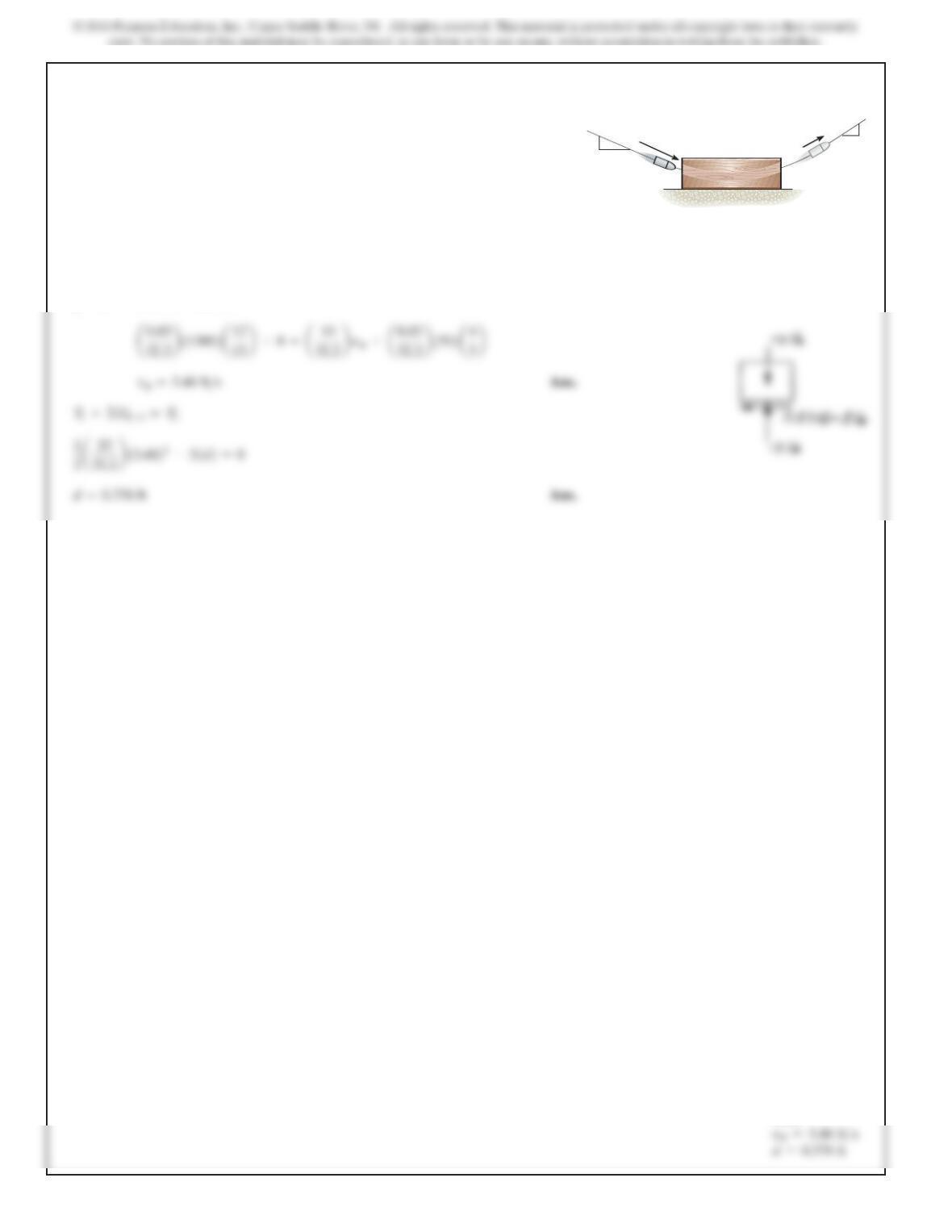
15–41.
A 0.03-lb bullet traveling at strikes the 10-lb
wooden block and exits the other side at as shown.
Determine the speed of the block just after the bullet exits
the block, and also determine how far the block slides
before it stops.The coefficient of kinetic friction between
the block and the surface is mk=0.5.
50 ft>s
1300 ft>s
SOLUTION
A
:
+
B
©m1n1=©m2n2
5
12
3
4
5
13
1300 ft/s
50 ft/s
Ans:
517
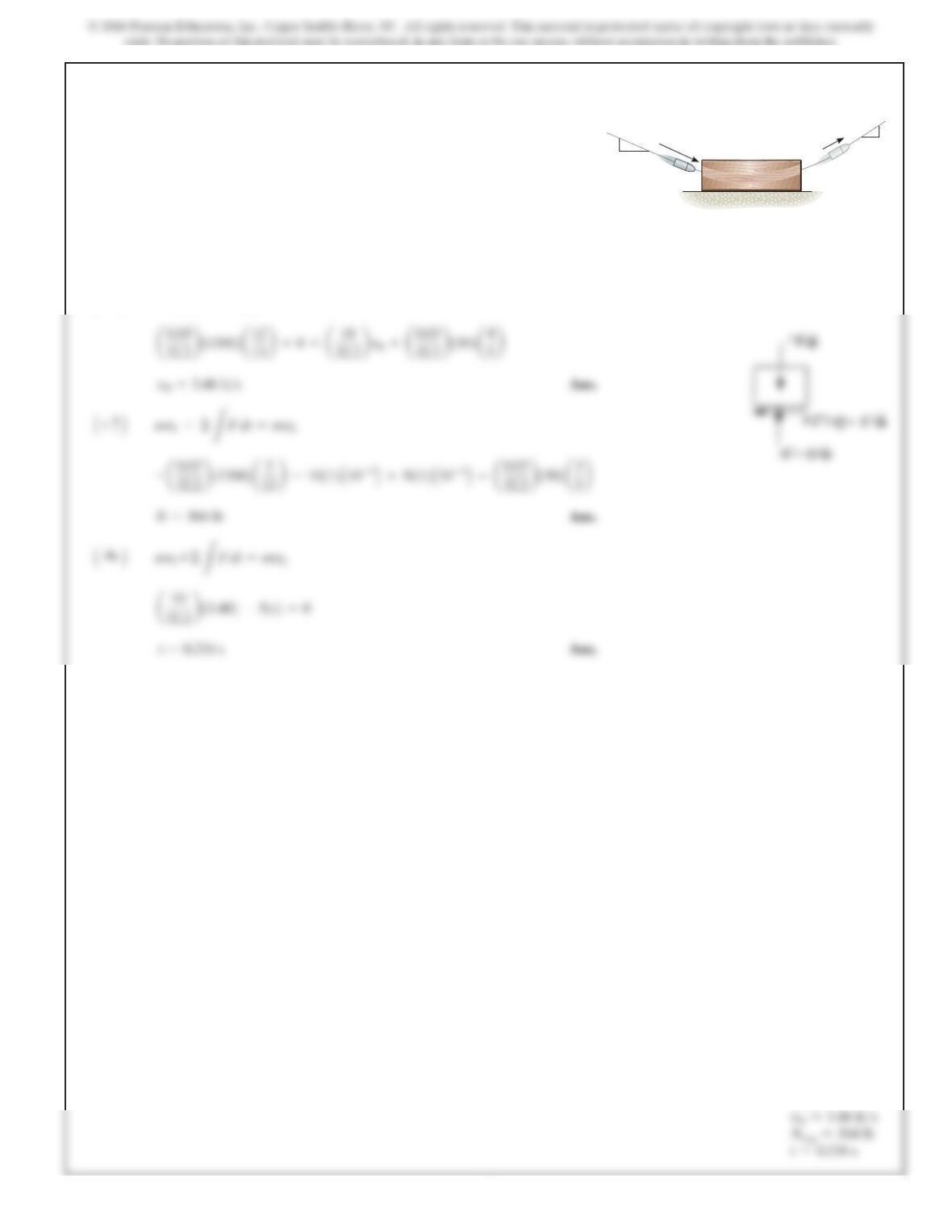
15–42.
SOLUTION
A
:
+
B
©m1v1=©m2v2
A
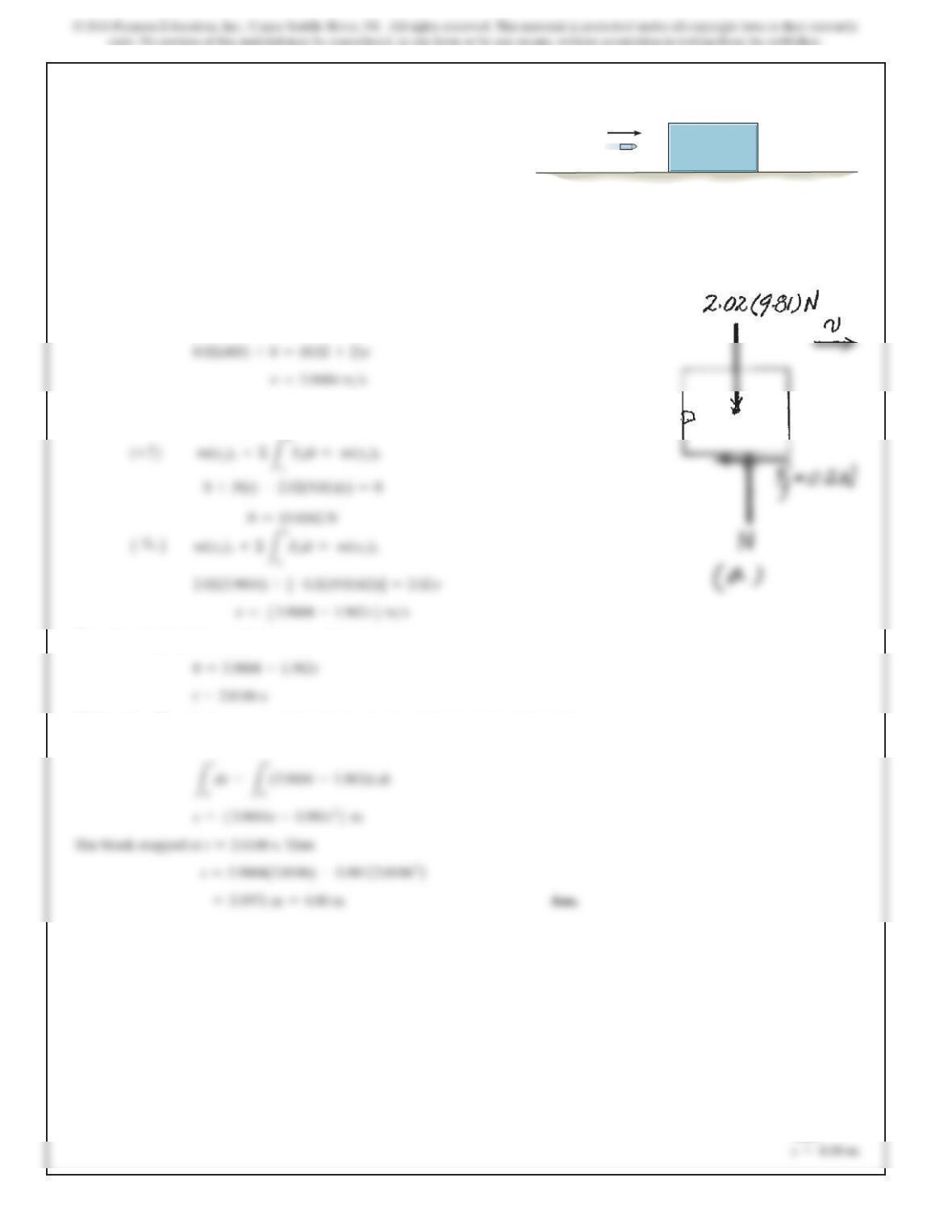
0.03-lb bullet traveling at strikes the 10-lb
wooden
block and exits the other side at as shown.
Determine
the speed of the block just after the bullet exits
the
block. Also, determine the average normal force on the
block
if the bullet passes through it in 1 ms, and the time the
block
slides before it stops.The coefficient of kinetic
friction between the block and the surface is
mk=0.5.
50 ft>s
1300 ft
>
s
5
12
3
4
5
13
1300 ft/s50 ft/s
Ans:
518
SOLUTION
Conservation of Momentum.
(
S
+
)
mbvb+ mBvB=( mb+mB)v
Principle of Impulse and Momentum. Here, friction
F
f
=
mk
N=0.2 N
. Referring
to the FBD of the blocks, Fig. a,
(
S
)
Thus, the stopping time can be determined from
t=2.0186 s
Kinematics. The displacement of the block can be determined by integrating
ds =v dt
with the initial condition
s=0
at
t=0.
t=2.0186 s.
15–43.
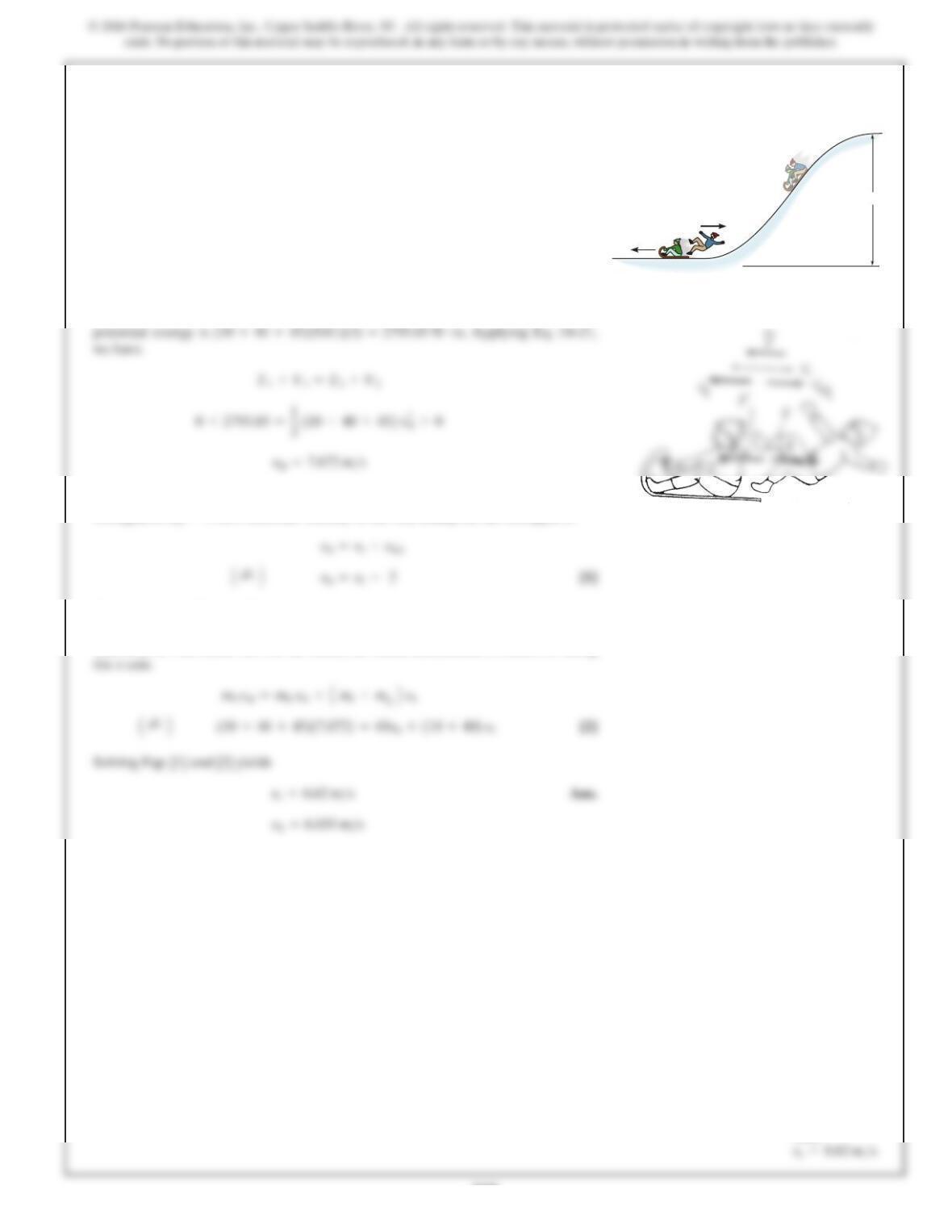
The 20-g bullet is traveling at 400 m
>
s when it becomes
embedded in the 2-kg stationary block. Determine the
distance the block will slide before it stops. The coefficient
of kinetic friction between the block and the plane is
m
k=0.2.
400 m/s
Ans:
519
*15–44.
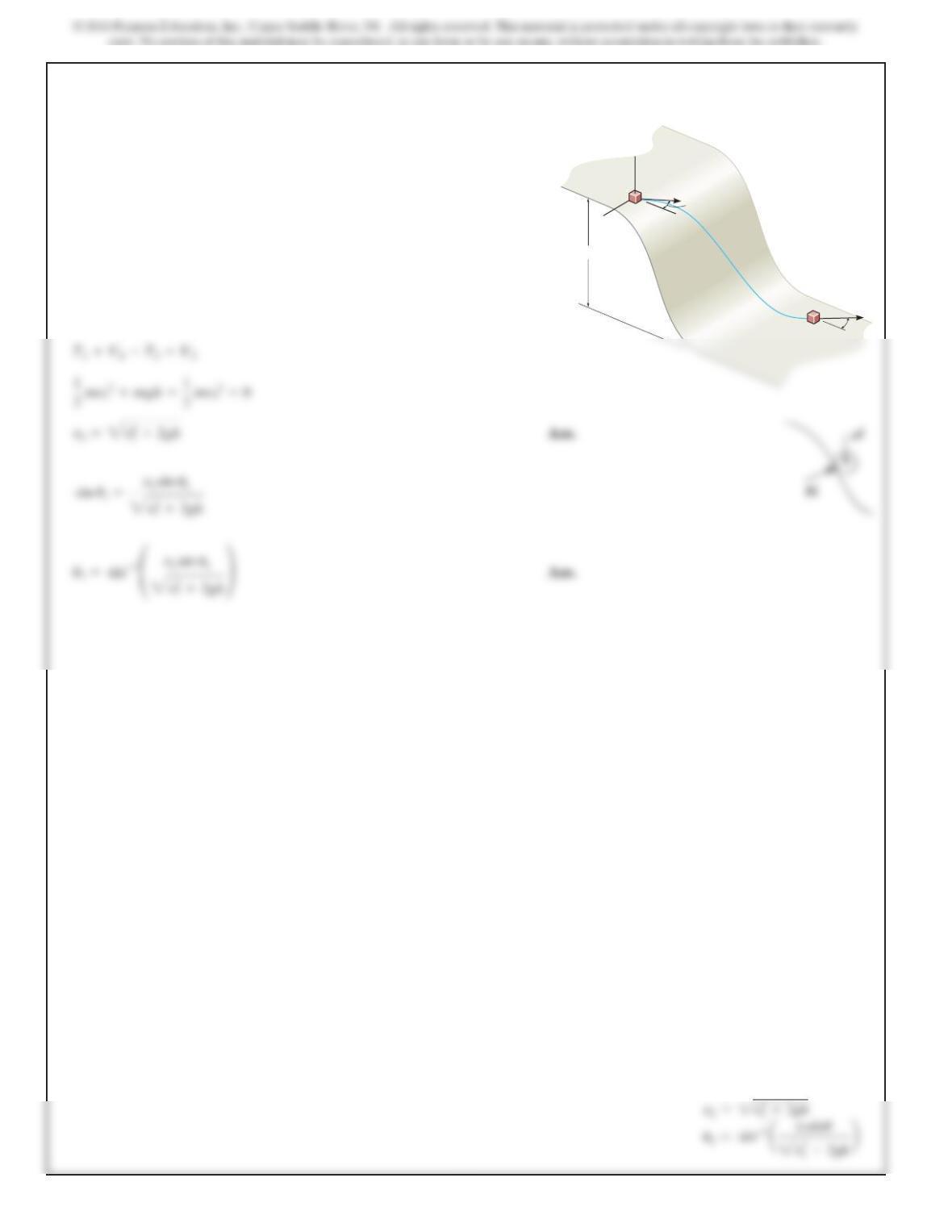
A toboggan having a mass of 10 kg starts from rest at Aand
carries a girl and boy having a mass of 40 kg and 45 kg,
respectively.When the toboggan reaches the bottom of the
slope at B, the boy is pushed off from the back with a
horizontal velocity of ,measured relative to
the toboggan. Determine the velocity of the toboggan
afterwards. Neglect friction in the calculation.
vb>t=2m>s
SOLUTION
Conservation of Energy: The datum is set at the lowest point B.When the toboggan
and its rider is at A, their position is 3 m abovethe datum and their gravitational
Relative Velocity: The relative velocity of the falling boy with respect to the
toboggan is .Thus, the velocity of the boy falling off the toboggan is
Conservation of Linear Momentum: If we consider the tobbogan and the riders as
a system, then the impulsive force caused by the push is internal to the system.
Therefore, it will cancel out. As the result, the linear momentum is conserved along
yb/t=2m>s
v
b/t
v
t
B
A
3m
Ans:
520
15–45.
1
2
v1
v2
x
h
y
u
u
z
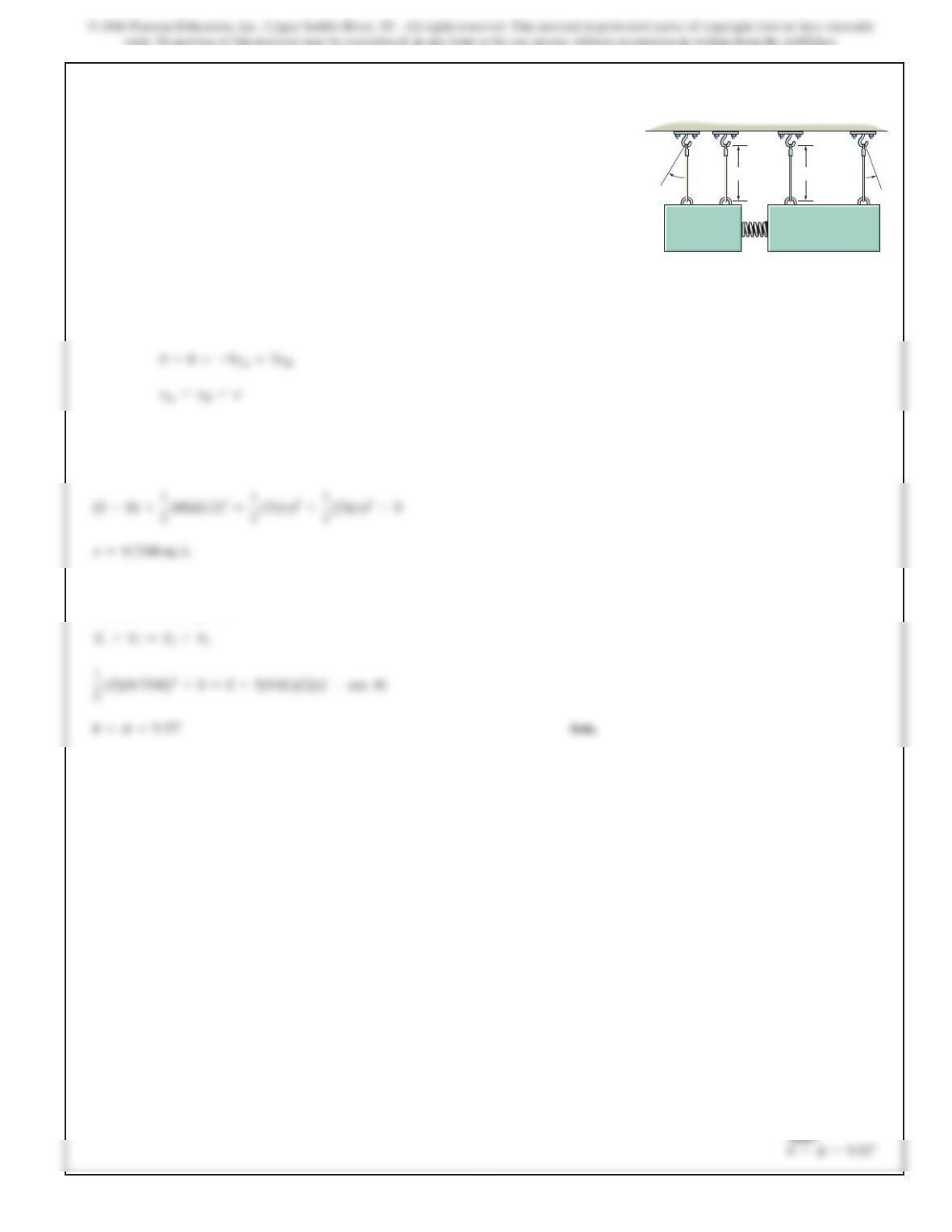
The block of mass mis traveling at in the direction
shown at the top of the smooth slope. Determine its speed
and its direction when it reaches the bottom.u2
v2
u1
v
1
SOLUTION
There are no impulses in the direction:
mv1 sin u1=mv2 sin u2
v
Ans:
521
15–46.
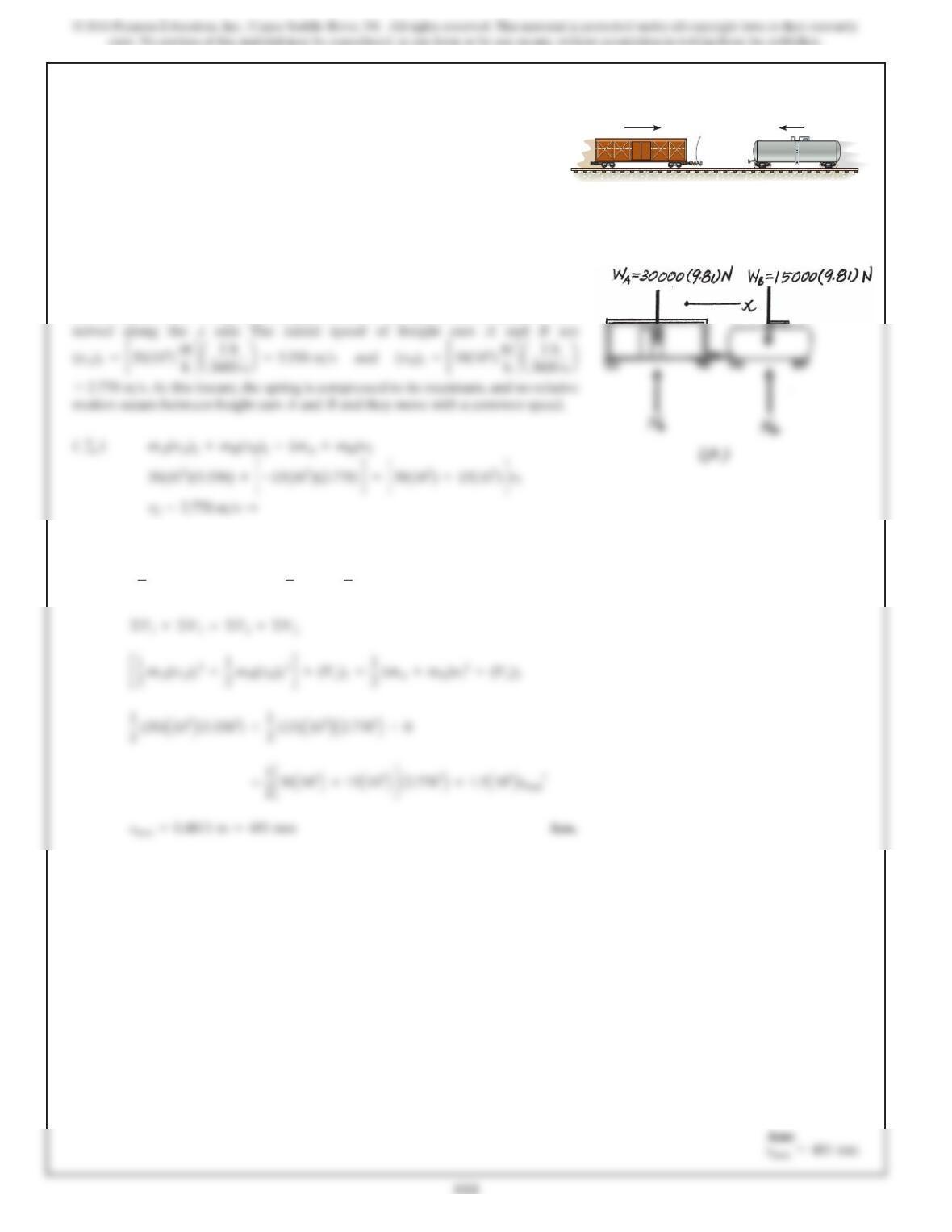
The two blocks A and B each have a mass of 5 kg and are
suspended from parallel cords. A spring, having a stiffness
of k=60 N>m, is attached to B and is compressed 0.3 m
against A and B as shown. Determine the maximum angles
u and f of the cords when the blocks are released from rest
and the spring becomes unstretched.
SOLUTION
(
S
+
)
Σmv1=Σmv
2
Just before the blocks begin to rise:
T1+V
1=T2+V
2
For A or B:
Datum at lowest point.
AB
2 m2 m
θφ
15–47.
BA
10 km/h20 km/h
k 3 MN/m
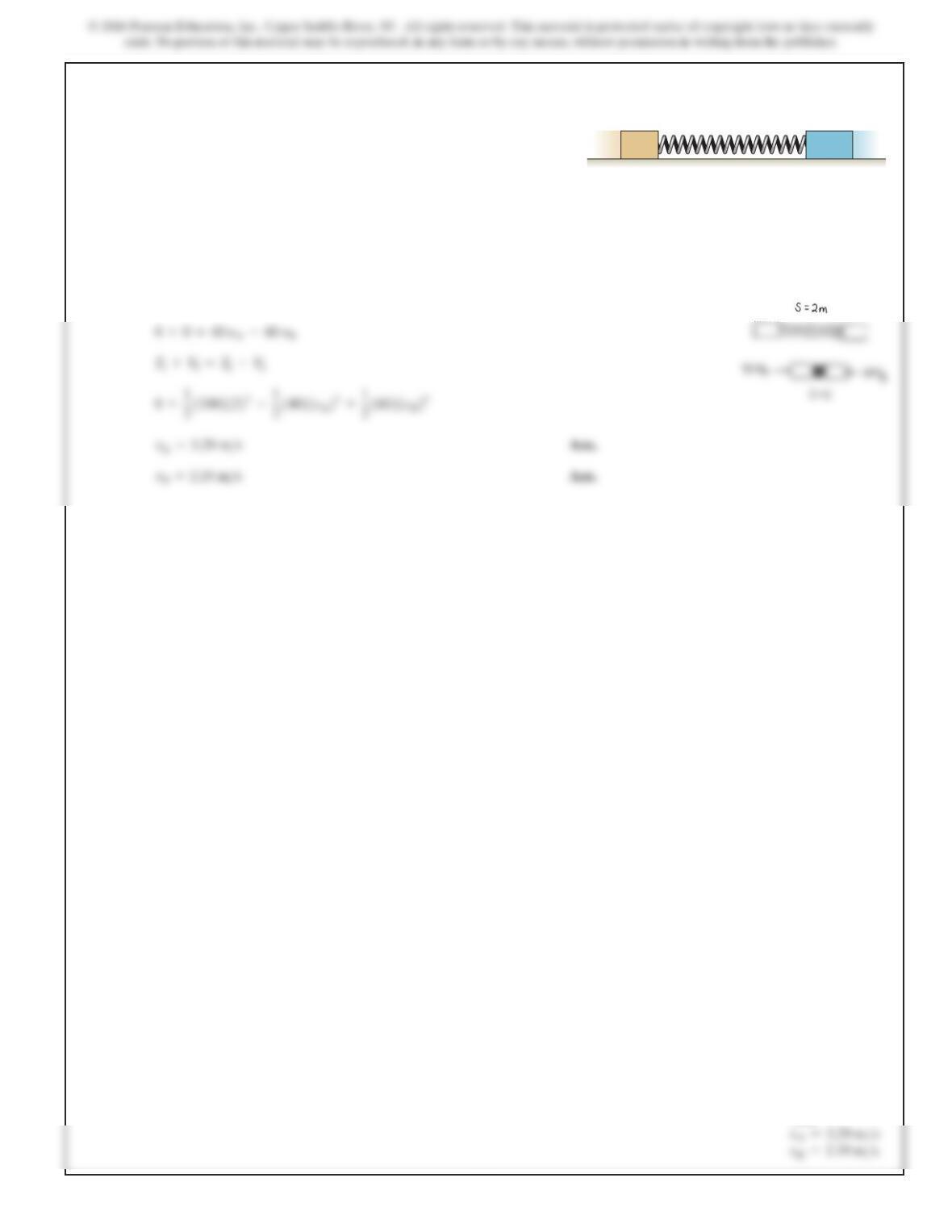
The 30-Mg freight car Aand 15-Mg freight car Bare moving
towards each other with the velocities shown. Determine the
maximum compression of the spring mounted on car A.
Neglect rolling resistance.
SOLUTION
Conservation of Linear Momentum: Referring to the free-body diagram of the freight
cars Aand Bshown in Fig.a,notice that the linear momentum of the system is con-
Conservation of Energy: The initial and final elastic potential energy of the spring
is and .
(Ve)2=1
2 ks22=1
2(3)(106)smax
2=1.5(106)smax
2
(Ve)1=1
2 ks12=0
523
*15–48.
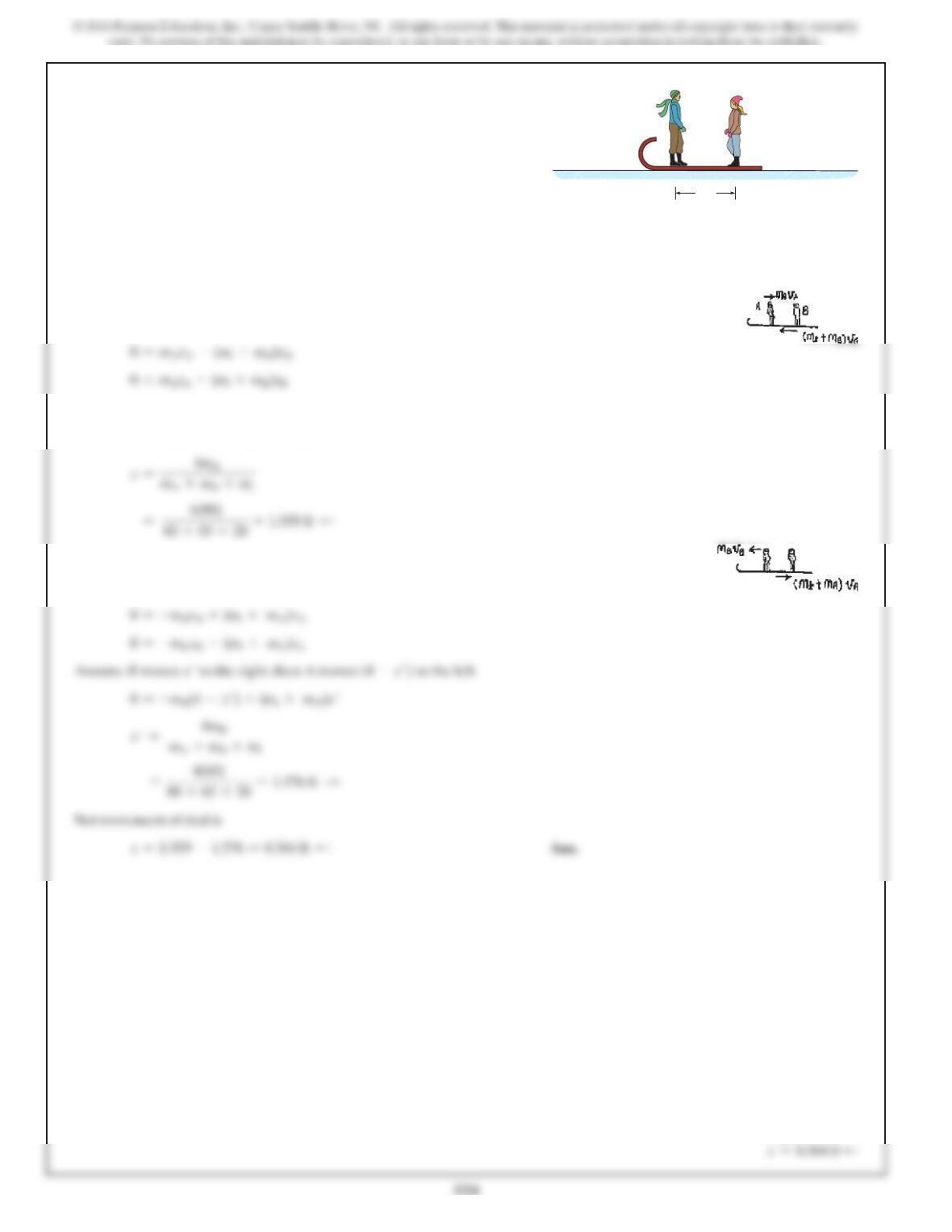
Blocks Aand Bhave masses of 40 kg and 60 kg,
respectively.They are placed on a smooth surface and the
spring connected between them is stretched 2 m. If they are
released from rest, determine the speeds of both blocks the
instant the spring becomes unstretched.
SOLUTION
(:
+)©mn1=©mn2
k 180 N/m
AB
Ans:
15–49.
A boy A having a weight of 80 lb and a girl B having a weight
of 65 lb stand motionless at the ends of the toboggan, which
has a weight of 20 lb. If they exchange positions, A going to B
and then B going to A’s original position, determine the final
position of the toboggan just after the motion. Neglect
friction between the toboggan and the snow.
SOLUTION
A goes to B,
(
S
+
)
Σmv1=Σmv2
0=mAvA–( mt+mB)vB
0=mAsA–( mt+mB)sB
Assume B moves
x
to the left, then A moves (
4–x
) to the right
0=mA(4 –x)–( mt+mB)x
B goes to other end.
(
S
+
)
Σmv1=Σmv2
0=–mBvB+( mt+ mA)vA
0=–mB sB+( mt+ mA)sA
0=–mB(4 –x′)+( mt+ mA)x′
4 ft
AB
Ans:
SOLUTION
A goes to B,
(
S
+
)
Σmv1=Σmv2
0=mAsA–( mt+mB)sB
Assume B moves x to the left, then A moves
(4 –x)
to the right
0=mA(4 –x)–( mt+mB)x
A and B go to other end.
(
S
+
)
Σmv1=Σmv2
Assume the toboggan moves
x′
to the right, then A and B move
(4 –x′)
to the left
0=–mB(4 –x′)–mA(4 –x′)+mt x′
(
S
+
)
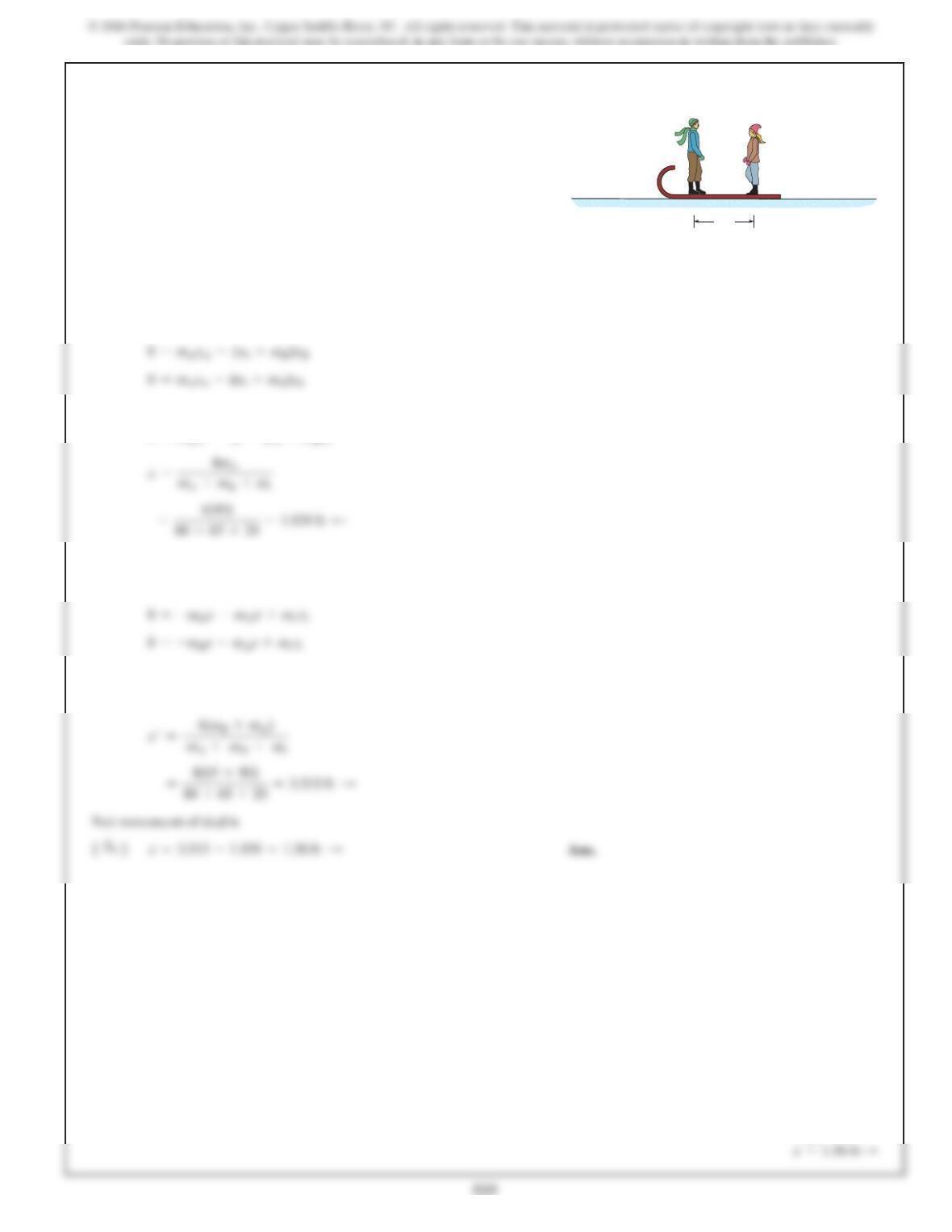
15–50.
A boy A having a weight of 80 lb and a girl B having a weight
of 65 lb stand motionless at the ends of the toboggan, which
has a weight of 20 lb. If A walks to B and stops, and both walk
back together to the original position of A, determine the final
position of the toboggan just after the motion stops. Neglect
friction between the toboggan and the snow. 4 ft
AB
Ans:
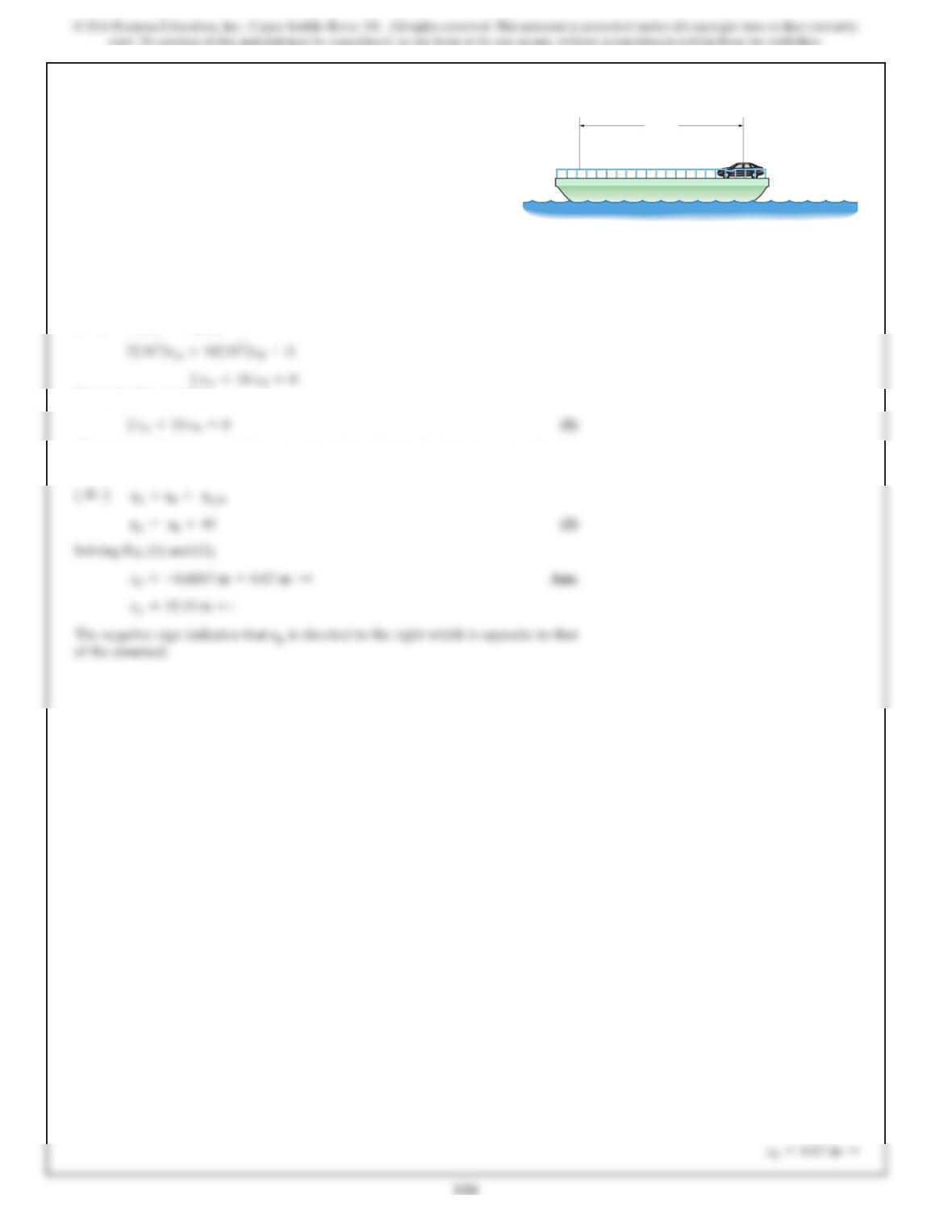
15–51.
The 10-Mg barge B supports a 2-Mg automobile A. If
someone drives the automobile to the other side of the
barge, determine how far the barge moves. Neglect the
resistance of the water.
40 m
A
B
SOLUTION
Conservation of Momentum. Assuming that VB is to the left,
(
d
+
)
mAvA+ mBvB=0
Integrate this equation,
Kinematics. Here,
s
A
>
B
=40 m d,
using the relative displacement equation by
assuming that sB is to the left,
(
+
)
Ans:
527
*15–52.
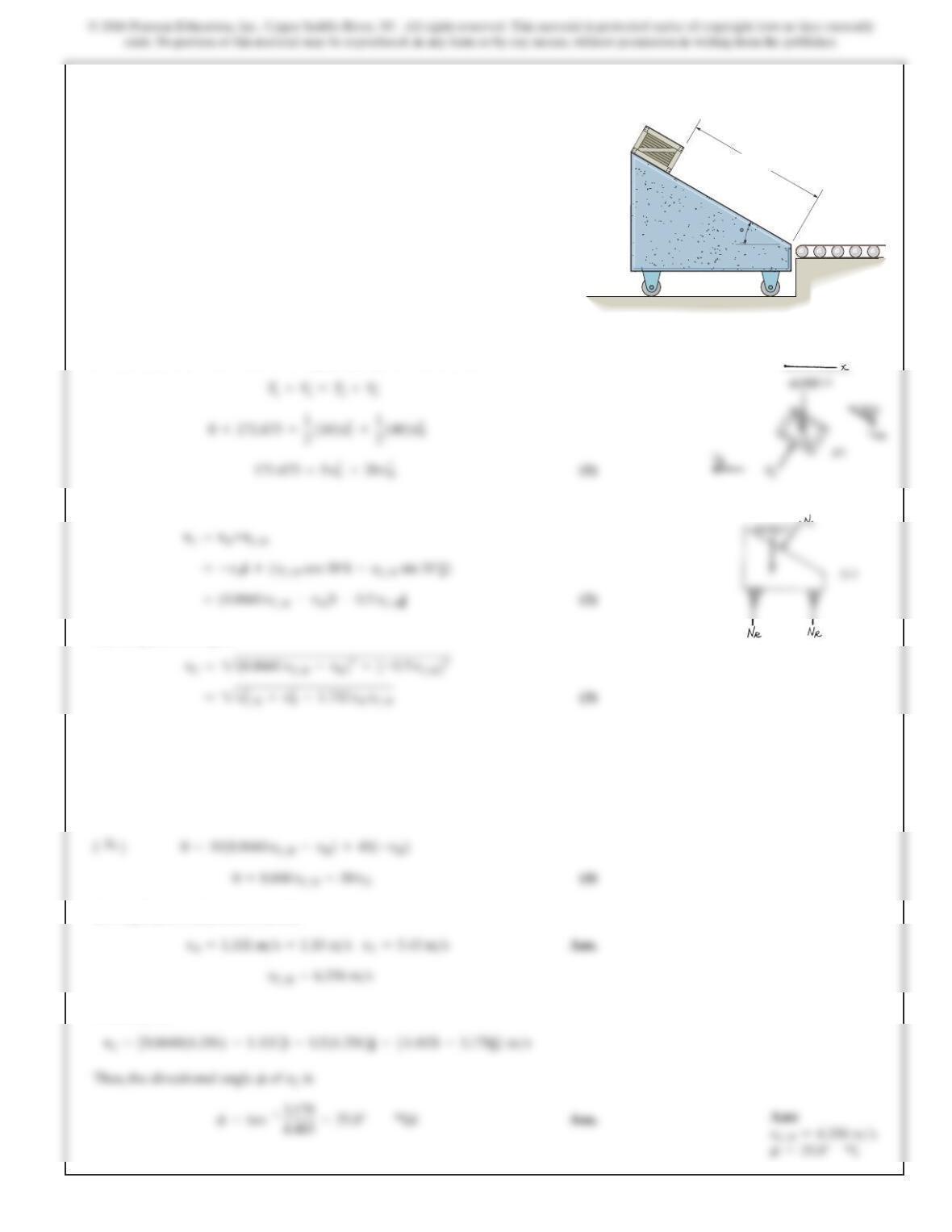
3.5 m
A
B30
SOLUTION
Conservation of Energy:The datum is set at lowest point B.When the crate is at
point A, it is above the datum. Its gravitational potential energy
evah ew,12–41.qE gniylppA. si
Relative Velocity:The velocity of the crate is given by
The magnitude of vCis
Conservation of Linear Momentum: If we consider the crate and the ramp as a
system, from the FBD, one realizes that the normal reaction NC(impulsive force)is
internal to the system and will cancel each other.As the result, the linear momentum
is conserved along the xaxis.
Solving Eqs. (1), (3), and (4) yields
From Eq. (2)
0=mC1vC2x+mRvR
1019.81211.752=171.675 N #m
3.5 sin 30°=1.75 m
The free-rolling ramp has a mass of 40 kg.A 10-kg crate is
released from rest at Aand slides down 3.5 m to point B.If
the surface of the ramp is smooth, determine the ramp’s
speed when the crate reaches B.Also, what is the velocity of
the crate?
528
SOLUTION
(
S
+
)
Σmv1=Σmv2
v
(
S
+
)
v
B
=–( v
A
)
x
+( v
B
>
A
)
x
v
15–53.
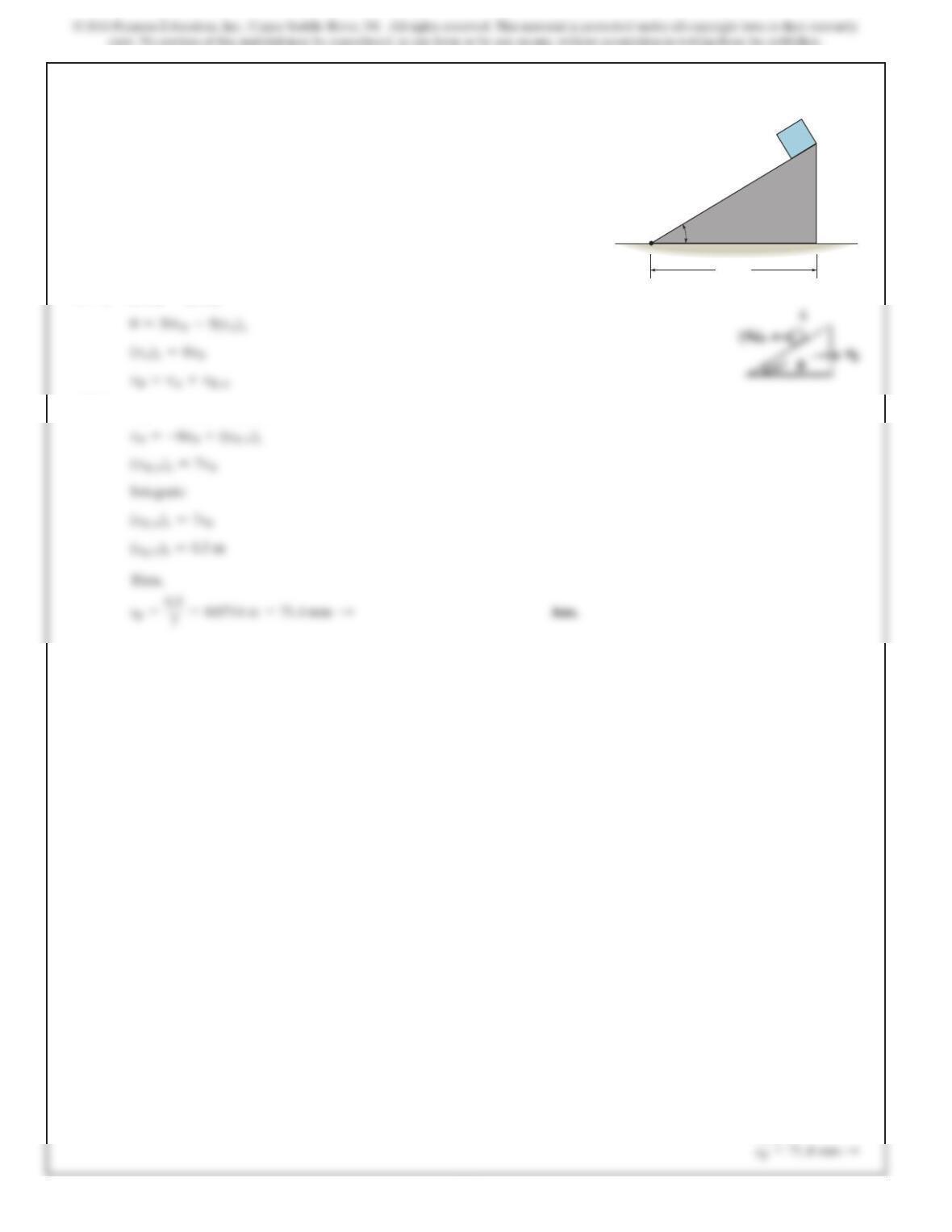
Block A has a mass of 5 kg and is placed on the smooth
triangular block B having a mass of 30 kg. If the system is
released from rest, determine the distance B moves from
point O when A reaches the bottom. Neglect the size of
block A.
O
0.5 m
A
B
30
Ans:
529
SOLUTION
+ aΣF
y
=0
;
NA–5(9.81) cos 30°=0
FA–5(9.81) sin 30°=0
15–54.
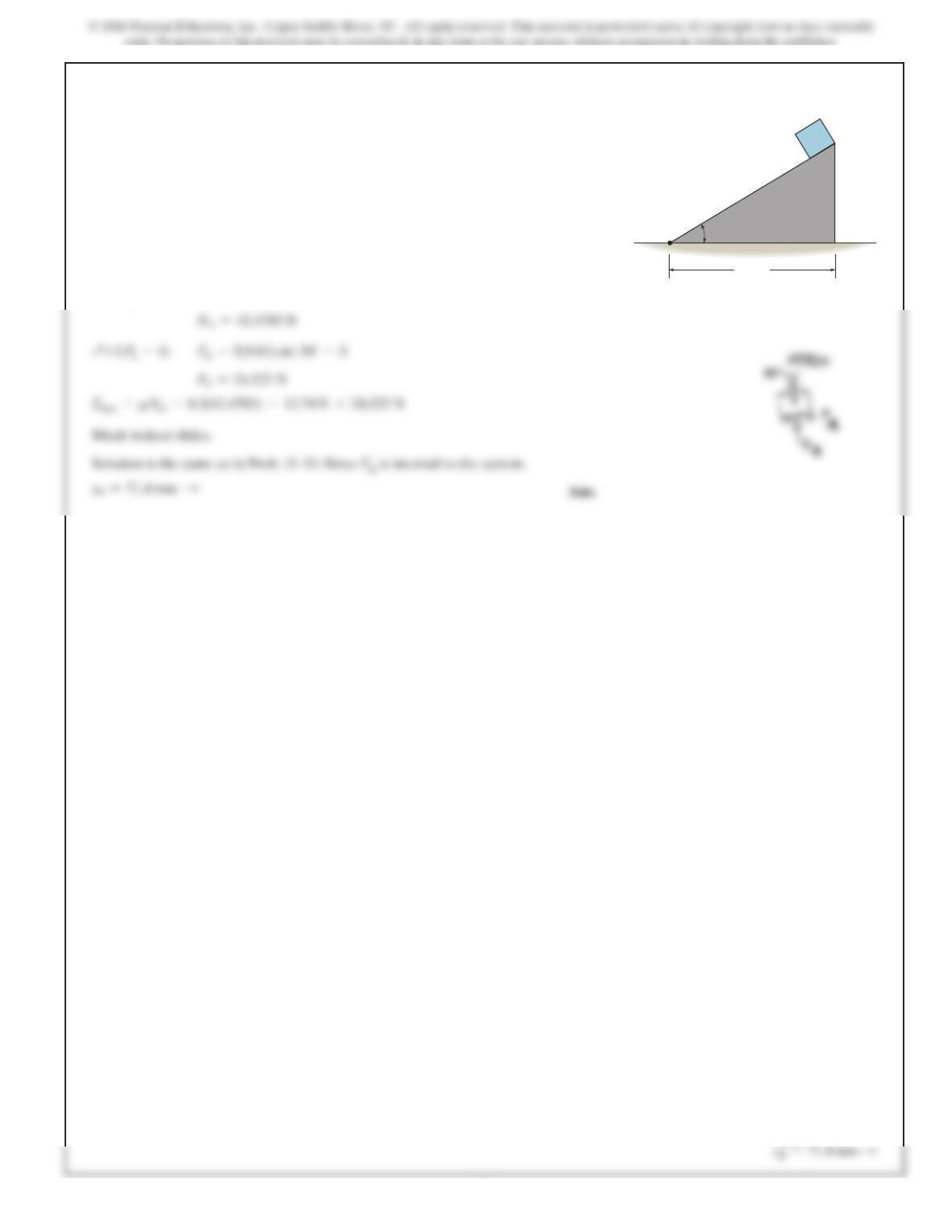
Solve Prob. 15–53 if the coefficient of kinetic friction
between A and B is m
k=0.3.
Neglect friction between
block B and the horizontal plane.
O
0.5 m
A
B
30
Ans:
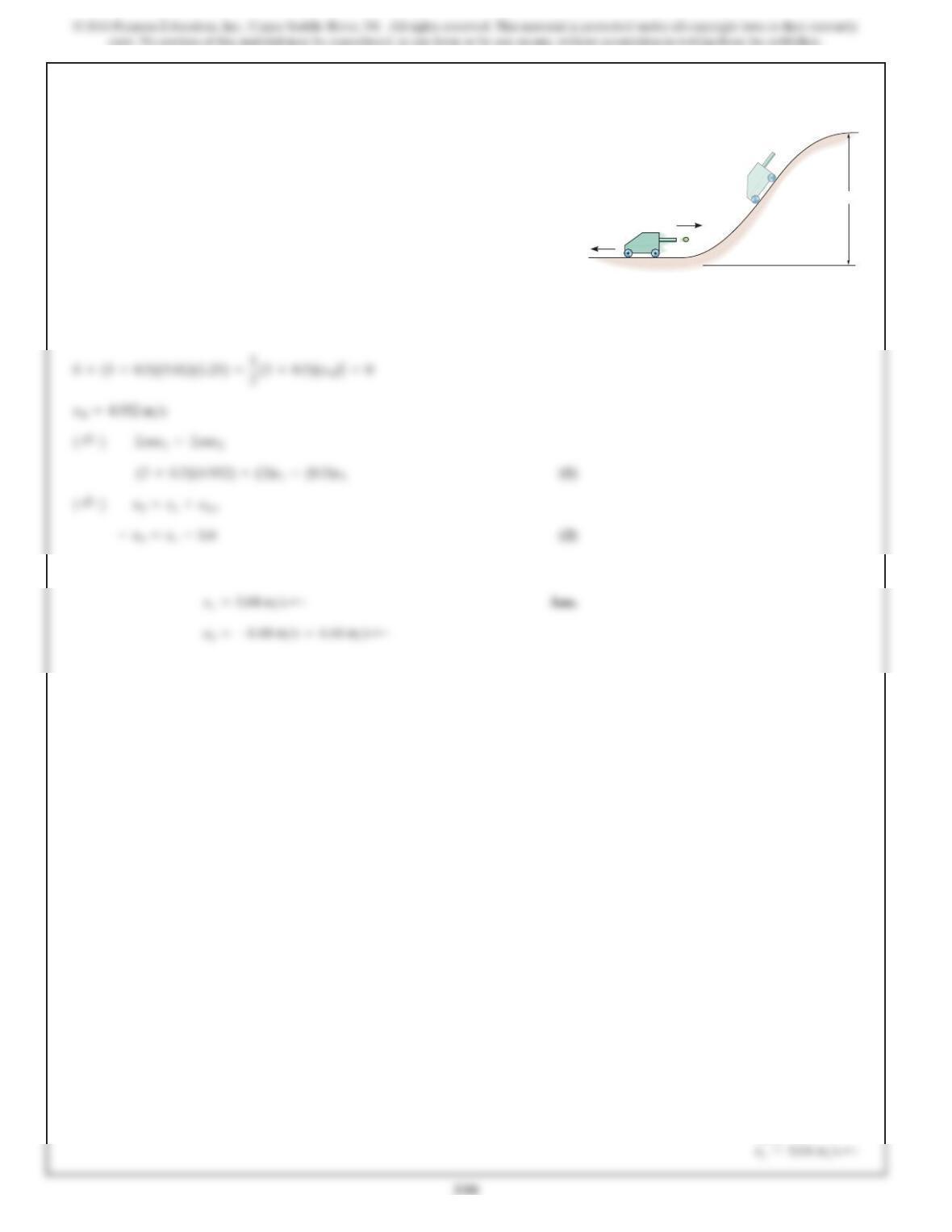
15–55.
SOLUTION
Datum at B:
Solving Eqs. (1) and (2),
T
A+V
A=T
B+V
B
T
h
e cart
h
as a mass of 3
k
g an
d
ro
ll
s free
l
y
d
own t
h
e s
l
ope.
When it reaches the bottom, a spring loaded gun fires a
0.5-kg ball out the back with a horizontal velocity of
measured relative to the cart. Determine the
final velocity of the cart.
vb>c=0.6 m>s,
v
b/c
v
c
B
A
1.25 m
Ans:
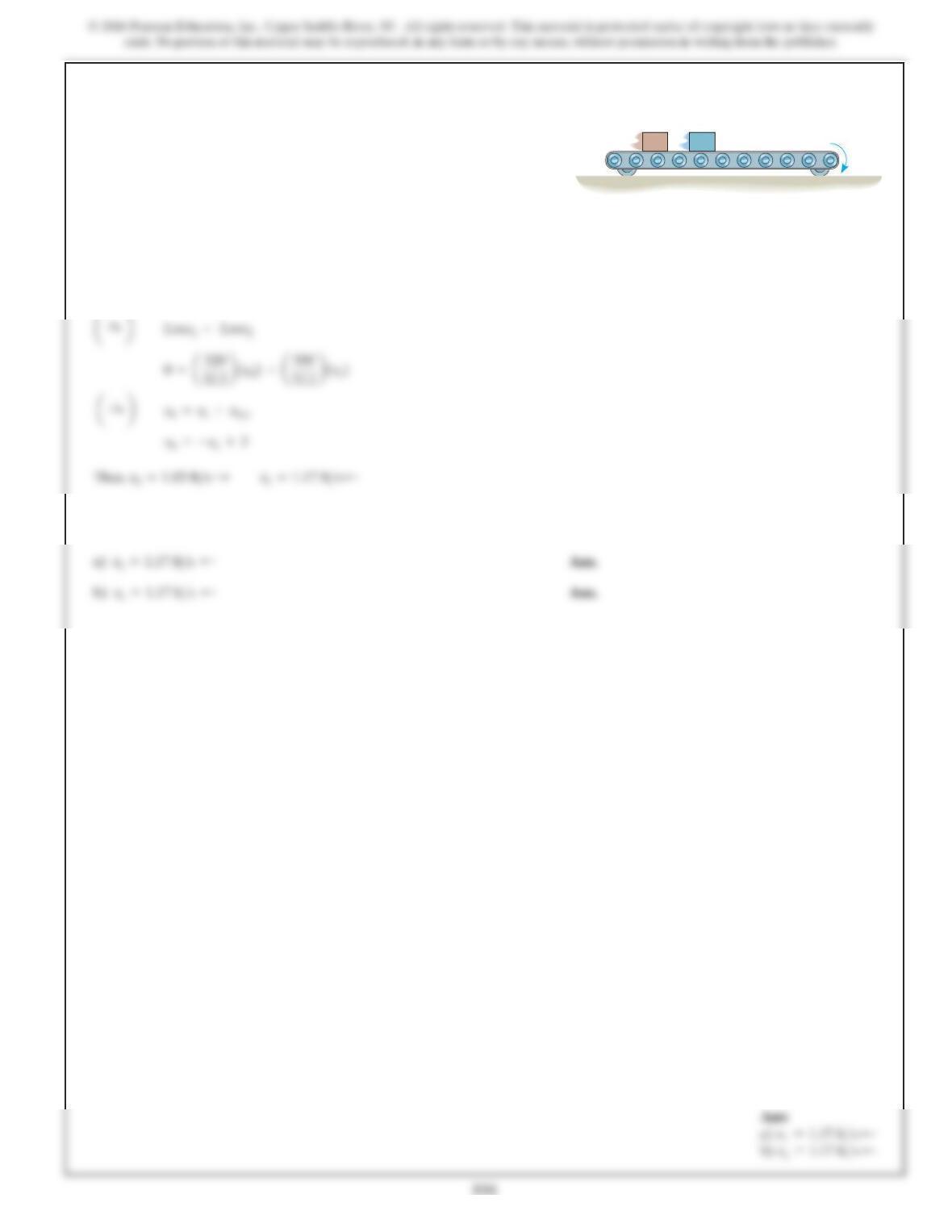
*15–56.
Two boxes Aand B, each having a weight of 160 lb, sit on
the 500-lb conveyor which is free to roll on the ground. If
the belt starts from rest and begins to run with a speed of
determine the final speed of the conveyor if (a) the
boxes are not stacked and Afalls off then Bfalls off, and (b)
Ais stacked on top of Band both fall off together.
3ft>s,
SOLUTION
a) Let vbbe the velocity of Aand B.
When a box falls off, it exerts no impulse on the conveyor, and so does not alter the
momentum of the conveyor.Thus,
A
B
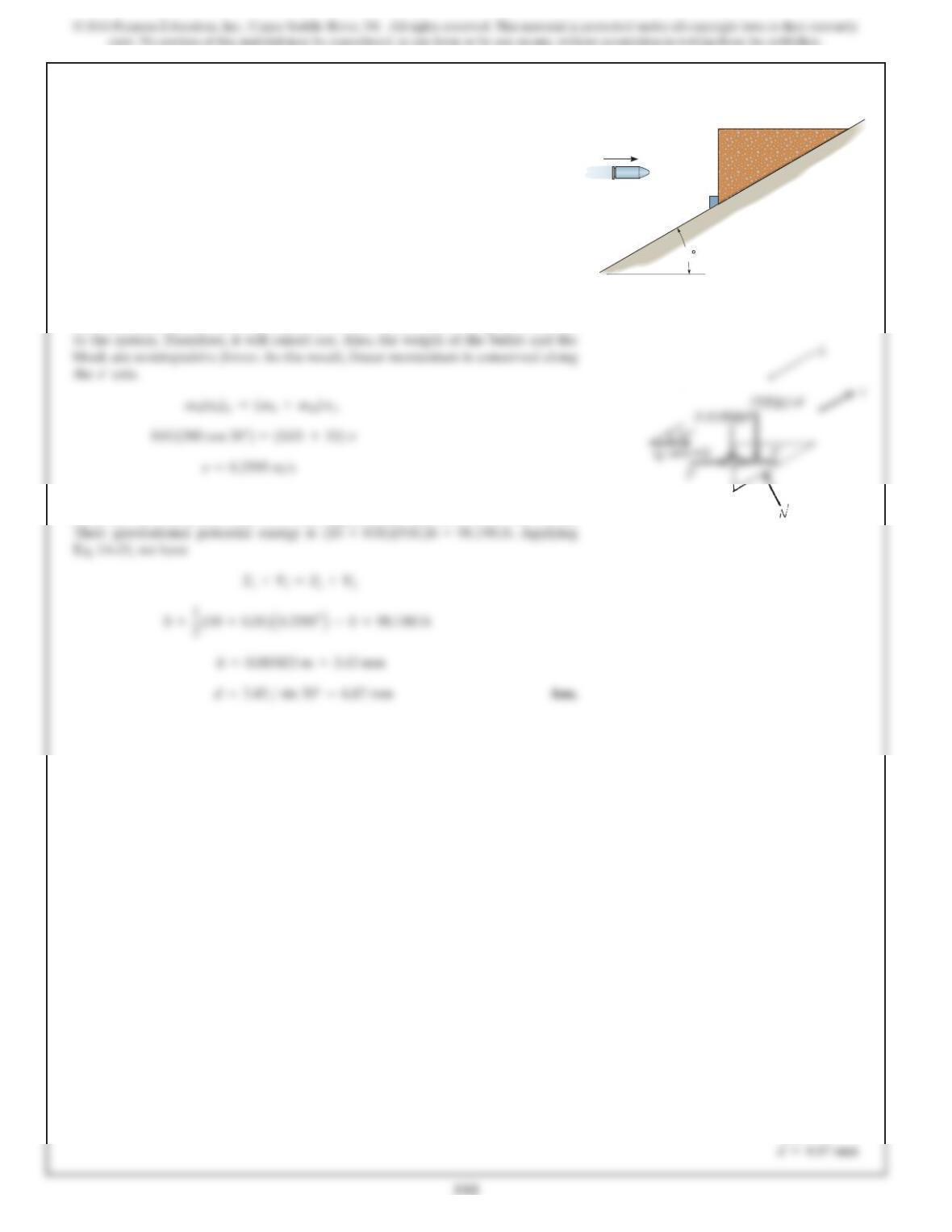
15–57.
The 10-kg block is held at rest on the smooth inclined plane
by the stop block at A.If the 10-g bullet is traveling at
when it becomes embedded in the 10-kg block,
determine the distance the block will slide up along the
plane before momentarily stopping.
300 m>s
SOLUTION
Conservation of Linear Momentum:If we consider the block and the bullet as a
system, then from the FBD,the impulsive force Fcaused by the impact is internal
Conservation of Energy:The datum is set at the blocks initial position. When the
block and the embedded bullet is at their highest point they are habove the datum.
30
A
300 m/s
Ans:
533
SOLUTION
(
S
+
)
(0.250)(2) +0=(0.250)(
v
A)2+(0.175)(
v
B)2
(
+
)
15–58.
Disk A has a mass of 250 g and is sliding on a smooth
horizontal surface with an initial velocity
(
vA
)1=2 m>s
.
It makes a direct collision with disk B, which has a mass of
175 g and is originally at rest. If both disks are of the same
size and the collision is perfectly elastic (e
=
1), determine
the velocity of each disk just after collision. Show that the
kinetic energy of the disks before and after collision is the
same.
Ans: